Introduction
There is a growing interest in the socio-cultural dimensions of singing in the UK. Wignall (Reference WIGNALL2008) reports the high rating of television shows which feature choirs with marginalised groups. Owen (Reference OWEN2009) reports on how the UK, BBC2 television series ‘The Choir: Boys Don't Sing’ beat UK other national TV favourites to win the BAFTA award for best television feature. Hinds (Reference HINDS2010) gives a two-page spread in a UK national newspaper reporting the roundtable discussion on the health and educational benefits of England's National Singing Programme ‘Sing Up’. At the same time Paddock (Reference PADDOCK2010) in the Medical News Today reports ‘first it was exercise on prescription, then it was arts on prescription, soon it could be singing on prescription’.
With this increased social and cultural interest, and arguably medical interest in group singing, there is a corresponding research interest to investigate the effects of singing. As Clift et al. (Reference CLIFT, HANCOX, STARICOFF and WHITMORE2008) report, there has been a growing body of research into the effects of singing and well-being, to include singing and mood (Rider et al. Reference RIDER, MICKEY, WELDIN, HAWKINSON and Maranto1991; Valentine & Evans, Reference VALENTINE and EVANS2001; Unwin et al., Reference UNWIN, KENNY and DAVIS2002). Research into singing and biological/physiological variables includes work by Rider et al. (Reference RIDER, MICKEY, WELDIN, HAWKINSON and Maranto1991), Valentine and Evans (Reference VALENTINE and EVANS2001), Kuhn (Reference KUHN2002), Kreutz et al. (Reference KREUTZ, BONGARD, ROHRMANN, GREBE, BASTIAN and HODAPP2004), Galati et al. (Reference GALATI, COSTA, ROGNONI and PISTERZI2006) and Wootton (Reference WOOTTON2007), which also encompasses the effect of singing as both positive ‘eustress’ and negative ‘distress’ (Beck et al., Reference BECK, CESARIO, YOUSEFI and ENAMOTO2000, Reference BECK, GOTTFRIED, HALL, CISLER and BOZEMAN2006; Grape et al., Reference GRAPE, SANDGREN, HANNSON, ERICSON and THEORELL2003). Schorr-Lesnick et al. (Reference SCHORR-LESNICK, TEIRSTEIN, BROWN and MILLER1985) and Steurer et al. (Reference STEURER, SIMAK, DENK and KAUTZKY1998) report research into singing and lung/function and hearing, whilst singing and measures of mental and physical health is reported on by Houston et al. (Reference HOUSTON, McKEE, CARROLL and MARSH1998) and Cohen et al. (Reference COHEN, PERLSTEIN, CHAPLINE, KELLY, FIRTH and SIMMENS2006). Singing as a health determinant within epidemiological research, i.e. the effects of singing as a social, cultural and leisure activity on population health, is reported on by Bygren et al. (Reference BYGREN, KONLAAN and JOHANSSON1996) and Hyyppä and Mäki (Reference HYYPPÄ and MÄKI2001).
Of particular interest to this paper is prior research which differentiates between singing as an individual activity and singing in a group. Clift and Hancox (Reference CLIFT and HANCOX2001) present two studies, the first of which was an exploratory qualitative study which asked choral singers to answer open questions regarding their experience of singing. Questions were specified in the areas of the effects of singing on physical, emotional, social and spiritual benefits. Of interest to this paper is how the factor analysis showed a correlation across the respective dimensions (in order): well-being and relaxation, breathing and posture, social, spiritual, emotional and benefits for the heart/immune system. Clift et al. (Reference CLIFT, HANCOX, STARICOFF and WHITMORE2008: 50) consider the first and largest factor well-being and relaxation:
the initial items highlight the immediate impact of singing on mood and sense of happiness in the setting of a rehearsal and performance, but subsequent items point to a wider context and impact – not only in helping to release stresses and forget worries from outside the singing session itself, but also reinforcing a more general sense of well-being and positive view of life which goes beyond the activity of singing.
Prior studies report singing as a group activity across different contexts, e.g. professional choristers (Beck et al., Reference BECK, CESARIO, YOUSEFI and ENAMOTO2000), choral societies which focus on Gilbert and Sullivan (Pitts, Reference PITTS2004), university choral societies (Clift & Hancox, Reference CLIFT and HANCOX2001), amateur choristers (Kreutz et al., Reference KREUTZ, BONGARD, ROHRMANN, GREBE, BASTIAN and HODAPP2004) and community choirs for the elderly (Hillman, Reference HILLMAN2002). Central to these studies is the recognition of the importance of the effects of the group process. For example, Bailey and Davidson (Reference BAILEY and DAVIDSON2005) describe the effects of group process in terms of caring and concern for one another, pleasure at being together and the importance of fellowship. This was particularly important for the participants from the marginalised groups. Of particular interest is how a participant from one choir in the study discusses ‘how the behaviour of the members of the group changed when they were mentally engaged in deciding how various selections of music should be performed. People were able to contribute significantly to the decision-making process when they had something relevant to focus on’ (Bailey and Davidson, Reference BAILEY and DAVIDSON2005: 294).
Silber (Reference SILBER2005) also recognises the importance of the ‘relational’ aspects of singing as a group process which is important in situating the research within singing, health and well-being. She reports two aspects of ‘relationship’ within the process of group singing as (i) vertical – between conductor and choir members and (ii) horizontal – peer interactions in the choral community. In her first category (vertical – between conductor and choir members), she challenges the tacit sine qua non of musical endeavour that the ‘participants accept the authority of the appointed leader/conductor and adhere to her rules’ (2005: 258). The notion of relationship in terms of challenge/submission to authority is particularly figural given the context of the study, which was situated in a prison (Rio & Tenney, Reference RIO and TENNEY2002). Here the embedded ‘hierarchical’ positions of power needed careful consideration because in Silber's study, these were disrupted given the setting. Silber states, ‘the individual singer and the conductor do not stand alone in the equation, disruption along the axis affects the whole choir, and the presence of the choir may therefore temper the interaction’ (Silber, Reference SILBER2005: 258). With the exception of Pitts (Reference PITTS2004) and Bailey and Davidson (Reference BAILEY and DAVIDSON2005), the particular effects of the leader on the group are subsumed into the effects of group singing itself. Yet Silber draws our attention to the ‘unspoken element of repertoire selection’ and how she ‘reached out to the “others” world’ by choosing music familiar to the choir members (Silber, Reference SILBER2005: 258). The co-constructed and negotiated meanings of hand signals for both musical and non-musical communication demonstrates a further relational aspect of singing leadership and the group process.
Silber's second category (the horizontal relationship – peer interactions in the choral community) (p. 259), outlines a set of relational considerations emerging from her study. These included the use of repetition of a song which the author considered to be an important ritual or routine which framed the beginning and end of the singing group process. A second consideration is referred to as ‘increased sensitivity; listening skills and eye contact’ (p. 260). Here the idea of attunement is also introduced particularly as this was a relational challenge for the participants in the prison context. The author cites how singing games supported the participants raising of awareness of both their own voice, and the voice of others. Participants’ comments are particularly powerful, for example:
‘I: You feel yourself and the other and feel the other in your voice . . . this is not something you usually get in prison’ (Silber, Reference SILBER2005: 261)
It was from this research base, that I constructed the first of the studies presented here, to consider singing as a group process and how this might contribute to an increasing sense of health and well-being in terms of awareness, dialogue and relational consciousness.
Study 1
Study 1 was part of a university CETL (Centre for Excellence in Teaching and Learning): C4C (Collaboration for Creativity) research project called Singing, Health and Well-being. This was undertaken across three contexts: (1) student singing groups as part of the music undergraduate Ensemble Performance Module and Community Music Module Placements; (2) group singing and workforce development programme as part of the National Singing Campaign ‘SING UP’ through York Vocal Force, York, UK; (3) Group singing in the local NHS hospital as part of an arts enhancement initiative (Mellor, Reference MELLOR2009b). For the purposes of this paper, examples are selected from the data from context (1) i.e. student singing groups as part of the music undergraduate Ensemble Performance Module and Community Music Module Placements.
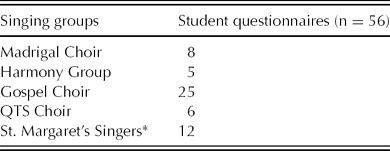
Fifty-six music students across five singing groups completed a questionnaire. Participants belonged to peer-directed singing groups as part of their undergraduate music degree Ensemble Performance Module (see Table 1).
Singing groups and participants in Study 1

*Although St. Margaret's Singers has been a staff-led choir, at the time of research it was being led by a student singer/song writer.
For the purposes of this paper the data from two questions from the questionnaire are discussed. These questions were:
Question 2: In your experience of singing, list the ways in which you consider singing to contribute to a sense of personal well-being.
Question 3: With reference to singing ensemble . . . . . . . . . . . . . . . (please name) what did you particularly find contributed to your sense of well-being when singing in this ensemble?
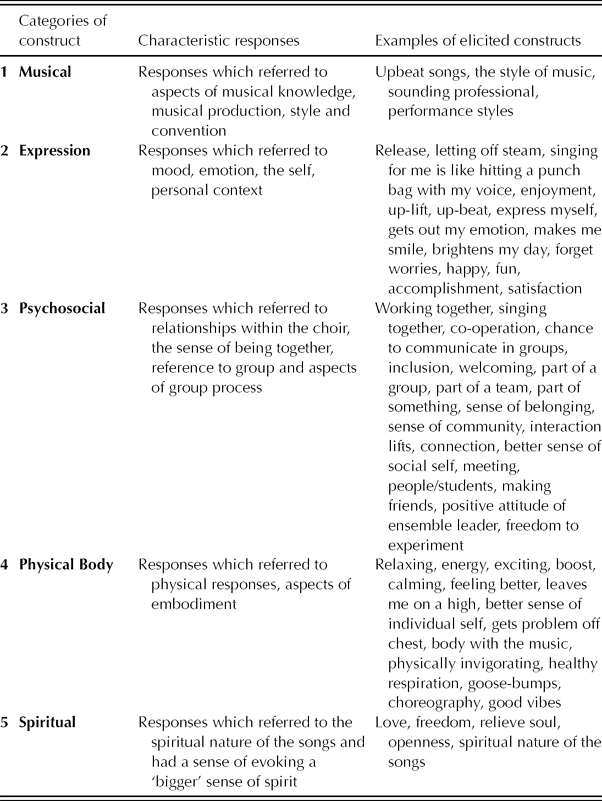
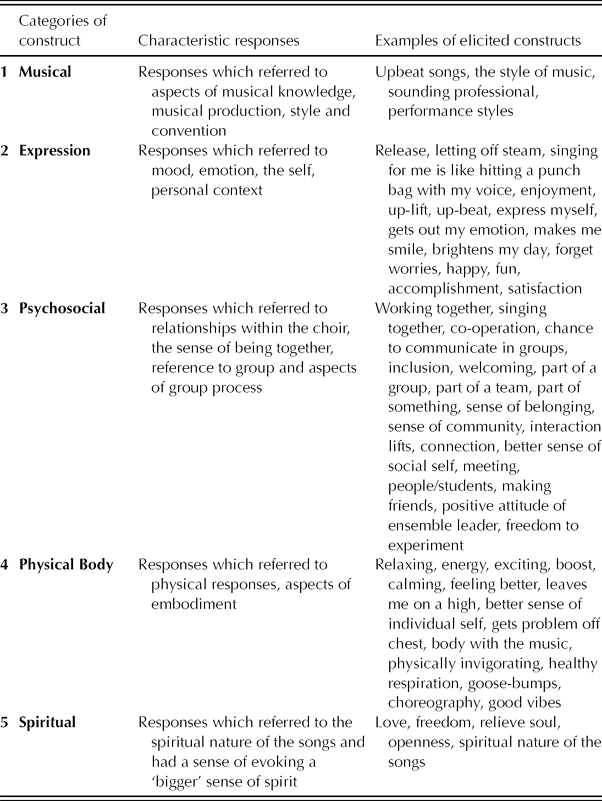
From the range of raw responses, the data were analysed by eliciting constructs using a technique developed in Mellor (Reference MELLOR1999). These constructs were then grouped initially into 14 categories then reduced to five categories of construct. Category 1: Musical included responses which referred to musical knowledge, musical production, style and convention. Constructs in Category 2: Expression referred to mood, emotion, the self and personal context. Constructs in Category 3: Psychosocial referred to the aspects of singing together in a group. In Category 4: Physical Body, constructs referred to physical responses, aspects of embodiment and bodily felt-experience. Category 5: Spiritual included more open constructs, referring to the soul, love and openness for example.
An independent researcher was invited to apply these categories to the elicited constructs. The results of this produced a 92% level of agreement. This was considered high enough to consider the categories ‘stable’ enough for further analysis of the data to proceed. The research acknowledges that some constructs could belong in more than one category e.g. ‘leave me on a high’ could be categorised in Category 2: Expression, in relation to an emotional high, in Category 4: Physical Body, in relation to a physical ‘high’ feeling, and Category 5: Spiritual, in terms of a transcendent ‘high’. In this particular case, after discussion, the researchers decided to place the construct in Category 4: Physical Body.
The five categories of construct emerging from the data are presented in Table 2.
Student perceptions of singing and well-being across five categories of constructs
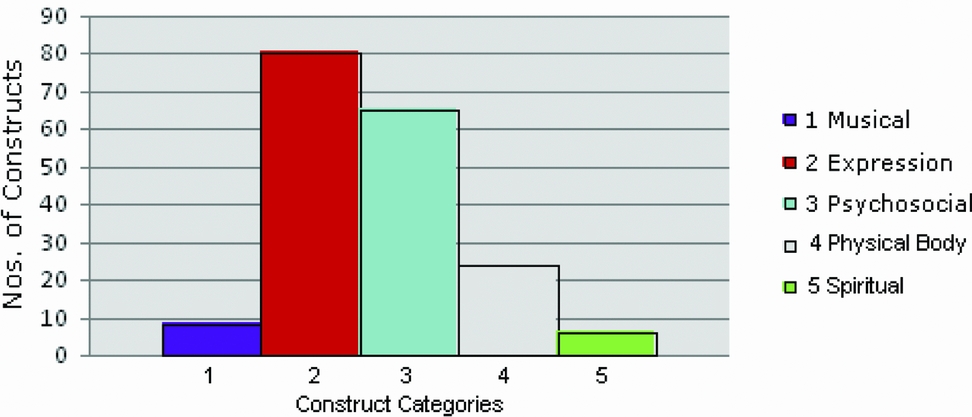
A total number of 196 constructs were elicited and Fig. 1 shows how these were distributed across the five categories of construct.
Graph to show singing and well-being: constructs across categories

From Fig. 1, it can be seen that the constructs elicited from the students’ perceptions of the relationship between singing and well-being were highest in Category 2: Expression, and Category 3: Psychosocial followed in decreasing order by Category 4: Physical Body, Category 1: Musical and Category 5: Spiritual.
To conclude the first part of this paper, it can be seen that for the students taking part in this research project the highest number of constructs related to singing and well-being in terms of expression and the psychosocial. This formed the basis on which to develop further investigations into this relationship.
Study 2
The second part of the paper draws from a successive research project. iSING (2010) was designed to probe the relationship between singing and well-being further with particular reference to the perceived relational aspects of the group process. This section describes the research approach from a theoretical perspective and sets out the research design, participants, procedure and examples from the data. It was informed by previous research in the field of counselling and psychotherapy with particular reference to Gestalt psychotherapy and the adaptation and application of the work of Denham (Reference DENHAM2006) and Etherington (Reference ETHERINGTON2004).
Research approach
The challenge for the research was how to research the students’ perceptions of singing as a group process. In addressing this, the research methodology draws from previous work in the field of the student perspective in music education (Mellor, Reference MELLOR and Bearne1998, Reference MELLOR2000, Reference MELLOR2007, Reference MELLOR2008), and recent research which applies a reflexive methodological approach from the field of research in counselling and psychotherapy (Mellor Reference MELLOR2009a, Reference MELLOR2009b, Reference MELLOR, Harrison and Finney2010; Mellor & Tune, Reference MELLOR, TUNE, Bloom and Brownell2011). This introduces two key ideas for the research presented here: (i) in the use of ourselves in research and (ii) reflexivity, presented through the work of Etherington (Reference ETHERINGTON2004). As Etherington states:
Reflexivity encourages us to explore our own construction of identity in relation to the data, our participants and ourselves and provides a bridge between our internal and external worlds. (Etherington, Reference ETHERINGTON2004: 126)
The usefulness of this approach for this study is that not only does it accommodate personal stories and experiences to be shared, but that it also takes into account the effects that the researcher may have on the participants or the data, and similarly the effect they may have on the researcher. Whilst it is difficult to make any generalised statements from such an approach, it allows a deeper richer exploration of what was actually co-created in the research process which may have validity in terms of its ‘transferability’ (Fook, Reference FOOK, Shaw and Gould2001). Etherington (Reference ETHERINGTON2004: 32) clearly identifies one important factor of such an approach:
By using reflexivity in research we close the illusory gap between researcher and researched and between the knower and what is known. By viewing our relationship with participants as one of consultancy and collaboration we encourage a sense of power, involvement and agency.
Developing reflexivity also involves developing awareness, dialogue and relational consciousness by making explicit one's own constructs and opening one's self-concept to change. The intention being that this transparency allows the researcher the freedom to work flexibly and more importantly, reflexively. In doing so, this eliminates the need to ‘bracket off’ aspects of the self from the process in the pursuit of ‘validity’. The research approach in the iSING research project was also informed by Gestalt psychotherapy theory in terms of both the process (in developing the focus group research methodology) as well as the content (in the application of Gestalt psychotherapy in the area of ‘presence’ in training, after Denham, Reference DENHAM2006). Presence is a key concept in Gestalt therapy in terms of awareness, being aware of ‘self’ and ‘other’ in relationship to one another. The notion of ‘presence’ had already emerged as a key finding from an interview with a SING UP: Vocal Force Leader in another part of the research project (Mellor, Reference MELLOR2009b). It seemed that the theory and approach might be a ‘good-match’ to support further explorations of singing as a group process.
Research tool
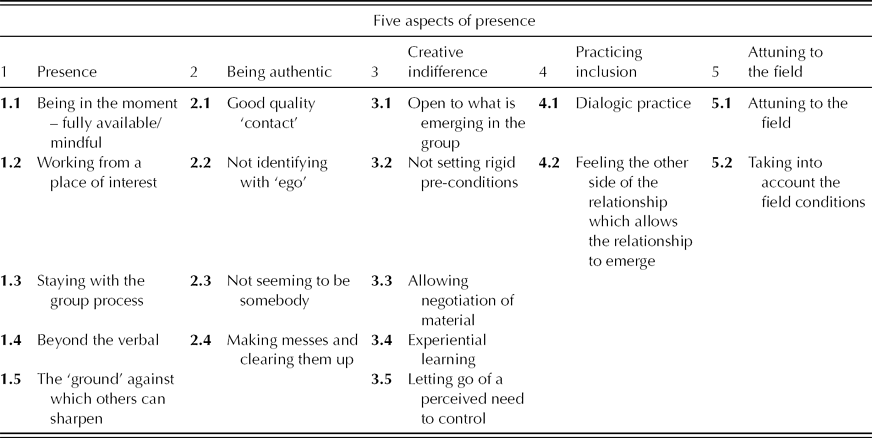
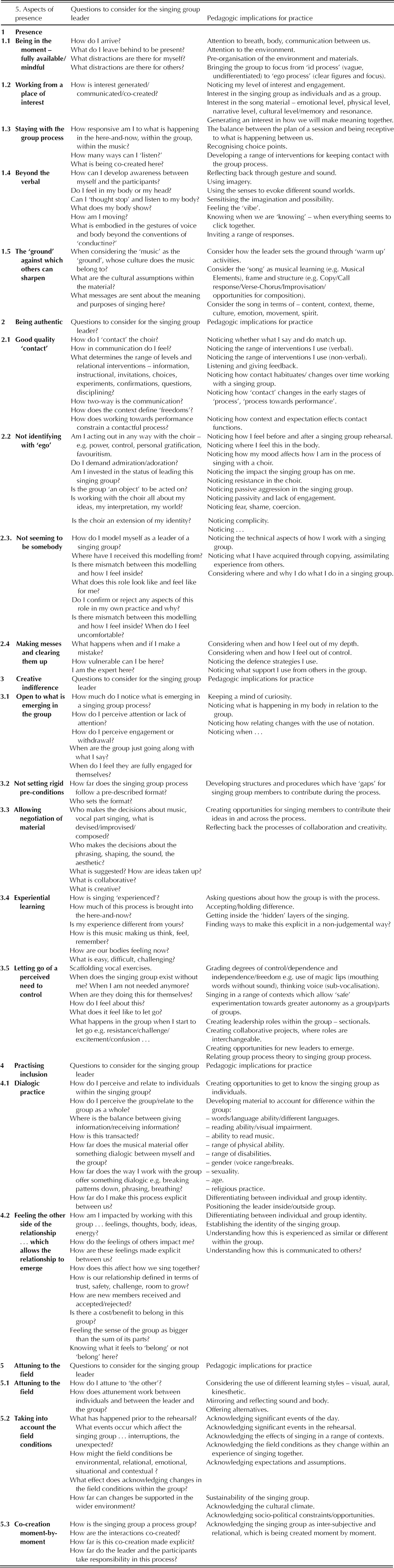
The next part of the article describes how Denham's original article on the ‘Five aspects of presence’ (2006) was adapted to put theory into practice in order to explore students’ perceptions of singing as a group process. I adapted Denham's original text to form a table – see Table 3.
Five aspects of presence (adapted from Denham, Reference DENHAM2006)

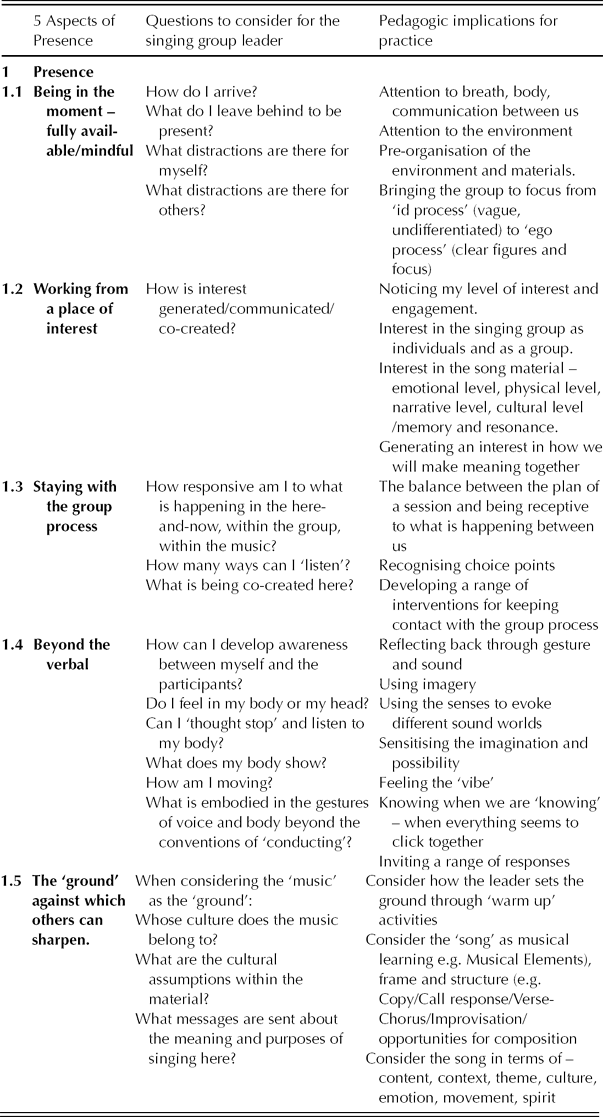
In order to make Denham's ‘Five aspects of presence’ more accessible and relevant for researching teaching and learning in the context of singing groups, a further two columns across each of the five aspects were added to include ‘Questions to consider for the singing group leader’, and ‘Pedagogic implications for practice’. This then created a framework for considering leadership and singing as a group process. Table 4 gives an example in relation to Denham's (Reference DENHAM2006) first aspect of presence.
Extract from application of Denham (Reference DENHAM2006) to singing as a group process

The full framework adapted from Denham (Reference DENHAM2006) across all ‘Five aspects of presence’ (Mellor Reference MELLOR2009a) can be found in Appendix 1.
Participants
Each focus group comprised eight students who led singing groups (5 female, 3 male) and two student researchers appointed independently to the project by the university (1 male, 1 female) and one staff member. Each participant's response is presented anonymously in the reporting of this study.
Research procedure
The research design comprised three 1.5 hour focus groups undertaken at the beginning, middle and end of Semester 2, 2010. Each participant was asked to sign a confidentiality statement prior to the commencement of each focus group. Focus group participants were invited to share their experiences with particular reference to their experience of singing as group process and were given individual copies of the framework described above. They were also invited to write their own singing stories after Etherington (Reference ETHERINGTON2004). Focus groups 1–3 used the framework to reflect on practice throughout the semester and Focus group 2 was designed to include a more open-ended discussion. Each focus group was audio-recorded using a Roland Edirol (R09). The research data were downloaded and transcribed by the student researchers. In addition, the students appointed as ‘students-as-researchers’ to the project held reflexive conversations following the focus groups which were also recorded and transcribed as part of the research procedure.
The procedure for data collection in the focus group was informed by principles of ‘figure and ground formation’. In Gestalt theory this is described as follows:
Each whole is organised around an emerging foreground or figure that is spontaneously energised and given a positive or negative valence by the person's dominant need. (Yontef, Reference YONTEF1993: 178)
This makes room for spontaneous reaction, curiosity, etc. and allows a relationship to form between the here-and-now interaction and a broad background. (Yontef, Reference YONTEF1993: 411).
In this way ‘figures’ of interest are brought into focus (highlighted) and the rest recede into the ‘back’ ground.
By applying this as a research methodology, the students in the focus group were asked to read through each of the ‘Five Aspects of Presence’ from the framework described above, and to highlight (literally – with a highlighter pen), which statements stood out or ‘figured’ for them in relation to their experience of leading singing groups. They were then invited within the group to say which statement from each of the five aspects of presence ‘caught their attention’ and why.
Other reports of this study give a more detailed account of how this yielded a range of responses from the students across all five of the aspects of ‘presence’ represented in the framework (Mellor, Reference MELLOR, Harrison and Finney2010). In terms of addressing the focus of this paper, it challenged the participants in the study to consider how they might be more present in themselves and with each other in the course of leading peer-directed singing groups and how this might contribute to informing pedagogic practice.
Examples from Study 2
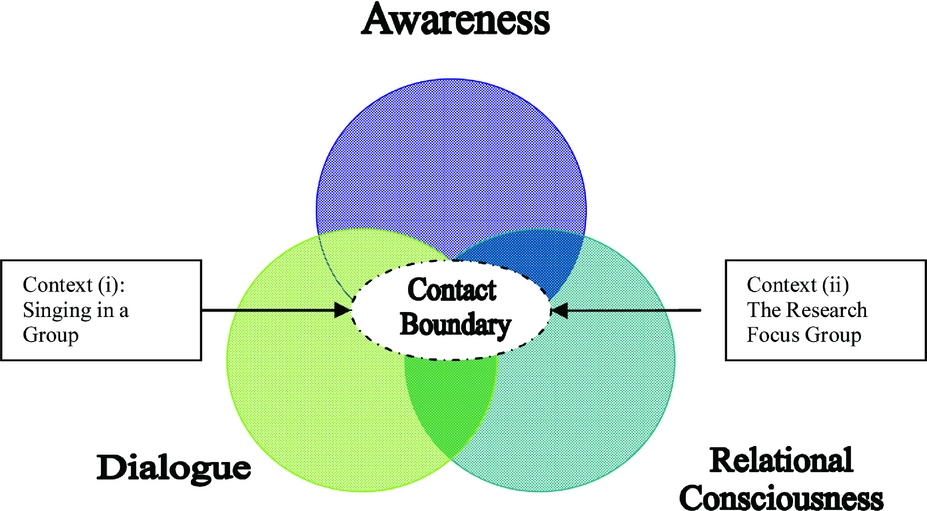
For the purposes of this paper, selected extracts from the transcriptions of the focus groups are presented in order to address the research questions. Rather than report the findings from each respective focus group in turn, this paper presents the examples from the research under three main headings: awareness, dialogue and relational consciousness. The analysis recognises that whilst student responses might be separated out under these headings for reporting purposes, the Gestalt approach would view these as inter-connected and co-constructed. This interlinking relationship is related to a Gestalt concept of the ‘contact boundary’. Polster and Polster's definition of the contact boundary is useful here:
the boundary at which contact can be made is a permeable, pulsating locus of energy . . . the contact boundary is the point at which one experiences the ‘me’ in relation to that which is not ‘me’ and through the contact, both are more clearly experienced. (Polster & Polster, Reference POLSTER and POLSTER1973: 102)
In Gestalt theory if the meeting is well supported at the contact boundary, healthy inter-relational functioning and a sense of well-being is possible. The contact boundary in this research has a parallel function between the two contexts of the research: (i) the relationship of the individual/leader to the group within singing as a group process and (ii) the relationship of the individual to the group within the research focus group itself. This is illustrated in Fig. 2.
Diagram to show the related functions of awareness, dialogue and relational consciousness at the contact boundary across contexts

Extracts from the participants’ transcribed responses are labelled and linked back to the original data by a coding initial, the Focus group number (1–3), the framework reference across each of the ‘Five Aspects of Presence’ (1–5), and the sub-group number and heading (cf. Table 3) for each citation e.g. ‘Participant P: Focus Group 1: Aspect 1: Presence: 1.1. Being in the moment – fully available/mindful’.
Awareness
This section gives examples of the students’ responses elicited through the focus group discussions. Several dimensions of awareness emerged in the data which relate to the psycho-social functions of the group. For example, some responses illustrated a growing awareness of creating the right sort of physical and mental space for a singing group rehearsal:
I think familiarity really helps in an ensemble situation . . . I personally haven't done that very well, and I think that's why I've noticed some of the problems I've had . . . shifting around times, location and just general set up . . . (Participant W: Focus Group 1: Aspect 5: Attuning to the Field and 5.2 Taking into account the field conditions)
Some responses draw out an awareness of arriving in a rehearsal:
I've highlighted “How do I arrive?” . . . my question to anyone else is, is there a way to arrive in a room or to establish yourself as a leader, or what would be the best way? (Participant P: Focus Group 1: Aspect 1: Presence: 1.1 Being in the moment – fully available/mindful)
The responses below show the increasing development of awareness as to not only what is being reflected about ‘self’ as leader within the group, but how the leader differentiates his/her response in relation to the group. It also shows an awareness of what is being co-created.
I think how you enter a room is a reflection of what you want back from your group. (Participant P: Focus Group 1: Aspect 1: Presence: 1.1 Being in the moment – fully available/mindful)
I think that the way that you arrive in a room probably has a lot to do with the way you prepare yourself before you actually arrive so maybe it's a psychological thing . . . you know you can kind of want to arrive one way but if you're not in the right mind-set then its gonna show from the second you're in that room and its gonna bounce back to you from that choir as well . . . (Participant T: Focus Group 1: Aspect 1: Presence: 1.1 Being in the moment – fully available/mindful)
The responses presented here not only show a developing awareness of ‘self’ but the inter-relational dimensions illustrated in Fig. 2. Another type of awareness considers the balance between ego and vulnerability. For example:
I think it is useful to . . . not be too embarrassed about making a mistake yourself and having that identified by the group, in front of everyone. You know, it's good for you to show, as a leader, that everyone makes mistakes and that's OK within that environment. (Participant B: Focus Group 1: Aspect 2: Being Authentic: 2.4: Making messes and clearing them up)
I do it because I love it. I want to make the sounds, I just love what it produces, so the people who are in it, I hope feel the same way . . . so it's not really about me and what I'm doing and how much effort I put in, it's about the result and how we all work together to get that result, so you know it's not an individual thing at all. (Participant L: Focus Group 1: Aspect 2: Being Authentic: 2.2. Not identifying with ego)
I think vulnerability as a leader is just showing you're a person. It's really hard isn't it, when you start to lead a group to think ‘I know what I'm doing, and you know you don't want to come across as having an ego, but you don't want to come across as too timid and that you're not really into it so it's really hard to strike that balance . . . (Participant T: Focus Group 1: Aspect 2: Being Authentic: 2.2. Not identifying with ego)
Another student shows the developing self-awareness of her own humility in the singing group process:
I have two points with regards to ego . . . one comes again from having sat in the choir for a year and a half before coming to lead it. You kind of come from being part of the choir to suddenly being in a position of leadership and you have to deal with the opposite of ego . . . then when you bring a song like the . . . song that I'm doing with them, I think I'm possibly the only person that knows the song, and the arrangement that I've made. It has to be followed because the timing is really strict so yeah, it's kind of they do have to follow my ideas and I'm kind of stuck with this kind of “These are my ideas, please accept them” (Participant L: Focus Group 1: Aspect 2: Being Authentic: 2.2. Not identifying with ego)
Awareness is developed in relation to letting go of the perceived need to have control of a singing group:
W: ‘Letting go of . . . control’ and ‘when does the singing group exist without me?’ I think that's really important. My ego likes to think that nothing can happen ‘til I'm there . . . (Participant L: Focus Group 1: Aspect 3: Creative Indifference: 3.5. Letting go of a perceived need to control)
Different types of phenomenological awareness emerge in the students’ experience of singing as a group process. For example in terms of the felt-experience:
I don't know why it happens but when we're singing in harmony and it's really really close harmony and it's really like rich and full . . . and it might just be one little chord or something like that, something that you strike, and then all of a sudden it's just like . . . it's like it hits you and you can feel it as well as hear it . . . and that's quite a spiritual moment I feel. (Participant P: Focus Group 2 Discussion)
Emergent in this response is an awareness of a spiritual dimension involved in singing as a group process.
Other responses show an awareness of group singing as opening up a ‘space’ in the body and the mind. For example:
I think that singing a song is sort of like a little meditation . . . it's just a short period where you don't think about anything . . . and it's just like a space. If you're singing a song, it's just three or four minutes of just purely singing and it does sort of cleanse your mind as well as your body. (Participant P: Focus Group 2 Discussion)
This response refers to singing as a means to become more ‘centred’ towards a more integrated mind/body state of awareness:
but I think singing for me has . . . it's just sort of a level higher than that . . . you're producing this sound and your mind's working and your body's working and you're hearing yourself back and it's all about, you know, the oneness and the kind of . . . you're centring yourself. (Participant P: Focus Group 2 Discussion)
To summarise, this section shows a range of responses elicited across the focus groups. The responses not only show different dimensions of self-awareness in relation to the students’ experience of singing in a group, but there is also an awareness of the ‘self’ in relation to others.
Dialogue
The concept of dialogue suggests a two-way communication by the very term itself. In the responses elicited in the focus groups different dimensions of dialogue are made explicit within singing as a group process.
For example, the framework elicited responses which gave examples of how ‘contactful dialogue’ might be achieved between the leader and members of the group:
It all comes down to not just talking at them but making sure that it's more of a conversation . . . you've got to be approachable enough for people to say ‘can you explain that a bit better?’ or ‘I don't understand that’ and know what to say, so that everyone knows. (Participant L: Focus Group 1: Aspect 2: Being Authentic: 2.1: Good Quality Contact)
Other examples refer to how decisions are made within the group.
Like, in the ensemble that I run it's very much a democracy and we all kind of pitch in . . . everyone has their fair share and says what they think. (Participant B: Focus Group 1: Aspect 3: Creative Indifference: 3.3: Allowing negotiation of material) Who makes the decisions about the phrasing, shaping of the sound and the aesthetic? You know any ideas or suggestions that come up, I'm the first one to take them on board. If it's a good idea I don't care where it comes from. If it works and sounds great then I'm happy.
(Participant W: Focus Group 1: Aspect 3: Creative Indifference: 3.3: Allowing negotiation of material)
Another response reflects the tension and fine balance involved between negotiated dialogue and control in the experience of learning to become a singing group leader:
There is a need for a leader as well, in my opinion. You do need someone to actually make the decisions. It doesn't mean that no one else can have an idea but it's really important that someone brings those ideas together and sorts out what's going to work well and what's not going to work so well. You know, its trial and error as well isn't it; you've got to be willing to experiment and don't be scared to try out stuff that people suggest, but you know you still need a final decision maker as well. (Participant L: Focus Group 1: Aspect 3: Creative Indifference: 3.1: Open to what is emerging in the group)
Participant P gives an example of how the process resulted in more personal involvement and more recognition of each other within the singing group:
Yeah just expanding on that really . . . in the [singing group] . . . and it was said at one point ‘Right, what do you guys think we should do?’ and all of a sudden everyone just got involved and it was great to see people thinking up their own ideas . . . and finally we decided on something and it was great, and it worked . . . suddenly it just becomes more personal and involving . . . everyone was attentive when they needed to be . . . it was probably out of recognition of each other's things that that happened. (Participant P: Focus Group 1: Aspect 3: Creative Indifference: 3.1 Open to what is emerging in the group)
Here awareness is linked to dialogue and how this impacts the relational contact within the singing group. The students as leaders responses, shuttle between what Buber (Reference BUBER1998) would describe as the ‘I–Thou’ and the ‘I–It’ dimensions of relational contact. In other words, in reflecting on their experience of leading singing as a group process, the students notice when there isn't a ‘wall’ between themselves and the choir there is more of a merging (I–Thou). Their responses also show a realisation when they have to pull back from being immersed in the singing experience to direct and initiate musical and verbal interventions within the group process (I–It). This illustrates the developing process of meta-cognition as part of reflecting on pedagogic practice.
Relational consciousness
As above, this section continues to present examples of the students’ perceptions of singing as a group process and draws out further aspects, predicated by awareness and dialogue, which contribute to an understanding of relational consciousness. Relational consciousness is defined here in terms of becoming more consciously aware of the relational or psycho-social implications of the group process and how this is co-constructed, particularly between the leader and the group. This leads towards an understanding of a more inclusive pedagogy.
Examples have been selected to illustrate different dimensions of relational consciousness. For example, some responses illustrate how the students in leading their groups have learned not to make assumptions:
because I've just known that song for years, I just thought oh everyone will know the words to the first verse, because you know, it's a well-known song. So we just started singing it, and some people were like ‘What's that line? What's that line?’ and I hadn't got it printed out or anything so I was just like ‘Ah, you don't know it . . .’. I probably should have thought about that really! (Participant L: Focus Group 1: Aspect 4: Practising Inclusion: 4.1 Dialogic Practice)
Here, one member relates the high value she placed on a peer-group singing leader who had considered the religious implications of the selected song:
We're doing a piece, an Indian piece . . . because like I'm a Christian, and I don't like feel comfortable if I know the lyrics are worshipping another deity and so on, like a Hindu deity, and she went and made a point of looking up what the lyrics meant and yeah that's just a way of making everybody feel included and making sure everybody is OK to sing a song. (Participant R: Focus Group 1: Aspect 4: Practising Inclusion: 4.1 Dialogic Practice)
Other dimensions of relational consciousness refer to a shared sense of belonging which might be significant for the singing group in a specific context:
We'd been away together for three weeks, like 90 of us, just standing in Heathrow airport before we all sort of parted . . . about five people just started singing this one song that we'd all loved over the tour, and it was always the final song of the concert . . . and we were all there just singing this one song, and all of us having that sort of feeling . . . like I don't want to go! I wanted to stay! (Participant BB: Focus Group 2: Discussion)
Another dimension refers to relational consciousness as a peak experience when everything seems to come together in the moment:
the more things that hit the jackpot . . . the time . . . like the perfect repertoire, the right location, the best friends, the best feeling at the time, the best quality of sound, ends up being the most spiritual or beautiful musical moment. (Participant BB: Focus Group 2: Discussion)
A further dimension of relational consciousness is related when boundaries and defences are seen to drop and a group member, with the support of the others, achieves a certain level of personal experience. In this moment the perceptual lens between the ‘self’ and ‘other’ seems to become more permeable. For example:
I just remember it, we were singing through a song, and he just launched into the most face-melting solo . . . and all of the others were just there going . . . just like looking at each other going oh my God, oh my God and he was just there and he was properly in his own little world and oh, it was really sort of spiritual’ cos I was like, oh my God, that's who he is! I haven't known him before this moment, that's who he is. Oh, it was just fantastic. (Participant P: Focus Group 2: Discussion)
The examples presented here illustrate the way the students developed their thinking in terms of relational consciousness as they reflected on their ongoing practice of leading singing groups using the framework after Denham (Reference DENHAM2006) and in more open-ended discussions in the focus groups.
Discussion
This paper set out to explore (a) singing as a group process in relation to health and well-being, (b) how this might be researched and (c), the implications for pedagogic practice in music education. The first part of the discussion considers how Study 1 and Study 2 relate to each other in the research to address these questions.
First, Studies 1 and 2 support a process whereby university music students’ perceptions of singing as a group process become more explicit across a range of dimensions. Both studies highlight the importance of the emotional, inter-relational and psycho-social aspects of singing as a group process. While Study 1 draws out some general characteristics which relate students’ perceptions of singing and well-being, Study 2 develops the findings by exploring the perceptions of leaders of peer-directed singing groups. In particular, Study 2 sought to investigate further key findings in Study 1, of self-expression and the psycho-social as contributory factors to singing and well-being.
Whilst the context is very different, Study 2 findings corroborate aspects of Silber's work (2005) which sets out aspects of singing as a group process in relationship to interactions and decision making within the singing group. Study 2 also furthers the work of Pitts (Reference PITTS2004) and Bailey and Davidson (Reference BAILEY and DAVIDSON2005) in drawing out the particular effects of the group leader on the group process by focusing on the developing awareness of the impact of ‘self’ and ‘other’ within the group.
The research tool developed in Study 2, referred to as the ‘framework’ across ‘Five Aspects of Presence’, adapted from Denham (Reference DENHAM2006) – which originally set out to consider the effects of the presence of the trainer in effective psychotherapy training in groups – generated stimulating discussions and a range of responses across the focus groups. In the process of the research, participants were able to reflect on their experience of leading singing groups, share their own stories and were able develop their meta-thinking in relation to singing as a group process. The ‘figure and ground’ approach from Gestalt practice was useful to support the research process during the course of the focus groups. The examples selected from the data illustrate how the framework not only facilitated the students to reflect on their own experiences, but also supported their ongoing creative adaptations to their new roles as singing group leaders.
The findings also relate to other dimensions of awareness, for example the aesthetic and the spiritual. This corroborates the work of Matsunobu (Reference MATSUNOBU2010) and Hay and Nye (Reference HAY and NYE1998), particularly in the area of ‘awareness-sensing’ in the ‘here and now’. Parallels can be seen as the students reflect on their understanding of Denham's ‘Five Aspects of Presence’ (Reference DENHAM2006), which link to Hay and Nye's framework of experience: (i) the here-and-now experience; (ii) tuning – being in tune with something outside of oneself such as a musical performance or nature; (iii) flow – a total performance of the a task, with the feeling that the activity, rather than the performer, is managing itself; (iv) focusing – the bodily felt sense of an experience; (v) relational consciousness – a deep-felt sense of connectedness with others and within oneself. The notion of the ‘here and now’ is also central to Gestalt theory and practice.
In terms of a Gestalt perspective on health and well-being, this is organised around a set of principles which support individuals to maintain healthy organismic self-regulation (Yontef, Reference YONTEF1993), where:
organismic self regulation is constantly renewed . . . essentially a system based on feedback and continual creative adjustment. There is a continuous bio-psychosocial process requiring a continuum of awareness and constant vigilance to new needs and changing resources in self, other and society. (Yontef, Reference YONTEF1993: 212)
This informs the research in two ways. First, in the particular responses elicited by the students in terms of key processes of awareness, dialogue and relational consciousness which reveal their own feedback and continual creative adjustments as they reflect, practice and continue to reflect on their experiences of leading singing groups. Second, in a transferability of the study towards supporting an understanding of the relationship between singing, health and well-being, in terms of the importance of the expressive and psychosocial aspects of singing as a group process which comprise the inter-related aspects of awareness, dialogue and relational consciousness across a range of dimensions.
The development of the methodology also allowed for a reflexive approach. In Study 2 the students in the focus group not only reflected on their own experiences of learning to lead peer-directed singing groups, they also were impacted by others in the group process of the focus group itself (cf. Fig. 2). In this way the research approach allowed for the reflexive impact of both the content and the process of research and in this way corroborates the work of Etherington (Reference ETHERINGTON2004). The studies also recognise that the findings are ‘snapshots’ within a continually evolving narrative and are field-dependent on the conditions at the time of the research.
In the final focus group the students also shared their responses as to how the research process itself had impacted how they thought about teaching and learning within a singing group. Through the sharing of their experiences in the respective focus groups and the impact of the discussions, there seemed to be a growing awareness of a leadership style which was inter-relational, inclusive and co-constructed. This seemed to foster qualities of affirmation, reassurance, confidence, a sense for encouraging others and a feeling for being more at ease in the role of leader. This is reported more at length in Mellor (Reference MELLOR, Harrison and Finney2010). There is further research to be done in the application to practice.
The two iSING ‘students-as-researchers’ in Study 2 revealed another layer of reflexivity within the study as they discussed the impact and implications of the research. For example:
I like the fact it was open, light hearted . . . but it was deep as well. It was all there . . . anger, laughter, pride, embarrassment . . . every emotion involved attached to singing. (Participant U: After Focus Group 2: Discussion)
I never really thought much about the singing leaders’ role – it was just like they get up and do rehearsals . . . and there's such an emotional aspect attached to it. (Participant O: After Focus Group 1: Discussion)
In the final focus group, students requested that the framework adapted from Denham (Reference DENHAM2006) to singing as a group process, be included in module documentation to support critical reflection and pedagogic practice. They also suggested that focus groups for leaders of singing groups should be part of the module to foster peer support, develop critical reflection on practice and pedagogy.
To conclude, the paper has attempted to make explicit some aspects of how (a) singing as a group process relates to health and well-being, (b) how this might be researched, and (c) the implications for pedagogic practice in music education. While examples from studies relate to music education in one higher education setting, the issues raised here also lend themselves to a wider discussion of singing as a group process in terms of health and well-being towards developing a more aware, dialogic and relationally conscious pedagogic practice in music education.
Mellor, L. (2009a) Application of Denham (Reference DENHAM2006) to singing as a group process: transferable pedagogic implications

Liz Mellor is a Reader in Music and Applied Arts (Community, Education and Health) in the Faculty of Arts, York St. John University. Liz has experience of teaching music in schools and coordinating the music curriculum from 3–18 years, and has trained teachers in Higher Education including those in the Faculty of Education, Cambridge and in York St. John University. Her research interests encompass aesthetic development, creativity, collaboration and health and well-being in music education. Currently, Liz is developing music activities in the local NHS Hospital and with Mental Health Service Users and is integrating her music education research with her training in Gestalt psychotherapy (GPTI).