Introduction
Globus pharyngeus is a non-painful sensation of a lump in the throat that is usually long-lasting and difficult to treat because of unclear aetiology. Gastroesophageal reflux is thought to be the leading cause of globus, representing 23–68 per cent of cases.Reference Lee and Kim 1 One hypothesised mechanism by which gastroesophageal reflux disease causes globus involves hypertonicity of the upper oesophageal sphincter brought about by a reflex to acidification or distension of the lower oesophageal sphincter. Gastroesophageal reflux disease is thought to also result in globus when there is a backwards flow of gastric contents into the laryngopharynx, a process known as laryngopharyngeal reflux (LPR).Reference Lee and Kim 1 In fact, one study showed that LPR was present in 72 per cent of patients with no other organic cause of globus.Reference Park, Choi, Kwon, Yoon and Kim 2 The globus sensation accompanied by LPR is believed to result from inflammation of the larynx and lower pharynx. Given the hypothesised role of gastroesophageal reflux disease, and specifically LPR, in causing globus, treatment with proton pump inhibitors (PPIs) has become the mainstay of initial therapy for globus.
Globus accounts for approximately 4 per cent of new referrals to otolaryngologists, and there is no consensus on the best method for diagnosis.Reference Lee and Kim 1 One study reported that 14 per cent of otolaryngologists performed no tests on patients referred for globus symptoms, and instead began treatment with PPI or other antacid medications.Reference Webb, Makura, Fenton, Jackson, McCormick and Jones 3 In cases where empirical treatment of LPR with PPIs proves unsuccessful, further investigation into other causes of globus is warranted. Other hypothesised causes of globus include oesophageal motor disorders, pharyngeal inflammation, malignancies, a retroverted epiglottis, thyroid disease and psychological disorders.Reference Lee and Kim 1 Globus sensation has also been strongly linked to salivary hypofunction, and conservative management of salivary hypofunction can improve globus symptoms.Reference Baek, Chung, Choi, So, Son and Jeong 4
Under normal physiological conditions, saliva serves to maintain homeostasis in the oral cavity and pharynx – it protects and lubricates the oral and pharyngeal mucosa, preventing irritation from noxious agents such as refluxed gastric contents.Reference Mese and Matsuo 5 Salivary gland hypofunction can lead to pharyngeal and oral sicca, known as pharyngoxerosis and xerostomia, respectively.Reference Baek, Chung, Choi, So, Son and Jeong 4 Xerostomia can be caused by a variety of factors such as radiation, systemic conditions such as Sjögren's syndrome and, most frequently, medications.Reference Cassolato and Turnbull 6 Because salivary glands are innervated by parasympathetic nerve fibres mediated by acetylcholine and muscarinic receptors, it is intuitive that anticholinergic medications top the list for medications that cause xerostomia.Reference Proctor and Carpenter 7 By decreasing glandular secretions, anticholinergic medications may be causing sicca beyond just the mouth, extending to the pharynx and larynx.
Extending upon Baek and colleagues’ work that demonstrated salivary hypofunction as a risk factor for globus,Reference Baek, Chung, Choi, So, Son and Jeong 4 we hypothesise that many cases of globus are due to a drying effect secondary to anticholinergic medication use. We also explored if globus was a persistent symptom in patients with a previous diagnosis of gastroesophageal reflux disease, who were relatively asymptomatic (as evidenced by a reflux symptom score, explained below). An awareness of these associations is invaluable to physicians for determining the aetiology of globus and implementing an effective treatment strategy. This work, along with our previous work demonstrating that anticholinergic use is a major risk factor for laryngitis, should provide physicians with an additional reason to be cautious when prescribing anticholinergic medications.Reference Haft, Farquhar, Carey and Mirza 8
Materials and methods
Study population
This was a cross-sectional sub-analysis from a previous larger study performed to establish the relationship between anticholinergic medication use and laryngitis in adults.Reference Haft, Farquhar, Carey and Mirza 8 The study comprised 270 consecutive patients who presented to a tertiary laryngology practice over a 6-month time period in 2013. Patients typically presented with voice or other laryngeal complaints after being referred from primary care or other otolaryngology practices. Participants completed the study questionnaire while also receiving their standard clinical care.
A medical chart review was used to gather information about participants’ gender, age, smoking status, co-morbidities, chief complaint and recent laryngeal surgical procedures. Participants were excluded from the primary analysis if they had structural anomalies including, but not limited to, polyps, nodules, granulomas or subglottic stenosis that may be causing chronic irritation. Other exclusion criteria included: persistent reflux refractory to medical treatment (patients currently taking an histamine H2-receptor antagonist or PPI, with a concurrent high score (4 or 5) on Reflux Symptom Index questions about ‘heartburn’ or ‘coughing after lying down’); professional voice overuse (singers, performers and teachers who complained of worsening hoarseness in the context of their profession); current smokers who have smoked more than a half a pack daily for more than a year; prior neck radiation; amyloidosis; Sjögren's syndrome; recent laryngeal surgery, within the past month; or tracheostomy dependency. Patients that met the inclusion criteria were further divided into those with and without globus, as determined by a self-reported globus score, described below.
The study was approved by the institutional review board, and all participants signed a written consent form before participating.
Medication classification
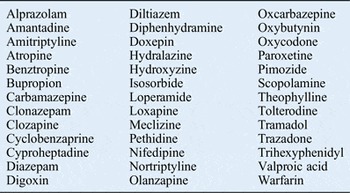
Patient medications listed in the medical record were confirmed and compliance was determined during the patient encounter; furthermore, over-the-counter medications were documented even when not included in the medical records. Participant's full medication lists were divided based on the following drug categories: anticholinergic, diuretic, sympathomimetic, opioid and other. Anticholinergic medication classification was based upon work by Carnahan et al.Reference Carnahan, Lund, Perry, Pollock and Culp 9 and Rudolph et al.Reference Rudolph, Salow, Angelini and McGlinchey 10 Table I lists some of the common anticholinergic medications used by our patient population.
Most common anticholinergics used by our patient population

Many of the drug categories other than anticholinergics have been shown to cause xerostomia,Reference Bergdahl and Bergdahl 11 prompting us also to explore their association with globus. Histamine H2-antagonists, commonly used in the treatment of gastroesophageal reflux disease, have moderate anticholinergic activity; however, we chose to exclude these drugs from our analysis to eliminate confounding associated with LPR. Vitamins were not included in the analysis.
Globus measurement
The Reflux Symptom Index, a self-administered questionnaire that reflects nine outcomes important in assessing LPR symptoms, was the scale used in this study to assess globus. The Reflux Symptom Index has been validated for its efficacy in assessing clinical improvement and thus has become widely utilised in laryngology practices.Reference Belafsky, Postma and Koufman 12 One of the items in the Reflux Symptom Index asks about ‘sensations of something sticking in your throat or a lump in your throat’; this item refers to the clinical symptom of globus and was therefore of particular importance in this study, serving as the primary endpoint.
Participants completed the Reflux Symptom Index prior to receiving their clinical care, in order to limit bias. Participants rated globus sensation on a 5-point severity scale – a score of 3 or greater was considered to represent significant globus, with those scoring 0 considered as controls (non-globus). A secondary analysis was performed to determine the association between significant globus and a prior diagnosis of gastroesophageal reflux disease in individuals who met the inclusion criteria of this study.
Co-morbidity assessment
Co-morbidities for globus were assessed to control for potential confounding variables. A chart review was conducted for each patient to collect data on sex, age, sinusitis, rhinitis, asthma, seasonal allergies, chronic obstructive pulmonary disease, recent laryngeal surgery and gastroesophageal reflux disease.
Statistical analyses
Globus scores were compared with participants’ medication lists, age and gender, and analysed using a multivariate logistic regression model with odds ratios. The data were segregated based on the number of anticholinergic medications used by participants. We also conducted an analysis of the association of a previous gastroesophageal reflux disease diagnosis, again using a multivariate logistic regression model and odds ratios. Odds ratios were converted to a natural log scale, creating a standard normal distribution. The confidence coefficient was set at 1.96 for a 95 per cent confidence interval. Standard error was calculated according to the natural log and converted back to the original scale. Limits not within 2 standard errors were considered statistically significant.
Results
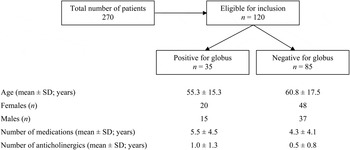
Of the 270 patients enrolled in the study, 120 met the inclusion criteria. Mean participant age was 59 years and 43 per cent of the sample were male. Forty-five per cent of the population took at least one anticholinergic medication, while 16 per cent took two or more. The most common anticholinergic medications taken by patients are listed in Table I. Thirty-five patients (29 per cent) were considered positive for globus, scoring 3 or more on the globus scale, and 85 were considered negative, scoring 0 (Figure 1). There were no significant differences between the two cohorts in terms of demographics or globus co-morbidities.
Study flowchart with patient characteristics listed. Patients were categorised as having globus if they scored a 3 or above on a 0–5 severity scale, with those scoring 0 considered as controls (non-globus). SD = standard deviation

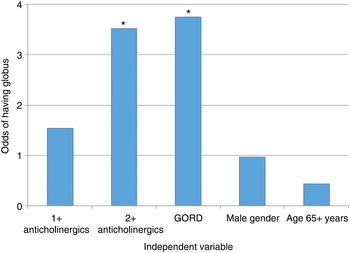
The analysis revealed that anticholinergic medication use and previous diagnosis of gastroesophageal reflux disease were risk factors for globus. Patients taking at least one anticholinergic medication did not have significantly increased odds of experiencing globus (odds ratio = 1.54; p = 0.42) (Figure 2). Patients taking 2 or more anticholinergics had significantly greater odds of experiencing globus, with an odds ratio of 3.52 (p = 0.02). Patients with a previous diagnosis of gastroesophageal reflux disease had a 3.75 increased odds of having globus (p = 0.004).
Odds ratios for globus as determined by globus scores of 3 or greater. Asterisks reflect statistical significance, indicated by a value more than two standard deviations outside the mean as calculated by logistic regression. GORD = gastroesophageal reflux disease

Gender and age were not significantly associated with globus (p = 0.43 and p = 0.08, respectively), although older age trended towards significance. There was no significant association between diuretics, sympathomimetics or opioids as compared to globus (p = 0.13, p = 0.20 and p = 0.48, respectively). Sinusitis and allergies were not significantly associated with globus (p = 0.36 and p = 0.50, respectively); however, both of these had relatively low populations (n = 3 and n = 14, respectively).
Discussion
This is the first study to our knowledge that implicates anticholinergic medication use as a possible cause of globus. The odds of having globus when taking 2 or more anticholinergic medications was 3.5 times that of a participant taking no anticholinergic drug, while participants on at least 1 anticholinergic were not at increased risk of globus. This suggests a synergistic drying effect of participants’ anticholinergic medications, with a single anticholinergic not having a significant enough effect to cause globus. Interestingly, recent work by You et al. showed that low-dose amitriptyline, an anticholinergic medication, was actually effective at treating globus and was superior to conventional PPI treatment.Reference You, Liu, Jia, Jiang and Wang 13 This may be explained by the fact that some globus is thought to be caused by increased upper oesophageal sphincter pressure which is mediated by acetylcholine and nicotinic receptors.Reference Mittal 14 Taken together, our findings and You and colleagues’ findings may suggest that there is a delicate balance between cholinergic levels and globus – a single anticholinergic could help to decrease upper oesophageal sphincter pressure and ameliorate globus, yet the additive sicca effects of multiple anticholinergics may contribute to globus.
In assessing globus, we based our primary endpoint on a simple five-point scale, as taken from the Reflux Symptom Index. The Reflux Symptom Index was designed to assess laryngitis as it relates to LPR, and we excluded patients with significant symptomatic reflux, defined as those who reported 4 or 5 on the Reflux Symptom Index items of ‘coughing after you ate or lying down’ and ‘heartburn, chest pain, indigestion, or stomach acid coming up’.
Gastroesophageal reflux disease has been suggested as a major aetiology of globus, occurring in anywhere from 23 to 68 per cent of patients, depending on the study.Reference Lee and Kim 1 We also found a significant association between globus and a previous diagnosis of gastroesophageal reflux disease in our study participants; these individuals were relatively asymptomatic, as indicated by scores of 3 or less on questions on the Reflux Symptom Index about ‘heartburn’ or ‘coughing after lying down’. These were possibly patients with silent reflux, where globus was a residual symptom after medical treatment with PPIs. Given our findings and the specific exclusion criteria, our study suggests that globus may be a more challenging symptom of gastroesophageal reflux disease to treat.
The Glasgow Edinburgh Throat Scale is a validated index for assessing globus;Reference Deary, Wilson, Harris and MacDougall 15 however; we chose to use the Reflux Symptom Index because it is a questionnaire routinely administered to patients in our laryngology practice. Furthermore, the data were pooled from a previous study in which we analysed laryngitis using the Reflux Symptom Index. The Reflux Symptom Index symptom of ‘sensations of something sticking in your throat or a lump in your throat’ is very similar to one of the most common globus complaints reported in the Glasgow Edinburgh Throat Scale questionnaire, the ‘feeling of something stuck in the throat’.Reference Deary, Wilson, Harris and MacDougall 15 A more rigorous scale such as the Glasgow Edinburgh Throat Scale should be used in subsequent work aimed at revealing the effects of anticholinergic medications on globus.
-
• Globus pharyngeus is a non-painful lump-in-throat sensation with unclear aetiology, representing 4 per cent of ENT referrals
-
• Gastroesophageal reflux disease with laryngopharyngeal reflux can often cause globus; thus, globus is often treated empirically with proton pump inhibitors and antacids
-
• Globus pharyngeus has been linked to salivary hypofunction
-
• This cross-sectional study explored the relationship between globus and medications that have a drying effect on salivary glands, such as anticholinergics
-
• Patients on two or more anticholinergic medications had significantly increased odds of experiencing globus
-
• A previous diagnosis of gastroesophageal reflux disease was also significantly associated with globus, which supports prior studies
There are other limitations to this study that need to be further elucidated. As this was a cross-sectional study, we were only able to show an association rather than a cause and effect relationship. Furthermore, we did not take into account previous PPI treatments as a potential outcome measure for globus, which may serve as a future avenue of investigation. The comparison group (patients without globus) comprised patients who had been referred to a laryngologist, and they could have had conditions related to the larynx or pharynx, which might influence throat-related symptoms. We attempted to reduce confounding considerably through our strict inclusion criteria and excluded patients with known aetiologies for globus.
Our findings suggest that the symptom of globus in patients who present to a laryngology practice may be caused by anticholinergic medications. Furthermore, all psychotropic medications, which are extensively used, have a significant anticholinergic effect and should be considered when reviewing the medication lists of patients referred for globus. Given the challenges of treating globus, the associations described in this work are essential to clinical practice.
Conclusion
This is the first study to our knowledge that implicates medication use, specifically anticholinergics, as a risk factor and possible cause of globus. The association with anticholinergic use suggests that an appreciable portion of globus cases without a clear aetiology may be due to sicca. An awareness of these important associations is invaluable when attributing cause to globus and considering treatment options within an otolaryngology practice.