Introduction
Ladybeetles are one of the most studied beneficial insects (Snyder et al., Reference Snyder, Ballard, Yang, Clevenger, Miller, Ahn, Hatten and Berryman2004) and coccinellids provide economic benefits in agroecosystems because of their biological control of many damaging insects (Hodek et al., Reference Hodek, van Emden and Honêk2012). In particular, ladybeetles have been valuable predators of aphids, whitefly, scales, mealy bugs, psyllids and mites (Obrycki and Kring, Reference Obrycki and Kring1998). Among the predatory coccinellids, Oenopia conglobata (L.) (Col.: Coccinellidae) is one of the most common ladybeetles in many pistachio-growing areas in Iran feeding on psyllid and aphid pests (Mehrnejad and Jalali, Reference Mehrnejad and Jalali2004). Predatory larval and adult stages of O. conglobata have been reported on aphids, psyllids and lace bugs from countries, such as Turkey, China, Iraq, Russia, Germany and Yugoslavia (Hodek et al., Reference Hodek, van Emden and Honêk2012).
Aphids are a varied group of plant pests that occur in most agricultural regions causing damage, either directly through their feeding and excretion of honeydew that promotes the development of sooty moulds, or indirectly by transmitting plant viruses (Raboudi et al., Reference Raboudi, Ben Moussa, Makni, Marrakchi and Makni2002). The cotton aphid, Aphis gossypii Glover (Hemiptera: Aphididae), is one of the most common aphid species found on weeds in pistachio orchards in Rafsanjan, south of Iran (Jalali, Reference Jalali2001) and is a major pest of many crops around the world (van Emden and Harrington, Reference van Emden and Harrington2017).
Among the abiotic factors, temperature has a significant effect on the ecology, biology and population dynamics of insect pests and their natural enemies. Determination of a pest's thermal requirements has helped improve pest management programmes, for example, by better predicting pest occurrence or improving mass-rearing programmes for natural enemies (Nava and Parra, Reference Nava and Parra2003). For natural enemies used in augmentation programmes, accurate information regarding their thermal requirements is also vital for the selection of the beneficial insects that are adapted to the environmental conditions found with the targeted pests (Obrycki and Kring, Reference Obrycki and Kring1998; Hodek et al., Reference Hodek, van Emden and Honêk2012). The thermal requirements for insect development can be calculated using several mathematical models. Different linear and nonlinear models have been suggested to estimate various critical temperatures of the insects (e.g. Campbell et al., Reference Campbell, Frazer, Gilbert, Gutierrez and Mackauer1974; Stinner et al., Reference Stinner, Gutierrez and Butler1974; Logan et al., Reference Logan, Wollkind, Hoyt and Tanigoshi1976; Sharpe and DeMichele, Reference Sharpe and DeMichele1977; Lactin et al., Reference Lactin, Holliday, Johnson and Craigen1995; Brière et al., Reference Brière, Pracros, Le Roux and Pierre1999; Ratkowsky and Reddy, Reference Ratkowsky and Reddy2017). The linear model has been used widely in entomological research because it requires a minimal number of fitted coefficients (see Kontodimas et al., Reference Kontodimas, Eliopoulos, Stathas and Economou2004) and it is easy to calculate and apply. The model usually yields correct values of thermal limits and is the only model that enables the researchers to estimate the thermal constant or the sum of effective temperatures (SET) within a confined range of temperatures, usually 15–30 °C (Obrycki and Tauber, Reference Obrycki and Kring1981; Kontodimas et al., Reference Kontodimas, Eliopoulos, Stathas and Economou2004). To determine the developmental rate of insects within a wider temperature range, and to estimate the maximum and optimum temperatures, various nonlinear models have been used (see Kontodimas et al., Reference Kontodimas, Eliopoulos, Stathas and Economou2004). Numerous non-linear models have been introduced to estimate the thermal thresholds of insects and mites (see Shi et al., Reference Shi, Reddy, Chen and Ge2016; Reference Shi, Ratkowsky, Wang, Li, Reddy, Zhao and Li2017). Among the nonlinear models, the Lactin equation (Lactin et al., Reference Lactin, Holliday, Johnson and Craigen1995) is a recommended model for the description of the temperature-dependent development of predatory coccinellids (Roy et al., Reference Roy, Brodeur and Cloutier2002, Kontodimas et al., Reference Kontodimas, Eliopoulos, Stathas and Economou2004).
Earlier research has revealed that temperature affects biological characteristics (such as survival, development time, body size, fertility and fecundity) of ladybeetles (Angilletta et al., Reference Angilletta, Steury and Sears2004, Jalali et al., Reference Jalali, Tirry and De Clercq2009, Hodek et al., Reference Hodek, van Emden and Honêk2012) and, therefore, can influence the effectiveness of these predators as biocontrol agents (Dixon and Kindlmann, Reference Dixon, Kindlmann, Dempster and McLean1998). Thus, information relating to the thermal requirements for a coccinellid's development has practical application for biological control (Infante, Reference Infante2000). The aim of this laboratory study was to estimate thermal requirements and limits for the development of O. conglobata fed on A. gossypii, using a non-linear model (Lactin) and a linear model. This is one critical factor to affect the performance of a polyphagous biocontrol agent like O. conglobata in different agroecosystems. The predictability and reliability of biological control programmes may be enhanced when we understand the thermal plasticity of omnivorous biological control agents, especially when eurythermal species with wide thermal tolerance are used.
Materials and methods
Predator and prey colonies
Adult O. conglobata were initially collected from pistachio trees in the pistachio plantation areas of Rafsanjan, southern Iran. The colony was transferred to a laboratory at the Plant Protection Department of Vali-e-Asr University and maintained in transparent plastic boxes (10 × 20 × 25 cm). The A. gossypii colony was initiated with material collected from a research greenhouse at the Shahid Bahonar University of Kerman and transferred to a laboratory. All predator and prey stocks were placed in a growth chamber at 25 ± 1 °C, 65 ± 5% RH and 16:8 (L:D) photoperiod. The main aphid colony was reared on cucumber seedlings raised in the greenhouse, with the cucumbers grown from seeds planted every two weeks in plastic pots (15 cm diameter (diam.) and 19 cm height). Additionally, the pots were isolated in organdy cages (100 × 100 × 90 cm).
Test arenas
All experiments were conducted under controlled conditions (a constant temperature, 65 ± 5% RH and 16:8 L:D). Six constant temperatures were tested (22.5, 25, 27.5, 30, 32.5 and 35 °C). Throughout the development period, ladybird larvae were provided aphid nymphs of various sizes and in quantities such that food was not a limiting factor for O. conglobata development. Plastic Petri dishes (6 cm in diam.) were used as the cage arena. A hole (15 mm diam.) in the centre of the lid was covered by a fine net (2 mm mesh) to provide ventilation. To keep humidity stable in the cage arenas, agar medium (8 gr/L) was added to the bottom of each Petri dish (Mehrnejad, Reference Mehrnejad1998). The agar medium was autoclaved in 120 °C and 1 atm pressure. After cooling, the media was poured into every Petri dish (3 mm thickness). Nymphs of A. gossypii were regularly collected from the main greenhouse colony and used as prey during the trials. The aphids were presented on a 6-cm cucumber leaf disc, placed on the agar medium and covered by a filter paper. Ten leaf-disc cages and two small plastic caps containing a saturated ‘magnesium nitrate’ salt solution (to maintain relative humidity at 65 ± 5%) were placed in a plastic box (10 × 20 × 25 cm) inside an incubator (Mehrnejad and Jalali, Reference Mehrnejad and Jalali2004). White fluorescent lamps set at 13 W/m2 were used to provide lighting.
Development
At each tested temperature, a leaf-disc cage with sufficient prey was offered separately to three mated adult females. To determine the incubation period of the eggs and their mortality rate, the production and condition of eggs were observed three times each day, with at least 100 eggs examined during each observation period. Additionally, the adult O. conglobata were moved to new cages after each observation period. To study the development times of the larvae, a newly hatched first instar larva was introduced into a leaf-disc cage containing sufficient aphid nymphs (40 larvae as replication). All cages were checked daily and the duration of each development stage was recorded until adult O. conglobata emergence.
Statistical analysis
All data were passed through Kolmogorov–Smirnov (K–S) test for normality and analysed with parametric tests. A two-way analysis of variance (α = 0.05) was used to analyse main effects of species and temperature. Means were separated using the Tukey–Kramer honestly significant difference test (Sokal and Rohlf, Reference Sokal and Rohlf1995). A chi-square test was performed to compare survival rates of immatures at different constant temperatures. The SPSS (SPSS Institute, 2006) and the JMP (SAS Institute, 2012) statistical packages were used for statistical analyses.
Linear and nonlinear (Lactin) models were used to assess the relationship between development rate and temperature. The mathematical expression of linear models is as follows:
 $$\begin{equation}
R\left( T \right)\;{\rm{or}}\;\frac{1}{D} = a + \left( {b \times T} \right)
\end{equation}$$
where D is development time (days), R is development rate at temperature T, a is the intercept and b is the slope of the linear function (Campbell et al., Reference Campbell, Frazer, Gilbert, Gutierrez and Mackauer1974; Obrycki and Tauber, Reference Obrycki and Tauber1982; Jarošík et al., Reference Jarošík, Honěk and Dixon2002). For Lactin model, the mathematical expression is as follows:
 $$\begin{equation}
\frac{1}{D} = {e^{\rho \times T}} - {e^{\left( {\rho \times {T_m}{\textstyle{{{T_{m - T}}} \over \Delta }}} \right)}} + \lambda
\end{equation}$$
where Tm, λ, Δ and ρ are fitted coefficients (Lactin et al., Reference Lactin, Holliday, Johnson and Craigen1995; Kontodimas et al., Reference Kontodimas, Eliopoulos, Stathas and Economou2004).
The thermal constant K is the amount of heat (degree-days, DD) needed by an organism to complete a given development stage. The thermal constant K was estimated by the following linear equation (Campbell et al., Reference Campbell, Frazer, Gilbert, Gutierrez and Mackauer1974):
 $$\begin{equation}
K = \frac{1}{b}\vspace*{-3pt}
\end{equation}$$
The standard error SE of the thermal constant K is
 $$\begin{equation}
{\rm{S}}{{\rm{E}}_k} = \frac{{{\rm{S}}{{\rm{E}}_b}}}{{{b^2}}} \vspace*{-3pt}
\end{equation}$$
The Lactin model enables the estimation of optimum, lower and upper temperature thresholds. However, the linear equation estimates only the lower temperature threshold. The standard error (SE) of lower temperature (t min), calculated from the linear model, is as follows:
 $$\begin{equation}
{\rm{S}}{{\rm{E}}_t}_{_{{\rm{min}}}} = \frac{{\bar{r}}}{b}\sqrt {\frac{{{s^2}}}{{N.{{\bar{r}}^2}}}} + {\left[ {\frac{{S{E_b}}}{b}} \right]^2}\vspace*{-3pt}
\end{equation}$$
where r is the sample mean, s 2 is the residual mean square of r, N is the sample size and SEb is the standard error of b (the slope of linear function) (Campbell et al., Reference Campbell, Frazer, Gilbert, Gutierrez and Mackauer1974).
Finally, the standard errors of t opt and t max were estimated from the nonlinear regression.
The following parameters were used to measure goodness of fit: R 2, which is the coefficient of determination (for linear model) or the coefficient of nonlinear regression (for Lactin model), and RSS, which is the residual sum of squares. The higher values of R 2 and lower of RSS reveal the better fit. In the linear regression, data values that did not fit the straight line were omitted to provide the proper estimation of the t min and thermal constant (De Clercq and Degheele, Reference De Clercq and Degheele1992).
Results
Development time
Mean developmental time of surviving eggs, larvae, and pupae and total development time (egg to adult) for each constant temperature is presented (Table 1). The development time of all immature stages decreased as temperature increased from 22.5 to 32.5 °C. Increasing temperature resulted in shorter egg incubation period (F = 135.82, df = 4, P = 0.001) and total larval period (F = 102.39, df = 4, P = 0.001). The longest larval period was 10.61 ± 0.15 days at temperature 22.5 °C and the shortest was 6.28 ± 0.21 days at 32.5 °C. Pupal development significantly decreased in response to increasing temperature (F = 90.65, df = 4, P = 0.001). Pre-adult period ranged from 19.3 ± 0.11 days at 22.5 °C to 11.3 ± 0.11 days at 32.5 °C and was significantly associated with increasing temperature (F = 178.618, df = 4, P = 0.001), although no significant difference was observed between 30 and 32.5 °C.
Mean (± SE) developmental time (days) for egg, larval (L1 to L4), pupal and total immature stages of Oenopia conglobata at different temperatures, fed on Aphis gossypii

Within columns, values followed by the same letter do not differ significantly (P <0.05) using Tukey–Kramer honestly significant difference (HSD) test. †Numbers of initially tested individuals.
Immature survivorship
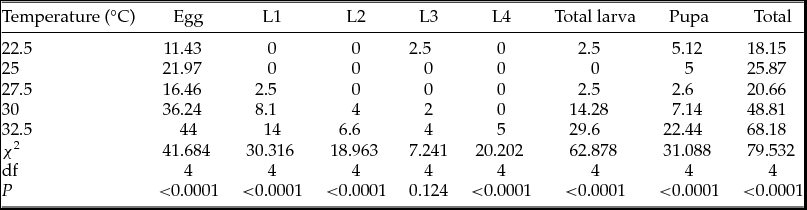
Oenopia conglobata could successfully develop to the adult stage from 22.5 to 32.5 °C. No eggs hatched at 35 °C. At temperatures that supported development, egg mortality ranged from 11.43 to 44%. Overall immature mortality was lower at the lowest temperature tested (18.15 at 22.5 °C), and total percentage mortality increased with increasing temperature to 25 °C (25.87%), declined at 27.5 °C (20.66%) and then increased at 32.5 °C (68.18%) (Table 2).
Stage-specific mortality (%) of egg, larval (L1–L4), pupal and total immature stage (egg–adult) of Oenopia conglobata at different temperatures, fed on Aphis gossypii

Thermal constants
The thermal threshold and the total thermal requirement for egg, total larva and pupa were 8.85 and 45.45, 7.66 and 156.25, 12.23 °C and 79.36 DD, respectively (Table 3). Therefore, the K and Tb values for the biological cycle (egg to adult) were 263.15 DD and 8.84 °C, respectively.
Thermal threshold (T min) and total thermal requirements (K) of pre-adult stages of Oenopia conglobata at different temperatures, fed on Aphis gossypii

Developmental rate models
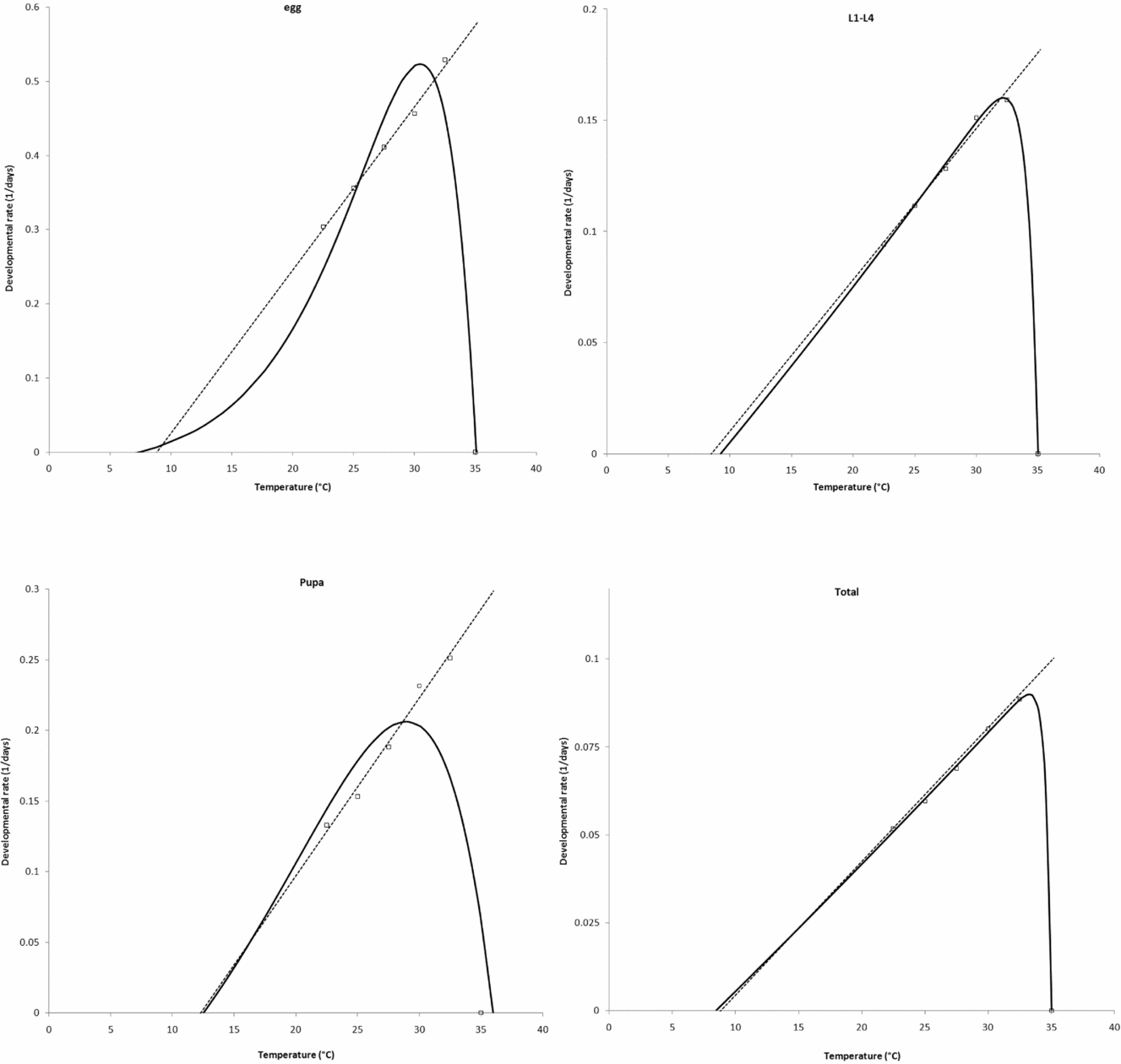
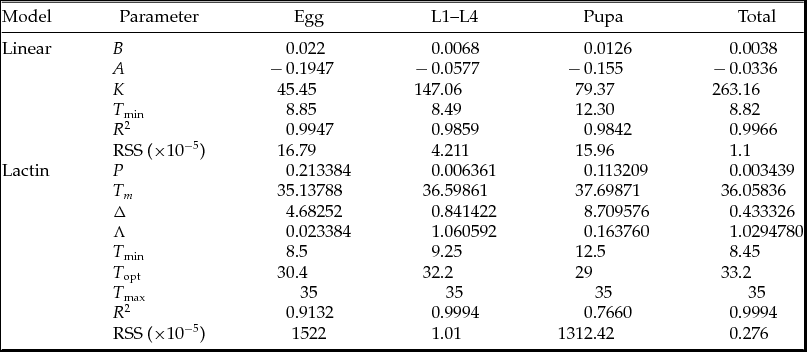
The development rate of O. conglobata showed a linear increase with increasing temperature from 22.5 to 32.5 °C (Fig. 1). Linear regression parameters for different immature stages and for total development are presented in Table 4. The optimum temperature, the minimum temperature and the maximum temperature thresholds for total development were 30.4, 8.5–8.85 and 35.0 °C, respectively (Table 4).
Developmental rate of eggs, larvae, pupae and total immature stages of Oenopia conglobata on Aphis gossypii, as a function of temperature, calculated by linear (dotted line) and Lactin (solid line) models.

Values of the fitted coefficients and measurable parameters of two developmental rate models describing the complete development of Oenopia conglobata on Aphis gossypii

RSS and R2 values
High R 2 values and low RSS values reveal a good fit to the experimental data for total development and different developmental stages of O. conglobata (Table 4). R 2 ranged from 0.9842 to 0.9966 for different developmental stages of O. conglobata described by linear model, indicating a good linear fit. R 2 ranged from 0.7660 to 0.9994 for the Lactin model. The linear model R 2 value was lower than the Lactin model for total developmental time. The RSS values were higher in the Lactin model (Table 4).
Discussion
The dynamics for pests and their natural enemies are affected by temperature (Pedigo and Rice, Reference Pedigo and Rice2014; Gullan and Cranston, Reference Gullan and Cranston2014). Practical implications of the temperature limits of insects can be incorporated into phenological models. Temperature-based phenological models can be used to predict the timing of life-history events in insects (Diaz et al., Reference Diaz, Muñiz, Barrios and Fereres2007). As expected, in the present study, increasing temperature resulted in shorter developmental time. The highest development rates for the pre-mature stages of the O. conglobata examined occurred at 30.4 °C. Butcher et al. (Reference Butcher, Snider and Snider1971) supposed that the optimum temperature is the temperature that maximized development rate and minimized mortality; and, based on this definition, the optimum temperature for the development of O. conglobata ranges from 27.5 to 30 °C. For example, at 32.5 °C, total mortality was three times higher than at 27.5 °C (Table 2).
High R 2 values and low values of RSS for both linear and Lactin models indicate a good fit to the observed data in most cases. Along with our results, some earlier studies also suggest that these two models may properly describe temperature-dependent development of predatory coccinellids (Roy et al., Reference Roy, Brodeur and Cloutier2002; Kontodimas et al., Reference Kontodimas, Eliopoulos, Stathas and Economou2004; Jalali et al., Reference Jalali, Mehrnejad and Kontodimas2014). In the current study, the Lactin equation estimated t min to be 8.45 °C. However, in another study (Jalali et al., Reference Jalali, Mehrnejad and Kontodimas2014), a t min value of 11.3 °C was obtained by Lactin model for O. conglobata fed on common pistachio psylla, Agonoscena pistaciae Burckhardt & Lauterer (Hemiptera: Aphalaridae). Also, a lower t opt value of 30.8 °C was observed for O. conglobata when reared on the psyllid diet (Jalali et al., Reference Jalali, Mehrnejad and Kontodimas2014). Although the effect of food on the thermal requirements of ladybeetles is not well described in the literature, it is not surprising if the prey quality significantly influences the thermal requirements of these poikilothermic predators by affecting their total development times. A comparison of the results of our current study with those of Jalali et al. (Reference Jalali, Mehrnejad and Kontodimas2014) confirms that prey species may affect the thermal requirements of O. conglobata. Hence, we can suppose that adults of O. conglobata may have tendency to tolerate large changes in temperature and this eurytopic habit may be responsible for dominance of this species among the other predatory coccinellids in pistachio plantations in Rafsanjan (Jalali, Reference Jalali2001).
Conclusion
We observed that the ladybeetle O. conglobata completed its development in a range of 22.5 to 32.5 °C. The developmental rate linearly increased with the increase in temperature, indicating the possible predation capacity of O. conglobata on A. gossypii over a wide range of temperatures. This eurytopic habit may make O. conglobata a worthy biocontrol agent of aphids, especially A. gossypii.
Acknowledgements
We are grateful to the Department of Plant Protection, Vali-e-Asr University of Rafsanjan, for the use of the greenhouse and laboratory facilities. The authors are also grateful for the assistance of Dr Dimitrios C. Kontodimas of Benaki Phytopathological Institute, Athens, for thermal requirements analysis.