


Twin-to-twin transfusion syndrome (TTTS) arises from a hemodynamic imbalance within the shared placental circulation of monochorionic twins. This imbalance, driven by uncompensated vascular anastomoses, results in a chronic net transfer of blood from one fetus (the donor) to the other (the recipient). The pathophysiological consequence is a characteristic dichotomy: the donor twin develops hypovolemia, leading to oliguria and oligohydramnios, while the recipient experiences hypervolemia, resulting in polyuria and polyhydramnios. Mortality from severe untreated TTTS is extremely high, with reported rates ranging from 70% and 100%. (de Paepe & Luks, Reference de Paepe and Luks2013; Zaami et al., Reference Zaami, Masselli, Brunelli, Taschini, Caprasecca and Marinelli2021).
TTTS is estimated to affect 1 to 3 in every 10,000 births (Society for Maternal-Fetal Medicine & Simpson, Reference Simpson2013). In pregnancies involving twins who share a placenta, the condition occurs in approximately 8−10% of monochorionic diamniotic (MCDA) cases and in roughly 6% of monochorionic-monoamniotic (MCMA) cases (Bamberg & Hecher, Reference Bamberg and Hecher2019). The diagnosis of TTTS is based on the sonographic confirmation of a significant amniotic fluid discordance between the two gestational sacs. This is defined by the concurrent findings of oligohydramnios in the donor twin, evidenced by a deepest vertical pocket (DVP) of ≤2 cm, and polyhydramnios in the recipient twin, characterized by a DVP of ≥8 cm before 20 weeks’ gestation or ≥10 cm at or after 20 weeks (Senat et al., Reference Senat, Deprest, Boulvain, Paupe, Winer and Ville2004). TTTS typically presents in the second trimester and exhibits a dynamic clinical course, which may range from a stable state to a pattern of rapid progression or, in some cases, spontaneous regression (Javinani et al., Reference Javinani, Khalil and Krispin2025).
The current therapeutic spectrum for TTTS ranges from conservative management (expectant monitoring) to invasive procedures, including serial amnioreduction, septostomy, fetoscopic laser ablation of placental anastomoses, and selective feticide (Abgral et al., Reference Abgral, Dumery, Mégier, Leyne, Luton, Benachi and Vivanti2025).
The therapeutic application of fetoscopic laser photocoagulation was pioneered by de Lia et al. (Reference de Lia, Cruikshank and Keye1990), originally necessitating maternal laparotomy. Subsequently, Ville et al. (Reference Ville, Hecher, Gagnon, Sebire, Hyett and Nicolaides1998) refined the procedure into a minimally invasive, percutaneous intervention performed under continuous sonographic guidance. FLP is recognized as the cornerstone of TTTS management, routinely utilized in tertiary referral centers to significantly improve both fetal survival and neurological prognosis (Sago et al., Reference Sago, Ishii, Sugibayashi, Ozawa, Sumie and Wada2018).
Fetoscopic laser therapy has emerged as the primary therapeutic intervention and the treatment of choice for this condition (Bamberg & Hecher, Reference Bamberg and Hecher2019; Murgano et al., Reference Murgano, Khalil, Prefumo, Van Mieghem, Rizzo, Heyborne, Melchiorre, Peeters, Lewi, Familiari, Lopriore, Oepkes, Murata, Anselem, Buca, Liberati, Hack, Nappi and Baxi2020). Technical advances in fetoscopic coagulation include a shift from the original nonselective technique, involving the occlusion of all crossing vessels, to more selective strategies (Ville et al., Reference Ville, Hyett, Hecher and Nicolaides1995). Although nonselective techniques effectively interrupt intertwin exchange, they invariably result in the collateral destruction of healthy vasculature. This iatrogenic reduction in functional placental territory has been linked to increased fetal mortality. To mitigate this, Quintero et al. (Reference Quintero, Morales, Mendoza, Allen, Kalter, Giannina and Angel1998) pioneered the selective fetoscopic laser photocoagulation (SFLP) technique, which specifically targets pathological anastomoses while preserving the noncommunicating vascular supply.
The evolution of fetoscopic laser photocoagulation (FLP) techniques, particularly the shift from nonselective to selective and Solomon approaches (Slaghekke et al., Reference Slaghekke, Lopriore, Lewi, Middeldorp, van Zwet, Weingertner, Klumper, DeKoninck, Devlieger, Kilby, Rustico, Deprest, Favre and Oepkes2014), has been shown to significantly improve perinatal survival over the past two decades (Akkermans et al., Reference Akkermans, Peeters, Klumper, Lopriore, Middeldorp and Oepkes2015). While the learning curve associated with this procedure is well documented in established Western centers, recent data from emerging fetal medicine programs in Asia, such as those in South Korea, Malaysia, and Singapore (Li et al., Reference Li, Sun and Liu2025; Natarajan et al., Reference Natarajan, Gosavi, Wataganara, Su, Amin, Leung, Choolani, Biswas and Mattar2022; Tan et al., Reference Tan, Gardener, Jeganathan, Naidu, Hassan, Ahmad Zainuddin and Kilby2023), suggest that attaining proficiency is highly dependent on caseload volume and structured simulation training.
However, significant limitations exist in the current literature regarding the global adoption of FLP. First, many reports from newly established centers are restricted by small sample sizes, often analyzing fewer than 20 cases (Natarajan et al., Reference Natarajan, Gosavi, Wataganara, Su, Amin, Leung, Choolani, Biswas and Mattar2022; Tan et al., Reference Tan, Gardener, Jeganathan, Naidu, Hassan, Ahmad Zainuddin and Kilby2023), which limits the statistical power to accurately define the stabilization of surgical competence. Second, while large cohort studies exist (Kim et al., Reference Kim, Lee, Won, Kim, Lee, Jeong and Kim2022), there is a distinct geographical disparity; to date, there are no comprehensive studies evaluating the implementation of a high-volume fetoscopic laser program in Iran or the broader Middle East region. Consequently, it remains unknown whether the competency thresholds and survival benchmarks established in East Asian or Western populations can be directly extrapolated to our specific tertiary referral setting.
This study addresses these gaps by presenting the first large-scale analysis of FLP outcomes in Iran. Unlike previous reports limited by small cohorts, we utilize Cumulative Sum (CUSUM) analysis on a substantial dataset to quantify the learning curve.
Method
Study Design and Setting
This retrospective cohort study included all consecutive MCDA twin pregnancies complicated by TTTS treated with SFLP (also referred to as FLP) at the Fetal Medicine Unit, Shariati University Hospital, Tehran, Iran between October 2018 and December 2024. The institutional review board approved the study protocol and all patients provided written informed consent prior to intervention.
TTTS Diagnosis and Staging
TTTS diagnosis was established by standard ultrasonographic criteria (discrepant amniotic fluid volumes with a deepest vertical pocket [DVP] ≥ 8 cm in the recipient sac and ≤2 cm in the donor sac before 20 weeks, or ≥10 cm and ≤2 cm respectively after 20 weeks) and clinical assessment. Disease severity was classified according to the Quintero staging system (Quintero et al., Reference Quintero, Morales, Allen, Bornick, Johnson and Kruger1999):
-
Stage I — oligohydramnios in the donor and polyhydramnios in the recipient with visible bladder in the donor;
-
Stage II — absent donor bladder;
-
Stage III — abnormal Doppler studies (e.g., absent/reversed end‑diastolic flow in the umbilical artery, reversed flow in the ductus venosus, or pulsatile flow in the umbilical vein);
-
Stage IV — hydrops fetalis in either twin;
-
Stage V — intrauterine fetal demise of one or both twins.
Inclusion and Exclusion Criteria
Inclusion criteria: (1) confirmed MCDA twin gestation; (2) TTTS diagnosed between 17 and 26 weeks of gestation and classified as Quintero stage II–IV, or symptomatic stage I with severe polyhydramnios causing maternal symptoms or cervical shortening; (3) candidacy for fetoscopic laser intervention as judged by the fetal medicine team.
Exclusion criteria: (1) major fetal structural anomaly or known chromosomal abnormality incompatible with life; (2) active labor or premature rupture of membranes prior to the procedure precluding safe fetoscopy; (3) cervical dilation >2 cm at time of planned procedure; (4) cases in which technical constraints necessitated conversion to other intrauterine procedures (e.g., selective cord occlusion) or pregnancy termination prior to attempted laser.
Procedural Technique (SFLP)
All procedures followed a standardized protocol. Anesthesia (general or spinal) was selected according to clinical circumstances and patient preference. Under continuous ultrasound guidance, a small skin incision was made at the anatomically optimal entry site. An F11 introducer was advanced percutaneously into the recipient amniotic cavity using the Seldinger technique. A 3.3‑mm fetoscope (model 11506AA, Karl Storz, Tuttlingen, Germany) was introduced through the catheter. For anterior placentas, a 11530 KB curved fetoscope sheath was employed to optimize visualization.
Superficial intertwin placental anastomoses were mapped visually and selectively coagulated using a 0.4‑ or 0.6‑mm fiber‑coupled diode laser (Dornier Med Tech GmbH, Wessling, Germany) at institutional power settings. When feasible, an equatorial dichorionization (‘Solomon’) line connecting coagulation sites was completed to reduce the risk of residual anastomoses and subsequent TAPS; if the Solomon line was not performed, selective coagulation of all visualized arteriovenous anastomoses was ensured. Following vessel coagulation, therapeutic amnioreduction was performed until the recipient sac DVP reached approximately 6–10 cm.
Perioperative Care and Side‑Effect Management
Post procedure, patients were monitored in the perinatal ward for a minimum of 24 hours. Routine prophylaxis included either indomethacin (100 mg rectal suppository, dosing per institutional protocol) or nifedipine (10 mg orally), and intravenous antibiotic therapy (e.g., ceftriaxone 1 g IV) per the center’s protocol. A transabdominal ultrasound was performed at 24 hours to confirm fetal viability and assess fluid status. Patients with uncomplicated early postoperative courses were discharged and followed at 2‑week intervals until delivery.
The main procedure‑related maternal and fetal complications monitored included preterm premature rupture of membranes (PPROM), preterm labor, intrauterine fetal demise (IUFD), recurrence of TTTS, iatrogenic twin anemia–polycythemia sequence (iTAPS/TAPS), chorioamnionitis, placental abruption, and need for neonatal transfusion. Management of complications followed institutional standards (e.g., expectant management or delivery for chorioamnionitis or nonreassuring fetal status; corticosteroids and tocolysis as clinically indicated).
Outcome Definitions
Primary outcome: favorable neonatal survival defined as survival of both twins to hospital discharge (two survivors at birth). Secondary outcomes: survival of at least one twin to discharge, gestational age at delivery, interval from laser to delivery (for pregnancies with at least one survivor), birth weight, and predefined neonatal complications (severe intraventricular hemorrhage grade III/IV, periventricular leukomalacia, sepsis, bronchopulmonary dysplasia, necrotizing enterocolitis, need for blood transfusion, and other major morbidities).
Data Collection and Variable Definitions
Demographic and obstetric variables (maternal age, parity, assisted reproduction status), clinical variables (gestational age at laser, cervical length on preoperative ultrasound), and procedural variables (placental location/orientation, presence of polyhydramnios, Quintero stage) were extracted from electronic medical records and the fetal unit database. Gestational age was derived from first‑trimester ultrasound or reliable last menstrual period when ultrasound was not available. Cervical length was measured by transvaginal sonography immediately prior to the procedure in millimeters.
Statistical Analysis
All analyses were performed using SPSS version 21 IBM. Continuous variables were tested for normality (Kolmogorov–Smirnov) and reported as mean ± standard deviation (SD) or median (interquartile range) as appropriate. Categorical variables were reported as counts and percentages. Between‑group comparisons across the three chronological cohorts (Group 1: first 100 cases; Group 2: cases 101–200; Group 3: cases 201–300) used one‑way analysis of variance (ANOVA) or Kruskal–Wallis for continuous variables and chi‑square or Fisher’s exact test for categorical variables.
To identify independent predictors of study outcomes, regression models were chosen according to the outcome variable type:
Binary logistic regression was used for the primary outcome (favorable neonatal survival: two survivors at birth). Independent variables entered into the model included group (chronological cohort), maternal age, gestational age at laser, cervical length, Quintero stage, placenta orientation, and presence of polyhydramnios. Model performance was assessed using the omnibus chi‑square test, Nagelkerke R 2, Hosmer–Lemeshow goodness‑of‑fit test, and overall classification accuracy. Results are reported as odds ratios (ORs) with 95% confidence intervals (CIs).
Linear regression models were applied for continuous outcomes (e.g., gestational age at delivery, birth weight) where appropriate. A two‑tailed p value <.05 was considered statistically significant.
Learning‑Curve Assessment (CUSUM Analysis)
To quantify temporal changes in procedural performance and identify the point of sustained competency, we performed a Cumulative Sum (CUSUM) analysis of binary outcomes. The CUSUM method detects deviation from a predefined acceptable level of performance.
Success was defined as favorable neonatal survival (≥2 survivors at birth), while failure was defined as the survival of zero or one fetus. We utilized the standard log-likelihood ratio CUSUM (LC-CUSUM) approach. Based on the validation study by Diehl et al. (Reference Diehl, Diemert, Grasso, Sehner, Wegscheider and Hecher2017), the predefined adequate and inadequate failure probabilities were set at .50 and .68, respectively.
These parameters were selected to evaluate institutional learning and stabilization of performance in a complex fetal intervention setting rather than to represent an ideal benchmark outcome. Error rates: Type I (α) and Type II (β) errors were set at 0.10.
The CUSUM score was calculated sequentially for each case. The curve was plotted to identify the inflection point where the graph stabilizes or trends downward, indicating that the failure rate had dropped below the unacceptable threshold and sustained proficiency was achieved.
The dataset comprised 300 consecutive SFLP procedures. To evaluate temporal trends and the learning curve, cases were divided chronologically into three equal cohorts of 100 cases each (Group 1: earliest, Group 2: intermediate, Group 3: most recent). This prespecified stratification enabled comparison of outcomes and regression modelling with group as a main predictor of interest.
All statistical procedures were conducted in SPSS v21.0. Reporting follows the STROBE guidelines for observational cohort studies.
The study protocol was approved by the Institutional Review Board of Tehran University of Medical Sciences (approval number not reported in the source manuscript). All participants provided written informed consent for the procedure and for anonymous use of clinical data for research.
Results
Study Population and Baseline Characteristics
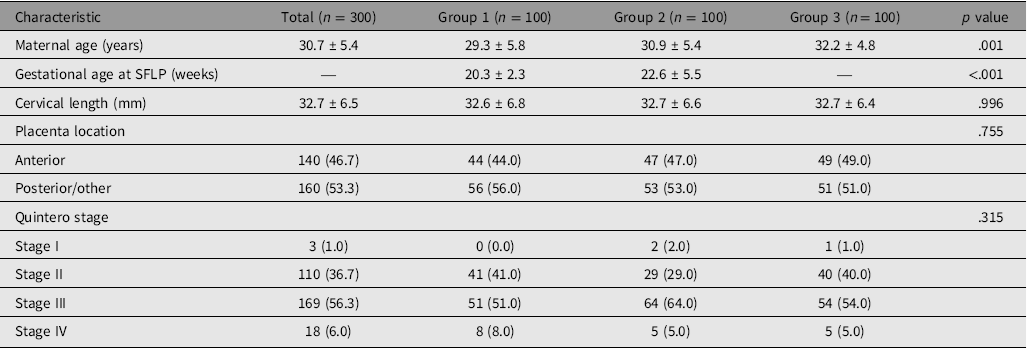
A total of 300 MCDA twin pregnancies complicated by TTTS underwent SFLP during the study period. The cohort was divided into three consecutive chronological groups of 100 patients each to assess temporal trends. Baseline obstetric and clinical characteristics are summarized in Table 1.
Baseline maternal and fetal characteristics

Note: Data are presented as mean ± standard deviation or n (%); p values were calculated using one-way analysis of variance (ANOVA) for continuous variables and chi-square tests for categorical variables. SFLP, selective fetoscopic laser photocoagulation;
There were no statistically significant differences between the three cohorts regarding Quintero stage distribution (p = .315), placental location (p = .775), or the prevalence of polyhydramnios (p = .361). The majority of cases were classified as Quintero Stage III (56.3%) or Stage II (36.7%). Maternal age was statistically higher in Group 3 compared to earlier groups (p = .001), though the absolute difference was clinically small. Gestational age at the time of laser intervention showed statistical variation across groups (p < .001).
Survival Outcomes
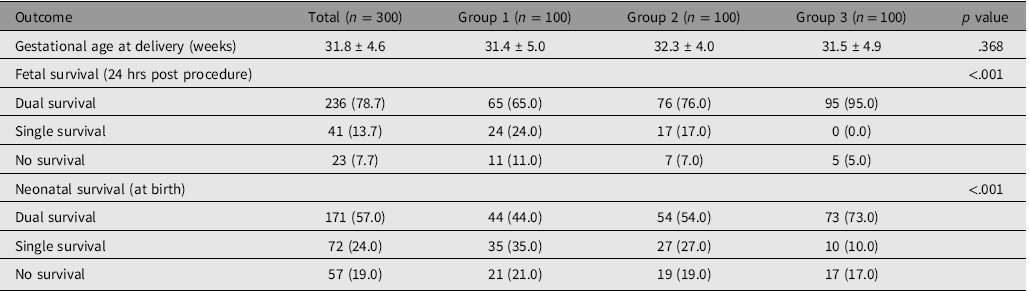
Perinatal survival outcomes improved significantly over the study period (Table 2). The overall rate of dual survival (both twins surviving to discharge) was 57%. When stratified by epoch, dual survival increased progressively from 44% in Group 1 and 54% in Group 2 to 73% in Group 3 (p < .001). Concurrently, the rate of dual fetal loss (zero survivors) decreased from 21% in Group 1 to 17% in Group 3.
Perinatal and survival outcomes

Note: Data are presented as mean ± standard deviation or n (%). p values were calculated using one-way analysis of variance (ANOVA) for continuous variables and chi-square tests for categorical variables.
Survival measured at 24 hours post procedure mirrored these findings, with the preservation of both fetuses rising from 65% in the initial cohort to 95% in the most recent cohort (p < .001). Among pregnancies with at least one survivor, the gestational age at delivery was comparable across groups (mean ∼31–32 weeks, p = .368).
Predictors of Survival
A binary logistic regression analysis was performed to identify independent predictors of favorable neonatal survival (defined as ≥2 survivors). The model was statistically significant (χ2 (10) = 108.17, p < .001) and achieved a classification accuracy of 75.0% (Nagelkerke R 2 = .418).
The chronological treatment epoch was the sole independent predictor of survival. Compared to the most recent cohort (Group 3), the odds of dual survival were significantly lower in Group 1 (adjusted OR 0.041, 95% CI [0.004, 0.429]; p = .008) and Group 2 (adjusted OR 0.051, 95% CI [0.005, 0.492]; p = .010). Notably, traditional risk factors, including Quintero stage (II vs. III/IV), anterior placental position, and cervical length at admission, were not statistically significant predictors of survival in this multivariate model (p > .05), suggesting that institutional experience outweighed the impact of disease severity in our cohort.
Learning Curve Analysis (CUSUM)
The learning curve for SFLP was evaluated using CUSUM analysis for binary outcomes (success defined as ≥2 survivors). The overall observed failure rate (survival of zero or one fetus) was 31.3% (SE 2.6%).
Using predefined acceptable and unacceptable failure probabilities of 32% (p0) and 50% (p1) respectively, the CUSUM plot (Figure 1) demonstrated a distinctive learning phase. The curve indicates that the surgical team achieved sustained proficiency defined as the point where the cumulative failure rate consistently stabilized within the acceptable range after the 141st procedure. Following this inflection point, the cumulative performance trajectory remained stable, reflecting the consolidation of surgical competence and improved survival rates observed in Group 3.
CUSUM chart showing procedural success over time. The source manuscript did not contain an embedded figure image in the uploaded file; the original caption is reproduced here. Adequate performance was defined as a failure rate ≤50%, with unacceptable performance at ≥68%. The 141st procedure marks the point where sustained adequacy was achieved.

Discussion
The current study demonstrates that selective fetoscopic laser photocoagulation (SFLP), a technique of selective laser photocoagulation of communicating vessels developed by Quintero et al. (Reference Quintero, Morales, Mendoza, Allen, Kalter, Giannina and Angel1998) for TTTS is associated with a pronounced institutional learning curve, with progressive improvement in dual survival as experience accumulates. Across 300 MCDA pregnancies divided into three chronological cohorts, dual survival increased from 44% in the first 100 procedures to 73% in the last 100, while the rate of dual fetal loss decreased from 21% to 17%. These gains occurred despite comparable Quintero stage distribution, placental location and polyhydramnios prevalence, and with similar gestational age at delivery among survivors (∼31–32 weeks), indicating that improved outcomes reflect refinement of SFLP technique and perioperative management rather than changes in baseline case mix or timing of birth.
A key finding is that treatment epoch was the only independent predictor of dual survival in multivariate analysis, whereas conventional prognostic factors, including higher Quintero stage (III/IV), anterior placental position and shorter cervical length, were not statistically significant in this model. This pattern shows the dominant effect of institutional experience and technical maturation on outcome once a program passes its early development phase.
Our results are consistent with the long-term systematic review of 34 studies (Akkermans et al., Reference Akkermans, Peeters, Klumper, Lopriore, Middeldorp and Oepkes2015), which showed that over 25 years, dual survival increased from 35% to 65% and at-least-one-twin survival from 70% to 88%, with mean gestational age at birth remaining ∼32 weeks, largely attributed to evolution from non-selective to selective, sequential and Solomon techniques, improved referral and advances in neonatal care (Akkermans et al., Reference Akkermans, Peeters, Klumper, Lopriore, Middeldorp and Oepkes2015).
The overall dual survival of 57% in our study, and particularly the 73% dual survival in the most recent group, places our performance at or above the upper range of historical benchmarks, while at-least-one-twin survival appears comparable to the 80–88% range reported in contemporary literature (Akkermans et al., Reference Akkermans, Peeters, Klumper, Lopriore, Middeldorp and Oepkes2015).
The learning-curve analysis in our study used CUSUM for binary outcomes (success defined as ≥2 survivors) with predefined acceptable and unacceptable failure probabilities (32% and 50%), and identified a distinct inflection point at the 141st procedure, beyond which the cumulative failure rate stabilized within the acceptable range. This builds on and extends the seminal learning-curve CUSUM work from a national referral center that treated 340 monochorionic TTTS pregnancies with fetoscopic laser coagulation between 2000 and 2010 (Peeters et al., Reference Peeters, Van Zwet, Oepkes, Lopriore, Klumper and Middeldorp2014). In that retrospective cohort, overall dual survival at 4 weeks was 59%, and median gestational age at birth was 32.0 weeks, closely matching our outcomes (Peeters et al., Reference Peeters, Van Zwet, Oepkes, Lopriore, Klumper and Middeldorp2014). While Ahmed et al. (Reference Ahmed, Luks, O’Brien, Muratore and Carr2010) observed no statistical correlation between case volume and outcome, Morris et al. (Reference Morris, Selman, Harbidge, Martin and Kilby2010) established a steep learning curve, requiring 111 procedures for 90% single survival.
Although Diehl et al. (Reference Diehl, Diemert, Grasso, Sehner, Wegscheider and Hecher2017) defined an individual competency threshold of 25–35 cases via CUSUM analysis, they simultaneously underscored the instability of skill retention, noting that operators frequently drifted back into out-of-control performance zones despite initial proficiency. Our institutional CUSUM curve suggests that sustained, institutional-wide proficiency requires a substantially higher cumulative case volume and parallel maturation of protocols, team coordination, and perioperative care. This is in contrast to the Diehl et al. results.
Unlike the Korean cohort (Kim et al., Reference Kim, Lee, Won, Kim, Lee, Jeong and Kim2022), where outcomes remained significantly constrained by biological variables (e.g., Quintero stage, sIUGR) despite the Solomon technique (Slaghekke et al., Reference Slaghekke, Lopriore, Lewi, Middeldorp, van Zwet, Weingertner, Klumper, DeKoninck, Devlieger, Kilby, Rustico, Deprest, Favre and Oepkes2014), our model identified treatment epoch as the sole survival predictor. This indicates that established surgical proficiency can effectively mitigate the adverse impact of disease severity. Consequently, our proficient-phase dual survival (73%) surpasses Korean cohort’s benchmarks, validating the primacy of cumulative institutional experience over baseline clinical factors.
Evidence from a Singapore prospective study (Natarajan et al., Reference Natarajan, Gosavi, Wataganara, Su, Amin, Leung, Choolani, Biswas and Mattar2022) illustrates that structured telementoring and simulation can effectively flatten the early learning curve, yielding a commensurate 77.8% six-month survival rate in a novice cohort (N = 9). However, the persistence of significant complications specifically TAPS (33.3%) and PPROM (22.2%) suggests that while supervision safeguards initial survival, it does not immediately mitigate procedural morbidity. The Singapore team achieved high safety standards with a low volume (N = 9) via intense mentorship, whereas our center achieved proficiency through high volume (N = 300) over time. Our learning curve was steeper (requiring 141 cases) likely due to the lack of real-time telementoring during our early phase. This comparison suggests that while learning by doing eventually yields excellent results (73% dual survival in Group 3), the adoption of telementoring or simulator training could theoretically shorten the learning phase for future centers in the region, preventing the learning dip observed in our Group 1.
Emerging centers with modest case numbers also provide additional context. The Malaysian national center’s retrospective cohort of 17 severe TTTS cases treated with fetoscopic laser ablation after simulation training reported at-least-one-twin survival of 76% and dual survival of 64% at 28 days, with stage-specific dual survival ranging from 0% in Stage III to 80–100% in Stages II and IV. They concluded that their outcomes were consistent with the published international learning curve and acceptable within their governance context, especially given their nationwide referral role (Tan et al., Reference Tan, Gardener, Jeganathan, Naidu, Hassan, Ahmad Zainuddin and Kilby2023).
These findings suggest that even low-volume centers using laser therapy can achieve satisfactory early outcomes particularly when underpinned by simulation and structured protocols but further gains towards dual survival rates in the 70% range likely require the kind of sustained experience and institutional refinement documented in our CUSUM analysis.
The present findings should be interpreted within the context of institutional program development rather than purely individual operator performance. In a fetal therapy service, outcomes depend not only on technical execution of the procedure but also on referral pathways, patient selection, multidisciplinary coordination, perioperative management, and neonatal care (Ahmed et al., Reference Ahmed, Luks, O’Brien, Muratore and Carr2010; Diehl et al., Reference Diehl, Diemert, Grasso, Sehner, Wegscheider and Hecher2017; Peeters et al., Reference Peeters, Van Zwet, Oepkes, Lopriore, Klumper and Middeldorp2014; Quintero et al., Reference Quintero, Morales, Allen, Bornick, Johnson and Kruger1999). The relatively consistent gap between 24-hour survival and survival to discharge across treatment epochs suggests that improvements over time may have been driven primarily by better immediate procedural success, while later losses likely remained influenced by disease severity, prematurity, and postnatal factors (Ahmed et al., Reference Ahmed, Luks, O’Brien, Muratore and Carr2010; Peeters et al., Reference Peeters, Van Zwet, Oepkes, Lopriore, Klumper and Middeldorp2014; Slaghekke et al., Reference Slaghekke, Lopriore, Lewi, Middeldorp, van Zwet, Weingertner, Klumper, DeKoninck, Devlieger, Kilby, Rustico, Deprest, Favre and Oepkes2014).
Although major complications such as PPROM, preterm labor, TTTS recurrence, iTAPS, chorioamnionitis, and placental abruption were monitored, these were not stratified by treatment epoch in the present analysis; future work should evaluate whether temporal improvements are also accompanied by reductions in post-procedural morbidity.
Telemedicine may likewise have played an important enabling role during service development by supporting remote mentorship, case review, imaging interpretation, and protocol refinement, and may represent a useful model for emerging centers seeking to establish new fetal therapy programs (Li et al., Reference Li, Sun and Liu2025; Tan et al., Reference Tan, Gardener, Jeganathan, Naidu, Hassan, Ahmad Zainuddin and Kilby2023).
Finally, the observation that classical prognostic markers did not independently predict dual survival in our multivariate analysis suggests that in experienced SFLP programs, the detrimental effects of advanced Quintero stage, adverse placental anatomy and cervical shortening can be attenuated by high-quality technique and perioperative care.
This does not lessen the biological significance of these factors, which have been extensively studied recently (Ezazi Bojnordi et al., Reference Ezazi Bojnordi, Eslamian, Marsoosi, Golbabaei, Sheikh Vatan, Shamshirsaz, Eshraghi and Ghaemi2023; Galan et al., Reference Galan, Galan, Zaretsky, Pan, Behrendt, Derderian, Emery, Johnson, Ryan and Goodnight2025; Krispin et al., Reference Krispin, Mustafa, Espinoza, Nassr, Sanz Cortes, Donepudi, Harman, Mostafaei, Turan, Belfort and Shamshirsaz2023). The observed survival increase is probably multifactorial and may be influenced by various types of bias. Although there are a number of plausible explanations for the increase in perinatal survival following laser treatment, only a randomized controlled trial with sufficient power for perinatal survival can show this effect (Akkermans et al., Reference Akkermans, Peeters, Klumper, Lopriore, Middeldorp and Oepkes2015).
Direction for Future Research
Future research should aim to integrate operator- and center-level learning-curve metrics, such as CUSUM-defined proficiency, into prognostic and referral algorithms for TTTS, thereby improving risk stratification, guiding centralization strategies and informing counseling about anticipated outcomes according to both disease severity and the position of the treating center on its SFLP learning curve.
In order to continuously update the standard for other centers, we encourage both new and established centers to publish their series and share their performance for peer review (Peeters et al., Reference Peeters, Akkermans, Westra, Lopriore, Middeldorp, Klumper, J Lewi, Devlieger, Deprest, Kontopoulos, Quintero, Chmait, Smoleniec, Otaño and Oepkes2015).
Strengths and Limitations
The study’s primary strength is its substantial sample size (N = 300), which enabled a CUSUM analysis of the learning curve under a consistent surgical team and minimizing inter-operator variability. Limitations include the retrospective design and lack of long-term neurodevelopmental follow-up, which precludes the assessment of intact survival. Additionally, the steep learning trajectory reflects the absence of early telementoring, while the inconsistent application of the Solomon technique in initial cohorts may have influenced complication rates, underscoring the need for future prospective studies with standardized protocols. We also did not perform an operator-specific analysis; therefore, the relative contributions of individual surgeon experience and broader team or protocol development could not be separately assessed.
Conclusion
In conclusion, this study confirms that SFLP is a highly effective treatment for TTTS, with survival outcomes in Iran now matching international standards. We demonstrated a significant learning curve requiring approximately 140 procedures to achieve sustained proficiency. These findings argue for the centralization of fetal surgery services to ensure sufficient case volume, thereby optimizing survival rates and minimizing the learning phase for future operators.
Data availability statement
The data that support the findings of this study are available from the corresponding author upon reasonable request.