1. Introduction
The Belgian Givetian sedimentary sequence of the Ardennes area represents one of the thickest and best-known Palaeozoic reef-related deposits of Europe. The relatively large quarries within the Givetian rocks and the numerous valleys crossing the Ardennes area offer easy access to a number of outstanding outcrops, allowing detailed sedimentological, biostratigraphical and taxonomic research (Lecompte, Reference Lecompte1951, Reference Lecompte1952; Errera, Mamet & Sartenaer, Reference Errera, Mamet and Sartenaer1972; Bultynck, Reference Bultynck1974, Reference Bultynck1987; Préat & Boulvain, Reference Préat and Boulvain1982; Préat et al. Reference Préat, Coen-Aubert, Mamet and Tourneur1984; Boulvain & Préat, Reference Boulvain and Préat1986; Coen-Aubert, Preat & Tourneur, Reference Coen-Aubert, Preat and Tourneur1986; Préat, Ceuleneer & Boulvain, Reference Préat, Ceuleneer and Boulvain1987; Bultynck et al. Reference Bultynck, Coen-Aubert, Dejonghe, Godefroid, Hance, Lacroix, Preat, Stainier, Steemans, Streel and Tourneur1991; Casier & Préat, Reference Casier and Préat1991, Reference Casier and Préat2013; Coen-Aubert, Reference Coen-Aubert1992, Reference Coen-Aubert2000, Reference Coen-Aubert2002; Préat & Kasimi, Reference Préat and Kasimi1995; Bultynck & Dejonghe, Reference Bultynck, Dejonghe, Bultynck and Dejonghe2001; Gouwy & Bultynck, Reference Gouwy and Bultynck2003; G. Poulain, unpub. Masters thesis, Univ. Liège, 2006; Boulvain et al. Reference Boulvain, Mabille, Poulain and Da Silva2009; Maillet, Milhau & Dojen, Reference Maillet, Milhau and Dojen2013). The Belgian Givetian carbonate platform shows important N–S and E–W facies variations (Bultynck & Dejonghe, Reference Bultynck, Dejonghe, Bultynck and Dejonghe2001; Boulvain et al. Reference Boulvain, Mabille, Poulain and Da Silva2009). As a result of the remarkable outcrop conditions, the southern and northeastern portions of the Dinant Syncline have been the focus of most of the investigations cited above whereas its northwestern area has suffered a lack of interest. Consequently, the reconstruction of lateral and vertical facies belt development within this platform has remained incomplete and hampers further palaeogeographic and palaeoenvironmental interpretation.
Over the last decade, magnetic susceptibility (MS) has been used extensively as a palaeoenvironmental, palaeoclimatic proxy and as a correlation tool (Bábek et al. Reference Bábek, Kalvoda, Aretz, Cossey, Devuyst, Herbig and Sevastopulo2010; Boulvain et al. Reference Boulvain, Da Silva, Mabille, Hladil, Gersl, Koptikova and Schnabl2010; Michel et al. Reference Michel, Boulvain, Philippo and Da Silva2010; Whalen & Day, Reference Whalen and Day2010; Da Silva & Boulvain, Reference Da Silva and Boulvain2012), and an extended database of MS measurements is available for numerous Devonian sections in Belgium (Da Silva et al. Reference Da Silva, De Vleeschouwer, Boulvain, Claeys, Fagel, Humblet, Mabille, Michel, Sardar Abadi, Pas and Dekkers2013; Pas et al. Reference Pas, Da Silva, Devleeschouwer, De Vleeschouwer, Labaye, Cornet, Michel, Boulvain, Da Silva, Whalen, Hladil, Chadimova, Chen, Spassov, Boulvain and Devleeschouwer2015) and worldwide (Hladil et al. Reference Hladil, Gersl, Strnad, Frana, Langrova and Spisiak2006; Whalen & Day, Reference Whalen and Day2008; Koptíková et al. Reference Koptíková, Bábek, Hladil, Kalvoda and Slavík2010; Koptíková, Reference Koptíková2011; Pas et al. Reference Pas, Da Silva, Suttner, Kido, Bultynck, Pondrelli, Corradini, De Vleeschouwer, Dojen and Boulvain2014). Moreover, a recent IGCP project (IGCP-580, UNESCO funding) has focused on the application of MS as a palaeoclimatic proxy, specifically for the Devonian. This has allowed a better understanding of the use of MS techniques as a tool for high-resolution correlation and palaeoenvironmental reconstructions (e.g. IGCP 580 project; Da Silva et al. Reference Da Silva, Whalen, Hladil, Koptikova, Chen, Spassov, Boulvain and Devleeschouwer2014). However, MS measurements need to be combined with the outcomes of other techniques such as geochemical data (Riquier et al. Reference Riquier, Averbuch, Devleeschouwer and Tribovillard2010; Da Silva et al. Reference Da Silva, De Vleeschouwer, Boulvain, Claeys, Fagel, Humblet, Mabille, Michel, Sardar Abadi, Pas and Dekkers2013), magnetic properties analyses (Devleeschouwer et al. Reference Devleeschouwer, Petitclerc, Spassov and Préat2010; Da Silva et al. Reference Da Silva, Dekkers, Mabille and Boulvain2012), sedimentology (Mabille et al. Reference Mabille, Pas, Aretz, Boulvain, Schröder and Silva2008b ; Da Silva et al. Reference Da Silva, Mabille and Boulvain2009), biostratigraphy, etc. to provide robust insights on the applicability of this proxy as a correlation tool or as a palaeoclimatological indicator. Indeed, it is essential to decipher whether the recorded MS signal represents a primary depositional-induced imprint (e.g. change in detrital supply basinwards, leading to a link between MS and independent geochemical proxies related to detrital inputs such as Zr, Al, Rb, etc.) or a post-depositional secondary signature (e.g. diagenesis and metamorphism).
This paper focuses on the La Thure section, from the northwestern margin of the Dinant Syncline. This section is worthy of interest for the following reasons: (1) it is an outstanding outcrop in an area where outcrops are rare and (2) it provides a relatively continuous record of a several million-year-long stratigraphic interval. This paper proposes detailed sedimentological analyses and illustrates the fascinating facies diversity that shaped the early–late Givetian platform on the northwestern margin of the Dinant Syncline. Thorough comparison with the southern extension of this platform was done in order to improve the knowledge on the distribution of the main facies belts and their evolution over million-year scales within the Dinant Basin. Moreover, we have set up a large set of MS and geochemical data in order to clearly constrain the link between MS and siliciclastic input proxies for each section, and to build a robust high-resolution MS reference profile for the shallow water of the early to late Givetian platform in Belgium. The MS million-year trends that are recorded in this profile will allow us to further test the applicability of MS as a correlation tool within the Rhenohercynian Basin, but also with other basins. The geochemical dataset is also used to gain a better comprehension of the palaeoredox and facies change history within the Dinant Basin. Moreover, this large set of data (including MS and geochemistry) will also serve to increase knowledge on the applicability and limitation of MS as a tool for palaeoenvironmental reconstruction.
2. Geological context
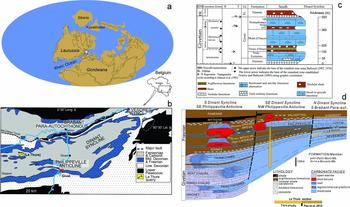
During Middle Devonian time, Belgium was situated around 20°S (Torsvik et al. Reference Torsvik, Van der Voo, Preeden, Niocaill, Steinberger, Doubrovine, van Hinsbergen, Domeier, Gaina, Tohver, Meert, McCausland and Cocks2012) along Laurussia's southeastern margin (Fig. 1a). During Givetian time, this area was part of a wide carbonate platform along the northern passive margin of the Rhenohercynian Ocean. In terms of modern geography, the Givetian carbonate platform extends from the Avesnois Basin (northern France) to Aachen (western Germany) in the east. In addition, isolated carbonate complexes grew in the east and the southwest, i.e. the Rhenish Massif (Rheinisches Schiefergebirge, e.g. Brilon Reef Complex; Pas et al. Reference Pas, Da Silva, Cornet, Bultynck, Königshof and Boulvain2013) and Torbay Reef Complex of SW England, respectively (Torbay Reef Complex; Garland, Tucker & Scrutton, Reference Garland, Tucker and Scrutton1996). In Belgium, Givetian sediments crop out all along the border of the Dinant and Vesdre synclines, in the Philippeville Anticline and along the southern border of the Brabant Massif, within the Brabant Para-autochthonous region and the Haine–Sambre–Meuse Overturned Thrust sheets (for precise location see Belanger et al. Reference Belanger, Delaby, Delcambre, Ghysel, Hennebert, Laloux, Marion, Mottequin and Pingot2012, fig. 5), which are all large-scale units of the Rhenohercynian fold-and-thrust belt (Fig. 1b). This extensive tectonic structure was formed during Carboniferous to Permian time as a consequence of the collision between the Laurussia and Gondwana supercontinents during the Variscan orogeny. Several authors (e.g. Molina Garza & Zijderveld, Reference Molina Garza and Zijderveld1996; Zwing et al. Reference Zwing, Matzka, Bachtadse and Soffel2005; Da Silva et al. Reference Da Silva, Dekkers, Mabille and Boulvain2012) highlighted that during this orogeny, the rocks belonging to the Rhenohercynian fold-and-thrust belt were affected by remagnetization.
(a) Location of Belgium on the eastern margin of Laurussia during Devonian time (simplified from Kiessling, Flügel & Golonka, Reference Kiessling, Flügel and Golonka2003). (b) Simplified geological map of southern Belgium with location of La Thure (NW of the Dinant Syncline) and Givet (south of the Dinant Syncline). For the location of the Haine–Sambre–Meuse Overturned Thrust sheets refer to the map of Belanger et al. (Reference Belanger, Delaby, Delcambre, Ghysel, Hennebert, Laloux, Marion, Mottequin and Pingot2012) (c) Givetian lithostratigraphic column established for the southern border of the Dinant Syncline showing conodont zones (Bultynck, Reference Bultynck1974, Reference Bultynck1987; Gouwy & Bultynck, Reference Gouwy and Bultynck2003) and the main transgressive–regressive cycles (Johnson, Klapper & Sandberg, Reference Johnson, Klapper and Sandberg1985). (d) Integrated lithostratigraphical and palaeogeographical framework for the Givetian and Frasnian of Belgium. Relative positions of the reefs show the retrogradation–progradation patterns of the carbonate platforms (modified after Boulvain et al. Reference Boulvain, Mabille, Poulain and Da Silva2009).

The La Thure section is located in southwestern Belgium (50°17′11″N, 4°09′40″E) and belongs to the northwestern border of the Dinant Syncline (Fig. 1b). The section covers sediments ranging from the Givetian to the lower Frasnian. Recently, the Frasnian part of the La Thure section has been the topic of a multi-disciplinary study (sedimentology, geochemistry and MS) published by Pas et al. (Reference Pas, Da Silva, Devleeschouwer, De Vleeschouwer, Labaye, Cornet, Michel, Boulvain, Da Silva, Whalen, Hladil, Chadimova, Chen, Spassov, Boulvain and Devleeschouwer2015).
The Givetian lithostratigraphic units, according to the Belgian Givetian lithostratigraphic chart defined in Bultynck & Dejonghe (Reference Bultynck, Dejonghe, Bultynck and Dejonghe2001), were established for the southern border of the Dinant Syncline. They are associated with conodont zones (Bultynck, Reference Bultynck1974, Reference Bultynck1987; Gouwy & Bultynck, Reference Gouwy and Bultynck2003) and with the main transgression–regression cycles (Johnson, Klapper & Sandberg, Reference Johnson, Klapper and Sandberg1985) (Fig. 1c). Five formations lying in the Givetian crop out on the southern border of the Dinant Syncline. From base to top those formations are, respectively (Fig. 1c, d): (1) the upper part of the Hanonet; (2) Trois-Fontaines; (3) Terres d'Haurs; (4) Mont d'Haurs and (5) Fromelennes formations. Lateral equivalents of these five formations on the northern border of the Dinant Syncline are the Nèvremont and Le Roux formations (Fig. 1d). In the La Thure section, the upper part of the Terre d'Haurs Fm and the Mont d'Haurs and Fromelennes formations are observed (see also local geological map of Hennebert, Reference Hennebert2008), and their lithologies remain relatively similar compared to the Dinant Syncline southern border. However, the Mont d'Haurs and Fromelennes formations show a reduced thickness, respectively, of ~50% and ~25% (in comparison with the formations as defined in the type area). Considering the similar lithologies, we assume that the Givetian conodont biostratigraphy developed for the southern border of the Dinant Syncline (Bultynck, Reference Bultynck1974, Reference Bultynck1987; Gouwy & Bultynck, Reference Gouwy and Bultynck2003; Narkiewicz, Narkiewicz & Bultynck, Reference Narkiewicz, Narkiewicz, Bultynck, Becker, Königshof and Brett2015) can convey an idea of the extension of the conodont zones. According to this, the Givetian strata in the La Thure section likely covers an interval extending from the early Givetian Polygnathus timorensis Zone to the late Givetian Lower Mesotaxis falsiovalis Zone.
Based on Givetian sections from the Avesnes (northern France), Dinant and Namur basins, which belong to the Dinant Syncline, Haine–Sambre–Meuse Overturned Thrust sheets and Brabant Para-autochthonous region, Préat & Mamet (Reference Préat and Mamet1989) defined 13 microfacies covering a large range of environments extending from open-marine and under the wave action zone, to reefal complexes, lagoons and evaporitic sabkhas including laminites and palaeosols. According to these authors, the Belgian Givetian carbonate platform was composed of several kilometre-sized faulted blocks. Furthermore, as summarized by Boulvain et al. (Reference Boulvain, Mabille, Poulain and Da Silva2009), the Givetian deposits in Belgium can be divided into three ENE–WSW-directed facies belts (Fig. 1d): (1) the most distal part of the platform (‘southern belt’) located along the southern margin of the Dinant Syncline is characterized by ramp and off-reef to internal platform deposits; (2) the ‘central belt’ cropping out in the Philippeville Anticlinorium and southeast of the Dinant Syncline, which is poorly known, and (3) a ‘northern belt’, in the north of the Dinant Syncline and in the south of the Brabant Para-autochthonous region, characterized mainly by the shallowest marine deposits and alluvial deposits. The shallowest to deepest depositional environments of the Givetian platform are in accordance with the general northerly transgressive sea-level trajectory, which progressively submerged the Old Red Continent from Emsian to late Frasnian time (Préat & Bultynck, Reference Préat, Bultynck, Bultynck and Dejonghe2006).
3. Methods
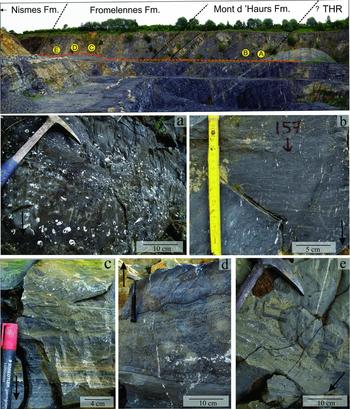
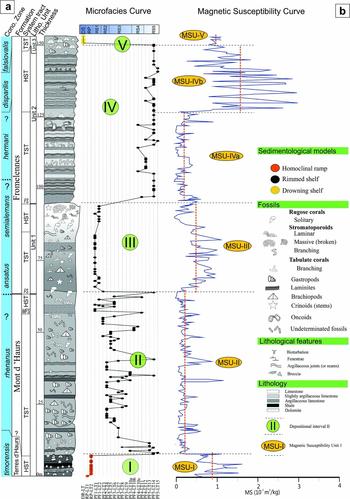
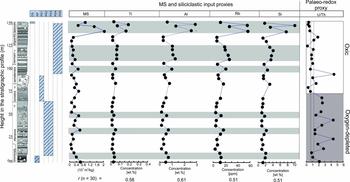
A detailed bed by bed description and sampling of the La Thure section (Fig. 2; 153 m in thickness) was performed with a sampling interval of 25 to 45 cm, depending on the outcrop condition. MS measurements were undertaken on all the collected samples (~400 samples). Each sample was measured three times with a KLY-3 (Kappabridge from AGICO) and weighted with a precision of 0.01 g. This allows the definition of the low-field mass-calibrated MS for each sample and the establishment of the MS curve (Fig. 10a). For microfacies analysis we selected around 200 samples for thin-section preparation (thin-sections are stored at the sedimentary petrology laboratory of the University of Liège, samples TUR 100–TUR 311). The textural classification used to characterize the microfacies follows Dunham (Reference Dunham and Ham1962) and Embry & Klovan (Reference Embry and Klovan1972). Estimation of sorting is based on the visual charts of Pettijohn, Potter & Siever (Reference Pettijohn, Potter and Siever1972) and visual percentage estimations are based on Baccelle & Bosellini (Reference Baccelle and Bosellini1965). Thin-sections were stained using Dickson solution to differentiate calcite, dolomite, ferroan calcite and ferroan dolomite (Dickson, Reference Dickson1965). A group of 30 samples (~1 sample per 5 m) was analysed for major- and trace-element concentrations at Activation Laboratories Ltd (Ancaster, Ontario, Canada). Analyses were performed by inductively coupled plasma mass spectrometry (ICP-MS) (major, minor and trace elements). The samples were prepared by fusion with sodium peroxide, Na2O2, which totally solubilizes all the minerals analysed in an aqueous solution after treatment.
Top: view of the Givetian section in the La Thure quarry with the three investigated formations and the location of photographs. (a–e) Close up of different facies, the black arrows point to the stratigraphic base. THR – Terres d'Haurs Fm. (a) Gastropod-rich levels in the lower portion of the Mont d'Haurs Formation. (b) Laminated limestone, showing vertical burrows filled by calcite exposed within the lower portion of Unit 1, Mont d'Haurs Fm. (c) Slightly yellowish laminated limestone commonly occurring within Unit 2, Fromelennes Fm. (d) Decimetre-thick level (delimited by dashed lines) enriched in branching stromatoporoids (note that the lower boundary of this level is characterized by an erosion surface while the upper boundary is overlain by a thin laminated fabric) – erratic block near upper portion of the section corresponding to the Fromelennes Fm. (e) Intraformational breccia overlying a level of laminated limestone.

4. Results
4.a. Description of the La Thure section (Fig. 2)
The measured Givetian section in the La Thure quarry is ~153 m thick with strata oriented N90°E and dipping 70°S. According to the Belgian Givetian lithostratigraphic charts defined by Préat & Bultynck (Reference Préat, Bultynck, Bultynck and Dejonghe2006) and data from the geological map of Hennebert (Reference Hennebert2008), the Terres d'Haurs, Mont d'Haurs and Fromelennes formations can be identified. In the La Thure section, only the upper part of the Terre d'Haurs Fm is observed. It is followed by the Mont d'Haurs and Fromelennes formations. These last two formations show reduced thicknesses, respectively, of ~50% and ~25% in comparison with that observed in the type areas, as presented in Figure 1c.
The Terres d'Haurs Fm (~8 m thick; Figs 1, 2) corresponds mainly to centimetre- to decimetre-thick dark-grey highly argillaceous limestone beds intercalated with decimetre-thick limestone locally rich in crinoid debris. This formation lies within the timorensis Zone.
The Mont d'Haurs Fm (~56 m thick; Figs 1, 2) is mainly composed of several decimetre-thick, well-bedded black to dark-grey limestones. Conspicuous within the lower and middle part are abundant gastropod shells (scattered within the sediment or organized into packed decimetre-thick levels parallel to the bedding; Fig. 2a). Other observed fossils include tabulate corals, stromatoporoids, crinoids and brachiopods. Locally, a well-developed bioturbated fabric can be observed (Fig. 2b). This formation lies within the rhenanus (Lower P. varcus) Zone.
The Fromelennes Fm (~85 m thick; Figs 1, 2) can be divided into three lithological units (U1–U3). Unit 1 (U1; from 64 to 93 m) is characterized by grey decimetre- to metre-thick beds. The proportion of gastropods is low and the abundance of reef-builder debris such as tabulate and rugose corals, and lamellar, branching and bulbous stromatoporoids is significant. Crinoids and brachiopods are also a major component of the faunal assemblage. The topmost part of Unit 1 is characterized by two metre-thick limestone beds showing abundant and large debris of reef-building organisms. Locally, stromatoporoids reach more than 50 cm in size. Unit 2 (U2; from 93 to 150 m) is mainly composed of decimetre-sized light-grey to ocherous limestone beds (corresponding to dolomitized beds). The conspicuous characteristic of this U2 is the abundance of a thin millimetre- to centimetre-sized laminar fabric (Fig. 2c). The fauna is usually poorly represented throughout the unit, whereas within the upper part, centimetre- to decimetre-thick, well-sorted laminated levels enriched in branching stromatoporoids such as Stachyodes and Amphipora occur (Fig. 2d). These levels are usually overlying laminated limestone or dolostone with a sharp erosive lower boundary. Locally, a well-preserved intraformational breccia developed from the laminated limestone can be observed (Fig. 1e). This formation covers a stratigraphic interval ranging from the ansatus to Lower falsiovalis zones.
Throughout Unit 2, organisms are essentially debris of reef-builders, such as branching and bulbous stromatoporoids and branching tabulate corals. The overlying Unit 3 (U3; from 150 to 153 m) is mainly characterized by decimetre- to several decimetre-thick dark-grey to dark-blue beds locally showing abundant brachiopod shells and crinoids. Unit 3 is overlain by ocherous limestone interlayered with black carbonaceous limestone belonging to the Nismes Fm of Frasnian age (for a detailed description see Pas et al. Reference Pas, Da Silva, Devleeschouwer, De Vleeschouwer, Labaye, Cornet, Michel, Boulvain, Da Silva, Whalen, Hladil, Chadimova, Chen, Spassov, Boulvain and Devleeschouwer2015).
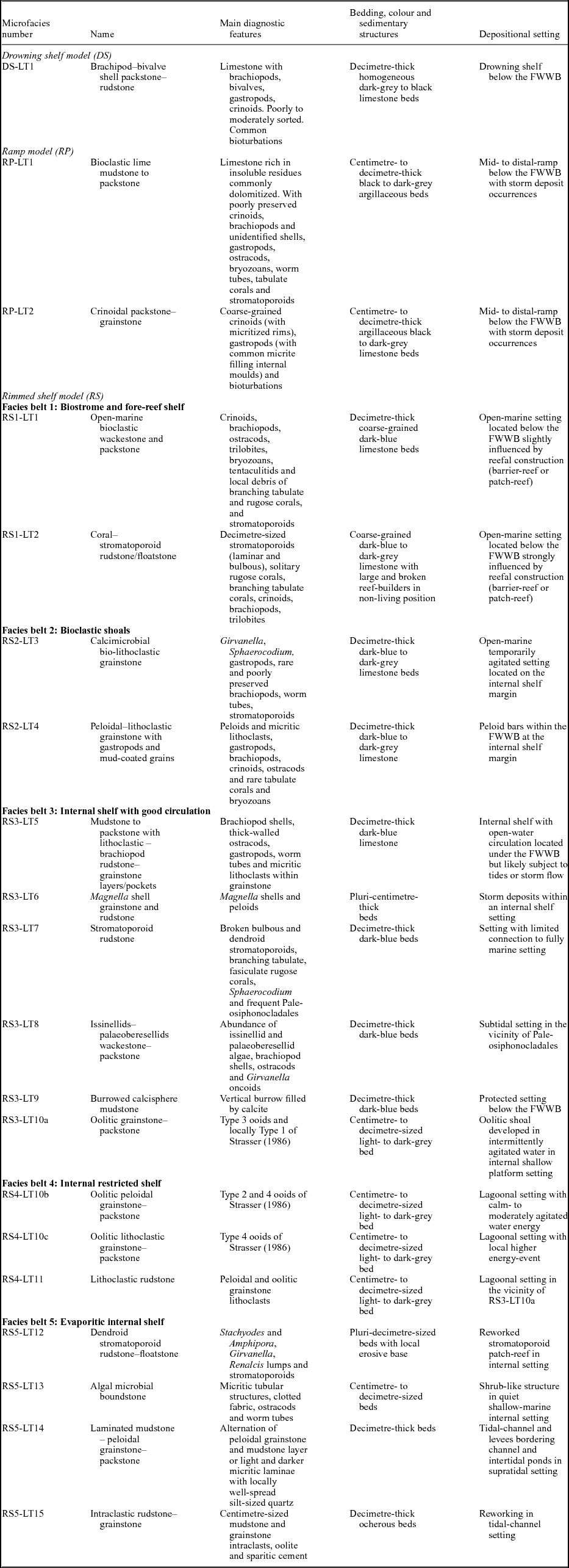
4.b. Microfacies descriptions of the La Thure section (Table 1; Figs 3–8)
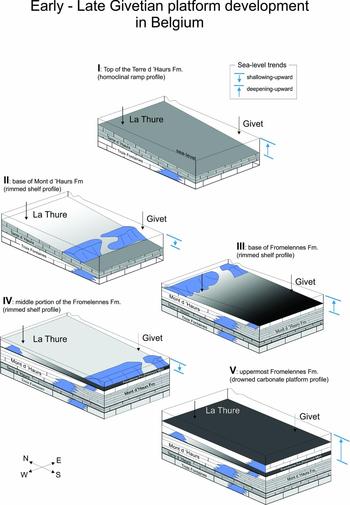
The lower–upper Givetian sequence in the La Thure section represents an outstanding example of the extensive diversity occurring in the Middle Devonian reefal realm. The description of texture, faunal and floral assemblages, preservation and sorting of organisms in combination with selected literature (Neumann, Pozaryska & Vachard, Reference Neumann, Pozaryska and Vachard1975; Strasser, Reference Strasser1986; Préat, Ceuleneer & Boulvain, Reference Préat, Ceuleneer and Boulvain1987; Skompski & Szulczewski, Reference Skompski and Szulczewski1994) allowed us to define 18 microfacies, which are summarized in Table 1 and described below. Texture reflects the level of water agitation during deposition, while the biotic composition is a consequence of more complex parameters such as the oxygen level, the water depth, the level of restriction from the open sea, the hydrodynamic conditions, etc. Our microfacies classification follows approximately the distal to proximal depositional setting (considering that some microfacies could be laterally equivalent). Furthermore, some microfacies represent event-like features, and are thus not limited to one or another depositional setting. For example, limestone with a concentration of shell material can be formed in different shallow-marine and deep-marine facies zones (e.g. Flügel, Reference Flügel2004, p. 799). Therefore, our classification of microfacies in a distal–proximal transect considers (1) the stratigraphic position, (2) the lateral extension and (3) the taphonomy of fossils that characterize the shell beds within the sedimentary sequence (e.g. Kidwell & Bosence, Reference Kidwell, Bosence, Allison and Briggs1991; Fürsich & Oschmann, Reference Fürsich and Oschmann1993). The obtained microfacies curves demonstrate a complex evolution of carbonate platform types throughout the early–late Givetian interval. Starting with a homoclinal ramp profile the carbonate platform evolves through a discontinuously rimmed shelf to a drowning shelf in latest Givetian time. Interpreted microfacies are thus considered to belong to a wide spectrum of carbonate platform profiles with two end-members. The subdivisions between carbonate platform types and related interpretations are discussed in Section 5. The system used to denote the facies underlines both the model type (DS – drowning shelf, RS – rimmed shelf and RP – ramp) and the studied locality (LT – La Thure).
Synthesis of microfacies for the Givetian in the La Thure section (western Belgium)

4.b.1. Drowning shelf: DS microfacies
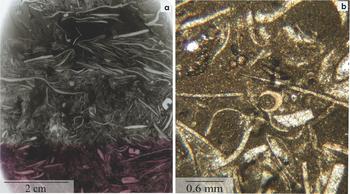
DS-LT1: mudstone and wackestone with densely packed brachiopod–bivalve shell levels (Fig. 3)
This microfacies exclusively occurs within Unit 3 of the Fromelennes Fm. It is mainly characterized by mudstone and wackestone textures, but, locally, densely packed centimetre-thick brachiopod–bivalve shell packstone and rudstone levels occur. The transition from mudstone–wackestone to these packed levels is gradual (erosional surfaces are not observed). Packed levels correspond to centimetre-sized accumulations of brachiopod (dominant), bivalve and gastropod shells embedded in a micritic matrix and show clear bioturbated fabrics. The shells of the brachiopods are relatively well preserved (locally articulated shells occur) and show sizes varying from 0.3 to 2.5 cm with an average of around 0.6 cm. Large bivalve shells are commonly broken but juveniles are better preserved. Sorting is poor to moderate and bioturbation commonly affects the sediment; this is underlined by the reorganization of shells (‘nesting’). Other fossils include common crinoid ossicles and plates, rare umbella (i.e. charophycean algae, Mamet, Reference Mamet1970), solitary rugose corals, ostracods, stromatoporoid debris and unidentified bioclasts. Crinoids are relatively well preserved and often millimetre in size. The matrix is a fine-grained micrite, locally dolomitized.
Interpretation
Brachiopod and bivalve shells embedded in a micritic matrix and the common occurrence of crinoids point to an open-marine setting with relatively quiet conditions prior to deposition. The poor to moderate sorting of shells and the vertical bioturbation corroborate this interpretation. According to Fürsich & Pandey (Reference Fürsich and Pandey1999) the significant density of shells may be the result of several processes: a high productivity combined with low sedimentary rate and occasional winnowing. According to Mamet (Reference Mamet1970) the occurrence of umbella indicates a nearshore setting and abnormal levels of salinity (high or poor) while echinoderms and brachiopods are in favour of open-marine conditions. Considering the thick inter- to supratidal lagoonal sequence developed beneath (e.g. Unit 2), deposition of DS-LT1 could have occurred within a proximal shelf setting concurrently with the re-establishment of open-marine conditions. This hypothesis is also confirmed by the overlying open-marine Frasnian shale sequence (Pas et al. Reference Pas, Da Silva, Devleeschouwer, De Vleeschouwer, Labaye, Cornet, Michel, Boulvain, Da Silva, Whalen, Hladil, Chadimova, Chen, Spassov, Boulvain and Devleeschouwer2015). The occurrence of bioclasts from various environments might be the result of distal tempestites. However, the high-rate of bioturbation that affected the sediment after deposition destroyed original fabrics and hampers testing of this hypothesis. In conclusion, this microfacies could correspond to an accumulation of shells in a calm open-marine setting, subjected to storm-related winnowing and bioturbation, probably during a time of transgression (e.g. end Givetian transgressive pulse).
4.b.2. Ramp: RP microfacies
RP-LT1: bioclastic lime mudstone to packstone
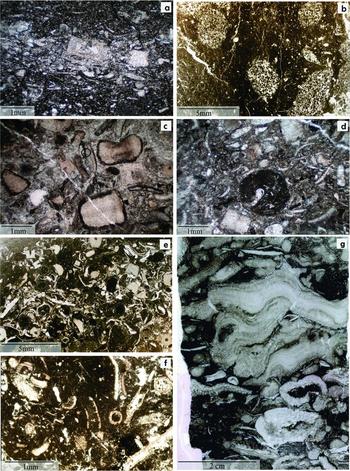
This microfacies only occurs at the base of the studied section attributed to the Terre d'Haurs Fm. It is characterized by a commonly dolomitized, fine-grained matrix, an open-marine faunal assemblage and the occurrence of millimetre- to centimetre-thick layers rich in poorly preserved crinoids and finely broken skeletal debris (Fig. 4a). Fossils are poorly to moderately preserved, except for some larger tabulate corals and stromatoporoids. The main fauna is represented by brachiopods (locally complete centimetre-sized shells) and other unidentified shells (often finely broken and strongly recrystallized) and crinoid debris (from 0.4 to 2 mm). Less common organisms are gastropods, ostracods, branching bryozoans, worm tubes and rare tabulate corals and stromatoporoids. Locally, the sediment is significantly bioturbated and shows clear examples of circular burrows filled by peloidal grainstone (Fig. 4b). In other cases, bioturbation is recognized by the reorganization of bioclasts. Rarely, brachiopod shells show infra-millimetre-thick encrustation by porostromates. Finely broken unidentifiable shells are locally the main constituents of sediment corresponding to shell hash. Crinoidal-rich layers, associated with fine-grained brachiopod and ostracod shells, show a packstone texture and the transition from lime mudstone–wackestone in those layers is gradual. Insoluble residues are commonly observed between the fine-grained bioclasts.
Microfacies DS-LT1 – drowning shelf – from the Givetian of the La Thure section, Belgium. Photomicrographs of thin-sections are oriented perpendicular to the bedding. Numbers preceded by ‘TUR’ correspond to bed numbers. (a) Shell packstone and rudstone (TUR 310, scanned thin-section, with alizsarine staining). (b) Shell packstone including umbella (centre of the photograph).

Microfacies RP-LT1–2 and RS1-LT1–2 from the Givetian of the La Thure section, Belgium. Photomicrographs of thin-sections are oriented perpendicular to the bedding. Numbers preceded by ‘TUR’ correspond to bed numbers. (a) RP-LT1 mid- to distal-ramp setting: crinoidal packstone rich layer within a dolomitized mudstone and wackestone (TUR 100b, transmitted light). (b) RP-LT1 mid- to distal-ramp setting: bioclastic mudstone–wackestone showing peloidal grainstone filling burrows (TUR 108, transmitted light). (c) RP-LT2 mid- to distal-ramp setting: coarse-grained grainstone, with crinoids showing micritized rim (TUR 100, transmitted light). (d) RP-LT2 mid- to distal-ramp setting: crinoidal packstone showing gastropod internal moulds filled by micrite (TUR 100, transmitted light). (e) RS1-LT1 biostrome and fore-reef shelf: bryozoan crinoidal packstone (TUR 181c, transmitted light). (f) RS-LT1 external reef and fore-reef shelf: bioclastic packstone showing remains of issinellid algae (TUR 195, transmitted light). (g) RS1-LT2 biostrome and fore-reef shelf: lamellar stromatoporoid rudstone (TUR 202, scanned thin-section).

Interpretation
Crinoids, brachiopods and bryozoans indicate a depositional environment below the fair weather wave base (FWWB) within open-marine conditions. The common occurrence of gastropods implies a shallow-marine environment while moderate to poorly preserved levels of bioclasts indicate that organisms were subjected to relatively long exposure on the sea-floor prior to burial. The occurrence of millimetre- to centimetre-thick layers mainly characterized by crinoid debris accumulations indicates high-energy events such as tempestites that triggered transport and concentration of debris basinwards. The dominance of crinoid debris in those layers also suggests the occurrence of a crinoidal meadow in a shallower location. The lack of clues from microfacies RP-LT1 makes it difficult to determine whether this microfacies represents a homoclinal ramp or an external shelf reef. Occurrences of this microfacies within lithologies belonging to the Terre d'Haurs Fm, which are commonly interpreted as ramp-related in southern Belgium (Mabille et al. Reference Mabille, De Wilde, Hubert, Boulvain and Da Silva2008a ; Boulvain et al. Reference Boulvain, Mabille, Poulain and Da Silva2009), suggest deposition on a ramp profile. In conclusion, the depositional setting might correspond to a mid- to distal-ramp located below the FWWB and locally influenced by higher energy events such as storms that triggered the transport of these bioclasts towards deeper marine areas.
RP-LT2: crinoidal packstone–grainstone (Fig. 4c)
This microfacies only occurs in a few decimetre-thick beds located at the base of the studied section attributed to the Terre d'Haurs Fm and is intercalated within microfacies RP-LT1. This microfacies is commonly dolomitized but the texture and faunal assemblage are preserved locally. When dolomitization does not affect the main characteristics of this microfacies, an abundance of crinoid ossicles and plates showing a micritized rim (Fig. 4c) is typical. Crinoids range from 0.5 to 2 mm with an average size of around 1 mm. Other fossils are generally broken and represented by gastropods, brachiopods, ostracods, rare bryozoans and finely comminuted unidentifiable debris. Gastropods commonly display an internal mould filled by micritic matrix (Fig. 4d). Burrows occur and are underlined by a core filled with finely broken organisms in a micritic matrix.
Interpretation
The abundance of crinoids and the occurrence of brachiopods and bryozoans within limestone with a packstone–grainstone texture suggest an open-marine environment likely close to crinoidal meadows and above the FWWB. Crinoid debris and gastropods packed in centimetre-thick levels surrounded by microfacies RP-LT1 suggest a deposition related to high-energy events, and in the vicinity of the setting assumed for RP-LT1. Indeed, RP-LT2 is surrounded by microfacies RP-LT1, and RP-LT1 is interpreted as having been deposited in an open-marine mid- to distal-ramp setting below the FWWB.
4.b.3 Rimmed shelf: RS microfacies
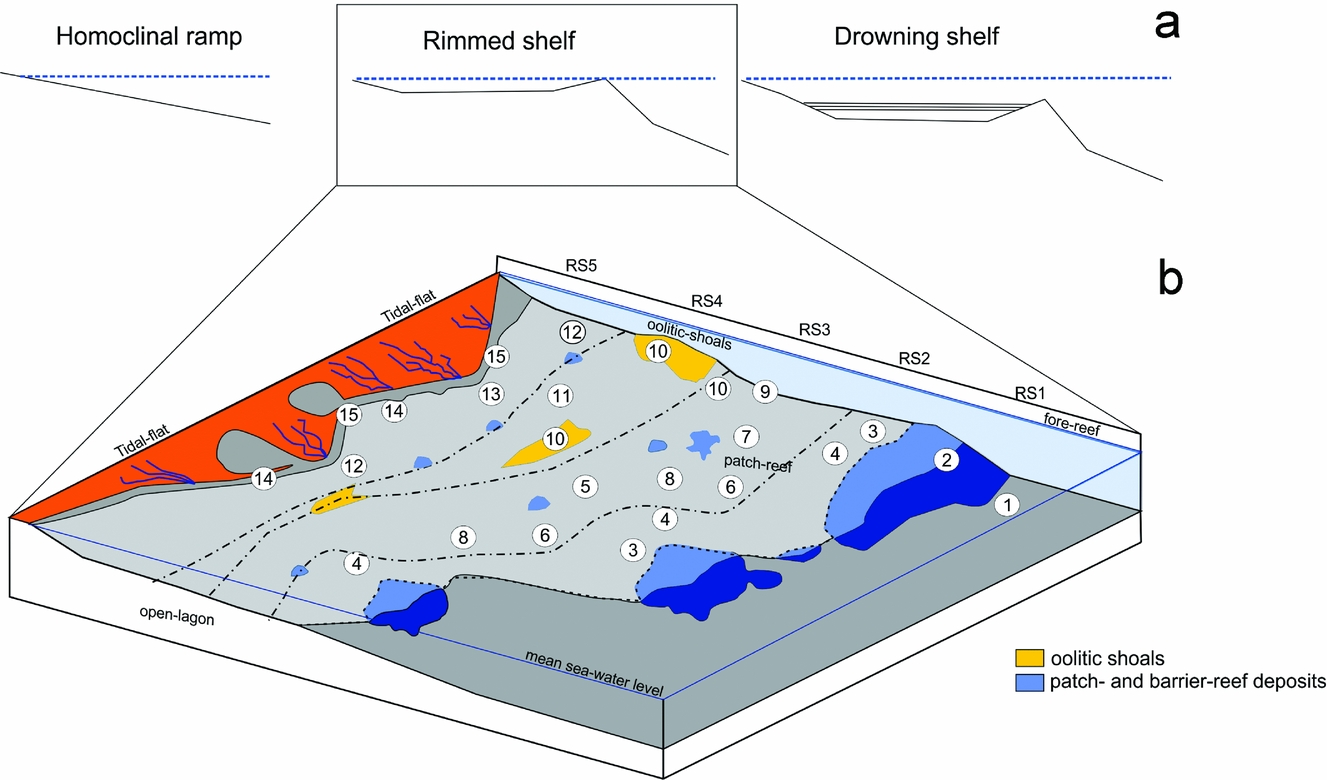
The complexity and diversity of depositional settings occurring in this carbonate rimmed shelf profile leads to its subdivision into five facies belts (RS1–RS5): (RS1) biostrome and fore-reef shelf; (RS2) bioclastic shoals; (RS3) internal shelf with fair circulation; (RS4) internal restricted shelf; (RS5) internal evaporitic shelf.
Facies belt 1: biostrome and fore-reef shelf
RS1-LT1: open-marine bioclastic wackestone and packstone (Fig. 4e, f)
This microfacies is characterized by open-marine faunal assemblages, embedded in a micritic matrix, showing poor to moderate sorting. Fossils are mostly broken and are represented in decreasing order of abundance by crinoids, brachiopods, ostracods (thick and thin-shelled), bivalves, gastropods, branching and fenestellid bryozoans, trilobites, tentaculitids, Paleosiphonocladales (e.g. issinellids; Fig. 4f) and abundant unidentifiable shells. Locally, debris of branching tabulate corals, rugose corals and poorly preserved branching stromatoporoids occur. From time to time, bioclasts are crushed and very poorly preserved displaying an average size of 0.2 mm. Bivalve shells locally show an irregular micritic envelope up to 0.5 mm thick. Thin shells represent up to 80% of the biological constituents. Complete brachiopod shells are locally filled by a clotted fabric. Pressure-solution processes forming horse-tails and an iden-supported fabric commonly occur. ‘Iden-supported’ is a fabric where idens (bodies that behave as homogeneous entities under chemical and physical conditions) are densely packed and bound by irregular, anastomosing microstylolites (Logan & Semenuik, Reference Logan and Semenuik1976) (see also caption of fig. 7.18b, p. 318 in Flügel, Reference Flügel2004). Argillaceous-rich millimetre-thick layers and seams parallel to the bedding also occur from time to time.
Interpretation
The abundance of open-marine biota such as trilobites, tentaculitids, bryozoans and crinoids embedded in poorly to moderately sorted micritic sediment indicates deposition within a relatively quiet open-marine setting, likely below the FWWB. The occurrence of reef-building organisms and shallow-water biota/flora, such as gastropods and Paleosiphonocladales, suggests an influence of a shallow to moderate shelf setting. Furthermore, the occurrence of reef-building organisms is in favour of a setting located in the vicinity of reefal constructions such as patch- or barrier-reefs.
RS1-LT2: coral–stromatoporoid rudstone/floatstone (Fig. 4g)
This microfacies occurs mainly in metre-thick beds in the upper part of the Mont d'Haurs Fm and lowermost part of the Fromelennes Fm. It is characterized by the dominance of several decimetre-scaled laminar and bulbous stromatoporoids, branching tabulate corals, encrusting stromatoporoids and solitary rugose corals. These coral and stromatoporoid skeletons are always reworked and broken. The area between the skeletal debris is filled by small and commonly unidentifiable bioclasts embedded in a dark micritic matrix showing a wackestone to packstone texture and commonly dolomitized. Identified bioclasts are trilobites, brachiopods, gastropods, ostracods and rare Paleosiphonocladales. The sediment filling the space between large organisms contains detrital quartz and is relatively similar to RS1-LT1.
Interpretation
The abundance of various and large-sized (several decimetre-sized) coral–stromatoporoid debris in a rudstone/floatstone texture indicates a depositional setting strongly influenced by shallow-marine reefal constructions and likely adjacent to RS1-LT1. A wackestone–packstone texture and bioclasts characterizing the space between large reef-builders are in favour of an environment located below the FWWB in the vicinity of RS1-LT1. The poor to moderate preservation and sorting of reef-building organisms suggests a reworking likely by wave action and a downward transport by gravity processes such as storm or debris-flows.
Facies belt 2: bioclastic shoals
RS2-LT3: calcimicrobial bio-lithoclastic grainstone
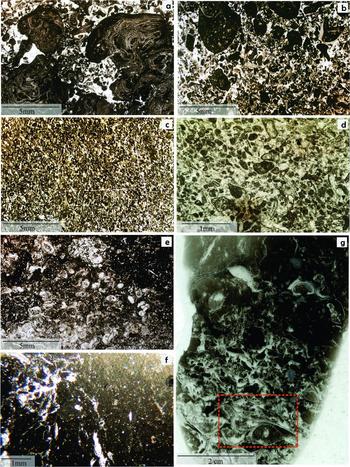
This microfacies is characterized by the common occurrence of the calcimicrobe Girvanella/Sphaerocodium (Fig. 5a) as encrusters and oncoid/lump builders. The Girvanella encrustation mainly occurs on gastropod shells and can reach up to several millimetres in thickness. Oncoids and lumps are also frequent and locally millimetre-scaled. Other skeletons are poorly preserved and consist of gastropods (locally complete), brachiopods, worm tube debris (with encrusting Sphaerocodium), rare stromatoporoids and crinoids. Another major characteristic of RS2-LT3 is the common occurrence of sub-angular to rounded, variously sized (0.3 to 2 mm) lithoclasts (Fig. 5b) constituted either of peloidal grainstone (e.g. RS2-LT4) or mudstone–wackestone (e.g. RS3-LT5). Locally, calcimicrobial encrustation surrounds lithoclasts of bio- and lithoclastic packstone.
Microfacies RS2-LT3–4 and RS3-LT5 from the Givetian of the La Thure section, Belgium. Photomicrographs of thin-sections are oriented perpendicular to the bedding. Numbers preceded by ‘TUR’ correspond to bed numbers. (a) RS2-LT3 bioclastic shoals: calcimicrobe Sphaerocodium oncoidal grainstone–rudstone (TUR 200b, transmitted light). (b) RS2-LT3 bioclastic shoals: lithoclastic grainstone–rudstone (TUR 189, transmitted light). (c) RS2-LT4 bioclastic shoals: fine-grained peloidal bioclastic grainstone (TUR 163c, transmitted light). (d) RS2-LT4 bioclastic shoals: peloidal grainstone with mud-coated grains (TUR 138b, transmitted light). (e) RS3-LT5 internal shelf with good circulation: wackestone showing worm tube accumulation (TUR 157, transmitted light). (f) RS3-LT5 internal shelf with good circulation: mudstone–wackestone with fenestrae (TUR 176, transmitted light). (g) RS3-LT5 internal shelf with good circulation: coarse-grained brachiopod shell level overlain by a fenestral mudstone–wackestone (TUR 176, scanned thin-section).

Interpretation
The common occurrence of the calcimicrobe Girvanella as coatings on gastropods and oncoids favours a euphotic internal shelf setting. According to Scholle & Ulmer-Scholle (Reference Scholle and Ulmer-Scholle2003) oncoid-like Girvanella can form in a setting episodically subjected to strong wave action. The grainstone texture and the occurrence of lithoclasts concur with this interpretation. The local occurrence of brachiopods and crinoids argues for an open-marine environment. This microfacies is likely formed adjacent to an external shelf subjected to strong wave action. The uncommon occurrence of reef-builders indicates that this depositional setting was little influenced by reefal construction.
RS2-LT4: peloidal–lithoclastic grainstone with gastropods (Fig. 5c, d)
Peloids represent over 80% of the grain assemblage; based on the variable size (from 50 to 200 µm) and shape (from sub-angular to sub-rounded) most of them are considered lithic peloids (variable shape and size ranging between 50 and 150 µm; Flügel, Reference Flügel2004, p. 112). Micritic lithoclasts (e.g. micritic allochems larger than 200 µm) are commonly observed. Common poorly preserved and rounded gastropod debris, brachiopods, crinoids, rare ostracod shells and rare tabulate corals, stromatoporoids and bryozoans are observed. When bioclasts are smaller than 500 µm they show intense micritization. Mud-coated grains are common, and sorting of the sediment is moderate to good within a grainstone texture, although local packstone texture occurs.
Interpretation
The main characteristic of RS2-LT4 is the abundance of lithic peloids and micritic lithoclasts. The origins of such allochems are interpreted as syn-sedimentary and post-sedimentary reworking of carbonate mud and micrite. The origins of the other peloids are varied: faecal, micritized grains, direct algal origin and intraclasts (Tucker, Reference Tucker2001). Based on the locally intense micritization of the bioclasts, the origin of many of these other peloids could be related to micritization. The common occurrence of gastropods points to an internal shelf environment. The relatively good sorting and grainstone texture without any sedimentary structure may suggest the occurrence of peloid bars near the margin of the internal shelf where agitation is important within the FWWB. Mud-coated grains favour this interpretation. Furthermore, the occurrence of tabulate corals and stromatoporoids indicates a reefal influence. The local pelmicritic texture might be related to periods of lower energy allowing micritic mud to settle.
Facies belt 3: internal shelf with fair circulation
RS3-LT5: mudstone to packstone with lithoclastic–brachiopod–rudstone–grainstone layers
This mudstone–packstone is characterized by a well-developed stylonodular fabric, which commonly hampers a good observation of the original texture. Locally, a significant proportion of clay particles and insoluble residues occur. Faunal assemblages are dominated by brachiopod shells, gastropods, thick-walled ostracods and worm tubes (Fig. 5e). Irregular fenestrae (Fig. 5f) are a common occurrence in the mudstone texture. Peloidal grainstone (e.g. RS2-LT4) commonly fills the internal moulds of brachiopod shells. Another dominant character of this microfacies is the local occurrence of brachiopod-rich, lithoclastic grainstone–rudstone layers (Fig. 5g). Within these layers both lithoclasts and brachiopod shells are abundant (Fig. 6a). Locally, there are also a few grainstone–rudstone pockets, dominated by lithoclasts. Lithoclasts are essentially micritic, well rounded and infra-millimetre to millimetre-scaled while brachiopods range from 0.3 to 1 cm in size and are locally articulated. Grainstone–rudstone layers and pockets are centimetre-scaled and their boundary with the mudstone–wackestone is not clearly visible owing to pressure-solution processes. Within this microfacies, bioturbation and a local clotted fabric occur. When argillaceous material is abundant, dolomitization is well developed.
Microfacies RS3-LT5–8–10a and RS4-LT10b–c from the Givetian of the La Thure section, western Belgium. Photomicrographs of thin-sections are oriented perpendicular to the bedding and were all made in transmitted light. (a) RS3-LT5 internal shelf with good circulation: brachiopod shell rudstone showing whole shell filled by a clotted fabric (for location see inset in Fig. 5g) (TUR 176). (b) RS3-LT6 internal shelf with good circulation: whole ‘Magnella’ shell grainstone (TUR 133). (c) RS3-LT6 internal shelf with good circulation: focused on conical shells like ‘Magnella’ (TUR 133). (d) RS3-LT8 internal shelf with good circulation: dolomitized packstone rich in palaeoberesellid (TUR 149b). (e) RS3-LT8 internal shelf with good circulation: Girvanella oncoid within a rich issinellid packstone (TUR 156). (f) RS3-LT10a internal shelf shoal setting: moderately sorted oolitic grainstone (oolite Type 3) with common peloids (TUR 159c). (g) RS4-LT10a internal restricted shelf shoal setting: detail on Type 3 oolite (Strasser, Reference Strasser1986), peloids and aggregate grains within a moderately sorted oolitic grainstone (TUR 159a). (h) RS4-LT10b internal restricted shelf lagoonal setting: micritized oolite grainstone (oolites are mainly of Type 2 and 4 – TUR 180).

Interpretation
The mudstone–wackestone texture and the faunal assemblage and its relatively good preservation indicate a quiet depositional setting for this microfacies, allowing settling of mud and the preservation of organisms as in microfacies RS2-LT3. However, the faunal assemblage implies an internal shelf with a fair circulation. Grainstone–rudstone layers or pockets occurring in this microfacies suggest a temporary storm-induced increase in the water energy level allowing an accumulation of brachiopods and the reworking of micritic clasts in a grainstone–rudstone texture.
RS3-LT6: Magnella shell grainstone and rudstone (Fig. 6b, c)
This microfacies only occurs within three centimetre-sized beds in the lower portion of the Mont d'Haurs Fm. These beds are intercalated within RS3-LT5 mudstone–wackestone. The conspicuous characteristic of this microfacies is the abundance of whole Magnella shells (i.e. attributed to pteropods by Neumann, Pozaryska & Vachard, Reference Neumann, Pozaryska and Vachard1975, pl. 3), associated with brachiopod shells. The Magnella shells are always complete, they show an average size of around 0.2 mm and can locally represent 80% of the sediment. Millimetre-sized brachiopod shells are mostly articulated but often strongly deformed. Space between organisms is filled with sparitic cement. Peloids are locally abundant; they are spread within the sediment or occur as millimetre-sized pockets. Where deformed brachiopod shells occur it is common to observe argillaceous seams and a pressure-solution fabric. Moulds of brachiopod shells are commonly filled with conical shells of Magnella. Rare lumps of Girvanella occur.
Interpretation
The characteristics of this microfacies point to an environment where energy is high enough to prevent the deposition of micrite (grainstone texture). The limited thickness of this microfacies and its intercalation with RS3-LT5 mudstone and wackestone suggest event-like deposition as tempestites. Indeed, overlying and underlying microfacies indicate a subtidal internal shelf setting. The scarcity of mentions of ‘Magnella’ in the literature does not allow for the inference of further details on the ecological interpretation.
RS3-LT7: stromatoporoid rudstone
These rudstones are relatively similar to those described in RS1-LT2. Differences are mainly the absence of open-marine organisms, such as crinoids and trilobites, the occurrence of the branching tabulate Stachyodes, fasiculate rugose corals and frequent Paleosiphonocladales. Stromatoporoids are locally encrusted by Sphaerocodium and serpulids. As for RS1-LT2, the matrix is often dolomitized and rich in insoluble residues.
Interpretation
The occurrence of reef organisms encrusted by calcimicrobes and serpulids, and the occurrence of Stachyodes are in favour of back-reef and near-reef environments (Flügel, Reference Flügel2004, p. 500). Furthermore, the absence of crinoids and trilobites suggests limited connection to a fully marine setting. This microfacies could correspond to small patch-reefs developed in an internal shelf setting.
RS3-LT8: Paleosiphonocladales wackestone–packstone
The main characteristics of this microfacies are the dark colour of the sediment, the commonly dolomitized matrix and the abundance of variously preserved issinellid and palaeoberesellid algae (Fig. 6d). Other organisms are broken brachiopod shells, ostracods and locally millimetre-sized Girvanella oncoids (Fig. 6e), rugose corals and branching stromatoporoids. Shells commonly expose spongiostromate encrustation. Irregular millimetre-sized grainstone lenses rich in micritic lithoclasts occur locally.
Interpretation
The abundance of issinellids and palaeoberesellids in a wackestone to packstone texture suggests a relatively quiet setting in the vicinity of Paleosiphonocladales. In a paper dedicated to the Belgian Givetian platform, Mamet & Préat (Reference Mamet and Préat1986) established that these algae mostly occurred in barrier and lagoonal settings. Considering the absence of reefal organisms we suggest deposition in a location distant from reefal influence.
RS3-LT9: burrowed calciphere mudstone (Fig. 2b)
The main characteristic of this mudstone is the occurrence of frequent calcispheres floating in a dark-brown micritic matrix and the common occurrence of centimetre-sized vertical burrows filled with sparitic cement. Other organisms are rare and represented by palaeoberesellid algae, ostracod shells and pteropods like Magnella shells (see also RS3-LT6). Locally, millimetre-sized pockets displaying a clotted texture and small fenestrae are observed.
Interpretation
The abundance of micritic matrix and vertical burrows suggest a very quiet depositional setting likely located in a subtidal setting characterized by a low sedimentation rate, where settling is the main sedimentary process. Calcispheres are recognized as common constituents of Middle Devonian lagoonal and back-reef carbonate settings (Mamet, Reference Mamet and Rober1991; Flügel, Reference Flügel2004). Furthermore, the occurrence of palaeoberesellid algae is also in favour of a lagoonal setting. This microfacies is thus interpreted as being deposited in a lagoonal setting, likely above the FWWB but in a sheltered setting.
RS3-LT10a and RS4-LT10b–c: oolitic grainstone–packstone
This microfacies is characterized by the abundance of ooids and the good to moderate sorting of sediment. Based on the occurrence of various types of ooids (Type 1, 2, 3 and 4; Strasser, Reference Strasser1986), bioclast and lithoclast abundance, as well as texture, this microfacies can be divided into three categories: (RS3-LT10a) oolitic peloidal grainstone; (RS4-LT10b) oolitic lithoclastic grainstone–packstone and (RS4-LT10c) oolitic shelly packstone–wackestone.
RS3-LT10a: oolitic peloidal grainstone–packstone (Fig. 6f, g)
The main characters of this microfacies are the moderate to good sorting of sediment, the abundance (80–90%) of Type 3 and 1 ooids of Strasser (Reference Strasser1986) and the regular occurrence of peloids. Type 1 corresponds to spherical micritic ooids with thinly laminated tangential cortices while Type 3 corresponds to ooids with thinly laminated fine-radial cortices. Observed ooids display an average size of 0.4 mm and are cemented by sparitic cement with the local occurrence of micritic matrix. The oolitic grainstone overlies RS3-LT5 mudstone–packstone with a sharp and erosional boundary. Lithoclasts of mudstone occur within the lower part of the overlying oolitic grainstone. Aggregate grains and micritic lithoclasts (infra-millimetre to millimetre-sized) are abundant and locally the space between ooids is dolomitized.
Interpretation
The abundance of well- to moderately sorted Type 1 and 3 ooids (Strasser, Reference Strasser1986) in a grainstone points to a depositional setting where water turbulence was relatively high, thus allowing for the sorting of grains, likely above the FWWB. Furthermore, according to Strasser (Reference Strasser1986), Type 1 ooids are formed in intertidal conditions with high water energy while Type 3 ooids (dominant) are interpreted as being formed within an intermittently agitated environment with moderate water energy (see fig. 10 in Strasser, Reference Strasser1986). This environment might correspond to an oolitic shoal or bar developed in a shallow lagoonal setting. Within his rimmed carbonate platform model, Wilson (Reference Wilson1975) defined several standard microfacies (SMF) Types (e.g. SMF15) referring to the occurrence of shoals in a shelf interior. Occurrence of this microfacies overlying mudstone and wackestone (e.g. RS3-LT5) indicates that the suggested shoal was likely developed in an internal shelf setting, in the vicinity of microfacies RS3-LT5.
Facies belt 4: internal restricted shelf
RS4-LT10b: oolitic lithoclastic grainstone–packstone (Fig. 6h)
The main characteristics of this microfacies are the moderate sorting, the dominance of micritized Type 2 and 4 ooids (Strasser, Reference Strasser1986), and the occurrence of lithoclasts and bioclasts. Type 2 corresponds to irregular micritic ooids with thinly laminated cortices while Type 4 corresponds to ooids with a few fine-radial laminae. Observed ooids have an average size of around 0.5 mm and they commonly show a nucleus constituted either of micrite or broken shells. Lithoclasts, constituted either of mudstone or oolitic grainstone/packstone, are usually rounded and range from 0.3 to 7 mm in size. Other observed allochems are rare and correspond to aggregate grains and broken brachiopod/bivalve shells. When the matrix is micritic, the sorting is moderate to poor. Micritization of allochems is generally significant.
Interpretation
Type 2 ooids are formed within normal marine salinity conditions while Type 4 ooids are made within hypersaline conditions. However, both of these types of ooids develop in calm to moderately agitated water likely within a lagoonal environment (Strasser, Reference Strasser1986). In comparison to RS3-LT10a, especially in the case of the Type 4 ooids, this microfacies might be located in a more proximal setting than RS3-LT10a.
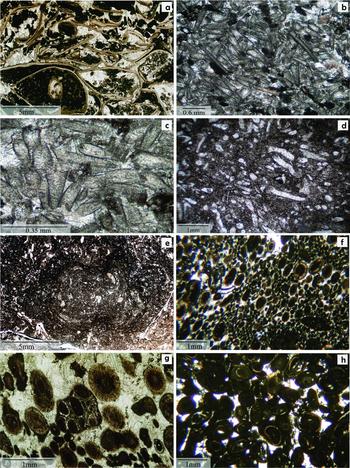
RS4-LT10c: oolitic shell packstone and wackestone (Fig. 7a)
This microfacies is mainly characterized by well to moderately sorted Type 4 ooids embedded in a micritic matrix (Fig. 7a). These oolites show ooids with an average size of around 0.4 mm with a micritic nucleus. The oolites are usually moderately packed but locally occur as densely packed oolitic levels, parallel to the bedding. Bioclasts consist only of broken bivalve and ostracod shells. This microfacies only occurs in the upper part of the Fromelennes Fm (U3), with RS5-LT14 and 15.
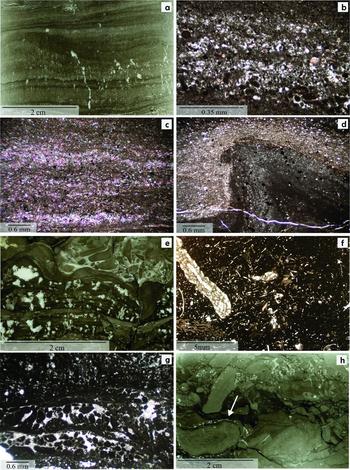
Microfacies RS4-LT10c–11 and RS5-LT12–13 from the Givetian of the La Thure section, western Belgium. Photomicrographs of thin-sections are oriented perpendicular to the bedding. (a) RS4-LT10c internal restricted shelf setting: wackestone–packstone with oolites (mainly of Type 4) and shells (TUR 268, transmitted light). (b) RS4-LT11 internal restricted shelf setting: coarse- to fine-grained lithoclastic rudstone–grainstone (large lithoclasts are constituted by oolitic grainstone) (TUR 226a, transmitted light). (c) RS5-LT12 internal evaporitic shelf setting: stromatoporoid rudstone (TUR 285, scanned thin-section). (d) RS5-LT12 internal evaporitic shelf setting: dendroid stromatoporoid rudstone (TUR 279c, scanned thin-section). (e) RS5-LT13 internal evaporitic shelf setting: boundstone (TUR 119, transmitted light). (f) RS5-LT13 internal evaporitic lagoonal setting: focused on micritic tubular structure with rims of fibrous cement (for location see inset in (e)) (TUR 119, transmitted light). (g) RS5-LT13 internal evaporitic lagoonal shelf setting: focused on the elongated tubular structure (note the polygonal aspect of the fibrous cement) (for location see inset in (e)) (TUR 119, transmitted light). (h) RS5-LT13 internal evaporitic shelf: peloidal and ostracod accumulation observed within RS5-LT13 algal boundstone (TUR 123a, transmitted light).

Interpretation
Type 4 oolite indicates restricted salinity conditions and intermittently agitated water conditions (Strasser, Reference Strasser1986). The abundance of micritic matrix resulting from mud settlement within calm water and the common occurrence of bivalve shells are in accordance with this interpretation. The local occurrence of this microfacies within the intraclastic breccia characterizing RS5-LT14 attests to restricted conditions during deposition.
In conclusion, submicrofacies RS3-LT10a, RS4-LT10b and RS4-LT10c were all deposited on shoals inside an internal shallow shelf setting in a context of various levels of water energy and restriction. From RS3-LT10a to RS4-LT10c the proximality or the restriction degree of the lagoon increased. The occurrence of the shoals in internal platform settings is also supported by the extended width of the internal platform (e.g. from the coastline to the barrier), estimated at about ~60 km by Préat (Reference Préat2006). This significant width, therefore, contributes to the development of a large range of hydrodynamic conditions.
RS4-LT11: lithoclastic rudstone (Fig. 7b)
This microfacies is characterized by variously sized (0.3 to 7 mm) angular to sub-rounded lithoclasts (Fig. 7b) cemented by sparitic cement. Lithoclasts are mainly composed of peloidal and oolitic grainstone (e.g. RS3-LT10a and RS4-LT10b–c) although locally, micritic lithoclasts can occur. A laminated fabric is underlined by the alternation of coarse- and fine-grained lithoclasts. Within the layers dominated by fine-grained lithoclasts abundant peloids occur. Type 1 and 3 ooids (Strasser, Reference Strasser1986) are commonly visible within the sediment and the fabric is clast-supported with blocky sparite cement.
Interpretation
The rudstone texture and the abundance of oolitic grainstone (RS3-LT10a) and micritic lithoclasts indicate the reworking of microfacies RS3-LT10a likely during a rapid increase in water energy. The limited occurrence of those sediments attests to the event-like character of this microfacies, which can be related to stronger tidal currents or storms. The distinction between those two processes is not obvious but in general an increasing proximity to the coastline is marked by an increasing influence of tidal currents. Thus, the depositional setting of this microfacies might have been located in the vicinity of RS3-LT10a and related to a rapid increase in water energy caused by storm or tidal currents.
Facies belt 5: internal evaporitic shelf
RS5-LT12: dendroid stromatoporoid rudstone–floatstone (Figs 2d, 7c, d)
Centimetre-sized dendroid (Stachyodes and Amphipora) and bulbous stromatoporoids lying parallel to the bedding and fine-grained ocherous dolomitized matrix characterize this microfacies. Stachyodes are millimetre to centimetre in size and commonly show encrustation by millimetre-scale encrusting stromatoporoids. Rare moderately to poorly preserved allochems such as brachiopods, peloids, lithoclasts, Girvanella, Renalcis lumps, tabulate corals and unidentified bioclasts are observed between large organisms. Locally, centimetre-sized bulbous stromatoporoids can be frequent. The sediment is moderately to well sorted. Locally, this microfacies is intercalated with sediment from RS5-LT14 (laminated mudstone – peloidal grainstone) with a sharp and erosive lower contact (Fig. 2d).
Interpretation
According to several authors (P. Cornet, unpub. Ph.D. thesis, Univ. Catholique de Louvain, 1975; Pohler, Reference Pohler1998; Wood, Reference Wood2000) Amphipora and Stachyodes are characteristic of shallow-water back-reef lagoonal settings and growth on soft substrate. The occurrence of abundant Stachyodes and Amphipora in a rudstone/floatstone texture intercalated with laminated mudstone RS5-LT14 (defined below) suggests significant reworking of dendroid stromatoporoids, which grew in the relative vicinity of the RS5-LT12 and RS5-LT14 depositional settings. According to Flügel (Reference Flügel2004, p. 500) branching stromatoporoids are frequently swept into other environments by storms. Furthermore, local erosive bases at the boundaries between RS5-LT14 and RS5-LT12 and the good sorting of dendroid stromatoporoids indicate an important increase in water energy enabling the reworking and landward transport of stromatoporoid patch-reefs within a location characterizing RS5-LT14.
RS5-LT13: algal microbial boundstone (Figs 7e–h)
This microfacies occurs in the lower portion of the Mont d'Haurs Fm and overlies beds formed by RS5-LT14. It is mainly characterized by the numerous occurrences of micritic tubular structures (diameter of tubes is around 0.2 mm), the abundance of cement and the common occurrence of peloids arranged in a clotted fabric. Locally, ostracods (showing thick-walled valves) and recrystallized worm tubes occur. Thin micritic tubes are usually surrounded by a fringe of fibrous cement (Fig. 7f, g) which fills the interparticle pores. This microfacies is also characterized by numerous stylolitic seams rich in insoluble residues locally forming a ‘horse-tail’ structure and on a larger scale an iden-supported fabric.
Interpretation
The abundance of sparitic cement and clotted fabric is in favour of a microbial/bacterial mediation (e.g. thrombolitic fabric: ‘peloidal micrite’, exhibiting a distinct clotted fabric; Flügel, Reference Flügel2004, p. 86). The abundance of sparitic cement filling the interparticle pores between thin micritic walled tubes is in favour of a relatively shallow-marine protected setting allowing the development of these thin tubes. Given the diameters of the micritic tubes (~2 mm), they would have been destroyed by any energetic event. According to Stepko Golubic (pers. comm.), the diameters of these tubes are out of the size range for cyanobacteria. Intercalation of this microfacies with RS5-LT14, interpreted as a lagoonal restricted environment, suggests an internal evaporitic setting for this microfacies.
RS5-LT14: laminated mudstone – peloidal grainstone (Fig. 8a–f)
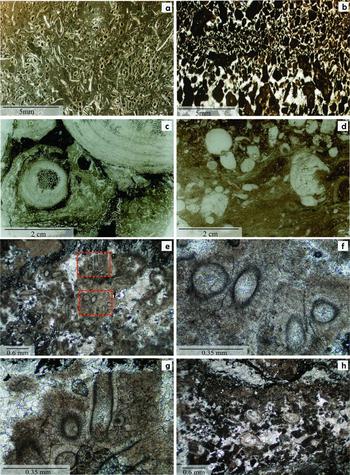
One of the most specific characteristics of this microfacies is the common occurrence of both wrinkled and regular laminae (Fig. 8a) underlined by a couplet of micrite alternating with fine-grained peloidal grainstone (Fig. 8b). Laminae can be arranged either in dense or sparse growth patterns (millimetre- to centimetre-sized). Within grainstone layers, the sizes of the peloids are relatively homogeneous, although from one layer to the next it can vary substantially (0.1 to 2 mm). Millimetre-sized vertically pronounced fenestral fabrics (Fig. 8a) crossing lamination and fenestrae showing horizontal patterns occur in this microfacies. Dolomitization is common and when affecting the sediment, the laminae are less clearly visible. Lamination can be locally highlighted by silt-sized quartz-grain-rich layers alternating with micritic-rich layers (Fig. 8c). Occasionally, lamination displays millimetre-scaled protuberances (Fig. 8d) locally filled with coarse calcite cement (Fig. 8e). Issinellids and Amphipora fragments floating in micritic mud (Fig. 8f) and gypsum evaporitic pseudomorphs are also observed. In this microfacies, fine-grained micritic clast grainstone layers occur locally and silt-sized quartz grains and clays are occasionally an important constituent of the sediment.
Microfacies RS5-LT14 and RS5-LT15 – inter- to supratidal internal evaporitic shelf – from the Givetian of the La Thure section, western Belgium. Photomicrographs of thin-sections are oriented perpendicular to the bedding. (a) RS5-LT14: alternation of dark and lighter laminae locally crossed by vertical fenestrae (TUR 158, scanned thin-section). (b) RS5-LT14: fine-grained peloidal grainstone alternating with mudstone texture (TUR 287, transmitted light). (c) RS5-LT14: alternation between silt-sized quartz-rich and micritic-rich levels (TUR 117, crossed light). (d) RS5-LT14: laminae marked by a well-developed protuberance (TUR 117, transmitted light). (e) RS5-LT14: wrinkled laminae showing stacked protuberance filled by coarse calcite cement (note the intraclastic breccia in the upper right of the thin-section) (TUR 293b, scanned thin-section). (f) RS5-LT14: abundant palaeoberesellids floating in a micritic matrix (TUR 282, transmitted light). (g) RS5-LT15: partly reworked algal mat (TUR 120, transmitted light) (h) RS5-LT15: intraclastic grainstone–rudstone (note the lithoclasts surrounded by algal layer) (TUR 291d, scanned thin-section).

Interpretation
The abundance of laminae (locally wrinkled), the occurrence of fenestrae and peloids and fine-grained micritic matrix characterize microbially modified sediments (Aitken, Reference Aitken1967). In the Middle Devonian carbonate platform of Poland, Skompski & Szulczewski (Reference Skompski and Szulczewski1994) interpreted similar microfacies as having formed within the shallow intertidal to supratidal restricted shelf. Similar upper Givetian sediments in Belgium are interpreted as having been deposited in extensive tidal flat complexes including channel, levee and back-levee systems (see microfacies Type 1ʹ, 2ʹ and 3ʹ and fig. 7 of Boulvain & Préat, Reference Boulvain and Préat1986). Furthermore, the occurrence of laminae crossed by a vertical fenestral fabric corresponding to desiccation cracks and the occurrence of evaporitic pseudomorphs both point to a setting temporarily subjected to emersion and an arid climate, triggering the desiccation of soft sediments. According to Scholle & Ulmer-Scholle (Reference Scholle and Ulmer-Scholle2003, p. 6) and Purser (Reference Purser1980, p. 98), laminae protuberances relate to the growth of evaporitic minerals (e.g. anhydrite) within the sediment. The rare occurrence of fauna corresponds to a hostile evaporitic environment and is characteristic of an inter- to supratidal restricted evaporitic setting.
RS5-LT15: intraclastic rudstone–grainstone (Figs 2d, 8g, h)
This microfacies is characterized by the millimetre- to centimetre-sized angular to rounded-elongated fenestral mudstone lithoclasts. Lithoclasts are locally surrounded by wrinkled laminae and space between lithoclasts is filled either by ooids, clay or coarse-grained sparitic cement. Pressure-solution processes produced iden-like textures.
Interpretation
Millimetre- to centimetre-sized elongated fenestrae associated with mudstone lithoclasts, corresponding to lithified algal mats, indicate the reworking of supratidal deposits likely during an increase in water energy (e.g. storms). The wrinkled laminae surrounding the lithoclasts argues for re-deposition in intertidal to supratidal settings. Oolites are likely allochthonous and derived from an oolitic sand bar located seawards (e.g. RS3-LT10a). Skompski & Szulczewski (Reference Skompski and Szulczewski1994, pl. 49) interpreted relatively similar deposits as tide-channel breccias. This microfacies might thus be deposited within an upper intertidal to supratidal location (e.g. tidal flat) and related to a change in the water energy triggering a reworking of the sediment and the transport of oolites through the RS5-LT15 depositional setting.
4.c. Summary of microfacies interpretation: palaeoenvironmental model (Table 1; Fig. 9)
Field and petrographic analyses of the La Thure section led to the definition of 18 microfacies (Table 1). These microfacies are an outstanding example of the wide range of depositional settings that shaped a shallow carbonate platform during early to late Givetian time. Together, these microfacies represent different types of carbonate platform setting and show a remarkable evolution through early to late Givetian time. Following the definition of Read (Reference Read1985), we distinguish three main platform profiles for the La Thure section: (1) a homoclinal ramp (RP-LT1–2); (2) a shallow-water discontinuously rimmed shelf (RS1-5–LT1-15); and (3) a drowning shelf (DS-LT1) (Fig. 9a). The establishment and differentiation between the three sedimentological models is based on the combination of field and microfacies criteria (e.g. marked lithological changes, faunal assemblage, matrix nature, terrigenous content and sediment texture) and the abundant literature mentioned throughout the previous sections. A major criterion for the establishment of the rimmed shelf profile on the western margin of the Dinant Syncline during middle Givetian time is the significant occurrence of biostromal deposits interpreted as having originated from a barrier-reef (G. Poulain, unpub. Masters thesis, Univ. Liège, 2006; Boulvain et al. Reference Boulvain, Mabille, Poulain and Da Silva2009), in time-equivalent lithologies on the southern margin.
(a) Homoclinal ramp, rimmed shelf and drowning shelf profiles of carbonate platform models proposed for the deposits observed in the La Thure section. (b) Detail of the main facies belts defined into the carbonate shelf model.

The carbonate ramp model of the La Thure section includes mid- and outer-ramp settings. Bioclastic lime mudstone to packstone (RP-LT1) and crinoidal packstone–grainstone (RP-LT2) characterize the mid- and outer-ramp settings and are interpreted as having been deposited above the FWWB but within the storm wave zone. Inner-ramp deposits are not observed in the La Thure section. For the rimmed shelf profile the situation is more complex. Indeed, in order to underline the diversity of depositional settings we divided this profile into five facies belts (RS1–RS5). These belts extend from an external fore-reef and biostrome to a supratidal internal shelf setting. Open-marine bioclastic wackestone–packstone (RS1-LT1) and coral–stromatoporoid rudstone–floatstone (RS1-LT2) represent the most distal settings defined on this shelf. Calcimicrobial bio-lithoclastic grainstone (RS2-LT3) and peloidal–lithoclastic grainstone with gastropods (RS2-LT4) correspond to sediments recorded in the bioclastic shoals developed at the platform interior margin (RS2). In a landward location, the internal shelf with good circulation (RS3) is characterized by a large set of microfacies: (a) mudstone to packstone with lithoclastic–brachiopod rudstone–grainstone layers (RS3-LT5), (b) Magnella shell grainstone and rudstone (RS3-LT6), (c) stromatoporoid rudstone (RS3-LT7), (d) Paleosiphonocladales wackestone–packstone (RS3-LT8), (e) burrowed calcisphere mudstone (RS3-LT9) and (f) oolitic peloidal grainstone–packstone (RS3-LT10a). Oolitic lithoclastic grainstone–packstone (RS4-LT10b), oolitic shell packstone and wackestone (RS4-LT10c) and lithoclastic rudstone (RS4-LT11) characterize the internal restricted shelf belt (RS4). Dendroid stromatoporoid rudstone–floatstone (RS5-LT12), algal microbial boundstone (RS5-LT13), laminated mudstone – peloidal grainstone (RS5-LT14) and intraclastic rudstone–grainstone (RS5-LT15) correspond to the most proximal facies belt (RS5) defined in this carbonate shelf model. The drowning shelf model is characterized by mudstone and wackestone with densely packed brachiopod–bivalve shell levels (DS-LT1). Microfacies stacking patterns for the Givetian interval in the La Thure section permit recognition of five main depositional intervals (I–V) separated by noteworthy shallowing–deepening trends in the section. The two first intervals correspond, respectively, to the Terre d'Haurs and Mont d'Haurs formations while the last three fit with the three lithological units defined for the Fromelennes Fm.
4.d. Magnetic susceptibility
In order to apply MS as a palaeoenvironmental proxy or as a tool for correlation, it is necessary to assess whether the MS signal reflects primary depositional conditions or secondary post-depositional imprint (synthesis in Da Silva et al. Reference Da Silva, De Vleeschouwer, Boulvain, Claeys, Fagel, Humblet, Mabille, Michel, Sardar Abadi, Pas and Dekkers2013). This assessment is imperative in our case as Devonian rocks from Belgium underwent a remagnetization event driven by the Variscan orogeny (Zegers, Dekkers & Baily, Reference Zegers, Dekkers and Baily2003; Zwing et al. Reference Zwing, Matzka, Bachtadse and Soffel2005). In a recent study dedicated to the origin of the MS signal in Devonian sections of Belgium, Da Silva et al. (Reference Da Silva, Dekkers, Mabille and Boulvain2012, Reference Da Silva, De Vleeschouwer, Boulvain, Claeys, Fagel, Humblet, Mabille, Michel, Sardar Abadi, Pas and Dekkers2013) established that the MS signal is mainly carried by fine-grained pseudo-single domain (PSD) magnetite formed during this remagnetization event. Nevertheless, Da Silva et al. (Reference Da Silva, De Vleeschouwer, Boulvain, Claeys, Fagel, Humblet, Mabille, Michel, Sardar Abadi, Pas and Dekkers2013) also showed that of six Devonian outcrops, four of them were still reflecting variations in detrital input as indicated by the relatively good relationship between MS and siliciclastic input proxies such as Ti, Zr, Al and Si. Similar results for the Devonian of western Belgium were recently published by Pas et al. (Reference Pas, Da Silva, Devleeschouwer, De Vleeschouwer, Labaye, Cornet, Michel, Boulvain, Da Silva, Whalen, Hladil, Chadimova, Chen, Spassov, Boulvain and Devleeschouwer2015).
The MS values for the lower–upper Givetian part of the La Thure section range between −5.64x10⁻⁹ and 2.97x10⁻⁷ m3/kg with an average value of 4.15x10⁻⁸ m3/kg. The entire MS curve provided for the Givetian of the La Thure section can be divided into six main MS units (MSU-I–MSU-V; Fig. 10). A vertical dotted line indicates the average MS value for each MS unit on Figure 10. The six main MS units correspond to the sedimentary intervals established from the microfacies curve. The Terre d'Haurs Fm shows locally relatively high values (1.5x10⁻⁷ m3/kg) and an average close to 1x10⁻⁷ m3/kg (MSU-I). The overlying Mont d'Haurs Fm records the lowest average MS value (0.2x10⁻⁷ m3/kg; MSU-II) and is locally punctuated by peaks reaching 1.3x10⁻⁷ m3/kg. A particularity of MSU-II is the occurrence of some well-defined cycles recorded in the MS curve. In this internal shelf setting MS values are homogeneous and relatively low. Higher up in the section, within the base of the Fromelennes Fm, MS values increase and show an average value of 0.75x10⁻⁷ m3/kg (MSU-III). Locally, peaks reaching 1x10⁻⁷ m3/kg also occur. The middle portion of the Fromelennes Fm, interval IV, shows lower mean values (0.3x10⁻⁷ m3/kg; MSU-IVa) but, throughout the upper part of the Fromelennes Fm (upper part of Unit 2) these values increase rapidly and reach 3x10⁻⁷ m3/kg. Within this portion, the MS values oscillate strongly between 0.7 and 3x10⁻⁷ m3/kg (MSU-IVb). Then values decrease to reach intermediate values of 0.9x10⁻⁷ m3/kg (MSU-V) within the uppermost portion of the Fromelennes Fm corresponding to Unit 3.
5. Discussion
5.a. Depositional environments: carbonate platform evolution
The transition between the carbonate ramp and the carbonate shelf model is characterized by lithological and microfacies changes (Fig. 10). Indeed, from 0 to 7.5 m, the Terres d'Haurs Fm is mainly characterized by black to brown argillaceous centimetre- to decimetre-thick limestone containing local accumulations of crinoids and brachiopods (for more details see description of the formations in Section 4). Above 7.5 m, the lithology is characterized by well-bedded dark decimetre-thick limestone with varying amounts of bioclasts such as gastropods, which corresponds to the Mont d'Haurs Fm. This lithological change corresponds to a transition from open-marine faunal assemblages to a shallow-water shelf setting. At the top of the studied section, the transition between the discontinuously rimmed shelf and the drowning shelf model is mainly based on a significant change that occurs within the uppermost part of the Fromelennes Fm (within Unit 3). Indeed, at the 150 m thick mark, there is a transition from laminated limestone (RS5-LT14) to thicker and dark-blue bedded limestone containing numerous shells of brachiopods and debris of crinoids (DS-LT1), undoubtedly indicating re-establishment of open-marine conditions. This transition is interpreted as the result of a sea-level rise allowing restoration of open-marine conditions within an inter- to supratidal lagoonal setting, corresponding to the drowning shelf model. It is characterized by a wide spectrum of textures ranging from mudstone–wackestone to packstone–rudstone showing crinoids and shell accumulations (DS-LT1). These sediments are interpreted as having been deposited in an open-marine setting where the low rate of sedimentation allowed accumulation of shells and the development of a strongly bioturbated fabric. After 3 m of condensed shelly limestone, those limestones are overlain by ocherous limestone interlayered with black carbonaceous limestone and then brown shale belonging to the Nismes Fm of Frasnian age (for more detail about this transition see Pas et al. Reference Pas, Da Silva, Devleeschouwer, De Vleeschouwer, Labaye, Cornet, Michel, Boulvain, Da Silva, Whalen, Hladil, Chadimova, Chen, Spassov, Boulvain and Devleeschouwer2015).
In order to gain a better comprehension of the platform development during the early to late Givetian interval and to build a robust pattern for correlation we defined a microfacies curve for the La Thure section. Over the lower–upper Givetian, five main depositional intervals (I–V) separated by noteworthy shallowing–deepening trends are evident (Fig. 10). Based on this study and selected literature (Boulvain & Préat, Reference Boulvain and Préat1986; Préat, Ceuleneer & Boulvain, Reference Préat, Ceuleneer and Boulvain1987; Préat & Boulvain, Reference Préat and Boulvain1988; Bultynck et al. Reference Bultynck, Coen-Aubert, Dejonghe, Godefroid, Hance, Lacroix, Preat, Stainier, Steemans, Streel and Tourneur1991; Boulvain et al. Reference Boulvain, Coen-Aubert, Mansy, Proust and Tourneur1995, Reference Boulvain, Mabille, Poulain and Da Silva2009; Préat, Reference Préat2006; Préat & Bultynck, Reference Préat, Bultynck, Bultynck and Dejonghe2006; Maillet, Milhau & Pinte, Reference Maillet, Milhau and Pinte2011; Maillet, Milhau & Dojen, Reference Maillet, Milhau and Dojen2013) we illustrate the geometry and the key depositional changes characterizing the Givetian platform in the Dinant Basin. A summary of our interpretations and the illustration of the palaeogeographic history for the Dinant Basin during early to late Givetian time, including southward–northward migration of reefal bodies, is shown in Figure 11. Considering that the shallowest depositional settings in the Dinant Basin are located to the north, sedimentary rocks from the La Thure section, cropping out on the northwestern margin of the Dinant Syncline, must have been deposited in shallower settings than sediments belonging to the southern margin (e.g. Givet area; see geological map in Fig. 1b). The base of the Terre d'Haurs Fm (Fig. 11-I), deposited in the timorensis Zone, represents a carbonate ramp setting which is commonly observed prior to the extensive middle–late Givetian carbonate platform development in Belgium (Boulvain et al. Reference Boulvain, Mabille, Poulain and Da Silva2009; Casier et al. Reference Casier, Devleeschouwer, Maillet, Petitclerc and Préat2013). The transition from the Terre d'Haurs to Mont d'Haurs formations (Fig. 10) is characterized by a shallowing-upward trend corresponding to a shift from mid-ramp (interval I) to internal shelf (interval II). This abrupt transition can be explained in the context of the well-marked north to south deepening of the depositional settings that are recorded for the Dinant Syncline (Préat & Boulvain, Reference Préat and Boulvain1988; Bultynck et al. Reference Bultynck, Coen-Aubert, Dejonghe, Godefroid, Hance, Lacroix, Preat, Stainier, Steemans, Streel and Tourneur1991; G. Poulain, unpub. Masters thesis, Univ. Liège, 2006; Préat & Bultynck, Reference Préat, Bultynck, Bultynck and Dejonghe2006; see also Fig. 1d). At the southern margin of the Dinant Syncline extensive biostromes developed throughout the Mont d'Haurs Fm (Boulvain et al. Reference Boulvain, Mabille, Poulain and Da Silva2009; Casier & Préat, Reference Casier and Préat2013). The progressive development of large patches and barrier-reefs resulted in the formation of the thick-bedded limestone composed of reef-building organisms of the Mont d'Haurs Fm on the southern margin of the Dinant Syncline (cf. G. Poulain, unpub. Masters thesis, Univ. Liège, 2006; Boulvain et al. Reference Boulvain, Mabille, Poulain and Da Silva2009). These reefal structures must have progressively divided the middle Givetian platform into an internal and an external shelf setting (Fig. 11-II). These conditions created the sedimentary settings which allowed for the deposition of lagoonal and bioclastic shoal facies (e.g. RS2-LT3 to RS4-LT10) in the La Thure area. According to Boulvain et al. (Reference Boulvain, Mabille, Poulain and Da Silva2009), thick-bedded reefal limestones occurring throughout the Mont d'Haurs Fm within the southern margin of the Dinant Syncline are the result of gravity flows coming from a barrier-reef located northwards. With respect to this interpretation, the location of the barrier-reef separating the northwestern margin (La Thure) and the southern margin (Givet area; see map in Fig. 1b) of the Dinant Syncline might exist in the subsurface near the axis of the Dinant Syncline. The Mont d'Haurs Fm as exposed in the La Thure section records numerous oscillations of microfacies, which correspond to alternation of small-scale regressive cycles that may correspond to parasequences (see Fig. 10 interval II). As mentioned by several authors (Playford, Reference Playford1980; F. Tourneur, unpub. Ph.D. thesis, Univ. Catholique de Louvain, 1985; Boulvain & Préat, Reference Boulvain and Préat1986; Préat & Carliez, Reference Préat and Carliez1994; Skompski & Szulczewski, Reference Skompski and Szulczewski1994; Da Silva & Boulvain, Reference Da Silva and Boulvain2004; Boulvain et al. Reference Boulvain, Mabille, Poulain and Da Silva2009), the record of cyclic sedimentation is a common characteristic of Devonian shallow-marine sequences. Moreover, De Vleeschouwer et al. (Reference De Vleeschouwer, Boulvain, Da Silva, Pas, Labaye, Claeys, Silva, Whalen, Hladil, Chadimova, Chen, Spassov, Boulvain and Devleeschouwer2015, see their fig. 3) related the 6 to 8 m thick oscillations in the microfacies curve to 100 ka eccentricity. At a larger scale, the Mont d'Haurs Fm can be considered as aggradational sedimentation in an inner-shelf setting.
The transition from the second (II) to the third interval (III) (Fig. 10) is characterized by a deepening-upward trend leading to the occurrence of biostromal and fore-reef deposits (RS1-LT1-2) in the La Thure area (Fig. 11-III), that overlie the inner-shelf and bioclastic shoal sediments (RS2-LT3 to RS4-LT10c) of the Mont d'Haurs Fm. This abrupt shift between intervals II and III is interpreted as the lateral equivalent of the transgressive pulse highlighted in the southern margin of the Dinant Syncline by Boulvain et al. (Reference Boulvain, Mabille, Poulain and Da Silva2009). In the Fromelennes type area, on the southern margin of the Dinant Syncline, this transgressive trend is marked by the occurrence of argillaceous limestone with an intercalation of clay (Préat & Bultynck, Reference Préat, Bultynck, Bultynck and Dejonghe2006) overlying thick reefal limestone of the Mont d'Haurs Fm. However, with respect to the northwestern location of the La Thure section, this transgressive pulse must have been represented by shallower sedimentation than on the southern margin. As recently established by Narkiewicz, Narkiewicz & Bultynck (Reference Narkiewicz, Narkiewicz, Bultynck, Becker, Königshof and Brett2015), this transgressive pulse in the base of the Fromelennes Fm (e.g. Flohimont Mbr) most likely corresponds to the base of the Taghanic Stage. Indeed, Narkiewicz, Narkiewicz & Bultynck (Reference Narkiewicz, Narkiewicz, Bultynck, Becker, Königshof and Brett2015) recently reviewed conodont samples collected by Bultynck (Reference Bultynck1987) in the mid Givetian outcrop belt in the south of the Dinant Syncline and documented the presence of P. ansatus in the lowermost part of this formation. These new data led Narkiewicz, Narkiewicz & Bultynck (Reference Narkiewicz, Narkiewicz, Bultynck, Becker, Königshof and Brett2015) to suggest that the transgressive basal part of the Fromelennes Fm corresponds to the base of the Taghanic Stage. The Taghanic Event is one of the most significant physical and biotic events of the Devonian associated with widespread transgression, the so-called Taghanic Onlap (Johnson, Reference Johnson1970) and major turnover in marine invertebrate and terrestrial vegetation (House, Reference House2002; Aboussalam, Reference Aboussalam2003; Baird & Brett, Reference Baird and Brett2008; Aboussalam & Becker, Reference Aboussalam and Becker2011; Marshall, Brown & Astin, Reference Marshall, Brown and Astin2011). Maillet, Milhau & Dojen (Reference Maillet, Milhau and Dojen2013) also suggested the Taghanic biocrisis as a driving mechanism of the significant change in benthic ostracod diversity characterizing the basal part of the Fromelennes Fm in its type area (southern Dinant Syncline margin, France). Based on these lines of evidence, we suggest that the deepening shift at the base of interval III corresponds to the onset of the Taghanic Onlap in the northwestern Dinant Syncline.
As discussed above, interval II displays several small-scale sedimentary cycles interpreted as related to 100 ka eccentricity. In interval III, despite being a comparable thickness to interval II, no such cycles are visible in the microfacies. Absence of cycles in interval III might be an artefact related to the rapid development of reefal limestone. Indeed, reefal limestone can build up in the duration of a single small-scale cycle but related deposits are thick.
The transition from interval III to interval IV (Fig. 10) is marked by a drop in relative sea-level corresponding to the first occurrence of lagoonal deposits. This relative sea-level drop likely favoured a seaward shift of the reefal structure that had provided the materials deposited during interval III (e.g. biostromal and fore-reef deposits). The development of this reefal structure in a seaward location allowed initiation and deposition of lagoonal deposits landwards (e.g. analogous to the pattern discussed for the interval I to II transition; see also Fig. 11-IV). According to the research of several authors (Bultynck, Reference Bultynck1974; Préat & Carliez, Reference Préat and Carliez1994), synthesized in Boulvain et al. (Reference Boulvain, Mabille, Poulain and Da Silva2009), the mid–upper Givetian on the south and southeastern margin of the Dinant Syncline is also characterized by lagoonal sedimentation (e.g. Fromelennes Fm) and interpreted by Boulvain et al. (Reference Boulvain, Mabille, Poulain and Da Silva2009) as related to the occurrence of a barrier-reef located southwards. The occurrence of locally thick intervals of Amphipora rudstone (e.g. RS4-LT12; see microfacies Section 4) could indicate an important increase in the water energy in an internal lagoonal setting suggesting a discontinuous barrier. Interval IV locally shows the occurrence of small-scale regressive cycles similar to those described in Boulvain et al. (Reference Boulvain, Mabille, Poulain and Da Silva2009, p. 173). In the uppermost part of the Fromelennes Fm (Fig. 10) the transition from interval IV to V corresponds to a significant deepening trend marked by the transition from lagoon-related (RS4–5 – LT12–15) to open-marine sedimentation (DS-LT1) including centimetre-sized brachiopods and crinoids. The lithostratigraphic position of this rapid transition, which is located a few metres below the first Frasnian shale (e.g. Nismes Fm; Pas et al. Reference Pas, Da Silva, Devleeschouwer, De Vleeschouwer, Labaye, Cornet, Michel, Boulvain, Da Silva, Whalen, Hladil, Chadimova, Chen, Spassov, Boulvain and Devleeschouwer2015) suggests that interval V is part of the large marine transgression characterizing the latest Givetian and the base of the Frasnian stage in Belgium.
5.b. Sequence stratigraphy
Based upon the previous discussion we have developed a preliminary sequential stratigraphic framework for the La Thure section. As presented above, the La Thure section is divided into five sedimentary intervals (I–V on Fig. 10) in which third-order systems tracts are recognized. Based on the abrupt shift towards shallower facies at the end of interval I, we can interpret this interval as a late highstand to falling stage. In interval II, two systems tracts are identified. The sedimentary sequence ranging from 9.5 m to 56 m in the measured section is identified as a transgressive systems tract (TST). The maximum flooding surface (MFS) is therefore located at the top of this TST and the remaining part of interval II corresponds to a highstand systems tract (HST). The base of interval III (64 m high) is a flooding surface (FS) that corresponding to the Taghanic Onlap. Interval III likely corresponds to a TST (from 64 to 88 m) followed by a HST (from 88 to 96 m) ending at the top of interval III. The top of interval III should correspond to a FS, which is associated with an emersion surface. This is followed by a new TST (from 96 to 131 m) enabling the accumulation of a thick sequence of peritidal facies and then likely a new HST that includes all the middle upper part of interval IV. Interval V clearly records a significant deepening of the facies which must correspond to a TST ending at the top of the section (153 m).
5.c. Comparison of magnetic susceptibility with selected geochemical elements
Detrital components such as Ti, Si, Th, Al and K are commonly used to document changes in siliciclastic input (Averbuch et al. Reference Averbuch, Tribovillard, Devleeschouwer, Riquier, Mistiaen and Van Vliet-Lanoe2005; Riquier et al. Reference Riquier, Averbuch, Devleeschouwer and Tribovillard2010; Śliwiński et al. Reference Śliwiński, Whalen, Meyer and Majs2012). For the La Thure section, we plot these elements next to the MS curve (Fig. 12). The large-scale trends followed by those elements show a moderate correlation with MS trends of the sample suite (r = 0.51–0.61; n = 30). These correlations indicate that the MS signal varies with the concentration of siliciclastic elements within the sediment. This means that variations in the terrestrial basinward influx have a strong influence on the intensity of the MS signal (for more examples see Da Silva et al. Reference Da Silva, De Vleeschouwer, Boulvain, Claeys, Fagel, Humblet, Mabille, Michel, Sardar Abadi, Pas and Dekkers2013). In addition, as mentioned for the Frasnian portion of this section (Pas et al. Reference Pas, Da Silva, Devleeschouwer, De Vleeschouwer, Labaye, Cornet, Michel, Boulvain, Da Silva, Whalen, Hladil, Chadimova, Chen, Spassov, Boulvain and Devleeschouwer2015), a strong positive correlation (r = 0.98) exists between Al and Ti, which means that variations of Al concentration related to diagenetic formation of clay is unlikely. Those observations also mean that, despite the remagnetization event characterizing Devonian limestone in the Ardennes Region (Zegers, Dekkers & Baily, Reference Zegers, Dekkers and Baily2003), the main trends in the MS signal still reflect some syn-sedimentary conditions (Da Silva et al. Reference Da Silva, De Vleeschouwer, Boulvain, Claeys, Fagel, Humblet, Mabille, Michel, Sardar Abadi, Pas and Dekkers2013). Thus, MS techniques can be used here as a proxy for changes in terrestrial influx driven either by variation in weathering type, reworked source or intensity of this reworking.
5.c.1. Comparison with facies and lithologies
As already demonstrated in various studies (Bábek, Přikryl & Hladil, Reference Bábek, Přikryl and Hladil2007; Mabille et al. Reference Mabille, Pas, Aretz, Boulvain, Schröder and Silva2008b ; Da Silva, Mabille & Boulvain, Reference Da Silva, Mabille and Boulvain2009; Whalen & Day, Reference Whalen and Day2010; Pas et al. Reference Pas, Da Silva, Suttner, Kido, Bultynck, Pondrelli, Corradini, De Vleeschouwer, Dojen and Boulvain2014), the behaviour of the MS signal classically shows a close relationship with microfacies, indicating an influence of sea-level changes on MS variations. However, the influences of environmental parameters such as water agitation, sedimentation rate, carbonate productivity and siliciclastic supply have already been highlighted as parameters influencing MS changes (Bábek, Přikryl & Hladil, Reference Bábek, Přikryl and Hladil2007; Mabille et al. Reference Mabille, Pas, Aretz, Boulvain, Schröder and Silva2008b ; Da Silva et al. Reference Da Silva, Mabille and Boulvain2009, Reference Da Silva, De Vleeschouwer, Boulvain, Claeys, Fagel, Humblet, Mabille, Michel, Sardar Abadi, Pas and Dekkers2013).
The Terres d'Haurs Fm is dominated by mixed carbonate and argillaceous lithologies, which are interpreted to have been deposited in a mid- to distal-ramp setting and assumed to be one of the deepest facies of our succession. This formation (MSU-I) presents high MS values. These results are similar to those obtained in the Belgian Eifelian–Givetian carbonate ramp system. Da Silva, Mabille & Boulvain (Reference Da Silva, Mabille and Boulvain2009) documented a general increase in average MS values from the inner to outer ramp. This increase is explained by the decrease in carbonate productivity with increasing depth and decreasing environmental energy allowing settlement of MS-carrying particles. Data available for the Terres d'Haurs Fm are limited to two microfacies and therefore further consideration of the MS behaviour would be inappropriate.
Sediments characterizing the Mont d'Haurs Fm in the La Thure section mainly represent internal shelf deposition (e.g. facies belt RS2-5, Fig. 9) dominated by relatively pure carbonate as shown by the low values in detrital proxies (Fig. 12). The low mean MS value expressed for this formation (MSU-II) could be related to the high carbonate production in this shallow-water setting within the internal shelf. Here, any input of siliciclastic material that carries magnetic particles will be strongly diluted by carbonate production (Mabille et al. Reference Mabille, Pas, Aretz, Boulvain, Schröder and Silva2008b ). The lowermost part of the Fromelennes Fm (Unit 1) has been deposited above the FWWB in a biostromal to fore-reef setting (e.g. facies belt RS1, Fig. 9) and records a significant increase in average MS value (MSU-III). In carbonate platform settings, such an increase is commonly attributed to both decreasing water energy level and the lowering of carbonate production (e.g. Da Silva, Mabille & Boulvain, Reference Da Silva, Mabille and Boulvain2009). The transition from fore-reef and biostromal deposits recorded in Unit 1 to the restricted internal platform sediments, belonging to Unit 2 (e.g. facies belt RS4-5), corresponds to a decrease in average MS value (MSU-IVa). This decrease is likely related to water agitation and the confinement characterizing this inter- to supratidal setting, which is dominated by a thick accumulation of laminated mudstone – peloidal grainstone (RS5-LT14). The upper part of Unit 2 was deposited in a relatively similar setting to its lower part. Nevertheless, it records a strong increase in MS values (MSU-IVb). This significant increase in average MS value occurs despite the absence of remarkable deviations in microfacies. Based on a detailed comparison with recent tropical sediment, Boulvain & Préat (Reference Boulvain and Préat1986) have demonstrated that during late Givetian time in Belgium (e.g. Fromelennes Fm), shore-face realm depositional processes were mainly dictated by arid conditions similar to those found today in the Persian Gulf. Local occurrences of desiccation cracks and evaporitic crystal-like pseudomorphs (e.g. RS5-LT14–15), indicating arid climate, are also observed in the Givetian La Thure sediments. Since climatic conditions control changes in sediment transport processes we consider that an increase in the aridity on the main landmass (cf. Old Red Sandstone) that bordered the Belgian Givetian carbonate platform might have favoured the amount of wind-related MS-carrying particles transported towards the marine realm. For instance, in a contemporary study dedicated to the evolution of climate during the Mesopotamian Empire (4170±150 yr bp), Cullen et al. (Reference Cullen, De Menocal, Hemming, Brown, Guilderson and Sirocko2000) performed various mineralogical and geochemical analyses on a marine sediment core from the Gulf of Oman which is downwind of Mesopotamian dust source areas. Their results document a very abrupt increase in aeolian dust parallel to Mesopotamian aridification. This increase in aeolian dust is similarly marked in MS (10−6 SI units) and aeolian dolomite (wt%) curves. During Givetian time, evidence of evaporitic plains, semi-arid deserts and continental redbeds are recognized worldwide (Scotese, Reference Scotese2005). Recently Hladil et al. (Reference Hladil, Gersl, Strnad, Frana, Langrova and Spisiak2006) published important gamma-ray spectroscopy (GRS) and MS data obtained in a middle-Eifelian to end-Frasnian Moravian isolated carbonate platform (Czech Republic) and underlined the important role played by aeolian inputs and arid conditions for the MS signal intensity in carbonate rocks. In addition, via the combination of GRS and MS measurements Hladil (Reference Hladil, Gersl, Strnad, Frana, Langrova and Spisiak2006, fig. 3) showed an increasing amount of atmospheric dust between late Givetian and middle Frasnian time on the Moravian carbonate platform. Therefore, we assume that the significant increase in the MS signal throughout the upper half of the Fromelennes Fm (Unit 2; Fig. 9) could be related to an increase in wind-blown dust deposition in shallow-water triggered by aridification of the main land during middle–late Givetian time. Nevertheless, as mentioned by Sur et al. (Reference Sur, Soreghan, Soreghan and Stagner2010), the geological record of aeolian dust in ancient carbonates is only consistent if all non-atmospheric sources of silica can be confidently eliminated from consideration (e.g. isolated platform, oceanic basin) for the investigated time interval. This means that only isolated platform or oceanic basin sedimentary records are consistent with such a hypothesis. According to various palaeogeographic reconstructions of Western Europe during Middle Devonian time (Ziegler, Reference Ziegler1982; McKerrow & Scotese, Reference McKerrow and Scotese1990) the south of Belgium was located in the immediate vicinity of the Old Red Sandstone continent (e.g. London–Brabant High) and non-atmospheric sources of silica cannot be eliminated. However, to date, siliciclastic facies or riverine deposits have never been identified throughout the upper Givetian in Belgium. Hence, the hypotheses of an increasing MS value related to higher amounts of aeolian-related dust deposition could be envisaged but must be carefully tested, as evidence of the separation of the Belgian platform from the main continent has not been well documented. At present, it is therefore preferable to envisage a combination of aeolian dust and riverine input to explain the recorded MS changes towards late Givetian time within the northwestern margin of the Dinant Basin.
5.d. Palaeoredox conditions within an early–late Givetian platform in the northwestern Dinant Basin
Redox sensitive elemental ratios commonly used to interpret palaeo-oxygenation in bottom water conditions are Ni/Co, V/Cr, V/(V+Ni) and U/Th (Hatch & Leventhal, Reference Hatch and Leventhal1992; Jones & Manning, Reference Jones and Manning1994). The concentrations of the trace elements (Ni, Co, V, and Cr) recorded in our dataset are below the detection limit. The concentrations of U and Th, on the other hand, are within this limit and the calculated redox element ratio U/Th profile through the section is shown in Figure 12. The general evolution of calculated U/Th ratio through the profile can be assigned to the anoxic–dysoxic–oxic threshold values of Jones & Manning (Reference Jones and Manning1994; < 0.75 = oxic, 0.75–1.25 = dysoxic, > 1.25 = anoxic), although these calculations should be viewed as relative. Indeed, as was mentioned by Rimmer (Reference Rimmer2004) and other authors (Riquier et al. Reference Riquier, Tribovillard, Averbuch, Joachimski, Racki, Devleeschouwer, El albani, Riboulleau, Over, Morrow and Wignall2005; Śliwiński, Whalen & Jed, Reference Śliwiński, Whalen and Jed2010), these threshold values should only be used as a relative scale to interpret the degree of palaeo-oxygenation. Subsequently, these threshold values were based either on contemporary dysoxic–anoxic basin analogues or they were developed for a specific palaeobasin. In line with the arguments of Rimmer (Reference Rimmer2004) and Śliwiński, Whalen & Jed (Reference Śliwiński, Whalen and Jed2010), the evolution of calculated U/Th ratio for the La Thure section reveals a significant large-scale change in the oxygenation level of the sediments (Fig. 12) from oxygen-depleted conditions throughout the lower half of the section to more oxic conditions within the upper half. This lowering in the U/Th ratio is concurrent with the onset of the extensive development of lagoonal–evaporitic settings in the La Thure section (see interval IV in Fig. 10) but also all over the Dinant Basin in Belgium and France (Boulvain & Préat, Reference Boulvain and Préat1986). On a more global scale, lagoonal–evaporitic sediments were also recorded in the middle and upper Givetian of the eastern Rheinisches Schiefergebirge (Brilon Reef; Machel, Reference Machel1990), Harz Mountain (Iberg Reef; Krebs, Reference Krebs and Laporte1974), Brunai Platform in Czech Republic (Gischler, Reference Gischler1995; Hladil et al. Reference Hladil, Gersl, Strnad, Frana, Langrova and Spisiak2006) and in the Carnic Alps (Schönlaub & Histon, Reference Schönlaub and Histon2000). These data support peaks in palaeo-temperature near the onset of Late Devonian time as established by Joachimski et al. (Reference Joachimski, Breisig, Buggisch, Talent, Mawson, Gereke, Morrow, Day and Weddige2009, Reference Joachimski, van Geldern, Breisig, Buggisch and Day2004) on the basis of a large δ18O dataset from biogenic calcite and conodont apatite collected in different locations bordering the Rheic Ocean (see fig. 1 in Joachimski et al. Reference Joachimski, van Geldern, Breisig, Buggisch and Day2004). Studying Devonian terrestrial environments, Marshall, Brown & Astin (Reference Marshall, Brown and Astin2011) also highlighted a change to severe aridity towards the end of middle Givetian time, resulting in a major collapse in the terrestrial vegetation. In the La Thure section, the relationship between the depositional setting and the low U/Th ratio value presumably indicates an aridification of the climate as the driving process for the change in bottom water oxygenation. Indeed, the arid climate characterizing middle and late Givetian time may have decreased the amount of organic matter (OM) and nutrients transported seawards. Considering that oxygen dissolved in water is consumed during the decay of OM, a decrease in OM flux towards the marine realm will automatically lead to oxygen enrichment of the bottom water, resulting in oxidizing water conditions. In such conditions, redox sensitive trace metals (e.g. U, V and Mo) are more soluble (Tribovillard et al. Reference Tribovillard, Algeo, Lyons and Riboulleau2006) and their concentration as well as the U/Th ratio in the sediment–water interface will decrease proportionally.
(a) Schematic sedimentological log showing formations, lithological units (U1–U3), system tracts and microfacies curve with the five main depositional intervals (I–V; intervals are separated by horizontal dotted lines). (b) Magnetic susceptibility evolution showing the six main magnetic susceptibility units (MSU-I to MSU-V). Vertical dotted lines correspond to average MS values for each MS interval.

Early–late Givetian carbonate platform development within the Dinant Basin showing main basinward v. landward migration of the reefal body in relation to the sea-level variations.

Chemostratigraphic profile of magnetic susceptibility (MS), Ti, Al, Rb, Si and U/Th ratio. Ti, Al and Rb concentrations are considered as proxies for detrital input and show moderate correlation with MS variations. Shaded areas highlight major- or trace-element enrichments. U/Th ratio is considered a proxy for redox condition at the sediment–water interface. Based on the marked drop in U/Th ratio recorded around the mid–late Givetian boundary we subdivided the La Thure section into two parts characterized by different bottom water redox conditions: a lower half with less oxic conditions (shaded area) and an upper half with more oxic conditions. Vertical dotted lines in the U/Th graph represent the threshold values for redox conditions based on Jones & Manning (Reference Jones and Manning1994; < 0.75 = oxic, 0.75–1.25 = dysoxic, > 1.25 = anoxic). Main facies belts occurring throughout this section are represented by hatched areas along the lithological log.

6. Conclusions
In this paper, we focus on the La Thure section, an outstanding outcrop cutting through a continuous lower to upper Givetian carbonate sequence belonging to the Belgian carbonate platform. About 400 samples were collected from this section and measured for MS, ~200 samples were selected for thin-section analysis and a group of 30 samples was analysed for major- and trace-element concentrations. The major conclusions of this multi-disciplinary investigation are as follows:
-
(i) Petrographic analyses discerned 18 microfacies which represent a remarkable carbonate platform evolution through early to late Givetian time, ranging from (1) a homoclinal ramp to (2) a discontinuously rimmed shelf and then (3) a drowning shelf. This facies model highlights the fascinating environmental diversity that characterizes a Givetian reefal system within the European Varicides.
-
(ii) Sedimentary development throughout the section can be divided into five major depositional intervals recording significant sea-level fluctuation and including the Taghanic transgressive event. The drowning that caused the demise of the Belgian Givetian platform is well marked by the re-establishment of open-marine conditions and the subsequent deposition of the overlying lower Frasnian shale.
-
(iii) A thorough comparison of our sedimentological data with an abundant literature permitted a better understanding of the main facies belt distributions and their evolution within the Dinant Basin for the early–late Givetian interval.
-
(iv) Based on the moderate to good correlation (r = 0.51–0.61; n = 30) observed between MS and proxies for siliciclastic influx we can deduce that the magnetic signal is still carrying some primary depositional-induced information. As a result of this, we conclude that MS can serve as a proxy for siliciclastic input variations. Throughout late Givetian time, aeolian-dust related deposition could potentially have had a major influence on the MS signal.
-
(v) In terms of palaeo-oxygenation, the U/Th proxy indicates an important change in the oxygenation level of bottom water conditions prevailing on the platform, from oxygen-depleted sediments throughout middle Givetian time to more oxic conditions within late Givetian time. This change through more oxic condition is thought to be driven by an increasing aridity towards middle–late Givetian time. Furthermore, we conclude that this hypothesis is concurrent with the increase in palaeo-temperature near the end of middle Givetian time related to the Taghanic Event.
Acknowledgements
This study is a contribution to two UNESCO International Geoscience Programs (IGCP 580 and 596 projects). This work was supported by a Ph.D. fellowship awarded by the Research Foundation–Flanders (FWO) assigned to DDV. J.P. Cullus is acknowledged for the preparation of the large number of thin-sections. This research would not have been possible without the cooperation of the “S.A. carrières de La Thure” which kindly provided access and permission to sample. Marie Coen-Aubert is also warmly thanked for all her helpful answers on biostratigraphic-related queries. Finally, we thank Carlton E. Brett and an anonymous reviewer for their pertinent comments, suggestions and English corrections, which together highly improve the quality of this article.