The only true voyage, the only bath in the Fountain of Youth, would be not to visit strange lands but to possess other eyes
Proust Reference Proust1993, 343
Finally other xapiri spirits carried my eyes off into the distance and this is how I too started to become a spirit
Kopenawa and Albert Reference Kopenawa and Albert2013, 51.
A desire for alterity
Yanomami thinker and shaman Davi Kopenawa (Kopenawa and Albert Reference Kopenawa and Albert2013, 51) recounts a story told to him by his stepfather of his capture by water spirits:
the water being woman grabbed my wrist and pulled me with her into the forest. I started to run at her side, smashing the branches in the underbrush as I passed. I was very excited and kept yelling: ‘Aï! Aï! Aï! A yawarioma girl is taking me on her path! The light is blinding me! I'm scared! Aï! Aï! Aï!’ No one other than me could see her . . . I could no longer see anything around me. I could not have recognized my people or my own house. I had become other.
What are we afraid of? We are motivated to understand the past by desires often veiled to us: I am at least partially driven by the search for what I now would call the sense of alterity experienced as a boy standing among the ruins of Dunstanburgh Castle in northern England. The memory of that experience is one of the familiar textures and smells of grassy mounds and masonry made uncanny by the absence of the people and things that they allude to by their very presence. Alterity I take to mean a state of being that escapes conventional modes of understanding. Can anything be made of it, or is it beyond the pale of archaeological analysis? My hope is that we can make something of it. I advocate for archaeologies of ‘risk’ and ‘wonder’. Through theoretical risk-taking and taking a stance of wonder in the face of our materials we open ourselves to the alterity latent in things and our experience of them.
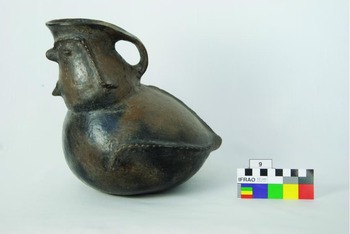
I've been trying to coax a particular body of pots into life for several years (e.g. Alberti Reference Alberti, Hallam and Ingold2014b; figure 1). The La Candelaria body-pots from north-west Argentina date to the first millennium AD. Now in museums and private collections, many were found in funerary contexts. Their odd anthropomorphism and association with bodies make them candidates for an exploration of alterity.
La Candelaria ceramic pot from the Arminio Weiss Collection, Museo Municipal de San Rafael, Argentina. Photograph by the author.

This approach is aligned with other ontologically oriented archaeologies, which I will classify into two camps: New Animists and New Materialists. New Animists search for the evidence of relational ontologies among premodern peoples. As such, animism has produced a renaissance of ethnographic analogies. Worlds proliferate with relations between non-human and human beings and objects are affective and powerful.
Amazonian perspectivism occupies a privileged position as a potent model for animist ontologies. It has been defined by its most vocal proponent, Viveiros de Castro (2012, 83), as ‘the conception according to which the universe is inhabited by different sorts of persons, human and non-human, which apprehend reality from distinct points of view’. Bodies are the seats of these distinct perspectives. Among the La Candelaria ceramics, zoo- and anthropomorphic bodies are fixed onto other bodies.
New Materialists offer exciting and complex correctives to conventional Western metaphysics (e.g. Olsen et al. Reference Olsen, Shanks, Webmoor and Witmore2012). Relational and symmetrical approaches redescribe time, materiality and archaeological practice. To those inspired by Jane Bennett's vital materiality (Bennett Reference Bennett2010) or Ingold's generative flux (e.g. Ingold 2011), the world itself and not just the non-modern world is full of inherent vibrancy. We are all said to participate in a ‘world-in-motion’.
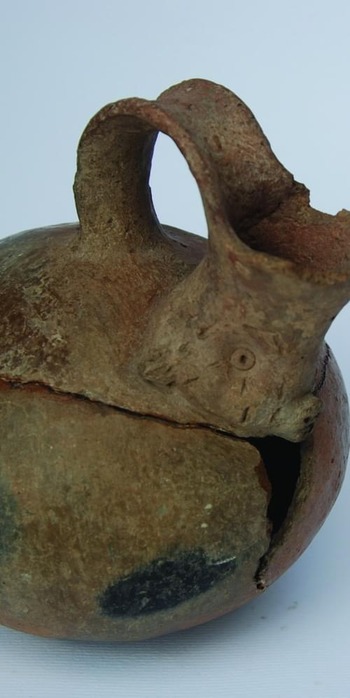
La Candelaria bodies and ceramics are unstable ( figure 2 ). Processes prevail over forms. Bodies are reinforced through practices of marking and fixing that are shared across the animate/inanimate divide.
Detail of La Candelaria ceramic from the Museo Arquaeólogico El Cadillal. Photograph by the author.

Somewhat dramatically, however, I would characterize these approaches as ontologically predatory – they swallow rather than open up alterity. More than a decade ago Viveiros de Castro (Reference Viveiros de Castro2003) argued that Indigenous peoples’ ontologies have been relegated to the status of epistemologies. Western science alone, he claimed, deems itself to have access to the singular Ontology, the really natural Nature. Others’ natures are simply seen as poorly scripted versions of Western Nature. I don't think ontological approaches in archaeology have fully addressed this critique, apparent in the way Indigenous peoples appear in the literature. New Animism, for example, equates ontology with belief and its method is that of analogy. These ontologies are to all intents and purposes still cultures – that is, beliefs about ontology. The New Materialists do address multiple ontologies but tend to draw from an alternative stable of Western theorists. Native informants can provide key examples of, say, a world in movement and flux, but in a kind of ontologically predatory act they disappear as active participants in theory building. Moreover, among some New Materialists metaphysical exhaustion seems to have set in. Fed up with the endless search for human meaning, objects are understood to hold something back (e.g. Olsen Reference Olsen2010). There is something mysterious and unreachable, broodingly independent, about these new things.
Risking theory
Casting what we do as mysterious – or even as a cause for wonder – I agree with. But equally important is the refusal to lock our theories or materials within scripted frameworks, new or old (Alberti et al. Reference Alberti, Fowles, Holbraad, Marshall and Witmore2011, 905). I take ontology to be a tool for unsettling our certainties rather than only a better way to describe the world. If we are to get at ontological difference we have to ‘take seriously’ other bodies of theory – Indigenous metaphysics, or its lack. This means refusing what Spivak (Reference Spivak1999) calls the figure of the Native Informant that haunts and founds modern texts – the animist, in our case. It means to risk following the theory, not simply the staged example. Harris and Robb (Reference Harris and Robb2012) argue for a notion of multi-modal ontologies of the body, in which ontologies can coexist in a given culture. They reference Descola's (Reference Descola1996) account of the ‘staging’ of a curing ritual by an Achuar shaman. Darts are removed from a patient's body, darts that had actually been hidden about the shaman's person beforehand. The efficacy of the cure despite its apparent duplicity depends, they argue, ‘on the beliefs with which we frame it’ (Harris and Robb Reference Harris and Robb2012, 671). While Descola's point is indeed that the regurgitation of the darts is a ‘conjuring trick’, the concept tsenstak, translated as ‘darts’, is in fact shorthand for an experience that is too complex to fully represent. Descola (Reference Descola1996, 333) explains, ‘The tsentsak are not real “darts” or even invisible ones. They are animated principles or incorporeal automata that are as impossible to represent as the mysterious entelechy . . . of classical philosophy’. In other words, shamans use the props to avoid having to make lengthy explanations to the uninitiated.
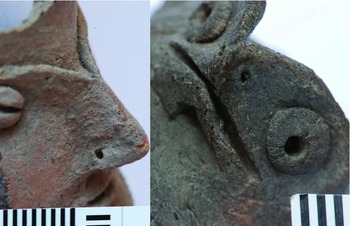
Humanoid faces and frogs are two of the most common forms on the ceramics ( figure 3 ). Humanoid faces are placed on necks. Frogs appear as plastic additions to bulges that push out from bodies. The eyebrows and nose of the face are replicated in the front legs and mouth of the frog. The eyes are isomorphically positioned.
Detail of La Candelaria ceramic from the Museo Archaeólogico El Cadillal. Photograph by the author.

The perspective of a given species differs according to affects proper to different bodies. ‘Souls’ are all human in origin. Bodies are always in danger of transforming into other species’ bodies, and therefore into other affective capacities, realities. Souls are only present at moments of danger. Under normal conditions the soul is not present ‘in’ the body because bodies and souls eclipse one another. These are visible and invisible worlds. There is no realm beyond the material where thought or souls reside. La Candelaria ceramic pots are not supports for representations, beliefs. They are fully entailed in what they depict.
Darts, rather than being evidence of two ontological modes of the body, correspond to figure and ground, the infinite supposition of states. Perhaps the lengthy explanation is significant to us as theoretical exegesis. That is, it is the thought of the shaman that we need as our interlocutor, not the conjury – just as we are not interested in, say, Bourdieu's table manners but care more about his concept of cultural capital.
Of course, taking such thought as theory we risk the loss of credibility. As Indigenous philosopher Viola Cordova (Reference Cordova2007, 53) has pointed out, the Native American ‘is not seen as a valid thinker’. We may be dismissed as ‘misguided neoprimitivists’, as Severin Fowles (Reference Fowles2013, xi) puts it. Fowles (ibid.) risks much by reading the Puebloan category of ‘doings’ through Indigenous theories in his ‘critical unpacking of religion’ in archaeology. It is not, however, only about credulity. With Kim Tallbear I would argue that archaeologists are actually terrified of the claims Indigenous scholars make on their theories. But the aim is just that – to treat Indigenous thought as theory, with the full reciprocal effect it ought to have on archaeology's theory-making and concepts. This, then, is not an analogical or illustrative usage; it is theoretical and conceptual engagement.
The pots have many eyes, but are also equipped with other organs of knowledge – ears, noses, skin. Knowledge requires the proprioceptive potential associated with a particular body part. To be open to knowledge you need to mark those organs in particular ways. The ceramic bodies provide an ear or nose to pierce; a skin to incise.
Davi Kopenawa (Kopenawa and Albert Reference Kopenawa and Albert2013, 35) gives an account of when the xapiri spirits first opened his eyes to knowledge:
When I was a very young child . . . I saw the spirits for the very first time. At nightfall, the warmth of the fire eased me to sleep in my mother's hammock. After a moment their images would start to come down to me . . . A path of light opened before my eyes and unknown beings came towards me . . . There were so many of them, and they kept their eyes set on me. It was beautiful but terrifying because I had never seen xapiri spirits before.
We could describe this as parallel to a state of wonder. Wonder is powerful, emotive; it is awe and terror in the face of something just beyond the reaches of comprehension. Wonder also expresses an attitude towards research. Philosopher of science Isabelle Stengers (Reference Stengers, Bryant, Srnicek and Harman2011) has recently likened scientific practices in their original and most creative condition to practices of wonder. Of course, the term carries risks. It evokes mysticism, the unknowable; again, incredulity. But Stengers does not mean we should be immobilized by awe at the wonderfulness of the world. Rather, we should simply ‘not explain away’ things. It is about taking on the surprise, letting it linger. Wonder can provide a powerful clue, especially when things are not well ontologically, when what did appear to make sense no longer does. Wonder, as Michael Scott (Reference Scott, Abramson and Holbraad2014, 20) tells us, can open us to unsuspected realities that threaten to disrupt and change our knowledge of what is.
And to see is to be seen. You must be seen first by the spirits in order to activate your own sight, knowledge. Davi Kopenawa is looked on by the xapiri spirits, and hence can see and then know. But these are staring, open eyes – they are the ghost of the living, those who are going to die. They cannot see the invisible.
Risky materials
Anthropologist Helen Verran (Reference Verran2001) has written of the ‘disconcertment’, the intellectual discomfort, she felt while observing mathematics taught in Yoruba primary schools. She was struck by the innovative manner in which local teachers adapted their limited supplies to teach maths using Yoruba number. The tension between different ontologies that was negotiated by the teachers led her to describe them as ‘ontic innovators’ (Verran Reference Verran2014). Ontic innovation is the practical side to wonder as a response to ontological tensions. The task of the archaeologist, as ontic innovator perhaps, is to work on the ontic immediacies – the concrete bits of ontology – at our disposal. We can see this in Jonathan Walz's (forthcoming) medical archaeology, where a new archaeology comes out of healers’ practices in Tanzania. Time, place and reality are reconfigured through the material objects assembled in medicine gourds during itinerant journeys. Lesley and David Green (Reference Green and Green2013) write how distress and wonder drew them into another kind of archaeology among the Palikur of Brazil. Palikur knowledge as movement led them to conceptualize archaeology as ‘reading the tracks of the ancestors’. ‘To follow’, the Palikur say, ‘is to allow oneself to be translated’. The Greens translate ‘tracking’ into archaeological terms but in such a way that archaeological concepts and practice change and not the original intention.
Following perspectivism, subjectivity is a condition of being and relating, not their result. And to know a thing is not to objectify it. It is to add the maximum amount of subjectivity to it. Ontological predation – the utter annihilation of an Other through changed perspective – requires maximal subjectivization of the Other. The danger is that the material worked on in putting together the pot has become too much of a subject itself, too capable. To know something – to make it subject – is to put you at risk of a predatory exchange. Souls can be stolen, perspectives lost; bodies transformed. The pot is thus only partially made subject. Its exchange capacities are curtailed. It is in fact an objectified subject.
Still, the situation of archaeologists is not strictly parallel to that of Verran's teachers. The ontological turn in anthropology has yet to tackle fully alterity in matter itself. Archaeologists’ ontological crises are not provoked in the first instance by encounters with living peoples but by encounters with materials, by what we see and touch. Materials are not outside the question of alterity in archaeology – they are central to it. Recognizing the ontological self-determination of matter (Alberti Reference Alberti2014a), to paraphrase Viveiros de Castro, is parallel to risking new theory. We acknowledge that materials act back. Scientific techniques discipline us; they force us into certain activities, practices and consciousness. Archaeological entities are constantly in flux – materializing and dematerializing – together with the cognitive work and practices of the archaeologist (Lucas Reference Lucas2012). But understanding the very particular ways they do is the principle challenge. ‘Vibrant materiality’ alone can only hint at the possibilities.
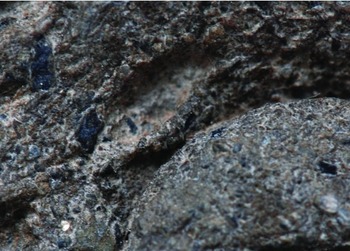
Materials are, like bodies, bundled affects, all the way down; enlivened, inherently capable of subjectivity. Materials, like Kopenawa's water spirits, can predate us – pull us through terror into wonder and knowledge, or blind us to our own ontological annihilation (figure 4).
Detail of La Candelaria ceramic from the Museo Archaeólogico El Cadillal. Photograph by the author.

So what is there to be afraid of? Plenty: the loss of perspective to some other theory; the loss of our identity as archaeologists; the loss of the true, historical past; being predated by our materials. But do we need generalized certainty, an overarching framework within which the truth of the past is revealed? Materials and concepts are brought into ontological determinacy locally. What we could call ‘material ontographies’ – descriptions and analysis of ontologies – should be highly specific and, as in the case of the Greens’ work among the Palikur, produce local resolutions to questions at the interface between archaeological materials, archaeologists, local communities and theory.
It is possible to experience the past as a foreboding and wondrous alterity, as the threat of rupture to quiet certainties. I would like to foster that feeling – though clearly it is just one starting point among many, just as Proust and Kopenawa are not talking from different perspectives but differ in what ‘perspective’, ‘eyes’, ‘bodies’, ‘knowledge’ are. Finding a way, through risk and wonder, to explore the potential of alterity in archaeology to generate new concepts and methods that can be deployed to agitate debate well beyond the discipline is my hope for a future archaeology.
Acknowledgements
An earlier version of this paper was presented at the Theoretical Archaeology Group conference, Champaign-Urbana, May 2014. I am grateful to the staff at the Museo Municipal de San Rafael, Argentina, and the Museo Archaeólogico El Cadillal for their assistance with the figures.