INTRODUCTION
The opening of the Suez Canal, which connects the tropical Red Sea with the warm-temperate Levantine Basin of the Mediterranean Sea, allowed a massive invasion of tropical fauna into the Mediterranean. Of the alien species recorded thus far, 81 are fish (78 Osteichthyes and 3 Chondrichthyes), the majority of which entered through the Suez Canal (Galil, Reference Galil2008a, Reference Galilb; Golani et al., Reference Golani, Appelbaum-Golani and Gon2008). Alien fish have a significant negative impact on the native biota, and some have been considered to have out-competed certain native fish species (Goren & Galil, Reference Goren and Galil2005; Galil, Reference Galil, Gollasch, Galil and Cohen2006, Reference Galil2007).
Most of the 30 species of the genus Apogon Lacepède, 1801, known from the Red Sea (Gon & Randall, Reference Gon and Randall2003; Froese & Pauly, Reference Froese and Pauly2008), are nocturnal, shallow-water and reef-associated species. However, the first Erythrean alien apogonid species to enter the Mediterranean, A. pharaonis Bellotti, 1874 (Fox, Reference Fox1927), occupies seagrass meadows as well as soft bottom habitats (sandy and muddy) at depth of 5–40 m (Goren, unpublished data). It partly overlaps the depth-range of the native Mediterranean A. imberbis (Linaeus, 1758), which occupies rocky reefs and seagrass habitats at 2–70 m (Froese & Pauly, Reference Froese and Pauly2008; Goren, unpublished data).
The present report of Apogon smithi in Turkey and A. queketti in Israel demonstrates the newly emerging pattern of nearly simultaneous appearance of new Indo-Pacific records along the entire Levantine coast of the Mediterranean Sea.
Abbreviations: TAU, fish collection of Tel Aviv University; TL, total length.
KEY TO THE SPECIES OF APOGON IN THE MEDITERRANEAN
1. First dorsal fin with 6 spines; body red-purple. . … … … … … … … … … … … … … … … . … A. imberbis
– First dorsal fin with 7 spines…… … … … … … 2
2. Four vertical dark bars on body. Anterior bar interrupted by dark ‘eye spot’, at mid body under first dorsal fin. Second bar under rear half of second dorsal fin, third (narrow) on peduncle and fourth bar on caudal fin base. Two median predorsal scales… … … … …. …A. pharaonis
– Different colour pattern. Three or more median predorsal scales… … … … … … … … … … … … …3
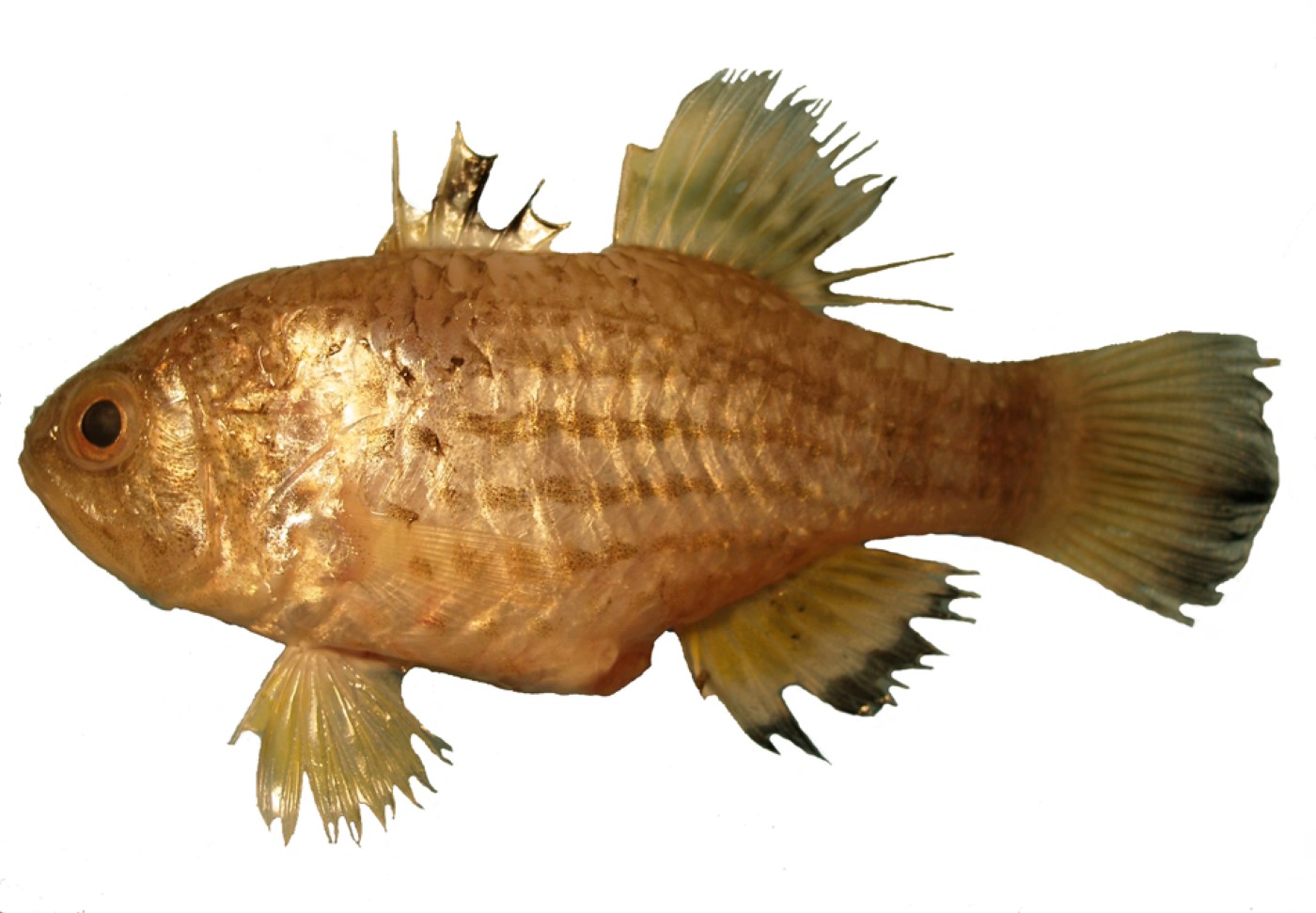
3. Dark (or golden) spots on scales form 6–7 longitudinal stripes on body. A black stripe on margin of anal fin. A black spot on upper part on first dorsal fin from third spine to seventh spine. Preopercle edge smooth. Three median predorsal scales… … … … … … … A. queketti
– 7–8 vertical bars on head and body (sometimes faded), no black stripe on margin of anal fin, black spot on upper part of first dorsal fin from first spine to fifth spine. 4–5 median predorsal scales…… … A. smithi
Apogon smithi (Kotthaus, Reference Kotthaus1970), Iskenderun Bay, Turkey. TAU—p. 13447, TL 102 mm. (Photograph: K. Gayer).

MATERIAL EXAMINED
TAU—p. 13447, Iskenderun Bay (Turkey), 7 ex. TL 96–110 mm, collected on 27 May 2008 by trawl, at depth of 20–40 m, tow co-ordinates: 36°30′N 36°00′E–36°35′N 36°07′E; TAU—p. 13347, off Ashdod (Israel), 10 ex. TL 78–108 mm, collected on 6 April 2008 by trawl, at depth of 40 m, tow co-ordinates: 31°45′N 34°30′E–31°49′N 34°33′E; TAU—p. 13364, off Ashdod (Israel), 20 ex. TL 75–112 mm, collected on 15 April 2008 by trawl, at depth of 40 m, tow co-ordinates: 31°48′N 34°32′E–31°45′N 34°30′E.
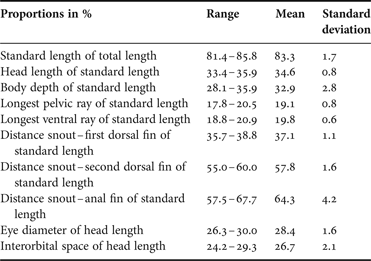
Brief description of the seven specimens collected in Turkey: an Apogon species with 7–8 faded dark vertical bars on body and head. Black spot on upper front of first dorsal fin. Two longitudinal black stripes on second dorsal fin, one on upper margin second at mid height of fin. A narrow black bar on rear margin of caudal fin. Lateral line scales 24–26 + 1–2 scales without pores on base of caudal fin. Median predorsal scales 4–5, the anterior one enlarged with median notch. First dorsal fin with 7 spines; the first very short, about half that of the second spine which is about half that of the fourth spine. Second dorsal fin with a spine and 9 rays (8 rays in one out of 7 fish). Anal fin with 2 spines and 8 rays (7 rays in one fish). Pectoral fin with 15 rays. Developed gill rakes on first gill arch 1 + 9–11. Selected proportions are presented in Table 1.
Selected proportions (in %) of 7 specimens of Apogon smithi collected from Iskenderun Bay.

REMARKS
Apogon smithi was first recorded along the Israeli coast by Golani et al. (Reference Golani, Appelbaum-Golani and Gon2008) who reported the finding of 6 specimens in March 2007 at a depth of 40 m. Our recent research revealed that A. smithi is common on sandy–mud bottoms along the Israeli coast.
Apogon queketti Gilchrist, Reference Gilchrist1903, Iskenderun Bay, Turkey. TAU—p. 13448, TL 98 mm. (Photograph: K. Gayer).

MATERIAL EXAMINED
TAU—p. 13236, off Ashdod (Israel), 1 ex. TL 98 mm, collected on 2 May 2007 by trawl, at depth of 58–63 m, tow co-ordinates: 31°48′N 34°28′E–31°53′N 34°32′E; TAU—p. 13448, Iskenderun Bay (Turkey), 4 ex. TL 86–106 mm, collected on 27 May 2008 by trawl, at depth of 20–40 m, tow co-ordinates: 36°30′N 36°00′E–36°35′N 36°07′E.
Brief description of the specimen collected in Israel: an Apogon species with 6–7 yellowish stripes along the body, black stripe on margin of anal fin, black spot on upper part of first dorsal fin from third spine to seventh spine. A black bar on rear margin of caudal fin. Lateral line scales 25 + 1 scale without pores on base of caudal fin. Median predorsal scales 3, the anterior one enlarged with median notch. First dorsal fin with 7 spines; the first very short, about half that of the second spine which is about half that of the fourth spine. Second dorsal fin with a spine and 9 rays. Anal fin with 2 spines and 8 rays. Pectoral fin with 15 rays. Developed gill rakes on first gill arch 2 + 10.
Morphometric data as proportions of standard length (SL): head length 35%; body depth 36%; distance snout–first dorsal fin 40%; distance snout–second dorsal fin 60%; distance snout–anal fin 63%; longest pelvic ray 20%; longest pectoral ray 20%. Proportions of head length (HL): eye diameter 28%; inter orbital space 31%.
REMARKS
Apogon queketti was first recorded from Iskenderun Bay (Turkey) by Eryilmaz & Dalyan (Reference Eryilmaz and Dalyan2006) who reported the finding of 2 specimens in March 2004 at a depth of 55 m. Our recent research revealed that the A. queketti is found at depths of 20–70 m on sandy–mud and muddy bottoms.
DISCUSSION
An analysis of the historical records of tropical invaders in the Mediterranean reveals that the majority of the 35 alien fish species recorded from both Israel and Turkey coasts were initially recorded from Israel and only subsequently from Turkish coastal waters. In fact, a delay of at least a decade, in one case as much as 67 years, typically separates the initial Israel and Turkey records (Galil, Reference Galil2008b). Two early exceptions are the records of Upeneus moluccensis (Bleeker, 1855) and U. pori Ben-Tuvia & Golani, 1989, recorded in 1942 from Turkey, and in 1947 and 1953 respectively off Israel (Haas & Steinitz, Reference Haas and Steinitz1947; Kosswig, Reference Kosswig1950; Ben Tuvia, Reference Ben Tuvia1953). We consider these an artefact, a consequence of the inadequate sampling and ichthyology study efforts conducted in those early years. Of the ten alien fish species that have been recorded in Israel and Turkey within three year intervals of each other, five—Bregmaceros atlanticus Goode & Bean, 1886, Fistularia commersonii Rüppell, 1835, Hippocampus fuscus Rüppell, 1838, Lagocephalus sceleratus (Gmelin, 1789) and Nemipterus randalli Russell, 1986—have been reported since 2000 (Golani, Reference Golani2000; Bilecenoglu et al., Reference Bilecenoglu, Taskavak and Kunt2002; Golani & Fine, Reference Golani and Fine2002; Gökoglu et al., Reference Gökoglu, Bodur and Kaya2004, Reference Gökoglu, Güven, Balci, Çolak and Golani2008; Yilmaz et al., Reference Yilmaz, Bilecenoğlu and Hoşsucu2004; Akyol et al., Reference Akyol, Unal, Ceyhan and Bilecenoğlu2005; Golani & Levy, Reference Golani and Levy2005; Golani & Sonin, Reference Golani and Sonin2006; Goren & Galil Reference Goren and Galil2006; Lelli, et al., Reference Lelli, Colloca, Carpentieri and Russell2008). The presently reported records of A. smithi from Turkey, one year after it was reported from Israel (Golani et al., Reference Golani, Appelbaum-Golani and Gon2008), and the record of A. queketti in Israel shortly after it was found in Turkey (Eryilmaz & Dalyan, Reference Eryilmaz and Dalyan2006), are two additional cases. It is suggested that the near concurrent records of Erythrean alien fish in the Levant are the result of intensified research efforts following increased awareness of the impact of invasive and alien species on native biodiversity, the likelihood that rising sea surface temperatures favour the tropical Erythrean aliens, and the continuous maintenance and enlargement of the Suez Canal that may have provided new cohorts of nektonic fish with improved chances of surviving the passage from the Red Sea to the Mediterranean.
ACKNOWLEDGEMENTS
This research was supported by the Porter School of Environmental Studies at Tel Aviv University with funding from the Italian Ministry of the Environment, Land and Sea. We thank our assistants, K. Gayer, N. Stern, Y. Klopman, M. Cooper, E. Kalkan, U. Karhan and U. Tural, for their invaluable help in the research and to N. Paz for editing the manuscript.