Attention-deficit hyperactivity disorder (ADHD) is a neurodevelopmental disorder that can persist into adulthood and has an estimated prevalence of 2.5% at adult age (Simon et al. Reference Simon, Czobor, Balint, Meszaros and Bitter2009). In several European countries and the United States, pharmacotherapy with stimulant medication is suggested as first-line treatment for adult ADHD (NICE, 2009; Kooij et al. Reference Kooij, Bejerot, Blackwell, Caci, Casas-Brugué and Carpentier2010; UMHS, 2013). In the Netherlands, stimulant medication is often combined with psychoeducation and skills training after or parallel to pharmacotherapy (NVvP, 2015). Despite the demonstrated efficacy of stimulants in the short term (Faraone & Glatt, Reference Faraone and Glatt2010; Moriyama et al. Reference Moriyama, Polanczyk, Terzi, Faria and Rohde2013), there is a call for evidence-based psychosocial treatments to offer in addition or as an alternative to pharmacotherapy (Matheson et al. Reference Matheson, Asherson, Wong, Hodgkins, Setyawan and Sasane2013). Several patients experience adverse effects that can result in discontinuation (Gajria et al. Reference Gajria, Lu, Sikirica, Greven, Zhong and Qin2014), some patients are reluctant to take medication (Matheson et al. Reference Matheson, Asherson, Wong, Hodgkins, Setyawan and Sasane2013), or respond insufficiently to stimulants and experience residual symptoms (Wigal, Reference Wigal2009) and long-term beneficial effects have not been convincingly established (Moriyama et al. Reference Moriyama, Polanczyk, Terzi, Faria and Rohde2013). Consequently, the NICE guidelines (NICE, 2009) and the European consensus statement (Kooij et al. Reference Kooij, Bejerot, Blackwell, Caci, Casas-Brugué and Carpentier2010) emphasise that pharmacotherapy should be part of a multimodal treatment approach.
A growing amount of evidence is showing that psychosocial treatments, like cognitive–behavioural therapy (CBT), can have an additional effect to pharmacotherapy in alleviating residual symptoms in adults with ADHD (Young et al. Reference Young, Moghaddam and Tickle2016), although a recent study did not find a difference between a group psychotherapy programme, including cognitive–behavioural elements and clinical management (Philipsen et al. Reference Philipsen, Jans, Graf, Matthies, Borel and Colla2015). Upcoming psychosocial treatments for ADHD are mindfulness-based interventions (MBIs). Mindfulness is defined as intentionally paying attention to present moment experiences in a non-judgemental way (Kabat-Zinn, Reference Kabat-Zinn1990). Neuroscientific studies showed that in healthy subjects, MBIs can result in improved attention regulation, enhanced brain activity and altered attention-related brain areas such as greater cortical thickness and enhanced white-matter integrity in the anterior cingulated cortex (Fox et al. Reference Fox, Nijeboer, Dixon, Floman, Ellamil and Rumak2014; Tang et al. Reference Tang, Holzel and Posner2015). Bachmann et al. (Reference Bachmann, Lam and Philipsen2016) suggested that mindfulness meditation can strengthen functioning in brain regions that underlie neuropsychological deficits in ADHD, positioning MBI as a promising treatment for ADHD. Currently, the evidence for MBIs for ADHD is growing and a first meta-analysis including three studies in adults demonstrated preliminary evidence for the efficacy of MBIs in reducing core symptoms, especially inattentiveness, with moderate-to-large effect sizes (Cairncross & Miller, Reference Cairncross and Miller2016). However, these findings should be interpreted with caution, as the included studies either lacked randomisation (Edel et al. Reference Edel, Hölter, Wassink and Juckel2017), were underpowered (Schoenberg et al. Reference Schoenberg, Hepark, Kan, Barendregt, Buitelaar and Speckens2014; Mitchell et al. Reference Mitchell, McIntyre, English, Dennis, Beckham and Kollins2017), used different MBIs (Schoenberg et al. Reference Schoenberg, Hepark, Kan, Barendregt, Buitelaar and Speckens2014; Edel et al. Reference Edel, Hölter, Wassink and Juckel2017; Mitchell et al. Reference Mitchell, McIntyre, English, Dennis, Beckham and Kollins2017) and/or lacked a follow-up period (Schoenberg et al. Reference Schoenberg, Hepark, Kan, Barendregt, Buitelaar and Speckens2014; Edel et al. Reference Edel, Hölter, Wassink and Juckel2017; Mitchell et al. Reference Mitchell, McIntyre, English, Dennis, Beckham and Kollins2017). Mindfulness-based cognitive therapy (MBCT) combines mindfulness practice with elements of CBT (Segal et al. Reference Segal, Williams and Teasdale2012). We previously reported moderate-to-large efficacy of a 12-weekly adapted version of MBCT in reducing ADHD symptoms and improving executive functioning in comparison to a waitlist control group (Hepark et al. Reference Hepark, Janssen, de Vries, Schoenberg, Donders and Kan2015). These results were in line with a recent randomised controlled trial (RCT) in college students with ADHD that found a reduction of ADHD symptoms after an adapted 6 weeks version of MBCT. However, both studies had methodological limitations, such as a small sample size (Gu et al. Reference Gu, Xu and Zhu2018), the lack of a follow-up period, no outcome data for drop-outs and single-centre enrolment (Hepark et al. Reference Hepark, Janssen, de Vries, Schoenberg, Donders and Kan2015). Therefore, the current RCT took account of these limitations. The main aim of our RCT was to examine the efficacy of MBCT added to treatment as usual (TAU) compared with TAU alone in reducing core symptoms as rated by a clinician in adults with ADHD. Secondary outcomes included self-reported ADHD symptoms, executive functioning, mindfulness skills, self-compassion, positive mental health and general functioning.
Method
Trial design
A multicentre, single-blind, parallel-group, randomised controlled superiority trial was conducted comparing MBCT + TAU with TAU alone (allocation ratio 1 : 1). The study protocol has been published previously (Janssen et al. Reference Janssen, Kan, Carpentier, Sizoo, Hepark and Grutters2015) and has been approved by the local medical ethics committee CMO Arnhem-Nijmegen for all participating centres (2014/206). The methodology is described briefly below, for more detail see our protocol (Janssen et al. Reference Janssen, Kan, Carpentier, Sizoo, Hepark and Grutters2015).
Participants
Patients were eligible when they were 18 years or older and met DSM-IV (APA, 2000) criteria for ADHD as their primary diagnosis assessed with the semi-structured Diagnostic Interview for ADHD in adults (DIVA) (Kooij, Reference Kooij2010). This interview was only conducted in those patients that had not received an ADHD diagnosis based on the DIVA before. For the other patients, the previously determined diagnosis was maintained. Exclusion criteria were: (a) not capable of filling out questionnaires in Dutch; (b) current depressive disorder with psychotic symptoms or suicidality; (c) current manic episode; (d) borderline or antisocial personality disorder assessed with the Clinical Interview for DSM-IV Axis II Disorders (SCID-II) (First & Gibbon, Reference First and Gibbon2004); (e) substance dependence; (f) autism spectrum disorder; (g) tic disorder with vocal tics; (h) learning difficulties or other cognitive impairments; and (i) former participation in MBCT or other MBI or workshop (>2 h). Criteria b, c and e were assessed with a psychiatric structured diagnostic interview (MINI-Plus) (Van Vliet & De Beurs, Reference Van Vliet and De Beurs2007).
Procedure
Participants were recruited between September 2014 and December 2015 by referral via three specialised outpatient clinics for adults with ADHD: the Department of Psychiatry of the Radboud university medical centre in Nijmegen, Reinier van Arkel Group in ‘s-Hertogenbosch, Dimence in Deventer and by self-selection through media advertisements (website, social media) and presentations at regional thematic meetings of the Dutch association of adults with ADHD ‘Impuls & Woortblind’. Currently and previously treated patients were informed about the study by their attending clinician in various stages of their treatment process. Eligibility was assessed in a research interview conducted by the researcher or a research assistant. Each participant provided written informed consent after receiving detailed information about the trial.
Randomisation and blinding
Random assignment to MBCT or TAU was performed by a website specifically developed for this study by an independent statistician. Randomisation was stratified by centre, after which block randomisation with varying predefined block sizes was used combined with minimisation for use of medication for ADHD (yes/no); previous participation in a psychoeducation training (yes/no); gender and ADHD subtype (combined/inattentive/hyperactive–impulsive/not otherwise specified). The researcher was blind for the block sizes and filled-out the online form.
Blinded assessments by a psychiatrist or specialist nurse took place at baseline (T0), post-treatment (T1), 3 (T2) and 6 (T3) months follow-up. Randomisation took place after enrolment, but participants were not informed about the assigned condition until after completion of T0. To ensure the blinding of the interviewers, participants were instructed not to share information about allocation with the interviewer.
Intervention
Mindfulness-based cognitive therapy
The programme was primarily based on MBCT (Segal et al. Reference Segal, Williams and Teasdale2012), consisting of 8-weekly sessions of 2.5 h and a 6 h silent day between the sixth and seventh sessions. The programme included meditation exercises (bodyscan, sitting meditation, mindful movement) combined with psychoeducation, CBT techniques and group discussions. In addition to the group sessions, participants were instructed to practice 6 days a week at home for approximately 30 min a day with guided exercises. Some modifications were made based on our pilot study (Janssen et al. Reference Janssen, De Vries, Hepark and Speckens2017) and the Mindful Awareness Practices for ADHD programme (MAPs) (Zylowska et al. Reference Zylowska, Ackerman, Yang, Futrell, Horton and Hale2008; Mitchell et al. Reference Mitchell, Zylowska and Kollins2015) to make the intervention more suitable for adults with ADHD, like the more gradual increase of the duration of meditation exercises, replacement of psychoeducation about depression by psychoeducation about ADHD, more emphasis on mindfulness awareness in daily life and inclusion of one session on mindful listening and speaking. See our study protocol for more details (Janssen et al. Reference Janssen, Kan, Carpentier, Sizoo, Hepark and Grutters2015). MBCT was taught in 10 groups with approximately nine individuals per group (consisting of both study and non-study participants with ADHD to strive for a group size of 8–12 patients) by four mindfulness teachers, who all met the advanced criteria of the internationally agreed good practice guidelines of the UK Network for Mindfulness-Based Teachers (http://mindfulnessteachersuk.org.uk/pdf/teacher-guidelines-2015.pdf). Once every 3 weeks, the teachers participated in peer supervision. Teacher competence and adherence to the protocol were assessed by the Mindfulness-Based Interventions-Teaching Assessment Criteria (MBI: TAC) (Crane et al. Reference Crane, Kuyken, Williams, Hastings, Cooper and Fennell2012). Two videotaped sessions per teacher were randomly selected to be rated independently by two assessors with experience in teaching mindfulness. The assessors discussed possible differences in their evaluations to arrive at an agreed evaluation. The competence levels of the teachers were advanced (taught nine participants), competent (taught 21 participants), advanced beginner (taught 22 participants) and beginner (taught six participants).
Treatment as usual
TAU was designed to reflect the usual treatments of adults with ADHD in various mental health centres across the Netherlands. All participants were open to start, continue and stop a treatment if desired and the research team did not influence participants’ decisions. We monitored TAU with additional online questions about pharmacological and psychosocial treatments during the last 3 months. Participants in the TAU group were offered MBCT after completing the T3 assessments.
Outcome measures
Primary outcome
The investigator-rated screening version of the Conners’ Adult ADHD Rating Scale (CAARS-INV: SV) (Adler et al. Reference Adler, Faraone, Spencer, Michelson, Reimherr and Glatt2007) was used by blinded clinicians (n = 12) to assess ADHD symptoms at each time point. Ratings can be organised in a DSM-IV symptom score (which served as the primary outcome) and in the subscales: inattention and hyperactivity/impulsivity. To reduce inter-rater variance, two training workshops were provided by two expert raters, and as far as possible, the same assessor conducted all interviews with a particular participant. A random sample of audiotaped CAARS-INV interviews (n = 25) was rated by blinded raters (n = 5) from another centre. The intraclass correlation coefficient was 0.73 [95% confidence interval (CI) 0.48–0.87].
Secondary outcomes
The following self-report questionnaires were administered online as secondary outcomes at each time point: Conners’ Adult ADHD Rating Scale-Self-Report: Screening Version (CAARS-S:SV) (Adler et al. Reference Adler, Faraone, Spencer, Michelson, Reimherr and Glatt2007) assessing the DSM-IV AHDH symptom score, Inattention and Hyperactivity/Impulsivity; the Behaviour Rating Inventory of Executive Function-Adult Version (BRIEF-A) (Roth & Gioia, Reference Roth and Gioia2005); the Five Facet Mindfulness Questionnaire-Short Form (FFMQ-SF) (Bohlmeijer et al. Reference Bohlmeijer, Peter, Fledderus, Veehof and Baer2011); the Self-Compassion Scale-Short Form (SCS-SF) (Raes et al. Reference Raes, Pommier, Neff and Van Gucht2011); the Mental Health Continuum-Short Form (MHC-SF) (Lamers et al. Reference Lamers, Westerhof, Bohlmeijer, ten Klooster and Keyes2011) assessing positive mental health; and the Outcome Questionnaire (OQ 45.2) (Lambert et al. Reference Lambert, Burlingame, Umphress, Hansen, Vermeersch and Clouse1996) measuring general functioning. Further details about these outcome measures can be found in our study protocol (Janssen et al. Reference Janssen, Kan, Carpentier, Sizoo, Hepark and Grutters2015).
Statistical analyses
All analyses were performed at a significance threshold of 5% (two-tailed) and two-sided 95% CIs were used.
Sample size calculation
The power calculation was based on an estimated minimum clinically relevant difference of four points (s.d. = 7.5) on the DSM-IV symptom score of the CAARS-INV, based on our previous RCT (Hepark et al. Reference Hepark, Janssen, de Vries, Schoenberg, Donders and Kan2015). Using an α of 0.5, a power of 80% and an analysis of covariance (ANCOVA) controlling for baseline levels with an assumed correlation of 0.5 between T0 and T1, 45 participants per treatment group were required. Taking account of an anticipated drop-out rate of 25%, a total number of 120 participants was necessary, 60 per treatment group.
Treatment effects at T1
All analyses were performed on both the intention-to-treat (ITT) sample, consisting of all participants who completed the questionnaire at T0 and T1, and additionally the per protocol (PP) sample (MBCT + TAU: participants who attended ⩾4 MBCT sessions; TAU: participants who did not attend an MBI). In the primary analyses, scores at T1 were compared between groups, using an ANCOVA while controlling for baseline levels, centre and minimisation variables (use of ADHD medication, previous participation in a psychoeducation training, gender and ADHD subtype). Cohens’ d effect size was calculated by dividing the adjusted group difference at T1 by the pooled standard deviation at T0. The reliable change index (RCI; Jacobson & Truax, Reference Jacobson and Truax1991) was calculated for the primary outcome between T0 and T1, using Cronbach's α for calculating the standard error of the difference, to determine which participants changed reliably. The number of improved (RCI <−1.96) and deteriorated (RCI >1.96) participants between groups was tested with χ2 tests. Additionally, the number of participants per group that showed a symptom reduction of ⩾30% on the primary outcome was calculated to determine which participants showed a clinical significant change (Zylowska et al. Reference Zylowska, Ackerman, Yang, Futrell, Horton and Hale2008; Hepark et al. Reference Hepark, Janssen, de Vries, Schoenberg, Donders and Kan2015; Mitchell et al. Reference Mitchell, McIntyre, English, Dennis, Beckham and Kollins2017). The symptomatic remission rate per group was calculated. Remission was defined by a mean total score ⩽1 on the 18 DSM-IV symptom scores of the CAARS-INV (Ramos-Quiroga & Casas, Reference Ramos-Quiroga and Casas2011). Sensitivity analyses were performed by imputing missing data according to Last Observation Carried Forward (LOCF) and Multiple Imputation (MI) techniques.
Follow-up effects
The consolidation of treatment effects over the follow-up period for primary and secondary outcomes was evaluated with multilevel modelling with time point as repeated measurement in the ITT and PP samples, controlling for baseline levels, centre and minimisation variables (use of ADHD medication, previous participation in a psychoeducation training, gender and ADHD subtype). An unstructured covariance matrix was used. When no group × time interaction was found, the interaction term was dropped from the analysis for the respecting outcome variable. Cohens’ d effect size was calculated by dividing the adjusted group difference between the pooled means (T1, T2, T3) by the pooled standard deviation at T0.
Moderation analysis
Moderation analyses, while controlling for baseline ADHD symptoms, were performed by adding potential predictors and its interaction with group to the models for testing treatment effects at T1 and follow-up effects. The following predictors were used: gender, age, ADHD subtype, use of ADHD medication, comorbid depressive disorder and comorbid anxiety disorder.
Results
Sample characteristics and TAU
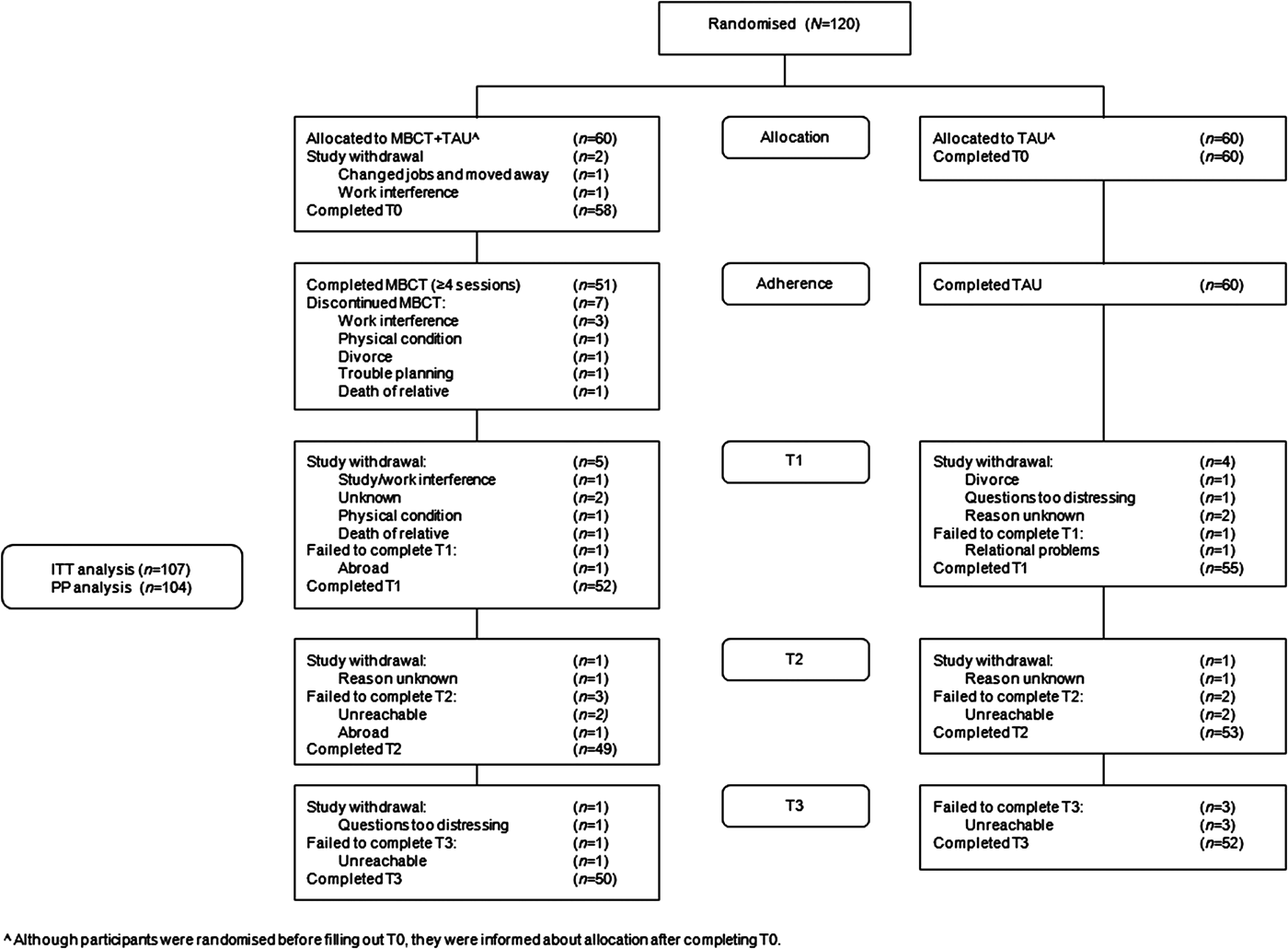
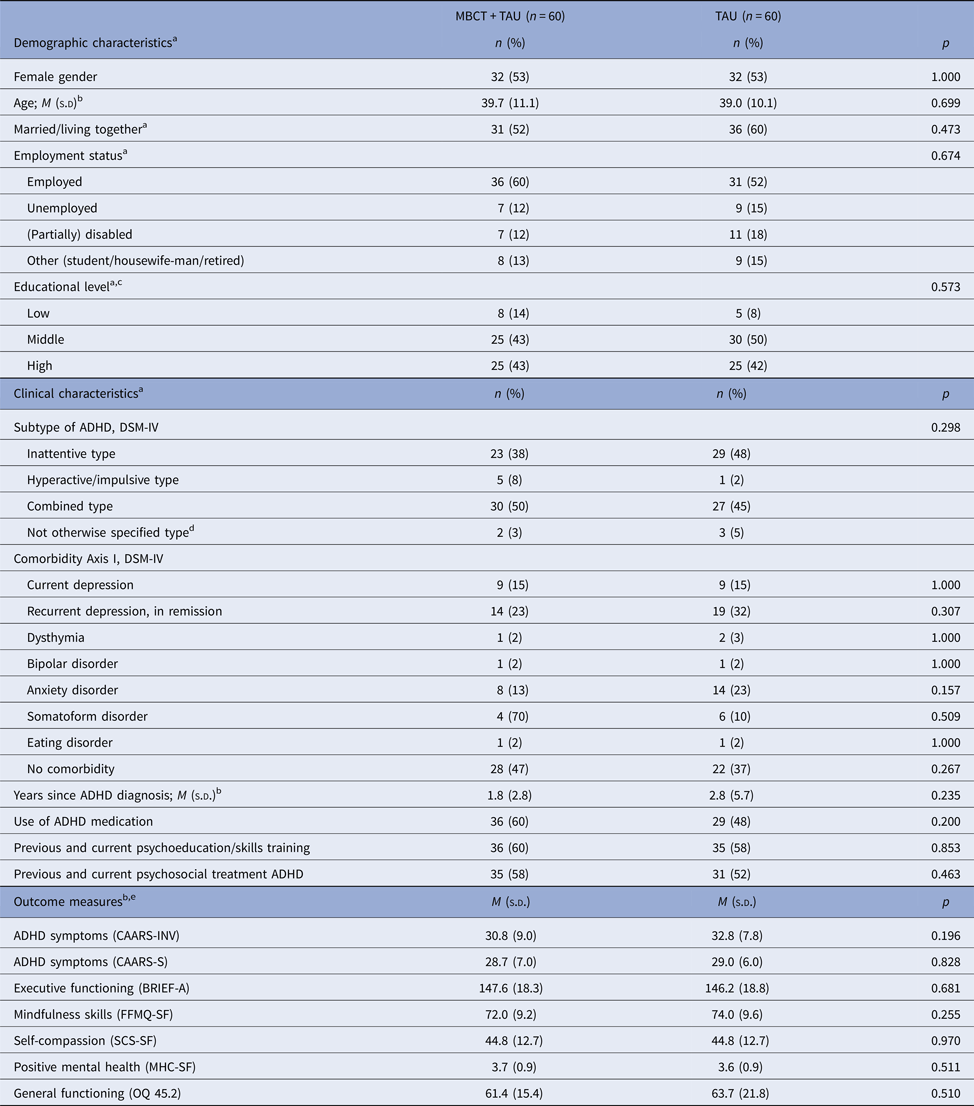
Of the 120 participants who met the eligibility criteria, the majority was referred by the participating specialised outpatient clinics (n = 67; 56%). The remaining participants were referred by their general practitioner or another health care professional (n = 18; 15%); or were self-referrals (n = 35; 29%). The participants were randomly assigned to MBCT + TAU (n = 60) or TAU (n = 60) (Fig. 1). At baseline, there were no significant differences in demographic and clinical characteristics between both groups (Table 1). From T0 to T1, TAU did not differ between groups, apart from the fact that more participants in the MBCT + TAU group than in the TAU group kept their medication stable, χ2(1) = 5.83, p = 0.016 (online Supplementary Table S1). A minority of participants received psychosocial treatment for ADHD.
CONSORT flow diagram. Note. ITT, intention-to-treat; PP, per protocol.

Baseline sociodemographic and clinical characteristics

BRIEF-A, Behaviour Rating Inventory of Executive Function-Adult; CAARS-INV, Conners’ Adult ADHD Rating Scale-Investigator; CAARS-S, Conners’ Adult ADHD-Self-report; FFMQ-SF, Five Facet Mindfulness Questionnaire-Short Form; MHC-SF, Mental Health Continuum-Short Form; OQ 45.2, Outcome Questionnaire 45.2; SCS-SF, Self Compassion Scale-Short Form.
a χ2 test.
b Independent samples t test.
c Educational level was classified as low (no education, elementary school, lower secondary education), middle (intermediate vocational education, upper secondary education) and high (higher vocational education, university).
d Reasons were: difficulty with recalling the presence of ADHD symptoms in childhood and no collateral history available (n = 1), ADHD symptoms in adulthood were aggravated by physical injury (n = 1), not displaying sufficient symptoms in childhood and symptoms emerging after meningitis in adulthood (n = 1), not displaying sufficient symptoms in childhood and no collateral history available (n = 2).
e Two participants in the MBCT + TAU group did not complete the baseline questionnaires. Data are based on n = 58.
Within the MBCT + TAU group, participants who dropped-out of MBCT (n = 9; 15%) were less likely to use ADHD medication at T0 than MBCT completers, χ2(1) = 6.30, p = 0.023. There were no differences in characteristics between those with missing data at T1 on all outcomes (n = 7) and those included in at least one of the ITT analyses at T1 (n = 113).
Treatment effects at T1
Primary outcome
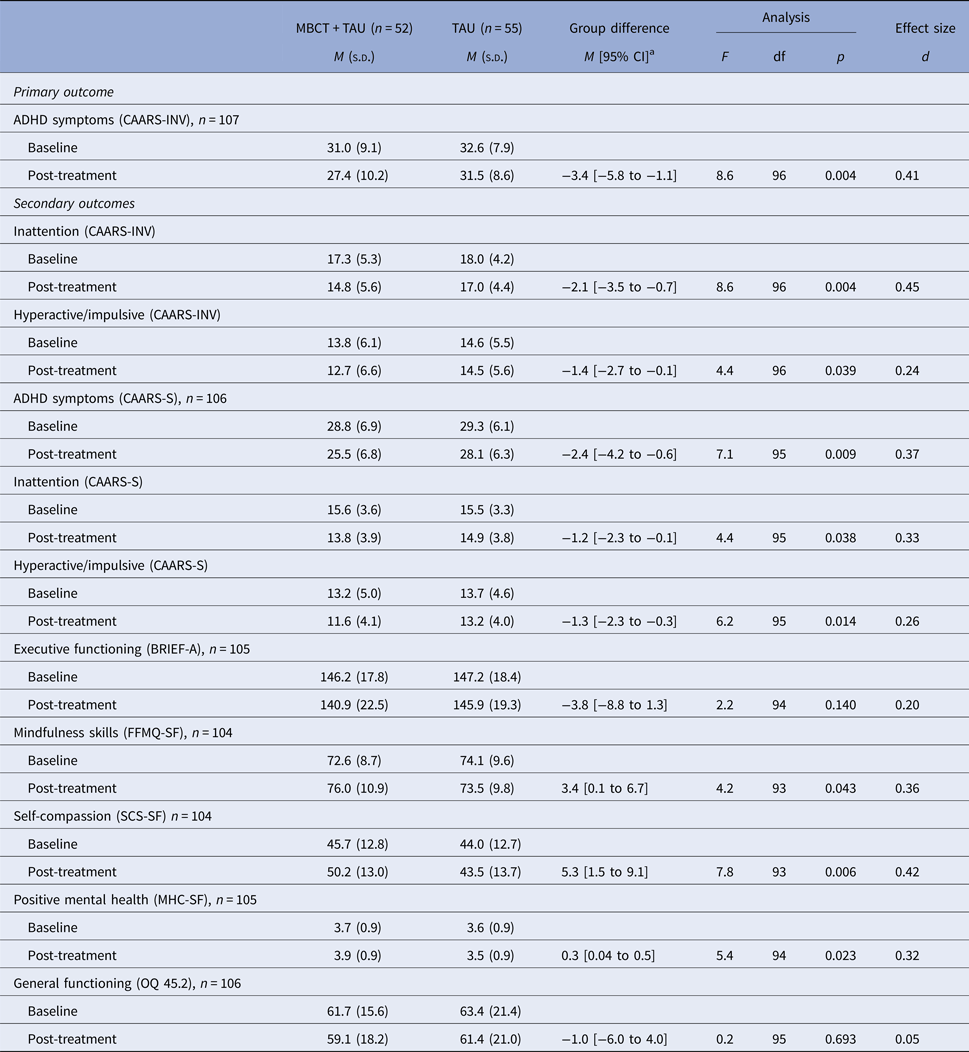
ITT analyses revealed that participants in the MBCT + TAU group demonstrated significantly less clinician-rated ADHD symptoms than those in the TAU group, with an effect size of d = 0.41 (Table 2). Analysis based on the PP sample (p = 0.007, d = 0.39) and sensitivity analyses based on LOCF (p = 0.005, d = 0.37) and MI (p = 0.046, d = 0.29) resulted in similar findings. Based on the RCI, the number of participants who had improved was higher in the MBCT + TAU group (n = 16; 31%) than in the TAU group (n = 3; 5%), χ2(1) = 11.73, p = 0.001, see online Supplementary Fig. S1. There was no difference between the two groups in the number of participants deteriorating (MBCT + TAU: n = 6; 12%; TAU: n = 3; 5%), χ2(1) = 1.28, p = 0.311. More participants in MBCT + TAU (n = 14; 27%) than in TAU (n = 2; 4%) showed a symptom reduction of ⩾30%, χ2(1) = 11.40, p = 0.001. Symptomatic remission was achieved by more participants in MBCT + TAU (n = 11; 21%) than in TAU (n = 4; 7%), χ2(1) = 4.27, p = 0.039.
Intention-to-treat analyses on primary and secondary outcomes at post-treatment

BRIEF-A, Behaviour Rating Inventory of Executive Function-Adult; CAARS-INV, Conners’ Adult ADHD Rating Scale-Investigator; CAARS-S, Conners’ Adult ADHD-Self-report; FFMQ-SF, Five Facet Mindfulness Questionnaire-Short Form; MHC-SF, Mental Health Continuum-Short Form; OQ 45.2, Outcome Questionnaire 45.2; SCS-SF, Self Compassion Scale-Short Form.
a Differences between MBCT + TAU and TAU at T1 based on the adjusted means, controlling for baseline levels, centre, use of ADHD medication, previous psychoeducation, gender and ADHD subtype.
Secondary outcomes
ITT analyses revealed that participants in the MBCT + TAU group demonstrated a significant larger reduction of self-reported ADHD symptoms and improvements of mindfulness skills, self-compassion and positive mental health compared with those receiving TAU only, with effect sizes varying from d = 0.32 to 0.42 (Table 2). No effects were found on executive functioning and general functioning. The PP analyses showed similar results, except for the effect on mindfulness skills (p = 0.051, d = 0.35). No effects were found for mindfulness skills in the LOCF analyses and for mental health in the MI analyses. The MI analyses did, however, show a small effect on total executive functioning (p = 0.040, d = 0.27).
Follow-up effects
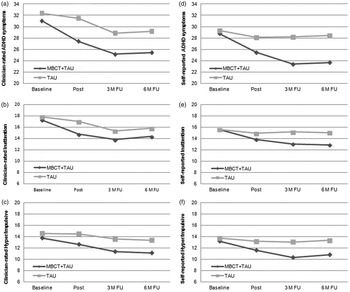
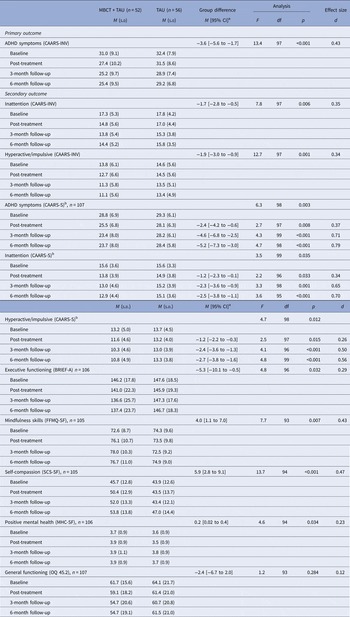
ITT analyses revealed that the significant difference between MBCT + TAU and TAU in clinician-rated ADHD symptoms remained stable over the course of the 6-month follow-up period (Fig. 2 and Table 3). The same pattern was found for mindfulness skills, self-compassion and positive mental health. A significant group × time interaction was found for self-reported ADHD symptoms, showing that self-reported ADHD symptoms further decreased over time in MBCT + TAU compared with TAU resulting in an effect size of d = 0.79 at 6-month follow-up. Over the course of the follow-up period, the difference between groups became significant for executive functioning with improvement of executive functioning in MBCT + TAU compared with TAU.
Unadjusted means for participants in MBCT + TAU and TAU at baseline, post-treatment, 3- and 6-month follow-up of ADHD Symptoms. Note. (a) clinician-rated ADHD symptoms, (b) clinician-rated symptoms of inattention, (c) clinician-rated symptoms of hyperactivity/impulsivity, (d) self-reported ADHD symptoms, (e) self-reported symptoms of inattention, (f) self-reported symptoms of hyperactivity/impulsivity.

Follow-up results of primary and secondary outcomes in the intention-to-treat sample

BRIEF-A, Behaviour Rating Inventory of Executive Function-Adult; CAARS-INV, Conners’ Adult ADHD Rating Scale-Investigator; CAARS-S, Conners’ Adult ADHD-Self-report; FFMQ-SF, Five Facet Mindfulness Questionnaire-Short Form; MHC-SF, Mental Health Continuum-Short Form; OQ 45.2, Outcome Questionnaire 45.2; SCS-SF, Self Compassion Scale-Short Form.
a Differences between the pooled scores in MBCT + TAU and TAU based on the adjusted means, controlling for baseline levels, centre, use of ADHD medication, previous psychoeducation, gender and ADHD subtype.
b A group × time interaction was found. Therefore, we reported the F-statistic for the interaction effect and the group differences per time point with the corresponding test-statistics (t, df, p) instead of the main effect of group.
PP analyses resulted in a similar finding for the primary outcome, F(1, 94) = 11.9, p = 0.001, d = 0.40 and for the secondary outcomes, except for the effect on executive functioning. A significant group × time interaction, F(2, 95) = 3.5, p = 0.034, showed that executive functioning further improved over time in MBCT + TAU compared with TAU resulting in an effect size of d = 0.49 at 6-month follow-up.
Moderation of treatment outcome
Clinician-rated ADHD symptoms at T1 were not predicted by gender, F(1,102) = 0.1, p = 0.783; age, F(1,102) = 1.8, p = 0.189; ADHD subtype, F(3,98) = 0.2, p = 0.878; use of ADHD medication, F(1,102) = 0.08, p = 0.782; comorbid depressive disorder, F(1,102) = 2.2, p = 0.145 and comorbid anxiety disorder, F(1,102) = 0.2, p = 0.632. Similar results were found for clinician-rated ADHD symptoms over the course of the 6-month follow-up period and in the PP sample.
Discussion
Principal findings
This first well-powered, multicentre, single-blind RCT with follow-up assessments on MBCT for adult ADHD showed that MBCT + TAU is effective in reducing core ADHD symptoms rated by a blinded clinician. The PP and sensitivity analyses underscore the robustness of this finding. The effect on core ADHD symptoms was maintained beyond completion of MBCT until 6-month follow-up.
Additionally, MBCT + TAU resulted in a significant reduction of self-reported ADHD symptoms and improvements of mindfulness skills, self-compassion and positive mental health at post-treatment. While most differences between groups remained stable over the 6-month follow-up period, self-reported ADHD symptoms further decreased in MBCT + TAU compared with TAU. Although no effects were found on executive functioning at post-treatment, over the follow-up period executive functioning was significantly better in the MBCT + TAU group than in the TAU group.
These results were largely in accordance with the findings of the two previous RCTs on MBIs for adults with ADHD (Hepark et al. Reference Hepark, Janssen, de Vries, Schoenberg, Donders and Kan2015; Mitchell et al. Reference Mitchell, McIntyre, English, Dennis, Beckham and Kollins2017), which also found significant reductions of clinician-rated and self-reported core symptoms in comparison to a non-active control group. In contrast with these two studies, which also reported an immediate post-treatment improvement of executive functioning, we only found this over the course of the 6-month follow-up. This could be explained by the application of a more rigorous methodological design and the use of the regular 8-week MBCT programme instead of the 12-week programme (Hepark et al. Reference Hepark, Janssen, de Vries, Schoenberg, Donders and Kan2015). The found effect at follow-up in participants who completed the MBCT might suggest that it takes more time and practice before MBCT results in improvements of executive functioning; however, this hypothesis needs further investigation, for example, by combining observational clinician-rated and self-reported measures with neurocognitive tasks.
Limitations and strengths
Unfortunately, no data were collected on the number and characteristics of people who were excluded from participation or who declined to be enrolled, which would have provided additional information about the generalizability of our findings. However, since the recruitment for the study was very successful and only lasted 16 months, there seemed to be a substantial interest in MBIs among participants with ADHD. This is in line with the findings of a qualitative study (Matheson et al. Reference Matheson, Asherson, Wong, Hodgkins, Setyawan and Sasane2013) under adults with ADHD that there is an unmet need for additional psychosocial interventions alongside medication to improve functioning, since for many access to non-pharmacological treatment is lacking. The ecological validity of this study was also enhanced by the multicentre design with specialised outpatient clinics for adult ADHD located in an academic hospital and in two centres for mental health care across the Netherlands, the relatively broad eligibility criteria including patients with most of the Axis I and II comorbidities according to the DSM-IV and the participation of patients in varying stages of their treatment process. In this way we stayed close to the daily clinical practice.
A second limitation was that, although we did our best to ensure the blinding of the clinicians, we did not assess the success of blinding as recommended by Boutron et al. (Reference Boutron, Estellat and Ravaud2005). This information would have increased the confidence in the validity of our main results. An aspect to reflect on is the range of competence levels of the teachers. This may be considered as a limitation; however, a current study did not find robust effects of teacher competence on possible mediators and outcomes in MBCT for recurrent depression (Huijbers et al. Reference Huijbers, Crane, Kuyken, Heijke, van den Hout and Donders2017). Furthermore, the found range may be representative of mindfulness teachers in daily clinical practice. Another factor to reflect on is the study design with TAU as comparison group. This pragmatic choice enabled us to determine whether MBCT adds incremental benefit to the usual treatments in ADHD (Dimidjian & Segal, Reference Dimidjian and Segal2015), which is an advantage over the comparison with an active control group. It has, however, also limitations, such as the diminished internal validity due to possible differences in TAU between the two conditions. We did, nonetheless, not find any differences in TAU between the two conditions during the intervention period, except for stability of medication. Therefore, an effect of a change in medication could not be completely eliminated.
Research and clinical implications
Interestingly, the participants who dropped-out of the MBCT were less likely to use ADHD medication during the intervention than completers. This suggests that MBCT might be more feasible for patients on ADHD medication. This is in accordance with a recent study that demonstrated that psychological interventions result in better outcomes when combined with methylphenidate instead of a placebo (Philipsen et al. Reference Philipsen, Jans, Graf, Matthies, Borel and Colla2015). Although we did not find that baseline use of ADHD medication predicted the treatment outcome, future research should further explore the possible interaction between pharmacological and psychosocial interventions in ADHD and the optimal combination of the two. For example, future RCTs could examine to what extent MBCT is suitable as a stand-alone treatment or as an additional intervention to pharmacotherapy to diminish residual symptoms. A 2 × 2 design, where the effects of MBCT and TAU with and without pharmacotherapy are compared, might be suitable to answer this issue.
In addition, it would be relevant to compare MBCT with an active control group to control for both amount of treatment time and non-specific therapeutic effects such as peer support and home practice exercises. A possible control condition would be CBT, since CBT is the best examined (Young et al. Reference Young, Moghaddam and Tickle2016) upcoming psychosocial intervention for adult ADHD. As is common in pharmacological studies in ADHD, potential side effects of MBCT should be systematically monitored. In this study, no structural monitoring of side effects was conducted, apart from serious side effects such as suicidal attempts. This information would be helpful for patients to make a well-informed decision whether MBCT is appropriate at this moment (Hanley et al. Reference Hanley, Abell, Osborn, Roehrig and Canto2016).
Overall, this RCT demonstrated that MBCT has significant benefits to adults with ADHD up to 6 months after post-treatment, with regard to both ADHD symptoms and positive outcomes. So far, research on the consolidation of treatment effects of psychosocial interventions in adults with ADHD is scarce (Philipsen et al. Reference Philipsen, Jans, Graf, Matthies, Borel and Colla2015; Young et al. Reference Young, Moghaddam and Tickle2016), although highly relevant for clinical practice to complement the shortcomings of pharmacotherapy as a standalone treatment. So, the results of this RCT indicate that psychosocial interventions, like MBCT, might be valuable additional treatments alongside TAU for adults with ADHD.
Supplementary material
The supplementary material for this article can be found at https://doi.org/10.1017/S0033291718000429
Acknowledgements
The authors thank all participants for their time and effort, the mindfulness teachers for teaching the MBCT groups, Irene Geujen for coordinating the data collection at Dimence, Geert Schattenberg for data management, Merel Fokkema for rating the teachers and Caroline Truijens for her assistance in a MBCT group. The authors also thank the interviewers of the CAARS, the employees of the specialised outpatient clinics for ADHD and the secretaries of the Reinier van Arkel, Dimence and Radboudumc for their contribution to this research project. This work was supported by ZonMW, the Netherlands Organisation for Health Research and Development (A.S., Grant number 837001501).
Declaration of Interest
The research team declares it had no part in developing the original MBCT programme. AS, LJ and SH made small modifications to this programme as described in our pilot study (Janssen et al. Reference Janssen, De Vries, Hepark and Speckens2017). The team does not gain income from the sale of books on MBCT, nor does it gain income from giving lectures or workshops about it. AS is the founder and clinical director of the Radboudumc Centre for Mindfulness. LJ and MS are affiliated with this centre. JB has been in the past 4 years a consultant to/member of advisory board of/and/or speaker for Janssen Cilag BV, Eli Lilly, Lundbeck, Shire, Medice and Servier. He is not an employee of any of these companies and not a stock shareholder of any of these companies. He has no other financial or material support, including expert testimony, patents and royalties. CK has also been a member of the advisory board and consultancy team of Eli Lilly BV and was a speaker at the Adult-ADHD Academy of Eli Lilly. The other authors declare that they had no competing interests.
About the authors
LJ, CK, PC, BS, SH, RD, JB and AS contributed to the design of the study. AS was the principal investigator of the study. LJ, CK, PC, BS and SH were involved in recruiting participants. LJ took care of the logistics of the project and data collection. LJ and MS analysed and interpreted the data under supervision of RD. LJ drafted the paper, which was critically modified and supplemented by all other authors. All authors read and approved the final version of the manuscript.
Ethical standards
The authors assert that all procedures contributing to this work comply with the ethical standards of the relevant national and institutional committees on human experimentation and with the Helsinki Declaration of 1975, as revised in 2008.