




No CrossRef data available.
Article contents
DEVELOPMENTAL SEQUENCES IN THE ACQUISITION OF ENGLISH L2 SYLLABLE CODAS: A Preliminary Study
Published online by Cambridge University Press: 05 February 2004
Abstract
This study examines the acquisition of English syllable codas by two native speakers of Vietnamese. Data were collected at three intervals over 1 year. Results indicate that a developmental sequence may exist and that this sequence may not be linear, with some longer (i.e., two and three member) codas emerging before some singleton codas. Furthermore, it was found that production type (e.g., with epenthesis or feature change) differed significantly by coda type and was indicative of acquisition processes. Finally, linguistic environment (preceding and following) and grammatical conditioning were found to significantly affect coda production and development.The author would like to thank Jun Liu, Mary Zampini, and the anonymous SSLA reviewers for their invaluable comments and suggestions on an earlier draft of this paper.
Information
- Type
- Research Article
- Information
- Copyright
- 2004 Cambridge University Press
Over the past 25 years, research on the acquisition of second language (L2) phonology, especially work on syllable structures such as onsets (consonants at the beginning of syllables) and codas (consonants at the end of syllables), has become one of the most dynamic areas in SLA, yielding important insights into the role of first language (L1) transfer and markedness in the development of a nonnative phonological system. Research in this area has also been characterized by the overall consistency of its findings. For example, it appears that L1 transfer is prominent (Benson, 1988; Broselow, 1984; Hodne, 1985; Major, 1987a, 2001; Sato, 1984; Tarone, 1980, 1987), especially in the early stages of L2 acquisition. L1 transfer appears to be facilitative if there are crosslinguistic similarities (Major, 1987a, 1996, 2001) and debilitative if there is crosslinguistic divergence (Sato; Tarone, 1980). There seems to be weak evidence for the universal preference for a consonant-vowel (CV) syllable structure (Hodne; Tarone, 1980, 1987); however, shorter syllable structures do appear to be produced more accurately than longer ones (Anderson, 1987; Carlisle, 1997; Hansen, 2001; Major, 1987b). Additionally, longer structures are modified in favor of shorter ones (Anderson; Broselow & Finer, 1991; Carlisle, 1991, 1997, 1998; Eckman, 1987, 1991; Hansen; Sato; Weinberger, 1987). In fact, the acquisition of longer clusters may imply the acquisition of shorter onsets and codas (Carlisle, 1998; Eckman, 1991; Hansen).
The issue of acquisition sequences in L2 phonological development, researched mainly through accuracy orders from one-time data sets, has also yielded a number of interesting findings. One consistent finding is that voiceless obstruents emerge before voiced obstruents (Broselow, Chen, & Wang, 1998; Hancin-Bhatt, 2000; Hansen, 2001; Major, 1987b). However, discrepancies in other orders exist, no doubt due to various L1s being investigated, task variation, and differences in the learners' proficiency level. For example, although Eckman and Iverson (1994) found that their Cantonese, Japanese, and Korean learners were able to produce nasals and fricatives more accurately than stops or liquids, Stockman and Pluut (1999) found that stops had higher accuracy percentages than nasals for their Chinese participants. Both Hansen, working with Mandarin Chinese speakers, and Hancin-Bhatt, in research on Thai speakers, found that the most accurately produced singletons were the voiceless stops and voiceless fricatives; however, whereas Hancin-Bhatt also found that her participants produced nasals with a high degree of accuracy, Hansen found that only /m/ was produced fairly accurately by the native Mandarin Chinese speakers. Additionally, although Abrahamsson (2001b, on Spanish L1 learners of Swedish), Eckman and Iverson, and Hansen found liquids to be among the most difficult consonants to produce, Tropf (1987) found them the most targetlike for his Spanish L1 learners of German. Tropf explained his findings on the basis of sonority, but the majority of researchers have postulated that L1 transfer may be the most powerful factor governing which consonants emerge first.
Developmental patterns in coda clusters have also been examined, and the findings suggest that codas that meet the Universal Canonical Syllable Structure (UCSS) are produced more accurately (Abrahamsson, 2001b; Carlisle, 1991; Hansen, 2001; Tropf, 1987), although there is contradictory evidence (e.g., Osburne, 1996).1
Margins meet UCSS “if the sonority of segments … increase[s] as the syllable nucleus is approached” (Herbert, 1986, p. 62).
We are beginning to understand more about developmental patterns in acquisition, although few studies (e.g., Abrahamsson, 1999, 2001a, 2001b; Dickerson, 1975; Hansen, 2001; Hecht & Mulford, 1982; Osburne, 1996; Sato, 1984, 1985) have focused on the longitudinal (e.g., 6 months or longer) development of the L2 structure(s) under examination. Although research that focuses on a single data set may document the current stage of the learners' L2 phonological development at a given time, it will not necessarily elucidate the actual process or developmental patterns in the acquisition of the structures examined. Second, the majority of the research has focused on a narrow set of syllable onsets, codas, or both, especially voiceless obstruents and nasals, which offers only a limited view of the learner's emerging L2 phonology and therefore may not be truly representative of the learner's actual L2 phonology at the time of the study.
Variation in production across different tasks is also an issue that needs consideration; many of the studies have only examined production across one task, typically a controlled word list or sentence-reading task. However, the studies that have examined production across task type (e.g., Dickerson, 1975; Eckman, 1981a, 1981b, 1991; Edge, 1991; Hodne, 1985; Major, 1987b; Sato, 1985) have consistently found that performance is variable across tasks, with the greatest level of accuracy occurring in more controlled tasks such as word lists and reading passages, whereas the greatest number of errors typically occur in more spontaneous conversation data. This may also imply that, if learners cannot produce a structure on a more controlled task, they will be unable to produce it in a more spontaneous task. This leaves the question as to whether a structure can be considered acquired if it can be produced in a controlled task but not in a spontaneous one, the answer to which depends on how acquisition is defined: Is it sufficient to define acquisition on the basis of highly accurate production on a more controlled task, or must the learner be able to accurately produce the structure in more spontaneous speech? In this paper, I take the latter position, maintaining that it is not clear to what extent targetlike production on a controlled task, such as a word list, in fact indicates acquisition of the structure(s) in question, especially if this is part of a one-time data set.
The issue of accuracy versus acquisition must also be examined carefully. Prior research has employed an 80% acquisition criterion established by Cancino, Rosansky, and Schumann (1978), under which, if a given segment is produced correctly 80% of the time, it is said to be acquired. However, in one-time research (when only one data set is being analyzed), it is questionable to base acquisition on accuracy, especially given that sociolinguistic research has established that both linguistic and extralinguistic variables may affect the production of a given segment (see Adamson & Regan, 1991; Bayley, 1996; Young, 1988). Therefore, the systematic variation of production of a segment must also be taken into consideration when determining whether or not a segment is “acquired.” For example, factors such as grammatical conditioning, preceding and following linguistic environment, and word stress have been shown to affect the production of a segment (Adamson & Regan; Bayley; Young).
Additionally, it becomes important to not only examine the accuracy of production but also examine how each structure is being produced. Previous research has focused on production modifications and has tended to generalize them by their subjects across syllable types. For example, Chinese learners of English have been found to favor devoicing (Broselow et al., 1998; Eckman, 1981b; Flege & Davidian, 1984), deletion (Anderson, 1987; Broselow et al.; Weinberger, 1987), and epenthesis (Anderson; Broselow et al.; Weinberger). For Vietnamese learners of English, Sato (1984) found that deletion was the favored strategy. To explain the different results, researchers have proposed such influences as L2 proficiency level (Weinberger), markedness (Broselow et al.; Eckman, 1987; Hancin-Bhatt & Bhatt, 1997), L1 interference (Anderson; Hancin-Bhatt & Bhatt; Tarone, 1987), L1 developmental processes (Eckman, 1981b; Hecht & Mulford, 1982), linguistic environment (Benson, 1988; Carlisle, 1997), and interlanguage rules (Eckman, 1981a, 1981b, 1987).
However, two issues need to be addressed in research on production modifications. First, the term modification is problematic, as it implies that the given structure has a targetlike representation in the learner's underlying grammar and has only been modified in the surface form. This may not be the case: The form in question may not have been acquired, and the surface form of the structure, with epenthesis, absence, feature change, or any combination of the three, may actually represent the current state of the learner's underlying grammar. Therefore, the form cannot be said to be modified. To determine whether a form has in fact been modified at the surface level, a phonological analysis of each segment must be conducted to ascertain the underlying phonemic structure of the segment and its variants across different linguistic environments. Without this type of analysis, it is not possible to determine whether the surface representation of a form, if different from targetlike production of the form, has been modified in some manner due possibly to natural phonological processes such as assimilation, or whether the surface form represents the learner's current underlying grammar.
Second, examining production type by onsets and codas in aggregate form, by length, or both (e.g., across C, or across CC or CCC clusters) may obscure individual coda or onset tendencies: There is some indication that production (e.g., with epenthesis or devoicing) is patterned by individual coda or onset type. For example, Broselow and Finer (1991) found that production type for English L2 obstruent + liquid and obstruent + glide onsets were onset-type specific for speakers of L1 Korean and Japanese. Hansen (2001) found that the Mandarin Chinese speakers in her study produced codas with epenthesis and feature change and that their choice of production type was dependent on the coda; Abrahamsson (2001b), in research on native speakers (NSs) of Spanish who were learning Swedish, found that epenthesis was preferred for fricative and stop codas over nasal codas. Few researchers have examined substitution patterns (see Broselow & Finer; Hancin-Bhatt, 2000; Piper, 1984), although the findings indicate that they are also patterned by specific onset or coda type. Even absence, as Osburne (1996) found, may be word specific and not random.2
The term absence rather than deletion is employed in this paper due to the problems with the term deletion.
Linguistic environment—both preceding and following—is also an important factor that requires examination to determine the underlying phonemic structure and allophonic variants of a given segment. Additionally, previous research has shown that linguistic environment does constrain production of segments for L2 learners (e.g., Bayley, 1996; Benson, 1988; Edge, 1991; Gatbonton, 1978; Major, 1987b, 1996; Osburne, 1996; Tarone, 1980; Yavas, 1997). Research has consistently shown that a following vowel may facilitate production (vs. absence) of a given segment (Bayley; Gatbonton; Major, 1996), whereas a following pause may facilitate devoicing (Edge; Major, 1987b), which is also common for NSs, epenthesis, or both (Tarone). The preceding or following linguistic environment may also have a significant effect on production: Both Benson and Osburne found that a preceding diphthong promoted absence of the following coda due to L1 transfer, whereas Yavas found that high vowels promoted devoicing.
Finally, grammatical conditioning may also exert a significant effect on syllable coda production. In research on final /ps, ts, ks/ clusters, Saunders (1987) found that /s/ was more likely to be retained in plural over third-person-singular /s/ codas, a finding corroborated by Abrahamsson (2001b). Osburne (1996) found that a grammatical marker in CC and CCC codas was likely to be retained, even if the coda violated the UCSS. In fact, codas that violated the UCSS were more likely to be correctly produced by her participant due to grammatical conditioning, as the last member of this type of cluster is typically a morphological marker.
Therefore, although research on the acquisition of an L2 phonology has provided a number of significant findings, particularly regarding transfer and markedness, we still lack an understanding of the longitudinal acquisition of an L2 phonology. Further longitudinal research needs to be conducted with more spontaneous production tasks, and factors such as preceding and following linguistic environment and grammatical conditioning need to be incorporated into the analysis, as they may exert a significant influence on production. We also need to examine the production type of each different syllable structure, as these processes, and their changes across time, may shed light on the process and product of SLA.
RESEARCH QUESTIONS
This study examines the acquisition of English L2 syllable codas by NSs of Vietnamese across 1 year of data collection. This type of research is in itself limited due to two main factors: (a) Only one group of learners, NSs of Vietnamese, was examined, and therefore effects of L1 transfer versus the effects of universal constraints are tentative; and (b) as the primary focus of the linguistic analysis is 4,400 syllable codas derived from interview data, the number of tokens generated from each participant automatically restricts the number of individuals whose data can be analyzed, and therefore the number of participants in this study is limited to two (however, some of the most influential and insightful studies of developmental patterns in child L1 phonological development have also focused on only one or two subjects—e.g., Leopold, 1939; Macken, 1979). Although these two factors limit the extent to which the findings from this study are generalizable across learners from the same or different L1 backgrounds, it does allow the data to be analyzed in a detailed manner for patterns that can then be examined in subsequent crosslinguistic studies. Therefore, this research is preliminary. However, the study examined more than 4,400 codas over 12 months and investigated the linguistic environment, grammatical conditioning, task type, and production type of each coda produced. Additionally, the analysis of the interview was supplemented by a discussion of word list (4,676 tokens) as well as onset (6,750 tokens) data when these data helped support the coda data from the interviews. As such, the analysis is based on a data set of 15,826 tokens.
In light of previous research on the acquisition of English syllable codas by L2 learners, this project focuses on three main research questions.
- What patterns exist in the emergence of syllable-final English L2 codas across 1 year in a spontaneous production task? What explains these orders?
- How are the codas produced, and how does this production change over time? How are these production types indicative of acquisition processes?
- To what extent do linguistic environment (e.g., preceding and following linguistic environment), stress, and grammatical conditioning (monomorphemic vs. bimorphemic coda) constrain the development and production of English syllable codas within and across time?
METHOD
Participants
Two adult NSs of Vietnamese were selected to be the participants of the study for a number of reasons. First, they had arrived in the United States within 6 months of the onset of the study. Second, the participants were also selected on the basis of personal characteristics: They are a married couple, thereby sharing similar social contexts of L1 use and L2 use and social networks. They are also similar in age. Third, both are from Saigon, with the same variety of Vietnamese. Finally, the participants were also selected on the basis of their willingness to provide data over 1 year. The rationale for focusing on Vietnamese as the L1 background is due to the difficulty of acquiring English syllable structures by speakers of this language.
Overview of Vietnamese and English Phonology
Given that the focus of the study is the acquisition of English L2 syllable codas by NSs of Vietnamese, an overview of Vietnamese and English phonology is necessary. There are a total of 22 consonant sounds in Vietnamese, not including the allophonic variations (shown in Table 1). All consonants can occur syllable initially, but syllable finally, Vietnamese only allows

—that is, voiceless plosives, nasals, and semivowels. Additionally, /p/ occurs as an allophone of /b/ syllable finally. There is an overall agreement that final consonants are unreleased or weakly released; furthermore, there are no consonant clusters in Vietnamese (Nguyen, 1970). Santry (1997) stated that a syllable in Vietnamese can optionally consist of an onset (a consonant or a consonant + semivowel) but must consist of a nucleus (a vowel or diphthong) and optionally a terminus (either a consonant or semivowel). Finally, Vietnamese does not allow a final consonant after a diphthong.
Overview of Vietnamese consonants

English syllable structure is more complex because all English consonants (shown in Table 2), with the exception of the velar nasal

and the palatal fricative

(except in French loan words such as genre), are allowed word initially, although

is allowed syllable initially, word medially in an unstressed syllable (Jensen, 1993). All consonants, except for /h/, and the glides /w, y/, which are realized as part of the diphthong vowel, are allowed syllable finally. English allows onsets with up to three adjacent consonants and codas with up to four consecutive members, resulting in the following possible syllable structures (Hammond, 1999): V (I), CV (he), CCV (tree), CCCV (stray), VC (at), CVC (bat), CCVC (float), CCCVC (sprig), VCC (apt), CVCC (mast), CCVCC (blast), CCCVCC (sprint), VCCC (angst), CVCCC (text), CCVCCC (sphinx), CCCVCCC (strengths), VCCCC (angsts), CVCCCC (texts). Many of the codas ending in the stops /t, d/ and the fricatives /s, z/ may be bimorphemic as the final stop may indicate a past-tense marker and the final fricative may indicate the plural, genitive, or third-person-singular form. In many of the three-member codas and all of the four-member codas, the final consonant is a morphological marker.
Overview of English consonants

Data Collection and Analysis
Data were collected three times over the duration of one year, for a total of three data sets approximately 3.5–4 months apart. Two types of phonological data were gathered at each data collection time: interview data, the primary focus of this research study, and word-list data.3
The word-list data were collected for three reasons: (a) to investigate task variation, (b) to elicit certain coda forms the learners may not freely produce during the interview sessions, and (c) to augment the number of complex codas in the study. The word list was developed to maximize the number of codas, onsets (not reported on in this study), and vowels in different environments. It was composed of 4,676 words across 130 different coda structures (21 singleton, 74 CC, 32 CCC, and 3 CCCC coda types). Insofar as possible, the word list comprised monosyllabic words to control for syllable length and stress.
For the interview data, the participants were recorded for approximately 1–1.5 hours while engaged in conversation together with the researcher. The conversation topics centered on social factors affecting the participants' language use, such as peer and family networks, work language use, attitudes, and motivation—topics on which both participants had a great deal to communicate and thus were felt to facilitate more spontaneous conversation among all three conversational participants (the two participants and the researcher).
Each data set was transcribed twice by the researcher, with an average intrarater reliability of 93%. Additionally, approximately 20% of the transcriptions were randomly checked by another IPA-trained researcher, with an average interrater reliability of 94%. When discrepancies arose, a third rater evaluated the word in question, and the transcription selected by a majority of the raters was adopted. In the rare cases (less than 1%) that a disagreement arose among all three transcriptions, the word in question was eliminated from the data set. Each token was coded for the target English word; if the target was unclear, the word was eliminated from analysis. Although this did not occur in the word-list data, at times it proved difficult to discern the target word in the interview data, especially in the initial data set, and therefore some words were excluded from analysis. The interview data yielded 4,400 syllable codas and 6,750 syllable onsets; the word-list data gave 4,676 syllable codas, for a total of 15,826 tokens.
As previously stated, the terms modification and deletion can be problematic, as they imply that a targetlike representation of the form is present in the learner's underlying grammar and has been simplified, reduced, or both on the surface level, which may not be the case. Rather, the form with absence of one or more members, epenthesis, and so forth, may represent the current state of the learner's L2 phonology. Therefore, in this article, the term production type is employed instead to describe the manner in which each coda is produced, and the term absence is used instead of deletion. To determine the underlying phonemic structure of each coda and how linguistic and extralinguistic factors constrained the production of these segments, a phonological analysis was conducted on each coda type across and within time and by each participant.
Following Sato (1985) and Hansen (2001), data were coded for the following production types: (a) targetlike production, (b) absence of one or more member, (c) epenthesis, and (d) feature change (i.e., place and manner change). A fifth category emerged during the data analysis: two or more types for a single coda. For example, one consonant in a two-member coda may be absent, with a vowel inserted after the remaining consonant (e.g., packs as

). In this case, the production was classified as two types rather than as separate examples of both absence and epenthesis. Each coda was also coded for the following factors: speaker, data-collection time (time 1, time 2, time 3), task (word list vs. interview), preceding linguistic environment (vowel, diphthong), and following linguistic environment (pause, vowel, consonant) as well as grammatical conditioning (monomorphemic vs. bimorphemic, as in past-tense, genitive, third-person-singular, and plural markings), and word stress.
As the data for the phonological analysis was categorical in nature, a loglinear analysis was employed to test statistical significance of production type, time, participant, and coda length. The loglinear program used was GoldVarb (Rand & Sankoff, 1990), developed by linguists to examine probabilities for the use of certain linguistic features, depending on both internal factors (i.e., linguistic factors such as linguistic environment) and external factors (i.e., social factors such as gender or social class). It has increasingly been employed by SLA researchers (Bayley, 1996; Hansen, 2001; Major, 1996; Young, 1988). VARBRUL calculates the input probability (pi) that a specific variant—for example, absence rather than /t/—will be produced based on the proposed factors. An input probability of 1.00 means that, in this context, the variant will be categorically produced; there is no variation in this particular context. When the input probability is .50, there is an even likelihood of a variant being produced or not in this environment. An input probability between .01 and .49 indicates that a factor inhibits the production of the variant, whereas the reverse is true of input probabilities ranging from .51 to .99. VARBRUL also subjects the factors to three tests of statistical significance: total chi-square, chi-square per cell, and log likelihood.
RESULTS
The discussion of the results is divided into three parts. First, overall patterns with regard to the production of codas by length and production type are discussed for both participants in individual and aggregate form. Second, the production of individual codas are discussed in detail, and finally, patterns of production type are examined.
Overall Production of Codas by Length and Participant
Table 3 illustrates coda production individually and in aggregate form across the three coda lengths, time, and production type. There were a total of 4,440 codas in the interview data with a total of 3,703 singleton codas, 607 CC codas, and 130 CCC codas. There were no CCCC codas in the interview data.
Production of codas by length, time, and participant

There was a consistent pattern of accuracy of production by length for both participants and across all three data sets: Singleton codas were produced more accurately than CC codas, and CC more accurately than CCC codas, with the resulting accuracy hierarchy of C > CC > CCC. At time 1, C codas were produced by the female participant at 45% accuracy and by the male at 53% accuracy. At time 2, the accuracy percentages were 40% for the female and 48% for the male. Finally, at time 3, the accuracy percentages were 49% for the female and 47% for the male. For the CC codas, accuracy was very low across time for both participants: For the female, it was 5% at time 1, 4% at time 2, and 2% at time 3; and for the male, it was 9% at time 1, 7% at time 2, and 11% at time 3. Finally, both participants had a 0% accuracy percentage across time for CCC codas.
The differences in production by time, participant, and coda length were tested for statistical significance using a VARBRUL analysis. This analysis was also set up to determine whether other linguistic factors affected production (e.g., whether linguistic environment affected rate of epenthesis or feature change) by length, participant, and time. The analysis also tested whether stress (e.g., an unstressed vs. stressed syllable), grammatical conditioning (monomorphemic vs. bimorphemic), and following linguistic environment (pause, consonant, or vowel) had an effect on production. Preceding linguistic environment was also tested for the entire coda structure. Because Vietnamese does not allow a coda following a diphthong, and as this has been found to promote absence in prior research on Vietnamese learners of English (Osburne, 1996), diphthong and vowel were selected as factors for preceding linguistic environment. Additionally, during the descriptive analysis of the data, it was noted that the mid back vowel

also promoted absence in the following segment, so this preceding vowel was included as a separate category in the analysis. Several VARBRUL runs were conducted for each production type to find the best goodness-of-fit; although the factor groups found to be not significant were eliminated from further statistical analysis, their numbers, percentages, and input probabilities are included in Table 4 for comparison.
Variable rule analysis of syllable codas by production type

Continued

Three factor groups—preceding linguistic environment, participant, and coda length—were found to have a significant effect on targetlike production, χ2 = 11.2648, df = 4, p < .01. A preceding vowel (pi .57) was found to slightly favor targetlike production, whereas a preceding diphthong (pi .12) and a preceding

(pi .24) strongly disfavored targetlike production. The male participant's production (pi .53) slightly favored targetlike production, whereas the female participant's production (pi .47) slightly disfavored targetlike production. Finally, a singleton coda (pi .59) was found to favor targetlike production, whereas a CC coda (pi .09) strongly disfavored targetlike production.
Preceding linguistic environment, participant, and coda length also had a significant effect on absence, χ2 = 12.2906, df = 5, p < .025. A preceding diphthong (pi .94) and

(pi .75) both strongly favored absence, whereas a preceding vowel (pi .42) had a slightly disfavoring effect on absence. The male participant's production (pi .45) slightly disfavored absence; the female participant's production (pi .55) slightly favored absence. The longer coda structures both strongly favored absence with CC having a .87 input probability and CCC with an almost categorical .95 input probability. In contrast, the singleton coda (pi .40) disfavored absence.
Five of the seven factor groups in the analysis (preceding linguistic environment, following linguistic environment, length, stress, and time) were found to have a significant effect on epenthesis, χ2 = 37.7122, df = 9, p < .0001. A preceding diphthong (pi .20) was found to have a strong disfavoring effect, a preceding vowel (pi .52) had little effect, and a preceding

(pi .58) slightly favored epenthesis. A following pause (pi .66) and a following glide (pi .58) favored epenthesis, whereas a following consonant (pi .36) and vowel (pi .43) disfavored epenthesis. Shorter codas also favored epenthesis, whereas longer codas did not: Singleton codas had an input probability of .59, CC codas had a value of .16, and CCC codas one of .07. A stressed syllable (pi .62) promoted epenthesis, whereas an unstressed syllable (pi .18) did not. Finally, both time 1 and time 2 slightly disfavored epenthesis (pi .47), with time 3 (pi .55) slightly favoring epenthesis.
Three factor groups (following linguistic environment, length, and stress) had a significant effect, χ2 = 24.5871, df = 6, p < .0005, on feature change. Although a following vowel (pi .49) seemed to have little effect on feature change, a following glide (pi .55) and pause (pi .54) slightly promoted feature change, whereas a following consonant (pi .43) disfavored feature change. Feature change was favored for singleton codas (pi .60) but strongly disfavored for both CC (pi .14) and CCC (pi .06) codas. It was also disfavored for stressed syllables (pi .44) but favored for unstressed syllables (pi .69).
Two factor groups (participant and length) had a significant effect on two types of production, χ2 = 5.8358, df = 3, p < .05. The male's production (pi .59) slightly favored two types of production, and the female's production (pi .42) slightly disfavored it. The singleton coda (pi .42) slightly disfavored it, but both the CC (pi .84) and CCC codas (pi .79) strongly favored it.
In summary, only one factor group, grammatical conditioning, was found not to be significant for any type of production. The factor group that affected the most production types was coda length; it affected targetlike production, absence, epenthesis, feature change, and two types of production. Preceding linguistic environment was found to have a significant effect on targetlike production, absence, and epenthesis; following linguistic environment had a significant effect on epenthesis and feature change. Participant significantly affected targetlike production, absence, and two types of production; stress affected epenthesis and feature change. Time was a significant factor only for epenthesis.
Production Accuracies of Individual Codas
A VARBRUL analysis was conducted to determine whether targetlike production numbers were statistically significant for each coda. Only singleton codas were included in this analysis as only 39 CC and no CCC were produced accurately. There were a total of 3,703 singleton codas; however, there were no tokens of

in the data set. The analysis included the same factor groups from the previous analysis; however, only type of coda (e.g., /p/ vs. /b/) and participant were significant, χ2 = 28.7153, df = 18, p < .025. A VARBRUL analysis of each participant's accurate production was not conducted, as this would result in a single independent variable. However, numbers and percentages for each individual are given for each coda type. In fact, as shown in Table 5, the participants had similar production accuracy percentages for each coda. When there were differences that could explain the significance of participant in the VARBRUL analysis, it was typically due to a lack of tokens of a given singleton for one of the two participants.
VARBRUL analysis of targetlike production by singleton type

On the basis of the VARBRUL input probabilities, significant at p < .025, it is possible to establish a pattern of accurate production: /p/ (pi .90) > /n/ (pi .82), /m/ (pi .77),

(pi .72) > /f, s/ (pi .64) > /t/ (pi .58) > /k/ (pi .51) > /v/ (pi .33), /l/ (pi .33), /g/ (pi .32),

(pi .31) > /d/ (pi .21),

(pi .18), /b/ (pi .12), /z/ (pi .12),

(pi .10),

(pi .03),

(pi .00). In sum, the consonants that both participants produced most accurately in syllable coda position were the nasals, voiceless fricatives, and voiceless stops. The consonants that both participants had some difficulty producing in syllable coda position were the liquids, the voiced fricative /v/, and the voiceless affricate. The most difficult consonants in syllable coda position for both participants were all the voiced stops, the voiced fricative /z/, the voiceless fricatives

, and the voiced affricate.
The coda data from the interviews were also compared to that from the word-list task to determine to what extent the participants could produce the codas under more controlled conditions. Additionally, onsets from the interview data were added to the analysis to determine whether the phonemes that the participants were not able to produce in coda position were in fact part of their emerging L2 phonology. The comparisons, which are summarized here (due to space limitations, the entire table is not included in this text but is available on request), were based on the 4,440 syllable codas from the interview data, 4,676 syllable codas from the word-list data, and 6,750 onsets from the interview data, resulting in 15,826 tokens. To make this data set manageable, the onsets and codas were grouped into six accuracy percentiles for each participant: 100%, 75–99%, 50–74%, 25–49%, 1–24%, and 0%. These accuracy percentages were based on the production of the coda or onset for all three or the last two data sets and so indicate stable production. If production was at zero for either time 2 or time 3, the onset or coda was labeled as unstable because although the coda appears to be emerging, it may in fact never emerge. For ease of comparison, the affricates

are labeled as fricatives in the consonant groupings.
When the codas from the interview data are compared to those from the word-list data, it becomes clear that strong similarities exist between data from the two tasks as well as between participants in terms of which phonemes are produced most and least accurately and which consonants are members of the CC and CCC codas that are beginning to emerge. For both tasks, codas that are produced more accurately contain nasals, voiceless stops, and the voiceless fricatives /s f/. These phonemes range in the 50–100% production accuracy percentile in the interview data, and between 75% and 99% for the word-list data, making them the most accurately produced singleton codas for both data sets. This is followed by the liquids, the voiced fricatives /z v/, and the voiced stop /d/: These are produced in the 1–49% percentile in both the interview and word-list data. Although not present in the interview data, the voiced interdental fricative is at 0% in the word-list task, and the voiced affricate is at 0% across both tasks. For both tasks, voiced consonants—whether in singleton, CC, or CCC codas—have much lower accuracy percentages than the corresponding voiceless consonant.
The CC codas that have begun emerging in the interview data are also the codas produced at higher accuracy percentages in the word-list task and contain the consonants that have begun emerging as singleton codas in the interview data: the nasals, voiceless stops, voiceless fricatives, and the voiced fricative /z/—for example, the male participant produced

with 25–49% accuracy. Although no CCC codas were produced accurately in the interview task, it is interesting to note that those that have begun to be produced accurately in the word-list data consist of nasals, voiceless stops, voiceless fricatives, liquids, and /z/. For example,

for the female and

for the male had begun to be produced accurately in the word-list task.
In comparing the coda data with the onset data, it is clear that the participants have a wider range of onsets, especially in singleton form, and higher accuracy percentages for onset production. The majority of the singleton onsets are produced with 75–99% accuracy by both participants. It is also possible to determine whether the consonants that the participants had difficulty producing in coda position, such as the voiced stops, the interdental fricatives, and the voiced affricate, were part of the participants' emerging L2 phonologies. It appears that the voiced stops were part of both participants' L2 phonologies, with the interdental fricative and the voiced affricate just beginning to emerge. For example, both participants produced the voiced stops with a high degree of accuracy in onset position (/g/ was at 100% for the female and between 75% and 99% for the male, and /b, d/ were at 75–99% for both). However, both participants had 0% production accuracy for the voiced interdental fricative in onset position, although for the female participant, the voiceless interdental fricative was emerging in onset position (produced between 1% and 24% accuracy) and emerging in her word-list data in both singleton and in CC clusters. For the male participant, this phoneme had 0% accuracy in both coda tasks. For both participants, the voiced affricate

was emerging in onset position, with a 1–24% accuracy percentage for the female and 25–49% for the male, although neither produced it accurately in coda position.
In terms of codas by type, across both tasks and both participants, there are a number of patterns (the following notation is used for the codas: L = liquid, S = stop, N = nasal, and F = fricative; so that LF# stands for a liquid-fricative coda). In the interview data, the male participant had begun producing LF#, NF#, and SF# codas with some accuracy. These are also the CC codas with the highest accuracy percentages in the word-list data. The first CCC codas to emerge are as follows: LNF#, NFS#, and LFS#. The most difficult CC and CCC codas are those consisting of the least accurate singleton consonants such as the voiced stops /b, g/, voiceless fricatives

and voiced fricatives

either in combination with each other or with more accurate consonants. Even the more easily produced CC and CCC clusters, such as NF# and LF#, have very low accuracy percentages if they contain the more difficult consonants. Regardless of which consonants composed them, the most difficult CC and CCC codas to produce were the following: LL#, SS#, FF#, LSF#, FSF#, NSF#, SFS#, NSS#, NFF#, LSF#, LFF#, FSF#, SSF#, and SFF#.
Production Type
As previously shown, there are very consistent patterns in the ordering of which codas emerged in terms of their accuracy percentiles; similarly, there are consistencies in the production type of each coda type (e.g., epenthesis or feature change). Unlike previous research that has suggested that learners from specific language backgrounds produce codas in one specific manner, this study found that the production types were patterned by specific consonant type. A discussion of the most important and consistent findings for production type follows (more detailed information is available on request).
C Codas.
All three voiceless stops were produced accurately the majority of the time, with accuracy increasing across time. When not produced accurately, they were epenthesized, primarily before a pause. At times, /k/ was produced as

(in headache), [s] (in speak and pack), and [t] (in take), and thus appears to be word specific. In a pattern that occurred across other codas as well the two types of modifications for /t, k/ were absence and epenthesis after tense vowels and diphthongs. Grammatical conditioning also had an effect on production of /t/: Although there were only 7 tokens of /t/ as a past-tense marker in the data, 57% of these were absent, and only 1 (14%) was produced targetlike, compared to only 27% (100/270) absent monomorphemic /t/ and 55% (203/370) targetlike monomorphemic /t/.
Nasals were usually produced accurately. Although there were cases of absence for both /m/ and /n/, which decreased across time, they only occurred following the diphthong /ay/. All three nasals were also epenthesized before a pause, and

were assimilated when they preceded alveolar consonants. Finally, words ending in /m/ showed absence and epenthesis when /m/ followed a diphthong as in time, produced as

. There were only a few examples of syllabic nasals in the data (4 tokens each of /m/ and /n/), making patterns difficult to discern. For the syllabic /m/, 75% (3/4) were produced accurately and 25% (1/4) were epenthesized. A similar pattern occurred for syllabic /n/: Two of each were targetlike and epenthesized, respectively.
The voiced stops /b, d/ were commonly produced as [p, t] across time as well as being epenthesized to fall syllable initially before a pause. Words ending in /d/ typically had absence of the /d/ and were epenthesized when following a tense vowel; /g/ was typically absent from production but also began emerging as [k], and accurately as [g] at time 3. Grammatical conditioning could also be a factor in the absence of /d/: Among past-tense markers, 57% (17/30) were absent compared with only 17% (17/96) of the monomorphemic /d/.
The voiceless fricatives /s, f/ were usually targetlike or epenthesized, but

was commonly produced as [k] for English (100% of the time at time 1 and time 2—28 times total—and 7/7 times for the male at time 3, but 0/4 for the female, who produced English targetlike at time 3) and as [s] in wish, finish, and fish. The voiceless interdental fricative

was typically produced as

. The voiceless affricate

was produced variably depending on the word: [ts] in beach (4/4 occurrences at time 2 and 1/1 at time 3), [t] in watch (1/2 at time 3), in each as [k] (1/1 for the male at time 3) or

(1/1 for the female at time 3).
For the voiced fricatives /z/ and /v/, targetlike production was fairly stable, though rate of epenthesis increased and absence decreased. Grammatical conditioning may also have been a factor in the absence of /z/: Of the bimorphemic tokens of /z/, 74% (20/27) were absent compared with 56% (138/246) of the monomorphemic tokens. The voiced affricate

was typically produced as

.
For the liquids,

was typically absent after

(60/177 at time 1 and time 2, and 94/312 at time 3). In every such instance, the

was coarticulated with the vowel, resulting in [a], which increased across time. /l/ tended to be produced as [n] after back and central vowels (19 times at time 1, 7 at time 2, and 28 at time 3) and as [ow] (once at time 1, twice at time 2, and 15 times at time 3) or [uw] (twice at time 2 and 5 times at time 3) after front vowels and diphthongs. The analysis of the 34 tokens of syllabic /l/ in the data show that 2 (6%) were absent in production, 7 (22%) were targetlike, 2 (6%) were epenthesized, 11 (34%) had two production types, and 10 (31%) were produced as either [n] or [ow], following a pattern similar to nonsyllabic /l/.
As there were a number of similarities in production type by consonant, a VARBRUL analysis was conducted to determine whether production type was statistically significant. For the VARBRUL runs, the singletons were grouped by type when production was similar—for example, the voiceless stops /t/ and /k/ were run together, and /p/ was excluded from this group because of its higher production accuracy. Similarly, the velar nasal

was run separately from /m/ and /n/ because of its higher incidence of feature change. Some consonants, such as

were run together as their production was similar across time. The results are outlined in Table 6. The input probabilities for each group of consonants are given as well as the input probabilities for the other significant factor groups for that group of consonants. Finally, chi-square statistics (total chi-square, chi-square per cell, degrees of freedom, and statistical significance level) are given for each group of consonants.
VARBRUL analysis of production type by singleton coda

Production type was statistically significant for each group of consonants. For each group, the favored production type is given along with the input probability: For /p/, targetlike production was favored (pi .53); for /t/ and /k/, targetlike production (pi .58) was slightly favored, whereas absence (pi .61) and epenthesis (pi .69) were more strongly favored; for the nasals /m/ and /n/, targetlike production was strongly favored (pi .75); for the velar nasal

, targetlike production (pi .77) and feature change (pi .82) were both strongly favored; for the voiced stops /b, d, g/, feature change (pi .86) and two types of production (pi .73) were strongly favored; for the voiceless fricatives /s, f/, targetlike production (pi .60) and epenthesis (pi .61) were favored; for the voiced fricatives /z, v/, epenthesis (pi .85), two types of modifications (pi .78) and absence (pi .78) were strongly favored; for the voiceless fricative

/ and the voiceless affricate

, feature change (pi .90) and two types of modifications (pi .94) were both strongly favored; for

, feature change and two types of modifications (pi .97) were strongly favored; for the liquids, feature change (pi .82) was strongly favored, and absence (pi .65) was favored. In summary, the most favored production type for each consonant is as follows: targetlike production /p, m, n/; epenthesis /t, k, s, f, z, v/; feature change

, and two types

(for

, feature change and two types had the same input probability). In terms of other significant factor groups for the different consonant types, a few are important to note: Grammatical conditioning was significant for voiced stops and voiced fricatives and following linguistic environment was significant for

.
CC Codas.
The major findings for CC codas are reported for each coda type:
Fricative-stop

. Sixty-three percent (66/104) had one member absent, and 33% (34) had both absence and epenthesis. Regardless of grammatical conditioning (e.g.,

clusters were bimorphemic), the first member of the cluster—the fricative—was produced, whereas the stop was absent.
Stop-stop (/kt, pt/). Seventy-five percent (16/20) had one member absent, whereas 25% (4) had absence and were epenthesized. All tokens of /pt/ were monomorphemic, and the first stop was produced, whereas the final stop was absent. At time 1, all /kt/ codas were monomorphemic, and production was word specific—as [t]: expect (2/2), correct (2/4); as [k]: connect (2/4); absence of both: correct (2/4). At time 2, all the clusters were bimorphemic, and [k] was produced.
Stop-fricative (/ks, ts, bz/). Sixty-eight percent (49/72) had one member absent, and 15% (11) were targetlike; /bz/ was produced as [ps] in both cases. If one member was absent, it was the fricative. Bimorphemic clusters had a higher accuracy percentage (50%) than monomorphemic clusters (10%).
Fricative-fricative

. There were only five tokens of this cluster; all were bimorphemic and produced as [z].
Liquid-liquid

. In the only example of this coda, only [l] was produced.
Liquid-fricative

. Twenty-four percent (9/38) were targetlike, 39% (15) had one member absent (the fricative in every case), 16% (6) were produced as different consonants (e.g.,

), and 21% (8) had absence and epenthesis following a tense vowel or absence and feature change. The highest accuracy percentages were for

: 50% (9/18) were targetlike.
Liquid-nasal

. Eight of the 10 tokens of this coda were produced as [n]. At time 3,

was produced targetlike once (1/6, or 13%).
Liquid-stop

. Of the 95 tokens of this coda, only eight were with /l/ + stop. For both the

+ stop clusters, the most targetlike were those with /d/;

was also accurate at times. For /l/ clusters, the /l/ was produced when one member was absent.
Nasal-stop

. All examples of and as well as all cases of contractions (e.g., can't, don't) were eliminated from analysis as they typically have absence of the final stop. For nasal-stop clusters, the patterns were similar: 86% (160/187) were produced as the nasal; 11% (21/187) were produced as an epenthesized nasal, and 2% (4/187) were targetlike (only /nt/ clusters). All /nd/ clusters were monomorphemic.
Nasal-fricative

. There were 70 tokens of this coda, and 90% (63) were produced as

(for /mz/ after a diphthong). Only /nz/ was targetlike.
CCC Codas.
The major findings for CCC codas are reported for each coda type.
Liquid-fricative-stop

. There was only one type of coda for this cluster; it was monomorphemic and produced as

.
Liquid-stop-fricative

. There were only four tokens of this coda. For three of these, a liquid-fricative coda

was produced. In one case,

(in words) was produced as [k]. All were bimorphemic.
Stop-fricative-stop (/kst/). In the seven tokens of this cluster (all monomorphemic), 56% (5) were produced as /k/; two were produced as

.
Liquid-nasal-stop

. Of the three tokens, two were produced [n], and one was epenthesized.
Nasal-stop-fricative (/nts, ndz/). Ninety-two percent (72/78) were produced as either [n] or [nz] (only for /ndz/). The remaining 8% (6) were produced as

. All were bimorphemic.
Liquid-liquid-stop

. The one token was produced as [z] (bimorphemic).
Liquid-stop-stop

. Of the five tokens, all bimorphemic, three were produced as

and two were produced only as [k].
Nasal-fricative-fricative

. The 22 tokens of this were all bimorphemic; 91% (20) were produced as

(female participant only). Two were produced as

.
Coda Production.
The analysis of the production of C, CC, and CCC codas indicates that there are differences in the type of production for different codas and that these differences are statistically significant in the case of singleton codas (CC and CCC codas were not analyzed statistically due to limited tokens of each type). In summary, the favored production type for each consonant is as follows: targetlike production /p, m, n/; epenthesis /t, k, s, f, z, v/; feature change

, and two types

. For CC codas, one segment was typically absent. For the majority of the codas (e.g., FS#, SS#, LF#, NS#, NF#), the first segment was produced; for a few codas (e.g., LL# and LN#), the second segment was produced. Finally, for the LS# coda, the liquid was typically produced if it was /l/, but for

, the stop was typically produced and the liquid was coarticulated with the vowel or absent. Finally, CCC codas were most typically produced as a C or CC coda; if produced as a CC coda, it was a coda that had begun emerging, such as

. Production of CCC codas differed by coda type: LFS# and LSF# were both produced as LF#, SFS# were produced as the first stop, and LNS# were produced as a nasal, NSF# were produced as a nasal or NF#; LLF# were produced as a fricative, LSS# were produced as the first stop, and NFF# were produced as the nasal. Overall, the nasal was favored for production across all coda types.
Two more issues need further discussion: the role of grammatical conditioning, and the production of tense vowels and diphthongs in open syllables, given their effect on absence and epenthesis in closed syllables. First, in terms of the role of grammatical conditioning, as the statistics on singleton consonants indicate, grammatical conditioning was a significant factor for voiced stops and voiced fricatives. Additional statistics on potentially bimorphemic codas were run. For the singleton codas, grammatical conditioning was significant, total χ2 = 8.6483, χ2/cell = .9609, df = 4, p < .05. Specifically, a monomorphemic coda slightly disfavored absence at .47, whereas a bimorphemic coda favored absence at .74. For CC codas, grammatical conditioning was also significant, total χ2 = 20.5332, χ2/cell = .5867, df = 7, p < .001. However, for CC codas, monomorphemic codas slightly favored absence at .56, whereas bimorphemic codas strongly disfavored absence at .28. For CCC codas, grammatical conditioning was also statistically significant, total χ2 = 12.4123, χ2/cell = .8865, df = 5, p < .001.
An examination of absence and accuracy patterns by inflection type (plural, possessive, third-person singular, regular past tense, irregular past tense) yielded few patterns. First, there were too few tokens (e.g., fewer than 10 tokens of each) of the irregular past tense, the possessive form, and the third-person-singular form for analysis. Second, for the CC and CCC codas, the last member(s) was typically absent, meaning that both the tense and the plural (or any other) markers were absent, which made it difficult to discern any differences among the inflectional morphemes. This left only the singleton coda /z/ for the plural marker and /d/ for the past-tense marker for analysis (all 7 tokens of the bimorphemic marker /t/ were irregular past tense; 1/7, or 14%, of these were accurate and the rest were absent). For these codas, 11% (3/27) of the /z/ plural marker were targetlike, whereas 43% (13/30) of the past-tense marker /d/ were targetlike, which is interesting because only 11% (11/96) of the monomorphemic /d/ were targetlike (10% or 25/246 of the monomorphemic /z/ were targetlike).
Finally, for both C and CC codas, it was noted that tense vowels and the diphthongs /ay/ and /au/ were epenthesized after absence of the C or CC cluster, resulting in, for example,

for about. An analysis of CV codas ending in the diphthongs /ay, au/ and the tense vowels /iy, ey/—the vowels that seemed to promote epenthesis in closed syllables—was conducted to determine whether these vowels were also epenthesized in open syllables. Of the 1,555 tokens of these vowels in the data, 180 (or 12%) were epenthesized; 77% of these (139/180) preceded a pause. However, not every instance of these vowels before pauses resulted in epenthesis: There were a total of 495 of these vowels before a pause, and only 28% (139) were epenthesized. The other 356 (72%) were produced without epenthesis.
DISCUSSION
The first research question sought to determine what patterns exist in the emergence of syllable-final English L2 codas across 1 year in a spontaneous production task. There were consistent, and statistically significant (p < .025), production accuracy rankings for the singleton codas across time and between participants:

were unclear due to a lack of tokens). This ordering is nearly identical across the two participants for the interview codas. On the basis of these orders, it becomes possible to posit a hierarchy of production, as outlined in Table 7.
Hierarchies in targetlike production for singleton codas

When codas were grouped by length, it was found that accuracy orders were higher for singleton codas over CC codas and higher for CC codas over CCC codas. However, examining codas in aggregate form obscures the variation of production for individual coda types: There were a number of CC codas produced more accurately than the shorter C codas or that emerged before a singleton coda. The CC codas consisting of nasals, voiceless stops, and voiceless fricatives, liquids, and /z/ were produced more accurately than singleton codas consisting of the interdental fricatives, /b/, and affricates for both participants. This corroborates previous research (Carlisle, 1991; Eckman, 1987; Hansen, 2001) that suggested that a longer cluster will not emerge before its constituent consonants have emerged in shorter form. It also suggests that acquisition is not linear and that the rank ordering of C > CC > CCC holds only if the codas consist of similar consonants. In fact, some CC and CCC clusters may emerge before a singleton onset or coda if that onset or coda consists of a difficult sound.
In terms of production of CC by type, given that the CC clusters investigated were not restricted to a subset of the various cluster types (e.g., with only voiceless stops and fricatives or with only certain voiceless fricatives) but also consisted of the more difficult consonants (such as the palatoalveolar and interdental fricatives, voiced stops, and affricates), it is not possible to generalize that one type of cluster is easier than another unless the members of the cluster are restricted to certain types, such as the fricative being /s, f/ but not

. For example, for both participants, the NF#, SF#, LS#, and LF# clusters that emerged first were

, with nasals, voiceless stops, voiceless fricatives, and /d/ and /z/. However, NF# clusters with the voiceless affricate (e.g.,

and LF# clusters with /v/ or the voiceless interdental fricative such as

) were at 0% accuracy for both participants. Even the more easily produced CC clusters had very low accuracy percentages if they consisted of the more difficult consonants. Overall, the most difficult CC codas for the participants were those consisting of the least accurate consonants such as the voiced stops /b, g/, voiceless fricatives

, and voiced fricatives

, either in combination with each other or in combination with the more accurate consonants, and even in clusters that have begun emerging with more accurately produced consonants.
When comparing the interview coda data with the word-list data, it becomes clear that the accuracy orders and emergence sequence of the codas are nearly identical regardless of length, time, and participant, although the accuracy percentages in the word-list data are higher. The CC codas that emerged in the word-list task are also similar to those in the interview data and also consist of nasals, voiceless stops, and voiceless fricatives. The CCC codas that began emerging in the word-list data also consisted of the nasals, voiceless stops, voiceless fricatives, liquids, /z/, and /d/, also with a close similarity between the two participants. This finding suggests that there are no significant differences between the more spontaneous and more controlled tasks in indicating phonological development within and across time. However, although the actual emergence order is strikingly similar between the two tasks, the accurate percentages differ greatly, especially for the more complex codas (e.g., some CC and CCC codas are produced with 100% accuracy in the word list but are at 0% in the interview data). Therefore, a question remains as to what extent accurate production on a more controlled task can be generalized to the acquisition of the segment in question, and data from a more controlled task may be a better indicator of developmental patterns than actual acquisition.
The most difficult consonants regardless of coda length were the voiced stops /b, g/, the interdental fricatives, and the voiced affricate. The question then arises as to what extent they exist in the learners' L2 inventories. It does appear (albeit based on a very limited number of tokens) that consonants emerge in onset position before they emerge in coda position. Both /b/ and /d/ are consistently produced with a high degree of accuracy in onset position (/b/ is allowed syllable initially in Vietnamese; although /g/ is not, unaspirated [plain] /k/ is allowed, and the participants may equate unaspirated /k/ with /g/, especially given that the English syllable-initial /k/ is aspirated—the /g/ may sound closer to the plain Vietnamese /k/), and it may have begun emerging in final position. Both the interdental fricatives and the voiceless affricates are emerging in onset position, and although they are emerging syllable finally (except for

), their production is much lower in this position.
What explains these patterns? Only voiceless stops, nasals, and semivowels are allowed in final position in a Vietnamese syllable, and therefore the greater targetlike production of these consonants across time for both participants and across all coda types regardless of length, task, and participant provides powerful evidence for the primacy of L1 interference effects on the acquisition of English syllable codas by speakers of Vietnamese, confirming prior research (e.g., Benson, 1988; Osburne, 1996; Sato, 1984, 1985). However, this does not account for the high accuracy percentage of /s, f/, which are not allowed syllable finally in Vietnamese, although they are allowed syllable initially. As will be discussed, /s, f/ (as well as /z, v/ to some extent) are produced with epenthesis to resyllabify them to fall syllable initially, which conforms to Vietnamese syllable structure. It appears that before these consonants emerge in syllable-final position, they are initially represented in the learners' L2 phonologies in a similar manner as they are represented in Vietnamese. Although this explains the high rate of epenthesis, it does not explain why /s, f/ emerge in coda position before the voiced fricatives or voiced stops, for example, which are also allowed syllable initially in Vietnamese.
This pattern, as well as the hierarchy of production in general, is best explained through both transfer and developmental effects. This study found that, initially, the learners' emerging L2 inventory consists of the sounds they transferred from their L1 and that those sounds allowed syllable finally in the L1 (e.g., nasals and voiceless stops) emerge in syllable-final position in the L2 before other consonants.
4Another perspective is that voiceless stops and nasals transfer precisely because they are crosslinguistically more common—and thus unmarked—and therefore their existence in the L1s of the learners and ensuing high production accuracy in the L2 are ultimately due to their crosslinguistically unmarked status.

; stage 3: /t, d, v, z/; stage 4:

; stage 5: no codas; stage 6:

; later,

(some codas were not included due to limited tokens). As Olmsted's stages indicate, voiceless consonants emerge before their voiced counterparts, and front consonants (e.g., labial and alveolar consonants) emerge before back consonants (e.g., palatal and velar consonants). Additionally, the voiceless fricatives /s, f/ emerge fairly early, whereas affricates and interdental fricatives are acquired late by children. Bernhardt and Stemberger (1998), in a crosslinguistic summary of recent longitudinal child language acquisition studies, also note that labials and coronals emerge earlier than velars, especially for stops and nasals, and that /s, f/ appear to emerge earlier than other fricatives.
In the present study, voiceless consonants emerged before their voiced counterparts (e.g.,

), a finding consistent for every voiceless-voiced pair. Additionally, bilabial and alveolar voiceless stops were produced more accurately than the velar voiceless stop—for example, /t/ and /p/ were produced with a higher degree of accuracy than /k/. The same was true for voiced stops, as /d/ and /b/ were also produced with higher degrees of accuracy than /g/. The same pattern existed for fricatives in that front fricatives were produced with greater accuracy than back (relatively speaking) fricatives: /f, v, s, z/ were produced more targetlike than

. These patterns help account for the higher accuracy ratings of voiceless over voiced consonants and may also explain the higher accuracy percentages of /s, f/ in this data set.
The finding that L1 transfer and developmental effects constrain the acquisition order (and production type) of singleton codas can also be extended to the longer codas. As previously discussed, the CC (and CCC, in the word-list data) that began emerging consisted of nasals, voiceless stops, voiceless fricatives, and the liquids, all of which had begun emerging in singleton form. This pattern indicates that the participants build on their emerging L2 phonologies and that, once they are able to produce consonants in a singleton form in a relatively stable manner, they can combine these consonants into longer codas, even before being able to produce the more difficult consonants in singleton form. This raises the following question: To what extent does the sequence and type of consonants within these codas constrain their emergence?
This study found that LF#, NF#, SF#, and LS# codas emerged earlier than LL#, SS#, NS#, LN#, and FF# codas, but only if these clusters consisted of the more accurate consonants. If they consisted of more difficult consonants, accuracy percentages were low or at 0%. If the codas consist of the consonants that emerged earlier and were produced more accurately, the patterns appear to be partly explainable on the basis of markedness and sonority: The more sonorous consonant + fricative codas appear to emerge before the less sonorous consonant + stop coda (e.g., NF# before NS#, SF# before SS#). The less marked LF#, NF#, SF#, and LS# codas appear to emerge before the more marked FF#, SS#, and LL# codas, and the less marked voiceless codas before voiced codas, which corroborates previous research (e.g., Major, 1987b). Interestingly, this study also found that SF# codas, which violate sonority constraints, were produced fairly accurately. This corroborates Major (1996), who found that SF# codas emerged before both FS# and FF# codas, which he explained by claiming that the /s/ is extrasyllabic and not attached to the syllable node such that this coda does not violate the UCSS. However, this high production accuracy may also be due to grammatical conditioning.
The second research question asked how the codas are produced and how this production changes across time, and sought to determine how these production types are indicative of acquisition processes. For the singleton codas (statistics were not run for CC and CCC codas due to a limited number of tokens for each type), the type of production was statistically significant for each group of consonants. The patterns that emerge as a result of the production modifications are indicative of acquisition processes.5
Another possible explanation (Abrahamsson, 2001b; Weinberger, 1987) for epenthesis and absence is that these two processes exist in a developmental relationship and that deletion is initially employed to create an open syllable structure, especially if the L1 does not allow a final consonant of the type that is absent. Later, in an attempt to recover the coda before a closed syllable can be produced, the learner may employ epenthesis to retain the segment, albeit in an onset position after resyllabification. Although this may explain epenthesis for /t, k/ and for the fricatives, it does not explain why other consonants that are allowed syllable initially but not finally do not have high rates of epenthesis but are instead produced either as voiceless stops or as another articulatorily similar consonant. In other words, this account only explains a small portion of the data. A better explanation, and one that can address the production types of all the codas, is that the segments are initially modified toward the L1 and, as acquisition proceeds, they are produced in light of the emerging L2. As the L2 changes, so do the production types. This explains the change of

at time 3 after the voiceless affricate had begun to emerge in coda position.
Fricatives initially emerge with epenthesis, thereby conforming to the acceptable syllable structure in Vietnamese, given that these consonants are allowed syllable initially in Vietnamese. Voiceless fricatives then begin emerging accurately prior to the voiced fricatives, possibly due to developmental effects. The voiced stops are typically produced as voiceless, which conforms to an acceptable Vietnamese syllable structure. In terms of the fricative

, which does exist in Vietnamese in syllable-initial position, the learners also produce this phoneme in light of their existing L2 phonology. The choice of /k/ or /s/ is word specific, as outlined in the Results section.
The consonants that do not exist in Vietnamese

are typically produced as a consonant that has begun emerging (e.g.,

as [s, t],

as [t, k]), as they are classified on the basis of the emerging L2 phonology. Once the participants' phonologies begin expanding, they are able to again reclassify these sounds based on the sounds that comprise their L2 phonology at a given stage, as evidenced in the production of

at time 3. The coda

also begins emerging syllable finally once it has begun emerging in onset position.
In terms of the high percentage of feature change for both

, prior research on the acquisition of English syllable codas by a Vietnamese speaker (Osburne, 1996) found that

was never realized in syllable codas. It was either absent or coarticulated with the vowel. As Osburne suggested, the Vietnamese speaker in her study may have perceived the articulation of

after a vowel as a glide and produced it as such. In fact, as Osburne stated, there is some speculation among linguists about whether

should be classified as a glide in postvocalic position in English. Kahn (1976), for example, classified the English

as a glide rather than as a sonorant consonant because of the lack of obstruction in the articulation of

, the reduction of

in postvocalic position to a glide in nonrhotic dialects, and similar patterning with other glides in its ability to syllabify in the nucleus. This study confirms Osburne's findings that

was sometimes not realized in syllable codas and also finds that the type of preceding vowel affects whether absence or coarticulation occurs. The fact that feature change appears to be increasing over time in this data set as absence decreases for

may indicate that the participants are not receiving counterevidence and therefore the classification is strengthening.
This analysis can also tentatively be extended to help explain the increase in feature change of /l/ across time as targetlike production decreases. As previously described, the preceding environment appeared to affect how /l/ was produced: After front vowels such as /iy/ and after diphthongs, /l/ was produced as a rounded back vowel. However, after a central or unrounded back vowel, /l/ was produced as [n]. This may indicate that /l/ is coarticulated with the glide that occurs in diphthongs and American front vowels such as /iy/. However, after lax central and back vowels, which lack the glide characteristic, /l/ is articulated as [n], changing only in manner of articulation from an oral to a nasal consonant.
For CC codas, the patterns that were found in aggregate form were absence and the favoring of two types of production; this does reflect the production of the majority of the CC codas, although some were produced accurately or epenthesized. Similar to the singleton coda, the production of CC and CCC codas builds on the emerging L2 phonology. As previously stated, in the few cases (39/607, or 6%) of targetlike production for the CC codas, they comprised consonants already produced targetlike in singleton form. In the few cases of feature change, the codas were produced as other CC that had begun emerging (e.g., /bz/ to [ps]). The few codas that were epenthesized also fit emerging patterns for the singleton codas, such as

and

. This also occurred for cases of absence and feature change (e.g.,

, and /ld/ to [n]) and absence and epenthesis (e.g.,

). When only one member of a CC coda was produced, it was typically the first member that was produced, which resulted in a coda composed of a consonant already produced with some degree of accuracy in singleton form (e.g., /pt/ to [p], /ts/ to [t], and

). There were a few cases where only the second member was produced; in each of these cases, the consonant that was produced was the one with a higher accuracy in production in singleton form (e.g.,

).
A number of factors may explain the production patterns of the complex codas. One is grammatical conditioning. It is clear that, in all the cases, the participants are building on their emerging L2 phonology and producing CC codas in light of what they have already acquired in singleton form and what has previously begun emerging in CC form. For FS#, SS#, and SF# clusters in which both members have begun emerging in singleton form, the pattern is to produce the first member, although in the SF# cluster, this choice leaves a less sonorous coda. Transfer does not appear to be a factor in these patterns because a cluster like /lp/ is produced as [l] even though /p/, and not /l/, is allowed syllable finally in Vietnamese. Instead, these patterns may be indicators of developmental effects, given that these reductions mirror those of child L1 learners of English, possibly due to sonority for the retention of the liquid in LS# and LF# and the fricative in FS# clusters. In a discussion of child L1 acquisition, Olmsted (1971) noted that it is typically the second member of the CC cluster that is affected by either deletion or modification (Olmsted's terminology), and that “frequently-retained members of consonant clusters are consonants that are usually gotten correct when they stand alone” (p. 241). In her research on child L1 learners of English, Ohala (1994) also found that, in FS# clusters, the F# is typically retained. This is also confirmed for L2 learners by Osburne (1996).
In LS# and LF# codas, the liquid is usually retained if it is /l/—if it is

, the final consonant is retained due to loss or coarticulation of

and the final stop or fricative being interpreted as a singleton coda, which can be explained by transfer and is corroborated by research by Hancin-Bhatt (2000) and Hancin-Bhatt and Bhatt (1997). In her work with Thai learners of English, Hancin-Bhatt (2000) found that in LN#, LF#, and LS# clusters, the liquid was often absent. Hancin-Bhatt and Bhatt (1997) found that Spanish learners lost the nasals and obstruents in these types of clusters but that Japanese learners lost the liquid and—like the Thai learners—produced the final nasal or obstruent. Finally, nasals, whether in NS#, NF#, or LN# codas (and therefore regardless of whether they are the first or second member of the coda), are typically produced, likely due to L1 transfer and possibly sonority (although transfer better explains the production of the nasal in a LN# cluster, given that the liquid is more sonorous than the nasal).
Similar patterns emerged for CCC codas, typically produced as a C or CC coda that had begun emerging accurately or with epenthesis: Both LFS# and LSF# codas were produced as LF#. Although the production of both CCC codas as LF# resulted in a more sonorous coda, the production of the LSF# coda as LF# also resulted in a change from a coda violating the UCSS to a form that did not. This confirms prior research in that margins violating the UCSS are typically produced as a form that does not violate the UCSS by L2 learners (Abrahamsson, 2001b; Hansen, 2001). Similar to the CC codas, all the codas with nasals (LNS#, NSF#, and NFF#) were produced as the nasal, regardless of whether the nasal was the second or first segment, which shows L1 transfer effects and possibly also sonority effects. The SFS# codas were produced as the first stop, which was voiceless and could indicate either developmental or transfer effects. Finally, the liquid cluster LLF# was produced as F# and LSS# as the first S#. These two patterns are interesting because they do not appear to be based on the developmental pattern of retention of the first segment—rather, the /z/ was produced in the LLF# cluster and the /k/ in the LSS# cluster. This could be due to the emerging L2 phonology as well as grammatical conditioning. However, because of the small number of tokens, it is difficult to determine a specific pattern for these two codas.
The third research question asked to what extent linguistic environment (e.g., preceding and following linguistic environment), stress, and grammatical conditioning (monomorphemic vs. bimorphemic coda) constrain the development and production of English syllable codas within and across time. Overall, linguistic environment, both preceding and following, exerted a significant effect on type of production. Across all codas, regardless of length, type, and participant, preceding linguistic environment had a significant effect on both targetlike production and absence due to the influence of a preceding diphthong and mid back vowel

, both of which strongly promoted absence and strongly disfavored accurate production. This is due to L1 transfer because, in Vietnamese, a consonant is not allowed after a diphthong in syllable-final position. Osburne (1996) explained that, in Vietnamese, the diphthong is realized as a vowel + glide rather than as a single segment, and the glide is viewed as a final consonant that closes the syllable. This study confirms both Osburne's and Benson's (1988) work in that Vietnamese speakers frequently did not produce a final consonant after a diphthong. This raises the question of the effect of

, which also promoted absence. Vietnamese has this vowel, but as Santry (1997) stated, this vowel is shorter before consonants than its English counterpart. Therefore, it is possible that, by relying on perceptual cues, the participants are classifying the English

as a diphthong, as it appears to be longer in duration than the Vietnamese

and thus closer in duration to the Vietnamese diphthong. This explains the high rate of absence of consonants following

.
There was also an interesting phenomenon of absence and epenthesis after the tense vowels /iy/ and /ey/ and the diphthongs /ay/ and /au/ and their epenthesis in open syllables, primarily before a pause. As Santry (1997) noted, the tense vowels /iy, ey/ are actually categorized as diphthongs in some descriptions of Vietnamese and typically produced as lax vowels in closed syllables and as diphthongs in open syllables. Similar to the longer duration of

in English, the longer duration of English /iy, ey/ in closed syllables (compared to their Vietnamese counterparts) may lead them to be perceived as diphthongs by the learners, which would then promote absence.
Following linguistic environment also had a significant effect on production, particularly on feature change and epenthesis. For example, a following pause or glide promoted epenthesis, whereas a following vowel and consonant disfavored epenthesis. The higher rate of epenthesis before a following pause has been found for other L2 learners (Tarone, 1980). The question then arises as to what extent the high rate of epenthesis that was found for the fricatives /s, f, z, v/ and postulated to be due to L1 transfer was actually caused by the linguistic environment of a following pause. As shown in the VARBRUL analysis of singleton-coda production, however, linguistic environment is not a significant factor for /s, f, z, v/; therefore, whether these fricatives are followed by a pause, vowel, consonant, or glide does not significantly affect the rate of epenthesis. The following linguistic environment also had a significant effect on feature change, with a following pause and glide promoting feature change, typically devoicing before a following pause. This has been noted in prior L2 research (Edge, 1991; Major, 1987b) and is a common phenomenon for NSs as well. The effect of a following glide on both epenthesis and feature change is interesting. When an analysis was done to determine why these patterns existed, however, it was found that the number of tokens for these environments was very small: 9% (20/359) of the following environments for epenthesis and 5% (33/642) of the following environments for feature change were a glide; therefore, there may not be a significant pattern. Finally, following linguistic environment was also statistically significant for the velar nasal, which is not surprising because of its high rate of nasal assimilation to the following consonant.
Stress was also a significant factor for epenthesis as well as feature change, with a stressed syllable favoring epenthesis and an unstressed syllable disfavoring epenthesis and an unstressed syllable favoring feature change. The employment of epenthesis for a stressed syllable creates an unstressed syllable, which results in an stressed-unstressed rhythm, the stress pattern of Vietnamese (Nguyen, 1970). The use of feature change in unstressed over stressed syllables may be due to the final consonants' lack of salience and resulting greater likelihood of assimilation to the following consonant.
There were some interesting patterns with the effects of grammatical conditioning, given that, for singleton codas and CCC codas, absence was promoted, whereas for CC codas, absence was disfavored for the bimorphemic coda. Additionally, it was found that for the singleton codas, the only discernable pattern for the differences in the production of inflectional morpheme types was the much higher accuracy percentage of bimorphemic /d/ (43%) over monomorphemic /d/ (11%). Production of the plural /z/ was about evenly targetlike regardless of whether it was morphemic (10%) or bimorphemic (11%). One interpretation is that final /d/ is salient as a morphological marker (especially in a singleton coda) and that the participants pay more attention to it in production, whereas the plural form is not as salient, perhaps because of redundancy in the syntax. As for the differences between grammatical conditioning and length, it appeared that for the CC codas that emerged with some targetlike production (e.g.,

), the final segment was a morphological marker (in this case, a plural marker). This appears to indicate that the plural form is emerging in the participants' grammatical system and that there is a morphophonemic interface in their coda production. This may also explain the common production of the CCC codas as a shorter form that typically, though not absolutely, contained the final consonant, especially when it was a plural marker (e.g.,

). The question then remains as to why this marker does not have a higher accuracy percentage in singleton form. However, the facts that /z/ is only beginning to be produced in singleton form and that it has an almost equal percentage in both monomorphemic and bimorphemic forms indicate that the plural morpheme is emerging and produced across all codas, regardless of length.
In summary, the emergence of syllable codas was sequenced in a consistent manner across time, participants, and tasks. The sequence is constrained not only by L1 transfer effects but also by developmental effects as well as grammatical conditioning. The learners initially transferred the syllable structure of their L1 (Vietnamese) into the L2, which becomes the basis of their emerging L2 phonology. Segments that are allowed in syllable-final position (in the L1) emerge in that position first, whereas consonants that are in the L1, but only in syllable-initial position, are initially produced in light of the L1 and the current state of the L2. As the L2 phonology continues to develop, these consonants begin to emerge in syllable-final position, but developmental and markedness effects constrain the order of emergence (voiceless over voiced, front over back consonants). Consonants that are not part of the L1 phonology are initially represented as a consonant that is allowed syllable finally (e.g., /t, k/). As the phonology develops, these consonants begin to be produced as the consonant closest in manner or articulation that has already begun emerging in the L2. The CC and CCC codas are initially produced as one of the emerging singleton consonants, usually with the plural marker. Along the way, the participants are constrained in both their acquisition (e.g., the effects of a preceding diphthong and mid back vowel) and production of the L2 by linguistic features such as inflectional morphemes, preceding and following linguistic environment, and syllable stress.
For specific codas, the following patterns were found. As they are allowed syllable finally in Vietnamese, nasals and voiceless stops transferred from the learners' L1 phonology to form one of the bases of the L2 phonology. Although these consonants did not have 100% accuracy percentages across time, the variation in their production can be explained by a number of factors. All these consonants had significantly higher absence rates after diphthongs, tense vowels, and the mid back vowel

as well as statistically significantly higher rates of epenthesis before a following pause. The rates of absence for /t/ may also be due to grammatical conditioning, as the past tense was in the process of being acquired and therefore there were higher rates of absence for past-tense /t/. The high rate of feature change of

was also due not to lack of acquisition of this consonant but rather to the natural phonological process of nasal assimilation to the following consonant, a process that also explains the feature change of /m/ before alveolar consonants.
The voiced stops /b, d, g/ are initially represented in the underlying grammar as /p, t, k/, respectively, as these latter consonants are part of the L2 phonology, or absent, especially in the case of /g/, as its voiceless counterpart /k/ is just beginning to emerge. The higher rate of absence of /d/ can be explained by grammatical conditioning. The voiceless fricatives /s, f/ are initially represented in the underlying grammar with epenthesis before emerging syllable finally—a transfer of syllable structure from Vietnamese (following linguistic environment was not a significant factor in epenthesis for these consonants). Absence rates can be explained by the effect of a preceding diphthong. The phoneme

does not initially exist in the underlying grammar, and its representation in the grammar is word specific (usually as /s/ except for in English, when it is represented as /k/). The same is true for

. For the female,

began to emerge in the underlying grammar, whereas for the male, it was represented as /t/ or /s/ (there were too few tokens to determine a pattern). The voiced fricative /z/ began emerging in the L2 phonology although it initially had a high degree of absence, due in part to grammatical conditioning (absence rates were higher when it was a morphological marker). As absence rates decreased, epenthesis increased as /z/ began emerging syllable initially, thus conforming to an L1 syllable structure. This same pattern was found for /v/, which also initially had a higher absence rate, and an increased epenthesis rate as it began emerging syllable initially. The voiced affricate

was initially represented in the learners' grammar as /t, k/ (there were too few tokens to determine any patterns) and later as

when the voiceless affricate began emerging in coda position. Finally, the liquids were present in the learners' underlying grammar, but only in some linguistic environments, due to L1 phonotactic constraints in both development and production. For the more complex codas, only

existed in the underlying grammar.
CONCLUSION
The acquisition of an L2 phonological system—in this case, English L2 syllable codas—is a complex phenomenon affected by not only by the L1 of the learners (and universal markedness and sonority constraints) but also the learners' levels of grammatical development, the task, and the preceding and following linguistic environments. Because of these multiple constraints, the task of defining acquisition becomes more difficult, given that production of a single segment varies greatly depending on the linguistic environment (e.g., the high production accuracy of /m/ except following diphthongs, when it was typically absent). Understanding the acquisition of an L2 phonological system also necessitates moving beyond examinations of only accuracy or absence percentages to an understanding (and categorization) of all the different types of production (e.g., with feature change or epenthesis) evidenced in the learners' speech; these production types are our lens into the process of L2 acquisition, providing us with insights into how and why certain segments are produced in a certain way.
As the various production types evidenced in the learners' data indicate, there does not seem to be a preferred production type by L1 background, as other research has suggested (e.g., that Chinese learners favor devoicing, and Vietnamese learners favor deletion). This study indicates that production type depends on consonant or coda type as based on learners' current L2 repertoire. Production types themselves are not stable but rather dynamic across time and coda, shifting as new codas emerge in the L2 phonology and as other codas are reanalyzed and the L2 phonology is expanded and changed. The manner in which a given segment is produced within and across time can be viewed not as products of L2 acquisition but, rather, as integral components in, and evidence of, the actual “process” of L2 phonological development.
References
REFERENCES
Abrahamsson, N.
(1999)
Vowel epenthesis of /sC(C)/ onsets in Spanish/Swedish
interphonology: A longitudinal case study.
Language Learning,
49,
473–508.Google Scholar
Abrahamsson, N.
(2001a).
Development and recoverability of L2 codas: A longitudinal study of
Chinese/Swedish interphonology. In
N. Abrahamsson,
Acquiring L2 syllable margins (pp.
39–61).
Stockholm:
Centre for Research on Bilingualism.
Abrahamsson, N.
(2001b).
Universal constraints on L2 coda production. In
N. Abrahamsson,
Acquiring L2 syllable margins (pp.
1–38).
Stockholm:
Centre for Research on Bilingualism.
Adamson, H. D., &
Regan, V.
(1991)
The acquisition of community speech norms by Asian immigrants
learning English as a second language.
Studies in Second Language Acquisition,
13,
1–22.Google Scholar
Anderson, J.
(1987).
The markedness differential hypothesis and syllable structure
difficulty. In
G. Ioup &
S. H. Weinberger (Eds.),
Interlanguage phonology: The acquisition of a second language sound
system (pp.
279–291).
Rowley, MA:
Newbury House.
Bayley, R.
(1996).
Competing constraints on variation in the speech of adult Chinese
learners of English. In
R. Bayley &
D. R. Preston (Eds.),
Second language acquisition and linguistic variation (pp.
98–120).
Amsterdam:
Benjamins.
Benson, B.
(1988)
Universal preference for the open syllable as an independent
process in interlanguage phonology.
Language Learning,
38,
221–235.Google Scholar
Bernhardt, B. H., &
Stemberger, J. P.
(1998).
Handbook of phonological development.
San Diego, CA:
Academic Press.
Broselow, E.
(1984)
An investigation of transfer in second language phonology.
IRAL,
22,
253–269.Google Scholar
Broselow, E.,
Chen, S.-I., &
Wang, C.
(1998)
The emergence of the unmarked in second language phonology.
Studies in Second Language Acquisition,
20,
261–280.Google Scholar
Broselow, E., &
Finer, D.
(1991)
Parameter setting in second language phonology and syntax.
Second Language Research,
7,
35–59.Google Scholar
Cancino, H.,
Rosansky, E., &
Schumann, J.
(1978).
The acquisition of English negatives and interrogatives by native
Spanish speakers. In
E. Hatch (Ed.),
Second language acquisition (pp.
207–230).
Rowley, MA:
Newbury House.
Carlisle, R. S.
(1991).
The influence of syllable structure universals on the variability
of interlanguage phonology. In
A. D. Volpe (Ed.),
The 17th LACUS Forum, 1990 (pp.
135–145).
Lake Bluff, IL:
Linguistic Association of Canada and the United States.
Carlisle, R. S.
(1997)
The modification of onsets in a markedness relationship: Testing
the interlanguage structural conformity hypothesis.
Language Learning,
47,
327–361.Google Scholar
Carlisle, R. S.
(1998)
The acquisition of onsets in markedness relationships: A
longitudinal study.
Studies in Second Language Acquisition,
20,
245–260.Google Scholar
Dickerson, L. J.
(1975)
The learner's interlanguage as a system of variable rules.
TESOL Quarterly,
9,
401–407.Google Scholar
Eckman, F. E.
(1981a)
On predicting phonological difficulty in second language
acquisition.
Studies in Second Language Acquisition,
4,
18–30.Google Scholar
Eckman, F. E.
(1981b)
On the naturalness of interlanguage phonological rules.
Language Learning,
31,
195–216.Google Scholar
Eckman, F. E.
(1987).
The reduction of word-final consonant clusters in interlanguage. In
A. James &
J. Leather (Eds.),
Sound patterns in second language acquisition (pp.
143–162).
Dordrecht:
Foris.
Eckman, F. E.
(1991)
The structural conformity hypothesis and the acquisition of
consonant clusters in the interlanguage of ESL learners.
Studies in Second Language Acquisition,
13,
23–37.Google Scholar
Eckman, F. E., &
Iverson, G. K.
(1994).
Pronunciation difficulties in ESL: Coda consonants in English
interlanguage. In
M. Yavas (Ed.),
First and second language phonology (pp.
251–265).
San Diego, CA:
Singular.
Edge, B. A.
(1991)
The production of word-final voiced obstruents in English by L1
speakers of Japanese and Cantonese.
Studies in Second Language Acquisition,
13,
377–393.Google Scholar
Flege, J., &
Davidian, R. D.
(1984)
Transfer and developmental processes in adult foreign language
speech production.
Applied Psycholinguistics,
5,
323–347.Google Scholar
Gatbonton, E.
(1978)
Patterned phonetic variability in second-language speech: A gradual
diffusion model.
Canadian Modern Language Review,
34,
335–347.Google Scholar
Hammond, M.
(1999).
The phonology of English: A prosodic optimality-theoretic approach.
Oxford:
Oxford University Press.
Hancin-Bhatt, B.
(2000)
Optimality in second language phonology: Codas in Thai ESL.
Second Language Research,
16,
201–232.Google Scholar
Hancin-Bhatt, B., &
Bhatt, R. M.
(1997)
Optimal L2 syllables: Interactions of transfer and developmental
effects.
Studies in Second Language Acquisition,
19,
331–378.Google Scholar
Hansen, J. G.
(2001)
Linguistic constraints on the acquisition of English syllable codas
by native speakers of Mandarin Chinese.
Applied Linguistics,
22,
338–365.Google Scholar
Hardison, D. M.
(1996)
Bimodal speech perception by native and nonnative speakers of
English: Factors influencing the McGurk Effect.
Language Learning,
46,
3–73.Google Scholar
Hecht, B. F., &
Mulford, R.
(1982)
The acquisition of a second language phonology: Interaction of
transfer and developmental factors.
Applied Linguistics,
3,
313–328.Google Scholar
Herbert, R. K.
(1986).
Language universals, markedness theory, and natural phonetic
processes.
Berlin:
Mouton de Gruyter.
Hodne, B.
(1985)
Yet another look at interlanguage phonology: The modification of
English syllable structure by native speakers of Polish.
Language Learning,
35,
405–417.Google Scholar
Jensen, J. T.
(1993).
English phonology.
Amsterdam:
Benjamins.
Kahn, D.
(1976).
Syllable-based generalizations in English phonology.
Unpublished doctoral dissertation,
Massachusetts Institute of Technology,
Cambridge.
Leopold, W. F.
(1939).
Speech development of a bilingual child: Vol. 1. Vocabulary growth
in the first two years.
Evanston, IL:
Northwestern University Press.
Macken, M. A.
(1979)
Developmental reorganization of phonology: A hierarchy of basic
units of acquisition.
Lingua,
49,
219–253.Google Scholar
Major, R. C.
(1987a).
A model for interlanguage phonology. In
G. Ioup &
S. H. Weinberger (Eds.),
Interlanguage phonology: The acquisition of a second language
system (pp.
101–124).
Rowley, MA:
Newbury House.
Major, R. C.
(1987b).
Variation in second language phonology
(No. ED310622).
Columbus, OH:
ERIC Document Reproduction Service.
Major, R. C.
(1996).
Markedness and second language acquisition of consonant clusters.
In
R. Bayley &
D. R. Preston (Eds.),
Variation linguistics and second language acquisition (pp.
75–96).
Amsterdam:
Benjamins.
Major, R. C.
(2001).
Foreign accent: The ontogeny and phylogeny of second language
phonology.
Mahwah, NJ:
Erlbaum.
Nguyen, D.-L.
(1970).
Vietnamese pronunciation.
Honolulu:
University of Hawai‘i Press.
Ohala, D.
(1994).
Sonority-driven cluster reduction.
Unpublished manuscript,
University of Arizona,
Tucson.
Olmsted, D. L.
(1971).
Out of the mouth of babes.
Berlin:
Mouton de Gruyter.
Osburne, A. G.
(1996)
Final cluster reduction in English L2 speech: A case study of a
Vietnamese speaker.
Applied Linguistics,
17,
164–181.Google Scholar
Piper, T.
(1984)
Observations on the second-language acquisition of the English
sound system.
Canadian Modern Language Review,
40,
542–551.Google Scholar
Rand, D., &
Sankoff, D.
(1990).
GoldVarb: A variable rule program for the Macintosh.
Montreal:
Centre de recherches mathématiques.
Santry, P. A.
(1997).
The way South Vietnamese pronounce English.
Frankfurt:
Hector.
Sato, C. J.
(1984)
Phonological processes in second language acquisition: Another look
at interlanguage syllable structure.
Language Learning,
34,
43–57.Google Scholar
Sato, C. J.
(1985).
Task variation in interlanguage phonology. In
S. M. Gass &
C. G. Madden (Eds.),
Input in second language acquisition (pp.
181–196).
Rowley, MA:
Newbury House.
Saunders, N.
(1987)
Morphophonemic variations in clusters in Japanese English.
Language Learning,
37,
247–272.Google Scholar
Stockman, I. J., &
Pluut, E.
(1999).
Segment composition as a factor in the syllabification errors of
second-language speakers.
Language Learning,
49 (Suppl.1),
185–209.Google Scholar
Tarone, E.
(1980)
Some influences on the syllable structure of interlanguage
phonology.
IRAL,
18,
139–151.Google Scholar
Tarone, E.
(1987).
Some influences on the syllable structure of interlanguage
phonology. In
G. Ioup &
S. H. Weinberger (Eds.),
Interlanguage phonology: The acquisition of a second language sound
system (pp.
233–247).
Rowley, MA:
Newbury House.
Tropf, H.
(1987).
Sonority as a variable factor in second language phonology. In
A. James &
J. Leather (Eds.),
Sound patterns in second language acquisition (pp.
173–191).
Dordrecht:
Foris.
Weinberger, S. H.
(1987).
The influence of linguistic context on syllable simplification. In
G. Ioup &
S. H. Weinberger (Eds.),
Interlanguage phonology: The acquisition of a second language sound
system (pp.
401–417).
Rowley, MA:
Newbury House.
Yavas, M.
(1997)
The effects of vowel height and place of articulation in
interlanguage final stop devoicing.
IRAL,
35,
115–125.Google Scholar
Young, R.
(1988)
Variation and the interlanguage hypothesis.
Studies in Second Language Acquisition,
10,
281–302.Google Scholar
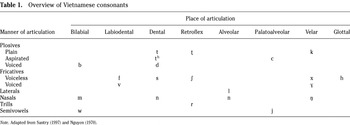
Overview of Vietnamese consonants
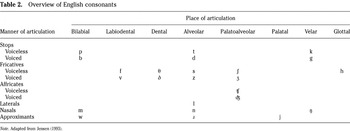
Overview of English consonants
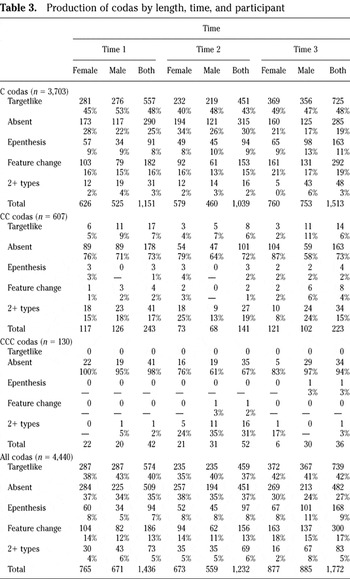
Production of codas by length, time, and participant
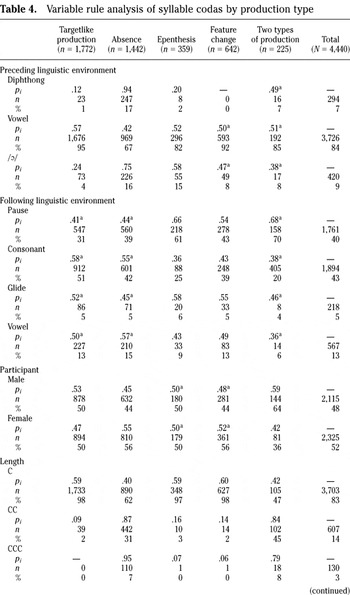
Variable rule analysis of syllable codas by production type
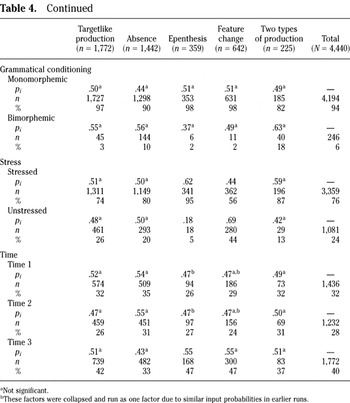
Continued
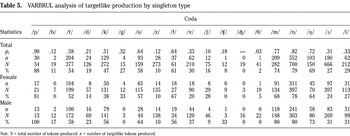
VARBRUL analysis of targetlike production by singleton type
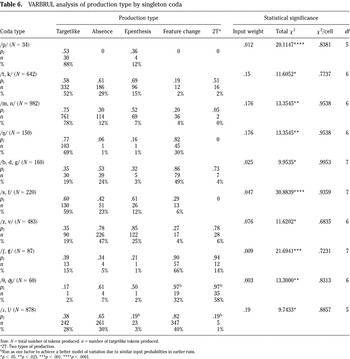
VARBRUL analysis of production type by singleton coda
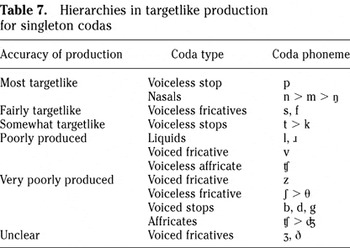
Hierarchies in targetlike production for singleton codas
 You have
Access
- 1
- Cited by