Early childhood is a period of substantial, rapid development in executive function (EF), the set of higher-order cognitive processes necessary for carrying out goal-directed behavior in situations involving affective, motivational, or cognitive load (Garon, Bryson, & Smith, Reference Garon, Bryson and Smith2008; Zelazo & Carlson, Reference Zelazo and Carlson2012). These rapid advances are manifest in children’s capacity to delay or inhibit behavior under salient emotional or motivational conditions, termed self-control (Wiebe et al., Reference Wiebe, Clark, De Jong, Chevalier, Espy and Wakschlag2015; Willoughby et al., Reference Willoughby, Kupersmidt, Voegler-Lee and Bryant2011), as well as in their ability to hold and inhibit cognitive representations in working memory, referred to as working memory/inhibitory control (WMIC; Wolfe & Bell, Reference Wolfe and Bell2004). Both poor self-control and WMIC during this period are well-documented risk factors for the development of externalizing behavior problems (Chang et al., Reference Chang, Olson, Sameroff and Sexton2011; Oh, Greenberg, Willoughby, & The Family Life Project Key Investigators, Reference Oh, Greenberg and Willoughby2020; Schoemaker et al., Reference Schoemaker, Bunte, Wiebe, Espy, Deković and Matthys2012). Because of the importance of early EF skills for the development of psychopathology and psychosocial functioning across childhood and into adulthood (Moffitt, Poulton, & Caspi, Reference Moffitt, Poulton and Caspi2013), it is important to identify factors contributing to the development of early EF.
Dopaminergic genotype and parental behavior are two factors associated with individual differences in EF (Barnes et al., Reference Barnes, Dean, Nandam, O’Connell and Bellgrove2011; Valcan, Davis, & Pino-Pasternak, Reference Valcan, Davis and Pino-Pasternak2017). Genes involved in the dopaminergic system (e.g., DRD2 and DRD4) are thought to affect children’s degree of reward sensitivity, although there is continued debate as to whether these genes confer increased risk for negative outcomes in adverse environments or enhanced sensitivity to both positive and negative environmental factors (Bakermans-Kranenburg & van IJzendoorn, Reference Bakermans-Kranenburg and van IJzendoorn2011; Belsky & Pluess, Reference Belsky and Pluess2009; Monroe & Simons, Reference Monroe and Simons1991). In this study, we aimed to inform this debate by exploring the relation of dopaminergic genotypes to EF as a function of children’s parenting experiences. Specifically, we examined interactions between a polygenic composite consisting of genes involved in dopamine catabolism (catechol-O-methyltransferase; COMT), transport (dopamine active transporter 1; DAT1), and reuptake (dopamine receptor D2, DRD2; and dopamine receptor D4, DRD4); and multiple dimensions of parental behavior in relation to children’s self-control and WMIC at 36 months.
Dopaminergic genes and reward sensitivity
Dopamine is involved in motivational, reward, and attention processes (Gatzke-Kopp, Reference Gatzke-Kopp2011; Yacubian & Büchel, Reference Yacubian and Büchel2009). Reduced dopamine availability may confer increased sensitivity to motivational rewards (Matthys, Vanderschuren, & Schutter, Reference Matthys, Vanderschuren and Schutter2013; Moore & Depue, Reference Moore and Depue2016). Such differential levels of reward sensitivity as a function of dopamine availability may be advantageous or disadvantageous depending on one’s environment (Bakermans-Kranenburg & van IJzendoorn, Reference Bakermans-Kranenburg and van IJzendoorn2011; Ellis et al., Reference Ellis, Boyce, Belsky, Bakermans-Kranenburg and van IJzendoorn2011). For example, a child with higher levels of reward sensitivity as a result of lower dopamine availability may be especially vulnerable in a relatively harsh environment, although they may flourish in an emotionally supportive, responsive setting with positive feedback. Conversely, a child who has less sensitivity to these environmental contingencies may be less affected in either setting. Dopaminergic candidate genes modulate sensitivity to environmental contingencies by impacting factors associated with dopamine availability, such as how quickly dopamine moves into the synapse, is reabsorbed, and is degraded (Chen et al., Reference Chen, Lipska, Halim, Ma, Matsumoto, Melhem, Kolachana, Hyde, Herman, Apud, Egan, Kleinman and Weinberger2004; Fuke et al., Reference Fuke, Suo, Takahashi, Koike, Sasagawa and Ishiura2001; Seamans & Yang, Reference Seamans and Yang2004).
The present study adopted a polygenic approach and considered the interaction between the cumulative effect of four dopaminergic genes – COMT, DAT1, DRD2, and DRD4 – and parental behavior in relation to children’s EF. Compared to a single candidate gene approach, a polygenic approach is likely to increase power to detect a significant interaction between dopaminergic genotype and parental behavior on children’s EF; thereby making a polygenic approach more sensitive and representative of the complexity of genetic effects (Salvatore & Dick, Reference Salvatore and Dick2018). COMT is the main enzyme responsible for the degradation of dopamine (Chen et al., Reference Chen, Lipska, Halim, Ma, Matsumoto, Melhem, Kolachana, Hyde, Herman, Apud, Egan, Kleinman and Weinberger2004). The Val allele of COMT leads to 3–4 times more COMT activity than the Met allele. This results in faster catabolism of extracellular dopamine and reduced dopamine availability. DAT1 controls the amount and duration of extracellular dopamine levels by removing dopamine from the synapse (Fuke et al., Reference Fuke, Suo, Takahashi, Koike, Sasagawa and Ishiura2001). The 10-repeat allele of DAT1 is linked to increased gene expression and transporter density (Yang et al., Reference Yang, Chan, Jing, Li, Sham and Chen2007). Higher transporter density is associated with faster removal of dopamine from the synapse, leading to lower dopamine levels. DRD2 and DRD4 are involved in the uptake of dopamine (Seamans & Yang, Reference Seamans and Yang2004). Compared to the A2 allele of DRD2, the A1 allele is associated with reduced gene expression and receptor density which predict reduced dopamine availability in the striatum and prefrontal cortex (Pohjalainen et al., Reference Pohjalainen, Rinne, Nagren, Lehikoinen, Anttila, Syvalahti and Hietala1998). Compared to the 2- to 10- repeat alleles, the 7-repeat allele of DRD4 results in reduced mRNA transcription (Schoots & van Tol, Reference Schoots and van Tol2003). Reduced mRNA transcription is associated with a decrease in receptors and binding affinity, which translates into reduced dopamine availability. The additive combination of these genes therefore provides a holistic indication of children’s dopamine availability across neural regions. Results of both randomized controlled trials and longitudinal studies provide support for this polygenic composite as a moderator of the effect of parental behavior on externalizing problems across early childhood, middle childhood, and adolescence (Chhangur, Weeland, & Belsky, Reference Chhangur, Weeland and Belsky2017; Fischer et al., Reference Fischer, van den Akker, Larsen, Jorgensen and Overbeek2020; Van Heel et al., Reference Van Heel, Bijttebier, Claes, Colpin, Goossens, Hankin and Van Leeuwen2020). Given that the same underlying neurobiology is involved in both externalizing problems and EF (Logue & Gould, Reference Logue and Gould2014; Matthys et al., Reference Matthys, Vanderschuren and Schutter2013), it is likely that these genes confer increased sensitivity to the effects of parental behavior on EF, as well.
Parental behavior and child EF
Negative reactive parental behavior is a robust predictor of poorer psychosocial and cognitive outcomes in children, including mental health problems, aggression, and EF (Gershoff, Reference Gershoff2002; Valcan et al., Reference Valcan, Davis and Pino-Pasternak2017). It is marked by emotional misattunement, power struggles, negative affect, and the use of punitive discipline techniques (Hill et al., Reference Hill, Maskowitz, Danis and Wakschlag2008; Karreman et al., Reference Karreman, van Tuijl, van Aken and Deković2006). More negative reactivity is associated with poorer self-control (Houck & Lecuyer-Maus, Reference Houck and Lecuyer-Maus2004) and WMIC in 3-year-olds (Valcan et al., Reference Valcan, Davis and Pino-Pasternak2017).
A second dimension of parental behavior, responsiveness, has also been linked to the development of children’s EF (Hughes & Devine, Reference Hughes, Devine, Wiebe and Karbach2017). Responsiveness includes the provision of emotional support and availability, contingent responses to children’s behavior, engagement, scaffolding, and reciprocal parent–child interactions (Clark et al., Reference Clark, Massey, Wiebe, Espy and Wakschlag2019; Hill et al., Reference Hill, Maskowitz, Danis and Wakschlag2008; Kochanska, Murray, & Harlan, Reference Kochanska, Murray and Harlan2000; Landry, Smith, & Swank, Reference Landry, Smith and Swank2006). More responsive parental behavior is associated with better EF in early childhood (Li-Grining, Reference Li-Grining2007; Razza & Raymond, Reference Razza and Raymond2013; Valcan et al., Reference Valcan, Davis and Pino-Pasternak2017).
Models of gene × environment interaction
Understanding the form of dopaminergic genotype × parental behavior interactions is important for understanding pathways to the development of externalizing behavior problems via EF (Davies & Cicchetti, Reference Davies and Cicchetti2014). Two competing models of the form of the interaction have been proposed and were explored in this study. The diathesis-stress model (Monroe & Simons, Reference Monroe and Simons1991) proposes that genotypes associated with increased reward sensitivity confer vulnerability to the negative effects of negative environmental factors, such that children with these genotypes will have worse outcomes in negative environments compared to children without these genotypes. In contrast, the differential susceptibility model (Belsky & Pluess, Reference Belsky and Pluess2009) proposes that genotypes associated with increased reward sensitivity confer increased sensitivity to both positive and negative environmental factors, such that children with these genotypes will have better outcomes in positive environments and worse outcomes in negative environments compared to children who do not have these genotypes.
There is empirical support for both models of gene × environment interaction; therefore, it remains to be seen which model best accounts for the form of the interaction between dopaminergic genes and parental behavior on children’s EF. Consistent with the diathesis-stress model, a longitudinal study found that maternal negativity was associated with worse self-control for adolescents with a dopaminergic composite associated with increased reward sensitivity (10-repeat allele of DAT1 and 7-repeat allele of DRD2) (Wright et al., Reference Wright, Schnupp, Beaver, Delisi and Vaughn2012). Further, a dopaminergic polygenic composite consisting of COMT, DAT1, DRD2, and DRD4 was associated with increased impulsivity, which, in turn, predicted antisocial behavior among 10-year-olds experiencing maltreatment (Thibodeau, Cicchetti, & Rogosch, Reference Thibodeau, Cicchetti and Rogosch2015). However, it is important to note that this study did not capture positive parental behaviors given the focus on maltreatment. Consistent with the differential susceptibility model, a polygenic composite that included the 10-repeat allele of DAT1, A1 allele of DRD2, and 7-repeat allele of DRD4 moderated the association of parenting quality to adolescent male’s self-regulation (Belsky & Beaver, Reference Belsky and Beaver2011). Males with more alleles associated with increased reward sensitivity had poorer self-regulation when parenting quality (a composite measure of parental involvement, disengagement, and attachment) was low and better self-regulation when parenting quality was high compared to males with fewer alleles associated with increased reward sensitivity. A longitudinal study of adolescents also found that adolescents with higher dopaminergic composite scores (Val allele of COMT, 10-repeat allele of DAT1, and A1 allele of DRD2) had less emotional insecurity and fewer externalizing symptoms when interparental conflict was low and more insecurity and externalizing symptoms when interparental conflict was high (Davies et al., Reference Davies, Pearson, Cicchetti, Martin and Cummings2019). Thus, the literature on this issue is unresolved, with the majority of the research concentrating on self-control and externalizing behavior in middle childhood or adolescent samples. Further studies examining these interactions in younger samples, with a broader spectrum of positive and negative parental behaviors, and in relation to mechanistic precursors of externalizing behavior, including different dimensions of EF, will help inform the understanding of the nature of gene × environment interactions across childhood.
The present study
This study explored the interactions between a dopaminergic polygenic composite and two aspects of parental behavior meant to capture the full range of children’s negative (negative reactivity) and positive (responsiveness) parenting experiences in relation to children’s EF at 36 months (Belsky & Pluess, Reference Belsky and Pluess2009). Although the study included a relatively small sample, we hypothesized that we would find evidence for a dopaminergic genotype × parental behavior interaction based on previous literature (Chhangur et al., Reference Chhangur, Weeland and Belsky2017; Van Heel et al., Reference Van Heel, Bijttebier, Claes, Colpin, Goossens, Hankin and Van Leeuwen2020). If dopaminergic genotype × parental behavior interactions were found, we planned to conduct additional exploratory analyses to identify whether the forms of the interactions were consistent with the diathesis-stress or differential susceptibility model. These analyses were treated as exploratory because of the study’s limited power to carry out extended moderation analyses. If results were consistent with the diathesis-stress model, we expected children with higher polygenic composite scores (i.e., a higher number of alleles associated with increased reward sensitivity) to have poorer EF than children with lower composite scores (i.e., fewer alleles associated with reward sensitivity) when parents were more negatively reactive and less responsive. If results were consistent with the differential susceptibility model, in addition to having poorer EF in higher-risk contexts, we expected children with higher composite scores to have better EF when their parents were less negatively reactive or more responsive. To test these associations, we used data from the Midwestern Infant Development Study (MIDS), a prospective longitudinal study which included genetic data, observational measures of parental behavior, and behavioral assessments of EF when children were 36 months old.
Method
Participants
Mother–child dyads were drawn from a follow-up of the MIDS completed when children were 36 months old (N = 135; 63 girls, 72 boys; M age = 3 years 6 days, SD = 99 days; 55% exposed to prenatal tobacco). Mothers were prospectively recruited during pregnancy at two Midwestern study sites (Carbondale, Illinois; and Lincoln, Nebraska) to study the effects of prenatal tobacco exposure on cognitive development (Espy et al., Reference Espy, Fang, Johnson, Stopp, Wiebe and Respass2011; Wiebe et al., Reference Wiebe, Clark, De Jong, Chevalier, Espy and Wakschlag2015; Wiebe, Fang Johnson, James, & Espy, Reference Wiebe, Fang, Johnson, James and Espy2014). Because of funding constraints, the 36-month follow-up only included children at the Lincoln, Nebraska site. Prior to participating in the study, mothers provided written, informed consent. Excluded from the cohort were mothers who reported illegal drug use (except for occasional marijuana use) or binge drinking. Infants born preterm (<35 weeks gestational age) or with birth complications known to affect developmental outcomes (e.g., neonatal seizures) were excluded. Dyads included in this study did not significantly differ from excluded dyads in terms of ethnicity, prenatal tobacco exposure status, maternal education, or child sex. MIDS is a predominantly low socioeconomic status cohort. Family income ranged from under $10,000 to over $100,000 (Mdn = $30,000). Parents completed between 11 and 18 years of formal education (M = 14.03). Children’s ethnic backgrounds are European American (n = 76), African American (n = 32), and Hispanic or Latinx American (n = 27). Indigenous (n = 2) and mixed-ethnicity (n = 5) children were excluded from this study because the sample sizes were not large enough to test for Hardy–Weinberg equilibrium.
Procedure
The 36-month follow-up was conducted at a developmental laboratory at the University of Nebraska-Lincoln. Children were individually tested by a trained research assistant over three sessions separated by approximately one week. After the completion of each session, children received a small toy. After completing all three sessions, mothers received a gift card. In the first session, children completed the Disruptive Behavior Diagnostic Observation Schedule (DB-DOS) (Wakschlag et al., Reference Wakschlag, Hill, Carter, Danis, Egger, Keenan and Briggs-Gowan2008). The DB-DOS is a standardized clinical observation designed to differentiate between clinically salient patterns of behavioral dysregulation and normative misbehavior in early childhood (Wakschlag et al., Reference Wakschlag, Hill, Carter, Danis, Egger, Keenan and Briggs-Gowan2008). A saliva sample was also collected for subsequent genotyping. In the second and third sessions, children completed a battery of EF tasks. EF tasks were administered in a fixed order to ensure that potential carry-over effects across tasks would be consistent across participants. Adherence to experimental protocols was maintained by reviewing session video recordings and regular team meetings. Study procedures were approved by the university’s Institutional Review Board.
Measures
Genotyping
Children were genotyped for the Val(108/158)Met polymorphism of COMT, the 3ʼ-UTR VNTR polymorphism of DAT1, the Taq1A polymorphism of DRD2, and the exon 3 VNTR polymorphism of DRD4. Trained research assistants collected saliva samples from participants using the DNA Genotek Oragene Self-Collection Kits (Ottawa, Canada). DNA was extracted and quantified with Quanti-iT Pico Green dsDNA assay (Thermo Fisher; Waltham, MA). Following polymerase chain reaction, products were separated on a 3730 Genetic Analyzer (Wakschlag et al., Reference Wakschlag, Kistner, Pine, Biesecker, Pickett, Skol, Dukic, Blair, Leventhal, Cox, Burns, Kasza, Wright and Cook2010). If genotyping was unsuccessful, a second saliva sample was collected from children at a 5-year follow-up of the MIDS and genotyping was redone.
For COMT, DAT1, DRD2, and DRD4, allele frequencies and the results of testing for Hardy–Weinberg equilibrium are presented separately for each ethnic group and the whole sample in Table 1. If all cells had more than five participants, Hardy–Weinberg equilibrium was tested using a χ2 test; otherwise, an exact test was used (Wigginton, Cutler, & Abecasis, Reference Wigginton, Cutler and Abecasis2005). For each gene, the individual ethnic groups and whole sample were in Hardy–Weinberg equilibrium.
Allele frequencies and Hardy–Weinberg equilibrium (HWE) for candidate genes

Next, we created a polygenic composite. To rule out gene × environment correlations as a possible confound (Dick et al., Reference Dick, Agrawal, Keller, Adkins, Aliev, Monroe, Hewitt, Kendler and Sher2015), we tested whether each candidate gene was correlated with the measures of parental behavior using bivariate correlations. None of the candidate genes were correlated with parental behavior (rs = −.11–.16, ps > .05); therefore, all four genes were used in the creation of the composite score. Each gene was dummy-coded (1 = present or 0 = absent) based on the presence or absence of the allele associated with increased reward sensitivity as identified in the literature (Bakermans-Kranenburg & van IJzendoorn, Reference Bakermans-Kranenburg and van IJzendoorn2011; Belsky et al., Reference Belsky, Newman, Widaman, Rodkin, Pluess, Fraley, Berry, Helm and Roisman2015). Alleles coded as present were (a) the Val allele of the Val(108/158)Met polymorphism of COMT, (b) the A1 allele of the Taq1A polymorphism of DRD2, (c) the 7-repeat allele of the exon 3 VNTR polymorphism of DRD4, and (d) the 10-repeat allele of the 3ʼ-UTR VNTR polymorphism of DAT1. The dummy codes were summed to form a composite score ranging from 0 to 4.
Parental behavior
Mother–child dyads were videotaped completing the parent context of the DB-DOS and maternal behavior was coded offline. The parent context was designed to “press” for key parental behaviors (e.g., negative reactivity) that are unlikely to spontaneously occur during the course of more naturalistic observations by placing dyads in four ecologically salient interaction contexts designed to elicit children’s “do” compliance, frustration, “don’t” compliance, and social play. Specifically, contexts included a clean-up task, where the mother instructed the child to assist in cleaning up crayons; a challenging puzzle task, where children completed a selection of four puzzles with maternal support; mother’s withdrawal of attention, where the mother instructed the child to wait while she completed questionnaires; and free play, where the mother and child played together with a selection of toys (Hill et al., Reference Hill, Maskowitz, Danis and Wakschlag2008; Wakschlag et al., Reference Wakschlag, Hill, Carter, Danis, Egger, Keenan and Briggs-Gowan2008). The combination of these four activities provides a holistic picture of parenting across different “press” scenarios. Each context lasted 5 minutes. Before starting the contexts, the procedure was explained to the mother and she was given flip cards with instructions. Transitions between tasks were marked by the ringing of a bell. Mothers were encouraged to act as they normally would at home.
Parental behavior during the DB-DOS was coded using a structured observational measure of parental behavior, the Parenting Clinical Observation Schedule (P-COS; Hill et al., Reference Hill, Maskowitz, Danis and Wakschlag2008). The P-COS is designed to assess problematic and competent parental behaviors globally across all four contexts of the DB-DOS. It is a validated observational measure of parental behavior: Scores on the P-COS are correlated with self-report measures of parenting, such as the Coping with Children’s Negative Emotions scale (rs = −.31–.19, ps < .05).
Two coders, trained to reliability (>80% exact agreement on each item) by a master coder involved in the development of the coding scheme, completed all coding. All three coders double coded 20% of the videos. Ongoing reliability was maintained through regular meetings. Disagreements between coders were resolved by consensus. Inter-rater reliability was high (negative reactivity: mean κ = .88–.91, exact agreement: 97%–98%; responsiveness: mean κ = .86, exact agreement: 95%). Coders watched each video twice before assigning final codes. Mothers’ behavior was coded globally, with codes capturing mothers’ behaviors across all four contexts. Each item was rated on a 4-point scale ranging from 0 (no evidence of the behavior) to 3 (high levels of the behavior). Descriptions and examples of each item are provided in Appendix 1.
The measure of negative reactivity consisted of the summed score of seven items: hostile behavior, verbally aggressive discipline, physical discipline, power struggles, emotional misattunement, intensity of angry/irritable affect, and pervasiveness of angry/irritable affect. Because scores on the intensity of angry/irritable affect and pervasiveness of angry/irritable affect items were highly correlated (r = .86), scores on these items were averaged together to form one item (Hill et al., Reference Hill, Maskowitz, Danis and Wakschlag2008). Internal consistency was adequate (ordinal ω total = .71).
The measure of responsiveness consisted of the summed score of the scaffolding, responsiveness to positive behaviors, warm affection, positive engagement, labeling, intensity of positive affect, and pervasiveness of positive affect items. Labeling was dropped from the measure because of poor loading on internal consistency analyses (corrected item-total r = .15) (Hill et al., Reference Hill, Maskowitz, Danis and Wakschlag2008). Internal consistency was good (ordinal ω total = .80).
Executive function
Children completed a battery of seven EF tasks meant to assess self-control and WMIC (Wiebe et al., Reference Wiebe, Clark, De Jong, Chevalier, Espy and Wakschlag2015). Administration, psychometric properties, scoring, and validation of the EF battery are described in more detail elsewhere (Wiebe et al., Reference Wiebe, Sheffield, Nelson, Clark, Chevalier and Espy2011, Reference Wiebe, Clark, De Jong, Chevalier, Espy and Wakschlag2015).
Two tasks assessed children’s ability to regulate their behavior in situations where rewards were highly salient. Goody Shelf was administered as part of the DB-DOS (Wakschlag et al., Reference Wakschlag, Hill, Carter, Danis, Egger, Keenan and Briggs-Gowan2008). In Goody Shelf, an experimenter unveiled an appealing set of toys on a small shelf. During a 5-minute delay, where the experimenter completed paperwork, children were instructed to sit at a table and were given paper and crayons to draw. Children were told they could look at, but not touch, the toys during the delay. Each instance of toy touching was coded for intensity on a scale from 1 (brief touches) to 3 (sustained touches where the child was resistant to examiner prompts to stop touching the toys). The dependent measure was a summary score representing child noncompliance.
In Snack Delay, children were instructed to keep their hands on a placemat marked with two handprints and stand still in front of M&M candies placed under a transparent cup for 4 minutes. Two dependent measures were created: a summary score representing child compliance during the delay, and a measure of task success. To create the summary score, children’s behavior was scored in 5-second intervals and summed across all intervals until either the child ate the snack or the task ended. Children received up to 3 points for standing still, keeping their hands on the mat, and remaining silent. The measure of task success was coded as 0 (ate the snack during the delay) or 1 (did not eat the snack during the delay).
Five tasks assessed children’s abilities to hold in mind and manipulate information and inhibit a prepotent response. In Delayed Alternation, a food reward was hidden in one of two locations and children had to pick the correct location of the reward. The experimenter changed the location of the reward after each correct trial. Trials were separated by a 10-second delay that required children to hold the previously rewarded location in working memory. The dependent measure was the proportion of correct responses.
For the Nebraska Barnyard task, children listened to sequences of animal names. Next, they pressed colored buttons on a touch screen that corresponded to the correct sequence of names. The dependent measure was a summary score calculated by summing the proportion of correct trials at each sequence length.
In the Big-Little Stroop task, children were shown small pictures of everyday objects, embedded within larger pictures that matched (congruent trials) or mismatched (incongruent trials) the smaller pictures. Children were asked to name the smaller, embedded pictures. The dependent measure was the proportion of correct responses on incongruent trials.
In Preschool Go/No-Go, children were told to press a button on a button box to catch colored fish (75% of trials), but to withhold pressing the button when a shark appeared (25% of trials). The dependent measure was d-prime (d’), the standardized difference between the hit rate and false alarm rate (Stanislaw & Todorov, Reference Stanislaw and Todorov1999).
The inhibit condition of Shape School required children to name the color of a cartoon shape character when the character had a happy face and to remain silent when the character had a sad face (inhibit trials). The dependent measure was the proportion of correct responses on inhibit trials.
Confirmatory factor analysis supported a two-factor measurement model for EF consisting of self-control and WMIC (see Wiebe et al., Reference Wiebe, Clark, De Jong, Chevalier, Espy and Wakschlag2015). A two-factor model fit the data well, χ 2 (19) = 32.52, p = .03, RMSEA = .07, CFI = .93, SRMR = .06. It provided a better model fit than a one-factor model (Δχ 2 (1) = 37.88, p < .01) and was more parsimonious than a three-factor model (self-control, WM, and IC) model (Δχ 2 (2) = 1.71, p = .43). Goody Shelf and Snack Delay loaded on a self-control factor. All self-control factor loadings were statistically significant and standardized factor loadings ranged from .43 to .97. Delayed Alternation, Nebraska Barnyard, Big-Little Stroop, Preschool Go/No-Go, and Shape School-inhibit condition loaded on a WMIC factor. The five factor loadings were statistically significant and standardized factor loadings ranged from .42 to .56. Factor scores for the self-control and WMIC latent factors were used as the measures of EF.
Covariates
Child ethnicity, prenatal tobacco exposure status, maternal psychological distress, household socioeconomic status, and child sex were included as covariates. Ethnicity is associated with the distribution of alleles in the population (Dick et al., Reference Dick, Agrawal, Keller, Adkins, Aliev, Monroe, Hewitt, Kendler and Sher2015). Child ethnicity was coded using a set of dummy codes with European American ethnicity serving as the reference. Prenatal tobacco exposure status was included as a covariate because mothers who smoked during pregnancy were overenrolled in the MIDS cohort. At two points during pregnancy and shortly after their child’s birth, mothers completed timeline-follow-back interviews about daily smoking. Maternal urine and infant meconium were assayed for cotinine, a metabolite of nicotine, to verify tobacco exposure status (Espy et al., Reference Espy, Fang, Johnson, Stopp, Wiebe and Respass2011). Prenatal tobacco exposure status was dummy coded as 0 (absent) or 1 (present). Maternal psychological distress, household socioeconomic status, and child sex are sometimes associated with parental behavior and EF (Carlson & Wang, Reference Carlson and Wang2007; Vrantsidis et al., Reference Vrantsidis, Clark, Chevalier, Espy and Wiebe2020). The Global Severity Index of the Brief Symptom Inventory (BSI; Derogatis, Reference Derogatis1993) was used as the measure of psychological distress. After mothers completed the BSI, scores on each item were summed and divided by the number of questions answered to create the Global Severity Index. To minimize the number of participants lost due to missingness on exogenous variables, missing Global Severity Index scores (n = 1) were replaced with scores from the 6-month follow-up. Socioeconomic status was indexed using parental education. Mothers reported on each parent or significant other’s highest educational degree. For single-parent households, mother’s highest degree was used as the measure of parental education. For two-parent households, the highest degree in the household was used. Child sex was dummy coded as 0 (absent) or 1 (present).
Analytic strategy
All dependent variables were examined for outliers and non-normality. In total, 5% of the data were missing, ranging from < 1% (maternal psychological distress) to 31% (Shape School). Full information maximum likelihood estimation using an expectation maximization algorithm was used to address missing data on endogenous variables. Full information at maximum likelihood assumes that data are missing at random. To test whether missing data on endogenous variables were related to demographic characteristics, a series of logistic regression models were computed. Missingness was unrelated to ethnicity, prenatal tobacco exposure status, maternal education, or child sex (ps > .05).
Before testing for moderation, a path model was established using MPlus 8.1 (Muthén & Muthén, 2012). First, predictors were mean-centered and product terms representing the interactions between the dopaminergic polygenic composite and parental behavior (polygenic composite × negative reactivity and polygenic composite × responsiveness) were calculated. Following recommendations on controlling for potential confounders in gene × environment interaction research (Keller, Reference Keller2014), product terms representing the two-way interactions between each covariate and polygenic composite and parental behavior were calculated. Results were unchanged (a) when covariates were not included in the model and (b) when covariate by polygenic composite and parental behavior interaction terms that did not reach significance were trimmed. Therefore, all two-way interactions between covariates and the polygenic composite and parental behavior were retained. Next, a path model was tested by adding directional paths from the polygenic composite, negative reactivity, responsiveness, interaction terms, and covariates to EF.
Moderation was tested using a series of path models. Paths for each polygenic composite × parental behavior interaction term were sequentially constrained to zero. A chi-square difference (Δχ2) test was used to compare the constrained model to the unconstrained model (Kline, Reference Kline2015). Moderation was supported if constraining the path to zero resulted in a significant chi-square difference test (p < .05). For significant tests, the less constrained model was retained; otherwise, the more parsimonious model was favored.
Significant interactions were probed following Roisman et al.’s (Reference Roisman, Newman, Fraley, Haltigan, Groh and Haydon2012) recommendations. First, we graphed significant interactions. Although distributions appeared normal based on visual inspection, skew values, and kurtosis values, negative reactivity (range = −.69–2.64 SD) and responsiveness scores (range = −2.5–1.79 SD) did not range from −2 to 2 standard deviations (Roisman et al., Reference Roisman, Newman, Fraley, Haltigan, Groh and Haydon2012). Therefore, we plotted the observed data and only bound the x and y axes at −2 or 2 standard deviations when the observed data extended beyond this range. Second, a regions of significance analysis, using the Johnson–Neyman technique (P. Johnson & Fay, Reference Johnson and Fay1950), was used to examine whether potential interactions supported the diathesis-stress or differential susceptibility model. A regions of significance analysis identifies the values of parental behavior at which differences in EF due to dopaminergic genotype are significant (Hayes, Reference Hayes2018). Third, the proportion of interaction (POI) was computed. The POI compares the area between the regression lines to the right of the crossover point to the area to the left (Roisman et al., Reference Roisman, Newman, Fraley, Haltigan, Groh and Haydon2012). A POI close to 0% supports the diathesis-stress model as it indicates that the area on one side of the crossover point is much larger than the area on the other side. A POI between 20% and 80% supports the differential susceptibility model (Del Giudice, Reference Del Giudice2017). Fourth, the proportion affected (PA) index was computed. The PA estimates the proportion of the sample with values of parental behavior above the crossover point (Roisman et al., Reference Roisman, Newman, Fraley, Haltigan, Groh and Haydon2012). A PA less than 2% supports the diathesis-stress model and a PA greater than 16% supports the differential susceptibility model. The regions of significance analyses, POI, and PA were computed using dopaminergic composite scores corresponding to the lower and upper quartile because participants did not have composite scores corresponding to −1 and +1 SD from the mean.
DRD2 was correlated with ethnicity (Latinx American: r = .22, p = .01; African American: r = .03, p = .77). Therefore, we ran all analyses (a) separately for European American participants as they were the largest ethnic group and (b) using the whole sample but excluding Latinx American participants. Results are available upon request from the first author. The results were marginally significant for European American participants and the results for the whole sample did not differ when Latinx American participants were excluded; therefore, we included all three groups in the analyses and controlled for ethnicity.
Results
Descriptive statistics
Descriptive statistics for all variables used in the analyses are presented in Table 2, and correlations are presented in Table 3. The polygenic composite and parental behavior measures were not significantly correlated. Negative reactivity and responsiveness were moderately correlated. The self-control and WMIC factor scores were strongly correlated. EF factor scores were generally not significantly correlated with the polygenic composite or parental behavior measures. Correlations among the covariates were typically not significant, as were correlations among the covariates and main predictors. Correlations among EF factor scores and covariates were generally not significant or small in magnitude.
Descriptive statistics for the dopaminergic polygenic composite, parental behavior, executive function, and covariate measures

Correlations between the dopaminergic polygenic composite, parental behavior, executive function factor scores, and covariates

Note. WMIC = working memory/inhibitory control. +p < .10; *p < .05; **p < .01.
Path analysis
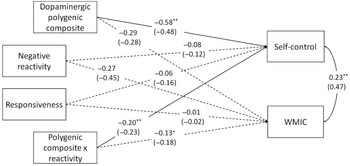
To test whether the interactions between the polygenic composite and parental behavior were associated with EF, self-control and WMIC were regressed on the polygenic composite, negative reactivity, responsiveness, interaction terms, and covariates. For both self-control and WMIC, the polygenic composite × negative reactivity and polygenic composite × responsiveness interaction terms were tested for moderation by comparing a model estimating the effect of the interaction term to a model constraining the path to zero. If the chi-square difference test was significant, the path was retained. If the test was not significant, the most parsimonious model was retained. For self-control, the polygenic composite × negative reactivity path was retained in the final model (Δχ 2 (1) = 8.18, p < .01); while the path from polygenic composite × responsiveness was dropped (Δχ 2 (1) = .44, p = .51). For WMIC, the path from polygenic composite × negative reactivity was retained (Δχ 2 (1) = 5.02, p = .03), and the path from polygenic composite × responsiveness was dropped (Δχ 2 (1) = 2.78, p = .10).
The final model is presented in Figure 1. The model was just identified, meaning it had the same number of free parameters as observations; therefore, model fit statistics could not be calculated (Kline, Reference Kline2015). Complete results are presented in Appendix 2. The final model accounted for 40% of the variability in self-control. The polygenic composite predicted self-control, but this main effect was qualified by an interaction with negative reactivity. The main effects of negative reactivity and responsiveness on self-control were not significant.
Path diagram illustrating the main and interaction effects of the dopaminergic polygenic composite score and parental behaviors on self-control and working memory/inhibitory control (WMIC). Both unstandardized and standardized (in parentheses) parameters are presented; error variances and covariates (child ethnicity, prenatal tobacco exposure status, psychological distress, parental education, and child sex) are not shown. + p < .10; * p < .05; ** p < .01.

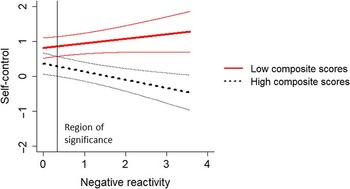
To determine the range of values of negative reactivity for which the association of dopaminergic polygenic scores to self-control was significant, we examined regions of significance. Results are presented in Figure 2. There were significant differences in self-control for children with low dopaminergic polygenic composite scores (lower quartile) versus high scores (upper quartile) at values of negative reactivity above .34 (.33 standard deviations below the mean). There were no significant differences in self-control for children with low versus high composite scores in the absence of negative reactivity. Consistent with a diathesis-stress model, higher negative reactivity was associated with poorer self-control for children with higher polygenic composite scores, indicative of a higher number of alleles associated with increased reward sensitivity. The crossover point for the interaction fell outside the range of observed negative reactivity scores, at a value of −1.22; therefore, it was not possible to calculate the POI index. The PA was 0% as no participants had scores above the crossover point. This result is consistent with the diathesis-stress model.
The relation of negative reactivity to self-control for children with low (lower quartile) versus high (upper quartile) dopaminergic polygenic composite scores, including upper and lower bounds.

The final model accounted for 27% of the variability in WMIC. Although the parameter estimate for the polygenic composite × negative reactivity interaction was marginally significant according to the Wald test, removing the interaction resulted in significantly poorer model fit (Δχ 2 (1) = 5.02, p = .03). We probed this interaction using regions of significance analysis. When negative reactivity was higher, children with high composite scores tended to have poorer WMIC than children with low scores. However, the upper and lower bounds for the two groups overlapped. The main effects of the polygenic composite, negative reactivity, and responsiveness on WMIC were not significant.
In terms of the covariates included in the model, sex, prenatal tobacco exposure, and higher maternal psychological distress were associated with poorer self-control. The effect of sex was qualified by an interaction with responsiveness: Boys had poorer self-control relative to girls when responsiveness was low. Higher maternal psychological distress was associated with poorer WMIC. There was a polygenic composite × prenatal tobacco exposure interaction for WMIC: Children with low composite scores tended to have better WMIC in the absence of prenatal tobacco exposure relative to children with high composite scores, although the upper and lower bounds for both groups overlapped.
Discussion
This study was the first to explore the interactions between a dopaminergic polygenic composite and parental behavior (negative reactivity and responsiveness) in relation to children’s EF in early childhood. We adopted a multi-faceted approach, examining pathways involving multiple dimensions of parental behavior and EF, using state-of-the-art, direct assessment methods. We hypothesized that the interactions between the polygenic composite and parental behavior would be associated with children’s EF. We found preliminary, partial support for this hypothesis. Higher negative reactivity was associated with poorer self-control for children with higher composite scores relative to children with lower composite scores. This result is consistent with the diathesis-stress model as the polygenic composite was only associated with self-control when negative reactivity was high. For WMIC, even though model fit declined when the polygenic composite × negative reactivity interaction was removed, the interaction was not significant. The polygenic composite × responsiveness interaction was not associated with EF. While promising, these initial findings should be treated with caution until they are replicated with larger samples and using polygenic scores based on genome-wide association studies.
Only higher negative reactivity was associated with poorer self-control for children with higher dopaminergic polygenic composite scores (i.e., a higher number of alleles associated with increased reward sensitivity) relative to children with lower polygenic composite scores. For responsiveness, children’s self-control did not significantly differ by polygenic composite score. This pattern of findings is consistent with the diathesis-stress model of gene × environment interaction and suggests that dopaminergic genes associated with increased reward sensitivity confer vulnerability for the development of poorer self-control, the motivational dimension of EF, in the context of a negative environmental factor.
This finding also highlights the importance of considering factors contributing to alterations in dopaminergic functioning and has potential implications for understanding pathways to the development of externalizing behavior problems. For example, reduced mesocortical dopamine activity is a risk factor for the development of behavior problems (Matthys, Vanderschuren, & Schutter, Reference Matthys, Vanderschuren and Schutter2013). The alleles in the dopaminergic polygenic composite that are associated with increased environmental sensitivity are also associated with reduced dopamine availability (Chen et al., Reference Chen, Lipska, Halim, Ma, Matsumoto, Melhem, Kolachana, Hyde, Herman, Apud, Egan, Kleinman and Weinberger2004; Pohjalainen et al., Reference Pohjalainen, Rinne, Nagren, Lehikoinen, Anttila, Syvalahti and Hietala1998; Schoots & van Tol, Reference Schoots and van Tol2003; Yang et al., Reference Yang, Chan, Jing, Li, Sham and Chen2007). Prenatal tobacco exposure, a risk factor for behavior problems like conduct disorder (Wakschlag et al., Reference Wakschlag, Pickett, Kasza and Loeber2006), amplifies the negative effect of parental behavior on effortful control in 5-year-olds (Clark et al., Reference Clark, Massey, Wiebe, Espy and Wakschlag2019). It also leads to alterations in the dopaminergic system, including reduced D2 receptor density, reduced dopamine levels in the striatum (Richardson & Tizabi, Reference Richardson and Tizabi1994), reduced dopamine turnover (Heath & Picciotto, Reference Heath and Picciotto2009), and changes in dopaminergic gene expression (Kanlikilicer, Zhang, Dragomir, Akay, & Akay, Reference Kanlikilicer, Zhang, Dragomir, Akay and Akay2017; Keller, Dragomir, Yantao, Akay, & Akay, Reference Keller, Dragomir, Yantao, Akay and Akay2018). Together, these findings suggest a need to examine genetic, epigenetic, and environmental factors leading to alterations in dopaminergic functioning as pathways to the development of psychopathology.
Further, negative reactivity is theorized to increase the risk of developing behavior problems in children with reduced dopamine activity (Beauchaine, Gatzke-Kopp, & Mead, Reference Beauchaine, Gatzke-Kopp and Mead2007). The present finding suggests that negative reactivity may be a risk factor for the development of behavior problems in children at genetic risk for lower dopaminergic activity via the impact of negative reactivity on self-control. There is preliminary support for this pathway in middle childhood and adolescence (Davies et al., Reference Davies, Pearson, Cicchetti, Martin and Cummings2019; Thibodeau et al., Reference Thibodeau, Cicchetti and Rogosch2015). The results of this study also suggest that interventions aimed at improving self-control in at-risk children, particularly by reducing the use of negative reactivity strategies, could potentially buffer against the development of behavior problems (Beauchaine & Gatzke-Kopp, Reference Beauchaine and Gatzke-Kopp2012).
Previous research on interactions between dopaminergic genotype and parental behavior on children’s EF has primarily focused on self-control (Augustine et al., Reference Augustine, Leerkes, Smolen and Calkins2018; Kok et al., Reference Kok, Bakermans-Kranenburg, van Ijzendoorn, Velders, Linting, Jaddoe and Tiemeier2013; Smith et al., Reference Smith, Sheikh, Dyson, Olino, Laptook, Durbin and Klein2012), but this study included WMIC, as well. Although model fit declined when the interaction between the polygenic composite and negative reactivity as a predictor of WMIC was removed from the model, the Wald test was marginally significant. The discrepant findings for WMIC and self-control were surprising given the importance of dopamine for both components of EF (Mier, Kirsch, & Meyer-Lindenberg, Reference Mier, Kirsch and Meyer-Lindenberg2010; Robbins & Arnsten, Reference Robbins and Arnsten2009). The age of the participants may have contributed to the pattern of results. Perseveration and impulsive responding are prevalent in preschoolers (Carlson, Reference Carlson2005). Therefore, the association of negative reactivity to WMIC, compared to self-control, may have been masked, but could emerge as the trajectories of children at different levels of reward sensitivity diverge with development. It is also possible that performance on self-control tasks is more sensitive to environmental factors, including parental behavior, than performance on WMIC tasks (Kidd, Palmeri, & Aslin, Reference Kidd, Palmeri and Aslin2013). For example, previous work using this sample found that harsh parenting was uniquely associated with self-control at 36 months (Vrantsidis et al., Reference Vrantsidis, Clark, Chevalier, Espy and Wiebe2020).
The interaction between dopaminergic genotype and responsiveness on both components of EF was not significant. The observed pattern of results for negative reactivity and responsiveness in the present study differed from previous research, which found interactions between dopaminergic candidate genes (e.g., COMT) and responsiveness, but not negative reactivity, on EF (Kok et al., Reference Kok, Bakermans-Kranenburg, van Ijzendoorn, Velders, Linting, Jaddoe and Tiemeier2013; Smith et al., Reference Smith, Kryski, Sheikh, Singh and Hayden2013). It is possible that collinearity between the positive and negative parenting dimensions contributes to the conflicting findings. Collinearity inflates the standard errors of parameter estimates causing the significance of parameter estimates to fluctuate, meaning it is not possible to determine the relative importance of collinear predictors (Mason & Perreault Jr., Reference Mason and Perreault1991). Collinearity was not likely to be a concern in this study as the correlation among negative reactivity and responsiveness was −.34, meaning that the variables accounted for unique variance in EF.
This study’s results should be interpreted within the context of the study’s strengths and limitations. In addition to the uses of a dopaminergic polygenic composite and multidimensional direct assessment methods of positive and negative parental behaviors, key strengths of this study were the use of developmentally sensitive measures of EF; and rigorous statistical methods to control for potential confounders, particularly ethnicity. First, the use of factor scores, based on a latent variable approach to the measurement of EF, likely improved the reliability of the EF measures. Performance on individual EF tasks reflects variations in both EF abilities and the basic abilities required to complete the tasks (e.g., motor abilities), often making individual tasks unreliable measures of EF (Nelson et al., Reference Nelson, James, Choi, Clark, Wiebe and Espy2016). The use of a latent variable approach resulted in a model of EF with good fit to the data, likely improving our ability to detect any potential associations of dopaminergic genotype and parental behavior to EF. Second, this study adopted more rigorous controls for covariates and population stratification than is typical in gene × environment interaction research (Dick et al., Reference Dick, Agrawal, Keller, Adkins, Aliev, Monroe, Hewitt, Kendler and Sher2015; Keller, Reference Keller2014). In addition to including the main effects of the covariates, all polygenic composite × covariate and parental behavior × covariate interaction terms were included in the analyses. Including the interaction terms controlled for the effects of the covariates (e.g., ethnicity) on the polygenic composite × parental behavior interactions. Finally, because the sample was ethnically heterogeneous, sensitivity analyses were conducted to further rule out population stratification as a possible confounder.
This study also had several limitations that are important to note. First, the sample size of the current study was relatively small for a genetic association study. A larger sample would increase the precision of estimates allowing for better discrimination of false positive and negative findings. Replication of the presenting findings is needed before strong conclusions about the strength of the evidence for dopaminergic polygenic composite × parental behavior interactions on children’s EF can be drawn. Second, this study was cross-sectional. As a result, we were unable to disentangle the direction of the relation between parental behavior and children’s EF. It is possible that children’s EF mediates the relation of their genotype to parental behavior (Kryski et al., Reference Kryski, Smith, Sheikh, Singh and Hayden2014). Nonetheless, results of randomized controlled trials provide additional support for an interaction between children’s genotype and parental behavior on children’s EF: Parenting interventions are more impactful for children with alleles associated with increased reward sensitivity relative to children without these alleles (for a meta-analysis see van IJzendoorn & Bakermans-Kranenburg, Reference van IJzendoorn and Bakermans-Kranenburg2014). Third, the restricted range of the parental behavior measures may have limited our ability to detect an interaction consistent with differential susceptibility (Roisman et al., Reference Roisman, Newman, Fraley, Haltigan, Groh and Haydon2012). Additional research testing competing models of gene × environment interaction using measures of parental behavior with greater variability is necessary. Fourth, this study used a dopaminergic polygenic score based on four genes involved in dopaminergic functioning. At least eight different genes and 200 single nucleotide polymorphisms have been linked to dopaminergic functioning (Derringer et al., Reference Derringer, Krueger, Dick, Saccone, Grucza, Agrawal, Lin, Almasy, Edenberg, Foroud, Nurnberger, Hesselbrock, Kramer, Kuperman, Porjesz, Schuckt and Bierut2010). The use of polygenic scores based on genome-wide association studies would better capture functioning of the dopaminergic system (Duncan et al., Reference Duncan, Shen, Gelaye, Meijsen, Ressler, Feldman, Peterson and Domingue2019).
This study provides evidence for a dopaminergic genotype × parental behavior interaction in shaping children’s EF in early childhood. Higher negative reactivity was associated with poorer self-control for children with higher dopaminergic polygenic composite scores relative to children with lower scores. This result is consistent with the diathesis-stress model rather than the differential susceptibility model of gene × environment interaction. Distinguishing between these two models is important for understanding whether candidate genes associated with increased reward sensitivity confer vulnerability or plasticity to the effects of parental behavior on children’s EF. Although they will require replication in novel samples, the results of this study provide evidence that these candidate genes confer vulnerability to the detrimental effect of negative parental behavior during the preschool period. By 36 months, parents’ negative reactive behavior is linked to the development of behavior problems (Scaramella & Leve, Reference Scaramella and Leve2004; Shaw, Bell, & Gilliom, Reference Shaw, Bell and Gilliom2000). Identifying early precursors from negative reactivity to behavior problems via self-control, as well as clinically meaningful early individual differences that buffer or amplify the effect of negative reactive behavior, is important for the development of interventions aimed at decreasing the risk for developing behavior problems in early childhood.
Supplementary material
For supplementary material accompanying this paper visit https://doi.org/10.1017/S0954579421001061
Acknowledgments
We gratefully acknowledge Erica Anderson for her assistance in coding maternal behavior, the members of the Developmental Cognitive Neuroscience Laboratory for assistance with data collection and coding, and the families who made this research possible.
Funding statement
This work was supported by NSERC (Daphne Vrantsidis, Postgraduate Scholarship-Doctoral); a Killam Cornerstone Grant (Sandra Wiebe); and NIDA (Kimberly Andrews Espy, grant number R01DA014661; Lauren Wakschlag and Kimberly Andrews Espy, grant number R01DA023653; and Sandra Wiebe, grant number R21DA024769).
Conflicts of interest
The authors have no conflicts of interest to report.