Introduction
Maternal and newborn mortality is problematic in Ghana and other sub-Saharan Africa countries (Magadi et al., Reference Magadi, Agwanda and Obare2007). In an attempt to achieve Millennium Development Goals 4 and 5, which are aimed at reducing maternal and child mortality by three-quarters by 2015, the government of Ghana has implemented relevant initiatives to improve access to, and utilization of, reproductive/maternal health services (Doku et al., Reference Doku, Neupane and Doku2012). The National Health Insurance Scheme (NHIS), introduced in 2003, is a notable example of such an initiative. The NHIS was designed to provide free access to maternal health care services purposely to encourage timely and regular antenatal care, delivery at medical facilities and early postnatal care (Witter & Garshong, Reference Witter and Garshong2009; Dixon et al., Reference Dixon, Tenkorang and Luginaah2011; Dzakpasu et al., 2012). Despite this and other initiatives, child survival remains an urgent concern since there is an estimated rate of 102 infant deaths per 1000 live births in Ghana (UNICEF, 2013). This figure is about nine times higher than that in the WHO European region (11 per 1000 live births).
Antenatal care (ANC), in particular, has been recognized as an important part of the maternal care continuum (Dixon et al., Reference Dixon, Tenkorang, Luginaah, Kuuire and Boateng2014). The importance of ANC for maternal health lies in its capacity to detect health complications in expectant mothers and the opportunity for acceptable remedial interventions (Carroli et al., Reference Carroli, Rooney and Villar2001; WHO, 2003). Generally, the number of ANC visits depends on the specific medical needs of women, but the World Health Organization recommends at least four ANC visits during pregnancy, with the first visit made by the end of the first trimester (Owoo & Lambon-Quayefio, Reference Owoo and Lambon-Quayefio2013; Dixon et al., Reference Dixon, Tenkorang, Luginaah, Kuuire and Boateng2014). Early timing and regular ANC provides time and space for health education on diet and other safety practices during and after pregnancy (WHO, 2003). Although about 90% of Ghanaian women report seeing a health professional at least once during pregnancy, most of them make their visit after the first trimester (Owoo & Lambon-Quayefio, Reference Owoo and Lambon-Quayefio2013). It is, however, apparent from the literature that the number and timing of ANC visits varies by education, parity and maternal age.
Research suggests that extremes of maternal age and parity (i.e. young and older ages, or higher parity) are associated with higher maternal morbidity and mortality and thus may be related to use of biomedical care. These factors may also reflect experience with pregnancy-related matters and, as such, older and multiparous women may be less inclined to seek care. The relationship between maternal age and maternal health care service utilization has been widely explored. Although the findings are inconsistent across studies, it is frequently suggested that age is positively associated with the utilization of maternal health care services (Doku et al., Reference Doku, Neupane and Doku2012; Owoo & Lambon-Quayefio, Reference Owoo and Lambon-Quayefio2013). These studies generally conclude that older women may have accumulated knowledge of health care services, and hence may demonstrate a higher rate of utility. It is important to note, however, that most of the studies treat age as continuous, and hence fail to capture how maternal health care utilization varies across different age groups. The work of Magadi et al. (Reference Magadi, Agwanda and Obare2007) and Doku et al. (Reference Doku, Neupane and Doku2012) are some of the few exceptions. Magadi et al. (Reference Magadi, Agwanda and Obare2007) compared the use of maternal health care services between teenage mothers, young mothers (20–34 years) and older mothers (35 years and above) from 21 African countries and found that teenage mothers generally started ANC late and made fewer antenatal visits relative to older mothers, especially those aged 20–30 years. Doku et al. (Reference Doku, Neupane and Doku2012) also found that Ghanaian women aged 25–34 years attended early ANC and were more likely to have trained delivery attendants during birth compared with those aged 15–24 years, but no significant difference was found between older mothers (35–49) and those aged 15–24 years. These exceptional studies show that the relationship between maternal health care service utilization and maternal age is rather complex and there are significant variations in use by maternal age. According to the 2008 DHS, older mothers aged 35–49 years, on average, make fewer ANC visits, and attend their first ANC check-up later than younger women aged 20–34 years.
Clearly, there is a need to explore the relevant factors that account for this disparity. For instance, different mechanisms underlie the association of younger and older maternal age with adverse perinatal outcomes, which are likely to be explained by socioeconomic position. Disaggregating this observed gap between the younger women and older women is important in order to develop age-specific initiatives to encourage maternal health care service utilization. To the best of the authors’ knowledge, no study has previously explored this, and this research lacuna is an opportunity to explore the age disparities in the timing and number of antenatal visits between younger and older mothers in Ghana.
Based on the relevant literature, the time and number of ANC visits is more or less influenced by some compositional variables, such as education, employment and wealth. Generally, education and employment status have been found to be positively associated with access to, and utilization of, maternal health care services (Arthur, Reference Arthur2012). A number of studies have also found that women from poor households are less likely to utilize maternal health care services (WHO, 2007; Babalola & Fatusi, Reference Babalola and Fatusi2009; Doku et al., Reference Doku, Neupane and Doku2012; Atunah-Jay et al., Reference Atunah-Jay, Pettinggell, Ohene, Micheal Oakes and Borowsky2013; Khanal et al., Reference Khanal, Adhikari, Karkee and Gavidia2014). As expected, rural–urban disparity in utilization of maternal health care is also evident in the literature. Studies suggest that rural residents are less likely to utilize these services because there are fewer health facilities in these areas (Peters et al., 2008).
Besides these compositional factors, important contextual considerations such as region, accessibility of and conditions within health care facilities, fertility behaviour and specific national policy initiatives have been found to influence the timing and number of ANC visits. For instance, Dixon et al.’s (Reference Dixon, Tenkorang, Luginaah, Kuuire and Boateng2014) study shows that women who experience barriers to accessing health facilities make fewer ANC visits. Likewise, Koblinsky et al. (Reference Koblinsky, Matthews, Hussein, Mavalankar, Mridha, Anwar and van Lerberghe2006) noted that women’s reluctance to use maternal care services can be attributed to poor service delivery at some medical facilities. Magadi et al. (Reference Magadi, Agwanda and Obare2007) have also documented that women with more children are more likely to attend ANC check-ups later than those with fewer children. What is more, Dixon et al. (Reference Dixon, Tenkorang, Luginaah, Kuuire and Boateng2014) acknowledged the positive effect of Ghana’s NHIS on maternal health outcomes. In particular, women enrolled under the insurance scheme made more ANC visits (Arthur, Reference Arthur2012; Dixon et al., Reference Dixon, Tenkorang, Luginaah, Kuuire and Boateng2014). Interestingly, however, Dixon et al. (Reference Dixon, Tenkorang, Luginaah, Kuuire and Boateng2014) found that the insurance scheme did not have a significant effect on the timing of ANC visits. Against this backdrop, these factors are considered theoretically relevant in explaining the disparities in the number and timing of first ANC check-up between younger and older women in Ghana.
Methods
Data
Data for this study came from the 2008 Ghana Demographic and Health Survey (GDHS), a nationally representative data set collected by the Ghana Statistical Service (GSS) with technical input from ICF Macro International as part of the Global Demographic and Health Surveys (GDHS) programme. The GDHS employed a two-stage, stratified sample frame, where systematic sampling with probability proportional to size was applied. The survey covered all ten regions of the country and was designed to collect, analyse and disseminate information on the compositional characteristics of the population, as well as issues related to maternal health, media access and fertility behaviour, which makes it suitable for this study. About 5096 eligible women aged 15–49 years from 11,778 households were identified during the survey, but only 4916 were interviewed. This study, however, restricted the data to only those who had their last birth three years before the survey was administered in order to minimize misreporting due to recall bias.
Measures
The outcome variables for the study were ‘number of ANC visits during pregnancy’ and ‘timing of first ANC check’. With regards to the number of ANC visits, respondents were asked: ‘How many times did you receive ANC during this pregnancy?’ Those who reported at least one ANC visit were asked to indicate the timing of their first visit. As already indicated, previous studies have established the link between ANC and some compositional factors, such as health insurance coverage, fertility behaviour and age. Age, a binary variable coded as ‘0’ for young women aged 20–34 years and ‘1’ for older mothers aged 35–39 years, was used to stratify the data. It was hypothesized that characteristics that distinguish childbearing teenagers from others – such as familial disadvantage, parental absence, low aspirations, abuse and certain partner characteristics – will also distinguish young childbearing women who had intended to become pregnant from those who had not. This study was concerned with women at least 20 years old and their decision to utilize ANC services, and for this reason teenagers were excluded.
With regards to fertility behaviour, respondents were asked the birth order of their last birth. This was coded as first child=0, second or third child=1, fourth or fifth child=2, and sixth child or more=3. Respondents were also asked the type of health insurance they had. Respondents who answered they had health insurance and then specified the type as ‘National/District Health Insurance’ were considered enrolled in the NHIS. The media variable included in this study was ‘listening to radio’ (coded as: yes=1 and no=0).
The compositional (biosocial and socio-cultural) variables included in the study were as follows: employment status of respondents (not employed=0; employed=1), educational background of respondents (no education=0; primary education=1; secondary/higher education=2) and wealth status, a composite index based on the household’s ownership of a number of consumer items including television and a car, flooring material, drinking water, toilet facilities, etc. (poorest=0; poorer=1; middle=2; richer=3; richest=4), marital status (not currently married=0; currently married=1) and the religious denomination of respondents (Christians=0; Muslims=1; Traditional=2; No religion=3). Contextual variables included place of residence (urban=0; rural=1) and region of origin (Greater Accra= 0; Central=1; Western=2; Volta=3; Eastern=4; Ashanti=5; Brong Ahafo=6; Northern=7; Upper East=8; Upper West=9).
Statistical analysis
Inferential and multivariate techniques were applied to examine associations between maternal health outcomes (frequency and timing of ANC visits) and theoretically relevant socio-cultural and biosocial variables using STATA 13 SE software (StataCorp, 2013). Univariate analysis of the predictors on older and younger mothers was operationalized via Pearson’s chi-squared statistics.
The counterfactual decomposition method used in this study, known as the Blinder–Oaxaca decomposition (Oaxaca Reference Oaxaca1973; Jann, Reference Jann2008), explains the gap in the means of maternal health outcomes (frequency and timing of ANC visits) between two groups (in this instance, between the older and younger mothers) in Ghana. O’Donnell et al. (Reference O’Donnell, Van Doorslaer, Wagstaff and Lindelow2008) gives a comprehensive account on the technique. The gap is decomposed into that part that is due to group differences in the magnitudes of the determinants of maternal health outcome scores, on the one hand, and group differences in the effects of these determinants, on the other hand. For example, younger mothers in rural Ghana may be less healthy not only because they have less access to health facilities but also because they are less knowledgeable about how to obtain the maximum health benefits from health posts in the respective districts.
Although two maternal health outcome variables (frequency and timing of ANC visits) were analysed in this study, only frequency of antenatal visits is used here to illustration the technique. Let frequency of ANC visits be y i , the outcome variable of interest. There are two groups in this study, referred to as the ‘older mothers’ and ‘younger mothers’. Frequency of ANC visits is assumed to be explained by a vector of determinants, x, according to a regression model:
 $$y_{i} = \left \{ \matrix{ \beta ^{{\rm younger\,mothers}} x_{i} {\plus}{\varepsilon}_{i}^{{\rm younger\,mothers}} \rm \,if\,\rm younger\,mother \hfill \cr \beta ^{{\rm older\,mothers}} x_{i} {\plus}{\varepsilon}_{i}^{{\rm older\,mothers}} \rm \,if\,older\,mother \hfill \cr \right$$
where the vectors of β parameters include intercepts. Older mothers are assumed to have a more advantageous regression line (lower scores on maternal health) than the younger mothers. Also, older mothers are assumed to have a higher mean of x. It is assumed that exogeneity, and thus the conditional expectations of the error terms in equation (1), are zero. The gap in mean maternal health scores between the younger (y younger) and older mothers (y older), is given by:
 $$y^{{{\rm younger}}} {\minus}y^{{{\rm older}}} =(\beta ^{{{\rm younger}}} \,x^{{{\rm younger}}} )-(\beta ^{{{\rm older}}} \,x^{{{\rm older}}} )$$
where x younger and x older are vectors of the independent variables evaluated at the means for the younger and older mothers, respectively. For the set of independent variables, the formulations are expressed as follows:
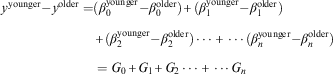 $$\eqalignno{ y^{{\rm younger}} {\minus}y^{{\rm older}} = & (\beta _{0}^{{\rm younger}} {\minus}\beta _{0}^{{\rm older}} ){\plus}(\beta _{1}^{{\rm younger}} {\minus}\beta _{1}^{{\rm older}} ) \cr & {\plus}(\beta _{2}^{{\rm younger}} {\minus}\beta _{2}^{{\rm older}} ) \cdots {\plus} \cdots (\beta _{n}^{{\rm younger}} {\minus}\beta _{n}^{{\rm older}} ) \cr & =G_{0} {\plus}G_{1} {\plus}G_{2} \cdots {\plus} \cdots G_{n} $$
so that the gap in maternal health outcomes between the younger and older mothers can be thought of as being due in part to (i) differences in the intercepts (G 0), (ii) differences in x 1 and β 1 (G 1), and (iii) differences in x 2 and β 2 (G 2). For example, G 1 might measure the part of the gap in mean score of frequency of ANC visits (y) due to differences in educational attainment (x 1) and the effects of educational attainment (β 1), and G 2 might measure the part of the gap due to the gap in wealth of respondents (x 2) and differences in the effects of wealth of respondents (β 2). Estimates of the difference in the gap in mean antenatal visits can be obtained by substituting sample means of the x values and estimates of the parameters β values into equation (2).
How much of the overall gap or the gap specific to any one of the x values (e.g. G 1 or G 2) is attributable to (i) differences in the x values (sometimes called the explained component) rather than (ii) differences in the β values (sometimes called the unexplained component) was estimated. In doing so, two options were considered. In the first, the differences in the x values were weighted by the coefficients of the younger mother group and the differences in the coefficients were weighted by the x values of the older mother group, whereas in the second the differences in the x values were weighted by the coefficients of the older mother group and the differences in the coefficients were weighted by the x values of the younger mother group. Either way, there was a way of partitioning the gap in outcomes between the younger and older mothers into a part attributable to the fact that the younger mothers have worse x values than the older mothers, and a part attributable to the fact that ex hypothesi they have worse β values than the older mothers. These formulations are expressed as follows:
 $$y^{{{\rm younger}}} {\minus}y^{{{\rm older}=}} \Delta x\beta ^{{{\rm poor}}} {\plus}\Delta \beta x^{{{\rm poor}}} {\plus}\Delta x\Delta \beta =E{\plus}C{\plus}CE$$
From equation (4), the gap in mean frequency of ANC visits can be thought of as deriving from a gap in x values or endowments (E), a gap in β values or coefficients (C) and a gap arising from the interaction of endowments and coefficients (CE). The endowments term represents the contribution of differences in explanatory variables across groups, and the coefficients term is the part that is due to group differences in the estimated coefficients. So, in effect, equation (5) places the interaction in the unexplained part, whereas equation (6) places it in the explained part:
 $$y^{{{\rm younger}}} {\minus}y^{{{\rm older}}} =\Delta x\beta ^{{{\rm younger}}} {\plus}\Delta \beta x^{{{\rm older}}} =E{\plus}(CE{\plus}C)$$
 $$y^{{{\rm younger}}} {\minus}y^{{{\rm older}}} =\Delta x\beta ^{{{\rm older}}} {\plus}\Delta \beta x^{{{\rm younger}}} =(E{\plus}CE){\plus}C$$
Oaxaca’s decomposition is also written as a unique case of equation:
 $$y^{{{\rm younger}}} {\minus}y^{{{\rm older}}} =\Delta x\,[D\beta ^{{{\rm younger}}} {\plus}(I{\minus}D)\beta ^{{{\rm older}}} ]{\plus}\Delta \beta [x^{{{\rm younger}}} (I {\minus} D){\plus}x^{{{\rm older}}} D]$$
where I is the identity matrix and D a matrix of weights. In the simple case, where x is a scalar rather than a vector, I is equal to one and D is a weight. In this case, D=0 in equation (5), and D=1 in equation (6).
In addition to the above formulations, three more formulations were considered. Cotton (Reference Cotton1988) suggested weighting the differences in the x values by the mean of the coefficient vectors, which yields:
 $${\rm diag}\,{\rm (}D{\rm )}=0.{\rm 5}\,{\rm (Cotton)}$$
where diag (D) is the diagonal of D. Reimers (Reference Reimers1983) also suggested weighting the coefficient vectors by the proportions in the two groups, so that if f NP is the sample fraction in the older mother group, the following is obtained:
 $${\rm diag}\,{\rm (}D{\rm )}=f_{{{\rm NP}}} ({\rm Reimers})$$
Finally, the decomposition proposed by Neumark (Reference Neumark1988) was included, which makes use of the coefficients obtained from the pooled data regression, β P:
 $$y^{{{\rm older}}} {\minus}y^{{{\rm older}}} =\Delta x\beta ^{{\rm P}} {\plus} [x^{{{\rm younger}}} (\beta ^{{{\rm younger}}} {\minus}\beta ^{p} ){\plus}x^{{{\rm older}}} (\beta ^{p} {\minus}\beta ^{{{\rm older}}} )]\,({\rm Neumark})$$
Results
This study explored the gap in the frequency and timing of ANC visits between younger and older mothers in Ghana. The Blinder–Oaxaca decomposition technique was used to analyse the gap in ANC utilization between younger and older mothers into a part that is ‘explained’ by group differences in the magnitudes of the determinants, and a residual part that cannot be accounted for by such differences in determinants. This technique is exceptionally useful to identify and quantify the separate contributions of group differences in measurable characteristics, such as education, marital status, geographical location and age (Fairlie, Reference Fairlie2006; Jann, Reference Jann2008), to maternal health care utilization. In addition, three other counterfactual decomposition techniques (Cotton, Reimer and Neumark) were used to assess the disparities in ANC visits between the two groups. Broadly, these findings indicate that differences in the mean values of the determinant (explained component) account for the vast majority of the difference in frequency and timing of ANC visits between younger and older mothers in Ghana.
Background characteristics of respondents
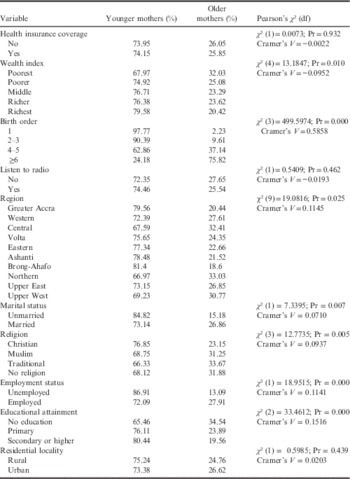
To find whether there is some association between age of mothers and other demographic factors chi-squared and Cramer’s V statistics were performed. The null hypothesis (H 0) is that there is no relationship. To reject this, a Pr<0.05 (at 95% confidence) must be obtained. The results show that there are notable associations between mother’s age and most of the demographic factors, as shown in Table 1. Mother’s age was associated with each of the following: wealth status, region of residence, marital status, religion, employment status and educational attainment. In all these cases, the strength of the association was weak, as evidenced by Cramer’s V<0.3. The strength of association between birth order (parity) and mother’s age was quite strong (Cramer’s V≈0.6). Interestingly, health insurance coverage, listening to radio (access to information) and rural–urban residence were independent of mother’s age.
Distribution of explanatory variables of sample women by age (n=1456), GDHS 2008

Decomposition results
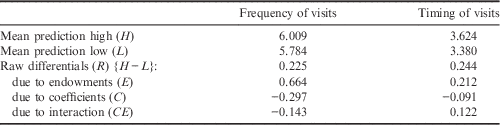
Table 2 shows the mean values of maternal health care utilization (frequency of antenatal visits and timing of antenatal visits) for younger and older mothers, and the difference between them. It also shows the contribution attributable to the gaps in endowments (E) and coefficients (C) and their interaction (CE). From the results, the gap in endowments accounts for the bulk of the gap in the two maternal health care outcomes (frequency of antenatal visits and timing of antenatal visits).
Summary of decomposition resultsFootnote a for maternal health care utilization of sample women, GDHA 2008
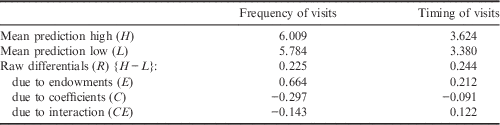
a High: age=0.0000; low: age=1.0000.
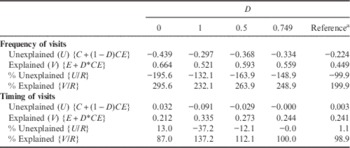
The fractions of mean frequency of antenatal visits and timing of antenatal visits based on each of the four decompositions (Oaxaca (0, 1); Cotton (0.5), Reimer (0.749) and Neumark) are shown in Table 3. Irrespective of the decomposition used, it is apparently the difference in the mean values of the endowments (explained component) that accounts for the vast majority of the difference in frequency of antenatal and timing of antenatal visits between younger and older mothers in Ghana.
Proportion of explained and unexplained components for maternal health care utilization of sample women, GDHS 2008

D in the 4th column=relative frequency of high group.
a Reference=pooled model over both categories.
For frequency and timing of visits the total for the explained and unexplained components in each column adds up to 100%.
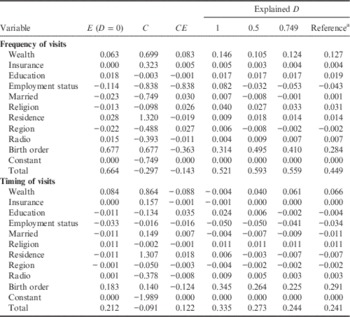
Table 4 demonstrates how far gaps in individual x values contribute to the overall explained gap. For example, focusing on the penultimate column corresponding to Reimer’s decomposition, it is recognized that the gaps in the three demographic variables (i.e. employment status, marital status and region) actually favour the younger mothers, whereas the gaps in all other remaining variables do not favour younger mothers.
Decomposition results for maternal health care utilization variables for sample women, GDHS 2008

a Reference=pooled model over both categories.
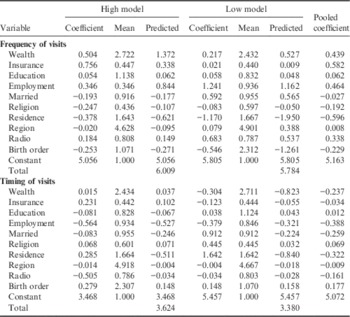
Table 5 indicates the coefficient estimates, means and predictions for each x for each group. For frequency of antenatal visits, the ‘high group’ is the younger and the ‘low group’ is the older mothers. For timing of antenatal visits, the ‘high group’ is the older and the ‘low group’ is the younger mothers. For the first Oaxaca decomposition (equation (5)), columns 2 and 3 of Table 5 allow the identification of how the gap in each of the β values contributes to the overall unexplained gap.
Coefficients, means and predictions for maternal health care utilization for sample women, GDHS 2008

The results of the decomposition analysis are discussed in two ways: first, the decomposition results for variables related to frequency of ANC utilization, then results of variables pertaining to timing of ANC visits.
In the Oaxaca decomposition, differences in the effects of the determinants (coefficients or unexplained component) play a small part in explaining frequency and timing of ANC visits between younger and older mothers, as compared with the gap in endowment. Based on Oaxaca’s decomposition D=0, differences in the mean values of x values (gaps in endowment) account for all of the differentials in the frequency of ANC visits between younger and older mothers. Similarly, for the Cotton decomposition, differences in the mean values of x values (gaps in endowments) explain the entire disparities in the frequency of ANC visits between younger and older mothers. In terms of the Reimer and Neumark decompositions, the differentials in frequency of ANC visits between younger and older mothers in Ghana are fully explained by the mean values of x (gaps in endowments).
Using the Cotton decomposition, birth order, or parity, alone account for 83% of the overall explained gap in frequency of ANC visits between the younger and older mothers. This is followed by wealth status of the household (16%), while education, religion, residence and exposure to media (radio) jointly account for less than 1% of the overall explained gap. Similar results were obtained using the Reimer decomposition, where birth order accounts for 73% of the overall explained gap in frequency of ANC visits between younger and older mothers. This was followed by wealth status (22%), with education, religion, residence and access to media (radio) together accounting for less than 5% of the overall explained gap. These trends continue when Neumark’s decomposition is used. Once again, birth order accounts for the largest proportion (63%) of the overall explained gap, followed by wealth status (28%). Education, religion, residence and media (radio) jointly account for less than 10% of the overall explained gap. Not surprisingly, the magnitudes of contribution of each of variable remain the same across decomposition techniques (Cotton, Reimer and Neumark).
The pattern of the estimates from the Oaxaca decomposition results for variables related to timing of ANC visits does not differ substantially from those for frequency of ANC visits among younger and older mothers. Based on Oaxaca’s decomposition D=0, differences in the mean values of x (gaps in endowment) account for about 87% of the differentials in timing of ANC visits between younger and older mothers. Using Oaxaca’s decomposition D=1, differences in gaps in endowment explain all of the differentials in timing of ANC visits. Based on Cotton’s decomposition, differences in gaps in endowment explain the entire differentials in timing of ANC visits. About 100% and 98% of the differentials in timing of ANC visits between younger and older mothers in Ghana are explained by the mean values of x (gaps in endowments) using the Reimer and Neumark decompositions, respectively.
Across decomposition techniques, birth order, once again, accounts for the largest share of contribution to the overall explained gap in timing of ANC visits between younger and older mothers in Ghana. Using Cotton’s decomposition, birth order accounts for a disproportionately large share of the gap in timing of ANC visits between the two groups. Wealth status, educational attainment, religion, residence and access to media (radio) jointly account for less than 3% of the overall explained gap. Similar results were obtained using the Reimer decomposition, where birth order alone accounts for about 92% of the overall explained gap in timing of ANC visits between younger and older mothers. These trends continue when Neumark’s decomposition is used. Birth order accounts for about 90% of the overall explained gap in timing of ANC visits between younger and older mothers. In the Reimer and Neumark decompositions, education, religion, residence and access to media (radio) still cumulatively account for less than 10% of the overall explained gap. This implies that, although the magnitudes of contribution of each variable differ across decomposition techniques, the trends and order of contribution remain almost the same.
Discussion
This study reveals interesting findings that are consistent with previous studies. Although the relationship between parity and ANC has been inconclusive, many studies have found that birth order, or parity, is significant in explaining disparities in ANC utilization in developing countries. Of the demographic factors, women’s parity displays substantial impact on the overall explained gap in both frequency and timing of ANC visits between younger and older mothers in Ghana regardless of decomposition technique used, suggesting that experience and knowledge accumulated over time on how to behave during pregnancy has significant influence on the utilization of ANC services. This is also supported in the literature, where it is argued that higher number of previous pregnancies is associated with decreased attendance at antenatal services (Magadi et al., Reference Magadi, Madise and Rodrigues2000; Navaneetham & Dharmalingam, Reference Navaneetham and Dharmalingam2002; Rai et al., Reference Rai, Singh, Kumar and Singh2013). It is thus not surprising that older women have decreased ANC attendance due to their experience and familiarity with common ailments during the pregnancy period. The findings also reveal that wealth status of the household significantly influences the explained gap in frequency of ANC visits.
Other personal characteristics, including the mother’s educational attainment, marital status, employment, religion, region of residence and access to media (radio), are also significant in explaining the gap in ANC use between younger and older mothers in Ghana. Although education was significant, the magnitude of the contribution was lower than expected in explaining the gap in number and timing of antenatal visits between the two groups. Evidence from many studies has found that well educated women are more likely than their counterparts with little or no education to use ANC (Buor, Reference Buor2003; Hug & Tasnim, Reference Hug and Tasnim2007; Greenaway et al., Reference Greenaway, Leon and Baker2012; Babalola, Reference Babalola2014). Addai (Reference Addai2000) reported that the attitude to ANC in Ghana is influenced by education, with higher level of education leading to increased and sufficient ANC use. He argued that educated women tend to be more informed and have better understanding of the advantages of prenatal care. Bbaale (2011) and Banchani and Tenkorang (Reference Banchani and Tenkorang2014) also found that mothers with secondary or higher education were more likely to make the recommended number of visits (at least four). Likewise, Babalola (Reference Babalola2014) found that better educated mothers were more inclined to use less expensive and skilled maternal care services. These results suggest that maternal education plays an important role in influencing the utilization and quality of ANC.
Geographic region (or ethnicity) was also significant in explaining the gap in ANC use. Geographic region has generally been shown to have greater influence on the utilization of maternal health service. Previous empirical studies have found that different regions are differently endowed with health care infrastructure and personnel, influencing access to, and utilization of, maternal health care services. For example, Banchani and Tenkorang (Reference Banchani and Tenkorang2014) reported regional differences in the number and timing of ANC visits, whereby women residing in regions of Ghana other than the Greater Accra region were significantly less likely to make the recommended number of visits (at least four). In the literature, there appears to be a strong link between religion and utilization of ANC. For instance, a study by Addai (Reference Addai2000) reported a positive association between being Catholic and the use of ANC in Ghana, while those who practise Traditional religion were less likely to make the recommended number of ANC visits. However, the relationship between religion and ANC utilization does not imply that religion contributes much to explaining the disparity between younger and older mothers in terms of their utilization of ANC services. For instance, this study found that the magnitude of the contribution of religion to explaining the gap between the two groups was rather low.
Place of residence (urban or rural) was also significant in the model but had a lesser influence in explaining the gap between the two groups. Previous studies have generally found residence to be a significant determinant of maternal health service utilization, especially in rural areas in sub-Sahara Africa (Gage, Reference Gage2007; Gabrysch et al., Reference Gabrysch, Cousens, Cox and Campbell2011; Masters et al., Reference Masters, Burstein, Amofah, Abaogye, Kumar and Hanlon2013). Physical proximity of health care services, especially in the developing country context, plays an important role in utilization of maternal health services. Rural dwellers may be more remote from health care facilities than their urban counterparts, increasing the distance from home to a health facility compared with those living in urban centres. As a result, those residing in rural areas are significantly less likely to make the recommended number of antenatal visits and/or make their first visit within the first trimester of pregnancy (Banchani & Tenkorang, Reference Banchani and Tenkorang2014).
This paper makes a number of key contributions to the maternal health literature, and, to the authors’ knowledge, is the first to attempt to decompose the gap in ANC visits by age in Ghana. Previous studies have largely focused on the relationship between the timing and frequency of ANC visits among Ghanaian women, yet assessing the explained gap in ANC visits between younger and older mothers is important to understand the possible causes of the gap. This study is an important first step in understanding the gap in endowments (determinants) and differences in the effects of the determinants (coefficients) between younger and older mothers.
There are some limitations to the study that are worth considering. While decomposition techniques are valuable for quantifying the contribution of various factors to a difference or change in maternal health outcomes, they do not reveal the underlying mechanism of the relationship between factors and outcomes. Nonetheless, by indicating which factors are quantitatively important and which are not, decompositions provide useful indications of particular hypotheses or explanations to be explored in more detail. For example, in this study, the differences in women’s parity account for a large fraction of the ANC age gap, and this suggests exploring in more detail how younger and older mothers time their ANC visits and how often they utilize maternal health care services.
Understanding the gap in endowments (determinants) and differences in the effects of the determinants (coefficients) between younger and older mothers will inform policymakers on how to systematically address these gaps in endowments in order to increase the utilization of ANC and attain a minimum recommendation of four visits as per WHO guidelines. The present study adds to the evidence underscoring the need for policy and programme interventions that cater for the needs of older mothers, which may differ from those of younger mothers. Age-specific interventions and the education of older mothers about their increased risk and vulnerability to pregnancy-related complications are required. Previous studies in Ghana have noted that simply providing health services, although necessary, is not sufficient to ensure optimal utilization of ANC services (Arthur, Reference Arthur2012); women have first to perceive that the benefits of the service outweigh the cost. Since the utilization of maternal and child health services is nearly universal in Ghana, with the implementation of the National Health Insurance Scheme in 2005 any further gains in infant and maternal health outcomes will come from improvement in maternal/ community education to ensure women’s understanding of the importance of ANC services and their individual health risks to potential complications.
In conclusion, this study disaggregated disparities in ANC services utilization between two mutually exclusive groups (younger and older mothers) in Ghana based on characteristic effects (explained variation) and coefficient effects (unexplained variation). Birth order (parity) was found to account for the largest share of the contribution to the overall explained gap in ANC between younger and older mothers regardless of the decomposition technique used. This indicates that ANC differentials between the two groups are probably due to biosocial factors. This paper is unique as it used decomposition techniques hitherto not extensively considered in the ANC research domain. Access to, and utilization of, ANC services is meaningless unless it is situated in context. Specifically, clarity is required to identify whether it is older unmarried mothers, younger unmarried mothers, younger married mothers or older married mothers who require prompt and significant attention in order to address their deficit in the access and utilization of ANC services. This is imperative considering the significant heterogeneity in the capacities of individuals, even within the same community.