Introduction
Abnormal social behavior is a core feature of schizophrenia that leads to marked functional impairment (Couture et al., Reference Couture, Penn and Roberts2006). Multiple deficits – in social cognition, motivation, decision-making, and learning – are thought to interfere with patients’ ability to navigate a wide range of socially relevant tasks, from maintaining basic hygiene to negotiating a raise at work. Disentangling the processes driving abnormal social behavior in order to uncover treatment targets has proven difficult, unfortunately, largely due to the complexity of studying dynamic interpersonal interactions. Multiplayer economic games and computational modeling are increasingly leveraged to address this challenge (Lee, Reference Lee2013), as these approaches allow quantification of specific aberrancies in cognitive and social processes that are relevant to real-world behavior yet difficult to measure.
The value of a reward, for example, must be estimated from observed actions rather than measured directly (Schultz, Reference Schultz2016). Rewards are critical for motivating actions that are necessary for survival, and the rewarding properties of social interaction, in particular, shape the relationships and social organizations that are essential for healthy functioning among mammals (Krach et al., Reference Krach, Paulus, Bodden and Kircher2010; Trezza et al., Reference Trezza, Campolongo and Vanderschuren2011). Dysregulation of the mechanisms underlying social reward are hypothesized to contribute to the abnormal social behavior observed in multiple neuropsychiatric disorders, including schizophrenia (Bora et al., Reference Bora, Yücel and Allen2009). People with schizophrenia demonstrate reduced neural sensitivity to social v. nonsocial reward (Lee et al., Reference Lee, Jimenez, Reavis, Horan, Wynn and Green2018) as well as impaired motivation for social interaction that is thought to reflect dysregulated reward processing (Fulford et al., Reference Fulford, Campellone and Gard2018). Though the mechanisms underlying reward processing in social contexts are not fully understood (Noritake et al., Reference Noritake, Ninomiya and Isoda2018), dysregulated dopamine signaling in schizophrenia (Carlsson, Reference Carlsson2006) is hypothesized to underlie deficits in the ability to form mental representations of reward (Gold et al., Reference Gold, Waltz, Prentice, Morris and Heerey2008) and to assign salience to social information (Palaniyappan et al., Reference Palaniyappan, Simmonite, White, Liddle and Liddle2013), both of which may contribute to aberrant sensitivity to social reward. Importantly, how this aberrancy impacts social behavior in schizophrenia and whether it represents a viable treatment target is unclear.
Recent advances in the experimental study of competitive behavior open the door to answering these questions. Competition is a fundamental part of social life, facilitating comparisons that help people make sense of their place in a social hierarchy (Festinger, Reference Festinger1954; Liu et al., Reference Liu, Zheng, Li, Xu, Cheng, Guo, Mulcahy and Xu2018). Competitive interactions can reflect not only the drive to maximize payoff (in money or other tangible rewards) relative to others (Messick and McClintock, Reference Messick and McClintock1968), but also the desire to attain social status by winning, an end in itself (Huberman et al., Reference Huberman, Loch and Önçüler2016). Thus, competitive interactions provide an opportunity to examine sensitivity to social reward in a dynamic context. The Auction Game is an economic paradigm that creates a tension between monetary and social reward to allow investigation of people's preferences in a competitive environment. The game leverages the phenomenon, observed both in real-world (Ashenfelter and Genesove, Reference Ashenfelter and Genesove1992; Capen et al., Reference Capen, Clapp and Campbell2013) and experimental settings (Bazerman and Samuelson, Reference Bazerman and Samuelson1983; Kagel and Levin, Reference Kagel and Levin2009), that people tend to overbid at auctions. While overbidding increases the chance of winning an auction, it also leads to monetary losses. Several explanations for overbidding have been proposed (Sheremeta, Reference Sheremeta2013), but evidence that it persists even after people are told how to avoid it (van den Bos et al., Reference van den Bos, Golka, Effelsberg and McClure2013a), increases when competition is highlighted (van den Bos et al., Reference van den Bos, Golka, Effelsberg and McClure2013a), and virtually disappears when people believe they are competing against computers instead of other humans (van den Bos et al., Reference van den Bos, Li, Lau, Maskin, Cohen, Montague and McClure2008), all suggest that motivation for the social reward of winning is a primary driver. In economic terms, people derive utility not only from obtaining an item at auction, but also from beating their competitors.
The salience of social reward is thought to be regulated by the hypothalamic neuropeptide oxytocin (Shamay-Tsoory and Young, Reference Shamay-Tsoory and Young2016), a potent modulator of social behavior across species. Evidence from animal models that oxytocin-containing projections innervate multiple structures in the mesocorticolimbic dopaminergic pathway (Boccia et al., Reference Boccia, Petrusz, Suzuki, Marson and Pedersen2013; Dumais et al., Reference Dumais, Bredewold, Mayer and Veenema2013) suggests that oxytocin may exert some of its behavioral effects via influence on reward circuitry (Groppe et al., Reference Groppe, Gossen, Rademacher, Hahn, Westphal, Gründer and Spreckelmeyer2013). Oxytocin receptors in the nucleus accumbens (NAc), for example, are critical for pair bonding in voles (Young and Wang, Reference Young and Wang2004) and oxytocin activity in the NAc is necessary for social interactions to be rewarding in mice (Dölen et al., Reference Dölen, Darvishzadeh, Huang and Malenka2013). In the ventral tegmental area (VTA), another key node in reward circuitry, oxytocin activity enhances NAc dopamine levels in rats (Shahrokh et al., Reference Shahrokh, Zhang, Diorio, Gratton and Meaney2010) and regulates social reward salience in hamsters and mice (Song et al., Reference Song, Larkin, Malley and Albers2016; Hung et al., Reference Hung, Neuner, Polepalli, Beier, Wright, Walsh, Lewis, Luo, Deisseroth, Dölen and Malenka2017). In humans, oxytocin administration has been shown modulate processing of social cues in the VTA (Groppe et al., Reference Groppe, Gossen, Rademacher, Hahn, Westphal, Gründer and Spreckelmeyer2013), and neural responses to social reward correlate with plasma oxytocin levels (Strathearn et al., Reference Strathearn, Fonagy, Amico and Montague2009). Recent evidence also suggests that oxytocin system dysfunction may play a role in the pathophysiology of neuropsychiatric disorders that involve core social impairments, such as schizophrenia (Peñagarikano et al., Reference Peñagarikano, Lázaro, Lu, Gordon, Dong, Lam, Peles, Maidment, Murphy and Yang2015; Kohli et al., Reference Kohli, King, Williams, Edwards, Ballard, Steward, Alberati and Fone2018) and autism (Gordon et al., Reference Gordon, Jack, Pretzsch, Vander Wyk, Leckman, Feldman and Pelphrey2016), generating interest in oxytocin's potential as a treatment. Though oxytocin may ameliorate aspects of abnormal social behavior in schizophrenia (Burkner et al., Reference Burkner, Williams, Simmons and Woolley2017), a lack of sensitive, objective measures designed to illuminate its mechanisms of action has limited our ability to determine whether oxytocin has clinical utility (Bradley and Woolley, Reference Bradley and Woolley2017).
Given that motivation for social reward is a driver of competitive behavior and oxytocin impacts the salience of social reward, we investigated oxytocin's effects on competitive interactions with the goal of determining whether modulation of social reward may be a mechanism by which oxytocin impacts social behavior in schizophrenia. We used the Auction Game and computational modeling to test whether a single dose of oxytocin could enhance sensitivity to social reward among men with schizophrenia and healthy controls in a randomized, placebo-controlled study. We expected that the social reward associated with winning the auction would be less salient for patients compared to controls, and therefore hypothesized that patients would overbid less than controls in the placebo condition. We also hypothesized that oxytocin would increase the salience of the social reward associated with winning, increasing overbidding in both patients and controls.
Methods and materials
Participants
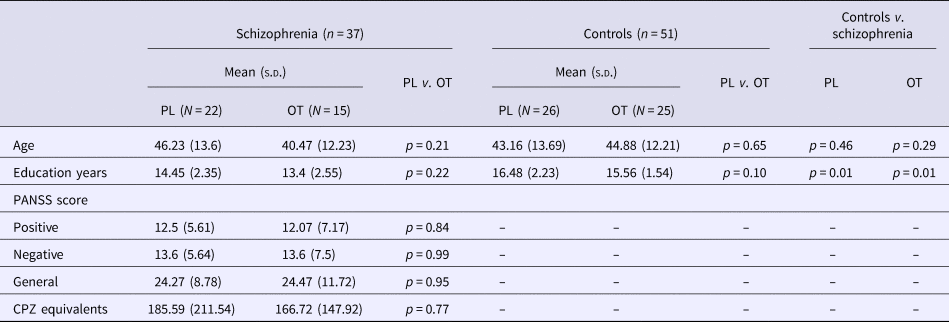
We recruited 39 male outpatients with schizophrenia and 54 matched healthy controls; see Table 1. Patients met diagnostic criteria for schizophrenia according to the Structured Clinical Interview for DSM-IV-TR (First et al., Reference First, Spitzer, Gibbon and Williams2002), were clinically stable, and had no medication changes in the past month. Exclusion criteria for all participants included: (1) substance use disorder in the past month; (2) conditions affecting the nasal passages that would interfere with intranasal administration; (3) history of a neurological or significant medical disorder; and (4) positive urine toxicology test. All participants gave informed consent according to the guidelines of the University of California, San Francisco Committee on Human Research.
Demographics and clinical information.

Shown by group and by placebo (PL) and oxytocin (OT) conditions.
Experimental design
Following baseline assessments, we randomized participants to receive either 40 IU of oxytocin or a placebo nasal spray (Wellspring Pharmacy, Berkeley, CA) administered using a standardized procedure (Guastella et al., Reference Guastella, Hickie, McGuinness, Otis, Woods, Disinger, Chan, Chen and Banati2013). Experimental tasks began 30 min after, and ended approximately 70 min after, oxytocin administration.
Measures and procedures
Auction Game
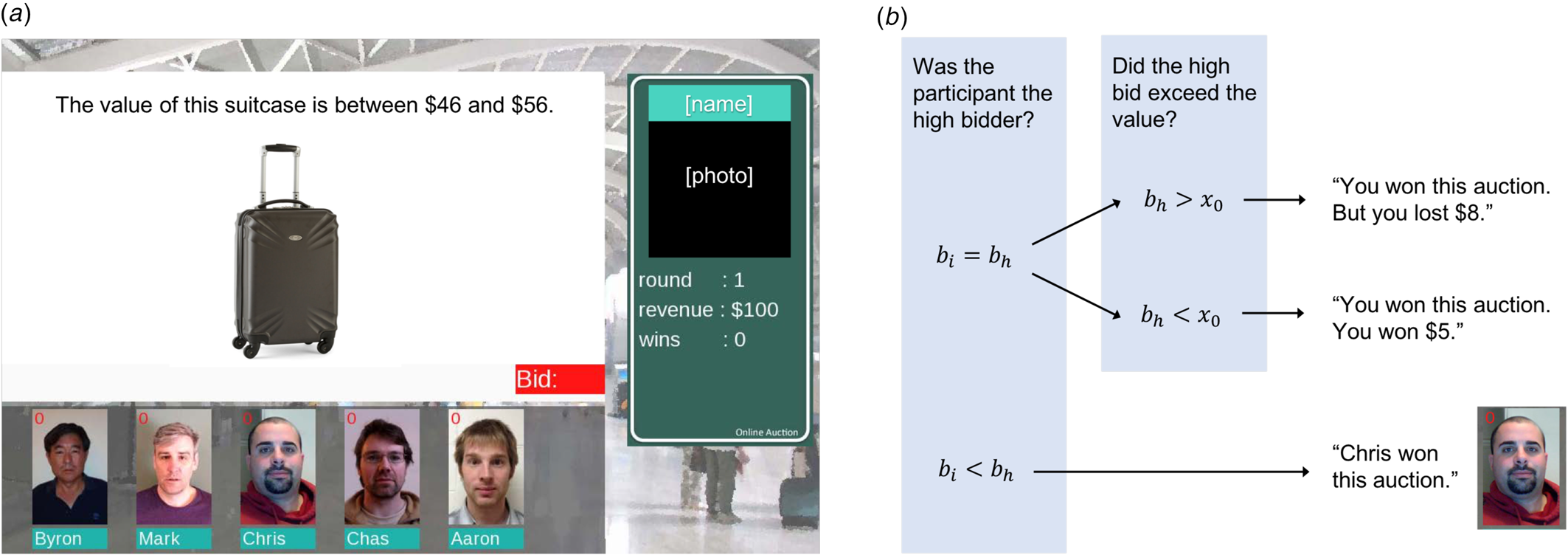
Participants completed a computer-based Auction Game adapted from van den Bos et al. (Reference van den Bos, Li, Lau, Maskin, Cohen, Montague and McClure2008), bidding against five other virtual players over 35 trials to win virtual items each with a true common value (X 0); see Fig. 1. We told participants that the other five players were situated at different locations, but in fact they were not bidding against anyone in real time. After explaining the task but before bidding began, we instructed participants in the optimal strategy to maximize their profit from the game: choosing the Risk Neutral Nash Equilibrium (RNNE) bid, the lower bound of the given estimated value range (e.g. if the range is $25–35, the RNNE bid is $25). The RNNE strategy assumes that participants are ‘risk neutral’ in that they are interested in maximizing their profits from the auction. By bidding the lowest estimated value of the item, a participant avoids the possibility of overbidding and thus losing money. This strategy represents a Nash Equilibrium, as there is no other strategy that would yield a higher payoff for a given participant. All participants completed written tests to confirm that they understood the RNNE strategy and could easily compute RNNE bids.
The Auction Game. Task interface (panel a): The participant's name and photo were displayed in the upper right of the monitor throughout the task. For each trial, a photo of a virtual item, a different closed suitcase, was displayed on the monitor. The participant viewed an estimate of the true value of the suitcase, X 0, within a range of 10 dollars. X 0 was always within this range. Task schematic (panel b): After viewing the item and value range, the participant entered a bid, b i, followed by a randomized 2–11-s waiting period to simulate gathering the other players’ bids. If the participant did not have the highest bid, the picture of the highest bidder and the text ‘(name) won this auction.’ was shown for 3 s. In this case, the participant's endowment did not change. If the participant had the highest bid, there were two possible outcomes. (1) If the participant bid higher than the true value of the suitcase, their picture was shown along with the text ‘You won this auction. But you lost $X.’ (2) If the participant bid lower than the true value of the suitcase, their picture was shown along with the text ‘You won this auction. You won $X.’ The outcome was shown for 3 s, and x 0 − b h was allocated to the participant's endowment at the end of each trial, where b h is the winning bid.

Devil's task
The Auction Game is inherently risky in the sense that any bid is only probabilistically associated with a variable range of monetary outcomes. Behavior during the game should therefore depend on the subjective value of winning and losing relative to a participant's risk preferences. To obtain an independent estimate of risk preferences, we had participants complete the Devil's task (Slovic, Reference Slovic1966), which involves making selections that are probabilistically associated with reward, but has no social context. In this task, participants select a number of cards to win money but must avoid a ‘disaster card’ that results in zero earnings.
See online Supplementary Information for details of experimental design and procedures.
Data analysis
Auction Game
The Auction Game had subjects bid for items with an unknown true value in the range of x L to x H (see Fig. 1). We analyzed bids by transforming to a bid factor κ (van den Bos et al., Reference van den Bos, Li, Lau, Maskin, Cohen, Montague and McClure2008) that is insensitive to x L to x H. For each of the 35 auction trials, the bid factor is defined as:
 $$\kappa = 2\displaystyle{{b_i-x_{\rm L}} \over {x_{\rm H}-x_{\rm L}}}$$
where b i is the bid placed by participant on trial i. For this study, the range of possible values (x L–x H) was always $10. Note that κ = 0 corresponds to the optimal RNNE bidding strategy, and κ = 2 corresponds to bidding x H.
We used a multilevel linear model to account for interdependence of within-subject data (ICC > 0.37) using R (R Core Team, 2016), package ‘nlme’ (Pinheiro et al., Reference Pinheiro, Bates, DebRoy, Sarkar and EISPACK2016) with the following structure:
 $$\eqalign{Y_{ij} = &\pi _{0j} + \pi _{1j}\lpar {{\rm Grou}{\rm p}_i} \rpar + \pi _{2j}\lpar {{\rm Dru}{\rm g}_i} \rpar + \pi _{3j}\lpar {{\rm Tria}{\rm l}_i} \rpar \cr & + \pi _{4j}\lpar {{\rm Grou}{\rm p}_i{^\ast}{\rm Dru}{\rm g}_i} \rpar + \pi _{5j}\lpar {{\rm Grou}{\rm p}_i{^\ast}{\rm Tria}{\rm l}_i} \rpar \cr & + \pi _{6j}\lpar {{\rm Dru}{\rm g}_i{^\ast}{\rm Tria}{\rm l}_i} \rpar + \pi _{7j}\lpar {{\rm Grou}{\rm p}_i{^\ast}{\rm Dru}{\rm g}_i{^\ast}{\rm Tria}{\rm l}_i} \rpar + r_{ij}} $$
with π 0j = π 0 + u 0j and π 3j = π 3 + u 3j.
The best fit model by log-likelihood tests allowed random intercepts by participant and random slopes for trial and accounted for heteroscedasticity and autocorrelation. We calculated simple effects for significant interactions using simplified models, described in the Results section.
A computational reinforcement learning (RL) model, described in van den Bos et al. (Reference van den Bos, Talwar and McClure2013b), accounts for how participants change their bids over time based on money won and lost. The model assumes that participants maintain estimates of the expected amount of money that would be gained or lost for bidding each bid factor κ. In addition, the model to individual data incorporates parameters that estimate the social value of winning (ρ win) and disutility of losing (ρ loss) beyond the monetary outcome. It is these parameters, (ρ win and ρ loss), that we hypothesized to differ with schizophrenia and oxytocin. Learning across trials is governed by an individual-specific learning rate (α), and choices are subject to a noise parameter (θ). We examined α and θ to test and rule out whether differences in bidding behavior were due to nonsocial factors. We compared individual parameter estimates between controls and patients for oxytocin and placebo using the Kruskal–Wallis test for a difference between the four groups, followed by Mann–Whitney tests.
Devil's task
We compared risk-taking preferences by conducting a 2 (drug: oxytocin v. placebo) × 2 (group: controls v. patients) analysis of variance.
We used Matlab for RL modeling; all other analyses presented were conducted using R (R Core Team, 2016). See online Supplementary Information for details of models and fitting procedures.
Results
We excluded three controls and one patient from analysis because they did not believe that they were playing against other human players. We excluded another patient who did not appear to attend to the task given that he entered the same bid, regardless of item value, for every trial. The final sample included 51 controls and 37 patients. We did not match groups on education given that decreased educational attainment is a consequence of schizophrenia, and matching may therefore obscure group differences and generate misleading results (Resnick, Reference Resnick1992).
Auction Game
Multilevel linear model
In the Auction Game, participants generally begin bidding near the upper range of possible values for the item under auction (x H). However, bidding this amount results in monetary losses, and with experience, participants reduce bidding until they reach a stable equilibrium. This equilibrium is generally significantly above the money maximizing strategy (RNNE; κ = 0). We examined whether these patterns exist in our sample and whether they differ by group or by drug condition.
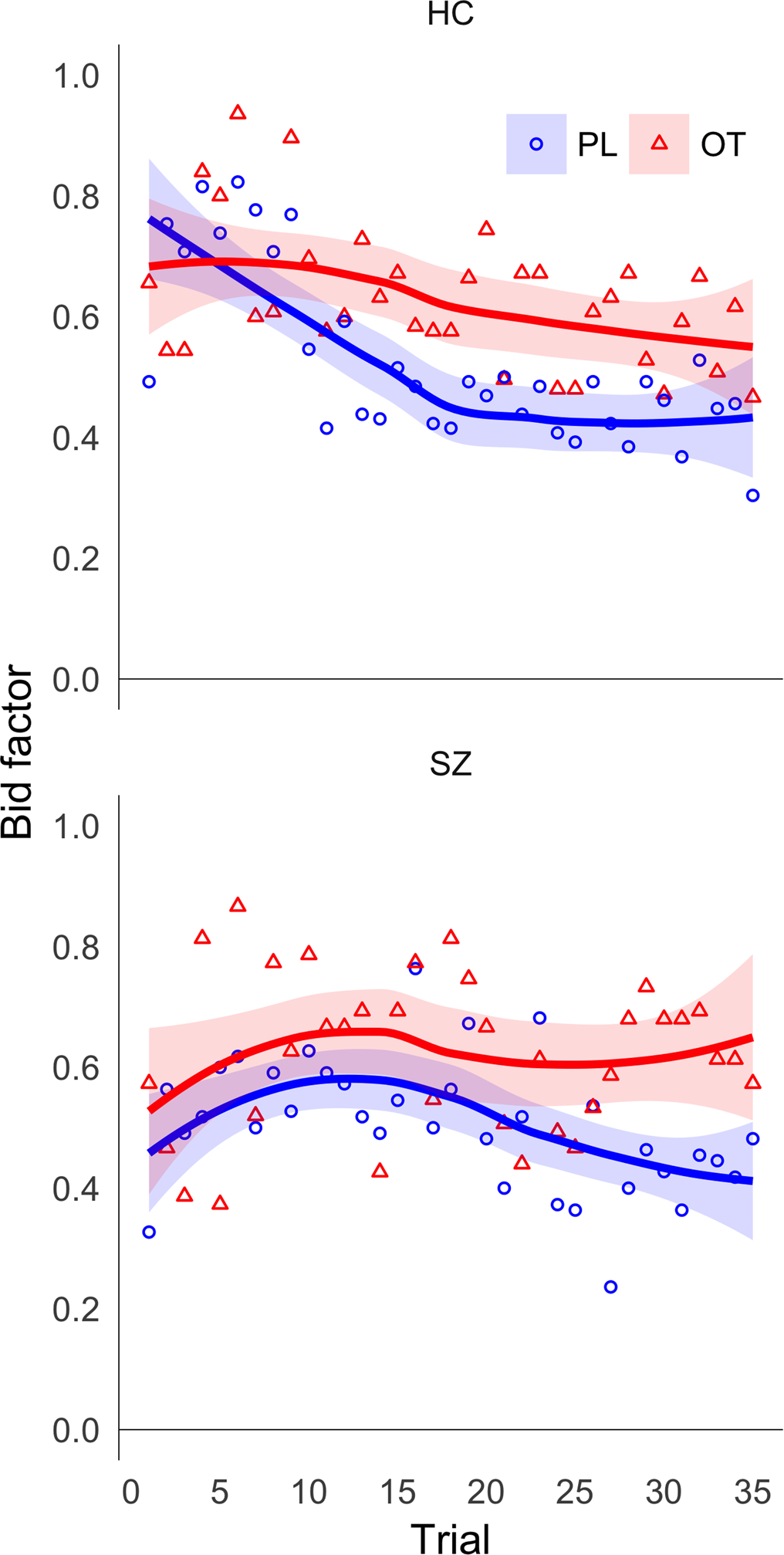
The 3-way interaction drug × group × trial was not significant (p = 0.95), nor was the 2-way interaction drug × group (p = 0.87), so we removed these terms from the model. The 2-way group × trial (b = 0.0053, t = 2.18, p = 0.029) and drug × trial (b = 0.0049, t = 2.01, p = 0.044) interactions were significant. To explore these, we first tested the simple effect of group × trial, controlling for drug. Controls reduced their bids over time (b = −0.0075, t = −4.58, p = 4.7 × 10−06), while patients did not (b = −0.0026, t = −1.35, p = 0.18). We then tested the simple effect of drug × trial, controlling for group. Participants who received placebo decreased their bids over time (b = −0.0074, t = −4.40, p = 1.1 × 10−05), while those who received oxytocin did not (b = −0.003, t = −1.62, p = 0.1); see Fig. 2.
Auction Game bidding over time. Raw bid factor values for healthy controls (HC) and patients with schizophrenia (SZ) under the placebo (PL) and oxytocin (OT) conditions.

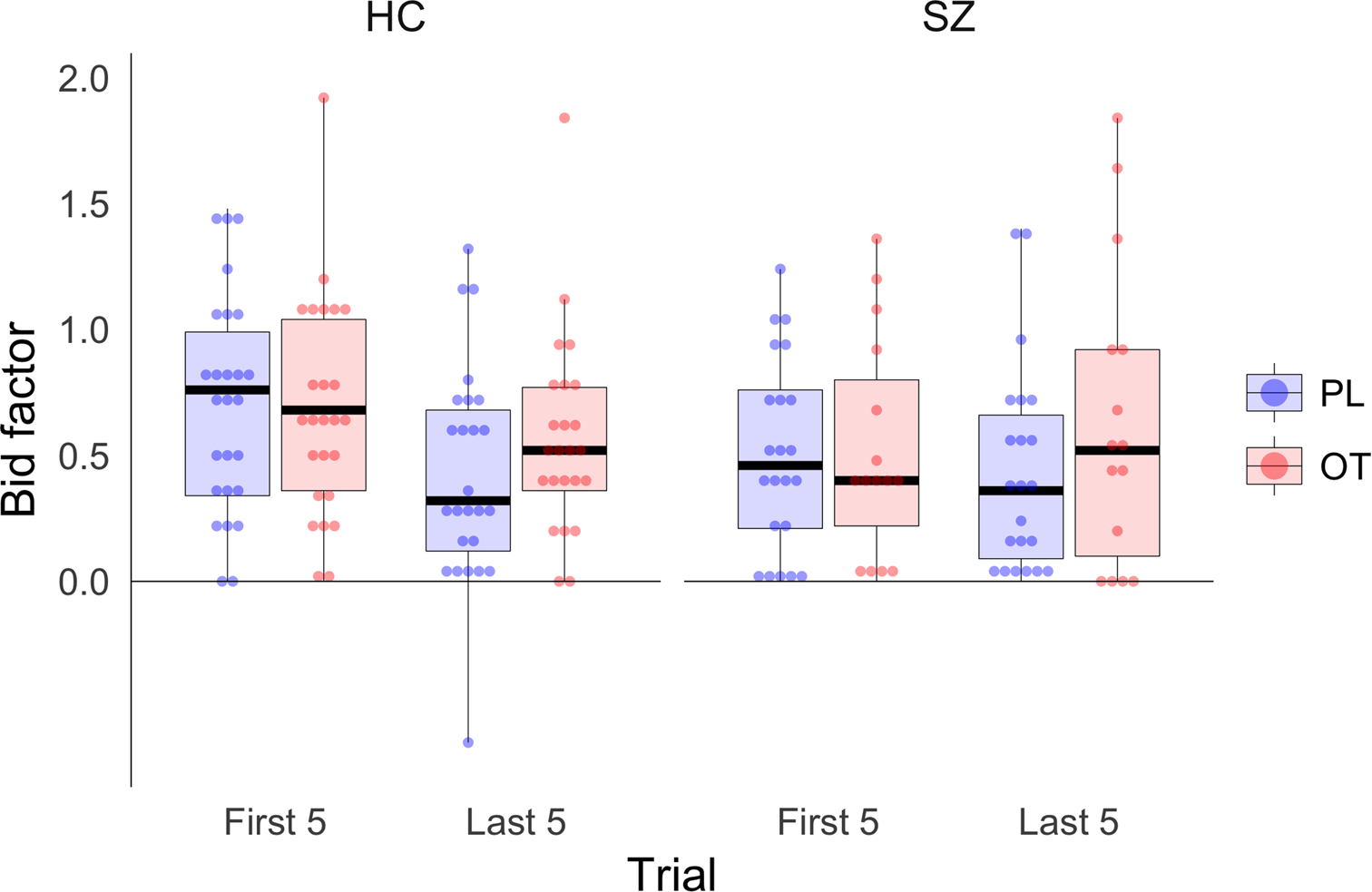
To better understand changes in bidding over time, we calculated average bid factors per participant for the first five and the last five trials. We compared these using a mixed model with the terms drug, group, trial (first five or last five), group × trial, and drug × trial. The 2-way interactions were significant: group × trial (b = 0.23, t = 2.66, p = 0.0094), and drug × trial (b = 0.18, t = 2.07, p = 0.041). To explore these, we first tested the simple effect of group × trial, controlling for drug. Controls decreased their bids from the first five to the last five trials (b = −0.21, t = −3.64, p = 0.00047), while patients did not (b = 0.0054, t = 0.082, p = 0.93). We then tested the simple effect of drug × trial, controlling for group. Participants on placebo decreased their bids from the first five to the last five trials (b = −0.19, t = −3.16, p = 0.0022) while participants on oxytocin did not (b = −0.03, t = −0.46, p = 0.65). Participants on oxytocin bid higher than those on placebo at the trend level in the last five trials (b = 0.16, t = 1.7, p = 0.093) but not in the first five trials (b = 0.0041, t = 0.044, p = 0.97); see Fig. 3. We conducted identical analyses using the first 10 v. last 10 trials and first v. second half of trials. All analyses yielded similar results, so these are not reported.
Auction Game bidding during the first five v. last five trials, shown for healthy controls (HC) and patients with schizophrenia (SZ) under the placebo (PL) and oxytocin (OT) conditions.

Reinforcement learning model
Visual investigation of bidding across trials shows that bids start high but then temporarily increase before decreasing toward the optimal strategy; see Fig. 2. This pattern of behavior is expected (van den Bos et al., Reference van den Bos, Talwar and McClure2013b) and results from the social rewards inherent in the task. Namely, losing an auction causes disutility (ρ loss). Chances of winning on any given trial are small due to the number of other bidders, so loss disutility tends to increase bidding in early trials. Additionally, bids are inflated from the additional utility of winning (ρ win) that derives from submitting the high bid.
These subtleties in bidding behavior may be disentangled by fitting the RL model designed to capture the idiosyncratic effects of trial outcomes from individual differences in preferences for social reward (see the section ‘Auction Game’). Model comparisons showed that a full RL model, including two separate parameters for social preferences, ρ win and ρ loss, fit the data better (Bayesian information criterion, BIC = 18 269) than an RL model that included only learning rate (α) and response variability (θ) parameters (BIC = 21 238), RL including ρ loss (BIC = 21 367), or RL including ρ win (BIC = 18 924). This suggests that, as we have found previously (van den Bos et al., Reference van den Bos, Talwar and McClure2013b), bidding is motivated not only by monetary gains, but also by social motivation to win (ρ win) and to avoid losing (ρ loss).
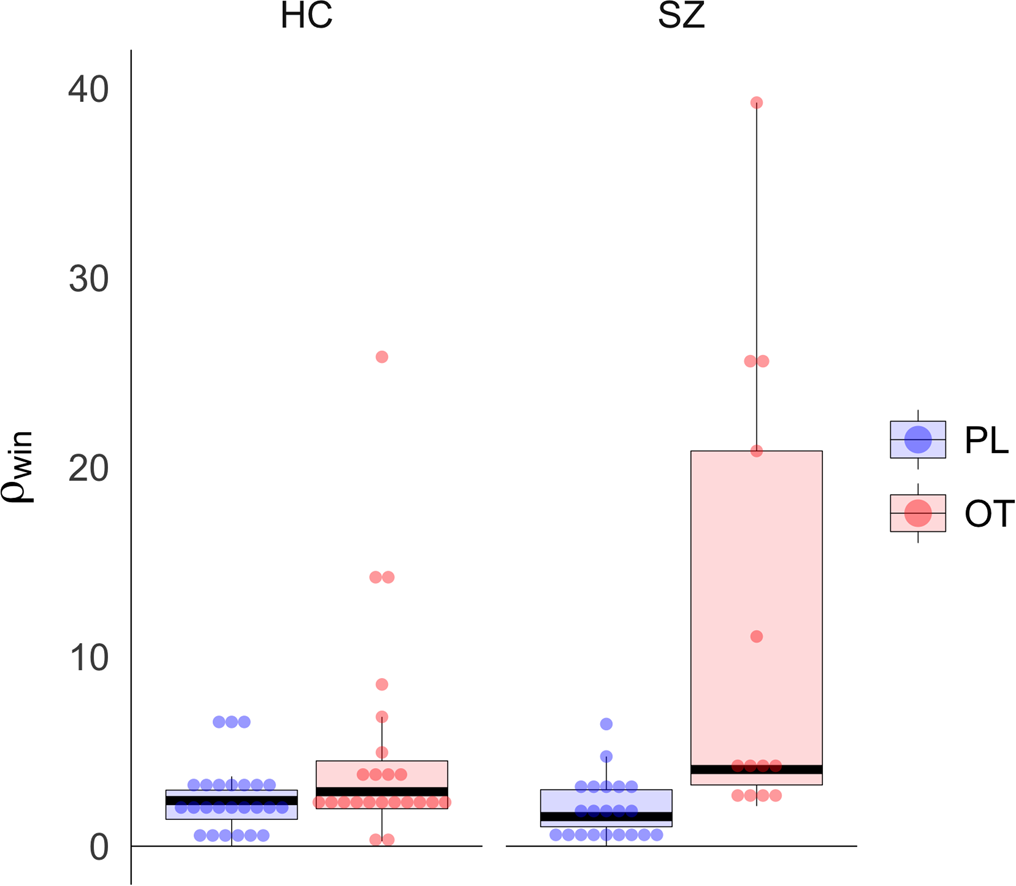
The Kruskal–Wallis test showed that ρ win differed significantly between groups and drug conditions, H(3) = 19.49, p < 0.001. Post-hoc, pair-wise Mann–Whitney tests showed that ρ win was not significantly different between controls and patients on placebo (U = 218.00, p = 0.24), but that oxytocin was associated with higher ρ win in schizophrenia (U = 30.00, p < 0.001) and at a trend level in controls (U = 227.00, p = 0.10); see Fig. 4. We found no significant differences between groups or drug conditions for the other parameters (ρ loss, H(3) = 0.62, p = 0.891; α, H(3) = 2.89, p = 0.442; θ, H(3) = 0.51, p = 0.918), suggesting that differences in bidding behavior between the groups and drug conditions are mainly attributable to changes in the value of being the winner.
Motivation to win the auction (ρ win), shown for healthy controls (HC) and patients with schizophrenia (SZ) under the placebo (PL) and oxytocin (OT) conditions. Note that three participants with ρ win values >40 are not shown in this plot: one healthy control on placebo, one healthy control on oxytocin, and one patient with schizophrenia on oxytocin.

Devil's task
We found no significant group, drug, or group × drug effects, indicating that differences in bidding behavior between groups and drug condition are unlikely to stem from differences in risk-taking preferences.
Predictors of bidding behavior in schizophrenia
Given that antidopaminergic medication and symptom severity may influence response to oxytocin (Bradley and Woolley, Reference Bradley and Woolley2017), we explored both as possible predictors of bidding behavior. We examined the effects of antidopaminergic medication dosage quantified as chlorpromazine (CPZ) equivalents (Andreasen et al., Reference Andreasen, Pressler, Nopoulos, Miller and Ho2010) and symptom severity using the Positive and Negative Symptom Scale (PANSS; Kay et al., Reference Kay, Fiszbein and Opler1987) on bid factor by trial and drug. The three-way PANSS × drug × trial interaction was not significant (p = 0.14). Given the relationship between reward valuation and negative symptoms in schizophrenia (Gold et al., Reference Gold, Strauss, Waltz, Robinson, Brown and Frank2013; Kring and Barch, Reference Kring and Barch2014), we also tested the negative symptom subscale of the PANSS and bidding behavior. The PANSS negative subscale × drug × trial was also not significant (p = 0.45). The three-way CPZ × drug × trial interaction was significant (b = 6.2 × 10−05 , t = 2.52, p = 0.012), such that patients taking the mean dosage in our sample (CPZ = 75.08) did not change their bids over time on oxytocin (b = −0.0021, t = −0.59, p = 0.55) v. placebo (b = −0.0019, t = −0.69, p = 0.49). However, patients on high dosages (CPZ mean + 1 standard deviation = 223.35) decreased their bids over time on placebo (b = −0.0053, t = −2.08, p = 0.038) but not on oxytocin (b = 0.0037, t = 1.13, p = 0.26).
See online Supplementary Information for details of analyses.
Discussion
We found that both men with schizophrenia and healthy controls were willing to lose money in order to win auctions, in line with evidence that the desire for social status is a driver of competitive bidding behavior. Consistent with our first hypothesis, patients overbid less than controls, suggesting impairment in their motivation to pursue the social reward of winning. Consistent with our second hypothesis, oxytocin administration was associated with increased overbidding, particularly in patients. Importantly, the driving force behind this effect was an increased motivation to win the auction, regardless of monetary reward or loss. These findings provide further evidence that oxytocin modulates behavior by increasing the salience of social stimuli and suggest that oxytocin administration may enhance sensitivity to social reward in people with schizophrenia.
Previous work in healthy people shows that overbidding is maximal early in the Auction Game and decreases over time (van den Bos et al., Reference van den Bos, Golka, Effelsberg and McClure2013a), as monetary losses prompt participants to reduce bids. We found that patients did not follow this pattern, overbidding less compared to controls at the outset of the game. This is consistent with the reduced anticipatory pleasure observed in schizophrenia (Gard et al., Reference Gard, Kring, Gard, Horan and Green2007), and may reflect dysregulated salience processing that leads to under-valuation of the social reward of winning and thus lower bids. It could also reflect impairment in mentalizing, the ability to infer beliefs and intentions of other people, a core deficit in schizophrenia (Green et al., Reference Green, Horan and Lee2015). Mentalizing may play a role in competitive behavior specifically by enhancing the ability to monitor gain and loss of rewards by others. Winning auctions has been associated with increased activity in the right temporoparietal junction (rTPJ; van den Bos et al., Reference van den Bos, Talwar and McClure2013b), part of a neural network that underlies mentalizing ability (Hampton et al., Reference Hampton, Bossaerts and O'Doherty2008). In schizophrenia, rTPJ hypoactivation (Lee et al., Reference Lee, Quintana, Nori and Green2011; Das et al., Reference Das, Lagopoulos, Coulston, Henderson and Malhi2012; Fett et al., Reference Fett, Shergill and Krabbendam2015) and abnormal functional connectivity between the rTPJ and temporal lobe regions (Bitsch et al., Reference Bitsch, Berger, Nagels, Falkenberg and Straube2018) has been observed during mentalizing tasks. Thus, mentalizing deficits among patients may have led to reduced social comparison during the game, resulting in lower bids. It is also possible that patients’ bidding patterns reflect a general impairment in adaptive decision-making. People with schizophrenia tend to make more predictable decisions (Paulus et al., Reference Paulus, Geyer and Braff1999) and have trouble incorporating feedback to inform future decisions (Fett et al., Reference Fett, Shergill, Joyce, Riedl, Strobel, Gromann and Krabbendam2012). During iterative decision-making games, for example, they may rely excessively on the most recent outcome rather than integrating the consequences of their decisions over time. These abnormalities amount to a ‘strategic stiffness’ (Kim et al., Reference Kim, Lee, Shin and Chey2007) – the tendency to default to a choice based on a recent stimulus – that may have limited patients’ ability to discover an optimal decision-making strategy over the course of the game.
Our finding that oxytocin enhanced the motivation to pursue social reward is consistent with previous studies in healthy people showing that oxytocin heightens attention to social preferences during decision-making (Aydogan et al., Reference Aydogan, Furtner, Kern, Jobst, Müller and Kocher2017; Lambert et al., Reference Lambert, Declerck, Boone and Parizel2017). Interactions between oxytocin and the dopamine system have been implicated in these salience-moderating effects (Love, Reference Love2014), which is in line with studies showing that oxytocin administration modulates brain reward circuitry in humans (Groppe et al., Reference Groppe, Gossen, Rademacher, Hahn, Westphal, Gründer and Spreckelmeyer2013; Scheele et al., Reference Scheele, Wille, Kendrick, Stoffel-Wagner, Becker, Güntürkün, Maier and Hurlemann2013). Thus, oxytocin may have exacerbated overbidding by shifting attention toward the social reward of winning and away from monetary reward via modulation of dopaminergic signaling. The fact that antidopaminergic medication dosage predicted oxytocin effects on bidding behavior among patients may also reflect oxytocin's interaction with the dopamine system. In animal models of psychosis, oxytocin administration has been shown to reduce dopaminergic signaling in the NAc and striatum (Qi et al., Reference Qi, Yang, Song, Li, Wang and Wu2008), and administration of certain antidopaminergic medications is associated with an increase in plasma oxytocin levels (Uvnäs-Moberg et al., Reference Uvnäs-Moberg, Alster and Svensson1992). However, the relationship between antidopaminergic medication dosage and response to intranasal oxytocin is unclear (see Bradley and Woolley, Reference Bradley and Woolley2017). Undoubtedly, endogenous and exogenous oxytocin–dopamine interactions are complex, and further work is needed to understand their implications for administering oxytocin to patients with schizophrenia.
Oxytocin administration has also been shown to enhance sensitivity to social reward in the absence of dopaminergic signaling modulation (Striepens et al., Reference Striepens, Matusch, Kendrick, Mihov, Elmenhorst, Becker, Lang, Coenen, Maier, Hurlemann and Bauer2014), highlighting the possibility that other mechanisms of action underlie our findings. Oxytocin may have exacerbated overbidding by boosting mentalizing ability, for example. Oxytocin administration improves mentalizing ability in schizophrenia (Burkner et al., Reference Burkner, Williams, Simmons and Woolley2017), and in macaques, it has been shown to increase sensitivity to rewards received by others (Chang et al., Reference Chang, Barter, Ebitz, Watson and Platt2012). Another possibility is that oxytocin influenced bidding behavior by altering the adaptive process of reinforcement learning that normally drives down bidding as the Auction Game progresses. Studies in rhesus monkeys (Parr, Reference Parr2014) and in healthy people (Hu et al., Reference Hu, Qi, Becker, Luo, Gao, Gong, Hurlemann and Kendrick2015) suggest that oxytocin influences reinforcement learning in social contexts, potentially via increased attention to social cues and feedback. Though we found that oxytocin did not impact participants’ learning rate during the Auction Game, it appeared to influence decision-making by shifting their underlying preferences for monetary v. social reward.
This study has several limitations. First, despite the interactive nature of the Auction Game and steps we took to maximize the feeling of being in a real social context, it does not reflect the true complexity of real-world interaction. Second, we did not include a condition in which participants played against a computer to control for impairments in nonsocial reinforcement learning. Third, we did not assess cognition, which is relevant given that cognitive limitations are a potential cause of overbidding in healthy people (Fudenberg, Reference Fudenberg2006) and cognitive impairment has been linked to deficits in reinforcement learning in schizophrenia (Premkumar et al., Reference Premkumar, Fannon, Kuipers, Simmons, Frangou and Kumari2008; Collins et al., Reference Collins, Brown, Gold, Waltz and Frank2014). However, by explicitly instructing participants on the optimal bidding strategy, we hoped to minimize the cognitive burden of the task. Fourth, we enrolled only men in this study, and results are not generalizable to women given oxytocin's sexually dimorphic effects (Dumais et al., Reference Dumais, Kulkarni, Ferris and Veenema2017). Fifth, the pharmacodynamics of intranasal oxytocin are poorly understood (Quintana and Woolley, Reference Quintana and Woolley2016). Human studies have generally included a 30-min delay after administration before beginning assessments, citing evidence of behavioral and physiological responses using this timing in healthy people (Macdonald and Macdonald, Reference Macdonald and Macdonald2010). Elevated cerebrospinal fluid oxytocin levels have been observed 75 min after intranasal administration (Striepens et al., Reference Striepens, Kendrick, Hanking, Landgraf, Wüllner, Maier and Hurlemann2013), and oxytocin-induced changes in regional cerebral blood flow are detectable between 25 and 78 min after administration (Paloyelis et al., Reference Paloyelis, Doyle, Zelaya, Maltezos, Williams, Fotopoulou and Howard2016). Though these findings offer some support for the standard timing used here, the peak and duration of intranasal oxytocin's central nervous system effects remain unclear. Thus, our finding that oxytocin increased overbidding during later trials of the game could reflect suboptimal timing of the task relative to oxytocin administration, resulting in a delayed peak of oxytocin effects. Finally, our sample size is modest; replication and extension of our findings by others is critical.
The robust link between decreased social engagement and poor health outcomes (Holt-Lunstad et al., Reference Holt-Lunstad, Smith, Baker, Harris and Stephenson2015) underscores the importance of developing targeted interventions for abnormal social behavior among people with schizophrenia. Objective measures of behavior are essential for tackling this challenge (Kapur et al., Reference Kapur, Phillips and Insel2012), given that insensitivity to social reward and other contributors to abnormal social behavior are not well captured by the interview-based symptom rating scales typically used in clinical trials (Freedman et al., Reference Freedman, Lewis, Michels, Pine, Schultz, Tamminga, Gabbard, Gau, Javitt, Oquendo, Shrout, Vieta and Yager2013). Indeed, we found no correlation between symptom ratings and motivation for social reward in this study, and prior studies have found a similar lack of association between symptom ratings and impaired reward processing in schizophrenia (Waltz et al., Reference Waltz, Frank, Robinson and Gold2007; Barch et al., Reference Barch, Carter, Gold, Johnson, Kring, MacDonald, Pizzagalli, Ragland, Silverstein and Strauss2017; Lee et al., Reference Lee, Jimenez, Reavis, Horan, Wynn and Green2018). Future work is necessary both to explain these incongruities as well as to elucidate the neural mechanisms that underlie oxytocin's effects on social reward. Most critically, we must determine whether oxytocin-induced increases in the perceived value of social reward facilitate social engagement among people with schizophrenia. Enhancing the rewarding value of social interactions may be a mechanism by which we can specifically target impaired social motivation, one of the most robust deficits associated with the disorder. Ultimately, clinical trials that evaluate behavioral changes in large samples will be essential to determine whether pharmacological enhancement of social reward sensitivity improves real-world social behavior and functional outcomes among people with schizophrenia. Given the impact of schizophrenia on patients, caregivers, and society as a whole, further examination of oxytocin's potential as a treatment is a worthwhile undertaking.
Supplementary material
The supplementary material for this article can be found at https://doi.org/10.1017/S0033291719000552.
Author ORCIDs
Ellen R. Bradley, 0000-0001-6787-1490
Acknowledgements
We would like to thank all of the participants who gave their time to this study.
Financial support
This work was supported by Career Development Award 1IK2CX000758-01A1 from the United States Department of Veterans Affairs, Office of Research and Development, Clinical Science Research and Development program, and National Institutes of Mental Health Grant R25 MH60482. The funders did not play any role in the decision to publish or the preparation of the article.
Conflict of interest
None.
Ethical standards
The authors assert that all procedures contributing to this work comply with the ethical standards of the relevant national and institutional committees on human experimentation and with the Helsinki Declaration of 1975, as revised in 2008.