The creation of the International Criminal Court (ICC) is one prominent example of a legalization process that reflects a profound institutional change in world politics. The Rome Statute as adopted in 1998 laid the foundations for a permanent court to prosecute serious violations of humanitarian law, including war crimes, crimes against humanity, and genocide. The ICC's creation reflects a major shift in international norms for the prosecution of such violations. Before the court was established, violations at best invoked a duty to prosecute or extradite perpetrators (for instance the grave breaches system of the Geneva Conventions) on a national basis. With the ICC in place, such offences now elicit a duty of international prosecution if states prove unwilling or unable to do so themselves.
What accounts for such a remarkable institutional change? By mapping out how the ICC arose, this article examines legalization as a specific form of institutional change by advancing a discourse approach to legalization that focuses on persuasion and discourse in collective decisions. The establishment of the ICC is not easily accommodated within international relation theories that rely either on the existing power structure (such as theories of hegemonic stability and, more broadly, neorealist thinking) or on current neoliberal rational-choice–based theories of legalization and institutional design, which hinge on strategic choices of self-interested actors.Footnote 1 While such theories can partly explain why states decided in the mid-1990s to create a court at all, they founder when accounting for the specific kind of court states created, that is, the institutional design of the ICC with its resulting duty of international prosecution.
The draft statute for an ICC by the International Law Commission in 1994 largely preserved the national autonomy of states. It envisaged a court heavily dependent on state consent in general and the United Nations (UN) Security Council in particular for its activation. But despite opposition by the major powers, the large majority of states rejected this conservative model and opted instead for a highly autonomous court with an independent prosecutor, less control by the Security Council over the court's dock, and automatic jurisdiction over core crimes upon ratification. To date, 108 states have ratified the Statute, and 139 have signed it. The court commenced work in 2002, preparing prosecutions concerning situations in the Democratic Republic of Congo, Uganda, the Central African Republic, and Sudan.
A content analysis of all summary minutes and press releases of negotiations on the ICC between 1994 and 1998 as well as a series of interviews reveals that this outcome cannot be explained in terms of power and states' initial interests. Instead, it suggests that interests changed during the negotiation process. The difficulty in explaining states' choice for the ICC's institutional design is a result of the static approach neorealist and neoliberal theories take to institutional change in general and to legalization in particular, as they tend to focus more on effects and outcomes than on process.Footnote 2 By neglecting process and possible endogenous change, these approaches overlook certain distinctive aspects of international lawFootnote 3 which is more than just an instrument of the mightyFootnote 4 or a functional device to further the given interests of state actors. It equally reflects a framework of legitimacy, defining the range and limits of political debate, which is not easily circumvented. Law generates a particular form of legitimacy that some attribute to the form characteristic of law,Footnote 5 though the process through which law is generated seems to be of particular importance.Footnote 6 Lawmaking brings into play the legal system as a whole with its agreed-upon principles, and procedures of due process.Footnote 7 Its specific legal discourse devalues arguments based on power and interests and requires normative justifications, based on legal precedent and analogy.Footnote 8
This article contributes to the understanding of institutional change in world politics by addressing the process of legalization within a constructivist framework of discourse theory. Habermas's discourse theory posits that (legitimate) law arises out of public deliberations in which actors may change their views in response to superior normative arguments to arrive at a rational consensus.Footnote 9 Contrary to rational-choice–based theories, rationality in a Habermasian sense is not limited to an instrumental understanding whereby actors choose the best strategy to maximize or satisfy their predetermined preferences.Footnote 10 In argumentative rationality the goal is to arrive at a shared understanding of the nature of a situation, that is, the kinds of preferences to be pursued legitimately or the kinds of norms to apply to it. Rationality in this sense refers to the ability to justify a course of action with commonly accepted reasons. Rationality can be ascribed not only to individuals but also to certain practices. The notion of “rational discourse” hence signifies a communicative practice in which agreement is solely steered by the free exchange of arguments.Footnote 11
Because the notion of deliberative lawmaking as purely grounded in rational discourse, isolated from (power) politics, is an ideal, a theoretical model is needed to define the conditions under which persuasion and discourse can affect real-world collective decisions. As the case study of the ICC highlights (and the case resembles a number of other recent instances of institutional change, notably the adoption of the landmine treaty),Footnote 12 actors may proactively strengthen the impact of law and morality over politics by creating institutional and normative conditions conducive to persuasion. Such strategies are often initiated by alliances between middle powers and nonstate actors who lack sufficient leverage compared to the major powers.Footnote 13 Although their coordinated activities fall short of transforming negotiations into a kind of rational discourse, they have the potential to decisively alter the course and outcome of negotiations.
Following an outline of the development that led to the creation of the ICC and the significant shift among states regarding its institutional design, this article sets out to substantiate the claim that neoliberal and neorealist accounts cannot sufficiently explain the outcome of the ICC negotiations. It then formulates a discourse approach to legalization, focusing on the potential change of interests, and applies it as a heuristic device to analyze the ICC negotiations. Subsequent sections discuss the findings and conclusions.
Toward an ICC
Although the idea of an international criminal court has frequently been on the international agenda, especially since the Nuremberg and Tokyo tribunals after World War II, attempts in the 1950s to set one up failed. With the advent of the Cold War there was no chance of achieving a consensus on this issue. No progress was made in establishing a court, but the pertinent body of international criminal law still grew. By the 1980s, the UN had managed to agree on a definition of aggression (1974)Footnote 14 and had adopted the Genocide Convention (1948), the Convention on Torture (1984), and the Convention against Apartheid (1973), as well as the Geneva Conventions (1949) and their Additional Protocols (1977). At best, these conventions imposed a duty on states to either prosecute perpetrators at the national level or extradite them.
The ICC issue resurfaced at the end of the Cold War. During a special session of the General Assembly (GA) on transnational drug trafficking, Trinidad and Tobago proposed an international court to assist states in prosecution. In response, the assembly requested that the International Law Commission (ILC) reconsider a draft statute for a permanent court. With its work overshadowed by the Balkan wars and the massive atrocities committed there, and under enormous public pressure to act, the UN Security Council finally decided to establish an International Criminal Tribunal for the former Yugoslavia (ICTY) in 1993. Only a year later, the Security Council set up the International Criminal Tribunal for Rwanda (ICTR) to tackle the genocide in that country. Against this background, the GA reacted to the final ILC draft for an ICC in 1994 by setting up an ad hoc committee in 1995, followed in 1996 by a Preparatory Committee (PrepCom), to discuss the ILC draft and finalize it in preparation for a diplomatic conference at which it could be adopted.
The ILC Draft: Empowerment of International Prosecution
The 1994 the ILC draft was the accepted basis for negotiations. Attempting to reflect the perceived political consensus of the day regarding an ICC, it envisaged the ICC as a part-time institution to be activated when needed to deal with serious breaches of humanitarian law (war crimes), crimes against humanity, genocide, and aggression. Proposed as subordinate to national courts, the ICC would thus be empowered to intervene only if national systems were unavailable. Its jurisdiction depended on the consent of the state on whose territory the crimes had been committed and the state that had custody over the suspect (state-consent mechanism). With the exception of genocide, accepting the court's jurisdiction was to be optional. After ratification, states were to choose for which crimes (and for what period of time) they were willing to accept the court's jurisdiction (opt-in mechanism). The proposal was for a court closely affiliated with and readily available to the Security Council. The council had the power to refer cases to it irrespective of whether the states in question consented. Only if the council identified an act of aggression could the court instigate prosecution. Finally, the ICC could take up only cases the council was not seized with under its Chapter VII responsibilities. These structures severely hamstrung a court that largely preserved national sovereignty. The ILC's commentary reveals that its considerations were based on both “practicality” and achieving “the widest possible adherence of states” to the statute. ILC members believed that states would be unwilling to surrender significant elements of their national sovereignty to a supranational judicial body and that the support of the major powers would be ensured only if the court was readily available to them.Footnote 15
However, negotiations in the PrepCom (1996–98) indicated that the ILC draft was far from uncontroversial. Before long, two key negotiation blocks emerged. The first was composed of small and middle powers known as the Like-Minded (LM) group that was supported by a burgeoning nongovernmental organization (NGO) coalition, the Coalition for an International Criminal Court (CICC). This group called for a strong, independent court with an independent prosecutor, limitation of the Security Council's power of referring cases to the court, and automatic jurisdiction over the core crimes. The second group, under the leadership of the Permanent Members of the Security Council (P5 group), favored a kind of permanent ad hoc court along the lines of the ILC draft. Thus, in the run-up to the Rome Treaty Conference in June 1998, the draft statute contained ninety-nine articles and about 1,300 square-bracketed dissents on specific issues. Remarkably, however, during the night of July 17–18, the Rome Statute was not only adopted by 120 states in favor, with twenty-one abstentions and seven nations against (namely the United States, Israel, China, Yemen, Qatar, Libya, and Iraq), but it also contained many features that went considerably beyond the ILC draft.
The Rome Statute: Duty of International Prosecution
As established by the Rome statute, the ICC has jurisdiction over the crimes of genocide, the most serious war crimes, and crimes against humanity. In line with the principle of complementarity, the ICC steps in only if a state is unwilling or unable to prosecute matters on its own. The court has automatic jurisdiction over such crimes if either the territorial state (within whose borders the alleged crime has been committed) or the suspect state (nationality of the suspect) consent to or are state parties to the statute.Footnote 16 Three mechanisms were established to launch an investigation. First, any state party can file petitions concerning so-called “situations” with the prosecutor. Secondly, the Security Council can refer situations under Chapter VII of the UN Charter to the ICC, in which case the ICC automatically has jurisdiction without any state consent needed. The third trigger mechanism grants the prosecutor the right ex officio to start an investigation. Additionally, the Security Council has the authority to halt investigations (by a qualified majority vote, whereby the vote of the P5 must be unanimous) regarding situations within the scope of its responsibilities under Chapter VII of the UN Charter.
It is clear from the outlined features of the statute that the conservative model envisioned by the ILC was rejected by a large majority. On all matters regarding the independence of the court, the Rome Statute differs radically from the ILC draft. The statute's adoption was not only “a gift of hope for succeeding generations” as UN Secretary General Kofi Annan put it,Footnote 17 it also signaled a profound normative and institutional change. Although the statute formally founds an institution designed to enforce compliance with already existing norms, it also establishes a new norm: the duty to ensure international prosecution of serious violations of humanitarian law on the assumption that such crimes threaten international peace and security.Footnote 18 This change could be accounted for by different theoretical approaches.
Explaining Institutional Change: Power, Preferences, Persuasion
Power-Based Approaches
In power-based approaches, such as the theory of hegemonic stability and broader neorealist thinking, (legal) norms and institutions are perceived as epiphenomena, reflecting the power relations underlying the international system. In essence, they are instruments hegemonic powers use in pursuit of their interests.Footnote 19 This implies that norms and institutions that strongly encroach on the national sovereignty of said powers are unlikely, especially where security issues are concerned.Footnote 20 The ICC clearly addresses security policy issues, especially in military terms, as certain conduct is not only prohibited but even criminalized.Footnote 21 Additionally, the ICC interferes with the core of national sovereignty, namely “the ultimate application of the power of the state to persons within its territory.”Footnote 22 From a power-based perspective, such norms and institutions can be established only by the will of a hegemon or major power coalition that can control their application,Footnote 23 so one would expect the creation and design of the ICC to reflect the preferences of the hegemon or major powers more broadly. The powerful states would have to retain control of the institution or, at least ensure the institution is so weak as not to interfere with their interests.
The history of international criminal tribunals would confirm this hypothesis. The Nuremberg and Tokyo tribunals as well as the ICTY and ICTR were all established at the will of the powerful and used against the weak or the defeated. Prosecution was clearly limited to crimes committed by the latter, while those who established the tribunals exempted themselves from scrutiny. The power-based explanation is further reinforced by the selectivity of ad hoc tribunals: tribunals were established for Yugoslavia and Rwanda, yet not for Uganda or Burundi. As political observers note, these tribunals were established not out of the conviction that prosecution was necessary but in order to avoid costly and risky military interventions that none of the major powers wanted.Footnote 24 In this regard, one would have to understand the establishment of the ICC as an attempt by major powers to share the costs of setting up tribunals with the international community as a whole.Footnote 25 Indeed, in the early 1990s major powers, and especially the United States, were skeptical of a permanent court.Footnote 26 Only when a certain tribunal fatigue materialized in the face of the enormous administrative and financial costs associated with ad hoc tribunalsFootnote 27 did major powers become cautiously supportive of the idea of a permanent court.
This support began to dwindle, however, the more the ILC draft was challenged during negotiations. The draft originally granted the Security Council clear control of the court and envisaged not a duty but an empowerment of international prosecution. Once negotiations started to favor enshrining a duty of international prosecution, major powers (China, Russia, United States, and, for a long time, Great Britain and France) began to oppose the ICC. However, their opposition did not prevent the norm being established within the new institution.Footnote 28 This is puzzling, considering the ICC would have direct relevance for major powers as well. The jurisdictional rules allow for the prosecution of nonstate party nationals when they are suspected of having committed crimes on the territory of a state party. Thus, the faster the ratification of the statute proceeds, the more the national autonomy of all states is infringed. Such reasoning led the U.S. government to execute a policy of active opposition to the ICC, but it did not prevent the court from coming into existence.
Power-based approaches can explain the selective establishment of ad hoc tribunals and the initial interest of major powers in the ILC draft, but they cannot account for the legalization of a duty of international prosecution, that is, the ICC's institutional design.
Rational Choice-Based Approaches
Rational choice-based approaches such as neoliberal institutionalism view the creation of international institutions as a strategic choice by self-interested actors to resolve recurrent cooperation problems relating to the transaction costs of renegotiations and monitoring and enforcement problems. Recent research has shifted focus away from the creation of international institutions toward explaining their institutional design. The legalization project perceives legalization as a “particular set of characteristics that institutions may … possess”Footnote 29 in terms of the obligations their rules create, the precision of those rules, and the degree to which the monitoring, application, and enforcement of rules are delegated to judicial bodies. The higher institutions place on all these levels, the higher the degree of legalization they exhibit. The ICC constitutes a case of high legalization of the “atrocities regime.” Its rules are obligatory and precise, and the ICC represents a delegation for the interpretation and application of rules.Footnote 30
High legalization is particularly likely in situations where actors expect great benefits from cooperation but simultaneously face enforcement and monitoring problems.Footnote 31 High legalization reduces the transaction costs for subsequent interactions, strengthens the credibility of commitments, curbs cheating, and resolves contracting problems.Footnote 32 Similarly, the rational design project stipulates that the centralization of decision making within institutions increases as the severity of enforcement problems increases. But high legalization or centralization also imposes significant sovereignty costs on actors. An increase in the legal obligations imposed by rules and the delegation of their application to judicial bodies means that actors lose significant control over the application and interpretation of rules. The higher the sovereignty costs, the more limited the prospect for centralization.Footnote 33 Sovereignty costs fall when greater control of the institution is facilitated by means of voting rules or veto powers, for example, or if flexibility is factored into institutions, for example, through escape clauses or opt-out provisions.Footnote 34 Finally, rational design theorists expect control of an institution to be asymmetrical in line with the capabilities of different actors and their importance for the viability of an institution.Footnote 35
Regarding the institutional design of the ICC, neoliberals stipulate that the prosecution of atrocities produces a collective action problem that can only be resolved by a “hard-law regime”—an institutional design involving high degrees of centralized decision making or delegation. However, as sovereignty costs can be expected to be rather high, one should observe high levels of asymmetric control of the institution by special voting rights or the inclusion of flexibility mechanisms such as opt-out provisions.
Before the ICC came into existence, it was the task of states to prosecute or extradite perpetrators. However, states were rarely willing to do so. The prosecution of crimes committed elsewhere incurred high costs and little return. Furthermore, smaller states especially feared that the prosecution of other states' nationals harbored the risk of impairing their relations to those states or even fomenting political crises. From a cost-benefit perspective, the national prosecution of international crimes is not a rational strategy,Footnote 36 a fact that generated an incentive to centralize prosecution.
The general preference for a permanent court can hence be illuminated by a rational choice-based approach, but what about its specific design? The centralization of prosecution by a permanent court entails enormous sovereignty costs for actors, because it “impinges on the relations between a state and its citizens or territory, the traditional hallmarks of (Westphalian) sovereignty.”Footnote 37 Logically, such sovereignty costs would obstruct centralization if they were not offset by high levels of individual control and/or flexibility provisions. The ILC draft provided extensively for both by the inclusion of opt-in and state-consent procedures for exercising jurisdiction and, finally, massive supervision by the Security Council. However, during negotiations these provisions were all abandoned or minimized in favor of a design with minimal controls and flexibility provisions despite a high degree of centralization and delegation. This choice then must be related to enormous attendant benefits.
The benefit of prosecution is its deterrent effect, which should help foster international peace and security.Footnote 38 However, there is evidence that the prosecution of such crimes neither deters similar future crimes nor fosters peace and stability.Footnote 39 Therefore, the ICC becomes puzzling for the rational-choice account for legalization: high sovereignty costs are weighed against uncertain benefits.
Still, this unattractive cost-benefit ratio does not apply to all states alike. In the 1990s, the majority of Western states did not face severe sovereignty costs. They had functioning national judicial systems and a low probability of involvement in massive violations of humanitarian law. Their costs were comparatively low because they had only a negligible risk of having to appear before the ICC. However, the constellation of interests during the negotiations was at odds with such an expectation. While a majority of Western liberal states was in favor of the ICC, others opposed it. More puzzling, many developing countries ended up vehemently supporting the court, despite having initially been somewhat reluctant. Plagued by military uprisings and failing state structures, these countries could realistically expect their heads of state to be summoned before the court, so they had to expect the highest costs. This constellation of interests cannot be explained by side payments, public pressure, or issue linkages.Footnote 40
Finally, the fact that the United States—the state most crucial to the institution's success—was left behind is most puzzling of all.Footnote 41 Although the United States vociferously expressed its concerns, it failed to achieve any major design concessions. This puzzle also dogs another potential explanation for the conditions under which a change in the normative system of international law leads to a change in its operating system, that is, the creation of the ICC. Specifically, while operating system change necessarily hinges on a perception of necessity as well as political shocks to overcome the inertia within the system,Footnote 42 change is still highly unlikely when it threatens the self-interests of the dominant states or is actively opposed by these. If change nevertheless occurs, it should be so shallow as not to challenge the major powers' interests.Footnote 43 In the case of the ICC, neither expectation materialized. The operating system was changed despite opposition of dominant states, and so profoundly that the United States deemed it necessary to challenge the new institution with an armada of bilateral and multilateral instruments, threatening to block UN missions if peacekeepers were not granted immunity from the ICC.
The adoption of the statute by the overwhelming majority of states as well as the swift ratification worldwide despite the active U.S. opposition indicates that neither the pre-existing power distribution nor the initial interests of states can sufficiently explain the emergence of a duty of international prosecution as reflected in the ICC's institutional design. Indeed, they suggest that those interests changed during negotiations.
Persuasion and Discourse
Such endogenous change is more inclined to a constructivist explanation of institutional change that focuses on persuasion and discourse. Constructivists argue that law cannot be reduced to a functional, cost-benefit equation; equally important is the inherent normativity of law, based on norms of due process, shared legal principles and broader normative understandings.Footnote 44
However, constructivists have not yet developed a compelling conceptual understanding of the process of changes of interests, that is, persuasion,Footnote 45 such as that offered by the broader debate on a discursive or deliberative understanding of law and democracy.Footnote 46 Discourse theory views the creation of legal norms as the result of rational discourses. Discourses are expected to transform actors' preferences by the ‘noncoercive coercion’ of the better argument.Footnote 47 This view presupposes that actors share a common frame of reference, which implies common knowledge and normative understandings, that is, that their life worlds sufficiently overlap.Footnote 48 Furthermore, to ensure that agreement depends solely on the strength of arguments, a discourse has to ensure inclusiveness, equal communicative rights, sincerity, and freedom from repression and manipulation.Footnote 49 Discourses need to be safeguarded against the asymmetric power resources of participants and everyone affected must be able to participate to ensure that the public interest prevails.
Because this type of lawmaking in a rational discourse is a (democratic) ideal, not a regular empirical occurrence,Footnote 50 the question arises under what conditions persuasion and discourse affect real-world collective decisions. Even in national settings, its approximation is necessarily based on a legal institutionalization of discourses. Law enables and stabilizes discourses by minimizing the risk of exploitation by strategically oriented actors and guaranteeing free and equal access and fair compromises.Footnote 51 Institutionalization is the central means by which “practical reason is implanted in the very forms of communication and institutionalized procedures, [so] it need not be embodied exclusively or even predominantly in the heads of collective or individual actors.”Footnote 52
While this internal linkage of law and politics is already fragile within national societies, it does not exist at all in the international political arena. Although fundamental institutions, such as sovereignty, pacta sunt servanda, and, more specifically, the culture of modern multilateral diplomacy and international public lawFootnote 53 constitute a thin veneer of a shared life world, these features are meager compared to national societies. These institutions cannot substitute for the shadow of hierarchy within the state that is capable of minimizing or even offsetting the risk of dissension and exploitation innate to discourse.Footnote 54 This situation poses doubts about whether discourse theory can indeed be applied to international politics.
However, institutions do not generate discourse quasi-automatically but should instead be understood as opportunity structures that foster trust, stabilize expectations among participants, and offer shared underlying normative understandings and procedural mechanisms that resemble some of the formal conditions of discourse.Footnote 55 Institutions should be capable of leveling the power asymmetries between actors and guaranteeing equal participation and principles of public argumentation.Footnote 56 That said, even such thin normative and institutional features are not an empirical regularity in multilateral negotiations, which are determined by power and information asymmetries as well as normative fragmentation.Footnote 57 Actors engaged in negotiations may themselves attempt to alter the normative and institutional setting of negotiations to foster persuasion and discourse.Footnote 58 These attempts can focus on (1) conditions of life world overlap (shared normative and factual background understandings) and (2) the procedures of rational discourse (inclusiveness, publicity, equality, and fairness).
Such attempts can be strategically motivated, as a shift from bargaining to discursive interaction also changes the underlying power structure of negotiations, weakening classical bargaining resources while strengthening the force of arguments. Such attempts might therefore be expected from those actors who will profit the most from discourse—the small and middle powers who, at least compared to major powers, lack sufficient bargaining weight—and even more so from NGOs. Interactions based on threats and promises essentially diminish their influence. NGOs in particular have only discursive resources: expertise, arguments, and publicity.
Constructivist studies on normative change have repeatedly pointed out how NGOs frame issues within negotiations to make them resonate with prior knowledge, agreed-upon principles, and norms,Footnote 59 a strategy that is especially apt for lawmaking processes in which NGOs can rely on a body of well-known, broadly shared normative understandings and principles. These actors will try to adjust or enrich the life world conditions of negotiations to increase the likelihood of persuasion and discourse. By dispersing information and pointing to agreed-upon principles, they aim to establish a common frame of reference to which actors within negotiations can allude in evaluating arguments. Specifically, when brokering rights and duties, as with the ICC negotiations, only those norms that are in principle universally acceptable can lay claim to validity.Footnote 60
Discourse theory would thus lead one to expect actors to seek to link negotiations to principles and norms that lend themselves to universality. Such reframing activities are closely connected to attempts to alter the institutional frame of reference. NGOs often try to change the institutional setting of negotiations if they are marginalized within the established setting. A well-known example is the so-called “Ottawa-Process.” Initially the landmine issue was dealt with in a security context, which is traditionally dominated by major powers, at the Geneva Conference on Disarmament (CD). Only after NGOs, in cooperation with a number of middle powers, initiated an alternative negotiation process outside the CD and reframed the landmine problem as a humanitarian issue did a comprehensive landmine ban become realistic.Footnote 61
Such alterations are most likely to increase the chance of persuasion if they approximate the conditions of discourse—if they increase norm density, transparency, inclusiveness, and equality; rely on consensus-based principles; and increase a sense of fairness and trust among participants. This example also indicates that NGOs frequently need to identify partners among progressive, often small, middle powers if they want to achieve major change in the institutional setting.Footnote 62
Given the ideal character of rational discourse, the expectation is to discover “islands” of persuasion—approximations of discourse in certain phases and between certain actors during negotiations. While this rules out any notion of a rational consensus as the outcome of negotiations, such “islands” might fundamentally alter the course and result of negotiations. The case study on the ICC illuminates these dynamics. It shows how NGOs and a group of small and middle powers intentionally altered the institutional and normative setting of negotiations in order to encourage persuasion and discourse, and how this affected the negotiations, shifting the range of legitimate arguments within negotiations and the scope of possible outcomes.
Persuasion and Discourse in the ICC Negotiations
Research Design, Methods, and Data
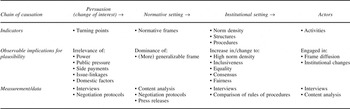
In order to apply this discourse approach, which is based on idealizations, to an empirical study, the research methodology, traces change back from the outcome (persuasion) to its potential causes.Footnote 63 The first step is hence to detect possible candidates for persuasion (potential instances of an endogenous change of interests within discourse). The negotiations are then analyzed to figure out whether the theoretically inferred normative and institutional conditions conducive to persuasion and discourse correspond positively with these candidates (see Table 1).
1. To identify possible candidates for persuasion, negotiations were screened for turning points, that is, phases in which crucial changes in state positions could be observed. Such turning points can indicate persuasion and discourse unless they can be explained by alternative factors, such as power, public pressure, side payments, issue linkages, or domestic factors such as elections or protests. To this effect, the positions of all participating states were traced over time.
2. The next step was to evaluate whether the normative setting of negotiations changed and whether the direction of change shifted in favor of more generalizable principles and thus corresponded with the conditions of persuasion. The analysis traced the development of normative frames used by states to justify their positions over time.Footnote 64 Similarly, changes in the institutional setting were traced to evaluate whether they were more or less conducive to persuasion and discourse (in terms of norm density, inclusiveness, equality, consensus, and fairness principles).
3. The final step was to assess which kind of actors were responsible for changes in normative and institutional settings, and what effects these processes had on the negotiations.
Retrospective methodology: Chain of causation and observable implications for the plausibility of the discourse approach

Obviously, this kind of analysis hinges on several caveats. Because the theoretical approach rests on idealizations and claims that approximations of these idealizations affect collective decision making, one cannot simply test for the existence of certain factors and contrast them with hypothesized effects. Instead, one has to carefully trace relative changes within these factors and determine how, if at all, they affect the course and outcome of negotiations. The analysis cannot completely prove that interests have changed. Since one cannot look into peoples' heads, it is nearly impossible to provide direct, reliable, empirical proof of an interest change.Footnote 65 Instead, the analysis has to focus on indirect evidence to render such a change at least plausible. Therefore, in the absence of alternative factors to account for such changes, one infers an interest change from a change in position plus a change in the normative frame that actors employ to justify their position.
The analysis does not trace individual state-level changes. If one stipulates that certain normative and institutional setting changes increase the chance of discourse within which actors may change their interests in response to normatively superior arguments, it would be futile to focus on individual changes. Instead I focus on strong correlations between the theorized variables by simultaneously excluding potential alternative explanations for observed changes. Furthermore, the analysis uses a triangulation of different methods and data to improve the reliability of its assessments.
The analysis in this study is based on a qualitative content analysis of the ILC report of 1994 (to grasp the normative environment in the starting point of negotiations) and of all summaries of state speeches within negotiations as recorded by UN press releases and summary minutes from 1994–98Footnote 66 (to establish changes in positions and normative frames).Footnote 67 I also conducted a series of twelve interviews with delegations, NGOs, and UN officials to take account of alternative factors and institutional changes and to cross-check whether the interviewees supported the findings of the content analysis.
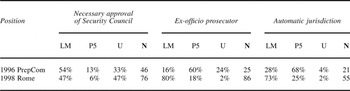
The content analysis focused on the opinions of the delegations concerning four issues, which were most closely linked to an obligation to pursue international prosecution, namely: whether delegations advocated or opposed automatic jurisdiction; whether they were for or against an independent prosecutor; whether the Security Council should have little or extensive control over procedures, and, finally, how they viewed the necessity and desirability of the ICC in general. The analysis traced the positions of all states over time with regard to the first three issues to detect potential turning points. The unit of analysis was the summaries of state speeches in negotiations. Since negotiations were soon dominated by two negotiation groups, coding followed this binary structure. Taking the inclusion of an independent prosecutor, for example, states could either support an independent prosecutor, which was coded as support for the LM group (LM), oppose the independent prosecutor, coded as support for the P5 group (P5), or they could hold a different position, coded as undecided/others (U). Each state and year was coded to arrive at estimates of the relative strength of the LM and P5 positions in negotiations over time.Footnote 68
Apart from the analysis of state positions, the normative frames used by states to justify their positions were also relevant to how and whether the normative setting of the negotiations had changed. For this purpose, the fourth issue, focusing on the necessity and desirability of the ICC, was added to the content analysis.Footnote 69 In this step, coding focused on only the justifications states gave in defense of their position (sample position: “The court should have an independent prosecutor”; sample justification: “Only an independent prosecutor can ensure the impartiality of the court”). This also meant that the size of the sample decreased since not all states justified their positions at all times.
These justifications were coded inductively. In a first round, state speeches were screened for the prominence of normative principles, which were then used to develop a scheme of categories for coding (including sovereignty, noninterference, universal adherence, independence, equality and impartiality, and universal applicability).Footnote 70 Because the categories still overlapped, they were subsequently condensed into normative frames (political reality and public interest).Footnote 71 State speeches were then coded again in several rounds using the frames. Finally, the frames were weighted in their strengths in relation to all framings employed in the justifications in order to evaluate whether one frame gained dominance during negotiations.
Turning Points
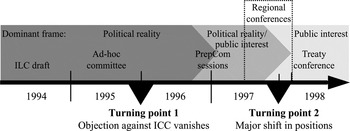
The negotiations underwent two turning points. The first can be located in the move from the ad hoc committee in 1995 to the PrepCom in 1996. In contrast to the ad hoc committee, where especially major powers argued against an ICC,Footnote 72 no state publicly objected to the ICC as such in the PrepCom,Footnote 73 though the type of court envisaged remained controversial, partly due to differing legal systems and cultural contexts. At its heart lay a conflict over the normative basis of the court, that is, over a potential obligation to pursue international prosecution including the question of how to instigate proceedings (trigger mechanisms), the role of the Security Council, and the type of jurisdiction.
A second turning point lies between 1997 and 1998, after the PrepCom sessions and before the Rome conference. During this period, positions changed dramatically. Until the end of 1996, a majority of states pushed for a very conservative ICC model. Led by the P5, this group called for a court under the control of the Security Council. This meant that the council would have to approve each case upon investigation (veto of P5). They also rejected the initial proposals for an ex-officio prosecutor, and they disliked automatic jurisdiction but favored several opt-in/opt-out mechanisms or a state consent regime to establish the court's jurisdiction.Footnote 74 In essence, they wanted a kind of permanent ad hoc tribunal.Footnote 75 The P5 defended this conservative position by arguing that their particular responsibility for peace and security should justify a special protection from the ICC.Footnote 76
This approach was countered by a dozen states that then coordinated their positions, emerging as the LM group, strongly supported by the NGO network (CICC). The LM group, which grew to forty-two members by the end of 1997, soon established broad principles to which all its members could subscribe despite minor differences on specific issues.Footnote 77 The group lobbied for automatic jurisdiction, an ex-officio prosecutor, and called for the Security Council's role to be limited to the referral of cases. A veto for the P5 was perceived as a politicization of the court and an undue interference in the workings of a judicial institution.
The majority of states, however, lay somewhere in between. While some, such as Syria or China, did not want any court, most had no coherent position, supporting LM positions on one issue and the P5 on another. By the beginning of the treaty conference in Rome in June 1998, however, majority opinion had changed drastically; the majority of states now backed LM positions for a strong and independent court, and this trend gained strength in the course of the conference. This increased support came especially from those regions that counted as the silent majority during the PrepCom meetings and were assumed to be reluctant to back an ICC.Footnote 78 They included the Southern African Development Community, West African states (usually thought to be Francophile), and parts of the RIO group, comprising eighteen Latin American countries (see Table 2).
Strength of support for LM and P5 positions in negotiations on three selected issues

Notes: Table is based on a content analysis of all summaries of state speeches during negotiations. LM = support for like-minded position. P5 = support for P5 position. U = undecided/others. N = total number of coded positions per issue and year.
These turning points cannot be explained by alternative factors: first, positions changed contrary to the existing material power structure. After all, it was the position of the major powers that lost support. Second, there is no evidence of side payments or issue linkages in negotiation protocols to account for this change, nor were they mentioned in interviews; nor did public pressure play a role, as negotiations were largely ignored by the public up until the Rome conference.Footnote 79 Although some specific changes can be credited to domestic factors (for the second turning point the change of positions of the U.K. delegation and partly that of France followed changes in government in 1997), these factors cannot account for the overall swing, especially among developing countries. However, an analysis of the development of normative framings underlying positions in negotiations strengthens the hypothesis that the change may indicate persuasion and discourse, that is, a change in interests.
Normative Frames
The analysis of all available summaries of state speeches reveals that the different positions toward the ICC also reflect different normative framings. From the outset, there was unanimity over the criterion on which to base the ICC: it had to be effective, capable of performing its task. “Effectiveness” had already been granted center stage in all statements in the ILC, though its meaning was highly disputed. The analysis identified two frames, one emphasizing politics (and in particular security politics) and the other explicitly focusing on fundamental principles of law and morality.
For the political reality frame, effectiveness is equated with universal adherence to the statute. Only a court acceptable to all states would be able to duly discharge its duties: “Universal participation [is] essential for the authority and effectiveness of the court.”Footnote 80 However, universal adherence can be achieved only if the court follows the political realities and not some principled ideals: “If we approach the court from an academically pure perspective, without regard for political realities and what states are willing to participate in and fund, we will have wasted our time.”Footnote 81 Only a step-by-step approach,Footnote 82 which accepts that sovereignty and noninterference are sacrosanct,Footnote 83 could ensure that the majority of states would accept the statute: “The only durable basis for the development of such international cooperation is scrupulous regard for the fundamental principles of the UN Charter, notably the sovereign equality of the states, non-discrimination and non-interference in internal affairs.”Footnote 84 But political reality is not only a principle of political wisdom. The frame posits political realities versus principled ideals. It refers to the power asymmetries within the international system that the court has to reckon with and which it should not amend but anticipate: “Realism dictates … that account must be taken of the diversity of regional interests, different stages of development and social and cultural traditions, and the position of major powers.”Footnote 85 Additionally, political reality as framed by the major powers implies that international prosecution is a potential threat to efforts at securing peace and security: “The ICC can be really effective only if it … is inscribed into the existing system of maintenance of international peace and security and takes into account the prerogatives of the Security Council.”Footnote 86 A judicial intervention into conflicts by the ICC is perceived as a threat as it might question the legality of decisions made by military leaders of members of the Security Council with regard to military interventions: “Soldiers deployed far from home need to do their jobs without exposure to politicized proceedings.”Footnote 87 Political reality is a conservative frame that perceives the ICC as an instrument of security politics—an area in which traditionally major powers and power politics prevail. It highlights the political over the principled. Universal adherence does not refer to a moral argument (what everyone can expect from one another) but instead propagates a power-preserving approach that safeguards the particularistic interests of states and subsumes law under politics. This framing was the dominant reference of the P5.
The alternative frame interpreted effectiveness as resulting from universal applicability. This public interest frame was at the heart of the CICC's statements but was also taken up by the LM group. In this frame, the ICC should not bow to the existing power asymmetries but be given the power to override them. Only a court able to interfere “regardless of national, political or other identity of the perpetrators”Footnote 88 could end impunity,Footnote 89 and restore peace:Footnote 90 “The rule of law precludes selective justice and means that victims should be able to seek redress for crimes of concern to the international community as a whole when a domestic system cannot provide it.”Footnote 91 Independence from and impartiality toward the political interests of states is a leitmotiv. The court is presented as a project of the public interest vis-à-vis the particular interests of states.Footnote 92 This presupposes, as its adherents formulate, “that we accept abandoning, to a certain degree, the classical concept of sovereignty of states.”Footnote 93 Consequently, public interest clearly perceives the court as a condition for peace and security: “Without justice there can be no reconciliation and without reconciliation no peace.”Footnote 94 In normative terms, while the political reality frame highlights politics as the guiding reference, the former public interest frame demands that the ICC “must not be clouded by politics' formulation of what the law is.”Footnote 95 Public interest is based on the potentially universal principles of equality and impartiality, shared by all major law systems.
The ILC draft was clearly dominated by a political reality frame. Ensuring universal adherence was the predominant justification within the commentary.Footnote 96 This frame remained dominant in deliberations in the General Assembly, where it could be identified in 57 percent of all justifications in 1995 and in 46 percent in 1996. However, in 1997 both frames were nearly equally represented (public interest with 31 percent; political reality with 28 percent). Indeed, at the beginning of the Rome conference public interest finally gained predominance, figuring in 47 percent of all statements while political reality stagnated at 28 percent (see Figure 1).
Strength of frames “political reality” and “public interest” in negotiations on “necessity and desirability of an ICC” in relation to all normative references

The frame analysis supports the hypothesis that the negotiations leading to the creation of the ICC were affected by persuasion and discourse. At least with regard to the second turning point the framing correlates with the shift in positions toward the ICC (see Figure 2).Footnote 97 More importantly, public interest, a clearly principled frame relating to universal values and norms, central to all major law systems, gains center stage in the negotiations. This kind of argumentative reference corresponds to the kind of arguments expected from a rational (legal) discourse. As I will show, this successful reframing resulted from a combined effort of the coalition of LM states and the CICC to alter institutional settings to gain support for their frame.
Timeline of events

The Institutional Setting
Originally, the ICC issue had been delegated to the ILC, which is renowned for neither its progressive stand toward international law nor its speed. The ILC is formally an expert forum whose members are all law authorities in their own right. This setting seems particularly conducive to rational discourse because it decouples political decision making (with its potential distributive implications) from the creative part of finding new solutions to the problem at hand, (problem-solving) which it delegates to experts.Footnote 98 However, as insiders to the UN claim, its discussions have always been deeply influenced by the political cleavages in the GA and especially the 6th (legal) Committee.Footnote 99
The move to the PrepCom altered the institutional setting enormously. Basically, it placed the item on the public agenda of the UN. Nearly a hundred governments participated in the PrepCom, observed by an NGO coalition. However, owing to the nature of the issue, the PrepCom shared some of its features with the ILC. The establishment of an ICC required enormous expertise. It entailed not only questions of institutional design but also drafting an international criminal code. The majority of delegates were therefore legal advisors while often higher ranking political advisors were in the minority. Decisions were based on consensus. However, the first year hardly saw any consensuses reached. Instead, delegates produced a nearly 300-page compilation of divergent and often contrary proposals. While it prompted highly expert-oriented negotiations, the sheer number and complexity of issues meant that expertise varied enormously among delegations. Wealthy states could afford to send delegations of ten or more members who were able to focus on all issues, but developing countries especially could send only one or two delegates.Footnote 100 Another problem was caused by the cultural implications of encounters between experts on common law, civil law, and the Sharia.Footnote 101
Overall, the degree of shared knowledge and normative understandings among delegations was rather low. Although the institutional setting was formally conducive to rational discourse (as it granted equal participation rights, was based on consensual decisions, and established the principle of public argumentation), this was offset by meager normative and factual underpinnings, as well as daunting inequality in terms of resources and expertise. The fundamental problem was the lack of effective participation by developing and transitional countries from Africa, Latin America, and Central and Eastern Europe. Given the complex nature of the issues, their delegations were hardly able to cover the entire gamut of negotiations, which were increasingly split up into working groups and formal, informal, and even informal-informal meetings. The lack of participation was also caused by a general mistrust that the ICC was being set up mainly to reinforce the dominance of major powers.Footnote 102 These fears were especially widespread among African countries, many of which had recently experienced violent upheavals and could not realistically expect to be spared from them in the future.Footnote 103 As an NGO representative from Senegal put it: “Apart from its Southern part, the continent remains unmotivated by an ICC because of a lack of information, but also because many Africans feel the ICC is created in order to put their heads of state on trial.”Footnote 104
This mistrust could not be resolved amid the tense negotiations in New York. In 1997, therefore, LM delegations, in close cooperation with the CICC, began to convene regional conferences to increase knowledge on the issue and respond to the special concerns of the respective regions. They organized conferences in Latin America, Africa, and Central and Eastern Europe to lay the groundwork for the Rome conference. These regional conferences were to allow open and free discussion—not necessarily to establish clear-cut positions on the specific issues—but to generate knowledge and an understanding of the main issues at stake.Footnote 105
These conferences were quite similar in structure. Designed as learning forums, they strove to approximate the ideal of a rational discourse. They were not formally bound to direct political decisions (participants were not forced to settle on official negotiation positions), but were forums for deliberation and the free exchange of views among colleagues, with input from experts. The delegations, not to mention the majority of experts and NGOs, all came from the same region. They often knew each other already, and shared similar perceptions of the problems, a common history, and cultural values. The life world certainties were much richer than in New York: they constituted an almost ideal-typical discourse setting.Footnote 106 It is striking that overall, from Pretoria via Dakar to Budapest, these regional conferences resulted in unexpectedly progressive positions toward the ICC that were almost identical to those of the LM group. In interviews, LM delegations saw these regional processes explicitly as persuasion:
A good example for our attempts to persuade more states of our position was a regional preparatory conference … We invited all future Rome delegates of those countries and sponsored their travel expenditures … to discuss the key issues of the Rome conference. We wanted the participants to evaluate the different models and then to decide upon which is the best model. We prepared about ten key issues and each delegation was responsible for one of these issues and was to prepare their recommendation on how to deal with them. In the end, we discussed those recommendations in plenary to achieve consensus. As a result, the conference participants agreed on fairly strong principles on the ICC, probably about the strongest I have witnessed throughout the process.Footnote 107
The analysis of the institutional setting supports the hypothesis that legalization can be attributed to persuasion and discourse. The change in positions, at least at the second turning point, corresponds to changes in the normative frames observed between 1997 and 1998, which in turn correspond to altered institutional settings resembling the formal conditions for rational discourse to a remarkable extent (see Figure 2). The analysis also highlights the crucial role of the CICC and LM group.
CICC and LM States Fostering Persuasion and Discourse
The NGOs championed a public interest frame as early as the start of the 1990s and attacked the political reality frame from the beginning. For NGOs, the ad hoc tribunals set up under Chapter VII responsibilities were a means to achieve and restore peace: “Governments had made a lot of statements in the context of the Yugoslavian and Rwanda tribunals about international justice … and it was very easy to use these statements against them to push them further.”Footnote 108
The political reality frame explicitly subordinated justice to peace and security. NGOs reversed the order so that justice was the prerequisite for security and peace, as impunity “only leads to renewed cycles of violence.”Footnote 109 NGOs used the discrepancies between the political reality frame and the widely supported ad hoc tribunals to shame those statesFootnote 110—it became simply inappropriate to publicly oppose the ICC.Footnote 111 So it was not persuasion and discourse, but shaming and blaming that brought about the first turning point. States simply abstained from publicly voicing their opposition without in fact changing their minds—a mechanism often described as rhetorical entrapment.Footnote 112
NGOs were also involved in altering institutional settings to promote their alternative frame—often in cooperation with the LM group, with which they started to forge bonds. For the LM group, this coalition had several advantages. First, security issues regularly disadvantage small and medium states in negotiations because security is traditionally seen as a central domain of great-power politics. The LM group could refer to the support of “civil society” for their position when seeking to legitimize it in the negotiations. Secondly, the LM group was able to draw on the strong expertise of NGOs to strengthen their arguments.
NGOs, on the other hand, used the coalition to gain access to even the informal meetings from which they were often barred, although the PrepCom had granted them access: “We of course had a lot of things leaked to us and we would comment on them and people started showing us drafts before they submitted them. Governments started to learn how to operate within this new diplomacy. They went to NGOs to leak the issues.”Footnote 113 This alliance became even more pronounced with regular consultations between NGOs and the LM group and cooperative strategies, culminating in the creation of “islands” of persuasion and discourse through the regional conferences.
Effects on the Negotiations
The approximations or “islands” of persuasion and discourse outlined here had far-reaching effects. They changed the structure of the negotiations, the range of legitimate arguments, and finally even the range of possible outcomes of the negotiations. Concerning the structure of the negotiations, the coordinated strategies of NGOs and LM states, especially in the regional settings, diminished the traditional lines of confrontation within the negotiations. In multilateral settings, negotiations are often characterized by an almost rigid confrontation and mistrust between different groupings such as the Western group, the nonaligned movement, or the Arab group. Outcomes in such settings usually reflect the lowest common denominator. In the Rome process, however, regional allegiances played a negligible role owing to the emergence of the LM group as a coalition of states from all regions, thus cutting across traditional cleavages. The regional conferences obviously supported this development:
We [the LM group] stood for a court for all states and with equal rights and duties for all. That had an immense appeal, especially to developing countries … You see, the American delegation also spoke to all delegations and was very friendly but what mattered was the difference in principle. We were able to attract support regardless of regional differences because we focused on universal issues and thus could prevent that regional groupings dominated the process.Footnote 114
The public interest frame that the LM delegations and NGOs promoted was at least potentially based on universal principles, which attracted support regardless of regional or cultural differences. The regional settings combined institutional features and argumentative structures: LM delegations and NGOs held positions that were universally appealing as they were common to all major law systems, and they developed institutional settings in which those positions could prevail.
With regard to the range of legitimate arguments, these islands of persuasion also had an impact on the kind of arguments perceived as appropriate within negotiations: the more dominant the public interest frame became, the less support alternative frames attracted. This effect can be demonstrated for the U.S. delegation, which was seen by many delegations as a constructive and well-prepared negotiation partner. The arguments over the special responsibility of the United States were partly considered legitimate, and both the LM countries and NGOs tried hard to find solutions to accommodate these concerns. They started to desist from these attempts, however, when the credibility of the U.S. delegation was increasingly questioned. Although they always argued for an effective court, their perception of what that meant was fundamentally different from the LM group:
We did not know what [the U.S. delegation] wanted. They used the same language as we did. They did indeed use the same rhetoric … Then, in Rome we figured that the U.S. and its followers made each proposal aimed at weakening the court by simply stating that this proposal needed to be incorporated for the court to be strong.Footnote 115
The reframing efforts now bore fruit and public interest became the dominant frame. Effectiveness did not entail special interests or responsibilities, but universal applicability based on equality and impartiality. From this new perspective, the tack taken by the U.S. delegation, though it constantly based its arguments on a political reality frame, was perceived as hypocritical. Realizing that its argumentative efforts were not translating into sufficient support, the delegation switched to classical bargaining resources such as threats and promises. Smaller states were threatened with a withdrawal of military aid if they did not support the U.S. position.Footnote 116 Additionally, Republican voices within the U.S. Senate proclaimed that no court that could convict a U.S. citizen would ever be passed in Senate. While the fierce rhetoric from the U.S. Senate can reasonably be said to have belonged to the shared life world of multilateral negotiations in the 1990s, the U.S. government's threats provoked outrage on the part of the other delegations once they became public.Footnote 117 Thus the frame was set: arguments were taken into consideration only if they related to the effectiveness of the court, and that now spelled equality and impartiality.
Notwithstanding this impact, the most decisive effect was on the range of possible outcomes. Until 1997, the prospect was either to have no court at all or a kind of permanent ad hoc court. When the treaty conference began, a court involving a duty of international prosecution became a realistic alternative. But although majorities shifted, the process fell far short of consensus. While the LM group and the CICC succeeded in raising support for their position in the regions, the confrontation with the P5 remained. Faced with the stalemate between the two camps, the conference chairman, Philippe Kirsch, actively started to work toward a compromise. At the beginning of the fourth week, his bureau circulated discussion papers on the controversial issues, leaving out the extreme positions and listing several moderate options. Kirsch then invited all delegations to express their views on these options.
Following these debates the CICC disseminated public lists reporting the country positions on the respective topics. These lists made abundantly clear that the P5 position was increasingly a minority position.Footnote 118 Given these numbers and delegations' resistance to compromise, Kirsch's bureau announced that it would draft a comprehensive package as a final text for the ICC's statute that would be put to an up-or-down vote. Last amendments were then negotiated. Not only for Kirsch, but also for the majority of the LM states, the support of the P5 and especially the United States remained essential. Kirsch was willing to compromise on several issues, but the only way to get the United States on board was with a passage guaranteeing that U.S. citizens could never be prosecuted before the ICC that the other delegations rejected outright. After unsuccessful attempts by the Indian and the U.S. delegation to press for amendments, the Committee of the Whole finally adopted the statute in an unrecorded vote.
Conclusion
The Rome Statute does not reflect a rational consensus, but a carefully designed compromise, as indicated by the opt-out clause for jurisdiction over war crimes. Still, the analysis has plausibly shown that even this compromise was affected by persuasion and discourse. It identifies a critical turning point in the negotiations between 1997 and 1998, when majorities shifted against the position of major powers. This shift was accompanied by a reframing of the issue away from a power-preserving politics-dominated frame (political reality) in favor of one based on fundamental principles of law and universal morals (public interest). This reframing was traced back to the coordinated activities of the LM group and the CICC, which intentionally altered institutional settings to enable more discursive interaction. The regional settings enriched the normative underpinnings of discourse (the conditions of life world overlap) and were remarkably consistent with the formal characteristics of rational discourse. As hypothesized at the outset of this article, such attempts to alter the normative and institutional setting are often made by actors with comparatively few bargaining resources. The LM group was, on average, made up of small and middle powers that were disadvantaged in a setting originally dominated by security politics. This was even truer for NGOs.
The advancement of the negotiation process toward a duty of international prosecution cannot be accounted for by realists or neoliberals. Their neglect of the process of legalization is one of their major weaknesses. However, these alternative explanations can plausibly outline why states initially attempted to establish a court in the 1990s. The cautiously supportive attitude of major powers opened a window of opportunity that NGOs and the LM states used to advance their vision of a permanent court. Only after major powers signaled that they would be ready to consider an ICC could the issue be on the agenda.
What these theoretical approaches fail to account for, however, is that interests and attitudes changed within the process. This kind of change is captured by the concept of persuasion as promoted by constructivists. The problem with this concept is that its plausibility has seldom been thoroughly assessed empirically: “Something goes on between the earlobes, and values subsequently change.”Footnote 119 How does one recognize persuasion? Drawing on Habermas's discourse theory, this article has introduced a strategy for coping with this analytical problem. Proceeding retrospectively, the analysis traced changes in positions, normative frames, and the institutional setting over time in search of correlations that correspond to the hypothesis derived from the discourse approach while simultaneously controlling for alternative factors. Although a change of interests can never be empirically proven, with such a triangulation of different methods and data its occurrence can be inferred to a high degree of plausibility.
A more general critique of a discourse approach is that it is derived from an originally normative theory based on idealizations and might thus be deemed irrelevant for the study of real-world politics. Certainly, all international lawmaking falls short of the deliberative ideal. Uneven power distribution, a lack of institutional safeguards, and the fragmented nature of the international system add up to a significant obstacle to discourse and persuasion. But while “international law operates in the shadow of power,”Footnote 120 as the analysis of the history of the ICC demonstrates, actors also do take the initiative to strengthen the importance of discourse and persuasion over (power) politics.
Persuasion and rational discourse are ideal types that by definition can never be observed empirically in pure form. Yet even their approximation within real-world negotiations can have quite formative effects. They change the range of legitimate arguments within debates and thus the range of possible outcomes as well.
Their long-term relevance for international legalization can be inferred from the further development of the ICC. 108 states, now including thirty African states, have ratified the statute. This number is remarkable when one considers the adjustments of national legal systems that are often necessary, not to mention the continued threats of the U.S. government pressing states into abstaining from ratification. In the absence of a common identity or sense of “we-ness” as well as a democratic polity at the global level, a major source of legitimacy of international governance seems to rest on “the sober power of reason and good argument.”Footnote 121 Thus, the swift global ratification of the statute may be one long-term effect of persuasion and discourse, namely, the potential to increase the legitimacy of norms and institutions. “Islands” of persuasion and discourse increase the importance of arguments and reasons within negotiations, thereby empowering weak actors who usually lack bargaining powers. In a sense, these “islands” lead to greater fairness in international negotiations by giving more of those affected by the outcome more of a say in the results. Even an originally normative and idealized deliberative approach to legalization can fruitfully be applied to empirical analytical studies and explain some of those puzzles otherwise left unsolved.