


INTRODUCTION
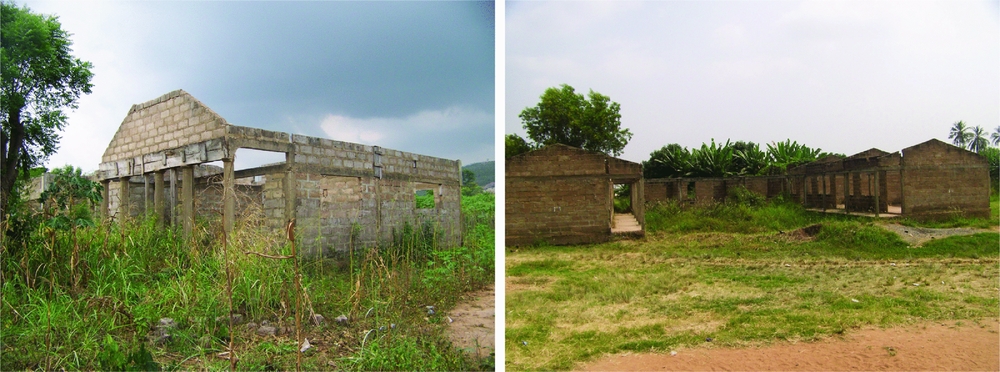
The provision of social infrastructure is a crucial function of government in developing countries, where access to basic facilities like schools, clinics, and latrines is often low. These targeted, visible, and popular projects are also exactly the type of public goods that politicians seek to deliver in theories of pork barrel politics, tactical redistribution, and credit claiming. Yet it is anecdotally common for governments in developing countries to start work on such projects but never actually complete them, leaving behind half-finished projects of no value to users and voters. Though widely remarked upon and substantively important, the extent and causes of this phenomenon have received surprisingly little attention.Footnote 1
Unfinished projects also pose a theoretical puzzle: conditional on a government having started a project, why would the same government subsequently not finish the project?Footnote 2 This question is not well explained by existing theories of politically motivated misallocation of public expenditure associated with distributive politics and clientelism, in which inefficiency arises due to the tactical targeting of expenditure (Cox and McCubbins Reference Cox and McCubbins1986; Dixit and Londregan Reference Dixit and Londregan1996; Golden and Min Reference Golden and Min2013) or over- or underspending on infrastructure relative to private transfers (Keefer Reference Keefer2007; Robinson and Verdier Reference Robinson and Verdier2013). Similarly, although corruption has been the overwhelming focus of studies of the implementation of public good provision in developing countries (Banerjee, Hanna, and Mullainathan Reference Banerjee, Hanna, Mullainathan, Gibbons and Roberts2013) and the allocation of infrastructure contracts to political supporters has been widely remarked (Samuels Reference Samuels2002), corruption in project delivery need not lead to noncompletion of the project. Indeed, when corruption takes the common form of inflated contract values or substandard quality (Olken Reference Olken2007; World Bank 2011), contractors may actually have stronger incentives to complete projects in order to fully reap their excess rents.
Unfinished Projects

I develop an alternative theory of project noncompletion as the dynamically inconsistent outcome of a collective choice process in contexts of limited resources, in which multiple political actors bargain over the distribution of a limited number of discrete, targeted projects. Building coalitions around a set of projects to be implemented in the current period requires intertemporal bargaining among these actors over future project distribution, but actors face credible commitment problems and so these bargains are inherently unstable, meaning that collective expenditure choices may not be dynamically consistent. Since project construction happens over a period of time, this time-inconsistency leads some projects to be interrupted mid-construction when collective expenditure priorities shift to new projects. The idea that collective choice over locally targeted projects among actors with commitment problems can lead to inefficient government expenditure has a long tradition in theory on public choice and legislative bargaining (Riker and Brams Reference Riker and Brams1973; Weingast and Marshall Reference Weingast and Marshall1988). However, it has received significantly less attention in developing country contexts, where research has focused almost exclusively on instrumental forms of public expenditure inefficiency.
I examine project completion empirically using an original dataset of over 14,000 small local government projects in Ghana from 2011 to 2013, which I compiled using administrative records that I collected, digitized, and coded. I estimate that approximately one-third of projects that start are never finished, consuming nearly 20% of all local government capital expenditure.Footnote 3 Although not directly comparable in welfare terms, this estimate of the fiscal waste from noncompletion is of similar magnitude to Olken’s (Reference Olken2007) estimate of resource loss from corruption in road building (24%) and Finan and Mazzocco’s (Reference Finan and Mazzocco2016) estimate of the percentage of public expenditure that is misallocated due to politically motivated distortions (26%). The social costs of noncompletion are large: the money spent on noncompleted projects by local governments alone would be enough to fully construct 667 additional three-room schools serving over 73,000 children, every year.Footnote 4 Since school construction has been shown to lead to increased educational attainment and higher future wages in infrastructure-poor developing countries such as Ghana (Duflo Reference Duflo2001), this fiscal waste may have long-term developmental consequences. The political opportunity costs are also potentially substantial: delivering infrastructure projects has been shown to win votes for the incumbent in Ghanaian elections (Briggs Reference Briggs2012; Weghorst and Lindberg Reference Weghorst and Lindberg2013; Harding Reference Harding2015), citizens and media often refer to unfinished projects in negative performance evaluations of government (Ghana News Agency 2014), and elections in Ghana are often closely contested, with the 2008 presidential election being decided by just 40,586 votes (Whitfield Reference Whitfield2009).
I derive and test observable implications of the corruption, clientelism, and collective choice theories of noncompletion in the context of decentralized public good provision in Ghana. I overcome the endogeneity concerns that plague much of the empirical distributive politics literature (Larcinese, Snyder, and Testa Reference Larcinese, Snyder and Testa2012) by exploiting the fact that the same types of projects are delivered in the same districts and communities by the same local politicians, bureaucrats, and contractors, but funded through two different intergovernmental transfer mechanisms. These transfers are similar in design and implementation, except that one has an exogenously imposed funding rule that places districts at risk of losing future transfers if they fail to complete ongoing projects before starting new ones. Consistent with the predictions of the collective choice theory, this rule has a large effect in districts whose partisan composition is likely to make efficient collective choice difficult and a much weaker effect elsewhere. I further support this result by showing that central government projects are unaffected by district partisan composition, by addressing concerns about endogenous project selection using Oster’s (Reference Oster2016) coefficient stability approach, and through extensive robustness checks. I also find considerable evidence that is inconsistent with either corruption or clientelism being significant causes of project non-completion.
These findings on the extent and causes of project noncompletion contribute to the broader literature on government expenditure inefficiency in several ways. The emphasis on the non-instrumentality of much expenditure inefficiency connects with Bandiera, Prat, and Valletti’s (Reference Bandiera, Prat and Valletti2009) distinction between active waste (which creates utility for the decision-maker) and passive waste (which does not), and their finding that the latter is quantitatively more important in procurement in Italy. While recent literature on developing countries has emphasized ways in which an agent might actively distort expenditure for private gain, whether through corruption or clientelism, expenditure decisions are arguably made through formal or informal collective choice processes at least as often as they are made by a unitary agent acting strategically. This is consistent with recent empirical studies by Hodler and Raschky (Reference Hodler and Raschky2014) and Burgess et al. (Reference Burgess, Jedwab, Miguel, Morjaria and Padró i Miquel2015), which find that greater constraints on the executive are associated with reduced ethnic favoritism in public good provision. Whereas these studies examine the effects of institutional change over time on public good provision, I demonstrate that different institutional rules can lead to different (and significantly improved) outcomes, even when applied simultaneously to the same set of politicians and bureaucrats. The idea that institutions can mediate the workings of distributive politics parallels a similar literature on administrative agencies in US politics (Bertelli and Grose Reference Bertelli and Grose2009). These findings also provide the first project-level evidence that the source of public funds matters for expenditure outcomes (Gadenne Reference Gadenne2015).
Viewing project allocation and implementation as distinct, but not independent, processes has significant methodological and theoretical implications for future studies of public good provision. Numerous empirical studies of distributive politics in developing countries measure politicians’ revealed tactical targeting strategies using either input-based measures of expenditure allocation (e.g., Keefer and Khemani Reference Keefer and Stuti Khemani2009; Banful Reference Banful2011) or output- or outcome-based measures of access or service quality (e.g., Franck and Rainer Reference Franck and Rainer2012; Kramon and Posner Reference Kramon and Posner2013).Footnote 5 However, these measures are only equivalent if the determinants of project implementation are unrelated to the determinants of project distribution, which this study suggests may not always be the case. Policy implementation can thus have distributive causes and consequences, yet the implementation of distributive policies has been largely overlooked in theory and empirics alike.
More broadly, this study provides a link between micro-level studies of public good provision and the more abstract theoretical literature on institutions, states, and development. In particular, this study’s empirical finding that institutions can improve efficiency by helping political actors collectively overcome credible commitment problems to resolve distributive conflicts is also a central idea in theories of institutions (Ostrom Reference Ostrom1990) and the long-term development of state capacity (Acemoglu, Johnson, and Robinson Reference Acemoglu, Johnson and Robinson2005; Besley and Persson Reference Besley and Persson2011). While the impact of institutions on development and state capacity has thus far been empirically examined mainly through longitudinal and cross-country or -region studies, this article shows that specific institutional rules can play a similar role even within a single polity at a single point in time.
BACKGROUND: DECENTRALIZED PUBLIC GOOD PROVISION IN GHANA
The provision of local public goods is highly salient in both local (Ghana News Agency 2015) and national (Joy News 2014) politics in Ghana, and voters have been shown to reward the delivery of visible public goods (Briggs Reference Briggs2012; Weghorst and Lindberg Reference Weghorst and Lindberg2013; Harding Reference Harding2015). Yet voters and politicians alike frequently complain about projects being abandoned mid-construction. Unfinished projects are widely reported on by the media (Ghana News Agency 2014), with even Parliament (Citi FM 2014) and the President (Joy News 2014) complaining about noncompletion. National elections are closely contested by two dominant parties, the National Democratic Congress (NDC, which won elections in 2008 and 2012 and was in power throughout this article’s study period) and the National Patriotic Party (NPP). The President is elected by national popular vote, so there is a strong incentive for the incumbent to deliver public goods in order to win votes across all districts.Footnote 6
The responsibility for actually delivering many of these local public goods rests with local governments, since Ghana has decentralized responsibility for delivering a range of public amenities such as schools for primary education, sanitation, primary care clinics, marketplaces, and housing and offices for district staff. While districts are statutorily restricted to relatively small projects, total local government expenditure on capital projects is nonetheless substantial: GHS 317 million (equivalent to just over US$135 million) in 2013, or 42.5% of their total revenue.Footnote 7
All districts are headed by a District Chief Executive (DCE) who is appointed by the President and presides over a directly elected district assembly, in which 70% of members are elected from geographically defined single-member electoral areas and 30% are appointed by the President.Footnote 8 DCEs do not have a fixed term and so would expect to serve until their party loses power or they are removed. Although district assembly elections are formally nonpartisan, district assemblies and DCEs are widely perceived in Ghana as politicized, partisan actors.Footnote 9 Assembly members are elected to four-year terms in elections that occur simultaneously nationwide; these took place in 2010, so the composition of assemblies was constant throughout this article’s study period of 2011–2013. District bureaucracies are composed of professional public servants, and the hiring and transfer of personnel is decided centrally.
Project selection is voted on in an annual budgeting process by assembly members and the DCE. The process begins with the District Planning and Coordinating Unit (DPCU), comprised of bureaucrats, which draws up a preliminary list of projects that then goes to the Executive Committee of the assembly for review and amendment.Footnote 10 The Executive Committee is chaired by the DCE, and membership is decided jointly by the DCE and the Presiding Member of the assembly, who is elected by assembly members. The Executive Committee then puts a project proposal to the full assembly, which debates the list, suggests priority projects, and ultimately approves the list as part of the final budget. In practice, however, political negotiations over expenditure priorities are ongoing throughout the year, as plans and budgets are often not strictly implemented.Footnote 11 These ongoing negotiations occur through both formal and informal means: the assembly itself meets three to four times throughout the year to receive an update on project progress and express their priorities, and may make mid-year changes to the plan and budget; and informal lobbying and protests by assembly members, other local elites, and communities in an attempt to influence expenditure decisions are common.Footnote 12 Although DCEs are not formally downwardly accountable to the assembly, they nonetheless actively seek to maintain their popularity in districts as persistent protests can lead to their removal by the President. While DCEs may be the most powerful individual actors in project selection and expenditure decisions, both formally and informally, these decisions are the products not just of the executive’s tactical targeting choices, but also of a collective choice process that includes other influential district-level actors.
These choices are made in a context where demand for public goods is great, but resources are scarce. For example, Kwabre East District Assembly spent GHS 1.36 million on capital projects in 2013 (just above the national median), and was comprised of 42 geographically distinct settlements represented by 31 elected assembly members. In the same year, the mean cost for a six-room classroom block (the modal project type) was GHS 169,909. Even if the district spent its infrastructure budget entirely on classroom blocks, it could still only deliver eight of them within the year—roughly two-thirds of its assembly members and over four-fifths of its communities would not receive anything.
Yet Kwabre East, as with many other districts, spends these scarce resources in somewhat puzzling ways. In December 2010, for instance, the Assembly began construction of a six-room school block in the community of Aboaso that was expected to be complete within 7 months. By the end of 2011, the construction had only reached the lintel level, however, and by the end of 2013 the project was still not complete despite the expenditure of GHS 50,500. The noncompletion was not due to the lack of the GHS 79,164 it would have taken to complete the project: between the commencement of the Aboaso school and the end of 2013, the District Assembly spent over GHS 6 million on other infrastructure projects in the district, including starting nine new schools in other communities (of which it completed four). Similarly, the District Assembly started a weaving center in the community of Bamang in July 2009 and construction proceeded to the lintel level, but then no further funds were spent on the project, and by 2013, the center still remained unfinished. Meanwhile, a different weaving center that had been started in another community after the Bamang center was completed promptly in 2011. This apparent inconsistency of priorities is a source of great frustration in Ghana among citizens and public servants alike, with the Ghana Audit Service making some version of the recommendation “that management of the Assemblies should endeavour to complete these projects before embarking on new ones” no fewer than six times in their 2013 audit report alone (2014, 20).
Districts’ capital expenditures are funded primarily through intergovernmental transfers, as is common for local governments in developing countries (Gadenne and Singhal Reference Gadenne and Singhal2014). The two largest transfers are the District Assemblies Common Fund (DACF) and District Development Facility (DDF), both of which are periodic, lump sum, formula-based transfers to districts (similar to block grants in a federal system).Footnote 13 The DACF is funded entirely by the central government, while the DDF is funded by a multidonor pool with the central government also contributing 30% co-financing. (For ease of exposition, I will refer to DACF projects as “government-funded” and DDF projects as “donor-funded” henceforth.) Funds are transferred to district governments as a lump sum (i.e., they are not earmarked for specific projects or kept in separate accounts), so districts can prioritize and reallocate funds across projects. Whereas there are no administrative restrictions with respect to expenditure allocation across government-funded projects, under the donor-funded transfer, districts are required to budget to complete existing projects before starting new ones. Otherwise, the two fund sources are operationally almost identical: in both cases, project selection, procurement, and implementation are entirely conducted at the district level by the same politicians and bureaucrats, and through the same planning and budgeting process. Both are restricted to spending on capital investments rather than recurrent expenditures or private transfers, both are financially audited by the same central government auditors as part of the routine annual district audit process, and both are administered by small central government secretariats to which annual budgets and reports are submitted but which play no direct role in implementation.
While my primary focus is on district-level projects funded by these two intergovernmental transfers, I also examine a third major source of project funding, the Ghana Education Trust Fund (“centralized projects” henceforth), under which districts propose a list of projects from which a central government committee selects some to fund. Unlike the government- and donor-funded transfers, for centralized projects, resources are not transferred directly to districts but are used centrally to pay contractors directly for work done in the districts.
UNFINISHED PROJECTS AS DYNAMICALLY INCONSISTENT COLLECTIVE CHOICE
This section presents a theory of project selection and implementation as collective choice, and sets out the observable implications of this theory in the context of decentralized public good provision in Ghana. I then discuss two alternative political economy-related explanations—corruption and clientelism—and their observable implications.
Collective Choice and Project Delivery
While theories of distributive politics in developing countries have largely viewed expenditure decisions as the tactical choices of a unitary incumbent (Golden and Min Reference Golden and Min2013), in many contexts, expenditure choices are made not by a unitary incumbent but by a group of political actors who have different distributive preferences. The canonical scenario is a legislature that must collectively select a set of projects that each deliver benefits to only one constituency. No legislator has an incentive to support a project in any other constituency, but each needs the support of others in order to gain majority approval of their own project, and so legislators must assemble coalitions by agreeing to vote for each other’s projects. This is often referred to as “logrolling” over pork-barrel projects. Since not all projects can be implemented simultaneously and not all votes occur simultaneously—noncontemporaneous benefit flows and non-simultaneous exchange, in Weingast and Marshall’s (Reference Weingast and Marshall1988) terms—forming vote-trading coalitions requires intertemporal bargaining among legislators. But these intertemporal bargains—vote for my project this year, and I will vote for your project next year—are difficult to maintain, since legislators who have just received a project have an incentive to renege on their promise ex post. Knowing this, nonrecipient legislators have little incentive to sacrifice their own immediate self-interest (receiving a project in their constituency) in order to support another legislator’s project. These commitment failures make coalitions inherently unstable, as any structure of actor preferences that enables bargaining also enables voting cycles, making any existing coalition vulnerable to an alternative proposal (Riker and Brams Reference Riker and Brams1973).
Political bargaining over projects in developing country contexts such as Ghana’s local governments is typically not as formalized as logrolling in the US Congress, given the importance of informal politics and the relative weakness of legislatures, and may have de facto decision rules that are more complex or ambiguous than a simple majority vote. However, the project selection and delivery process in Ghana shares the key features of logrolling: spatially targeted projects that deliver concentrated benefits to one political actor but few or no benefits to other actors; the necessity of nonetheless gathering some degree of support from nonrecipient actors; and the time-inconsistency and thus instability inherent in the resulting intertemporal bargains. Senior Local Government Service officials also confirm the existence of these dynamics: while individual assembly members are primarily interested in projects in their own areas, formal and informal vote trading does occur as members seek broader support for their projects, and resources that had been allocated to one community are often reallocated later, leading to protests from the community.Footnote 14
While project implementation (as distinct from selection) is not a feature of existing formal models of collective choice, it is straightforward to see how the instability of collective expenditure priorities could affect development projects that are not instantaneously implemented. As Figure 2 illustrates, the technical and contractual process of constructing even small projects involves not just an initial phase of project selection and budgeting, but also an iterated process of construction (by the contractor) followed by payment (by the government) throughout the life of a project. A six-room school in Ghana, for example, has a median expected project duration of 5 months and may be divided into five payment tranches, the nonpayment of any of which can lead the contractor to stop work until payment is made. Since each disbursement on a project takes funds away from other potential projects, each payment tranche effectively requires a reaffirmation of collective expenditure priorities. The more unstable these collective priorities are, the more likely it is that a project will be interrupted with no guarantee when (or if) its completion will once again become a collective priority. The effect of this political instability is aggravated by technical and contractual characteristics of infrastructure projects: mid-project delays increase the cost of completing the project due to interest costs, physical decay in exposed works, and eventual relocation of the contractor’s staff and plant.Footnote 15 Since the contract sums of small development projects are typically not indexed to inflation or exchange rates, these cost increases can render further work on contracts unprofitable for contractors after even relatively short delays.
Stylized Timeline of a Small Infrastructure Project

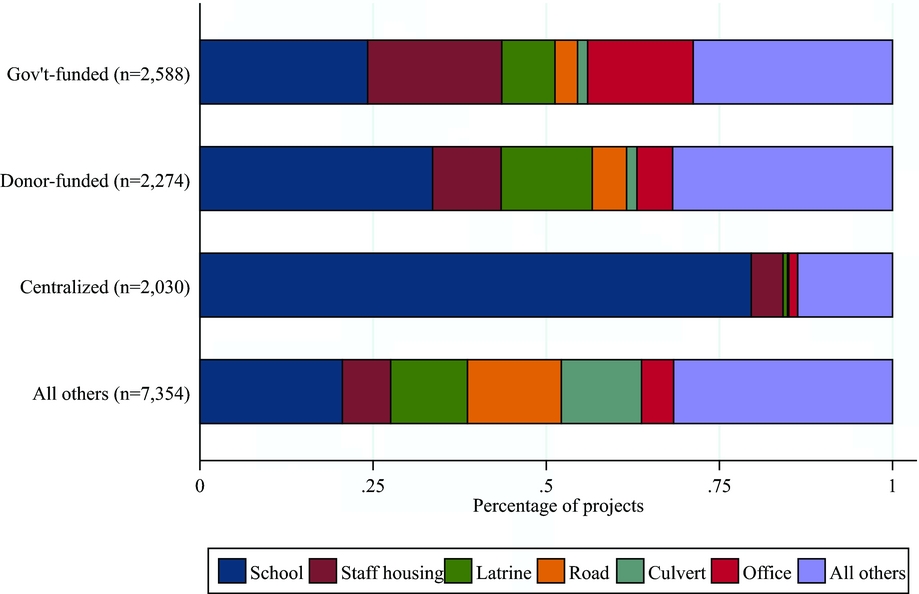
Project Type by Fund Source

While novel to the political economy literature, the idea that unstable political support coalitions can affect project implementation features prominently in the qualitative policy implementation literature within public administration. For example, Pressman and Wildavsky (Reference Pressman and Wildavsky1984 [1973], 92) note in their classic study of urban development projects in Oakland that “Agreements [among project stakeholders] were reached, eroded, and remade. The frequent calls for coordination. . .reflected the inability of the machinery for implementation to move fast enough to capture the agreements while they lasted.” Similarly, political actors in Ghana express concern that the government’s ability to efficiently provide public goods is undermined by its inability to simultaneously satisfy all the distributive demands on it. This is perhaps most clearly illustrated in a speech by the President of Ghana, John Mahama:
“We all have demands on government but we have to be moderate in these demands in order that we do not disrupt the budget and government expenditure. . .As the head of your family, you cannot provide all that your family needs at once. . .Alhassan needs a shoe, Fuseini needs a bicycle, your wife needs a new cloth, and your mother needs a refrigerator. You cannot provide all these at once and so what you have to do is to prioritize. . .The fact that government has not yet provided a certain development that was requested does not mean that government will not provide it” (TV3 Network 2015).
The President’s invocation of a familial metaphor to explain the necessity of sequencing project delivery, and his pleading with voters for patience “in order that we do not disrupt the budget and government expenditure,” concisely summarizes both the necessity and difficulty for politicians of intertemporal bargaining over the delivery of public goods, as well as the negative efficiency consequences of failing to maintain these agreements. District-level actors also express similar concerns about how distributive pressures can undermine project execution. At a public hearing about a project audit, the bureaucratic head of Sekyere South district explained that the district bureaucracy “implements recommendations from the General Assembly. They have reduced projects but the citizens keep demanding projects. . .They [the General Assembly] try to prioritise but it is not easy to do so” (Ghana Audit Service 2016b, 68). A senior Audit Service official involved in project audits explained the consequences of having to pay for the constant stream of new projects: “It’s not shown that it’s being taken from the budget, but what it means is that the other projects won’t be completed. And unfortunately these districts, a lot of the projects that they start they don’t complete.”Footnote 16
Observable Implications
These collective choice dynamics cannot be examined directly in my empirical case, as much of the bargaining is informal and there is no data on proceedings and voting in district assemblies in Ghana (as is the case with local-level governance in many developing countries). I instead identify the impact of collective choice failures indirectly, by making theoretical predictions about characteristics of districts and fund sources that are likely to make sustaining intertemporal bargains over project distribution more (less) challenging, and thus lower (raise) completion rates.
Legislative institutions such as committees that enable agenda-setting and facilitate enforcement through rewards or punishments are key to resolving problems of the durability and enforceability of legislative bargains (Weingast and Marshall Reference Weingast and Marshall1988; Baron and Ferejohn Reference Baron and Ferejohn1989). In the Ghanaian context, the executive is more likely to be able to stabilize local project support coalitions in districts that are politically aligned with the ruling party, due to two asymmetries in the structure of district governance in Ghana: the DCE is always appointed by the President, regardless of district vote shares; and in every district, 30% of assembly members are appointed by the President to at-large seats.
DCEs can use their powers of ex ante agenda-setting—through their control of the DPCU, their chairing of the powerful Executive Committee, and their influence on committee memberships—and ex post implementation of assembly decisions to try to ensure that started projects get finished. However, their incentives to do so are much stronger when these projects benefit the ruling party—projects which incumbent-leaning assemblies are more likely to have started in the first place. Since DCEs control many nonproject aspects of expenditure, they can also use other side-payments to induce cooperation from assembly members. Not only are they likely to be more willing to do so with respect to members of their own party, but they may also be better able to commit to doing so due to the availability of intraparty sanctioning mechanisms. The Presiding Member of the assembly can also help stabilize resource allocations through their committee appointment powers, but this power is likely to support the DCE’s efforts when they are co-partisans and work at cross-purposes when they are not.
There is ample qualitative support for the idea that DCEs selectively use their formal and informal powers to coordinate with co-partisans on project delivery. Local Government Service officers confirm that DCEs and opposition assembly members often have different preferences on project locations, stating that “DCEs in opposition strongholds will have a fight” to agree on project locations with the assembly.Footnote 17 Similarly, Nathan (Reference Nathan2016, 8) quotes one NDC assembly member as explaining, “[The DCE is] a government appointee and I’m also from the same government. . .He listens to the NDC assembly members more than the others. It’s the norm,” while in contrast, an NPP assembly member lamented, “But then your project, you have to spend years chasing it before you get the money. . .I don’t bother going to the [DCE’s] office. . .because the [DCE] has his own agenda, his own political agenda. . .The other assemblymen will have finished their projects, and they’ll be saying no money for you.”
Observable Implications of Theories of Noncompletion

Likewise, whereas the electoral incentives and thus project distribution preferences of elected assembly members are divided between bringing projects to their own electoral area and supporting projects in other areas that would be electorally beneficial to their party, the incentives of the appointed assembly members are to support whatever projects will be electorally beneficial for the incumbent. This is consistent with qualitative accounts of appointed members’ partisan affiliations, with (for example) a former president of the National Association of Local Government Authorities of Ghana stating, ‘About 95 percent of the appointees to the assembly by the President belong to the party of the President” (Citi FM 2016). Appointed assembly members can thus act as a stabilizing force for project support coalitions of elected members, but have stronger incentives to do so when these coalitions are comprised of members of their own party.
Project completion should therefore be positively correlated with the district’s partisan alignment with the ruling party, which I proxy by the ruling party’s vote share in the presidential election preceding the study period.Footnote 18 However, a simple test of this prediction using cross-district variation in partisan vote shares and project completion could be biased due to the potential endogeneity of voting patterns and public good provision or to unobservable confounds more generally.
Instead, I exploit within-district variation in the completion of projects across different fund sources. As discussed above, the donor-funded transfer program’s rule that districts must budget to finish ongoing projects before starting new ones makes donor-funded projects less vulnerable than government- funded projects to collective choice failures by strengthening nonrecipient assembly members’ incentives to complete ongoing projects located outside their electoral area. The within-district difference between donor- and government-funded project completion rates should thus be an indicator of the impact of collective choice failures on project completion.Footnote 19 This funding rule is likely to have the strongest effect in districts that are politically aligned with the opposition party, where these collective choice failures are most acute.
The key observable implication of the collective choice theory is therefore that the completion rate of government-funded projects should increase in districts with higher ruling party vote share relative to the completion rate of donor-funded projects in the same district. Since this prediction relies on within- rather than across-district variation in completion rates, it is possible to control for the observable and unobservable characteristics of districts, as well as for the politicians and bureaucrats selecting and implementing the projects, thus eliminating concerns about endogeneity and unobservable district characteristics.
A further implication of the idea that the ruling party’s vote share in a district is a proxy for district-level collective choice failures (rather than a characteristic on which the incumbent tactically targets completion) is that vote share should have no effect on the completion of centrally delivered projects in the district. The completion rate of centralized projects relative to the completion rate of donor-funded projects should therefore be unrelated to district ruling party vote share.
Alternative Explanations: Corruption and Clientelism
There are two other plausible explanations for project noncompletion in which noncompletion is a deliberate outcome rather than a collective choice failure. First, noncompletion could be caused by a specific form of corruption: projects could be left incomplete if contracts were given to favored contractors who are paid for the work but placed under little pressure to complete it. This would enable the contractors to keep as profit, or pay as kickbacks, the cost savings from not completing the project.Footnote 20
While this type of corruption on the “quantity” margin—as opposed to the quality and price margins that the existing literature has focused on (Olken Reference Olken2007; World Bank 2011)—has not previously been documented, it does have a clear empirical implication: financial expenditure on noncompleted projects should be greater than the physical progress of construction on these projects. In effect, this test is analogous to Olken’s (Reference Olken2007) well-known indicator of “missing expenditures,” albeit where the “missing” expenditure is on the quantity rather than the quality margin. In contrast, an observable implication of the collective choice theory is that the “missing expenditures” measure described above should be negative, reflecting underpayment to contractors for work done, as projects are interrupted mid-construction by nonpayment due to shifting collective expenditure priorities.
Second, noncompletion could be the outcome of a clientelist strategy by the ruling party to use project completion decisions as a way to reward or punish voters. However, existing theories of clientelism as tactical targeting of voters overwhelmingly focus on the allocation of projects, not their completion, so on their own, these theories do not explain why a government would choose to allocate its scarce resources to begin a project in a particular community, but then not finish it. This observation is not to challenge the prevalence of clientelism in project allocations or voting patterns in Ghana or elsewhere, on which there is a large and well-established literature (cf. Golden and Min Reference Golden and Min2013), but rather to distinguish theories of the distribution of projects (which is not my focus) from theories of the implementation of these projects conditional on them having been started (which is).
Nevertheless, one way in which clientelist dynamics could lead to project non-completion is if politicians deliberately leave projects incomplete before elections due to voters’ inability to credibly commit to reward projects with votes. This alternative version of the clientelism theory builds on the logic underlying theories of clientelism as a two-way credibility problem (Robinson and Torvik Reference Robinson and Torvik2005; Robinson and Verdier Reference Robinson and Verdier2013). While project completion is not the focus of these models, the logic of two-way credibility problems—that politicians sometimes find it rational to make apparently inefficient public expenditure choices in order to “tie the continuation utility of a voter to their political success” (Robinson and Verdier Reference Robinson and Verdier2013, 261)—could potentially be applicable to project completion. If credit-claiming dynamics make the incumbent more likely than a challenger to complete a project started by the incumbent, starting but not finishing a project would increase nearby voters’ incentives to vote for the incumbent, and so immediately before an election, incomplete projects may actually be more desirable from the incumbent’s point of view than completed projects.
This clientelism-based theory of noncompletion has several observable implications. First, project noncompletion should vary significantly across the electoral cycle. Since Ghana held a presidential election in December 2012, the clientelism theory would imply a lower completion rate in the election year (2012) than in pre-election (2011) or postelection (2013) years.Footnote 21 A second implication is that the degree of physical progress on started projects is likely to be low, since the project start itself is what creates the desired voting incentives (from the incumbent’s point of view), and further expenditure on the project does not enhance these incentives. Third, and in contrast to the predictions of the collective choice theory, if the ruling party views project noncompletion as an effective political strategy then the completion rate of centralized projects should mirror that of government-funded projects—i.e, should be positively correlated with ruling party vote share relative to donor-funded projects.Footnote 22
Finally, there could also be other causes of project noncompletion that are outside the scope of this article, either because they are not directly related to political economy dynamics or because they are not relevant in my empirical context. Examples of the former could include the competence of bureaucrats and contractors, geographical or economy characteristics of communities, district budget sizes, or simple bureaucratic turnover, which I am able to fully control for empirically, and thus should not bias the analysis. Examples of factors that are not relevant in my context could include elections that lead to the incumbent’s removal or severe economic shocks that lead to unanticipated fiscal contractions, although it is easy to see how these could also cause project noncompletion in other contexts. I discuss the scope conditions of this article’s theoretical argument further in the conclusion.
MEASURING AND DESCRIBING NONCOMPLETION
Data
To measure the completion of infrastructure projects, I collected, digitized, and coded all available district Annual Progress Reports (APRs) for the years 2011–13. These reports are written annually by each district’s bureaucracy and submitted to the central government, and include a table listing basic information about projects that were ongoing or active during the calendar year (Appendix A). Altogether, it was possible to locate 479 out of a potential 602 district-year APRs (79.6%), of which 407 (67.6%) had sufficient information to be entered into the database.Footnote 23 After cleaning and removing noninfrastructure projects, this yielded a database of 14,246 project-year observations, which is the core dataset used in this study’s analysis.
Tracking the progress of projects across years is challenging, since many projects do not have commencement dates reported, few districts make use of unique project identification numbers, data is censored before 2011 and after 2013, and many incomplete projects attrite out of the dataset. I use three alternative methods of linking project observations across years and take numerous steps to verify that the key results are not being driven by reporting bias, attrition, or double counting; these are reported in Appendices D, E, and F. Most importantly for my empirical strategy, Appendix D shows that attrition is uncorrelated with project fund source and thus should not bias my main estimates.
All reports were manually double entered into the database and variables were coded through text matching from these strings, with manual disambiguation for key variables (see Appendix C). Projects were coded into 17 different basic “types,” such as schools, clinics, and staff housing. The category “schools” was broken down into five subcategories according to the number of classrooms, leaving a total of 22 project type categories. Project completion was coded for each observation as a binary variable by combining information from three raw variables. For instance, project completion was coded as 1 for values such as “COMPLETE,” “100%,” or “INSTALLED AND IN USE,” and 0 for values such as “ONGOING,” “90%,” or “LINTEL LEVEL.”Footnote 24 I validated the accuracy of districts’ completion reporting in several ways, including site visits, comparison against smaller datasets on project completion compiled through independent evaluation reports, interviews, and alternative government data sources, and found no evidence of systematic bias or misreporting of completion status in the reports (Appendix E).
In addition, for 140 districts, I was also able to digitize District Medium-Term Development Plans. These were 3-year plans written in late 2010 that included tables of planned development projects through 2013, and for the subset of districts with no missing APRs, I linked these planned projects (using the same procedure as linking across years of the APRs) to records of actual projects undertaken over the plan period from the APR dataset.
Extent, Dynamics, and Costs of Noncompletion
Less than half of projects (45.8%) were finished within their first year of implementation, and even after three years, 35.5% remained unfinished.Footnote 25 These low completion rates were not due to long completion schedules: the median project had a scheduled duration of five months and 88.8% were scheduled to be complete within twelve months. The completion hazard rate decreases after the first year of a project: conditional on not being complete after one year, over half of projects see zero or near-zero physical progress in the subsequent year.Footnote 26 A similar bifurcation of project outcomes is evident when examining delays: the median completed project was delayed by just one month, 81.0% were finished in less than twelve months, and just 10.7% were delayed by a year or more. The median incomplete project, however, is twelve months past its expected completion date—a 200% delay—and there is a long tail of over a quarter of incomplete projects that are more than two years past their planned completion date. These dynamics are consistent across project types, as Figure 4 shows for the three most common types.
Project Completion

While the availability of only three years of data makes it impossible to directly observe the eventual completion rate of projects left incomplete after three years, 99.5% of projects were scheduled to be completed within three years, and examining the completion dates of completed projects reveals that just 2.9% of completed projects took three years or more to complete. Assuming that the past distribution of project completion times reflects the time-to-completion distribution of projects started in a given year, extrapolating this rate out from the observed three-year completion rate implies that 33.5% of all projects are never completed.Footnote 27 Of course, this estimate is based on the available three-year window of data that may or may not be representative within Ghana, and thus project completion rates could be lower or higher in other time periods (or other countries).
A key observable implication of the clientelism theory of noncompletion is that project completion rates should vary across the electoral cycle, and be lower in the election year, 2012. However, Figure 5 shows that there is no statistically significant variation in completion rates across years for government- or donor-funded projects. Completion rates are actually slightly higher in the election year for centralized projects for which the central government is responsible for implementation, suggesting that—if anything—the incumbent views completing projects just prior to elections is more electorally beneficial than leaving them unfinished. While electoral cycles could affect project completion in other contexts, particularly if the incumbent loses, in this case, the phenomenon of unfinished projects is remarkably consistent across the electoral cycle.
Noncompletion Not Driven by Electoral Cycle

Most unfinished projects have had a significant amount of work done on them: projects that remain unfinished after their third year average 64.9% physical completion and have seen 55.5% of the contract sum disbursed to the contractor. The heavy investment into unfinished projects contradicts a key observable implication of the clientelism explanation for noncompletion, and also illustrates the fiscal and social costs of noncompletion. If 33.5% of projects are never finished and expenditure on these averages 55.5% of the contract value, a back-of-the-envelope calculation suggests that 18.6% of total local government capital expenditure is spent on projects that will never be finished. Scaling this by the total capital expenditure of Ghana’s local governments in 2013 of US$135 million implies annual spending on never-to-be-completed projects of approximately US$25.1 million. If this wasted expenditure were to be spent entirely on new three-room school buildings, it would be enough to fully construct 667 additional schools per year, so the social opportunity cost of noncompletion is also substantial.Footnote 28
To examine the observable implications of the corruption and collective choice theories of noncompletion related to over- and underpayment of contractors, I construct a two-sided analog to Olken’s (Reference Olken2007) missing expenditures measure by subtracting the percentage of physical construction that has been completed on a project from the percentage of the contract’s value that has been paid by the district to the contractor. Positive values would be consistent with corruption in procurement—either through kickbacks or by selecting politically connected contractors who are paid but not put under pressure to finish projects—as a cause of noncompletion, while negative values would be consistent with nonpayment of contractors due to districts’ unstable collective expenditure choices. Of course, positive values may also be due to factors other than corruption, such as project cost overruns, so this measure likely overstates the extent of corruption-related overpayment. While the relationship between these values need not be strictly linear, depending on the details of contracts and construction, for these small projects, there are unlikely to be large discontinuities, and for completed projects, at least they should be equal. Appendix E discusses steps taken to validate these completion measures and shows that underpayment is not explained by normal time lags in processing payment.
Empirically, Figure 6 shows that underpayment of contractors is far more common than overpayment. For incomplete projects, underpayment by 10% or more is over three times more frequent than overpayment by 10% or more, and for completed projects underpayment is over sixteen times more common than overpayment. This is the opposite of what would be observed if corruption on projects were a significant driver of noncompletion, but is consistent with project interruptions driven by unstable collective priorities: projects start, the contractor does part of the work, but at some point during construction, the government’s collective priorities shift and the government thus fails to make a payment for work done, so construction stops.Footnote 29
Missing Expenditures and Underpayment for Completed Work

The prevalence of underpayment is also consistent with qualitative accounts of frequent complaints by contractors in Ghana about delayed and nonpayment by government (Abotsi Reference Abotsi2013) and with the conclusions of central government auditors (Ghana Audit Service 2016a; see Appendix E). The link between districts’ failure to pay contractors for work done and districts’ shifting collective expenditure priorities has also been noted by auditors: a 2013 report of districts’ spending of statutory funds criticized “the failure of the Assemblies to complete and pay for projects before embarking on new ones” and “recommended that management of the Assemblies should endeavour to discharge all obligations on time and also ensure completion and payment of ongoing projects before commencing new projects” (Ghana Audit Service 2014, 19).Footnote 30
Finally, comparing planned projects to actual projects reveals a high degree of instability in district expenditure priorities. For the 39 districts with digitized medium-term plans and all three years of APR data, on average, only 5.7% of projects that districts planned for the period were actually started, and only 3.8% of projects reported in the APR database could be identified in the plan for the period.Footnote 31 These patterns are consistent with the premises of the collective choice theory that there is a large number of potential projects for which demand exists, and a great deal of temporal instability in which projects are recognized as collective priorities at any given moment.
ANALYSIS
Empirical Strategy
To examine the remaining observable implications of the collective choice and clientelism theories, I estimate a linear probability model (LPM) of the form:
 $$\begin{eqnarray}
y_{i,j,k,t} &=& {\bm{FS}_{i,j,k,t}}{\bm{\beta} } + {\bm{FS}_{i,j,k,t}}*V_{k}*{\bm{\tau}} + {\bm{P}_{i,j,k,t}}{\bm{\gamma} }\nonumber\\
&& +\, \lambda _{j} + \theta _{k,t} + \varepsilon _{i,j,k,t}
\end{eqnarray}$$
where y i, j, k, t is a binary indicator of completion of project i of type j in district k and year t,Footnote 32 FS i, j, k, t is a vector of fund source indicator variables (government-funded and centralized, with donor-funded the omitted category), V k is the vote share in the district of the ruling party during the study period (the NDC) from the first round of the 2008 presidential electionsFootnote 33 , P i, j, k, t is a vector of project characteristics including construction type (i.e., new construction vs. maintenance or repair) and the number of years since project start, λ j is a vector of project type fixed effects, θ k, t is a vector of district-year fixed effects, ε i, j, k, t is an error term, and β , γ , and τ are vectors of parameters to be estimated.
The parameters τ are of primary analytical interest. The parameter τ Gov't represents the marginal effect of partisan vote share on government-funded project completion relative to the marginal effect on donor-funded project completion. A positive τ Gov't would be consistent with the key observable implication of local-level collective choice failure in project completion. The identifying assumption is that any correlation between the within-district donor-government completion rate gap and the district’s partisan alignment is driven only by the collective choice mechanism discussed above, so other factors could cause differences between the overall completion rates of donor- and government-funded projects without biasing my analysis so long as they are uncorrelated with district vote share V k . Selection of projects into fund sources on unobservable project characteristics is the major concern with this assumption’s validity, but I show below that such selection effects appear to generate, if anything, a downward bias on τ Gov't and thus understate the true effect.
In turn, the parameter τ Central shows the marginal effect of district partisan vote share on centralized project completion relative to its effect on donor-funded project completion. This interaction term functions similarly to a placebo test, in that if the effect τ Gov't is driven by district-level collective choice failures, then τ Central should be zero since these district-level collective choice processes should not impact project completion decisions by the central government. On the other hand, if τ Central is also positive, then τ Gov't could be reflecting a deliberate clientelistic strategy by the government, which it is somehow constrained in employing with donor-funded projects.
Interaction of Fund Source and Partisan Alignment
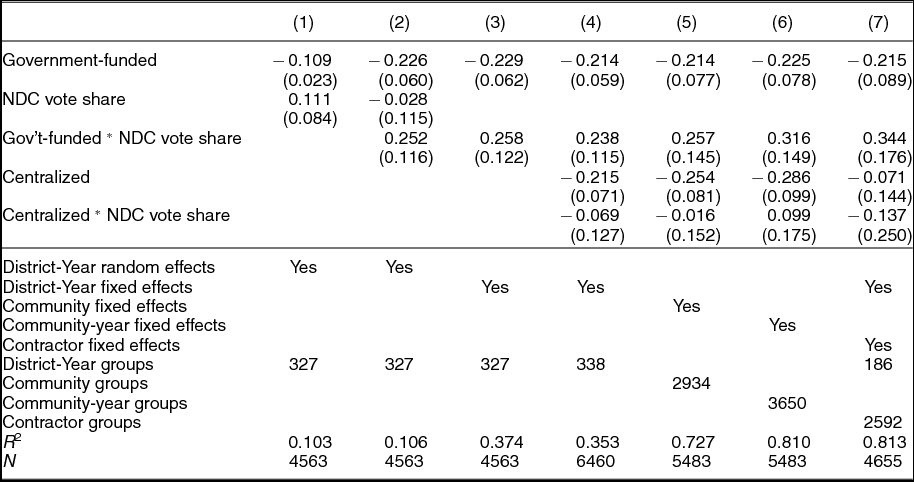
I begin by estimating a simplified version of Equation (1) (Table 2, Column 1) on the sample of government- and donor-funded projects, with no fund source-vote share interaction term and with district-year random effects rather than fixed effects to enable the inclusion of the time-invariant variable V k (NDC vote share). As expected, the coefficient on the Government-funded dummy is negative—government-funded projects have a conditional annual completion probability 10.9 percentage points lower than that of donor-funded projectsFootnote 34 —and the coefficient on NDC vote share is positive, although not statistically significant. This direct test of the effect of NDC vote share is potentially misleading for two reasons, however: first, it assumes that this effect will be the same for both government- and donor-funded projects; and second, it does not fully control for district characteristics that could be correlated with both project completion and NDC vote share.
Interaction of Project Fund Source and Partisan Vote Share

Note: Dependent variable is project completion. All specifications include: fixed effects for 22 project types, with schools grouped by number of classrooms; construction type (construction or maintenance); and indicators for number of years since project start. Year fixed effects included in Columns 1-2 and 6. NDC vote share 2008 is the ruling party’s vote share in the 2008 presidential elections in the district (or its antecedent district, for districts that split in 2012). Huber-White robust standard errors clustered by district-year in Columns 1-4, by contractor in Column 5, by community in Column 6, and by community-year in Column 7.
To address the first issue, Column 2 adds the Gov’t-funded * NDC vote share interaction term. Consistent with the collective choice theory, the effect of NDC vote share is entirely driven by government-funded projects:
 $\hat{\tau }^{Gov't}$
is positive and statistically significant (p = 0.031), while the main effect disappears entirely.
Column 3 presents the full model in Equation (1), using district-year fixed effects to fully control for all observable and unobservable district characteristics, both time-variant and -invariant.Footnote
35
The coefficient
 $\hat{\tau }^{Gov't}$
remains positive and statistically significant (p=0.035). The estimated effect is also economically important: a one standard-deviation increase in the ruling party’s 2008 vote share in the district (16.9 percentage points, from a mean of 49.7) is associated with a 4.36 percentage point decrease in the donor-government completion rate gap.Footnote
36
This is equivalent to closing 39.8% of the total completion gap between donor- and government-funded projects. In absolute terms, a new six-room school in a district at the 5th percentile of NDC vote share (corresponding to a strongly opposition-supporting district where the NDC received only 21.1% of the vote) would have an estimated annual completion probability of 49.7% if it were donor-funded (CI: 38.9-60.4) but just 32.4% if government-funded (CI: 22.4–42.4), a gap of 17.3 percentage points. In a district at the 95th percentile of NDC vote share (88.9%), however, this gap disappears: the government-funded school would have a completion probability of 47.6% (CI: 36.1–59.1), almost identical to that of the donor-funded school (47.8%, CI: 34.6–60.9).Footnote
37
This is strong evidence in support of the collective choice theory of noncompletion: in districts where local political actors are almost uniformly aligned with the incumbent, the executive is better able to use its agenda-setting, implementation, and intraparty enforcement mechanisms to uphold intertemporal bargains on project sequencing and thus avoid leaving projects incomplete.
To further discriminate between the observable implications of the collective choice and clientelism theories, Column (4) adds centralized projects into the estimation sample and introduces the centralized dummy and interaction term. While
 $\hat{\tau }^{Central}$
is not significantly different than zero (indeed, is slightly negative),
 $\hat{\tau }^{Gov't}$
remains positive and significant, and the difference between the two coefficients is statistically significant (p = 0.017). This is inconsistent with the clientelism theory that government-funded project completion patterns reflect a deliberate policy of the incumbent either to leave projects unfinished in order to give voters an incentive to return them to office or to punish opposition voters. If the government thought this to be an effective political strategy, we would have expected that NDC vote share should have a similar effect on centralized projects as it does on government-funded projects executed by districts. Instead, the markedly different effects are consistent with the collective choice theory that the incumbent is constrained in the completion of government-funded projects by local-level collective choice problems that are more difficult to resolve in opposition-leaning districts. The district-year fixed effects in this specification also exclude the possibility that the observed effects are driven by changes in districts’ political leanings over the study period, which is further evidence that these results are not driven by clientelist dynamics of using project completion tactically to reward or punish voters. Figure 7 presents the marginal effects of NDC vote share on the three fund sources graphically, with donor-funded projects as the baseline category represented by the dashed horizontal line at zero.
Marginal Effect of Partisan Alignment by Fund Source

A further concern is that the relevant clientelist dynamics might operate not at the level of whole districts, but rather across communities within districts. For example, if within each district the government systematically allocated donor-funded projects to its core supporter communities and government-funded or centralized projects to opposition communities, and if donor-projects were more likely to be completed and projects in core supporter communities were also more likely to be completed, then the estimates of
 $\hat{\tau }^{Gov't}$
in Columns 14 could be biased upward. To address this, Column 5 re-estimates Equation (1) with fixed effects for the 2,934 communities in which projects were executed, to control for all observable and unobservable characteristics of these communities, including partisan affiliations as well as other more general community-level determinants of project completion. Controlling for these community-level factors actually slightly increases the point estimate of
 $\hat{\tau }^{Gov't}$
, although the statistical significance drops slightly (p = 0.077) due to an increase in standard errors. Column (6) pushes this even further by controlling for community-year fixed effects, thus capturing any shifts over time in partisan affiliations that might affect project completion, leading to
 $\hat{\tau }^{Gov't}$
increasing even further and becoming more statistically significant (p = 0.034). The continued significance of district-level partisan affiliation in explaining government-funded (but not donor-funded or centralized) project completion—even after controlling for time-variant community-specific determinants of project completion—is strong evidence that these results are driven not by clientelist strategies of using project completion as a reward or punishment, but rather by district characteristics that affect collective choice outcomes.
Finally, Column (7) adds contractor fixed effects, since
 $\hat{\tau }^{Gov't}$
could be biased upward by contractor identity if the donor-government completion gap was driven by contractor quality and less able contractors were more likely to be selected in opposition-leaning districts. This specification takes advantage of the fact that some of the 2,592 contractors who implemented these projects did so in multiple districts and/or for multiple fund sources. The estimated
 $\hat{\tau }^{Gov't}$
actually increases slightly and remains statistically significant (p = 0.050). This provides further evidence that the observed patterns of project noncompletion are not being driven by theories of corruption and clientelism that focus on rent-seeking behavior in procurement by politicians, bureaucrats, and politically connected contractors.
These results are robust to a wide range of alternative specifications and additional controls; Appendix F presents these specifications.
Addressing Endogenous Selection into Fund Sources
Even though the district-year, project type, community, and contractor fixed effects control for a wide range of observable and unobservable variables that could bias the analysis, one remaining concern is that communities may be sufficiently heterogeneous that projects could even be targeted (i.e., be locally excludable) within communities, for instance, based on very local ethnic or partisan geography (Ichino and Nathan Reference Ichino and Nathan2013). If projects are locally excludable and thus can be targeted based on within-community unobservable variation, this could potentially bias
 $\hat{\tau }^{Gov't}$
upward if the extent of within-community selection of projects into fund sources was also positively correlated with the ruling party’s vote share in the district.
Although I lack detailed geographic data with which to measure this within-community heterogeneity directly, I am able to gauge whether this bias could plausibly be driving
 $\hat{\tau }^{Gov't}$
using the coefficient stability approach developed by Altonji, Elder, and Taber (Reference Altonji, Elder and Taber2005) with corrections from Oster (Reference Oster2016) and Gonzalez and Miguel (Reference Gonzalez and Miguel2015). Oster shows that if selection on unobservables (such as within-community variation) is as strong as selection on observables (across-community variation), a bias-adjusted estimate of τ is:
 $$\begin{equation}
\tau ^{*} = \tilde{\tau } - (\dot{\tau }-\tilde{\tau })\frac{R_{max} - \tilde{R}}{\tilde{R}-\dot{R}},
\end{equation}$$
where
 $\tilde{\tau }$
is the estimated coefficient from a regression including community fixed effects (Column 2) and
 $\tilde{R}$
is the R
2 from this regression,
 $\dot{\tau }$
is the estimated coefficient from the regression excluding community fixed effects (Column 1) and
 $\dot{R}$
is the R
2 from this regression, and R
max
is the percentage of all variation in the dependent variable theoretically explainable by all possible observables and unobservables. Even under the most conservative case of R
max
= 1 where within-community unobservables account for all remaining unexplained variation and there is no measurement error, calculating τ*
Gov't
using Equation (2) and the estimates from Table 3 still generates a bias-adjusted coefficient of 0.253. More intuitively, these estimates imply that the process of endogenous selection into fund sources on unobservable within-community variation would have to be 58 times stronger than the process of within-district selection across communities in order for the observed
 $\hat{\tau }^{Gov't}$
to be driven entirely by selection on unobservables. While a correlation between NDC vote share and the degree of endogenous selection of projects into fund sources cannot be ruled out, it seems implausible that selection on unobservables accounts for more than a tiny share of the differential effect of NDC vote share on government-funded projects relative to donor-funded ones.
Community Fixed Effects

Note: Dependent variable is project completion. Sample is all projects with nonmissing community name. All specifications include project type and characteristics as in Table 2. Year fixed effects included in Column 2. Huber-White robust standard errors clustered by district-year in Column 1 and community in Column 2.
CONCLUSION
This article has: (1) provided the most comprehensive evidence to date on the extent and costs of development project noncompletion in one country, Ghana; (2) argued that this phenomenon is best understood as the inefficient outcome of a dynamically inconsistent collective choice process among local political actors, rather than an instrumental outcome of corruption or clientelism; and (3) shown that the effects of these collective political failures are mediated by the fiscal institutions through which projects are delivered. I conclude by discussing some broader implications of these three contributions.
First, whereas recent literature on the political economy of public good provision has overwhelmingly focused on corruption as a cause of implementation failure, this article echoes Bandiera, Prat, and Valletti’s (Reference Bandiera, Prat and Valletti2009) emphasis on the non-instrumental nature of much expenditure efficiency. In contrast to Bandiera, Prat, and Valletti, though, I show that implementation failure can be caused by distributive pressures and have consequences for distributive outcomes. The view of implementation as potentially endogenous to distribution presents an opportunity for theory development, as well as a major methodological and measurement challenge: whereas empirical studies of distributive politics usually treat measures of the partisan, geographic, or ethnic incidence of public good inputs, outputs, and outcomes as interchangeable (mostly out of convenience), if implementation is endogenous to distribution, then these associations will differ and thus be potentially biased measures of politicians’ “true” targeting strategies.
Second, the insight that significant fiscal waste can arise due to the de jure and de facto collective nature of government expenditure decisions—rather than simply the private incentives of a powerful agent—has wide-ranging implications for research on the political economy of public good provision in developing countries. Whereas political economy theories of clientelism and distributive politics focus on the potentially distortionary impact of elections on the expenditure choices of an incumbent politician, these findings emphasize that much of the formal and informal politics of delivery actually takes place in between elections. Greater attention to the institutional and bureaucratic details of how and by which actor(s) expenditure decisions are actually made could shed light on these understudied dynamics, and—together with the endogeneity between distributive concerns and implementation—may help to explain the puzzling variation in public good provision patterns observed in the empirical distributive politics literature (Golden and Min Reference Golden and Min2013).
While the collective choice mechanism proposed in this article seems most applicable to contexts of electoral competition and relatively scarce resources, it is likely to have broader relevance. Building coalitions of competing interest groups is a central aspect of politics in democracies and autocracies alike, and access to government expenditure is often the object of coalitions’ formation as well as one of the main tools that can be used to sustain them. Similarly, most polities are characterized by limited budgets and excess demand for government expenditure.Footnote 38 Although my analysis has focused on physical infrastructure projects, the same mechanism could also apply to any nonphysical type of expenditure whose implementation is not instantaneous. The strengths of institutions that stabilize political coalitions or limit the impact of political instability on implementation processes seem likely to be key determinants of the extent to which these collective choice issues manifest in policy implementation across contexts.
Finally, these findings have important policy implications for governments, donors, and aid. The extent of wasteful expenditure and the impact of fiscal institutions in improving project completion suggest that greater investment in expenditure monitoring and control in intergovernmental transfer systems can be an effective way to improve public good provision. Another implication is that donor involvement in project delivery in developing countries may be beneficial not only by contributing funds, but also by strengthening government delivery institutions, especially since it may be easier for donors to credibly commit to enforcing rules than the government. This is a largely unexplored area for research and policy design, and a new perspective on debates around aid effectiveness.
SUPPLEMENTARY MATERIAL
To view supplementary material for this article, please visit https://doi.org/10.1017/S0003055417000351.
Replication materials can be found on Dataverse at http://doi.org/10.7910/DVN/ZUMTTN.








Comments
No Comments have been published for this article.