Introduction
Labyrinthine fistula is one of the most common complications of chronic otitis media associated with cholesteatoma. The incidence of labyrinthine fistula due to cholesteatoma is about 10 per cent.Reference Sheehy and Brackmann1–Reference Dornhoffer and Milewski7 In nearly 90 per cent of such patients, the labyrinthine fistula opens into the horizontal semicircular canal.Reference Copeland and Buchman2–Reference Palva and Ramsay8
Optimal management of labyrinthine fistula remains controversial. Debate over the choice of canal wall up versus canal wall down techniques, as well as total versus incomplete matrix removal, remains unresolved. Some surgeons choose a conservative approach, leaving the cholesteatoma matrix overlying the fistula,Reference Gacek9 whereas others remove the matrix completely and reconstruct the fistula.Reference Merhy and Suarez5, Reference Sanna, Zini, Gamoletti, Taibah, Russo and Scandellari6, Reference Palva and Ramsay8, Reference Kobayashi, Sato, Toshima, Ishidoya, Suetake and Takasaki10, Reference Herzog, Smith, Kletzker and Maxwell11 The former assume that opening the labyrinth could cause post-operative sensorineural hearing loss, whereas the latter believe that preservation of the matrix over the fistula predisposes the patient to further progression of disease.
The current study focused on fistulae of the semicircular canals, as this is the most frequent location. Thirty-one patients with a semicircular canal fistula were treated. In all patients, the matrix was removed during the first operation. This report evaluates the clinical features of labyrinthine fistula and investigates the surgical techniques available, for example regarding the handling of the matrix over the fistula.
Patients and methods
Between 1995 and 2005, 561 surgical procedures were performed to treat cholesteatoma at Kurume University Hospital. In 31 of these procedures, the cholesteatoma was complicated by a fistula (6 per cent incidence). The following data were collected: sex, age, pre-operative symptoms, results of the fistula test, site of fistula, stage of fistula, surgical technique, and post-operative results with respect to hearing and vertigo.
The fistulae were divided into four stages, according to the classification of Palva and Ramsay.Reference Palva and Ramsay8 A stage I fistula was characterised by a distinct ‘blue line’ on the top of the canal, with a thin layer of bone still remaining. A stage II fistula occurred when all the bone had been absorbed but the endosteum remained intact. A stage III fistula constituted a true fistula, with an opened perilymphatic space; the cholesteatoma matrix was thus in direct contact with the membranous semicircular canal. A stage IV fistula occurred when bone erosion was more extensive and the membranous labyrinth was invaded by the cholesteatoma. Patients with limited bony erosion, such as the blue line characteristic of stage I, were not included in the current investigation.
The condition of the bone can be used as an indicator of the stability of cochlear function. Patients' sensorineural hearing levels were calculated by averaging values for bone conduction at 500, 1000 and 2000. A significant hearing loss was defined as more than 10 dB sensorineural hearing loss. A significant hearing improvement was defined as 10 dB or more sensorineural hearing gain.Reference Dornhoffer and Milewski7
If an ear with a cholesteatoma was thought to contain a labyrinthine fistula, the cholesteatoma matrix over the fistula was cut sharply with microscissors and left in place. If the presence of a fistula seemed to be likely after a mastoidectomy, then the remaining cholesteatoma matrix was again cut with microscissors, leaving a 2-mm wide area over the fistula. Lastly, the fistulous matrix was gently rolled forward and removed. The resulting bony defect was quickly covered with bone dust and/or temporal muscle fascia.
An intact canal wall tympanoplasty was performed for management of the posterior meatal wall, when there was no association with the fistula size and location. Nevertheless, a canal wall down tympanoplasty was selected in cases with very significant bone destruction on the posterior meatal wall and atelectasis of the middle ear.
Results
Clinical data
Of the 31 patients, 17 were men and 14 were women. Their ages ranged from 36 to 88 years, with a mean of 56 years. The mean length of follow up was 26 months.
Pre-operative symptoms
Aural discharge, hearing loss, vertigo and facial nerve palsy were common clinical symptoms of labyrinthine fistula. All patients presented with hearing loss. Twenty-three (74 per cent) patients were first seen due to symptoms of vertigo and dizziness. Because of the anatomical proximity of the facial nerve to the labyrinth, facial nerve palsy was observed occasionally; two (6 per cent) patients initially presented with facial nerve palsy.
Fistula test
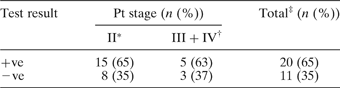
All patients underwent the fistula test. This test was positive in 20 patients and negative in 11 patients, giving a positive fistula test rate of 65 per cent (20/31 patients). In patients with a stage II fistula, the fistula test was positive in 15 (65%) patients and negative in eight (35 per cent). In patients with a stage III or IV fistula, the fistula test was positive in five (63 per cent) patients and negative in three (37 per cent). The positive fistula test rate did not correlate with the progress of the labyrinthine fistula (Table I).
Fistula test results
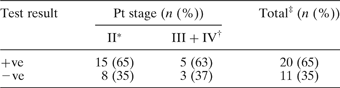
p = 0.89, for stage II vs stage III + IV. *n = 23; †n = 8; ‡n = 31. Pt = patient; +ve = positive; −ve = negative
Site and stage of fistula
The most frequent site of labyrinthine fistula was the horizontal semicircular canal (28 patients, 90 per cent). The labyrinthine fistula was located in the posterior canal in one (3 per cent) patient, and in the combined superior and horizontal canals in two (7 per cent) patients.
Twenty-three (74 per cent) patients had a stage II fistula, seven (23 per cent) had a stage III fistula and one (3 per cent) had a stage IV fistula.
Surgical technique
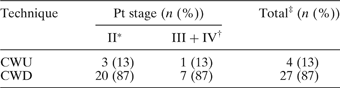
The canal wall down technique was used in 27 (87 per cent) patients and the canal wall up technique in four (13 per cent). The canal wall down technique was used regardless of the progression of the disease (stage II, 87 per cent; stage III and IV, 87 per cent; Table II). In all patients, the cholesteatoma matrix was completely removed. The material inserted to seal the fistula was bone dust and temporalis fascia in 29 (94 per cent) patients and temporalis fascia only in two (6 per cent) patients.
Surgical techniques used
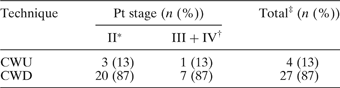
*n=23; †n = 8; ‡n = 31. Pt = patient; CWU = canal wall up; CWD = canal wall down
Disequilibrium outcome
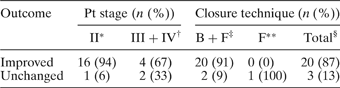
Twenty-three patients with labyrinthine fistula complained of vertigo and dizziness pre-operatively. After surgery, vestibular symptoms improved in 20 of these patients (87 per cent) and remained unchanged in three (13 per cent). No patients developed new vestibular symptoms post-operatively. In patients with a stage II fistula, vestibular symptoms improved in 16 (94%). In patients with a stage III or IV fistula, vestibular symptoms improved in four (67%). Vestibular symptoms improved in 20 patients (91 per cent) whose fistula had been closed with bone dust and temporalis fascia (Table III). The closure technique was significantly statistically correlated with patients' disequilibrium outcome (p < 0.01).
Disequilibrium outcomes
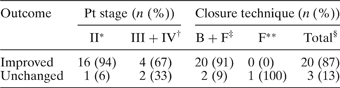
p = 0.08, for stage II vs stage III + IV; p < 0.01, for B + F vs F. *n = 17; †n = 6; ‡n = 22; **n = 1; §n = 23 (i.e. patients complaining of pre-operative vertigo and dizziness). Pt = patient; B = bone; F = temporalis fascia
Post-operative hearing
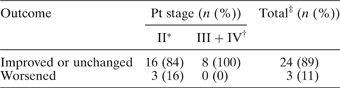
A post-operative hearing test was administered to 27 patients; seven (26 per cent) showed improved hearing, 17 (63 per cent) showed no change and three (11 per cent) showed a deterioration. Patients' post-operative hearing loss ranged from 10 to 13.3 dB, with a mean of 11.7 dB. No patient suffered post-operative deafness. Post-operative hearing outcomes were compared by dividing patients into two groups, comparing those with a stage II fistula (i.e. endosteum intact) versus those with a stage III or IV fistula. In the stage II fistula group, 16 (84 per cent) patients had improved or unchanged hearing and three (16 per cent) had impaired hearing. In the stage III plus IV fistula group, all patients (100 per cent) showed improved or unchanged hearing (Table IV). There was no statistically significant relationship between the progress of the labyrinthine fistula and the hearing outcome.
Post-operative hearing outcomes
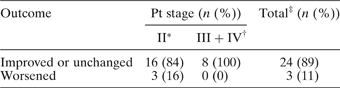
p = 0.23, for stage II vs stage III + IV. *n = 19; †n = 8; ‡n = 27 (i.e. patients undergoing post-operative hearing test). Pt = patient
Discussion
The results of the present study of surgical treatment of labyrinthine fistula with cholesteatoma highlight current controversies regarding this condition and its surgical management. Debate continues regarding the best surgical management for preservation of inner-ear function. The present study aimed to evaluate the clinical features of labyrinthine fistula in patients with cholesteatoma and to investigate the surgical technique used, including the handling of the matrix over the fistula.
In this study, the incidence of labyrinthine fistula was 6 per cent. This incidence is similar to findings reported by other authors,Reference Sheehy and Brackmann1–Reference Dornhoffer and Milewski7 in which they reported that the most common site is the horizontal semicircular canal. Most authorsReference Copeland and Buchman2–Reference Dornhoffer and Milewski7 reported that the most common site is the horizontal semicircular canal. In this report, 90 per cent patients had a labyrinthine fistula involving this structure. The incidence of patients with multiple fistulae (7 per cent) was consistent with other studies.Reference Copeland and Buchman2–Reference Palva and Ramsay8
The rate of a positive fistula test in patients with a cholesteatoma has been reported as 40 to 80 per cent;Reference Sheehy and Brackmann1, Reference Palva and Ramsay8, Reference Gacek9, Reference Hakuba, Hato, Shinomori, Sato and Gyo12, Reference Rizer and House13 in the current study, it was 65 per cent. Because the fistula test is easy to conduct in the out-patient clinic, it is a serviceable pre-operative test for the presence of a labyrinthine fistula. If the labyrinthine fistula is visible, direct touch is helpful in pinpointing its exact site.Reference Hakuba, Hato, Shinomori, Sato and Gyo12
A canal wall up technique is the procedure of choice for cholesteatoma. However, in patients with a labyrinthine fistula a canal wall down technique is preferred (being used in 87 per cent of patients in our series). The criteria for selecting a canal wall down technique were the presence of very significant bone destruction of the posterior canal and atelectasis of the middle ear. In such cases, surgery should be performed carefully. Surgical options for the treatment of labyrinthine fistula vary greatly. Likewise, protocols for addressing the matrix over the fistula vary in different groups. Some surgeons advocate preservation of the matrix,Reference Gacek9 while others advocate its total removal.Reference Merhy and Suarez5, Reference Sanna, Zini, Gamoletti, Taibah, Russo and Scandellari6, Reference Palva and Ramsay8, Reference Kobayashi, Sato, Toshima, Ishidoya, Suetake and Takasaki10 The former believe that preservation of the matrix over a fistula protects hearing function. The latter believe that preservation of the matrix worsens the patient's condition and that complete removal prevents further complications.
Palva and Ramsay recommend the canal wall up technique and always remove the matrix during the first operation.Reference Palva and Ramsay8 Kobayashi et al. recommend a one-stage, open method tympanoplasty and emphasise that careful manipulation of the semicircular canal can be conducted without damaging cochlear function; they stress that treatment of the labyrinthine fistula should be performed delicately.Reference Kobayashi, Sato, Toshima, Ishidoya, Suetake and Takasaki10 Gacek recommends that the matrix of a small fistula (i.e. less than 2 mm in size) can be removed safely, while the matrix of a large fistula (more than 2 mm) should be left over the fistula.Reference Gacek9 However, Gacek advocates that the decision to remove the matrix should be based on the surgeon's ability and experience, and on the location and size of the fistula and the function of the ear. Sheehy and BrackmannReference Sheehy and Brackmann1 recommend performing the canal wall up technique in two stages, with removal of the matrix over the fistula during the second stage. Sanna et al. recommend leaving the matrix over the fistula in all cases in which a canal wall down technique is performed.Reference Sanna, Zini, Gamoletti, Taibah, Russo and Scandellari6 On the other hand, when a canal wall up technique is performed, they believe that the matrix can be removed safely in the case of a small fistula, but that the matrix of a medium or large fistula should be left over the fistula and removed in the second stage.
Copeland and Buchman, who reviewed 1018 patients with labyrinthine fistula, publishing their findings in 25 articles, reported that hearing results were equally well preserved in patients undergoing complete and incomplete removal procedures.Reference Copeland and Buchman2 In other words, both surgical procedures involve the risk of inducing hearing loss. Ultimately, the choice of surgical technique for a labyrinthine fistula is determined by the patient's general condition, the ipsi- and contralateral hearing thresholds, and the skill and experience of the surgeon.
Conclusions
In this report, the incidence (between 1995 and 2005) of labyrinthine fistula was 6 per cent, and 90 per cent were found to occur in the horizontal semicircular canal. In all patients, the cholesteatoma matrix over the fistula was completely removed during the first operation. The bone conduction hearing level was preserved in 89 per cent of patients. Therefore, a cholesteatoma with labyrinthine fistula should be treated according to the degree of eradication required. The choice of surgical method should depend on various factors, such as the patient's general health, auditory and vestibular condition, location and classification of the fistula, and the skill and experience of the surgeon.