Introduction
A prominent feature of public management reform during the last decades has been the devolution of tasks and services to semi-autonomous entities (Christensen and Lægreid Reference Christensen and Lægreid2001; Pollitt et al. Reference Pollitt, Bathgate, Caulfield, Smullen and Talbot2001; Pollitt and Talbot Reference Pollitt and Talbot2004; Verhoest et al. Reference Verhoest, Van Thiel, Bouckaert and Lægreid2012). Moving public services “further out” from political control (Pollitt Reference Pollitt2004) actualises a potential trade-off between control and autonomy (Christensen and Lægreid Reference Christensen and Lægreid2006; Bovens et al. Reference Bovens, t´Hart and Schillemans2008) and raises concerns over accountability deficits – a deficiency of political control by elected representatives (Mulgan Reference Mulgan, Bovens, Goodin and Schillemans2014). A substantial body of literature has explored accountability issues related to statutory bodies, which are agencies with high degrees of autonomy but clear linkages to a parent ministry (Pollitt et al. Reference Pollitt, Bathgate, Caulfield, Smullen and Talbot2001; Verhoest et al. Reference Verhoest, Roness, Verschuere, Rubecksen and MacCarthaigh2010). However, these agencies constitute the penultimate case of devolution at best. More severe accountability deficits would logically be assumed in cases where public tasks are divested to even more autonomous bodies, such as state-owned enterprises (SOEs). Transferring public service provision and task fulfilment to an SOE entails a profound departure from traditional modes of public sector control and accountability. However, the implications of this shift in accountability are poorly understood. While there is a long-standing debate on the transition from public administration to public management and the general implications of this shift for accountability (Painter Reference Painter1988; Hughes Reference Hughes1992), only recently has a growing awareness of the specific accountability problems associated with SOEs been evident (Luke Reference Luke2010; Bruton et al. Reference Bruton, Peng, Ahlstrom, Stan and Xu2015; Grossi et al. Reference Grossi, Papenfuß and Tremblay2015; Olsen et al. Reference Olsen, Solstad and Torsteinsen2017). Following the pervasive “corporatisation” of the public sector in many countries, increasing attention to market signals and corporate strategy may divert attention away from the political agendas of elected principals. But as noted by Caiden (Reference Caiden1994), “all public administration is political: it is an instrument of politics and political values dominate”. To the extent that policy-makers persist in using SOEs as instruments for achieving politically decided goals, improved understanding of the preconditions for democratic control and accountability is clearly needed.
We argue that the specific accountability problems associated with SOEs can only be understood properly by examining how the challenge of ensuring control and accountability has been met in the world of private enterprise. The private sector approach to accountability is commonly referred to as corporate governance (Berle and Means Reference Berle and Means1933; Blair Reference Blair1995; Hart Reference Hart1995), a rather elusive and multidimensional term. From a legal standpoint, corporate governance refers to structures and procedures laid down by corporate law, such as governing bodies and the distribution of roles and authority between them. From an analytical perspective, corporate governance relates to a growing body of work aspiring to create a global corporate governance theory.Footnote 1 Corporate governance is clearly a normative system, epitomised notably by the G20/OECD Principles of Corporate Governance (OECD 2015a).Footnote 2 In the present context, we conceptualise corporate governance as a system of accountability relations (Bovens et al. Reference Bovens, t´Hart and Schillemans2008). As such, we contrast corporate governance with the accountability relations found in traditional models of public administration. We argue that accountable governance of SOEs requires reconciliation of the disparities between these two systems of accountability relations.
To this end, we propose a model for structuring accountability relations between SOEs and governmental owners based on the distinction between political and managerial accountability. A key aspect to the model is that democratic control requires SOE managers to be accountable to elected politicians for issues pertaining to goal definition and goal obtainment. In order to safeguard managerial autonomy, however, the responsibility for overseeing SOEs in matters related to running operations should primarily reside with top managers. This model’s relevance is tested empirically, based on data from our study of SOEs in Norway’s local government sector (Bjørnsen et al. Reference Bjørnsen, Klausen and Winsvold2015).Footnote 3 We examine how political and managerial accountability relations play out through the different “phases” of account giving. Our key hypothesis is that account giving, structured in accordance with the model we propose, is associated with positive evaluations of overall accountability and control.
Public versus private sector accountability
Accountability, in a literal sense, means being called “to account” to some authority for one’s actions (Jones Reference Jones and Leach1992). As has been noted, although accountability is a contested and widely used concept, many authors agree to a considerable extent about the term’s defining features (Brandsma and Schillemans Reference Brandsma and Schillemans2013). In what follows, we choose to take as a point of departure Bovens’ (Reference Bovens2007) commonly cited “narrow” definition of accountability as “a relationship between an actor and a forum, in which the actor has an obligation to explain and to justify his or her conduct, the forum can pose questions and pass judgment, and the actor may face consequences” (p. 450).Footnote 4 This definition has been reformulated by Schillemans (Reference Schillemans2011) as three “phases” of account giving: in the information phase, the actor provides information about his or her conduct; in the discussion phase, the forum may ask questions and the actor is obliged to answer; and in the consequence phase, the forum may pass a judgement and make the actor face consequences.
Established conceptions of representative democracy and public administration, such as the parliamentarian system of government, rely on a comprehensive chain of accountability relations (Hughes Reference Hughes1992; Fuller and Roffey Reference Fuller and Roffey1993; Parker and Gould Reference Parker and Gould1999). Bureaucrats on all levels, from street-level service providers and up, are accountable to their superiors, and top public managers are accountable to ministers (Barberis Reference Barberis1998; Hodge and Coghill Reference Hodge and Coghill2007; Mulgan Reference Mulgan, Bovens, Goodin and Schillemans2014). In turn, ministers are accountable to parliament, and finally, parliament is accountable to the people. We will refer to the representative system of control and accountability as the “integrated” model, since democratic accountability relies on an unbroken chain of accountability relations between hierarchically ordered agents and forums.Footnote 5 In each relation, the agent is obliged to provide information and clarification about his or her conduct. The forum can ask questions, pass judgement and make the agent face the consequences of his or her behaviour (Bovens Reference Bovens2007).
In the literature on public sector accountability, the integrated model of democratic accountability has been problematised from several angles. Johnson (Reference Johnson and Barker1982) warned that, in practice, the controlling effect of ministerial accountability is often extremely limited. At the extreme end of the spectrum, critics have depicted ministerial accountability as a “system for the mutually-reinforcing active concealment of government action and public purposes” (Lewis and Longley Reference Lewis and Longley1996). Barberis (Reference Barberis1998) contended that the traditional accountability doctrine always “lived on a wing and a prayer”, partially due to elements of ambiguity and confusion surrounding the concept. Notably, erosion of ministerial responsibility occurs when senior officials, instead of the responsible minister, are called to account for decisions that have gone awry. Even so, ministerial accountability and the integrated model overall remain the cornerstones of public sector accountability.
A paradigmatic change in the conceptualisation of public sector accountability came with the transition from the traditional model of public administration to new models of public “management” (Allison Reference Allison and Lane1982; Painter Reference Painter1988; Gray and Jenkins Reference Gray and Jenkins1995). A key distinction is that public management not only involves carrying out policies decided by others but also involves “organisation to achieve objectives with maximum efficiency, as well as genuine responsibility for results” (Hughes Reference Hughes1992). Bureaucrats consequently attain a role more similar to that of top managers in private enterprises. In what follows we focus on the implications for democratic accountability of the transition from public administration to public management, and specifically the introduction of corporate governance to the public sector. We conceive of corporate governance as the private sector counterpart of the integrated model of public sector control and accountability. Corporate governance has been portrayed as a system of checks and balances on managerial behaviour, a system for delimiting the managers’ ability to pursue their personal agendas (Blair Reference Blair1995; Hart Reference Hart1995). The need for such checks and balances stems from the dispersion of listed companies’ ownership between large numbers of small owners. Shareholders are often too small and numerous to exercise control on a day-to-day basis, and individually, they have little or no incentive to monitor management (Hart Reference Hart1995). Thus, dispersed ownership necessitates a separation between ownership and control (Berle and Means Reference Berle and Means1933), or in other words, delegation of authority to the company’s management. Hence, to some extent, delegation of authority is a practical necessity. At the same time, providing managers with discretionary powers is a strategy for maximising returns. These twin purposes of practical necessity and revenue maximisation were elucidated by the OECD (2015a) as follows:
As a practical matter (…) the corporation cannot be managed by shareholder referendum. (…) The corporation’s management must be able to take business decisions rapidly. In light of these realities and the complexity of managing the corporation’s affairs in fast moving and ever changing markets, shareholders are not expected to assume responsibility for managing corporate activities. The responsibility for corporate strategy and operations is typically placed in the hands of the board and a management team that is selected, motivated and, when necessary, replaced by the board. (p. 18)
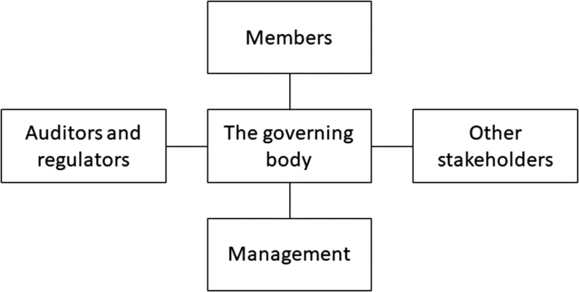
Following this, a key aspect of corporate governance is avoiding undue interference from the owners in day-to-day management decisions. Managerial autonomy may, however, give rise to agency problems. The owners of the enterprise have reasons to fear that the manager will promote a personal agenda, for instance, by seeking extravagant perks. A key institutional mechanism to counter such pathologies is the introduction of a governing body that acts on the owner’s behalf to oversee and provide directions to management. This system is depicted by the simplified model of corporate governance provided by Tricker (Reference Tricker1995), who defined corporate governance as the “formal and informal relationships, networks and structures” between five classes of actors, namely members, the governing body, management, auditors and regulators and other stakeholders (Figure 1).
Model of corporate governance.

Management (the chief executive officer, CEO) is accountable to the governing body (the board), which is in turn accountable to the “members” (owners). In this way, corporate governance enables maximisation of returns by allowing management to make quick decisions to adapt to rapidly changing markets, while at the same time, keeping tabs on management to prevent and correct agency problems.Footnote 6 Thus, in principle, a working balance between autonomy and control is achievable, even in enterprises with many small owners.
Unlike many listed enterprises, SOEs often have one or a few large owners. As noted by Hart (Reference Hart1995), unified ownership creates an entirely different situation in terms of generating leeway for direct control by the owners, as compared with dispersed ownership: if a company has one 100% shareholder, there is no longer a separation between ownership and control. Indeed, this scenario has traditionally been typical of SOEs. Historically, public ownership, especially of monopolies for the provision of goods like electricity, telecommunications and railways, entailed extensive direct governmental intervention in running operations (Thynne Reference Thynne2011). The idea that SOE managers should be protected against intervention from their owners is relatively recent, and it can largely be traced back to the advent of New Public Management (NPM) (Hood Reference Hood1991; Kettl Reference Kettl1997). A transition from “ownership as regulation” to “ownership and regulation” (Thynne Reference Thynne2011) took place as large government monopolies were dissolved, from the 1980s and onward. Institutional separation of regulatory functions from ownership of enterprises was a prerequisite for ensuring a level field of competition between public and private providers. Furthermore, scaling back direct state intervention in the SOE’s running affairs was in line with the much-cited slogan “Let the managers manage” – a key tenet of NPM (Aucoin Reference Aucoin1990; Kettl Reference Kettl1997). The intention was to increase efficiency by insulating operational decisions from political interference (Bognetti and Obermann Reference Bognetti and Obermann2012; Zatti Reference Zatti2012).
The institutional set-up of SOEs includes many features that serve to insulate operational decisions from considerations other than business-related ones. As Mulgan (Reference Mulgan1997) noted, the rationale for contracting out – efficiency gains – can largely be attributed to the ways in which reduced accountability allows greater flexibility and innovativeness in day-to-day operations, for instance, in terms of more flexible employment procedures and a reduced risk of being blamed for mistakes, as compared with blame-gaming in the public sector (Hood 2002, Reference Hood2011). Perhaps unsurprisingly, the overall impression from extant research is that the balance between management autonomy and “political interference” tends to tip in favour of the former. In his study of “hybrid” organisations in the United States (US) government, Koppell (Reference Koppell2003) concluded that “the political cost of quasi-government (…) is a loss of control over public policy” (p. 164). Similarly, Christensen et al. (Reference Christensen, Lægreid, Peters and Bouckaert2004) noted that structural devolution means a decrease in political authority and the capacity for exercising control and less attention to political considerations in state-owned companies. In their Guidelines on Corporate Governance of State-Owned Enterprises, the OECD (2015c) warned against the “lack of any oversight due to totally passive or distant ownership” (p. 12). The general dilemma of importing corporate governance to the public sector is clearly to ensure democratic accountability and control, while allowing managerial autonomy. In the following section, we propose a theoretical model for accountable SOE ownership that seeks to reconcile the dilemma.
A model for accountable SOE ownership
The nascent literature on accountability problems related to SOEs provides certain clues as to how the dilemma of reconciling autonomy and accountability may be resolved. Based on interviews with SOE executives in New Zealand, Luke (Reference Luke2010) identified a complex pattern of accountability relations with multiple stakeholders, including managerial and political principals, the public in different capacities (taxpayers, citizens, voters, customers and creditors) and professional and legal stakeholders. Overall, Luke’s (Reference Luke2010) study found that the accountability structure surrounding SOEs “is perhaps more coherent and extensive than many commentators either realise or acknowledge” (p. 158). Especially, Luke noted that “SOEs” managerial accountability to Government should be distinct from SOEs’ political accountability to Government’. Although this distinction at times appeared blurred, the importance of demarcating the boundaries between managerial and political issues was emphasised (p. 157). Indeed, one of the implications for practice that emerged from Luke’s (Reference Luke2010) study was a recommendation that “Second, the separation of managerial and political functions should be clearly documented and included as part of a SOE regulatory framework, so that both SOEs and Government can be held accountable for fulfilling their respective roles.” (p. 158).
The distinction between political and managerial accountability was also taken up by André (Reference André2010), who underscoredFootnote 7 the importance of a clear mission statement as a requirement for meaningful accountability. In contrast, he also noted that “bureaucratic controls and systems comprise the government methods for keeping GSOsFootnote 8 accountable” (André Reference André2010). Accordingly, accountability requires a distinctly political regard for the mission of the SOE and its accomplishment, as well as functional procedures for bureaucratic oversight.
Similarly, in his study of “The Politics of Quasi-Government”, Koppell (Reference Koppell2003) emphasised the distinction between control over mission-related and non-mission-related preferences. Mission-related preferences are those that “strike at the centre of an organization’s function”, utilising an organisation’s core technology or competence. Non-mission-related preferences “relate to the manner in which an agency pursues its objectives” (pp. 72–73) and are often of a procedural nature. Koppell alleged that the preconditions for achieving control over each type of preference may differ. Notably, the choice of institutional structure may affect the relative degree of control over each type of preference. Politicians may, for instance, choose to cede control over non-mission-related preferences in the name of efficiency if they retain control over mission-related preferences.
Following Koppell’s (Reference Koppell2003) conclusions, the key to reconciling the democratic accountability/managerial autonomy dilemma may lie in an institutionalised separation of SOE account giving related to mission-related and non-mission-related preferences. SOEs should be accountable to the elected principals of their governmental owners in matters pertaining to goal definition and goal attainment, or in other words, mission-related preferences. In contrast, elected representatives should delegate the responsibility for overseeing SOEs in matters related to running operations (non-mission-related preferences) to top public managers. The advantages of delegating oversight of running operations to managers are manifold. An obvious practical advantage is that public managers may draw on the capacity and specialised competence of the public administration to exercise this control function. An advantage that relates more directly to the general autonomy–accountability dilemma, however, is that SOEs are not part of the governmental owner’s organisation. Public managers are institutionally constrained from interfering in decisions made by the management of the SOE. Only the owners, on the general assembly, can hold the SOE to account. The implication is that the accountability relationship between the public owner and SOE on matters pertaining to non-mission-related preferences should be of an indirect nature.
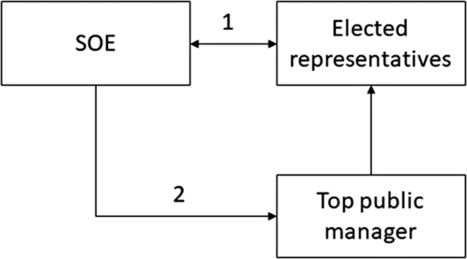
With reference to the three-phase conceptualisation of accountability mentioned above (Schillemans Reference Schillemans2011), “information” on mission-related preferences should flow directly from the agent (SOE) to the forum (elected representatives). However, for non-mission-related preferences, top public managers should be a primary recipient of “information”, and as such, they should occupy an intermediate position between the agent and forum. Top public managers should also play a role in the “discussion” phase, in the sense that they should detect signs of malfeasance or actions that could potentially infringe on mission-related preferences and call this to the attention of elected representatives. As for the “consequences” phase, which may involve replacing the board or changing the SOE strategy, the elected representatives are the forum in all cases. Figure 2 depicts the distinction between the direct accountability relation pertaining to mission-related and non-mission-related preferences.
Model for structuring accountability on mission-related (1) and non-mission-related (2) preferences.

In the model in Figure 2, line 1 represents the direct accountability relationship between the SOE and elected representatives on mission-related preferences. Note that line 1 points both ways because the relationship involves both account giving and consequences. Line 2 represents non-mission-related preferences, and it points from the SOE to the managerial level of the government owner before the information is passed on to the political level.
The aim of what follows is empirically testing the relevance of this model. We adopt the following Hypotheses 1 and 2:
(H1): Accountability and control are evaluated more positively if information about mission-related preferences (goal definition or goal obtainment) is addressed to elected representatives rather than chief managers.
(H2): Accountability and control are evaluated more positively if information about non-mission-related preferences (day-to-day decisions) is addressed to chief managers rather than elected representatives.
The following section presents the empirical context for the analysis.
Empirical context: Local SOEs in Norway
The empirical context of the present study is SOEs in the local government sector. SOEs have become a prominent feature of local government service provisions in several European countries (Warner and Hebdon Reference Warner and Hebdon2001; Kuhlmann Reference Kuhlmann2008; Bognetti and Obermann Reference Bognetti and Obermann2012; Citroni et al. Reference Citroni, Lippi and Profeti2013; Wollmann et al. Reference Wollmann, Koprić and Marcou2016). The “demise of in-house production” (Denters and Rose Reference Denters, Rose, Denters and Rose2005) and the ensuing “corporatisation” of the local government sector (Teles Reference Teles2015) have proceeded markedly, not least in Norway (Aarsæther and Vabo Reference Aarsæther and Vabo2002; Gjertsen and Martiniussen Reference Gjertsen and Martiniussen2006; Aars and Ringkjøb Reference Aars and Ringkjøb2011; Bjørnsen et al. Reference Bjørnsen, Klausen and Winsvold2015). At present, almost all local governments in Norway own at least one SOE, alone or as one of several owners. The Norwegian context, therefore, provides a unique opportunity to investigate variations in perceived control over municipal owner interests.
In Norway, local governments are largely free to decide on their own administrative structures.Footnote 9 A wide range of semi-autonomous organisational forms is available for organising municipal tasks. Because we aim to analyse how corporate governance as a private sector accountability system works in conjunction with the “integrated” model of public sector accountability, our study was delimited to the two forms that correspond most closely to regular private enterprises: limited liability corporations based on corporate law (Ltd) or “Intermunicipal Companies” (IMCs), mandated by the Intermunicipal Companies act (Bjørnsen et al. Reference Bjørnsen, Klausen and Winsvold2015). Both the Ltd and IMC forms designate SOEs as independent legal entities. The former is used by both private and public owners, but the latter can only be owned by a group of municipalities. Unlike Ltds, IMC owners take on unlimited liability for the company’s obligations. Furthermore, the ownership structure of an IMC is determined by an ownership agreement, which can only be changed by a joint decision – there are no freely transferrable shares. Otherwise, the two forms are similar. The owners exert their authority in the general assembly (corporate assembly in IMCs), notably by deciding on the annual documents and appointing the company board. The CEO is chosen by, and is accountable to, the board.
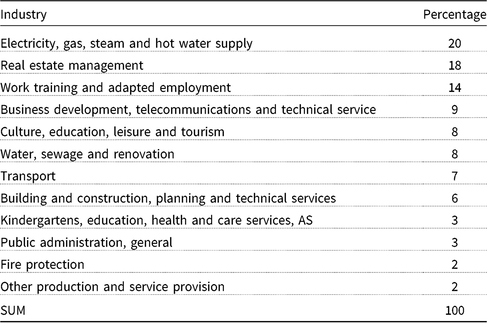
At the time of study, there were 2,020 SOEs held by local governments in Norway, of which 1,775 were Ltds and 245 were IMCs (Bjørnsen et al. Reference Bjørnsen, Klausen and Winsvold2015). These companies belonged to a broad variety of industries. Table 1 presents these SOEs organised by branch.
Norwegian local state-owned enterprises by branch of industry (2014)*

Note: N = 2,020.
* Limited corporations (Ltd.) and Intermunicipal Companies (IMC). Each Ltd or IMC may comprise one or several units.
Source: Register of Business Enterprises/Brønnøysund Register Centre.
On average, each municipality owned slightly less than 7 SOEs, varying between 3 on average for very small municipalities (less than 5,000 inhabitants) and 22 on average for large ones (more than 20,000 inhabitants).
Data and methods
The data used in this study are taken from a web-based survey of all Norwegian municipalities that own at least one SOE. According to data from the Norwegian Register of Business Enterprises, by 2014, 407 of Norway’s then 430 municipalities fell in this category. In October 2014, these 407 municipalities received an email containing a link to the survey, with the instruction to pass it on to the manager incharge of overseeing the municipality’s SOEs. In smaller municipalities, this would be the chief officer (CO), whereas in larger cities, the manager in charge would be situated one or two rungs lower in the municipal hierarchy, acting on delegated powers from the CO. We refer to the respondents as CO’s, since regardless of their exact position, being responsible for overseeing the municipalities’ SOEs, they act in the role of CO. Emailed reminders were distributed twice, after two and four weeks. In total, 223 municipalities out of 407 participated in the survey, resulting in a 55% response rate. Because 53 respondents did not complete the survey in full, the response rate for the complete survey was 43%.
Small municipalities and municipalities with few SOEs are underrepresented in the net sample. Forty-four percent of municipalities below 5,000 inhabitants responded, as compared to 65% of municipalities above 5,000. While 70% of municipalities owning 10 SOEs or more responded, the response rate was 52% for municipalities owning fewer than 10 SOEs.Footnote 10 Otherwise, the municipalities in the sample are representative of Norwegian municipalities in terms of income distribution (free income per capita) and geographical spread.
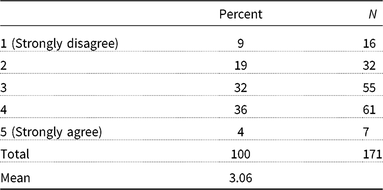
Survey respondents were asked to assess the perceived level of control with ownership interest on a 5-point Likert scale.Footnote 11 The distribution on the dependent variable, displayed in Table 2, reveals substantial variation in perceived control.
The municipality exerts adequate control over its ownership interests
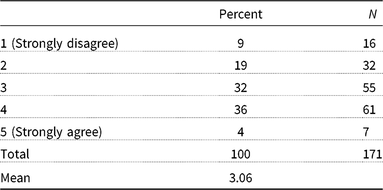
Note: Distribution on dependent variable. N = 171.
Source: Survey.
To test whether variation in perceived control can be attributed to accountability practices, the respondents were asked to report the use of such practices. We distinguish between accountability practices pertaining to mission-related and non-mission-related preferences, involving the elected representatives and/or the administration. We further distinguish between three phases of accountability as presented earlier: the information phase, the discussion phase and the consequence phase (Schillemans Reference Schillemans2011).
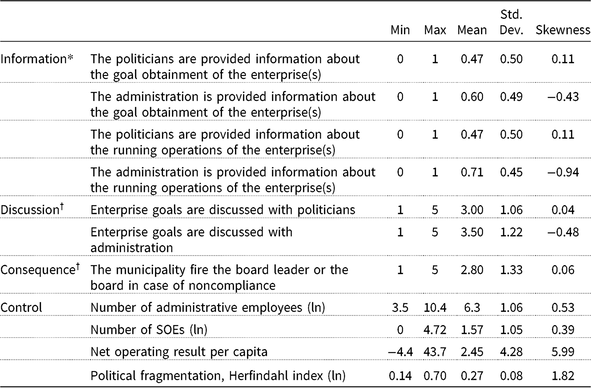
Accountability practices in the information phase were gauged by four items on whether or not the politicians and the administration, respectively, were informed of non-mission-related goals (running operations) or mission-related goals (goal obtainment). As for the discussion phase, the respondents were asked whether goal and performance requirements were discussed in political forums and in the municipal administration, respectively. Whereas accountability practices in the two first phases can involve both elected representatives and the administration, passing judgement – the consequence phase – is the prerogative of the elected council. Therefore, accountability practice in the third phase was measured by one single question relating to elected representatives only: the respondents were asked to report whether the council would fire the board in case of noncompliance.
The distributions of the various accountability mechanisms are presented in Table 3.
Independent variables. Mean values, standard deviation and skewness

Note: N = 169.
* Dichotomous variables, no = 0, yes = 1. The variable is coded 1 if respondents report that either the board of aldermen or the council or both are provided information.
† 5-point Likert scale from 1 (strongly disagree) to 5 (strongly agree). “Politicians” refer to the board of aldermen and/or the council.
Source: Survey.
The mean values indicate that both in the information and discussion phases, accountability practices more often involve the administration than the politicians: in 60% of the municipalities the administration is informed about goal obtainment, as compared to 47% for politicians. For running operations, the percentages are 71 and 47, respectively. As for the discussion phase, more respondents agree that enterprise goals are discussed with the administration than with the politicians. All variables are rather symmetrical and fairly spread out.
To assess the impact of the various accountability practices on perceived control, we perform an ordered logistic regression (OLR). The model estimates the odds ratio and z-scores for each independent variable. Odds ratios smaller than 1 signify a negative relationship, whereas odds ratios larger than 1 signify a positive relationship. The higher the z-score, the higher the relevance of the variable.Footnote 12
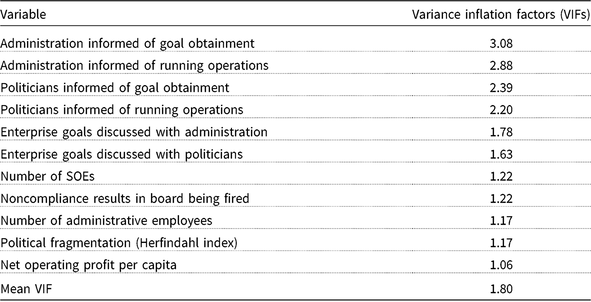
Analysis of data taken from nonexperimental settings such as surveys is susceptible to a number of validity threats including omitted variables, common method variance/common source bias (CSB) and reverse causality (Antonakis et al. Reference Antonakis, Bendahan, Jacquart and Lalive2010). Omitted variable bias occurs if the model attributes the effect of missing variables to the estimated effects of the included variables. While sample size delimits the number of variables in the model, we included four theoretically grounded, non- or modestly correlated variables to reduce the risk of underspecifying the model. Firstly, we expect the size of the municipal administration (number of employees) to affect the capacity for oversight, and thereby the sense of control. Secondly, we included the net operating result, a much-used indicator of sound fiscal management (Borge Reference Borge2005) to control for variations in managerial capacity more generally. Thirdly, we include the number of SOEs owned by the municipality in the model although expectations are ambiguous. Increasing the enterprise portfolio could either impair the sense of control because the control span widens or increase the sense of control because the administration gains improved competence through specialisation. Fourthly, we include a measure of political fragmentation in the council. We expect councils composed of many small party groups to be less capable of consistent communication with the administration than councils dominated by fewer and larger parties, thus impairing the sense of control. Political fragmentation is measured by the Herfindahl index score (HIS), computed as the sum of squared shares of seats in the council for each party. HIS = 1 (minimal fragmentation) occurs if all seats are held by one single party (Borge Reference Borge2005).
CSB is a salient and long-standing methodological issue in research fields relying on survey data (Doty and Glick Reference Doty and Glick1998; Podsakoff et al. Reference Podsakoff, Mackenzie, Lee, Podsakoff and Zedeck2003; Meier and O’Toole Jr Reference Meier and O’Toole2010). Originally discussed by Campbell and Fiske (Reference Campbell, Fiske and Helson1959), the essence of the CSB problem is that a nonrandom component of the error term introduced by the measurement method may affect the dependent and the independent variables equally much, thus inflating positive effects and conflating negative effects (Meier and O’Toole Reference Meier and O’Toole2010). The severity of the CSB problem is, however, debatable. Examining 25 empirical studies published in prominent organisational research journals, Doty and Glick (Reference Doty and Glick1998) did find that correlations were overall inflated. However, in most cases, the bias in observed correlations was not sufficient to challenge the theoretical interpretation of the relationship (Doty and Glick Reference Doty and Glick1998).
The survey method is susceptible to a number of method biases, including social desirability (answering in line with social norms), acquiescence (yea-saying), consistency motifs (attempts to maintain consistency) or implicit theories (answering based on assumed causalities) (Podsakoff et al. Reference Podsakoff, Mackenzie, Lee, Podsakoff and Zedeck2003). Extant research indicates that such biases affect some kinds of assessments more than others. Cote and Buckley (Reference Cote and Buckley1987) found that concrete constructs that require limited judgement are less vulnerable to CSB. Similarly, Meier and O’Toole (Reference Meier and O’Toole2010) found that questions about “how managers spend their time, questions dealing with observable behavior (…) seem to be less affected by common source bias”. To mitigate CSB, we use indicators of a factual nature as independent variables, whereas the dependent variable is evaluative.
As for reverse causality, a distinct limitation of nonexperimental, survey-based research is that causal relationships (and hence the directionality of correlations) cannot be established based on the identification of statistically significant associations alone (Kleinbaum Reference Kleinbaum1998). In the present analysis, reverse causality would mean that the CO’s sense of control affects the structuring of information flows between the SOEs and elected representatives/COs – not the other way around, as assumed by the model. For the reverse causality assumption to hold, the COs would have to be capable of structuring the accountability process through deliberate intervention. The fact that SOEs as legally independent entities are not subsumed under the COs chain of command, but report directly to the mayor as the municipality’s representative in the general assembly, indicates that COs are not in a position to make such interventions. Because reverse causality cannot be ruled out entirely, we carry out a series of tests reported in a separate appendix available online. The test results corroborate the analytical model’s assumptions about causal ordering, suggesting that reverse causality is not a significant threat to the model’s validity.
Data on the municipal economy and size of the administration were obtained from the KOSTRA register (Municipality – State Reporting), provided annually by Statistics Norway. The number of SOEs per municipality was obtained from the Norwegian Register of Business Enterprises. The Herfindahl index for political fragmentation in the council was computed by the authors based on data from the Municipality Database.Footnote 13
In October and November 2014, the authors conducted 22 interviews with elected councillors and COs in 6 municipalities selected as “diverse” cases (Gerring Reference Gerring2017), reflecting variations in number of inhabitants, size of SOE portfolio and urbanity/rurality. All interviews were conducted by phone, recorded and transcribed by the authors. The interviews lasted between 20 minutes and 1 hour. Because extant research on accountability problems associated with local SOEs is scarce, interviews with informants in the municipalities formed a crucial part of our overall research strategy. In the current article, observations from the qualitative study supplement the results from quantitative analysis by providing a more nuanced, in-depth understanding of accountability practices and preconditions for democratic control and oversight.
Results
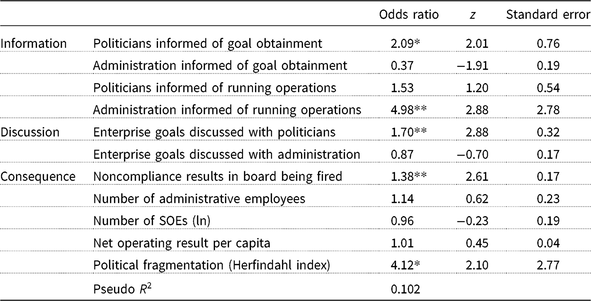
The results from the OLR analysis are presented in Table 4.
Managers’ assessments of municipal control over ownership positions

Note: Ordered logistic regression. N = 169
*p < 0.05, **p < 0.01.
Source: Survey.
The first two variables relate to the direction of the information flow on mission-related preferences (goal obtainment). As expected, providing politicians with information on goal obtainment increases the likelihood of expressing a higher sense of control. In contrast, providing information on goal obtainment to the administration does not increase the sense of control. The third and fourth variables indicate the recipients of information on non-mission-related preferences (running operations). As expected, providing such information to politicians does not significantly alter the perceived sense of control. Providing the administration with information on running operations, however, is associated with a more positive assessment of control. The fifth and sixth variables relate to the discussion phase, and more specifically, discussions about mission-related preferences (enterprise goals). As predicted by our model, discussing mission-related preferences with politicians is positively associated with the overall sense of control, whereas discussing enterprise goals with the administration does not significantly alter the likelihood of a sense of control. The seventh variable pertains to the consequences phase of SOE accountability. The results indicate that replacing SOE boards or board leaders in cases of noncompliance with the municipality’s preferences increases the likelihood of a heightened sense of control.
As for the control variables, political fragmentation correlates with the sense of control, although in an unexpected direction. Contrary to what we hypothesised, the sense of control seems to increase with increasing political fragmentation. One way of interpreting this somewhat surprising finding is to draw on insights from the literature on the effects of board diversity on firm performance. For instance, Lückerath-Rovers (Reference Lückerath-Rovers2013) suggested that demographically diverse boards tend to reach better decisions because a broader range of perspectives is taken into consideration. Diverse boards may stimulate the exchange of ideas, increase creativity and provide new insights (Watson et al. Reference Watson, Kumar and Michaelsen1993; Schippers et al. Reference Schippers, Den Hartog, Koopman and Wienk2003). Conversely, we may assume that a plurality of smaller party groups in the council stimulates political debate, hence improving political heedfulness on mission-related preferences. The other control variables did not correlate significantly with the dependent variable.
Interviews from the six case municipalities lend support to these results. COs, SOE managers and politicians alike recommended division of labour between the administration and the politicians: while politicians should be responsible for setting the goals of the SOEs and ensure that these goals are met, the COs should be responsible for monitoring the running operations. Such division of labour was referred to as proper and even as “natural”. A common thread in the informants’ lines of reasoning was that politicians set goals on the citizens’ behalf, so politicians should also supervise goal obtainment. However, the administration should supervise running operations because politicians lack detailed knowledge. The narrative about controlling SOEs was succinctly summarised by one mayor: “(As the people’s representatives) politicians should ask the big questions: Why is the quality of this service so bad? Why don’t people use this particular facility? Instead of drowning in details, we (the politicians) can ask: Why doesn’t this SOE meet the economic goals? If you are not happy (with the answers), you can fire the board”.
The norm prescribing division of labour between politicians and the administration was frequently referred to as “understanding of roles”. Politicians, COs and SOE managers were highly aware of their distinct roles, and regarded proper understanding of their own role as essential for retaining control. The leader of a large SOE in one of the case municipalities alleged flatly: “Unclear role understanding is the main chaos-inducing factor in public administration”.
It appears from the interviews that the distinct roles attributed to politicians and administration provide legitimacy for involvement towards enterprise goals and running operations, respectively. One CO mentions, for example, that she cannot interfere with SOE goal obtainment, because that is the “domain of the politicians” not of the administration. Likewise, politicians recount not only how they act with confidence and perceived legitimacy when posing questions about goal obtainment, but also how they stay away from the detailed tasks that are assumed to be the responsibility of the administration. The norm prescribing division of labour seems to incur a sense of control – not necessarily because it is the most efficient way of keeping control with the SOEs, but because it is perceived as the legitimate way of keeping control. It should be noted that a number of politicians think not “being in touch” with details impairs their ability to act as ombudsman for citizens in particular need of representation. Still, even these politicians indicate that the norms prescribing division of labour take precedence over any need to intervene on behalf of individuals or groups.
As for the nature and contents of the mission-related preferences, these seemed to vary considerably between different SOEs, according to their core tasks. Some municipalities chose to classify their SOEs using a rough categorisation of the purpose of ownership. One municipality distinguished between three categories. Ownership of SOEs with a financial purpose was motivated by the prospect of returns on investment. Hence, mission-related preferences for these SOEs mainly related to profitability. In contrast, the municipality did not expect SOEs with a societal purpose to provide revenues. Instead, these SOEs were held accountable for their effectiveness in terms of building roads and bridges, running the cinema or providing shielded workplaces for occupational rehabilitation. A third category, of special interest in the present context, was SOEs established with a political purpose. These SOEs included a science centre, concert hall, enterprise for regional business development and centre for promoting regional movie production. According to the municipality in question, realisation of the purpose of these SOEs would be difficult without political prioritisation and engagement. Consequently, ongoing political engagement and interaction with the management of these SOEs was seen as an integral part of their mode of operation not as “interference”. The management of the “financial” purpose SOEs, in contrast, was expected to operate much more autonomously in the period between general assemblies.
Clarifying the mission-related preferences for each SOE allowed the municipality to exert democratic control using the institutional structures of corporate governance; it did so, first, by formulating the statutes of each SOE at its establishment, and second, by discussing and deciding on the SOE’s strategic documents in the general assembly. These documents served as a basis for holding the SOE’s management accountable for mission-related preferences, while at the same time, avoiding infringement of managerial autonomy in the period between general assemblies.
Discussion
Any talk of accountability presumes a distinction between an “actor” to be called to account and a “forum” that receives information, carries out discussions and ultimately decides on consequences. In terms of public service provisions and task performance, given the vast range of forms in the “administrative zoo” (Pollitt Reference Pollitt2004) of governmental organisation, the nature and degree of the distinction between the accountor and accountee clearly varies significantly. The distinction is minimal in traditional public administration (Hood Reference Hood1991; Osborne Reference Osborne2010), in the sense that both parties to the accountability relationship are embedded in the same comprehensive, highly formalised and hierarchically organised system – hence the label “integrated” accountability. In contrast, the corporate form provides a high degree of managerial autonomy by design, while minimising “interference” by the owners. The implication is that the distinction between the actor and forum becomes much more marked. By conceptualising “corporate governance” as the private sector counterpart of the “integrated” model of accountability in the public sector, we sought to highlight the basic dilemma that arises from attempting to combine the two models: How can adequate levels of control be ensured, given a much higher degree of managerial autonomy?
Responding to this dilemma, we developed a model for structuring the accountability relation between SOEs and their public owners, based on extant research and our conceptual discussion. The model prescribes a distinction between the roles of top managers and elected representatives as “forums” for accountability (Figure 2). Our model emphasises a strong and direct role for politicians on matters related to SOE goals. In terms of the SOE’s running operations, however, the model prescribes an indirect relationship between elected politicians and the SOE. Introducing top public managers as primary recipients of information on the running operations of the SOE has the dual benefit of increasing the governmental owner’s capacity for oversight, and at the same time, insulating the management of the SOE from undue interference in day-to-day decisions. Top managers would be responsible for keeping politicians informed about running operations, especially in cases where there is reason to fear wrongdoing or breaches of legal standards. Because public managers cannot legally intervene directly in the running operations of the SOE, the autonomy of SOE management is preserved. Pursuant to corporate law, the “consequences” phase is a distinctly political domain in any case. However, because the top manager would be the primary recipient of information on running operations, political intervention due to non-mission-related preferences would only occur in the event of malfeasance.
The purpose of the empirical analysis was to gauge the relevance of our model. We assumed that accountability practices in line with the prescriptions of the model would be associated with a heightened sense of control over the SOEs. Overall, the analysis results supported our assumptions. The informants tended to evaluate their municipality’s degree of control more positively in cases where actual information flows, discussions and the consequences phase of the accountability process were structured as prescribed in the model. The ideal situation involves directing information and discussions on goal-related issues to politicians and leaving the administration out. In contrast, the administration is clearly seen as the correct recipient for information about running operations. Although these results seem encouraging, the model raises a number of issues that must be addressed before a conclusion about its utility can be made.
A basic premise of the model is role differentiation between elected politicians and public managers. On a general level, this feature of the model carries connotations of a “frontier” between politics and management (Pollitt and Bouckaert Reference Pollitt and Bouckaert2011). The practical relevance of such a frontier is certainly debatable. Recent management reforms may have brought about an invasion of the political domain by administrators, and conversely, invasion of the administrative domain by politicians (p. 161). Furthermore, extant research indicates that the politics–management divide tends to be blurred in “the apex” of local government organisation, in the sense that there is limited role distinction between the mayor and CO in practice (Mouritzen and Svara Reference Mouritzen and Svara2002). In light of this, the model’s reliance on differentiation between mission-related and non-mission-related fields of responsibility clearly requires further consideration. A first step is to note that the model does not imply that top public managers should be accountable for actions taken by the SOE management. With reference to current debate in the United Kingdom on civil servants’ accountability, we do not propose to distinguish between “accountability” and “responsibility” in such a way that elected politicians can avoid responsibility by pointing at top public managers while retaining formal accountability (HoL 2012). Placing the blame on the top public managers for actions taken by SOE management would clearly be untenable: SOEs are independent legal entities, and as such, not parts of the administrative hierarchy. However, the model underscores that top public managers are responsible for keeping well informed on SOEs and for keeping politicians in the loop about any relevant developments. In other words, while top public managers cannot be accountable for SOE misconduct, they can be held responsible for not passing on relevant information to their elected principals.
Following this, any problems of isolating non-mission-related preferences from mission-related preferences, and furthermore, deciding on what specific information political principals should receive, would need to be sorted out by top public managers. Indeed, the model suggests that sound discretion in terms of deciding on the kinds of information to pass on to political principals would be a key qualification of top public managers working for governments that own SOEs. The implication is that, while the managerial role of top public managers constricts by moving tasks and services outside of the governmental hierarchy, the controlling role of top public managers expands.
The “consequences” phase of the accountability relationship between the SOE and its municipal owners resides with elected politicians, regardless of what kind of preferences – mission-related or non-mission-related – are at stake. In the public eye, cases involving severe managerial defaults or downright malfeasance, for instance, in the form of corruption or embezzlement, would probably figure most prominently among the situations where SOE management is called to account. Uncovering such cases tends to occasion considerable media attention, as does the outcome of the consequences phase, for instance, the replacement of the board or even levelling of criminal charges. While obviously a crucial aspect to the role of elected politicians in holding SOEs accountable, there is also a less dramatic, and at times, strangely elusive element to the role of the municipality’s political principals as a forum, specifically, overseeing the SOE’s fulfilment of its purpose and considering the interchange between the SOE’s strategy and other politically relevant factors. This dimension of accountability relates directly to the municipal owner’s mission-related preferences, and as such, it is at the heart of democratic governance. Yet, the very idea of mixing business and politics is often seen as an abomination, not least in management circles. Possibly, ensuring accountability over non-mission-related preferences is deemed as more understandable and straightforward than holding SOEs accountable for mission-related preferences. Few, if any, would voice principled objections against municipal owners replacing the board of an SOE following an audit uncovering malfeasance or mismanagement. However, any talk about “political” considerations in the context of corporate strategy runs the risk of immediately being branded as inappropriate or inadmissible. Clearly, for the model proposed above to be workable, there is a need for clarifying the legitimate and proper place for politics in the context of SOEs.
One approach to answering this question is to note that, ultimately, the general purpose of all tasks and activities carried out in the public sector is to implement a political decision. Establishing an SOE or deciding to buy into a preexisting SOE does not change this fact. After all, many tasks divested to the SOEs included in our study were carried out administratively in other municipalities. A key to finding the proper place for politics in the context of SOEs may be clarifying the purpose of owning each SOE in particular.
Conclusions
Our point of departure was that political control over SOEs requires reconciliation of two disparate systems for control and accountability – the traditional “integrated” system of democratic government and private sector “corporate governance”. The article’s theoretical contribution is the development of a model that combines these very distinct accountability systems, thereby demonstrating how the principles of democratic political control can be maintained without jeopardising managerial autonomy. The qualitative data from our study indicate that politicians, COs and SOE managers in Norwegian local governments have developed certain norms, principles and procedures that enable them to navigate the murky waters of SOE governance, to retain political control without infringing on the prerogatives of SOE management. The conclusion from the qualitative analysis is that these practice-based understandings seem highly congruent with the theoretical model. While these findings from a limited sample of informants offer some reassurance as regards the relevance of the theoretical model, the survey to all Norwegian local governments put the qualitative findings on a more solid footing, largely supporting the findings from the qualitative studies. According to the perceptions of municipal COs, a precondition for effective control is that SOEs are accountable to elected politicians as regards goal formulation and goal obtainment; furthermore, that politicians ensure that there are consequences if set goals are not met. Concurrently, top managers should be responsible for overseeing running operations of the SOEs and report to their elected superiors to the extent that is required.
As noted, empirical studies on accountability practices towards SOEs are still scarce. Further empirical studies are needed in order to test the relevance of the model in other institutional settings and on other levels of government. While conceptions about key tenants of this private sector system of accountability and control seem to converge, one would expect significant variations between countries and business sectors. Conversely, there is no globally shared conception of parliamentary accountability either. Notably, we would like to see studies that emphasise the political goals that SOEs are set up to achieve, and the mechanisms that are used for ensuring democratic accountability while avoiding undue interference in managerial autonomy.
Supplementary material
To view supplementary material for this article, please visit https://doi.org/10.1017/S0143814X19000229
Acknowledgements
The authors would like to thank Tom Christensen, as well as two anonymous reviewers, for their thoughtful feedback on earlier drafts of this manuscript.
Data availability statement
Replication materials are available in the Journal of Public Policy Dataverse at https://doi.org/10.7910/DVN/TMO87V
Appendix
Survey questions and construction of variables
Dependent variable
(Q38) On a scale from 1 (strongly disagree) to 5 (strongly agree), to what extent would you say you agree to the following statement:
“The municipality exerts adequate control over its ownership interests”
Independent variables, information
(Q29_1) Who get information on the SOEs goal obtainment?
1. The board of aldermen 2: The municipal council 3: The municipal administration.
(Q29_2) Who get information on the SOEs running operations?
1. The board of aldermen 2: The municipal council 3: The municipal administration.
The variables used in the OLR model “The Politicians are provided information about the goal obtainment of enterprise(s)” and “The politicians are provided information about the running operations of the enterprise(s)” are coded 0 when neither the board of aldermen nor the municipal council is informed and 1 when either or both are informed.
Independent variables, discussion
(Q6) On a scale from 1 (strongly disagree) to 5 (strongly agree), to what extent would you say you agree to the following statement:
(Q6_1) “The goals and performance requirements of the SOEs are discussed in the board of aldermen”
(Q6_2) “The goals and performance requirements of the SOEs are discussed in the municipal council”
(Q6_3) “The goals and performance requirements of the SOEs are discussed in the municipal administration”
To compute the variable “Enterprise goals are discussed with politicians” responses to Q6_1 and Q6_2 were summarised and divided by two.
Independent variable, consequences
(Q47) On a scale from 1 (strongly disagree) to 5 (strongly agree), to what extent would you say you agree to the following statement:
“The municipality fire the board leader or the board in case of noncompliance”