The low incidence of coronary heart disease in Eskimo populations, who frequently consume omega-3 polyunsaturated fatty acids, has attracted attention. Research has shown that omega-3 polyunsaturated fatty acids have anti-arrhythmic effects, resulting in the stabilisation of the cardiomyocyte membranes and the inhibition of ion channels.Reference Dimitrow and Jawien 1 Another study showed that omega-3 polyunsaturated fatty acids inhibit type-1 calcium channels, as well as sodium channels. The prevention of arrhythmic discharge and extreme cytosolic calcium fluctuations have also been documented.Reference Leaf, Kang, Xiao and Billman 2 Polyunsaturated fatty acids also regulate calcium–potassium ion channels.Reference Kang and Leaf 3
Autonomic cardiac control is important in the pathogenesis of sudden cardiac death. Increased vagal activity is considered protective against sudden cardiac death, whereas sympathetic activity favours the development of cardiac arrhythmias. The modulation of autonomic control and a change in vagal tone and/or sympathetic tone may therefore be of major importance for the prevention of sudden cardiac death. Heart rate variability is used as a non-invasive indicator of the cardiac autonomic system. The incorporation of omega-3 polyunsaturated fatty acid in synaptic membranes could potentially influence the autonomic control of the heart. Studies have shown that omega-3 polyunsaturated fatty acids reduce the risk of sudden cardiac death and the risk of arrhythmia by increasing heart rate variabilityReference Christensen 4 and vagal tonus.Reference Christensen and Schmidt 5
The role of omega-3 fatty acids in the prevention of cardiac arrhythmias in adults has been well studied. However, this issue has not been investigated in children before. Therefore, we evaluated the left ventricular function in children with premature ventricular contraction more frequent than 2%. We also assessed the possible changes in echocardiographic findings in terms of ejection fraction %, fractional shortening %, myocardial performance index, and changes in percentiles of premature ventricular contraction frequency in patients who received 1 g/day polyunsaturated fatty acids.
Materials and methods
The study group was planned to include all patients referred for arrhythmia between May, 2010 and July, 2011 to our centre. In all, 13 male (52%) and 12 female (48%) patients were included in this study. Of these patients, 11 (44%) were symptomatic (chest pain and/or palpitations). Those patients had premature ventricular contractions detected on electrocardiography and/or 24-hour Holter monitoring, and were already taking β blockers. The remaining 14 patients (56%) had asymptomatic premature ventricular contractions and they were not receiving any medical therapy. The control group consisted of 30 age- and weight-matched healthy children who were admitted to our clinic with innocent murmurs. All patients underwent electrocardiography, transthoracic echocardiography, 24-hour Holter electrocardiography, and an exercise stress test.
Patients who had premature ventricular contraction more frequent than >2% were included in the study and divided into two groups according to their premature ventricular contraction percentages. The first group (Group 1, n-12) consisted of patients who had premature ventricular contraction <5%, and the second group (Group 2, n-13) consisted of patients who had premature ventricular contraction ⩾5%. Patients who had ventricular tachycardia or polymorphic premature ventricular contractions that did not disappear in the exercise stress test were excluded.
Left ventricular M-mode assessment and myocardial performance index testing were performed with transthoracic echocardiography. Omega-3 fatty acids at a dose of 1 g/day was recommended to all patients. After 3 months of omega-3 fatty acid supplementation, control echocardiography and 24-hour Holter electrocardiography were performed on the patients. Neither placebo nor omega-3 fatty acids were given to the control group.
Transthoracic two-dimensional and Doppler echocardiographic evaluations of the patients were performed with the GE Vivid 3 device (GE Healthcare, Milwaukee, Wisconsin, United States of America) using 3S and 7S transducers for coronary assessment. The M-mode echocardiography measurements were obtained from the level of the posterior mitral valve, according to the recommendations of the American Society of Echocardiography.Reference Sahn, DeMaria, Kisslo and Weyman 6 Left ventricle internal diameter at the end diastole and at the end systole, interventricular septal thickness at the end systole and at the end diastole, and left ventricle posterior wall thickness at the end systole and at the end diastole were assessed. The left ventricular ejection fraction and fractional shortening were calculated using conventional formulae.
The myocardial performance index was calculated by dividing the sum of the isovolumic contraction time and the isovolumic relaxation time by the ejection time; and extracting the left ventricular ejection time from the time interval between the beginning and the end of the mitral flow for the left ventricle and dividing it by the ejection time.Reference Tei, Ling and Hodge 7
Heart rate, QRS axis, PR and QRS durations, and QT and corrected QT intervals were measured manually with a 12-lead electrocardiography. Bazzet’s formula (QTc=QT/√RR) was used to calculate the corrected QT interval. The distance from the starting point of the QRS complex to the end of the T wave was deemed to be the QT interval. If premature ventricular contractions were present, we assessed whether they originated from the right ventricle (premature ventricular contraction with the left bundle branch block) or from the left ventricle (premature ventricular contraction with the right bundle branch block). If possible, the axis of the premature ventricular contractions was also determined.
Next, 24-hour ambulatory electrocardiogram recordings were taken using the Pathfinder Software (version 8.255, Lifecard CF model; Reynolds Medical, Fairburn, Georgia). The lowest, mean, and highest heart rates were evaluated in the Holter recording. Premature ventricular contractions were expressed as a percentage of the total number of QRS complexes per 24 hours. It was determined whether the premature ventricular contractions were uniform or multiform and whether there were couplets or ventricular tachycardia. Furthermore, we identified the heart rate above which no premature ventricular contractions were present.
During ergometry (bicycle test), the patient’s heart rate was measured at rest and during exercise. Furthermore, we identified the heart rate above which no premature ventricular contractions were found. The exercise test was ended when the patient complained of fatigue or when ventricular arrhythmias – couplets or ventricular tachycardia – occurred.
Statistical analysis
Statistical analyses were performed using the SPSS software (version 17.0 for Windows; SPSS Inc., Chicago, Illinois, United States of America). Normally distributed variables were assessed with the Kolmogorov–Smirnov test. Student’s t-test was used to examine the significance of differences between the control and the patient groups with regard to series with a normal distribution, and the Mann–Whitney U-test was used for series with a non-normal distribution. Kruskal–Wallis and one-way analysis of variance tests were used for comparison of parameters with and without homogeneous distribution in more than two groups, respectively. p Values <0.05 were considered to indicate statistical significance.
Results
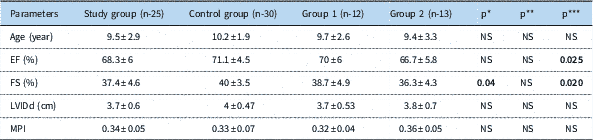
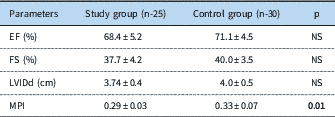
The mean age of the patients was 9.5±2.9 (5–13) years; 12, 13, and 30 patients were recruited into Group 1, Group 2, and the control group, respectively. The median percentage of premature ventricular contraction was 5.4 (range 2.3–44). Premature ventricular contractions had a superior axis in two patients, an inferior axis in 23 patients, a right bundle branch block in nine (36%) patients, and a left bundle branch block in 16 (64%) patients. The premature ventricular contractions disappeared in all patients during peak exercise. There was no statistically significant difference between the patient and the control groups in terms of ejection fraction, myocardial performance index, or left ventricle internal diameter at end diastole values (p>0.05). The patient group had statistically significantly lower fractional shortening values compared with the control group (p=0.04). Group 2 (premature ventricular contraction ⩾5%) showed statistically significant reductions in ejection fraction (p=0.01) and fractional shortening (p<0.01) values compared with the control group (Table 1). At 3 months after the initiation of omega-3 supplementation, the myocardial performance index was markedly reduced in the study group (p=0.01). Comparative data regarding the study and control groups gathered after omega-3 therapy are summarised in Table 2.
Comparison of parameters of the study group, Group 1, and Group 2 with the control group.

EF=left ventricular ejection fraction; FS=fractional shortening; LVIDd=left ventricle internal diameter at end diastole; MPI=myocardial performance index; NS=not significant
* Comparison of the study group and the control group
** Comparison of Group 1 and the control group
*** Comparison of Group 2 and the control group
p<0.05
Comparison of the study group and control group after omega-3 therapy.

EF=left ventricular ejection fraction; FS=fractional shortening; LVIDd=left ventricle internal diameter at end diastole; MPI=myocardial performance index; NS=not significant
p<0.05
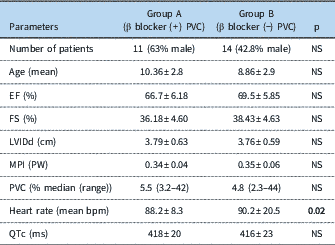
There was no statistically significant difference between the patients already receiving β blocker therapy and the patients with no medication in terms of all data (Table 3).
Comparison of patients with β blocker and patients with no medication.

bpm=beat per minute; EF=left ventricular ejection fraction; FS=fractional shortening; LVIDd=left ventricle internal diameter at end diastole; MPI=myocardial performance index; NS=not significant; PVC=premature ventricular contraction; QTc=corrected QT interval
p<0.05
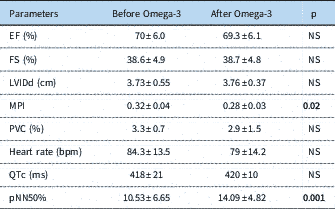
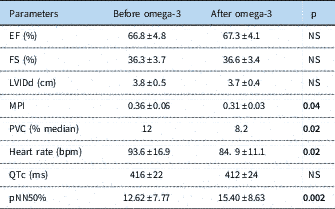
A statistically significant reduction in the mean heart rate and premature ventricular contraction percentage of Group 2 was observed after omega-3 supplementation. pNN50%, which reflects vagal tone, increased in Groups 1 and 2 after the omega-3 intervention. We found no statistically significant differences between Groups 1 and 2 with regard to any other parameters. The study results obtained before and after omega-3 therapy in Groups 1 and 2 are summarised in Tables 4 and 5, respectively.
The comparison of parameters before and after omega-3 therapy in Group 1.

bpm=beat per minute; EF=left ventricular ejection fraction; FS=fractional shortening; LVIDd=left ventricle internal diameter at end diastole; MPI=myocardial performance index; NS=not significant; PVC=premature ventricular contraction; QTc=corrected QT interval
p<0.05
The comparison of parameters before and after omega-3 therapy in Group 2.

bpm=beat per minute; EF=left ventricular ejection fraction; FS=fractional shortening; LVIDd=left ventricle internal diameter at end diastole; MPI=myocardial performance index; NS=not significant; PVC=premature ventricular contraction; QTc=corrected QT interval
p<0.05
Discussion
Premature ventricular contractions can be observed in 0.3–2.2% routine resting electrocardiographies of healthy children and is interpreted as benign in structurally normal hearts. Although the prognosis in patients with frequent premature ventricular contractions was considered relatively benign, attention should be paid to the progression of the left ventricle dysfunction during a long-term observation, especially in patients with a high premature ventricular contraction prevalence.Reference Kakavand, Ballard and Disessa 8 – Reference Hasdemir, Kartal and Sımsek 10 Ventricular extrasystoles – ventricular tachycardia and symptomatic premature ventricular contractions – can be provoked by emotional and physical stressors. Previous studies have indirectly suggested a relationship between emotion and arrhythmia. Anger can trigger ventricular arrhythmias in patients with ICDs, as can physical exertion. Treatments aimed to block the response to these stressors were thought to reduce ventricular arrhythmias in such patients.Reference Lampert, Joska, Burg, Batsford, McPherson and Jain 11
The atrioventricular nodal re-entrant tachycardia is associated with significantly higher trait anxiety levels compared with other types of paroxysmal supraventricular tachycardia.Reference Papiashvili, Tabagari-Bregvadze and Brugada 12 Catecholaminergic polymorphic ventricular tachycardia linked to strenuous exercise or acute emotion.Reference Del Franco, Gualandi and Malagù 13 Anger and other negative emotions can precipitate sudden death, as shown in studies of population stressors. Clinical studies of patients with implantable defibrillators demonstrate that anger can trigger ventricular arrhythmias. Long-term negative emotions also increase vulnerability to arrhythmias. Mechanisms linking anger and arrhythmias include autonomic changes, which alter repolarisation, possibly enhanced in patients with sympathetic denervation, which in turn trigger potentially lethal polymorphic ventricular tachycardias.Reference Lampert 14
An inferior axis and left bundle branch block are seen on electrocardiography in most patients. In children, premature ventricular contractions with a right bundle branch block do not need follow-up, but those with a left bundle branch block must be followed-up through adulthood.Reference Beaufort-Krol, Dijkstra and Bink-Boelkens 15
In animals and humans, omega-3 polyunsaturated fatty acids have anti-arrhythmic properties. They stabilise the electrical activity of isolated cardiac myocytes by inhibiting sarcolemmal ion channels. Thus, to create action potentials, a stronger electrical stimulus is required, and the refractory period is extended significantly. These are probably the major anti-arrhythmic mechanisms.Reference Leaf, Kang, Xiao and Billman 16 It is believed that omega-3 polyunsaturated fatty acids also exert indirect effects on increases in heart rate variability, baroreceptor sensitivity, and cardiac control of the autonomic nervous system. The incorporation of omega-3 polyunsaturated fatty acid in synaptic membranes could potentially influence the autonomic control of the heart. Studies have shown that the omega-3 polyunsaturated fatty acids reduce the risk of sudden cardiac death and the risk of arrhythmia by increasing heart rate variabilityReference Christensen 4 and vagal tonus.Reference Christensen and Schmidt 5
Increased heart rate variability is an indication of “good” cardiac adaptation and “good” autonomic control mechanisms and reduces the risk of arrhythmia. Omega-3 fatty acids stabilise cardiac cells electrically and inhibit L-type calcium channels and fast voltage-gated sodium channels, rendering cardiac cells more resistant to arrhythmias.Reference Leaf, Xiao, Kang and Billman 17 Within 14 days, 1 g/day of omega-3 therapy improves both the endothelial-dependent and endothelial-independent vasodilation of the brachial artery of healthy individuals. The effect on endothelial function is observed after 2 weeks to 8 months of supplementation.Reference Shah, Ichiuji and Han 18 , Reference Khan, Elherik and Bolton-Smith 19 A total of 1 g/day of omega-3 fatty acids is recommended for the secondary prevention of sudden cardiac death and post-myocardial infarct treatment.Reference Hooper, Thompson and Harrison 20 , Reference Smith, Blumenthal and Babyak 21 Adult patients who experienced acute myocardial infarction have been reported to have fewer premature ventricular contractions after omega-3 polyunsaturated fatty acid consumption, and administration of a high-concentration preparation of omega-3 polyunsaturated fatty acids (1 g daily) for 3 months reduced the number of premature ventricular contractions per day.Reference Gogolashvili, Litvinenko and Pochikaeva 22 In our study, the omega-3 supplementation provided a reduction in premature ventricular contractions.
The cardiac sodium concentration was higher in diabetic rats than in non-diabetic rats, and both the ventricular and left atrial sodium concentrations decreased in diabetic rats with eicosapentaenoic acid treatment compared with controls. Long-term oral eicosapentaenoic acid therapy stimulated the production of nitric oxide and reduced the concentration of cardiac noradrenaline, which probably played a role in the inhibition of increased cardiac sympathetic activity in the diabetic rats.Reference Nishimura, Nanbu and Komori 23 In another study, omega-3 fatty acids reduced noradrenaline blood levels in healthy people.Reference Hamazaki, Itomura and Huan 24 We thought that the same mechanism might be involved in reducing the mean heart rate after the daily consumption of omega-3 fatty acids, especially in the patient group with premature ventricular contraction ⩾5% (Group 2). However, studies have suggested that the supplementation with 1.5 g n-3 polyunsaturated fatty acid/day did not substantially suppress the number of premature ventricular contractions in a patient population with frequent premature ventricular contractions. In another study, n-3 fatty acids reduced the heart rate by 2.1 beats/min, a significant change that predicted a lower risk of sudden death.Reference Geelen, Brouwer and Schouten 25
In the current study, owing to the deterioration in the myocardial function of children with premature ventricular contractions, 1 g/day omega-3 polyunsaturated fatty acid was recommended to our patients for 3 months because of the documented beneficial effects of omega-3s. We observed a significant improvement in left ventricular myocardial performance at the end of 3 months. After omega-3 therapy, the myocardial performance index was reduced markedly in all patient groups.
The myocardial performance index is a non-geometric index of ventricular function that can be readily determined to evaluate right and left ventricular function; blood pressure, heart rate, and the ventricle geometry do not affect the myocardial performance index. The myocardial performance index may have good prognostic value in many different clinical situations.Reference Jurko, Jurko and Minarik 26 After heart transplantation, one study detected 85% specificity and 82.5% sensitivity for acute cardiac rejection based on a left ventricular myocardial performance index ⩾0.47.Reference Flanagan, Cain and Tatum 27 The same study detected 100% specificity and 90% sensitivity for an increase from baseline ⩾20.4%. The study emphasised that the left ventricular myocardial performance index was a sensitive and specific marker for acute cardiac rejection. Various studies have reported a positive correlation between an increased left ventricular myocardial performance index and dysfunctional capacity. The fact that the patient group showed good functional capacity despite a higher myocardial performance index supports the view that the myocardial performance index is important in monitoring prognosis because it facilitates diagnosis of ventricular dysfunction before clinical indications appear. In normal cases, the index remained within a narrow gap, increasing progressively in accordance with the deterioration in left ventricular function. Other studies have drawn attention to a relationship between the left ventricular myocardial performance index and n-terminal-pro-B-type natriuretic peptide.Reference Mikkelsen, Moller and Bie 28 In this study, the significant reduction in the myocardial performance index after omega-3 treatment shows that omega-3 improved global left ventricular function.
Omega-3 polyunsaturated fatty acid supplementation was associated with improved left ventricle diastolic function and decreased B-type natriuretic peptide levels in patients with chronic heart failure.Reference Chrysohoou, Metallinos and Georgiopoulos 29 Omega-3 polyunsaturated fatty acids have been reported to improve the subclinical biventricular myocardial systolic function observed in typical Rett Syndrome,Reference Maffei, De Felice and Cannarile 30 and high-dose n3-polyunsaturated fatty acid showed improvement of endothelial function and decrease of interleukin 6.Reference Moertl, Hammer, Steiner, Hutuleac, Vonbank and Berger 31 In our study, an increase in the fractional shortening % was observed after omega-3 supplementation in the patient group.
Omega-3 fatty acids improve global left ventricular function by reducing the mean heart rate, the number of premature ventricular contractions, and the myocardial performance index. As omega-3 fatty acids seem to be able to correct the harmful effects of premature ventricular contractions, we suggest that this therapy, which does not require medical follow-up, might be offered to all children with premature ventricular contractions.
Conclusions
Premature ventricular contractions can lead to systolic cardiac dysfunction in children. Omega-3 therapy may improve cardiac function in children with premature ventricular contractions. Omega-3 supplementation provides reductions in the myocardial performance index, mean heart rate, and the frequency of premature ventricular contractions. We believe that the omega-3 fatty acids may have a role in preservation of cardiac function in children with benign premature ventricular contractions more frequent than 5% in 24-hour Holter electrocardiography. Further studies are required to determine the mechanisms of the observed omega-3 effect. This is the first study conducted in children to investigate the possible role of omega-3 polyunsaturated fatty acid supplementation on treatment of premature ventricular contractions.
Limitations
The limitations of our study are the relatively low number of patients, the duration of Holter electrocardiography being no longer than 24 hours, and the absence of a placebo-receiving patient group to compare the outcome regarding omega-3 polyunsaturated fatty acid effect.
Financial Support
This research received no specific grant from any funding agency, commercial, or not-for-profit sectors.
Acknowledgements
T.O. designed the study, planned the concept, and prepared and edited manuscript. R.O. and O.D. had a role in data acquisition and analysis. Y.Y. and S.D. designed the study, and had a role in manuscript design and review. M.M.Y. and B.G. had a role in manuscript design and data analysis. D.B.G. and T.M. reviewed the manuscript, and had role in literature overview and data analysis. V.T. searched literature and performed statistical analysis.
Conflicts of Interest
None.
Ethical Standards
The authors assert that all procedures contributing to this work comply with the ethical standards of the relevant national guidelines on human experimentation in Turkey and with the Helsinki Declaration of 1975, as revised in 2008.