I. INTRODUCTION
Aluminum matrix composites possess many advantages such as high specific stiffness, low density, good wear resistance, high specific strength, good thermal stability, and electromagnetic shielding capacities with the development of some noncontinuous reinforcement materials, fibers, whisker, or particles. In particular, particle-reinforced aluminum matrix composites not only have good mechanical and wear properties but also are economically viable.Reference Kumar, Chakraborty, Subramanya Sarma and Murty1–Reference Zhu, Min, Li, Ai, Ge and Wang5
Usually, microceramic particles are used to improve the yield and ultimate strength. However, it was reported that the elongation, ultimate strength, and yield strength (YS) of the Al matrix composites reinforced with nanosized ceramic particles were enhanced more significantly than those reinforced with microsized particles.Reference Habibnejad-Korayem, Mahmudi and Poole6,Reference Mazahery and Shabani7 Tahamtan et al.Reference Tahamtan, Halvaee, Emamy and Zabihi8 showed that decreasing alumina particle size from micrometer (10 μm) to nanometer (100 nm) caused improvement in tensile strength of composite. In another study, Ma et al.Reference Ma, Tjong, Li and Liang9 suggested that the tensile strength of 1 vol% Si3N4 (10 nm)/Al composite was comparable to that of the 15 vol% SiCp (3.5 μm)/Al composite, while the YS of the former is much higher than that of the latter.
Tian et al.Reference Tian, Zhao, Jiao, Zhang, Zhang and Wu10 posited that the tensile testing showed an increase in the tensile strength and a considerable increase of the elongation in the 2024Al matrix composites reinforced by the ZrB2 nanoparticles, compared with the unreinforced 2024Al alloy. HemanthReference Hemanth11 reported that the presence of nano-ZrO2 particulates in Al matrix noticeably improved hardness, strength, and fracture toughness but with slight reduction in ductility.
Hybrid aluminum nanocomposites can be considered as an outstanding material, where high strength and wear-resistant components were of major importance, particularly structural applications in the aerospace, automotive, and military industries.Reference Ravindran, Manisekar, Vinoth Kumar and Rathika12 Thakur et al.Reference Thakur, Kong and Gupta13 showed that the addition of SiC nanoparticulates to hybrid (Al/Ti + SiC) composites assisted in increasing microhardness, macrohardness, Al–Ti interfacial hardness, 0.2% YS, and ultimate tensile strength (UTS), whereas the ductility was marginally affected. Ahamed and SenthilkumarReference Ahamed and Senthilkumar14 fabricated Al alloy composite reinforced by nanosized Al2O3 and Y2O3 particulates and reported that the 0.2% YS, UTS, and work of fracture were improved over the unreinforced A16063 alloy, and failure strain was decreased in reinforced nanocomposites.
ANSI 332 aluminum alloy, with 9.5% Si, 3.0% Cu, and 1.0% Mg, typically has applications in automotive piston and parts requiring elevated temperature strength.Reference Smith15 In this study, combined addition of Al2O3 and ZrO2 nanopowders on the mechanical properties of ANSI 332 aluminum alloy was investigated. Nanocomposite was produced by stir casting in the present research. The main advantages of Al2O3 are its high hardness and wear resistance, whereas ZrO2 exhibits higher strength and fracture toughness, besides its lower Young's modulus.Reference Daguano, Santos, Souza, Balestra, Strecker and Elias16 Therefore, this study was conducted to investigate the possibility of replacing ZrO2 with Al2O3 as suitable candidates in the hybrid composites.
II. EXPERIMENTAL PROCEDURE
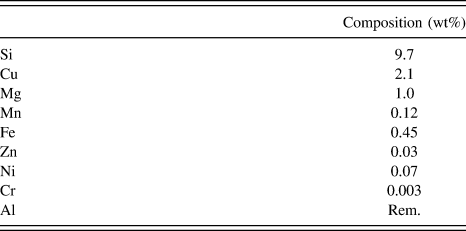
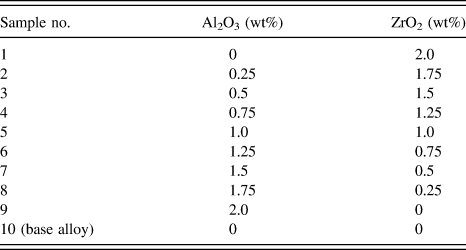
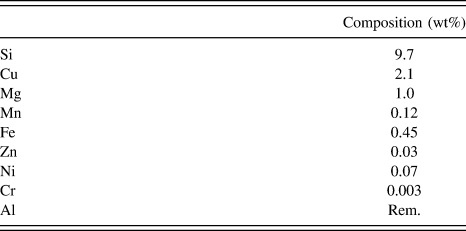
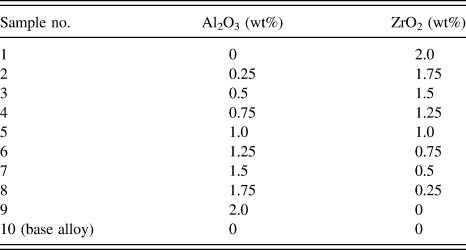
Chemical composition of ANSI 332 alloy is given in Table I. In addition, physical and mechanical properties of this alloy are shown in Table II. The alloy was melted in a graphite crucible in ambient atmosphere using an electrical furnace. Nanoreinforcements were produced by ball-mill processing of microalumina and microzirconia particulates. The average sizes of nanoalumina and nanozirconia particulates were 30 and 35 nm, respectively. In the first stage of the study, the total amount of nanopowders including Al2O3 and ZrO2 was considered equal to 2 wt%. The names allocated to the samples and the amounts of any nanoceramics added to the alloy used in this experiment are presented in Table III. In the next step, nanocomposites reinforced by 1 wt% Al2O3 and different ZrO2 contents including 2 and 3 wt% ZrO2. After additions, the melt was stirred in 750 °C for 5 min to acquire uniform distribution of powders within the melt. The melt was cast in a permanent mold at 725 °C.
Chemical composition of experimental ANSI 332 alloy.
Physical and mechanical properties of ANSI 332 aluminum alloy based on ASTM SB-108.

a 1 indicates best of the group; 5 indicates poorest of the group.
Designation of the nanocomposite samples.
The as-cast samples were machined based on ASTM E 8M–04. A SANTAM Universal tensile/compression testing machine/STM-50 series (SANTAM-Iran, Tehran, Iran) equipped with a data acquisition system was used to carry out the tensile tests at room temperature at a strain rate of 1 mm/min. To compare mechanical behavior of as-cast and heat-treated samples, some samples were heat treated through solution treatment at 500 °C for 6 h followed by quenching in water at 60 °C. Artificial aging was carried out for samples at 205 °C for 9 h. A programmable Nabertherm furnace was used for heat treating. The hardness of as-cast and heat-treated alloys and nanocomposites was measured using an ERNST Brinell hardness tester at an applied load of 187.5 kgf and 2.5-mm diameter ball. The samples were grounded, polished, and etched by Keller etch reagent for 15 s and then were studied using optical microscopy. A Bruker D8 ADVANCE x-ray diffractometer (Karlsruhe, Germany) and a TESCAN VEGA II XMU scanning electron microscopy (coupled with energy dispersive spectroscopy (EDS) to identify elements) were used to study the intermetallic phases of nanocomposites. Fracture surfaces of tensile test samples were examined by scanning electron microscope (SEM) to determine the macroscopic fracture mode.
III. RESULTS AND DISCUSSION
A. Microstructural characterization
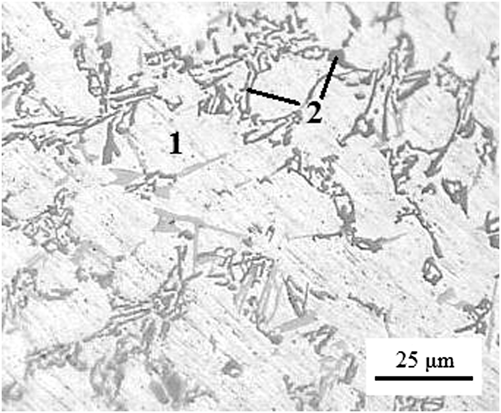
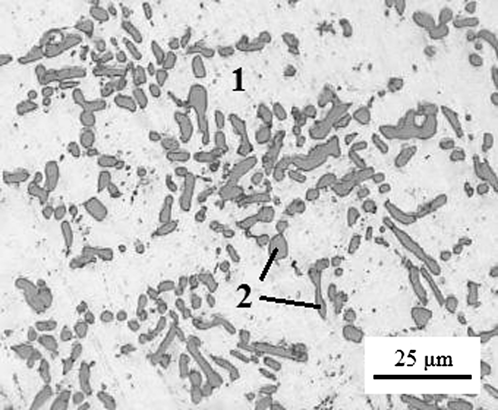
Optical micrographs of the as-cast and heat-treated samples are shown in Figs. 1 and 2, respectively. The microstructure of ANSI 332-cast alloy consists of α-phase dendrites (light gray, 1), eutectic phase (mixture of α-matrix, and rounded dark gray Si phases, 2) and some intermetallic phases. It is observed that large flakes of eutectic silicon phases with sharp tips changed into spherical shape particles after the heat treatment. This change decreases stress concentration and susceptible sites to crack nucleation.
Optical micrograph of as-cast ANSI 332 aluminum alloy.
Optical micrograph of heat-treated ANSI 332 aluminum alloy.
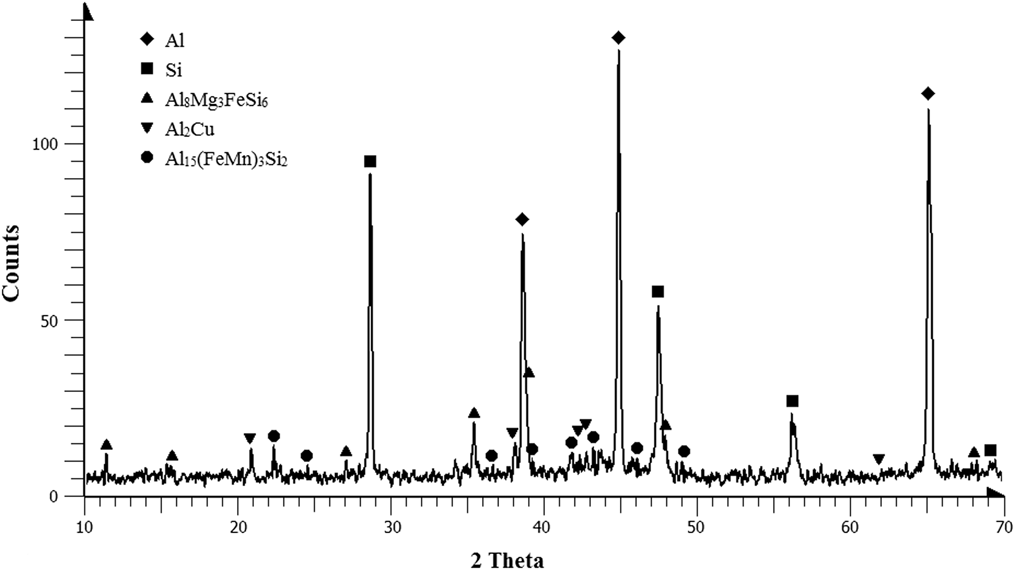
A number of Fe-rich intermetallic phases, including α (Al8Fe2Si or Al15(FeMn)3Si2), β (Al5FeSi), π (Al8Mg3FeSi6), and δ (Al9FeSi3), have been identified in Al–Si cast alloys.Reference Fang, Shao, Liu and Fan17–Reference Taylor20 Intermetallic phase Al15(FeMn)3Si2 (alpha- or α-phase) with cubic crystal structure forms in “skeleton like” morphology or in form “Chinese script.” Presence of Mg with Si results in an alternative called π-phase form, Al5Si6Mg8Fe2, which has script-like morphology. Cu is also present in Al–Si–Cu cast alloys primarily as phases: Al2Cu, Al–Al2Cu–Si, or Al5Cu2Mg8Si6. Al2Cu with tetragonal crystal structure generally precipitates as fine spheroidal Al–Al2Cu–Si ternary eutectic.Reference Tillová, Chalupová, Hurtalová and Kazmiruk21 The compact skeleton-like morphology that was seen in micrographs (Fig. 3) and XRD examination of experimental ANSI 332 alloy can be an evident of existence of some of these phases such as Al8Mg3FeSi6 and Al2Cu (Fig. 4).
Intermetallic phase: (a) Fe-rich phase. (b) EDS spectra of the phase (marked by arrow), which can be attributed to Al8Mg3FeSi6.
XRD examination of experimental ANSI 332 alloy.
Furthermore, investigation by SEM and EDS revealed intermetallic compounds that are shown in Fig. 5(a) by arrow marks. The Al, Si, and Zr elements were identified by EDS analysis [Fig. 5(b)]. Zhu et al.Reference Zhu, Ai, Min, Wu and Wang22 fabricated Al–ZrO2–C composite by in situ method and declared that Al3Zr phase could be formed through an exothermic reaction between Al and ZrO2 at 1023 K (750 °C) based on the reaction formula 13Al + 3ZrO2 = 2Al2O3 (α) + 3Al3Zr. This coherent precipitate, which is essentially inert in the matrix, acts as hard pinning points in the matrix inhibiting dislocation motion leads to affect the strength of the material.Reference Cho, Lee, Im and Kwon23 The main advantage of the precipitate formed is its stability at elevated temperatures because of the low solubility of this precipitate. However, Mohamed and SamuelReference Mohamed and Samuel24 highlight the fact that the intermetallic phase of Al3Zr is the main feature in the microstructures and mechanical properties of Al–Si–Cu–Mg alloys in the presence of Zr, which also leads to the formation of Al3Zr. According to the EDS analysis result, the intermetallic phases observed in microstructure [Fig. 5(a)] can be attributed to Al3Zr. It is possible that greater precipitating of this compound occurs throughout the matrix by increasing in zirconia content.
(a) SEM micrograph of nanocomposite reinforced by 2 wt% ZrO2. (b) EDS spectra of the phase (marked by arrow), which can be attributed to (Al,Si)3Zr.
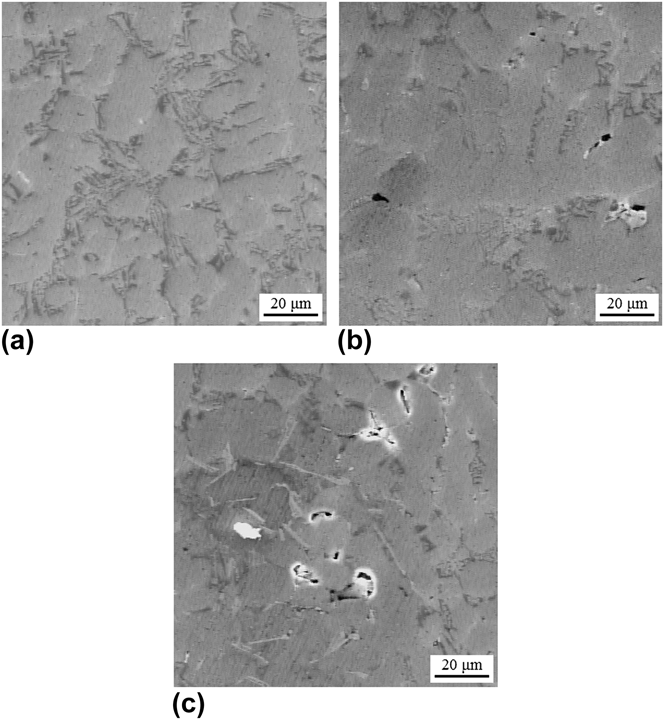
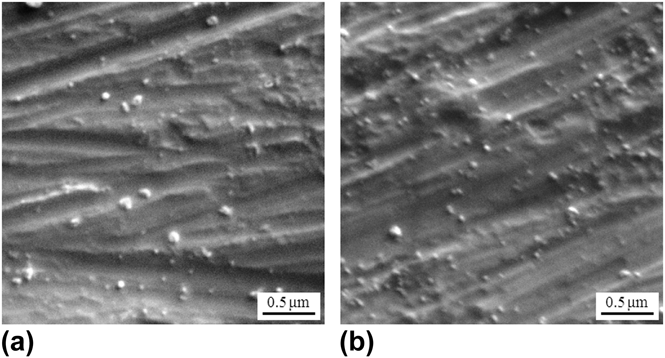
Microstructure examination of nanocomposite surfaces shows that increase in alumina content results in porosity. However, this is not observed in samples with high content of zirconia. The porosity is an inevitable consequence of stir-casting method; however, the microscopic observations revealed no porosity in nanocomposites reinforced by 1.25–2 wt% ZrO2. The porosity happened in the sample reinforced by different amounts of reinforcements is shown in Fig. 6. Furthermore, microstructural analysis of composites revealed that agglomeration of alumina particulates occurred throughout the samples, Fig. 7(a). However, agglomeration of reinforcements was not observed in composites reinforced by high content of ZrO2, even uniform distribution of nanoparticulates is noticeable in these samples [Fig. 7(b)].
SEM photographs of nanocomposites show porosity in reinforced samples (a) 2 wt% ZrO2, (b) 1.75 wt% Al2O3 and 0.25 wt% ZrO2, and (c) 2 wt% Al2O3.
SEM photograph of nanocomposites (a) agglomeration of alumina in reinforced 2 wt% Al2O3 composite, (b) uniform distribution of reinforcements in composite reinforced by 1.75 wt% ZrO2 and 0.25 wt% Al2O3.
B. Mechanical properties
1. Hardness
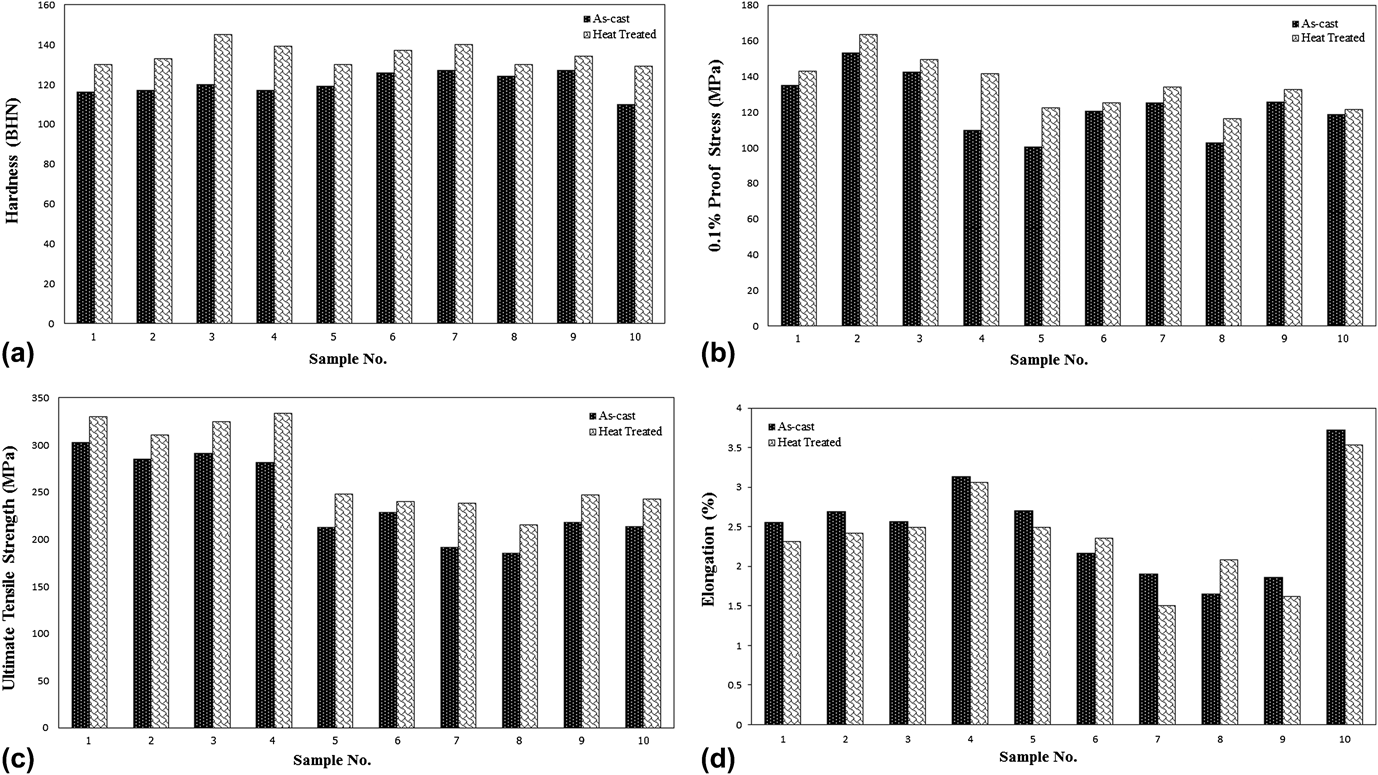
The hardness values of the as-cast and heat-treated composites for different percent of reinforcements are shown in Fig. 8(a). It is observed that the average hardness values improved nearly 10% with the addition of various amounts of reinforcements in comparison with the base alloy. Furthermore, heat treatment resulted in hardness improvement. Heat treatment increases the average hardness up to 11% compared with the as-cast samples, probably because of diffusion proceeding that leads to better bonding of the nanoparticulates to the matrix and precipitation hardening. The most effect of additions was observed in hardness value of samples 7 and 9 with 13.5% growth in hardness, which indicated that hardness enhanced with increasing Al2O3 amount. It can attribute to larger hardness of alumina than zirconia because the hardness of composites depends on the hardness of the reinforcement and the matrixReference Zhang, Zhang and Mai25; (hardness: alumina = 22 GPa and zirconia = 14 GPaReference Pasaribu26). The comparison of hardness values of sample 1 and sample 9 reveals that the addition of 2 wt% ZrO2 and 2 wt% Al2O3 increased hardness up to 5 and 13.5%, respectively, that is, higher hardness of alumina provides higher hardness.
Mechanical properties of as-cast and heat-treated samples. (a) Hardness values, (b) 0.1% proof stress, (c) UTS, and (d) elongation values.
2. Tensile properties
The influence of weight percentage of reinforcements and heat treatment on the YS of ANSI 332/Al2O3 + ZrO2 composites is shown in Fig. 8(b).The results indicate that the average YS values increases by 8.6% after heat treatment. In the course of cooling, dislocations form at the matrix/reinforcement interface owing to the thermal mismatch. Based on Besterci et al.,Reference Besterci, Slesar and Jangg27 the YS of the Al alloys relates to the interaction between particulate and dislocations by means of the Orowan bowing mechanism. The tangled dislocations around the agglomeration of the particulates could contribute a reinforcement effect in the Al alloy matrix. Figure 8(b) shows that increase in the amount of ZrO2 results in increase of YS values. Results present an increase of 23% YS in composite over the as-cast condition base alloy and an increase of 26% YS in the heat-treated composite over the heat-treated base alloy in the composite reinforced with 1.75 wt% ZrO2 and 0.25 wt% Al2O3.
The general descending trend in YS values of samples with increasing Al2O3 indicates that increase in alumina percentage has a negative effect on tensile behavior of samples. For composites reinforced with 1.75 wt% Al2O3, the tensile test results show that nanocomposites failed at smallest yield values rather than the base alloy.
The UTS values of as-cast and heat-treated specimens is shown in Fig. 8(c). The UTS follows the same trend as the YS of ANSI 332/Al2O3 + ZrO2 nanocomposites. There is an increase of 30% UTS in the composite reinforced with 2 wt% ZrO2 over the as-cast alloy. There is also an increase of 36% UTS in the heat-treated composite in comparison with the heat-treated ANSI 332 alloy when the metal matrix alloy is reinforced with 1.25 wt% ZrO2 and 0.75 wt% Al2O3. Based on the obtained results, the mean of UTS values increased by 12% using the T6 heat treatment for this Al alloy reinforced with alumina and zirconia. Furthermore, it is clearly observed that the T6 heat treatment has a better effect on UTS values than the YS values of nanocomposites.
With increasing the amount of alumina, the values of yield and ultimate strength decreases. The decrease in the yield and ultimate strengths can be due to the formation of clusters of Al2O3 in the nanocomposites at high weight percentage of Al2O3. The reason could be the inhomogeneous distribution of reinforcements and degree of clustering, which could reduce the effective amount of powders for strengthening. Furthermore, the porosity of samples increased when alumina content was higher than zirconia content. Another reason for this behavior may involve wettability of alumina nanoparticulates. According to the recent works, below 1000 °C, the contact angle between aluminum and Al2O3 is greater than 90°, resulting in poor wetting by the liquid metal.Reference Saiz, Tomsia and Suganuma28,Reference Schultz, Ferguson and Rohatgi29 This poor wetting behavior favors clustering of the alumina particles, thereby limiting the degree to which Al2O3 can be incorporated in a liquid melt.
However, in the process of load transfer, the matrix transfers the load to the nanoparticulates. So if the boundary is assumed to be strong, ceramic particles prevent plastic deformation of the matrix and this leads to the strengthening and higher work-hardening rate.Reference Abdizadeh and Baghchesara30 In the case of Al2O3, weak bonding between the particle and matrix declines the plastic deformation and UTS values.
The influence of the heat treatment on the ductility (measured in terms of tensile elongation) has illustrated in Fig. 8(d). The results show that the average values of elongation declined by around 5% applying the T6 heat treatment on nanocomposites. The general descending trend in ductility values of samples with increase in Al2O3 weight percentage is shown in Fig. 8(d). It was verified from the work carried out by Hajizamani and BaharvandiReference Hajizamani and Baharvandi31 that ductility of the composites reinforced with Al2O3 decreased with increase in alumina content because of porosity content. According to the YS and UTS values, it can be concluded that in simultaneous using of Al2O3 and ZrO2 nanoparticulate reinforcements in ANSI 332 aluminum alloy, the mechanical behavior of nanocomposites increased with increase in the weight percentage of zirconia.
According to the XRD and EDS analysis of microstructures, the most intermetallic phases formed in nanocomposites are Al2Cu, Al15(FeMn)3Si2, Al8Mg3FeSi6, and Al3Zr. The coherent precipitates such as Al3Zr are undissolved even in elevated temperatures.Reference Cho, Lee, Im and Kwon23
It is possible that volume fraction of the intermetallic compound rises as the percentage of ZrO2 increases. The comparison in UTS values of composites shows that the Zr and Al may interact between themselves to form new phases, which lead to increase in the strength of nanocomposites.
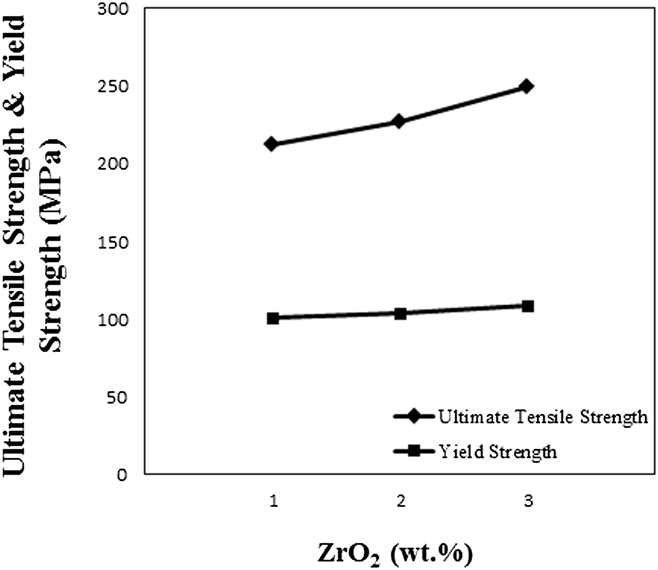
For more study on the effect of ZrO2 on Al2O3reinforced composite, the nanocomposites reinforced by 1 wt% Al2O3 and different contents of ZrO2 including 2 and 3 wt% ZrO2 have been investigated to confirm the beneficial effect of zirconia particles. The influence of adding zirconia content on tensile properties is shown in Fig. 9. Although alumina content is constant, improvement in tensile properties can be attributed to increase in weight percentage of zirconia. It is observed from Fig. 9 that the addition of 2 and 3 wt% ZrO2 changes UTS from 213 MPa to 227 and 248 MPa, respectively, and an increase of 7 and 15% was observed over the composite reinforced by 1 wt% ZrO2. The YS values increased by 3 and 7% showing that increase in zirconia content had a better effect on UTS than YS value.
UTS and YS values of composites reinforced by 1 wt% Al2O3 and different contents of ZrO2.
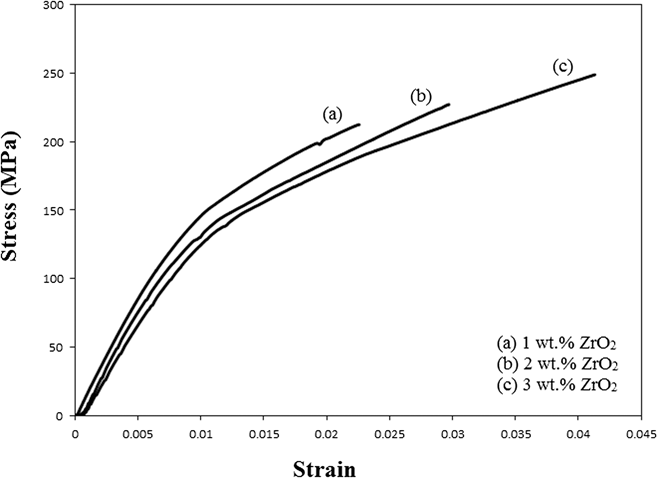
Another possible mechanism that may play a role in the improvement of properties with increase in zirconia content is the effect of zirconia as the barrier to crack propagation during the tetragonal to monoclinic transformation. Rendtorff et al.Reference Rendtorff, Garrido and Aglietti32 suggested that tetragonal to monoclinic phase transformation is a martensitic transformation and independent of temperature and atoms diffusion. This transformation acts as a barrier to crack growth and increases resistance of the base alloy. The expansion occurred due to the tetragonal to monoclinic transformation forms the impacted regions, which hardens crack propagation. When this mechanism takes place in composites, a part of energy is consumed by transformation during cracking and results in toughening of the material.Reference Lin and Duh33 Increase in zirconia content leads to increase in monoclinic zirconia phases; therefore, the residual stresses are raised by expansion because of transformation that results in improvement in composite toughness. The stress–strain diagrams for nanocomposites reinforced by 1 wt% Al2O3 and different contents of ZrO2 are shown in Fig. 10. The fracture toughness (KIC) of materials which is required energy for fracture and equals to the area beneath the stress-strain diagram. Figure 10 shows that the area beneath the stress–strain diagrams (the toughness fracture of nanocomposites) increases by increase in the zirconia content.
Stress–strain diagrams for nanocomposites reinforced by 1 wt% Al2O3 and different contents of ZrO2.
3. Fracture behavior
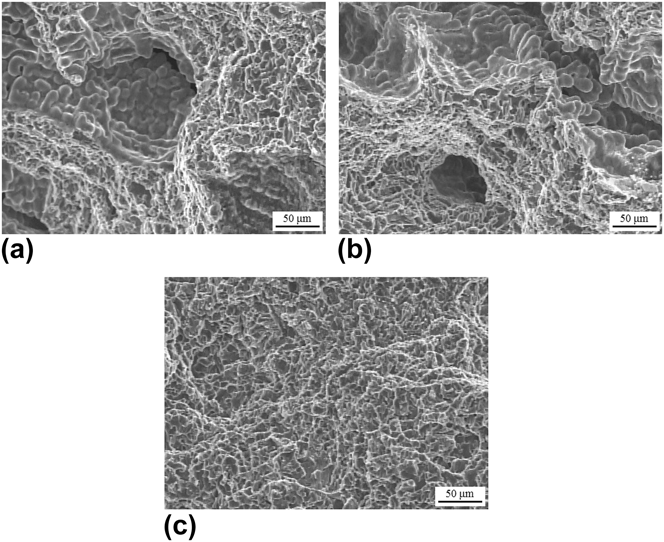
The ductile to brittle fracture at macroscale fracture surface examinations was observed. Tensile fracture surfaces of heat-treated samples of numbers 2, 4, and 6 are shown in Figs. 11(a)–11(c).
SEM micrograph of fracture surface of heat-treated tensile samples: (a) 0.25 wt% Al2O3, (b) 0.75 wt% Al2O3, (c) 1.25 wt% Al2O3.
It is observed from SEM photographs that increase in alumina content results in porosity and brittle behavior of fracture mode. Generally, porosities and voids have an important role in brittle manner. The fracture of metal matrix composites occurs in one or combined condition of these mechanisms: reinforcement fracture,Reference Li, Ramesh and Chin34 matrix/reinforcement interfacial decohesion,Reference Syu and Ghosh35 and failure in the matrix.Reference Baghchesara, Baharvandi and Abdizadeh36 Results show that fracture behavior in this research followed by the third mechanism. Reinforcement nanoparticles are pushed toward by solid/liquid interface during solidification and are localized in interdendritic regions or the last solidified zones.
Figures 11(a) and 11(b) show the dendritic structures in the fracture surface. These structures are observed in vast areas of fracture surfaces. It shows that the main mechanism of failure is interdendritic cracking. This failure mode is identical for the unreinforced ANSI 332 alloy that has been recently investigated.Reference Tahamtan, Boostani and Nazemi37 During solidification of the composite, the nanoparticles and alloying elements (mainly Si) are rejected to the solid–liquid interface and segregate to the interdendritic regions.Reference Li, Ramesh and Chin34 The microcracks propagate along interdendritic aluminum–silicon eutectic during the fracture and failure of the specimens occurs. It indicates that fracture behavior is controlled by fracture of matrix because of aggregation of nanoparticles in silicon eutectic.
Dimples that are observed in some areas of fracture surfaces, shown in Fig. 11(c), may be a result of the void nucleation at eutectic silicon particles and subsequent coalescence by shear deformation and fracture process on the shear plane.Reference Akbari, Mirzaee and Baharvandi38 It is reported in the researches that all the fracture surfaces of the composites consist mainly of dimples in the matrix and fragmentation and decohesion of the particles from the matrix. The fracture and decohesion of the particles can be explained by work hardening and the fragmentation of the ceramic phase caused by high stress concentration.Reference Tahamtan, Boostani and Nazemi37,Reference Mazahery and Ostad Shabani39
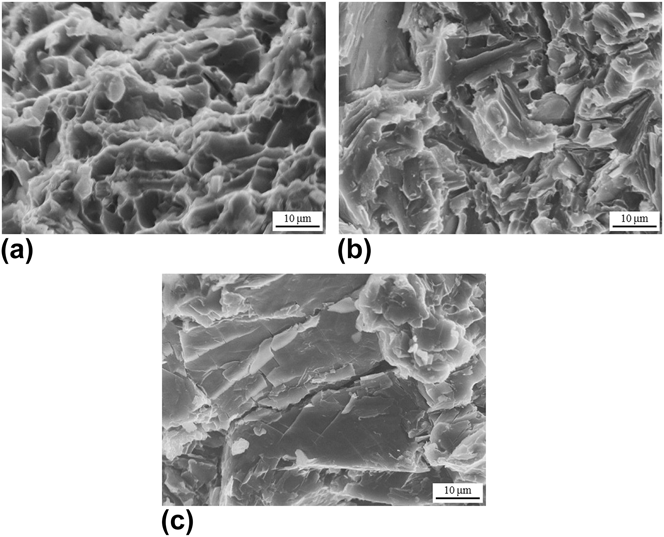
Tensile fracture surfaces of nanocomposites reinforced by 1 wt% Al2O3 and different contents of ZrO2 including 1, 2, and 3 wt% are shown in Fig. 12(a)–12(c), respectively. These figures clearly show that the brittle behavior of fracture enhanced with increase in zirconia content. The glossy broken planes indicate cleavage fracture of samples. This type of fracture occurs by rapid crack propagation and without appreciable macroscopic deformation. It is clearly observed that the dimple structure changes to complete brittle manner by increasing the zirconia content.
SEM micrograph of fracture surface of nanocomposites reinforced by 1 wt% Al2O3 and (a) 1 wt% ZrO2, (b) 2 wt% ZrO2, (c) 3 wt% ZrO2.
It is reported by Zhang et al.Reference Zhang, Liu, Li, Zhang and Sun40 that the fracture mode turns to the combination of transgranular failure and intergranular failure in aluminum composite with the addition of ZrO2 because of stronger bonding of grains, which resulted in improvement in fracture toughness of composite.
IV. CONCLUSION
The characteristics and mechanical behavior of ANSI 332 matrix composite reinforced with nanosized alumina (Al2O3) and zirconia (ZrO2) were investigated. The following conclusions can be drawn:
(1) Replacing zirconia with alumina in constant total wt% reinforcement leads to improvement in tensile properties. It can be attributed to the formation of hard intermetallic phases such as (Al,Si)3Zr, enhancing in wettability Al2O3 particulates and reducing in porosity, which leads to enhancing UTS and YS.
(2) The highest tensile strength achieved in the specimen containing 1.25 wt% ZrO2 and 0.75 wt% Al2O3 can be attributed to increase in zirconia content, which play a remarkable role in improving the microstructure of composite.
(3) It has been found that the maximum value of hardness is acquired at maximum values of Al2O3.
(4) The sensitivity of UTS to heat treatment is more than YS.
(5) It is observed from SEM photographs that increase in alumina content converts the fracture behavior from rather ductile, with fine ductile dimples to brittle, with cleavage facets.