I quote from others, the better to express myself.
(Michel de Montaigne)
Mahler and the Volkstümlich
Mahler’s music is replete with folk-, dance-, and military-music references in the form of melodic, harmonic and rhythmic allusions, and certain underlying structural and stylistic practices. Virtually all who discuss Mahler acknowledge the allusions, and there have been several more focused studies.Footnote 1 The general consensus emerging from this body of work is that though occasional identical passages and a number of close similarities can be identified between elements of Mahler’s melodic, harmonic and rhythmic idioms and actual folk, dance and military music known to have existed in the Bohemian, Moravian, Austrian and Southern-German orbit in which he spent his formative years, there is no concrete evidence to indicate that Mahler deliberately set out to cite specific sources. According to most commentators, it is more the case that Mahler’s music is infused with the spirit, rather than being dependent on the letter, of folk music, and that apparent instances of ‘citation’ or allusion arose instinctively and accidentally out of the composer’s deep well of half-buried, half-remembered childhood experiences of local folk culture. In one of the more recent considerations of the topic, for example, Renate Ulm concludes, after Hans Heinrich Eggebrecht: ‘one can safely assume that it was not Mahler’s intention to slip authentic folk music into his works’, and goes so far as to say that even if it were, ‘[the question of] whether he used models, and if so which exact ones, has absolutely no significance for assessing the way that folk-like song operates in the context of his works’.Footnote 2
According to personal testimony from one of Mahler’s earliest biographers, Richard Specht, ‘almost exclusively, those impressions gained between the ages of 4 and 11 were decisive and bore conclusive fruit in his artistic creativity … everything later only rarely came to artistic fruition’.Footnote 3 Yet Mahler almost never identified precise sources for any of his references to folk/popular music, preferring to speak in the most general terms:
So it is in music, that the songs which a child assimilates in his youth will determine his musical manhood. … the musical influences which surround the child are those which have the greatest influence upon his afterlife and … the melodies which composers evolve in their maturity are but the flowers which bloom from the fields which were sown with the seeds of the folk-song in their childhood.Footnote 4
The Bohemian music of my childhood home has found its way into many of my compositions. I’ve noticed it especially in the ‘Fischpredigt’. The underlying national element there can be heard, in its most crude and basic form, in the tootling of the Bohemian pipers.Footnote 5
If the fact of Mahler’s folk/popular-music influences can hardly be disputed, there is no clear agreement about the meaning of such compositional practice. For Max Brod it is not a matter of Mahler’s desired assimilation into German culture, but rather of the unconscious expression of his Jewish (Hassidic) ‘soul’,Footnote 6 while for Karl Komma it is precisely this Jewishness that enabled him through the medium of folk appropriation to amalgamate the different national music traditions of his early Czech and German-Sprachinsel contexts.Footnote 7 By contrast, both Jon Finson and Peter Franklin liken the patent folk-like tone of the Wunderhornlieder to Arnim and Brentano’s original aim of underpinning and promoting a specifically German cultural identity and forging a recognizably German ‘voice’.Footnote 8 For others, the popular or the ‘trivial’, especially when incorporated into the symphonic (and a distinction should be made between the more direct assumption of the folk-like in the early songs and the Wunderhornlieder, and its often more oblique transformation in symphonies) acts as a ‘foil for the sublime’, in the knowledge that though Mahler may have come from the ‘land’, he also later outgrew these origins.Footnote 9 Yet one of the most thoroughgoing and careful scholars of this topic, Vladimír Karbusický, notes that such sublimity and transcendence usually associated with elevated ‘high art’ were for Mahler attainable through the simplest musical means, and that the mere major triad that so frequently formed the melodic and harmonic basis of his folk-like tone was to him ‘proof of the existence of God; I need no more’.Footnote 10 Karbusický also reminds us of the highly contested notion of ‘authenticity’ in folk repertoire. Highlighting the emergence of a ‘new style’ of sentimental and plangent folk music in the second half of the nineteenth century forged by a growing economy of street singers who would adapt familiar ‘classical’ folk repertoire with ‘unstable intervals’ and ‘emotional surgings’, he notes both that it was this music for which Mahler had a ‘sharp ear’, and that it was a style long considered by folklorists to be ‘inauthentic’ and ‘corrupted’ – part of a post-1848 tradition that, largely on the back of increased urbanization, became ‘saturated with pseudo-folk music and with professionally fabricated songs, made popular by the then fashionable practice of community singing, and by the so-called “shopkeepers’ output” of music’.Footnote 11 Unlike Henry-Louis de La Grange, who plausibly suggests that Mahler’s folk tone was a product of his nostalgia for a lost age of innocence of the sort promulgated more self-consciously and speciously by the turn-of-the-century Wandervogel folk-revival movement – and also by the 1903 folk song competition sponsored by Berlin’s popular periodical Die Woche Footnote 12 – Karbusický thus rejects the idea of Mahler idealizing some mythical notion of pure folk origins. He does so partly because in the end such pure essence is non-existent or at least unobtainable and partly because he believes that Mahler called on relatively unprocessed folk sounds as the ‘voice of [his milieu’s] raw everyday life’, to give ‘insight into the social condition’, in which a mass music that negated originality and evolution projected the sense of an ‘eternal present’, rather than a prelapsarian past.Footnote 13
The reality may be yet more complex, however, since as Adorno’s hierarchical dialectics perhaps inadvertently claim, folk/popular material in Mahler can be seen as both marked irritants that ‘remain as sand in the mechanism of purely musical construction’ and as a pliable reactant, an ‘unrisen lower’ that is ‘stirred as yeast into high music’.Footnote 14 It can be both passive agent of sentimental nostalgia and active agent of disruptive artistic and social critique, in part because the turn of the twentieth century was a highpoint of that era before empiricist notions of archival preservation took hold, when folk traditions were constructed, reconstructed, and re-imagined freely in increasingly eclectic contexts of court, concert-hall, salon, Heuriger, street, and home performance. Moreover, as a semi-outsider assimilationist hailing from a culturally and politically subjugated and musically exploited land, Mahler was aspiring to, and eventually reaching, a Vienna that was caught between suppressed memories of the misery and shame of the abortive 1848 democratic revolutions and the latter-day stagnation of its Habsburg absolutism.Footnote 15 Sensitive to the relativity of ideas of ‘Echtheit’ and the nuances of musical value, Mahler seems at one moment to be striving to build bridges and at another to be relishing ironies of inevitable historical difference and distance, the latter exciting critical indignation in the contemporary reception of some of his songs’ perceived disparity between material and treatment.Footnote 16
It is interesting that (in summer 1900) Natalie Bauer-Lechner reported Mahler’s annoyance at having inadvertently alluded to an unidentified Brahms symphony and Beethoven piano concerto in the first movement of his Fourth Symphony, realizing this too late for the reminiscences to be removed,Footnote 17 but that conversely, he expressed no such qualms about his folk/popular music appropriations. Indeed, given that he rarely acknowledged specific sources of influence, it is doubly significant that in early summer 1901 he not only named a precise piece of music but also appeared to be pleased that it had made its way, initially unnoticed like the Brahms and Beethoven, into his Fifth Symphony:
Koschat’s theme ‘An dem blauen See’ [das Thema von Koschat ‘An dem blauen See’] (by which was meant the Wörthersee), had found its way into the second movement. ‘I’m glad that it’s from Koschat rather than Beethoven, because Beethoven developed his themes himself!’, [Mahler said].Footnote 18
This case gains further significance in light of the fact that Thomas Koschat was a highly popular contemporary composer of Carinthian folkloric music, and that this was therefore an instance of the allusion to, or borrowing of, a vernacular music which Mahler evidently came to know not in his youth but in his maturity, although it may well have contained echoes of his childhood folk culture. Given that Koschat’s music exemplified the ambiguous kind of ‘manufactured’ folk music of the late nineteenth century identified by Karbusický, and given that it has yet to be established exactly which theme by Koschat Mahler is identifying, where and why it made its way into the symphony, and what role it plays, the issues become all the more intriguing. This study contributes to the discussion of Mahler’s appropriation of folk/popular/’trivial’ musics by shedding new light on this hitherto enigmatic allusion or quotation and its possible significance for understanding the Fifth Symphony, a key work in his compositional development.
The Koschat Allusion and the Chronology of the Symphony
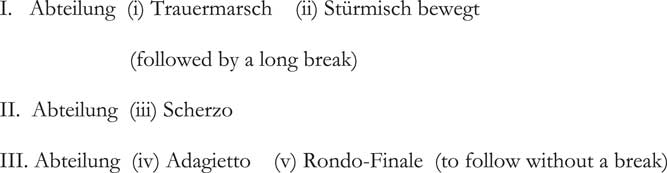
The principal problems associated with this instance of borrowing or allusion are, first, that there is no such work or song as ‘An dem blauen See’ by Koschat; and second, that there is confusion about which movement of the symphony Mahler was discussing. To begin with the second problem: by ‘second movement’, it is not immediately clear whether Mahler meant the ‘Stürmisch bewegt’ second movement, which together with the opening ‘Trauermarsch’ would eventually form the first larger ‘section’ (Abteilung) of the three-section work (see Fig. 1) or whether, already thinking of the first two movements as a single unit, he was thus referring in the conversation with Bauer-Lechner to the third-movement Scherzo as the second, larger ‘movement’ or section of the symphony.
Structural Outline of the Fifth Symphony

This difficulty is compounded by two things. First, the Koschat comment comes in the middle of a conversation that is clearly signposted as being about the movement on which Mahler was currently working – the Scherzo third (individual) movement:
During these past days [c. 4 August 1901], Mahler spoke to me for the first time about his current work, his Fifth Symphony, and in particular the third movement, which he was then writing …
He remarked that Koschat’s theme ‘An dem blauen See’ (by which was meant the Wörthersee) had found its way into the second movement …
Finally Mahler told me that the movement he was working on was a ScherzoFootnote 19
Is Mahler referring here to two different movements or to the same movement, given that the Koschat comment is immediately followed by the designation of the movement as Scherzo? Or could Bauer-Lechner simply be mistaken?
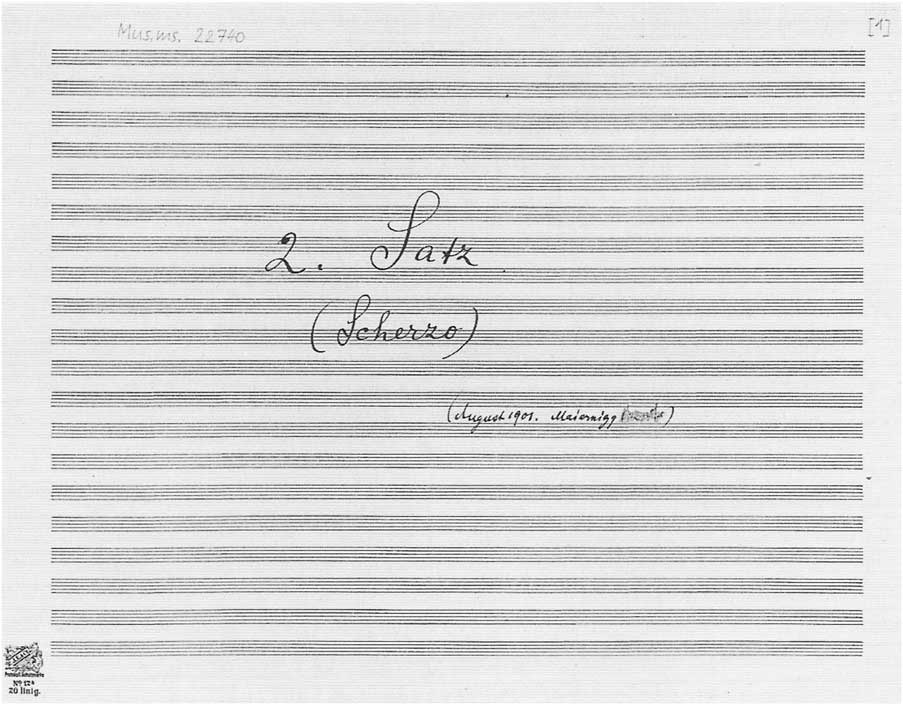
The problem is compounded secondly because the precise chronology of the work’s composition is open to some debate. Bauer-Lechner’s report from summer 1901 suggests that Mahler worked first on the Scherzo third movement (or second larger symphonic section), and this is corroborated by Gustav Brecher, assistant conductor at the opera and Mahler’s contact point with the Peters publishing house.Footnote 20 Although Mahler undoubtedly made preliminary sketches for the whole work, frustratingly only one page possibly from this earlier stage in the symphony’s development survives, and this contains inconclusive material for the Scherzo. Alma Mahler’s comment that in the following summer, 1902, Mahler worked on the symphony, of which ‘two movements’ had already been ‘completed’,Footnote 21 is interpreted by Reinhold Kubik, editor of the latest critical edition, to mean that the first two Abteilungen or sections (that is, the first three individual movements) were finished by this time.Footnote 22 In the summer 1901 conversation with Bauer-Lechner cited above, apparently prior to working on the short-score draft of the opening of the symphony, Mahler was still referring to the work as ‘a regular symphony in four movements’,Footnote 23 suggesting that at this stage he expected to write two movements either to precede or to surround the Scherzo (an allegro opening movement and some kind of slow movement perhaps), and a finale to follow it. It is possible that Mahler’s burgeoning relationship with Alma (from November 1901) leading to their marriage in March 1902 had at least something to do with the subsequent expansion of the symphony to five movements with the addition of the famous ‘Adagietto’ between the Scherzo and the Rondo-Finale.Footnote 24 Certainly by this stage, and probably by the end of summer 1901, after the conversation with Bauer-Lechner, it would seem that the opening of the work had developed into a larger section divided into two movements. This assumption appears to make reasonable sense of a convoluted picture, until we consider the title page for what looks to have been a completed short score draft of the Scherzo movement which came to light from the Moldenhauer Archive some 12 years ago, clearly dated August 1901 Maiernigg (the scratched out word has been identified as beendet (‘completed’), and labelled 2. Satz (see Fig. 2).
Title page of short-score draft of Scherzo movement (Moldenhauer-Archiven, Bayerische Staatsbibliothek Mus. ms. 22740)
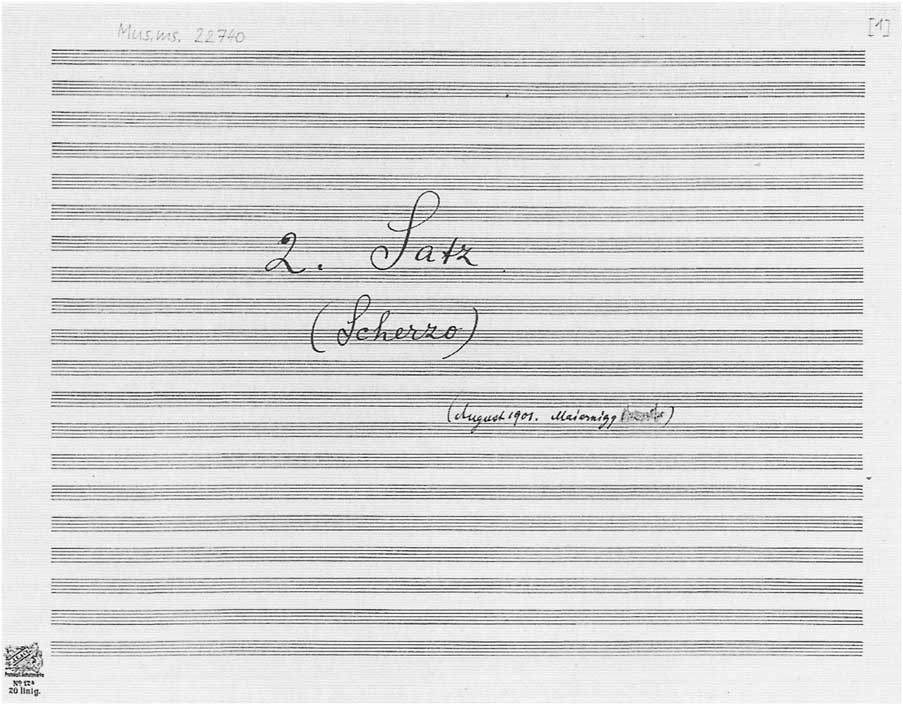
In light of this source, and if Bauer-Lechner is accurate, it seems that, both during and even after completing the drafts of the Scherzo in summer 1901, Mahler himself was unsure whether he was producing a movement that would occupy second or third place in the structure. This might explain the apparent confusion in Bauer-Lechner’s or Mahler’s account, and lead us in a certain direction with regard to the Koschat question. There is, however, another possible explanation for the confusion. But in order to get to that we need to go back and address the first principal problem I mentioned above in relation to the possible identity of the Koschat piece used by Mahler, around which this whole issue revolves.
Mahler and Thomas Koschat
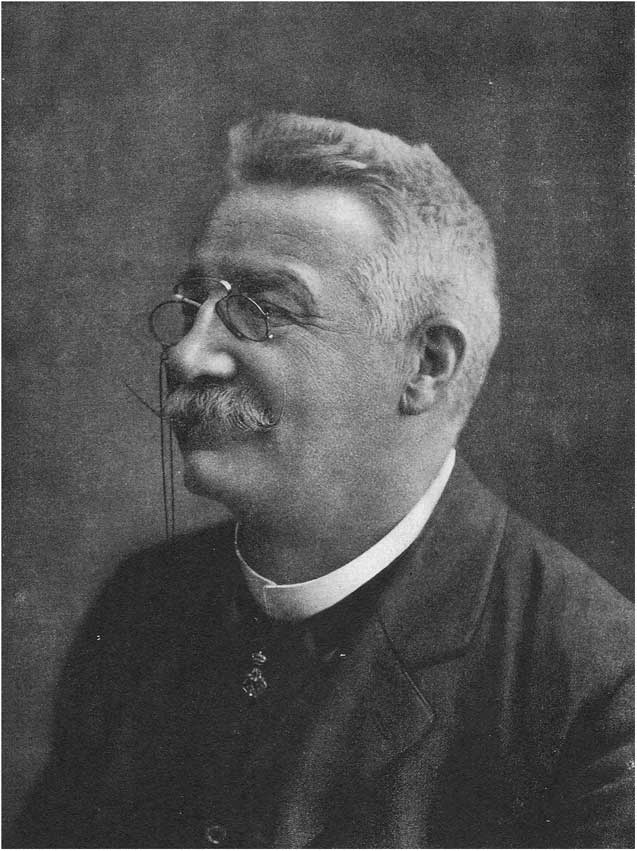
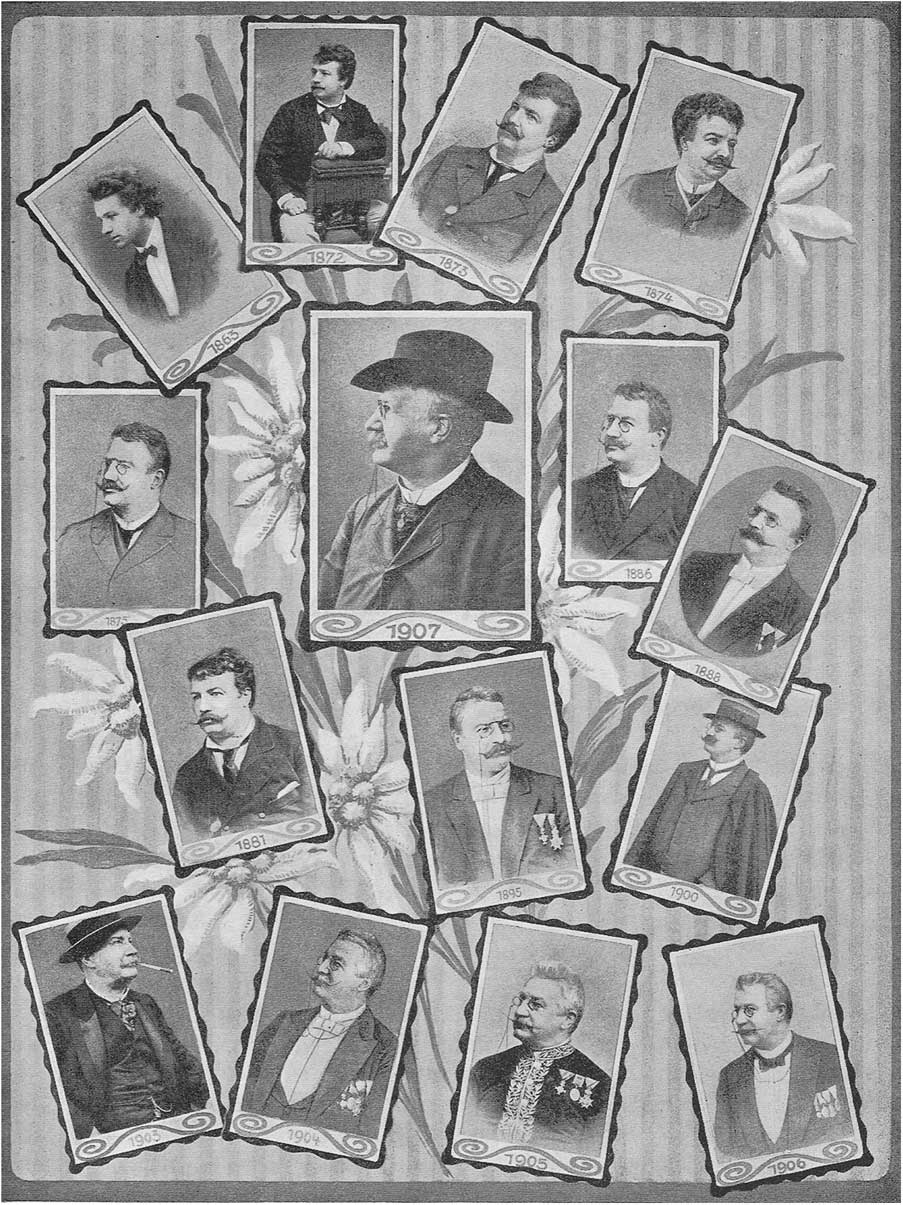
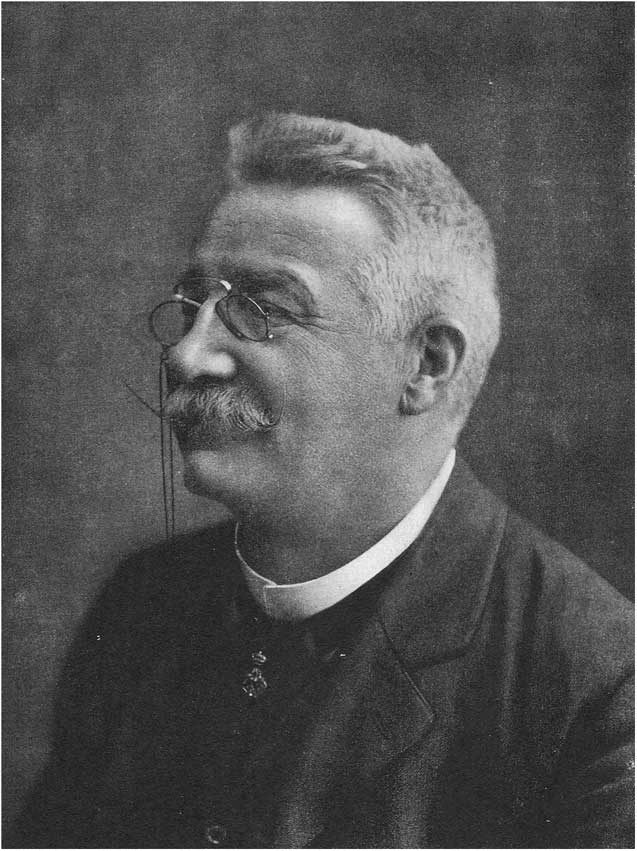
Thomas Koschat (1845–1914; see Figs. 3 and 4) was in many respects Mahler’s mirror-image or alter-ego.
Thomas Koschat
Koschat ‘through the years’
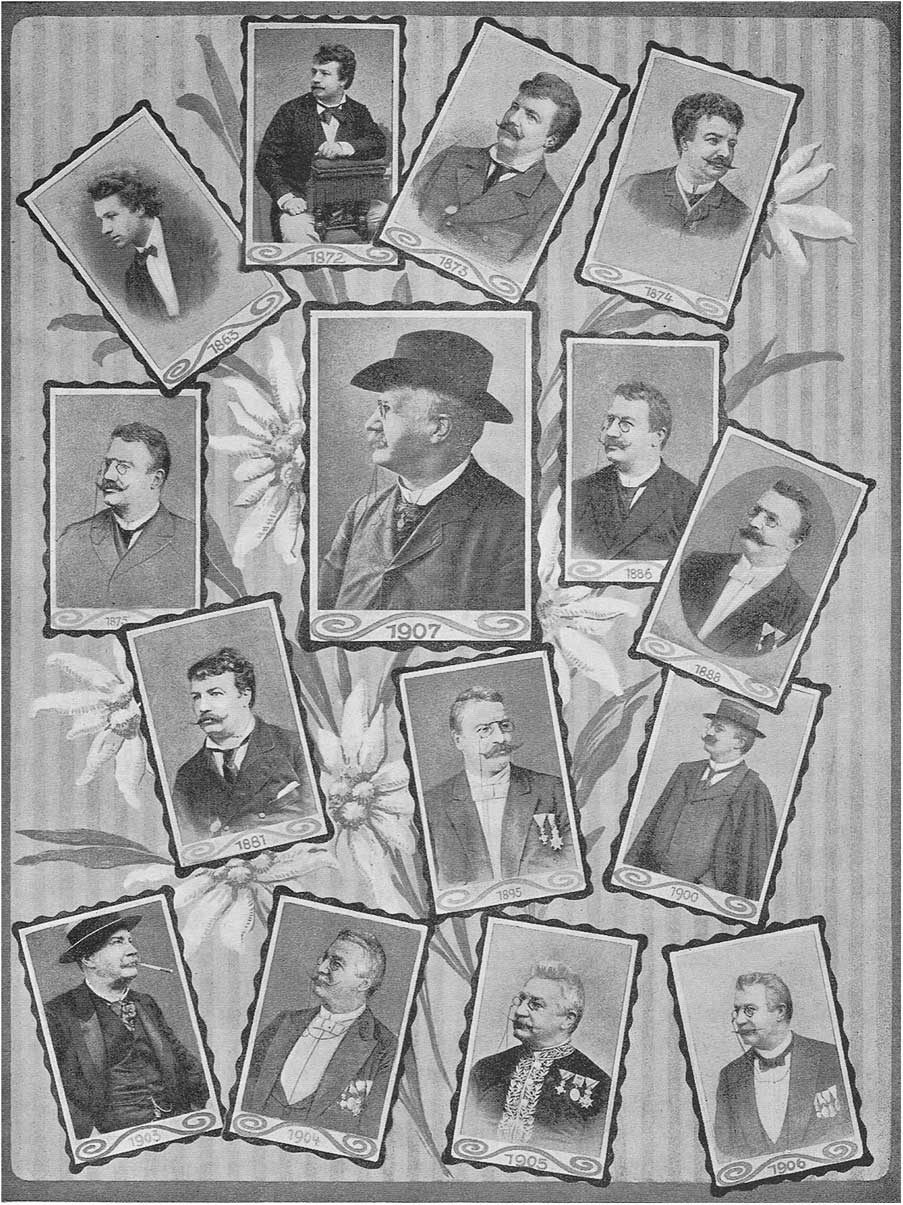
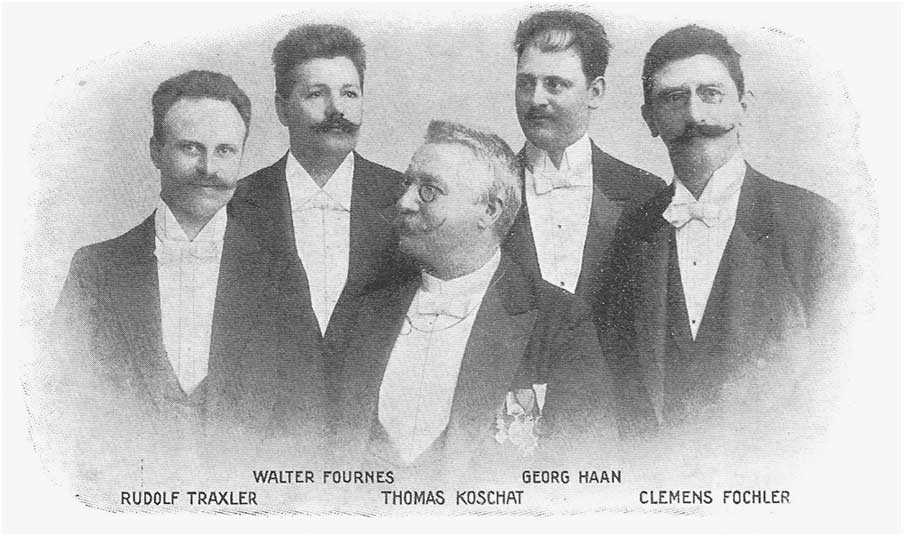
Like Mahler he progressed from (semi-)rural and provincial roots (in his case Viktring near Klagenfurt) to international recognition. Like Mahler, this process involved achieving success in Vienna, although Koschat settled there at a much earlier stage in his life, serving for 45 years as a member of the opera chorus (1867–1912), latterly as its leader, as well as singing at the Hofkapelle, the Cathedral, in three prominent choral groups – the Wiedner Männerchor, the Wiener Männergesang-Verein and the Akademischen Gesangsverein – and founding the eventually world-famous Koschat vocal Quintet with whom he travelled the globe (including, like Mahler, the United States) in approximately 1,200 concerts (see Fig. 5).
The Koschat vocal quintet

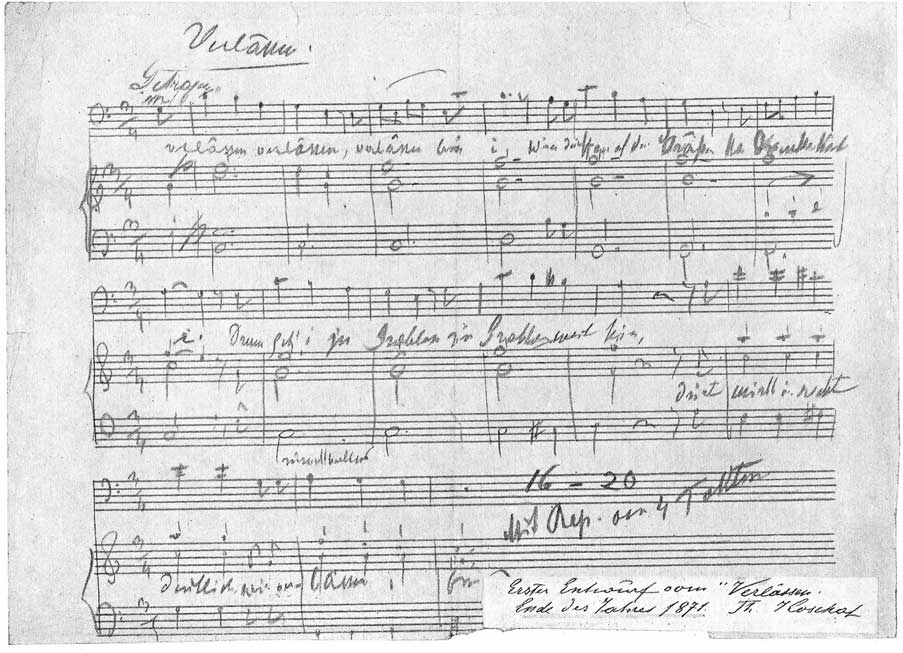
Moving, like Mahler, in Viennese Kaffeehaus circles where he became acquainted with Wolf,Footnote 25 Koschat spent summer vacations on the Wörthersee, his beloved native area, as did Mahler from 1901 to 1907. They both also tangentially shared something of a predilection for expressions of loss and leave-taking in their music (for example, Koschat’s songs ‘Âbschied’, op. 33b, and his famous ‘Verlâssen bin i’, op. 4 no. 1; see Fig. 6):
In Austria there are few songs more popular among all classes than the Kärnthner-Lieder (the songs of Carinthia), of Thomas Koschat. Among them, too, there is none so sure to excite the sympathies of an Austrian audience as that beautiful little song, ‘Verlassen bin i’. It is the complaint of the typical young Austrian peasant, who, finding himself deserted by his sweetheart, feels as lonely in the world as a stray stone on the high-road. He walks out to the little country church, kneels down inside it, and tearfully bewails his love-lorn plight (weint sich aus).Footnote 26
Koschat’s first draft of ‘Verlâssen bin i’, 1871.

Unlike Mahler, however, Koschat led a long life, relatively free, it seems, from personal and professional strife and from extensive adverse criticism of his work (see n. 64 below). Not only widely recognized by the general public as the true voice of Carinthian folk culture (regardless of the degree to which that voice, by today’s standards, could be described as ethnographically authentic), and honoured by fellow Heimat artist Peter Rosegger as ‘Volksliedmann’,Footnote 27 he was also fêted by royalty and prominent musicians, among them Liszt and Wagner, at whose Wahnfried Villa Koschat performed, and who engaged him to sing in the first Bayreuth Festival in 1876.Footnote 28 As reported in the Musical Times and Singing Class Circular in 1895:
KLAGENFURT. – The fiftieth birth-anniversary of the popular composer, Thomas Koschat, was celebrated here last month by the Kaerntner Sängerbund and other choral societies, and amidst general rejoicings of the populace. The proceedings culminated in a Volksfest, held in the vicinity of the town, in which over ten thousand people took part. Similar demonstrations took place recently at Vienna and elsewhere in Austria, where the composer’s songs enjoy an immense popularityFootnote 29
The Vienna celebrations were similarly recorded in the Monthly Musical Record:
The simple, fresh, and characteristic melodies of the Carinthian composer, Thomas Koschat, enjoy enormous popularity throughout the Austrian empire. Slightly anticipating the actual date, which is August 8th, the Viennese celebrated the composer’s fiftieth birthday by a grand Jubilee Festival (on June 23rd) in which forty-six vocal societies, with about 1,400 singers, took part. The affair was a truly popular success of the most brilliant kind.Footnote 30
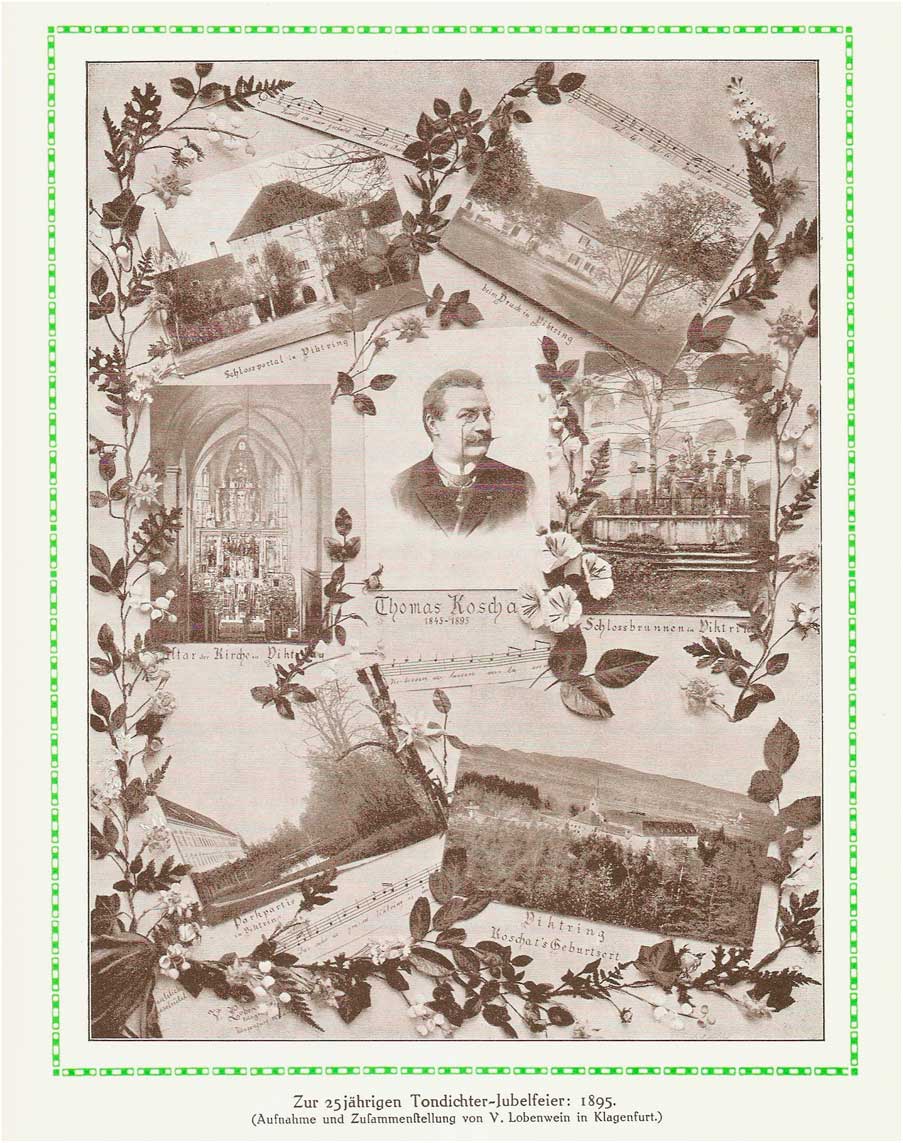
The poster shown in Figure 7 was produced in Klagenfurt for the celebrations in Carinthia, during which Koschat was named honorary chorus master of the Kärntner Sängerbund and given honorary citizenship of Velden (a spa town on the Wörthersee) and Klagenfurt, one of whose streets was also named after him.
Koschat’s fiftieth birthday celebrations (or twenty-fifth anniversary as ‘Tondichter’), 1895.

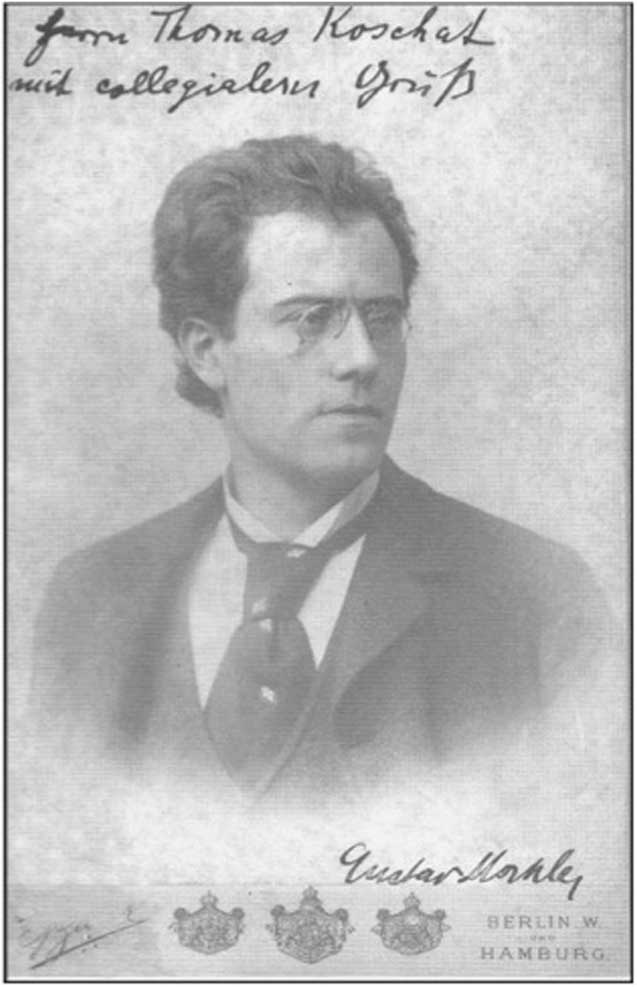
It is probable that Mahler sent the signed greeting card (Fig. 8) to Koschat from Hamburg to mark the same occasion (since the portrait dates from 1892, when Mahler was in his first or second year at the opera there), at a time when he may already have been considering the possibility of his future career move to the ‘Southern Climes’ of a Vienna where Koschat had long been flourishing.
Postcard from Mahler to Koschat, probably 1895

In stark contrast to Mahler’s modest burial service in 1911, Koschat’s funeral shortly before the outbreak of the First World War was accompanied by a choir of over 600 singers and reportedly attended by thousands of people. But conversely, the latter’s copious musical output of compositions and arrangements seems now to be largely forgotten, at least outside his native Carinthia and home town of Klagenfurt (where there is a Koschat Society and Museum, a Koschat Männerchor, and various memorials), and certain satellite pockets of interest. He does not even merit an entry in the New Grove Dictionary (although he does appear in recent editions of MGG Footnote 31 ). It also seems that even during Koschat’s lifetime, folkloric fatigue was in danger of taking root within some of the more resentful quarters of a highbrow critical fraternity, outside his immediate Viennese and Carinthian orbit, which subscribed to a certain consensus of musical taste and value:
Thomas Koschat has given, with his ensemble party, some well-attended concerts, he having become very popular in Germany by his ‘Kärnthner Weisen’, ‘Am Wörther See’, etc. But the performance cannot lay claim to artistic eminence, and for that reason cannot expect serious criticism.Footnote 32
Herr Thomas Koschat, whose hyper-sentimental and trivial compositions unfortunately enjoy so great popularity, visited us with his quintet party, and found, as usual, a large and appreciative public. Criticism is quite out of place.Footnote 33
Thomas Koschat, the Carinthian vocalist, has again visited Leipzig with his quintet party, consisting, to the best of our knowledge, exclusively of members of the chorus of the Vienna Court Opera. He has given concerts at the Bonorand garden Etablissement, and roused his audiences to the greatest enthusiasm. To hear a few of such sentimental, sweet-scented Lieder is all very well; in the end, however, they become very monotonous.Footnote 34
Koschat was the Christian by birth to Mahler’s ‘converted’ Jew; the native Austrian with clear and unproblematic sense of national identity and Heimat, to Mahler’s wavering Moravian-Bohemian-Czech-Austrian-German forever in search of his Heimat. He was the unpretentious, conservative, middle-class, late-Biedermeier figure to Mahler’s apparently neurotic, one-time radical pan-Germanist, aspirational, upwardly mobile Jewish assimilationist, and disturber of the cosy and smug, whether provincial or otherwise; and Koschat was the creator of immediately accessible, mono-cultural popular music – in the form of either occasional arrangements and transcriptions of original Carinthian folksong, or, more commonly, compositions born from the same fruit that were widely regarded as the embodiment of an authentic folk spirit or assumed the nature of latter-day folk songs themselvesFootnote 35 – to Mahler’s composer of a difficult, lofty music struggling for recognition, often criticized for its inauthenticity, pretensions, and its pluralistic cultural allusions, as was especially the case with the Fifth Symphony to which I now turn.
Identifying the Koschat Source and its Role in the Symphony
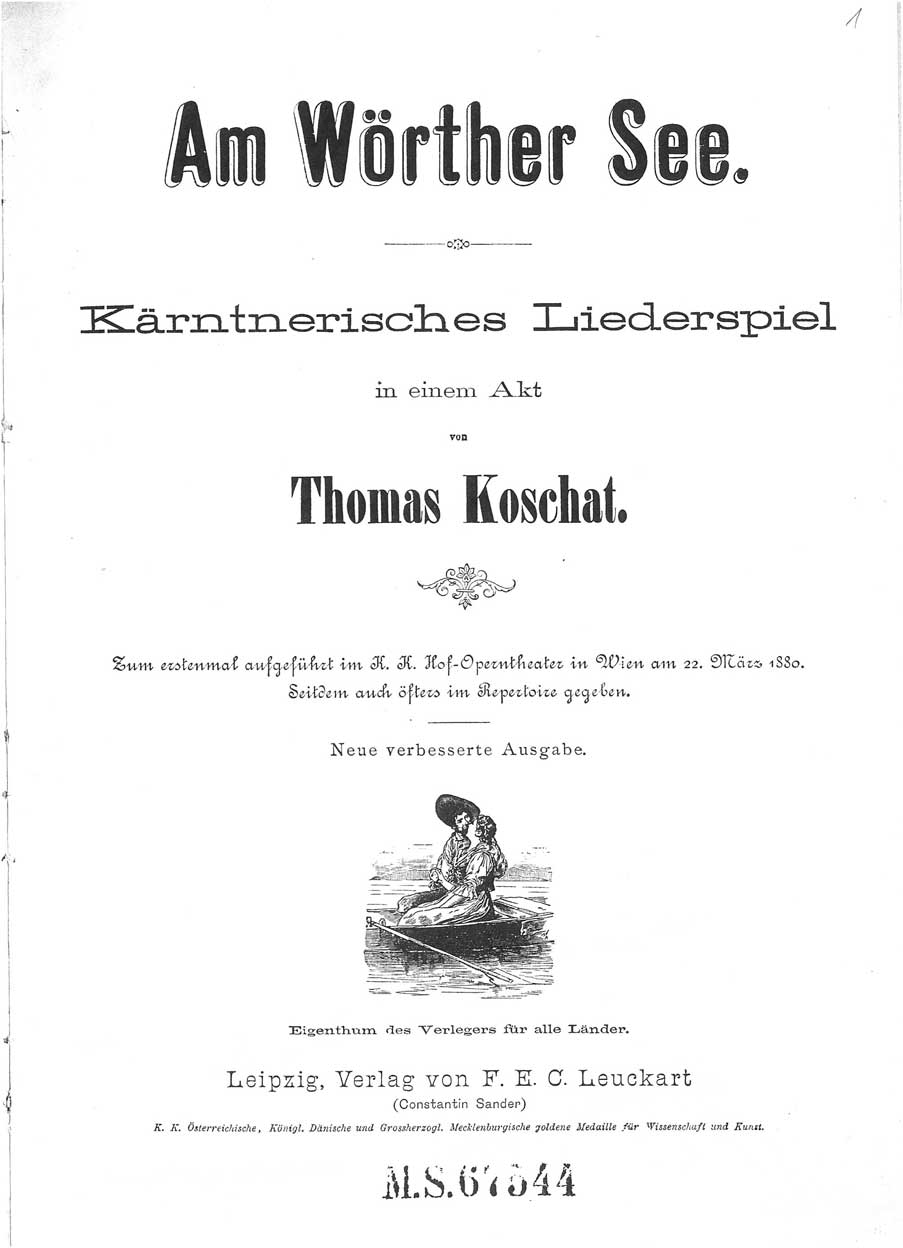
Although, as mentioned above, there is no such piece by Koschat precisely called ‘An dem blauen See’, it seems almost certain that in Mahler’s conversation with Bauer-Lechner, one or other of them was referring to Koschat’s ‘Carinthian Liederspiel’ Am Wörther See (see Fig. 9) mentioned above by one of the Monthly Musical Record critics, which was performed 40 times at the Vienna Opera between 1880 and 1912, including six times in 1898 during Mahler’s tenure, although he did not conduct it.Footnote 36 A note written by Mahler in August 1899 to the tenor Fritz Schrödter on the matter of the singer’s refusal to ‘lower’ himself to performing in Strauss’s operetta Die Fledermaus corroborates at least the fact that Mahler knew the Koschat work, and also gives a glimpse into Mahler’s own understanding of generic musical hierarchies:
An operetta is simply a small and lighthearted opera and many classical works are given this title. The fact that recently compositions without musical value have been called operettas makes no difference. Johann Strauss’s work surpasses them in every way, notably in its excellent musical diction, and that is why the administration has not hesitated to include it in the Opera repertoire. You, yourself, dear Herr Schrödter, have often sung works that are far below the level of Die Fledermaus – Am Wörther See, for example.Footnote 37
Title page of Koschat’s Am Wörther See

That Mahler had a penchant for street, folk, and popular music is clear from his own music and from his comments cited in the opening part of this study. However, as much as we might wish to believe that Mahler embodied an early example of ‘postmodern’ cultural relativity and democratization, this may not have been entirely the case. To be sure, he had a particular liking for the sound of barrel organs, and some operetta,Footnote 38 but his low estimation of Koschat’s ‘Liederspiel’ should be seen in the context of his unwillingness to accept the waltzes of Johann Strauss as ‘art’ even though he enjoyed them: ‘they have as little to do with art as has, say, the folksong “Ach, wie ist’s möglich den”,Footnote 39 no matter how moving it is’, Mahler is reported to have said. The relentless, un-developing eight-bar phrases ‘cannot count as “composition” in any sense of the word’.Footnote 40 Koschat’s approach was certainly similar, though as we will see he extended the technique to form a medley-based narrative structure.
Am Wörther See comprised an orchestral Vorspiel and nine vocal or choral numbers interspersed throughout the part-sentimental, part-comic staged story (also written by Koschat) of simple Wörthersee folk, which tells of the overcoming of a lakeside inn-owner’s objection to his daughter’s union with a seemingly neglectful but in fact deeply patriotic soldier whose lack of communication while away fighting in Turkey, it transpires, was due to a spell lying injured in hospital. This is certainly Wunderhorn territory, though couched in more blatant levels of Kitsch, and less powerful, archaic or universalizing poetry. Indeed, ‘The Opera is becoming a music-hall [Tingltangl]!’ was the kind of critique offered by newspapers in response to early performances,Footnote 41 while the satirical journalist Ottokar Franz Ebersberg (writing as O. F. Berg) of the Illustrierte Wiener Extrablatt countered:
Rather the frightful musical witches’ Sabbath of the most miserable Wagner imitator; rather the stalest mish-mash of a musician of the future or the feeble melodic copying of a foreign plagiarist, than the sounds of our homeland. For these noble activities are no more than ‘music-hall’. However much the heart is moved and the values of homeland are evoked, whatever bears the stamp of Austria is an abomination. If someone in France were to describe the glories of their homeland as music-hall, they would quite rightly be sent packing. With some satisfaction, then, we welcome the report in a local paper that, in the face of claims that Am Wörther See was not good enough for the Opera House, His Grace Archduke Wilhelm has given his public assurance to the composer Koschat that it has been very well received in court circles. So, no more music-hall! What would those who disdain a gift for the vernacular, the leaders of opinion who seek to shun any trace of Heimat in the Hoftheater, say to that?Footnote 42
What, indeed, would Mahler say to that? My examination of the source material of Am Wörther See (held in the Austrian National Library in Vienna) in the form in which it was presented at the Opera House, and of the published score and the surviving short-score drafts of the symphony (only two drafts exist, both of the Scherzo) revealed no immediately obvious evidence of thematic borrowing in the second or third movements.Footnote 43 Without access to preliminary sketches, it is impossible to know whether Mahler had anything specific in mind at that early point, which he subsequently excised or reworked. However, Mahler Footnote implied to Bauer-Lechner that this was a theme from Koschat that came somewhat unconsciously and which lent itself to symphonic development, rather than just being baldly quoted. Everything in the Scherzo is ‘kneaded through and through so that no little grain remains unmixed and unchanged’, as he said in the same conversation with Bauer-Lechner.Footnote 45 For in typically Mahlerian fashion the Scherzo movement is far more than a simple Scherzo and trio structure, but rather a highly complex combination of this with elements of episodic Rondo and subverted sonata-like developmental processes. Furthermore, if Bauer-Lechner is correct, rather than ‘a’ theme, Mahler speaks of ‘the’ theme from Koschat’s piece – the ‘An dem blauen See’ theme. If we think along these lines, possibilities emerge.
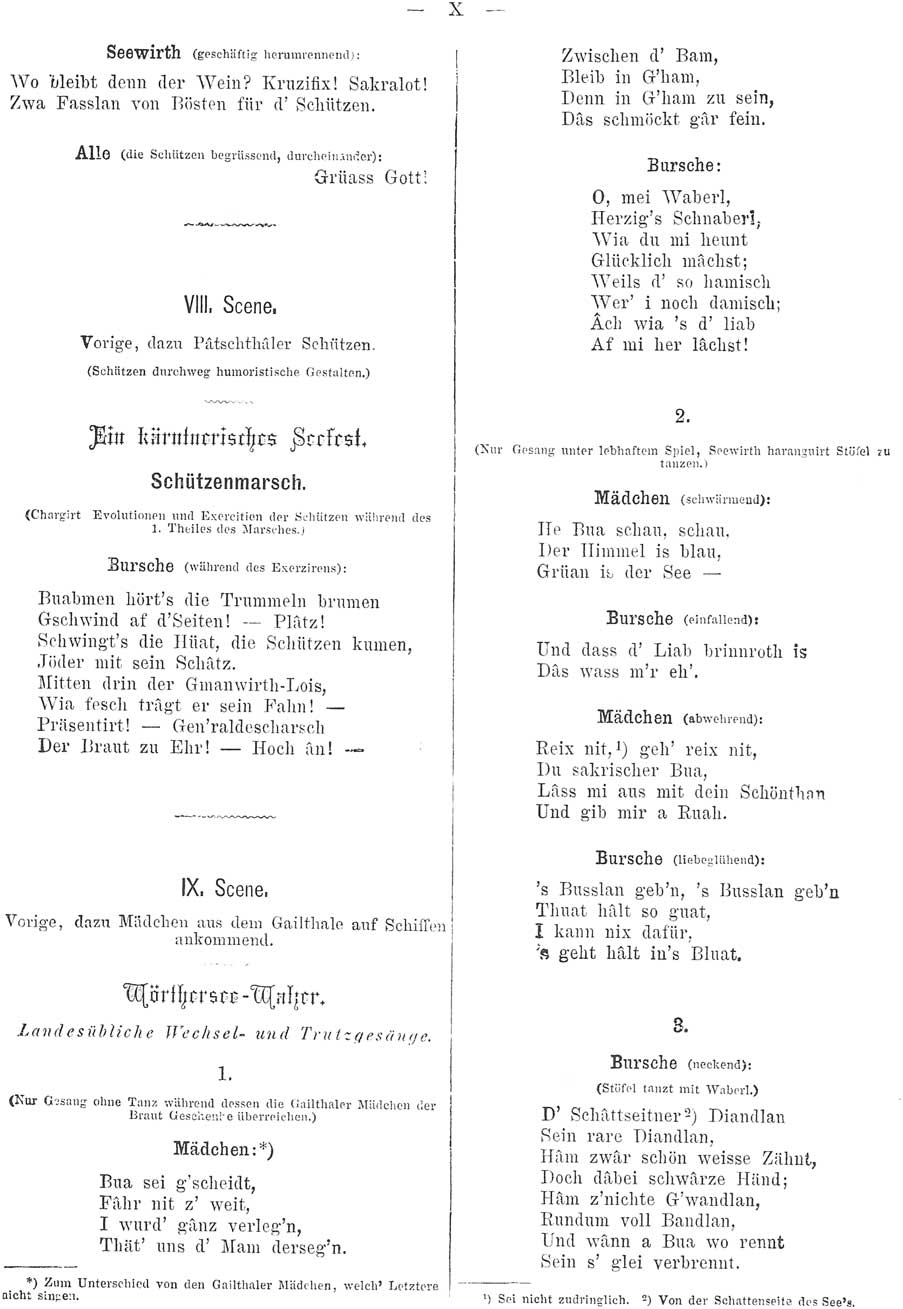
Am Wörther See ends with scenes of general rejoicing, singing and dancing at a Seefest on the banks of the lake, for which Koschat utilized a set of waltzes of the same name composed in 1878,Footnote 46 now entitled ‘Wörthersee-Walzer: landesübliche Wechsel- und Trutzgesänge’, and arranged for alternating, and eventually combined, four-part female and male choruses (see Fig. 10).
Page x of Am Wörther See piano score44

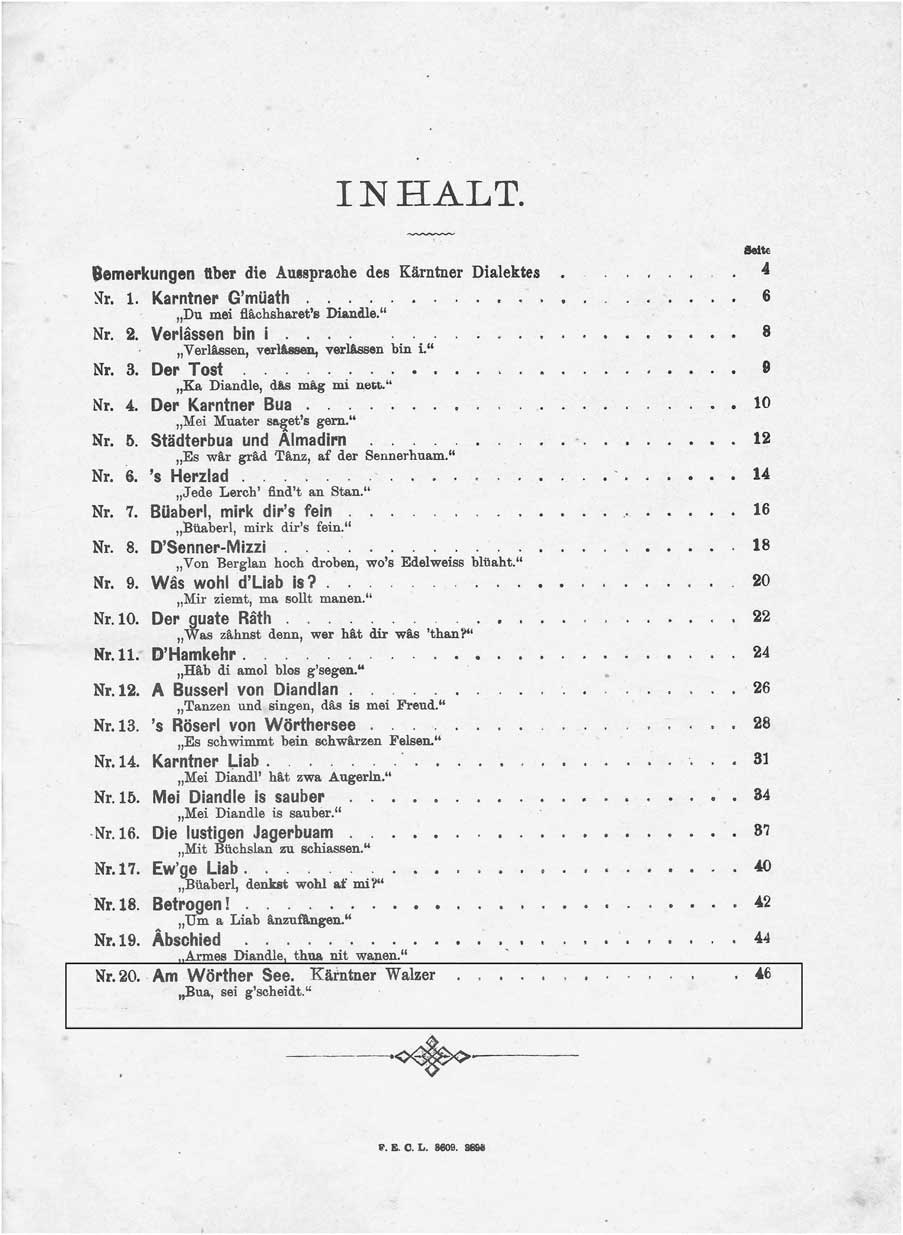
These ‘Carinthian Walzes’ from Am Wörther See, which ‘now and again incorporate a finely seasoned Viennese touch’,Footnote 47 retained, and quickly developed further, an independent life of their own, appearing in numerous editions, arrangements, and collections of his work, such as the later example shown in Figure 11.
Contents page of Koschat-Album for voice and piano (Leipzig: Leuckart, 1914)

Not only that, but the ‘Wörthersee-Walzer’s Introduction (slightly altered) and the ensuing first Waltz are repeated at the end of the work (simply labeled ‘Schluss’), to form a kind of Coda reprise, and thus cementing their position as material that lends the work its musical identity. If Mahler’s thematic allusions are to be found anywhere, it is most likely to be in this signature part of the Koschat Liederspiel.
The first thematic or motivic idea we hear in the orchestral introduction to the ‘Wörthersee-Walzer’ is given in Example 1.
Koschat, Am Wörther See, no. 9: ‘Wörthersee-Walzer’, bars 6–14

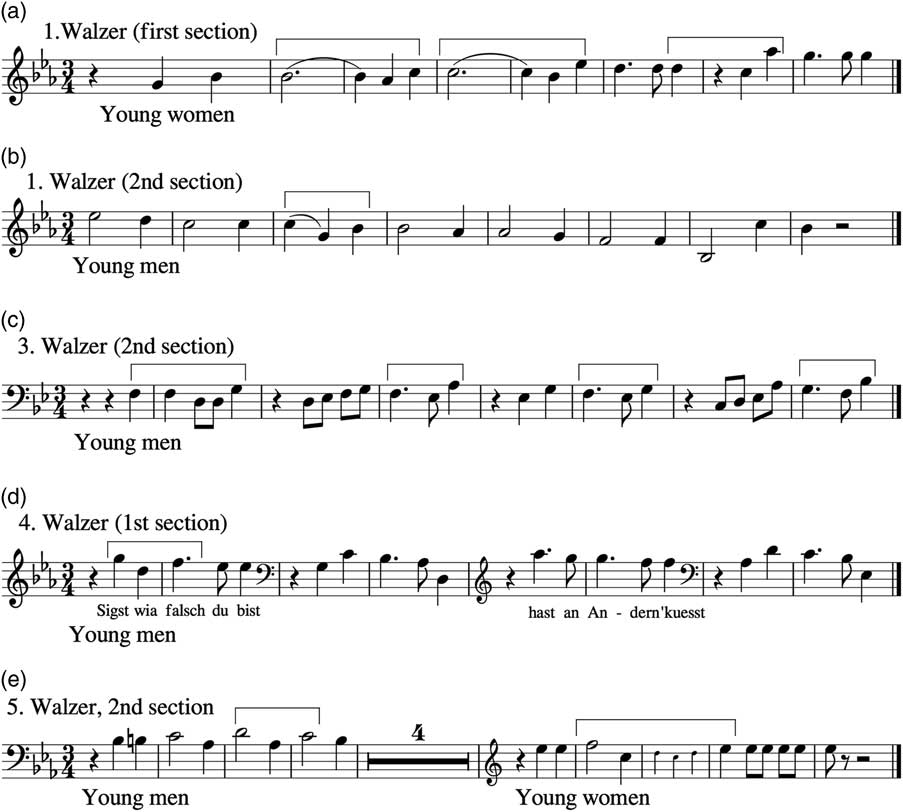
The idea is taken up, adapted in intervallic shape, and inserted within the melodic lines of the following opening Waltz or Wechsel-Gesang, and then also appears in the third, fourth and fifth Waltzes in its original and adapted forms (Ex. 2).
Adaptation of the opening theme in First, Third, Fourth and Fifth Waltzes

And, of course, it appears in the repeat of the opening introduction and Waltz that occurs at the end of the piece. It seems credible to suggest on this basis that the gently lilting Ländler material which provides the first significant change of mood in Mahler’s Scherzo movement, from bar 136, may be the primary candidate for the Koschat allusion, built as it is on the same or similar three-note melodic idea, and using the same initial pitches as Koschat’s fourth Waltz (see Ex. 3).
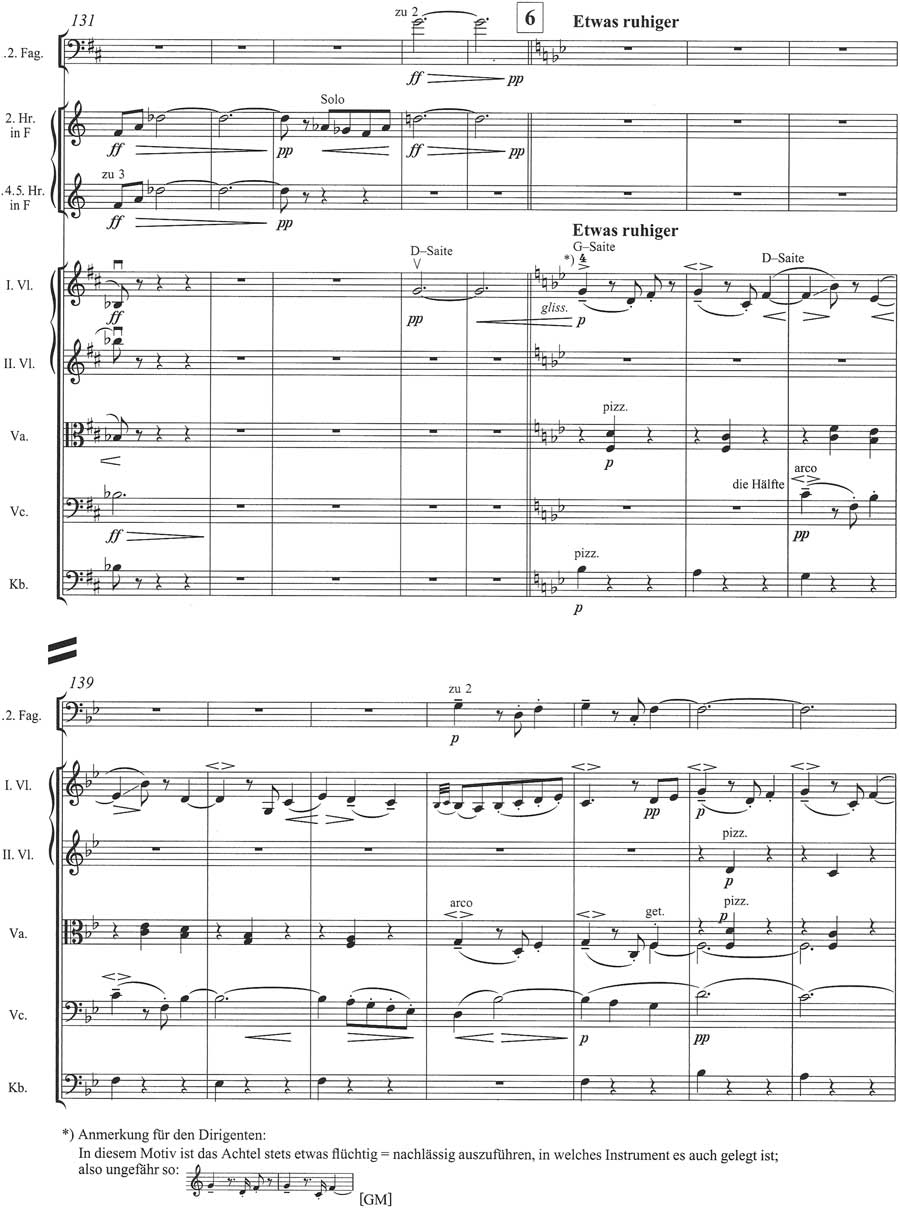
Mahler Symphony No. 5, Scherzo, bars 131–145. Reproduced by kind permission of Peters Edition Limited, London
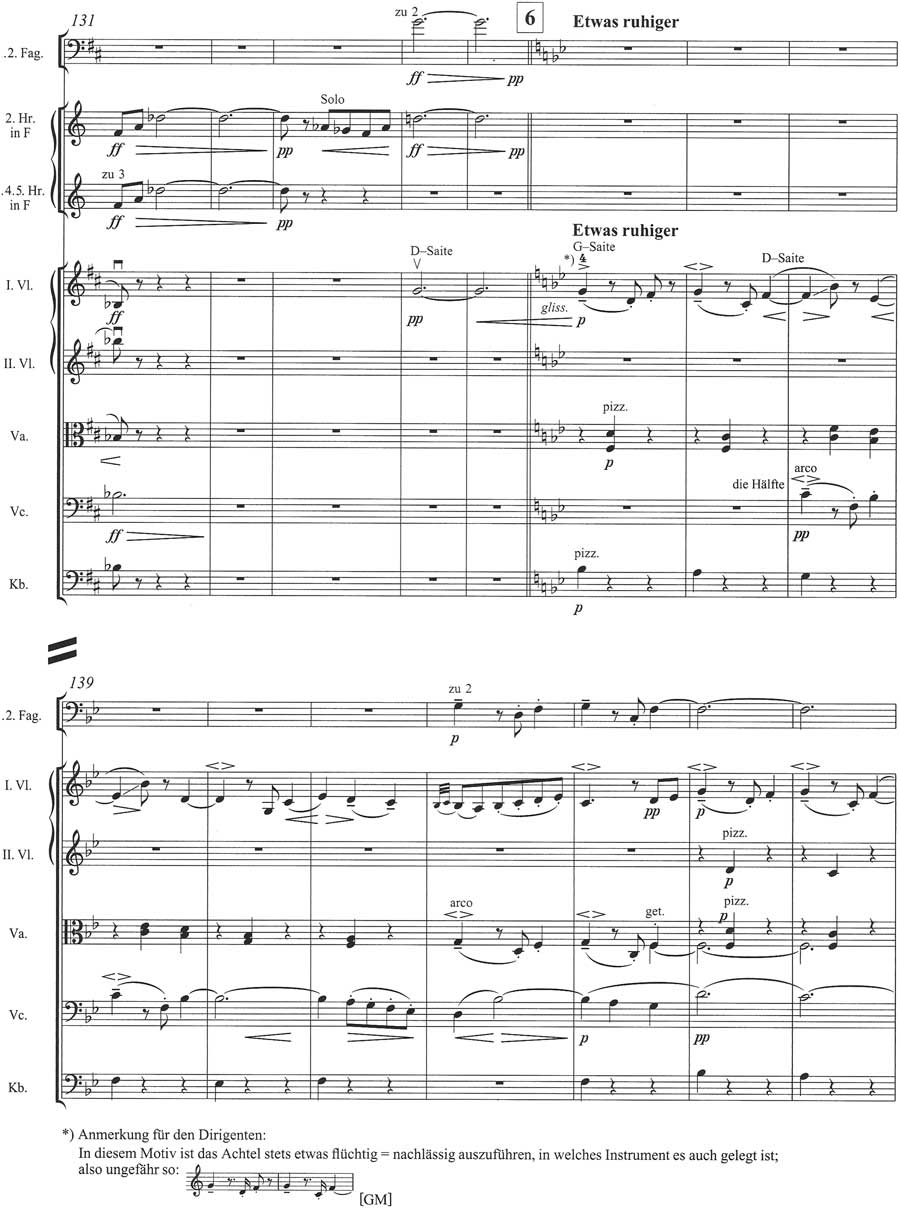
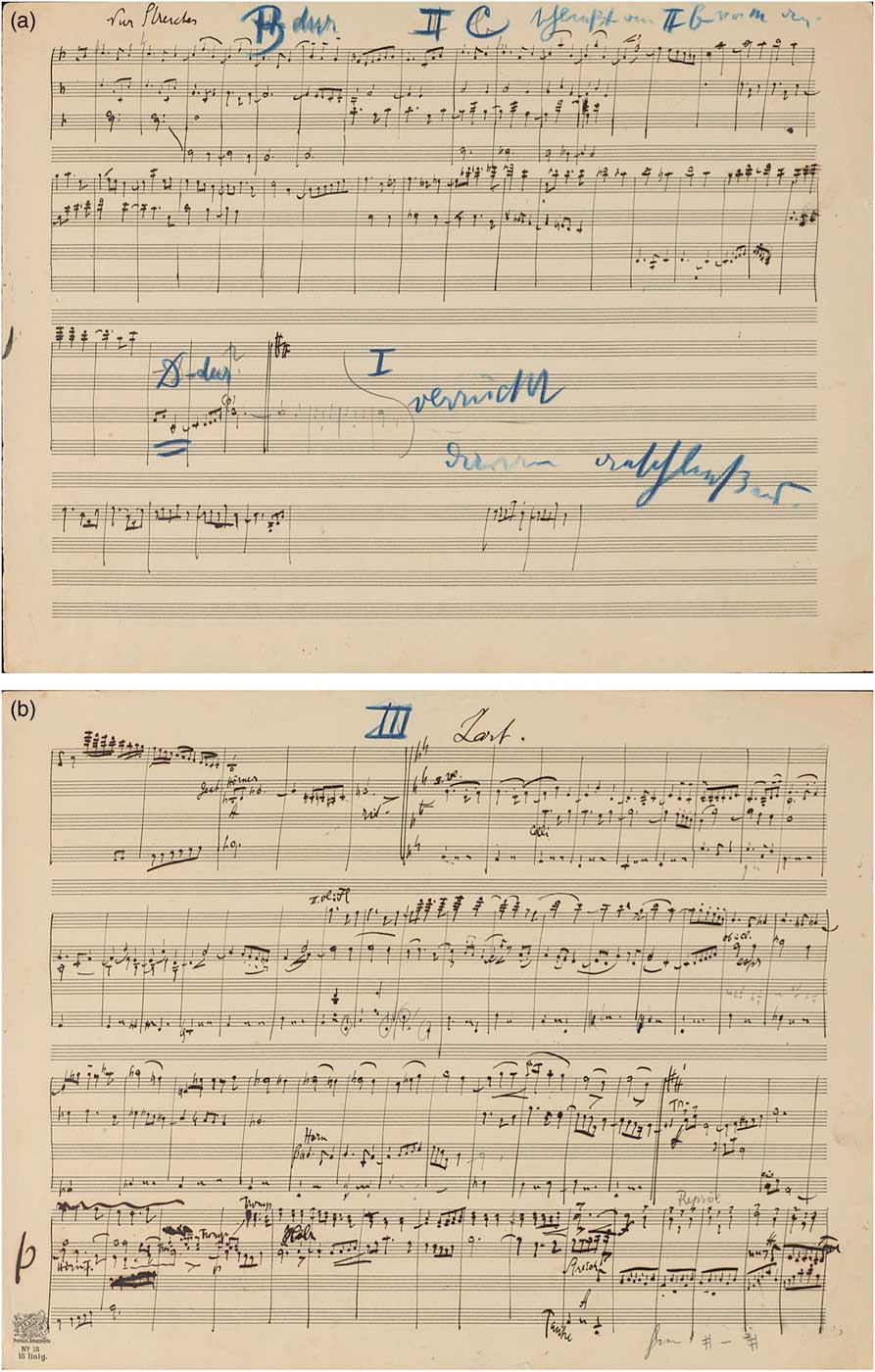
We can see from Mahler’s short-score draft of the movement how he had two attempts at working on this material (Fig. 12). It is striking in this draft that Mahler tended to like fitting whole structural sections of music onto a single page as far as possible, sometimes adding inserts to retain this pattern. That there are two pages evidently labelled ‘II’, each containing different material, might suggest that Mahler was unsure of the ordering of the allegro quaver-based contrapuntal idea (first page ‘II’, bars 83–128 of the movement) and the Ländler material (second page ‘II’, bars 136ff. of the movement) that follows it. But the surrounding continuity of the draft makes this highly improbable. We are left with a page marked ‘II’ and one marked ‘III’ (Fig. 12), both of which contain versions of the same Ländler material – in F major (with an indication in blue pencil that this should be changed to B-flat major), and in B-flat major respectively – and it is more likely that the former is simply an earlier version of the latter. Mahler’s somewhat enigmatic annotation in blue pencil on the first of these pages: ‘II C [written over what looks like ‘II b’ in ordinary pencil] schließt an II b vorne an’ (‘II C fits in front of II b’) suggests the existence of further sketch pages, now lost, and it remains unclear why he should have numbered the page that clearly follows on (in terms of musical continuity) from the first page ‘II’, also as page ‘II’ (or ‘II C’). If there was a correlation for Mahler between Roman numeral and structural features of the movement, rather than the numbers simply indicating pagination (the number ‘VIII’, for example, later in the draft, corresponding to bars 308–336 of the movement, clearly refers only to part of that manuscript page; and Mahler may have returned to these drafts at a later point to add or alter these numbers, possibly as a guide to the next stage of composition), then it is not beyond the bounds of possibility that in his 1901 conversation with Bauer-Lechner he might have been referring to the ‘second (or third) section’ within the Scherzo movement in connection with the Koschat allusion, and that she was not sufficiently precise in her reporting of terminology, or had misunderstood Mahler’s account.
Successive pages in Mahler’s short-score draft of the Scherzo, marked ‘II’ and ‘III’ in blue pencil. Reproduced by kind permission of the Pierpont Morgan Library, New York. Photographic credit: The Pierpont Morgan Library, New York

Whatever the case, it is rewarding to trace the structural narrative of these folk-inspired, likely Koschat-inspired, ideas, because they play crucial roles in the trajectory of the symphony as a whole. Remembering that the Scherzo short-score draft was completed before what were to be the first two movements of the symphony, but that the chronology of any presumed earlier sketching for the whole work (now lost) is necessarily unknown, it is significant that, during the course of the finished work, the little three-note figure appears initially in the second movement, ‘Stürmisch bewegt’ (Ex. 4). Whether or not by the time of his conversation with Bauer-Lechner Mahler already knew that the motive would appear in this movement, (thereby lending some credence to, though not fully clarifying, her account), remains an unresolvable question in the absence of evidence from earlier sketches.
Symphony No. 5, second movement, bars 169–175

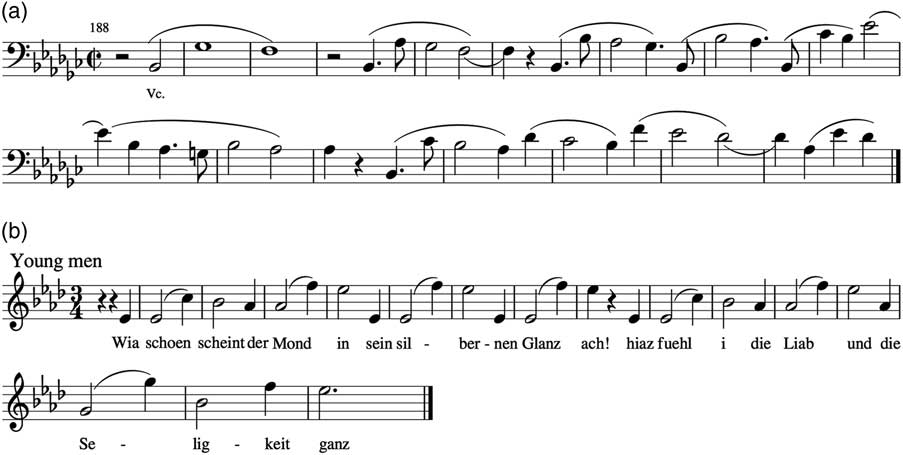
Seemingly innocuous, in fact this and later appearances in the movement always herald incipient structural breakdowns and/or imminent intrusions of material of radically contrasting mood. In this first instance, for example, the reprise of the movement’s stormy, vehement opening music rapidly disintegrates after the appearances of the motive, to be replaced by one of Mahler’s lonely, monophonic solos, a melody which itself strongly resembles a minor-mode variant of another distinctive vocal line in Koschat’s ‘Wörthersee-Walzer’, characterized by upward leaps (sometimes of a ninth, which Fritz Pamer early identified as a distinctive folk-like ploy with similarities to the portamento upbeat in folk singing)Footnote 48 and whose text gently evokes the silvery light of the moon (see Ex. 5).
a) Symphony No. 5, second movement, bars 188–203; b) ‘Wörthersee-Walzer’, Fifth Waltz

The feature of a large rising interval followed by stepped descent (or, in the Mahler, occasionally ascent) shared by these melodies here (often involving appoggiatura functions) first occurs most obviously in the final funeral dirge of the Symphony’s opening movement, from bar 322. But it can be traced further back, somewhat buried, in the movement’s core material: 1) the preceding funeral dirge in the woodwind, bars 294–307; 2) embedded in the very first appearance of the funeral dirge material, bars 42–47; 3) in a secondary, closing horn phrase in the opening funeral march section, bars 24–27; and 4) at a key transitional moment as funeral dirge and fanfare shift abruptly to the first allegro section proper of the movement, bars 152–157.
Earlier in the second movement this idea is also briefly foreshadowed by the isolated examples shown in Example 6, which are similarly implicated in the breakdown of this movement’s Stürmisch material, but then, from bar 78, become an insistent accompaniment in the ensuing evocation of that final dirge of the first movement.
Symphony No. 5, second movement, bars 68–82

Whether paired together or singly, these two ideas (the three-note and rising-leap ideas) partake in remarkable formal events:
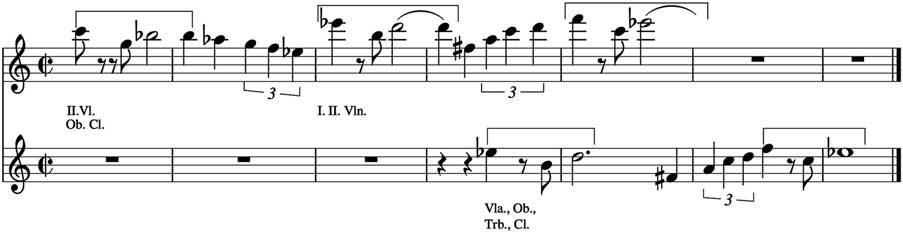
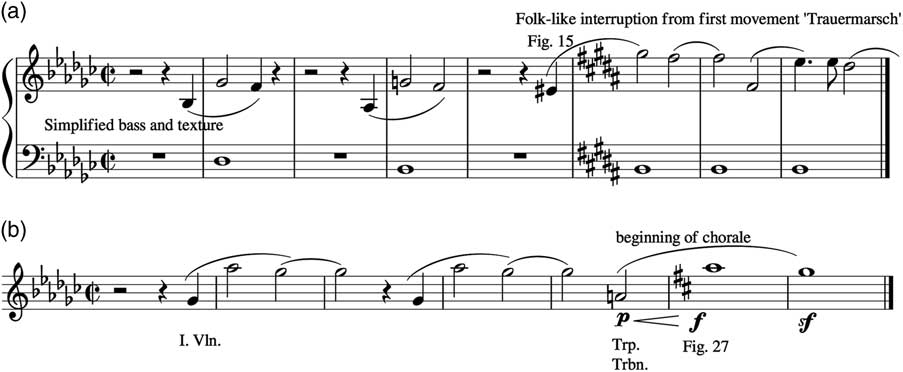
a) In the lead-up to rehearsal Figure 15, thematically ushering in the ray of volkstümlich light that previously had temporarily penetrated the opening ‘Trauermarsch’s’ gloom (there at rehearsal Figures 5 and 14). See Example 7a.
b) Thematically anticipating the abortive seven-bar chorale outburst at six bars before rehearsal Figure 18, and the more substantial chorale at rehearsal Figure 27, the latter illustrated in Example 7b.
c) In the case of the rising-leap-falling-step idea, infiltrating nearly all parts of the rest of the movement, until it becomes the final motivic idea left in our ears (bars 523–527, reduced to just the falling step in bars 533, 535–539, and, recombined with the rising leap, closing the movement in bars 568–574).
Symphony No. 5, second movement, a) bars 261–268; and b) bars 459–465

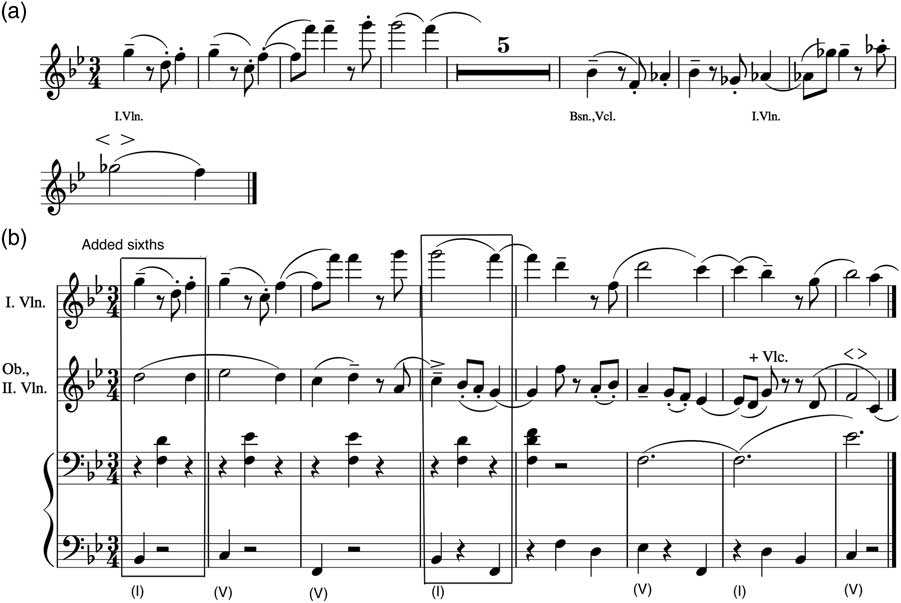
Moving on to the Scherzo, where, in general, folk-like musical topics are more brazenly displayed, not only does the three-note motive provide the building block for important contrasting material to the horn-dominated and contrapuntal opening waltz material of the movement as discussed earlier, but also within this context it joins hands with the rising leap idea to form a convincingly elegant Koschat-type adapted whole, as shown in Example 8.
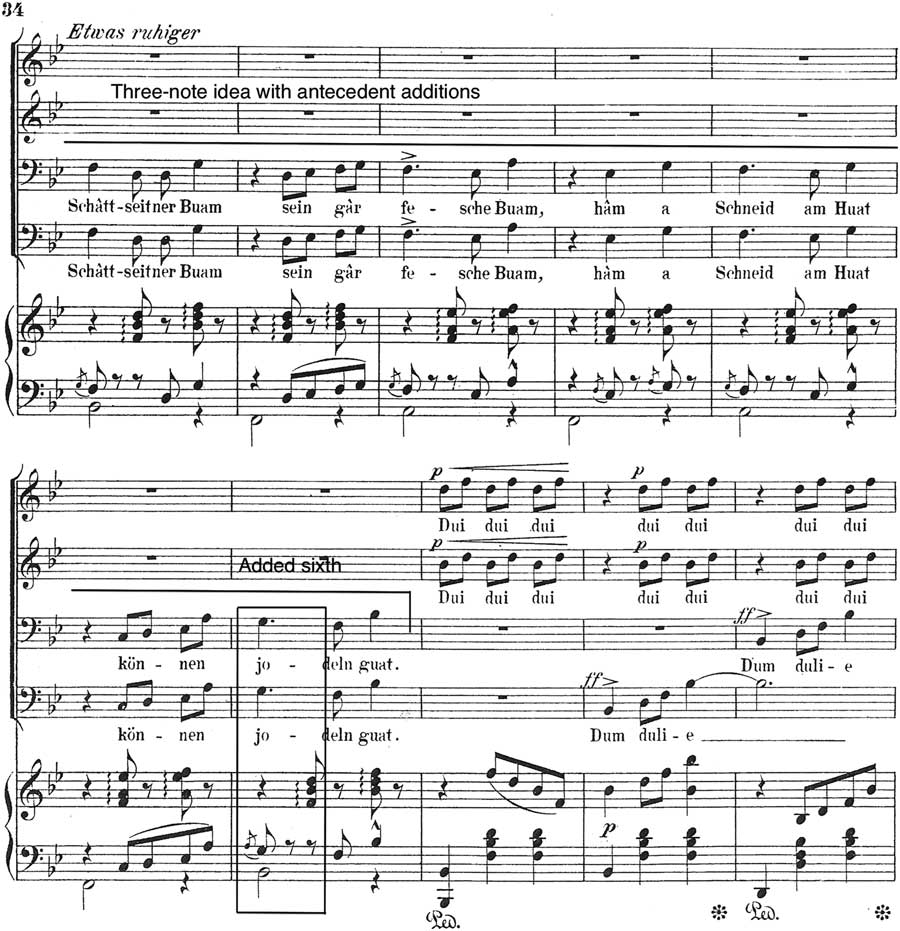
Symphony No. 5, Scherzo, a) bars 151–163, melodic phrases; b) bars 151–158 in short score with added 6ths and I–V progressions indicated

From adopting an initial secondary role, this little complex assumes relentlessly more significant functions in the musical argument, and it does so with even greater structural intensity than in the previous movement:
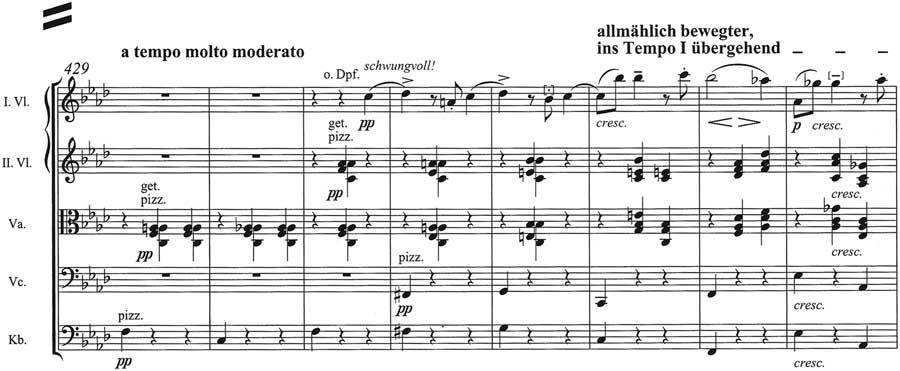
a) It helps to bring the music out of stasis after the second breakdown of the movement’s main horn material, appearing from bars 329, 400, 411, and 431 onwards (see Ex. 9).
b) It partakes in the horn-related material’s fast tempo and ebullient mood from rehearsal Figure 15, bar 448
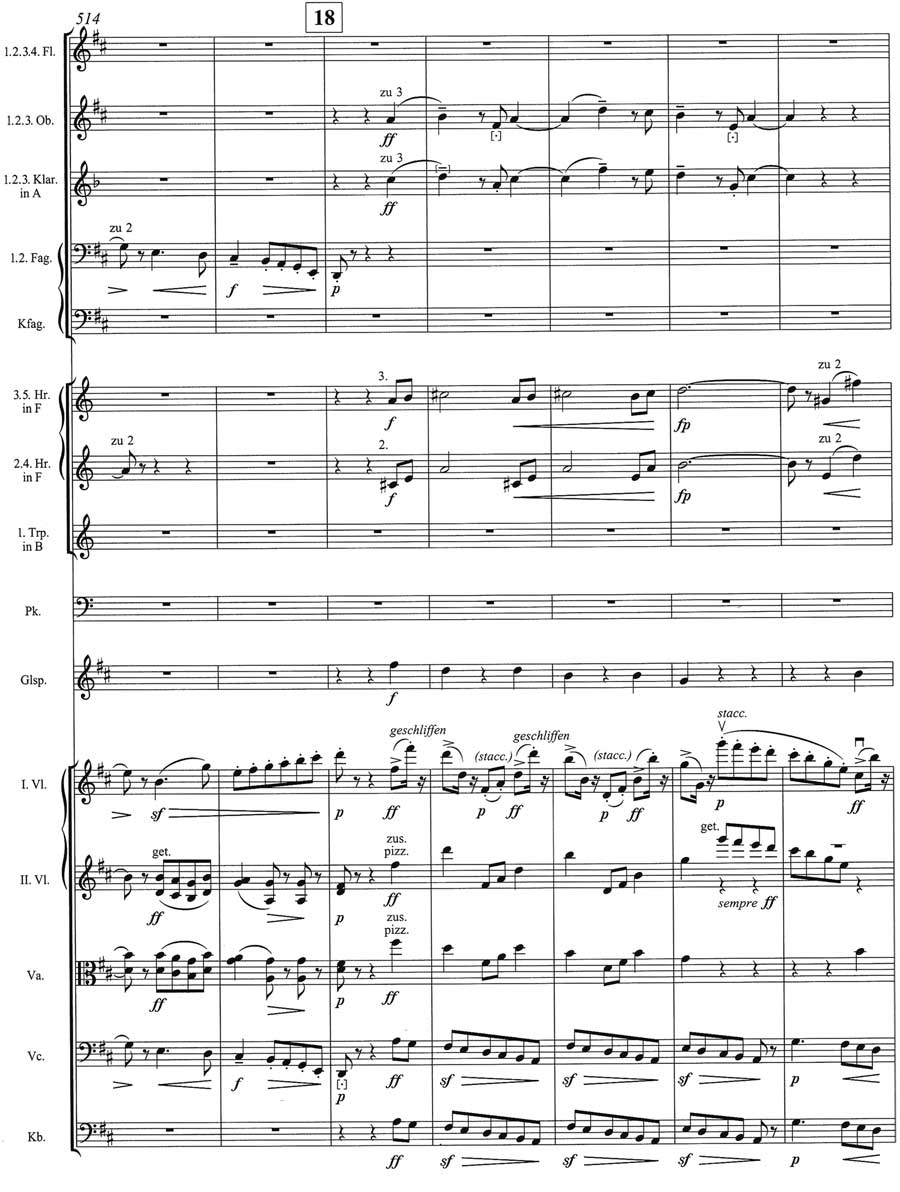
c) It insinuates or forces itself into the actual reprised horn material, in the woodwind from rehearsal Figure 18, bar 516, over ‘yodeling’ figures in the first violins (Ex. 10).
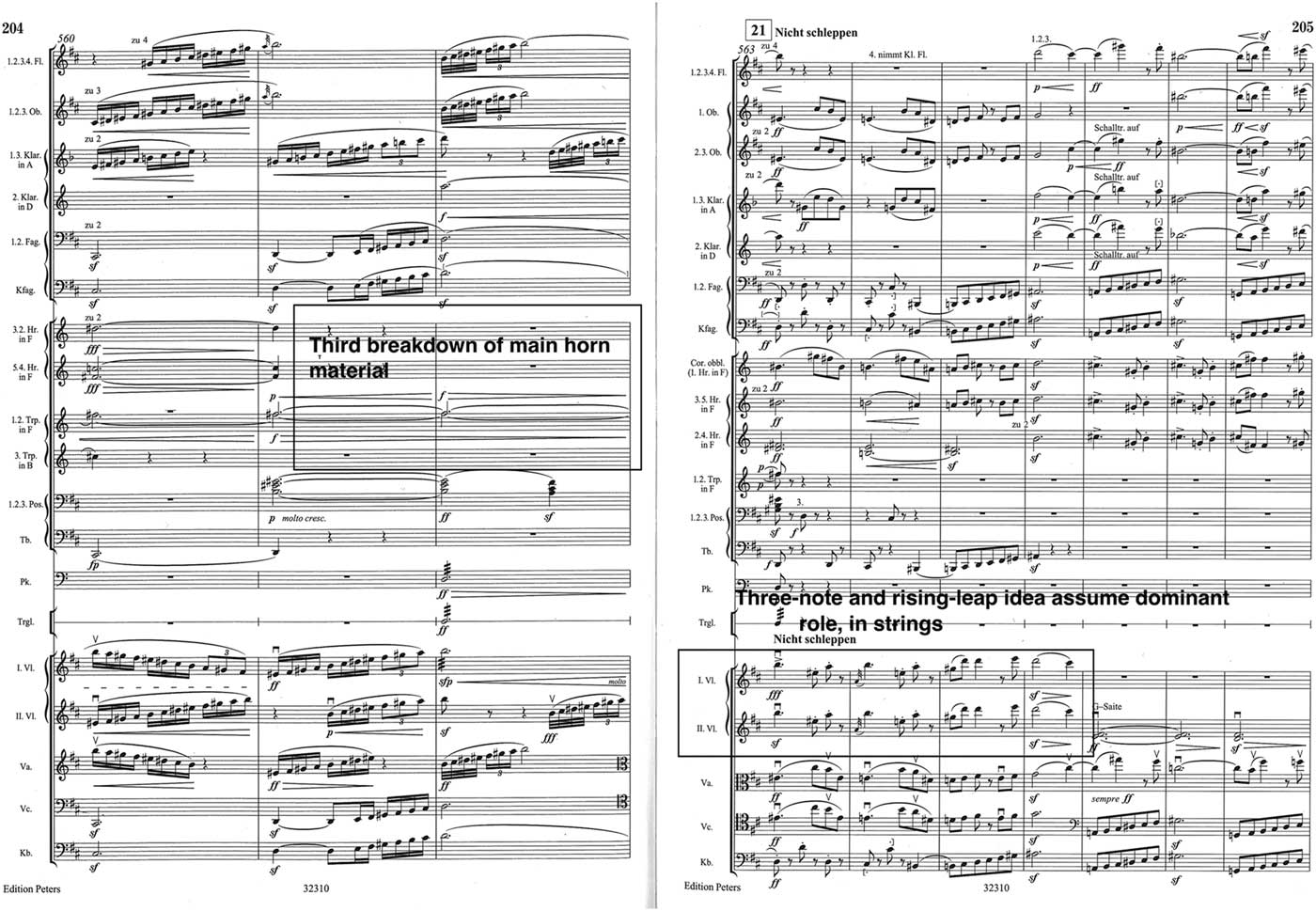
d) It then assumes the horn material’s previously dominant, primary structural role (in violins, rehearsal Figure 21, bar 563) after the third breakdown of that horn material (Ex. 11).
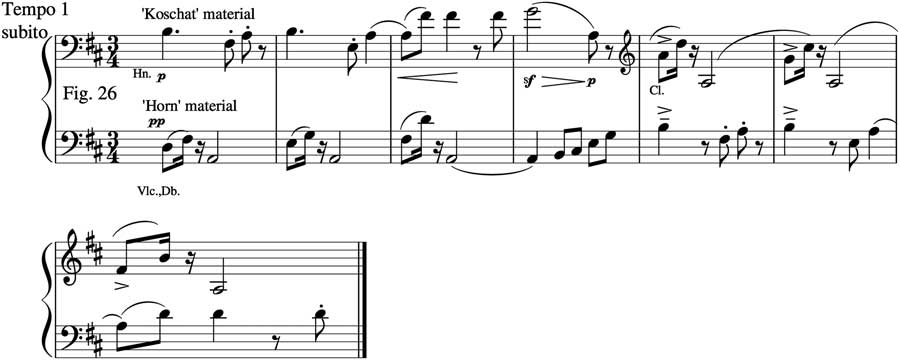
e) At bar 633, it does not ‘allow’ that main material to re-establish dominance, by interrupting and vying with it (just as it itself had twice been displaced earlier by the returning horn material at rehearsal Figure 7, bar 174 and rehearsal Figure 17, bar 490), until its presence and validity seem to be fully accepted at rehearsal Figure 26 (bar 662) at Tempo I – now, significantly, given initially to the horn, and appearing alongside the ‘horn’ material which is now initially heard in lower strings in a marked timbral exchange of the material’s prior associations that has been emerging intermittently during the movement (Ex. 12).
f) Until the Coda, bar 764, which splits everything apart again: not only the Koschat complex (bars 784–790) from the main horn material (bars 791–798) which now alternate with each other, but also the two halves of the Koschat complex themselves – the three-note idea (bars 784–790) and the rising-leap idea (bars 799–808), whose final falling step is left manically to repeat over the concluding horn-material flourish, itself now contorted tonally and outlining an augmented-triad fanfare (bars 809–813).
Scherzo, bars 429–436. Reproduced by kind permission of Peters Edition Limited, London

Scherzo, bars 514–520. Reproduced by kind permission of Peters Edition Limited, London

Scherzo, bars 560–569. Reproduced by kind permission of Peters Edition Limited, London

Scherzo, bars 662–668

Reflections and Conclusions
An idea of the gulf that was perceived to exist between certain ‘art’ and ‘folk’ music is evident from the 1912 Koschat biography (one of very few) cited earlier in this study, by his close colleague Karl Krobath, who notably specifically contrasts him with Mahler, and in the process offers an intriguing early critique of the latter composer:
Sensational pursuit of effect! [Effekthascherei] – I mean that in the time of Richard Strauss and Gustav Mahler, Koschat’s muse is worlds away from this pursuit, indeed it is quite unpretentiously simple.Footnote 49
Mahler was certainly no Bartók, Kodály, Cecil Sharp or Vaughan Williams when it came to folk music, but, contra Krobath, it seems that he did want to tap into the kind of aesthetic of the ingenuous, offered by the likes of Koschat, and work it into his own symphonic approach, especially in this work. ‘The return to simplicity’Footnote 50 that the culturally conservative Kaiser Wilhelm II perceived and extolled in Koschat’s music in conversation with the Carinthian composer, was not necessarily the same as a return to the simplistic, and Mahler found adopting this creative approach to be no easy task. It is notable that in the two volumes of Volkslieder für Männerchor published in Leipzig in 1906 at the behest of the Kaiser, who wished to reinstate a folk-inspired tradition of national German choral music in the face of what he considered to be the overly complex music of the day – ‘to capture the essential traits of the songs of the folk, their directness, their truth, simplicity, unpretentiousness, intimacy’Footnote 51 – contributions by Bruch, Humperdinck, Richard Strauss and Ludwig Thuille stand alongside arrangements of works by Schubert, Mendelssohn, Schumann and Wagner, as well as, in volume 2, four compositions and four arrangements by Koschat.Footnote 52 Perhaps unsurprisingly for political reasons, and because the idea of setting out to write a folk song was anathema to him, there is nothing from Mahler in the collection.
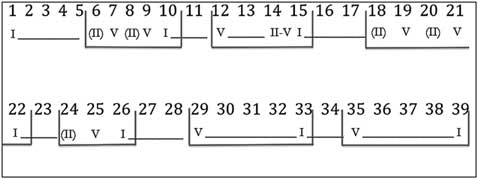
Although the ‘simplicity of its themes … built solely on the tonic and dominant’,Footnote 53 as Mahler noted, caused compositional difficulties for him in the Scherzo movement, this trait nevertheless entirely epitomized (though not uniquely) Koschat’s idiom, where the I–V harmonic oscillation is virtually ubiquitous, in combination with other characteristic features (see Exx. 8b, 13 and 14). The entire opening section of Mahler’s Scherzo (bars 1–39), constituting the main horn-based material, also comprises repetitions and prolongations of six successive (II) V–I progressions in the tonic D major, often with the bass line moving to E, the second scale degree, before arriving on the dominant (see Koschat’s description of this bass technique below), and decorated throughout with the composer’s trademark diatonic part-writing and Fortspinnung of the type that he would explore further in the Ninth Symphony’s opening movement in the same key (see Fig. 13). Similar harmonic treatments are also to be found in later reprises of this principal Scherzo material, from bars 174, 490, and 662.
Repeated (II) V–I progressions in bars 1–39 of the Scherzo

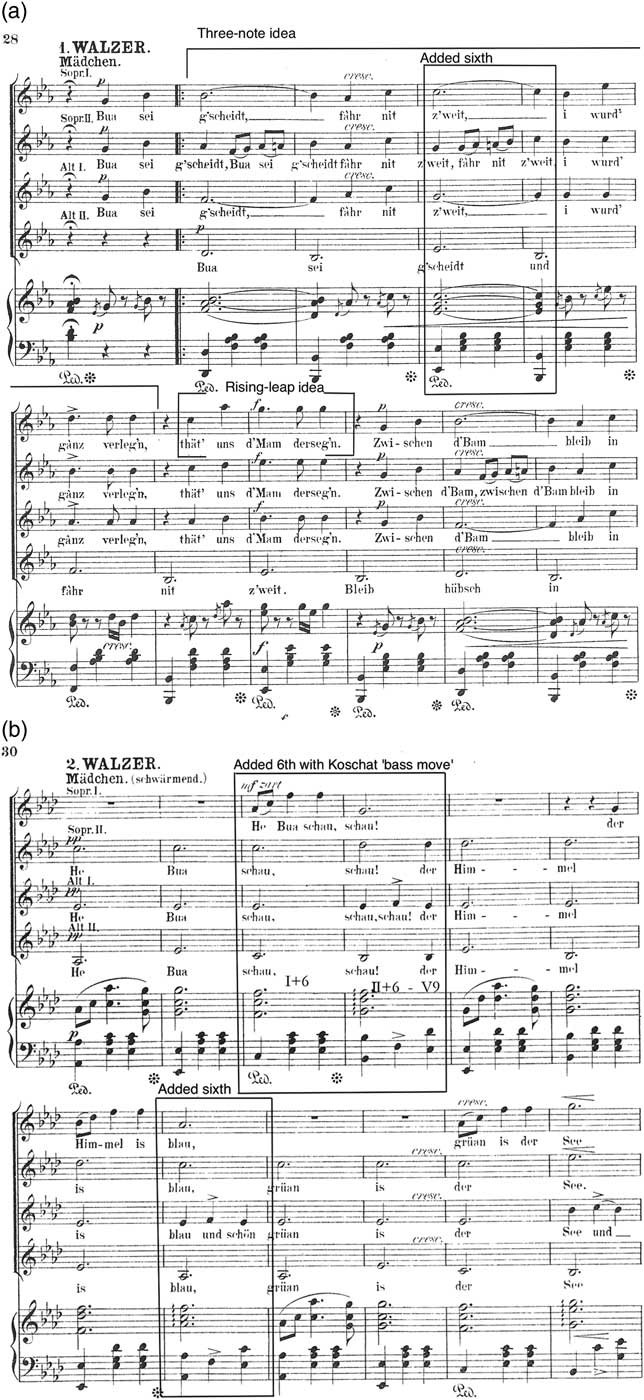
Koschat, ‘Wörthersee-Walzer’, a) First Waltz; b) Second Waltz: tonic–dominant oscillations, three-note idea and added sixths

Koschat, ‘Wörthersee-Walzer’, third Waltz: tonic–dominant oscillations, three-note idea and added sixth

Mahler, whose harmony was described by Donald Tovey as ‘the most diatonic that has been heard since classical times, though it has no inhibitions whatever’,Footnote 54 thus pays respect to this language – whose simple harmonic oscillations form recurrent, generative structural reference points for him – subtly extending it with counterpoint, tonal exploration and more complex voice leading at various points in the movement, but retaining more than just vestiges of the framework, with his melodic phrasing and gestures such as the sweet added sixth ‘resolving’ to a fifth (perhaps the aforementioned ‘Viennese touch’), which both Koschat and he use at or near the beginning of their waltzes (see Exx. 8b, 13 and 14).Footnote 55
Koschat described the Carinthian melodic style as ‘zart-naiv’,Footnote 56 employing one of Mahler’s favourite performance directions (‘zart’, meaning delicate, tender, gentle or mellow) which, as Figure 12b shows, the composer used at the short-score stage to characterize the Ländler-Waltz section of the Scherzo from bar 136 (Ex. 3). This was eventually replaced with the more prosaic ‘Etwas ruhiger’ (‘somewhat calmer’) which also happens to be the marking used by Koschat for the passage in his fourth waltz in Am Wörther See that bears a close resemblance of pitch and key to Mahler’s Ländler-Waltz (see Exx 2c, 3 and 14).Footnote 57
Further specific characteristics of Carinthian folksong identified by Koschat in his own work, in the arrangements of others,Footnote 58 and in wider folk-music practice, may have found echoes and re-workings in elements of Mahler’s volkstümlich practice too. ‘A particular idiosyncrasy … is that the melody is sung not by the highest voice but by the so-called principal voice, also known as the chanter [Vorsängerstimme]. Experience shows that a baritone or low tenor is best suited for this’, Koschat notes,Footnote 59 and this can be seen in ‘Verlâssen bin i’ (Fig. 6). In light of this, one might speculate about Mahler’s habit of transferring the Ländler or Waltz motive that first occurs from bar 136 of the symphony’s Scherzo to such a register in low strings, woodwind or brass – albeit not within simple homophonic textural contexts but sometimes at significant structural moments: see bars 138–139, 142–143, 400–402, 411–416, 460–461, 633–634, and 638–639 (when it is vying with the main horn material at Tempo I – see e) above), and 662–668 (when it is directly juxtaposed with the horn material at Tempo 1 subito – see Ex. 12). Koschat also explains that ‘in many Lieder it sounds very effective and gives a well-rounded musical impression in a change of harmony from tonic to dominant if the bass, rather than going straight to the dominant note, shifts initially to the second scale degree … and only later, not until the second or third quarter of the bar, assumes the dominant’.Footnote 60 Such a procedure is indeed at work in the opening section of Mahler’s Scherzo as described above, and in bars 151–153 and 157–158 of the first Ländler or Waltz section in the movement (Ex. 8b). Comparison of this with bars 7–9 in the second system of the short-score draft (Fig. 12b) reveals that in fact he excised three circled dominant bass notes (and made similar alterations in bars 13–14) precisely, it seems, in order to achieve a putative Koschat-like part-writing effect.Footnote 61 Koschat again: ‘A characteristic speciality of Carinthian Lieder are the short grace notes that the principal voice adds through a sharp snap of the subdominant, dominant or octave, before ending on the fundamental note’,Footnote 62 to be seen in the introduction to the ‘Wörthersee-Walzer’ (Ex. 1) and in the upper vocal line of the Fifth Waltz’s second section, sung by lads and lasses and marked aufjauchzend (‘shouting for joy’, ‘exulting’) at the words: ‘What joy it is, as soon as you hear music’. No significant investigation has yet been carried out into Mahler’s use of such ornaments as an expressive and idiomatic device, especially in his more colourful or folk-related music such as the third movement of the First Symphony, Lieder eines fahrenden Gesellen, several of the Wunderhornlieder, first movement of the Third Symphony, Scherzo of the Sixth Symphony, and second movement of the Ninth Symphony. Grace notes play an important role in the stylization of the Fifth Symphony, incorporated first into the opening movement’s Bohemian dirge where at bar 39, Mahler instructs that they be played ‘as fast as possible’, and to a lesser extent in the intervening passages of volkstümlich sunlight alluded to above, at bars 127 and 314. In the second movement they are transformed into the rapid glissandi of vicious lower-string, lower-woodwind and horn stabs in the main theme complex (bars 9–10, 342–343), but also appear in the intense string melody of the second theme complex (bars 36, 45, 47, 49, 51, 54, 57, 59) and in the evocation of the first movement’s final dirge mentioned above, alongside the ‘Koschat’ figure shown in Ex. 6 (bars 105–109, and later in the section at bars 123 and 131 before the sudden return of the opening material). In the Scherzo the kind of wide-interval melodic effect described by Koschat becomes more prevalent, often allied with crescendi, sf or fp markings in the main horn material passages as a means of emphasis and flamboyant characterization (first violin, bars 18, 35, 56, 58, 96). They later appear in bar 439 of the Ländler-Waltz as it performs its structurally important role of restarting the musical momentum (the beginning of this is shown in Ex. 9), and in bars 564, 572, 640, and 687–689 as that material crucially assumes dominance and vies with the main horn material, expanding to a dramatic double-stopped example at bar 661 in one of Mahler’s typically sweeping, climactic ‘scene-changing’ scale-like gestures occurring here immediately before the all-important point at rehearsal Figure 26, where Ländler-Waltz and horn material co-exist and exchange instrumental setting (Ex. 12). Thereafter the ornament achieves heights of lyrical intensity in the ‘Adagietto’, and reappears with continued frequency in the ‘Rondo-Finale’ especially in passages that rework the ‘Adagietto’ melodic material (from bars 205, 372, 386, and 642 onwards), and at the rhythmically intensified return of the opening: ‘Plötzlich wieder wie zu Anfang (Tempo I subito)’, bar 497.
Just as the line between what in today’s ethnomusicological terms might be considered an authentic and a constructed folk voice was perhaps always blurred or not even an issue for Koschat and his followers, most of whom heard his music as unaffected Heimatkunst – an acceptably commercial form of folk-music popularization – so was the area between the ingenuous and the disingenuous a bone of zealous contention for many contemporary critics of Mahler’s Fifth Symphony.Footnote 63 It did not particularly matter whether the Koschat-like material was of a second- or third-order folkloric nature, already distanced from layers of putative ‘original’ folk culture, a fact that tended to be overlooked according to Krobath, who maintained somewhat spuriously that ‘Koschat Lieder and original Carinthian Lieder are two mutually distinct spheres’, but more imaginatively suggested that ‘The Koschat Lied is like the fir tree that grows its roots in the same ground as, for example, the neighbouring larch’.Footnote 64
The issue of this type of authenticity may not have mattered to Mahler either, since in his time artistic authenticity meant something very different from later empirically derived notions. Burgeoning philological exactitude in the study and preservation of folk culture which risked fossilizing practice as museum-piece was contemporaneously matched by powerful acts of reconstruction and adaptation that perpetuated the notion of folk art as constantly in flux at the expense of fidelity to its organic, pre-industrial closeness to nature. A case in point was the sometimes radical Mahlerian transformation of the Ländler, particularly in the context of the generic Scherzo movement. In addition to Mahler’s pliable, instinctive modes of folk expression, what was important in this symphony was the crucial narrative that this material enacted throughout the work – a narrative that was more obvious to contemporaries, but which has become submerged in the passing of time, to be replaced by other familiar ones of darkness to light, C-sharp minor to D major, adagio to allegro, funeral march to irrepressible rondo finale. This alternative narrative is one of the changing hierarchy of ‘high’ and ‘low’, a questioning of what these categories even constitute, a re-negotiation of then-dominant bourgeois Western European cultural perspectives and models. The type of material that embodied the musical-cultural-symphonic ‘other’ – the ethnic, Bohemian-sounding, funeral dirge of the first movement’s secondary material (first occurring from bar 34) – by the end of the symphony has taken centre stage and come to terms with, if not subsumed, ‘conventional’ or then widely understood symphonic propriety in a bold assertion of an all-encompassing folk-like diatonicism.Footnote 65 The second movement and Scherzo play important roles in generating these different perspectives along this narrative’s path, and the catalyst seems to have been the putative Koschat material incorporated intuitively as a ‘ghost in the machine’ in Mahler’s musical thinking. This too enacts its own localized narrative of infiltration, usurpation and fragmentation in which both the Scherzo’s opening Ländler-like horn material and its own waltz character are posed and questioned, forming what for Donald Mitchell is a ‘dialectical complex’ between ‘the primitive, peasant’ and ‘the ‘brilliant, worldly’.Footnote 66
Which voice, if any, the music (or through it Mahler) sides with remains an open question, perhaps even the wrong question. Indeed Julian Johnson suggests that the folk tone of the Wunderhorn settings (which provided templates for Mahler’s concurrent and later symphonic thought) constitutes the composer’s deliberate ‘avoidance of the question of voice’.Footnote 67 Whether a folk-like tone has been co-opted and distorted by developmental art-music processes, or whether high-art protocols have been liberated and disabused of their superior pretensions becomes a moot point in light of the empirical ‘inauthenticity’ of the borrowed Koschat material in the first place, and the fact that the history of ‘high-art’ music is littered with examples of related forms of appropriation (for example, Renaissance mass settings, Baroque dance suites, the Classical symphonic minuet, Schubert and Schumann’s vocal and symphonic forays into folk-like idiom in the context of supposed ‘high-art’ practice, or other nineteenth-century nationalist allusions to, and adaptations of, popular dance forms), all of which had already paved the way for this aspect of Mahler’s symphonic practice.
In a continuation of the distinctive attitude of objectivity that E. Mary Dargie identifies in Mahler’s setting of Wunderhorn texts,Footnote 68 as Boris Voigt has recently suggested, the waltz idea in Mahler’s Scherzo is not so much ‘played’ as ‘shown’, in the form of ‘icons of waltzes’, so that ‘the waltz and its connotations become thematized’ with all their bourgeois baggage of ‘impropriety … aspiration … seducibility … delirium and death’ at work in what Mahler himself saw as a ‘chaos’, ‘a raging sea of sound’ where worlds are created only to be toppled forthwith.Footnote 69 One of its earliest reviewers, Hugo Leichtentritt, was sensitive to this idea of a knowingly dramatic, culturally marked play with the nature of the waltz genre: ‘The Scherzo is based on Viennese waltz melodies of the popular type that are in the air in Vienna; coming from this neighbourhood [Berlin] I could not convince myself of the genuineness of their sundry impassioned outbursts’.Footnote 70 Early critical response to the symphony in the Austro-German press was for the most part much more vehemently negative, and the greatest vitriol was reserved for the perceived effrontery with which Mahler introduced the popular or trivial into the work. But one is never quite sure exactly what these critics were lamenting: whether it was Mahler’s apparent lack of etiquette in the way he treated this popular music, either by presenting it in a state that was less refined than that of other contemporary composers, or by toying with the material as if to demean it, or whether it was simply his using it, vulgarly ‘dressed-up’, in a symphonic context in the first place and thereby ‘defiling’ a venerated genre, or at least generating a ‘dichotomy between the concept of the “folk song” and … artful, superabundant orchestral accompaniment’, as Hanslick wrote in a 1900 review of a performance of Wunderhornlieder.Footnote 71 In accordance with political needs to consolidate a sense of (‘greater’-) German identity and the universality of the country’s national music, this critique (including that of some Vienna reviewers) was often allied with condescension towards minority or simply ‘other’ national-ethnic traditions used as vehicles for Mahler’s compositional practice – anti-Semitism never being far away from this line of argument too. Either Mahler was being disrespectful to honoured Viennese popular/folk repertoire or the same material was decried as unacceptably Slavic, Magyar, Czech or possibly Judaic.Footnote 72 Perhaps what this generation of critics failed or refused to appreciate was that, as Dahlhaus suggests, any appeal to ‘nature’ in art is always a ‘cultivated, second nature’, and that, through complex layers of dissembling irony and bald sincerity, Mahler was in fact reflecting back on them their own uncomfortable bourgeois resistance to, yet suppressed longing for, the sentimentality of a distant, mythologized and ossified folk culture – as the instantly gratifying Kitsch of, say, an evening of Koschat’s rural Liederspiel at the city’s Opera might offer – seen from a privileged urban perspective that had no interest in the alien realities of rural, servile existence.Footnote 73 Paradoxically, the artifice of Koschat, both specifically and as emblem of a wider fashionable ‘recapturing’ of folk idioms and of the pleasure-seeking popularity of the waltz, assumes a veneer of realism through the artfulness of Mahler’s acts of reprocessing it in a contrived symphonic arena. This is neither an elevating of the trivial nor a coarsening of the concert hall, but an all-too-real, rupturing collision of seeming incommensurables, of nostalgia and presence, Austrian anxiety and ‘Wird schon werden’,Footnote 74 in a search for at least artistic, if not socio-political, revelation and change in an Austro-Germanic world riven with static hierarchies as well as a growing monolithic nationalism and ethnic exclusivity of the type promoted in Houston Stewart Chamberlain’s Foundations of the Nineteenth Century of 1899.Footnote 75
Perhaps Mahler’s compositional practice in the end conveys a different democratizing message of greater geo-political and cultural significance – one that reveals what had always been the inherent falsity of such categorical distinctions of folk/popular/‘art’ in the first place, and the pretence involved in the inherited ‘professional caste distinction’ whereby composers such as Chopin, Berlioz, Tchaikovsky and even Brahms could write waltzes in remarkably similar idioms to those of Joseph Lanner and Johann Strauss, while at times tempering certain aspects of melodic style and increasing overall constructive complexity to mark their artistic ‘seriousness’.Footnote 76 But as late as 1960, in describing the twin poles of Mahler’s aesthetic as mutually dependent categories of the ‘trivial’ and the ‘grotesque’, Franz Willnauer suggested that the ‘moving sounds [Tonbewegungen] out of which Mahler fashions his symphonic themes possess no melodic “dignity”’, and that the catalyst for his destructive process of distorting ‘established melodic ideas’ is banality.Footnote 77 Mahler himself would consider this view problematic in the absence of any qualifying ethical context:
This is a mystery to me. What does it mean: ‘trivial’? Either something is born from a person’s genuine, vital feelings, in which case it has the right to exist and will work effectively; or it is false and a lie, factum, non genitum [made, not born],Footnote 78 in which case it will perish.Footnote 79
The idea of Kitsch similarly requires careful treatment. For Milan Kundera, himself ‘exiled’ from an oppressed, minority Czech nation, Kitsch is the mirage which excludes the uncomfortable and unacceptable in human existence – a political smokescreen of fantasies and archetypes that flourishes in irony-free monolithic and authoritarian regimes. Yet once Kitsch is acknowledged as a ‘beautiful lie’, it loses its power, ‘becoming as touching as any other human weakness’, for ‘no matter how we scorn it, kitsch is an integral part of the human condition’.Footnote 80 Is Mahler exalting notions of Kitsch-laden Heimat only to look beyond them or behind them? Narrowing his cultural focus in order to face outwards, Koschat has been described as ‘showing the path to rich veins of pure gold’, offering stability and comfort as a ‘composer of the people’ whose music ‘rises above all political borders’ and assumes an ‘ideal familial bond linking all [German] brotherhood’ at a time when humankind was becoming oppressed by the machine age.Footnote 81 By contrast, Mahler – as an exiled Bohemian, adopted Austrian and aspiring German – widens his cultural outlook in order to refocus more keenly and critically on the inner life, challenges the deceptively reassuring but ultimately constraining and potentially fascistic machinery of the monolithic state, ethnic purity and cultural proscription, and becomes thoroughly socio-politically implicated as a migrant, multi-faceted individual artist in an unstable, pluralistic world.