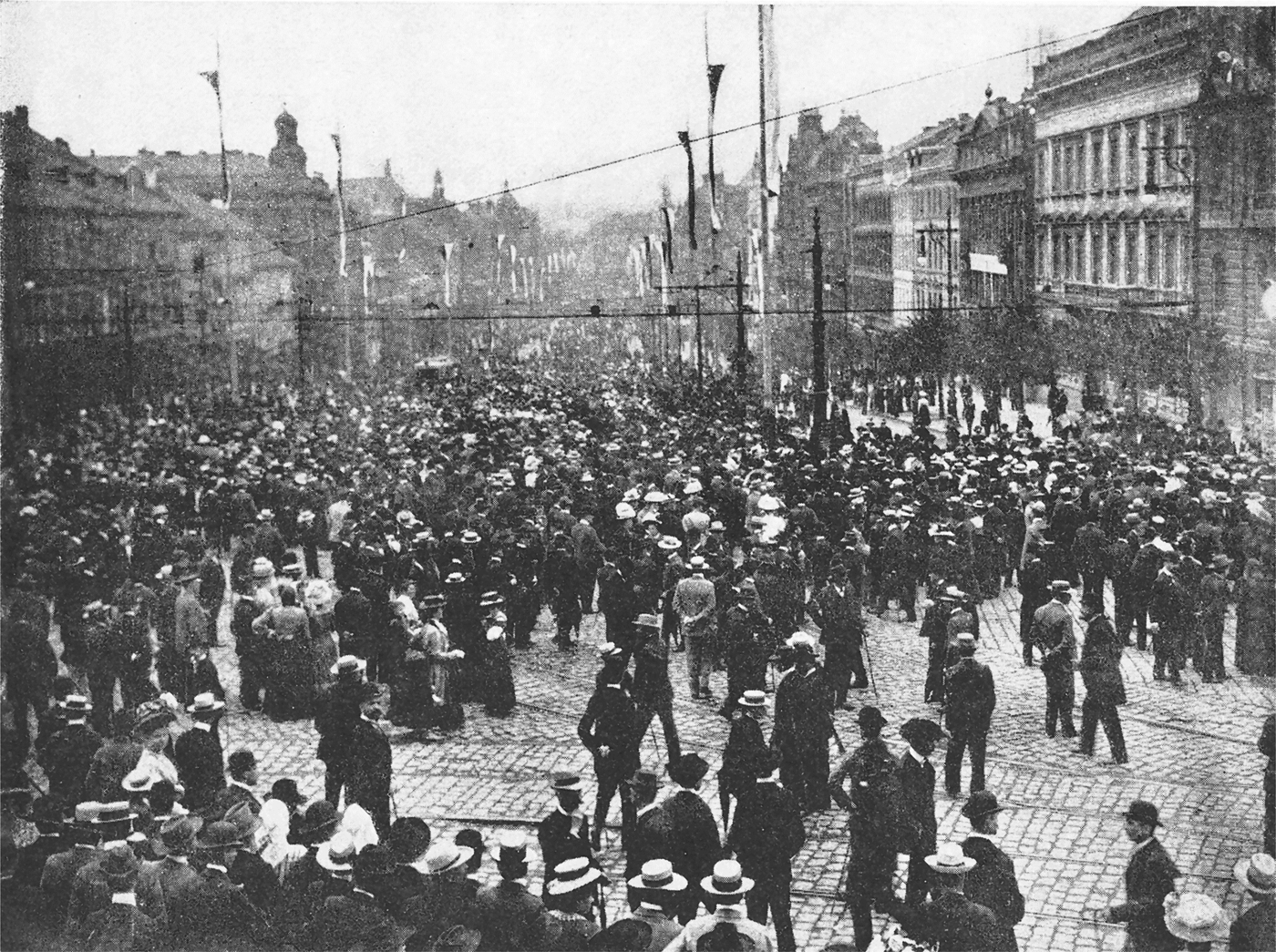
Scenes of deep national division, competition, and conflict dominate standard historical narratives about the Austro-Hungarian monarchy during the late nineteenth century and most of its successor states in the 1920s and 1930s. Nationalist political movements flourished in this multicultural environment as capitalist agricultural and industrial development encouraged popular social ambitions and resentments over inequalities, while the advance of modern civil society and constitutional government provided public space for political movements. After the 1860s, political parties committed to nationalist interests increasingly dominated middle-class politics, and by 1900 national loyalties created growing fissures even in the ostensibly international Social Democratic movement. Some of the most intense nationalist social and political competition developed in the Crownlands of Bohemia, Moravia, and Silesia between Czech and German national interests. The Bohemian capital, Prague, became the stage for repeated mass nationalist demonstrations and rioting in the 1890s and after 1900 (see Figure 1).
Demonstration on Wenceslas Square, 9 August 1908, for Czech minority schools [from Zlatá Praha 25 (1908), supplement 13: 52].

Nationalist political leaders, writers, artists, and scholars saw Prague as a highly contested space, and nationalist contention penetrated most areas of public life. Even street signs became a focus of heated debate when the Prague board of aldermen in 1893 decided to replace the city's bilingual Czech and German signs with new ones only in Czech, an action so widely discussed in the Habsburg monarchy that it found its way into Sigmund Freud's correspondence and dreams.Footnote 1 The growth of political antisemitism among both Czech and German radical nationalists called into question how the 26,000 Jews (6.7 percent of the civilian population in Prague I–VIII and the four inner suburbs) should align themselves politically, and by the 1890s they faced strong pressures to abandon their previously strongly German liberal political loyalties and to side with the Czech national cause.Footnote 2
By 1900 the political arena in Prague had been sharply divided on Czech-German lines for more than thirty-five years, and voluntary associations, schools, and many pubs and cafés showed equivalent divisions. In many Central European localities with culturally mixed populations, nationalist activists in the late nineteenth century made the division of public space on national lines central to their efforts to build their movements for the broader transformation of society and politics.Footnote 3 The symbolism of nationally designated organizations and institutions and the everyday praxis of participating in nationally defined spaces all contributed to what one might call in the sociologist Pierre Bourdieu's terms a nationalist habitus, that is, a system of structured orientations that governed social action and reproduced patterns of interaction that nationalist activists propagated to assert national solidarity among their supporters.Footnote 4
During the late 1830s and 1840s, Czech nationalists in Prague began to create national spaces in the nascent public sphere, and they resumed those efforts in the late 1850s, when the restrictions on public life of the Habsburg neoabsolutist regime began to wane. German liberal nationalist activity in the city began later, to a great extent in reaction to the Czechs; but by the middle and late 1860s, public life in Prague showed a deep Czech-German division. Nationalist activists on both sides called for the public to extend national divisions to all areas of life and to give preference to those of the same nationality in all their daily interactions. By the 1890s campaigns on both sides for nationalist preference in commerce led to calls for outright boycotts, even if many otherwise avowed supporters of the Czech or German political cause ignored the boycotts when they proved personally inconvenient.Footnote 5
By 1900 politicians, scholars, writers, artists, and journalists widely shared a sense of deep national alienation and unremitting conflict between Czechs and Germans in Prague with Jews gradually becoming estranged from radical nationalist politics on both sides. The historian Hans Kohn, born in Prague in 1891, wrote of the “voluntary segregation” that existed between Czechs and Germans.Footnote 6 Many commentators on the “Prague circle” of German-speaking writers, which included Max Brod, Franz Kafka, Franz Werfel, and others, have portrayed this group as largely the product of a small Jewish ghetto within the increasingly isolated society of Prague's declining German minority. That German minority, measured by the Austrian census according to language use, accounted for less than 8 percent of the population in the city and four inner suburbs in 1900.Footnote 7 The Vienna-born literary historian Heinz Politzer wrote of an air of “frustration” that was characteristic of most German-language writers in the Bohemian capital and suggested that the only coherent national community they could know there was that of the Czechs.Footnote 8 The Czech Jewish writer Pavel Eisner argued that “the life of the German Jew in Prague became fundamentally pathological because he belonged to a sociologically abnormal minority which hung like a mote in the air.”Footnote 9 The novelist and translator Max Brod, who gained his greatest fame as custodian of Franz Kafka's literary estate, reacted, in fact, against treatments of the German Jewish intellectuals as unnaturally isolated and ghettoized,Footnote 10 but still, many historians and literary scholars have shared notions of the sharp social separation of the national groups in Prague. For them the famous leftist Jewish journalist Egon Erwin Kisch (1885–1948) accurately captured the city's deeply divided social environment and the situation of the German-speaking population:
The Prague Germans! They were almost exclusively grande bourgeoisie: owners of lignite mines; executives of the mining companies and the Škoda munitions works; hops merchants who traveled back and forth between Žatec (Saaz) and North America; sugar, textile, and paper manufacturers as well as bank directors; in their own circle professors, higher army officers, and state officials. There was no German proletariat.
Other than for business affairs, the Prague German did not traffic with the half million Czechs of the city. He never lit a cigar with a match from the Czech School Society [Matice školská] nor did the Czech light his with matches from the German School Society [Deutscher Schulverein]. No German appeared in the Czechs' Burghers' Club [Měšťanská beseda], and no Czech entered the German Casino. Even the concerts were ethnically exclusive, as were the public swimming facilities, parks, playgrounds, most restaurants, cafes, and businesses. The Czechs' corso was Ferdinandová [now Národní třída], that of the Germans, Am Graben [Na příkopě] . . . No Czech citizen attended the German Theater at that time and vice versa.Footnote 11
Friedrich F. G. Kleinwächter (1877–1959), an Austrian state official, later a practicing attorney and sometime journalist, came from a highly educated Prague German family. He remembered the sharp divisions between Germans and Czechs in the city with a note of despair:
The Germans in Prague cut themselves off fundamentally from their Czech surroundings. The separation was so sharp, that even personal interaction between Germans and Czechs was completely excluded. Over many years, when I annually made a longer visit to Prague . . . I, of course, never encountered a Czech in German company. When I once expressed the desire to attend a performance in the Czech opera, which was reputed to be excellent, I was instantly shouted down . . . Naturally, I went straightaway to the Czech opera, but . . . without telling anyone about it. If my action had become known, I would have been thrown out of my own family. Only in the last years before the war did the Germans slowly begin to attend Czech theater and to take notice of their Czech neighbors. Until then, a complete separation reigned. There were German balls, German concerts, German tennis tournaments; in short one lived in Prague as if in a German city. Only when one went down the street, did one notice that one was actually in a Czech city. One could manage to live in Prague for years without speaking a Czech word. I have known people who were born in Prague and grew old there without being able to speak more than the most essential fragments of Czech.Footnote 12
In fact, such portraits of the political and social encapsulation of the Czech and German communities and of the supposed increasing exclusion of Jews from both after the 1890s have been drawn too starkly and simply, and, like that of Kisch, often contradict themselves about just how thorough was the separation of Czechs and Germans. Czech- and German-speaking residents of Prague had daily contact with each other in workplaces and commercial dealings, in government offices at all levels, in public parks and at local landmarks, and for many, in the very buildings where they lived. Even in the German-speaking minority's schools before World War I, students whose mother tongue was Czech nearly always accounted for a sizable fraction of the students.Footnote 13 Perhaps the very richest of the German-speaking minority could keep their contacts with Czechs to a minimum, but even they were likely to have daily interactions with Czech employees and servants, municipal and provincial government employees, and business proprietors. Nonetheless, many Prague residents and informed observers such as Kisch and Kleinwächter were convinced that a deep social division existed.
Nationalist rhetoric and agitation to create and maintain sharp national divisions were major features of Prague's political landscape and of popular and elite understandings of the social environment from the late nineteenth century to World War II. At the same time, though, one must recognize that even in this city's heated nationalist atmosphere some residents regularly crossed the lines. Even here some remained ambivalent about their national loyalties up to 1918 and throughout the interwar period, and some crossed from one camp to another in their claimed allegiances at various stages in their lives.Footnote 14 Still, one must take the discourse about the national divisions seriously as a token of strongly held nationalist beliefs and goals and not discount it as political hyperbole. In this city and others like it during the late nineteenth century, the sustained political agitation to create and maintain national divisions and widely shared beliefs about their significance gave those convictions central importance in popular and elite mentalities. Nationalist activists in Prague, whether Czech, German, or eventually Jewish diaspora nationalists and Zionists, believed it was imperative to establish lines of national solidarity and visible social and political boundaries to separate each group from the national others. Convinced nationalists expected such divisions to extend to cultural and artistic life, but there, too, everyday realities and the interests and dynamics of the cultural and artistic pursuits themselves often failed to conform neatly to nationalist strictures. Examining the seeming contradictions between nationalist visions of sharp division and the everyday experience of crossing the boundaries in cultural and artistic life can tell us much about what nationalist loyalties really meant in Prague and other cities like it in Imperial Austria and about the realities of cultural and artistic activities there.
From the beginnings of the national movements, nationalist activists throughout Central and East Central Europe made cultural pursuits important parts of their efforts to articulate visions of their nations, of their past, present, and future, and to help build public support. Writers, actors, musicians, and artists figured among the educated and semieducated people who provided leadership for Czech nationalist activity in the early and middle decades of the nineteenth century.Footnote 15 The founding of museum and publication societies, the creation of magazines and journals, the revival of the Czech literary language, and the establishment of theaters to perform in Czech are well-known parts of the Czech national movement in its early phases. Nationalist writers, artists, and musicians shared in creating an independent Czech cultural life for a nationally conscious Czech public, set apart from the cultural and literary activities of their German-speaking neighbors. As German nationalist activity developed in the city, German intellectuals made similar efforts to cultivate a distinct German cultural life. On a smaller scale, local Jewish nationalist and Zionist intellectuals after 1900 tried to do similarly. One cannot treat here the whole range of public cultural activity at the turn of the century. However, some selected episodes or scenes, drawn from the activity of the theaters, concerts, literary life, and art exhibitions, are instructive for understanding the extent to which the national boundaries proved more porous in the cultural sphere than the nationalist rhetoric claimed and just what such a contradiction meant.
Opera and Theater
At the end of the nineteenth century, the prosperous Czech and German middle classes in Prague treated their separate Bohemian provincial theater companies (c. k. české zemské divadlo, k. k. deutsches Landestheater) as objects of enormous civic pride. Czech nationalists mounted a great fund-raising campaign between the 1860s and early 1880s to build first the provisional theater, which opened in 1862, and then a great modern opera house, the National Theater (Národní divadlo), which opened in 1881, burned two months later, was rebuilt by 1883, and stands proudly on the Vltava embankment today. Czech efforts to establish a separate Czech theater began as early as 1844 out of dissatisfaction with the German-dominated repertoire of the existing Theater of the Estates, located adjacent to the Karolinum in the Old Town, which performed opera and stage plays only occasionally in the Czech language. The Theater of the Estates, funded primarily by nobility, responded to Czech nationalists' complaints by creating separate German and Czech sections in 1846, but this did not satisfy those who wanted a distinct Czech institution. Moreover, that theater, first opened in Mozart's time in 1783, was small and technically inadequate to the requirements of mid-nineteenth-century opera, drama, and ballet.
From the time that major Czech nationalist political figures began fund-raising for the Czech theater, that institution had obvious political significance. Its sponsors wanted it to showcase Czech stage works but also expected its very existence, with an imposing presence and elaborate nationalist decorations, to serve important representational functions. The Habsburg imperial family did not miss the significance of the effort: the 1881 ceremonial opening took place during a visit by Crown Prince Rudolf to Prague, and the emperor and other Habsburgs contributed to the rebuilding effort in 1881–83.Footnote 16 The Bohemian Diet contributed as well, but an independent voluntary association was to operate and finance the theater as the Imperial-Royal Czech Provincial Theater under the authority of the Crownland government. Czech nationalist pride in the theater was expressed openly in the words emblazoned over the stage of the completed structure, Národ sobě [The Nation for Itself], a contrast to the old motto of the Theater of the Estates, Patriae et musis [To the Native Land and the Muses].
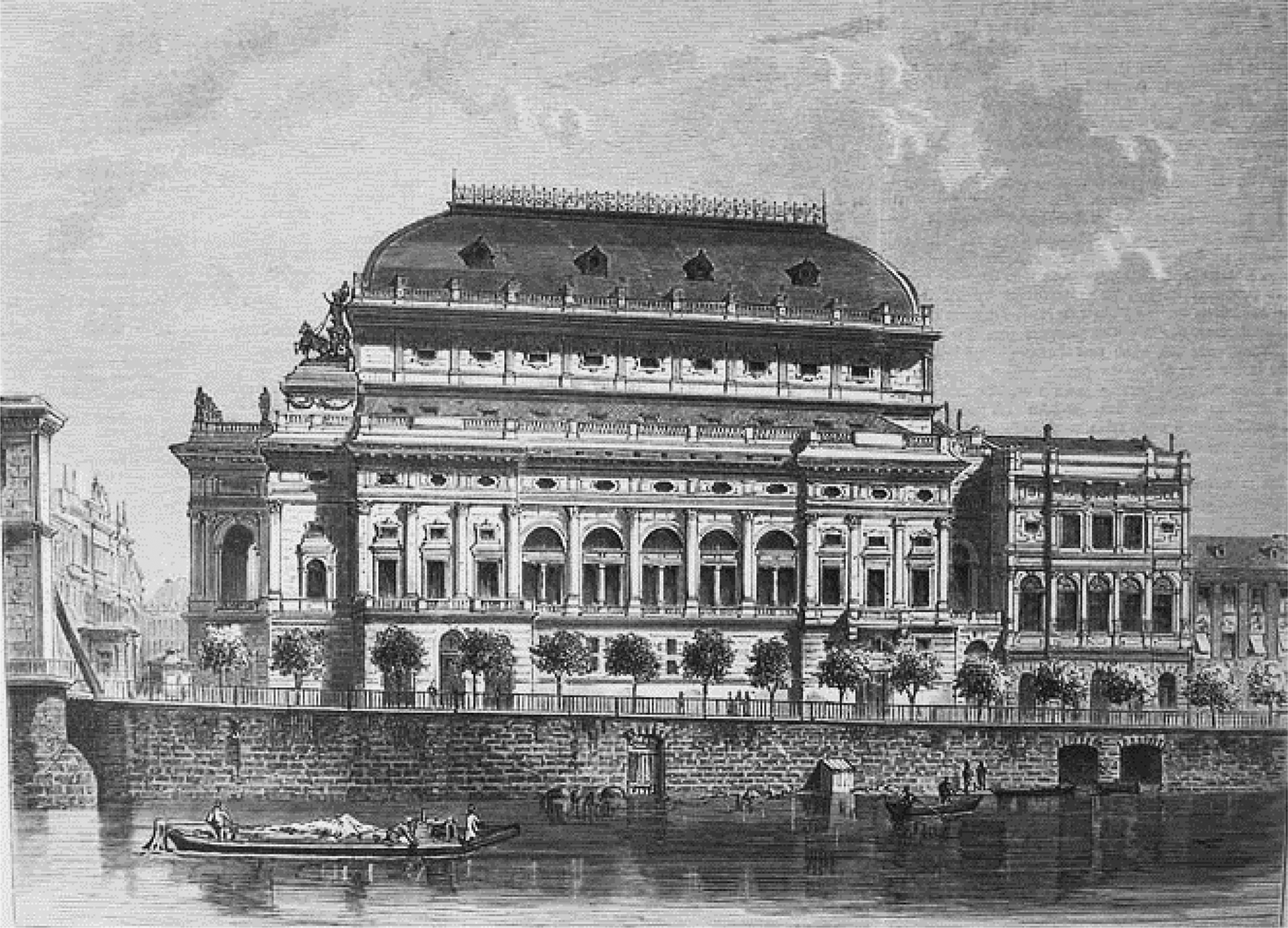
Underneath the prominent Czech nationalist decorations in the National Theater was a structure in neo-Renaissance style with many features that were common to new opera houses constructed throughout the Habsburg monarchy during the late nineteenth century (see Figure 2). The first architect was Josef Zítek (1832–1909), who was born in Prague but received his training in Imperial Austria's premier architectural programs at the Vienna Technical College and the Academy of Fine Arts in Vienna. The theater was finished by Josef Schulz (1840–1917), Zítek's sometime assistant, who also studied in the Academy of Fine Arts in Vienna, where he worked with Eduard van der Nüll and August Siccard van Siccardsburg during the early 1860s, when they were designing the new edifice of the Vienna Court Opera on the Ringstrasse. In Prague, as well as other capitals of the Austrian Crownlands, architectural design for major public buildings in the late nineteenth century regularly mixed distinctive regional or nationalist decoration with international architectural style and features common to major public structures throughout Austria.Footnote 17
The Czech National Theater, Prague, 1881 [after a photograph by F. Fridrich, Prague—Wikimedia Commons].
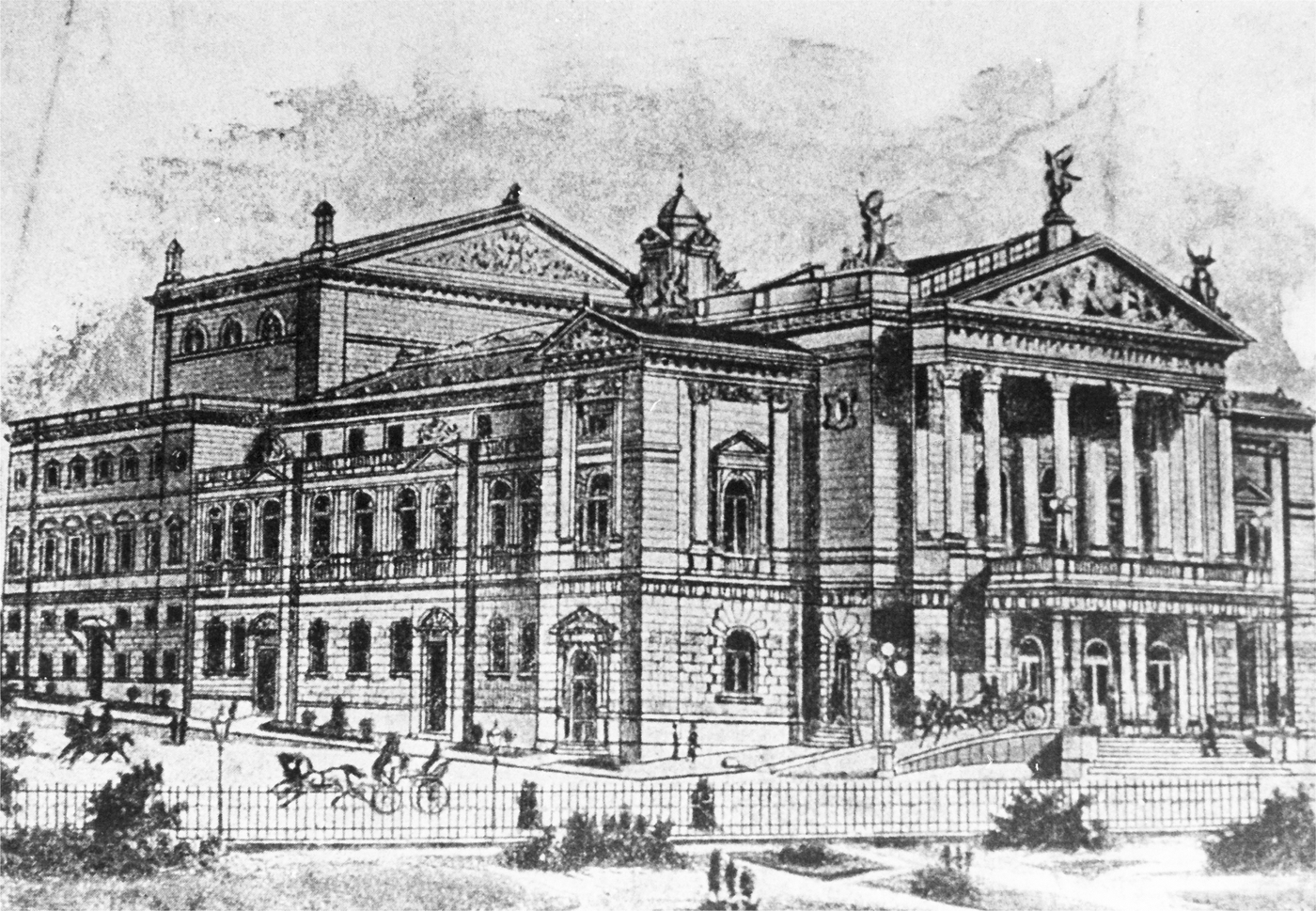
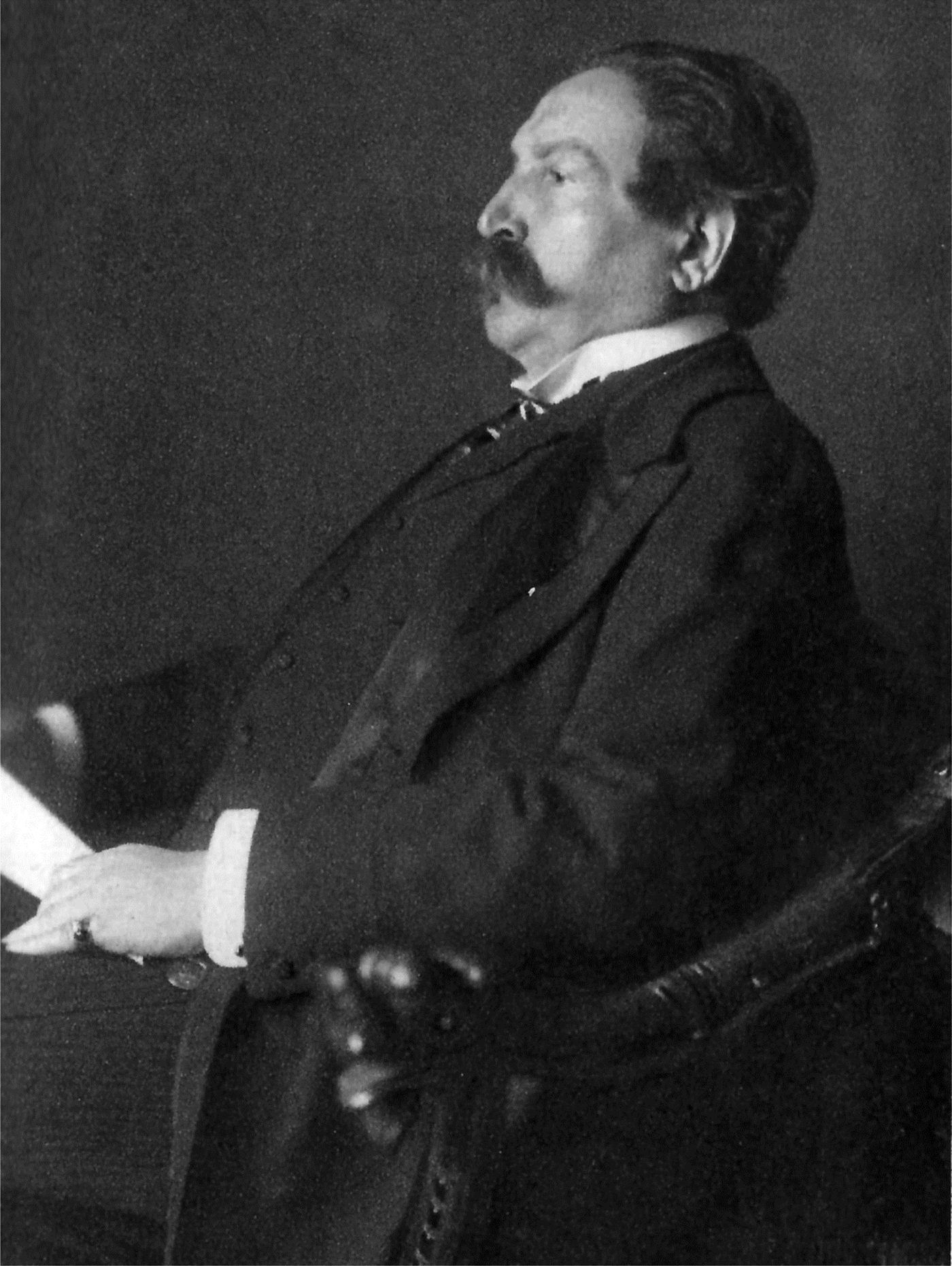
The Czech nationalists' successful fund-raising and construction of the National Theater galvanized German political interests in Prague to expand the facilities for German opera and theater. The Theater of the Estates continued to stage productions primarily in German, but German artistic and political interests also saw the need for a larger theater to accommodate Romantic grand opera and larger audiences. The result was the New German Theater (today called the Prague State Opera), designed by the Viennese architects Ferdinand Fellner and Hermann Helmer, designers of theaters across Central and East Central Europe, and by Karl von Hasenauer, architect of Vienna's Burgtheater (see Figure 3). The New German Theater, built near the main train station, opened in 1888 under the direction of a noted Wagnerian opera impresario, Angelo Neumann (see Figure 4).Footnote 18
The New German Theater, Prague, contemporary artist's drawing (From Smetanovo divadlo. Vydalo Národní divadlo v Praze k znovuotevření Smetanova divadla v roce 1973 [The Smetana Theater. Published by the National Theater in Prague for the Reopening of the Smetana Theater in 1973], used by permission).
Angelo Neumann [from Heinrich Teweles, Theater und Publikum (Prague,1927), 89].
As Kisch, Kleinwächter, and others noted, Czech and German nationalists in Prague voiced strong taboos against attending the other nationality's opera theater. Memoirs of political and intellectual figures, whether German, Czech, or Jewish, expressed their cognizance of the taboos by repeating them or at least generally keeping silent about any crossing over that took place. Nonetheless, the attraction of parts of the opera and operetta repertoire for theatergoers regardless of nationality resulted in appreciable crossing over. Indeed, to some extent the Czech and German opera companies competed with each other for audiences, as some candid observers admitted. The varied repertoire of Italian, French, and even German operas that the Czech National Theater quickly developed and its high production standards soon drew audiences away from the German-led Theater of the Estates, including some German-speakers as well as Czechs, and helped push the latter company into bankruptcy in 1885.Footnote 19
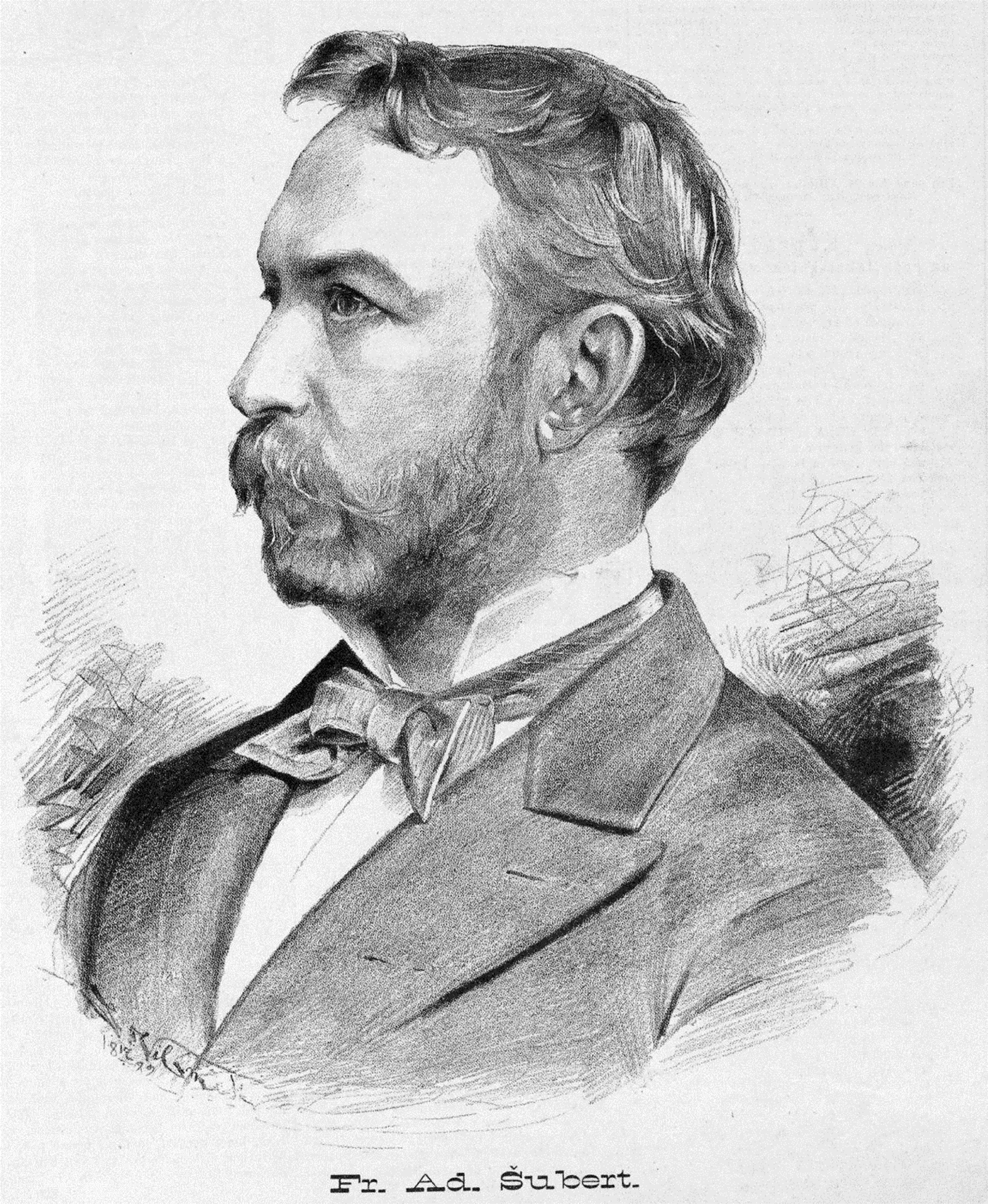
Faced with the financial challenges of producing opera and with competition for at least the part of the local audience that was willing to cross over, the directors of the Czech and German theaters during the 1880s and 1890s agreed to divide parts of the opera repertoire between them. František A. Šubert, who led the Czech National Theater from 1883 to 1900 (see Figure 5), and Neumann, who directed the German provincial theater company from 1885 until 1910, made an arrangement to give the Czech National Theatre first performances of new French and Italian works, as well as Czech works, while the German theater had rights to the first local performances of new German works.Footnote 20 After Šubert proudly announced that the National Theater would present no German operas during its first season, in the second season he turned around and staged Wagner's popular Lohengrin, in Czech, with great success. Indeed, the National Theater successfully produced a number of Wagner operas before World War I. Otherwise, as the Czech art historian and raconteur V. V. Štech (1885–1974) later remembered, the National Theater around 1900 generally minimized direct competition with the German theater in productions of Wagner and other parts of the repertoire that were Neumann's specialties and for which he often brought in famous soloists from Vienna and Germany.Footnote 21
František A. Šubert [drawing by Jan Vilímek, 1882, from Humoristické listy 1882, no. 16—Wikimedia Commons].
The German provincial theater company enjoyed stronger finances after the opening of the New German Theater in 1888, but competition with the Czech National Theater was a continuing issue, despite any understandings about repertoire between the two directors. In January 1888, Šubert scored a great coup by having the Czech National Theater give the first performance of Verdi's Otello north of the Alps, albeit in Czech. In early 1911, Richard Strauss' Der Rosenkavalier premiered in Dresden with instant success, and other European houses rushed to perform it. The management of Prague's German provincial theater wanted to stage it but refused to pay the high royalties demanded by Strauss and his publisher. The director of the Czech National Theater, however, was willing to pay and managed within six weeks of the Dresden premiere to put on the first Prague production of Der Rosenkavalier, again in Czech translation.Footnote 22 The National Theater had already staged Strauss' Elektra, in Czech, which the composer himself conducted in June 1910.Footnote 23 The German opera company eventually performed Der Rosenkavalier in 1914 under conductor Alexander Zemlinsky, despite the theater director's fears of poor ticket sales after the Czech National Theater had given some thirty-six performances.Footnote 24
The competition between the Czech and German opera companies worked out differently, though, for the first local staging of Wagner's Parsifal after the composer's family lifted its prohibition of stage performances outside Bayreuth. The release was effective on 1 January 1914, and that day both the New German Theater and the Czech National Theater (performing in Czech) offered their first stagings of Parsifal. This only underlined the interest in Wagner in both the German and Czech theaters as an important part of the international operatic repertoire, despite the expectation of some Czech nationalists that their National Theater should give priority to the Czech and Slavic operatic repertoire over the German.Footnote 25
Some Prague residents did record attending both the Czech and German opera theaters. These memoirs made no special point of the fact, but even mentioning it specifically might acknowledge that some considered this out of the ordinary in the city. In 1897 Richard Kukula, born in Styria, came to Prague, knowing little Czech, to serve as director of the university library in the Klementinum shared by the Czech and German faculties. His circle of acquaintance soon included Czech intellectuals and publishers, as well as Germans, and he attended the Czech National Theater while he also saw opera and drama in the German theaters. The bank employee Egon Basch (1876–1939), born into a Prague Jewish family, also wrote of attending the Czech National Theater regularly, as well as the Theater of the Estates and the New German Theater.Footnote 26 During the interwar period Prague Germans may have attended the Czech National Theater and Czechs, performances in the New German Theater even more frequently than before 1914.Footnote 27
Staff members of the German theater and opera establishment in Prague might also have attended the Czech National Theater when interested, apparently without repercussions. Soon after Neumann took over the direction of the German provincial theater in 1885, he appointed a gifted, ambitious young conductor born in Bohemia and trained in Vienna, Gustav Mahler. In the year that Mahler worked in Prague, he conducted the Wagnerian opera repertoire so dear to Neumann and some major concerts. Mahler's curiosity about Slavic operas led him to attend performances of works by Smetana, Dvořák, and Glinka in the National Theater.Footnote 28 Later he pursued that interest as director of the Vienna Court Opera,Footnote 29 and when he returned to Prague in May 1908 to conduct a concert, he again attended a Czech opera performance, this time Karel Kovařovic's Psohlavci, based on Alois Jirásek's nationalistic historical novel.Footnote 30
Little has been written about Czech- and German-speaking residents of Prague crossing over to see stage plays in the smaller theaters, but several sources record such occurrences. Kukula wrote in his memoirs that Czech friends took him to performances of Czech plays. V. V. Štech, whose father was a successful Czech novelist and playwright, noted that he saw Frank Wedekind's Frühlings Erwachen [“Spring Awakening”], performed by a visiting company with the author in the cast, in a German arena theater attached to Heine's Restaurant in Vinohrady.Footnote 31
For many Prague residents, understanding a stage performance given in the “other” language presented no insurmountable problem. Until 1945 most Czech-speakers in Prague and other Bohemian and Moravian cities studied German in school and spoke the language with varying degrees of competence. Around 1900, 47 percent of the working Jews in Prague and its suburbs still engaged in commerce and another 22 percent were in some area of manufacture; speaking both languages was essential in daily life for many of them and their family members.Footnote 32 The great majority of pupils in the German elementary schools in Prague took at least some instruction in Czech as a second language. The historian Robert Luft judges that around 1900 from two-thirds to three-quarters of the students with German mother tongue who attended the state gymnasia with German-language instruction in Prague's Old Town and New Town took Czech as a second language, and that number was increasing.Footnote 33
One can speculate that many opera and theater aficionados in Prague, whether their mother tongue was Czech or German, simply attended performances regardless of the language when particular productions attracted them. In the early 1970s an accomplished Czech translator, who was born in 1905 to an ardently Czech nationalist Jewish family, assured me that the most beautiful production of Smetana's The Bartered Bride which she had ever seen in a lifetime of opera and theater attendance in Prague was given in the New German Theater, sung in German, in the 1920s or early 1930s.Footnote 34
Concert Life
Testimony about the audiences for concerts in Prague before 1918 is even more fragmentary than for opera and theater, but apparently there was much mixing of Czech and German attendees in some concert venues and also among the musicians in many orchestral concerts. The Prague Conservatory of Music, along with the Academy of Fine Arts, operated as one of the few major educational institutions in Prague not divided on national lines after the early 1880s, and the Conservatory and its concerts drew a mixed public around 1900. In contrast, local voluntary associations that were committed to one or the other nationalist cause sponsored many local concerts after the early 1860s, and a number of the sponsors and venues had nationalist connections that may well have affected attendance.
For orchestral concerts, practical needs for large musical ensembles and for larger audiences to pay for the performances resulted in their having through the mid 1880s what was termed a binational or, in Bohemian parlance, an “utraquistic” character, with orchestras composed of musicians from both the Czech and German opera theaters and audiences including both Czech- and German-speakers.Footnote 35 From the 1870–1871 season through 1877–1878 and again from 1882 through 1884, a few “philharmonic” concerts took place each year in the four-hundred seat hall of the music academy on the Sophie Island (today, Slovanský ostrov, Slavic Island), with musicians drawn from both the Czech and German theater orchestras and conductors alternating from the two opera companies. By 1884, financial pressures, scheduling issues, and nationalist tensions made it impossible to continue that practice. Thereafter, the orchestras of the two provincial theater companies put on separate concert seasons, the Czech orchestra in the National Theater or increasingly in the concert hall of the Rudolfinum, which opened in February 1885, and the German orchestra performing in the New German Theater.Footnote 36
Evidence is lacking about whether Czech- and German-speaking music-lovers crossed over to attend the concerts staged separately by the Czech and German theater orchestras. Major concerts with renowned visiting artists continued to draw mixed audiences, though, following the older tradition of utraquistic concerts. On 4 December 1884, for example, the Meiningen Court Orchestra, one of the finest ensembles of the time in Germany, performed in the concert hall on Sophie Island under its renowned conductor Hans von Bülow. The audience included both Czechs and Germans. At the end of the program, as a gesture to the Czech musical community and Czech public, Bülow, speaking haltingly from notes in Czech, invited Antonín Dvořák to the podium to conduct his own overture, “My Home” (Domov můj), which quotes the Czech nationalist anthem, “Kde domov můj?” [Where is my home?]. The Czech musical journal, Dalibor, reported this moment with great national pride.Footnote 37 In contrast, the newspaper voice of local German liberal political interests, Bohemia, commented disapprovingly that Bülow's introducing Dvořák in Czech to conduct the overture offended “a large part of the audience,” and a few walked out.Footnote 38
A more favorable account of this episode appeared in the Prager Tagblatt, which, although also German liberal, was less strongly partisan and offered more arts coverage than Bohemia. The Prager Tagblatt's reviewer wrote approvingly that after Bülow introduced Dvořák, “Our famous native composer was greeted with applause, and his transcription of ‘Kde domov můj’ was received with lively applause.”Footnote 39 In a second review of the concert, however, which the Prager Tagblatt published the next day, the reviewer took exception to Bülow having spoken in Czech: “Where did [Bülow] get this idea? The art-loving compatriots [Landesleute] of Dvořák take the same standpoint as art-lovers elsewhere. When Dvořák comes to Berlin or London, one does not ask what language he speaks, but rather the quality of his art. In Prague one naturally responds in the same manner to foreign artistic notables.”Footnote 40
For the Prager Tagblatt's reviewer, then, it was acceptable to have a famous German orchestra present Dvořák's Czech-nationalist tinged overture with the composer conducting alongside the main work on the program, the decidedly German music of Brahms' Third Symphony in its local premiere, although the first review described the overture somewhat dismissively as a transcription of the song “Kde domov můj.” It was the German conductor's speaking in Czech—and speaking poorly at that—which raised objections in the Prager Tagblatt. With Dvořák already enjoying international success and some Austrian and German music critics content to accept his symphonies as falling within the German symphonic canon, a German critic in Prague could consider it in order for the Meiningen orchestra to include his work on the Prague concert program. Bülow's speaking in Czech at the performance, however, threatened to bring some of the political contention over the equal public use of the Czech and German languages into the concert hall, which the German newspaper reviewers and apparently some German audience members could not accept.Footnote 41
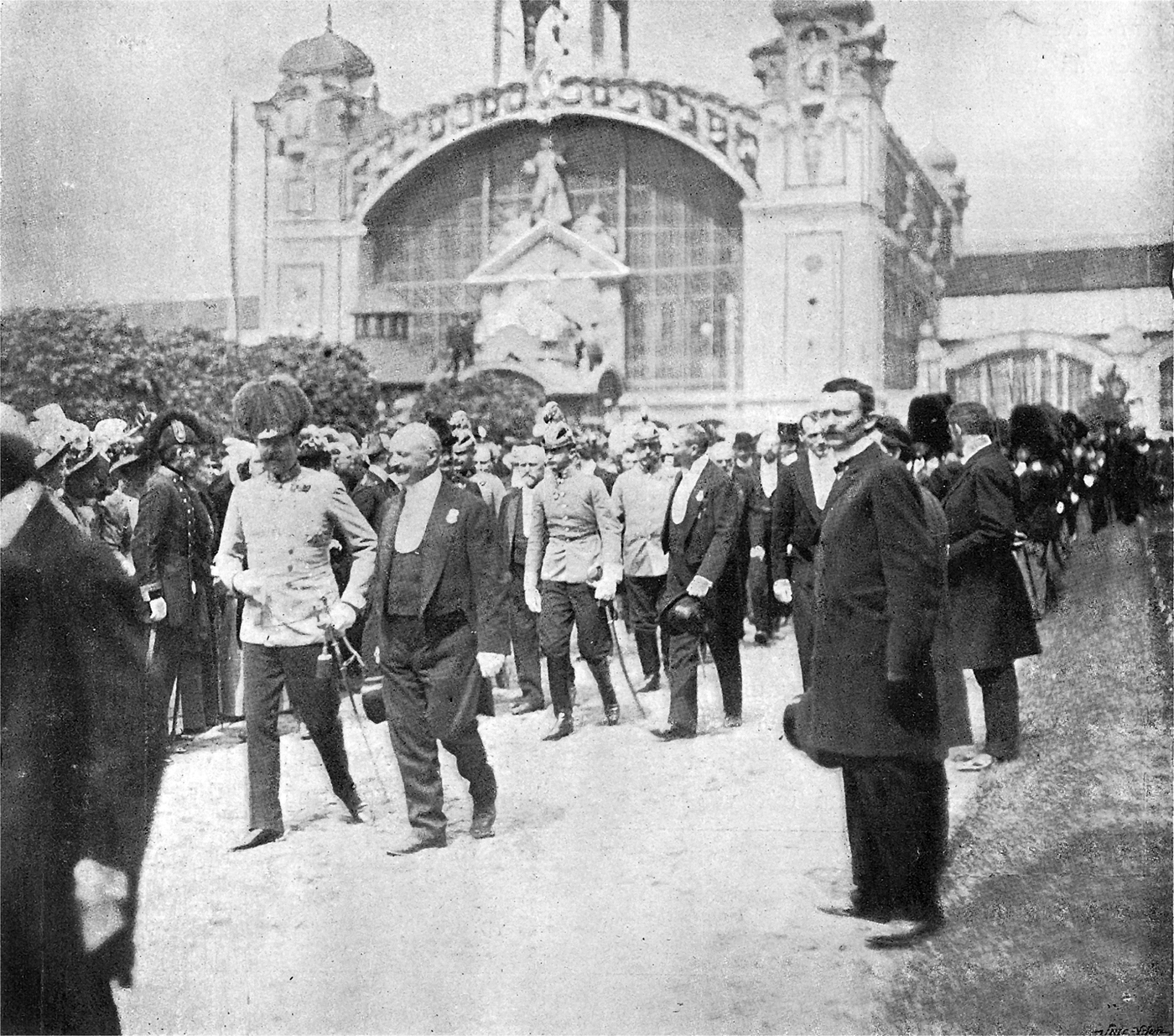
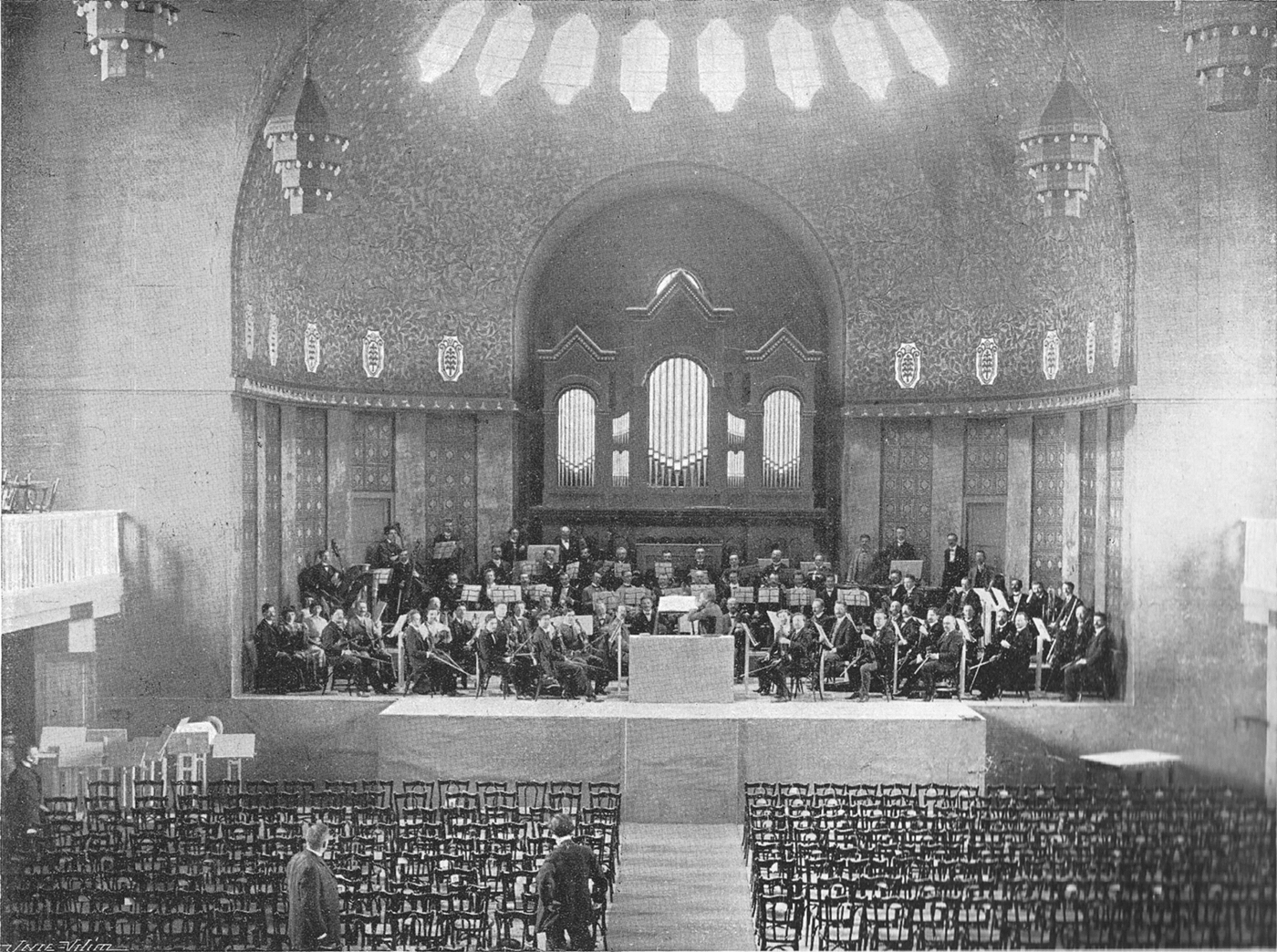
The Czech Philharmonic Orchestra emerged out of the National Theater orchestra, giving its first concert under the new name in January 1896. After a musicians' strike at the National Theater in 1901, the opera director fired the strikers, who then reorganized the Czech Philharmonic as an independent, freestanding concert orchestra. No independent professional German orchestra developed in Prague to match the Czech Philharmonic. In 1908 the Prague Chambers of Trade and Industry invited the latter to perform for special concerts in the 1,500 seat pavilion built at the Prague fairgrounds in Holešovice for the exposition staged by the Chambers to honor the sixtieth anniversary of Emperor Francis Joseph's coming to the throne (see Figures 6 and 7). The Austrian state created the chambers in the mid nineteenth century to represent all commercial and industrial enterprises in each region, and the Prague Chambers hoped in 1908 to attract citizens of whatever language or nationality to the exposition and its associated events. It was perhaps not surprising that for those concerts that required a large orchestra, the exposition management fell back on the local practice of the 1870s and 1880s and recruited musicians from both Czech and German local ensembles, in this case initially some fifty members of the Czech Philharmonic and sixteen musicians from the German provincial theater.Footnote 42
Archduke Francis Ferdinand at the opening of the Jubilee Exposition in Prague, 14 April 1908 [from Zlatá Praha 25 (1908), supplement 7: 27].
Concert Pavilion at the 1908 Jubilee Exposition in Prague, designed by Josef Zasche [from Zlatá Praha 25 (1908), supplement 8: 3].
Eager for maximum star-power, the concert organizers engaged Gustav Mahler, then at the height of his fame, to conduct major concerts at the beginning and end of the exposition concert series. The first program, in May 1908, included Beethoven's Coriolan Overture and Seventh Symphony, the overture to Bedřich Smetana's opera, The Bartered Bride, and several preludes to Wagner operas. Mahler's second concert, in September, presented the premiere of his own Seventh Symphony.Footnote 43 These two concerts drew large, appreciative audiences and much critical praise from both Czech and German reviewers. The local musical public, Czech and German, already knew Mahler's work as both conductor and composer. Since 1886 he had been back to conduct the German provincial theater orchestra several times: in March 1898 to lead his own First Symphony; in June 1899 for the Beethoven Ninth Symphony; and in February 1904 for his own monumental Third Symphony. The German provincial theater orchestra gave concert performances of other music by Mahler under Richard Strauss in 1901 and Leo Blech in 1902 and 1905. In the meantime the Czech Philharmonic performed Mahler's Second Symphony under Oskar Nedbal in 1903 and the Fourth under Vilém Zemánek in 1907. In March 1908 Nedbal also performed the First Symphony in the Rudolfinum with the visiting Vienna Tonkünstler Orchestra.Footnote 44 By spring 1908, then, Prague had a strong tradition of performances of Mahler's music by both Czech and German ensembles. For audiences and the music critics, the musical interest of Mahler's concerts in Prague that year overshadowed—but did not completely efface—nationalist interests and distinctions.
When Prague newspapers reported on the 1908 concerts, their accounts reflected the realities of these musical events, including both Czechs and Germans in the orchestra and the audiences, and the habitual nationalist discourse about the divisions in the city's public life. On 22 May, the day before the first of Mahler's concerts and in the midst of repeated confrontations between German nationalist students and Czech crowds on the German corso, Na příkopě, Bohemia ran a lead article entitled, “The Prague Musicians.” It began by noting:
On Saturday Gustav Mahler, a German artist, will conduct the works of the composers and with the enchanting power of his magical baton teach Germans as well as Czechs the utraquism of culture. A few hours later perhaps Mr. [Václav] Klofáč [leader of the Czech National Social Party, GC] will direct the work of the wreckers on Na příkopě and influence a channeled crowd with the suggestion that the Germans in Prague commit outrageous offenses against the holiest possessions of the Czech people as soon as they openly and freely acknowledge themselves as Germans.Footnote 45
The subsequent review of the concert for Bohemia by the Viennese-born critic Felix Adler praised the performances of all the works in the highest terms. He concluded with the observation that:
The musical Prague of both nations filled the impressive hall to the last seat and gave Mahler the most enthusiastic ovations. The spirited demonstrations reached their high point after the elemental conclusion of the last movement of the Beethoven symphony and after the prelude to Die Meistersinger. Naturally, of course, after the overture to The Bartered Bride, there was a separate expression of national enthusiasm among the Czech audience, which peaked in the presentation of a huge palm branch tied with a white and red bow.Footnote 46
Adler added a special word of praise for the orchestra, composed predominantly of members of the Czech Philharmonic, “who brought to bear all their considerable capability in fulfilling Mahler's extravagant demands.” The Prager Tagblatt published a review by Richard Batka, a great admirer of Mahler and well known in Prague as the previous music critic for Bohemia. He, too, lauded the concert but began by describing Mahler as the first among German musical artists from Bohemia and went on to note his formative experience under Angelo Neumann at the German provincial theater, as well as the recent local performances of Mahler's own compositions. Batka also singled out the playing by the orchestra and the exemplary work of the Czech Philharmonic's regular conductor Vilém Zemánek in preparing them.Footnote 47
One of the most prominent and controversial Czech music critics of the day, the historian and musicologist Zdeněk Nejedlý (1878–1962), gave Mahler a glowing review in the Prague newspaper, Den, but from his own personal and Czech nationalist standpoint.Footnote 48 Nejedlý and his supporters were battling with conservative defenders of the existing Czech musical culture for what Nejedlý envisioned as a stylistically progressive and socially engaged modern music.Footnote 49 He enthusiastically praised Gustav Mahler's conducting as representing the finest modern musical style and sensibility. Commenting on the program, Nejedlý drew a direct line of pioneering champions of modern music extending from Beethoven to Wagner and his own hero, Smetana, following the musical esthetic of one of his mentors at the Czech university, Otakar Hostinský. Nejedlý argued that Czech music in Smetana's tradition had reached the highest international level just as had that of the German nation. He dismissed the music of Bohemian Germans, though, as “provincial and without significance for the development of music.” Bohemian Germans might claim Mahler as one of their own, but Nejedlý judged that his music-making had little to do with them, because he had left Bohemia as a youth. This suggests that Nejedlý considered the best modern musical tendencies, exemplified by Beethoven, Wagner, and Smetana, all included in the program, to be international in their reach and impact; but at the same time Nejedlý and many like him in Prague were unable to consider music in purely anational terms.
The most prominent Czech nationalist newspaper of the day, Národní listy, long aligned with segments of the Young Czech Party, published no review of Mahler's May 1908 concert, but in the feuilleton section on the front page of its 22 September 1908 edition, it printed a substantial account of the premiere of Mahler's Seventh Symphony. Antonín Šilhan, a defender of the Czech musical establishment antithetical to Nejedlý, wrote the review with a mixture of praise and distinct reservations about aspects of the new work. Šilhan took note of the international importance of the event, the interesting qualities of the music, and the positive response of the audience, but the review expressed an unmistakable awareness of the Czech nationalist interests of the newspaper and its readership:
The last philharmonic concert of the jubilee exposition, on Saturday, September 19, was a great musical event: Gustav Mahler personally directed his new symphony. Given his world renown as a conductor and composer, it is understandable that the sight of the wide world of music was directed to the Prague exposition grounds, first of all, of course, the attention of Germans and Jews, the latter who excel particularly in musical sense. If Mahler–who has the doors of more prominent platforms open to him–went to Prague to perform his new work, this can be seen not only as a fond reminiscence of the place where the native of Kaliště (near Humpolec) achieved his first major successes and established his fame as a conductor with performances of Wagner, but also as a recognition of Prague's old musical traditions, the good reputation of Prague audiences for welcoming new musical phenomena with understanding. In that respect he was not disappointed, and although his symphony offers much that is unusual and eccentric, even exceeding in this regard his previous symphonies, it was received with appreciation and after the second and fourth movements very warmly.Footnote 50
Šilhan made no comment on the national composition of the audience or of the orchestra, and he concluded his review by praising the memorable performance by the augmented Czech Philharmonic under the composer's direction, without mentioning the musicians drawn from the German provincial theater.
Nejedlý's review of the premiere of Mahler's Seventh Symphony trumpeted his enthusiasm for Mahler's modern musical style, but here, too, he voiced nationalist sentiments. He saw the concert as a great occasion to experience some of the most innovative new music, representing impulses that he believed many Czech musicians had lost sight of in recent years. Otherwise, Nejedlý offered little in his review on the actual musical qualities of the new symphony, but he noted the national character of the occasion:
The Mahler concert was, of course, ‘bilingual,’ and Germans perhaps predominated in the audience, but in the Prague circumstances it is still possible to speak of it as a Czech Mahler concert. The musicians were in any case nearly all Czechs, among them members of the National Theater orchestra and Czech professors from the conservatory . . . and in the audience were all the prominent figures of our musical world.”Footnote 51
Mahler may have understood some Czech from his early youth, but he spoke German during the rehearsals in May 1908. His demanding work with the predominantly Czech musicians sparked some national tensions and resistance among them during the early stages, according to the Mahler scholars Henry-Louis de la Grange and Donald Mitchell.Footnote 52 Mahler showed considerable respect for the assisting Czech conductor, Zemánek, and treated the musicians with particular tact. A visiting admirer of Mahler observed that the musicians' attitude only warmed after they played through the sunny, boisterous finale for the first time: “This time the orchestra, adamantly Czech as it was with regard to the German conductor, was conquered! Swept off its feet!”Footnote 53
The accounts of the Mahler premiere published in Prague's major German daily newspapers, Bohemia and the Prager Tagblatt, offered more extensive treatment of the musical character of the new symphony than did Nejedlý or Šilhan with no explicit comment on the mixing of Czechs and Germans in the audience and the orchestra.Footnote 54 The short review in the Prager Abendblatt concluded, though, by celebrating the “beautiful unity in which the whole tone-setting German and Czech society of Prague found itself for the performance of the master work of a musical genius born of the Bohemian soil.”Footnote 55
The writers for all Prague's German newspapers worked in much the same political and discursive world, saturated with nationalist ideology, as did their Czech counterparts. Writing for the Prager Tagblatt, Richard Batka described Mahler as “the best German musician from Bohemia and someone whom expert judgment has long since named the general music director of Austria,” and a man who was, from the vantage of this extraordinary concert, “perceived and accepted as a representative of modern German art.” The luminous quality of Mahler's music and persona had a powerful effect in Prague, Batka argued: “The force of his personality is so compelling that it breaks down the great barriers between nations and finds followers in the Czech musical world. While before, Dvořák and Smetana represented music in Bohemia, the hero of this summer's concerts was undoubtedly our Mahler.”Footnote 56
In presenting this judgment in the first paragraph, Batka made the competition between the Czech and German nationalities in Bohemia a major subject of his review alongside his assessment of the new symphony. At the very beginning of the review, Batka noted that he wanted to avoid the “difficult question of the relationship between art and race”—an issue that the antisemitic press in Austria and Germany frequently raised—but he did not let pass the fact that Mahler was born a Jew. In Mahler's defense, Batka quoted the ironic contrast between Mahler and the German composer Richard Strauss drawn by the celebrated Viennese Jewish writer Arthur Schnitzler in private conversation. Schnitzler observed that someone who was uninformed of their identities might find more Semitic characteristics in the composer of the opera Salome, including “the luxuriant, erotic sensuality . . . the proclivity toward outward effect, the talent for self-presentation, and, above all, the economic utilization [Auswertung] of his works” than were to be found in Mahler's compositions and career, which reflected “a man of mystic rumination, one who climbs gigantic boulders . . . and an idealist—in short, the paragon of modern German art.”Footnote 57
Art Galleries and Museums
One can find similar instances of joint participation by Czech- and German-speaking residents of Prague around 1900 in other local cultural activities, even if it was selective, and most participants remained conscious of the nationally marked character of much of public life, so that national loyalties were seldom far below the surface. As in the musical sphere, several of the older fine arts associations were nationally neutral or formally organized on a binational basis. One of the oldest, the Society of Patriotic Friends of Art in Bohemia (Společnost vlasteneckých přátel umění v Čechách, Privat-Gesellschaft patriotischer Kunst-Freunde in Böhmen—SVPUČ), carried forward something of the old Bohemian Landespatriotismus from before 1848. In 1796, at the very beginning of the Czech national movement and a time when German national political loyalties were hardly known in Bohemia, Count Francis Joseph Sternberg-Manderscheid and Count Johann Rudolf Czernin led a group of Bohemian nobility and prosperous burghers in founding the Society of Patriotic Friends of Art. Their goal was to create a public art museum and academy of art in the Bohemian capital; their gallery eventually became the basis for the National Gallery in Prague in the mid twentieth century. In the late 1890s Bohemian aristocrats, including members of the Thun-Hohenstein, Nostitz, and Buquoy families, still served on the governing board of the Society alongside the Czech architect Josef Schulz, the German banker Karl Zdekauer, and the German industrialist, construction magnate, and art collector Adalbert Freiherr von Lanna.Footnote 58 A fundamentally conservative body, the Society took a neutral stance in national questions and from the 1870s to 1918 was committed to national parity in its operations.Footnote 59 In 1885, when the Rudolfinum opened, the Society moved its gallery to that venue, which drew both Czech- and German-speaking publics.
Another Prague artistic society with a lineage similar to the Society of Patriotic Friends of Art was the respected Krasoumná jednota or Kunstverein (Fine Arts Association), which was founded in 1835 and brought together diverse artists for major annual exhibitions of their work. The exhibiting artists included Czech- and German-speakers from Bohemia, as well as some from elsewhere in Austria, Germany, and other European lands. The Association staged its shows at the Sophie Academy after 1865 and in the Rudolfinum galleries after the mid 1880s, venues that much of the public perceived as more or less nationally neutral. Zdeněk Hojda's research on purchases of works exhibited in the Fine Arts Association's annual shows from 1840 to 1896 revealed a distinct social profile, which did not simply follow the linguistic or national political and social lines that were characteristic of many other Prague milieus during the period.Footnote 60 Aristocratic collectors were well represented among the purchasers, but after the 1860s the majority of buyers came from the ranks of prosperous industrialists, businesspeople, property owners, and professionals. Many of these were German-speakers, with Czech-speaking bourgeoisie appearing more sporadically. The purchasers, however, included notably few of the bourgeois entrepreneurs and professionals who were actively engaged in Czech or German nationalist politics in the city. The social conditions and Landespatriotismus of the era before 1848 were long gone by the 1870s and 1880s, but those who purchased art works at these exhibitions still evoked more of the Bohemian society of earlier decades than the more sharply divided and contentious one of the age of high nationalism.
Even among fine arts institutions in Prague that originated during the late nineteenth century, the particular circumstances of their founding and sponsorship might lead to their still having patrons and publics drawn from both the Czech- and German-speaking populations. A prominent example was the Prague Museum of Decorative Arts (Uměleckoprůmyslové muzeum, Kunstgewerbliches Museum), founded by the Prague Chambers of Trade and Manufacture in 1885 and modeled after the Austrian Museum of Art and Industry (today the Museum für angewandte Kunst, the “MAK”), which opened in Vienna in 1864, and other museums and exhibitions of applied art that were launched around Europe between the 1850s and 1880s. To the end of the monarchy, the Prague museum remained under the control of the Chambers of Trade and Manufacture, which in turn were subordinate to the Austrian Ministry of Commerce. The controlling authorities expected this museum to serve both Czech- and German-speaking publics, and it drew leadership and major donations from a mixed group of Czech- and German-speaking businesspeople and industrialists. Its founding owed much to the initiative of the Czech Jewish industrialist Bohumil Bondy (1832–1907), a stalwart of the Old Czech Party and president of the Prague Chambers of Trade and Manufacture after 1877.Footnote 61 Adalbert Freiherr von Lanna (1836–1909), a longtime member of the German Casino in Prague, did much to develop the collections through his gifts.Footnote 62 The museum's carefully balanced governing board included representatives of the Chambers of Trade and Manufacture, the Bohemian Diet's executive committee (zemský výbor, Landesausschuss), the Vienna Museum of Art and Industry, the German-leaning directorate of the Bohemian Savings Bank, and the Czech-led Prague city government. The museum's official sponsorship, together with its initial use of exhibit space in the Rudolfinum and later the construction of its own handsome neo-Renaissance building, just across the street from the Rudolfinum and the Prague Conservatory, helped assure that it served a mixed public of Czech- and German-speakers.Footnote 63
Prague's Modern Gallery, begun in 1901–1902 with a gift from the emperor, followed a different model, reflecting the Bohemian political imperative that the government formally assure national parity in its cultural services. The founding, in fact, represented one of the Austrian minister-president Ernest von Körber's cultural initiatives, designed to bring together the contending groups and interests in the Austrian population. In the short term, establishing the new gallery in Prague might also help win support for the government from Karel Kramář and other Young Czech deputies in the lower house of the Reichsrat.Footnote 64 The Modern Gallery in Prague, like its Viennese counterpart, was to provide support for contemporary artists by purchasing and exhibiting their work. The executive committee of the Bohemian Diet administered the Modern Gallery, and to assure equal treatment for Czech and German artists in an unmistakable way, the Gallery displayed their works in the same building but in separately organized divisions.Footnote 65
Modernist Literary and Artistic Life
Much of literary life in Prague around 1900 displayed the divisions on national lines that so many observed elsewhere in local public life. From the early nineteenth century, activists in the Czech national movement had made the revival of older works of Czech literature and the creation of a robust modern Czech literature a major goal, and writers played a prominent part in Czech civic and cultural affairs throughout the late nineteenth century.Footnote 66 The national movement expected writers and artists to provide a mirror for national existence and identity, as the sociologist Derek Sayer puts it, and Czech nationalists celebrated their great patriotic writers as national heroes.Footnote 67 Bohemian Germans hailed their literary greats as well, although German nationalists also liked to claim their superiority through sharing in the wider realm of German-language literature in Austria and Germany. In part, Czech and Bohemian German belles lettres served nationalist purposes simply by being available for reading, discussion, and celebration in homes, schools, and associations; but some works made explicit nationalist statements. Alois Jirásek (1851–1930), for example, found a huge audience among the Czech public for his plays and historical novels that celebrated the heroic struggles of the Czech common people for freedom and justice against the nobility and alien, German-speaking rulers. Characteristic of Bohemian German nationalistic writing was the Heimat fiction that depicted the struggle to maintain German settlements and identity against Slavic adversaries in communities on the so-called linguistic borders, exemplified in Fritz Mauthner's Der letzte Deutsche von Blatna (Dresden, 1887) or the more sharply anti-Czech stories by radical nationalists such as Karl Türk, Karl Hermann Wolf, and others.Footnote 68
Nationalist activists in Prague and throughout Bohemia, Moravia, and Silesia, whether Czech or German, urged their followers to focus on the arts and literature of their own nation and to reject the cultural influence of the national other. Czech nationalists, determined to end the two-hundred-fifty-year dominance of the German language and culture, reached out to the examples of other great national cultures, whether French, Russian, English, or North American. Many Bohemian German nationalists, for their part, were dismissive of Czech cultural accomplishments. Determining to what extent Prague's Czech and German publics actually adhered to the nationalist strictures about what they should read is a challenging question, which must be left to specialists in popular readership. One can say with confidence, though, that before 1918 many well-educated Czech-speakers in Prague were exposed to a sampling or more of the classics of German literature and had sufficient command of German to be able to read what German writings they chose. Educated German-speakers in the city had some exposure to Czech literature in the Czech classes they took in the German schools and through Czech acquaintances. We know that at least some of the German-speaking intellectuals in the city around 1900 had adequate command of Czech and an eagerness to read Czech literature. It should be noted that after the division of the Prague university in the early 1880s, the Czech university developed a solid tradition in German studies while the German university had able professors of Slavic studies.Footnote 69 The scholars of Bohemian and Austrian history in the Czech and German philosophical faculties read and debated about what each other wrote, and occasionally a few students in various disciplines crossed over to the other university to study formally or informally with particular professors.Footnote 70
From the 1890s onward, a number of younger intellectuals in Prague, both Czech- and German-speaking, became increasingly eager to break free of the nationalist literary strictures, whether with respect to styles, genres, or interest in other national literatures. One finds this in literary journals, public readings and discussions, and literary cafés. The literary avant-garde represented only one aspect of a spectrum of emerging modernist impulses in the Bohemian Crownlands that broke away from late-nineteenth-century bourgeois cultural orthodoxies, much like their better-known modernist counterparts in Vienna and Budapest.
The nascent modernist movement in Czech culture in the 1890s and just after 1900 took an avowedly cosmopolitan stance and looked for kindred spirits and models in Vienna and cities in Germany, as well as West European capitals, as scholars such as Katherine David-Fox, Nicholas Sawicki, and Neil Stewart have noted.Footnote 71 Ties to Paris were important, but several waves of Czech writers and literary critics also reached out to Vienna and Berlin, in particular, as they developed new modes of expression. The poet Josef Svatopluk Machar (1864–1942) took up residence in Vienna for more than thirty years. With support from friends in Prague, Machar in 1895 published in the Prague literary journal Rozhledy [Outlooks] “The Manifesto of the Czech Moderna,” calling for a revolt against the Czech political, literary, and artistic status quo. Thereafter, Rozhledy and the writers, artists, and other intellectuals gathered in the Moderna group advocated iconoclastic positions in culture and politics, with many pursuing a social reading of art and literature. They developed close ties with the Viennese writers associated with the journal Die Zeit and Hermann Bahr.
The cosmopolitan tendencies among the Czech literary avant-garde in the 1890s took other directions among the writers who gathered around the critic and translator Arnošt Procházka (1869–1925), the colorful, decadent poet and critic, Jiří Karásek ze Lvovic (1871–1951), and their journal, Moderní revue pro literaturu, umĕní a život [Modern Review for Literature, Art, and Life], which began publication in 1894. This group rejected the social and political engagement of many in the Moderna group and found inspiration in the French symbolists, among decadent writers in various European lands, and in the writings of Friedrich Nietzsche. Moderní revue provided a counterpoint to Rozhledy in advocating radical new directions in Czech literary life; and it, too, pushed for a stronger engagement with foreign literary trends, particularly with the writers and artists in Berlin connected with Stanislaw Przybyszewski, others in Germany and German-speaking Austria, and even German-speaking writers in Prague.Footnote 72Moderní revue published, for example, poems by the Prague-born Rainer Maria Rilke, in German as well as Czech translation, and articles and reviews by the Prague German writer Paul Leppin.Footnote 73
Defenders of the nineteenth-century Czech national cultural heritage rejected the strongly cosmopolitan outlook of many of the modernists and reacted with hostility to many of their literary and artistic initiatives. The decidedly Czech and academic orientation of the journal Dílo [The Work of Art], for example, expressed the conventional Czech nationalist cultural perspective.Footnote 74 As a result, there was much ferment and controversy in Czech literary and artistic circles around 1900. One group of young Czech visual artists, for example, vocally opposed the advocacy of contemporary Berlin art in Moderní revue and founded in 1896 their own journal, Volné směry [Free Directions], under the aegis of the Society of Visual Artists Mánes (Spolek výtvarných umělců Mánes). Czech artists who were eager to break free of academic conventions and stylistic orthodoxies had organized the Mánes Society in 1887, and by the 1890s it was well established as a secessionist organization.
The Mánes Society and Volné směry combined strong support for Czech arts and Czech artists with their own advocacy of innovation and engagement with contemporary trends elsewhere in Europe, including France, Russia, Croatia, Poland, Denmark, Germany, and Britain. The Mánes Society sponsored major exhibitions in Prague devoted to Auguste Rodin in 1902, Russian art in 1904, Edvard Munch in 1905, French impressionist painters in 1907, and the French late impressionists and postimpressionist Les Indépendants in 1910. Those exhibitions, although not free of Bohemia's nationalist politics, had an enormous impact on local artists and intellectuals, as well as on the broader Prague public, both Czech- and German-speaking.Footnote 75
Still, the Mánes Society could hardly contain all the modernist impulses emerging among Czech artists during the first decade of the new century. Some of those impulses led to Czech artists making common cause with their German-speaking counterparts in Prague and Bohemia. Inspired by the Munch exhibition, a group of eight young painters, called simply Osma [The Eight], came together in spring 1907 for an independent exhibition, which showed affinities to the Fauvists in France and the emerging German expressionists, particularly Die Brücke. Osma included the Czech painters Bohumil Kubišta, Emil Filla, Otakar Kubín, Emil Artur Pittermann, and Antonín Procházka and also the Bohemian German Willi Nowak and the German-speaking Jews Max Horb and Friedrich Feigl.Footnote 76 In 1911, Kubišta, Filla, Procházka, and Josef Čapek, the painter brother of the writer Karel Čapek, broke away from the Mánes Society to create the Skupina výtvarných umělců [The Group of Visual Artists], which sponsored its own major exhibitions in 1912, 1913, and 1914. Those influential exhibitions, which included works of Braque, Derain, Picasso, Die Brücke, Gris, and the group's own members, helped open the way to cubist and expressionist art more generally in Prague.Footnote 77
The emerging modernist voices in Czech literary and artistic life in the 1890s and just after 1900 displayed no real unity, but they initiated conversations with avant-garde elements in other countries and sparked the vigorous modernist experimentation that flowered across a broad front in Prague after World War I.Footnote 78 The openness to new cultural developments and new modes of expression among other peoples gave some Czech writers and artists in Prague around 1900 common interests with the German-speaking literary and artistic avant-garde in their city and led some on each side of the linguistic and national divide to develop contacts with each other. The inclusion of works by Prague German writers in Moderní revue and the mixed membership of Osma were only two examples of this.
The younger generation of German-speaking writers in Prague around 1900, most of them Jewish, have won greater international fame than their Czech counterparts. They are commonly labeled “the Prague Circle,” but as Scott Spector has rightly argued, several partly overlapping groupings of German-speaking writers formed in the city between the late 1890s and World War I.Footnote 79 The writer, critic, and translator Max Brod, who did much to help publish and publicize them, identified an inner circle composed of Oskar Baum, Franz Kafka, Felix Weltsch, and himself; then a younger circle around Franz Werfel and Willy Haas; and what developed as a Zionist group including Hugo Bergmann, Robert Weltsch, Hans Kohn, and others.Footnote 80 Prague had yet other interesting figures writing in German in this period, including the older non-Jewish writers Gustav Meyrink and Paul Leppin and the younger Jewish writers Otto Pick, Rudolf Fuchs, Egon Erwin Kisch, and Paul Kornfeld.
From the early 1870s to the early 1890s, the Concordia Association, led by figures such as Alfred Klaar, Friedrich Adler, and Hugo Salus and allied with the German Casino and its national liberal politics, dominated local German literary and artistic life. By the mid 1890s, a younger generation emerged, who, similar to their Czech modernist counterparts, wanted to break free of the established German middle-class cultural norms in Prague and Bohemia. In 1895 a “Young Prague” group, including Camill Hoffmann, Paul Leppin, Gustav Meyrink, Hedda Saur, Oskar Wiener, and others, organized the Association of German Artists in Bohemia (Verein deutscher bildender Künstler in Böhmen), signaling dissatisfaction with Concordia.Footnote 81 The Young Prague group in turn helped pave the way toward the more radically modernist writings of Kafka, Brod, Werfel, Fuchs, Pick, and Kornfeld.
Prague's German-speaking avant-garde writers, critics, and translators around 1900 proved to be a remarkably diverse group. What is of interest here is, as Scott Spector has depicted, how many of them were concerned with issues of cultural and political identity and the question of what political and social space or territory they could occupy as they faced the decline of liberal politics and the rise of populist radical nationalism and antisemitism, whether among Austrian Germans or Czechs.Footnote 82 Some of the German-speaking writers, like their counterparts elsewhere in Europe, turned away from current politics and looked to the psychological space of the self and the senses, while others explored new political and ideological alternatives, whether it be social democracy, revolutionary socialism, or Zionism. Despite their upbringing in families, schools, and organizations long committed to German liberal politics and bourgeois social and cultural norms, Prague's German-speaking literary and artistic avant-garde found that their modernist impulses took them in similar directions as the Czech avant-garde. In fact, Brod, Kafka, Haas, Werfel, Leppin, and Pick in varying degrees all had significant familiarity with contemporary Czech belles-lettres. At a remove of some fifty years, Haas, for example, remembered how he and his friends read some of the best Czech poets from the turn of the century, including Otokar Březina, Petr Bezruč, and František Šrámek.Footnote 83
A number of the German Jewish writers took up mediating roles between Czech- and German-language modernist cultures, even though such activity was rejected by German nationalists in Prague and Bohemia at large. Spector sees these figures as seeking middle ground between the Czech and German national camps.Footnote 84 Otto Pick wrote his own poetry and translated much contemporary Czech poetry and prose into German as well as German writing into Czech. The poet Rudolf Fuchs also translated Czech poetry into German. Paul Leppin, as already noted, published in the Moderní revue and had friendships with Karásek ze Lvovic and Šrámek.Footnote 85 Max Brod churned out reviews of new writing, art, and music that took up the work of Czechs as well as German-speakers. He put himself forward as mediating between the two cultures, touted to German readers the author Jaroslav Hašek and his Good Soldier Švejk, translated the libretti of most of Leoš Janáček's operas into German, and worked assiduously for their performance in German and Austrian opera houses. Brod's review for a Berlin journal of the first exhibition of the Osma artists in spring 1907 typified his vocal support for new literary and artistic departures and crossing the national dividing lines in Prague's public life:
Spring! Spring! Germans and Czechs have gathered together, eight artists without regard for their nationality. Here in Prague, in the epicenter of struggles, where bowling club and lyric ensemble alike convene under the shadow of national-colored banners. It is difficult to convey to anyone who is not from Prague the comical and delicate nuances of our linguistically stratified society, which so eagerly cultivates its talent for accentuating only those things that divide both tribes and never what they have in common . . . At the risk of offending some patriots on both sides, I wish to assert that in Prague it is difficult to speak of a purely German or purely Czech nation, only of Praguers, inhabitants of this wonderful and mysterious city. A melding has occurred, blood has mixed, and cultural and economic ties lure people across boundaries.Footnote 86
In a number of cases, members of the Czech and German-speaking literary and artistic avant-gardes in Prague developed close personal connections. Franz Kafka's friendship and extensive correspondence after 1919 with the Czech translator and journalist Milena Jesenská are well known.Footnote 87 Over several decades Otto Pick translated into German a number of works by the Czech Jewish author of plays, short stories, and essays, František Langer. In his memoirs Langer vividly described participating before 1914 in gatherings of leading young Czech literary and artistic figures at the Café Union on Ferdinandová třída, including the Čapek brothers, V. V. Štech, Emil Filla, the sculptor Otto Gutfreund, and the architect Josef Gočar. Langer also remembered going to the German theater and visiting the Café Arco, near the Prague central train station, which Brod, Kafka, Werfel, Pick, Leppin, and Kisch frequented. Langer commented simply: “The relationship between us and the young German authors was very friendly. We were interested in their work; we exchanged our firstborn pieces; and Brod and Pick were already engaged with Czech music and literature and were transmitting them across the linguistic boundary.”Footnote 88
The relationship between Pick and Langer and Pick's translations of Langer's writings brings this discussion to one final scene in the crossings between the Czech and German cultural spheres in Prague. In April 1911 the Viennese culture critic and satirist Karl Kraus published in his journal, Die Fackel [The Torch], Pick's translation of a macabre erotic story by Langer, under the title, “Der Rattenfänger und die Dirnen” [“The Rat Catcher and the Bordello Girls,” Krysař a holky in Czech].Footnote 89 In the same issue Kraus reported on the second lecture he had given in Prague in recent months.Footnote 90 Willy Haas and student colleagues helped arrange both these Prague events, the first on 12 December 1910, in the rooms of the Lese- und Redehalle of the German students, and the second on 15 March 1911, in a meeting room of the Hotel Central (in Panská street/Herrengasse), which regularly hosted German lectures and discussions.Footnote 91 Kraus spoke to large audiences on both occasions, thanks to his considerable notoriety and public disputes with other writers and journalists. For the first lecture, the Lese- und Redehalle gave priority for tickets to its own members, leaving only a few seats for the general public.Footnote 92 It is unlikely that any Czechs attended then, particularly since it took place in the home of the principal liberal German students' organization. As was his habit, Kraus published in Die Fackel press notices of his December lecture from Bohemia, the Prager Tagblatt, and the Prager Abendblatt, but nothing from any Czech periodical.Footnote 93
Kraus's second Prague lecture, given in the hotel near Wenceslas Square, drew German-speakers and some Czechs. Franz Kafka attended, along with other Prague German literati.Footnote 94 The Prager Tagblatt and Národní listy as well reported on the presentation, which included Kraus's polemical essay, “Heine and the Consequences,” as well as critiques and satirical remarks on current cultural luminaries, including his former mentor Maximilian Harden. The Prager Tagblatt published a laudatory review by Ludwig Steiner.Footnote 95Národní listy printed a short, less friendly account, which stressed Kraus's sarcasm, cutting criticism, and fearless statements.Footnote 96 That Národní listy reported on the lecture indicated, though, the recognition that some of that newspaper's readers would want to hear about this German-language event.
The attendance of at least some Czechs at the March 1911 lecture and the belief that members of the Czech literary and artistic avant-garde would be interested in Kraus's presentation were evident in the sympathetic and highly laudatory review that the brilliant Czech critic František Xaver Šalda (1867–1937) published in his own biweekly journal, Novina.Footnote 97 Šalda had collaborated in issuing the manifesto of the Czech Moderna, wrote for many Czech literary and artistic journals, and had close ties to many Czech modernist artists. Šalda praised Kraus as “a Viennese satirist of great style and true spiritual propriety,” who “had suffered much due to Vienna and its feuilleton manners, its dirtiness, and indecency in matters of the spirit.” About Kraus's Heine essay, Šalda wrote, “This is a work of powerfully insightful criticism, a white-hot assessment of the completely crazy things which protect modern sentimentality from an honest and definitive reckoning.” Kraus's iconoclasm and bold expression of his views were welcome to the ears of a dedicated modernist like Šalda, who was eager to break through many established cultural and social barriers.
Perhaps it was only to be expected that some Czech- and German-speaking avant-garde intellectuals and artists in Prague ignored nationalist taboos and reached out to each other where they shared common interests in their disciplines and the determination to break free from established orthodoxies. As we have seen, though, not merely the intellectual and artistic elites but parts of the broader Czech- and German-speaking publics in the city also participated together in cultural events. Important occasions such as the visit of the Meiningen Court Orchestra, Gustav Mahler's concerts, other notable concerts and operatic performances, or a lecture by a renowned figure such as Karl Kraus might attract interest regardless of nationality. The mixing of audiences or of contributing patrons was facilitated, of course, if the venues or sponsoring institutions were not identified exclusively with one or another national cause. The Czech National Theater and the two stages of the German provincial theater, however, were jewels in the crown in the public life of each national community. Yet, the calculations about ticket sales and understandings about repertoire worked out by the directors of the two companies showed their recognition that Czech and German audience members would cross over to attend particularly attractive productions or hear specific singers. There is evidence that such audience behavior extended in some instances to lesser Prague theaters as well.
In part this argument confirms the findings of the historian Philipp Ther in his pathbreaking comparative study of opera theaters in late-nineteenth-century Dresden, Prague, and Lemberg/Lwów/Lviv that artists' and audiences' interests in experiencing the international operatic repertoire alongside native national works defeated narrower nationalist visions of the missions and repertoire of those theaters.Footnote 98 The scenes from life in Prague discussed here, however, suggest that broader artistic and intellectual interests were able to override narrower nationalist visions and confining strictures in other areas of cultural life beyond the opera houses, even in such a hotly contested multinational setting. “Something there is that doesn't love a wall,” the American poet Robert Frost observed in another context.Footnote 99
This is not the place to examine other areas of popular culture and entertainment in Prague, but one can note the findings of the historian Ines Koeltzsch that the clientele of many Prague dance halls, music halls, cabarets, smaller theaters, and movie houses between 1918 and 1938 showed no strong divisions along national or ethnic lines.Footnote 100 Movie theaters had enormous popularity in the Czechoslovak capital during the 1920s, and many of the films were imported from Germany or the United States. Czech nationalists complained about the showing of German productions and the non-Czech character of the movie theaters, but only in 1930, when the movie houses began to show significant numbers of sound films, did Czech Fascists stage a violent protest in central Prague against the screening of German talking films. In response, the exhibitors stopped showing German films, although American imports continued and German-language films, in fact, returned after several months in a number of theaters.Footnote 101
Those who chose to ignore national barriers in Prague's cultural life around 1900 and crossed over on various occasions may have included some people who were ambiguous about their own national loyalties, but the majority probably affirmed support for one or another national cause in their politics and other aspects of their lives. Despite the criticism of nationalist excess expressed by some intellectuals, nationalist political forces and national loyalties here were by no means weakening around 1900. Indeed, nationalist contention was growing more bitter. Egon Erwin Kisch knew Czech well, and his writings described Prague's back streets, night life, and underworld with enchanting wit and color; but he and Friedrich Kleinwächter, as observers of public life in the city, affirmed the reality and power of the national divisions, even while each chose to cross the lines in particular aspects of daily existence. In describing the national divisions in Prague society, they echoed an important persisting element of the discourse of the nineteenth-century nation-builders and nationalist activists who urged the observance of political, social, and economic boundaries in everyday life as critical to national emancipation, prosperity, and power.
At the beginning of the twentieth century, nationalist political activists of all stripes in Prague and throughout the Habsburg monarchy felt obliged to reiterate continually the importance of national loyalties and distinctions in social and political life in order to discipline the populace to respect those divisions and remain faithful to the nationalist causes. The Czech and German nationalist efforts in Bohemia and Moravia to exhort and even constrain parents to send their children to the proper schools and not to those that taught in the other language were only one salient example of this.Footnote 102 Nationalist activists well knew that in the complexity of the everyday, individual loyalties might prove ambiguous or negotiable and that many might find it convenient to cross national lines where they saw fit. In localities with mixed populations, like Prague, the national social boundaries so important to the national activists had to be reaffirmed and recreated continuously.
In Prague and the Bohemian Lands, Czech- and German-speakers, Catholics, Protestants, and Jews, all shared the same physical and economic landscape and parts of the social and cultural landscape as well. We and those whom we might identify as the saner minds there during the early twentieth century might well see advantages in their all sharing together in that rich environment. Here and in many parts of Central and East Central Europe, though, more radical nationalists took what began in the early nineteenth century as an ideology of popular emancipation, equal citizenship, and social progress and transformed it into a doctrine of social division, domination, and ultimately forced assimilation or exclusion with tragic consequences for all.