Introduction
In spite of the present interest in developing and commercializing lithium (Li) battery powered electric vehicles for the mass market, 2012 was a year of unprecedented collapse in the Li battery sector, as some manufacturers went bankrupt, dissolved joint ventures, wrote off assets, or restructured operations in an attempt to survive. In the United States, A123, Valance, and Ener1 filed for Chapter 11 protection. All of the principal players in the industry are steering away from battery-powered electric cars because they cannot make money selling batteries at prices carmakers can pay.Reference Petersen1
Interestingly, the first battery-powered electric car was invented by Thomas Davenport in mid-1830s.Reference Tubbs2 By the end of the century, electric vehicles were well established and more frequent in the streets than cars with internal combustion engines.3 The electric car started easily and accelerated smoothly because electric motors have good torque even at a low speed. They were silent with no emissions, and no oil company could be accused of stopping alternative energy solutions. Despite all benefits, and a half century head start, the electric car was quickly abandoned when Otto and Diesel’s engines came, because battery development was too slow.
Rechargeable batteries are not as rechargeable as we often would like to believe. When a battery is charged or discharged with nonzero currents, various temperature, concentration, voltage, and current gradients are created. These gradients are created over complex interfaces in the battery cell, between electrodes and electrolytes, between conductors and electrode materials, and between the charged and discharged parts of the electrode. These gradients drive a variety of unwanted and complicated interconnected parasitic side reactions. If the electrode reactions involve dissolution/precipitation of different phases, where atoms and molecules are moved around, they are more likely to derail the battery cell upon cycling. In older battery chemistries, some of these side reactions have been given trivial names such as sulfation or memory effect.Reference Linden and Reddy4 All reactions, including the side reactions, have to be exactly reversed when shifting from discharge to charge. The inability to fully reverse all the reactions will make rechargeable batteries unstable with respect to charging and discharging. To minimize this instability, it is important for the electrodes to work under as ideal conditions as possible. Gradients and their effects must be minimized. This puts a high demand on the production quality, with an emphasis on uniformity of electrodes and separators with respect to porosity and purity.
Battery development is thus about minimizing side reactions by optimizing the design of the battery components or by trying to minimize the effects using better materials. Although we understand the basic principles of battery chemistries, many of the side reactions are both poorly characterized and understood. Coupled with the time it takes to test batteries, this makes battery development tediously slow.
This article covers critical issues with NiMH batteries in comparison with Li batteries and suggests some important improvements to the surface reactions. These improvements may provide a significantly better NiMH battery with a focus on hybrid electric vehicle (HEV) applications.
Metal hydride batteries
There are similarities and differences between the recently developed NiMH (nickel metal hydride) and conventional Li batteries. Both are based on intercalation reactions, thus enhancing the possibility of reaching long cycle life. In the Li-battery anode, lithium is usually intercalated in a carbon structure, graphite, or coke, and in the cathode into various metal oxides, different for each Li-battery chemistry.Reference Linden and Reddy4 In the NiMH battery metal hydride anode, hydrogen is intercalated between metal atoms in an alloy and in the cathode into a nickel hydroxide.Reference Linden and Reddy4 This similarity could motivate the NiMH battery to be called a “hydrogen battery.” In the NiMH battery, the energy is contained in the O–H bond in the nickel hydroxide cathode. In the Li battery, this corresponds to an O–Li bond, most commonly in a cobalt oxide cathode, if the battery is targeting a high capacity application, such as mobile phones or laptop computers. In these applications, each gram of weight saved is important for satisfying the end user’s wish to have a slim and lightweight device. When the batteries are charged, the bond to hydrogen (NiMH) or lithium (Li battery) is broken with the help of the energy from the battery charger. In the NiMH battery, the hydrogen atoms are then absorbed in the metal alloy anode working as a “hydrogen sponge.” In the Li battery, lithium atoms are absorbed in a porous carbon-based anode. The presence of hydrogen in the metal hydride anode protects its metal atoms from oxidizing. A NiMH battery performs well when fully charged. In the Li battery, on the other hand, the very reactive lithium itself is corrosion prone in the anode. If hydrogen (NiMH) is corroded, it forms water, which is the base for the electrolyte in this type of battery. If lithium corrodes, it forms insolvable species with a negative influence on the performance. This is why storing Li batteries in a charged state is not recommended and why laptop batteries have a short life expectancy. Life is shortened even more when the fully charged Li battery is accompanied by a warm environment caused by the laptop’s electronics dissipating heat. This corrosion reduces the life of the Li battery, even if it is not cycled, explaining why it is recommended to select replacement batteries with a recent manufacturing date.
The stronger O–Li bond in the Li battery compared to the O–H bond in the NiMH battery gives the Li battery the benefit of having a three times higher voltage, approximately 3.7 V, compared to 1.25 V for the NiMH battery.Reference Linden and Reddy4 However, the Li-battery capacity is not three times higher. The metal hydride anode can store a higher density of hydrogen atoms compared to the carbon-based anode storing lithium atoms. The lower voltage in the NiMH battery brings advantages as it allows the use of a highly conducting water-based alkaline electrolyte, which also simplifies the choice of separator. In the Li battery, the separator must be thin to compensate for the poor conductivity. The thin separator (micrometers thickness) that separates the highly reactive electrode materials leads to stringent quality demands for safety reasons. An internal short caused by a lack of homogeneity and/or defects will have dangerous consequences. The choice of electrolyte for Li batteries is limited to a few very stable lithium halide salts in organic solvents, where there is always a difficulty in preventing slow decomposition driven by the high cell voltage.
Higher cell voltages are the driving force behind parasitic reactions, thus driving increased demands on quality. This is the main reason for the slow price decline of high-quality Li batteries. Battery developers notoriously underestimate the cost of the high quality required to reach a long cycle life. One may say that no rechargeable battery should be charged and discharged in order for it to work well. By utilizing only partial charge/discharge, the chaotic development described previously will slow down. The ordinary lead acid starter battery for cars is a good example. It is often only partially discharged a few seconds in the morning and another few seconds in the evening. At all other times, it is kept fully charged by the generator. A lead acid battery will last approximately the lifetime of the car (∼10 years) (somewhat shorter in a modern car, as the battery is not switched off completely with the starter key but is slowly drained by various electronic equipment). A mobile phone battery or a laptop battery is a much more difficult battery application. The mobile phone battery consists of only one high quality state-of-the-art cell supervised by control circuits for best performance and safety. Still, many mobile phone users have experienced the battery’s performance decaying after only a few years. This is not a major issue, as users will buy a new device after a couple of years.
Electric vehicle batteries
A plug-in hybrid electric vehicle (PHEV) or a battery electric vehicle (BEV) battery has a hundred cells or more in series, and as in a chain, the weakest link will determine the performance of the battery pack. A PHEV/BEV battery will also not be kept at constant room temperature, compared to the mobile phone battery in the pocket of the user. All cells have to be very similar to each other, not only when they are made but also over time. They must age at the same rate, independent of where they are placed in the battery pack. It will be difficult and costly to reach a >10 years lifetime with a performance that is acceptable for PHEVs or BEVs.
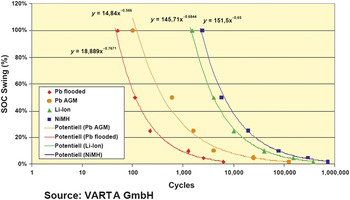
A battery that is only partially charged/discharged will, over its cycle life, deliver significantly more cumulative charge/discharge capacity. This was well illustrated by Duvall in 2005, as seen in Figure 1,Reference Duvall5 which shows that a 1 Wh NiMH battery will deliver 2300 full cycles. This corresponds to a total cumulative capacity of 2300 Wh during its total life expectancy. This is somewhat oversimplified and misleading, as the battery will undergo a gradual decay in the end of its life, during which its internal resistance will gradually increase, limiting the performance. If the battery is only discharged from 50% to 100% state-of-charge (SOC), with a SOC window of 50%, the available capacity will be reduced by 50%, but the corresponding number of cycles the battery can endure has increased to 6600 cycles, leading to a total cumulative capacity of 3300 Wh. This is an increase of about 150% of total available capacity to supply an application over the lifetime of the battery. If the SOC window is further reduced to a few percent, the total cumulative capacity can increase with a factor of 10 or more, as indicated in Figure 1. This drastic increase explains why a lead acid starter battery reaches a life expectancy of approximately the age of the vehicle it sits in, although a standard lead acid battery barely survives a few hundred full charge/discharge cycles. By using a small part of the SOC window, only a fraction of the active electrode materials will be converted in cell reactions, and the remaining parts will help to keep the main cell reaction paths on track.
Available charge/discharge cycles at different SOC (state-of-charge) windows. The SOC swing is the percentage of the full capacity that the battery is cycled within.Reference Linden and Reddy4 Potentiell in the legend refers to the fitted line through experimental data points.

Compared to the use of batteries in BEV and PHEV applications, a hybrid electric vehicle (HEV) battery has important similarities to a starter battery. The HEV battery is usually only discharged for 10–15 seconds during acceleration, and then the charger brings it back to an optimal charged state, from which it is not allowed to deviate very far. This, together with the corrosion protection of the anode by the contained hydrogen in a NiMH battery, helped the Toyota-Panasonic-Electric Vehicle Energy (PEVE) company to develop a HEV battery that has shown a >10 years lifetime. To apply batteries for propelling vehicles in the foreseeable future, the battery needs to last the lifetime of the vehicle, be cost effective, and Wh capacity should maximize fuel savings.
A typical HEV battery is almost 20 times smaller than a BEV battery. The Toyota Prius has a 1.3 kWh HEV battery compared to the 24 kWh BEV battery in the Nissan Leaf, or even up to 85 kWh in Tesla’s top model. Thus the battery capacity of a BEV is enough for 10–20 HEVs, and it will save 5–10 times more fuel when used in 20 HEVs compared to being used in one BEV, assuming a possible improved fuel efficiency of 50% for an HEV compared to a conventional internal combustion engine vehicle. This assumes that both HEV and BEV batteries degrade at the same rate. But the extended lifetime resulting from the shallower cycling of HEV batteries, as described previously, will increase the fuel savings per installed HEV battery capacity by an additional factor of 5 to 10 times, dependent on the SOC window allowed for the battery. The lesser quality demand from shallower cycling can be used to save production costs.
We believe, however, that NiMH battery chemistry has the capability to significantly improve high rate properties, thus enabling smaller size, lower cost, and more sustainable battery solutions. The yearly global vehicle production is close to 70 million.6 If even a small fraction of these are going to be HEVs, we will need much smaller batteries than are available today. It is not possible to exchange the fuel tank with a large battery based on costly materials.
NiMH batteries do not have the high capacity of Li chemistries but have a simpler and more rugged chemistry. The main electrode reactions are two intercalation reactions of hydrogen that easily diffuses into the electrode materials. The amount of the water-based electrolyte is constant over the charge/discharge cycle. Protection for overcharge and also overdischarge is built into the basic chemistry,Reference Petersen1 whereas each Li-battery cell needs to be electronically monitored and controlled for avoiding these charge states, which will destroy or even make the cells explode.
Surface treatment of metal hydride electrodes
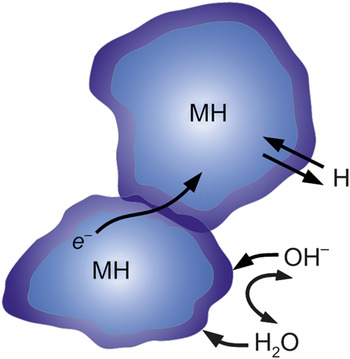
At very high charge/discharge rates of NiMH batteries, the metal hydride electrode becomes rate limiting. We next report how surface treatment can improve its high rate properties. We also want to emphasize that a better understanding of the reactions on the surface of the metal hydride particles can lead to better properties in general and open up possibilities to use other metal combinations than those in present alloys. As depicted in Figure 2, the surface has to perform several, sometimes contradicting, functions. It has to form a dense passive layer that protects the inner particle from being corroded by the electrolyte. It must be catalytically active in the making and breaking of O–H bonds in the water molecules that transport hydrogen between the electrodes. It must be permeable for hydrogen atoms to move between the surface and the inner parts of the alloy that stores the hydrogen atoms in the interstitial sites in the metal atom framework of the alloy, and finally it has to be electrically conductive. Better surface protection against alloy corrosion will also further increase the cycle life of the cells. The battery chemistry that offers both the longest calendar and cycle life is the much-related Ni-H2 battery. It differs from the NiMH battery in the use of pressurized gaseous hydrogen.Reference Linden and Reddy4 This battery has mainly been developed for space applications, where it has reached operation times approaching 20 years, counting tens-of-thousands of cycles. The key to increasing both high power performance and usable life time of NiMH batteries lies in the understanding of the surface reactions on the MH-alloy particles.
Surface reactions on metal hydride (MH) particles in the MH-electrode. The surface serves several important functions. It must protect the metal hydride from further corrosion by the electrolyte. It must transport hydrogen between the surface and the interior of the metal hydride particle, where it is stored between metal atoms. Finally, it must be catalytically active in helping to break and form an O–H bond in the water molecules that transport hydrogen between the electrodes in the aqueous electrolyte.Reference Linden and Reddy4

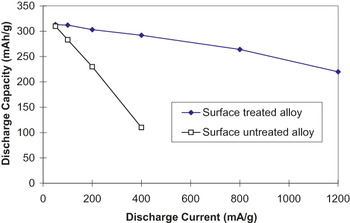
We know very little about the reactions proceeding on the metal hydride particle surface. Powdered AB5 metal hydride alloys are most frequently used as the active material of the negative battery electrode. The electrode’s electrochemical charge and discharge kinetics can vary greatly, depending on alloy composition and electrode fabrication method, but they are always considerably slower than the gas-phase hydrogen absorption and desorption kinetics. Many groups have attempted to improve the electrochemical charge and discharge kinetics, for example by surface treatmentReference Chen and Zhang8–Reference Iwakura, Mattsuoka, Asai and Kohno10 or A- and B-element substitutionReference Chen, Lu, Wang and Hu11–Reference Sakai, Yussa, Ishikawa, Miyamura and Kuriyama13 and by varying the stoichiometry of the electrode material.Reference Notten, Einerhand and Daams14,Reference Iwakura, Miyamoto, Inoue, Matsuoka and Fukumoto15 Several mathematical models have also been developed for understanding the characteristics of the discharge of a metal hydride electrode.Reference Sakamoto, Kuruma and Naritomi16–Reference Geng, Han, Feng and Northwood18 Researchers, however, have failed to understand exactly why there is such a large difference between electrochemical charge and discharge kinetics and gas-phase absorption and desorption. So far, there is no agreement on what the rate-limiting step is in electrochemical charge and discharge. A large reaction surface combined with a stable and uniform particle size of the MH-alloy powder is, however, important to promote high-rate performance and better utilization of the alloys.Reference Noréus and Ye19 This is shown in Figure 3, where a large surface and uniform particle size have been created via a pre-oxidation process.Reference Noréus and Ye19 This leads also to a flatter discharge curve and more stable and uniform reaction conditions as gradients are minimized. More ideal reaction conditions will help to increase the cycle life when applied in future NiMH cells, making them approach the long cycle life in Ni-H2 cells and allowing cells to be discharged deeper without being derailed by the cycling parasitic reactions. In this aspect, the low cell voltage in NiMH cells will always be an advantage. More ideal working conditions also open up for other metal alloy compositions than those used today. It is important to find more sustainable metal combinations if we want to see large-scale usage of HEVs, as the annual global vehicle production is now about 70 million and growing. A better understanding of the rate-limiting steps among all surface reactions will facilitate development of still better-performing batteries.
Comparison of discharge capacities of two similar metal hydride electrodes using a standard LaNi5 type alloy, but where the surface area of the particles in the upper curve has been increased.Reference Noréus and Ye19

Conclusion
NiMH batteries, a cousin to the extremely durable and long-lived NiH2 (nickel hydrogen battery) used in space applications, could become more robust and have longer lifetimes if the metal hydride particles that make up the electrodes have improved surface properties. This would also lead to improvements in high rate properties, thus making it possible to further reduce the battery size and cost in HEV applications. This is needed if we are going to see a dominant use of hybrid vehicles.
Acknowledgment
This work has been financially supported by the Swedish Energy Agency.