Introduction
Both political scientists (such as McCarty et al., Bartels) and popular commentators (for example, Thomas Frank) have reacted to the culture wars of the 1990s as something new in American politics—a deviation from the durable grounding of politics in economic interests.Footnote 1 However, as recent work, along with many of the classic and more recent treatments of the Populist and Progressive eras, demonstrate, American politics has long been infused with both culture and economics.Footnote 2 The interesting question is thus not “which one” but rather how these two dimensions of political value have intersected through time and what the dynamics of those intersections reveal.
This article uses the family as a policy subject to demonstrate the dynamics of intersectionality of the two dimensions, economic and cultural, during the Progressive Era. At their very core, family policy debates embody differing perspectives on state action into a profoundly social institution, encapsulating the contentious normative relationship between state and society. Discursive analysis of committee hearings data in this study suggests the presence of two understandings of the family, one economically determined and the other cultural, each aligned with one of the two political parties and articulating alternative conceptions of legitimate state and family relations.
The progressive framework embraced by northern Republicans imagined the family, its functionality and morals, as determined by its economic condition; whereas the traditionalist ideology espoused by southern Democrats stressed a cultural understanding of the family as a self-regulating, moral unit. As critical literature on the welfare state during this period has rightly noted, progressives' engagement with the family was by no means acultural; instead, intervention into family economics often also implied the imposition of a racist, classist, and gendered social-cultural system on immigrant, ethnic, and other minority families.Footnote 3 Nevertheless the progressive family frame legitimated state intervention into a hitherto deeply private sphere by stressing the economic qualities of families' conditions. In contrast, traditionalists were more concerned with a family's cultural, non-economic aspects—for instance, its independence and autonomy, traditional sexual mores, and racial/gendered hierarchies. Within this cultural conception, state intervention into family economics was both inappropriate as well as ineffective.
Thus with family economics as the base and culture as the superstructure, progressives were much at odds with traditionalists, who instead saw family culture as the base and its economics as the superstructure, if related at all. The two frameworks illustrate alternate ways in which economics and culture were assigned value in political deliberations during the Progressive Era. As history unfolded, the progressive conception ultimately prevailed over the traditionalist in New Deal and postwar social policies, which continued to emphasize the economic foundations of family issues over the cultural.
The Progressive Era antecedents of the modern welfare state can accordingly be seen not only in the early presence of various social policies but also in the specifics of the progressives' conceptual alignment of the economic frame with the cultural.Footnote 4 By paying attention to how the two dimensions intersected in policy ideation during the Progressive Era, the article suggests a pathway by which to bring the literature showing the persistence of morality and culture in American politics in conversation with works focused instead on the endurance of economics as the durable organizing frame.Footnote 5 Such a move goes beyond parsimonious formal models based on the analysis of votes or even texts of bills but requires careful content-based, discursive analysis of more qualitatively rich data sources, such as the transcripts of committee hearings used here.
Like many of the above works, I focus on political parties, investigating the intersection of economics and culture through the window of the two parties' policy positions. The two parties appear here as both composites of individual legislators and as intermediaries or conduits between state and society, reflecting their sectional bases. Alternative preferences for economics over culture as the organizing frame or vice versa are found to be aligned with each of the two political parties during this early time, in many ways resembling our own period. The competing value assigned by parties to economics or culture within policy debates also enables us to track partisan developments in ideology and policy preferences over time.
I systematically assemble two conceptual frameworks of the family, the progressive and traditionalist, capturing the dominant policy approaches of the Republican and Democratic Parties, respectively. I find that both parties dually articulated economic and cultural concerns in family policy debates, differing however in their conceptions of how the two dimensions intersected with one another. Partisan espousal of economics or culture as foundational base or epiphenomenal superstructure in Progressive Era politics is mirrored in contemporary, albeit switched, party positions. Whereas liberal Democrats now embrace a position mirroring that of prior progressive Republicans by emphasizing a family's economic foundations over its culture, contemporary Republicans instead articulate an approach more in line with that of previously traditionalist Democrats inasmuch as they privilege families' cultural qualities as more foundational, only loosely related to its economics.
The dynamic of partisan ideologies over time is thus one of reversal, alternatively grounding the family in economics or culture in various social policies, and paralleling parties' reversals on issues of race and women's rights.Footnote 6 Despite the reversal, the research presented here suggests that the phenomenon of such partisan ideological differences is not limited to the contemporary period but was also extant in the Progressive Era. By focusing on Progressive Era family policy debates, the following article thus illustrates the competing ways in which the two durable features of American political debate (economics and culture) were envisioned to intersect in that early period; their partisan alignment revealing a switched dynamic in political parties' ideological preferences in comparison to our current period, while also demonstrating that partisan competition over the political value of each frame is an enduring feature of partisan politics.
The first section outlines the research method and sources used; in the subsequent section I construct the conceptual frameworks of the family in the Progressive Era, separating out the economic and cultural policy components and identifying their partisan character. Statistical analysis is used to identify the sectional factions that were the most active proponents of these conceptual frameworks and their policy foundations. The final section uses the debates on child labor policy as a case study in how the two overarching frameworks of the family, the traditionalist and progressive ideals, conceptualized the intersection of culture and economics within public policy, serving to divide the parties along dual, interrelated dimensions.
Research Method and Sources
My sources are the transcripts of House and Senate hearings for eleven Congresses during the Progressive Era: the Fifty-sixth to Sixty-sixth Congress, spanning the period from 1900 to 1920.Footnote 7 Hearings in which the family is indexed (implying its significance as a focal subject for gathering testimony) were chosen for examination.Footnote 8 Committee hearings are one of the most interesting and detailed practices in CongressFootnote 9 and have been shown to contain some of the richest qualitative data on political practices and policy preferences.Footnote 10
In the Progressive Era, congressional hearings were conducted differently from the contemporary period. In some hearings, members of Congress themselves took an active part in inviting witnesses to present testimony; although this practice has now become common, such instances were rare in the Progressive Era. More often, unaffiliated social and civil reform groups (such as the Anti Saloon League, Women's Christian Temperance Union, pro and antisuffrage groups, the International Reform Bureau, etc.) petitioned to present their position to the committee, typically for the purpose of advancing or challenging a pending legislative bill. When committees allowed such groups to testify, members of the committee actively interrogated sets of witnesses for and against the pending legislation. Each member had his or her own beliefs and interests, which he or she would often express in direct statements placed on record or else during the course of interrogation, in response to witness testimony.
During hearings on legislation affecting the family, anecdotes describing the situation and circumstances of actual families were frequently recounted. Members of Congress (MCs) were interested in the narration of such family cases and engaged with them in at least three ways: (a) directly, by themselves narrating personal stories about their own families or the families with which they had come in contact; (b) by directing comments or questions at the narrator regarding the family story, and (c) indirectly, by endorsing the witnesses who narrated the family case or else submitted the story as part of the record of their testimonies. In each of the above-described instances, these family anecdotes were used to highlight a family issue of significance to public policy as well as illustrate the virtues and pathologies of policies seeking to address family conditions.Footnote 11
I have compiled a dataset of 406 such “episodes” or “events” in which MCs engaged with anecdotes of real families from the sample of 230 selected committee hearings on diverse bills affecting the family during the Fifty-sixth to Sixty-sixth Congress. In each instance an MC engaged with an anecdote or narrative of a family and made reference to an issue of public policy significance illustrated through the story; this episode formed one case in the dataset. The same story but with references made to different policy issues or made by different MCs was recorded separately; the goal was to code the kinds of family issues seen as significant to public policies to investigate the relationship between individual MCs and the frames (economic or cultural) by which family conditions were addressed. Each family narrative provides a window through which MCs expressed their ideas and beliefs regarding families and the types of policy issues involving the family that were of interest to them.Footnote 12 Members concerned with family culture, for example the issue of preservation of traditional sexual morality, raised this policy issue when talking about or interrogating a family case—even in cases in which the witness testimony might have focused on other policy concerns (for example, immigration regulation). In this way I am able to connect specific MCs (coded as “active member”) to specific economic or cultural types of family policy issues that they raised when discussing family cases.Footnote 13
I coded twenty-one policy issues that MCs raised in connection to family cases (referred to as “policy issues”), characterizing them as economic or cultural and aggregating them into four broad conceptual “policy categories”: family Autonomy, Ascription, Social Welfare, and Regulation.Footnote 14 The research objective is to discern aggregate partisan approaches to the family as a policy subject, as expressed through the kinds of policy issues raised by members.
The assumption throughout is that members will raise those kinds of policy issues that are of concern to them when discussing or interrogating actual family cases. Policy issues are thus used as illustrations of members' conceptual approaches to the family, documenting the interrelationship, if one exists at all, between economic and cultural frames; actual family cases served as qualitative samples to “get at” or draw patterned inferences of members' conceptual positions on the family as a policy subject.
Finally, I also coded the member's party, state, and region in order to trace sectional patterns in family conceptual divisions within and across parties and to investigate the development in the approaches of the two parties to family policy issues. Research questions such as which kinds of issues/aspects and types of policy categories of the family are brought up by which members for policy consideration, from what party and which region, guided the following analysis.
Partisan Conceptions of the Family as a Policy Subject—Progressive and Traditionalist Family Conceptions
Party politics in the Progressive era was in many ways similar to the contemporary period: parties were divided and mostly polarized by region.Footnote 15 The election of 1896 had marked the beginning of the “Fourth Party System,” in which the political fortunes of the two parties in a given region were closely tied to its economy. Although Republicans were favored nationally, they dominated in Eastern and Midwestern states with manufacturing and capital-based economies,Footnote 16 whereas Democrats were elected primarily from agrarian states in the South and West.Footnote 17 This stable alignment marked a new era of party competition, replacing the preceding period of electoral flux, a “state of courts and parties” in which either party could equally hope for victories after every election.Footnote 18
The Progressive Era was also characterized by a political climate rife with the fervor of reform. Reformist groups decried the excesses and vagaries of the patronage-based political and laissez-faire economic systems and advocated instead widespread civil and social reform. In so doing, interest groups (radicals, agrarians, socialists, progressives, etc., as well as single-issue civic and religious groups) were active directly in society as well as in politics and attempted to press their agenda on the masses, Congress, and state legislatures.Footnote 19 In a style of politics familiar today, cultural and moral issues infused a variety of social movements, such as temperance and women's suffrage, regulation of child labor, and prevention of white slavery, among others.Footnote 20
The structural upheaval accompanying the country's move from a primarily rural, agrarian-based economy to a predominantly urban, industrialized one had marked effects on families. Family practices such as fertility (use of contraception, marital sexuality, etc.), child-rearing, and gendered division of labor all underwent substantial change such that “newspapers and magazines brimmed with speculation about the crisis of marriage and family.”Footnote 21 Rising divorce rates, falling birthrates among the “better sort of people,” the changing position of women, and a so-called revolution in morals caused alarm among policymakers, civic groups, and the general population alike.Footnote 22 Family poverty was also increasing and many more families were female-headed due to workplace casualties involving the male breadwinner.Footnote 23 Thus, in many ways, the economic and cultural transformations accompanying the newly industrializing country were embodied by the multi-faceted changes occurring within the family. Policymakers of both political parties were not impervious to these family developments and addressed them repeatedly in various policy discussions, attempting to devise appropriate policy responses.
Region played a prominent role in determining the approaches of individual legislators to family and social problems. In collective terms, political parties during this period were sectional entities with distinct regional bases, allowing for sectional differences among members to be by and large channeled through the party system with the dominant factions determining each party's aggregate position. As noted, the Republican Party agenda was largely informed by the northern core's manufacturing constituencies and the Democratic by southern and western periphery's agrarian interests. These commitments however were not rigid; instead each party's policy ideology was more an amalgam of various worldviews, formed from a looser, more shifting, coalition of interests than today.Footnote 24 Social-progressive orientations focusing on the economic dimension of family problems—in welfare policies and the establishment of child-saving institutions and other uplift measures—were not confined to one party but instead somewhat dispersed across the two.Footnote 25 Similarly, more conservative positions, privileging cultural aspects such as smaller government, individual autonomy and traditionalist values, were expressed by factions in both parties.Footnote 26 Despite the fact that ideological factions could extend beyond party lines, as we shall see it is still fair to say that aggregate partisan differences in policy conceptualization were apparent during this era.Footnote 27
As noted, the South was a region that had a firm (Democratic) partisan character at this time. Southern Democrats, both in terms of numbers and seniority, dominated the congressional party for the eleven Congresses investigated (Fifty-sixth to Sixty-sixth). Their strength was also reflected in the distribution of members in Congress who actively discussed family cases in committee hearings.
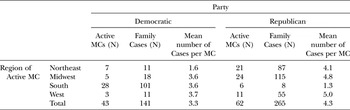
As seen in Table 1, southern Democrats formed the largest delegation to discuss family cases, followed by midwestern and northeastern Republicans (thereafter collectively referred to as northern Republicans). Among the two parties, Republicans on an average discussed more family cases (4.3 per member) than Democrats (3.3), with the average Republican from the West and the Midwest referring to many more family cases than any other group. The proportions of Democratic and Republican factions actively engaging with family case examples reflect the general sectional composition of Congresses at this time, with Democrats dominating in the South and Republicans in the North.Footnote 28
Family Case Activity by Party and Region, 56th–66th Congress, 1900–1920

Data compiled by author, congressional committee hearings, 1900–1920.
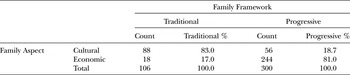
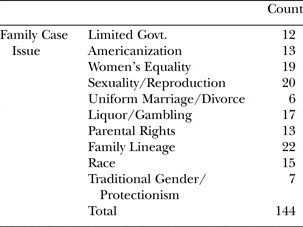
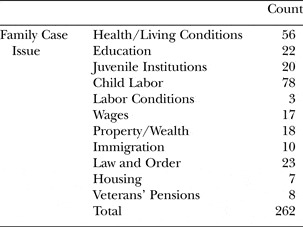
When discussing and interrogating family cases, members of Congress repeatedly addressed a variety of aspects of family life as they related to public policy (designated as “family case issue(s)” in tables). These aspects included: education of children and other family members, family health and living conditions, housing, wages and pensions, and also parental rights, limits on government capacity to intervene into the family, sexuality and reproduction, race, gender relations, etc. Some of these issues were “economic” in character inasmuch as they were aspects of families' material conditions (such as housing, wages, labor, etc.—even education); others were “cultural” insofar as they referred to non-material, non-economic qualities (such as gender relations, Americanization, sexuality, etc.).Footnote 29 I also coded family case references independently as articulating either a progressive or traditionalist framework, that is viewing family conditions as either foremost economically determined or culturally significant, respectively. By cross-tabulating the family-policy framework (progressive or traditional) with the type of family-policy issue raised (economic or cultural), we find that indeed those policy issues that were economic in nature were raised disproportionately within the progressive framework versus those that were cultural, which were instead raised far more often within the traditionalist framework—each significantly so.Footnote 30 Social progressives and traditionalists hence evidenced disproportionate concern for economic over cultural issues and vice versa respectively (see Table 2). I need to note that the issues themselves were neither inherently progressive nor traditional. For example, discussions about a cultural issue such as family sexuality could be (and sometimes were) framed within the progressive framework: pathological sexuality as a result of impoverished economic conditions; or it would be discussed within a traditionalist framework, as a characteristic inhering independently to certain types of families (particularly immigrant, ethnic families). Indeed, we find that sizeable proportions of cultural issues were raised within the progressive framework as were some economic issues within the traditionalist. Nevertheless the largest proportion of family aspects discussed within the progressive framework were economic, as opposed to the largest proportion of family issues referred to within the traditionalist, which were instead cultural.
Economic and Cultural Family Aspects Highlighted by Progressive and Traditionalist Family Cases, 56th–66th Congress, 1900–1920

Data compiled by author, congressional committee hearings, 1900–1920.
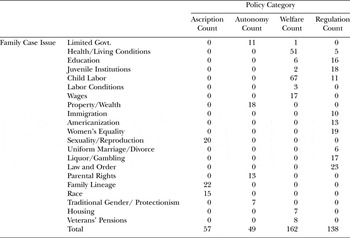
Each of the policy issues may also be categorized into four overarching policy categories, each category encapsulating conceptually related family qualities and a distinct, coherent conception of the relationship between family and state.Footnote 31 The policy schema is as follows:
(a) Ascription – policies that focused on the biological (“ascriptive”) qualities of the family, perceived as crucial to the membership and reproduction of a family. This category included the following family policy issues: racial composition (intermarriage), “blood” affiliation or “family lineage,” family sexual practices and biological reproduction.
(b) Autonomy – policies emphasizing the private qualities of the family in which the primary concern was to limit state expansion in the domestic realm. This category included the following policy issues: parental rights and parental choice, limits on government intervention, and traditional gender relations.
(c) Regulation – policies that targeted the public aspects of the family, perceived as crucial to national interest in which the government was conceived to have a direct, regulatory, and often coercive role. This category included the following policy issues: compulsory schooling/education, juvenile institutions for delinquent children, immigration and Americanization of foreign families, control of liquor/gambling and of addictive/abusive behavior, marriage registration and divorce, and gender equality in suffrage/citizenship.
(d) Social Welfare – policies focusing on the economic condition of the family, perceived as independent of the state but in which the state was assumed to have an active, “welfarist” role out of necessity. This category included the following policy issues: health and living conditions of the family, labor/work conditions, housing, child labor, wages and veterans' pensions.
Ascription and autonomy policy issues were entirely cultural, and social welfare issues were economic; however, regulation issues were mixed—both economic and cultural—because both types of family aspects were seen as tied to larger national regulatory interest.Footnote 32
Democratic and Republican members used family cases to draw attention to certain common policy issues, primarily within the category of Social Welfare. For instance, members from both parties raised issues such as education of children and illiterate adult family members, wages and salaries, and veterans' pensions with comparable frequency (see Tables E(i) and (ii) in the Appendix). Despite these commonalities, aggregate partisan patterns in policy preference were evident within the policy schema.
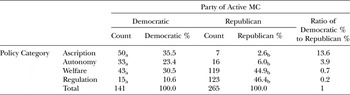
As seen in Table 3, compared to Republicans, Democratic members used family cases in far greater proportion to emphasize policy issues in the cultural categories of Ascription and Autonomy; and Republican members disproportionately used family cases to focus on mixed—economic and cultural—issues of family Regulation,Footnote 33 and on the economic issues of Social Welfare. Table 3 reveals that Democratic members through family cases raised Ascription issues 13.6 times more frequently than did Republican members, and they also raised Autonomy issues 3.8 times more than Republicans did (see last column, ratio of Democratic percentage of cases versus Republican percentage in Table 3). In contrast, for every one family case used by Democrats to illustrate issues of family Regulation, Republican members proffered almost five such cases (4.4) (flipped ratio from last column Table 3, Republican percentage of cases versus Democratic percentage). Policy issues in the category of Social Welfare evidenced less stark difference between the parties; for every one case used by a Democratic member to highlight family Welfare, there were approximately 2 cases (1.5) stressing Welfare by Republican members. The partisan distribution of the policy categories illustrated through family cases is summarized in Table 4.
Policy Categories Illustrated by Family Cases, Controlling for Party of Active MC, 56th–66th Congress (1900–1920)

Data compiled by author, congressional committee hearings, 56th–66th Congress.
Note: Values in the same row and subtable not sharing the same subscript are significantly different at p < 0.05 in the two-sided test of equality for column proportions.
Partisan Distribution of Family Policy Categories

Source: Compiled from congressional committee hearings, 1900–1920.
The family in policy debate in the Progressive Era was thus perceived both economically and culturally by members from both parties. However we also find that Democrats and Republicans alternatively privileged family economics or culture as foundational to their family conception. For Democrats, concern over family economics, seen in their high interest in Social Welfare issues, occurred alongside their partisan concern over families' cultural issues of Ascription and Autonomy; for them, as some have argued, policy interest in family economics was legitimate only insofar as it supported distinct cultural relations of dependence within (patriarchal and racialized) social structures.Footnote 34 Whereas for Republicans, interest in families' cultural aspects within Regulation policies instead occurred alongside their concern for economic, Social Welfare, issues, seeing family culture not independently but in organic relation to larger national (state) interest. Column proportions and chi-square tests confirm that party and policy categories bore a statistically significant relationship, with significant differences between the parties in relation to all four policy categories. Democrats discussed significantly larger proportions of Ascription and Autonomy issues through family cases, and Republicans referenced significantly more Welfare and Regulation issues through family case examples.Footnote 35
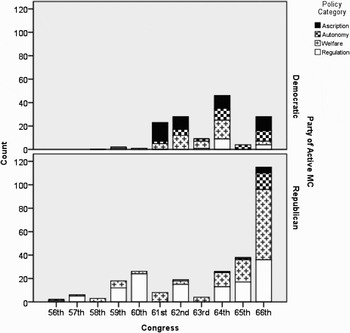
By controlling for party and using the active MC as the unit of analysis,Footnote 36 we can chart the use of the four policy categories referenced in family cases over the Progressive Era (see Figure 1). We find two alternative policy configurations, further suggesting alternative approaches to the ideation of state and family relations.
Partisan Family Policy Development, 56th–66th Congress (1900–1920).

We see that the traditionalist policy framework illustrated by Democratic members, although far more cultural in its focus than the Republican approach, also covered a concern for family economics, contained instead in their references to Welfare policy issues. Starting with the Sixty-first Congress (1909–1911), the emergent Democratic concern with Welfare issues aligned with their more consistent concern over cultural issues, seen through discussion of family Ascription and Autonomy policy issues. By emphasizing family Ascription and Autonomy through diverse, interrelated issues such as parental rights, family independence from government control, family sexuality and procreation, and family lineage and race, Democratic members evidenced a preoccupation with cultural characteristics of the family and its social, non-economic practices. Within the traditionalist framework, family practices were viewed as independent and self-regulating, autonomous from the state or other political institutions; traditionalist support for state (welfare) assistance was accommodated within this thinking as a means to preserve prevailing social structures, not to alter them.Footnote 37
We observe a different configuration within the progressive framework, suggested by members of the Republican Party. For them, starting with the Sixty-first and Sixty-second Congress, that is, around the turn of the first decade (1910–1911), family Welfare began to be increasingly aligned with the more long-standing concern with family Regulation. In later Congresses (Sixty-fourth through Sixty-sixth) we find Republicans articulating more consistently the progressive configuration with which we are familiar today, combining Welfare and Regulation to solicit active state intervention into family affairs. This extended to discussions regarding the amelioration of impoverished conditions of child-laboring families, establishment of child-saving institutions, support for greater gender equality in family relations in citizenship and immigration, and easy family transfer of wealth and property—all of which assumed an organic interdependent relation between state and family and were far more economically determined than issues within the traditionalist framework.
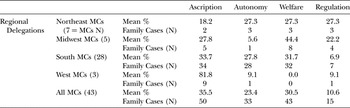
Controlling for region, we further find that the traditionalist view of the family can be more accurately attributed to the faction of southern Democrats within the Democratic Party. In contrast, Republicans from the northern and western regions as well as some midwestern Democrats were aligned in their progressive views of the family.
The midwestern (and to a lesser extent, northern) faction of Democrats was disproportionately interested in the enhancement of family economic conditions. They used higher proportions of family cases than the average Democrat to highlight progressive policy issues of family Social Welfare and Regulation. Midwestern Democrats' significant emphasis on Social Welfare issues suggests that they, in particular, had an economic understanding of the family more than any other regional faction within the Democratic Party.Footnote 38
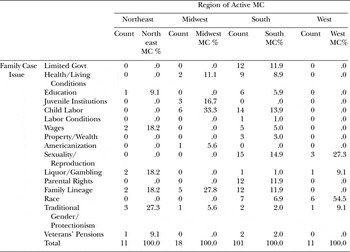
Northern Democrats (midwestern and northeastern) used family cases to highlight issues of child labor, the health and living conditions of families, juvenile institutions, and wages (see Table E(i) in the Appendix). Like their more traditionalist southern counterparts, midwestern Democrats also used family cases to emphasize family lineage when discussing cases of foreign families that were scattered through the midwestern countryside and stressed the need to register such families, effectively monitoring their citizenship privileges and actively Americanizing them.Footnote 39 Northern, particularly midwestern, Democrats, like other Republicans of the time, thus held the progressive view of interrelated, interventionist state and family relations.Footnote 40
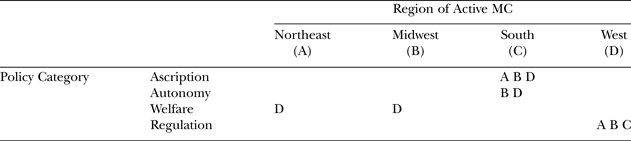
On the other hand, southern Democrats—such as William Kitchin (NC), Dudley Hughes (GA), and Richard Whaley (SC) in the House; also Pat Harrison (MS), Thomas Martin (VA), and Thomas Sisson (MS) in the Senate—composed a faction that was the most cohesive in its traditionalist family conception. They consistently brought up perceived threats to the traditional structure and innate morality of the family such as miscegenation and intermarriage,Footnote 41 and indiscriminate sexual relations beyond the family.Footnote 42 Their traditionalist family ideal is reflected in the inordinately high proportion of cases by southern Democrats on issues of Ascription and Autonomy (Table 5a). Despite their preoccupation with Ascriptive and Autonomy issues, southern Democrats also engaged with a large proportion of family cases to highlight issues of Welfare (31.7% of all cases by southern Democrats, on average). Thus we find that in this era the faction (southern Democrats) combined their concern with family economic issues into their broader, more consistent, emphasis on the culturally-based family issues of Ascription and Autonomy.
Policy Categories Illustrated through Family Cases, Controlling for Region (Democratic Party) 56th–66th Congress (1900–1920)

Data compiled by author, congressional committee hearings, 1900–1920.
Only a few western Democrats referenced family cases for the Congresses studied; however of these, some, such as Senator James Phelan (D-CA) and Representative John E. Raker (D-CA), were disproportionately concerned with family Ascription, which they brought up in hearings stressing the immorality of race-based intermarriage. This was especially the case in the wake of the continued influx of non-white immigrants (Chinese, Japanese, Mexican) into the western states of California and Hawaii.Footnote 43 However, unlike southern Democrats and those more closely resembling progressives, western Democratic members viewed family and state relations in organic, not independent, terms, calling for national state intervention into family cultural practices such as gender relations and federal regulation of divorce and marriage laws.Footnote 44
Thus the distribution suggests that of all regional groups, the true traditionalist faction, those who used the highest proportions of family cases to illustrate the cultural aspects of family as natural and autonomous from state, hailed from the Democratic southern states. However, their traditionalist leanings did not prevent southern Democrats from also espousing concerns over family economic conditions, evidenced in the sizeable proportion of family Welfare issues they also emphasized. In contrast, the data indicates that the policy concerns of the northern faction of Democrats, particularly the midwestern group, more resembled that of their regional counterparts in the Republican Party than that of their southern partisans.
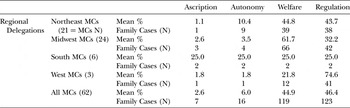
Republican members who illustrated their policy concerns through family cases during hearings were more regionally dispersed and less confined to one dominant region. Table 5b above shows that members from the Midwest formed the largest Republican delegation to address policy through family cases. In so doing, they referenced a much larger (than average) proportion of issues stressing Social Welfare. Northeastern Republicans formed the other large delegation in their party to reference family cases and also raised a large proportion of Social Welfare issues in addition to Regulation. Although a much smaller group, Regulation featured prominently among the family cases associated with western Republicans. Thus Social Welfare had its greatest Republican proponents in the North, and issues of family Regulation were most raised by scattered Republican members of the West; family Regulation was also, however, featured prominently in the discussions by northern Republicans. The “new” progressive configuration seen among Republicans in the later decade of the Progressive Era (Figure 1), combining family Welfare issues with Regulation as the basis of active state and family relations, had dispersed sectional components: Welfare was more important to northern, particularly midwestern, Republicans, and Regulation was more important to those from western regions, while also important to northern Republicans.Footnote 45
Policy Categories Illustrated through Family Cases, Controlling for Region (Republican Party) 56th–66th Congress (1900–1920)

Data compiled by author, congressional committee hearings, 1900–1920.
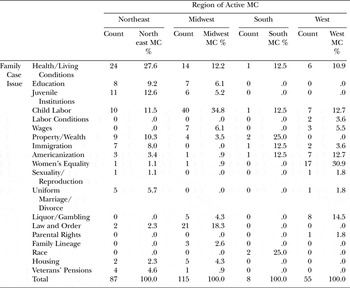
At the level of specific issues, the average northern Republican member used large proportions of his total of family cases to raise progressive economic concerns, such as health and living conditions, child labor, schooling, and juvenile institutions (Table E(ii) in the Appendix). In addition to families' health and living conditions, midwestern Republicans, such as Judge Horace M. Towner (IA), Senator Charles Curtis (KS), and western Republican members such as Jeanette Rankin (MT) and Senators Hiram Johnson and John Works from California were also likely to highlight cultural issues, albeit within the progressive framework, calling for strong state intervention to ensure women's equality within the family (through suffrage and citizenship laws), regulation of liquor and gambling to reduce their deleterious impact on families, and the Americanization of foreign families.Footnote 46
Republicans from northeastern states, such as Isaac Seigel (R-NY), were generally more concerned with immigration and Americanization of foreign families; others, such as Walter Chandler (R-NY), used family cases to press for federal uniform marriage and divorce standards throughout the country. The more conservative members from the Northeast, like the standpatter Senator Jacob Gallinger (R-NH) and Representative George Holden (R-MA), were the most consistent in highlighting family issues of property and wealth transfer.
Therefore, except for a small southern faction, progressive family conceptions were prevalent among most regional delegations throughout the Republican Party. Republicans from the North, strongly advocated active state intervention into families through Welfare and Regulatory policy issues. They viewed state intervention, in the form of such programs as education, Americanization, and a variety of federal laws and enforcement, as a means of rescuing the family from generational cycles of poverty and socioeconomic adversity. This is in striking contrast to the traditionalist family conceptions of southern Democrats with their emphasis on the cultural aspects of the family and its separateness from state, naturally adapting to structural changes within a self-regulated society.
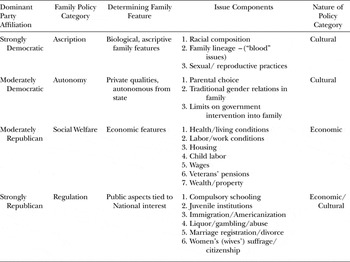
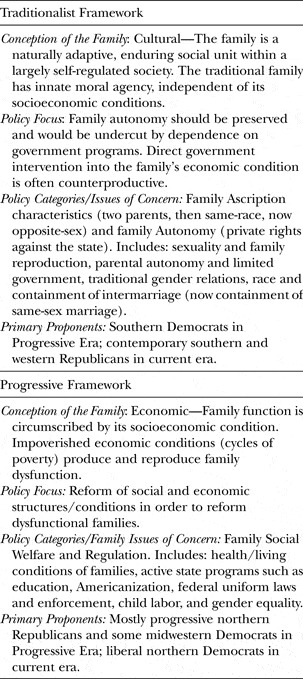
In the Progressive Era therefore the parties were largely divided into two major conceptual camps, each with their own understandings of the family. The (northern) Republican-progressive and (southern) Democratic-traditionalist frameworks privileged economic and cultural conceptions of the family respectively; each conception contained distinct visions of how family economics intersected with culture and, accordingly, whether state and family relations were organic and interdependent or separate and independent of each other. As summarized in Table 6, both frameworks resemble partisan family ideologies with which we are familiar today.Footnote 47
The Two Partisan Conceptual Frameworks of the Family

In the next section, I use child labor debates to illustrate the competing progressive and traditionalist understandings of the family, demonstrating the alternating visions of intersectionality between economics and culture as dimensions of political value in policy debates during the Progressive Era.
Child Labor—A Policy Window into Progressive and Traditionalist Conceptions of the Family
During the Progressive Era widespread social and economic changes accompanied rapid industrialization. These changes disrupted the structure of the traditional family, in which the mother was a housewife with a “separate (domestic) sphere” from that of the father.Footnote 48 Within this family structure children were dependent on both parents—on the father for wages on which the family lived and on the mother for her domestic management and nurturance.Footnote 49 However, fathers were now frequently injured or killed in what had become dangerous workplaces, and mothers were either forced or induced to work and/or put minor children to work due to changing demands in the labor market.Footnote 50
Members from both political parties and social reform groups all acknowledged these economic stresses on the family as well as the larger social dislocations accompanying industrialization; yet the partisan factions were divided over whether or not this necessitated a reconfiguration of extant state and family relations in favor of more active state intervention. This division, I suggest, illustrates the underlying conceptual differences between the progressive and traditionalist understandings of the family. Advocates for child labor restrictions used a progressive conception of the family in which family health was fundamentally determined by its economic conditions, necessitating active state intervention in the face of family (economic and moral) adversity. Alternatively, proponents against such restrictions presented a cultural vision of the family as a natural, enduring entity, independent of its economic conditions and capable of successful self-regulation and reproduction.
Traditionalist southern Democrats and progressive northern Republicans and midwestern Democrats all frequently used family cases to focus on child labor and to thus oppose or call for family Regulation.Footnote 51 In the following pages, after a brief review of the history of child labor legislation, I use committee testimony on actual family cases to illustrate the dynamics of the interrelationship between culture and economics, as contained within the progressive and traditionalist understandings of state and family.
The 1900 census had revealed that 2 million children were working in mills, mines, fields, factories, stores, and on city streets across the United States; and this helped spark a national debate over child labor.Footnote 52 The Republican Party, as the party of business, had been slower to embrace child-labor regulations; whereas the Democratic Party, as the party of states' rights, had limited itself to state child labor restrictions.Footnote 53 Only by 1908 had both parties adopted child labor regulation in their platforms. For the Republicans it was a means of “conserving the public welfare.”Footnote 54 In comparison the Democratic platform of 1908 was more unequivocal and “advocate[d] the organization of all existing national public health agencies into a national bureau of public health with such power over sanitary conditions connected with factories, mines, tenements, child labor and other such subjects as are properly within the jurisdiction of the Federal government.”Footnote 55 Much later, only in 1916, both the Democratic and Republican national platforms called for the immediate enactment of a federal law prohibiting all child labor.Footnote 56
As with most issues, the two parties fit child labor into their broader ideologies. Thus the Republican Party's ideals of “free labor,” “social harmony,” and “statism”Footnote 57 characteristically colored their position on child labor. For example, in 1912 the preamble to the Republican Party platform had described its mission and child labor in the following manner:
The Republican party is now, as always, a party of advanced and constructive statesmanship. It is prepared to go forward with the solution of those new questions, which social, economic and political development have brought into the forefront of the nation's interest. It will strive, not only in the nation but in the several States, to enact the necessary legislation to safeguard the public health; to limit effectively the labor of women and children, and to protect wage earners engaged in dangerous occupations; to enact comprehensive and generous workman's compensation laws in place of the present wasteful and unjust system of employers' liability; and in all possible ways to satisfy the just demand of the people for the study and solution of the complex and constantly changing problems of social welfare. Footnote 58 (italics added)
For the progressive faction in the Republican Party, child labor was part of the complex of social problems that had emerged in response to “social, economic and political development;” in this way the issue of child labor resembled other economic issues such as civic, workplace, and public health hazards that were also seen to have accompanied urbanization and industrialization. The Republican Party, as an advocate of stability and order, embraced child labor reform and federal government intervention as a means of imposing social order over a rapidly changing, increasingly hazardous society.Footnote 59
In contrast, the progressive section in the Democratic Party aligned child labor with an ideology characterized by “egalitarianism,” “majoritarianism,” and “Christian humanism.”Footnote 60 In its 1916 platform, the Democratic Party advocated restrictions on child labor as one of seven “principles of just employment”Footnote 61 and placed it within the humanist idea of labor:
Labor is not a commodity; it is human. Those who labor have rights, and the national security and safety depend upon a just recognition of those rights and the conservation of the strength of the workers and their families in the interest of sound-hearted and sound-headed men, women and children. Laws regulating hours of labor and conditions under which labor is performed, when passed in recognition of the conditions under which life must be lived to attain the highest development and happiness, are just assertions of the national interest in the welfare of the people.Footnote 62 (italics added)
The Democratic warm emphasis on the humanity of labor and on the happiness of “life which must be lived” was often deployed against cold Republican materialism and social order.Footnote 63
The material and “human” face of family life also underpinned discourse in congressional hearings on child labor reform. The child-laboring families at the center of hearings were almost always viewed through both materialist and humanist lenses; however, members were divided in their ideas of how one dimension (material or economic) contributed to the other (the humanity or morality of the family), if, indeed, they connected at all.
The issue of child labor highlighted the relationship between the family's economic structure and its culture, in this case its values.Footnote 64 On the one hand, the debate revolved around the economic structure of families in which both parents and children earned wages. Both sides acknowledged that the emergence of the child-laboring family was primarily the outcome of larger, industrializing economic forces. An important example of this was in the cotton mills of the South. Traditionalist southern Democrats alluded to the “conditions which confront … the South” wherein “the growth of cotton manufacturing … has been very great within the last 20 years” such that the number of spindles had quadrupled since 1890; thus “necessarily there have had to be certain conditions which were novel to us, … and there necessarily had to be readjustments, and the child-labor question was one of those.”Footnote 65 Similarly, progressives such as Florence Kelley, the general secretary of the National Consumer's League, also stated, “One State after another changes from an agricultural State to a manufacturing State … I believe there are more children under 16 years old working to-day … because our manufacturing industries increased stupendously.”Footnote 66
On the other hand, progressives viewed regulatory reform of child labor as an instrumental means, reforming the material conditions and hence the values that they believed were attached to and reproduced by such families.Footnote 67 These families, they claimed, were reproducing illegitimate values, including irresponsible or self-interested fatherhood/parenting, impairment of “childhood innocence” with precociousness and corruption of children's morals, and immorality and sexual promiscuity. In short, for progressives the economic conditions that encouraged child labor were responsible for faltering family moral values, and the regulation of child labor, although fundamentally an economic issue, was also a moral one.
In congressional testimony witnesses repeatedly described irresponsible fathers who lived off the labor of their children as an argument in favor of state regulation of parental autonomy:
…when the fish are brought in to the cannery the children are sent there by their fathers, who are a very shiftless set. They are a great deal like the man in Janet Lee's little story of Uncle William. He was asked what the people do in Maine in the long winter. He replied, “Along the beginning of November you make a big fire in the fireplace and from then until Washington's Birthday you sit and think, and then long after Washington's Birthday you mostly just sit there.” These fathers are about like that. Whenever there is any work they send their children into the factory, and the children work, at any age and unlimited hours. You can understand how confusing it is to their moral sense.Footnote 68
Progressives in Congress interrogated witnesses in order to portray the irresponsibility of such fathers as a widespread condition that, if unregulated, would hopelessly pervade family life. In contrast, traditionalists presented these cases as exceptions that did not deserve regulation as they could be resolved naturally (that is, without policy) by the vigilance of closely knit communities, such as those that existed in the southern cotton mills.Footnote 69
Progressives thus advocated stringent state intervention in the form of strict regulation of “bad” (poor) parents, those who would, if given the opportunity, sacrifice their children at the altar of pecuniary gain.Footnote 70 The following is another illustrative case used to stress the need for strong intervention to curb parental self-interest and failure, as presented by the Juvenile Protection Association:
Poor child labor law—need for provision prohibiting the employment of children by parents at improper hours or trades: Fifteen-year-old white girl found selling candy at one of the local theaters. Both the father and the mother of this girl have a most unsavory reputation; have been divorced and have both remarried … the girl herself has not a good reputation. The case was referred to the child-labor inspector, and the report made that nothing could be done in this case to punish the employer, as the girl was working for her mother, who had the candy rights in the theater … because of the inadequacy of law there was nothing to prevent the mother from placing the girl in an equally undesirable position and nothing to force the child into school should the mother fail.Footnote 71
Self-interest made parents put to work their children even in the bleakest of conditions, and this necessitated decisive state action, as noted by a report of the International Child Welfare League, whose president was the wife of a prominent Republican financier from New York:Footnote 72
Cannery in Biloxi, MS: a group of little boys, six in all, the oldest perhaps 8 years old, were sitting on the floor about a big tin pan. Shucking into their own tin cans, they began to talk and laugh and the father and mother of 2 of them began to scold. The father would call out, “Here! here! you boys get to work. This is not the time for play. Earn your bread.” The mother said, “Here, George, you get to work. If you boys can not work faster we will leave you down here. We won't take you back to Baltimore.”Footnote 73
Poor parents who put their children to work were often perceived as irresponsible and uncaring at best and mercenary and mean at worst; they were thus considered appropriate targets for state regulation. In conjunction with these perceptions, the regulation of conditions of child labor – particularly on streets – was also argued for on grounds that such conditions produced a precociousness that corrupted the child and exposed him to other moral hazards such as gambling, truancy, indiscipline, and profligacy.Footnote 74
Furthermore, the material conditions in mill villages, with densely packed and overcrowded living quarters, were also associated with sexual impropriety and promiscuity and presented as another part of the argument for state restriction of child labor:
Richmond Mill, Laurel Hill, N.C: “This mill has only about 25 operatives at present…it is a wooden frame building, very low-ceiled, dark and crowded…the homes are absolutely wretched, with roofs leaking, floors falling in and steps broken down…the immorality among the people is unspeakably gross. Illegitimacy is prevalent in almost every family and about half of the people are of mixed blood, mulattoes, and Croatians.”Footnote 75
All of these—irresponsible and self-interested fatherhood/parenting, childhood corruption, promiscuity—created an illegitimate moral/cultural code by which child-laboring families were imagined to live. Progressives believed these family values were created and reproduced by the economic structure and circumstances of these families. Rigorous, coercive state intervention prohibiting child labor and enforcing compulsory education for minors were thus the appropriate policy responses. The failure of the state to intervene therefore neglected the welfare of children by implicitly endorsing the family's illegitimate values that would continue unabated, generation after generation, as stated by Florence Kelley, general secretary, National Consumer's League:
We seem to take care of everything except the most essential thing—the children, whose moral sense is being molded here. When we are dead they will be the Republic. Negatively, of course, Uncle Sam is assuming a great responsibility in his continued neglect of them … and continued neglect of the greater interests of the Republic. That is the way the matter presents itself … in the problem of the immigrant children, or our own poor white children … who are losing their childhood and the privileges of education, who are going the way the English children have gone for the last 100 years.Footnote 76
Progressives thus called for an energized active state to “remold” families' impoverished economic conditions, so to stem the illegitimate family values reproduced by the cycles of poverty otherwise endemic to widespread industrialization.Footnote 77 In this way, they viewed family culture as determined by its economic conditions, legitimating an organic relation between state and family and soliciting active state intervention by stressing the material foundations of families' problems.
This progressive, economic-interventionist, perspective was strongly challenged by the traditionalist, conservative faction of southern Democrats and their constituents (mill owners prominent among them). They defended the cultural values of child-laboring families and argued for the traditionalist conception in which the moral function of the family was independent of its economic circumstances. They described instead a self-regulating family as naturally reproducing positive values despite impoverished socioeconomic conditions. Their depiction of the positive values inculcated by mill families included the value of “work” in building good character, community attitudes of benevolence and voluntary charity, individual self-sufficiency and family independence, and responsible parenting in the best interests of children. These family values were enduring, self-regulating and adaptive, and unmoored from the family's economic structure or conditions. Regulation aimed at reforming the economic foundation of the family to produce “good” values was not necessary and often counterproductive; instead, preservation of parental autonomy was the appropriate policy response for traditionalists.
In their opposition against child labor regulation, traditionalists often stressed the moral integrity of “responsible children” who wanted to step up and “take care” of their parents, especially mothers, when their families encountered economic adversity. Among the illustrative examples they offered, one drawn from Pottsville, Pennsylvania, noted the importance of family autonomy and the importance of cultivating responsibility in children:
We take the case of Mrs. O'Brien. Mrs. O'Brien was a religious woman, she read her Bible and learned that it is God's eternal decree that man shall increase and multiply. She has six children and her husband worked in the mines. The whole family ate well, slept well, sympathized with their less fortunate neighbors and obeyed the law. The earnings of the father barely provided for their current needs. One day Mr. O'Brien was struck down with an incurable malady. The eldest boys were respectively 11 and 13 years of age. They were willing, anxious, and able to work to make up for the loss of the father's wages. But no: it was economically wrong for boys of their tender age to labor in a free country. Hence the family was divided up: one child was sent here, another there, and poor Mrs. O'Brien died of a broken heart.Footnote 78
Due to child labor prohibition, the “willing, anxious and able” boys of the good and religious Mrs. O'Brien were not permitted to provide for their family, and as a consequence, the family lost its autonomy, was broken up, and forced to rely on external relief. Misguided state policy, the traditionalists concluded, failed to recognize the family's innate moral strength, as a cultural quality inhering to families despite economic adversity. Progressives, in contrast, believed that minor children needed to be “protected against their own immature judgment” to labor. This position however was extremely controversial even among more moderate (less traditional) members who believed boys should recognize their responsibilities and thus independently help their family avoid the humiliation of charity:
Mr. Milton A. Romjue (D-MO): Can you conceive of a young chap, strong and healthy, about fifteen and a half years of age—suppose you were a young fellow and your parents were in poverty, would you rather be refused the right to go out and work, say, two months—suppose the poverty that was on them was temporary, and two or three months of your services would relive them, would you prefer to be denied that privilege and let them resort to charity, or would you prefer to have that privilege to aid yourself?
Mrs. E. K. Bushee (executive secretary, Juvenile Protection Association, Washington D.C.): I think a child of 14 or 15 would probably feel that he wanted to go out and help his family himself, but I think that child ought to be protected against his own immature judgment.
Mr. Romjue: Don't you think that the protection for the young fellow would do him more injury in the long run … ?
Mrs. E. K. Bushee: I believe it would not; not any more than the person who accepts a loan to go to college … I think there would be not greater humiliation for the child …
Mr. Romjue: … I may be wrong in my convictions. I was offered to have my tuition paid through college if I would accept it. I did not accept: I worked my way through college. Now I have stayed out of school—and I believe in education—I have stayed out of school, to help my people, and I was a strong young fellow fifteen and a half years of age, and if temporary poverty should overtake my parents, I would much prefer to work a few months than to have my parents rely on charity. The humiliation that would come to me would far overbalance what I might lose in doing something for them.Footnote 79
Traditionalists also squarely confronted the progressive depiction of poor parents as irresponsible, whose self-interest trumped any concern for the welfare of their children. Instead, they argued that these parents were just like all other parents in that they too considered their children's best interests: “We say a great deal has been written about the oppression of the child in the southern mills. Why, do you not know that the southern father and mother love their children as well as any other father and mother?”Footnote 80
Traditionalists contended that parents of child-laboring families only put their children to work to adapt to necessity: “… because it is a necessity, not from a matter of choice, but because it is a necessity.”Footnote 81 The “widow” example, as it came to be called, was just such an adaptive family in which children worked to provide for their widowed mother; and was used time and time again in the hearings to illustrate the family's capacity for self-regulation in response to economic necessity. Child labor was thus not a symptom of the irresponsibility or the self-interest of poor parents,Footnote 82 parents merely wanted “[the] opportunity to make a living in case it was necessary.” The preeminence of necessity, not self-interest, was made evident in family cases of parents who did not make their children labor when the family's economic condition improved but rather sent them back to school, to acquire an education:
You look up the records and you will find just as rapidly as these people get in comfortable condition, so that they can send their children to school, they are sending them. That is not so in every instance, but it is the rule. The boy that stood second to the highest in the class at Trinity this last year was a mill boy. We had three others there … the girl that took the highest mark in an academy there in that State, a well-known academy in North Carolina, was a mill girl. When she came home at Christmas, during her vacation she worked in the mill and worked until the very day she left for school again. These people take advantage of all the opportunities as rapidly as they can.Footnote 83
Traditionalists also refuted the progressive claim of the need to rescue “childhood” as a time separated from adult pursuits such as wage labor. Instead, they claimed that childhood was a pivotal stage in the preparation for adulthood, in which “work” had intrinsic value—work was a time-honored training that built character and kept children from idleness and laziness. Early training in the “habits of industry” would inculcate independence and responsibility in children, enabling them to contribute successfully to society and provide for their own future well-being.Footnote 84
Finally, in their opposition to child labor regulation, traditionalists pointed to the benevolence and community cohesiveness that they regarded as innate to mill families in the cotton South. Mill families generously came to the aid of their neighbors despite their own poverty. Class hierarchies in mill communities—between the laboring families and the management, for example—were downplayed. In sharp contrast to progressive depictions of exploitative factory owners who entrenched their workers and their families in self-perpetuating cycles of poverty, mill-company management was presented as voluntarily charitable and committed to the economic well-being and progress of their communities. An exemplary case presented by the superintendent of the Newberry cotton mills in South Carolina told the story of a family of a mill boy who came from the country:
I would like to tell you about that boy and his father… .The father of that boy came into my office about the middle of November … He asked me for a position. I told him I was filled up … He came back December 1st and asked me to find him a place. I told him I was filled up; … I had absolutely no empty houses in the entire village. On December 10 I came into my office and found Mr. and Mrs. Mills sitting there. The father of this boy is about 50 years old; his wife about 45 … and she said to me: “ … I have come now to tell you that we must have work. I do not want you to tell me that there is no room vacant in your village that you can give us, because it is a matter of desperate necessity. We live 20 miles out here in the country. We have almost nothing in the home: no clothes; and we are on the point of starvation.” … I told that woman: “I will provide a place for you. Come.” In the three days she came in … I had secured a three-room cottage for them. She said: Mr. Davis, if you find another family in bad shape as we are, and have no empty house … you let me know it and I will make arrangements to let them have one room of my home. Because I feel that if there is another family in this whole community in such straits as we are, that somebody ought to take them in.Footnote 85
Here, both Mrs. Mills (the mother) as well as Mr. Davis (the mill manager), are portrayed as voluntarily charitable and concerned with the welfare of their neighbors; Mrs. Mills's generosity toward others prevailed in spite of her own family's poverty.
Democratic members from the South and their witnesses depicted southern mill community societies as more homogenous and cohesive and thus naturally producing greater individual and community values. They contrasted the high moral standards of southern laboring communities with the immorality or amorality in northern mill communities, where despite state intervention by way of child labor and other regulations, the “admixture” of races and ethnicities had eroded core moral values.Footnote 86 Southern mill owners thus claimed that
there is no more comparison between the cotton mill labor in Massachusetts and the labor in North Carolina than there is between Africa and America … the Amoskeag Mills in Manchester, N.H … employ 15,500 people. They have the mill rules printed in five languages, and they have interpreters all over the place. They have Poles and French Canadians, and everything … I know that the way in which those people live is not to be compared with the [far better] way that they live in the South.Footnote 87
Hence according to those who articulated a traditionalist family framework, child-laboring families were self-regulating in the sense that the families created and reproduced “good,” “American” values, which inhered naturally to them; these families self-adapted to economic adversity and change and thus ultimately transcended their material condition. In the absence of state intervention, child-laboring families—despite their economic structure and impoverished conditions—would reproduce the values of responsibility, sharing and benevolence, acquisitiveness, community cohesion, and above all, industry.
Such values, far from harming or entrenching children in cycles of poverty and immorality, were presented as the means through which children and families could independently overcome poverty. In direct opposition to progressive ideas of cyclical poverty and the reproduction of associated harmful values requiring strong Welfare and Regulatory state intervention,Footnote 88 traditionalists argued for the value of Autonomy for the self-regulating family whose strong values would, in time, enable it to rise above economic adversity, without state assistance. Progress or amelioration of impoverished conditions did not require active state intervention but would occur spontaneously and incrementally—through the innate force of family values and individual, autonomous agency.
Parental autonomy was therefore a “first principle” in the traditionalist family framework, a principle to be respected and preserved in public policy. Children in child-laboring families did not need state intervention; instead, on their own accord and enabled by their positive family values, they would themselves overcome economic adversity. Family Autonomy was thus far more crucial to long-run social health than the provision of Social Welfare and Regulatory facilities:
Let the State provide every facility for education, provide board as well as tuition at the State college; offer premiums to the children of the poor who seek higher education; and establish free professional schools for the poor; but then leave it to the wise judgment of our good fathers and mothers to determine whether their children need manual labor as well as education in order to develop their children.Footnote 89
Thus within child labor policy debates in the Progressive Era, members articulated competing visions of the family and its normative relationship to the state. The traditionalist conception of southern Democrats was that of a self-regulating family ideal, as a cultural/moral unit even in the face of economic adversity. It prioritized a family's cultural qualities (moral values) over its economic conditions and in so doing envisioned a limited, more preservationist, state. On the other hand, the progressive conception of northern members was one in which the family's moral qualities were circumscribed, even determined, by its economic condition. Family economics was more foundational than its culture, thus legitimating a more interventionist state. The progressive reconfiguration of state and family relations during the Progressive Era hence contained the distinct alignment of economics as base and culture or morality as superstructure—an alignment that ultimately prevailed in the social policies of the New Deal and postwar periods.
In addition, the child labor debates in the Progressive Era also draw our attention to the reversals and endurances in party ideologies. The traditionalist cultural ideal of family articulated by Progressive Era southern Democrats strongly resonates with contemporary Republican family ideology.Footnote 90 Moreover, current liberal Democratic conceptions of family mirror the progressive framework of northern Republicans in the Progressive period, in which state intervention in the form of family Social Welfare and Regulatory policies are seen as vital insofar as family health is embedded in its material condition.Footnote 91
This reversal in family ideology among the two parties is neither surprising nor unexpected given the realignment of the once solid-Democratic South and the rise of southern Republicans.Footnote 92 For instance, the switch in the parties' policy positions and averred ideologies on women's rights and on race are well documented.Footnote 93 More striking, however, is the durability and enduring partisan conflict over the political value of economics or culture within policy agendas, suggesting a more nuanced multidimensional picture of politics and polarization than is conventionally portrayed.
Conclusion
In many ways, the politics of the Progressive Era is prescient of dynamics within contemporary politics. Now as then, cultural battles over family values for instance exist in tandem with appeals for more economically focused public policy. Whereas some political scientists and political commentators have approached the so-called culture wars of the late twentieth century as an aberration to the more durable grounding of politics in economic interests, others have pointed to previous periods, such as the Progressive Era, to illustrate the persistence with which cultural and moral battles have long infused politics, as much as struggles over economic interests. This article has hoped to contribute to both sets of literature, suggesting that investigation into the dynamics of intersectionality between economics and culture is a potential pathway to bridge work emphasizing durable economic interests in politics with other work focused on the endurance of moral conflicts in political deliberations.
I have argued that by careful study of policy discourse, it is possible to both separate out economic and cultural concerns as well assemble the specific alignment of the two frames. Family policy is especially appropriate for such multidimensional study insofar as it encompasses issues of both economic and cultural character. The research presented here finds that in the Progressive Era southern Democrats articulated a traditionalist understanding of family, as a naturally adaptive cultural unit, independent of its economic circumstances, and in so doing asserted a limited, preservationist role for the state. On the other hand, northern (mostly) Republicans espoused a progressive family ideal in which family functionality and morals were instead viewed as fundamentally determined by its economic condition, and in so doing alternatively affirmed a proactive, interventionist state—one assumed to exist not independently but in organic relation to family. These two alternative approaches to state and family relations were thus predicated on whether culture or economics was seen as foundational or epiphenomenal, if related at all, in social relations; each therefore offered competing visions of how economics and culture were imagined to relate to one another.
Uncovering the partisan character of the relational value assigned to economics or culture within the Progressive Era has at least two implications regarding the importance of that period to the study of political development. Firstly, the antecedents of the modern American welfare state may be traced back to the Progressive Era position of progressive Republicans and some Democrats, inasmuch as they assigned a higher political value to family economics over its cultural aspects. As scholars (such as Byron Shafer) have noted, this alignment of economics over culture continued to inform the policies of the dominant coalitions within the New Deal and Postwar periods, thus suggesting the long-term importance of the emergence of this alignment during the Progressive period.Footnote 94 Secondly, the progressive policy configuration combining family Welfare and Regulation policies can also be first seen in the Progressive Era. This configuration too was soon to become a mainstay in the construction of the New Deal state, further demonstrating the importance of the Progressive Era to that later development.
In addition, the alternative approaches to the intersectionality of the two frames during the Progressive Era also suggest that we modify our conventional understanding of party polarization. Relying on committee hearings as rich and textured sources of discursive investigation, I find that the picture gleaned from roll-call analysis, identifying the centrality of ideological differences over economic redistribution to legislators' policy preferences during this period, is incomplete.Footnote 95 Instead the article has sought to demonstrate that partisan divisions in the Progressive Era did not occur along the economic dimension alone, but that partisan ideation was also divided over how the two—economic or cultural dimensions—intersected, if at all. This has further implications for how we understand American politics. Instead of viewing politics as comprising separate, competing dimensions such as culture or economics, the data presented here suggest a conception of politics as a complex, layered tapestry of interweaving frames in which polarization and convergence can occur simultaneously on both levels. The task is thus not to determine “which one” but “how” the intersection of the two axes develop over time. By taking such an approach, we open the door to uncovering new ways of conceptualizing the development of the welfare state, as well as refocusing investigation into developments in party politics.
Appendix Tables
Cultural Family Policy Issues Illustrated through Family Cases, 56th–66th Congress

Data compiled by author, congressional committee hearings, 1900–1920.
Economic Family Policy Issues Illustrated through Family Cases, 56th–66th Congress

Data compiled by author, congressional committee hearings, 1900–1920.
Policy Issues and Policy Categories Illustrated through Family Cases, 56th–66th Congress

Data compiled by author, congressional committee hearings, 1900–1920.
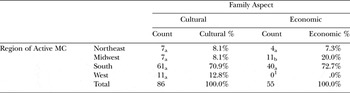
(accompanying Footnote 38) –Comparisons of Column Proportions, Family Aspect and Region of Member (Democratic Party)

Note: Values in the same row and subtable not sharing the same subscript are significantly different at p < 0.05 in the two-sided test of equality for column proportions. Cells with no subscript are not included in the test. Tests assume equal variances.
1. This category is not used in comparisons because its column proportion is equal to zero or one.
(Accompanying Footnote 45) –Comparisons of Column Proportions, Region and Policy Category (Republican Party)
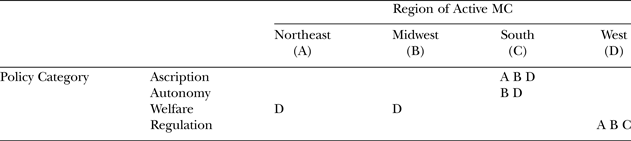
Results are based on two-sided tests with significance level 0.05. For each significant pair, the key of the category with the smaller column proportion appears under the category with the larger column proportion.
Policy Issues Illustrated through Family Cases, Controlling for Region of Active MC, 56th–66th Congress (Democratic Party)

Data compiled by author, congressional committee hearings, 1900–1920.
Policy Issues Illustrated through Family Cases, Controlling for Region of Active MC, 56th–66th Congress (Republican Party)

Data compiled by author, congressional committee hearings, 1900–1920.