Introduction
Crop damage caused by plant-parasitic nematodes, especially cyst and root-knot nematodes, with annual losses in billions of dollars (Chitwood, Reference Chitwood2003; Niblack et al., Reference Niblack, Lambert and Tylka2006), and increased restrictions on the use of toxic nematicides, demand discovery and development of novel control strategies based upon fundamental biological processes. One such process is hatching, which in plant-parasitic nematodes is highly regulated to maximize reproductive success (Perry, Reference Perry and Lee2002; Niblack et al., Reference Niblack, Lambert and Tylka2006; Curtis et al., Reference Curtis, Robinson, Perry, Perry, Moens and Starr2009). Particularly important to hatch in nematodes such as Heterodera glycines is the cyst, formed by females to contain and protect eggs from the environment. The cyst and its contents have been of continuing interest as potential sources of hatch regulatory materials (Okada, Reference Okada1972, Reference Okada1974; Charlson & Tylka, Reference Charlson and Tylka2003; Pridannikov et al., Reference Pridannikov, Petelina, Palchuk, Masler and Dzhavakhiya2007; Masler & Rogers, Reference Masler and Rogers2011). Among components identified in the cyst are polyphenols (Clarke, Reference Clarke1968), including catechins, which can affect hatching in plant-parasitic (Kaul, Reference Kaul1962; Shepherd & Cox, Reference Shepherd and Cox1967) and animal-parasitic (Molan et al., Reference Molan, Meagher, Spencer and Sivakumaran2003) nematodes.
Plant catechin polyphenols affect a broad range of fundamental cellular metabolic processes (Singh et al., Reference Singh, Shankar and Srivastava2011), including essential proteasome enzymes (Nam et al., Reference Nam, Smith and Dou2001; Lam et al., Reference Lam, Kazi, Kuhn, Chow, Chan, Dou and Chan2004; Dou et al., Reference Dou, Landis-Piwowar, Chen, Huo, Wan and Chan2008), making them attractive subjects for drug discovery. Examination of these compounds, and possibly related materials from nematode cysts, for biochemical and biological effects in plant-parasitic nematodes, should be useful in novel nematode control agent discovery. Results presented here demonstrate that proteases, including proteasomal chymotrypsin-like enzyme, in preparations from the plant-parasitic nematodes H. glycines and Meloidogyne incognita, and the free-living nematode Panagrellus redivivus, are inhibited by catechin analogues and by a heat-stable component of the cyst, in a species-specific manner. In addition, catechin analogues and cyst preparations inhibit hatching and behaviour in plant-parasitic nematodes.
Materials and methods
Nematode rearing, collection and extraction
Heterodera glycines was raised on soybean (Glycine max ‘Kent’), and M. incognita was raised on pepper (Capsicum annuum ‘PA-136’) using a constant moisture system (Sardanelli & Kenworthy, Reference Sardanelli and Kenworthy1997), at 27°C and 16 h light:8 h dark photoperiod. Plants were inoculated near the rhizosphere. Soybean was inoculated with ~1500–2000 H. glycines eggs per plant, and harvested after 5 weeks. Cysts were collected from infected G. max roots, broken open in water to release eggs, and the freed eggs placed into hatching plates. Pepper was inoculated with ~3000 M. incognita eggs per plant, and harvested after 5–6 weeks. Egg masses were collected from infected C. annuum roots under a dissecting microscope, rinsed with tap water, and placed into hatching chambers.
Hatching chambers were six-well assay plates (Falcon B-D, Franklin Lakes, New Jersey, USA) fitted with 12-mm-diameter sieves. Sieves were prepared with Netwell plate inserts (Corning Costar, Corning Incorporated, Corning, New York, USA) consisting of a c. 1-mm-diameter plastic collar supporting a 500 μm pore polyester mesh. A circle of 30 μm pore nylon mesh (Spectrum Laboratories, Rancho Dominguez, California, USA) was placed on top of the 500 μm mesh and secured in place with a tight-fitting ring cut from a polypropylene tube.
Assembled sieves were suspended in each plate well in 2 ml sterile tap water and eggs were added. As infective stage juveniles (J2) hatched from eggs they passed through the mesh into the plate well and were collected daily. Freshly hatched J2 were either used immediately in bioassays, or were collected by centrifugation (15 s, 16,000 × g) to remove water, and the worm pellets stored at − 20°C for later extraction. Panagrellus redivivus were reared in sterile liquid culture at 22°C (Chitwood et al., Reference Chitwood, Lusby, Thompson, Kochansky and Howarth1995) and harvested after 1 week as a mixed-age population. Worms were washed with sterile distilled and de-ionized (SDD) water to remove culture medium, water was removed as above and the worm pellets were stored at − 20°C for later extraction.
Worms were thawed and suspended in ice-cold SDD water (~10 volumes of water/worm volume) and mechanically disrupted in 1.5 ml polypropylene tubes containing 0.5 mm zirconia-silica beads shaken in a Bead Beater (BioSpec Products, Bartlesville, Oklahoma, USA). Processing consisted of six rounds of shaking (30 s per round) alternated with six periods of cooling on ice (3 min each). The processed homogenates were centrifuged at 16,000 × g for 30 s at room temperature and the supernatant (S1) was transferred to a glass high-speed centrifuge tube on ice.
Approximately 1 ml of SDD water was added to the extraction tube and a second set of six rounds of shaking and centrifugation was done as above. The resulting supernatant (S2) was pooled with S1 and an aliquot of the 16,000 × g pellet was examined at 40 × and 100 × to assure that all worms were disrupted. The remaining pellet was washed by shaking in 1 ml SDD water followed by 16,000 × g centrifugation and the supernatant added to the pool. This was repeated 2–3 times until the supernatant was clear. All 16,000 × g supernatants were pooled, centrifuged at 40,000 × g for 20 min at 5°C, and aliquots of the resulting supernatant were dried by vacuum centrifugation and stored at − 20°C. Total protein was determined using the microBCA assay (Pierce Chemical Co., Rockford, Illinois, USA).
Preparation of cyst contents and catechin analogues
Heterodera glycines cysts were collected by gently rubbing infected G. max roots under a stream of tap water over an 80-mesh sieve. The collected cysts were rinsed into a sterile 50 ml tube containing 40 ml of SDD water and shaken vigorously to wash the outer surfaces of the cysts. Cysts were allowed to settle and the supernatant wash was decanted. Washing was repeated three additional times with SDD water, and the exhaustively washed cysts transferred to a sterile glass Petri dish for processing. Cysts (c. 5000 cysts in 100 ml SDD) were gently crushed with a sterile rubber stopper to release eggs and contents. Total number of eggs was estimated by direct count of eggs in multiple 0.1 ml aliquots of the crush mixture followed by extrapolation to total mixture volume.
The crushed cyst mixture was filtered through a series of nested sieves (80-, 120-, 635-mesh) and filtrate 1 was collected on ice. The sieve stack with retained cyst materials and eggs was rinsed with c. 400 ml of SDD water. Filtrate 2 was collected, pooled with filtrate 1, and the volume of the pooled filtrates was measured. The filtrate pool was centrifuged at 40,000 × g for 20 min at 5°C, and the resulting supernatant (cyst–egg wash, CE) was dried as aliquots by vacuum centrifugation and stored at − 20°C. Total cysts were estimated by using a ratio of 200 eggs/cyst, and CE equivalents for each preparation were calculated as: total estimated cysts/total filtrate volume = CE equivalent/ml filtrate.
(+)-Catechin, ( − )-epicatechin (EC), ( − )-gallocatechin (GC), ( − )-epigallocatechin (EGC), ( − )-catechin gallate (CG), ( − )-gallocatechin gallate (GCG), ( − )-epicatechin gallate (ECG) and ( − )-epigallocatechin gallate (EGCG) (Sigma Chemical, St. Louis, Missouri, USA) were each dissolved in SDD water and dried as aliquots by vacuum centrifugation. For protease inhibitor assays, each catechin analogue was prepared as a 5 mm stock solution in 100 mm Tris, pH 7.8 protease assay buffer. Aliquots of the stocks were added to reaction mixtures at 1 mm final concentration. For bioassays, analogues were prepared as 2 mm stock solutions in sterile tap water and used at 1 mm final assay concentration.
Protease substrates, inhibitors and assays
FRET-modified peptide substrates QXL520-KSAYMRF-K(5-FAM)a (A2, AnaSpec, Fremont, California USA; used as a general protease substrate) and succinyl-LLVY-AMC (P3, EMD Chemicals, San Diego, California, USA; used as a selective protease substrate to detect proteasome chymotrypsin-like protease, CTL) were prepared as stock solutions in dimethyl sulphoxide (DMSO). The CTL proteasome protease inhibitor MG-132 (EMD) was supplied as a stock solution in DMSO. All were stored at − 30°C until use. Dried CE aliquots were dissolved in TRIS protease assay buffer, heated for 5 min at 95°C, chilled on ice for 5 min, and centrifuged at 16,000 × g for 1 min. The resulting supernatant was used immediately in protease assays or bioassays.
Reactions were performed at 27°C in 384-well assay plates (flat bottom, non-treated, Corning, Inc.) in 100 mm Tris, pH 7.8 assay buffer with 25 μl reaction volume. Nematode extracts were dissolved in assay buffer. Reactions contained 0.04–0.16 μg/μl extract protein for use with QXL520-KSAYMRF-K(5-FAM)a or 0.2–0.8 μg/μl for use with succinyl-LLVY-AMC. Reactions were started by the addition of substrate. Final concentrations of substrates were 1 μm QXL520-KSAYMRF-K(5-FAM)a or 100 μm succinyl-LLVY-AMC with a final concentration of DMSO of 2% in reactions. Final concentrations of inhibitors were 100 μm MG-132, 1 mm catechin analogue, or 0.6 CE eq/μl heated CE wash. Inhibitor was added to the reaction mixture and incubated for 15 min at 27°C prior to addition of the substrate.
Reactions were monitored for 60 min for increasing fluorescence (Ex = 490 nm, Em = 520 nm for substrate QXL520-KSAYMRF-K(5-FAM)a or Ex = 380 nm, Em = 460 nm for succinyl-LLVY-AMC) using a SpectraMAX EM fluorescent plate reader (Molecular Devices, Sunnyvale, California, USA). Substrate controls (no extract) were used to correct for background. Reaction rates were quantified using SoftMax Pro instrument control and data collection software (Molecular Devices), and increase in relative fluorescence units (RFU) over time was recorded and reduced to Vmax/s. Data were then converted to Vmax/min/total μg reaction protein. Inhibitor data are presented as the per cent reduction in Vmax/min/μg in test versus control reactions: ((Vmax/min/μgcontrol− Vmax/min/μginhibitor)/Vmax/min/μgcontrol) × 100.
Bioassays
Eggs from H. glycines or M. incognita were collected as above and transferred to 96-well microtitre plates (Falcon-BD) using a micropipette, with 20–40 eggs per well, in 200 μl of tap water (controls) or 200 μl test solution in tap water. Test solutions used were either (+)-catechin or analogues (1 mm final concentration), or heated CE wash (0.6 CE eq/μl final concentration). These solutions were prepared just prior to use.
All wells were inspected at 40 × magnification for both eggs and hatched J2, and totals for each well were recorded. Plates were covered and incubated for 7 days in a humid chamber at 26°C. On day 7, all eggs and J2 in each well were counted as above, and per cent hatch calculated using the formula: ((J2D7 – J2D0)/EggsD0) × 100. For each hatch experiment, 6–16 treatment and control replicates were used and experiments were repeated 2–8 times.
Freshly collected H. glycines or M. incognita J2 were transferred to chambers of an Ibidi μ-Slide (Ibidi μ-Slide Angiogenesis, uncoated chamber for cell microscopy, www.ibidi.com) at 5–15 J2/well in 50 μl tap water (controls), 50 μl 1 mm EGCG, or 50 μl of 0.6 CE eq/μl heated CE wash. Slide chambers were covered and slides incubated in a humid chamber at 26°C. After 20–22 h incubation, individual J2 were observed continuously for 1 min at 40 × for signs of movement.
J2 movement was scored using a subjective five-step activity scale with values from 0 (no movement of any kind) through 3 (very highly active, whole body flexing, rapid and consistent anterior waving). Scores were assigned by four individuals to minimize bias, experiments were repeated 2–4 times using separate J2 collections, and data are summarized across all J2. Data are expressed as both mean activity score and mean per cent activity of treated J2 relative to controls.
Data analysis
Individual data means were compared using Student's t-test and relationships among data means were analysed using one-way analysis of variance (ANOVA) with Tukey's multiple comparison. P is indicated for each comparison. Statistical analyses were done using GraphPad Prism (GraphPad Software, La Jolla, California, USA) and JMP10 (SAS Institute, Cary, North Carolina, USA).
Results
Catechin analogues and protease activity
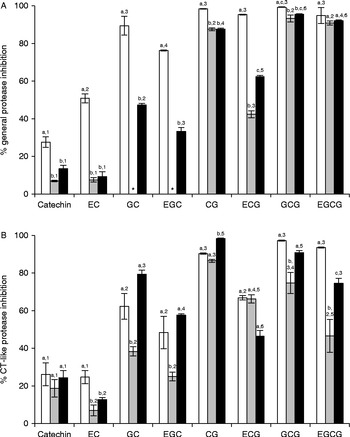
Catechin and seven catechin analogues inhibited general and specific protease activities in all three nematode species (fig. 1), but the levels of inhibition varied among species and across the eight analogues. With substrate QXL520-KSAYMRF-K(5-FAM)a (fig. 1A), only EGCG inhibited activities from all three species equally, at greater than 91.50% in each, but GCG inhibited each species' activity by more than 94.10%. Within each species, inhibition by GCG and EGCG was not different. Inhibition of P. redivivus activity was greater than 90% with GC (90.35 ± 5.09%), CG (99.35 ± 0.19%) and ECG (96.35 ± 0.22%). Each of these values was significantly higher (P< 0.05) than the corresponding value for either H. glycines or M. incognita, and except for EGCG, P. redivivus general protease activity was inhibited more (P< 0.05) than that in H. glycines or M. incognita by each analogue.
Effect of polyphenol analogues on general and specific protease activities in preparations from free-living and plant-parasitic nematodes. Nematode extracts were prepared as described and protease activities were detected using the fluorometric substrates QXL520-KSAYMRF-K(5-FAM)a (A) and succinyl-LLVY-AMC (B) in the presence of various catechin polyphenol analogues. Results were analysed by one-way ANOVA with Tukey's all means comparison. Means compared across species followed by different letters are significantly different (P< 0.05). Means compared across analogues followed by different numbers are significantly different (P< 0.05). EC, epicatechin; GC, gallocatechin; EGC, epigallocatechin; CG, catechin gallate; ECG, epicatechin gallate; GCG, gallocatechin gallate; EGCG, epigallocatechin gallate. White bars, P. redivivus; grey bars, H. glycines; black bars, M. incognita.

Neither GC nor EGC inhibited H. glycines activity, and they inhibited M. incognita activity 52.90% less and 43.70% less (P< 0.05), respectively, than P. redivivus activity. Except for the lack of inhibition by GC and EGC in H. glycines, catechin and EC were significantly (P< 0.05) lower in inhibition than any of the other six analogues in all species. With substrate succinyl-LLVY-AMC (fig. 1B), per cent inhibition was highest (P< 0.05) in all three species with CG (91.23 ± 0.33%, P. redivivus; 87.29 ± 0.77%, H. glycines; 99.31 ± 0.17%, M. incognita) and GCG (98.23 ± 0.27%, P. redivivus; 75.45 ± 5.68%, H. glycines; 91.69 ± 1.05%, M. incognita). In addition, EGCG inhibition was the same (94.47 ± 0.28%) as CG and GCG in P. redivivus. Catechin and EC were the weakest inhibitors (P< 0.05) among all analogues in each species.
Unlike with QXL520-KSAYMRF-K(5-FAM)a, where seven of eight analogues inhibited P. redivivus activity more strongly than in H. glycines and M. incognita preparations, M. incognita digestion of succinyl-LLVY-AMC was the most strongly inhibited (P< 0.05) by both CG (91.23 ± 0.33%, P. redivivus; 87.29 ± 0.77%, H. glycines; 99.31 ± 0.17%, M. incognita) and GC (62.93 ± 6.90%, P. redivivus; 38.71 ± 2.46%, H. glycines; 80.08 ± 2.19%, M. incognita).
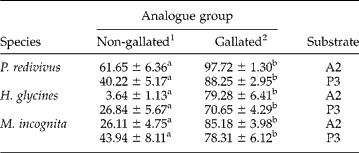
Nearly all gallated catechin analogues were significantly stronger inhibitors (P< 0.05) than the corresponding non-gallated form in all three species with each substrate. Exceptions were GC and GCG in P. redivivus QXL520-KSAYMRF-K(5-FAM)a assays and EGC and EGCG in H. glycines succinyl-LLVY-AMC assays. The overall differences between non-gallated and gallated analogue inhibitions are summarized in table 1, where the mean per cent inhibition combined across four gallated analogues is consistently greater (P< 0.05) than that combined across the non-gallated forms. This is true for each substrate.
Mean per cent inhibition of general and specific protease activities in extracts of Panagrellus redivivus, Heterodera glycines and Meloidogyne incognita exposed to gallated and non-gallated catechin analogues.

Means were compared between analogue groups using Student's t. Those followed by different letters are significantly different (P < 0.005).
1 Catechin, epicatechin, gallocatechin, epigallocatechin.
2 Catechin gallate, epicatechin gallate, gallocatechin gallate, epigallocatechin gallate.
A2, QXL520-KSAYMRF-K(5-FAM)a; P3, succinyl-LLVY-AMC.
Protease activities and CE preparations
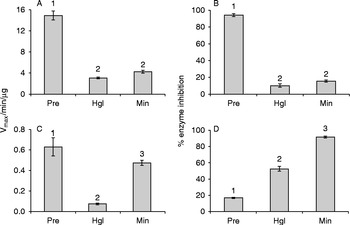
Specific activities (Vmax/min/μg) were consistently higher (P< 0.05) in P. redivivus extracts than in those of H. glycines and M. incognita with either QXL520-KSAYMRF-K(5-FAM)a (fig. 2A) or succinyl-LLVY-AMC (fig. 2C) as substrate. With QXL520-KSAYMRF-K-(5-FAM)a, P. redivivus activity was 4.8-fold and 3.5-fold higher than that of H. glycines and M. incognita, respectively. With succinyl-LLVY-AMC, the same ratios for the same comparisons were 8.2-fold and 1.3-fold. In succinyl-LLVY-AMC assays, M. incognita activity was 6.2-fold higher (P< 0.05) than that of H. glycines.
Effect of Heterodera glycines cyst-egg wash (CE) on general and specific protease activities in preparations of free-living and plant-parasitic nematodes. Nematode extracts were prepared as described and protease activities were detected using the fluorometric substrates QXL520-KSAYMRF-K(5-FAM)a (A, B) and succinyl-LLVY-AMC (C, D) in the presence (B, D) or absence (A, C) of heated CE preparation. Results were analysed by one-way ANOVA with Tukey's all means comparison. Means followed by different numbers are significantly different (P < 0.05). Activity (Vmax/min/μg) is rate of increase in relative fluorescence per total μg nematode protein in reaction. Pre, P. redivivus; Hgl, H. glycines; Min, M. incognita.

While P. redivivus activity with the general protease substrate QXL520-KSAYMRF-K(5-FAM)a was higher than that in either H. glycines or M. incognita, it was also the most susceptible (P< 0.05) to inhibition by CE (fig. 2B). Activity was reduced 94.90 ± 1.70% in P. redivivus compared with 10.13 ± 1.81% in H. glycines and 15.44 ± 0.97% in M. incognita. In contrast, P. redivivus digestion of succinyl-LLVY-AMC was inhibited 17.24 ± 0.55% by CE (fig. 2D), significantly less (P< 0.05) than inhibition of H. glycines (52.86 ± 2.77%) activity, and both were inhibited less than M. incognita (92.07 ± 0.68%) activity.
Finally, inhibition of succinyl-LLVY-AMC digestion by the proteasome chymotrypsin-like protease inhibitor MG-132 was 89.71 ± 0.47% (n= 6) for P. redivivus, 61.51 ± 4.96% (n= 10) for H. glycines and 97.55 ± 0.02% (n= 7) for M. incognita. MG-132 inhibition of H. glycines activity was significantly less (P< 0.05) than either P. redivivus or M. incognita, which were not different.
Hatching and behaviour
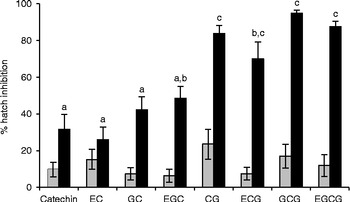
Hatching of H. glycines J2 was only mildly inhibited by catechin analogue treatment (fig. 3), no differences were observed among the eight analogues and no analogue inhibited more than 25%. Hatching of M. incognita was inhibited no less than 25% by each analogue, and was highest with the gallated forms, where per cent inhibition by CG (83.88 ± 4.26), ECG (69.98 ± 9.14), GCG (94.93 ± 1.71) and EGCG (87.93 ± 2.89) was significantly (P< 0.05) greater than with the corresponding non-gallated analogue. CE preparations had no effect on hatching. Mean per cent hatch for H. glycines at 7 days was 57.48 ± 3.37 (control) and 49.54 ± 9.99 (CE) and in M. incognita 36.30 ± 10.36 and 32.16 ± 9.21, respectively.
Effect of catechin analogues on hatching in Heterodera glycines and Meloidogyne incognita. Eggs from H. glycines and M. incognita were incubated, as described, in tap water or in 1 mm preparations of catechin analogues (see fig. 1 legend for abbreviations). After 7 days, per cent hatch was calculated and results are shown as mean per cent hatch inhibition by each analogue relative to water control. Means were compared by one-way ANOVA with Tukey's all means comparison, and those followed by different letters are significantly different (P < 0.05). Grey bars, H. glycines; black bars, M. incognita.

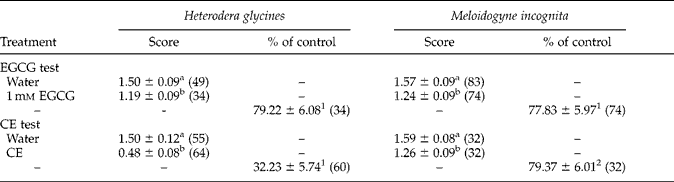
EGCG affected J2 activity in both H. glycines and M. incognita after overnight exposure (table 2). Mean activity scores were reduced (P< 0.05) in both species compared with control means. The degree of inhibition was the same in both species, as measured by the per cent of control activity present in treated J2. CE also reduced (P< 0.05) J2 activity in both H. glycines and M. incognita. However, the effect of CE on H. glycines J2 was significantly more (P< 0.05) than that on M. incognita.
Effects of the plant polyphenol (−)-epigallocatechin gallate (EGCG) and H. glycines cyst-egg wash (CE) on infective juvenile movement of H. glycines and M. incognita in vitro.

Juveniles exposed to treatments as described were scored for degree of movement. Data were summarized for all worms in each treatment and analysed using Student's t. Score means compared within species followed by different letters are significantly different (P < 0.05). Per cent means compared between species followed by different numbers are significantly different (P < 0.05). Numbers in parentheses are number of juveniles tested.
Discussion
The plant polyphenol catechin and seven structural analogues exhibited varying degrees of inhibition of protease activities in preparations from three nematode species. The extent of inhibition was generally related to the structure of the analogue, with the gallated forms significantly stronger inhibitors, as a group, than the non-gallated forms. This was true for both general protease activity detected with QXL520-KSAYMRF-K(5-FAM)a, which was shown previously to be a good substrate in H. glycines, M. incognita and P. redivivus preparations (Masler, Reference Masler2012), and proteasome-specific activity detected with succinyl-LLVY-AMC, which has been used to detect nematode proteasome CTL protease activity in Caenorhabditis elegans (Pispa et al., Reference Pispa, Palmen, Holmberg and Jantti2008). The greater inhibitory effect of the gallated polyphenols in the nematode systems is consistent with the inhibition of activity in a 20S proteasome fraction purified from human tumour cells (Nam et al., Reference Nam, Smith and Dou2001). Those authors report that each gallated catechin polyphenol strongly inhibited CTL activity while the non-gallated forms were only weakly or non-inhibitory.
Among individual analogues, catechin and EC were consistently poor inhibitors, especially with preparations from the plant-parasitic nematodes. The most consistently strong inhibitor was CG, which was the only analogue to inhibit activities with each substrate more than 80% in all three species. The inhibition of broad protease activity was higher across all analogues in P. redivivus preparations than in those from either H. glycines or M. incognita, with the exception of EGCG, which was equally effective with all species. A possible source for this difference in inhibition of general protease activity may reside in the nematode populations used for extract preparations. As noted previously (Masler, Reference Masler2012), mixed stages of P. redivivus likely provide a more diverse collection of proteases than the juvenile-only sources of H. glycines and M. incognita. Indeed, P. redivivus specific activity with QXL520-KSAYMRF-K(5-FAM)a is significantly higher than that of the plant parasites, suggesting that more, and more varied, protease targets are available for inhibition.
The only species that did not exhibit inhibition greater than the others under any circumstance was H. glycines. Although firm conclusions cannot be made within the context of this survey, the complete absence of inhibition by GC or EGC of H. glycines general protease activity is curious. It is especially so since both GC and EGC inhibited activity in M. incognita, the other plant parasite. Much closer examination of protease activities is needed to determine if there are fundamental differences between these plant-parasitic nematode degradomes that can be exploited for control purposes.
One of the purposes of using a proteasome substrate was to look at interactions of catechins, and CE preparations, on cellular components that have fundamental roles in maintaining metabolic health and provide novel molecular targets (Nam et al., Reference Nam, Smith and Dou2001; Lam et al., Reference Lam, Kazi, Kuhn, Chow, Chan, Dou and Chan2004; Dou et al., Reference Dou, Landis-Piwowar, Chen, Huo, Wan and Chan2008; Singh et al., Reference Singh, Shankar and Srivastava2011), with potential for nematode control. The inhibitory responses detected using the proteasome substrate revealed more species differences than were observed with QXL520-KSAYMRF-K(5-FAM)a. GCG and EGCG were not as consistently effective inhibitors across species as they were with general protease activity, while both GC and CG inhibited M. incognita activity more than in the other two species.
The inhibition of protease activities by cyst preparations, the first time this has been demonstrated, revealed intriguing species differences. Inhibition of general protease activity was far greater in P. redivivus than in either plant parasite, and was consistent with results obtained in the catechin analogue survey. In contrast, inhibition of CTL protease activity by CE washes was significantly greater in the plant-parasitic nematode preparations than in P. redivivus.
Furthermore, CE inhibition of CTL activity in M. incognita was greater than in H. glycines, whereas general protease activity was inhibited equally in the two plant parasites. It is important to note that inhibition of CTL activity by the known inhibitor MG-132 (Pispa et al., Reference Pispa, Palmen, Holmberg and Jantti2008) was high in all three species, especially so with M. incognita and P. redivivus. This indicates, not surprisingly, that CE wash, while capable of inhibiting proteasome enzyme activity, contains a number of inhibitors with different protease targets, and that these targets may differ, especially between H. glycines and M. incognita.
It is also significant that, although cysts were washed thoroughly, the cyst–egg wash preparations likely contained materials from bacteria resident within the cyst (Nour et al., Reference Nour, Lawrence, Zhu, Swerhone, Welsh, Welacky and Topp2003). This is a rich source of biological agents, including protease inhibitors, which could affect nematode physiology. Indeed, Nour et al. (Reference Nour, Lawrence, Zhu, Swerhone, Welsh, Welacky and Topp2003) suggest that at least some of the bacteria within the cyst could play a role in hatching. In this context, it is interesting that CE wash reduced H. glycines J2 motility more than M. incognita, whereas EGCG effects on J2 movement were the same in the two species.
Although hatch inhibition in H. glycines by catechin analogues was mild, there was a clear difference between gallated and non-gallated forms in inhibition of hatch in M. incognita. Similar contrasts between biological activities of gallated and non-gallated forms of catechins were observed in hatching and larval exsheathment of animal-parasitic nematodes (Molan et al., Reference Molan, Meagher, Spencer and Sivakumaran2003; Brunet & Hoste, Reference Brunet and Hoste2006). The effects of polyphenol analogues of the catechin identified in nematode cysts on biochemical and behavioural activities in plant-parasitic nematodes, and the discovery of protease inhibitors in H. glycines cysts, indicate that these structures should be explored further as sources for novel control agents.
Acknowledgements
Thanks are extended to Mr S.T. Rogers, biological technician, for excellent research support, particularly for maintaining nematode cultures and conducting hatch assays, and to Ms C. Chen and H.-M. Park, student aides, for their help with the behaviour and protease assays