Introduction
Response inhibition, i.e. the suppression of actions that are no longer required or are inappropriate, is one of the key components of executive control (Ridderinkhof et al. Reference Ridderinkhof, Van den Wildenberg, Segalowitz and Carter2004). Deficits in response inhibition have been reported in a range of psychiatric disorders, including attention-deficit/hyperactivity disorder (ADHD) (Slaats-Willemse et al. Reference Slaats-Willemse, Swaab-Barneveld, Sonneville, Van der Meulen and Buitelaar2003). Both response inhibition and ADHD are highly heritable and share genetic loading, such that response inhibition is considered to be an endophenotype for ADHD (Faraone & Khan, Reference Faraone and Khan2005; Crosbie et al. Reference Crosbie, Arnold, Paterson, Swanson, Dupuis, Li, Shan, Goodale, Tam, Strug and Schachar2013). An endophenotype is a quantitative biological trait that lies on the pathway from gene to clinical phenotype (Gottesman & Gould, Reference Gottesman and Gould2003). However, behavioural response inhibition measures show a large overlap in performance between probands with ADHD and healthy controls (Lipszyc & Schachar, Reference Lipszyc and Schachar2010). On the other hand, several studies (Pliszka et al. Reference Pliszka, Glahn, Semrud-Clikeman, Franklin, Perez, Xiong and Liotti2006; Cubillo et al. Reference Cubillo, Halari, Giampietro, Taylor and Rubia2011; Mulligan et al. Reference Mulligan, Knopik, Sweet, Fisher, Seidenberg and Rao2011), including one by our group (Van Rooij et al. Reference Van Rooij, Hartman, Mennes, Oosterlaan, Franke, Rommelse, Heslenfeld, Faraone, Buitelaar and Hoekstra2015), have indicated that the neural activation during response inhibition shows a stronger link with ADHD than behavioural measures of response inhibition.
Response inhibition has a clear link with the neurotransmitter dopamine, as evidenced by positron emission tomography studies which have shown that response inhibition is associated with dopamine release in the striatum, mediated by dopamine D2/D3 receptor availability in the striatum (Albrecht et al. Reference Albrecht, Kareken, Christian, Dzemidzic and Yoder2014). Additionally, the most common treatment in ADHD is prescription of methylphenidate medication, a dopamine reuptake inhibitor that interacts with the dopamine transporter in the striatum (Schwartz & Correll, Reference Schwartz and Correll2014), has been shown to improve response inhibition performance (Costa et al. Reference Costa, Riedel, Pogarell, Menzel-Zelnitschek, Schwarz, Reiser, Möller, Rubia, Meindl and Ettinger2013) and to normalize neural activation during response inhibition in children with and without ADHD (Rubia et al. Reference Rubia, Halari, Cubillo, Mohammad, Brammer and Taylor2009).
Multiple studies have also implicated a relationship between genetic variants related to the dopamine system in response inhibition performance (Congdon et al. Reference Congdon, Lesch and Canli2008). These studies have indicated that genetic variants related to less extracellular dopamine availability are associated with decreased response inhibition performance. However, to date only a handful of studies have investigated the association between genetic variants and neural activation during response inhibition. The first study demonstrated that polymorphisms in two dopaminergic genes, the catechol-O-methyltransferase gene (COMT) and the dopamine transporter gene (SLC6A3 or DAT1), were related to neural activation during response inhibition (Congdon et al. Reference Congdon, Constable, Lesch and Canli2009). Specifically, COMT gene rs4680 single nucleotide polymorphism (SNP) Met-allele carriers and 9-repeat carriers of a variable number of tandem repeats (VNTR) in the 3′-untranslated region (UTR) of the DAT1 gene have previously shown greater activation in medial and inferior frontal brain regions during response inhibition. A more recent, larger, study has also investigated the effect of this COMT polymorphism, but found the opposite pattern, reporting increased activation in Val-allele carriers, and this only in males (White et al. Reference White, Loth, Rubia, Krabbendam, Whelan, Banaschewski, Barker, Bokde, Büchel, Conrod, Fauth-Bühler, Flor, Frouin, Gallinat, Garavan, Gowland, Heinz, Ittermann, Lawrence, Mann, Paillère, Nees, Paus, Pausova, Rietschel, Robbins, Smolka, Shergill and Schumann2014). Another study has further investigated the association between DAT1 gene polymorphisms and response inhibition performance and activation (Cummins et al. Reference Cummins, Hawi, Hocking, Strudwick, Hester, Garavan and Wagner2012). Here, both the presence of the rs460000C allele and the rs37020T allele predicted longer stop-signal reaction time (SSRT) while rs37020T allele carriers showed decreased neural activation in medial frontal areas during response inhibition. That study did not replicate the association between the DAT1 VNTR and neural activation (Congdon et al. Reference Congdon, Constable, Lesch and Canli2009). The DAT1 3′-UTR 10 repeat variant (Braet et al. Reference Braet, Johnson, Tobin, Acheson, McDonnell, Hawi, Barry, Mulligan, Gill, Bellgrove, Robertson and Garavan2011) and the COMT rs4680 Val-allele have also been linked to increased risk for ADHD (Guan et al. Reference Guan, Wang, Chen, Yang, Li, Qian, Wang, Faraone and Wang2009). Last, a recent large-scale imaging study has found direct evidence for a role between the monoamine oxidase A (MAOA) genotype and neural activation during response inhibition in ADHD (Nymberg et al. Reference Nymberg, Jia, Lubbe, Ruggeri, Desrivieres, Barker, Büchel, Fauth-Buehler, Cattrell, Conrod, Flor, Gallinat, Garavan, Heinz, Ittermann, Lawrence, Mann, Nees, Salatino-Oliveira, Paillère Martinot, Paus, Rietschel, Robbins, Smolka, Banaschewski, Rubia, Loth and Schumann2013), showing that the decreased activation in ADHD may be dependent on the MAOA genotype. A recent meta-analysis (Gizer et al. Reference Gizer, Ficks and Waldman2009) has confirmed this significant association of MAOA and DAT1 variants with ADHD, but not for the COMT variant. Additionally, several studies have demonstrated that a haplotype of two DAT1 VNTRs in the 3′-UTR and intron-8 region shows the strongest relationship with ADHD (Brookes et al. Reference Brookes, Xu, Chen, Zhou, Neale, Lowe, Anney, Aneey, Franke, Gill, Ebstein, Buitelaar, Sham, Campbell, Knight, Andreou, Altink, Arnold, Boer, Buschgens, Butler, Christiansen, Feldman, Fleischman, Fliers, Howe-Forbes, Goldfarb, Heise, Gabriëls, Korn-Lubetzki, Johansson, Marco, Medad, Minderaa, Mulas, Müller, Mulligan, Rabin, Rommelse, Sethna, Sorohan, Uebel, Psychogiou, Weeks, Barrett, Craig, Banaschewski, Sonuga-Barke, Eisenberg, Kuntsi, Manor, McGuffin, Miranda, Oades, Plomin, Roeyers, Rothenberger, Sergeant, Steinhausen, Taylor, Thompson, Faraone and Asherson2006a ; Asherson et al. Reference Asherson, Brookes, Franke, Chen, Gill, Ebstein, Buitelaar, Banaschewski, Sonuga-Barke, Eisenberg, Manor, Miranda, Oades, Roeyers, Rothenberger, Sergeant, Steinhausen and Faraone2007).
The present study was undertaken to further investigate the association between genetic variants influencing dopamine neurotransmission and neural activation during response inhibition in individuals with and without ADHD. The influence of five variants based on the previous studies (Congdon et al. Reference Congdon, Constable, Lesch and Canli2009; Cummins et al. Reference Cummins, Hawi, Hocking, Strudwick, Hester, Garavan and Wagner2012; White et al. Reference White, Loth, Rubia, Krabbendam, Whelan, Banaschewski, Barker, Bokde, Büchel, Conrod, Fauth-Bühler, Flor, Frouin, Gallinat, Garavan, Gowland, Heinz, Ittermann, Lawrence, Mann, Paillère, Nees, Paus, Pausova, Rietschel, Robbins, Smolka, Shergill and Schumann2014) was investigated. Both the rs37020 and rs460000 SNPs of the DAT1 gene were included, as well as the rs4680 SNP of the COMT gene and the 10–6 haplotype of the 3′-UTR and intron-8 DAT1 VNTRs. Our study aimed to both validate previous results of whole-brain analyses of the influence of DAT1 and COMT on neural measures of response inhibition (Congdon et al. Reference Congdon, Constable, Lesch and Canli2009; Cummins et al. Reference Cummins, Hawi, Hocking, Strudwick, Hester, Garavan and Wagner2012) and to extend them to participants with ADHD. COMT is one of the main enzymatic regulators of dopamine availability in the prefrontal cortex (Hong et al. Reference Hong, Shu-Leong, Tao and Lap-Ping1998), while DAT1 is expressed mainly in striatal regions (Durston et al. Reference Durston, Fossella, Casey, Hulshoff Pol, Galvan, Schnack, Steenhuis, Minderaa, Buitelaar, Kahn and Van Engeland2005). Therefore, we expected the influence of COMT polymorphisms on neural activation mainly in the prefrontal regions and that of the DAT1 polymorphisms on neural activation mainly in striatal areas. We also investigated whether DAT1 and COMT variants would be associated with ADHD diagnosis, and related to the altered neural correlates of response inhibition in probands with ADHD and their unaffected siblings. The neural correlates in this latter analysis were based on data from a previous study by our group (Van Rooij et al. Reference Van Rooij, Hartman, Mennes, Oosterlaan, Franke, Rommelse, Heslenfeld, Faraone, Buitelaar and Hoekstra2015), describing the altered neural activation during response inhibition in probands with ADHD as compared with controls.
Method
Participants
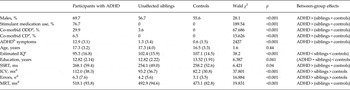
All participants were part of the NeuroIMAGE study, the Dutch follow-up of the International Multicenter ADHD Genetics (IMAGE) study into the biological nature of ADHD. Details concerning ethics improvement, recruitment, demographics, diagnostics and testing procedures can be found in the NeuroIMAGE methods publication (Von Rhein et al. Reference Von Rhein, Mennes, Van Ewijk, Groenman, Zwiers, Oosterlaan, Heslenfeld, Franke, Hoekstra, Faraone, Hartman and Buitelaar2015) and the online Supplementary material. The current sample included subjects with ADHD (n = 184), their unaffected siblings (n = 111) and healthy controls (n = 124). Participant demographics are listed in Table 1; all subjects were of European descent, and all participants were required to withhold stimulant medication use for at least 48 h before testing. The proportion of females and the average intelligence quotient (IQ) scores were significantly lower in participants with ADHD than in siblings and controls; likewise, medication use and co-morbid disorders were higher in the ADHD group. There was no difference in IQ, age or gender between the two scan sites.
Participant characteristics and task outcomes derived from the stop-signal task

Data are given as mean (standard deviation) unless otherwise indicated.
ADHD, Attention deficit/hyperactivity disorder; ODD, oppositional defiant disorder; CD, conduct disorder; IQ, intelligence quotient; SSRT, stop-signal reaction time; ICV, intra-individual coefficient of variance; Errors, number of errors on go-trials; MRT, mean reaction time; K-SADS, Kiddie Schedule for Schizophrenia and Affective Disorders; WISC, Wechsler Intelligence Scale for Children; WAIS-III, Wechsler Adult Intelligence Scale.
a ODD and CD diagnosis was based on K-SADS structured psychiatric interviews.
b ADHD diagnosis was based on K-SADS structured psychiatric interviews and Conners’ questionnaires (0–18 symptoms).
c Estimated IQ was based on two subtests of the WISC or WAIS-III.
d Task effects for the stop-task derived from generalized estimating equations models, using a significance threshold of p < 0.05 and correcting for familiality, gender, age and IQ.
Stop-signal task (SST)
Response inhibition was measured using a version of the SST adapted for functional magnetic resonance imaging (fMRI) (Van Meel et al. Reference Van Meel, Heslenfeld, Oosterlaan and Sergeant2007). Participants were instructed to respond as quickly as possible to a go-signal, unless this was followed shortly afterwards by a stop-signal (25% of trials), in which case they were supposed to withhold their response. By varying the delay between go- and stop-signals, it was possible to derive the main outcome measure of the task, the SSRT, which reflects the time necessary for a subject to successfully inhibit their response in 50% of the stop-trials. Secondary outcome measures were the number of omission and commission errors on go-trials (errors), the intra-individual component of variation (ICV) and mean reaction time (MRT) on go-trials. The task consisted of a total of four blocks of 60 trials.
All task outcome analyses were performed in SPSS (version 19.0; USA). General estimated equations (GEE) models were used to correct for familial relationships between siblings. Separate regression models were executed for SSRT, ICV, errors and MRT, with age, gender and IQ added as covariates. A significance threshold of 0.016 (0.05/3) was entrained for all analyses.
Genotyping
An extensive description of DNA extraction and genotyping in IMAGE has been provided elsewhere (Von Rhein et al. Reference Von Rhein, Mennes, Van Ewijk, Groenman, Zwiers, Oosterlaan, Heslenfeld, Franke, Hoekstra, Faraone, Hartman and Buitelaar2015). Briefly, for the IMAGE sample DNA was extracted from blood samples at Rutgers University Cell and DNA Repository, NJ, USA. DNA for additional samples collected during NeuroIMAGE was isolated from saliva using Oragene® containers (DNA Genotek Inc., Canada). VNTR polymorphisms from the 3′-UTR and intron-8 of the DAT1/SLC6A3 gene had been genotyped by the IMAGE consortium (Brookes et al. Reference Brookes, Mill, Guindalini, Curran, Xu, Knight, Chen, Huang, Sethna, Taylor, Chen, Breen and Asherson2006b ), additional samples were genotyped at the Department of Human Genetics of the Radboud University Medical Center. Standard polymerase chain reaction protocols were used, after which results were analysed with GeneMapper® Software, version 4.0 (Applied Biosystems, USA). Genotyping of the rs37020 and rs4680 SNPs was performed in Nijmegen; further details concerning genotyping can be found in the online Supplementary material.
fMRI acquisition and analysis
fMRI data were collected at two sites using similar Siemens Scanners and identical coils and protocols, and were processed using FSL FEAT (version 6.0, FMRIB's Software Library; www.fmrib.ox.ac.uk/fsl). The details regarding acquisition, preprocessing and first-level analysis can be found in the online Supplementary material.
Genetic effects on ADHD diagnosis and task performance
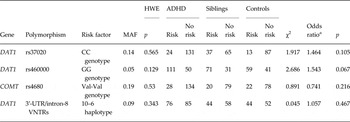
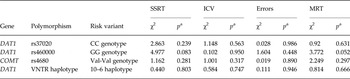
Direct effect of the four genetic variants (rs37020, rs460000 and rs4680 SNPs and the 10–6 VNTR haplotype) on the distribution of ADHD diagnoses or on behavioural response inhibition were investigated using χ2 statistics and analysis of variance, respectively (see Tables 2 and 3).
Distribution of genotypes per diagnostic group

MAF, Minor allele frequency; HWE, Hardy–Weinberg equilibrium; ADHD, attention-deficit/hyperactivity disorder; DAT1; dopamine transporter gene; COMT, catechol-O-methyltransferase gene; UTR, untranslated region; VNTR, variable number of tandem repeats.
a Odds ratio illustrates the relative distribution of genotypes between participants with ADHD and healthy controls.
Influence of DAT1 and COMT variants on stop-task performance

DAT1, Dopamine transporter gene; COMT, catechol-O-methyltransferase gene; SSRT, stop-signal reaction time; ICV, intra-individual coefficient of variance; Errors, number of errors on go-trials; MRT, mean reaction time; VNTR, variable number of tandem repeats.
a Gene effects on the stop-task outcome measures were derived from generalized estimating equations models corrected for familiality, age, gender and intelligence quotient.
Role of genetic variants in whole-brain activation in the combined ADHD–control sample
To investigate the effect of each genetic variant on brain-wide task activation, four separate analyses were conducted in FSL. ADHD diagnostic status (ADHD, unaffected sibling, control) was entered as a second factor in these models, in order to investigate any mediation or interaction between genotype, task activation and diagnosis. Age, IQ, gender and scan site were added as covariates in all group-level analyses. Correction for multiple comparisons was performed according to FSL standards, by thresholding resulting Z-stat clusters with a minimum Z-score of 2.3 and using a family-wise-corrected significance threshold of p < 0.05 (Woo et al. Reference Woo, Krishnan and Wager2014).
Relationship between genetic variants, whole-brain fMRI activation, stop-task performance and ADHD severity
In order to further specify the size and direction of the genetic effects, inferential statistics were calculated within SPSS by using exported, individual β values from those clusters that showed significant effects of genetic variants. Therefore, all inferential statistics were generated using GEE models. To demonstrate that findings did not depend on the familial structure of the data, post-hoc analyses using only one individual from every family were conducted. An additional set of GEE analyses was run to investigate the potential relationship of these genetic effects on neural activation with stop-task performance. The influence of age, IQ, gender, scan site, medication use and co-morbid disorders on the genetic differences was also assessed. A second set of similar analyses was run to test whether the observed genetic effects on neural activation were associated with the number of ADHD symptoms as a continuous measure of ADHD severity. Significance levels for p values of all models using extracted β values (both above-mentioned and subsequent) were adjusted for multiple comparisons using Bonferroni–Holm corrections (Holm, Reference Holm1979).
Influence of potential confounders on whole-brain fMRI activation
Given the unbalanced distribution of our sample on several demographical and clinical factors, sensitivity analyses were performed to investigate whether whole-brain activation was influenced by the covariates age, gender, IQ, scan site, medication use, or the presence of co-morbid oppositional defiant disorder or conduct disorder. For each of the clusters from the whole-brain analyses, β values were entered as dependent variables in a GEE model, using each covariate as predictor.
Genetic effects on between-group differences in fMRI activation
A next analysis was run to further test if the primary ADHD group effects on response inhibition activation could be explained by our genetic variants. For this analysis, we used the data describing the main effect of diagnostic status on neural activation, as described in a previous publication (Van Rooij et al. Reference Van Rooij, Hartman, Mennes, Oosterlaan, Franke, Rommelse, Heslenfeld, Faraone, Buitelaar and Hoekstra2015). Here, an F contrast modelling the effects of diagnostic group on fMRI activation across all subjects was calculated. The activation β values from the nodes indicated in the diagnostic group contrasts of this previous study were exported and used to test the effect of the four DAT1 and COMT risk variants on this activation. Specifically, a set of models was run to investigate effects of the risk genes on each node, using GEE models to correct for familial relationships, modelling the β values from each node as the dependent variable, risk genes as predictors, and gender, age, IQ and scan-site as covariates.
Results
Genetic effects on ADHD diagnosis and task performance
The distribution of the risk variants did not differ significantly between participants with ADHD, their unaffected siblings and healthy controls (see Table 2). No significant relationships between any of the risk variants and task outcome measures were observed, nor were there any main effects of (or interactions with) age, gender or IQ (see Table 3).
Role of genetic variants in whole-brain activation in the combined ADHD–control sample
The neural activation pattern during response inhibition across all groups and genotypes can be found in the online Supplementary material (see Table S1 and Fig. S1). When investigating whole-brain activation as a function of the different genetic variants, we found differences in neural activation for the DAT1 rs37020 polymorphism and VNTR risk haplotype homozygotes and COMT rs4680 polymorphism. No effects were observed for the DAT1 rs460000 polymorphism.
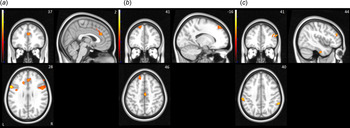
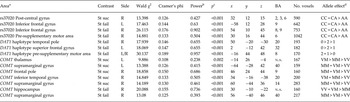
The effects of the DAT1 rs37020 polymorphism were located in the right and left inferior frontal gyri, as well as the right pre-supplementary motor area and post-central qyrus (see Fig. 1, Table 4). The activation differences in the post-central gyrus were restricted to the successful stop-trials; all other differences were seen during failed stop-trials. In all instances post-hoc tests indicated that the carriers of the AA genotype showed lower levels of activation as compared with CC homozygotes or CA heterozygotes.
Group differences of the dopamine transporter (DAT1) rs37020 single nucleotide polymorphism (SNP) (a), the DAT1 variable number of tandem repeats (b) and the catechol-O-methyltransferase (COMT) rs4680 SNP (c) on neural activation during failed stop-trials. The right side of the image depicts the right side of the brain.

Risk gene effects on the response inhibition network

BA, Brodmann area; St suc, successful stop-trials; R, right; St fail, failed stop-trials; L, left; DAT1, dopamine transporter gene; COMT, catechol-O-methyltransferase gene; n.a., not applicable.
a Activation clusters derived from the F contrasts testing differences in task activation as a function of DAT1 and COMT variants over all subjects, including gender, intelligence quotient, age and scan site as covariates.
b Power estimates computed using Quanto software (http://biostats.usc.edu/Quanto.html).
c Correction for multiple comparisons was one using a cluster threshold of Z > 2.3 and a significance threshold of p < 0.05 corrected.
d Group effects are derived from post-hoc analyses, corrected for familiality.
The effect of the DAT1 10–6 haplotype was observed during failed stop-trials in the bilateral pre-supplementary motor areas, and in the superior frontal and temporal pole areas (see Fig. 1). The former area showed higher activation in risk haplotype homozygotes; the latter two showed decreased activation in risk haplotype homozygotes.
Finally, the COMT Val158Met variant resulted in differential activation patterns during successful stop-trials in the thalamus, frontal pole, left supramarginal and inferior temporal gyrus; activation in hippocampus also differed between genotypes during the failed stop-trials, as did activation in the right supramarginal gyrus in both conditions (see Fig. 1). In all nodes the Val-Val genotype showed decreased activation as compared with Met alleles carriers, except in the hippocampal region, where the Met-Met homozygotes showed hypoactivation compared with both other genotypes.
To correct for potential effects of familial dependency in our sample, all analyses of the genetic variants on whole-brain neural activation were repeated in a reduced sample using only one child per family. These results have been added to the online Supplementary material, and show that the above-mentioned results are not influenced by the familial structure of our sample.
Relationship between genetic variants, whole-brain fMRI activation and stop-task performance
Neural activation in the right inferior frontal gyrus and pre-supplementary motor area, that were differentially activated depending on DAT1 rs37020 genotype, showed a significant relationship with SSRT duration (B = −0.085, p < 0.012 and B = −0.039, p < 0.004, respectively). In both nodes, higher neural activation, as seen in participants without the risk genotype, was associated with shorter SSRT length (see online Supplementary Table S3).
Activation in both nodes of the right supramarginal gyrus, that were differentially active depending on the COMT rs4680 genotype, was significantly associated with ICV (B = −144.12, p < 0.0001 and B = −172.09, p < 0.0001, respectively). In both nodes, higher activation, seen in participants without the risk allele, was associated with lower intra-individual variation in response inhibition performance.
Relationship between genetic variants, whole-brain fMRI activation, and ADHD status or severity
No interactions between genetic effects and ADHD diagnostic status (ADHD probands v. unaffected siblings v. healthy controls) were observed in any of the whole-brain fMRI results. Post-hoc analysis of the β values from all differentially activated nodes indicated no main effect of ADHD status on fMRI activation, either with or without incorporation of the main gene effects. A final set of post-hoc models was used to associate β values with the number of ADHD symptoms, and also separately investigate the influence of these polymorphisms on the hyperactive/impulsive and inattentive subscales of the Conners’ questionnaire. However, no significant effects were observed between the total symptom count, either subscale or any of the genetic variants tested.
Influence of potential confounders on whole-brain fMRI activation
No main or interaction effects of IQ, gender or scan-site were detected, indicating that these variables did not influence the reported genetic effects on fMRI activation. The activation in the superior frontal region node which showed differential effects of the DAT1 haplotype additionally showed a main effect of age (B = −1.031, p < 0.001), indicating decreased activation with increased age. However, there was no interaction between age and the VNTR effect, indicating that the age effect was additional to the VNTR effect. No other effects of age were observed.
In previous publications, we showed there are no main effects of medication use or co-morbidity on the neural activation within this sample (Van Rooij et al. Reference Van Rooij, Hartman, Mennes, Oosterlaan, Franke, Rommelse, Heslenfeld, Faraone, Buitelaar and Hoekstra2015). Also, medication or co-morbidity did not show any interaction effects with the reported genetic effects on the neural activation.
Genetic effects on between-group differences in fMRI activation
The direct diagnostic group contrast (ADHD v. siblings v. controls) of neural activation during the stop-task indicated differential activation in a number of nodes, including inferior frontal, superior frontal, supramarginal and temporal/parietal nodes in both successful and failed stop conditions. Participants with ADHD demonstrated hypoactivation in all these nodes compared with controls; the unaffected siblings displayed intermediate levels of activation. The activation maps and tables detailing the size and direction of these effects can be found in Van Rooij et al. (Reference Van Rooij, Hartman, Mennes, Oosterlaan, Franke, Rommelse, Heslenfeld, Faraone, Buitelaar and Hoekstra2015), and have also been described in the online Supplementary material of this paper. However, none of the genetic variants showed effects in any of these nodes, and there were no significant interactions observed of genetic variants with the ADHD effect (see online Supplementary material for details).
Discussion
The current study showed novel evidence for the role of two dopaminergic gene variants on the neural correlates of response inhibition in a large sample of adolescents with ADHD, their unaffected siblings and healthy controls. We investigated the effects of variance in the DAT1 and COMT genes on whole-brain neural activation during response inhibition in the combined ADHD–control sample. These analyses indicated widespread alterations in neural activation in relation to DAT1 rs37020 genotype and VNTR haplotype, as well as COMT rs4680 genotype. The genetic polymorphisms also showed associations with behavioural response inhibition outcomes but not with ADHD diagnostic status or symptom count. First, we assessed the influence of the DAT1 and COMT variants on whole-brain neural activation in a hypothesis-free manner. This analysis indicated significant effects of all variants but one in DAT1 on brain-wide neural activation during response inhibition. The DAT1 rs37020 AA genotype, the DAT1 10–6 risk haplotype homozygotes and the COMT rs4680 Val-Val genotype all showed hypoactivation in superior, inferior and medial frontal nodes; the rs4680 Val-Val genotype further showed increased activation in the thalamus. These regions are key parts of the frontal–striatal network that plays a central role in the regulation, initiation and execution of the response inhibition process (Aron, Reference Aron2011). We also showed that the activation in the right inferior frontal and pre-supplementary motor areas were predictive of SSRT duration, providing additional support for the role of these areas in response inhibition performance. The findings regarding the influence of the DAT1 rs37020 variant on neural activation are largely in line with those of Cummins et al. (Reference Cummins, Hawi, Hocking, Strudwick, Hester, Garavan and Wagner2012). Furthermore, while Cummins reported no effects of the DAT1 VNTRs and Congdon et al. (Reference Congdon, Constable, Lesch and Canli2008) showed hypoactivation in the pre-supplementary motor area in carriers of the 10 repeat allele of the DAT1 3′-UTR VNTR, we demonstrated effects of the VNTR haplotype, including the 3′-UTR VNTR, in the same area, although we showed hyperactivation for the risk haplotype. As we additionally found hypoactivation in the superior frontal and temporal gyri for carriers of the 10–6 haplotype, our findings suggest a shift in activation from frontal to medial areas of the response inhibition network for the risk haplotype. Both the inconsistencies in the literature regarding the role of DAT1 and the observed variation of influences between the rs37020 polymorphisms and VNTR haplotype indicate that DAT1 has a complex role in response inhibition that deserves more intensive study.
Furthermore, the observed influence of the COMT rs4680 SNP also concurs with results reported by Congdon et al. (Reference Congdon, Constable, Lesch and Canli2009). We found effects of the COMT polymorphism in the supramarginal, temporal and hippocampal areas, though care should be taken when interpreting these findings, since the observed power of these effects is not sufficient to exclude the possibility of false positives. The supramarginal area is associated with the frontal–parietal network, and is thought to implement attentional direction and task-set maintenance during response inhibition (Fassbender et al. Reference Fassbender, Murphy, Hester, Meaney, Robertson and Garavan2006; Chambers et al. Reference Chambers, Garavan and Bellgrove2009). We showed that activation in the supramarginal areas is associated with lower intra-individual variation in stop-task performance, supporting the role of this area in attentional processing. The presence of the Val-Val genotype was related to less activation in these areas, which may suggest that decreased attentional resources were available during cognitive performance in Val homozygotes. The results by White et al. (Reference White, Loth, Rubia, Krabbendam, Whelan, Banaschewski, Barker, Bokde, Büchel, Conrod, Fauth-Bühler, Flor, Frouin, Gallinat, Garavan, Gowland, Heinz, Ittermann, Lawrence, Mann, Paillère, Nees, Paus, Pausova, Rietschel, Robbins, Smolka, Shergill and Schumann2014) showed a genotype × gender interaction for the COMT variant, indicating higher activation in the inferior frontal and supramarginal nodes of the response inhibition network in Val-Val adolescent males. Our findings diverge in both the location and direction of the genotype effect, but we found no evidence for an effect of gender in these analyses. The relationship between COMT and hippocampal functioning during memory tasks has been documented (Bertolino et al. Reference Bertolino, Rubino, Sambataro, Blasi, Latorre, Fazio, Caforio, Petruzzella, Kolachana, Hariri, Meyer-Lindenberg, Nardini, Weinberger and Scarabino2006; Krach et al. Reference Krach, Jansen, Krug, Markov, Thimm, Sheldrick, Eggermann, Zerres, Stöcker, Shah and Kircher2010), but its relationship with response inhibition is currently unknown. Unexpectedly, individuals with the Met-Met genotype showed decreased activation in the hippocampus, as opposed to the Val-Val group, which are considered the risk group due to decreased dopamine availability (Matsumoto et al. Reference Matsumoto, Weickert, Akil, Lipska, Hyde, Herman, Kleinman and Weinberger2003). Possibly, the hippocampal involvement may indicate a working memory component in stop-task performance, for example by tracking task demands of the number of trials since the last stop-signal was presented. The Val-Val genotype may rely more heavily on these cues to compensate for their decreased recruitment of the regular response inhibition nodes. However, the causal relationships between attention, memory and response inhibition processes cannot be accurately discerned from the paradigm used in the current study, indicating the need for further research into the role of COMT in these different neural processes.
The results in this study further showed that the effects of DAT1 and COMT variants are similar in participants with ADHD, unaffected siblings and controls, a result which may be surprising given the previously found positive links between DAT1 and COMT variants and ADHD (Cornish et al. Reference Cornish, Manly, Savage, Swanson, Morisano, Butler, Grant, Cross, Bentley and Hollis2005; Brookes et al. Reference Brookes, Xu, Chen, Zhou, Neale, Lowe, Anney, Aneey, Franke, Gill, Ebstein, Buitelaar, Sham, Campbell, Knight, Andreou, Altink, Arnold, Boer, Buschgens, Butler, Christiansen, Feldman, Fleischman, Fliers, Howe-Forbes, Goldfarb, Heise, Gabriëls, Korn-Lubetzki, Johansson, Marco, Medad, Minderaa, Mulas, Müller, Mulligan, Rabin, Rommelse, Sethna, Sorohan, Uebel, Psychogiou, Weeks, Barrett, Craig, Banaschewski, Sonuga-Barke, Eisenberg, Kuntsi, Manor, McGuffin, Miranda, Oades, Plomin, Roeyers, Rothenberger, Sergeant, Steinhausen, Taylor, Thompson, Faraone and Asherson2006a ; Guan et al. Reference Guan, Wang, Chen, Yang, Li, Qian, Wang, Faraone and Wang2009; Braet et al. Reference Braet, Johnson, Tobin, Acheson, McDonnell, Hawi, Barry, Mulligan, Gill, Bellgrove, Robertson and Garavan2011; Matthews et al. Reference Matthews, Vance, Cummins, Wagner, Connolly, Yamada, Lockhart, Panwar, Wallace and Bellgrove2012). Alternatively, we may have had insufficient statistical power to detect small genetic effects on ADHD diagnosis or severity. Additionally, divergent findings on the influence of the DAT1 9–6 and 10–6 haplotypes on response inhibition in adults and children (Brookes et al. Reference Brookes, Mill, Guindalini, Curran, Xu, Knight, Chen, Huang, Sethna, Taylor, Chen, Breen and Asherson2006b ; Franke et al. Reference Franke, Vasquez, Johansson, Hoogman, Romanos, Boreatti-Hümmer, Heine, Jacob, Lesch, Casas, Ribasés, Bosch, Sánchez-Mora, Gómez-Barros, Fernàndez-Castillo, Bayés, Halmøy, Halleland, Landaas, Fasmer, Knappskog, Heister, Kiemeney, Kooij, Boonstra, Kan, Asherson, Faraone, Buitelaar, Haavik, Cormand, Ramos-Quiroga and Reif2010) may have obscured a direct link, or there may have been interfering effects of the long-term use of medication in our ADHD sample. The use of neural differences between participants with ADHD and controls during response inhibition as an intermediate phenotype did not prove to be more successful than the clinical phenotype in detecting significant genetic effects of our candidate genetic variants. ADHD is an aetiologically complex disorder, thought to be caused in most cases by cumulative small effects of many genetic variants as well as environmental effects. Possibly the influence of, and interaction with, other genetic variants, or interactions with the environment, may have obscured the association between our risk genes and altered neural response inhibition correlates in ADHD.
Next to ADHD, response inhibition deficits have been observed in a range of major psychiatric disorders, like schizophrenia (Enticott et al. Reference Enticott, Ogloff and Bradshaw2008) and bipolar disorder (Passarotti et al. Reference Passarotti, Sweeney and Pavuluri2010). Recent evidence has shown shared genetic contributions for all these major psychiatric disorders (Cross-Disorder Group of the Psychiatric Genomics Consortium, 2013a ), and a genome-wide effect of the DRD2 dopamine receptor gene on schizophrenia (Schizophrenia Working Group of the Psychiatric Genomics Consortium, 2014). The results of the current study also imply a stronger link between dopaminergic genes and the neural correlate of response inhibition, as compared with the behavioural or phenotype levels, or specifically ADHD. Taken together, these findings imply that diagnostic boundaries between psychiatric disorders may not reliably represent underlying genetic mechanisms (Cross-Disorder Group of the Psychiatric Genomics Consortium, 2013b ), and suggest that the use of neurobiological constructs may provide more valuable targets for genetic studies than single disease phenotypes.
In sum, we showed the influence of DAT1 and COMT variants on the neural activation during response inhibition, indicating that variance within the catecholamine system may explain a significant part of the neural activation of response inhibition. We demonstrated widely spread genetic effects across both frontal–striatal and frontal–parietal networks during successful and failed inhibitions. These findings are consistent with the earlier studies (Congdon et al. Reference Congdon, Constable, Lesch and Canli2009; Cummins et al. Reference Cummins, Hawi, Hocking, Strudwick, Hester, Garavan and Wagner2012) showing activation changes in medial and lateral prefrontal as well as supramarginal areas as a function of these genetic variants. Extending these findings, we also found association of variants within these dopamine genes in temporal and parietal activation. Our results further indicate that different genetic variants may influence distinct parts of the neural network underlying response inhibition. Given that the current study only investigated a limited number of genetic risk variants, a more comprehensive study of genetic variance in response inhibition may be warranted. Future implementation of polygenetic risk scores (Dudbridge, Reference Dudbridge2013) or pathway-based approaches (Bralten et al. Reference Bralten, Franke and Waldman2013) may be used to further elucidate the relationship between neurotransmitter functioning and (the neural correlates of) response inhibition performance. Our power calculations show that though many of our main effects are very robust (observed power > 0.9), we cannot fully discount potential false-positive findings, specifically with regard to the activation associated with the COMT polymorphism. This variation in statistical power indicates that researchers should take care to not only report p values, but effect sizes and power calculations as well. It also emphasizes the importance of large sample sizes in genetic fMRI research. Although our results indicate a putative pathway between catecholamine gene variants and the ADHD phenotype, we have demonstrated no direct influences of these genetic effects and ADHD diagnosis. The generalizability of these genetic effects across this large age range as well as over the diagnostic groups may further indicate that these genetic effects are equally important in a wide range of adolescents with and without ADHD.
Supplementary material
For supplementary material accompanying this paper visit http://dx.doi.org/10.1017/S0033291715001130
Acknowledgements
We acknowledge the Department of Pediatrics of the VU University Medical Center for having the opportunity to use the mock scanner for preparation of our participants. The authors thank Roshan Cools for her invaluable input and comments in the preparation of this paper.
Declaration of Interest
This work was supported by National Institutes of Health grant R01MH62873 (to Stephen V. Faraone), Netherlands Organization for Scientific Research (NWO) Large Investment Grant 1750102007010 and NWO Brain & Cognition an Integrative Approach grant 433-09-242 (to J.K.B.) and grants from Radboud University Nijmegen Medical Center, University Medical Center Groningen and Accare, and VU University Amsterdam. B.F. is supported by a Vici grant (016.130.669) from NWO. J.K.B. has been in the past 3 years a consultant to/member of advisory board of/and/or speaker for Janssen Cilag BV, Eli Lilly, Bristol-Myer Squibb, Shering Plough, UCB, Shire, Novartis and Servier. He is not an employee of any of these companies, and not a stock shareholder of any of these companies. He has no other financial or material support, including expert testimony, patents and royalties. J.O. has received in the past 3 years an investigator-initiated grant from Shire Pharmaceuticals. None of the other authors has any conflicts of interest to report.