


Introduction
Mindfulness for psychosis
People with distressing psychosis often struggle to cope with distressing voices or beliefs, and frequently get trapped in cycles of either trying to avoid their experiences or getting lost in battling against them (e.g. paranoid rumination, arguing with voices). Mindfulness offers an alternative way of being with psychotic experiences: bringing non-judgemental awareness, acceptance of the present moment and the letting go of struggling or fighting against experiences (Chadwick, Reference Chadwick2006). The first meta-analysis of mindfulness for psychosis studies reported data from seven randomized controlled trials (RCTs) and six uncontrolled trials, including a total of 468 participants (Khoury et al., Reference Khoury, Lecomte, Gaudiano and Paquin2013b). The authors concluded that mindfulness interventions are moderately effective in reducing negative and affective symptoms, and in increasing functioning and quality of life. The estimated effect size in pre‒post analyses (12 studies, Hedges’ g = 0.52) were comparable to those reported for mindfulness-based treatments for other non-psychotic disorders (72 studies, Hedges’ g = 0.55) (Khoury et al., Reference Khoury, Lecomte, Fortin, Masse, Therien, Bouchard, Chapleau, Paquin and Hofmann2013a). Subsequent meta-analyses reached similar conclusions including later additional RCTs [Cramer et al. (Reference Cramer, Lauche, Haller, Langhorst and Dobos2016): eight RCTs, n = 434; Louise et al. (Reference Louise, Fitzpatrick, Strauss, Rossell and Thomas2017): 10 RCTs, n = 572]. Cramer et al. (Reference Cramer, Lauche, Haller, Langhorst and Dobos2016) reported moderate evidence for the short-term effectiveness of mindfulness on total psychotic symptoms (five studies, standardized mean difference = 0.46), and positive symptoms (four studies, standardized mean difference = 0.57). Louise et al. (Reference Louise, Fitzpatrick, Strauss, Rossell and Thomas2017) similarly reported evidence of a significant benefit for mindfulness on total psychotic symptoms, but with a smaller effect size (eight studies, Hedges’ g = 0.29).
Qualitative studies of mindfulness for psychosis have also been conducted within community (Abba et al., Reference Abba, Chadwick and Stevenson2008; Dennick et al., Reference Dennick, Fox and Walter-Brice2013), inpatient (York, Reference York2007), and early intervention settings (Ashcroft et al., Reference Ashcroft, Barrow, Lee and MacKinnon2012). These studies are informative about the phenomenology of mindfulness for psychosis, and the possible therapeutic processes involved. For example, participants describe the process of deliberately turning towards difficulty, and in doing so, coming to a powerful realization that they can make an active choice in how to respond to their experiences, on a moment-by-moment basis, and how this can lead to a greater acceptance of themselves, and a sense of identity that is no longer dominated by psychosis (Abba et al., Reference Abba, Chadwick and Stevenson2008).
Evidence for community groups
The first published study of mindfulness for psychosis described a small uncontrolled trial of group therapy, with service users of secondary mental health services within a community setting (Chadwick et al., Reference Chadwick, Taylor and Abba2005). All participants had been experiencing distressing psychosis for at least 2 years (including voices and paranoia). Participants (n = 10) showed a significant improvement on a general measure of clinical functioning [Clinical Outcomes in Routine Evaluation (CORE); Evans et al. (Reference Evans, J, Margison, Barkham, Audin, Connell and McGrath2000)] from pre‒post group, and there were no adverse effects arising from the meditation practices. Chadwick and colleagues (Reference Chadwick, Hughes, Russell, Russell and Dagnan2009) went on to conduct an RCT that also showed significant pre‒post improvements on both the CORE, and a measure of mindfulness of thoughts and images [Southampton Mindfulness Questionnaire (SMQ); Chadwick et al. (Reference Chadwick, Hember, Symes, Peters, Kuipers and Dagnan2008)]. This work was subsequently expanded by Chadwick and colleagues into an intervention specifically for distressing voices called Group Person Based Cognitive Therapy (PBCT), which integrates cognitive behaviour therapy for psychosis (CBTp) and mindfulness. Data from nine pilot groups (Dannahy et al., Reference Dannahy, Hayward, Strauss, Turton, Harding and Chadwick2011) and a subsequent larger RCT of 108 participants (Chadwick et al., Reference Chadwick, Strauss, Jones, Kingdon, Ellett, Dannahy and Hayward2016) indicated positive benefits on distress associated with voices, and depression. Our approach was also used in a randomized trial showing significant improvement in psychological quality of life when mindfulness groups were added to standard psychiatric rehabilitation for people with psychosis (Lopez-Navarro et al., Reference Lopez-Navarro, Del Canto, Belber, Mayol, Fernandez-Alonso, Lluis, Munar and Chadwick2015).
Concerns about potential harms
Evidence from mindfulness for psychosis trials have established the acceptability, safety and feasibility of the approach. However, there are historical concerns about using meditation techniques with people experiencing current psychotic symptoms, or who might be vulnerable to developing them. For example, as far back as the 1970s, a pilot study reported positive benefits of mindfulness meditation with people with mood symptoms including depression and anxiety but cautioned against their use in with people experiencing ‘hallucinations, delusions, thinking disorders, and severe withdrawal’ [p. 331, Deatherage (Reference Deatherage1975)]. This is important within the broader context of clinicians’ concerns about potential harms for people with psychosis of practising mindfulness and how these might impede wider implementation (Morera et al., Reference Morera, Bucci, Randal, Barrett and Pratt2017). For example, some case studies have reported people, both with and without a previous history of psychosis, experiencing psychotic or manic episodes associated with meditation (Kuijpers et al., Reference Kuijpers, van der Heijden, Tuinier and Verhoeven2007; Sethi and Bhargava, Reference Sethi and Bhargava2003; Walsh and Roche, Reference Walsh and Roche1979; Yorston, Reference Yorston2001). However, the precipitating events to these episodes are often described as particularly intensive bouts of meditation (of varying schools of meditation), usually in the context of a retreat. A review by Shonin et al. (Reference Shonin, Van Gordon and Griffiths2014) highlighted that none of the meditation practices described would be typical of a mindfulness-based intervention; and additional complex factors associated with retreats such as the effects of sleep deprivation and food restriction were likely to have played a significant role. For example, in the case studies reported by Walsh and Roche (Reference Walsh and Roche1979), the meditation retreats were described as involving ‘many hours each day of sitting and walking meditation and total silence, without communication of any kind (even eye contact)’ (p. 1085), and up to ‘18 hours of meditation a day’ (p. 1086) over the course of a 2-week retreat.
No study to date has yet reported data on the short-term effects (i.e. over the course of a single therapy session) of mindfulness for psychosis within a community setting. The aim of this study was to therefore assess the impact of taking part in a mindfulness for psychosis group session, using within-session self-report measures of effects on general stress and symptom-related distress. We hypothesized there would be no statistically significant increase from pre- to post-session in general stress, or symptom-related distress.
Method
Ethical approval
Data from the community groups were collected as part of a service evaluation project, with R&D approval from the local NHS trust (reference PPF_PSYCHOLO-14-01).
Participants
Participants (n = 34) took part in one of five groups offered to service users of South London community mental health services. There were between six and eight participants in each group. Service users could self-refer or were referred to the group by care co-ordinators or psychiatrists. All participants had been experiencing psychotic symptoms, including voices and/or delusional beliefs, for at least 2 years prior to the start of the group, and were currently prescribed anti-psychotic medication.
Measures
A self-report visual analogue scale was used, with ‘bubbles’ of increasing sizes representing different degrees along the scale (see Supplementary Material). This scale has been found to be acceptable to service users, and to be easy to understand and complete, including for service users with cognitive difficulties such as a reduced concentration span (Jacobsen et al., Reference Jacobsen, Morris, Johns and Hodkinson2011). Participants were asked to rate (1) general stress levels, and (2) distress arising from unwanted thoughts/images/voices on a scale from 1 (‘not at all’) to 5 (‘extremely’). Ratings were taken at the beginning and end of each group session.
Mindfulness intervention
Each group session was delivered by two facilitators, who were senior clinical psychologists, with over 5 years of experience as mindfulness teachers, specializing in psychosis. As with other cognitive therapies, the mindfulness for psychosis groups was based on a collaboratively developed formulation, which explicitly identified processes that maintain distress. Group facilitators normalized wanting to block out or avoid difficult experiences at times; or at the other end of the spectrum, to get caught up in struggling or fighting against them. However, it was explained that a sole reliance on avoidance or fighting with psychotic symptoms often perpetuates distress over the longer term. The rationale for a mindfulness-based intervention was therefore established as a way to help people develop an alternative way of relating to their experiences. This involved deliberately turning towards the difficult, practising acceptance of what is present just in the moment, and letting experiences come and go in their own time.
The intervention was delivered as eight weekly 1.5-hour group sessions, and included review of practice over the previous week and two 10-minute guided mindfulness practices. Following modifications outlined by Chadwick et al. (Reference Chadwick, Taylor and Abba2005, Reference Chadwick, Hughes, Russell, Russell and Dagnan2009), practices were brief, and included frequent guidance, to minimize the likelihood of participants getting lost in psychotic rumination, and referred explicitly to psychotic experiences and reactions to them. Practices included mindfulness of the breath, body scan and mindful movement. Each practice was followed by Socratic dialogue to facilitate reflective learning and metacognitive insights. This included the nature of experience (e.g. unpleasant psychotic sensations do not stay in awareness permanently) and how reactions to it (e.g. judgement, rumination) maintain distress.
Analysis plan
Data were analysed using SPSS for Windows 22.0. We used a non-parametric test (Wilcoxon signed ranks test) to analyse pre‒post differences in the mean scores for each variable (stress and distress ratings). We used a non-parametric test because there was a degree of skew in the distribution of the data, and the rating scale used might best be conceptualized as ordinal (rankings), rather than a true interval scale. The alpha value for statistical significance was set conservatively at 0.01 to adjust for multiple testing, and all hypothesis tests were two-tailed.
Results
Demographic and clinical characteristics
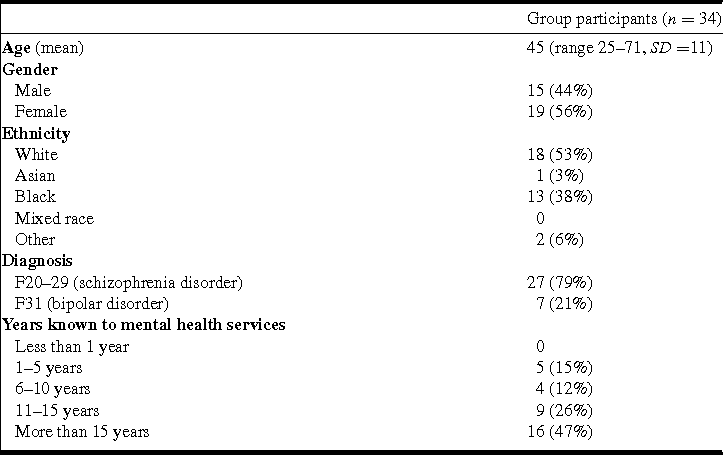
Demographic and clinical characteristics of the participants are shown in Table 1. The majority of participants had a schizophrenia-spectrum diagnosis. There was a range of length of time participants had been using mental health services. Almost half of participants had been known to services for over 15 years (47%), which reflects the longer-term nature of the difficulties these service users experienced. The ethnic mix of participants reflected the ethnically diverse communities served by the local NHS trust, with 47% of participants coming from a black or ethnic minority background. Participants attended a mean average of 5.5 out of eight sessions (range 1‒7). Although explicit permission to either stop a session or leave a session early if needed was given, no participant ever walked out of a session, or left early.
Participant demographic and clinical characteristics

Stress and distress ratings
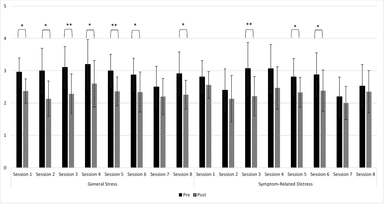
As shown in Fig. 1, the mean average rating for stress and distress lay between 2 and 3 for most sessions, only exceeding 3 for pre-ratings in sessions 3 and 4. As higher scores indicated greater severity on the scale used (1‒5), this indicated a medium level of stress and distress. As the average scores for the group were in the middle of the scale, there was no evidence of an overall ceiling or floor effect. However, this may still have been a factor on an individual basis, for people who either experienced either very high or low levels of perceived stress or distress. Participants used the full range of the scale in most sessions (Table 2 in Supplementary Material).
Mean stress and distress scores pre‒post group by session (error bars: 95% confidence interval). *p < 0.05, **p < 0.01.

Visual inspection of the data showed there was a decrease in general stress, and symptom-related distress, across all sessions (Fig. 1). A Wilcoxon signed rank test showed there was a statistically significant reduction in stress for sessions 3 and 5, and for distress for session 3 (p < 0.01; Table 2 in Supplementary Material). In line with our hypotheses, there was no mean increase in stress or distress for any session.
Discussion
The aim of the study was to assess the short-term impact of taking part in a mindfulness for psychosis group session, using within-session measures of effects on general stress, and symptom-related distress. Data from an 8-week community group programme indicated significant benefits of engaging in a mindfulness for psychosis session for people with psychotic symptoms. Average ratings of general stress and symptom-related distress decreased from pre‒post session, although not all observed differences were statistically significant. Another key finding was that there was no observed increase in ratings of stress or distress from psychotic symptoms across any session.
These findings are consistent with the results of a small but growing number of mindfulness for psychosis RCTs, which have found no evidence of any adverse events linked to meditation practices. Despite the growing evidence base in the area, clinicians in everyday clinical practice often remain concerned about the appropriateness of mindfulness for psychosis for people experiencing active psychotic symptoms (Chadwick, Reference Chadwick2014). This may be due to unfounded concerns that mindfulness meditation would somehow lead to the person becoming ‘lost’ in psychotic symptoms, or that a focus on symptoms such as voices or paranoid voices as they rise in awareness, is unhelpful as it might increase pre-occupation with such experiences. These concerns often arise from a misunderstanding of how mindfulness-based approaches work. Chadwick's model of mindfulness for psychosis is very clear in its intentions and adherence to the underlying attitudinal qualities of mindfulness practice, which include non-judging, acceptance and letting go (Kabat-Zinn, Reference Kabat-Zinn2005). In this way, we are inviting people with psychotic symptoms to recognize, and step out of, habitual reactions of avoidance or entrenchment which often underpin distress and impairment associated with psychotic symptoms, rather than perpetuating such patterns. Appropriate adjustments are also made to accommodate the needs of the particular clinical group. For example, more frequent guidance that includes reference to psychotic experience helps to provide a firm anchor to the here-and-now for people who may be experiencing intense or frequent voices.
A particular strength of the study reported here is that it took place in the often unpredictable context of frontline clinical services in South London, a demographically diverse area with high rates of psychiatric morbidity. The participants reflected the local population both in terms of demography and morbidity, which provides evidence that these interventions are an acceptable adjunct to routine care in NHS Mental Health Trusts. As encouraging as these results are, we would also sound a note of caution that the data presented here are taken from a group therapy delivered by clinical psychologists highly experienced in working with psychosis, who had also undergone substantial additional training as mindfulness teachers, and were in receipt of specialist mindfulness supervision. We recognize that mindfulness for psychosis, like any other therapy, can only be delivered with fidelity if practitioners are appropriately trained and supervised. Therefore, challenges remain in wider dissemination in the NHS in terms of training more clinicians to competency in the approach, as with other mindfulness-based therapies (Rycroft-Malone et al., Reference Rycroft-Malone, Gradinger, Griffiths, Crane, Gibson, Mercer, Anderson and Kuyken2017).
In terms of the limitations of the current study, the ‘bubbles’ scales used were acceptable and understandable to patients with psychosis, who often experience high levels of cognitive impairment due to various factors. However, the use of a non-standard measure does have other limitations, as we do not have full psychometric data on the scale, particularly in terms of construct validity. We deliberately chose to use a self-report measure, as we were interested in participant's subjective ratings of their own experiences. However, it would perhaps be interesting to compare these subjective ratings with another source of data, for example, biological indicators of emotional arousal such as heart rate variability (Lumma et al., Reference Lumma, Kok and Singer2015). The aim of this study was to investigate within-session effects of mindfulness practice. However, the impact on participants of practising mindfulness by themselves between sessions remains unknown. Anecdotally, some participants who took part in our community groups did report practising at home, and no adverse effects were reported. However, we do not have systematic data on rates, types or frequency of home practice in this sample. This is a very important issue to investigate further, as frequent home practice has been linked to better outcomes in mindfulness for depression studies (Crane et al., Reference Crane, Crane, Eames, Fennell, Silverton, Williams and Barnhofer2014). Further work is needed to highlight both facilitators and barriers to home practice for people with psychosis. It would also be helpful to know more about the factors that might affect an individual's experience of a particular group session – for example, how do pre- and post-measures relate to frequency of voices or paranoia.
Finally, in terms of other further research, there is a clear need to extend these findings by looking at within-session effects of mindfulness for psychosis in acute settings, where mode of delivery is by necessity adapted to the needs of participants experiencing a current crisis (see Jacobsen et al., Reference Jacobsen, Peters and Chadwick2016).
In conclusion, using an adapted mindfulness protocol for people experiencing psychotic symptoms, delivered by appropriately qualified and experienced therapists, we found no indication of any harmful effects. We observed an indication of potential positive effects on general stress and symptom-related distress, which would warrant further testing within a larger sample, ensuring adequate statistical power.
Conflicts of interest: The authors declare they that have no conflicts of interest with respect to this publication.
Financial support: This research received no specific grant from any funding agency, commercial or not-for-profit sectors.
Ethical standards: The authors assert that all procedures contributing to this work comply with the ethical standards of the relevant national and institutional committees on human experimentation and with the Helsinki Declaration of 1975, and its most recent revision.
Supplementary material
To view supplementary material for this article, please visit https://doi.org/10.1017/S1352465818000723




Comments
No Comments have been published for this article.