Why do similar regimes tend to crop up in the same areas of the world? Efforts to explain this phenomenon have often focused on institutional diffusion through factors such as state-elite interactions and citizen protests (e.g., Elkink Reference Elkink2011; Gleditsch and Ward Reference Gleditsch and Ward2006; Cederman and Gleditsch Reference Cederman and Gleditsch2004; Weyland Reference Weyland2010; Wejnert Reference Wejnert2005). More recent research has demonstrated that governmental practices are often spread by specific groups. For instance, Woodberry (Reference Woodberry2011) and Hariri (Reference Hariri2012) have shown how Protestant missionaries and European settlers, respectively, had a positive influence on the spread of representative government outside of Europe. However, even though political representation initially developed in medieval Europe, much less is known about how these practices first diffused across the Latin west (Stasavage Reference Stasavage2016; Finer Reference Finer1997; Pitkin Reference Pitkin1967; Pocock Reference Pocock1975; Skinner Reference Skinner2002; Manin Reference Manin1997). In this article, I examine the spread of representation in Europe between 1200 and 1800 and provide evidence that a specific religious order—the Dominicans—played an important role in this regime diffusion.
The Dominican order is a Catholic monastic order that was established in 1216. Its structures of internal government were based on the Roman law notion of plena potestas, which implied that a community could elect a representative to make binding decisions on their behalf. Although the order did not invent this idea, they developed the most extensive practice of representative government in the high Middle Ages (Finer Reference Finer1997, 1030). I argue that the Dominican order provided a model of representative government, which could be emulated by local secular elites, thus facilitating regime change in European cities that housed Dominican monasteries. To apply this argument empirically, I employ a new dataset on the presence of Dominican houses in medieval cities.
Using a difference-in-difference design, I find that representative institutions were more likely to emerge when the Dominican order was present in a city. Previous research on the causes of urban regime change have highlighted the role of the Church in general (Møller Reference Møller2018; Belloc, Drago, and Galbiati Reference Belloc, Drago and Galbiati2016; Tabacco Reference Tabacco1989; Post Reference Post1964), the lack of central authority (Dutaillis Reference Dutaillis1978; Stasavage Reference Stasavage2016; Blockmans Reference Blockmans1978), warfare (Levi Reference Levi1988; Tilly Reference Tilly2003; Bates Reference Bates2010; Dincecco and Wang Reference Dincecco and Wang2018), and the revitalization of trade and proto-industry (Wahl Reference Wahl2015; Abramson and Boix Reference Abramson and Boix2019). I show that none of these alternative explanations can account for my results.
Furthermore, I test three more specific observable implications of my argument. First, that the Franciscan monastic order, which appeared simultaneously with the Dominicans, did not foster secular regime change in the same way. Second, that the effect of the Dominicans dissipated after the order autocratized in the fifteenth century. Third, that cities located close to other cities that housed the Dominican order, were not more likely to transition to representative government, as persistent interaction between city elites and Dominican friars was unlikely. All three implications are confirmed.
I thereby make three sets of contributions to the vast but growing literature on European state formation and regime change. First, as emphasized by several generations of research, the spread of medieval urban representation is crucial to understanding broader patterns of European state formation (Poggi Reference Poggi1978; Bartlett Reference Bartlett1993; Ertman Reference Ertman1997; Tilly Reference Tilly2003; Spruyt Reference Spruyt1994; Stasavage Reference Stasavage2011, Reference Stasavage2014, Reference Stasavage2016; Dincecco and Wang Reference Dincecco and Wang2018). The presence of many different local elite groups, including townsmen organized around urban assemblies, forced European state leaders to bargain with their subjects in exchange for revenue to wage war. In contrast, rulers in much less politically fragmented areas, such as China, could circumvent local lords and raise revenue without having to give up political influence (Ertman Reference Ertman1997, 28-34; Downing Reference Downing1989; Møller Reference Møller2014; Stasavage Reference Stasavage2016, 154-157; Dincecco and Wang Reference Dincecco and Wang2018, 342-343). For example, Angelucci, Meraglia, and Voigtlander (2020) document that urban representation in England played a key part in defending parliament during the Civil War of 1642 and in supporting the extension of the franchise in 1832. Nonetheless, recent research on the spread of representation has focused almost entirely on territorial assemblies in, for instance, the Iberian Peninsula and England (see Stasavage Reference Stasavage2010; Møller Reference Møller2017, Reference Møller2018; van Zanden, Buringh, and Bosker Reference van Zanden, Buringh and Bosker2012; Blaydes and Chaney Reference Blaydes and Chaney2013; Boucoyannis Reference Boucoyannis2015). As a consequence, attempts to explain how urban representative institutions emerged and spread have been rare. I address this gap by focusing attention on the diffusion of representation at the urban level.
Second, recent research has argued that the spread of representation in Europe cannot be accounted for without the Catholic Church (Møller Reference Møller2018; Grzymala-Busse Reference Grzymala-Busse2020). The finding that the Dominican order spread urban representation confirms this insight, but it also expands it by showing that the Church influenced political regime change not only via state-level territorial assemblies but also through its effect at the urban level.
Finally, my results illustrate how societal actors can spread political practices by providing an example that can be imitated. This finding contributes to the literature on regime diffusion, which has often failed to specify the actors actually responsible for spreading certain institutions or ideas (e.g., Wejnert Reference Wejnert2005; Leeson and Dean Reference Leeson and Dean2009; Weyland Reference Weyland2010; Elkink Reference Elkink2011). The results also add insights to the literature on the impact of civil society on political regimes, which due to data constraint has not been able to distinguish between the organizational make-up of societal actors when examining their effect (e.g., Bernhard et al. Reference Bernhard, Jung, Tzelgov, Coppedge and Lindberg2017; Beichelt et al. Reference Beichelt, Hahn-Fuhr, Schimmelfenning and Worschech2014; Bell, Clay, and Murdie Reference Bell, Clay and Murdie2012; Hadenius and Uggla Reference Hadenius and Uggla1996).
The article proceeds as follows. I first expand on what I seek to explain, namely the spread of representation in medieval Europe. This is followed by a short primer on the history of the Dominican order. I then develop my argument about why the Dominicans fostered lay representation in this period in particular, and apply this argument using a dataset comprising 325 cities in the period 800–1800. The final section concludes.
Representation in Medieval Europe
Between 1100 and 1200, the Latin west developed a set of unique practices of political representation, based on two core components. First, societal groups could send a representative who was competent to make binding decisions on their behalf. Second, that those who govern should have the consent of the subjects touched by their decisions (Stasavage Reference Stasavage2016; Manin Reference Manin1997; Pitkin Reference Pitkin1967).
Representative government appeared in both cities and larger territorial states. Besides the general importance of urban self-government for European state formation mentioned above, there are two more specific advantages of focusing on the development of representative government in cities. First, practices of representation were most highly developed in cities (Stasavage Reference Stasavage2016, 147). Second, the rights of both ruler and ruled were primarily constituted and contested at the local level during the Middle Ages (Blickle Reference Blickle1997, 3-4; Sabetti Reference Sabetti2004, 74-77; Møller Reference Møller2017, 196). This is especially true for the politically fragmented Holy Roman Empire, which is the main empirical context under study.
An urban representative assembly is understood in a broad sense as an institution within a small polity that has the right to regulate at least one core policy area, such as taxation, judicial affairs, and defense. In addition, the institution must be constituted of inhabitants from the city in question who are chosen by the citizens (or parts of the citizenry) (Stasavage Reference Stasavage2014, 342).Footnote 1
Before the emergence of urban assemblies, cities were usually ruled by either a lord, bishop or abbot, who had the final say in all policy decisions. These rulers extracted taxes and tolls, and sometimes used the citizens as soldiers. Transitions to representative city government usually occurred in two ways: citizens attempted to take control of government during opportune moments where their ruler was either dead (as happened in the duchy of Brabant in 1261), or away on business (as happened in Cambrai in 1076); alternatively, the citizens and their lord negotiated a deal, where the cities gained self-rule in exchange for providing revenue. This deal was, for instance, struck between the citizens of Wismar and the Count of Holstein (Uytven and Blockmans Reference Uytven and Blockmans1969, 403; Poggi Reference Poggi1978, 36-59; Bartlett Reference Bartlett1993, 106-132; Arnold Reference Arnold2009, 173-176; Holland Reference Holland2019, 213).
There is a large literature that attempts to explain these developments (see Stasavage Reference Stasavage2011, 96-106). The two most influential explanations are the “bellicist” literature, which argues that the cost of warfare has driven rulers to bargain revenue for representation (Levi Reference Levi1988; Tilly Reference Tilly2003; Bates Reference Bates2010), and the “endowment” literature which argues that a revitalization of trade and proto-industry strengthened the bargaining position of urban centers vis-à-vis their rulers, which allowed them to gain political influence (Wahl Reference Wahl2015; Abramson and Boix Reference Abramson and Boix2019). In the empirical strategy section, I elaborate on how I eliminate these alternative explanations.
The first large wave of transitions to representative city government took place between 1100 and 1200, mostly in Italy, and to a lesser extent Southern France. In the sample of Northern Italian cities studied by Belloc, Drago, and Galbiati (Reference Belloc, Drago and Galbiati2016), all the cities that renounced autocratic rule did so before 1239. As the Dominican order was founded in 1216, it was unlikely to have played a role in this first wave. Footnote 2
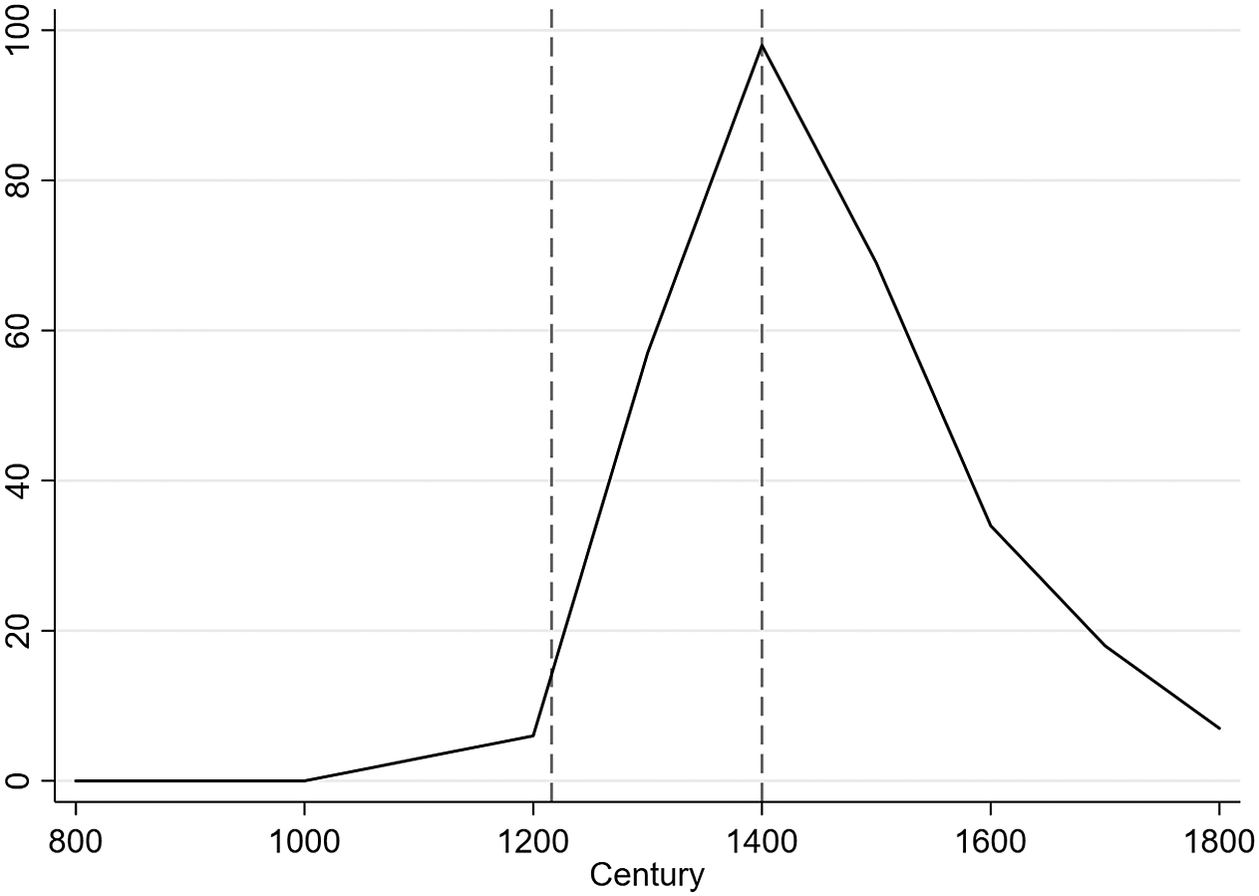
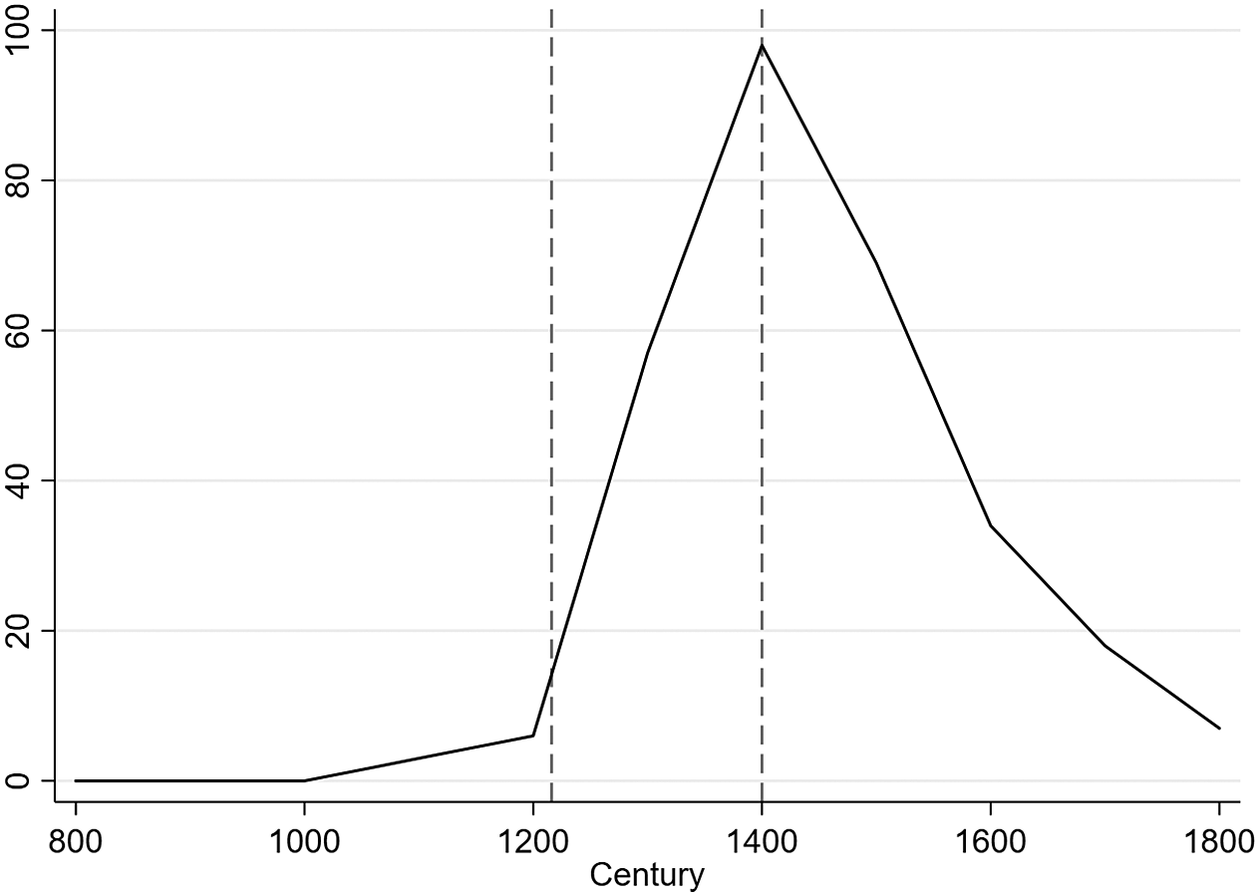
However, I focus not on the initial emergence of representative city government, but rather on its later diffusion across Central Europe. Figure 1 uses data from Wahl (Reference Wahl2016b) to plot the development in the number of cities that transitioned to representative government in the Holy Roman Empire. The spread of urban representative government in the two centuries after 1216, which is marked by the dashed lines in figure 1, is the subject of this article. It encompasses cities in the former Holy Roman Empire, which are located within contemporary Germany, Austria, France, Belgium, Poland, and the Netherlands. I propose that the Dominican order was a crucial driver of the diffusion of representative governance in these areas.
Number of cities that transition to representative government
Source: Based on the Election, Institutionalized Burgher Repres and Guild Participation Index variables from Wahl (Reference Wahl2016b).
The Dominican Order and Representation
The Dominican order took its name from Dominic, who founded it in 1216. The order was ruled by a chapter general and a master general. The master general was elected by the provincial priors and two friars from each province. The chapter general was made up of assemblies, composed of either delegates from each province or provincial priors. The priors were chosen via election by the friars of each convent. The territorial provinces were ruled by a provincial chapter, which was made up of two priors and two friars from each community. These representatives were chosen via elections. The integrity of these elections was taken seriously, as the chapters ensured that no friar was deprived of his vote. Thus, from top to bottom the order was ruled by a system of representatives (Tunmore Reference Tunmore1941, 482-83; Hinnebusch Reference Hinnebusch1965, 217-232; Lawrence Reference Lawrence1994, 82-83; Finer Reference Finer1997, 1031).
Each representative in the order possessed plena potestas. This meant that the delegate was able to litigate, accept a sentence, and negotiate settlements or even judge on behalf of the community that had elected him. Indeed, all of this could be done without consulting his constituents as long as it fell within his original mandate as a representative (Showalter Reference Showalter1973, 561-62; Tierney Reference Tierney and Davis1995, 86; Post Reference Post1964, 94, 109-10). Consequently, although the Dominican order did not invent representation, it developed the most extensive practice of representative government in medieval Europe (Lawrence Reference Lawrence1994, 82; Tierney Reference Tierney and Davis1995, 83; Finer Reference Finer1997, 1030-31). In contrast to Francis of Assisi, who founded the contemporary Franciscans, Dominic was not a charismatic leader. Consequently, he had to rely on organizational skill to secure his order. Using previous ideas concerning representation, he managed to construct a new constitutional arrangement that was unparalleled in its use of representation (Prudlo Reference Prudlo2010, 1277).
However, the order did not retain this structure over time. Beginning in the late fourteenth century, the chapters stopped meeting annually, and the Pope increasingly interfered with elections. Following its increased focus on the Inquisition, the order’s system of government became progressively more autocratic, as power was concentrated in the hands of a small elite (Hinnebusch Reference Hinnebusch1965, 240-42; Gailbraith Reference Gailbraith1923, 190-91; Showalter Reference Showalter1973, 565-66).
Conditions of Diffusion
Diffusion denotes the spread of practices within a social system, whereby a receiver, in this case a city government, takes up a practice from a source, here the Dominican order (Wejnert Reference Wejnert2005, 55).
Beginning with Barker (Reference Barker1913), it has been argued that the representative practices of the Dominican order provided a model for national parliaments.Footnote 3 What I argue in this article is that the Dominican order had a much more forceful effect on practices of representation at the urban level. In the following, I outline the conditions under which representative practices are likely to diffuse between organizations, and, on this basis, argue that practices of representation are likely to have been transmitted to secular urban elites from the Dominican order.
I follow Weyland (Reference Weyland2008, 289-296) in arguing that the likelihood that organizational practices diffuse between political units is determined by two factors: first, the demand for institutional change among the adopters (in this case townsmen); second, the external supply of institutions on which to model change. In terms of demand, the collapse of the Carolingian empire, with its strong exercise of royal or public authority, in the ninth century propelled cities to establish informal assemblies to protect themselves against lordly repression, and to press their interests—what has been termed the communal movement (Reynolds Reference Reynolds1997, 164-165; Finer Reference Finer1997, 954). This created a demand for institutions that could effectively organize the collective interests of the citizens. This was no easy matter, as conflict was rife in many of the newly formed assemblies. They saw frequent revolts perpetrated by dissatisfied citizens (Finer Reference Finer1997, 956; Casagrande Reference Casagrande, Andrews and Pincelli2013, 195; Wahl Reference Wahl2015, 2-3; Lawrence Reference Lawrence1994, 177). Thus, by the thirteenth century many towns across Europe had an acute demand for institutional change.
Adopters do not, however, simply pick among the total supply of institutions. When faced with demands for institutional change, policymakers (in this case urban elites) search for external organizations that can provide an easy solution to their problem. In particular, adopters look for information that is readily available, implying that organizations in the immediate vicinity of towns are much more likely to serve as inspiration. The same is true for organizations that are highly visible in the townscape. Adopters are also disposed to focus on recent cases, thus looking excessively at contemporary sources that demonstrate organizational success (Wejnert Reference Wejnert2005, 56; Weyland Reference Weyland2008, 291-292; Gilovich, Griffin, and Kahneman Reference Gilovich, Griffin and Kahneman2002).Footnote 4
These arguments give rise to two expectations concerning institutional diffusion in medieval cities. First, that townsmen are more inclined to adopt institutional ideas from organizations that are present and visible in the cities. Second, that townsmen are more likely to adopt institutional ideas from organizations that have recently exhibited their prowess. These points hold a fortiori for medieval Europe where travel and communication across distances were difficult (Stasavage Reference Stasavage2010).
Based on this, political and economic elites are more likely to initiate a regime change if they are located near, and often interact with, actors that expose them to alternative organizational practices. Since it was expensive to travel long distances in medieval Europe, geographical proximity largely dictated links between city elites.Footnote 5 As a result, an urban presence was necessary for the diffusion of the Dominican order’s representative practices.
As opposed to the earlier Benedictine monks who preferred rural seclusion, the Dominican order had an eye for cities with an active scholarship, culture, and commerce. The first and second factor satisfied the order’s interest in intellectual pursuits, while the third entailed a number of benefits for the order. Wealthy merchants could provide economic support for the order in exchange for religious services. Additionally, the proliferation of commerce provided a marketplace where the order could find an audience (Lawrence Reference Lawrence1994, 72, 80, 102-3; Garcia-Serrano Reference Garcia-Serrano1997, 23-25; Zaldivar Reference Zaldivar2012, 175; Hinnebusch Reference Hinnebusch1965, 120-22, 279). As a consequence, the presence criterion which is required for institutional diffusion was certainly fulfilled with regards to the Dominican order.
However, while spatial closeness enables interaction it does not in itself ensure that the source is visible to the adopter. This requires persistent and continuous interactions between organizations, in order to establish dependable relationships. Research on social contact shows that continuous interaction is more probable between similar individuals (e.g. Verbrugge Reference Verbrugge1977; Currarini, Jackson, and Pin Reference Currarini, Jackson and Pin2010; Centola and van de Rijt Reference Centola and van de Rijt2015; McPherson, Smith-Loving, and Cook Reference McPherson, Smith-Loving and Cook2001). The diffusion of representative practices was thus more likely if members of the Dominican order were akin to the elites of medieval cities, as this would have made frequent interaction more likely.
The ideal Dominican friar, in the eyes of the order’s founder, was well-educated and competent to either elect or serve as a representative within the order. The order even boasted that they valued intellectual engagement on a par with religious exercises in the pursuit of spiritual growth. Consequently, the order primarily accepted and attracted men who were well versed in canon law or theology—in other words, university men. These admission criteria naturally resulted in a membership mostly comprised of men from wealthy families (Showalter Reference Showalter1973, 561, 566-67; Lawrence Reference Lawrence1994, 69, 72-75; Hinnebusch Reference Hinnebusch1965, 282-87). Historical evidence shows that the Dominican order was quick to establish relations with both the middle and upper classes of nearby cities (Powell Reference Powell2008, 566-68; Stanford Reference Stanford2005, 187-188). Moreover, the Dominicans also formed close relations with merchants by legitimizing commerce in exchange for donations or using the marketplace as a location for preaching (Garcia-Serrano Reference Garcia-Serrano1997, 3, 24; Zaldivar Reference Zaldivar2012, 189-91). The Dominicans were therefore often in close contact with both the political and economic elites of cities (Lawrence Reference Lawrence1994, 166-81), which made the order highly visible in the townscape.
In addition, because Dominican convents often had large meeting rooms that were considered neutral and prestigious gathering places they were favoured for hosting large secular meetings, such as council and guild meetings or even trials (Jakobsen Reference Jakobsen2008, 204-214). This meant that the Dominican order was present and visible during policy discussions. For example, the convent in Barcelona hosted the city’s council meetings in the latter part of the thirteenth century (Zaldivar Reference Zaldivar2012, 178, 183-88, 203). Similarly, the town of Macon held its assemblies in its Dominican convent (Röhrkasten Reference Röhrkasten and Trio2006, 135).
Moreover, members of the order often performed administrative tasks for the lay government, which further ensured interaction between members of the order and political elites. There were a number of reasons why Dominican friars were attractive as administrators in the eyes of secular rulers. First, they were largely disinterested in personal wealth and patronage. They were also highly educated, well versed in many languages, and they had international contacts (Lawrence Reference Lawrence1994, 173-75; Bonacini Reference Bonacini, Andrews and Pincelli2013, 116-118; Casagrande Reference Casagrande, Andrews and Pincelli2013, 184, 187-88, 194; Pincelli Reference Pincelli, Andrews and Pincelli2013, 127; Zaldivar Reference Zaldivar2012, 201). This made the order highly visible to the urban elite. It also served to illustrate the order’s organizational prowess.
The organization of the Dominican order was highly regarded within the Church, and it later became the model for new foundations (Gailbraith Reference Gailbraith1923, 25). Their organizatorial success was not limited to the ecclesiastical sphere. As described earlier, their administrative skills were sought after in the secular government. For example, the introduction of self-government had led to serious conflict in several Italian cities. To secure peace Dominican friars took control of the government and rewrote their statutes and laws (Thompson Reference Thompson1992, 24; Prudlo Reference Prudlo2011, 201; Prudlo Reference Prudlo2010, 1278). This indicates that urban elites saw the order as an organizational success.
Supporting this, the order often functioned as arbiters of conflict during times of political crisis (Casagrande Reference Casagrande, Andrews and Pincelli2013, 195; Lawrence Reference Lawrence1994, 177). An example of this comes from Cologne. For much of the middle ages the city was ruled by its archbishop. However, during the thirteenth century its citizens pressed for political influence. In these conflicts the Dominican prior, Albertus, acted as a mediator. In the “little” arbitration of 1252 and in the “grand” arbitration of 1258 he counseled the archbishop to recognize the citizens’ demand for influence. The archbishop did not give in to these demands. Still Albertus continued to champion the interests of the citizens, who in the end were successful in gaining political representation (Stehkämpler and Dietmar Reference Stehkämpler and Dietmar2016; Heusinger Reference Heusinger, von Heusinger, Füllenbach, Senner and Springer2016, 13).
A final, more direct way that the order could demonstrate their organizational capabilities was the order’s own provincial and general chapters. These were often attended by important outsiders, who were then able to observe the practice of representation (Jakobsen Reference Jakobsen2008, 213).
A further example that illustrates the perception of Dominican organizational success is the city of Perugia. When the leader of the city was up for election in 1260, two friars from the Dominican order were entrusted with administering the election. In 1303, the city transitioned to a government that relied on guild participation. The Dominican order again acted as administrators during the election of officials (Casagrande Reference Casagrande, Andrews and Pincelli2013, 182-83, 189-90).
I argue that the direction of diffusion primarily runs from the Dominican order to secular elites, for three reasons. First, the organizational structure of the order was determined by Dominic at the foundation of the order, and it was subsequently centrally dictated (Prudlo Reference Prudlo2010, 1277). While there is no documentation that Dominic got the initial idea of using representatives from Pope Innocent III’s Fourth Lateran Council in 1215,Footnote 6 he received considerable support for his new order and its organizing principle from the Pope and the Church hierarchy (Showalter Reference Showalter1973, 560). Second, the order was a highly successful organization that managed to cover most of Europe within 30 years. Thus, the order had a low demand for institutional change. Third, in comparison, contemporary kings, lords, and bishops had trouble controlling much smaller pieces of territory. Similarly, even the larger city states often controlled no more than a few other cities in their immediate surroundings (Johanek Reference Johanek and Hansen2000). Thus, even if the Dominican order had a demand for institutional change, it is unlikely that it would perceive lay political institutions as successful examples worth emulating.
In order for diffusion to occur, it is necessary that the source actually demonstrates the practice to the receiver. As the Dominican order autocratized in the late fourteenth century (Hinnebusch Reference Hinnebusch1965, 240-42; Gailbraith Reference Gailbraith1923, 190-91; Showalter Reference Showalter1973, 565-66), they were no longer able to provide an example of successful governance for secular elites after this point in time. Thus, it is unlikely that the order facilitated lay representative government from the fifteenth century onwards.
The Dominican order was a frontrunner in the Inquisition, which sought to promote Christian orthodoxy, beginning around 1200 (Tavuzzi Reference Tavuzzi2007; Vose Reference Vose2013). This may strike some readers as being at odds with the order’s use of political representation. However, as elsewhere in medieval Europe representation was simply a means to ensure effective government of the order’s continent-spanning network of monasteries. Thus, no contradiction was apparent between these two institutions at the time.Footnote 7 That representation later became the bedrock of modern democracy is a prime example of a political innovation having unanticipated downstream consequences (see Pierson Reference Pierson2000; Mahoney and Thelen Reference Mahoney and Thelen2010; Stasavage Reference Stasavage2016).
The Dominican order was highly visible in cities, and it was also considered an organizational success by contemporaries. Therefore, I expect that practices of representative government spread from Dominican friars to secular elites, increasing the probability that a city established representative institutions, until the autocratization of the order began in the late fourteenth century. To summarize, I put forth the following empirically testable hypothesis concerning the spread of representation in medieval Europe:
Before the fifteenth century, cities in the vicinity of Dominican houses were more likely to establish representative institutions.
Data
To assess the relationship between the location of Dominican houses and the emergence of local representative institutions, I rely on a dataset that covers medieval cities within the borders that the Holy Roman Empire had around 1500 AD, with city-century as the unit of analysis. To measure representative institutions I construct an indicator based on three variables on city government from Wahl (Reference Wahl2016b). The first indicator is equal to one if a city is governed by a council whose members were chosen to represent groups of craftsmen. The second is equal to one if a city is governed by a council of citizens that includes representatives of different citizen groups. The final indicator is equal to one if the council is governed by members elected by the citizenry. The dataset covers 325 cities from 800 to 1800; their geographical distribution is shown on page 2 in the online appendix. Cities that at least once in the period 800–1800 register more than 5,000 inhabitants are included in the dataset (according to Bosker, Buringh, and van Zanden Reference Bosker, Buringh and van Zanden2013; Bairoch, Batou, and Pierre Reference Bairoch, Batou and Pierre1988). This dataset is used as it provides the best measure of representation in city government. See “Assessing the external validity of the findings” in the online appendix for a more detailed discussion.
The dependent variable, transition it, is equal to one if city i switches to any of the three types of representative government in century t. The city drops out of the sample after its government becomes representative, unless it reverts to an autocratic city government without any type of representatives.Footnote 8 This dataset is used because, to the best of my knowledge, it is the only one that contains information on the presence of representatives in the city government. In my baseline sample, I have 289 transitions to a representative city government.
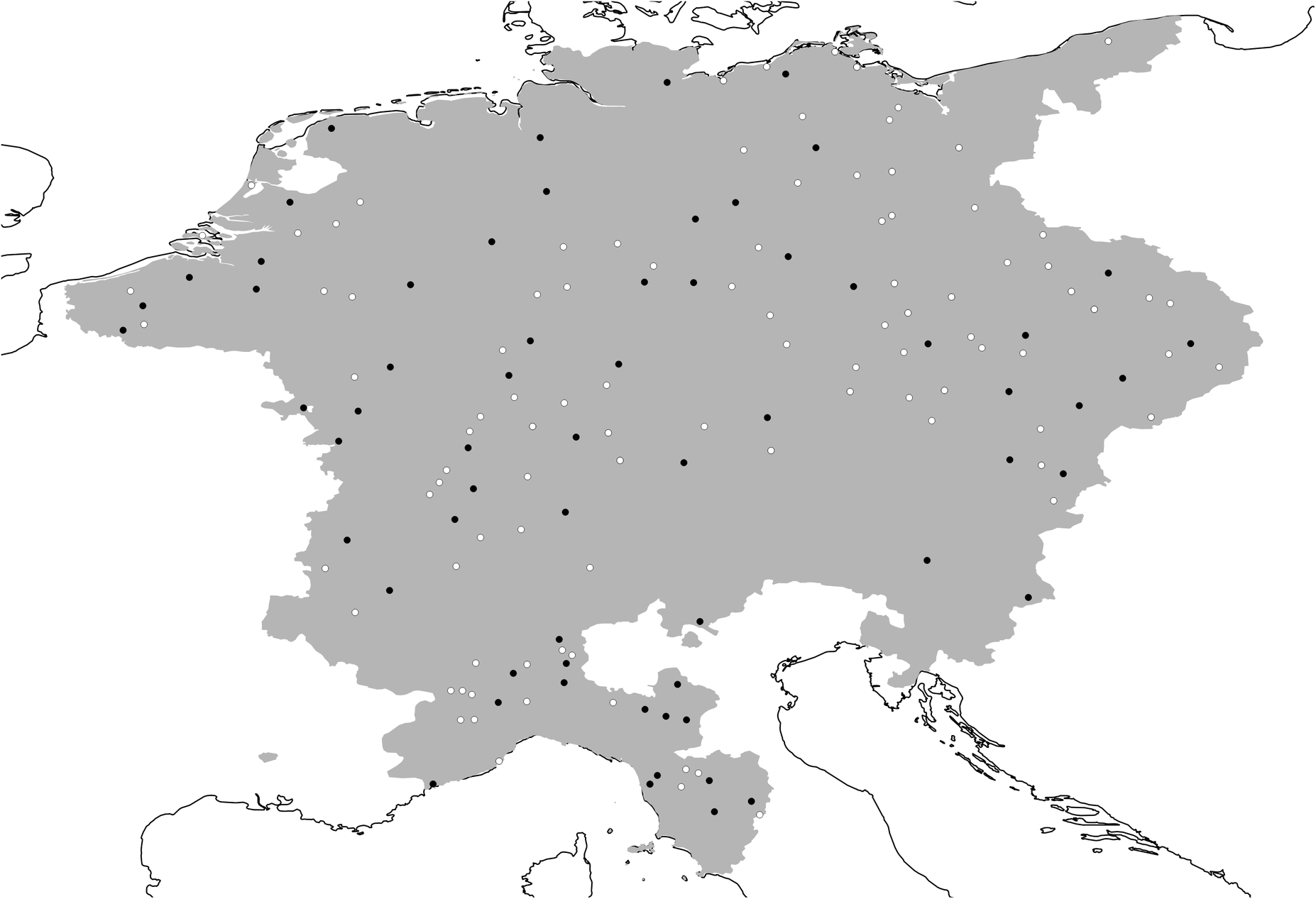
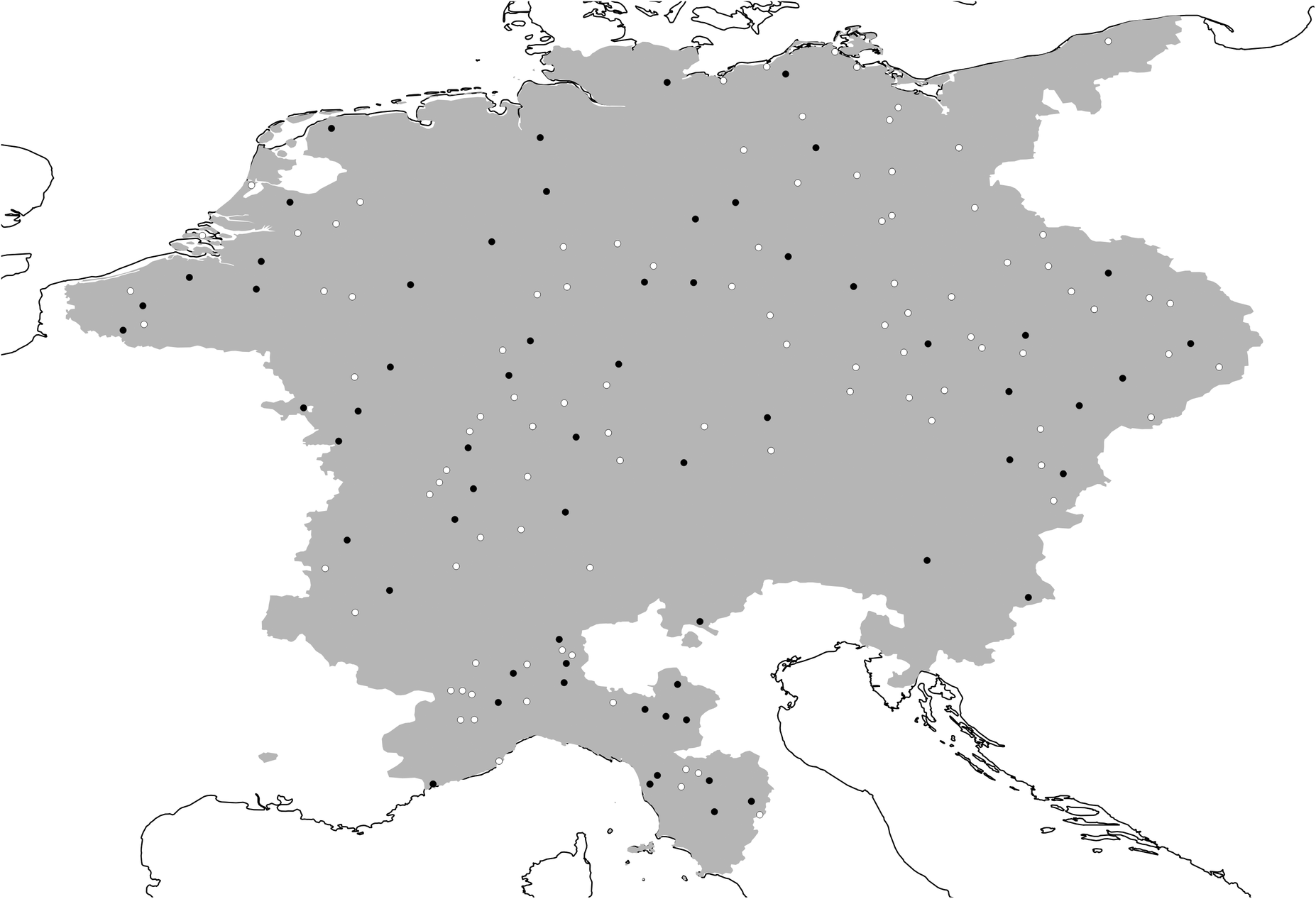
To gauge the impact of the Dominican order, I rely on a map with coordinates and city names for the Dominican houses that were established before 1300 (presented in McCormick, Georganteli, and Moore Reference McCormick, Georganteli and Moore2018; based on Jedin, Latourette, and Martin Reference Jedin, Latourette and Martin1987). I map this on to the cities from Wahl (Reference Wahl2016b). Each match is checked using the klosterdatenbank (GS 2019). Sixty-nine cities fulfill this requirement, and to capture this I construct a binary indicator for the order’s presence, dominicanit. As the order appeared in 1216, this indicator is equal to zero if t<1300. The indicator is equal to one if t=1300, and a house was established before 1250 in city i. It is equal to one if t=1400, and the house was settled between 1216 and 1299.Footnote 9 The indicator is set to zero from t=1500 and onwards, following from the autocratization of the order’s mode of government. The geographical and temporal spread of Dominican cities within the Holy Roman Empire is presented in figure 2.
Dominican houses before 1300
Note: The grey area denotes the approximate territory of the Holy Roman Empire in 1500 AD (Nüssli and Nüssli Reference Nüssli and Nüssli2008). Black circles represent Dominican houses established before 1250. White circles represent houses established between 1250 and 1299.
Empirical Strategy
I analyze the relationship using a variant of the difference-in-difference design. To analyze the effect of the Dominican order on the likelihood of transitioning to representative city government, I employ the following baseline specification:
 $$ transition\_ i\_t=\alpha \_ i+\gamma \_ t+\delta\ dominican\_ i\_t+\varepsilon \_ i\_ t\hskip0.85em (1) $$
The coefficient δ, which is the quantity of interest, captures the effect of having the Dominican order present, while αi and γt are city fixed effects, and century fixed effects, respectively. Finally, εit is the error term. The city fixed effects accounts for any unobserved time-invariant confounders, which impacts both the location of Dominican houses and the likelihood of transitioning to representative city government. For instance, this could be a Roman legacy or an advantageous accessibility. Century fixed effects mitigate time shocks that are common across cities, such as interregnums in the Holy Roman Empire. The coefficient δ can be given a causal interpretation if cities with and without the Dominican order would have followed a similar trend in governance in a counter-factual world without the order. This is also called the common trends assumption (see, e.g., Angrist and Pischke Reference Angrist and Pischke2008). Given the number of fixed effects (and for interpretability), this specification is estimated using a linear probability model (LPM). As a robustness test, the main models are rerun adopting the conditional logit estimator. Standard errors are clustered at the city level. To handle potential spatial correlation of the error term of unknown form, I also present Conley’s standard errors. They allow for spatial correlation that decreases as the distance between cities increases, as well as for temporal correlation (Conley Reference Conley1999; Conley and Molinari Reference Conley and Molinari2007).
The common trends assumption is relaxed in additional models. The Dominican order selected urban centers that were active in terms of culture, intelligentsia, and trade, as their base of operations (Lawrence Reference Lawrence1994, 72, 80, 102-3; Garcia-Serrano Reference Garcia-Serrano1997, 23-25; Hinnebusch Reference Hinnebusch1965, 279). These factors have been linked to the proliferation of representative institutions (see, e.g., Abramson and Boix Reference Abramson and Boix2019; Epstein Reference Epstein and Hansen2000). To mitigate bias stemming from the usage of these selection criteria, I control for a number of potential observable characteristics pertaining to these criteria (βX it).
To account for selection based on economic development and trade, I include a measure for the logged population size based on the Bairoch, Batou, and Pierre (Reference Bairoch, Batou and Pierre1988) dataset.Footnote 10 I also control for a city being a trade center (data from Wahl Reference Wahl2016a), and for being a member of the Hanseatic league (data from McCormick, Georganteli, and Moore Reference McCormick, Georganteli and Moore2018). In order to take selection based on cultural and intellectual activity into account, I include a measure for the logged distance to the nearest university in each century (based on Cantoni and Yuchtman Reference Cantoni and Yuchtman2014). To account for warfare, I follow Dincecco and Onorato (Reference Dincecco and Onorato2016) and control for conflict exposure within 150km of a city (based on conflict data from Dincecco and Onorato Reference Dincecco and Onorato2016; Bosker et al. Reference Bosker, Buringh and van Zanden2013). Dominican houses could have been established in areas where the Church was already strong, thus conflating the effect of the two.Footnote 11 I therefore control for the presence of a bishop or an archbishop using the Catholic compendium of dioceses (Chow Reference Chow2018).
Moreover, given that the first cities governed by representatives emerged before the Dominican order, nearby cities with such a government may have attracted the Dominican order and served as inspiration for other cities (Wahl Reference Wahl2015). Consequently, I control for both the logged distance to nearest city with representative government, and the logged distance to the nearest city that experienced a regime transition in the preceding century. As national assemblies may have inspired city elites, and may correlate with the cultural importance and development of a city (e.g., van Zanden, Buringh, and Bosker Reference van Zanden, Buringh and Bosker2012), I also include an indicator for whether a city was the host of a Reichstag in the preceding century (coded based on Annas Reference Annas2018; Leeb and Lanzinner Reference Leeb and Lanzinner2010; Schweinzer Reference Schweinzer2009; Guba Reference Guba1884; Ehrenberg Reference Ehrenberg1883; Wacker Reference Wacker1882). In additional models, all measures are interacted with century fixed effects, thus allowing heterogeneous effects over time.
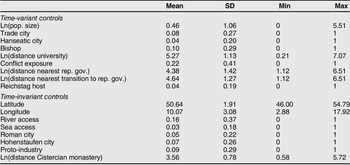
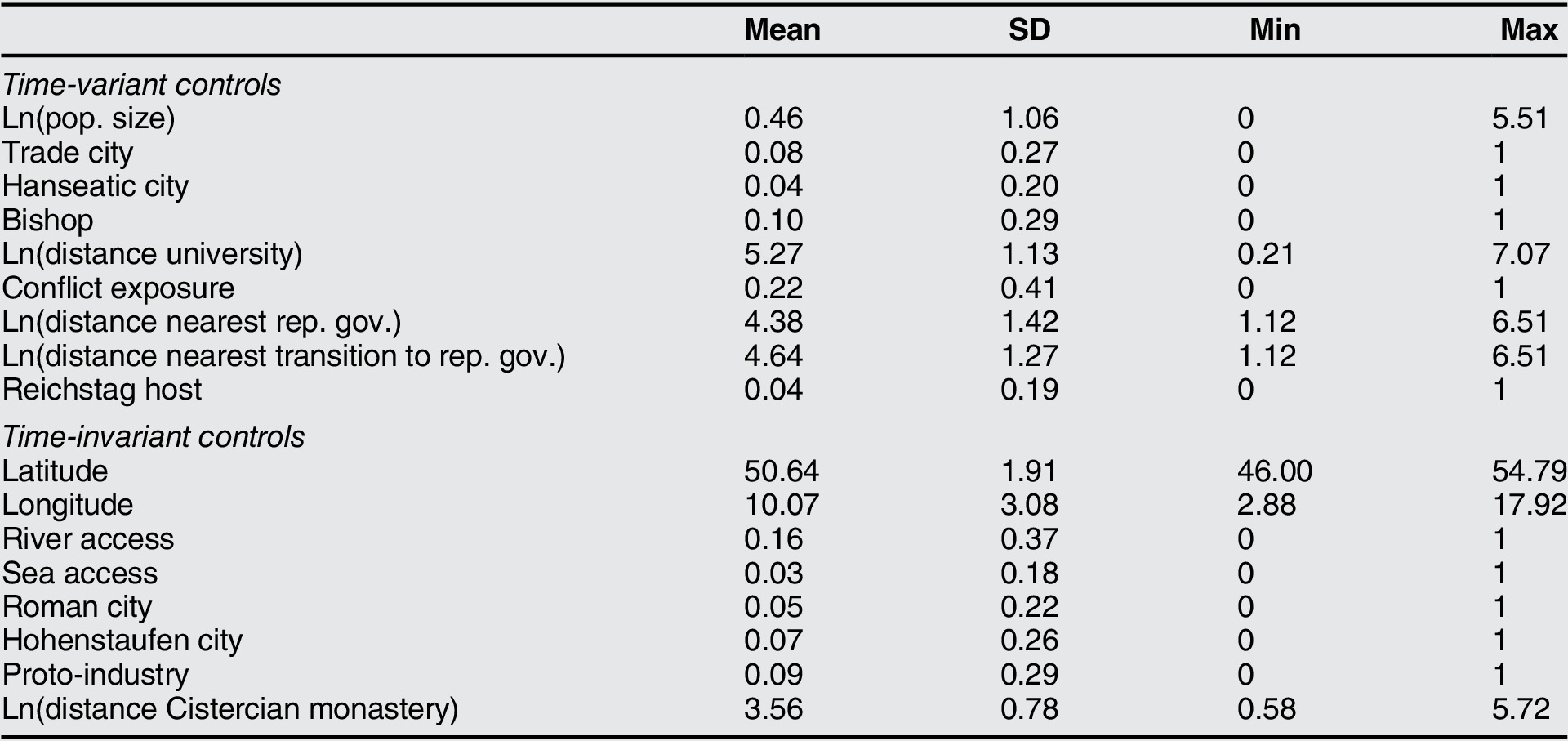
In these models, I also include additional spatial factors that are interacted with century fixed effects to allow for differential effects across centuries. To flexibly control for geographical factors that might affect the location of the Dominican order and a city’s propensity to transition, I control for a city’s latitude and longitude. Trade via waterways was much cheaper during the medieval period. I therefore include an indicator for access to a navigable river and the sea (data from EEA 2018; Patterson and Kelso Reference Patterson and Kelso2018). Having a Roman legacy might also make it more likely that a city introduced representative practices based on Roman law. To account for this, I use an indicator variable for whether a city is located within ten kilometers of a Roman city (data from Hanson Reference Hanson2016). Century fixed effects account for all common time shocks, including the collapse of central authority that followed the great interregnum after the collapse of the Hohenstaufen dynasty in the thirteenth century. However, as this collapse of public power was not felt everywhere—many local princes remained in control of their territories—I add an indicator equal to one if a city belonged directly to the Hohenstaufen emperor before the interregnum (based on Schlunk Reference Schlunk1988). Proto-industry has also been shown to promote regime change (Wahl Reference Wahl2015; Abramson and Boix Reference Abramson and Boix2019); I account for this using an indicator that is equal to one if a city was an important metalworking (based on Nef Reference Nef, Postan and Rich1952; Escher and Hirschmann Reference Escher and Hirschmann2005; Gutmann Reference Gutmann1988; Sprandel Reference Sprandel1968), or textile center (based on Escher and Hirschmann Reference Escher and Hirschmann2005; Carrus-Wilson Reference Carrus-Wilson, Postan and Rich1952; Gutmann Reference Gutmann1988). As the Dominican order’s practices of representation were partly inspired by the Cistercian order (Finer Reference Finer1997, 1031), I control for the logged distance to the nearest Cistercian monastery in 1200.Footnote 12 Descriptive statistics for all control variables are presented in table 1.
Descriptive statistics
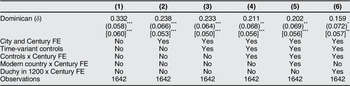
Finally, the common trends assumption is relaxed further, by interacting modern country location with century. Thus, these analyses only look at deviations in governance that cannot be explained by macro changes. However, this might induce post-treatment bias, as the location of modern borders is a result of, among other things, city developments in the period under study. Therefore, I match each city to the duchy it was located within before the appearance of the Dominican order (in 1200, from Nüssli and Nüssli Reference Nüssli and Nüssli2008), and allow each macro unit a differential effect in each century. Examples include Saxony, Swabia, and Meissen. I present my results in table 2.
Difference-in-difference estimates
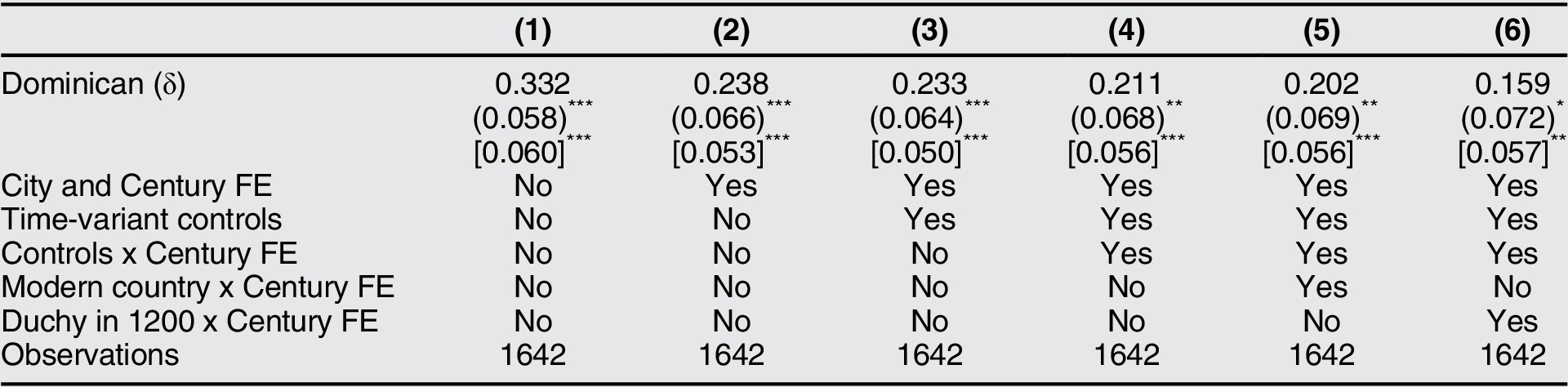
Estimated using OLS. 325 cities. Standard errors clustered by city in parentheses. Conley standard errors in brackets. * p<0.05, ** p<0.01, *** p<0.001
Results
As a preliminary analysis, I run a simple regression of transition to representative city governance on the presence of the Dominican order. The coefficient is shown in Column (1). Here it can be seen that cities in the proximity of the order were 33.2 percentage points more likely to transition, thus confirming my expectation. Yet there is a risk that these observed differences in the likelihood of transitioning are driven by confounding factors or a time trend. I therefore turn to the results from the difference-in-difference models, which are presented in the remaining columns.
The difference in likelihood diminishes when city and century fixed effects are introduced in Column (2). Cities with the Dominican order present are now 23.8 percentage points more likely to transition to representative government. The estimate remains substantially unaltered when controls for city size, bishopric presence, trade, national assemblies, conflict, and distance to the nearest university, representative city government, and city regime change are included in Column (3). The estimate drops slightly to 21.1 percentage points in Column (4), when the aforementioned factors and spatial characteristics are allowed to have a heterogeneous impact across centuries. The coefficient is slightly attenuated when accounting for confounding at the macro-polity level in Column (5) and (6).
How substantial, then, is the impact of the Dominican order? Based on the last model, cities without the order had a 16.7 percentage point chance of switching to representative city government.
In comparison, Dominican cities had a 32.6 percentage point chance of transitioning more than twice as high. This difference is substantively important. Dominican cities that transitioned to representative city government kept these institutions for 4.3 centuries on average. To ensure that these results are not driven by functional form assumptions, I reran the analysis using conditional logistical regression. These models, which are shown in table A4 in the online appendix, confirm my findings. Looking at transitions for the three indicators of city government from Wahl (Reference Wahl2016b) separately, the effect is strongest for burgher and guild assemblies, and weakest for elected councils. However, the relationship is positive for all three indicators, warranting their collapse into one composite indicator. These results are shown in table A5-A7 in the online appendix.
Two additional objections to the results can be raised. First, are the results specific for the German lands? In table A8 in the online appendix, I use a sample of cities that cover the whole of Europe, and find that the Dominicans broadened the scope of participation in city government across Europe. Second, the inclusion of centuries before the appearance of representative city government and centuries after the autocratization of the order may risk artificially depressing the standard errors (Bertrand, Duflo, and Mullainathan Reference Bertrand, Duflo and Mullainathan2004). I therefore rerun all the models from table 2 using a limited sample, which only includes the centuries where representative city government first appeared and the Dominican order was representative (1200–1400). These models, which are shown in table A9 in the online appendix, confirm the earlier findings.
Additional Observable Implications
I argue that the order spread representative government through its own example. However, an alternative interpretation is that my results reflect the Dominican preference for urban centres. To test which interpretation holds up, I compare the order to another contemporary monastic movement—the Franciscans. Like the Dominicans, the Franciscans were an urban mendicant order that spread to many cities across Europe.
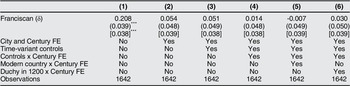
However, their mode of organization did not match the Dominicans with respect to the use of representation.Footnote 13 Using data on the location of Franciscan houses established before 1300 (McCormick, Georganteli, and Moore Reference McCormick, Georganteli and Moore2018; Jedin, Latourette, and Martin Reference Jedin, Latourette and Martin1987), I construct a binary indicator equal to one in t=1300 and t=1400 if a city is within ten kilometers of a Franciscan house.Footnote 14 I reran my main models using this indicator instead. If the alternative interpretation is correct, I would also expect a positive relationship between the Franciscans and representative city government. Conversely, if my argument that representation diffused through the Dominican order’s example is correct, I would not expect any relationship.
Looking at table 3, the model without any controls or fixed effects returns significant results. In all other specifications, however, I find no discernible relationship between the Franciscan order and representative city government. This suggests that it is not the general presence of urban monastic orders that explains my results, but rather the example set by the Dominican order via its representative mode of government.
Franciscans and representation
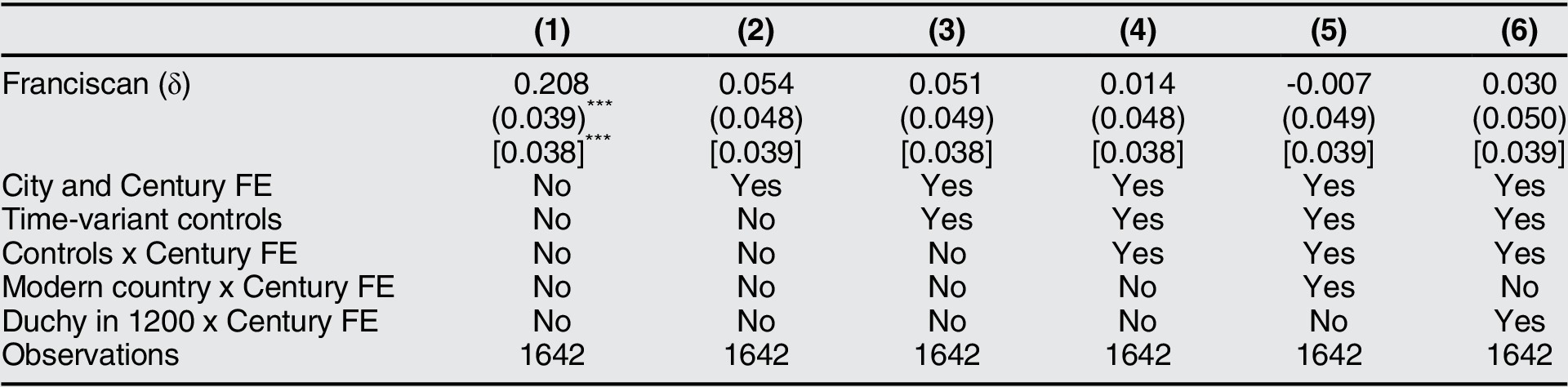
Estimated using OLS. 325 cities. Standard errors clustered by city in parentheses. Conley standard errors in brackets. * p<0.05, ** p<0.01, *** p<0.001
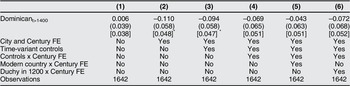
If the order spread representation through its own example, I would furthermore expect the Dominican order to have either no effect or a negative effect on the likelihood of transitioning to representative city government after it autocratized in the late fourteenth century. I test this implication using an indicator for Dominican presence, which is equal to one if the order was present in the city and t>1400. Using this indicator, I reran my baseline models. In support of my argument, I find no positive relationship between this measure and the likelihood of transitioning. Most models even suggest a negative impact. These results are reported in table 4. Cities had few representative role models but many autocratic ones, such as kings, lords, or bishops. This may explain the non-significant impact of the Dominican order after autocratization.
The impact of the Dominicans after autocratization
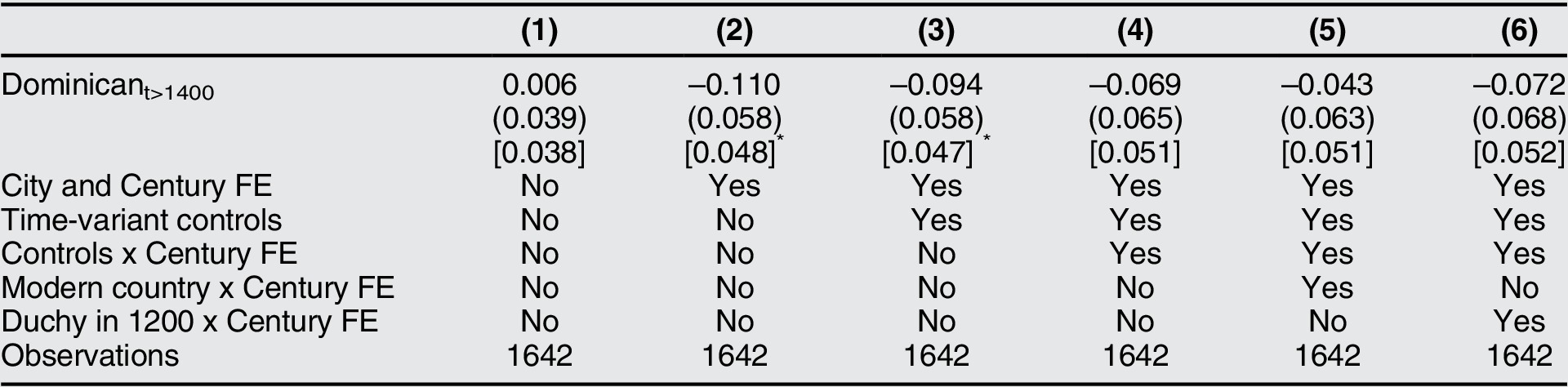
Estimated using OLS. 325 cities. Standard errors clustered by city in parentheses. Conley standard errors in brackets. * p<0.05, ** p<0.01, *** p<0.001
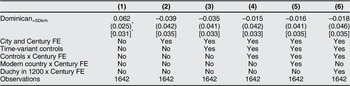
As the diffusion of institutions between source and adopter require that the source visibly demonstrates an institution’s success, it is unlikely that cities, which did not themselves host a Dominican convent, took lessons from the Dominicans. Thus, I would not expect cities that are located close to other Dominican cities to be more likely to transition to representative city government. To test this implication I construct an indicator, which is equal to one if a city is within 50 km of Dominican convent in 1300 or 1400. Table 5 shows the results from rerunning my baseline models with this indicator. In general, there is no discernible relationship between being near another city that hosts the Dominican order and city regime change. This indicates that visibility is crucial for the diffusion of organizational practices.
The impact of being near another Dominican city
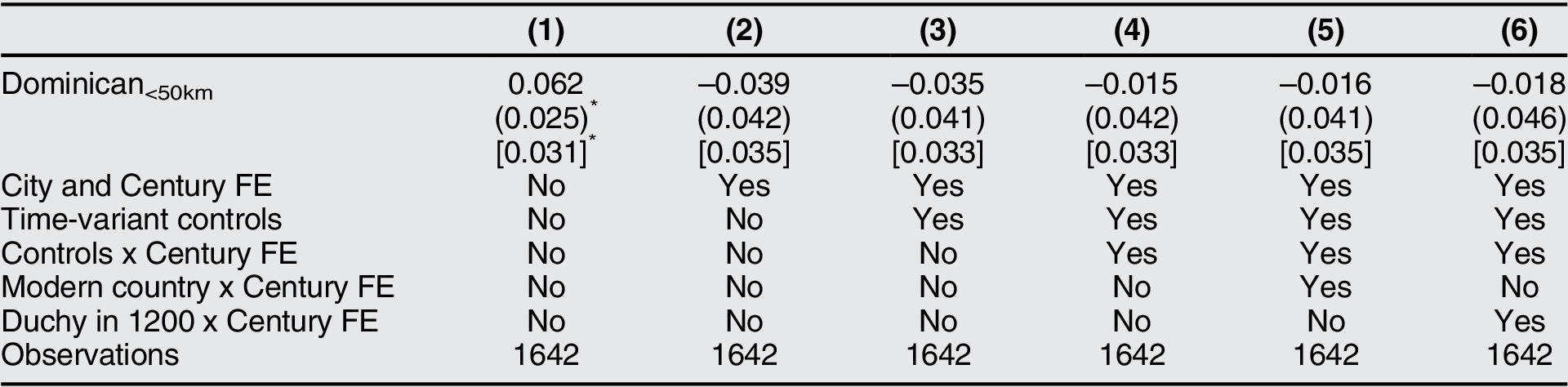
Estimated using OLS. 325 cities. Standard errors clustered by city in parentheses. Conley standard errors in brackets. * p<0.05, ** p<0.01, *** p<0.001
Conclusion
Using a dataset on the form of government in 325 Central European cities during the period 800–1800, I have analyzed the effect of the Dominican order on political change. The analysis shows that the presence of the order increased a city’s likelihood of transitioning from autocratic to representative government. I argue that this pattern reflects the diffusion of representative practices from the order to secular elites. The Dominican order was organized from the base to the top on principles of representation. Local houses often interacted with the economic and political elites of nearby cities, and secular leaders could gain inspiration from the order’s mode of government and introduce representative institutions during times of institutional change.
Further supporting this argument, I have shown that a relatively similar urban monastic order, the Franciscans, did not induce regime change. The Franciscans did not have representative practices that were comparable with the Dominicans, and therefore could not serve as an inspiration for secular regime change to the same extent. Likewise, I find that the Dominican order did not promote representative government after it became autocratic in the late fourteenth century.
The development of urban representative institutions has been singled out as a key factor in European state formation (Poggi Reference Poggi1978; Downing Reference Downing1989; Spruyt Reference Spruyt1994; Ertman Reference Ertman1997; Tilly Reference Tilly2003; Stasavage Reference Stasavage2016; Dincecco and Wang Reference Dincecco and Wang2018; Angelucci, Meraglia, and Voigtlander 2020). However, the causes of the diffusion of medieval urban representation have been overlooked in most prior research. By showing how the Dominicans spread representative institutions across cities, I shed new light on these developments.
The results also demonstrate that societal groups can increase the likelihood that local elites adopt representative institutions by providing an example that can be imitated. This finding contributes to both the literature on regime diffusion, which to date has mainly been concerned with diffusion from one macro regime to another (Weyland Reference Weyland2010; Wejnert Reference Wejnert2005; Elkink Reference Elkink2011), and to the literature on the effect of civil society on political regimes, which, for the most part, has not distinguished between the organizational make up of societal actors (e.g., Bernhard et al. Reference Bernhard, Jung, Tzelgov, Coppedge and Lindberg2017; Ottaway and Carothers Reference Ottaway and Carothers2000; Beichelt et al. Reference Beichelt, Hahn-Fuhr, Schimmelfenning and Worschech2014; Hadenius and Uggla Reference Hadenius and Uggla1996; Bell, Clay, and Murdie Reference Bell, Clay and Murdie2012).
Supplementary Materials
A. Data
B. Alternative Dependent Variables
C. Alternative Estimator
D. Disaggregated Outcome
E. Assessing the External Validity of the Findings
F. Narrow Sample
G. Alternative Independent Variable
H. Inclusion of North-Italian Cities
I. References
To view supplementary material for this article, please visit http://dx.doi.org/10.1017/S1537592720002121.