Introduction
Watermelon is a major fresh market crop in the United States, with 1.49 billion kg harvested at a value of $514 million in 2014 (USDA-NASS 2017). In North Carolina, watermelon is valued at as much as $32 million annually (USDA-NASS 2018). However, weed interference can cause severe reductions in watermelon yield and fruit quality. In bareground watermelon production, failure to control large crabgrass [Digitaria sanguinalis (L.) Scop.], smooth pigweed (Amaranthus hybridus L.), and yellow nutsedge (Cyperus esculentus L.) reduced yield 82%, 70%, and 50%, respectively (Buker et al. Reference Buker, Stall, Olson and Schilling2003; Monks and Schultheis Reference Monks and Schultheis1998; Terry et al. Reference Terry, Stall, Shilling, Bewick and Kostewicz1997). In a polyethylene mulch production system, interference of American black nightshade (Solanum americanum Mill.) caused up to 60% yield loss of marketable fruit, and a mixed population of large crabgrass, common purslane (Portulaca oleracea L.), and yellow nutsedge caused yield loss of 46% (Adkins et al. Reference Adkins, Stall, Santos, Olson and Ferrell2010, MB Bertucci, unpublished data).
Weed management is particularly difficult in watermelon, because the wide spacing of crop seedlings leaves large areas of the field bare early in the growing season, and the vining growth habit of watermelon and sensitivity to mechanical injury limits tillage to the early season (Coolong and Granberry Reference Coolong and Granberry2017; Wilhoit and Coolong Reference Wilhoit and Coolong2013). Transplanting into polyethylene mulch provides excellent control of broadleaf and grass species within planting rows and can result in earlier and increased yields (Lament Reference Lament1993). However, weeds may still emerge from planting holes or between rows, and purple nutsedge (Cyperus rotundus L.) and yellow nutsedge can penetrate polyethylene mulch (Webster Reference Webster2005). Thus, the best weed management practices in watermelon utilize these cultural practices in combination with herbicides (Johnson and Mullinix Reference Johnson and Mullinix2002; Norsworthy et al. Reference Norsworthy, Burgos, Witt, Barrett, Ward, Shaw, Llewellyn, Nichols, Webster and Bradley2012).
Research has documented crop tolerance and effective weed control for several herbicides that are registered for use in watermelon, including clomazone, ethalfluralin, and halosulfuron (Dittmar et al. Reference Dittmar, Monks, Schultheis and Jennings2008; Grey et al. Reference Grey, Bridges and NeSmith2000; Mitchem et al. Reference Mitchem, Monks and Mills1997). Currently, there are 13 federally registered herbicides for use in watermelon production, representing nine modes of action (MOAs) (WSSA Groups 1, 2, 3, 5, 8, 9, 13, 14, 22): clethodim, sethoxydim, halosulfuron-methyl, DCPA, ethalfluralin, trifluralin, terbacil, bensulide, glyphosate, clomazone, carfentrazone, paraquat, and metam-sodium. Others, such as S-metolachlor, have Section 24(c) special local needs registration for use in watermelon, but not in North Carolina.
Bicyclopyrone, a 4-hydroxyphenylpyruvate dioxygenase (HPPD) inhibitor (WSSA Group 27), would offer a new MOA for weed control in watermelon production. Bicyclopyrone is currently registered for use in corn (Zea mays L.) for PRE control of broadleaf and annual grass weed species (Anonymous 2015; Janak and Grichar Reference Janak and Grichar2016). In red beets (Beta vulgaris L.), bicyclopyrone PRE (0.48 kg ai ha–1) provided excellent (92% or better) residual control 86 d after application of common lamb’s quarters (Chenopodium album L.), common purslane, redroot pigweed (Amaranthus retroflexus L.), common ragweed (Ambrosia artemisiifolia L.), and yellow foxtail [Setaria pumila (Poir.) Roem. & Schult.] (Colquhoun et al. Reference Colquhoun, Heider and Rittmeyer2016). Bicyclopyrone has demonstrated effective control for several glyphosate-resistant weed species, such as Palmer amaranth (Amaranthus palmeri S. Wats.), horseweed [Conyza canadensis (L.) Cronquist], and Russian thistle (Salsola tragus L.) (Janak and Grichar Reference Janak and Grichar2016; Kumar et al. Reference Kumar, Spring, Jha, Lyon and Burke2017; Sarangi and Jhala Reference Sarangi and Jhala2017).
A 2016 survey determined that the most common weeds in North Carolina watermelon fields were Palmer amaranth, carpetweed (Mollugo verticillata L.), goosegrass [Eleusine indica (L.) Gaertn.], large crabgrass, and yellow nutsedge (Van Wychen Reference Van Wychen2016). The same survey reports Palmer amaranth, yellow nutsedge, and wild radish (Raphanus raphanistrum L.) as the most troublesome weeds in North Carolina watermelon fields (Van Wychen Reference Van Wychen2016). Registration of bicyclopyrone for use in watermelon would provide extended residual control of many of these common and troublesome weeds and would provide an additional herbicide MOA, allowing growers to rotate MOAs and reduce selection pressure for herbicide resistance (Norsworthy et al. Reference Norsworthy, Burgos, Witt, Barrett, Ward, Shaw, Llewellyn, Nichols, Webster and Bradley2012). Therefore, field studies were conducted to determine watermelon tolerance and yield when treated with bicyclopyrone preplant (PREPLANT), POST, and POST-directed (POST-DIR).
Materials and Methods
Field experiments were conducted at the Horticultural Crops Research Station (35.028°N, –78.288°W) near Clinton, NC, and Cunningham Research Station (35.297°N, –77.574°W) near Kinston, NC, in 2016, and repeated at Cunningham Research Station in 2017. Soil in Clinton was an Orangeburg loamy sand (fine-loamy, kaolinitic, thermic Typic Kandiudults) with pH 5.8 and 0.45% humic matter, whereas soil in Kinston was a Norfolk loamy sand (fine-loamy, kaolinitic, thermic Typic Kandiudults) with pH 5.8 and 0.32% humic matter.
‘Traveler’ (Harris Moran Seed Co., Modesto, CA) and ‘Exclamation’ (Syngenta Seeds, Greensboro, NC) triploid watermelons were used in 2016 and in 2017, respectively. ‘Super Pollenizer 6’ (SP-6, Syngenta Seeds, Greensboro, NC) plants were included to provide pollen for triploid watermelon fruit set. Seeds of triploid watermelon and pollenizers were sown in 72-cell planting trays (T.O. Plastics, Clearwater, MN) containing pre-moistened Tobacco Soil Mix (Carolina Soil Co., Kinston, NC) using previously described methods for triploid watermelon germination (Hassell and Schultheis Reference Hassell and Schultheis2004). Plants were sown 3 to 4 wk prior to transplanting to allow emergence and hardening off. Watermelon seedlings reached the two- to three-leaf stage and were approximately 9 cm tall at the time of transplanting.
Fields were prepared by forming beds (15 cm high by 76 cm wide) on 3-m centers. As beds were formed, drip tape was laid (8 cm depth) and black polyethylene mulch laid as a cover. Pic-Clor 60 (TriEst Ag Group, Inc., Greenville, NC) was applied beneath the polyethylene mulch, delivering chloropicrin and 1,3-dichloropropene at 174 and 114 kg ai ha–1, respectively. Bed formation and fumigation was conducted as a single operation and was performed a minimum of 21 d prior to watermelon transplanting in both sites and years.
Watermelon were transplanted on June 1 (Clinton) and June 2 (Kinston), 2016, and on May 17, 2017 (Kinston). Twenty-four hours before transplanting, holes were punched in the polyethylene mulch using a water wheel to allow any residual fumigant to dissipate. Watermelon seedlings were transplanted by hand and then immediately watered via drip irrigation. In Clinton and Kinston, watermelon were transplanted at 0.6 and 0.76 m in-row spacing, respectively. SP-6 pollenizer seedlings were transplanted within plots, between every third triploid seedling, to ensure proper fruit set for the triploid watermelons (Dittmar et al. Reference Dittmar, Monks and Schultheis2010). The experimental unit was a plot of 10 triploid watermelon plants measuring 7.3 m (Clinton) or 9.1 m (Kinston) in length. To control weeds between watermelon rows, ethalfluralin (Curbit® EC, 1.2 kg ai ha–1; Loveland Products, Inc., Greeley, CO) was banded between rows 15 d prior to transplanting, following bed formation. In-season weed control was achieved by hand weeding, and fluazifop (Fusilade® DX, 280 g ai ha–1; Syngenta Crop Protection, LLC, Greensboro, NC) was applied as needed for control of annual grasses.
PREPLANT applications were made 1 d prior to transplanting, and treatments consisted of bicyclopyrone (37.5 and 50 g ai ha–1) and fomesafen (175 g ai ha–1). Prior to applying PREPLANT treatments, plastic mulch from the fumigation was removed to allow PREPLANT applications to be made directly to the soil of the beds. Following PREPLANT applications, new polyethylene mulch was laid over treated plots; thus, all experimental units were under polyethylene mulch for the duration of the growing season. POST and POST-DIR treatments were applied 14 ± 1 d after transplanting and consisted of bicyclopyrone (37.5 and 50 g ha–1) POST and POST-DIR, and S-metolachlor (802 g ai ha–1) POST-DIR. POST and POST-DIR applications of bicyclopyrone included a nonionic surfactant (Scanner, 0.25% vol/vol; Loveland Products, Inc., Greeley, CO). POST treatments were broadcast over crop canopy, whereas POST-DIR treatments were applied to row middles, ensuring that no herbicide contacted crop canopy or plastic mulch. All herbicide applications were made with a CO2 backpack sprayer fitted with two flat-fan 8003VS nozzles (Spraying Systems Co., Glendale Heights, IL) calibrated to deliver 187 L ha–1.
Data collection included visual ratings of watermelon crop tolerance (chlorosis to bleaching and stunting) 1, 2, 3, 4, 6, and 8 wk after transplanting (WAT). Ratings were determined by visually scoring watermelon canopy for symptoms using a scale of 0 (no crop injury) to 100% (crop death) (Frans et al. Reference Frans, Talbert, Marx and Crowley1986). In 2016, watermelon harvest was initiated on August 2 in Clinton and August 9 in Kinston. In 2017, harvest was initiated on July 26. Watermelon fruits were harvested weekly until plants declined or no fruit remained. At each harvest, ripe fruits were picked by scouting for one to two senescent tendrils on the vine proximal to the crown from the fruit, and unripe fruit were left on the vine for future harvests (Vinson et al. Reference Vinson, Woods, Kemble, Perkins-Veazie, Davis and Kessler2010). Watermelons weighing at least 4 kg were considered marketable (Schultheis and Thompson Reference Schultheis and Thompson2014), and average marketable fruit weight (kg fruit–1) was calculated by dividing marketable yield by the number of marketable fruit across all harvests.
The study was a randomized complete block with four replications. The experiment was repeated in two locations and over 2 yr. Each year and location combination represented a unique environment and was treated as a fixed effect. Thus, models included herbicide treatment and environment as fixed effects and rep (block) nested within environment as a random effect. Analysis of watermelon injury, yield, fruit number, and average fruit weight was performed using the GLM procedure in SAS (version 9.4, SAS Institute, Cary, NC), with means separation conducted according to Fisher’s protected LSD at a significance level of P ≤ 0.05. Many herbicide treatments resulted in no foliar symptoms (chlorosis to bleaching) or stunting, interfering with the ability to conduct ANOVA based on the assumptions of normality and equal variance. In these cases, means were reported with approximate P values and approximate LSD values, based on the subset of treatments where symptoms were observed.
Results and Discussion
Watermelon Tolerance
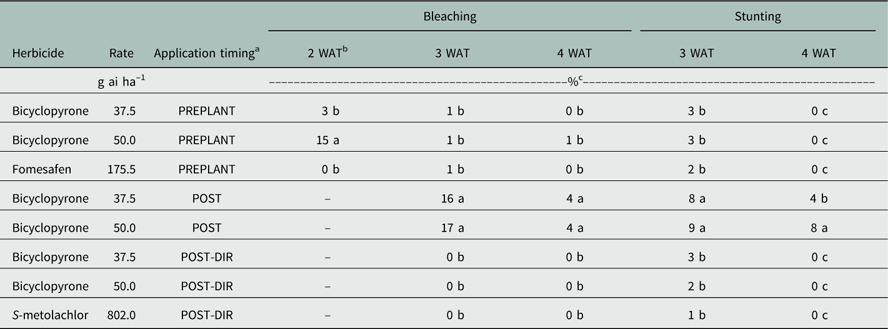
Data for herbicide injury were pooled across environments (years and locations), because the interaction of environment and herbicide treatment was not significant (P>0.05). At 1 and 2 WAT, only PREPLANT treatments had been applied; therefore, injury ratings are reported only for bicyclopyrone (37.5 and 50.0 g ha–1) and fomesafen (175.5 g ha–1) PREPLANT (Table 1). No injury was observed 1 WAT (data not shown). At 2 WAT, bicyclopyrone PREPLANT 50.0 g ai ha–1 caused 15% bleaching.
Watermelon tolerance of bicyclopyrone, fomesafen, and S-metolachlor applied PREPLANT, POST, and POST-DIR on watermelon in Clinton and Kinston, NC, 2016 and 2017.

a PREPLANT applied 1 d prior to transplanting. POST and POST-DIR applied 14 ± 1 d after transplanting. POST-DIR treatments were applied to row middles.
b Abbreviations: WAT, wk after transplanting.
C Bleaching and stunting injury were determined by visual ratings of watermelon canopy, using a scale of 0 (no crop injury) to 100% (crop death). Means within a column followed by the same letter are not significantly different from each other according to Fisher’s protected LSD test at P ≤ 0.05.
POST and POST-DIR herbicide treatments were applied at 2 WAT; thus, injury ratings at 3, 4, 6, and 8 WAT included all herbicide treatments (Table 1). Bleaching was 16% and 17% at 3 WAT from bicyclopyrone POST at 37.5 and 50.0 g ha–1, respectively. By 4 WAT, bleaching from bicyclopyrone POST at both rates was 4%. No bleaching injury was observed at 6 and 8 WAT in response to herbicide treatments.
By 3 WAT, bicyclopyrone POST at 37.5 and 50 g ha–1 caused plant stunting of 8% and 9%, respectively (Table 1). However, by 4 WAT stunting caused by bicyclopyrone POST (37.5 and 50 g ha–1) was 4% and 8%, respectively. No stunting was observed from bicyclopyrone PREPLANT or POST-DIR. By 6 and 8 WAT, no stunting injury was observed in response to herbicide treatments.
Watermelon Yield, Fruit Number, and Fruit Size
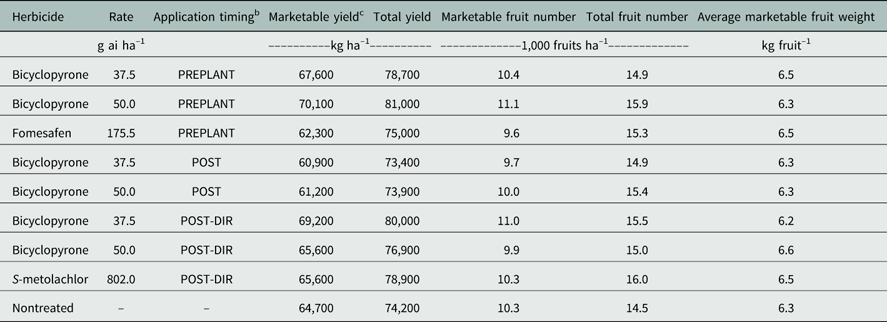
Herbicide treatments showed no significant reductions in watermelon marketable yield, total yield, marketable fruit number, total fruit number, or average marketable fruit weight (Table 2). Environment had a significant effect (P<0.0001) for all yield measurements; however, yield, fruit number, and fruit weight measurements were pooled across environments because of the lack of significant interaction of herbicide treatment with environment. Marketable and total watermelon yields in the hand-weeded check were 64,700 and 74,200 kg ha–1, respectively. Some variation can be observed in the means of herbicide treatments; for example, watermelon marketable yield and total yield ranged from 60,900 to 70,100 and 73,400 to 81,000 kg ha–1, respectively (Table 2). However, ANOVA determined that no herbicide treatment had a significant effect on yield, fruit number, or fruit weight; thus, watermelon yielded similarly and produced fruit of similar size, regardless of herbicide treatment.
Effect of bicyclopyrone, fomesafen, and S-metolachlor applied PREPLANT, POST, and POST-DIR on watermelon yield, fruit number, and fruit weight in Clinton and Kinston, NC, 2016 and 2017.Footnote a

a Means separation using Fisher’s protected LSD test, P ≤ 0.05. Lack of letters indicates that F statistic was not significant at α=0.05.
b PREPLANT applied 1 d prior to transplanting. POST and POST-DIR applied 14 ± 1 d after transplanting. POST-DIR treatments were applied to row middles.
c Yield and fruit number totals calculated from the sum of all harvests. Marketable yield and marketable fruit number include fruits weighing ≥4 kg.
The findings from the present study demonstrate the tolerance of watermelon cultivars ‘Traveler’ and ‘Exclamation’ to PREPLANT, POST, and POST-DIR applications of bicyclopyrone at 37.5 and 50.0 g ha–1. Transient bleaching was observed at 3 WAT for bicyclopyrone POST, but symptoms were greatly reduced at 4 WAT and no injury was observed after 6 WAT. Similarly, bicyclopyrone POST resulted in stunting at 3 and 4 WAT, but no injury was observed after 6 WAT. Transient symptoms did not reduce yield, fruit number, or average fruit weight. These results are in agreement with the EPA registration for sweet corn and yellow popcorn, which reports that bicyclopyrone POST at 50 g ha–1 may cause transient bleaching (and subsequent recovery) in those crops depending on the hybrid, plant stress, or extreme weather conditions (Anonymous 2015). Previous research demonstrates the ability of watermelon to produce yields similar to the nontreated watermelon despite visual injury symptoms due to halosulfuron (39 g ai ha–1) POST-DIR at the distal portion of the vine (Dittmar et al. Reference Dittmar, Monks, Schultheis and Jennings2008).
Bicyclopyrone would provide a new MOA (WSSA Group 27, HPPD inhibitor) for weed management in watermelon and would be especially useful for control of glyphosate-resistant weeds such as Palmer amaranth or horseweed, which could be problematic with subsequent crops (Norsworthy et al. Reference Norsworthy, Griffith, Griffin, Bagavathiannan and Gbur2014; Sarangi and Jhala Reference Sarangi and Jhala2017). As only a limited number of herbicides are registered for use in watermelon, this new MOA could reduce selection pressure for herbicide-resistant weed populations (Norsworthy et al. Reference Norsworthy, Burgos, Witt, Barrett, Ward, Shaw, Llewellyn, Nichols, Webster and Bradley2012). Whichever herbicide options are implemented, it is vital that growers are judicious and eliminate seed production by the most common and troublesome weeds. Herbicide resistance is a constant threat, and HPPD resistance has already been reported in populations of Palmer amaranth and tall waterhemp [Amaranthus tuberculatus (Moq.) Sauer] in Nebraska (Jhala et al. Reference Jhala, Sandell, Rana, Kruger and Knezevic2014; Oliveira et al. Reference Oliveira, Jhala, Gaines, Irmak, Amundsen, Scott and Knezevic2017). Registration of bicyclopyrone for use in watermelon as PREPLANT, POST, or POST-DIR applications would provide watermelon growers a safe and novel MOA for chemical weed control of many common and troublesome broadleaf and grass weed species.
Acknowledgments
The authors express appreciation to the following individuals for their assistance with conducting this research: Nicholas Basinger, Stephen Smith, Wesley Hairr, and the station crew at Horticultural Crops Research Station in Clinton, NC. Authors thank Victor Mascarenhas with Syngenta for supporting this experiment. No conflicts of interest are declared.