


1 Introduction
The goal of this paper is threefold: firstly to provide a detailed description and analysis of tonal spreading rules at the phrasal level in Copperbelt Bemba, secondly to demonstrate a novel rule interaction in phrasal phonology that involves mutually feeding iterative rules and how this can be formalised within Optimality Theory, and finally to consider the phonology–syntax mapping in Copperbelt Bemba and evaluate how well current prosodic correspondence theories – here Align/Wrap theory and Match theory – account for the prosodic constituent structure in Copperbelt Bemba.Footnote 1
Building on earlier work conducted on Copperbelt Bemba tonology (Bickmore & Kula Reference Bickmore and Kula2013), two H-tone spreading patterns will be central to the discussion of phrasal phonology in Copperbelt Bemba, namely bounded spreading and unbounded spreading. The characterisation of φ's is crucial in accounting for these spreading patterns. The paper will examine H-tone spreading within a series of single-word φ's occurring in particular syntactic contexts where it is observed that a single H in the initial φ can surface on each lexically toneless syllable of subsequent φ's. We present the basic tone patterns in §2, and show in §3 that a rule-based approach is forced to analyse the long-distance spreading patterns as involving mutually feeding iterative rule interaction. In §4 we present an alternative OT account of the facts, which relies on a CrispEdge constraint that makes reference to juncture effects. §5 provides a discussion of whether constraints requiring the juncture of two smaller domains to be contained within a larger one are necessary, and what the implications of an alternative formulation might be, at least for the set of data considered here. Finally, §6 provides some concluding remarks.
2 Unbounded and bounded high spreading
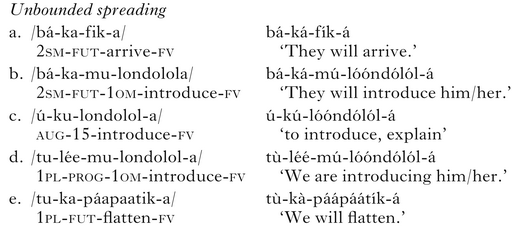
Following Bickmore & Kula (Reference Bickmore and Kula2013), we can identify two main H-tone spreading processes within words in Copperbelt Bemba, namely unbounded and bounded spreading. Unbounded rightward H spreading targets the rightmost H tone in a phrase-final word (‘phrase’ will be made more precise in §3), spreading it to the end of the word. We will show that unbounded spreading applies only within a word and not across words. (1) illustrates unbounded spreading in Copperbelt Bemba: the source/lexical H tone is on the subject marker in (a, b), on the pre-prefix in (c), on the tense/aspect/mood (TAM) marker in (d) and on the first syllable of the verb stem in (e). In all cases the H spreads to the word-final TBU.Footnote 2
-
(1)

Unbounded spreading occurs only if it can reach the word-final TBU. Bounded spreading, on the other hand, results in a ternary pattern in Copperbelt Bemba if the word-final TBU already has a H or if the word undergoing H spreading is not phrase-final. Bounded ternary spreading is shown in (2).
-
(2)
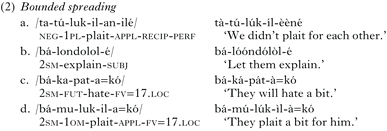
In these examples, the first lexical H in the word does not undergo unbounded spreading, as it cannot reach the final TBU of the word, due to the presence of another H. It undergoes ternary spreading instead. In (2a, b) a melodic H is realised on the word-final TBU, blocking unbounded spreading.Footnote 3 In (2c, d) the verb is followed by the locative enclitic /kó/.Footnote 4
The examples in (3) show that a H tone does not undergo unbounded spreading across a word boundary to the end of a phrase, demonstrating that unbounded spreading is restricted to words.
-
(3)
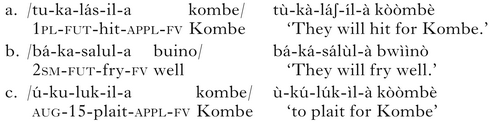
In these cases the H in the first word will not undergo unbounded spreading to the end of the phrase, even though all subsequent TBUs within the phrase are toneless. This is because, while unbounded spreading always targets the final TBU of the phrase, it applies only within a word, never crossing a word boundary. As seen, in (3a) and (b) the H undergoes bounded spreading instead. In (c) the H on the pre-prefix undergoes ternary spreading, but a subsequent tone rule delinks the H from a word-initial onsetless syllable after it has undergone ternary spreading. The application of Unbounded Spreading can be characterised as in (4).
-
(4)

The examples in (5) show that a H tone surfacing on a word-final TBU will ultimately spread to the final TBU of a following toneless word.
-
(5)

While it might prima facie seem that the H at the end of the first word is spreading in an unbounded fashion to the end of the phrase, this is actually not the case. We analyse these forms as undergoing two tone rules. The first is Interword Doubling, which spreads a word-final H onto the initial TBU of a following word. This feeds Unbounded Spreading, which spreads the H, now on the initial TBU of the second word, to the end of the second word, which is final in the phrase. The examples in (6) show that Interword Doubling is an independently attested process.
-
(6)
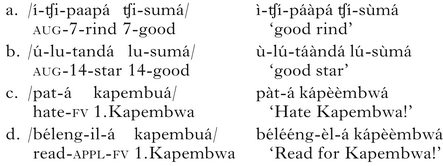
These examples illustrate that a word-final H tone spreads to the initial TBU of the following word. However, since the final TBU of the second word has a H, the H which has spread onto the initial TBU of the second word cannot then undergo unbounded spreading. The rule of Interword Doubling is thus defined as in (7).
-
(7)

Next, let us consider the examples in (8), where an underlying H on the penult spreads into a following word, and subsequently spreads to the end of the following word if it is completely toneless.
-
(8)

We argue that the H on the penult in the first word of both (a) and (b) will undergo Bounded Spreading (as it is not the rightmost H of a phrase-final word). Since the H is now linked to the word-final TBU, it will subsequently undergo Interword Doubling onto the initial TBU of the second word. In (8b), where the following word is completely toneless, Unbounded Spreading will apply, spreading the H to the word-final TBU of the second word, which is the end of the phrase.
To generalise thus far, a H tone will ultimately spread to the end of a phrase in three cases: (i) if it is underlyingly in a phrase-final word followed by a string of toneless TBUs extending to the end of that word (e.g. (1)), (ii) if it originates on the final TBU of a word followed by a completely toneless word (in the same phrase) (e.g. (5)) and (iii) if it originates on the penultimate TBU of a word where the final TBU is toneless and there is a following completely toneless word in the same phrase (e.g. (8b)).
If the H in the first word is in antepenultimate position (as in (3) above), the H does not spread to the end of the second word, but instead undergoes bounded spreading. Given this, one might wonder why the H on the antepenult of the first word in (3a) does not spread to the end of the word, given that we have characterised bounded spreading in Copperbelt Bemba as ternary. To account for this, we must examine the process of bounded spreading more closely.
Bickmore & Kula (Reference Bickmore and Kula2013) argue that the ternary spreading pattern is formally accomplished by the application of two distinct rules – distinct in that they are motivated by and subject to different constraints, but related because they have a dependency relation; the application of the second rule requires the application of the first. The two rules are summarised in (9).
-
(9)
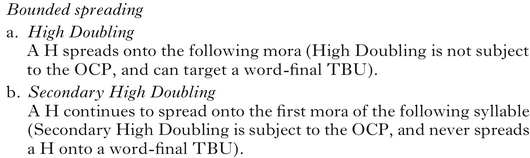
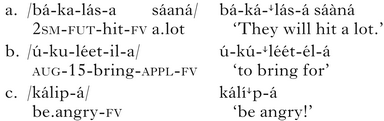
The two rules can be distinguished by their OCP requirements and their ability to spread a H onto a word-final TBU. High Doubling spreads a H onto a following TBU, even if that produces an OCP violation, as can be seen in the examples in (10). These derived OCP violations result in phonetic downstep.Footnote 5 In each case the rightmost lexical or melodic H is downstepped after it becomes adjacent to a following lexical H as a result of High Doubling. Example (10a) (like (8b))) demonstrates that High Doubling can target word-final TBUs.
-
(10)
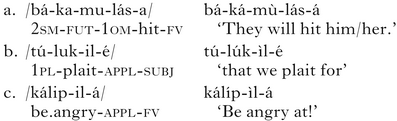
The application of High Doubling contrasts with that of Secondary High Doubling, in which additional H spreading is blocked to avoid an OCP violation, as the examples in (11) show. In these cases the leftmost H is followed by another H within the word, which blocks ternary spread so as to avoid an OCP violation. These data demonstrate that the OCP does not in fact apply across the board to all tone-spreading rules, but only constrains certain spreading processes.
-
(11)
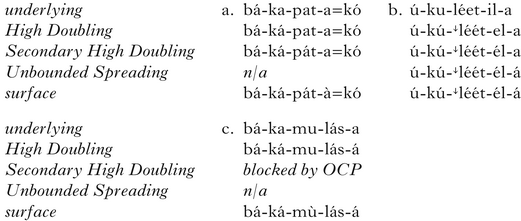
We provide derivations for (2c), (10b) and (11a) in (12).
-
(12)
The second distinction between High Doubling and Secondary High Doubling is that the latter never spreads a H onto a word-final TBU, even in cases where the following word begins with a TBU which is unspecified for tone. This is illustrated in (13).
-
(13)

In the examples above, the rightmost H in the first word in each case only spreads once onto the following TBU, and not to the final vowel. This, then, serves to explain why only a H on the penultimate or final vowel will ultimately spread into a following word. A H in antepenultimate position will not spread into the following word, since it never spreads to the final TBU of the word that it occurs in. If it is on the antepenultimate TBU (of a non-phrase-final word) it will not undergo ternary spreading. If the H is in pre-antepenultimate position, full ternary spreading will only reach the penultimate TBU, and if it is in antepenultimate position, it will not reach the final TBU, due to a prohibition on Secondary High Doubling spreading a H to a word-final TBU.
Now that we have examined High Doubling and Secondary High Doubling in some detail, it is important to highlight that each of these differs from Interword Doubling. One might, for instance, ask whether the spreading across words exemplified in (6) and (8) might be the result of High Doubling. The first indication that it is not is that we saw in examples such as (2) that High Doubling feeds Secondary High Doubling, yet this is not attested in (6c) or (d). Second and most importantly, we see in (8) that High Doubling must be able to feed Interword Doubling.
To illustrate the rule interaction involved in generating these forms, we provide derivations below for (6c), (8a) and (8b).
-
(14)
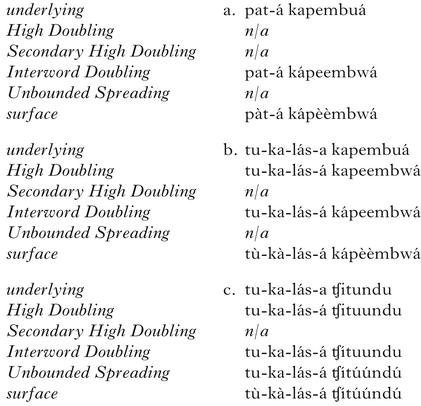
In (14a) neither High Doubling nor Secondary High Doubling applies, as these are both word-level rules. Interword Doubling does apply, spreading the H onto the initial TBU of the following word. Unbounded Spreading does not continue to spread that H, since there is a subsequent H in the second word. In both (b) and (c), High Doubling applies to spread the root H onto the word-final TBU. Secondary High Doubling again does not apply, as it is strictly a word-level process. Interword Doubling then spreads the H onto the initial TBU of the following word. In (c), Unbounded Spreading also applies, since no other H follows, spreading the H to the final TBU of the second word.
We have shown that Unbounded Spreading only applies to the rightmost H in a phrase-final word. Unbounded Spreading does not apply in (14a) or (b), because the H is not rightmost. But we predict that it should also fail to apply if yet another word follows in the same phrase, even if the H is rightmost within its word. That this is true is illustrated in (15), where the postverbal object nouns are modified by an adjective.
-
(15)
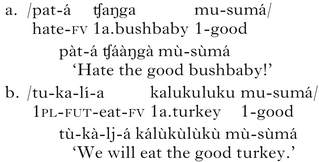
In both cases in (15), the H in the first word spreads onto the initial mora of the following word, by Interword Doubling. However, it does not continue to spread as a result of Unbounded Spreading. This is because the H, now on the initial mora of the second word, does not meet the structural description of Unbounded Spreading, which requires the H to be the rightmost H of a phrase-final word. Since another word follows in the phrase, no additional spreading occurs, even though all the following moras in that second word are toneless.
We will now look at the spreading processes discussed above, with the goal of better understanding the contexts in which they apply and specifically defining the syntactic contexts which have an effect on H-tone spreading in Copperbelt Bemba.
3 Phrasal domains in Copperbelt Bemba
3.1 Theories of prosodic phrasing
We assume that phrasal phonological processes make reference to prosodic constituents, which, in turn, are determined by various aspects of the syntax. We first list the four central prosodic domains we assume, following the work of Selkirk (Reference Selkirk1984) and Nespor & Vogel (Reference Nespor and Vogel1986).
-
(16)
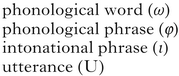
These domains are motivated in particular languages when a phonological process applies within certain groups of words, but not others. In Copperbelt Bemba, for example, we have claimed that unbounded spreading affects the rightmost H in a ‘phrase-final word’. We must now describe and formalise exactly what this phrase is. In the discussion that follows we make reference to two current approaches to prosodic phrasing.Footnote 6 The first is the Align approach presented in Selkirk (Reference Selkirk1984, Reference Selkirk, Beckman, Dickey and Urbanczyk1995), where prosodic phrase edges are found at either the left or right edges of maximal projections. As part of this first approach we include Truckenbrodt's (Reference Truckenbrodt1999) proposal, which presents WrapXP, a constraint which demands that each syntactic maximal projection be contained within a φ. Thus, a VP with two objects, [V [NP][NP]], without WrapXP or where WrapXP is low-ranked, would be prosodically phrased (if alignment is to the right) as in (17a), whereas when WrapXP outranks Align(XP) it would be phrased as in (17b). And whereas both (a) and (b) respect the Strict Layer Hypothesis (Selkirk Reference Selkirk, Beckman, Dickey and Urbanczyk1981), the introduction of a Non-recursivity constraint (Selkirk Reference Selkirk and Fretheim1995) allows for additional phrasings. If WrapXP and Align(XP) outrank Non-recursivity, then the phrasing would be as in (17c).
-
(17)
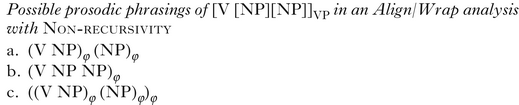
The second approach to prosodic phrasing that we will consider is Selkirk's (Reference Selkirk, Goldsmith, Riggle and Yu2011) Match theory. This theory proposes that syntactic constituents are matched (on both the right and left edges) by a corresponding prosodic constituent. Specifically, a syntactic clause is matched by an ɩ, a syntactic phrase by a φ and a syntactic word by a ω. In brief, given these assumptions, assuming no higher-ranked constraints intervene, Match theory will generate only the prosodic phrasing shown in (18). Selkirk therefore argues that Match theory is more restrictive than Align/Wrap theory.
-
(18)

With these brief descriptions as background, let us now focus on an examination of the Copperbelt Bemba phrasal patterns.
3.2 Motivating and defining phonological phrases in Copperbelt Bemba
The phrases that we have examined thus far have contained words in a fairly close syntactic relationship to each other, for example verb–adverb (e.g. (3b), (10a)), verb–object (e.g. (3a, c)) and noun–adjective (e.g. (6a, b)). As has been shown for a variety of other languages (see e.g. Selkirk Reference Selkirk1984, Nespor & Vogel Reference Nespor and Vogel1986 and McHugh Reference McHugh1990, as well as many of the papers in Inkelas & Zec Reference Inkelas and Zec1990, Dehé et al. Reference Dehé, Feldhausen and Ishihara2010 and Vincent & Mycock Reference Nigel and Mycock2010), we propose that these sequences of words belong to the same φ. In each case the first word is not in phrase-final position and the rightmost H in that word never undergoes unbounded spreading. Apart from the fact that the words in question have a close syntactic relationship, we will show that there is also strong phonological evidence supporting this phrasing.
In all of the φ-comprising verb–adverb, verb–object and noun–adjective sequences given above, H spreading within the first word of the phrase is bounded. This contrasts with unbounded spreading, which is found when the word is phrase-final (1). The question then arises: what happens to the rightmost H in one word when it is followed by another word that is not in the same φ (i.e. where the two words have a less close syntactic relationship)? To answer this, let us examine the case where the two words consist of a subject–verb sequence.Footnote 7 As seen below, in this case the rightmost H in the first word undergoes unbounded spreading rather than bounded spreading, even though another word follows.
-
(19)
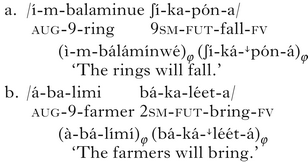
These examples can be accounted for straightforwardly if we assume that unbounded spreading indicates the fact that the word is in final position within a φ. The verb in (19) constitutes its own φ, and exhibits unbounded spreading of its rightmost H. We assume that these two φ's combine to form an ɩ and ultimately an utterance.
We have proposed that in cases of a verb+object the verb is not in phrase-final position, while the subject in a subject+verb sequence is, as it constitutes a separate φ. Given the behaviour of the examples in (2), (6) and (13) (where the rightmost H in the first word undergoes bounded spreading), as opposed to those in (19) (where the rightmost H in the first, non-phrase-final word undergoes unbounded spreading), we now examine a fuller set of Copperbelt Bemba examples to determine which syntactic contexts behave like the former and which like the latter. In each case, the presence of unbounded spreading will diagnose a following )ᵩ (the right edge of a φ), and bounded spreading will indicate the absence of a following )ᵩ. We will then return to the question as to whether Align/Wrap theory or Match theory better represents the prosodic phrasing necessary to account for the presence or absence of unbounded spreading.
In each of the examples in (20), the rightmost H in the first word undergoes bounded (ternary) spreading, and is therefore diagnosed as not being at the end of a φ. In each case we show the first and second words as belonging to a φ that comprises both words, i.e. (ω1–ω2)ᵩ. While this is predicted by both Align/Wrap theory and Match theory, we note here that the latter theory also predicts that the second word, being a syntactic phrase, constitutes its own φ, i.e. (ω1–(ω2)ᵩ)ᵩ.
-
(20)
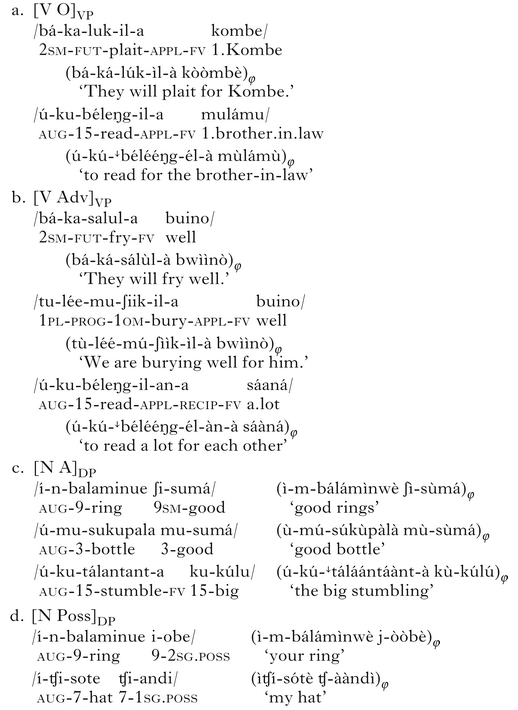
These examples contrast with those in (21), where the rightmost H in the penultimate word undergoes unbounded spreading. We account for this by assuming that this word is in φ-final position, and that the following word begins a new φ. In cases where the first φ consists of two words (21b, c), unbounded spreading is, as expected, observed on the final word (i.e. the second word) of the first φ.
-
(21)
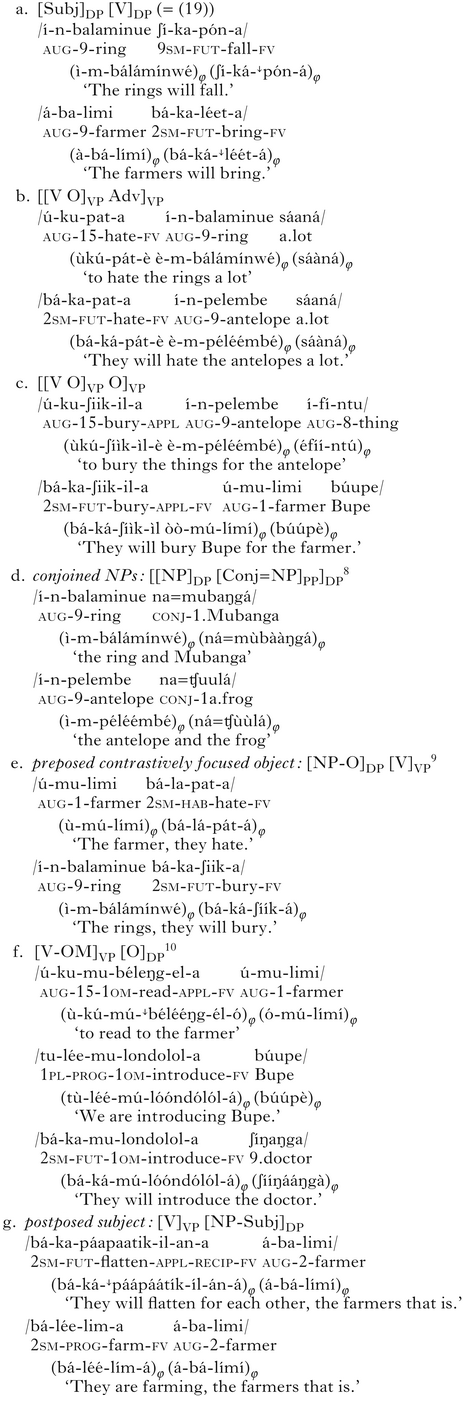
Based on the patterns of bounded and unbounded spreading in the above examples, we are able to determine the presence vs. absence of a )ᵩ between the two words in question.Footnote 11 We conclude this section by noting that both Align/Wrap theory and Match theory clearly distinguish the prosodic phrasing in the relevant two-word sequences in (20) from those in (21). Both theories predict that the first word in these sequences is not φ-final in the former, but is in the latter. We note again that Match theory also predicts that the second word in sequence in (20) constitutes its own (recursive) φ. We conclude, then, that the prosodic phrasing necessary to account for the H-tone spreading in Copperbelt Bemba is adequately established by both theories and thus the data does not decide between them.
3.3 Mutually feeding spreading rules
Let us now examine some additional Copperbelt Bemba phrases. The examples in (21d) reveal something interesting about the interaction between Interword Doubling and Unbounded Spreading. The former rule was shown to feed the latter in (5). The H on the pre-prefix aug in the first noun in the examples in (21d) undergoes Unbounded Spreading, as it is the rightmost H in a φ-final word. But as can be seen, that process then feeds Interword Doubling, as the H then spreads onto the toneless proclitic conjunction /na/, which is part of the following word. The interaction between these two rules is pushed even further in the examples below, where Interword Doubling spreads onto a following completely toneless word, in which case Unbounded Spreading applies a second time.
-
(22)
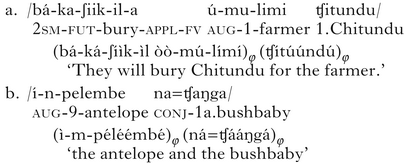
In these examples, the H on the pre-prefix in the φ-final word in the first φ spreads to the end of the word via Unbounded Spreading, as it is the rightmost H in a φ-final word. That H then undergoes Interword Doubling (as it did in (21d)). Then, since the H, now on the first mora of the final word, is again the rightmost H in a φ-final word, it yet again undergoes Unbounded Spreading.
In a rule-based approach we conclude that the rules of Interword Doubling and Unbounded Spreading are mutually feeding processes. It does not seem possible to account for the totality of the spreading in (21d) or (22) with a single rule. The examples in (20), where the two words are not separated by a )ᵩ, show that it is certainly not the case that there is unbounded H spreading through toneless syllables across word boundaries.
On the assumption that these two rules are mutually feeding and iterative, our analysis then predicts that in a sequence of ω1, ω2, … ω n , where a )ᵩ follows each word in the sequence, and all TBUs in ω2, … ω n are toneless, the rightmost H in ω1 will ultimately spread to the very end of ω n . This can be seen in the examples in (23).
-
(23)
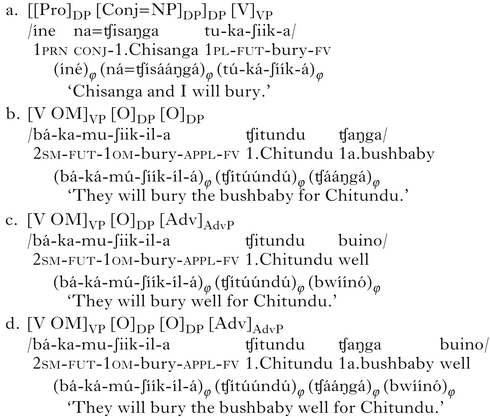
In all these examples, each word consists of its own φ, as demonstrated by the presence of unbounded spreading, which for example has the effect that all three toneless constituents following the verb in (23d) surface with H. A derivation of (23d) in a rule-based approach, detailing each step of the process and the rule interaction involved, is given in (24).
-
(24)
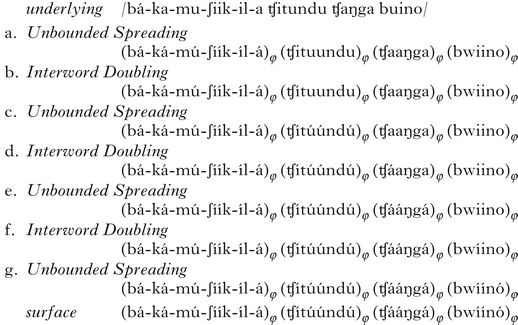
The underlying representation of the sentence contains a single H on the subject marker /bá-/, all the other TBUs in the sentence being toneless. Unbounded spreading indicates that there is a φ boundary after each word. The mapping of the three syntactic junctures, from left to right, was motivated in (21f), (c) and (b) respectively. In (24a) the H on the subject marker undergoes Unbounded Spreading, as it is the rightmost H in a φ-final word. In (b) we see that Interword Doubling has spread the H from the final TBU of the first word onto the initial TBU of the following word. The H is now the rightmost one in the last (and only) word in its φ, and hence undergoes Unbounded Spreading again, as in (c). This feeds Interword Doubling (d), which feeds Unbounded Spreading (e), which again feeds Interword Doubling (f), which again feeds Unbounded Spreading (g). The ultimate effect is that the H has spread over twelve syllables, to the end of the utterance.
It is appropriate to stress again that this is not a process that simply spreads a H onto as many subsequent toneless syllables as possible. This can be clearly seen by contrasting the spreading behaviour in (24) with that in (25), where the latter is the very same sentence, but without an object marker in the verb. Recall that the reason there is a φ boundary between the first two words in (24) is due to the presence of an object marker in the verb (as illustrated in (21f)). If we remove the object marker, then the verb and the following object will be part of the same φ (as seen in (20a)). This has drastic effects on the spreading of the H, as seen below.
-
(25)
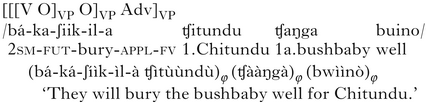
Even though the H on the subject marker /bá-/ is followed by all toneless TBUs, the H spreads only in a bounded fashion. This is because Unbounded Spreading only occurs if the H is the rightmost H in a φ-final word. While this is true for the H on /bá-/ in (24), it is not the case in (25), since there is another word (/ʧitundu/) following in the same φ. As bounded spreading does not spread the H to the final TBU of the word, the structural description of Interword Doubling is not met, and hence the spreading stops.Footnote 12 A second example illustrating the same point is given in (26), where the object noun is modified by an adjectival phrase.
-
(26)
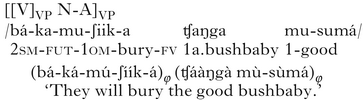
Here the H on /bá-/ spreads to the final TBU, as it is the rightmost H in a φ-final word. This then feeds Interword Doubling, which doubles the H onto the initial TBU of the following object. But while that H is now rightmost in the object, the object is not phrase-final, due to the following adjective, which groups with it in the same φ (as in (20c)). Therefore no additional spreading occurs, even though the following four TBUs in the utterance are toneless.Footnote 13
To conclude the descriptive analysis of the above examples, the full array of Copperbelt Bemba phrasal patterns can be accounted for within a rule-based framework by the interaction of three spreading processes: Bounded Spreading, Unbounded Spreading and Interword Doubling. This analysis, however, demands that Unbounded Spreading and Interword Doubling be mutually feeding rules that apply iteratively in order to account for the full array of surface phrasal patterns. It is not evident to us how one could dispense with or complicate either of these rules such that an iterative application would not be necessary.
4 An optimality-theoretic analysis
Having described the spreading patterns and shown that a rule-based approach requires a mutually feeding iterative rule interaction, we now turn to an OT analysis of the same patterns. We begin by accounting for bounded spreading at the prosodic word level, which, as described above, is generally ternary, as in (2), unless this would cause an OCP violation, in which case it is binary, as in (11). We model spreading with the constraint in (27).Footnote 14
-
(27)

This constraint will force spreading, and is satisfied with any amount of spreading. The constraint penalising spreading is *H, given in (28).Footnote 15
-
(28)

Ranking *MonomoraicHTS above *H predicts spreading to a single TBU – i.e. doubling.Footnote 16 But since spreading is optimally ternary in Copperbelt Bemba, we need an additional constraint. While this could be accomplished in different ways, we will assume a constraint which forces additional spreading, formulated in (29).
-
(29)

The final constraint needed here is an OCP constraint, since, as shown in (10) and (11) above, it has differential effects on binary vs. ternary spreading.
-
(30)

The proposed ranking of these four constraints is given in (31).
-
(31)

*MonomoraicHTS will force a H to spread even if it violates OCP, and therefore must be ranked above OCP. *BimoraicHTS attempts to spread the H onto a second TBU, but will fail to do so if it would cause an OCP violation, and is therefore ranked below OCP. Both *MonomoraicHTS and *BimoraicHTS force spreading, which results in violations of *H. *H plays an important role in penalising any spreading which is not necessary to satisfy the higher-ranked constraints which ensure ternary spread. We exemplify the constraint interaction in the schematic tableaux below.
We first consider the case of full ternary spreading. This is schematised in (32), where a H in a non-φ-final word undergoes ternary spreading (illustrated in (2) above).
-
(32)
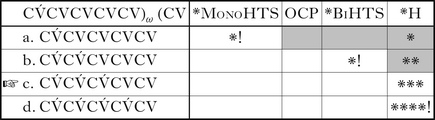
In (32), the correct surface form is the one in which the only (and therefore rightmost) H in the input undergoes bounded spreading (ternary in this case) because it does not occur in a φ-final word. Candidate (a) is maximally faithful, but violates *MonomoraicHTS, which insists that the H undergo some spreading so as not to surface as a H-tone span of a single TBU. Candidate (b) satisfies *MonomoraicHTS, but violates *BimoraicHTS, as it contains a H-tone span comprising exactly two TBUs. The optimal candidate, (c), where the H has spread to the following two moras, avoids both *MonomoraicHTS and *BimoraicHTS violations. This is also true of candidate (d), but (c) is preferred over (d), which violates *H more egregiously; the spreading in (c) is the minimum necessary to satisfy the higher-ranked constraints.
The tableau in (33) illustrates the configuration that results in a phonetic downstep between syllables (cf. the data in (10) above).
-
(33)
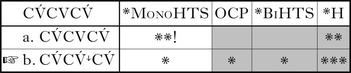
The input in (33) has an underlying H–toneless–H sequence. The faithful candidate, (a), violates *MonomoraicHTS twice, as both the first and last moras in the word constitute monomoraic H-tone spans. In (b), the word-initial H has undergone spreading to the following TBU, creating a bimoraic H-tone span, and thus only the H on the last mora violates *MonomoraicHTS. While this candidate violates OCP, this constraint is ranked lower than *MonomoraicHTS, and therefore (b) is optimal.Footnote 17
Finally, we consider forms where two toneless TBUs intervene between two Hs, as in (11) above.
-
(34)
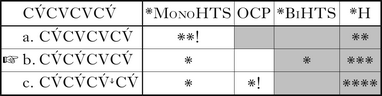
While *MonomoraicHTS is violated by all candidates, due to the H on the word-final TBU, candidate (a) violates it twice, as the word-initial H has not spread. Candidate (b), where the H has spread to just the following TBU, violates *BimoraicHTS but not OCP. Candidate (c), where the H has spread two TBUs to the right, satisfies both *MonomoraicHTS and *BimoraicHTS, but violates OCP. The optimality of candidate (b) is accounted for by ranking OCP above *BimoraicHTS but below *MonomoraicHTS.
Let us now turn to unbounded spreading. We account for unbounded spreading by positing a constraint that penalises a φ-final toneless TBU, as formalised in (35). This constraint will force the φ-final TBU to surface as H. Since we assume that both Max(H) and Ident(H) constraints are undominated in Copperbelt Bemba, satisfaction of this constraint will never result in a H being added, or an input H being displaced to the φ-final TBU. Thus it will have no effect on phrases with no H, nor any discernible effect on phrases in which the final TBU is already H. But in a phrase where the final TBU in the input is toneless and there is a H on some other TBU within the phrase, this constraint compels H to become multiply linked, up to and including the φ-final TBU.
-
(35)

The effects of this constraint are illustrated in the tableau in (36).
-
(36)
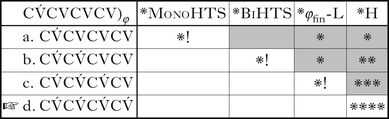
The fully faithful candidate in (a) violates *MonomoraicHTS. The candidate in (b), where the H has spread over one TBU, creating a binary HTS, violates *BimoraicHTS. While candidate (c) satisfies both *MonomoraicHTS and *BimoraicHTS, it violates *φfin-L, as the final TBU is not H. Candidate (d) is optimal, as it satisfies this constraint, at the expense of more violations of lower-ranked *H.
Having illustrated how these constraints work at the word level, we are ready to move to phrases. First, we must account for interword doubling, illustrated in (5), (6) and (8), where the H on a word-final TBU of one word spreads onto the first TBU of the following word. We account for this by positing the domain-juncture constraint in (37), which penalises a configuration where the final TBU of one word is H and the initial TBU of the following word is toneless.Footnote 18
-
(37)
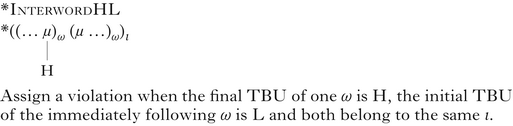
With regard to the prosodic domain that both TBUs must belong to, the process of interword doubling was seen to operate over a word boundary in (5), (6) and (8), and over a φ boundary in (22) and (23). The minimal tonal pairs of phrases in (38) and (39) below show that while this process does in fact operate across a φ juncture, it does not operate across an ɩ juncture – i.e. the two TBUs in question must belong to the same ɩ. For this reason, we formulate *InterwordHL as a domain-juncture constraint, introduced as one of three types of phrasal rules in Selkirk (Reference Selkirk, Aronoff and Kean1980), where the larger domain is indicated by the outer brackets. We take up this issue again below.
-
(38)
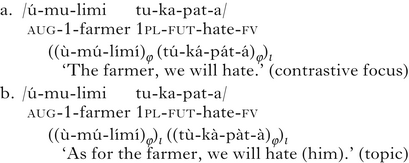
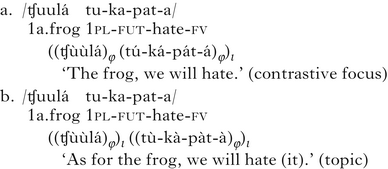
In (38a) the object NP is contrastively focused by being preposed to the left of the verb. Additional examples of this construction were given in (21e). In rule-based terms, the pre-prefix H undergoes unbounded spreading to the end of the word, which feeds Interword Doubling, which in turn feeds Unbounded Spreading again. In (38b), however, the preposed object is topicalised. Here we assume the word is part of a different ɩ from the word that follows. This is supported not only by the lack of spreading of the H, but also by the fact that there is an audible pause between the two words. In this case, while the pre-prefix H does undergo Unbounded Spreading (as it is φ-final), Interword Doubling does not apply, since the two words are not part of the same ɩ. The examples in (39) show that even when the H is underlyingly word-final, it will only spread onto the initial TBU of the following word if the two words belong to the same ɩ (39a), but not if they belong to separate ɩ's (39b).
-
(39)
The *InterwordHL constraint is illustrated in the tableau in (40), where a H in one word spreads onto the initial TBU of the following word, but no further.
-
(40)
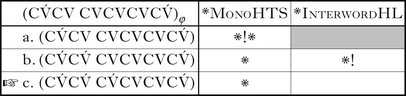
While all candidates violate *MonomoraicHTS, because the word-final H in the second word has nowhere to spread, the candidate in (40a) violates this constraint a second time, since the H in the first word has not spread. Candidate (b), where the H has spread just one TBU to the right onto the word-final TBU, violates *InterwordHL, since the word-initial TBU of the following word is toneless. Candidate (c), where spreading has reached into that word-initial TBU, is therefore optimal.
We now need a way to account for the long-distance spreading patterns seen in (21)–(23). Specifically, in a ω1–ω2 sequence where there is a single H in ω1 and no H in ω2, we must ensure that the H in ω1 undergoes bounded spreading when the first word is not itself final in a φ (41a), but unbounded spreading to the end of ω2 when the words are part of different φ's (41b).
-
(41)

We propose to account for this difference by positing a second domain-juncture constraint, formalised in (42). This one penalises spreading between two words belonging to the same φ. As we will show below, this constraint will penalise phrases of the type in (41a), but not those of the type in (41b).
-
(42)
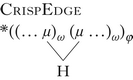
This constraint is a member of the CrispEdge family, as proposed by Itô & Mester (Reference Itô, Mester, Kager, van der Hulst and Zonneveld1999) and employed by Selkirk (Reference Selkirk, Goldsmith, Riggle and Yu2011), which insists that some feature not be shared across a prosodic juncture (demanding instead that it be crisply aligned with a single edge of a prosodic domain). If ranked above *φfin-L, this CrispEdge constraint will block unbounded spreading in cases such as (41a), where the spreading would generate the illicit structure in (42). This is illustrated in (43).
-
(43)
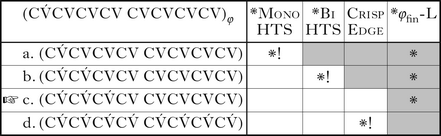
The faithful candidate in (a) violates *MonomoraicHTS, while (b) violates *BimoraicHTS. The candidate in (d), where H spreads to the very end of the phrase, is the only one which satisfies *φfin-L. But this spreading violates CrispEdge, since a single H is linked to TBUs of two words belonging to the same φ. The optimal candidate in (c), where the spreading is ternary, violates *φfin-L, but satisfies CrispEdge, which is higher-ranked.
Of course, CrispEdge will be violated by the optimal candidate in cases such as (40), where an input H on the penultimate or final vowel spreads into the following word (even when the two words are part of the same φ). We account for this by ranking *InterwordHL above CrispEdge, as shown in (44).
-
(44)

The candidate in (b), where the H has undergone binary spreading, violates *InterwordHL, but not CrispEdge. Candidate (c), where the H has spread to the initial TBU of the following word, violates CrispEdge, but not the higher-ranked *InterwordHL.
Let us now examine the form in (41b), where the H must spread to the end of the entire utterance. It was examples such as this, presented and discussed at the end of §2, which motivated the mutually feeding iterative rules in the derivational account.
-
(45)
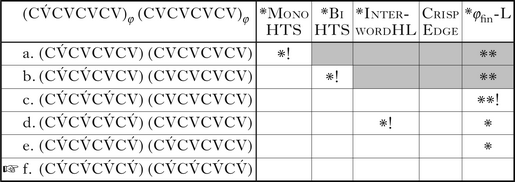
Candidates (a) and (b) each violate one of the highest-ranking constraints, which force spreading to at least two additional TBUs. Candidate (c) incurs two violations of *φfin-L, since there are two toneless φ-final TBUs in this utterance. Candidate (d) spreads H to the end of the first ω (and φ), thus incurring only a single *φfin-L violation, but also incurs a *InterwordHL violation. Candidate (e) spreads H one TBU further, onto the initial TBU of the second word. This avoids the *InterwordHL violation, but it still violates *φfin-L, as the second φ-final TBU is not H. The optimal candidate, (f), satisfies *φfin-L, since each of the two φ-final TBUs in the utterance is H-toned. Crucially, CrispEdge is not violated in (f). This is because even though the H has spread from the first word into the second, CrispEdge is specifically formalised to penalise this only if the two words in question are part of the same φ. In (f) (as well as (e)), however, the words are part of different φ's, and therefore no penalty is assigned.
It should be evident that, even in much longer utterances, such as (23d), if each word constitutes its own φ, the optimal candidate will be the one that spreads a H to the very end of the entire utterance, as this will completely satisfy *φfin-L, and not incur any CrispEdge penalty. In this respect the derivational account seems to be driven by slightly different factors than the OT one. In the derivational account, the two rules which accounted for this long-distance spreading were: (i) Unbounded Spreading, a word-level process that spreads a H to the end of a word, and (ii) Interword Doubling, which spreads a H from the final TBU of one word onto the initial TBU of the following word. The most direct analogues to these two rules in the OT account are *φfin-L and *InterwordHL. While *φfin-L certainly motivates unbounded spreading to an often distant TBU, it is less clear that it is *InterwordHL which forces spreading beyond the end of the first φ, when another (single-word) φ follows. It certainly ends up preventing the spreading from stopping on the final TBU of the first φ, but, as seen in (45e), it does not play a role in preventing the spread from stopping within the following single-word φ. Ultimately this is prevented by *φfin-L. CrispEdge, as it has been formalised, ultimately determines, in a string of adjacent words, whether the spreading of the H in the first word will undergo unbounded spreading or bounded spreading. But in a configuration such as the one in (45), it plays no role in determining where the spreading will stop. Thus it seems that *φfin-L is really doing the work of forcing long-distance spreading in the OT account. In summary, were the particular OT analysis presented here cast in derivational terms, a H tone would look to find the most distant toneless φ-final TBU it can spread to (where all intervening TBUs are toneless), where that doesn't involve spreading over two words which are part of the same φ. Characterised as such, *InterwordHL does not play a crucial role in this long-distance spreading, whereas its rule-based counterpart, Interword Spreading, certainly does.
5 Domain-juncture effects in Optimality Theory
Both the *InterwordHL and CrispEdge constraints proposed above were formulated as domain-juncture constraints, with both outer and inner prosodic edge boundaries. Given the fact that there is not much precedent in the OT literature for such constraints, we now ask whether two sets of prosodic boundaries are in fact needed, or whether the outer set could be dispensed with.
Let us begin with the *InterwordHL constraint. We noted above that this constraint accounts for the fact that spreading of a H across a word boundary takes place between two words when those words are part of the same ɩ, but not when the words are part of distinct ɩ's. While the domain-juncture style formulation in (37) captures this, it would also be possible to account for the same tone patterns by using a *InterwordHL constraint without the outer ɩ specification, in tandem with an additional CrispEdge constraint which prevented spreading of a H from the final TBU of one ɩ into another ɩ. These constraints are given in (46).
-
(46)
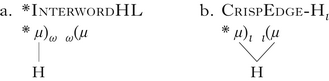
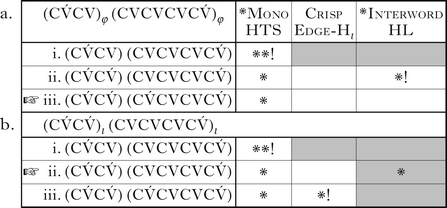
We assume that the revised *InterwordHL constraint forces a H on the final TBU of one word to spread into the next word, regardless of whether the two words are part of the same φ or ɩ. However, the CrispEdge constraint in (46b) will prohibit such spreading from one ɩ into another. When (46b) is ranked above (46a), the attested spreading patterns in this regard are accounted for, as illustrated in (47).
-
(47)
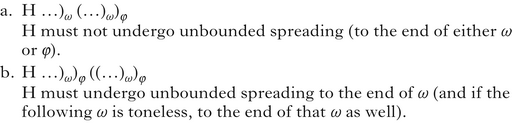
Having found an alternative to specifying outer edge prosodic boundaries in the definition of the *InterwordHL constraint, we now investigate if this might also be possible with regard to the CrispEdge constraint formalised as a domain-juncture constraint in (42). The constraint was formalised as such so that it would penalise the unbounded spreading of a H in cases such as (48a), where the two words belong to the same φ, but not to cases such as (48b), where the two words belong to separate φ's.
-
(48)
Removing the outer φ brackets of the CrispEdge constraint as formalised in (42) yields (49).
-
(49)
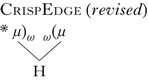
The revised constraint in (49) will penalise a multiply linked H between any two words in sequence, regardless of whether the words are members of the same φ or ɩ. This revised CrispEdge constraint makes the same, correct, prediction in the case where the two words are part of the same φ. It will, for example, assign the very same penalties that the domain-juncture CrispEdge constraint in (42) did in cases such as (43), where the two words belong to the same φ. However, the revised CrispEdge constraint in (49) makes incorrect predictions when the two words are part of different φ's, as shown in (50).
-
(50)
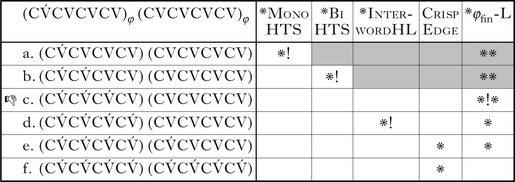
As can be seen, if CrispEdge, as revised in (49), penalises the spreading between any two words, then it will assign a penalty to candidates (e) and (f), but not to (c). This ultimately selects candidate (c), which exhibits ternary but not unbounded spreading, as optimal, but it is not. Given the fact that CrispEdge must be ranked above *φfin-L (required in (43)), it is not clear to us what other constraint could be invoked which, ranked above the revised CrispEdge constraint in (49), would penalise (50c) while not also penalising (50f).
We therefore conclude here that while the *InterwordHL constraint can in fact be formalised without resorting to the domain-juncture style formulation which necessitates both an outer and inner domain specification, the CrispEdge constraint in (42) does seem to require both domains in its formalisation.
6 Summary and conclusion
In this paper, we have described a wide array of phrasal tone-spreading patterns in Copperbelt Bemba. When a word has more than one H tone, all Hs before the final one undergo bounded (ternary) spreading. What is interesting is the spreading pattern of the rightmost H in a word. In some cases it undergoes bounded spreading, while in other cases it undergoes unbounded spreading. We have demonstrated that this choice is strictly determined by the prosodic phrasing. In a ω1–ω2 sequence, the rightmost H in ω1 will undergo bounded spreading if ω1 and ω2 are part of the same φ, but it will undergo unbounded spreading if the two words are part of different φ's, i.e. when the first word is φ-final. We showed that the location of these φ boundaries correspond to the right edges of maximal projections of lexical phrases. This is consistent with the range of possible phrasings predicted by current OT-based theories of the syntax–phonology interface, such as Align/Wrap theory and Match theory. In a rule-based approach, the two processes of Unbounded Spreading and Interword Doubling turn out to stand in an iterative mutually feeding relationship. Thus, given a string of words, each of which comprises a single φ, a H in the first word will spread through the whole string of toneless words to the final TBU.
In addition to a *φfin-L constraint which accounts for unbounded spreading to the end of φ's, a second phrasal constraint, *InterwordHL, accounts for a process whereby a H on the final mora of a word will double onto the initial mora of the following word. We presented two possible analyses which prevent such spreading from occurring across ɩ. Unbounded spreading of a H from one word to the following one must be prevented when the two words belong to the same φ. This is accomplished with a CrispEdge constraint. We endeavoured to show, however, that in order for the constraint to only penalise spreading between words belonging to the same φ, it must be formalised as a domain-juncture type of constraint in which two prosodic domains are specified.


