Introduction
Renal cell carcinoma (RCC) accounts for 90% of all kidney cancers. The prognosis for patients with metastatic RCC (mRCC) is poor, with a median overall survival (OS) ranging from 2 to 3 years (Heng et al., Reference Heng2013). Efforts have long been under way to regularly screen and effectively manage distress as an important component of patient care (Carlson et al., Reference Carlson, Waller and Mitchell2012). There have been attempts to identify whether an association between distress and survival exists, although not specifically in mRCC patients (Onitilo et al., Reference Onitilo, Nietert and Egede2006; Pirl et al., Reference Pirl2012). This association remains controversial, and it is possible that the variability in study findings results from complex relationships according to cancer type, disease stage, and patient factors (Onitilo et al., Reference Onitilo, Nietert and Egede2006). Given the multifactorial nature of distress and the paucity of related research exploring mRCC patients, this study aims to explore rates and types of distress among this understudied group and provide a preliminary examination of the relationship between distress and survival.
Methods
This is a retrospective study conducted in a comprehensive cancer center, located in Duarte, CA. Clinical and pathologic data of patients diagnosed with mRCC were collected. Patients were eligible if they were age ≥18 years, had histologically confirmed RCC, and had radiographic evidence of metastatic disease. The study protocol was approved by an institutional review board and ethics committee.
Measures
Demographic (age, gender, marital status, ethnicity, education) and clinical (date of diagnosis, performance status, laboratory data) information were extracted from patient charts. Based on clinical data, patients were classified as high, intermediate, or low disease risk, following the Heng criteria for mRCC prognosis (Heng et al., Reference Heng2013). The Heng criteria form a well-validated prognostic classifier using clinicopathologic variables, including performance status, time from nephrectomy to systemic therapy, and laboratory variables (calcium, hemoglobin, neutrophil count, and platelet count). A touch screen–based instrument was used to assess biopsychosocial problem-related distress in approximately 10–15 minutes at the patient's first/second visit with their oncologist. The instrument surveys 22 core items on a 5-point Likert scale ranging from 1 (not a problem) to 5 (very severe problem) and spans physical, practical, functional, and emotional domains (Lowery et al., Reference Lowery2012). Items rated ≥3 are considered to reflect high distress.
Statistical analysis
SPSS, version 22.0 (IBM Corporation, New York, NY), was used. Descriptive summaries of demographic and clinical variables were compiled. The prevalence of high distress was calculated by counting all biopsychosocial problems rated ≥3 by that individual, with a maximum total score of 22. Survival was defined as the interval between the date of the pathological diagnosis and the date of death or of the last follow-up. Survival curves according to the Kaplan-Meier method were computed by dichotomized groups (high distress vs. low distress). All other tests of associations between distress and survival were conducted as adjusted analyses using Cox proportional hazard models and controlling for potential confounders (age, gender, marital status, and ethnicity), previously described in the literature (Clark et al., Reference Clark2016; McFarland et al., Reference McFarland2018; Parker et al., Reference Parker2003).
Results
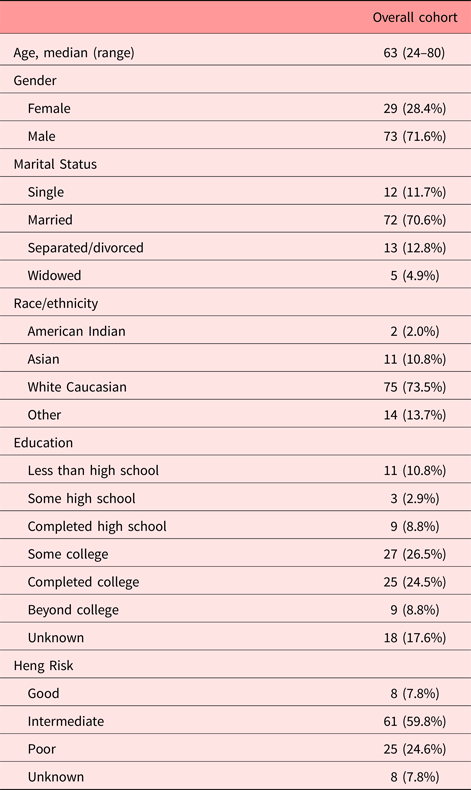
Clinical and pathologic information and distress screening data were obtained for 102 patients with mRCC. The majority of patients were male (71.6%), married (70.6%), and white Caucasian (73.5%) (Table 1). Educational background was quite heterogeneous in the study sample. Using the Heng criteria, most patients had intermediate disease risk (59.8%).
Patient characteristics (N = 102)

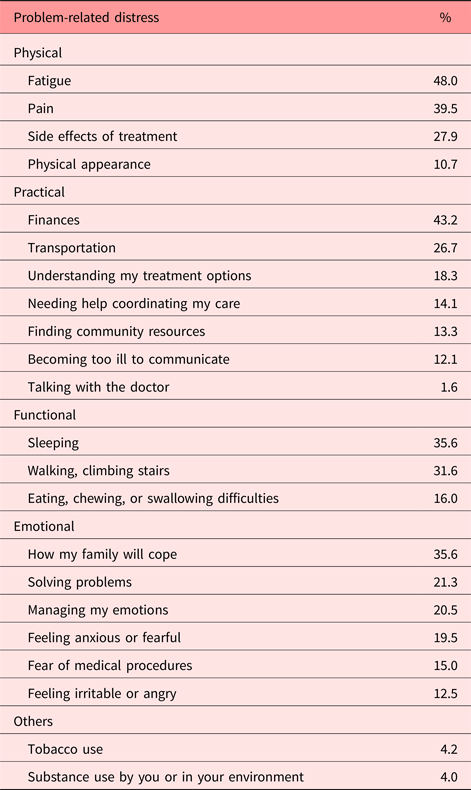
Problems most ranked as high distress (rated ≥3) included fatigue (48.0%), finances (43.2%), pain (39.5%), sleeping (35.6%), how family will cope (35.6%), walking/climbing stairs (31.6%), side effects of treatment (27.9%), and transportation (26.7%). In contrast, the least reported were talking with the doctor (1.6%) and tobacco use (4.2%) (Table 2).
Proportion of biopsychosocial problems endorsed as high distress (N = 102)

The proportion of patients reporting high distress (rated ≥3; 20.7%) did not significantly differ based on Heng risk criteria (p = 0.09). The median OS was 43.7 months (95% confidence interval [CI 95%] = 35.5,52.5) for the overall cohort; 20.0 months (CI 95% = 16.0, 55.9) in patients with high distress, and 45.8 months (CI 95% = 36.1, 55.5) in those with low distress (p = 0.81). After controlling for confounders, a trend was observed toward poorer OS in patients with high distress versus low distress (p = 0.09).
Discussion
The current study examined distress among patients with mRCC using a novel touch screen application, revealing rates of distress that exceeded the expected (20%) across various metrics (Brintzenhofe-Szoc et al., Reference Brintzenhofe-Szoc2009). Further examination identified several interesting patterns. For example, fatigue was the most prominent symptom reported. This is not surprising, given that fatigue represents the most common toxicity observed across multiple phase III trials in mRCC (Motzer et al., Reference Motzer, McCann and Deen2013). Using the Common Toxicity Criteria for Adverse Events grading system, roughly 50% of patients incurred any grade of fatigue, whereas 10–15% of patients incurred grade 3–4 fatigue, which implies either disabling toxicity or toxicity precluding activities of daily living. Several strategies can be implemented to address fatigue, including exercise programs and pharmacologic strategies (e.g., modafinil) (Conley et al., Reference Conley2016).
Further, a high prevalence of financial issues was reported by patients. There are increasing reports regarding the “financial toxicity” associated with cancer-related treatments (Guy et al., Reference Guy2017). mRCC is a disease almost exclusively addressed with expensive targeted agents and immunotherapy. Cost estimates for vascular endothelial growth factor-tyrosine kinase inhibitors range from $5,000–15,000 USD per month, and recently approved immunotherapeutic agents such as nivolumab may cost upwards of $10,000 USD per two-weekly infusion (Shih et al., Reference Shih2011). Although payers and patient support programs in the United States often address large portions of this cost, there often remains a large residual left to the patient in many cases. Addressing these needs early may circumvent distress from financial concerns during treatment. A substantial proportion of patients also incurred distress secondary to transportation-related issues. Presumably, these issues are magnified because these patients were all at a single tertiary care center. Transport to and from tertiary care institutions has often been cited as a major barrier to receiving treatment.
Whereas the current study highlighted some of the key factors underlying distress among those diagnosed with mRCC, we did not possess sufficient power to thoroughly examine survival trends. However, it worth noting that a nonsignificant trend toward improved survival was noted in low distress patients when controlling for confounders. This warrants further exploration in larger series. Another notable limitation is that all patients were treated at a single tertiary care institution. Finally, the assessment performed in this study was at a single time point early in treatment; thus, future research should track these factors longitudinally.
In summary, this study provides the first specific insights into distress among patients with mRCC. For the practicing oncologist and supportive care team personnel, the results highlight the need to focus on certain elements of the disease experience that may be associated with high distress in this population. Efforts are ongoing to expand our dataset to allow for more comprehensive assessment of survival trends in patients with high versus low distress. Moving forward, tailored interventions to alleviate distress should be devised.