Introduction
The growth potential of broiler chickens has been improved immensely during the last few decades. The pace of this improvement could be appreciated from the fact that days required for achieving 2.3 kg live gain have been reduced from 52 d in 1995 to 36 d in 2017 - a reduction of 0.73 days per year. Comparisons made between the genetic stocks from 2001 with those of 1957 suggest that a predominant part of this improvement can be attributed to genetic selection (Havenstein et al., Reference HAVENSTEIN, FERKET and QURESHI2003). There is little doubt that the most important component of efficiency associated with genetic selection is increased appetite, whereby the broiler eats a given amount of feed and reaches market body weight in significantly fewer days. It has been further substantiated that no fundamental change has been noticed in terms of digestibility or metabolisability of diets during this period of time. In fact, a larger appetite would have been expected to affect diet digestibility and metabolisability negatively (Svihus, Reference SVIHUS2011).
A major shift in the composition of gain has been made apparent from the observation that breast meat yield (12% of body weight in the year 1957) increased to 20% in 2001. Most recent data from commercial breeders suggest that today's broiler is capable of producing 23% of its live body weight as breast meat (Ross 308 performance objectives, 2014). The focal point of this short review is to discuss the quantitative aspects of these changes on energy (AME) and amino acid requirement of broilers.
Broiler response to nutrient density
Growth is a function of nutrient intake, and further increasing nutrient density can be expected to linearly improve feed efficiency (FE). A good example of this was presented in recent work from Wageningen University (The Netherlands), which demonstrated that broiler gain and FE continued to respond to ever increasing nutrient density - the summit FCR of 1.19 at 2500 g live BW being achieved at the highest density tested (Lamot, Reference LAMOT2017). One important observation from this was the feed intake response to altered nutrient density, or rather the lack of a feed intake response. In classical work from Dr Lesson's group at the University of Guelph in Canada on the response of the broiler to nutrient density, it had been noted that broilers adjust their feed intake to maintain a fairly constant intake of energy (and nutrients) and tend to realise a similar gain for age (Leeson et al., Reference LEESON, CASTON and SUMMERS1996a; Reference LEESON, CASTON and SUMMERS1996b). This observation was in line with the widely accepted theory that broiler chickens eat to meet the requirement of the first limiting resource in a diet and attempt to achieve the genetically set maximum growth potential (Emmans and Fisher, Reference EMMANS and FISHER1986). The data of Lamot (Reference LAMOT2017), however, appears to suggest that today's broiler perhaps eats to its physical capacity and increased nutrient density resulted in a linear improvement in gain and FE, with no down-regulation of intake (Figure 1). More work is needed to establish if genetic selection for growth has resulted in today's broiler being less sensitive to the classical appetite control mechanisms (Forbes, Reference FORBES1985).
Effect of diet nutrient density on feed intake, gain, and FCR of broiler (Lamot, Reference LAMOT2017).

Optimum dietary AME and amino acids
The question regarding optimal dietary AME is central to practical feed formulation. At constant high feed intakes (commensurate to that needed to support the maximum growth potential of a given animal) of protein and other nutrients, an increasing supply of energy results in a linear increase in protein accretion in tissues, until a maximum rate - a genetically defined term-, is reached. Supply of energy beyond this point would merely translate into an excess of body fat (De Lange and Swanson, Reference DE LANGE and SWANSON2006). While protein accretion is a logical commercial objective in meat production, an excess of body fat is undesirable in terms of energetic efficiency. This is explained in view of the lower AME requirement for unit protein- vs. fat-gain combined with the relative effect of each component on liveweight gain. It follows that the cut-off point where the energy supply is sufficient to support maximum protein accretion would, concurrently, maximise efficiency of feed utilisation (Campbell, Reference CAMPBELL1988). Although the exact level of dietary AME where the protein accretion hits its maximum is not precisely known, data from recent studies suggest that the optimum level of energy is lower than that being fed in most commercial scenarios (Cho, Reference CHO2011; Chang et al., Reference CHANG, ELFICK, SOONCHARERNYING and CERRATE2015).
Extracted from the data of Chang et al. (Reference CHANG, ELFICK, SOONCHARERNYING and CERRATE2015), Figure 2 shows that the optimum level of energy was well below the recommendation by the primary breeder e.g. reducing energy from 100 to 92.5% (a reduction corresponding roughly to ~ 200 kcal per kg of diet) resulted in only 2 and 4 points loss in body weight corrected FCR respectively at 100 and 120% BP. The trend observed by Chang et al. (Reference CHANG, ELFICK, SOONCHARERNYING and CERRATE2015), in terms of the response of broilers towards dietary energy density, has been confirmed recently by Sharma et al. (Reference SHARMA, CHOCT, TOGHYANI, LAURENSON, GIRISH and SWICK2018), who observed that a reduction in finisher AME from 3250 to 3050 (-200 kcal) had similar, or higher gains and breast yield while having no effect on FE. Some other examples pointing to ‘reduced’ sensitivity towards dietary energy in the range of -100 to -200 kcal from ‘standard’ include data from Gopinger et al. (Reference GOPINGER, KRABBE, SUREK, LOPES and AVILA2017), Hu et al. (Reference HU, LAN, ZHU, PANG, MU and HU2018) and Maynard et al. (Reference MAYNARD, LATHAM, BRISTER, OWENS and ROCHELL2019).
The interactive effect of energy (AME) and balanced protein (BP) on weight corrected FCR (corrected to 2643 g BW using 0.03 points for each 100 g BW difference from 2643 g i.e. mean BW excluding BP 80 groups) of broilers (Chang et al., Reference CHANG, ELFICK, SOONCHARERNYING and CERRATE2015).

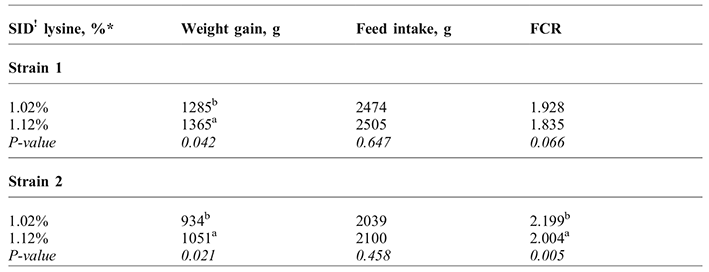
However, there is still the link between energy and protein to be considered. The data in Figure 2 showed a significant response of broilers to increasing AA density and suggests the optimum AA density (expressed as balanced protein) to fall somewhere between 100 to 120% of recommendations. The notion of an ‘increased responsiveness of broiler chickens to dietary AA density, in particular lysine’, was highlighted in review of Vieira and Angel (Reference VIEIRA and ANGEL2012) and maintained in a recently published review on the subject matter (Cerrate and Corzo, Reference CERRATE and CORZO2019). It appears that the current recommendations for AA, in particular for grower- and finisher-phases, may not be sufficient to optimise gain and FE. For example, Sharma et al. (Reference SHARMA, CHOCT, TOGHYANI, LAURENSON, GIRISH and SWICK2018) reported that 14-34 d old broilers responded linearly to increased digestible lysine (up from 0.95 to 1.15%) whereby 1.15% digestible lysine was about 10% higher than recommended by the primary breeders for birds aged more than 25 d. Similarly, recent data (Creswell, 2019 - unpublished; included with permission in Table 1) on the response of two major strains of commercial broilers to AA density (100 and 110% of breed recommendations) from 26-40 d of age suggested the optimal AA density for finishing period may be higher than current recommendations.
Response of finishing (26-40 d) broiler to dietary amino acid density.

*Expressed as balanced protein fed with 3100 kcal AME per kg. 1 standard ileal digestible lysine
The above discussion supports the notion that today's broiler is more responsive to dietary protein (amino acids) and less to energy concentration. This paradigm shift can be explained on two accounts; 1) a significant reduction in the number of days to reach market weight has resulted in reduced maintenance need. Since maintenance energy represents a significant proportion of the total intake energy, this clearly has resulted in reduced overall energy requirements of broilers. The same would have been true for the amino acids (and possibly the other nutrients), but the effect would be far less in magnitude compared with energy since maintenance is a smaller proportion of the total intake requirement of amino acids; 2) the effect of altered composition of gain is quite straightforward in that an increase in the lean (muscle) growth as a percent of body weight would drive an increased amino acid requirement. As a consequence, it is not surprising to expect a net shift in the amino acids to AME requirement.
Possible implications for ideal AA ratios
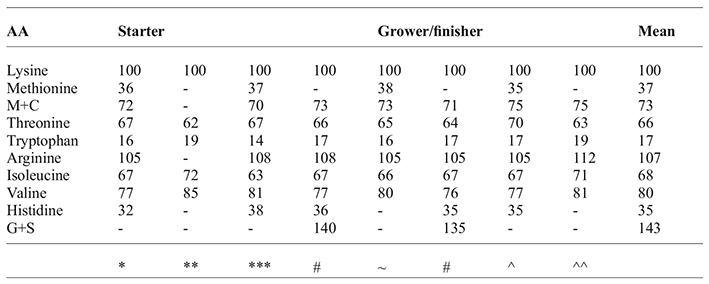
The animal's amino acid requirement is the sum of protein accretion and maintenance and hence follows a distinct pattern based on the weighted average of these functions. This has formed the basis for the concept of formulating to ‘ideal protein’ (IP), which expresses the requirement of individual essential amino acids (EAA) as a fixed percentage of lysine. Table 2 provides a summary of the published IP estimates for broiler chickens which serves as a reference for commercial nutritionists.
Summary of published IP ratios for broilers.

*Baker and Han Reference BAKER and HAN1994; **Baker et al., Reference BAKER, BATAL, PARR, AUGSPURGER and PARSONS2002 (based on gain); ***Gruber 1999 and ~Schutte 1996 as cited by Lemme, Reference LEMME2003; ^Baker, Reference BAKER1994; ^^Mack et al., Reference MACK, BERCOVICI, DE GROOTE, LECLERCQ, LIPPENS, PACK, SCHUTTE and VAN CAUWENBERGHE1999; #Dorigam et al., Reference DORIGAM, SAKOMURA, SILVA, WECKE, SUENDER and LIEBERT2013.
While most of these studies include all EAA in their estimates, only Dorigam et al. (Reference DORIGAM, SAKOMURA, SILVA, WECKE, SUENDER and LIEBERT2013) included the ratio of glycine (glycine + serine). In the case that glycine could be a limiting amino acid in typical corn-soy diets (Aftab, Reference AFTAB2006; Waguespack et al., Reference WAGUESPACK, POWEL, BINDER, PAYNE and SOUTHERN2009) it appears that defining a minimum ratio of glycine + serine: lysine is crucial to the application of the IP concept, especially if the aim is to formulate diets without a crude protein minimum. Hence an estimate of the glycine + serine: lysine ratio has been included in Table 2 that represents an average of several independently published studies (Heger and Pack, Reference HEGER and PACK1996; Corzo et al., Reference CORZO, KIDD, BURNHAM and KERR2004; Jiang et al., Reference JIANG, WALDROUP and FRITTS2005; Waldroup et al., Reference WALDROUP, JIANG and FRITTS2005; Dean et al., Reference DEAN, BINDER and SOUTHERN2006; Ospina-Rojas et al., Reference OSPINA-ROJAS, MURAKAMI, EYNG, NUNES, DUARTE and VERGAS2012; Dorigam et al., Reference DORIGAM, SAKOMURA, SILVA, WECKE, SUENDER and LIEBERT2013). It is important to note that, unlike most EAA, a large variation appears to exist in the ratio estimates of glycine + serine: lysine e.g. from 127 (Jiang et al., Reference JIANG, WALDROUP and FRITTS2005) to 170 (Corzo et al., Reference CORZO, KIDD, BURNHAM and KERR2004). The ratios in Table 2 shall be referred to as ‘published IP’ for the remainder of the current paper.
The first version of IP for broilers was published by Dr Baker's group at the University of Illinois in the early 1990's. In this paper (Baker and Han Reference BAKER and HAN1994) the authors stated one of the underlying assumptions behind the IP concept as: “Dietary, environmental, and genetic factors may affect the absolute amino acid requirement, but the ratio of all essential amino acids to lysine should remain largely unaffected by these variables”. The following section highlights some of the possible exceptions to the above assumption that may have resulted in altered IP ratios for today's broiler. The argument revolves around the fact that published IP estimates, especially those from Illinois, had been established with slow-growing broilers and, with the exception of Dorigam et al. (Reference DORIGAM, SAKOMURA, SILVA, WECKE, SUENDER and LIEBERT2013), the rest of the studies on IP were done before 2002 and do not represent today's genetics.
The effect of growth rate
As discussed earlier for AME, faster growth rate, or reaching market age in fewer days, reduces the requirement directed to serve the maintenance function. Although far less compared with energy, the same is expected to apply to all nutrients, including amino acids. This effect however is expected to vary for individual amino acids, depending upon the relative need for maintenance vs. protein accretion. The net effect of this proposition is a reduction in the ratio of amino acids, such as cysteine, threonine, tryptophan, and glycine, whose maintenance needs relative to lysine are higher (Baker and Han, Reference BAKER and HAN1994; Emmert and Baker, Reference EMMERT and BAKER1997).
The effect of composition of gain
Following growth rate, one of the important changes brought about by genetic selection in the broiler is an increased breast yield (Havenstein et al., Reference HAVENSTEIN, FERKET and QURESHI2003). The amino acid composition of the muscle proteins differ from the IP estimates in that meat contains much more lysine compared with almost all of the EAA. Hence, relative to the IP, broiler breast meat is characterised by distinctly lower ratios of methionine (27), threonine (47), valine (59), isoleucine (54), arginine (83), and glycine + serine (88) (Strakova et al., Reference STRAKOVA, SUCHY, VITULA and VECEREK2006). This would imply that an increase in unit breast yield would increase the relative requirement of lysine more so than the rest of the essential amino acids. This hypothesis is supported by data from Rostagno et al. (Reference ROSTAGNO, PAEZ and ALBINO2013), who reported higher lysine requirement estimates for high- vs. low-breast yielding strains of commercial broiler.
The effect of live weight
The effect of live weight appears to relate to the composition of gain, in that breast and thigh yield linearly increase with body weight (Ross 208 performance objectives, 2014). The fact that these components need more lysine compared with other EAA suggest that the ratio estimates made with broilers at lighter live weights may not fit those targeted for heavier harvest weights. This may have implications for the existing IP estimates, e.g. the fact that all Illinois studies used smaller broilers (<800 g live weight) which may have underestimated the actual need of lysine relative to the other EAA for broilers targeted for heavier slaughter weights.