Following the Financial Crisis of 2007/8 and the associated Great Recession, the importance of reducing government debt and deficits became a central conflict in economic policy debates (Blyth Reference Blyth2013; Farrell and Quiggin Reference Farrell and Quiggin2017). Massive fiscal intervention in response to COVID-19 has increased public debt even more, reviving questions about the wisdom and sustainability of public borrowing. There is little consensus among policy makers and economists on the correct approach (for example, compare Cochrane (Reference Cochrane2009) and Barro (Reference Barro2012) with Krugman (Reference Krugman2015) and Wren-Lewis (Reference Wren-Lewis2015)). Meanwhile, the public may dislike cuts to spending and increases in taxation (for example, Bremer and Bürgisser Reference Bremer and Bürgisser2019; Hübscher, Sattler and Wagner Reference Hübscher, Sattler and Wagner2020), but there is plenty of evidence that voters are, on average, rather averse to government borrowing (for example, Peltzman Reference Peltzman1992).
Public aversion to borrowing may be surprising in political economy terms, but research on political behaviour emphasizes that voters' preferences diverge from rational, materialist, future-discounting income maximization. Public preferences over the deficit are malleable to cues from partisan leaders (Bisgaard and Slothuus Reference Bisgaard and Slothuus2018) and media framing (Barnes and Hicks Reference Barnes and Hicks2018b). This follows the more general pattern that political communication can shape mass attitudes, especially if it reinforces heuristics and biases in popular reasoning (Arceneaux Reference Arceneaux2012). We may not yet fully understand what makes particular presentations persuasive (Blumenau and Lauderdale Reference Blumenau and Lauderdale2020), but a wide literature on the use of metaphor and analogy in (political) reasoning provides the expectation that analogies may be highly persuasive heuristics of this kind (Bougher Reference Bougher2012; Lakoff Reference Lakoff1995; Lau and Schlesinger Reference Lau and Schlesinger2005; Schlesinger and Lau Reference Schlesinger and Lau2000), and used to understand complex problems (Chan, Paletz and Schunn Reference Chan, Paletz and Schunn2012). And in political rhetoric across the advanced industrial democracies in the 2010s, a specific analogy was widely deployed in the context of fiscal policy: the analogy between the budget of the household, and that of the government.
This article has two central motivations and contributions. First, it seeks to examine the effectiveness of political persuasion by analogy in the case of fiscal balance. Our question is: Does analogizing from the household budget to the government budget (‘the household analogy’) drive mass attitudes about government borrowing? Fiscal balance is an area of economic policy making that is highly technical and abstract, and was initially unfamiliar, where levels of uncertainty are relatively high and personal experience and narrative – except through the analogy we are interested in – are effectively impossible. In addition, the specific budget balance analogy we study, in the context of 2010s Britain, was widely promulgated by the media and various political groups, which made it widely accessible. As such, we think the household analogy to the government budget provides something of a best case: we have an analogical argument that meets the criteria of availability, accessibility and plausible applicability, making it a likely case for persuasion (Chong and Druckman Reference Chong and Druckman2007). Moreover, the analogy's deployment in political discourse around public finances, and austerity's surprising popularity in Britain, provide prima facie evidence that persuasion by analogy helped to influence opinions. While we do not argue that this is a crucial, once-and-for-all ‘test’ of the general phenomenon of analogical reasoning, we do think that based on common understandings of its utility we would expect to find evidence of it in this case.
Secondly, we have a substantive interest in the household analogy because of the widespread view that it drives support for fiscal consolidation. How public opinion on complex macroeconomic issues is formed, then, is a puzzle of renewed importance, given the huge debts incurred in response to the 2020 COVID-19 pandemic. The politics of the macroeconomic reaction will remain with us for the next decade, and will have to deal with the issue of public borrowing. The UK's austerity programme in the 2010s is important given the substantive consequences for politics and the size and shape of the public sector (Taylor-Gooby Reference Taylor-Gooby2012; Fetzer Reference Fetzer2019). But it is also an important case in the purer politics of fiscal policy: it was (relative to some other countries' debt-crisis consolidations) discretionary, and remade the distributive orientation of the state under the framework of deficit reduction.
The almost universal assumption that the popularity of fiscal conservatism is due to analogical reasoning between the budget imperatives of households and those of governments (for example, Krugman Reference Krugman2015; Wren-Lewis Reference Wren-Lewis2015) is a striking feature of discussions of public opinion on fiscal balance. Voters are seen as hostile to counter-cyclical spending by governments because they mistakenly attribute constraints that households face to the government. That is, aversion to counter-cyclical spending by governments is seen to be, at least partially, caused by the widespread adoption and application of the analogy from household finances to government finances (for example, Wren-Lewis Reference Wren-Lewis2016). Many prominent scholars believe the resulting political economy of public debt – that of ‘austerity’ – has been ‘collectively disastrous’ (Paul Krugman quoted in Aitkenhead Reference Aitkenhead2012).
This idea of a pathological analogy operating in the minds of both policy elites and the mass electorate is both neat and seductive. However, there is almost no empirical evidence that the claim, at least as it applies to voters, is true. We use observational and experimental data from original surveys fielded in the UK. Our results indicate that while there is a correlation between endorsing the analogy to the household budget and disliking government borrowing, the analogy to the household budget does not appear to support public enthusiasm for austerity in any causal way. The observational correlation is not driven by subsets of people who ‘should’ embody it, based on the logic of the analogy mechanism. Multiple survey experiments that prime the analogy, frame the government budget question in analogical terms, or highlight dimensions of similarity or difference all yield null effects on deficit attitudes. Rather, the analogy appears to provide a convenient justification for views on public borrowing that are held for other reasons.
Analogies, Persuasion and The Household Budget
Analogies hold where similar relationships and systems of relationships hold across different objects. As such, analogies ‘capture parallels across different situations’ (Gentner and Smith Reference Gentner, Smith and Daniel2013). Perceiving these parallel features across different domains is a key feature of cognitive reasoning. It allows for learning by extending understandings of a familiar object to an unfamiliar one. The philosophical adequacy of arguments from analogy has a long history of debate, but the everyday use of analogies is ubiquitous. As when ‘horsepower’ is applied to cars, metaphors and analogies render phenomena that may be abstract, technical or novel comprehensible by highlighting parallels to more familiar things.
In politics, this rendering can clearly be useful for problem solving and for understanding complex situations. For foreign policy decisions, the use of analogies to earlier wars has been prominently studied (Khong Reference Khong1992). Elsewhere it has been argued that ‘[p]olicy transfer is a form of decision making by analogy, using another entity's experience as a source of ideas and evidence’ (Mossberger and Wolman Reference Mossberger and Wolman2003, 428). In considering mass, rather than elite reasoning, the same kinds of cognitive processes are likely to be important. Ordinary people use policy metaphors in their political discussions to evaluate policy options regarding healthcare (Barabas, Carter and Shan Reference Barabas, Carter and Shan2020; Lau and Schlesinger Reference Lau and Schlesinger2005; Schlesinger and Lau Reference Schlesinger and Lau2000), diversity and affirmative action (Marotta Reference Marotta2017), and broader ideological identities (Lakoff Reference Lakoff1995).
Metaphors and analogies are not exactly the same, and indeed some prior research has taken the distinction between metaphor and analogy very seriously (for example, Bougher Reference Bougher2012; Schlesinger Reference Schlesinger2018; Schlesinger and Lau Reference Schlesinger and Lau2000). However, other studies have used the two concepts relatively interchangeably (Hartman Reference Hartman2012). The government-budget-as-household-budget comparison has features of both types of reasoning (according to Schlesinger and Lau's (Reference Schlesinger and Lau2000) distinguishing characteristics), but our implementations and conclusions focus on the role of analogical reasoning in particular, rather than (for example) the succinctness of communication, vividness of experience or emotional content that has been argued to be part of the power of metaphorical arguments (Hartman Reference Hartman2012).
In the context of public opinion, this literature raises questions about analogies as tools of persuasive communication. Studies of political rhetoric focus on their use as distinctive features of politicians' communication. Close to our purpose, Charteris-Black highlights Margaret Thatcher's analogy of ‘economics as “household management”…by which abstract financial decisions of government are described as if they were the more familiar financial decisions made by families’ (Charteris-Black Reference Charteris-Black2011, 112). The study of rhetoric rests on the idea that, at least in principle, it can shape public opinion. This is echoed in the literature on framing. Framing effects occur not only when different frames are used, but where they affect public cognition of the issue at hand (Chong and Druckman Reference Chong and Druckman2007).
The Household Budget Analogy
Our central question focuses on a best-case situation for the persuasive power of reasoning by analogy. Most individuals do not have direct experience of government budgets. In contrast to taxes, which people do have some experience of paying, there are a number of additional steps between any personal action and the budget deficit. Moreover, there are important similarities between household and government budgets that make the analogy accessible and credible. Superficially, they are semantically close: both are ‘budgets’. They are also conceptually close: both households and governments have revenues and expenditures, savings and debts. The ways in which the two budgets diverge generally involve features of the government budget that are hard to fathom. The government budget is an aggregate consequence of a large number of unknown transactions, which people are cognitively ill equipped to understand (Leiser and Krill Reference Leiser, Krill and Rob2016).
Pragmatically, we argue that the household budget is a most likely context for analogical persuasion because austerity advocates thought it was effective – as did their academic and political opponents. The analogy between household and government finances has been made widely – especially by politicians on the right. In the USA, then Speaker of the House of Representatives, John Boehner, argued that, ‘American families are tightening their belt, but they don't see government tightening its belt’ (quoted in Krugman Reference Krugman2015). Likewise, the right-wing Heritage Foundation use the idea of ‘the U.S. budget vs. the family budget’ to explicitly, and negatively, frame government borrowing with reference to household finance.Footnote 1
In the UK, then Shadow Chancellor of the Exchequer, George Osborne, expressed concern over the Labour government ‘maxing out the nation's credit card’ (Seager Reference Seager2009), echoing a long tradition emphasizing parallels between national and domestic budgets. The analogy also appears beyond the Anglosphere in the prudent, budget-balancing, ‘Swabian housewife’ lauded by Angela Merkel.
On the political left, the household economy metaphor is bemoaned in both popular and academic treatments. Academics query whether ‘extrapolating from the need to balance one's household budget to the need to do the same for the state budget – may resonate better with ordinary citizens than the Keynesian counterintuitive proposition to spend more at a time of high deficits and debts’ (Schmidt and Thatcher Reference Schmidt and Thatcher2014, 343). Meanwhile, left-wing journalists lament that language and framing may be ‘duping’ the public, using ‘misleading metaphors …to talk about economic policy’ (Williams Reference Williams2018).
Discussions of the household analogy in the popular and academic press generally do not (and need not) work through the precise details of how this effect is produced. The critiques from economists, and from the left, share the implication that the analogy is not operating in a strictly logical way – that it would not withstand intense scrutiny. So the idea is that the household budget operates as a heuristic shortcut. But the conventional wisdom does not specify whether this ‘works’ through an agenda-setting, priming or framing mechanism (Cacciatore, Scheufele and Iyengar Reference Cacciatore, Scheufele and Iyengar2015). Our reconstruction of the logic is that the public broadly views the household budget as an applicable schema through which to process information about the government budget. Boosting the salience of this feature (that is, priming) will increase reference to the analogy by enhancing its accessibility as a heuristic tool. Similarly, political discourse using and endorsing the analogy reinforces its perceived applicability (that is, framing). Both of these – and a broad agenda-setting mechanism that combines the two effects – rely on the underlying logic that the government budget is ‘like’ the household budget in relevant ways, as we discuss below.
The Household Budget As a Case Of Analogical Persuasion
The conception of the household budget analogy as a schema whose accessibility and applicability can be manipulated fits readily into how analogies more generally should ‘work’ in public opinion. The complicated, abstract and unfamiliar issue of government fiscal policy – in particular budget balance – is rendered manageable for public reasoning by its reduction to the parallel issue of budgeting at the household or personal level. As problem-solving tools, analogies may be found relatively spontaneously, or may be suggested explicitly or implicitly as ways to solve a problem (Kershaw, Flynn and Gordon Reference Kershaw, Flynn and Gordon2013). For this specific analogy, the semantic and structural similarities of the two types of budgets make it a plausible candidate as a framework for thinking through the difficult question of public finance. But the use of this particular heuristic can also be encouraged by either raising its salience or emphasizing the appropriateness of the frame. In both cases, the underlying analogy should have a more powerful impact on people's thinking about public finance, and thus persuade them that government policy should reflect that of a (prudent) household.
Two brief clarifications are in order here. First, the household budget analogy appeals to concrete personal experience, but empirically, the specific experience to which it appeals varies: not all households budget alike. The household budget analogy leading to support for fiscal consolidation is ironic in a context where many household budgets do not, in fact, balance. However, the prescription is recovered if these households dislike or regret their borrowing (as documented by Stanley (Reference Stanley2014)). More importantly, we can leverage variation in the content of beliefs about household borrowing itself to investigate whether analogical reasoning affects preferences regarding public budgets. If individuals prefer not to borrow at the household level, the implication of the analogy is that they should not like government borrowing either. If they think household borrowing is sensible, then the analogy should lead to parallel enthusiasm for government borrowing.
Secondly, our research question is different from studies focusing on whether different analogies lead to different policy prescriptions.Footnote 2 Other metaphors are available to inform public thinking about government finances (Ecnmy 2017), but their implications for support for government borrowing are unclear and, empirically, the household budget frame was relatively uncontested within mainstream UK public discourse on the deficit. As such, analogical persuasion of the type we are looking for is more likely: the household analogy was not pitted against strong alternative frames.
There is some evidence that the public uses the analogy to think and talk about austerity. Stanley (Reference Stanley2014) documents feelings of household overspending underpinning support for government budget consolidation in UK focus groups. Participants make the analogy between household and government budgets more or less explicitly. For example, ‘Maddie’ notes, ‘whether you go from individuals, to nations, to the globe. Debt is a problem’ (our emphasis, Stanley Reference Stanley2014, 904).
Overall, then, reasoning about the household budget provides a ‘most likely’ test case for persuasion by analogy. In terms of the factors influencing persuasiveness (Chong and Druckman Reference Chong and Druckman2007), the household budget is available, thanks to its prevalence in news discussions of government borrowing. It is accessible, in the sense that personal budgeting is a ubiquitous experience. Finally, the close parallel makes it likely that the analogical considerations are deemed applicable. The target policy is complex, technical, and an area in which we know attitudes are relatively malleable (Barnes and Hicks Reference Barnes and Hicks2018b; Bisgaard and Slothuus Reference Bisgaard and Slothuus2018). It is rendered concrete through the personal parallel.
Case Selection and Research Design
Our empirical data come from the UK, a place where the household budget analogy ‘should have worked’ to persuade. As documented above, the idea that the analogy is a powerful persuasive tool in the UK is widespread. Moreover, other reasons for voters to be supportive of budget consolidation are less compelling in the UK than in many other countries. Britain's debt levels were high, and increased during the financial crisis, but there is little evidence that the deficit was unsustainable. Borrowing costs remained low throughout the austerity period. Britain also maintains its own currency, providing monetary alternatives that were off limits in the Eurozone.
Moreover, the dynamics of austerity preferences in Britain are important in practical empirical terms: support for a balanced budget position was consequential in keeping the Conservative Party in power throughout the 2010s, and austerity cuts drove a radical transformation of the public sector in Britain (Taylor-Gooby Reference Taylor-Gooby2012). Public support for fiscal orthodoxy, and its perception as a necessity, combined with the unpopularity of the spending cuts it entailed drove dissatisfaction not with budget consolidation itself, but instead with the broader structure of British politics, as seen in the link between austerity and support for Brexit (Fetzer Reference Fetzer2019).
The primary disadvantage of using the UK as a case for examining the effect of the household budget analogy on deficit preferences is the same feature that makes it a substantively important case: the widespread use of the analogy in public discussions of the government budget. Our experimental approach relies on randomly assigned differences in the extent to which people use the analogy to think about their budget preferences. But thanks to its high salience, there is the possibility that everyone in our sample was strongly ‘pre-treated’ with the analogy before our experimental interventions. We recognize this threat, and pay particular attention to it, examining two observable implications of this specific threat to our inferences below.
Research Design and Empirical Tests
Our basic research design combines observational and survey experimental approaches to address the basic research question: does the household budget analogy underpin greater support for fiscal consolidation? While we document a ‘first-order’ positive correlation between explicit analogy endorsement and preferences for a balanced budget, our central observational test is based on the idea that, to the extent that analogical reasoning drives preferences over government borrowing, the content of ideas about household borrowing should matter. If the analogy between household- and government-level budgets drives support for balanced government budgets, this should be driven by those who think borrowing is not a good strategy at the household level.
Our second set of tests of the idea that the household analogy increases support for fiscal balance uses a set of experimental manipulations of the analogy. In the main analyses presented here, we provide our survey respondents with explanations of government finances that more or less strongly draw on the household analogy. Without requiring conscious recognition of its utility, analogical reasoning should result in stronger support for budget balance among those who see the reasoning explained in an analogical way. Other manipulations, discussed more briefly, provide alternative primes or frames.
To be clear about the link between our experimental manipulations and the theoretical mechanism – analogical reasoning – we investigate here, we can neither manipulate nor observe a cognitive process like analogical reasoning directly in our survey experiment.Footnote 3 Our experimental manipulations instead provide priming or framing treatments to increase the accessibility, salience or availability of the household analogy in people's minds, or to cause them to reflect on its applicability. As far as possible, we design each treatment to ‘work’ only through this greater attention to the household budget. As such, we rely on relatively abstract treatments rather than concrete policy proposals, or those made by specific politicians. The latter potentially introduce other effects (such as partisan cues (Slothuus and de Vreese Reference Slothuus and de Vreese2010)) or even other frames or primes, which would contaminate our inferences about the analogy itself.
However, these abstract treatments may be too weak and bloodless to elicit any response. This becomes a particular concern in light of the null results that we recover. However, a priori we had a good deal of confidence in the capacity of these abstract frames to affect budget preferences, on the basis of similar effects in the existing literature. We note in our pre-analysis plan that a similar text yielded effects of 18 per cent of a standard deviation in Barnes and Hicks (Reference Barnes and Hicks2018b), and that the set of reasons for concern about the level of government borrowing we discuss here should have larger effects. They contain no mention of dissensus, show only negative information (shown to have stronger effects than positive frames (Ledgerwood and Boydstun Reference Ledgerwood and Boydstun2014)) and note ‘major difficulties’ and a loss of control, which could elicit some anxiety from respondents (which has also been shown to enhance the impact of framing, especially for negative frames (Druckman and McDermott Reference Druckman and McDermott2008)).
Below, we address the potential problem that all our respondents had prior exposure to the analogy treatment, including a completely different experimental treatment that primed the need for household budget balance. If everyone is pre-treated, and using the analogy, this should lead to greater endorsement of government budget consolidation. We find no evidence of this.
Given the coexistence of a simple correlation between analogy endorsement and preferences for a balanced budget, but the absence of any evidence of a causal link between them in either the differential utilization of the analogy across groups in our observational data or in our experiments, below we discuss a further analysis of our data to try to explain the correlation.
Observational Evidence
The data for our observational analyses are drawn from a survey of 3,810 respondents, fielded with YouGov in the UK in March 2019 as part of its omnibus daily polling service.Footnote 4 We consider whether explicit endorsement of the utility of the budget analogy is related to consolidation preferences in public opinion, and for whom.
Our measure of explicit endorsement of the analogy invites respondents to locate themselves on a six-point scale anchored at each end by (opposite) declarative statements about the appropriateness of a household budget in reasoning about government budgets. We ask respondents:
People have different views about how we should think about government budget balance, that is, what the government spends compared to its income from taxes.
How useful do you find ideas about household budgets for understanding government budgets? Please place yourself on this 6-point scale.
• ‘The way we think about household budgets shows us how we should think about government budgets.’
• …
• ‘The way we think about household budgets is irrelevant for how we should think about government budgets.’
• ‘Don't know”
We do not allow for a neutral response as we wish to avoid a satisficing response that is difficult for us to classify as corresponding to analogizing or not (Johns Reference Johns2005; Krosnick Reference Krosnick1991). We also avoid asking respondents to agree or disagree with a specific statement in an attempt to minimize acquiescence bias. Unless otherwise noted, our analyses use a continuous numeric version of the responses (range: 1 to 6) with higher values indicating endorsement.
How widespread is self-conscious agreement with the analogy between household and government budgets?Footnote 5 Figure 1a shows the distribution of responses to our analogy question, weighted to be representative of the UK population. Contrary to expectations, we find a reasonably uniform distribution of responses – and, indeed, the modal response after ‘Don't know’ is the strongest rejection of the analogy.Footnote 6
Weighted distributions of responses to the household analogy and balanced budget questions.

The attitudinal outcome we are interested in is support for balancing the government budget. Our measure is generated from responses to the question: ‘How appropriate do you think it is for the UK Government to spend more than its income in any given year?’. The response options are: ‘Never appropriate’; ‘Rarely appropriate’; ‘Sometimes appropriate’; ‘Often appropriate’; ‘Always appropriate’; ‘Don't know’. While the ‘how appropriate’ question could be answered with evaluative terms rather than ‘frequency’ terms, the frequency (‘how often’) response options provide less of a normative steer. We also deliberately separate the question from perceptions of current macroeconomic circumstances.
The raw responses to the balanced budget question are ordered categories, and Figure 1b plots their distribution. For our subsequent analyses we use a numeric version ranging from 1–5, with higher values corresponding to more hawkish attitudes and ‘Don't know’ responses dropped.
The Correlation Between Analogy and Budget Attitudes
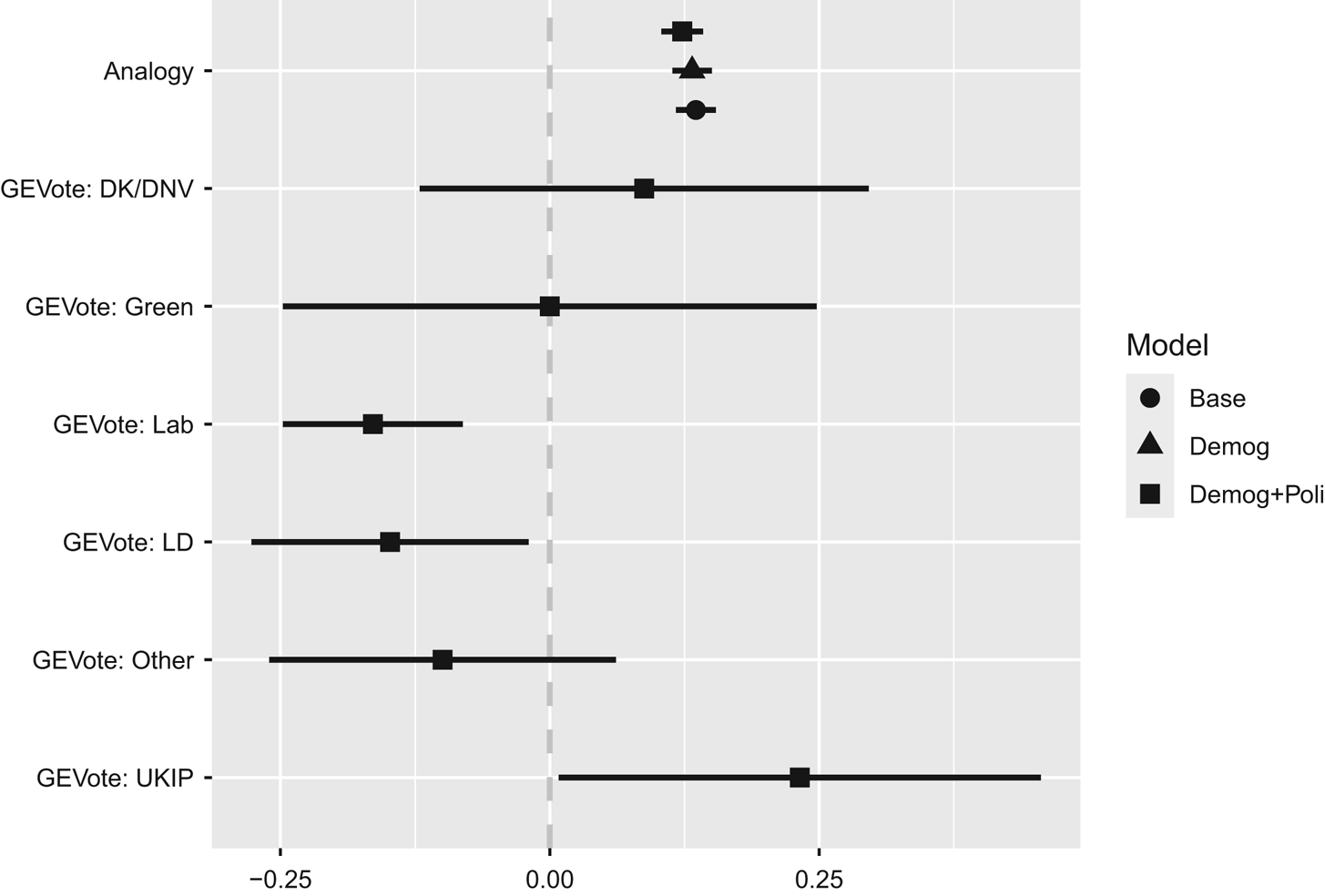
In line with the conventional narrative, qualitative evidence, and the idea that analogical reasoning drives UK support for austerity, we find a positive correlation between the two items in the survey data.Footnote 7 Figure 2 shows that the relationship between the two is positive, of a magnitude comparable to observed partisan differences, and stable across specifications including various covariates.
Selected coefficients from models explaining preferences for budget balance
Note: ‘Base’ model includes analogy endorsement and treatment group dummies. ‘Demog’ model adds controls for age, gender, social grade, housing tenure and household income. ‘Demog + Poli’ model further adds controls for 2017 general election vote choice, Brexit referendum vote choice and newspaper readership. Based on estimates from Appendix Table A8.

However, for these observational data, it is very difficult for us to rule out plausible unobserved characteristics that would make respondents more likely to endorse the analogy and the preference for consolidation, or a reverse causal pathway. Consequently, we consider (1) more complicated observational comparisons that draw on the content of the household analogy held by different individuals and (2) experimental evidence to investigate the accuracy of the causal claim of mass persuasion.
To elicit views on household budget balance, we asked our survey respondents the following question:
In Britain today, people borrow money for many different reasons. For example, people may borrow to invest for the future, to increase their personal spending, or to make ends meet when times are hard. How important should each of the following considerations be when households are thinking about borrowing money?
Respondents were asked to rate the following statements as either ‘Not at all important’, ‘Not very important’, ‘Important’, or ‘Very Important’:
1. It allows for purchases that are beneficial in the long run, for example in the form of business or student loans, or mortgages
2. It allows people to get through temporary hard times
3. It seems like a good idea in the short run, but leads to difficulties later on
4. It encourages spending at unsustainable levels
5. Whatever the underlying reasons or consequences, it is better to avoid borrowing if possible.
We again convert responses to numerical form (4 = Very Important; 1 = Not at all important) and construct two measures of attitudes to household borrowing.Footnote 8 The first measure uses responses to the overall assessment provided in response to item 5. The second measure is an index that adds the numeric responses to the negative statements (3 and 4) and subtracts endorsement of the positive responses (1 and 2). Both variables are scaled such that higher values correspond to greater aversion to household borrowing. With HHBorrowBad indicating either of these variables, we estimate models of the form:
 $$\eqalignno&{{\displaylines BalanceBudget_i &= \alpha _0 + \alpha _1\cdot Analogy_i + \alpha _2\cdot HHBorrowBad_i }}\cr &\quad+ \alpha _3\cdot Analogy_i\cdot HHBorrowBad_i + \alpha _X\cdot X_i + {\rm \epsilon }_i\;.} $$
The formal test for the hypothesis, then, is that the coefficient on the interaction term (α 3 > 0) is positive.Footnote 9
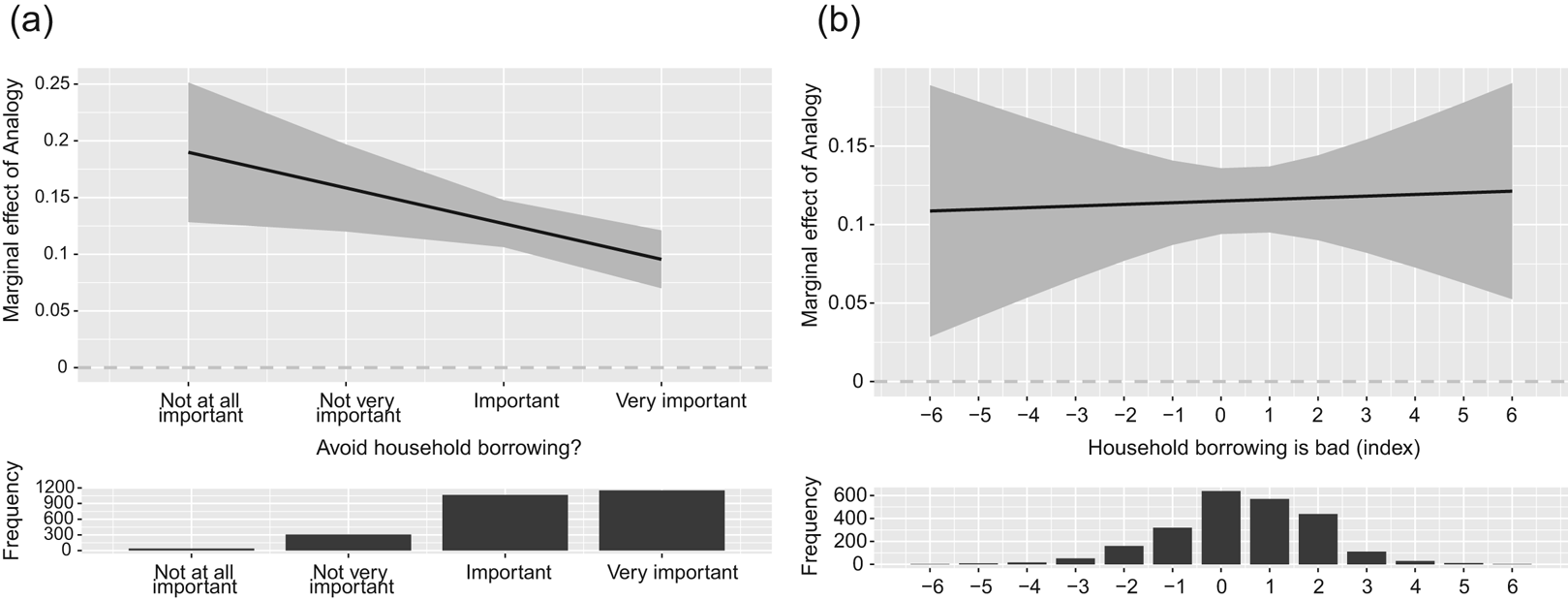
The full results are presented in Appendix Table A10. Here, we focus on the core findings. Regarding the explicit hypothesis tests, we obtain estimates for the analogy-bad borrowing interaction of –0.031 (p = 0.014) using the overall avoid household borrowing measure and 0.002 (p = 0.863) for the index measure of bad borrowing. Figure 3a shows that, if anything, the evidence is more consistent with the effect of analogy endorsement on hostility to government borrowing being weaker when hostility to household borrowing is higher – the opposite of the theoretical expectation.Footnote 10
Marginal effects of endorsing the analogy on balanced budget preferences, conditional on attitudes about household borrowing
Note: based on estimates from Appendix Table A10.

Experimental Evidence
Our experiment again takes respondents' views on how appropriate it is for the government to spend more than its income in a year as its dependent variable. The control group sees the question text in the simple version presented above. By contrast, the treatment groups see texts with one of the following appended to the introductory paragraph:Footnote 11
1. Analogical Reason
‘A common way of thinking about government finances is that governments should not spend more than they earn in any given year because borrowing leads to major financial difficulties. Just like households, governments have creditors who worry about repayment. Just like households, governments have a credit score that may be downgraded. Just like households, governments borrowing too much can see their debts spiral out of control.’
2. Less Analogical Reason
‘A common way of thinking about government finances is that governments should not spend more than they earn in any given year because borrowing leads to major financial difficulties. Governments have creditors who worry about repayment. Governments have a credit rating that may be downgraded. Governments borrowing too much can see their debts spiral out of control.’
3. Reason
‘A common way of thinking about government finances is that governments should not spend more than they earn in any given year because borrowing leads to major financial difficulties.’
Table 1 summarizes the design for this experiment. Once again, we have a relatively large sample, in this case yielding ≈567 in each treatment condition. Power calculations reported in the pre-analysis plan indicate that we are adequately powered to detect treatment effects that are even ‘small’ in Cohen's-d terms (Barnes and Hicks Reference Barnes and Hicks2018a). The survey was fielded in the UK by YouGov in the middle of August 2018.
Design for the Analogical Reason experiment

The main results of the experiment are presented in Figure 4, which shows ordinary least squares (OLS) estimates of the three ‘reason’ treatment effects.Footnote 12 In short, we find that none of our treatments has a discernible effect on attitudes towards balanced budgets.Footnote 13 The confidence intervals around our point estimates are neither wide on the scale of unit changes in the balanced budget outcome, nor compared to the standard deviation in that variable (0.91). Providing a reason to support balanced budgets that implicitly or explicitly uses the household analogy appears to have no effect on expressed views about balanced budgets.
Estimated effects of the various ‘reason’ treatments on balanced budget attitudes, measured using BalanceBudgeti

Probing the Null Result
A central feature of the experimental design is that it need not rely on conscious use of the analogy. However, in light of our null results, it is worth considering whether there are detectable effects between the treatment groups among those for whom an effect is the most likely. We consider that set to be respondents whose endorsement of the analogy (in explicit terms) is moved by our treatment interventions. A priori, individuals who are least likely to have accepted the analogy prior to our intervention seem most likely to be affected by the (more novel, to them) reasoning by analogy when we present it. These include respondents who pay little attention to politics, as they are less likely to have had prior exposure to the analogy, and Labour Party identifiers, as they are less likely to have accepted it. Both of these characteristics were measured in the YouGov respondent profile before our experiment, so we do not drop observations based on anything measured post-treatment: the comparisons here are of similar groups in treatment and control, but groups more narrowly defined than the full sample (Montgomery, Nyhan and Torres Reference Montgomery, Nyhan and Torres2018).
Indeed, within these two subsets of respondents, exposure to the Analogical Reason text does lead to greater explicit endorsement of the analogy logic (see Models 1 to 3 in Table 2). However, even within these subgroups, this treatment has no effect on their balanced budget preferences (Models 4 to 6). These estimates are simple OLS models without covariates.Footnote 14
Estimated effects of the various ‘reason’ treatments on household analogy endorsement (Analogy) and balanced budget attitudes (BalanceBudget) among groups for whom the treatments shift analogy endorsement

***p < 0.01; **p < 0.05; *p < 0.1
We note that this subgroup analysis was not pre-registered, and is somewhat underpowered. In formal hypothesis testing terms, it should be considered highly exploratory. But it takes what is effectively the best-case scenario for ex post ‘fishing’ for a positive effect of our treatment on the outcome, and nevertheless finds none. As such, it gives us more confidence in the null results uncovered in the main analysis.
A separate survey experiment provides further null results. Space constraints prohibit an expansive discussion here, but full details are provided in Appendix C. We conducted a survey in which some respondents were randomly assigned to see four sentences with concrete examples of the household analogy, and then asked how many of those examples they agreed with, before proceeding to questions on the analogy and on preferences for budget balance. The examples treatment invited assessments of the similarities (or not) between: taxes and earnings, national infrastructure and home improvements, foreign aid and charity, and the police and burglar alarms. This treatment had a statistically significant negative effect on analogy endorsement – that is, it worked to ‘rebut’ the analogy somewhat – but had no meaningful effect on balanced budget preferences.Footnote 15 We take this as further support for our null findings as there is, again, no evidence of a causal effect from changing analogy endorsement to balanced budget preferences.
What alternatives are there to our interpretation that the analogy is interestingly having no effect? It could be the case that balanced budget attitudes are simply too well entrenched to move – no effect, but not interesting. We find the strongest version of this critique generally unconvincing – that voters have some kind of intractable entrenched preference over government budget balance. More weakly, there may be a substantive ceiling effect: there is no way for voters to hate borrowing (in treatment) more than they already do (in control). Alternatively, our measurement may induce a ceiling effect: voters do move, but our instrument cannot detect it. At face value, the descriptive statistics do not support this third interpretation. While there is little support for the government spending more than its income, our balanced budget measure has an ex ante distribution with ample room to move in either direction. Nearly half of respondents indicate that it is ‘sometimes’ appropriate for government spending to exceed income, and only 13 per cent are in the most hawkish category.
The malleability of balanced budget preferences is not directly observable in the experimental data we present here. However, other studies of popular preferences regarding government borrowing indicate that these preferences are quite responsive to changes in the information and arguments surrounding the topic. Bisgaard and Slothuus (Reference Bisgaard and Slothuus2018) find that parties’ shifting positions on the deficit issue lead partisans to change their opinions on the matter. Barnes and Hicks (Reference Barnes and Hicks2018b) find that different media portrayals of the deficit have an important impact on balanced budget preferences. Barnes and Hicks (Reference Barnes and Hicks2021) find that respondents' views on deficit reduction change depending on whether they are given information indicating that the economy is doing well or poorly. Not only do these studies indicate that deficit preferences can be shifted in principle; they also find these effects within random assignment survey experiments much like the one we describe here. It is possible that some version of an analogical argument might have been persuasive (and indeed was, in the real UK history), but that we failed to articulate this compelling version in our treatment (Blumenau and Lauderdale Reference Blumenau and Lauderdale2020). However, it is not obvious why the analogy would be harder to translate into an effective experimental treatment than the subjects of these prior studies. Moreover, various approaches to the treatment yield similar null results (including one more, below).
The Threat from Pre-Treatment
One plausible reason why the analogy treatment might (differentially) fail is the idea of ‘pre-treatment’. If the population as a whole has been widely exposed to all of the analogical arguments about the similarities between household and government budgets, our emphasis in the experimental treatment groups will have no additional effect. Nevertheless, without the analogy being deployed ‘in the wild’, preferences might have looked quite different.
We consider the threat from pre-treatment in two ways. First, we extend the low-attention subgroup analysis described above to a full evaluation of treatment effect heterogeneity by political attention. Secondly, we field another survey experiment that uses a priming approach that should be more effective the larger the pre-treatment phenomenon is. Due to space constraints, we present the political attention results here, and briefly describe the experiment. Appendix F provides a full description of the latter.
The intuition behind our analysis is that those who pay little attention to politics are less likely either to have considered and developed the household analogy themselves, or to have been as strongly exposed to political and media messages encouraging its use. Once exposed, however, low-information citizens may be the most likely to be susceptible to analogical reasoning, ‘because people with limited knowledge and information are inclined to seek answers in familiar and easily understandable objects, such as the personal household budget’ Elkjær (Reference Elkjær2020, 10). To the extent that we accept this logic, we can assess the extent to which our null findings are driven by pre-treatment of the sample by exploring potential heterogeneity of treatment effects by political attention.Footnote 16 Our data include self-reported political attention on an 11-point scale (0 = Pay no attention; 10 = Pay a great deal of attention).Footnote 17
Figure 5 shows the treatment effect of Analogy Reason across different levels of political attention. Following Hainmueller, Mummolo and Xu (Reference Hainmueller, Mummolo and Xu2019) regarding the specification of interaction effects, Figure 5a presents separate treatment effect estimates for respondents in the bottom 25 per cent, middle 50 per cent, and top 25 per cent of the distribution of political attention – which we label ‘factorial moderation’. Providing more modelling structure to give the data the best chance of supporting the pre-treatment argument, Figure 5b shows the result of estimating linear moderation of the treatment effects across the political attention scale.
Estimated effects of the ‘Analogy Reason’ treatment on balanced budget attitudes as moderated by political attention.

In neither case does the evidence support the pre-treatment argument. Indeed, the factorial moderation results are strikingly inconsistent with it: they indicate that the treatment effect for the low-attention respondents is negative. The linear moderation results are more consistent with the pre-treatment argument in that there is some negative slope to the treatment effects, but the confidence intervals are so wide that the effects are indistinguishable from zero and from each other.
Additional evidence relevant to pre-treatment comes from a further survey experiment, detailed in Appendix F. We randomly assigned half of a large (n = 3,400) sample from the YouGov omnibus panel to answer a question designed to prime concerns about the household budget constraint. They were asked: ‘If your monthly income were to unexpectedly fall by 10 per cent, how do you think this would affect your monthly expenditure, if at all?’ This personal budget prime was followed by a question eliciting their government budget preferences. The control group went straight to the preferences question with no prime.
If respondents have been pre-treated with the household analogy, those primed to think about the household budget constraint should offer more hawkish deficit responses.Footnote 18 However, we find no such effect. Again, the treatment effect of the personal austerity prime is a very precisely estimated zero. Given that we obtain these null effects for a treatment that is designed to work in an environment in which there is widespread pre-treatment with the household analogy, we have further reason to doubt that the null findings from our previous experiment are driven by widespread pre-treatment.
Explaining the Correlation Between Analogy and Budget Balance Attitudes
The evidence from the previous section weighs heavily against the idea that the use or prevalence of the household finance analogy causes mass attitudes regarding government borrowing to be more hawkish. However, we have seen that analogy endorsement and debt hawkishness are positively correlated. If there is no causal relationship from analogy endorsement to borrowing attitudes, why would there be a correlation?
The core of our answer is that the correlation arises due to reverse causation. Respondents' endorsements of the household analogy are given so as to appear to be consistent with their government budget preferences. Having expected to find positive causal effects in the previous sections, this ‘theory’ is self-consciously part of our ex post discussion and probing of the broader null results, rather than the central claim of the article. Nevertheless, some additional analyses provide suggestive evidence.
Our empirical approach assesses whether randomly adjusting the order in which survey respondents answer our analogy endorsement and balanced budget questions affects the responses to each question. Respondents who answer the balanced budget question first can use the latter to justify their first response. Since respondents tend to express a fairly hostile view to government borrowing, on average, this would lead to a higher rate of endorsement of the analogy. If balanced budget attitudes are primary, analogy endorsement reflects this rationalization, and analogy endorsement itself does not affect balanced budget attitudes, then we should see no symmetric question order effect on responses to the balanced budget question.
Our March 2019 survey provides us with the opportunity to assess these claims.Footnote 19 Table 3 summarizes the design of this experiment. Figure 6 shows the estimated effects of the question ordering on both balanced budget views and analogy endorsement as dependent variables.Footnote 20 Consistent with our argument, we find that balanced budget attitudes are not influenced by whether respondents have been asked about the extent to which they endorse the household analogy first. However, analogy endorsement is influenced by whether respondents have previously indicated their balanced budget preference.
Estimated effect of answering the Balance Budget question first on balanced budget attitudes (BalanceBudgetNi) and household analogy endorsement (AnalogyNi)

Design for the Balanced Budget Attitudes Cause Analogy Endorsement experiment

We can push the analysis a little further. If endorsement of the household analogy justifies a preference for less government borrowing (ex post), then the effect on analogy endorsement of answering the balanced budget question first should be strongest for respondents who hold the most hawkish borrowing attitudes. Accordingly, Figure 7 shows the results of a model that tests whether balanced budget attitudes moderate the question ordering effect on analogy.Footnote 21 It is indeed the most hawkish respondents who appear to adjust their analogy endorsement most strongly when given the chance to make the latter consistent with the former.
Estimated effect of answering the Balance Budget question first on analogy endorsement (Analogyi), conditional on factor levels of balanced budget attitudes (BalanceBudgeti)

Conclusions
In this first attempt to examine the prevalence and consequences of the household finance analogy, we find that it is less consequential for public opinion on fiscal balance than has been widely claimed. These findings should provide reassurance to scholars and practitioners of the political economy of macroeconomic policy that the public is not ‘duped’ by a false analogy. However, this good news unmasks a new set of inter-related puzzles.
Despite finding no causal link between the analogy and opposition to government borrowing, we nonetheless continue to see evidence that voters are, on average, rather hawkish. We think it is important to have eliminated one bad explanation of public support for austerity, but the challenge of finding good explanations remains. One possibility is that elements of the analogy message that are distinct from its specific analogical component were important. Alternatively, future work in this vein may focus on the specific content of frames surrounding the public budget, given its complexity as an issue. The analogy itself may be a weak frame and seen as such; future studies could test this possibility empirically.
These results have important theoretical implications for thinking about how the general public reason, and are – or are not – persuaded by particular types of evidence and argument. It does not seem that the general public used this analogy to problem solve in the development of policy preferences. Here we contribute to mixed results on the use of analogy in other policy areas. For example, Barabas, Carter and Shan (Reference Barabas, Carter and Shan2020) find that (only) when combined with policy rationales do (some) analogies about health care in the United States shift support for policy. An open theoretical question concerns which characteristics of the situation – the policy area, the specificity of the analogy, the source of the message – might change any propensity of analogies to change thought patterns. We thought the budget deficit a most-likely case for the use of analogical reasoning: a complex, abstract and highly uncertain issue for which some kind of ‘model’ is necessary to understand the topic, but also a high-salience, and quite high-stakes issue where understanding should be important, but other features may be more important in generating analogical reasoning.
Our reverse causation results, however, indicate that in this case the analogical cognitive process seems to be more closely tied to the ex post justification of policy preferences reached by other means. We remain uncertain as to what these means would be. Other work has emphasized the leadership of partisan elites on the issue (Bisgaard and Slothuus Reference Bisgaard and Slothuus2018), and we expect that agenda setting by elite actors is a large part of the story. For some citizens, (anti-)deficit attitudes could be used to rationalize a distaste for government spending overall, although this seems more likely in the American context than in Britain (or Europe more generally), where reminders of the spending implications of fiscal consolidation tend to undermine support for budget balance (Hübscher, Sattler and Wagner Reference Hübscher, Sattler and Wagner2020).
It remains an open question whether the household budget analogy has a causal impact on policy through its use by those tasked with solving the problem more directly – namely political elites. To the extent that it causally affects elite attitudes, the analogy could be consequential. This would be consistent with other evidence on the use of analogy in problem solving, and provide a path for the household analogy to consequentially affect mass attitudes through elite influence. But recent work would caution against expecting radically different behavioural responses from elite actors, compared to the public (Kertzer Reference Kertzer2020; Sheffer et al. Reference Sheffer2017). Nevertheless, even if the analogy is not causally persuasive, it may yet be rhetorically useful. It may provide elites with a quick and easy way to communicate their position on a complex issue, and as such have communicative value to politicians that is independent of its persuasive power.
More broadly, the absence of support for the household analogy explanation of public preferences for austerity highlights important dynamics in elite–mass interactions on the topic of fiscal policy. Even without direct effects on the public's policy preferences, the perceived power of the analogy may have shaped political contestation over austerity. Policy makers, commentators and academics may have thought that public policy was electorally constrained by voters’ commitment to the household budget analogy. Yet all the evidence we have been able to find indicates that this was wrong.
Supplementary material
Online appendices are available at https://doi.org/10.1017/S0007123421000119.
Data availability statement
Replication data for this article can be found in Harvard Dataverse at: https://doi.org/10.7910/DVN/PXTOK9.
Acknowledgements
We are extremely grateful to the following people for very helpful comments at various stages of this project: Ben Ansell, Jack Blumenau, Mark Copelovitch, Alan Jacobs, Mark Kayser, Ben Lauderdale, Lucas Leemann, Scott Matthews, Tom O'Grady, Jonas Pontusson, Ethan Porter and Vera Troeger. In addition, we benefited greatly from feedback at: the European Political Science Association conference (20–23 June 2018); the workshop on ‘Unchallenged Democracy’ at the University of York (27–29 June 2018); a seminar in our department (4 October 2018); the workshop on ‘Political Causes and Consequences of Credit Markets’ at Nuffield College, University of Oxford (10 May 2019), and the CAGE conference, University of Warwick (26 June 2019).
Financial support
This work was supported by a Leverhulme Trust Research Fellowship (RF-2017-227\7, Hicks) and a UKRI Future Leaders Fellowship (MR/S015280/1, Barnes).
Ethical standards
The research was conducted in accordance with the protocols approved by the UCL Research Ethics Committee.