Extreme weather events and expanding human activities are expected to heighten the frequency and intensity of global geological disasters, posing substantial threats to social, economic, and ecological systems.Reference Becker, Aerts and Huitema1, Reference Jiang, Deng and Tang2, Reference Gould, Shrum and Ramirez Harrington3 In China, where approximately 260 000 hazards have been identified, 74 million individuals face immediate threats, and over 1000 towns and 50 000 natural villages are situated in high-risk areas.Reference Peng, Tan and Deng4, Reference Tan, Zhou and Peng5 The rural population in southwestern China, particularly vulnerable due to marginal settlements and weak infrastructure, bears a disproportionate burden.Reference Tan, Zhou and Peng5 While technology and governance are acknowledged strategies for mitigating disaster risks, household-level preparedness becomes paramount, especially in regions with scattered settlements and high disaster occurrence.Reference Hoffmann and Muttarak6, Reference Peng, Tan and Deng4, Reference Hong, Kim and Lee7
Disaster preparedness refers to the proactive measures and actions households take to minimize the impact of disasters, encompassing both mental readiness and tangible preparations such as emergency kits, insurance, and other strategies.Reference Hong, Kim and Lee7, Reference Sadeka, Mohamad and MdSK8 Residents in disaster-stricken areas, as firsthand witnesses, can easily observe environmental changes and take proactive measures to mitigate disaster losses. Those who have adopted appropriate precautionary measures can engage in self-rescue and mutual aid before external assistance arrives.Reference Peng, Tan and Lin9, Reference Tan, Zhou and Peng5 Despite the pivotal role of individual preparedness, its adoption in rural, disaster-stricken settings remains low.
Natural disasters evoke diverse psychological responses, and psychological factors profoundly impact disaster preparedness. Individuals’ perceptions, coping mechanisms, and mental preparedness significantly influence their decisions and actions in mitigating potential disasters.Reference McNeill, Dunlop and Heath10, Reference Jiang, Deng and Tang2, Reference Lindell, Huang and Wei11, Reference Bradley12 This study addresses the impact of psychological variables on disaster preparedness, drawing on the Protection Motivation Theory (PMT) and the Protective Action Decision Model (PADM), with a comprehensive focus on the relatively underexplored realms of risk appraisal, coping appraisal, and stakeholder appraisal. While risk perception has received attention, coping appraisals remain underexplored despite their potential as superior predictors.Reference Bamberg, Masson and Brewitt13, Reference Van Valkengoed and Steg14 Limited research exists on the constraints hindering the transformation of disaster preparedness willingness into action in China’s vast disaster-stricken areas.
This study adds significant value to the existing knowledge on disaster preparedness by bridging critical gaps. Firstly, by integrating PMT and PADM within a conceptual framework informed by insights from rural mountainous regions of China, it offers a comprehensive and contextually relevant understanding of the psychological factors that influence self-protective and eco-friendly intentions. This enhanced framework not only enriches theoretical models but also makes them more applicable to the unique challenges faced by rural communities in China. Secondly, by delving into the reasons why preparedness intentions do not always translate into actions, this study sheds light on the complexities involved in the transition from willingness to behavior. This nuanced understanding highlights the need for a more holistic approach that considers both psychological responses and external factors such as resource availability. Lastly, this study contributes to practical policymaking by identifying opportunities for adaptation through the alignment of psychological factors and resource availability. Policymakers can leverage these insights to design and implement interventions that are more likely to promote public disaster preparedness effectively. In summary, the added value of this study lies in its contribution to both theoretical advancements and practical applications in disaster preparedness.
Framework and Hypotheses
The Protection Motivation Theory (PMT) and the Protective Action Decision Model (PADM) have been employed in previous research to predict responses to a variety of environmental changes, including floods, earthquakes, storms, tsunamis, public crises, and climate change.Reference Terpstra and Lindell15, Reference Zhu, Wei and Zhao16, Reference Lindell, Huang and Wei11 The PMT, originally modified by Rogers and Prentice-Dunn,Reference Rogers and Prentice-Dunn17 consists of 3 stages: information source, cognitive mediation process, and coping response process. The cognitive mediation process, the central phase of the framework, encompasses threat appraisal and response appraisal. Threat appraisal, like risk perception, refers to an individual’s evaluation of risks. Within PMT, threat appraisal includes perceived possibility and perceived impacts. Response appraisal includes self-efficacy (confidence in one’s ability to carry out a specific action), response efficacy (belief in the effectiveness of a specific protective measure), and response cost (perception of the costs associated with taking a specific protective measure). PMT posits that threat appraisal and response appraisal can evoke protection motivation, ultimately influencing decisions regarding protective or non-protective behaviors.
The PADM categorizes determinants of protective behavior into hazard-related attributes (perceived effectiveness of specific protective actions) and resource-related attributes (perceived requirements in terms of money, time, effort, knowledge, skills, and cooperation to implement a protective behavior). High levels of hazard-related attributes and low levels of resource-related attributes increase the likelihood of engaging in protective behavior.Reference Lindell18 Lindell and PerryReference Lindell and Perry19 revised the PADM model, incorporating 3 central psychological predictors: threat perception (parallel to threat appraisal in PMT), protective action perception (including hazard-related and resource-related attributes), partially overlapping with response appraisal in PMT), and stakeholder perception. Stakeholder perception encompasses perceived responsibility (beliefs about who should be responsible for disaster risk management) and trustworthiness (degree of trust in other stakeholders).
There are overlapping and differing conceptualizations in the core elements of the Protection Motivation Theory (PMT) and the Protective Action Decision Model (PADM) regarding the psychological factors influencing the decision-making process for disaster preparedness.Reference Lindell and Perry19, Reference Terpstra and Lindell15 For example, PADM contains an additional component, stakeholder perception, which is not present in PMT. The hazard-related properties in PADM encompass the effectiveness of protecting individuals and property, as well as utility for other purposes, which conceptually align with the response efficacy concept in PMT. However, PMT lacks an equivalent concept to the utility attribute. Additionally, the resource-related attributes in PADM provide more detailed categorizations of perceived costs, including financial requirements, time, knowledge, manpower, and social cooperation. In contrast, PMT offers a more generalized division of perceived costs.Reference Trainor, Nagele and Philips20, Reference Lindell, Huang and Wei11, Reference Yang, Tan and Peng21, Reference Bamberg, Masson and Brewitt13, Reference Van Valkengoed and Steg14
In this study, we propose a reconfigured analytical framework to examine the influence of various psychological factors on disaster preparedness. The specific indicators employed in the framework are derived from a combination of the PMT and PADM models, with adjustments made to accommodate the unique characteristics of the study area. For example, the risk appraisal component encompasses perceived probability, perceived severity, and an emotional dimension. To capture the influence of emotions on disaster preparedness measures, we introduce a “perceived worry” variable in the risk appraisal section. Emotions such as fear or worry have been found to effectively motivate individuals to undertake mitigation actions.Reference Lindell and Perry19, Reference Lu and Schuldt22 Regarding cost considerations, we concur with PADM that a more detailed categorization of costs facilitates a better understanding of participants’ sensitivity to different types of costs. However, this also poses challenges in terms of data collection for empirical research. Considering that individuals with lower annual incomes in rural areas may be more sensitive to monetary costs and less sensitive to non-monetary costs, we divide response costs into economic and non-economic categories. Our study examines disaster preparedness in terms of both self-protective behaviors and ecological protection behaviors, with the latter receiving limited attention in existing literature.
The uncertainty inherent in disasters contributes to the uncertainty of return on investment in disaster preparedness. While psychological perception can stimulate willingness to prepare for disasters, it is not sufficient to drive actual response. Non-psychological factors also play a significant role, with limited livelihood capital emerging as a prominent constraint. Public access, facilitated by public entities such as governments, companies, and NGOs, in terms of information, resources, and channels, is crucial for understanding the barriers to disaster preparedness efforts. Rural inhabitants are faced with multiple responsibilities regarding their livelihoods, such as agricultural cultivation, childcare, and elderly care, demanding considerable time, financial resources, and effort. Consequently, the problems posed by natural disasters are often perceived as distant and are overshadowed by competing priorities, leading to diminished significance. The analytical framework is illustrated in Figure 1.
Conceptual framework (revised from Rogers and Prentice-Dunn [1997] and Lindell and Perry [2012]).

As discussed above, the hypotheses are proposed as follows.
H1: Risk appraisal has a significant influence on disaster preparedness intentions.
H2: Coping appraisal has a significant influence on disaster preparedness intentions.
H3: Stakeholder appraisal has a significant influence on disaster preparedness intentions.
Methodology
Data Collection
The survey data was obtained from a study conducted in Chongqing, China. China is characterized as a mountainous country with 70% of its land area being mountainous. Disasters are comon in China, including landslides, collapses, and debris flows, with a nationwide tally of 260 000 recorded potential disaster points. Chongqing primarily consists of mountainous terrain (75.9%) and hilly areas (18%), with a significant variation in elevation exceeding 2700 meters between ridges and valleys. This extensive mountainous landscape creates favorable conditions for geological disasters such as landslides and debris flows. Due to climate change and its geographical features, Chongqing has become one of the most severely affected regions. By 2019, over 15 000 potential disaster sites had been identified in Chongqing, predominantly located in rural areas characterized by high and steep mountain slopes. Chongqing has a rural population of nearly 10 million people, with over 1 million residents directly at risk from geological disasters. Considering the context of climate change and rapid urbanization, it is anticipated that climate-related geological disasters in Chongqing will continue to escalate, leading to an increasing population at risk.
From May to July 2021, a questionnaire survey was conducted to gather information about the socio-demographic characteristics, disaster response strategies, and cognitive processes of rural residents. Before the formal survey, 6 interviewers from local universities underwent a 1-week training program and trial survey to acquaint themselves with the questionnaire items. To eliminate any potential uncertainties in the questionnaire, we provided comprehensive instructions to the interviewers. The survey was initially tested in 2 villages located in the Beibei district and underwent multiple revisions based on feedback received from the interviewees. Several test questions were placed to determine the quality of the questionnaires.
A stratified random sampling approach was employed in the official investigation to choose samples. Initially, 4 districts (or counties) were selected based on their GDP rankings and the number of disaster sites. These districts/counties are at risk of debris flow, landslides, and collapses due to extreme weather events and geological conditions, with an average of 700 disaster points in each area. Considering the distribution of disasters and population density, 2 to 4 towns were selected from each district/county, followed by the selection of 1 to 3 villages in each town (Figure 2). Subsequently, 8 to 15 farmers residing near the disaster sites were randomly chosen from each village for household interviews. The formal survey primarily took place through face-to-face interviews conducted in the respondents’ homes, with an average interview duration of 55 minutes. Prior to conducting the survey, we ensured that the respondents were fully informed about the research objectives, the intended usage of their data, and the confidentiality measures taken to safeguard their personal information. Additionally, we respected the autonomy of the respondents and granted them the option to withhold any information they were unwilling to disclose. These precautions were taken to uphold the privacy and autonomy of the respondents, ensuring fairness and ethicality throughout the entire survey process. We gave priority to selecting the head of the household, and in their absence, a household member knowledgeable about the household. The survey was predominantly conducted in the local language, with a few instances of Mandarin. Ultimately, 325 valid questionnaires were collected from 22 rural communities prone to hazards, resulting in a response rate of 90.28%. The questionnaires show acceptable reliability (Cronbach’s alpha greater than 0.7).
Sampled villages.

The respondents have an average age of 55.6 years. The gender ratio is 52 males to 48 females. On average, each sampled household consists of 4 individuals. More than 40% of those interviewed have received only primary education, while nearly half have attended junior or high school and less than 10% hold a bachelor’s degree. The average annual household income is 54 500 yuan. Within this income, 42.8% falls within the range of 30 000 to 50 000 yuan. Approximately a quarter of the respondents own a private car. Villagers have a high rate of house ownership, with 98% living in their own houses and less than 2% renting. Most families (95%) possess land operation rights, with an average of 7 plots and a cultivated area ranging from 120-2000 square meters. Apart from agricultural income, common livelihood strategies include engaging in casual construction labor, running small businesses such as stores or barber shops, working in public institutions like civil service, teaching or medical professions, and receiving subsidies for the elderly, disabled, or impoverished, as well as alimony from children.
Research Model
The current analysis employed Stata 17 software and utilized an Ordinary Least Squares (OLS) model to explore the correlation between psychological factors and individuals’ willingness to participate in disaster preparedness. More specifically, the equation for the OLS model is as follows:
 $$ y={\beta}_1+{\beta}_2X+{\beta}_3Z+\mu $$
Where the dependent variable
 $ y $
indicates the intention to disaster preparedness.
 $ X $
constitute perceived probability, perceived worry, and perceived severity from the dimension of risk appraisal, as well as self-efficacy, preparedness efficacy, and preparedness cost from the coping appraisal dimension. Additionally, perceived responsibility and perceived governmental capacity from stakeholder appraisal are included.
 $ Z $
encompasses certain control variables.
Measurement
Intentions to disaster preparedness
Disaster preparedness constitutes a crucial stage in the cycle of disaster risk management, as it involves proactive measures to ensure an effective response to calamities.Reference Sadeka, Mohamad and MdSK8 In this research, we focused on 4 specific behaviors associated with disaster preparedness: evacuating before disasters, obtaining disaster insurance, maintaining emergency supplies, and adopting eco-friendly practices. Participants were surveyed about their inclination to engage in various actions aimed at mitigating disaster risks. The questions posed were as follows: “To minimize the impacts of geological disasters, would your family be willing to (1) store emergency supplies like medical kits, tents, survival tools, instant food, and waterproof bags? (2) relocate to a secure location during prolonged heavy rainstorms? (3) purchase insurance coverage for natural or agricultural disasters? (4) refrain from sand accumulation, slope foot excavation, or steep slope cultivation?” All responses were recorded on a 5-Likert scale, where a rating of 1 represented very low willingness and a rating of 5 indicated very high willingness.
Risk appraisal
Risk appraisal is a concept related to evaluating the likelihood and impact of natural disasters, focusing on how individuals perceive these risks.Reference Slovic23, Reference Peng, Tan and Lin9, Reference Yang, Tan and Peng21 Scholars agree that using a single measure to represent risk perception oversimplifies its multidimensional nature.Reference Slovic23, Reference Ayanian and Tausch24, Reference Perlstein25 Based on previous studies, we selected 3 sub-dimensions: perceived possibility, perceived severity, and perceived worry. To assess perceived possibility, respondents were asked to estimate the likelihood of geological disasters occurring near their homes in the next 5 years using a scale of 1 (quite impossible) to 5 (quite possible). Similarly, we evaluated perceived severity by inquiring how participants perceive the impacts of geological disasters, such as landslides, collapses, and debris flow, on their safety and property, using a scale of 1 (quite weak) to 5 (quite strong). Perceived worry was measured by asking respondents to rate their level of concern and fear when thinking about landslides, mud-rock flows, collapses, and other disasters on a scale of 1 (quite disagree) to 5 (quite agree).
Coping appraisal
The concept of coping appraisal pertains to individuals’ beliefs regarding specific measures to prevent disasters. This includes their self-efficacy, preparedness efficacy, and perceived cost of preparedness.
Self-efficacy in the field of risk analysis refers to individuals’ confidence in their ability to participate in actions and achieve goals related to reducing disaster risks.Reference Peng, Tan and Lin9, Reference Mol, Botzen and Blasch26 In this study, the question “Do you feel confident in your ability to mitigate the adverse effects of a geological disaster if it were to occur?” was chosen based on Peng et al.Reference Hong, Kim and Lee7 Responses were recorded on a scale of 1-5, where a higher value indicated stronger self-efficacy.
Preparedness efficacy refers to an individual’s subjective assessment of the effectiveness of preparedness measures.Reference Zhu, Wei and Zhao16, Reference Lindell, Huang and Wei11 It is divided into long-term efficacy and short-term efficacy, representing beliefs about the effectiveness of specific precautionary behaviors in reducing disaster damage over the long term and short term, respectively. For example, when assessing emergency storage, the study used the following items: “Do you think it is effective to prepare emergency supplies (1) in the short term? (2) in the long term?” Similar measurement scales ranging from 1 to 5, with 1 representing strong disagreement and 5 representing strong agreement, were used for the other 3 disaster preparedness strategies.
Preparedness cost refers to an individual’s subjective evaluation of the cost associated with implementing disaster prevention behaviors.Reference Lindell, Huang and Wei11 This includes monetary costs, as well as costs related to time, energy, manpower, and psychological expectations. In this study, perceived preparedness cost included economic and non-economic factors, considering the sensitivity of farmers with lower incomes in rural mountainous areas to prices. To measure the preparedness cost of emergency storage, participants were asked, “Do you think it costs a lot of (1) money? (2) manpower, time, energy, and special knowledge and skills to prepare emergency supplies?” Similar measurements were used for the other 3 disaster preparedness actions. The responses were recorded on a Likert scale ranging from 1 (strongly disagree) to 5 (strongly agree).
Stakeholder appraisal
Stakeholder appraisal is a concept that pertains to individuals or groups who may assume specific roles and responsibilities in managing disaster risks.Reference Lindell and Perry19 These stakeholders encompass a range of entities such as farmers, governments, weather experts, disaster experts, NGOs, media, and local factories. In this study, the stakeholders are simplified to farmers and the government, with the government representing the authoritative body equipped with greater information, technology, and resources. According to the PADM model, stakeholder assessment comprises 2 aspects: perceived responsibility and perceived governmental capacity. The measurements used were as follows: “To what extent do you believe the responsibility for disaster preparedness lies with the government? (1 = primarily government; 2 = government accounts for more than half; 3 = government and myself share equal responsibility; 4 = government accounts for less than half; 5 = primarily myself)” and “How well do you think the government has performed in terms of disaster preparedness? (1-5 very poor - excellent).”
Control variables
Table 1 presents the description of various variables used in regression analysis, including socio-demographic characteristics, economic level, experience, and geographical features. These additional variables have been extensively studied in the literature and have been shown to play a significant role in disaster risk reduction.Reference Nojang and Jensen27, Reference Paton28, Reference Abunyewah, Erdiaw-Kwasie and Okyere29, Reference Enjolras, Wøien Hansen and Slagsvold Winsvold30
Variables description

Note: S.D. refers to standard deviation.
Results
Results of Regression Models
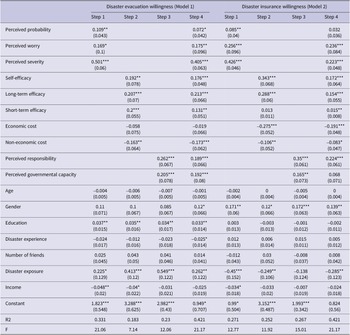
The results of the baseline specification are presented in Table 2. Taking intention to disaster evacuation as an example (see Model 1 in Table 2a), we introduce 3 sub-indicators of risk appraisal based on control variables in the first step. The results indicate that perceived possibility, perceived severity, and perceived worry all positively and significantly influence disaster evacuation. In steps 2 and 3, we introduce sub-variables of coping appraisal and stakeholder appraisal separately, and the findings demonstrate that most psychological factors have a significant impact on evacuation intention. In Step 4, all psychological variables are simultaneously included, resulting in a Pseudo R2 value of 0.421. The results of Step 4 show that the coefficient of perceived severity on evacuation intention is the largest (β = 0.405, P < 0.001). Farmers who have confidence in their ability and believe that disaster evacuation has short-term or long-term effects on reducing disaster risk are more likely to take action. This finding aligns with the research of Esham and Garforth,Reference Esham and Garforth31 which indicates that farmers’ adoption of climate change adaptation strategies in agricultural production is influenced by their perception of the effectiveness of adaptation measures. Economic cost does not significantly affect evacuation intention (β = -0.019), but non-economic costs can significantly reduce evacuation intention. This could be because evacuation requires fewer financial resources but places higher demands on non-economic factors such as manpower, energy, and time. The role of perceived government capacity in disaster evacuation is confirmed. As shown in Model 1, risk appraisal, preparedness appraisal, and stakeholder appraisal all have a significant impact on the intention to evacuate.
Hierarchical regression analysis (1)

In Table 2a, Model 2, Table 2b, and models 3 and 4, we analyze the psychological factors predicting willingness to engage in disaster insurance, emergency storage, and eco-friendly practices, respectively. The hierarchical regression results for all 4 types of disaster preparedness intentions support the hypotheses: risk appraisal, coping appraisal, and stakeholder appraisal significantly influence these intentions.
Hierarchical regression analysis (2)

Notes: n = 325. Standard error in parentheses. *, P < 0.1; **, P < 0.05; ***, P < 0.01. The data and code used in this research are available upon request from the authors.
Robustness Checks
In our baseline model, we employed a direct questioning approach to gather data for the independent variable, specifically asking participants if they were willing to take disaster preparedness measures. While this method is suitable for individuals with limited education, it may lead to misunderstandings among respondents. For example, some participants may answer based solely on their internal psychological perceptions, while others may consider various constraints. For instance, when asked about their willingness to purchase disaster insurance, some farmers may hesitate due to low risk appraisal, while others may be unwilling due to economic constraints, despite recognizing the high risk.
To address this potential bias, we conducted 2 additional robustness checks. For the first robustness check, we refrained from direct questioning and, instead, after participants answered questions related to actual barriers to purchasing catastrophe insurance, posed a follow-up question: “If we disregard these practical difficulties, would you be willing to purchase catastrophe insurance?” Then, for the second robustness check, we asked “Would you be willing to purchase disaster insurance in the future?” Both questions effectively mitigate potential understanding biases associated with direct questioning. As presented in Table A.1, the findings from these robustness tests are similar to those obtained in the standard model. Risk appraisal, coping appraisal, and stakeholder appraisal all demonstrate a significant influence on the 4 types of disaster preparedness intentions.
Challenges in Translating Intentions for Disaster Preparedness into Actions
The practical implementation of disaster preparedness intentions requires consideration of realistic limitations. The disparity between intentions and actions is significant, as illustrated in Table 3. For instance, although nearly 85% of participants expressed a willingness to evacuate during disasters, only 12.31% have done so. On the other hand, there is a strong inclination to adopt the other 3 measures, with an average acceptance rate of over 85%. However, when it comes to actual behaviors, emergency storage has the highest participation rate at 56.92%, while the rates for other behaviors are around 10%.
Gaps between intentions and behaviors of disaster preparedness (%)

Merely relying on psychological factors may not be sufficient to generate a proactive response. To investigate the obstacles hindering the transformation from intention to implementation, this study conducted additional interviews with farmers who have expressed a desire to act but have not done so. These interviews revealed 5 primary barriers faced by rural residents in implementing disaster preparedness (as depicted in Figure 3). The primary concern of respondents is the lack of resources for participation, such as financial constraints, limited land, and fixed assets. The second most mentioned difficulty is the scarcity of access to collective resources. Approximately 40% of rural residents indicate a lack of information about participation processes. Timing issues, as well as social pressure and habitual behaviors, are also identified as additional challenges by the respondents.
Rural residents’ 5 greatest barriers to disaster preparedness.

We can classify the top 5 challenges into 3 main categories: lack of capital to participate, lack of access to participate, and lack of triggers. Subsequently, we explore how these obstacles impede the transition from intentions to actions in rural mountainous communities.
Lack of capital to participate (private capacity, including financial, human, physical, natural, and social resources)
Livelihood capital plays a crucial role in facilitating the implementation of disaster preparedness measures, reflecting the ability of households to adapt. Insufficient financial resources, human resources, land, housing, and other assets hinder the translation of disaster preparedness intentions into actions. The capital requirements vary depending on the specific type of disaster preparedness activity. For instance, in evacuation situations, human capital (such as health) and physical capital are more influential. During prolonged heavy rainfall, it becomes challenging to relocate disabled individuals, the elderly, and the sick to safer places. Moreover, the decision to evacuate while taking poultry and livestock into account is also crucial, as many farmers mention that “chickens, ducks, pigs, and other poultry livestock need to be fed every day. If we move first, no one can feed them.” This finding is consistent with the study by Brackenridge et al.,Reference Brackenridge, Zottarelli and Rider32 which indicates that families with animals to care for are less willing to evacuate compared to those without animals. Roughly half of the respondents reported having only 1 house and no alternative options for safer housing. Limited financial resources emerge as a significant barrier to purchasing disaster insurance, partly because farmers earn less and lack extra funds for non-compulsory insurance. Another possible reason is their lack of knowledge about insurance, leading to overestimation of insurance premiums. Educated individuals are crucial facilitators in emergency preparedness, as a lack of knowledge about what to prepare stands as a major obstacle to stockpiling emergency supplies. This issue is closely tied to the level of disaster literacy among residents. The scarcity of available land is identified as the biggest challenge to adopting eco-friendly practices. This is due to the absence of suitable and safe areas for disposing of waste materials when constructing houses. Even if residents have no intention to harm the environment, they are compelled to pile waste on steep slopes due to the lack of alternatives.
Social pressure and path dependence appear to be the primary barriers to translating intentions into actions. For instance, nearly a quarter of farmers indicate that the reason they did not act despite their desire to do so is because “other residents did not evacuate.” Some farmers express concerns that “Everyone around me has not left. If my family leaves, I will be looked down upon.” “If the others are still here, we can look after each other. If they move, we move too.” In terms of purchasing insurance, 27.2% of farmers state that “I want to buy. But no one in the neighborhood has bought it, so I am afraid that I would be cheated.” Some farmers argue that their familiarity with recurrent disasters reduces their motivation to change their behavior.
Lack of access to participate (public capacity)
Facilitating public access to disaster preparedness promotes the active involvement of rural residents in managing hazards, particularly actions that require coordination with other departments. One example is the purchase of disaster insurance, which is perceived by rural residents as the most significant obstacle due to a lack of knowledge about the purchasing process. There are 2 main reasons why farmers may not be familiar with the process: firstly, the availability of disaster insurance products is limited as China’s disaster insurance markets are still in the early stages of development. The complexity and severity of disasters make it challenging for insurance companies to handle potential large claims, thus restricting the availability of disaster insurance. Secondly, local grassroots organizations and insurance agents face difficulties in organizing and promoting disaster insurance. In the surveyed regions, 6 insurance institutions offer policy-based agricultural insurance. The village committees are responsible for raising awareness and facilitating unified application, while insurance agents handle qualification examinations and policy creation. However, the absence of local governments at the grassroots level and insurance companies creates a lack of channels for potential applicants to purchase insurance.
It is important to note that the disaster preparedness behaviors examined in this study are relatively straightforward, with families having a high level of autonomy in carrying them out. On the other hand, the implementation of other disaster preparedness activities, such as relocation, risk mapping, and diversifying livelihoods, is more likely to be influenced by factors like political authority and legitimacy, market conditions, external resources, and leadership.
Lack of triggers (out of priority)
The trigger, or timing of participation, is another dominating concern. Rural interviewees explain that they do not feel a sense of urgency or immediate need to act, indicating that preparedness is not their primary focus. Among farmers who express willingness but have not taken action to evacuate, 75% state that they have not experienced a severe emergency disaster yet, but they would evacuate in a dangerous situation in the future. Regarding insurance purchases, some farmers mention that "there are no valuable crops in the land at present, so I haven’t bought it now. But I want to grow citrus and prickly ash in the future, and I will buy insurance then.” When it comes to eco-friendly behaviors, the emphasis is on refraining from environmentally harmful actions rather than actively engaging in ecological practices. The reason behind nearly 70% of farmers not adopting eco-friendly behaviors is that they have not encountered situations where they must choose between harming or preserving the environment.
Discussion
The findings indicate a significant yet subtle impact of perceived likelihood on intentions related to evacuation, emergency supplies storage, and eco-friendly behavior. However, this impact is not statistically significant when considering the willingness to purchase insurance, partially deviating from the results of Peng et al.Reference Peng, Tan and Lin9 This discrepancy may stem from the inherent unpredictability of disaster occurrences, with residents in disaster-stricken areas having become accustomed to the regularity of such events, which might diminish the perceived urgency. Perceived likelihood is no longer a potent motivator for residents to engage in more intricate disaster preparedness actions, especially those involving additional financial or learning investments, such as insurance purchases. Conversely, perceived severity strongly predicts various preparedness intentions. This personalized aspect of severity, where individuals connect the severity of disasters to their own losses, drives a heightened willingness to take urgent preparedness measures. This finding, consistent with a study by Yang et al.,Reference Yang, Tan and Peng21 underscores the intricate influence of perceived likelihood and severity in disaster psychology on various preparedness behaviors.
Coping appraisal, which includes self-efficacy and preparedness efficacy in both short-term and long-term contexts, plays a crucial role in influencing various disaster preparedness intentions. Notably, coping appraisal seems to have a more substantial impact than risk appraisal, aligning with findings from previous studies by Bamberg et al.Reference Bamberg, Masson and Brewitt13 and van Valkengoed and Steg.Reference Van Valkengoed and Steg14 This emphasizes the pivotal role of individual attitudes towards protective actions compared to their perception towards risks. Regarding the perception of economic costs, a notably negative impact is observed only on the willingness to purchase disaster insurance, while the impact on the other 3 behaviors is not statistically significant. This discrepancy may be attributed to the fact that only insurance incurs directly associated transaction costs, such as administrative fees or processing charges. Concerning non-economic costs, such as energy, time, and learning, a significant negative impact is evident in evacuation, insurance purchase, and emergency supplies storage. In rural communities, individuals may face various daily life stressors related to work, family, and other aspects. Consequently, the need to invest additional energy, time, and learning for disaster preparedness activities may be perceived as an additional burden.
This study emphasizes the crucial roles of perceived responsibility and government capabilities in shaping disaster preparedness intentions. Individuals feeling responsible for disaster mitigation are likely to actively support community disaster risk management initiatives, aligning with Tan and Lin’s Reference Tan and Lin33 findings on the positive impact of a sense of responsibility on individual engagement in such endeavors. Trust in the government’s ability during disasters is foundational to disaster preparedness intentions, rooted in past successes or a general faith in government institutions. Those who perceive the government as capable of effective communication and relief coordination are more likely to trust its guidance and adhere to recommended pre-disaster evacuation measures.
Furthermore, despite exhibiting strong intentions, households in rural mountainous areas demonstrate low levels of action when it comes to disaster preparedness. The 3 main barriers that hinder the translation of willingness into behavior include a lack of resources to participate, such as insufficient funds, land, housing, and labor; limited access to participation opportunities; and a lack of triggers. These findings suggest that addressing these barriers and transforming willingness into action necessitates continuous efforts, such as increasing the resources available to households, providing enhanced government support and services, and creating a sense of urgency among farmers.
Limitations
It is recognized that the study possesses several limitations, which can be divided into controllable and uncontrollable categories. In terms of controllable limitations, despite endeavors to ensure the representativeness of the sample, residual social and cultural disparities within China’s diverse rural environments may persist. Future research could adopt more stringent sampling methodologies and broaden the scope of social and cultural considerations. Additionally, the study’s reliance on cross-sectional data might have precluded capturing the temporal dynamics of disaster preparedness. To address this, longitudinal studies could be employed to more precisely monitor changes and trends. As for uncontrollable limitations, a notable one is the inherent subjectivity of psychological perceptions, which may introduce biases in self-reported measures. This introduces an element of uncertainty and potential bias that is difficult to fully eliminate. It is crucial to acknowledge that while the uncontrollable limitation cannot be completely overcome, their recognition and consideration are paramount in the interpretation and application of the study’s findings.
Implications
Based on the findings, policymakers are urged to implement targeted measures for enhancing disaster preparedness. Firstly, a comprehensive approach to strengthening risk appraisal is recommended, involving the dissemination of information through diverse channels such as news and the internet, with a specific emphasis on highlighting the potential severity of disasters. Secondly, for the agricultural sector, particularly farmers, the government should enhance preparedness efficacy by providing clear instructions through visually impactful channels. This involves emphasizing the effectiveness of specific actions, streamlining participation procedures, and offering practical guidelines to boost farmers’ confidence while reducing perceived costs associated with preparedness. Thirdly, to leverage the perceived responsibility aspect, disaster risk management departments should establish a risk-sharing mechanism among the government, organizations, and residents. This can be achieved through contractual agreements and commitments that clearly delineate the responsibilities of each party. Lastly, addressing barriers to the conversion of preparedness intentions into actions is crucial, requiring strategic investments in disaster preparedness measures, such as developing insurance schemes or establishing well-equipped evacuation centers.
Conclusion
This study develops an enhanced conceptual framework by integrating the protection motivation theory (PMT) and the protective action decision model (PADM) to better understand the influence of psychological factors on disaster preparedness in rural China. Through the utilization of hierarchical regression analyses and rigorous robustness checks, our study confirms the significant impact of psychological factors on the disaster preparedness intentions of rural residents in response to geological disasters. The study also delves into the barriers preventing these intentions from translating into actual behaviors. While various psychological perception variables exhibit varying degrees of significance in influencing different disaster preparedness intentions, overall, factors such as farmers’ risk appraisal (encompassing perceived probability, worry, and severity), and coping appraisal (like self-efficacy and preparedness efficacy) have positive influence on disaster preparedness intentions. Conversely, the perceived preparedness cost stemming from coping appraisal has a negative impact on these intentions. Additionally, stakeholder appraisal, including perceived responsibility and governmental capability, also positively influences preparedness intentions. Furthermore, obstacles to the transition from intentions to behaviors encompass the lack of livelihood capital, limited public access, and the absence of triggers. By examining psychological motivators for disaster preparedness among rural residents, our study contributes to fostering higher disaster resilience and mitigating potential disaster impacts in the future.
Acknowledgments
This study is supported by the Fundamental Research Funds for the Central Universities (Project No. 2023CDSKXYGG006).
Author contribution
Jing Tan conceptualized the research, conducted the literature review, analyzed the data, and wrote the first draft. Lei Lin provided critical insights, contributed to the methodology, and reviewed and revised the manuscript. Tingjin Cao revised the manuscript.
Appendix
Robustness checks for psychological variables predicting disaster preparedness willingness (n = 325)