

First-year students are more susceptible to financial, social, physical and mental health related issues (Gallagher, Golin, & Kelleher, Reference Gallagher, Golin and Kelleher1992; Raunic & Xenos, Reference Raunic and Xenos2008). The period of transition to university is marked by developmental issues such as establishing identities, forming romantic relationships, learning to be independent from the comfort of their families and learning about the culture of the tertiary institution (Giovazolias, Leontopoulou, & Trilivia, Reference Giovazolias, Leontopoulou and Triliva2010). Flisher, de Beer and Bokhorst (Reference Flisher, De Beer and Bokhorst2002), in their survey of students who have received counselling, found that women students are more likely to receive counselling than men. First-year students were also more likely to receive counselling services than senior students, as was found by Giovazolias et al. (Reference Giovazolias, Leontopoulou and Triliva2010) in their survey of Greek students. Guneri, Aydin, and Skovholt (Reference Guneri, Aydın and Skovholt2003) cautioned that both student counselling service providers and their clients may be exposed to intervention strategies that are intended to satisfy program needs rather than the needs of clients. Cilliers, Pretorius, and Van der Westhuizen (Reference Cilliers, Pretorius and Van der Westhuizen2010) found in their survey of student counselling in South Africa that the demand for counselling has increased, with an accompanying increase in the severity of students’ problems. They recommended that future research should obtain student perspectives of counselling services and that such service should be matched to the expectations and needs of students. While studies have shown that student needs surveys have a range of benefits, Morrison, Brand, and Villiers (Reference Morrison, Brand and Cilliers2006) cautioned that counselling centres will have to provide more explicit and tangible proof of their impact in relation to specific concerns and goals of the university (Nicholas, Reference Nicholas1995, Reference Nicholas1997a, Reference Nicholas, Foster, Freeman and Pillay1997b, Reference Nicholas2002). They expected that the financial pressure on counselling centres will increase, and advised that a strategy shift away from a reactive function where problem cases are delegated out of sight, toward, among others, involvement in institutional decision-making and research on needs assessment must occur.
Apart from support programs, which appeared to not function at their optimum, there is also an issue of non-use of counselling services by students (Nicholas, Reference Nicholas2002). Recently, Giovazolias et al. (Reference Giovazolias, Leontopoulou and Triliva2010) identified: (1) low expectations of benefiting from counselling; (2) a negative attitude toward the counselling services; (3) lack of information about the existence of the services; (4) issues of confidentiality; (5) a belief that their problems were not sufficiently important to explore with a counsellor; and (6) a belief that it is better to solve one's own problems without relying on the help of a professional as factors that may contribute to non-use of psychological services. Raunic and Xenos (Reference Raunic and Xenos2008) reported in their review of characteristics of counselling services across countries that international students experience more barriers to academic success than local students, including factors such as second language proficiency, cultural values underlying negative attitudes toward seeking help from university counselling centres, and the perceived stigma and shame associated with seeking counselling services. Kenny, Aluede, and McEachern (Reference Kenny, Aluede and McEachern2009) found that Nigerian students expressed a higher need for counselling on almost all subscales compared to US students, as did Nicholas (Reference Nicholas1997a) when comparing Black South African and US students.
Yi, Lin, and Kishimoto (Reference Yi, Lin and Kishimoto2003) in their study of 562 international students found that almost 70% of students who had sought counselling reported that they were worried or extremely worried about their future. Students who sought assistance for career concerns were younger, female and undergraduate, whereas those seeking help for personal concerns were older, male and graduate students. Yi et al. (Reference Yi, Lin and Kishimoto2003) recommended that future studies regarding the attitudes and characteristics of students who have not sought counselling, but may be in need of counselling services, should be carried out.
The present study investigated the needs of first-year students and their preferred interventions in addressing those needs. The university where the study was conducted is a small campus of an Australian university in South Africa, which draws most of its students from a number of African countries.
Method
Participants
In total, 567 first-year students participated in the study (51.9%, females). Most students were Zimbabwean (52.4%), followed by South Africans (35.8%) and other African countries such as Zambia (1.8%), Botswana (1.8%), Tanzania (1.9%), Malawi (1.1%), Kenya (0.7%), Uganda (0.4%) and Mozambique (0.2%). The remaining 3.7% indicated ‘other'and 0.4% did not indicate their country of origin. Participants were on average 20.11 years old (ranging from 16 to 36). South Africans were significantly younger (M = 19.10, SD = 2.17) than non-South Africans (M = 20.71, SD = 2.26), t (434.78) = −8.23, p < .001.
Procedure
Students attending the orientation program on campus before the start of the academic year were invited to participate in the study. They were provided with a detailed explanatory statement in which the aims, scope, and procedures of the project were outlined. In the explanatory statement, potential participants in the study were informed that their involvement in the research would be voluntary and anonymous and that they would not be required to disclose any information about themselves that would enable the researchers to ascertain their identity. It was also conveyed that they could withdraw from participation at any time. On the basis of the information provided in the explanatory statement, consenting students anonymously completed the questionnaires. Ethics approval for the project was granted by the university's Human Research Ethics Committee.
Instrument
A 42-item Survey of Student Needs developed by Gallagher et al. (Reference Gallagher, Golin and Kelleher1992) was used in this study. Participating students were asked the extent to which they need information or help with the listed concerns by marking one of four possible responses to each item (1) high, (2) moderate, (3) slight, and (4) no need. In addition, respondents were asked what kind of assistance they would like to receive for the concerns that they listed. The options which respondents could select from were: individual counselling, group counselling, workshops, lectures, professional help outside the university, indigenous healer, and religious helper. An additional item, xenophobia, was added under ‘personal concerns’ given the multi-national nature of the sample and the prevalence of the problem in South Africa (Vromans, Schweitzer, Knoetzer & Kagee, Reference Vromans, Schweitzer, Knoetze and Kagee2011).
Results
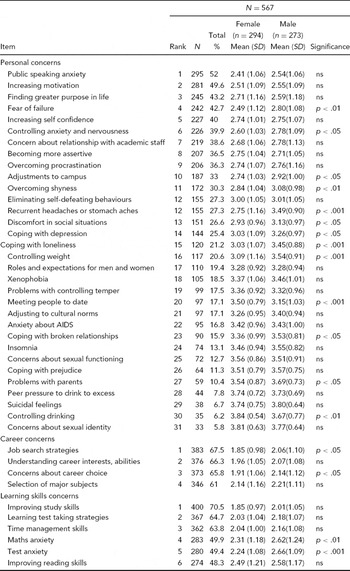
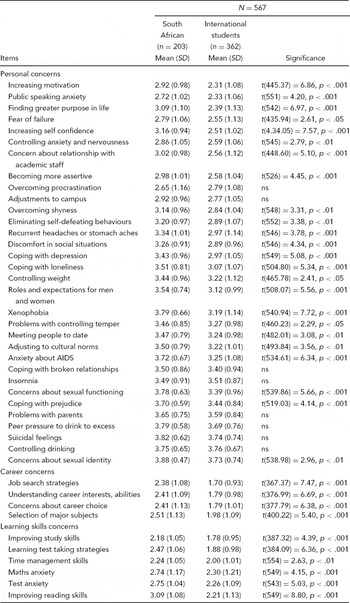
The rank order of respondents’ concerns is substantially similar to surveys reported by Nicholas (Reference Nicholas1995, Reference Nicholas1997a, Reference Nicholas, Foster, Freeman and Pillay1997b, Reference Nicholas2002), and the top five personal concerns in these studies were the same as our survey. Women respondents reported a significantly greater need for assistance than males for 12 of the personal concerns, 2 career concerns and 2 learning skills concerns. Among students indicating a high or moderate need for assistance, xenophobia was ranked 18th (105 respondents) and within this pool of respondents, 89.5% (n = 94) were international and 10.5% (n = 11) were South African students. International students as expected reported a significantly higher need for assistance with this concern than South African students (see Table 2).
Percentage of Respondents Indicating a High and Moderate Need for Assistance With Personal, Career and Learning Skills Concerns

Note: The lower the scores the more need is indicated and vice versa.
Means, Standard Deviations and Mean Differences Between South African and International Students in Their Need for Assistance With Personal, Career and Learning Skills

Note: The lower the scores the more need is indicated and vice versa.
In addition, international students reported a significantly higher need for assistance for all career and learning needs concerns and for all but six personal concerns: coping with broken relationships, insomnia, problems with parents, peer pressure to drink to excess, suicidal feelings, and controlling drinking.
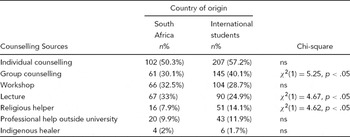
Significantly more international than South African students selected group counselling, lecture format and religious helper as their preferred means of assistance with concerns.
Discussion
The participants in this study were first-year students who are not necessarily representative of the campus population or university students in general. The data were collected using self-report measures, which are prone to socially desirable responding and compliance and sensitive to individuals’ current level of psychological adjustment. While significantly fewer students indicated a need for assistance than Nicholas’ (Reference Nicholas1995, Reference Nicholas1997a, Reference Nicholas, Foster, Freeman and Pillay1997b, Reference Nicholas2002) surveys, a substantial percentage of respondents require assistance with their concerns. Counsellors should consider initiating services that respond to the greater need for assistance reported by women and international students, and the preferred mode of assistance desired by international students.
Flisher et al. (Reference Flisher, De Beer and Bokhorst2002) pointed out that their finding that women students are more likely to receive counselling than men confirms a number of international studies. In the present study, women students indicated a higher need for assistance with personal concerns, with reference to a wide range of issues including fear of failure, controlling anxiety and nervousness, adjustment to campus, overcoming shyness, recurrent headaches or stomach aches, discomfort in social situations, coping with depression, coping with loneliness, controlling weight, coping with broken relationships, and problems with parents. In contrast, male students had stronger concerns than female students in relation to meeting people to date and controlling drinking. With reference to career issues (i.e., job search strategies and concerns about career choice) and learning skills (i.e., maths and test anxiety), women students also indicated a greater need for assistance with their concerns than male students. This suggests that women students are prone to greater psychological vulnerability than male students, and that in the context of the various challenges surrounding the initial stages of student life, women students are in a greater need of psychological support in relation to personal, career and learning skills concerns. The multiple concerns reported by women students appear to be related at least to some degree to gender differences in socialisation and social expectations (Flisher et al., Reference Flisher, De Beer and Bokhorst2002).
The finding in the present study that international students have greater counselling needs than local students has been supported in other research (see Raunic & Xenos, Reference Raunic and Xenos2008). In addition to the typical adjustment difficulties associated with commencement of university study, international students also have to deal with cultural change, separation from home, family and friends and limited support structures in a new country. International students’ concern about xenophobia requires special attention given the highly publicised problems that South Africa has in this regard (Vromans et al., Reference Vromans, Schweitzer, Knoetze and Kagee2011).
Linked to these elevated concerns manifested by international students are the differences between the two groups regarding their preferred counselling sources. Compared to their South African peers, a higher percentage of international students reported that they need to be assisted with group counselling, lecture or by a religious helper (see Table 3). Cilliers et al. (Reference Cilliers, Pretorius and Van der Westhuizen2010) stated that students’ views about preferred counselling services should be considered and our study established such student preferences. Accordingly, counselling services should be particularly responsive to the specific needs of students and their preferred counselling sources.
Relationship Between South African Versus International Students and Preferred Counselling Sources

(n = 203) (n = 362)
The highest ranked concerns should also enjoy particular attention, and lectures and workshops on these topics could be initiated during the orientation period. Doing so would advertise the existing counselling services and inform those respondents who indicated a preference for off-campus services about the availability and quality of on and off campus services.