INTRODUCTION
Most sessile marine benthic invertebrates possess complex life cycles with at least two contrasting stages: an adult sessile stage alternating with a mobile and dispersive larval phase. The larval stage duration has a direct effect on the adult distribution (Thorson, Reference Thorson1950). The longer the larvae persist at the planktonic stage, the further they can be distributed (Todd, Reference Todd1998). Therefore colonization is not necessarily dependent on local reproductive success, but is influenced more by an external and unpredictable supply of new recruits (so-called ‘supply-side ecology’ theory formulated by Roughgarden (Levin, Reference Levin1986)).
It is often difficult or impossible to observe marine invertebrate settlement in situ. One of the most practical ways used to infer settlement is to study their recruitment (Zea, Reference Zea1993; Mariani, Reference Mariani2003). Settlement and recruitment are initial steps determining the structure of population of many species (Rodriguez et al., Reference Rodriguez, Ojedal and Inestrosa1993). Settlement refers to a process of transformation from a pelagic to a benthic stage of life ending with metamorphosis, while recruitment is a process of establishing a population incorporating settlement and all early post-settlement events (Ólafsson et al., Reference Ólafsson, Peterson and Ambrose1994). Understanding the processes of recruitment is important as it is the first step of community development and has significant consequences for population dynamics and structure (Young, Reference Young1990). Knowledge about recruitment processes has broad practical application, especially in marine conservation. In particular, it can be used in developing models of community succession and community recovery after severe disturbance events, when freshly cleared substrate is available for recolonization. In many habitats, patterns of recruitment may determine the direction of subsequent colonization (Gaines & Roughgarden, Reference Gaines and Roughgarden1985; Mullineaux & Butman, Reference Mullineaux and Butman1990), thus predictions of local recruitment could have implications for spatial management tools in marine protected areas (MPAs) (Santangelo et al., Reference Santangelo, Bramanti, Rossi, Tsounis, Vielmini, Lott and Gili2012).
This study is focused on the benthic, hard substrate assemblage of Skomer Island in Wales. Biological surveys in the investigation area date back to the 1980s and were mostly based on non-destructive stereophotographic sampling techniques (Bullimore, Reference Bullimore1986). Surveys undertaken revealed the diverse and special nature of the area and helped lead to the designation of the Skomer Marine Nature Reserve in 1990. Since then, long-term monitoring programmes have been developed and conducted on intertidal and subtidal habitats, including sponge assemblages, algal communities, sediment infauna and several selected epifaunal species (e.g. Alcyonium glomeratum (Hassall, 1843), Eunicella verrucosa (Pallas, 1766), Pentapora fascialis (Pallas, 1766) (Lock et al., Reference Lock, Burton and Newman2003; Bell et al., Reference Bell, Burton, Bullimore, Newman and Lock2006; Burton et al., Reference Burton, Lock, Gibbs and Newman2008)). This is the first experimental study undertaken in this area to gain an understanding of the spatio-temporal patterns of benthic assemblages at their early stage of development during a three-year long period. Owing to the special importance of this habitat it is crucial to further investigate inter- and intra-specific interactions of recruits and their role in early community development.
Here, we aim to investigate recruitment patterns of benthic larvae in relation to the position of the substrate (top vs underside surface of panels), depth and site, and to compare recruitment of species with two different life history strategies (colonial forms with short-lived larval phase and unitary forms with long-lived larval phase). The study also reveals information on monthly (seasonal) changes in the abundance and diversity of recruits over a three year period.
MATERIALS AND METHODS
Study area
The study area, Skomer Marine Nature Reserve (Wales, UK), is located in St George's Channel between the Celtic and Irish Seas (51°43′N 5°17′E) (Figure 1). The reserve covers about 1500 ha of seabed off the coast of Pembrokeshire. The area has a wide range of habitats, including algal communities on bedrock, boulders and cobbles. The shallow rocky subtidal of Skomer Island supports locally rich epifaunal assemblages (Lock et al., Reference Lock, Burton and Newman2003).
Map of study area.

The two sites selected were on different sides of Skomer Island about 2 km apart (Figure 1). Thorn Rock (T) is located on the south side with moderate currents (up to 1 m s−1). It is wave exposed flat bedrock with occasional cobbles and boulders. The shallow site (6 m) is in kelp forest on bedrock, while the deeper site (12 m) is a reef dominated by massive sponges (Polymastia spp., Axinella spp. and Cliona celata) and bryozoan turf. The Bernies Rock (B) site is located on the north side of the island, 30 m from the cliff, on a boulder slope swept by strong currents (up to 1.5–2.5 m s−1) but sheltered from wave action. A boulder and cobble seabed dominated by kelp and red algae is characteristic of the shallow site (6 m). The deep site (12 m) is a boulder and cobble seabed covered with bryozoan and hydroid turf and red algae.
The sea temperature at the time of deployment was 12.8°C at both sites and varied between 7.8°C in April 2010 and 16.7°C in August 2009.
Sampling protocol
In order to minimize the influence of substrate heterogeneity and for ease of replication, three black, flat Perspex panels of similar size and shape (15 × 15 cm) were submerged in water at 6 and 12 m depths at each site in May 2009 (Figure 1). The panels were attached to a horizontal metal frame which was secured on the sea floor by metal bolts screwed into the seabed. Each set consisted of three panels and each panel was treated as a subsample. The panels were removed from each frame and replaced with a new set on a monthly basis from spring to autumn until the end of the study period in September 2011. The panels were not changed between October and April due to weather conditions.
Sample and statistical analysis
Only the 10 × 10 cm2 central squares of each panel were inspected in order to minimize the ‘edge effect’. Panels were examined under a binocular microscope to identify colonizing organisms to the lowest taxonomical level possible.
The number of colonial organisms was calculated as number of colonies. Since the panels' immersion period varied over the study, results were standardized to a 30 d period. The obtained abundance data were transformed by log(x + 1) in order to meet assumptions about homogeneity of variance. The differences in abundance and species richness of recruits between the two sites (Bernies Rock and Thorn Rock), two depths (6 and 12 m), two positions on panels (underside and top) and three years (2009, 2010 and 2011) for an overall number of 420 replicates, were tested using multifactorial ANOVA (STATISTICA v.6, Statsoft). One-way ANOSIM pair-wise tests were used to check dissimilarities of species composition between the two sites, positions on panels, depths and years (PRIMER package v.6, Clarke & Warwick, Reference Clarke and Warwick2001).
RESULTS
Epibenthic assemblage on panels
Number of taxa per panel over the total time period varied between 0 and 22, with an average of five taxa. In total 55 encrusting macrobenthic taxa belonging to eight phyla were recorded on panels between June 2009 and September 2011. Twenty-two taxa were identified to species level. The number of recruits per 30 d ranged between 0 and 197 per each panel. Of the total of 8564 recruits, 71% were of colonial growth forms (such as bryozoans, hydrozoans, sponges) and 29% were unitary forms (polychaetes, bivalves, cirripedes). The majority of recruiting individuals possessed a short-lived, non-feeding larval phase (65%), while planktotrophic larvae were characteristic for 31% of individuals settled on panels. The remaining 4% of individuals had unknown reproductive strategies (mainly juvenile polychaetes).
Mean number of individuals that possess short-lived non-feeding larvae was higher in comparison to recruits with long-lived, planktotrophic larvae regardless of the position on panel, site and depth (Figure 2). A very similar pattern was observed when comparing the two growth forms of settling epifauna. Colonial forms dominated the recruiting fauna on both surfaces of panels, at both sites and depths (Figure 2). Moreover, the patterns in number of recruits were consistent for species with short and long-lived larvae as well as for colonial and unitary forms. In each case, there were always higher numbers of recruits on the bottom surface of the panel, at Bernies Rock and at the deeper station (Figure 2).
Mean (±standard error) number of recruits with different larval phase and different growth forms/30 d at Thorn Rock (site T) and Bernies Rock (site B), in shallow and deep stations and on the top and underside surface of panels.
Bryozoans were the most abundant group (6977 individuals) followed by bivalves (1191), polychaetes (1168), cirripedes (409), sponges (342) and hydrozoans (290). Eight taxa, namely the bryozoans Chorizopora brongniartii (Audouin, 1826), Electra pilosa (Linnaeus, 1767), Escharoides coccinea (Abildgaard, 1806), Haplopoma impressum (Audouin, 1826), Microporella ciliata (Pallas, 1766), Tubuliporidae indet., Crisiidae indet., the bivalve Anomia ephippium Linnaeus, 1758, and the polychaete Spirobranchus triqueter (Linnaeus, 1758), dominated in terms of population abundance and were the most frequently recorded (occurring in over 20% of samples) settling on the panels. These species represented 63% of the total abundance.
Spatial and temporal recruitment fluctuation
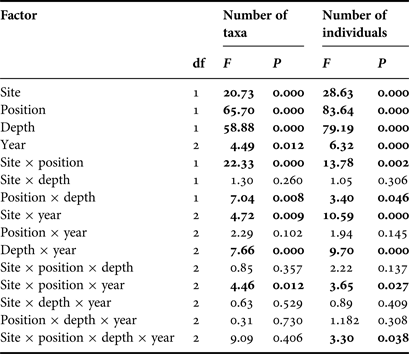
Site, position on panels, depth and year were significant variables influencing both the number of taxa and abundance of recruits on experimental panels (see the results of ANOVA in Table 1). There were a number of significant interactions between variables showed by multifactorial ANOVA indicating that differences in abundance varied interactively across sites with time, depth and position on panels, while differences in recruit species richness varied across sites with time and position on panels (Table 1).
ANOVA on number of taxa and number of individuals. Significant values are in bold.
A higher number of both taxa and individuals settled on the underside of the panels, with the monthly mean of about 6.5 taxa and 32 individuals per panel. On the top surface of the panels the mean number of taxa and individuals were, respectively, three and nine per panel. There was a higher monthly mean number of taxa and number of recruits at 12 m depth (respectively 6.1 taxa and 27 individuals) compared to 6 m depth (3.3 taxa and 14 individuals). Mean assemblage abundance and number of species were significantly higher at Bernies Rock, reaching on average 5.5 taxa and 26 individuals per panel compared to 3.9 taxa and 14 individuals in Thorn Rock. The assemblage significantly changed from year to year in terms of species richness and abundance. Post hoc comparison showed significant difference between 2010 and 2011 (Kruskal–Wallis test on species richness: z = 3.17, P = 0.005, on number of individuals: z = 3.70, P = 0.001) with the highest species richness and abundance in 2011 (Figures 3 & 4).
Mean (±standard error) abundance of fauna/30 days on the top and underside surfaces of panels at Thorn Rock (T) and Bernies Rock (B), and both depths 6 and 12 m.
Mean (±standard error) number of taxa/30 d on the top and underside surfaces of panels at at Thorn Rock (site T) and Bernies Rock (site B), and both depths 6 and 12 m.
There was significant but low dissimilarity in species composition between the two sites (ANOSIM: global R = 0.079, P = 0.001), position on panels (ANOSIM: global R = 0.287, P = 0.001), two depths (ANOSIM: global R = 0.071, P = 0.001) and among three years (ANOSIM: global R = 0.061, P = 0.001).
There were large differences in average monthly species richness and abundance between top and underside surfaces of panels. On the top surface, the average abundance was patchy and varied temporally between sites and depths (Figure 3A, C). There was an opposite trend in abundance at 6 and 12 m depth at Bernies Rock in 2009 (Figure 3C). In the deeper sites the peaks were in July and August, while in shallow sites the number of individuals reached maximum abundance in June and then decreased. At both depths at Thorn Rock the maximum abundance was in September 2009 (Figure 3A). In 2010, clear peaks were observed in September at 12 m depth at Thorn Rock and Bernies Rock. Maximum abundance in 2011 was noted in May at 6 m depth at Bernies Rock due to the occurrence of Electra pilosa (Figure 3C). At Thorn Rock the peaks in abundance were in May and September at 12 m depth (Figure 3A).
On the underside of panels, the faunal distribution showed a similar temporal trend at the different sites and depths (Figure 3B, D). In 2009, peaks were observed in July at Thorn Rock at 12 m depth (Figure 3B) and at Bernies Rock at 12 m depth (Figure 3D). Density of recruits rose from low values in Spring 2010 to a maximum in September at both depths at Thorn Rock (34 individuals at 12 m depth and 29 at 6 m depth) and 12 m depth at Bernies Rock (125 individuals), while at 6 m depth at Bernies Rock the peak was in August (132 individuals) (Figure 3B, D). In 2011 at Thorn Rock the average monthly abundance of recruits reached high values from June to August at 12 m depth and in July, August at 6 m depth. At Bernies Rock the highest number of recruits was noted in August at 12 m depth (158 individuals) and a much smaller peak was in July at 6 m depth (28 individuals).
Large month-to-month fluctuations were noted in species richness (Figure 4). The differences between the top and underside surfaces of the panels were particularly evident at 6 m depth. At 12 m depth if we compare both sites separately there were some common patterns on both surfaces of the panels. At Thorn Rock peaks in species richness were observed in August 2009 (six taxa on the top surface and seven taxa on the underside surface), in July 2010 (six taxa on the top and underside surface) and in July 2011 (seven taxa on the top surface and 12 taxa on the underside surface) (Figure 4A, B). At Bernies Rock, the maximum numbers of taxa were noted in July 2009 (five taxa on the top and nine taxa on the underside surface), in July and September 2010 (four taxa and six taxa on the top surface) and in August (14 taxa on the underside surface), in 2011 in August on both surfaces (seven and 15 taxa, respectively) (Figure 4C, D). The variability between depths and sites was great. Only on the underside of panels in 2010, there was a pattern of increasing number of species at both depths and both sites until the summer months and a sudden drop in October (Figure 4B, D).
Spatial and temporal fluctuation of epifaunal groups
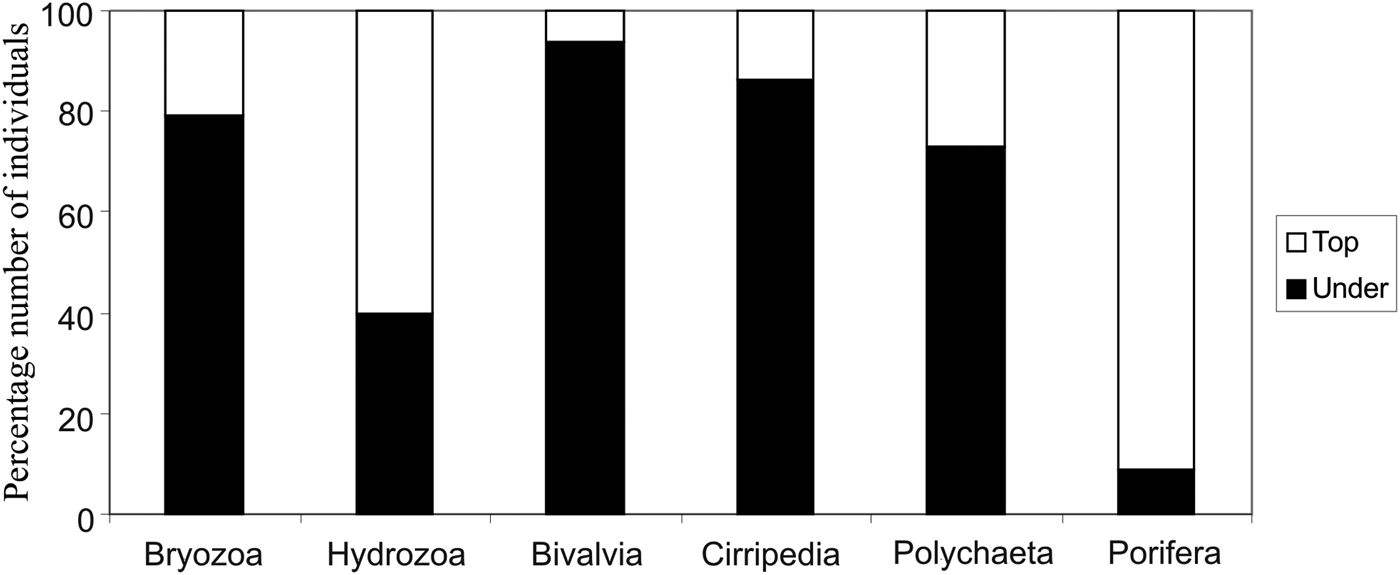
There were clear differences in abundance of particular faunal groups in each month. Bryozoa dominated in all studied years and months reaching the highest mean value on the underside surface of panels in August 2010 (83 individuals) (Figure 5). The only exceptions were noted in July 2009 on both surfaces of panels in favour of bivalve Anomia ephippium (Figure 5) and in August on the top side of panels in favour of polychaetes. The dominance of Bryozoa on panels was less pronounced in 2009 compared to 2010 and 2011. The recruitment of bryozoans reached peaks in August 2010 (82 individuals) and August 2011 (60 individuals) on the underside of panels and in September 2010 (12 individuals) and May 2011 (25 individuals) on the top surface of panels. Bivalves showed large fluctuations across years with peaks in July and October 2009 (five individuals on the top surface in July and 32 and 13 individuals on the underside surface in July and October respectively) and very low abundance (about 0) in 2011. The hydrozoan abundance was low throughout the study period, however they were absent from panels only in October 2010. Cirripedes occurred in low numbers on panels deployed in April, May, June (with maximum mean number of individuals of 4.5 in May 2011) and then they disappeared in September and October. Settlement of polychaetes reached peaks in August or September with the highest mean value in August 2010 (22 individuals). Poriferans were most abundant in April 2011 (1.3 individuals) and in September 2011 (5.3 individuals) on the top side of panels. The top surface of panels was colonized in the majority by hydroids and sponges (Figure 6), while bryozoans, Anomia ephippium, Balanus sp. and polychaetes dominated the under surface of panels in terms of number of individuals.
Seasonal patterns of faunal recruitment (mean ± standard error of abundance) on experimental panels.
Distribution of individuals in main epifaunal groups on the top and underside surfaces of panels.
Species showed diverse temporal patterns of settlement (Figure 7). There were species that settled on panels in each studied month. These were E. pilosa, C. brongniarti and E. coccinea. Although they were present from April to October, some seasonal peaks were observed, for example in May for E. pilosa and in summer months for E. coccinea and C. brongniarti. The recruitment of Bugula fulva and S. triqueter was only in summer months (June, July, August). Few species colonized panels in spring (B. crenatus) and autumn (Haploma impressum—not shown) or both (e.g. C. dumerilii and Escharella variolosa).
Seasonal recruitment of selected species (mean ± standard error); for bryozoans (B) the number of colonies (equivalent to settlement events) is displayed rather than number of individual zooids.
DISCUSSION
The process of larval recruitment is highly unpredictable and variable (Sutherland & Karlson, Reference Sutherland and Karlson1977; Keough, Reference Keough1983; Hutchinson & Williams, Reference Hutchinson and Williams2001). In the present experiment we have observed significant differences at initial stage of assemblage development in epifaunal species richness and abundance at spatial and temporal scale.
Various factors are known to influence the epifaunal recruitment success, including light availability and sedimentation rate (Maughan, Reference Maughan2001), water currents (Hoffmann et al., Reference Hoffmann, Pfaff and Branch2012), type and characteristic of substratum (Anderson & Underwood, Reference Anderson and Underwood1994), temperature (Privitera et al., Reference Privitera, Noli, Falugi and Chiantore2011), presence of a microbial film (Keough & Raimondi, Reference Keough and Raimondi1996) and presence of resident adults (Dean & Hurd, Reference Dean and Hurd1980). It is worth noting, however, that the response of individual species to different factors and their intensity is highly specific thus a combination of the above factors might drive a large fluctuation in the overall pattern of recruitment. Sessile marine invertebrates may be subject to heavy post-settlement mortality (Keough & Downes, Reference Keough and Downes1982; Hunt & Scheibling, Reference Hunt and Scheibling1998). Our experimental design provided favourable conditions for recruits. The colonization of panels during any one month was not intense; less than 3% of space on the panels was colonized (personal observation). We also did not trace any grazing activities on panels' assemblages. The inhibition of subsequent larval recruitment by resident adults, as described by Boyd (Reference Boyd1972), is also unlikely to have occurred due to the short time of assemblage development and the large areas that remained available for settlement on the panels.
Recruitment density at the studied sites in the Skomer Marine Nature Reserve was low in terms of the number of recruiting individuals and species compared to other studies of temperate marine fouling invertebrates. Over a period of 5 yr at the sea lake Lough Hyne (south-west Ireland), Watson & Barnes (Reference Watson and Barnes2004) noted a monthly mean number of recruits of up to 4000 per panel per 30 d. In the present study the maximum mean number of recruits reached 160 recruits. Such dissimilarity may be explained by different characteristics of the coastline and hydrography at these two study areas. A semi-enclosed water body such as Lough Hyne ensures greater retention and accumulation of larvae at a given site. In contrast, sampling sites at Skomer Island are exposed to constant exchange of water masses, thus continuous inflow and outflow of larvae.
Most sessile species generally display one of two different life strategies (Jackson, Reference Jackson1986). In the present study, species with short-lived larvae are primarily also colonial while those with extremely long-lived larvae are mainly unitary forms. The panel assemblages in the two study sites, depths and on both upper and lower surfaces were dominated by colonial recruits with short-lived larvae. At open coast sites, like our study site, the most likely explanation for this is that the local larval pool of the surrounding habitat is more important in shaping encrusting assemblage than inflow of planktonic larvae with currents. Many bryozoan species exhibit an aggregation type of settlement (Ryland, Reference Ryland1976), while barnacles and spirorbid tubeworms larvae display even stronger attraction to resident adults of the same species during settlement event, a phenomenon called ‘gregariousness’ (Crisp, Reference Crisp, Grant and Mackie1974).
The patterns in number of recruits were consistent when comparing the two sites, two surfaces and two depths for both species with short and long-lived larvae as well as for colonial and unitary forms. In each case, there were always higher numbers of recruits on the bottom surfaces of panels, at Bernies Rock and at deeper stations. Environmental requirements are likely to be similar irrespective of the type of larva and growth form of recruits.
Site and depth
The large variability in species richness and abundance of epifauna between sites only 2000 m apart is noteworthy. Numbers of individuals and numbers of species were markedly higher at Bernies Rock. The reason for this variation can be attributed to the differences in water dynamics between the sites, with Bernies Rock being more exposed to water currents but sheltered from wave action.
Many sessile benthic species have pelagic larvae that are dispersed with ocean currents (Todd, Reference Todd1998). However, the majority of recruiting species on our experimental panels produce short-lived lecithotrophic larvae which often occur only in near sea bottom habitat and have limited dispersal capabilities (e.g. Bryozoa (Mariani, Reference Mariani2003), Porifera (Maldonado & Bergquist, Reference Maldonado, Bergquist and Young2002)). Their recruitment will depend mainly on reproduction success of neighbouring parental colonies and physical factors at the site of attachment. Some of the recruits on the panels in the present study produce planktotrophic larvae (e.g. S. triqueter—Polychaeta: Serpulidae (Rouse & Pleijel, Reference Rouse and Pleijel2001), nauplii of cirripedes and veligers of the bivalve A. ephippium (Bramanti et al., Reference Bramanti, Magagnini and Santangelo2003), or cyphonautes of the bryozoan E. pilosa (Ryland, Reference Ryland1970)) which may have travelled long distances with the water masses. In this case, current is a very important force which brings larvae from distant places (Scheltema, Reference Scheltema and Crisp1971). Water turbulence may influence the larval ability to encounter suitable substrate and to adhere to it (Pawlik et al., Reference Pawlik, Butman and Starczak1991; Todd, Reference Todd1998). Turbulent flows may stimulate active selection of suitable habitat for settlement (Pawlik & Butman, Reference Pawlik and Butman1993) and provide better conditions for filter-feeding animals (Todd, Reference Todd1998), but if flow velocity exceeds a critical value, active selection for some larvae may be impossible (Maldonado & Young, Reference Maldonado and Young1996; Todd, Reference Todd1998). The lower number of recruits at Thorn Rock may be a result of heavy wave action at the site. Possibly such conditions prevent larvae from settling in unfavourable sites and/or cause larval resuspension and bed-load transportation (Jonsson et al., Reference Jonsson, André and Lindegarth1991).
Higher abundance and species number were observed at the greater depth. Variation in number of settling larvae, even at smaller depth intervals of 0.5 m, has been described by Osman (Reference Osman1977) for many common species in Woods Hole. Lower wave and tidal forces at 12 m in comparison to the shallower location may provide an explanation. A higher energy environment might lead to increased mortality and overall prevent recruitment.
Substrate position
Overall, a higher number of species and individuals attached to the underside surface of panels. Similar settlement preference for the under surface has been noted by many authors (e.g. Shin, Reference Shin1981; Glasby, Reference Glasby1999; Maughan, Reference Maughan2001). The two sides of the panels vary in light intensity, with the underside being the shaded side. Explanation for selecting the underside surfaces of panels may as well be avoidance of competition for space with algae, which generally colonize the top surface of the panels (Breitburg, Reference Breitburg1984). In addition, a deterrent effect of accumulated silt on the top of panels has been noted for Bryozoa (Maturo, Reference Maturo1959). However, in our study sites exposed to strong hydrodynamic conditions, we did not observe any effect of small silt cover on the recruitment process.
Differences in epifaunal abundance linked to the position on panels may be explained by the photonegative behaviour of larvae of many species. Such larval behaviour may have developed as a response to a risk of being smothered by silt (Maldonado & Young, Reference Maldonado and Young1996). By choosing sheltered areas of crevices juveniles are hidden from predators. Bryozoans and serpulid larvae tend to be more successful settlers on shaded, cryptic rather than exposed surfaces (Ward & Thorpe, Reference Ward and Thorpe1989; Cotter et al., Reference Cotter, O'Riordan and Myers2003) but a range of responses to light are possible for different species (Knight-Jones, Reference Knight-Jones1951; Ryland, Reference Ryland, Woollacott and Zimmer1977). In the present study, the upper (unshaded) surface was preferred by hydroids and sponges. The results of an experiment conducted by Glasby (Reference Glasby1999) did not show differences in sponge cover between shaded and unshaded treatments, while in contrast to our results, Bergquist & Sinclair (Reference Bergquist and Sinclair1968) and Sutherland & Karlson (Reference Sutherland and Karlson1977) observed photonegative behaviour during the larval stage of shallow-water sponges. The planulae of hydrozoan species may be positively or negatively phototactic before settlement (Boero, Reference Boero1984).
Between-year variation and seasonality
The experimental results provide evidence of both seasonal and year to year variations in recruitment patterns of epifauna, both in terms of species richness and abundance of recruits. The peaks in abundance occur in the summer months (July–September). Phytoplankton peaks earlier in the season (Hickman et al., Reference Hickman, Moore, Sharples, Lucas, Tilstone, Krivtsov and Holligan2012), therefore reproduction of organisms is likely timed to maximize food availability for the adult organisms before larval release or for some of the larvae which can feed while in the water column, rather than for settling juveniles. However, even in summer, there was considerable variation in recruitment intensity. For instance the monthly mean at Bernies Rock at 6 m depth in August varied from 10 (in 2011) up to 135 (in 2010) individuals per underside surface of panel. The duration of peaks varied between years and the peak timing differed between depths and position on panels.
Recruits of some species are present on the panels throughout the whole study period from April to October. Electra pilosa, C. brongniarti and E. coccinea can colonize panels in each month (with no data on winter months), however some seasonal peaks are observed. Electra pilosa reaches the highest abundance in May, while the top abundance of C. brongniarti and E. coccinea falls in summer. Examples of strong seasonal pattern in occurrence are S. triqueter, Bugula cf. fulva and Haplopoma impressum which appear on panels only in summer months or B. crenatus occurring in May. Only a few species (e.g. C. dumerilii and Escharella variolosa) peak in both spring and autumn. Any generalization is difficult, as reproductive activity of Bryozoa varies a lot from species to species and may be correlated with day-length, with cycle of planktonic production, and with temperature and other environmental factors (Ryland, Reference Ryland1970). Season and associated changes in physical environment have a marked effect on reproduction and larval availability of recruits and their abundance for many marine invertebrates (Sutherland & Karlson, Reference Sutherland and Karlson1977; Keough, Reference Keough1983; Turner & Todd, Reference Turner and Todd1993; Underwood & Anderson, Reference Underwood and Anderson1994; Watson & Barnes, Reference Watson and Barnes2004). Most species reproduce during a limited time period (as in the present study) and early composition of the assemblage is mostly a function of larval abundance during the time of exposure (Osman, Reference Osman1977).
CONCLUSIONS
Bryozoa was the dominant taxon during one month panel exposure in each month and year both in terms of species richness and abundance. The panel assemblages in the two studied sites, at both depths and on both upper and lower surfaces were dominated by colonial recruits with short-lived larvae.
Significant variability in the recruitment of fouling communities on experimental panels between top and underside surface, sites, depths and years suggests high patchiness of that process both in temporal and spatial scales. There is a range of interacting forces affecting the establishment and development of the epifaunal community (e.g. light, water dynamics, depth, seasonality). These large differences detected at a small spatial scale highlight the need for a better understanding of pre- and post-settlement processes that are crucial for the development of benthic faunal assemblages and further studies of settlement and recruitment processes at both species and community level.
ACKNOWLEDGEMENTS
We thank anonymous referees for valuable comments on the manuscript.
FINANCIAL SUPPORT
The study has been completed thanks to funding from the Polish Ministry of Science and Higher Education (396/N-EOL-ENC/2009/0).