Introduction
Global climate change projections show an increasing probability and severity of many different kinds of natural disasters heading into the end of the century. Reference Reidmiller, Avery and Easterling1 In the United States, hurricanes, heat waves and droughts, tornadoes, and flooding caused nearly US $550 billion dollars in damage between 2004 and 2013. Reference Bell, Herring and Jantarasami2,Reference Smith and Katz3 These disasters pose immediate threats to the health and safety of communities, Reference Patz, Grabow and Limaye4 while, at the same time, overwhelm public health response capacity. Reference Keim5 At a community scale, disaster preparedness and mitigation measures are often predicated on residents’ prior experience with disasters, social capital, financial reserves, and health care/disaster response capacity. Reference Bihari and Ryan6 When these variables are limited, the community’s initial and long-term recovery capacity is substantially impaired. Reference Mallick, Rahaman and Vogt7,Reference Lindsay8
Among individuals, those with preexisting physical and mental health issues and/or with fewer socioeconomic resources experience higher morbidity and mortality during and post-disasters. Reference Alderman, Turner and Tong9-Reference Masozera, Bailey and Kerchner12 For example, those who have trouble thermoregulating, such as infants, elderly, and people with chronic diseases, suffer more acutely during unexpected heat waves or when external support systems, such as electricity and air conditioning, fail. Reference Basu and Ostro10 Further, families without substantial socioeconomic resources may be unable to relocate quickly and suffer from the disruption of the disaster for longer periods of time, for example, through traumatic experiences that impact long-term mental health. Reference Lindsay8
Although these and other studies have explored the impact of a single natural disaster on physical and mental health, there is relatively little research on the health impacts of recurring natural disasters. Reference Greenough, McGeehin and Bernard13 Research suggests that those who are at risk, in terms of health and socioeconomic status, will be less likely to rebound between disasters due to the inability to replenish economic and social capital following each incident, Reference Lindsay8,Reference Greenough, McGeehin and Bernard13 leading to decreased resilience with each disaster. In the long-term, community and individual recovery involves not only rebuilding infrastructure, but also restoring social and economic activities, addressing chronic and delayed physical and mental health impacts, and often substantial changes in the demographics of a region. Reference Cutter, Emrich and Mitchell14
Vulnerability to natural disasters is determined by the interplay of social, economic, political, and environmental factors. These risk factors are generally grouped into three elements: exposure, sensitivity, and adaptive capacity. Reference Bell, Herring and Jantarasami2 Exposure to a natural disaster is often determined by geographic location and the built environment. For example, people living in coastal areas are more likely to experience storm surge or hurricanes. Sensitivity, or the degree to which an individual or a community is affected (eg, physically, psychologically, or behaviorally) by a natural disaster, is to a large degree, a result of demographics, underlying medical conditions, and other social determinants of health such as income and occupation. Reference Lindsay8,Reference Miller and Rivera15 Finally, adaptive capacity or resilience is the ability of an individual or community to adjust to and rebound from a natural disaster. For example, people with fewer financial resources may have a more difficult time evacuating or rebuilding after a storm, and individuals with limited English-proficiency or fewer social networks may also be less likely to receive public health information during a disaster.
When creating community preparedness plans, it is essential to consider not only exposure, but also the underlying social and economic disparities within a community. Reference Nomura, Parsons and Hirabayashi16 Knowledge about differential vulnerability within a jurisdiction allows policy-makers to create informed development and evaluation strategies to lessen the health risks of disasters. Reference Miller and Rivera15 A spatially explicit database with key risk factors associated with disproportionate health and/or economic impacts from natural disasters can support community-based planning. During and after a disaster, these same indicators can be useful for allocating limited resources across a community.
Previous studies have attempted to create indices of social vulnerability for disaster planning. Reference Cutter and Finch17,Reference Flanagan, Gregory and Hallisey18 While these social vulnerability indices (SVIs) have been used to show variation in the underlying sensitivity and adaptive capacity of communities to natural disasters, neither has been combined with natural disaster exposure to assess the impact of disaster occurrence on population-level health outcomes. Here, we evaluate the relationships between the occurrence of recent and recurring natural disasters on the incidence of acute and chronic health outcomes at the census tract level across the United States. This assessment can support future disaster preparedness and response efforts by highlighting characteristics of communities most impacted by natural disasters.
Methods
Health outcome data were from the 2017, 500 Cities data set from the Centers for Disease Control and Prevention (CDC). Reference Scally, Pettit and Arena19 The data set provides indicators of chronic disease, unhealthy behaviors, and preventive care at the census-tract level. Census tracts are official subdivisions of geographic areas for which the US Census Bureau publishes data. Each census tract has a unique numeric code and has about 4000 inhabitants on average, with a range of 1200–8000 individuals. The 500 cities data are available for the 500 largest cities across the United States, with at least one city in every state, based on the 2010 census population. The most populous cities in Vermont, West Virginia, and Wyoming were also included in the data set to ensure that all states were represented. Approximately 1/3 of US residents lived in 1 of these 500 cities in 2010, and the city populations ranged from 42 417 (Burlington, Vermont) to 8 175 133 (New York City).
The four health outcomes used here were census-tract prevalence measures of poor mental health, poor physical health, high blood pressure, and asthma. Poor mental and physical health were self-reported. Respondents were coded as having poor mental or physical health if they reported that out of the past 30 days, they felt that their mental/physical health was not good for ≥ 14 days. The prevalence of high blood pressure was measured by asking survey respondents whether they had been told by a doctor, nurse, or other health professional that they have had high blood pressure at any time previous to the survey. Those who self-reported the diagnosis of high blood pressure during pregnancy or as borderline hypertension were not included. The self-reported diagnosis of high blood pressure was considered in analyses because psychosocial stress, such as that experienced during and after natural disasters, Reference Galea, Nandi and Vlahov20 has been shown to be associated with increased risk of hypertension. Reference Liu, Li, Li and Khan21 Asthma prevalence was similarly measured, with those answering affirmatively to both questions, “Have you ever been told by a doctor, nurse, or other health professional that you have asthma?” and “Do you still have asthma?” included in the count. Severe stress has been linked to increased incidence and morbidity of asthma. Reference Wright22,Reference Yonas, Lange and Celedón23 Wildfire smoke, one type of natural disaster included in these analyses, has also been associated with increased respiratory morbidity, including asthma. Reference Cascio24 For these reasons, we included asthma as a potential outcome for the physical effects of natural disasters in this study.
Data from the US Small Business Administration (SBA) Disaster Loan Database were used to estimate exposure to natural disasters between 2001 and 2015. The SBA provides low-interest disaster loans to homeowners and renters, private non-profit organizations, and businesses of all sizes. The long-term loans are for both physical and economic damage due to a wide variety of disasters (eg, hurricanes, floods, earthquakes, wildfires, and tornadoes), but only for federally designated disasters. We extracted total annual residential losses from physical disasters between 2001 and 2015 and aggregated this into total losses by ZIP Code. We used the US Housing and Urban Development Office of Policy Development and Research’s USPS ZIP Code Crosswalk file to match the SBA data at the ZIP Code level to US census tracts. Reference Wilson and Din25 ZIP (Zone Improvement Plan) Codes are postal codes primarily used for mail delivery that represent regions generally larger than census tracts. We derived two census tract-level exposure variables from the SBA data set: (1) occurrence of a recently declared natural disaster and (2) occurrence of recurring natural disasters. Census tracts were considered to have experienced a “recent natural disaster” if any SBA funding was disbursed to the tract between 2010 and 2015. The occurrence of recurring natural disasters was measured using a continuous count of the number of years between 2001 and 2015 that any SBA funding was disbursed to a census tract.
The CDC Social Vulnerability Index (SVI) data set (2014) was used to measure social and demographic variables for each census tract in our models. The SVI is derived from 15 variables at the census tract level and includes socioeconomic and demographic factors such as percent individuals below the poverty level, percent employed, educational attainment, ethnicity, primary language spoken, housing crowding, and transportation availability. The SVI variables are combined into a composite score by ranking the census tracts by each variable, assigning percentile ranks, summing the percentile ranks within four thematic domains, and then summing the domain percentile rankings. Reference Flanagan, Gregory and Hallisey18 We created a categorical SVI variable by taking the overall tract SVI ranking for each census tract relative to all other census tracts in the United States and designating the lowest tertile as “low SVI,” the middle tertile as “medium SVI,” and the highest tertile as “high SVI.”
Statistical Analysis
Health outcomes were log transformed to normalize distributions. All census tracts within each of the 500 cities in the data set were included in our analysis. To account for the hierarchical data, multilevel random intercept models were used to test the associations between exposure to natural disasters and poor health outcomes at the census tract level. The city in which a census tract is located was specified as a random effect, and we used variance components for the covariance structure.
Using the four health outcomes described in detail above (reported poor mental health, reported poor physical health, self-reported diagnosis of high blood pressure, and self-reported diagnosis of asthma), we ran three sets of models. The first group of models explored the association between social vulnerability (as measured by the SVI) and the incidence of each of the health outcomes. The second and third groups of models assessed the association between a recent natural disaster or recurring natural disasters with each of the health outcomes, while controlling for social vulnerability and including an interaction term between the relevant disaster variable and SVI. Coefficients are presented as risk ratios (RR) with 95% confidence intervals (95% CI). Statistical relationships with P < 0.05 were considered statistically significant. All statistical analyses were performed using SAS, version 9.3 (SAS Institute Inc., Cary, NC).
Results
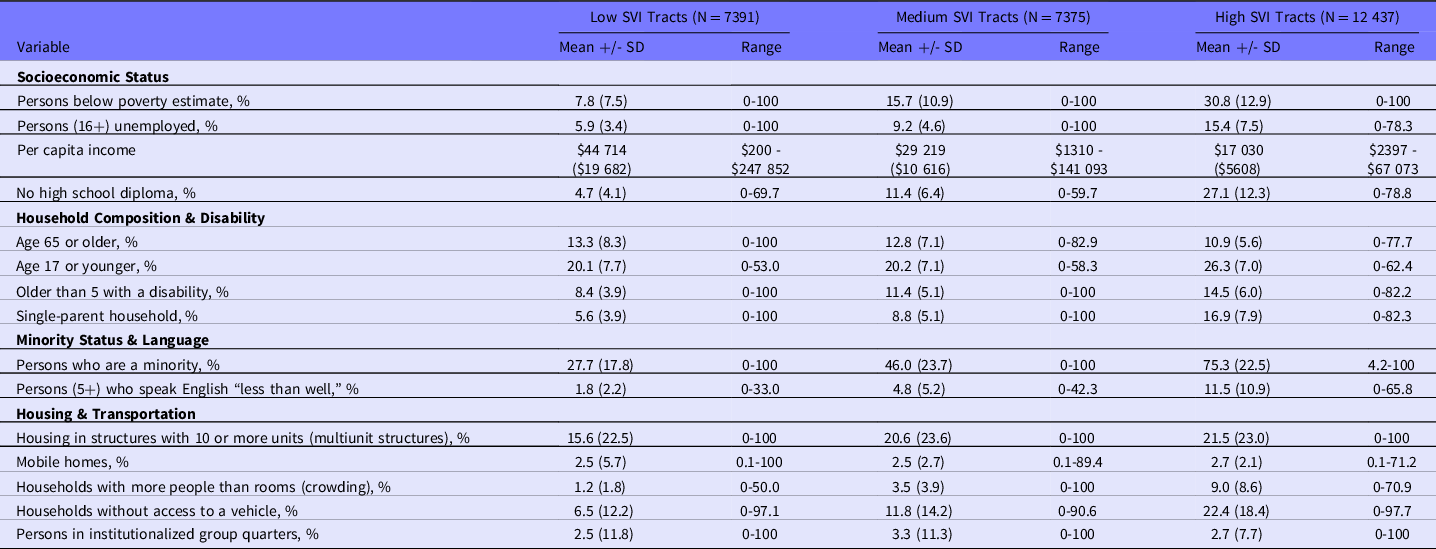
Data from 27,204 census tracts from 500 cities in the CDC 500 cities data set were included in the analysis. Almost half of the tracts were classified as “high vulnerability” in the CDC SVI dataset, and the other half was approximately evenly split between low and medium vulnerability classifications (Table 1).
Summary of sociodemographics of census tracts in low, medium, and high Social Vulnerability Index (SVI) categories

Sociodemographic Characteristics and Health Status of Communities
Measures of socioeconomic status at the census tract level tracked with SVI categories, such that the percentage of individuals living below the poverty line increased from low to high SVI (7.8% and 30.8%, respectively), with an intermediate level among medium SVI tracts (15.7%) (see Table 1). Unemployment and percent of adults with no high school diploma followed similar patterns, with the highest levels at 15.4% and 27.1% in high SVI tracts, respectively. Per capita income decreased from low to high SVI tracts, with the highest average per capita income at US $44,714 per year, and the lowest at US $17,030.
High SVI tracts had lower percentage of individuals who were at least 65 years old and a higher percentage of individuals who were younger than 18 years (10.9% and 26.3%, respectively), compared to the low and medium SVI tracts (low SVI tracts: 13.3% and 20.1%; medium SVI tracts: 12.8% and 20.2%). There were also more individuals age five years and above living with a disability (14.5%), and a higher number of single parent households (16.9%) in high SVI tracts. High SVI tracts also had a much higher percentage of minority residents (75.3%) compared to medium SVI (46.0%) and low SVI (27.7%) tracts. English language fluency followed the opposite pattern, with the highest number of individuals who speak English “less than well” in the highest SVI tracts (11.5%).
Housing characteristics generally varied across SVI levels as well. While the percentage of mobile homes remained consistent across SVI levels (˜2.5%), the percentage of multi-unit structures was highest in high SVI tracts (21.5%). Household crowding and lack of access to a vehicle were also more common in high SVI tracts compared to low SVI tracts (9.0% and 22.4% vs 1.2% and 6.5%, respectively).
Distribution of Natural Disasters
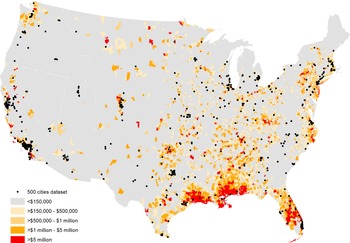
A small portion of the United States sustained most of the damage from natural disasters between 2000 and 2015 (Figure 1). The distribution of cumulative federal disaster relief funds over this period shows that communities along the Gulf of Mexico, Florida, the East Coast, Southeast, Southern Plains region, and the coast of California experienced a disproportionate impact relative to other places in the United States. Over 90 percent of the disaster funding went to census tracts where approximately 13 percent of the US population resides. Just 12 ZIP Codes in New Orleans, with less than 1 percent of the US population, accounted for 1/5 of all disaster funds distributed between 2000 and 2015.
Total amount of Small Business Administration (SBA) disaster funding received in a census tract between 2000-2015 with the cities in the 500 cities data set overlaid.

Within the census tracts in the 500 cities included in this analysis, there was a similar disparity in the distribution of disaster funding. Over US $195 billion in disaster funding was distributed among these tracts between 2000 and 2015, but almost half of the census tracts received less than US $150,000 (n = 12,415; 46%). Almost 50 percent of the disaster funding was distributed among 127 tracts in Louisiana (New Orleans = 107 tracts, Kenner = 12 tracts, and Gulfport = 8 tracts). Among the 500 cities, disaster funding was concentrated in 53 cities in 14 states. In particular, over 20 percent of the New York (n = 208; 22%) and Louisiana (n = 211; 23%) census tracts in the data set, and approximately 15 percent of the California (n = 133; 14%) and Texas (n = 145; 16%) tracts in the data set received disaster funding during this period.
There were also disparities among census tracts within a city. For example, the mean total amount of disaster funding received among the 2117 New York City census tracts in the data set between 2000 and 2015 was over US $9 million, but that ranged from US $0 to over US $280 million, with less than 13 percent (n = 275) of census tracts receiving more than US $5 million each. Among the 552 Houston tracts in the data set, the mean disaster funding was over US $16 million, ranging from approximately US $220,000 to US $130 million per census tract over the 15-year period.
The number of years that a census tract received any disaster funding (> US $0) was used here to measure “recurring natural disasters” in a community. Most census tracts received disaster funding in less than four years during the 2000–2015 period, but more than 8% (n = 2189) of the census tracts received disaster funding in 5 or more years. Ten census tracts, five in New Orleans and five in Oklahoma City, received funding in 9 or 10 years out of 15. The vast majority of census tracts in the 500 cities in our analysis (n = 22,172; 82%) received some SBA disaster funding between 2000 and 2015. Almost half of the census tracts (n = 12,042; 44%) received disaster funding between 2010 and 2015 and therefore were considered to have experienced a “recent natural disaster” for this analysis.
Impact of Social Vulnerability on Health Outcomes
For all self-evaluated and self-reported diagnoses of measures of health, census tracts with higher SVI had worse health outcomes (Table 2). Compared to low SVI census tracts, the incidence of poor reported mental health increased by 19% in medium SVI tracts (RR: 1.19, 95% CI: 1.19-1.21) and by 51% in high SVI tracts (RR: 1.51, 95% CI: 1.51-1.52). Similarly, poor reported physical health increased by 22% in medium SVI tracts (RR: 1.22, 95% CI: 1.22-1.23) and 69% in high SVI tracts (RR: 1.69, 95% CI: 1.68-1.70), compared to low SVI tracts. This pattern held for high blood pressure and asthma, but the relationship was attenuated. The incidence of people who reported having been diagnosed with high blood pressure increased 9% in medium SVI tracts (RR: 1.09, 95% CI: 1.08-1.10) and 28% in high SVI tracts (RR: 1.28, 95% CI: 1.27-1.29) compared to areas with low SVI. The incidence of people who reported having been diagnosed with asthma increased 8% in medium SVI tracts (RR: 1.08, 95% CI: 1.08-1.08) and 22% in high SVI tracts (RR: 1.22, 95% CI: 1.22-1.22) with the same reference group.
Effect of social vulnerability on the incidence of reported poor mental and physical health, high blood pressure, and asthma at the US census tract level

**P < 0.01
Impact of Recent and Recurring Natural Disasters on Health Outcomes
The occurrence of a recent natural disaster was associated with increased risk of self-reported poor mental and physical health and self-reported diagnosis of high blood pressure or asthma, after controlling for the SVI in the census tract (Table 3). Communities that experienced a natural disaster in the previous five years compared to those that had not experienced a recent natural disaster, had a higher incidence of poor mental health (RR: 1.02, 95% CI: 1.01-1.02), poor physical health (RR: 1.03, 95% CI: 1.02-1.04), high blood pressure (RR: 1.04, 95% CI: 1.02-1.05), and asthma (RR: 1.01, 95% CI: 1.01-1.02). The association between exposure to a recent natural disaster and the risk of being diagnosed with high blood pressure was magnified for people living in medium and high SVI census tracts.
Effect of a recent natural disaster on the incidence of reported poor mental and physical health, high blood pressure, and asthma across communities with varying levels of social vulnerability at the US census tract level

**P < 0.01, *P < 0.05.
We found similar results when comparing communities that had experienced recurring natural disasters between 2001 and 2015 (Table 4). The incidence of all health outcomes increased with each additional year that a community experienced a disaster, after controlling for SVI. For example, we found that in a community with a medium or high SVI, the incidence of reported poor mental health was 19% or 51% higher (medium SVI RR: 1.19, 95% CI: 1.18-1.20; high SVI RR: 1.51, 95% CI: 1.50-1.52), respectively, than in communities with a low SVI, without accounting for the additional impact of natural disasters (see Tables 2 and 4). For each additional year that a community experienced a natural disaster, the incidence of reported poor mental health increased an additional 1% (RR: 1.01, 95% CI: 1.00-1.01). In the most extreme case, the risk of reporting poor mental health was 66% higher in a high SVI community that experienced a disaster every year between 2001 and 2015, compared to a low SVI community that did not experience a single disaster over the same period.
Effect of a recurring natural disaster on the incidence of reported poor mental and physical health, high blood pressure, and asthma across communities with varying levels of social vulnerability at the US census tract level

**P < 0.01, *P < 0.05.
The risk of reported poor physical health or receiving a high blood pressure or asthma diagnosis was magnified in communities that experienced recurring natural disasters and were ranked as having medium or high social vulnerability, compared to low vulnerability tracts. In high SVI tracts that experienced a disaster every year between 2001 and 2015, the risk of being diagnosed with high blood pressure was 56% higher compared to low SVI tracts that did not experience a natural disaster. We found similar trends for self-reported poor physical health and asthma diagnosis. In summary, at the census tract level, recurring natural disasters were associated with an increased risk of poor health outcomes to the same or to a higher extent as measures of socioeconomic status, and these associations were magnified in communities with higher measures of social vulnerability.
Discussion
Our study indicated that both recent and recurring natural disasters were associated with poorer perceptions of personal mental and physical health, as well as clinical measures of physical health. The incidence of these poor health outcomes was significantly higher in low-resource communities. In communities that experienced recurring natural disasters, the risk of reported poor physical health and self-reported diagnosis of measures of physical health (high blood pressure and asthma) was significantly worse in communities that lack financial, educational, and social resources to cope with the impacts of natural disasters, compared to communities in the lowest social vulnerability category that had the most resources. In summary, this study across 500 US cities demonstrates that there is a compounding effect of natural disasters and socioeconomic measures on health, such that communities with low socioeconomic measures that experience natural disasters exhibit the poorest mental and physical health outcomes.
Much of the disaster literature focuses on a single major event. These studies have noted disparities across race, gender, and income with regard to mental health outcomes, including posttraumatic stress disorder (PTSD) and depression, and the ability to recover emotionally and financially after a disaster. Reference Cutter, Emrich and Mitchell14,Reference Rhodes, Chan and Paxson26-Reference Sastry and VanLandingham28 Hurricane Katrina was one of the worst natural disasters in US history in terms of social impact and economic damage, and post-disaster research has highlighted the inequitable and disproportionate impact that the storm had on low-income African American women and communities in New Orleans. Reference Rhodes, Chan and Paxson26,Reference Sastry and Gregory29-Reference Toldson, Ray, Hatcher and Louis31 After Hurricane Harvey, low-income communities in Texas experienced disproportionate environmental exposures to chemical contaminants. Reference Bodenreider, Wright and Barr32 In this context, an increase in property-related damages and perception of exposure to environmental contaminants were associated with probable anxiety. Reference Schwartz, Tuminello and Kerath33 An assessment of patients in Alabama after a severe tornado found that those who lived in a mobile home were more likely to suffer injuries, and a history of psychiatric disorders was associated with PTSD symptoms eight months after the disaster. Reference Niederkrotenthaler, Parker and Ovalle34 These case studies demonstrate that social and economic characteristics of individuals and communities often determine how severely a single natural disaster can affect both acute and long-term health. Individuals and communities with lower socioeconomic status (SES) are likely living at the maximum capacity of their means, without a reserve of financial, physical, or social capital to use when disaster strikes. These families may also have internal competing crises that impair their health and financial status tangentially to a natural disaster. Although we cannot compare the relative impact of the occurrence of a natural disaster and social vulnerability directly in this analysis, it is clear that underlying socioeconomic resources are an important predictor of the ability to cope with a disaster and risk of acute and chronic health burdens post-disaster.
Building on this work, our study demonstrates that the intersection of social determinants and natural disasters is not place-specific. While post-disaster epidemiologic studies have shown these associations in specific contexts, here we show that this pattern exists across geographic areas and types of natural disasters. Using nationally representative, publicly available data sets, we demonstrated the magnifying effect that recurring natural disasters can have on existing health disparities in communities. Given the unpredictability, recurrence, and widespread nature of natural disasters, this long-term retrospective study across 500 US cities provides a new approach for understanding the underlying role of social factors in predicting health outcomes post-disaster. In particular, both the 500 cities and SVI data sets represent some of the highest resolution and largest health and social determinants data sets available for the United States. Combining these data sets with a disaster insurance database allowed us to test associations among wealth, health, and natural disasters at a much broader geographic scale than has previously been possible. Others have used the 500 cities data set to examine place-based effects on obesity Reference Fitzpatrick, Shi, Willis and Niemeier35 and clusters of chronic kidney disease. Reference Liu, Li and Liu36 By integrating these high-resolution health and social-determinant data sets with ancillary data such as census information or environmental exposure data monitored nationally, future studies can assess epidemiologic associations in a large population to support other place-specific assessments.
Limitations
There are several limitations to consider when interpreting these results. First, this study only included census tracts within the cities included in the 500 cities data set. These are predominantly densely populated urban communities in the United States, which may have limited generalizability to rural areas. Rural communities may experience additional stress and other negative health impacts post-disaster due to lack of access to emergency services, a high proportion of elderly, socially isolated adults, and a higher reliance on natural resources. Reference Morrissey and Reser37-Reference Ashida, Robinson, Gay and Ramirez39
The health outcomes we used were based on self-assessment and the self-report of clinical diagnoses, and likely provide limited representation of the broad array of mental and physical health outcomes occurring in the populations included in the study. While a validated screening scale for mental health and medical chart review for blood pressure and asthma diagnosis would be preferable for defining health outcomes, this approach would have sacrificed sample size and comparability across census tracts. Furthermore, the Behavioral Risk Factor Surveillance System (BRFSS) methods used to collect the data used in this study are well-established and provide a consistent, nationally representative sample that can be used for longitudinal analysis.
The SBA data set on disaster losses is a coarse proxy for exposure to a disaster. We considered using the actual monetary value of losses as the exposure variable but decided against it due to possible confounding due to community affluence or high-density development. The use of a binary indicator for experiencing a natural disaster if any residential SBA funding was received in a census tract is a sensitive measure of disaster exposure. It is possible we included census tracts with relatively minor disasters in the “exposed” category. If this is the case, we expect that the potential lack of severe natural disasters in these census tracts would attenuate the statistical associations presented here.
Conclusions
In an era of increasing frequency and magnitude of natural disasters, it is imperative that we have a firm understanding of the health impacts of disasters, as well as the underlying social and environmental risk factors that have the potential to contribute to the severity of these health burdens. Prevention and preparedness plans that work to build resilience in communities before disasters should focus on closing the gap in environmental and social determinants that have been linked with disproportionate health burdens and slow recovery post-disaster. Reference Nomura, Parsons and Hirabayashi16 Additionally, the development of mitigation plans to reduce preventable morbidity and mortality should include evaluation of risk, for example, by examining socioeconomic characteristics of census tracts in a jurisdiction. Prior to disasters occurring, targeted community education and needs assessment efforts should be organized to support families to prepare within their SES capacity (eg, disaster fund savings programs with incentives, registration of families that may need medical and logistical support in the event of an emergency, and planning guides that encourage individuals to outline their emergency contacts and identify service needs). Response plans should include timely and targeted psychological care services that could potentially help prevent or alleviate long-term mental and physical health impacts of a disaster. As more frequent natural disasters become our new reality, data-informed disaster preparedness and response will be essential to protect public health.
Acknowledgments
We would like to express sincere gratitude to Thomas Folan, Kori Blakely, and Euan-Angus MacLeod for their contributions to the early stages of this project.
Author Contributions
MH was responsible for conceptualization, methodology, formal analysis, writing the original draft, visualization, supervision, project administration, and funding acquisition. RVW was responsible for conceptualization, methodology, reviewing and editing the manuscript, and funding acquisition. LL was responsible for reviewing and editing the manuscript. RF was responsible for reviewing and editing the manuscript.
Funding Statement
This work was supported by the Centers for Disease Control and Prevention Foundation, the Urban Institute, and the Robert Wood Johnson Foundation 500 Cities Program (Grant #74563).
Conflict(s) of Interest
The authors declared no potential conflicts of interest with respect to the research, authorship, and/or publication of this paper.