Introduction
Species-level investigations are invaluable to aquatic ecology studies of community structure, including food web research, biodiversity surveys, and ecosystem health assessments (Rosenberg et al. Reference Rosenberg, Danks and Lehmkuhl1986; Lenat and Resh Reference Lenat and Resh2001). Although the need for accurate species-level identifications is increasing in the field of aquatic entomology, the number of expert taxonomists is declining (New Reference New1996; Stribling et al. Reference Stribling, Moulton and Lester2003). Thus, accurate identifications using morphological characters alone often prove difficult to obtain due to lack of taxonomic expertise, significant variation in regional phenotypes and damaged specimens (Packer et al. Reference Packer, Gibbs, Sheffield and Hanner2009). Furthermore, aquatic studies often prove challenging because the commonly collected immature stages are difficult to identify to species as many are cryptic and taxonomic species level keys often do not exist and/or are designed for only the male or adult stage.
Cryptic species are indistinguishable morphologically, however, the use of morphological features in conjunction with DNA barcoding can lead to definitive identifications. (Pauls et al. Reference Pauls, Blahnik, Zhou, Wardwell and Holzenthal2010; Pramual et al. Reference Pramual, Wongpakam and Adler2011). DNA barcoding (Hebert et al. Reference Hebert, Cywinska and Ball2003a) is the analysis of a standardised molecular identification system that provides species-level identifications when morphological identification is difficult. Mitochondrial molecular markers are ideal for species level identification because mitochondrial DNA (mtDNA) has a faster mutation rate than nuclear DNA, often revealing genetic differences between species where many nuclear molecular markers would remain identical. The most commonly used molecular marker for DNA barcoding is a short (~650 base pairs) segment of the mitochondrial cytochrome C oxidase subunit 1 (COI) gene (Hebert et al. Reference Hebert, Ratnasingham and de Waard2003b). The COI gene has been used to successfully identify aquatic invertebrates such as springtails (Collembola) (Hogg and Hebert Reference Hogg and Hebert2004), mosquitoes (Kumar et al. Reference Kumar, Rajavel, Natarajan and Jambulingam2007), Chironomidae (Diptera) (Pfenninger et al. Reference Pfenninger, Nowak, Kley, Steinke and Streit2007; Sinclair and Gresens Reference Sinclair and Gresens2008), black flies (Diptera: Simuliidae) (Rivera and Currie Reference Rivera and Currie2009), mayflies (Ephemeroptera) (Ball et al. Reference Ball, Hebert, Burian and Webb2005; Webb et al. Reference Webb, Jacobus, Funk, Zhou, Kondratieff and Geraci2012), and caddisflies (Trichoptera) (Parker Reference Parker2000; Zhou et al. Reference Zhou, Adamowicz, Jacobus, DeWalt and Hebert2009, Reference Zhou, Robinson, Geraci, Parker, Flint and Etnier2011).
Many areas in Saskatchewan, Canada are inhabited by rare organisms that provide great insight into the biodiversity and ecosystem health of the region (Phillips et al. Reference Phillips, Parker and McMaster2008). The Cypress Hills in southwestern Saskatchewan, in particular, supports rich and unique biodiversity that remains understudied. The area is a flat-topped plateau acting as a montane refuge in the prairies for unique species (Phillips et al. Reference Phillips, Parker, Hoemsen, Bell and Chivers2013). Many of these species are deemed pre-glacial relicts (Hilton Reference Hilton1985; Campbell and Peck Reference Campbell and Peck1990), anomalies for the prairies (Shorthouse Reference Shorthouse1991), representative of Rocky Mountain fauna (Russell Reference Russell1951; Bird Reference Bird1962; Newsome and Dix Reference Newsome and Dix1968), or “Sonoran” in origin (Lehmkuhl Reference Lehmkuhl1980), originating from the Colorado system in Utah, United States of America. Focussed studies on such unique ecological systems and taxa, especially those including life history of aquatic insects, are highly valuable to our knowledge of the ecology of streams in the Northern Great Plains (Benke et al. Reference Benke, Van Arsdall, Gillespie and Parrish1984).
During a focussed ecological study of Pine Cree Creek in the Cypress Hills we discovered a new family (Thremmatidae) and species of Trichoptera for Saskatchewan, Neophylax splendens Denning. Here we describe our methods of combining morphological identification and genetic barcoding to identify N. splendens, and provide detailed observations about its life history.
Methods
Description of Pine Cree Creek
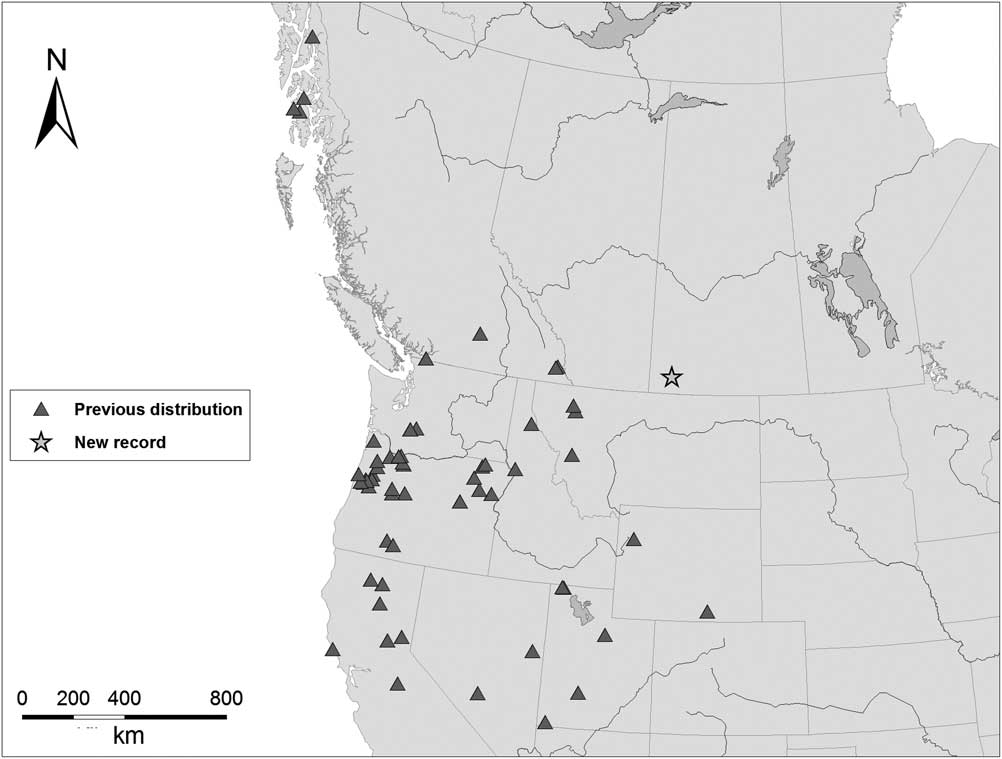
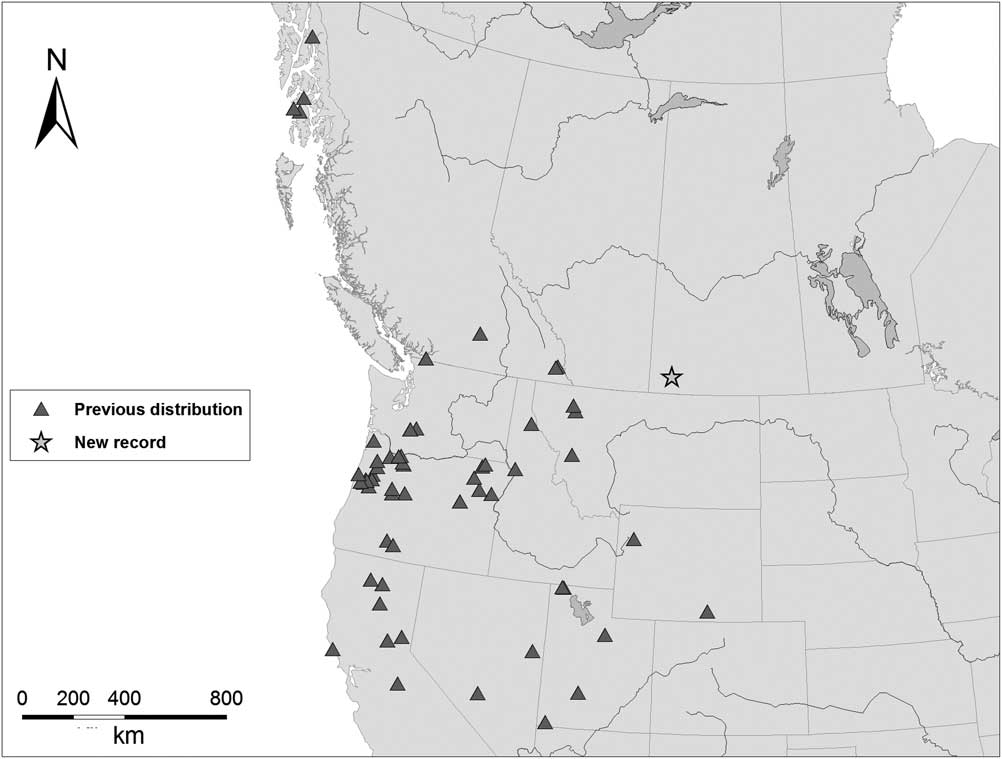
Pine Cree (49°36'32.1"N, 108°45'43.0"W) is a first order, spring-fed stream that flows through the Pine Cree Regional Park of the Cypress Hills (altitude=1070 m; Fig. 1). The riparian zone includes mixed wood forest of white spruce (Picea glauca (Moench) Voss (Pinaceae)), lodgepole pine (Pinus contorta Douglas ex Loudon (Pinaceae)), trembling aspen (Populus tremuloides Michaux (Salicaceae)), and balsam poplar (Populus balsamifera Linnaeus (Salicaceae)). The creek has a mean annual specific conductivity of 638 μS (±38 μS), mean pH of 7.02 (±0.80), mean summer temperature of 4.5 °C (May–September) with maximum temperature of 16.4 °C. Riparian health averages 89% and is deemed healthy following Prairie Conservation Action Plan (2008) riparian health assessments.
Known distribution of Neophylax splendens (triangle markers) showing new record of the species from Pine Cree Creek, Saskatchewan, Canada (star marker). Records obtained through Barcode of Life Database (BOLD) (http://www.boldsystems.org) and Vineyard (Reference Vineyard2005).
Sampling methods
We have conducted on-going annual fall sampling of Pine Cree Creek and other streams in the Cypress Hills since 2006. A 500 μm mesh size D-frame net was used to sample riffle, run, and pool habitats. The site was visited monthly from May–October 2012, and three samples were collected in each riffle, run, and pool habitat using a 500 μm mesh size Hess sampler. In addition, an emergence trap was suspended over a productive pool habitat upstream of the Pine Cree Regional Park and emptied monthly. Samples were placed in 70% ethanol and sorted under 7× magnification. Specimens were identified using the keys of Clifford (Reference Clifford1991), Vineyard (Reference Vineyard2005), and Merritt et al. (Reference Merritt, Cummins and Berg2008) and unique taxa were separated for further investigation. Diet was established through dissection of the gut and observation under 100× magnification.
Identification
Third instars (based on case length; Vineyard Reference Vineyard2005) were collected in 5 May 2012. Specimens were sent to Michael Floyd at the United States Fish and Wildlife Service for verification and species identification. However, as the specimens were early instars with key characters including the setae on the submarginal row indiscernible, species-level identification was inconclusive (M. Floyd, United States Fish and Wildlife Service, personal communication). We therefore conducted genetic analysis to complement morphological characters for species determination (Flint and Kjer Reference Flint and Kjer2011). Specimens were selected for genetic analysis based on the following family and generic characters: long basal spurs on the tarsal claws, reduced metathorax Sa1 and sclerotised mesothoracic plate (Wiggins et al. Reference Wiggins, Weaver and Unzicker1985; Vineyard and Wiggins Reference Vineyard and Wiggins1988; Vshivkova et al. Reference Vshivkova, Morse and Ruiter2007).
A single leg was removed from three selected specimens for DNA extraction and purification using DNeasy® Blood & Tissue Kit (Qiagen, Toronto, Ontario, Canada). Using the extracted DNA as a template, a 658 base pair region of the mitochondrial cytochrome oxidase I (COI) gene was targeted and amplified using two primers, IDT LCO1490 (5′-GGT CAA CAA ATC ATA AAG AAG ATA TTG G-3′) and HCO2198 (5′-TAA ACT TCA GGG TGA CCA AAA AAT CA−3′). The polymerase chain reaction products were purified using ExoSAP-IT® procedure, and sequenced at the National Research Council Canada, Plant Biotechnology Institute, Saskatoon, Saskatchewan, Canada. The DNA sequences were entered into the Barcode of Life Database (BOLD) (Ratnasingham and Hebert Reference Ratnasingham and Hebert2007) for taxonomic identification. All 191 Neophylax sequences in the BOLD database as of 15 January 2014 were downloaded as FASTA files and included in the analysis. Sequences were aligned using MUSCLE alignment (Edgar Reference Edgar2004) and TreeDyn (Dereeper et al. Reference Dereeper, Guignon, Blanc, Audic, Buffet and Chevenet2008, Reference Dereeper, Audic, Claverie and Blanc2010) was used to generate a neighbour-joining tree.
Larval voucher specimens are deposited in collections at the Royal Saskatchewan Museum, Regina, Saskatchewan, Canada, and the Water Security Agency of Saskatchewan, Saskatoon, Saskatchewan, Canada.
Results and discussion
Larvae of Neophylax splendens were collected at Pine Cree Regional Park in the Cypress Hills, Saskatchewan, Canada 6 May 2012 (n=3) and 6 June 2012 (n=17) by I.D.P., B.M.H., and A.J.B. Thus, representing the first record of the family Thremmatidae in Saskatchewan and extending the known distribution of this family over 500 km east of the Rocky Mountains (Fig. 1). Prepupal aggregations were observed 3 October 2012. No adult specimens were found in emergence traps nor through active searching in early October.
Morphological features identified the specimens as Neophylax species and COI sequences confirmed N. splendens (over 99.4% similarity) using the BOLD (http://www.boldsystem.org) with BIN: BOLD:AAG9543. Specimen and locality information are also available on GenBank (http://www.ncbi.nlm.nih.gov/genbank/) under the accession numbers KF367633–KF367635. Publicly available sequences within the same cluster as our specimens were used to generate a neighbour-joining tree (Fig. 2).
Neighbour-joining tree depicting relationships between Neophylax specimens publicly available on Barcode of Life Database (BOLD) (BIN: BOLD:AAG9543) (http://www.boldsystems.org). Specimens recorded from Saskatchewan, Canada are new to the database. Species names are followed by their BOLD process ID number, the country and state in which they are recorded, and the BOLD BIN number. The scale bar indicates the length of a branch estimated to have experienced 0.03 substitutions per site.

Life cycle
Neophylax splendens is typically found in small, first order streams at high elevations (Vineyard Reference Vineyard2005), similar to Pine Cree Creek, Saskatchewan. All species of Neophylax are univoltine, hatching from eggs in early spring and emerging as adults in late fall (Vineyard Reference Vineyard2005). In Pine Cree Creek, this caddisfly appears to have peak larval abundance in early June then enters pre-pupal diapause from late August until early October. A long diapause can allow larvae to avoid high summer temperatures, synchronise emergence (Corbet Reference Corbet1964; Masaki Reference Masaki1980), take advantage of increased food availability in fall (Beam and Wiggins Reference Beam and Wiggins1987), or defer oviposition until the height of the drought period is over (Ross Reference Ross1944). Pre-pupal aggregations were found on the undersides of rocks or debris in Pine Cree Creek in late September. These aggregations allow for avoidance of predation and parasitism (Otto and Svensson Reference Otto and Svensson1981) and can facilitate colonisation of other invertebrates (McCabe and Gotelli Reference McCabe and Gotelli2003). Pupation typically extends from two to six weeks with shorter emergence in cooler waters (Beam and Wiggins Reference Beam and Wiggins1987). Adults generally emerge synchronously in early fall (Vineyard Reference Vineyard2005). At Pine Cree Creek, no adults were collected in emergence traps, suggesting emergence was later than 3 October.
Diet
Larvae were collected in aggregations under woody debris and rocks in riffle habitat. Gut content analysis of N. splendens larvae from Pine Cree Creek revealed diatoms, periphyton, and fine organic particles of aufwuchs. Mandibles of Neophylax are simple scrapers with a brush of 10–15 long, slender setae along the mesal edge that serve to brush small particles into the mouth (Slack Reference Slack1936). This supports their classification as obligate grazers (Sedell Reference Sedell1971; Cummins Reference Cummins1973).
Stream insect community
Many other Trichoptera were collected from Pine Cree Creek at the same time as N. splendens, including representatives of Glossosoma Curtis (Glossossomatidae), Rhyacophila Pictet (Rhyacophila), Hydropsyche Pictet (Hydropsychidae), Lepidostoma Rambur (Lepidostomatidae), Onocosmoecus Banks (Limnephilidae), Hesperophylax Banks (Limnephilidae), and Cheumatopsyche Wallengren (Hydropsychidae). These genera also have limited distributions in the northern and southern boreal region of Saskatchewan (Smith Reference Smith1984). Neophylax rickeri and N. splendens are sister species (Vineyard Reference Vineyard2005) and are typically found in sympatry but distributed along a longitudinal gradient, with N. splendens occurring upstream of N. rickeri (Vineyard Reference Vineyard2005; Mendez and Resh Reference Mendez and Resh2008). However, we did not detect N. rickeri in our samples.
Distribution
Neophylax splendens is widely distributed in western North America, from southeastern Alaska to southern California and extending east in the Rocky Mountains into western Colorado and southcentral Wyoming (Fig. 1). It is the most common species of Neophylax in western North America but has not previously been recorded in the central part of the continent (Houghton et al. Reference Houghton, Holzenthal, Monson and MacLean2001). Much of the work on Trichoptera in Saskatchewan has focussed on the boreal streams and the North and South Saskatchewan Rivers (Smith Reference Smith1975, Reference Smith1984). No previous records of this species currently exist for Saskatchewan (Smith Reference Smith1975); Royal Saskatchewan Museum collection; Water Security Agency of Saskatchewan voucher collection; AquaTax Consulting (Dale Parker, personal communication).
Neophylax splendens is typically found in cool, fast flowing streams (Vineyard Reference Vineyard2005). The restricted locality of N. splendens in Saskatchewan could be due to the exceptional water quality of Pine Cree Creek and unique characteristics of the Cypress Hills, including high elevation. Based on tolerance values for the northwest, N. splendens has a tolerance value of 3 (Barbour et al. Reference Barbour, Gerritsen, Snyder and Stribling1999) indicating their sensitivity to human disturbance. Elevation could be the driver of the localised distribution of caddisflies (Williams Reference Williams1991) in Pine Cree Creek, as it is at comparable elevations to the Utah, United States of America and British Columbia, Canada records (2040 and 1122 m, respectively). The occurrence of this species in the Cypress Hills strengthens the biogeographical link with montane regions such as Utah and British Columbia population. This supports Lehmkuhl’s (Reference Lehmkuhl1980) hypothesis of the insect fauna in the Cypress Hills being similar to montane regions such as Utah, forming the “Sonoran Connection”.
Pine Cree Creek has been sampled each fall since 2006 as part of Saskatchewan’s biomonitoring programme (Davies and Hanley Reference Davies and Hanley2010). Because this coincides with pre-pupal diapause or emergence time, this may explain why N. splendens has not been recorded to date. In the interests of expanding our knowledge of biodiversity in Saskatchewan, monitoring efforts should incorporate smaller order lotic systems. Currently, springs are understudied in Saskatchewan as sampling efforts focus largely on studying higher order systems due to their economical importance. However, it is imperative to study the springs from which these rivers originate to better understand freshwater systems as a whole (Danks and Williams Reference Danks and Williams1991). These smaller order streams can support rare and sensitive species, as we have shown with N. splendens. This species is adapted to cold springs and information relating to its life history and distribution is especially valuable in studies of biomonitoring and ecosystem health.
Conclusion
This study highlights the value of species-level identification in biological surveys and the use of genetic analysis in obtaining this taxonomic resolution. It also illustrates the inadequacy of annual, single season/date, sampling regimes to assess stream biodiversity.
Acknowledgements
The authors are grateful for the support provided by Joan Hodgins at Pine Cree Regional Park and the expertise provided by Michael Floyd, Christy Geraci, and Xin Zhou. The Saskatchewan Wildlife Federation, Saskatchewan Summer Student Works, Natural Science and Engineering Research Council of Canada (NSERC) scholarships to B.M.H. and I.D.P., RBC Blue Water Group, EcoFriendly Sask EcoAction Grant, and the Entomological Society of Saskatchewan provided funding that supported this research. Furthermore, they would like to thank two anonymous reviewers for their comments on earlier drafts of this manuscript.