I. INTRODUCTION
In recent years the economic thought of Hazel Kyrk (1886–1957) has received a growing attention, which culminated on the anniversary of A Theory of Consumption, her main theoretical contribution (Kyrk Reference Kyrk1923).Footnote 1
Drawing inspiration from the works of Thorstein Veblen, Wesley Mitchell, and other institutionalist economists, Kyrk (Reference Kyrk1923) criticized the epistemological roots of neoclassical demand theory, influencing a new wave of studies on consumption (Trezzini Reference Trezzini2016; Le Tollec Reference Le Tollec2020; Philippy, Betancourt, and Dimand Reference Philippy, Betancourt and Dimand2024; Todorova Reference Todorova2024). Her peculiar approach to economics, blending theory with applied research, fitted well with the contemporary growth of quantitative research, and strengthened opportunities for women economists in academia and public institutions, in a world dominated by gender discrimination (Becchio Reference Becchio2019, pp. 94–97; Kuiper Reference Kuiper2022, pp. 135–136; May Reference May2022, p. 207). In interwar America, Kyrk gained a leading role in both fields, providing a powerful signal of the changing status of women. In academia and the public service, she reshaped home economics in the economist’s scientific agenda, taking distance from the first generation of home economists, who focused mainly on the “practical” problems of the home.
Trained in economics at the University of Chicago (PhD in 1920), Kyrk taught in both the economics and home economics departments up to her retirement in 1952, achieving full professorship in 1941. In Chicago, she supervised nine PhD economists who worked on home economics, and who would later provide the bulk of applied research on consumption markets (Le Tollec Reference Le Tollec2020, p. 48). Her experience as public advisor goes back to 1918, when she traveled to London for “special service” as a statistician with the Allied Maritime Transport Council, and continued well into the 1940s, when she chaired the Technical Advisory Committee of the Bureau of Labor Statistics (BLS) (Beller and Kiss Reference Beller and Kiss1999).
Kyrk’s main challenge was to offer new theoretical bases for understanding the socio-anthropological dimensions of consumption. At the same time, she did not ignore the importance of going beyond epistemological issues and building up more solid quantitative foundations regarding the comprehensive sphere of consumption and the attitudes of consumers, studying standards of consumption and the relationship between family incomes and expenditures (Johnson Reference Johnson2023; Kuiper Reference Kuiper2024; Trezzini Reference Trezzini2016, Reference Trezzini2024). In the final chapters of her book, an ambitious research program was launched with the purpose of providing empirical contents for measuring theory and verifying common beliefs regarding consumers’ behavior.
Another important part of Kyrk’s criticism of established theory was her quest for consumers’ education. At a time when firms and advertising agencies were setting off a marketing revolution, home economists tried to offer scientific intermediation between producers and consumers (Goldstein Reference Goldstein, Stage and Vincenti1997, Reference Goldstein2012). In the wake of Veblen and Mitchell, Kyrk argued that the act of consumption did not merely imply the presence of an agent who was passively buying commodities according to some immutable set of preferences. Consumption, instead, involved active choices through “selection, skills and thought” (Kyrk Reference Kyrk1923, p. 85). Thus, unsurprisingly, neoclassical economics did not have much to say about consumers’ education, which was often downgraded as an unscientific issue.
On these premises, this paper analyzes both the contents and the impact of Kyrk’s post-1923 scientific production and professional activities, regarding the quantitative foundations of consumption together with her attempt to feed contemporary knowledge of consumers’ behavior with pragmatism and field studies.
The paper is structured as follows. Section II gives an overview of the state of the art from which Kyrk started, providing some contextualization of her professional activities. Section III focuses on consumers’ education and how to enhance “critical consumption.” Section IV explores Kyrk’s efforts to build up a new science of statistics. The section is based on her studies of the bakery industry and the multiple dimensions of consumption, as they were observed through the New Deal statistical reports on consumption. Although the use of new sampling methods for studying consumption was still in its infancy, Kyrk called for a massive (but “wise”) use of statistical tools and new ideas for broadening the scope of investigation. Section V deals with the importance of “invisible” objects and their statistical processing using different perspectives: women’s work, non-market activities, and the non-monetary measures of welfare. The paper ends with a section of conclusions.
II. THE INSTITUTIONALIST LEGACY, HOME ECONOMICS, AND THE RISE OF STATISTICS
During the Progressive Era, few American economists studied consumption as a socio-economic phenomenon extending beyond the abstract assumptions of the marginalist theory based on agents’ rationality and given preferences. Besides Veblen, Richard Ely and Simon Patten paid attention to the social dimension of consumers’ choices under the influence of German historicism (Philippy Reference Philippy2021, pp. 384–387). The widespread underestimation of social and cultural variables that influenced consumption expenditures spurred a new generation of home economists, including Hazel Kyrk, to fill this gap.
David Philippy, Rebeca Gomez Betancourt, and Robert Dimand (Reference Philippy, Betancourt and Dimand2024) showed that American institutionalism and the home economics movement were Kyrk’s main intellectual roots and sources of inspiration. Following Veblen’s Theory of the Leisure Class, Kyrk and Theresa McMahon developed new ideas for explaining the social determinants of consumption and savings.Footnote 2 Kyrk’s work was also related to the other main figure of the institutionalist movement, Wesley C. Mitchell, who preached for more solid empirical foundations of consumption, at a time when government agencies, including the National Bureau of Economic Research (NBER) and the Bureau of Home Economics (BHE), also favored a quantitative turn in economic research.Footnote 3
Veblen’s and Mitchell’s legacy affected Kyrk’s epistemology and her rejection of marginal utility theory. Studying consumers’ choices required a greater awareness of the connections between human nature and institutions, while hedonistic psychology remained completely incapable of grasping the complexities of reality and motivations (Todorova Reference Todorova2024). As Kyrk wrote, “motives were neither constituted simply by pleasure and pain, nor simply by dominant desires, passions or impulses, nor simply by reason, but they depend upon the nature of the universe within which they emerge” (Kyrk Reference Kyrk1923, p. 152). The nature of consumers’ choices was inherently dynamic and affected by a mutable set of variables: status, class of income, ethnicity, geographical location, family composition, and religion and cultural backgrounds.
Kyrk’s post-1923 empirical work could be regarded as a natural progression of her theoretical work, extending Mitchell’s research program, providing surveys on social aspects of consumption and collecting data on family expenditures. Data collection was a practical tool to identify standards that would allow consumers to make “wise choices” (van Velzen Reference van Velzen, Barker and Kuiper2003, pp. 48–49).
Going beyond Mitchell and using an interdisciplinary body of literature, including anthropology, sociology, and psychology, Kyrk outlined a research agenda for helping consumers to reflect critically on their behavior. Her contributions on education, household expenditures, and women’s participation in the labor market could be regarded as consistent with the idea of providing useful information to families and individuals for making conscious decisions for their own ends. It is worth remarking at this stage that Kyrk also applied the ideas of the pragmatic philosopher and educator John Dewey, who described consumers’ valuation as a process of “making practical judgments,” since values were merely instrumental and subjective, while full rationality was not a specific attitude of consumers (van Velzen Reference van Velzen, Barker and Kuiper2003, pp. 41–42).Footnote 4
Kyrk’s efforts to educate families were part of a public policy for consumers’ protection and greater awareness (Spring Reference Spring2003). Since its foundation in 1923, the BHE promoted a culture of expertise in matters of consumption, strengthening the impact of scientific achievements and methodologies in everyday life, beginning with the use of social surveys assessing national trends in food consumption. By the early 1930s, democratic political leaders and policy makers relied on BHE to both educate consumers and represent consumers’ interests in technical committees that were part of the New Deal reform agenda (Goldstein Reference Goldstein, Stage and Vincenti1997, Reference Goldstein2012).
Education included dissemination through radio talks. The growing popularity of movies and radio programs threatened the protection of consumers’ interests and somewhat reduced the impact of scientific achievements in shaping consumers’ choices. Hence, BHE invited experts of home economics and consumption to raise their voice against the illusion of consumerism that advertising campaigns tried to force on the American public. Kyrk contributed to this movement by providing regular talks on the educational radio programs in Chicago, promoted also by the local universities (Field Reference Field1991).
Edith Hawley, who joined the BHE in 1924, was an important figure promoting new surveys on food consumption. Hawley developed techniques to establish “scales of relative food requirements” in a comparative perspective and new methods for assessing the nutritive value of individual diets, thus promoting a new field of “food economics.” Kyrk and Day Monroe, another economist trained by Kyrk at the University of Chicago, cooperated with Hawley, albeit not uncritically. In their view, home economics should focus on “the problems of the family” rather than simply conduct studies on mass-produced goods (Kyrk Reference Kyrk1933; Goldstein Reference Goldstein2012, pp. 86–111).
To some extent, this shift from theoretical to applied economics undertaken by Kyrk (and other home economists) depended on the changing role of women in academia. Before the war women represented a sharp minority within the academic profession, although they participated in conferences, and published books and articles on the same topics that attracted their male colleagues. By contrast, in the interwar years, doctorates in economics awarded to women dropped significantly, and home economics offered a disciplinary refuge for women with economics backgrounds, as it was one of the few fields where women pursued careers and obtained professional recognition.Footnote 5 The Great Depression exacerbated women’s employment conditions, with a further reduction in their opportunities as economists in academia. However, state and federal agencies (like BHE or BLS) offered positions to women home economists for statistical analysis of prices, wages, and consumption, and increasingly so under the New Deal (Folbre Reference Folbre and Silverberg1998, p. 43; Rossiter Reference Rossiter1982, p. 70; Forget Reference Forget2011). This often-neglected activity would provide postwar economists with fundamental empirical materials and new insights into family budgets and consumption behavior (Philippy Reference Philippy2021).
While gender constraints prevented women from working fully on theoretical economics, Kyrk and her Chicago group (which included Margaret Reid and Elizabeth Hoyt) reformed the tradition of home economics, as it was focused mainly on scientific management of the house. Born in the nineteenth century as a science for the efficient management of household labor, the home economics movement was established by Ellen Richards between 1899 and 1908, during the Lake Placid Conferences. During the 1908 Lake Placid Conference, the American Home Economics Association was established, as well as the Journal of Home Economics. Richards emphasized women’s crucial role in savings and consumption instead of housekeeping and decoration (Philippy Reference Philippy2021). Home economics soon became an expression of the ideals of the Progressive Era, emphasizing the role of social responsibility and scientific education at a time when market purchases and the industrial society were gaining ground (Becchio Reference Becchio2019, pp. 88–89).
When Kyrk started contributing to the field, she tried to establish closer connections between economics and the old-fashioned approach that mainly focused on the role of women in increasing housekeeping efficiency (van Velzen Reference van Velzen, Barker and Kuiper2003, pp. 47–48). Introducing her book Economic Problems of the Family ([1929] Reference Kyrk1933, p. xix), Kyrk remarked how “home economics” was not meant to cover “technical and practical questions of nutrition, childcare, care of the house and selection of clothing, furniture and household equipment” without considering such problems as “‘economic’ in the academic sense of that term.” “Home economics” thus became “household economics,” a subfield of microeconomics, with its own production functions, including unpaid domestic labor as an input that shaped the demand curve (Becchio Reference Becchio2019, pp. 87–95). Not surprisingly, some of Kyrk’s late writings explored the place of women within and outside the labor market, and how to measure it.
Many women economists had already dealt with women’s labor conditions and social reforms, under the influence of John Commons (Becchio Reference Becchio2019, p. 59–71). Edith Abbott, who got her PhD at the University of Chicago in 1905 under the supervision of Sophonisba Breckinridge, was one of the most prolific writers in the field of social reforms, including wage gaps and the minimum wage and other issues, such as housing, immigrants, crime, prisons, and truancy (Goldin Reference Goldin2006, p. 4). Emilie Hutchinson, a 1919 Columbia PhD in economics, was another scholar who saw how the advent of the machine age had deeply changed the relationship between men and women in the labor market (Hutchinson Reference Hutchinson1929).
A growing mass of empirical studies on household incomes and expenditure was published in the interwar years, as first shown by Faith M. Williams and Carle C. Zimmerman (Reference Williams and Zimmerman1935).Footnote 6 William Ogburn (Reference Ogburn1919, Reference Ogburn1923) was among the foremost institutionalists who elaborated wage statistics and standards of living, assuming consumption as a socially determined activity. Ogburn introduced the idea of consumption baskets and their complex connections with income. New evidence on consumption dynamics became relevant in steering the “way Keynes came to America” (Trezzini Reference Trezzini2024).
Thus, both institutionalist economists and women home economists developed empirical studies of consumption and living standards. Jessica Peixotto, a forerunner of home economics at Berkeley, published on family budgets (Reference Peixotto1927b), while Carle Zimmerman (Reference Zimmerman1927) provided an in-depth analysis of rural families’ expenditures. Building upon this literature, Kyrk’s Consumer Purchases Study (Kyrk et al. Reference Kyrk, Monroe, Cronister and Perry1941) provided further estimates, which would then be used to test the Keynesian consumption function. In particular, Elizabeth Gilboy used Kyrk to criticize John Maynard Keynes’s propensity to consume and the slope of the curve.Footnote 7 According to Gilboy, statistical evidence showed that a general theory of the propensity to consume made little sense and could not explain patterns of behavior and choices (Gilboy Reference Gilboy1938). Kyrk’s data were also used by Dorothy Brady and Rose Friedman (Reference Brady and Friedman1947) for their research on income and wealth, which emphasized the importance of relative, rather than absolute, income (Forget Reference Forget2023).
III. INCREASING CONSUMERS’ EDUCATION: THE ROLE OF KNOWLEDGE AND PUBLIC REGULATION
In the early 1920s, Kyrk became actively involved in “pro-consumers” campaigns alongside many interwar economists, including Gardiner Means and Leon Henderson (van Velzen Reference van Velzen2001).Footnote 8 Consumers’ education was a frequent topic in Kyrk’s scientific writings, radio talks, and other occasional contributions.Footnote 9 One important publication regarded the 1938 revision of the 1925 book Food Buying and Our Markets (Monroe, Kyrk, and Stone [1925] Reference Monroe, Kyrk and Stone1938), which dealt with many economic aspects of food purchases and how to improve consumers’ abilities to make choices.Footnote 10 The 1938 revision stressed the impact that the crisis had provoked mainly through the increase of urbanization.Footnote 11
Many were the challenges ahead. From a “destructive” point of view, the main task was to offset the distortions of marketing and advertising as being mainly undertaken in the interest of producers. From a more constructive perspective, Kyrk’s interventions dealt with three main issues: 1. the definition of consumers’ education; 2. the main objectives of a future program of consumers’ education; and 3. the policy priorities that institutions, authorities, advisory boards, or private associations should pursue.
According to Kyrk, the act of “buying wisely” was a difficult job that needed training at different levels of schooling. “Wise buying” did not depend on gender, and neither was it a specific attitude that women possessed.Footnote 12 It rather depended on the peculiar characteristics of the goods that individuals consumed and on the difficulties with which buyers operated.Footnote 13
During a radio talk ironically titled “Are Women Economic Imbeciles?” Kyrk argued that, unlike personal consumption, “wise buying” did not significantly affect commercial consumption, since “the commercial buyer has sources of exact information about goods that are not available to the household buyer” (Kyrk Reference Kyrk1934a, p. 3). By contrast, individual consumers (regardless of their gender) faced difficulties that depended on the larger variety of goods, the smaller amount of cumulative experience, and the value of intangibles—such as “comfortableness, beauty, happiness” (Kyrk Reference Kyrk1934a, p. 2)—that were inevitably more difficult to appraise.
How to improve “wise buying”? A greater scientific knowledge strengthened consumers’ standards through a process of building competence from schools to universities.Footnote 14 Education for buying should become a new subject of high schools’ curricula, “as much as training in the arts, techniques, and skills” (Kyrk Reference Kyrk1934b, p. 19). At the university level, courses offered by departments of economics could offset the dangers of demand distortions through advertising and help coordinate attempts to reinforce consumers’ standards (Kyrk Reference Kyrk1930; Kyrk Reference Kyrk1934b). In the past, Kyrk noted, schools and universities “have only played a part in educating people to sell (supply chains) or to trade, but not to buy” (Kyrk Reference Kyrk1934b, p. 21), while consumers’ education was left in the hands of manufacturers or intermediaries, with huge conflicts of interest being the obvious consequence; hence, the necessity to transfer education “from biased to unbiased hands” (Kyrk Reference Kyrk1930, p. 14).
The first goal of consumers’ education was to increase value by reducing transaction costs. Transaction costs could be reduced by providing relevant information regarding alternatives and by acquiring economies of scale through time and energy saving. They could also be affected through a more widespread knowledge regarding the maintenance of durables, the lengthening of the life cycle of goods, and the elimination of waste. Again, minimizing transaction costs was not peculiar to the sex of the buyer but rather to the difficulties with which buyers operate, and to the opportunity costs related to his/her main occupation or position in society. Measuring consumption efficiency according to sex and through women’s presumptively better ability to shop was just another form of gender discrimination, while “waste and backwardness are not due to the sex of the buyer. They are due to the nature of the goods bought and the use to which they are to be put” (Kyrk Reference Kyrk1934a, p. 4).
A second purpose of education was to increase the scientific background and awareness in consumers’ choices. Here, Kyrk suggested that different forms of education could help to shape values, wants, and preferences in a more appropriate direction for the consumer’s well-being. One strategy followed the guidelines of science and rejected emulation and deep-rooted habits. Undoubtedly, this was the most difficult goal to be attained through science and experience since it could be deeply influenced by outside forces. Among these, Kyrk cited the case of monopolies, organized producers, pressure groups, and advertising agencies; but she also emphasized the role of churches, the press, and, most significantly, informal actors, such as “neighbours,” the “upper class,” or what “the best people do” (Kyrk Reference Kyrk1935a, p. 44). Hence, the reduction of consumers’ illiteracy could become an impossible task against the coalescing power of these forces.
Education had a fundamental importance particularly in those cases when it implied an increase in such superior values that regarded consumers’ health or morality. Here, Kyrk thought, education should avoid the confusion created by the belief that a growth-induced democratization of standards inevitably implied an improvement of consumption standards. Thus, education could steer consumption away from the dangers of emulation. The introduction of “educational psychology”—the study of how people learn—in scholastic curricula strengthened awareness and autonomy, and formed a class of choice-conscious consumers who do not follow the example of a higher order élite at all costs (Kyrk Reference Kyrk1930, p. 18).
Obviously, the success of education was much harder to achieve when the objective was the improvement and reform of existing standards. One instance regarded the relationship between food and health, which Kyrk (Reference Kyrk1935a, p. 43) saw as “one of the major revelations of modern science, one of the greatest advances of the past 100 years in the understanding of the processes of life.” In this case, authorities should prevail on free choice, particularly when health standards were threatened by unsound practices (Kyrk Reference Kyrk1930, p. 18).
Consumers’ education should become a policy priority. It had the nature of a public good that state authorities should provide. Kyrk (Reference Kyrk1923) had already mentioned that state departments were responsible for improving educational standards through the creation of “bureaus of markets or bureaus of standards,” whose main task was to provide information and measures against fraud. In her subsequent writings, she insisted that authorities should provide “a clearer notion of what consumers’ interests are, of the measures necessary to promote them, and of the difficulties in the way” (Kyrk Reference Kyrk1935b, p. 201). Public policy, however, was often written by producers. New Deal legislation, in this respect, was disappointing since it had done too little to counter “the prevailing interests of producing groups or occupational groups” (Kyrk Reference Kyrk1935b, p. 202): an injury to consumers was still insufficient to justify a “cease and desist” order from the Federal Trade Commission that could prevent firms from continuing bad practices. Thus, while some headway had been made to increase the power of small firms, the consumer was often neglected.
One difficulty depended on the conflict between the individual’s interests as a consumer and his other interests as a wage earner or income recipient. In fact, most people’s attention was concentrated on income and occupation, while no consideration was given to benefits related to lifestyle, social values, or alternative modes of expenditure. Hence, in her educational campaigns, Kyrk suggested that authorities should “go beyond” the income bias and reduce ignorance of the behavioral and informational drivers of consumption: if so, “policies for safeguarding the interests of consumers as such will be more adequately formulated” (Kyrk Reference Kyrk1934a, p. 25). Here, again, education clarified “the relevance of social values attached to consumption” to convince people that the “abundance of goods at low cost is not, of course, the sole concern of a society. There are other competing and completing values—leisure, security, good working conditions” (Kyrk Reference Kyrk1935b, p. 203).
For home economists, educational issues enhanced the need to design new, active policy measures. Kyrk suggested different lines of action, the first of which was to increase transparency: consumers were often obliged to pay for services and accessories that were imposed on them and were not part of their demand (Kyrk Reference Kyrk1935a). The second was to impose a higher quality of grade marking and informative labels—something that was still inadequate and unreliable. This was a critical issue, indeed, which raised Kyrk’s skepticism on the effective power of consumers, despite the role played by consumers’ activism in the Progressive Era.Footnote 15 In fact, New Deal attempts to impose well-defined standard codes of labeling on industrial producers through the agency of the consumers’ advisory board had been disappointing. At the same time, public actions to disseminate external, independent “grading” and improve qualitative standards had suffered the same fate (Kyrk Reference Kyrk1934a, pp. 20–23).Footnote 16 The third line of action was to promote the creation of pressure groups representing consumers and the diffusion of groups fighting monopolies. Minorities had already been defended in such complex fields as banking and finance,Footnote 17 and pressure groups supporting consumers could gain the public scene since, as Kyrk suggested (Reference Kyrk1935b, p. 203), “they represent votes.”
IV. KYRK’S CONTRIBUTIONS TO EMPIRICAL ECONOMICS
In 1925 Kyrk made a significant contribution to empirical research with an inquiry of the American bakery industry, a study that has so far received little attention from scholars and biographers. Kyrk prepared the manuscript in the winter of 1923–24, when she was a research associate with the Food Research Institute at Stanford University, founded by Herbert Hoover in 1921 to study the problems of production, distribution, and consumption of food.Footnote 18
Bakery was a crucial topic for the early generations of home economists, since mass-produced food, including bread, was gradually replacing homemade cooking.Footnote 19 Kyrk’s study was built on census data,Footnote 20 providing information on the position and growth of the industrial sector, its economic and financial characteristics, and the labor force, including information on wages and the conditions of children and women (Kyrk and Davis Reference Kyrk and Davis1925). The report produced results under three different headings.
The first section was the industry’s position and growth. From this respect, baking ranked high, together with such giants as iron and steel, automobiles, and clothing. Its annual value exceeded one billion dollars, despite the postwar deflationary trend. The second section was the economic characteristics of the industry. The making of bakery products was a small-scale activity with a low average number of employees per establishment (about seven in 1919), a much lower figure than the average for all industrial sectors (thirty-six employees per establishment). Moreover, census data showed a small proportion of corporate ownership (over three-quarters of bakeries were owned by individuals). In the third section, Kyrk offered relevant information on workers. As in all manufacturing industries, the percentage of children employed in baking was low and declining. Men constituted 73.2% of wage earners but only 65.4% of lower-salaried employees. At the same time, the proportion of women was increasing, probably due to the introduction of more mechanical methods. According to the census, real wages in bakery had substantially increased since 1914, following about the same trend as the manufacturing industry.
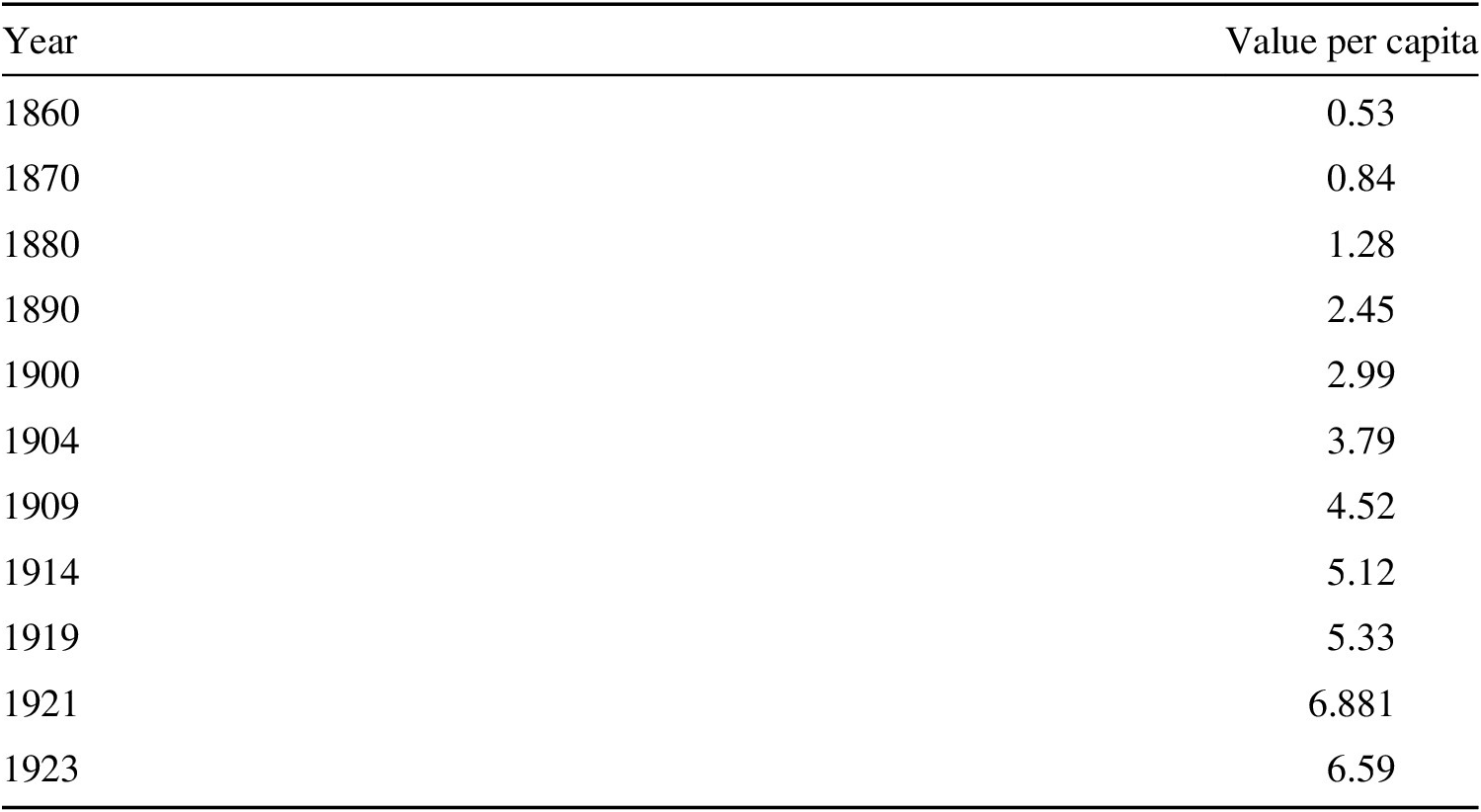
The study of bakery had connections with Kyrk’s theory of consumption, mainly in the effort to analyze the availability of products. This was evident in the proportion of wheat flour for domestic consumption (see Table 1) or the value of bakery products per capita (see Table 2). Increasing productivity had boosted domestic consumption, since the external components of demand declined due to the worsening international relations and the fall of income in Latin American countries and other traditional trading partners.
Home Consumption and Export of Wheat Flour (in Thousands of Current Dollars), 1899–1923

Source: Kyrk and Davis (Reference Kyrk and Davis1925, p. 86)
Value of Bakery Products Per Capita (in Dollars, on 1913 Price Level), 1860–1923

Source: Kyrk and Davis (Reference Kyrk and Davis1925, p. 87)
Between the late 1920s and the first half of the 1930s, data collection was an essential pre-requisite for understanding American society and for advising reforms. Statisticians, government bureaucrats, and social scientists looked for more sophisticated tools for measuring social changes. At the end of the 1920s Kyrk reflected on some methodological aspects regarding the use of statistical data, being unsatisfied with an excessively descriptive approach. In a 1929 discussion hosted by the Journal of Farm Economics, Kyrk stressed the need for a methodological turn in consumption and agriculture: “we will be obliged to acquaint ourselves with the techniques necessary for studying quantitative data. It has probably not been the lack of imagination alone, but the lack of knowledge of statistical methods, that has limited the study of the data collected” (Kyrk Reference Kyrk1929, p. 576). More sophisticated techniques were needed to improve knowledge of consumers’ behavior. “We do not buy food or clothing. We buy specified kinds of food and clothing. If we are to study consumers’ behaviour, we must know its specific variations with changing conditions” (Reference Kyrk1929, p. 576). Moreover, Kyrk was aware of the need for an increase of international comparisons and the standardization of international methodologies: “I believe,” she said, “[it] would help to open our eyes to new possibilities in studying our data; that is, the enlargement of our knowledge of what has been done in other countries” (1929, p. 576).
So far as empirical methods are concerned, a partial advancement was accomplished by her book Economic Problems of the Family, published in 1929 and revised in 1933.Footnote 21 Its main subject was the study of the economic welfare of American families, in terms of incomes, prices, and standards of living: an ambitious project focused upon the family as an economic unit. The book used published and unpublished materials scattered across a wide array of specialized research sources.
More specifically, Kyrk attempted to establish a scale for reducing data about families of differing size and composition to standard consumption units, using methods for measuring the total costs of maintaining a given standard of living of the family and the relative monetary costs and caloric requirements of the different members of the family (Kyrk [1929] Reference Kyrk1933, ch. 11). Following the path traced by the German statistician Ernst Engel (but also by Adolphe Quetelet and Frederic Le Play before him), Kyrk explored the advantages and weaknesses of family budgets as the source for establishing an empirical approach to consumption. Food consumption was a proxy for measuring the expenditures of a “standard family,” using the energy requirements of the various ages, sexes, and occupations or, alternatively, the cost of food. Different studies had already proposed different scales. Their comparison showed, however, a common reliance on the average caloric need or the average level of expenditure of one member of the family, usually the adult male, as the base for expressing the relative requirement of women and children. At that time, Edgar Sydenstricker and Wilford King (Reference Sydenstricker and King1920) had elaborated the best-known cost scale in a study of the expenditures of South Carolina families in 1916–17. The unit for measuring food requirements corresponded to the demand for food of the average male, in monetary terms, as exemplified in Table 3.
Relative Cost of Food for Various Members of the Family Group as Estimated in Certain Minimum Standard Budgets (Sydenstricker and King Reference Sydenstricker and King1920 Scale)

Source: Kyrk ([1929] Reference Kyrk1933, p. 196)
A necessary integration was required to measure the relative needs of age groups and sexes for clothing, housing, and other categories of basic consumption goods. In this regard, Kyrk emphasized the lack of accurate statistical data at a disaggregated level that weakened the empirical foundation of her theory of consumption. Crucial questions to be answered were the effects of nationality and occupation on consumption, as well as the price level or the size and composition of the family.Footnote 22 Subsequently, Kyrk attempted to fill this gap by writing other substantial reports on these matters.
Kyrk ([1929] Reference Kyrk1933) returned to the definition of “standard of living,” one of the most challenging issues of her 1923 book.Footnote 23 If a standard was “an attitude toward, a way of regarding or of judging, a given mode of life” (Kyrk Reference Kyrk1923, p. 175), it followed that there were a variety of standards that changed under the influence of cultural and social variables. Kyrk attempted to substantiate this point using a 1928 study conducted at Yale University, which focused on the “academic” standard of living.Footnote 24 The results of this research confirmed that the same class of monetary income was judged as “decent” or “unsatisfactory” as the income or the attitudes toward a particular mode of living of different individuals or social groups changed. With regard to the definition of the American standard of living, Kyrk suggested that no quantitative estimate was possible and simply stated that America was too big and varied to admit the existence of a characteristic American standard: “Nothing is more difficult than to see the peculiar characteristics of one’s own standard of living” (Kyrk [1929] Reference Kyrk1933, pp. 379–380).Footnote 25
As Thomas Stapleford has observed, the Depression and the New Deal offered consumption economists political and social reasons to implement a national expenditure survey and the economic resources to do it (Stapleford Reference Stapleford2007). Many women economists, among which were many of Kyrk’s students, were involved in writing government reports, showing an increasing interest for studying income distribution and promoting consumers’ behavior (Johnson Reference Johnson2023). In this context Kyrk achieved prominence as a consultant to public agencies and had the opportunity to lead one of the most original and updated public surveys on family expenditure.Footnote 26
Between 1935 and 1936 many public agencies developed quantitative studies on consumption: among them, the National Resources Planning Committee, the BHE, the BLS, the Work Projects Administration, and the Central Statistical Board. Kyrk co-authored all these papers subsequently published in a series of volumes on the Consumer Purchases Study (Kyrk et al. Reference Kyrk, Monroe, Cronister and Perry1941). The reports were divided in two parts. The first was on family incomes, family composition, occupation, and—considering the distinction between city families and village families—rent paid and rental values of owned homes. The second published data on expenditures for the major consumption categories. Details of family consumption were presented in separate reports for food, clothing, transportation, housing and household operation, housing facilities, education, reading, medical care, and other expenditures.
These reports represented the first large-scale statistical study of the American standard of living and consumer purchasing,Footnote 27 influencing also contemporary debates on Keynes’s General Theory, as we have seen in section II. They also served to establish base-year prices for the cost-of-living index (the forerunner of the Consumer Price Index), an important economic indicator and, increasingly, a reference point in industrial negotiations.Footnote 28
This major effort of data collection was inspired by a mixed sampling method (both random selection and non-probability selective sampling). Sampling surveys were routinized and popularized in the 1930s, due also to their lower costs; the random sample survey method was used to study unemployment or household budgets (Desrosières Reference Desrosières1998, pp. 204–209).Footnote 29
The sample was limited to communities of a significant size living in five broad geographic regions: New England, Middle Atlantic and North Central, Plains and Mountain, Pacific, and Southeast. Communities were selected to typify five distinct degrees of urbanization in each region: large cities, middle-sized cities, small cities, villages, and farm counties. In sampling the cities, Kyrk’s studies influenced the selection of additional factors under consideration: the interdependence between communities; the density of population and their rate of growth; the proportion of White natives; the main economic activities; and the cultural patterns.
The study of consumption was confined to the largest families in the population, namely native White, unbroken (“cohesive”), and non-relief families. Native Black families were included only in the Southeast region and in New York City and Columbus, Ohio, where they were studied separately. For its inclusion in the income investigation, a city or village family had to meet other requirements, such as the existence of a couple (husband and wife), married for at least one year.Footnote 30 All information on family incomes and expenditures was obtained through personal interviews with the housewife or other responsible members of the family. Households were selected with a random method from among eligible families according to pre-established criteria (Kyrk et al. Reference Kyrk, Monroe, Cronister and Perry1941, pp. 213–223).
By computing annual income data from 300,000 American families across the country, the Consumer Purchases Study became a milestone in empirical research, and a real advancement for the research program outlined by Kyrk. It was more extensive, innovative, and informative than any other previous expenditure survey in the US or other Western countries. As Stapleford (Reference Stapleford2007, p. 440) observed, the survey was an instrument for avoiding waste and over- or underproduction and supporting the New Deal. This and other similar investigations were designed and implemented primarily by left-leaning economists (women, in many cases) to support, justify, and implement economic policies that would have reflated mass purchasing power as a way out of the Great Depression (Backhouse and Cherrier Reference Backhouse and Cherrier2017). However, despite the hopes of the economists involved in federal planning, the reports failed to be “an effective aid to New Deal reformers, proving far more useful to another group: advertisers and market-research professionals” (Stapleford Reference Stapleford2007, p. 419).
V. SOME “INVISIBLE” OBJECTS FOR STATISTICS: WOMEN’S CONDITIONS AND INCOME DISTRIBUTION
Historians have shown how female work in official statistical sources has been traditionally undervalued due to cultural and social gender biases, ultimately leading to a misrepresentation of household work as non-productive work (Boserup Reference Boserup1970; Folbre Reference Folbre1991; Bateman Reference Bateman2019). At the same time, a well-established literature has demonstrated the inadequacy of the standard definition of GDP in measuring the real economic conditions of individuals and social groups: its main references to market relations and commodities measured in monetary terms disallowed the possibility of capturing goods and services produced outside the market (such as gifts, homemade, and other services). This circumstance brought about the study of alternatives to GDP for measuring economic performance and social welfare, considering non-market activities, such as household labor, which often coincide with female employment.Footnote 31
Together with other American women economists of her age, Kyrk was a forerunner of such a critical approach to income measurement. Kyrk ([1929] Reference Kyrk1933) conducted original analyses on women’s conditions, their participation in the labor market, and their productive role in invisible activities, and identified “home” as a place where consumption and production activities take place.Footnote 32 She devoted many pages to the economic status of women engaged in household production, where particular attention is paid to the problematic distinction between productive and unproductive work:
The home is a place of consumption; it is not the center of production, but productive activities still go on there. They do not consist to the same degree as formerly in the creation of form utilities. Housekeeping women can no longer be classed occupationally with farmers and manufacturers; instead, their activities are analogous to those of middlemen and those who render services. The increase in the relative importance of activities such as these is an outstanding feature of our society. (Kyrk [1929] Reference Kyrk1933, p. 77)
When Kyrk wrote the above and similar passages, data collection on household production was still in its infancy. At the BHE, the economics division had started a study about the actual working time of over 2,500 rural and urban homemakers living in different parts of the United States (Kyrk [1929] Reference Kyrk1933, p. 92). The study was promoted by Hildegarde Kneeland (Reference Kneeland1929a, Reference Kneeland1929b), a professor and head of the department of household economics at Kansas State Agriculture College. Available evidence suggested that the housewife oversaw a significant amount of work in the home, although conditions were changing according to times, places, and status. Five-sixths of women spent over forty-two hours a week in homemaking, more than half spent over forty-eight hours, and one-third spent over fifty-six hours (fifty-two hours on average for the rural homemakers; forty-six hours for urban homemakers). Only 10% of women in large cities claimed spending less than thirty-five hours a week (Kyrk [1929] Reference Kyrk1933, p. 93).
Some years later, Kyrk (Reference Kyrk1947) further investigated the nature of women’s work in the household—normally regarded by official statistics as non-work—and its measurement. In the case of women, “working” was often considered a deviation from the norm. No such question would be asked concerning men. The expectation in their case, as Kyrk argued, was active, paid employment:
If the number of able-bodied males neither in school nor in the labor force grew to sizable proportions, immediate inquiry would be made into the reasons for the defection. With women, it is the reverse. Attention is concentrated upon the thirteen million who were in the labor force in 1940 rather than upon the thirty million able to work and out of school who were neither employed nor seeking employment. (Kyrk Reference Kyrk1947, p. 44)
Before Kyrk, the issue of women’s entry in the labor market had already been addressed by other scholars. Sophonisba Breckinridge (Reference Breckinridge1933) provided evidence about the activities of women outside the home, as part of a study titled Recent Social Trends in the United States, commissioned by President Hoover, to which Mitchell and other institutionalist economists contributed. Paul Douglas and Erika Schoenberg had explored the labor supply of men and women across cities, noticing that married women’s employment was negatively correlated with their husband’s income (Douglas Reference Douglas1934; Douglas and Schoenberg Reference Douglas and Schoenberg1937). As to the women who were part of the “official” labor force, Kyrk collected evidence showing the relevance of social variables, ideally continuing the work of Breckinridge, and Douglas and Schoenberg. According to the 1940 census, working women were often single, widowed, or divorced, and about three-quarters of them lived in cities. Only a tenth of the female workers were part of the rural farm population, even though almost a fifth of the able-bodied, out-of-school women lived in farm communities (US Bureau of the Census 1943).
Marital conditions influenced female participation in the labor market: single women accounted for one-half of the female labor force. Here, again, Kyrk combined quantitative analysis with social and economic explanations. In her view, young women working for pay or profit were a consequence of a growing market economy and the diversion of resources, human and otherwise, from production for individuals and family uses to production for markets. This was a transformation of the economic system that managed to break down and ultimately overcome social and cultural barriers: “It is also true that the compulsion to take a job or even the inclination to do so is still not as strong among daughters as among sons. Some families resist their daughters’ entrance into the labor market, either through pride, through a mistaken notion of protection, or through desire for their companionship or services” (Kyrk Reference Kyrk1947, p. 46). The presence of a child had a deterrent effect upon paid employment. In fact, the proportion of women with children who were gainfully employed sharply decreased with the number of children. Mothers of young children were more likely to work for money only if their husband’s earnings were low.
Kyrk stressed the importance of a more detailed statistical analysis of “when and why” women worked. In this respect, more facts about the economic life history of women were needed; the census gave only a partial perspective, since it collected data that captured just a single event in people’s lifetime. Thus, in her 1948 address to the Women’s Bureau Conference, Kyrk outlined a socio-economic analysis of the labor market from a specific, gendered point of view. Although no statistical evidence was provided, Kyrk presented an interesting taxonomy of different earning women in the labor market: the married, the single, the widowed, the divorced, and those living separately from their husbands. Current times were characterized by a sort of historical transition:
In 1940 four-fifths of the urban single women not in schools or institutions were in the labor force. This period of employment is becoming part of the accepted life pattern. In this one particular, at least, we can say that the employed single women present no problem. Their presence in the labor force is accepted and approved. We do not fear that they are neglecting home responsibilities, or that their ability to earn will affect adversely the marriage age or rate. (Kyrk Reference Kyrk1948, p. 2)
Kyrk expressed an explicit value judgment emphasizing that no restrictions should be placed upon women’s freedom to enter a productive activity, and the same principle should be applied to all kinds of workers and non-workers. A specific focus regarded how to reconcile active employment with home responsibilities. The basic question was about how heavy the female workload was for a contemporary American household, in times of a general decline of manual activities and increase of services. Despite the reduction in the number of children and the widespread diffusion of time-saving devices, new and always unbalanced duties fell upon women’s shoulders, often independent of their standard of living. Here, again, Kyrk admitted that no accurate measure of the length (and other related features) of the home-keeping working day was available. However, empirical studies had showed that home duties for women with young children exceeded those of women without children by almost 50%. Increasing the statistical relevance implied the knowledge of how the worktime of women varied according to the stages of their life. Again, this was difficult evidence to collect (Kyrk Reference Kyrk1948, p. 6).
In the postwar years, Kyrk’s attention focused increasingly on the analysis and measurement of welfare in her position as a BLS consultant and chair of the Technical Advisory Committee charged with formulating a standard family budget.Footnote 33 In a 1950 paper published by the American Economic Review, Kyrk outlined the importance of income distribution as a measure of welfare, at a time when economists mainly treated this issue in connection with macroeconomic concerns, namely growth and production. The paper was built around these questions: To what extent is income distribution a proper measure of economic welfare? Is monetary income a good measure of people’s command over goods? Possible answers required information on the state of the beneficiaries, their satisfaction, health, happiness, and personality, suggesting the involvement of both psychological and physical phenomena.
Personal income distribution was also a consequence of the family status and composition. An increase of school-leaving age or marriage age could reduce the number of earners and total family incomes, with the apparent effect of increasing inequality in the command over goods. Attention should be paid to the proportion of non-money incomes, for instance, in the case of rural families or the smaller communities that lived on homegrown food. Kyrk was aware of the difficulties in measuring these informal economic activities:
The total addition to real income through the services rendered by unpaid family labor, primarily women, is obviously of some magnitude. In recent years about thirty million able-bodied adults have at any one time been employing their energies only in this way. In addition, most of the six and a half million married women in the labor force who are coheads of households devote a good many hours per week to housework, and other family members perform services that have a market counterpart in varying smaller amounts. No feasible method has ever been suggested for placing a money value on these services. (Kyrk Reference Kyrk1950, p. 348)
Thus, the number and value of free services and transfers available from private and public sources affected income distribution and inequalities. Food, housing, and medical and hospital care were the most frequently cited goods in this respect. As to their empirical measurement, the visible amount of these transfers varied according to whether they were supplied in cash or in kind. If in cash, the results will appear in the income distribution; if in kind, they will not. Thus, the amount of the money income (even if deductions and additions were considered) was an imperfect measure of economic welfare.Footnote 34
Overall, although contemporary debates on national accounts were never mentioned, Kyrk’s emphasis on these issues was a pioneering step towards the modern debates on alternative measures of national welfare, with a view to building more comprehensive indicators that go “beyond the GDP.”
VI. CONCLUSIONS
An overview of Kyrk’s scientific and professional activities shows that she was a multifaceted and original scholar who contributed to a wide range of topics—both theoretical and empirical. Three distinct scientific paths emerge from her biography.
First, a theoretical stage, corresponding mainly to her 1923 book, was both a challenge to neoclassical demand theory and an attempt to develop a theory of consumption more oriented toward pragmatism and social and statistical analysis. The second path was an empirical stage, with many original contributions on specific industries, labor conditions, consumption, households, and the dissemination of good consumption practices intended to enhance consumers’ education and self-awareness. Her late contributions were a third path, published mainly after the Second World War, devoted to a critical analysis of “invisible statistical objects”: women’s work, income distribution, and welfare conditions.
Kyrk’s Reference Kyrk1923 book left many intriguing questions unanswered. Attempts to build some empirical foundations of the “standard of living” proved a difficult and unrealistic task, and it was not by chance that Kyrk’s main efforts came to be directed to measuring ways of living (housing, food, education, clothing, etc.). No straightforward answer was provided to such complex epistemological questions (i.e., the scientific definitions of what a “standard of living” or a “wise consumption” were). However, starting from 1923 Kyrk opened new strands of research, making significant contributions to empirical research on consumption and strengthening the critical use of statistical information.
In this paper we have shown how Kyrk’s post-1923 works contributed to the quantitative turn in the history of economics. They provided new methodological perceptions; favored the adoption of new tools in statistical research; and strengthened the empirical foundations of some relevant phenomena that belonged to the world of production, labor, consumption, and the daily social life in America. In a sense we could say that a more general understanding of what an “American standard of living” really meant was made possible by the many reports and inquiries that saw the participation of Kyrk and her group of Chicago women economists, of whom many were Kyrk’s students. Moreover, while her 1923 book on consumption was still characterized by current male-biased language (woman being described as “natural” heads of modern households), her 1929 book (and, more evidently so, her subsequent papers) started to deconstruct statistical sources and their cultural and sexist biases, providing a more refined socio-economic analysis of the labor market from a specific, gendered point of view, and questing for a wider, also non-monetary, definition of income and welfare.
COMPETING INTERESTS
The authors declare no competing interests exist.