Implications
Saturated fatty acids in animal products are undesirable. A better understanding of the microbial biohydrogenation is necessary to limit this process in the rumen and increase the proportion of health-associated polyunsaturated fatty acids in ruminants’ meat and milk. The protozoan Isotricha prostoma is not involved in the rumen lipid metabolism whereas its associated bacteria convert a limited amount of C18:2n-6 to C18:1t11. Solid-associated bacteria perform the full hydrogenation reaction to C18:0 while liquid-associated bacteria accumulate C18:1 fatty acids, predominantly C18:1t10 and C18:1t11.
Introduction
In a recent in vivo trial, incomplete rumen biohydrogenation after algae supplementation was associated with the disappearance of ciliate protozoa (Boeckaert et al., Reference Boeckaert, Fievez, Van Hecke, Verstraete and Boon2007). Some protozoal species were less abundant in the rumen of algae-fed cows such as Isotricha intestinalis, Epidinium caudatum, Eudiplodinium maggii and Diplodinium dentatum but the holotrich Isotricha prostoma was particularly affected. Previously, I. prostoma (Gutierrez et al., Reference Gutierrez, Williams, Davis and Warwick1962) and I. intestinalis (Williams et al., Reference Williams, Gutierrez and Davis1963) have been shown to hydrogenate oleic acid (C18:1c9) to stearic acid (C18:0), whereas Wright (Reference Wright1959) reported in vitro hydrogenation of linoleic (C18:2n-6) to C18:0 by mixtures of ruminal ciliates comprising mainly holotrichs and Epidinium sp. However, the unequivocal role of protozoa in the hydrogenation of unsaturated fatty acids cannot be assessed from these in vitro studies since bacterial contamination cannot be excluded from protozoal fractions (Dawson and Kemp, Reference Dawson and Kemp1969). It is well known that protozoa contain bacteria in vesicles in their endoplasm (endosymbionts) and/or have bacteria attached to the outside of the pellicle (ectosymbionts) (Williams and Coleman, Reference Williams and Coleman1992). The above-mentioned results are therefore inconclusive. Later studies concluded that Isotricha species possess little or no ability to hydrogenate unsaturated fatty acids in the absence of bacteria (Chalupa and Kutches, Reference Chalupa and Kutches1968; Abaza et al., Reference Abaza, Abou Akkada and El-Shazly1975) while co-incubations with bacteria harvested from the rumen liquid phase resulted in biohydrogenation of C18:2n-6 to C18:0 (Girard and Hawke, Reference Girard and Hawke1978). These findings illustrate that protozoa require bacteria for rumen biohydrogenation. In contrast, it remains unclear whether bacterial biohydrogenation is enhanced by protozoa. The main bacteria involved in the biohydrogenation process have been identified. So far known, biohydrogenation is performed by bacteria belonging to the Butyrivibrio group, including the genera Butyrivibrio and Pseudobutyrivibrio (Paillard et al., Reference Paillard, McKain, Rincon, Shingfield, Givens and Wallace2007a). Kemp et al. (Reference Kemp, White and Lander1975) identified C18:0-producing bacteria as Fusocillus spp., which actually corresponds to Clostridium proteoclasticum isolated by Wallace et al. (Reference Wallace, Chaudhary, McKain, McEwan, Richardson, Vercoe, Walker and Paillard2006) and was recently reclassified as Butyrivibrio proteoclasticus (Moon et al., Reference Moon, Pacheco, Kelly, Leahy, Li, Kopecny and Attwood2008). However, it is uncertain whether or not bacteria within the Butyrivibrio group are associated with protozoa, in particular I. prostoma. Following on our previous results regarding the disappearance of I. prostoma when biohydrogenation is obstructed by algae, this study aimed at evaluating the hydrogenating capacity of I. prostoma and its endogenous and exogenous associated bacteria. Therefore, in vitro incubations with rumen fluid from a monofaunated sheep were performed. The latter houses only one genus or species of protozoa in its rumen, i.e. I. prostoma in this study. Fractions of I. prostoma were prepared and incubated to discriminate between the biohydrogenating activity of I. prostoma together with its endogenous and exogenous associated bacteria, I. prostoma alone or the associated bacteria of I. prostoma alone. Biohydrogenation of C18:2n-6 and its main intermediates CLA c9t11 and C18:1t11 has been studied. Additionally, the biohydrogenation capacity of this protozoal fraction was compared with that of non-fractioned rumen fluid inoculum and its liquid-associated bacteria (LAB) and the solid-associated bacteria (SAB), respectively.
Material and methods
Rumen fluid and fatty acid preparations
Animal care was in accordance with the guidelines for animal research of the French Ministry of Agriculture. A wether monofaunated with I. prostoma (6.6 × 10³I. prostoma/ml rumen fluid) was used as donor (Jouany et al., Reference Jouany, Zainab, Senaud, Groliere, Grain and Thivend1981). The wether was fitted with a rumen cannula and fed once a day 600 g alfalfa pellets, 400 g barley grain and 150 g meadow hay. Rumen contents were sampled before morning feeding (0800 h) and were strained through a nylon monofilament membrane (800 μm) under an O2-free CO2 stream to remove large particulate matter.
Unesterified C18:2n-6 and CLA c9t11 (Larodan Fine Chemicals AB, Malmö, Sweden) were dissolved in hexane (200 μg/ml) after which 50 μl of the hexane solution (10 mg fatty acid) was added to the incubation flask and evaporated by CO2 before incubation. C18:1t11 (Larodan Fine Chemicals AB), dissolved in hexane, crystallized when evaporated by CO2 before incubation. This hampered a homogeneous mixing of the fatty acid with the incubation fluid. Therefore C18:1t11 was dissolved in ethanol (100 mg/ml) and 100 μl of the ethanol solution was added directly to the buffered rumen fluid in the incubation flask. This volume of ethanol does not affect fermentations (Morgavi et al., Reference Morgavi, Boudra, Jouany and Michalet-Doreau2004) and was not considered toxic for the rumen microorganisms. The average amounts of C18:2n-6, CLA c9t11 and C18:1t11 in the serum bottles with 25 ml incubation fluid were 9.21 ± 0.78, 10.6 ± 0.35 and 11.4 ± 0.17 mg in the first experiment (protozoan fractions) and 10.7 ± 0.57, 11.9 ± 0.11 and 12.1 ± 1.81 mg in the second experiment (LAB, SAB and LAB + SAB fractions).
In vitro incubations
In vitro incubations were performed during 6 h in 120-ml serum bottles containing fractionated or monofaunated rumen fluid (8 ml), Goering–Van Soest buffer (17 ml) (Goering and Van Soest, Reference Goering and Van Soest1970), either unesterified C18:2n-6, CLA c9t11 or C18:1t11 (10 mg) and 0.1 g glucose/cellobiose (1/1, w/w) (Sigma, Saint-Quentin Fallavier, France) as substrate. Additionally, incubations without the addition of a particular fatty acid were performed for each fraction and acted as control incubations in terms of rumen fermentation. Flasks that had been previously filled with pure CO2 once more were gassed with CO2 after rumen fluid addition to eliminate trace amounts of oxygen. Finally, they were closed by a crimped butyl septum and were maintained at 39°C in a water bath. The medium in each incubation flask was regularly agitated by a magnetic rod (300 r.p.m. for 30 s followed by a resting period of 3 min). All incubations were performed in three runs on separate days.
Experiment 1: Role of I. prostoma and its associated bacteria in rumen biohydrogenation
Protozoa were obtained using a sedimentation procedure as described by Williams and Coleman (Reference Williams and Coleman1992) with some modifications. Briefly, 200 ml of I. prostoma monofaunated rumen fluid was mixed with 400 ml of Simplex type Coleman buffer (Coleman, Reference Coleman1978), prepared as recommended by Broudiscou and Lassalas (Reference Broudiscou and Lassalas2000), and 0.6 g of glucose. The mixture was transferred into a separating funnel and incubated at 39°C for 30 min to allow I. prostoma to settle. Protozoa accumulated in a clear white zone at the bottom of the separating funnel. The remaining liquid above was removed by suction. The sediment was collected in a jar and diluted with autoclaved I. prostoma monofaunated rumen fluid to the initial volume of 200 ml (=protozoal fraction). To discriminate between the biohydrogenation capacity of I. prostoma and its associated bacteria (IP + B), I. prostoma alone (IP) or the associated bacteria alone (B), incubations with this protozoal fraction were further subdivided. Batch incubators containing the complete protozoal fraction (IP + B), including endogenous and exogenous associated bacteria, were supplemented with an antibiotic mixture (0.3 mg/ml of chloramphenicol crystalline/streptomycin/ampicillin sodium salt, 1/1/1, w/w/w) to halt bacterial metabolism (IP) or were sonicated (40 kHz, 240 V) (Deltasonic, Meaux, France) during 15 min to lyse I. prostoma cells (B). Preliminary tests indicated that these sonication parameters were efficient to lyse protozoal cells without negative effects on the associated bacteria (Onodera et al., Reference Onodera, Yamaguchi, Eguchi and Kandatsu1977). Each fraction was incubated with unesterified C18:2n-6, CLA c9t11 or C18:1t11. The latter two incubations starting with biohydrogenation intermediates were performed since I. prostoma and/or its associated bacteria are possibly involved in only part of the rumen biohydrogenation of C18:2n-6.
Experiment 2: Role of LAB and SAB in rumen biohydrogenation
LAB and SAB were obtained following a centrifugation procedure of Legay-Carmier and Bauchart (Reference Legay-Carmier and Bauchart1989) with some modifications. Briefly, 2 × 200 ml of I. prostoma monofaunated rumen fluid was centrifuged during 3 min at 500 × g. From one aliquot, the supernatant was collected by suction and diluted with autoclaved I. prostoma monofaunated rumen fluid to the initial volume of 200 ml. This fraction represented the LAB. The remaining white interface layer and the pellet were also diluted with autoclaved I. prostoma monofaunated rumen fluid to the initial volume of 200 ml and represented the SAB fraction containing bacteria as well as I. prostoma with its endosymbionts and ectosymbionts. Another aliquot was mixed again by means of a magnetic stirrer and represented the I. prostoma monofaunated rumen fluid, further referred to as LAB + SAB. The last aliquot was also subjected to centrifugation to ensure similar manipulations of the rumen microorganisms. Each fraction (LAB, SAB and LAB + SAB) was incubated with unesterified C18:2n-6, CLA c9t11 or C18:1t11.
Sampling and analysis
Gas production was recorded after 6 h of incubation using a pressure transducer. A headspace sample was collected and fermentation gases were analyzed by gas chromatography (DI-700, Rungis, France) as described by Broudiscou et al. (Reference Broudiscou, Papon and Broudiscou1999). The pH was measured immediately after opening the incubation flasks. Aliquots of incubation fluid were sampled for short chain fatty acid (SCFA) analysis and DNA extraction. For SCFA determination, gas chromatography was applied as described by Broudiscou and Lassalas (Reference Broudiscou and Lassalas2000). The net amount of SCFA produced during 6 h of incubation was calculated by deducting the amount of SCFA in the corresponding 0 h incubation sample. For DNA extraction, 2 ml of incubation fluid was stored at −80°C until further analysis. The remaining incubation fluid (21.2 ml) was transferred to a recipient after which the incubation flask was rinsed with 7 ml of chloroform/methanol (C/M, 2/1, v/v) and added to the recipient to stop further reactions. Recipients were stored at −20 °C until fatty acid analysis.
Lipid extraction followed the method of Folch et al. (Reference Folch, Lees and Sloane Stanley1957) with some adaptations as described by Chow et al. (Reference Chow, Fievez, Moloney, Raes, Demeyer and De Smet2004). Methylation of fatty acids and subsequent identification of fatty acid methyl esters were performed as described in Boeckaert et al. (Reference Boeckaert, Vlaeminck, Fievez, Maignien, Dijkstra and Boon2008).
Microbial community analysis
Total DNA of 0.5 g incubation fluid from LAB, SAB and B fractions was extracted as described by Boon et al. (Reference Boon, Top, Verstraete and Siciliano2003). A PCR to amplify a fragment of the 16S rRNA gene of the Butyrivibrio group was performed following Boeckaert et al. (Reference Boeckaert, Vlaeminck, Fievez, Maignien, Dijkstra and Boon2008). The amplified PCR product of one LAB, SAB and B sample was cloned using a TOPO-TA cloning kit (Invitrogen, Carlsbad, CA, USA) according to the manufacturer’s instructions in order to create a clone library. For each clone, an aliquot of 800 μl was stored in 40% glycerol (v/v) while plasmid DNA was isolated from the remaining liquid using the high pure plasmid isolation kit (Roche Diagnostics GmbH, Mannheim, Germany). The resulting 41 clones for LAB, 52 clones for SAB and 51 clones for B were identified by sequencing the partial 16S rRNA gene fragments (Genetic Service Unit, Gent, Belgium). Close relatives of the 16S rRNA sequences were identified with the sequence match server of the Ribosomal Database Project II (Wang et al., Reference Wang, Garrity, Tiedje and Cole2007). Nucleotide sequences for clones 1 through 144 have been deposited in the GenBank database under accession numbers FJ345536–FJ345679. Additionally, sequences were aligned with the NAST software (DeSantis et al., Reference DeSantis, Hugenholtz, Larsen, Rojas, Brodie, Keller, Huber, Dalevi, Hu and Andersen2006). The alignment was manually checked using the ARB aligner tool (ARB software, Ludwig et al., Reference Ludwig, Strunk, Westram, Richter, Meier, Yadhukumar, Buchner, Lai, Steppi, Jobb, Förster, Brettske, Gerber, Ginhart, Gross, Grumann, Hermann, Jost, König, Liss, Lüßmann, May, Nonhoff, Reichel, Strehlow, Stamatakis, Stuckmann, Vilbig, Lenke, Ludwig, Bode and Schleifer2004), after which sequences were added to the original phylogenetic tree (Greengenes database January 2008) using Parsimony (ARB software, Ludwig et al., Reference Ludwig, Strunk, Westram, Richter, Meier, Yadhukumar, Buchner, Lai, Steppi, Jobb, Förster, Brettske, Gerber, Ginhart, Gross, Grumann, Hermann, Jost, König, Liss, Lüßmann, May, Nonhoff, Reichel, Strehlow, Stamatakis, Stuckmann, Vilbig, Lenke, Ludwig, Bode and Schleifer2004) without changing the tree topology. Clones from the same original samples (SAB, LAB or B), showing 97% or more sequence similarity (ClustalW2), were considered the same species and were grouped in the phylogenetic tree. For example, samples LAB-146 and LAB-147 showed 99% similarity and are represented by Lab-cl1 (2), denoting cluster 1 contains two clones.
Statistical analysis
Rumen fatty acid were statistically analyzed using the MIXED procedure of SAS Institute (SAS Institute Inc., 2004). The statistical model for rumen fatty acid data included the fixed effect of fraction, incubation time and their interaction and the random effect of repetition assuming an autoregressive order one covariance structure fitted on the basis of Akaike information and Schwarz Bayesian model fit criteria. Incubation time was treated as a repeated measure. Least squares means are reported and significance was declared at P < 0.05. Differences among fractions were evaluated using a multiple comparison test following the Tukey–Kramer method.
Results
Experiment 1: Role of I. prostoma and its associated bacteria in rumen biohydrogenation
Incubations with C18:2n-6
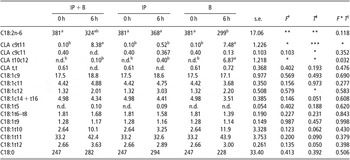
C18:2n-6 concentrations decreased during 6 h of incubation for all fractions (Table 1). However, the decrease was more pronounced for the IP + B and B fractions as compared to the IP fraction. Decreases in C18:2n-6 were associated with increased CLA c9t11 concentrations being substantially higher for the IP + B and B fractions. Additionally, CLA t10c12, CLA c9c11 and unidentified non-conjugated C18:2 fatty acids were formed by all fractions. The high increase in CLA t10c12 concentrations for the B fraction is noteworthy. Also C18:1c12 and C18:1t12 concentrations increased whereas C18:1t11 only showed a trend to increase. None of the fractions significantly produced C18:0 during 6 h of incubation with C18:2n-6.
Concentration of C18 fatty acids (μg/ml) before (0 h) and after (6 h) incubation of Isotricha prostoma and its associated bacteria (IP + B), I. prostoma alone (IP) and the associated bacteria alone (B) with C18:2n-6 (n = 3)

n.d.: not detected.
s.e.: standard error of mean.
a,bMeans within a row with a different superscript differ (P < 0.05).
†Effect of fraction (F).
‡Effect of time (T).
§Interaction between fraction and time (F * T).
Incubations with CLA c9t11
Similar decreases in the concentration of CLA c9t11 were observed for all fractions and were associated with accumulation of CLA t10c12, CLA c9c11, a CLA t,t and an unidentified non-conjugated C18:2 fatty acid (Table 2). C18:1c9, C18:1c11, C18:1t11 and C18:1t12 concentrations increased for all fractions, although the C18:1t11 increase was only prominent for the IP + B and B fractions. As with the C18:2n-6 substrate, C18:0 production did not take place.
Concentration of C18 fatty acids (μg/ml) before (0 h) and after (6 h) incubation of Isotricha prostoma and its associated bacteria (IP + B), I. prostoma alone (IP) and the associated bacteria alone (B) with CLA c9t11 (n = 3)

n.d.: not detected.
s.e.: standard error of mean.
a,bMeans within a row with a different superscript differ (P < 0.05).
†Effect of fraction (F).
‡Effect of time (T).
§Interaction between fraction and time (F * T).
Incubations with C18:1t11
A non-significant decrease (P = 0.110) in C18:1t11 concentrations occurred whereas C18:1c9 was produced by all fractions, i.e. +4.5, +10.9 and +4.2 μg/ml for the IP + B, IP and B fractions, respectively (full tables not shown). C18:1t9 concentrations decreased in IP + B and IP and increased in B while other C18:1 fatty acids did not change. As with C18:2n-6 and CLA c9t11, C18:0 concentrations did not increase.
SCFA, CH4 and H2
Rumen fermentation parameters were measured to further evaluate in vitro incubations. The IP fraction produced minimal amounts of SCFA (1.01 ± 0.44 mmol/l, n = 9), mainly as butyrate. No CH4 was produced for the IP fraction while H2 accumulation was on average 2.23 ± 0.15 μmol/flask. Incubation of IP without the addition of a fatty acid generated a net total amount SCFA of 3.91 mmol/l (n = 3) with acetate, propionate and butyrate (56 : 12 : 31, mol : mol : mol) as the main SCFA. The IP + B and B fraction produced low net total amounts of SCFA, which was independent of the addition of fatty acids (5.83 ± 1.02 (n = 24) and 7.80 ± 0.96 (n = 24) mmol/l, with or without fatty acid addition, respectively). Acetate, propionate and butyrate (on average 79 : 10 : 11, mol : mol : mol) were again the main SCFA. CH4 production was low, on average 0.96 ± 0.002 and 0.94 ± 0.11 μmol/flask for the IP + B and B fraction, respectively, whereas H2 production was on average 3.35 ± 0.40 and 2.43 ± 0.14 μmol/flask for all incubations (with and without the addition of a fatty acid).
Experiment 2: Role of LAB and SAB in rumen biohydrogenation
Incubations with C18:2n-6
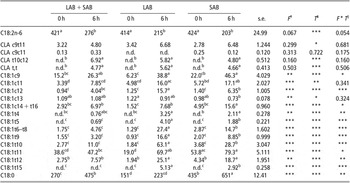
Concentrations of C18:2n-6 decreased in all fractions (Table 3) but was most pronounced for the SAB fraction and was considerably higher than that observed with the protozoal fractions. Disappearance of C18:2n-6 from the incubation media was associated with increased amounts of all C18:2 isomers, except for CLA c9c11. Likewise, most C18:1 fatty acids, in particular C18:1t10 and C18:1t11, increased in concentration. The increase in C18:1 isomers was substantially higher for the LAB fraction, with the exception of C18:1c11 and C18:1c14 + t16. This higher concentration of C18:1 fatty acids for the LAB fraction was associated with lower C18:0 concentrations as compared to the SAB and LAB + SAB fractions. Overall, the LAB, SAB and LAB + SAB fractions converted 25%, 69% and 87%, respectively, of the C18:2n-6 substrate into C18:0.
Concentration of C18 fatty acids (μg/ml) before (0 h) and after (6 h) incubation of Isotricha prostoma monofaunated rumen fluid (LAB + SAB), liquid-associated bacteria (LAB) and solid-associated bacteria (SAB) with C18:2n-6 (n = 3)

n.d.: not detected.
s.e.: standard error of mean.
a,b,c,dMeans within a row with a different superscript differ (P < 0.05).
†Effect of fraction (F).
‡Effect of time (T).
§Interaction between fraction and time (F * T).
Incubations with CLA c9t11
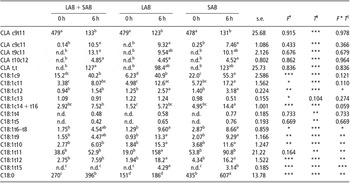
C18:2 isomers increased at the expense of CLA c9t11 with some unidentified non-conjugated C18:2 fatty acids typically higher for the SAB fraction (Table 4). There was a particularly large increase in the production of CLA t,t. Furthermore, concentrations of all C18:1 fatty acids increased, except for C18:1c13. However, the increase in C18:1t10 was less important than in incubations with C18:2n-6. The LAB fraction again showed substantially high increases in most C18:1 fatty acid concentrations. Accordingly, C18:0 concentrations increased less for the LAB fraction as compared to the SAB and LAB + SAB fractions.
Concentration of C18 fatty acids (μg/ml) before (0 h) and after (6 h) incubation of Isotricha prostoma monofaunated rumen fluid (LAB + SAB), liquid-associated bacteria (LAB) and solid-associated bacteria (SAB) with CLAc9t11 (n = 3)

n.d.: not detected.
s.e.: standard error of mean.
a,b,c,dMeans within a row with a different superscript differ (P < 0.05).
†Effect of fraction (F).
‡Effect of time (T).
§Interaction between fraction and time (F * T).
Incubations with C18:1t11
C18:1t11 concentrations only decreased numerically (P < 0.1, full tables not shown). Nevertheless, C18:1c9 concentrations increased while C18:1t10 and C18:1t12 concentrations decreased in all fractions. Changes in the other C18:1 trans fatty acids were dependent upon the fraction. C18:1t4 and C18:1t5 concentrations increased for the LAB and SAB fractions and were unchanged for the LAB + SAB fraction. C18:1t6–t8 and C18:1t9 increased for the LAB + SAB and LAB fractions but decreased for the SAB fraction. C18:0 production was low in all fractions, increasing by 42, 85 and 35 μg/ml incubation fluid for the LAB, SAB and LAB + SAB fractions, respectively.
SCFA, CH4 and H2
SCFA produced during 6 h of incubation with C18:2n-6, CLA c9t11 or no additional fatty acids did not differ between fractions (47.3 ± 3.22 mmol/l, n = 27). However, for incubations with C18:1t11, net total amounts of SCFA were lower for the LAB fraction (40.2 mmol/l, n = 3) as compared to the SAB (55.9 mmol/l, n = 3) and LAB + SAB (52.0 mmol/l, n = 3) fractions. The proportion of main SCFA produced was 57 : 23 : 20 (mol : mol : mol) for acetate, propionate and butyrate. For all incubations, CH4 production was lower for the LAB fraction (51.2 ± 2.58 μmol/flask, n = 12) as compared to the SAB (74.0 ± 8.41 μmol/flask, n = 12) and LAB + SAB (72.2 ± 9.80 μmol/flask, n = 12) fractions while H2 production remained very low for all fractions (0.56 ± 0.17 μmol/flask, n = 36).
Cloning and sequence analysis of the LAB, SAB and B fractions
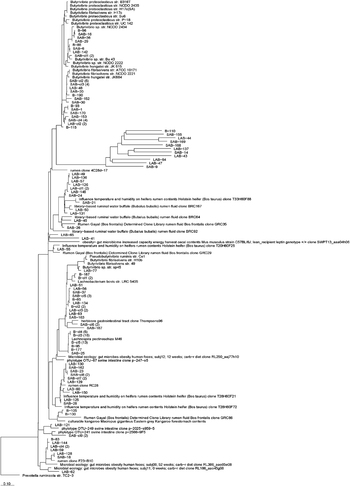
Based on the results of the different fractions (LAB, SAB, IP + B, IP and B) in rumen biohydrogenation of C18:2n-6, CLA c9t11 or C18:1t11, clone libraries were constructed with the Butyrivibrio-specific PCR products of one LAB, SAB and B sample. Sequence match analysis indicated that all 144 clones were related to bacterial species within the family of the Lachnospiraceae. Clones matched as follows: 39 clones within the genus Butyrivibrio (29 SAB, 4 LAB and 6 B), 14 clones within the genus Pseudobutyrivibrio (5 SAB, 6 LAB and 3 B), two clones within the genus Oribacterium (2 B), three clones within the genus Lachnobacterium (3 B), 56 clones within the genus Lachnospiraceae Incertae Sedis (8 SAB, 11 LAB and 37 B) and 30 clones were unclassified Lachnospiraceae (10 SAB and 20 LAB). The phylogenetic clustering of the clones, based on 16S rRNA sequence (417 bp) analysis, is presented in Figure 1. The branch with bacteria known so far to convert C18:2n-6 into C18:0 (i.e. B. proteoclasticus and Butyrivibrio species) contains nine clones among which six SAB, one LAB and two B. Seventy clones were in close phylogenetic relationship with bacteria converting C18:2n-6 into C18:1 fatty acids (i.e. the genera Butyrivibrio and Pseudobutyrivibrio) including 32 SAB, 28 LAB and 10 B. The remaining 65 clones (14 SAB, 12 LAB and 39 B) clustered further away from the genera Butyrivibrio and Pseudobutyrivibrio with 36 B clones closely related to Lachnospira pectinoschiza species.
Phylogenetic tree representing the classification of 144 clones obtained from a liquid-associated bacteria (LAB) sample (42), a solid-associated bacteria (SAB) sample (52) and a sample containing the endogenous and exogenous associated bacteria (B) of Isotricha protoma (51) within the Lachnospiraceae family. Sequences were added to the original phylogenetic tree (Greengenes database January 2008) using Parsimony (ARB software, Ludwig et al., Reference Ludwig, Strunk, Westram, Richter, Meier, Yadhukumar, Buchner, Lai, Steppi, Jobb, Förster, Brettske, Gerber, Ginhart, Gross, Grumann, Hermann, Jost, König, Liss, Lüßmann, May, Nonhoff, Reichel, Strehlow, Stamatakis, Stuckmann, Vilbig, Lenke, Ludwig, Bode and Schleifer2004) without changing the tree topology.

Discussion
Role of I. prostoma and its associated bacteria in rumen biohydrogenation
In vitro incubations with fractions of I. prostoma monofaunated rumen fluid were performed to investigate the activity of I. prostoma and its associated bacteria in rumen biohydrogenation of C18:2n-6 and its main intermediates CLA c9t11 and C18:1t11.
The minor disappearance of the added fatty acids and the lack of a substantial formation of intermediates or end products observed for the IP fraction (protozoan alone) indicate that I. prostoma is not directly involved in rumen biohydrogenation of C18:2n-6, CLA c9t11 and C18:1t11. Similarly, Devillard et al. (Reference Devillard, McIntosh, Newbold and Wallace2006) reported little C18:2n-6 biohydrogenation activity by a mixed protozoal fraction. These results confirm previously published information that attributed the minor hydrogenating capacity of this ciliate to ingested or associated bacteria (Abaza et al., Reference Abaza, Abou Akkada and El-Shazly1975; Girard and Hawke, Reference Girard and Hawke1978). Nonetheless, two particular features are worth mentioning for the IP incubations. Firstly, the slight decrease in C18:2n-6 and CLA c9t11 concentrations with a concomitant increase in CLA isomers, which may indicate some isomerase activity (Bauman et al., Reference Bauman, Baumgard, Corl and Griinari2000). Or-Rashid et al. (Reference Or-Rashid, AlZahal and McBride2008) earlier demonstrated CLA production from C18:2n-6 by mixed rumen protozoa, whereas Paillard et al. (Reference Paillard, McKain, Chaudhary, Walker, Pizette, Koppova, McEwan, Kopecny, Vercoe, Louis and Wallace2007b) associated the capacity to isomerize C18:2n-6 to CLA c9t11 entirely with the bacterial Butyrivibrio group. The isomerase activity observed suggests that either I. prostoma can isomerize C18:2n-6 or that either the associated bacteria or their enzymes were not entirely or immediately inactivated by the antibiotic treatment. Ultimately, isomerization might also be the result of an abiotic process in the rumen. Secondly, C18:1c9 concentrations considerably increased upon incubation with C18:1t11. Research by Mosley and McGuire (Reference Mosley and McGuire2008) demonstrated that the biohydrogenation of 13C-labeled C18:1t11 by ruminal microbes in vitro involves the formation of positional isomers of cis and trans C18:1 and C18:0. However, in the present study, only C18:1c9 concentrations increased upon C18:1t11 incubations. Moreover, the amount of C18:1c9 formed was similar for the IP + B, IP as well as the B fraction. These equal amounts of C18:1c9 in all fractions, despite the lower bacterial activity for the IP fraction, sustain the hypothesis of the abiotic isomerization of C18:1t11 at high in vitro concentrations.
In contrast to the IP fraction, substantial disappearance of C18:2n-6 and CLA c9t11 occurred for both the IP + B and B fraction. Both CLA c9t11 and CLA t10c12 were produced by the B fraction upon C18:2n-6 incubation. However, it is not clear why the IP + B fraction produced similar amounts of CLA c9t11 but not of CLA t10c12. Biohydrogenation proceeded until C18:1t11 but no further reduction to C18:0 was observed. The incubation of a protozoal suspension in the absence of antibacterial agents by Or-Rashid et al. (Reference Or-Rashid, AlZahal and McBride2008) also resulted in the production of C18:1t11 and C18:1t10. The absence of differences between IP and IP + B fractions regarding the extent of biohydrogenation suggest the hydrogenating activity originated from the endogenous and exogenous associated bacteria. The fact that C18:1t11 was not converted to C18:0 by these endosymbionts and ectosymbionts indicates that they do not belong to the group of bacteria currently known to transform C18:2n-6 into C18:0 and/or that they lack the reductase enzyme necessary for this final biohydrogenation step. On the other hand, incubation length might have been insufficient to enable C18:0 production since Or-Rashid et al. (Reference Or-Rashid, AlZahal and McBride2008) observed increased C18:0 concentrations when protozoal suspensions were incubated without antibiotics for 12 h or longer.
The fatty acid results exclude, besides a direct role of I. prostoma in rumen biohydrogenation, also the indirect role (e.g. H transfer) of I. prostoma in rumen lipid metabolism. The latter disproves the hypothesis of a required interaction between ciliate and bacterial communities for rumen biohydrogenation (Boeckaert et al., Reference Boeckaert, Fievez, Van Hecke, Verstraete and Boon2007). Moreover, overall biohydrogenation by the IP + B and B fractions remained very limited as compared to hydrogenation performed by monofaunated rumen fluid. On average only 18% of C18:2n-6 and 14% of CLA c9t11 disappeared when the IP + B or B fraction was incubated while 46% of C18:2n-6 and 72% of CLA c9t11 disappeared with non-fractioned monofaunated rumen fluid.
Role of LAB and SAB in rumen biohydrogenation
A second aim of the current study was to assess the biohydrogenation capacity of SAB v. LAB. In this study, SAB represented the bacteria attached to the particulate solid matter (pellet) obtained after filtration (800 μm mesh) and centrifugation (500 × g, 3 min) of the monofaunated rumen fluid. Hence, SAB were not obtained from bulk, coarser solids retained by a wire gauze (1 mm mesh) as in other studies, e.g. Legay-Carmier and Bauchart (Reference Legay-Carmier and Bauchart1989). It should be also noted that LAB and SAB fractions obtained in the current study could be atypical since the source of microorganisms was a single wether monofaunated with I. prostoma.
Incubations with the different fractions showed that decreased C18:2n-6 and CLA c9t11 concentrations were associated with increased amounts of hydrogenation intermediates and C18:0 in all fractions. Since biohydrogenation took place in both LAB and SAB fractions, biohydrogenating bacteria are not exclusive to any of the two phases. Previous research showed that hydrogenation of C18:2n-6 to C18:1t11 and subsequently to C18:0 was mainly associated with rumen solids (Harfoot et al., Reference Harfoot, Noble and Moore1973; Singh and Hawke, Reference Singh and Hawke1979). However, these authors used a different methodology to obtain their bacteria, cell-free supernatant and food particle fractions as they were collected after incubation with lipid supplements. It was postulated that the preferential adhesion of lipids to the particulate matter resulted in an uneven distribution of biohydrogenating bacteria in the rumen (Ward et al., Reference Ward, Scott and Dawson1964) rather than an intrinsic difference in hydrogenating capacity between SAB and LAB (Harfoot et al., Reference Harfoot, Noble and Moore1973). Our results indicate that the addition of equal amounts of fatty acids to the LAB and SAB fraction indeed results in a similar disappearance of C18:2n-6, CLA c9t11 and C18:1t11. However, differences between SAB and LAB did occur in terms of intermediate biohydrogenation steps with LAB fractions containing substantially higher concentrations of C18:1 fatty acids and lower concentrations of C18:0, suggesting that bacteria involved in the conversion of C18:1 fatty acids to C18:0 are largely absent in the LAB fraction. Probably, the LAB fraction mainly contains bacteria that have been categorized as group A bacteria by Kemp and Lander (Reference Kemp and Lander1984) and which hydrogenate C18:2n-6 to C18:1t11 whereas the SAB fraction possibly contains the group B bacteria, which convert C18:1c9, C18:1t11 and C18:2n-6 to C18:0.
In general, the production of C18:0 (μg/ml) is lower for incubations with CLA c9t11 followed by C18:1t11, as compared to incubations with C18:2n-6. Most probably, this is related to the different biohydrogenation pathways (e.g. CLA c9t11 and CLA t10c12) that may arise from incubations with C18:2n-6 and that all contribute to C18:0 production. As an example, the LAB fraction contained similar concentrations of C18:1t10 and C18:1t11 when incubated with C18:2n-6 while incubations with CLA c9t11 were mainly associated with increased C18:1t11 concentrations. This suggests that C18:1t10-producing bacteria can proliferate only when the substrate CLA t10c12 is present. Moreover, it is not surprising that the formation of CLA t10c12 proceeds more smoothly from C18:2n-6 (one isomerization) than from CLA c9t11 (two isomerizations). Indeed, incubations with C18:2n-6 resulted in similar amounts of CLA c9t11, CLA t10c12 and CLA t,t, which all represented only a minor proportion of the fatty acids being formed.
It should be noted that the C18:0 production relative to the disappearance of C18:2n-6 is higher for the LAB + SAB fraction as compared to the SAB fraction. This might indicate that the presence of both bacterial groups increases the overall hydrogenation efficiency. In this respect, Kemp and Lander (Reference Kemp and Lander1984) pointed out that high yields of C18:0 require a balance between the number of group A and group B bacteria. A striking feature is the high production of CLA t,t upon incubation with CLA c9t11. This reveals that the disappearance of added CLA c9t11 for all fractions is predominantly attributed to isomerization to CLA t,t.
Phylogenetic analysis of I. prostoma-associated, LAB and SAB bacteria
Bacteria that are currently known to be involved in rumen biohydrogenation belong to the Butyrivibrio group (Paillard et al., Reference Paillard, McKain, Rincon, Shingfield, Givens and Wallace2007a). Therefore, amplified Butyrivibrio PCR products were cloned in this study. A phylogenetic analysis of 42 LAB, 52 SAB and 51 B clones was performed to relate lipid metabolism with the clones’ phylogenetic position (Figure 1). The majority (71%) of the B clones clustered in close relationship with L. pectinoschiza. This species was isolated from the pig intestine (Cornick et al., Reference Cornick, Jensen, Stahl, Hartman and Allison1994) and is related to Lachnospira multiparus. Both bacteria are pectinolytic, decomposing pectin into oligogalacturonides in the rumen, which are further metabolized intracellularly with a high yield of acetic acid (Dušková and Marounek, Reference Dušková and Marounek2001). Protozoa themselves also degrade pectin to oligouronides and methanol, but these products are not further metabolized (Abou Akkada and Howard, Reference Abou Akkada and Howard1961). L. pectinoschiza might be associated with I. prostoma to further degrade the oligogalacturonides produced by I. prostoma into acetic acid. This might explain the high acetate proportions relative to propionate and butyrate proportions (79 : 10 : 11, mol : mol : mol) measured for the fractions containing active associated bacteria. An other 12 B clones were closely related with the genera Butyrivibrio and Pseudobutyrivibrio, both of which contain species previously shown to be involved in rumen biohydrogenation of C18 fatty acids (Paillard et al., Reference Paillard, McKain, Chaudhary, Walker, Pizette, Koppova, McEwan, Kopecny, Vercoe, Louis and Wallace2007b). Among these, 2 B clones were situated on the branch involving the C18:0-producing B. proteoclasticus (Moon et al., Reference Moon, Pacheco, Kelly, Leahy, Li, Kopecny and Attwood2008), although no C18:0 was produced (Figure 1).
The LAB fraction also had a minor role in C18:0 production. Nonetheless, the 1 LAB clone clustered within the C18:0-producing branch (Figure 1). The SAB fraction produced considerable amounts of C18:0 and 6 SAB clones were closely associated with the C18:0-producing branch whereas 32 SAB clones were positioned on different sub-clusters between both genera (Figure 1). Similar results were obtained in a previous experiment with dairy cows supplemented with docosahexaenoic acid-enriched algae, which dramatically decreased ruminal C18:0 production, although 20% of the clones remained clustered in close relationship with the C18:0-producing branch (Boeckaert et al., Reference Boeckaert, Vlaeminck, Fievez, Maignien, Dijkstra and Boon2008).
Conclusion
I. prostoma cannot biohydrogenate C18:2n-6 whereas its associated bacteria play a minor role in the conversion of C18:2n-6 to C18:1t11. Both SAB and LAB possess hydrogenating capacity. SAB perform the full hydrogenation reaction to C18:0 while LAB accumulate C18:1 fatty acids, predominantly C18:1t10 and C18:1t11. Phylogenetic analysis of clones originating from Butyrivibrio-specific PCR products indicated that bacteria associated with I. prostoma show a close relationship with L. pectinoschiza. SAB and LAB clones clustered mainly within the genera Butyrivibrio and Pseudobutyrivibrio. SAB clones predominantly clustered with unknown and yet-uncultivated microbial species between the genera Butyrivibrio and Pseudobutyrivibrio and to a lesser extent within the known C18:0-producing B. proteoclasticus branch.
Acknowledgments
C. Boeckaert has received a grant from the Institute for the Promotion of Innovation through Science and Technology in Flanders (IWT-Vlaanderen) (Belgium). The stay of C. Boeckaert at the INRA was supported by the Fund for Scientific Research – Flanders (Belgium). The authors are grateful to B. Lassalas for the technical support during incubations.