My purpose in this article is to examine the impact, value and affect of catharsis in contemporary live art. To review catharsis in contemporary live art practice necessarily engages me in a critical process that dislodges an idea of Aristotelian catharsis from realist representations in theatre. Further, it allows me to look beyond or to open up the more familiar purgation and purification tropes and to examine what I later describe as the possibilities of an ethical catharsis. More specifically, as my case study examples for this article are taken from and influenced by the UK-based artist Kira O'Reilly, it is on a feminist political framing-up of catharsis that my argument comes to rest.
Kira O'Reilly has been practising live art for over ten years. She is best known for her one-to-one performances: evocative skin works that involve O'Reilly in the cutting of her flesh. In the artist's own words, her work, ‘while wilfully interdisciplinary and entirely undisciplined, stems from a visual art background: it employs performance, biotechnical practices and writing with which to consider the body and material as site’.Footnote 1 Her one-to-one works include My Mother (2003), Inthewrongplaceness (2005) and a series of performances ‘named’ Untitled Action. O'Reilly's interest is in creating scenarios for a ‘highly stylized, highly structured, heightened social interaction’,Footnote 2 as evinced in the two performances explored in this article: My Mother and Untitled Action: NRLA, The Arches, Glasgow.
To resituate an idea of the cathartic experience in the context of live art practice, by drawing on O'Reilly's works, requires certain points of explanation. Firstly, the experience of catharsis described in the writing that follows is mine alone. Although I identify spatial, temporal and gestural configurations that evoked my catharsis, such variables cannot be argued as triggering catharsis in all spectators/collaborators. Secondly, articulating my embodied reflections on the performances that follow demands that I wrestle with the process of translating physiological, emotional and psychological responses to an encounter that in some ways has no appropriate vocabulary but which, through the process of this writing, I am seeking to locate. Thirdly, the aesthetic I am writing from – live art – by its nature thrives on critiquing, questioning and displaying its fluid parameters and unfixed definitive terms.Footnote 3 Finally, and vitally, in choosing to reflect on my experiences of encounters with performance practitioner Kira O'Reilly, I am trying to place an official framework on works which were informed precisely by O'Reilly's desire to ‘make things about things that I didn't have words for . . . like language failed me . . . or words are failing me’.Footnote 4 This landscape, therefore, is full of aesthetic, conceptual, experiential responses and provocations that are in a state of flux – continually moving, shifting and developing, no matter how much I try to fix them on the page.
Given this state of flux, one concept that is helpful to me is Julia Kristeva's concept of le vréel (the true-real): the unattainable desire that exists ‘[w]hen we listen to the contemporary forms of discourse . . . the great disruptive force in present-day speech [that] can be summed up as follows: the truth they seek (to say) is the real, that is, the “true-real” (vréel)’.Footnote 5 Functioning, as live art does, as a terrain for nurturing critiques of representation, challenging dominant ideologies and thriving in the space in between – in ‘the cracks of culture’, as Lois Keidan puts itFootnote 6 – suggests an alignment between le vréel and the aesthetics of live art. In respect of O'Reilly, the ‘tremulous corporeality’Footnote 7 that characterizes her work implies an idea of the true real, articulated beyond conventional boundaries, frames, skins, whether aesthetic, material, or psychoanalytical. Her rupturing of traditional methods of representation and patriarchal ways of seeing argue for an embodied feminist display of le vréel: an aesthetic state and a feminist drive sharing a common goal – to disclose, reveal and uncover a more truthful encounter between performer and spectator.
Visions of excess: My Mother
My Mother was performed by O'Reilly as part of Visions of Excess (2003). Co-curated by body artist Ron Athey, and drag performance artist, musician and filmmaker Vaginal Davis, Visions of Excess was a twelve-hour, through-the-night coming-together of live and performance artists, burlesque strippers, porn stars and international actors, performing in a seedy strip club. A tribute to Georges Bataille, Visions was staged as part of Fierce Festival's annual programme of live art happenings platformed in and around the powerhouse of the Industrial Revolution – the West Midlands city of Birmingham.
Aside from O'Reilly, other UK-based artists presenting work were Stacey Makishi, a visual artist who was working on a project involving prosthetic make-up and plastics used to create skin wounds, and Marisa Carnesky, the ‘Jewess Tattooess’, who displayed her illustrated body in a glass cage, dispensing fortune-telling advice to paying customers. The festival offered several one-to-one performances. The proliferation of one-to-one shows in recent years is an interesting phenomenon – especially when I think of the number of women making work in this form. Perhaps it suggests a need for intimate ‘intercourse’Footnote 8 given the growing sense of isolation in the face of widespread globalization (a bigger question than I can do justice to here). For O'Reilly, My Mother, performed at Visions of Excess, was the first in a series of works made for an audience of one.
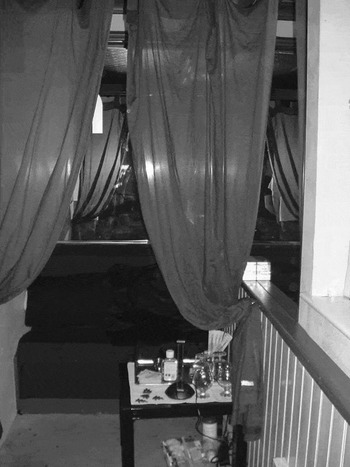
On the night of the performance, a small huddle of eager participants milled around the entrance to O'Reilly's booth (Fig. 1). They were warmly greeted by Liz, O'Reilly's mother, who offered each participant a glass of brandy to be drunk while waiting for their turn to enter. Since Bad Humours/Affected, O'Reilly's degree-show performance in 1998, in which she gave spectators glasses of wine to sip as they watched the flow of red blood seep from the leaches she had placed on her back, O'Reilly frequently makes use of opportunities for sensual connections with her audience. By giving her spectators alcohol to stimulate their physiological responses, she extends the affect of the performance event, warming them to it and allowing them to savour it outside of the one-to-one moment of performance interaction.
Booth for My Mother, Visions of Excess, 2003. Photo: courtesy of Kira O'Reilly.

As I entered the performance space, a small cubicle normally used for private dances, a thin curtain fell as an unfixed boundary between O'Reilly and myself and the quiet crowd outside. Months later O'Reilly reflected that the space ‘had a funny transparency, literally covered with a veil’.Footnote 9 I sat beside her, we sat together. In front of us was a low table spread with implements including cotton wool, scalpels and candles. O'Reilly's manner was calm and inviting as she attempted to dispel the anxiety I failed to hide. Even though my body was ‘safe’ and I felt at ease with O'Reilly, my impulse was to fear the utensils. Sensing my apprehension, or so it seemed to me, O'Reilly initiated dialogue; took the empty brandy glass from my hand and asked whether I had met her mother.
There then followed an informal discussion about mothers and daughters. O'Reilly explained that she had recently been thinking about the maternal relationship and especially about the physical, mental and emotional ties that exist between one and the other. I remember that she spoke of her fondness for her mother. We talked about mannerisms and personality traits we felt we had inherited from our mothers. The close(d) environment was conducive to confession and I spoke honestly. An openness was invited and as I felt this, it enabled me to share intimate, uneasy thoughts with someone who was a virtual stranger. I expressed a fear I'd had for years; the strength of it has since subsided. I wonder, in retrospect, if I left it in the ether there, or the force of it at least. Our (constructed) relationship did not feel fixed, nor was the content of my contribution in any way demanded, nor the content judged. An inter-experience rather than a set ‘exchange’, the space between us felt open for sharing, fertile for transformation.Footnote 10 Like the therapist's couch, this ‘psychic stage,’ as Peggy Phelan might term it, easily allowed for a transference of feelings and emotions to occur, reminiscent of the safe space needed for a cathartic response to take place.Footnote 11
After I had told her a story about my mother, O'Reilly said, ‘I'm going to cut myself now, are you OK with that?’ A brief silence followed and she said to me, reassuringly, ‘It'll hurt a little bit but I wouldn't do it if it hurt a lot.’Footnote 12 Hearing her acknowledgement of the pain she would experience but ‘grading’ it as ‘little’, I gave my consent. Using the brandy glass I had been drinking from, she performed a cupping ritual on the upper part of her leg, a few inches from my body.Footnote 13 As the blood came from between the seams, O'Reilly softly said, ‘Here's some blood that shows the story you told me about your mother.’ Through this opening, made on my behalf, with my consent, O'Reilly revealed the signification of my story in her skin. O'Reilly then placed the bloodied brandy glass in a clear bag and handed it to her mother. Later, I saw that the bloodstained glasses were positioned outside the booth in a pyramid form – artefacts from an intensely personal performance experience. The opportunity O'Reilly afforded me in My Mother was a rare encounter, framed by a ritual that involved her marking my verbal disclosure with a physical opening that also spilled.
O'Reilly's visceral critique of hysteria
While O'Reilly, as previously explained, is concerned to ‘make things that felt real rather than a kind of representation . . . to make things about things that I didn't have words for’,Footnote 14 the task of the critic is to make meaning out of the ‘spilling’. Helpful in this regard is O'Reilly's acknowledgement that her work has been influenced by hysteria, creating interpretative grounds for My Mother and other of her rupturing-of-the-skin works (all seven of O'Reilly's live performances between 1998 and 2005 involved the scoring of her skin) as presenting, performing treatments for hysteria.
To be clear, in stating this, my contention is not that O'Reilly fetishizes the hysteric in her acts of cathartic blood-purging, but rather that she performs a visceral critique of how women have been ‘treated’ as hysterics. Bad Humours/Affected (1998) showed O'Reilly re-enacting the ancient treatment of laying leeches onto her skin – a well-known masculine attempt to cure the hysteric's dis-ease. O'Reilly followed Bad Humours/Affected with a series of performances entitled Wet Cup (1999–2002), again performing the removal of ‘diseased’ blood, this time via the Chinese treatment of cupping.Footnote 15 O'Reilly's use of cupping and laying leeches onto her skin can be seen as performed rituals that display hysterical abject states in order to then demonstrate (against) masculine remedies of recuperation.
In displacing the acts of treatments from the private, sterile medical environment and resituating them into performance spaces of ritual, O'Reilly exposes traditional structures of patriarchal power, reclaiming her body from the pain historically inflicted upon it at the hands of (male) doctors of hysteria.Footnote 16 Further, her decision not to articulate distress re-marks and re-presents such ‘treatments’ – reclaims and reframes them in critical feminist terms. More specifically, borrowing from Sidonie Smith, I might argue that O'Reilly's re-presentation of the medical ‘curing’ of hysterical symptoms suggests ‘a strategic occupation of hysteria as a form of resistance to assigned sexual and social roles’.Footnote 17 Deploying such recuperative treatments, O'Reilly can be considered as performing a subversive reiteration of the power structures that mark the female body as negative/deathly. The traditional patriarchal systems of power signed onto the female body are interrogated, manipulated and refracted through O'Reilly's reappropriation of both the ritual and its referent, pointing us back to a Kristevian idea of le vréel: one that, as Elin Diamond argues, ‘unites the hysteric to the artist because both take the signifier for the real’.Footnote 18 In sum, O'Reilly's performed embodiment of masculine treatments for hysteria propels meaning into the affective space between performer and spectator through an aesthetic that reappropriates referents, ‘take[s] the signifier for the real’, functioning in the interests of performing a feminist political.
Untitled Action: NRLA, The Arches, Glasgow
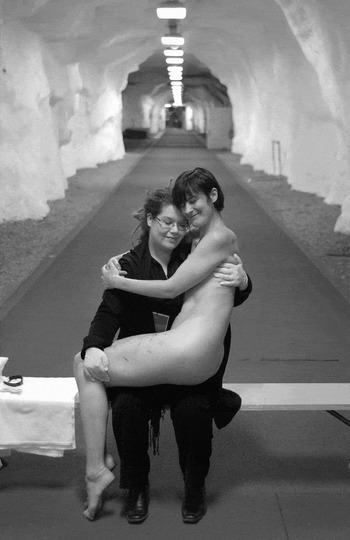
At My Mother I experienced what I understand as a typically cathartic response: a purgative, emotional cleansing marked by a ritual that afforded (me) a sense of transformation. However, my subsequent experience of O'Reilly's Untitled Action: NRLA, The Arches, Glasgow served to unsettle or open up my thinking of catharsis in more complex ways (Fig. 2).Footnote 19 The venue for the performance was the National Review of Live Art – an annual programme of international live art, installation and video artworks produced by New Moves International. Originating from a one-day event in 1979, the four-day festival is now one of the foremost platforms for experiencing innovative live artworks by emergent and established practitioners.
Untitled Action for Bomb Shelter, Anti-Contemporary Art Festival, Kuopio, 2003. Photo: Pekka Makinen, courtesy of Kira O'Reilly.

As I began to enter the performance space, a small white room, my gaze became fixed on O'Reilly's bare back, scored, marked, and slightly bloody. Looking ahead I saw a reflection of myself still half inside the door. A huge television screen faced us, relaying the live video feed of O'Reilly sitting on a white towel-covered chair beside an empty seat, mirroring our image back to us. O'Reilly looked at me as we smiled our ‘hello’. My clammy hands had discoloured the surgical gloves I had been told to put on before entering the room. The energy seemed electrified, my fear was paramount as she invited me to sit beside her.
O'Reilly did her best to put me at ease with vocal reassurances, the tone of her voice and syntax like that of a counsellor's as she calmed me, making our shared psychic stage as secure and comfortable as it could be. The reason for her über-supportive stance was to allow me to consider accepting the invitation given to me in a sealed envelope as I had sat outside the room, waiting ‘my turn’. If I wanted, I could make the one short cut on her body that the invitation clearly instructed. A highly secure space for a dangerous act – the surveillance did not dilute or dissipate the tension; it felt magnified.
I sat next to her naked body, almost clothed by the hundreds of scars from incisions made into her skin in various performances since her graduation performance in 1998. ‘Some people want to make the mark, others use plasters’, O'Reilly said. I knew that I did not want to cover up a wound. I said I wanted to soothe them. I gently laid my fingers over the various openings.
Trying to put my response into words, the closest I can get to this is to say that it was as if I were attempting to press in my affect, feeling the energy of the opening, facing the gap, recognizing the space in between. I felt an incredible amount of care and concern for O'Reilly though I knew her pain was volunteered, not demanded. For me, the sign of the marks revealed painful wounds. Set against this feeling, however, was the knowledge that O'Reilly had designed the performance, that she was surveying the scene (via the television screen and via her own ‘panopticism’) as she was ‘present’ in it.
After this exchange she asked if I would hold her in a stylized pietà pose as we both looked at the mirror image of our scene. Incorporating a pietà pose to frame the vulnerability of O'Reilly's body captured a tableau image of my complex response to our time together, paradoxically mixing, for me, pain and pleasure, fear and desire. The meaning of ‘pain’ and ‘sufferance’ was indelibly written into this scene, however much I tried to remove it; like the cuts in O'Reilly's skin, I could not ‘cover up’ their signs of trauma, as I searched for something in my presence that I hoped relayed healing.
Towards an ethical catharsis
On reflection, my critical ‘feeling’ about this work was that it did not, as previously suggested, accord with a typical cathartic response in the sense of an emotional cleansing, and the differences between my experiences of O'Reilly's performance of My Mother and Untitled Action provoke questions about catharsis and its affect. These revolve around issues such as responsibility, ritual and risk – critical components of the performer–spectator relationship. The contract at stake in Untitled Action was, for me, so ambiguous, so difficult, so intriguing, so personal, so much, so little, that I did not know what I was being asked to be responsible for, much less consent to. I felt the stasis of this crisis and became fixed at the site of the wound.
Helpful to thinking my way out of this was a talk by art historian Amelia Jones: ‘Performing the Wounded Body: A New Theory of Political Agency in the Visual Arts’ (Queen Mary University of London's quorum, 2007). Jones spoke of how a specific performative act of wounding, ‘as private as it may seem, . . . etches itself into our skin, our heart, our sense of self; the wound opens us to social responsibility’. Suggesting that works taking place at the intersection between political activism and performance art can ‘provide powerful ways of engaging the political, and producing political effects within political contexts’, she went on to argue that ‘certain kinds of live art presented in certain contexts cross over into activism through particular acts of wounding which can prick or move the spectator into a relation of embodied attachment and emotional connection’.
While catharsis was not a concern of her paper, Jones's questioning of how ‘acts of wounding’ might move spectators to make emotional and political attachments to the subject in performance shares some common ground with scholarship that engages with the attachment-making possibilities catharsis might offer.
Ideologically restless, exhaustive investigations from every discipline of human analysis have become consumed by Aristotle's lack of detailed description of the experience of catharsis. Fetishizing the abyss at the original site of enquiry, countless theorists, academics, cultural critics and philosophers have perpetuated the intensity behind the mystery of an experience that promises the purification/purgation of negative emotions. As these tropes have been carefully studied and intricately investigated, a third, arguably more social strategy was left behind which my response to O'Reilly's Untitled Action and Jones's reflections encourage me to revisit: the healing function of catharsis in the re-establishment of our collective consciousness and awareness of social responsibility; in short, an ethical catharsis.
Elizabeth Belfiore expands on the notion of an ethical catharsis by suggesting that beyond, or rather before, corporeal pain was used to invoke fear or terror, Aristotle's understanding of ‘tragic fear is not merely phobos, fear of physical pain, but . . . also has much in common with “social” fears, the shame emotions . . . tragic emotion is best aroused by the shameful actions that violate philia relationships’.Footnote 20 Here Belfiore clearly articulates the vital yet often overlooked attribute of catharsis that this writing, in part, is attempting to resurrect: catharsis was meant to draw spectators’ attention towards sustaining and improving our familial (whether social, collective or human) relationships.
Helpful also to thinking in terms of an ethical catharsis is Philip Fisher's analysis into The Vehement Passions, where pity and fear figure as two of the five impassioned states he investigates – along with anger, jealousy and wonder. His writing also carefully documents the sociopolitical potential of catharsis to remind the spectator of their place in humanity through the experience of shared fear:
Aristotle opened up the nuanced relation between fear and pity that marks the path along which I move in consciousness, from my own full experience – my fear, here and now – to a civic interest and full experience of the states and harms of others, whether in pity, in fear, or in the shudder of fear that we call terror.Footnote 21
In Untitled Action, my sense of O'Reilly exhibiting a punitive encounter, articulated through the mechanism of spectacle employed to foreground my presence through hypersurveillance, aroused in me a ‘shudder of fear’, moved me from considering my self to considering our relation, shifted me from my place to our shared space.
Removed from the ritualistic purgation frame that I felt secured us both as one in My Mother, in Untitled Action O'Reilly's stripped, self-inflicted wounds laid bare to me inferred wider questions of social violence, trauma and healing and, essentially, my responsibility in this setting. Examining responsibility and response-ability in the space between performer and spectator is core to O'Reilly's work. The affect of performance interactions with O'Reilly is always subjective and utterly dependent on the temporary relationship formed in the brief space of the performance encounter. However, the transient togetherness in Untitled Action was, for me, also marked by a reading of the performance as both resistant and referential. Here, too, feeling le vréel produced an intimate attachment that pulled me into a complicit, invited act of rupturing.
O'Reilly's literal opening of her skin to reveal gaps in verbalization is concurrently bound by her desire to dis-play the hysteric, the figure historically considered ‘other’. The hysteric's disease is what Elisabeth Bronfen calls ‘the knotted subject’ and it can also be considered in the Laingian sense as reflecting the dis-ease of society's sickness.Footnote 22 In framing the purgation of social sickness, therefore, the abject spilling in Untitled Action ignited in me an empathetic response to heal, similar to the extraordinarily difficult one Jones spoke of. It was an altercation with alterity that unearthed in me an ethical desire to mend, fix, resolve, at best unite, or at the very least connect the edges of the wound I felt witness to.
Kelly Ives closes her exploration of Cixous, Irigaray, Kristeva: The Jouissance of French Feminism with the statement ‘Artists know, though, that their many-faceted, ambiguous and sometimes glorious creations do not compensate for the wound. Art never has done, never will.’Footnote 23 However, in O'Reilly's body artworks, which not only present the wound but also draw her other into a complicit decision-making process of making the wound, one sees something else, something more than the deficiency Ives detects in what she claims is art's inability to ‘compensate for the wound’. Whether through verbal consent in My Mother or physical action in Untitled Action, O'Reilly's invitation to her other is to draw the line, to score her skin, to make the wound. Bringing her other face to face with this literal tear in her sk-interface,Footnote 24 the physical outpouring is offset, redressed, compensated, even, by an emotional attachment and cathartic empathy.
The shape and form of catharsis in the two performances I shared with O'Reilly were very different, perhaps spanning two ends of a spectrum of cathartic response. In My Mother the familiar purgation trope found itself nestled in the narrative of a close, confessional encounter and in Untitled Action an awareness of social responsibility in the guise of an atypical ethical catharsis surfaced, troubled and revised my understanding of the value and efficacy of catharsis, returning me to a less familiar, yet ostensibly more connected, shared experience. Common to both performances, nonetheless, were the embodied traces of O'Reilly's unwavering conceptual and aesthetic commitment to a feminist political drive, to le vréel, one to one.