I. INTRODUCTION
In the last decade, numerous studies have been devoted to the investigation of the role of nanostructure in controlling the transport properties of solid ionic conductors. Several examples have evidenced as the electrical properties of these materials can undergo considerable alteration when the grain size falls in the low nanometric range, below 30–50 nm.Reference Maier1–Reference Schoonman4
Among these transport anomalies, it has gained recently considerable attention the insurgence of an unprecedented proton conduction in dense nanometric oxides under humid atmosphere at temperatures below 150 °C. This unusual behavior has been reported for nano fluorites such as doped ceria and zirconia, i.e., materials generally considered for their oxygen ion conductivity.Reference Kim, Anselmi-Tamburini, Park, Martin and Munir5–Reference Shirpour, Gregori, Merkle and Maier12 The proton conductivity was shown to increase considerably by reducing the grain size and to disappear for grain sizes greater than 50–80 nm. This grain size effect was also demonstrated in one of the very few practical applicationsReference Kim, Anselmi-Tamburini, Park, Martin and Munir5, Reference Park, Kim, Shim, Kang, Gur and Prinz13 of this new type of conduction: using nanograined dense doped ceria and zirconia as electrolyte in a concentration cell, it was shown as the current generated was three orders of magnitude higher than that obtained using the same electrolytes in micrometric form.Reference Kim, Anselmi-Tamburini, Park, Martin and Munir5 The power density was nevertheless low and would require further optimization, in particular for what concerns the electrolyte conductivity, either through further reduction of the grain size or through the use of other, more conductive, nanooxides.
Despite the good agreement existing on the phenomenological aspects of this new form of protonic conduction, the basic mechanism responsible for the proton transport has not been yet clarified. As recently pointed out by Shirpour et al.,Reference Shirpour, Gregori, Merkle and Maier12 both grain boundary cores as well as open porosity offer the possibility of explaining the high protonic conductivity in nanometric oxides, and further investigation is indeed necessary to characterize the role of these two conduction paths.
The aim of the present work was to explore the possibility of achieving high low-temperature proton conductivities in nonfluoritic bulk nanometric oxides. In particular, we will report here on the results obtained on bulk nanometric TiO2 in its anatase crystallographic form. The proton transport in anatase materials has been previously reported. High-porosity (relative porosity >50–70%) anatase membranes with nanometric pore size have recently attracted considerable attention as one of the most promising inorganic material for applications as electrolytes in Proton Exchange Membrane Fuel Cells (PEMFCs) and as humidity sensors.Reference Colomer14, Reference Garcia-Belmonte, Kytin, Dittrich and Bisquert15 At these very high porosity levels, the conduction observed in moist environment has been generally explained by hopping of protons through a percolation path formed by adsorbed water molecules inside the pore network. Nevertheless, the proton conductivity of anatase seems to present more complex and interesting aspects. Recent results, obtained using fully covering TiO2 films, suggested that this material could conduct protons even in dense form. Titanium oxide films, in fact, have been shown to conduct protons up to a thickness of 18 nm, whereas zirconia and Ta2O5 already block proton transport at a thickness of 1.5 nm.Reference Ekström, Wickman, Gustavsson, Hanarp, Eurenius, Olsson and Lindbergh16 Investigation of the hydrogen density and transport inside TiO2 nanoparticles immersed in sulfuric acid evidenced that H+ and D+ ions show rapid self-diffusion inside the anatase structure.Reference Chan, Borghols and Mulder17
On the basis of the results described above, the possibility to investigate proton conduction in polycrystalline dense samples with grains in the low nanometric range appears to be particularly intriguing. Several studies have been devoted to the preparation of polycrystalline bulk anatase samples with grain size in the nanometric range using several different nonconventional sintering approaches, including spark plasma sinteringReference Lee, Lee, Hong and Kim18–Reference Noh, Jung, Lee, Kim and Hong21, hot pressing,Reference Weibel, Bouchet, Denoyel and Knauth22 and two-stage sintering.Reference Mazaheri, Hesabi and Sadrnezhaad23 Spark plasma sintering proved to be particularly successful, although samples prepared at relatively low pressures (7–15 MPa,Reference Angerer, Yu, Khor and Krumpel19 62 MPa,Reference Lee, Lee, Hong and Kim18 and 40 MPaReference Noh, Jung, Lee, Kim and Hong21) required fairly high sintering temperatures (800–1000 °C). At these temperatures grain growth, although limited, was sufficiently high to promote (and sometimes complete) the phase transition from anatase to rutile. On the other hand, we have recently shown as the High Pressure Field Assisted Sintering method (HP-FAST), thanks to its rapid sintering cycles and to the high pressures involved (up to 1 GPa), allows the synthesis of fully dense nanocrystalline TiO2 with a minimal grain growth, allowing to preserve the anatase structure in the final densified products.Reference Maglia, Dapiaggi, Tredici and Anselmi-Tamburini24
II. EXPERIMENTAL
The nanopowder sintering was performed using a homemade HP-FAST apparatus. As starting material, nanometric TiO2 powder (Aldor, >99% pure, specific surface area >250 m2/g) was used. In a typical experiment, 0.08 g of powder was loaded in a double-stage die.Reference Anselmi-Tamburini, Garay and Munir25 The low-pressure section of the die was made out of high-density graphite, while the high-pressure section was made out of silicon carbide and tungsten carbide. The die was loaded in the HP-FAST apparatus, which was evacuated to a pressure of 10 Pa. A moderate initial uniaxial pressure (150 MPa) was applied. The temperature was then increased with a heating rate of 200 °C/min. Once the sample reached the designated temperature, the pressure was rapidly increased to the final value. The final sample (5 mm in diameter, ∼1 mm thick) was held under these conditions for 5 min and then the pressure was quickly released and the power turned off. Temperatures were measured using a shielded K-type thermocouple inserted in the lateral wall of the die.
The relative density (r.d.) of the sintered samples was measured using the Archimedes method and from geometric and gravimetric measurements. Microstructural characterization of the samples was made using a high-resolution scanning electron microscope (SEM, TESCAN Mira 3, Brno, Czech Republic) operated at 25 kV.
AC electrical characterization was performed using a Material Mates frequency response analyzer in the frequency range between 100 and 106 Hz under a bias voltage of 50–100 mV. Platinum electrodes were deposited on the two opposite main faces of the cylindrical sample by sputtering. The electrochemical characterization has been performed in oxygen gas at various temperatures under a constant gas flux of 5 L/h. The gas was either dry or saturated with water at 25 °C ( = 32 mbar). Before the beginning of the electrical measurements, the samples were annealed for several hours in flowing dry oxygen atmosphere at 550 °C to restore its oxygen stoichiometry. To ensure the achievement of equilibrium conditions, the conductivity measurements were performed during heating and cooling cycles allowing 2 h of equilibration at each temperature. To exclude the possibility that the observed conductivity may be a trivial surface phenomenon, some experiments were conducted after covering the external surface of the samples with epoxy resin.
Thermogravimetric analysis for the determination of water content in the samples were performed with a TA Instruments Hi-Res Modulated TGA 2950 Thermogravimetric Analyzer (TA Instruments, New Castle, DE) under dry oxygen atmosphere.
III. RESULTS AND DISCUSSION
As we recently reported, the HP-FAST technique allows the densification of anatase nanopowder with complete preservation of the anatase structure for temperatures up to 700 °C using sintering cycles of 5 min. The transition to rutile is completed just above 900 °C. Under an applied pressure of 800 MPa high-density anatase samples, with a residual porosity around 5–8 vol% can be obtained between 500 and 700 °C. In the same temperature interval, the grain size increases linearly between 24 and 56 nm.
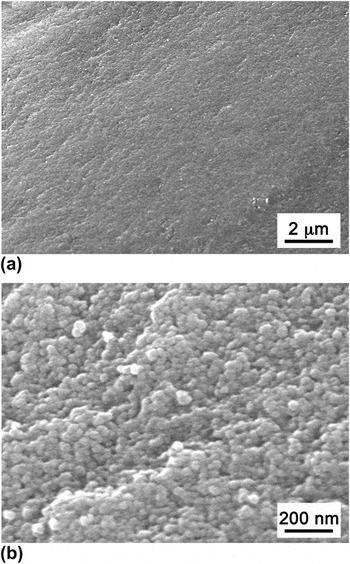
Figure 1 shows two SEM images, at different magnification, of a fracture surface of an anatase sample sintered at 550 °C under a pressure of 800 MPa. Despite the rather severe agglomeration of the precursor nanopowder (not shown), the sintered sample appears to be free of residual interagglomerate porosity or cracks. Moreover, from the high-magnification image, it is possible to appreciate the good homogeneity of the grain-size distribution [around 30 nm, as confirmed by x-ray diffraction (XRD) measurement] and the presence of a small volumetric fraction of nanopores (around 6 vol%).
(a) Low (10 k ×) and (b) high (200 k ×) magnification SEM images of a fracture surface of an anatase sample sintered at 550 °C.

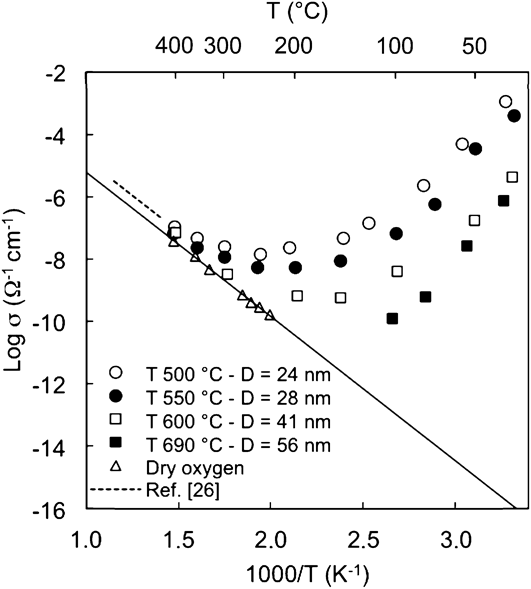
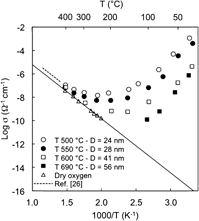
Figure 2 shows the temperature dependence of the total conductivity, measured in dry and humidified oxygen atmosphere, of four anatase samples sintered at 500, 550, 600, and 690 °C. The mean grain size of the samples, as determined by XRD measurements, was equal to 24, 28, 41, and 56 nm, respectively. The r.d. values correspond to 92, 94, 94, and 95 vol%, respectively. Since the results obtained under heating and cooling differ only negligibly, only those obtained during cooling are reported. A marked difference in the electrical behavior, between humid and dry conditions, can be observed in all the samples. Under dry oxygen atmosphere, a linear trend of the Arrhenius plot was observed in the investigated temperature range. The conduction mechanism of nanometric anatase (grain size 35 nm) at high oxygen partial pressure was previously described by Knauth and Tuller.Reference Knauth and Tuller26 These authors observed that, in contrast with a coarsened material with micron-sized grains, characterized by hole conductivity, the nanocrystalline anatase shows an uncommon ionic conductivity, due to the migration of Ti interstitials. This suggests that mixed conduction can be excluded in nanocrystalline anatase as long as the oxygen partial pressure is kept reasonably high. Even though the data reported by Knauth and Tuller span a limited and slightly higher temperature range, the agreement with our conductivity data obtained under dry oxygen atmosphere is remarkable (Fig. 2). The activation energy, in particular, was almost identical (1.0 ± 0.1 eV).
Temperature dependence of the total conductivity, measured in dry and humidified oxygen atmosphere, of four anatase samples sintered at 500, 550, 600, and 690 °C; r.d. of the samples: 92 vol% (500 °C), 94 vol% (550 °C), 94 vol% (600 °C), 95 vol% (690 °C).
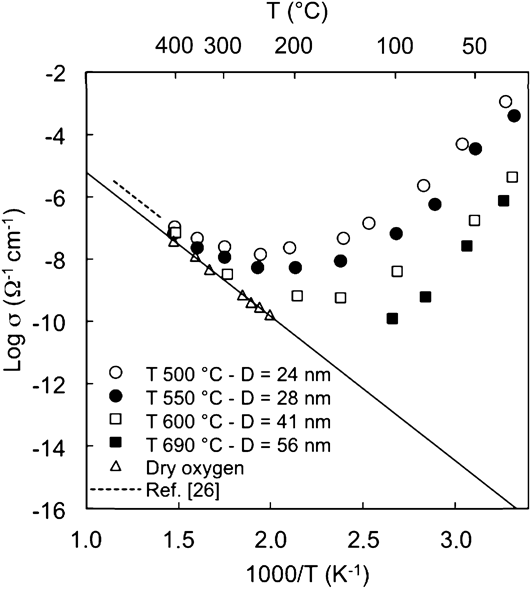
Under humid environment, a marked deviation from high-temperature behavior, similar to the one previously observed in zirconia and ceria, is observed at low temperatures. The conductivity, in fact, markedly increases as the temperature is decreased between 350 °C and room temperature. As a consequence of the inverted temperature dependence of the conductivity, a conductivity difference of several orders of magnitude between dry and humid atmosphere can be observed at the lowest temperatures.
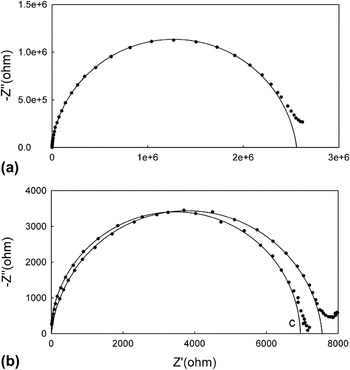
As shown in Fig. 3, independently of the grain size and porosity of the samples, the Nyquist plots measured under humid atmosphere are characterized by the presence of a single semicircle instead of the two generally observed for polycrystalline ceramics and attributed to the bulk and grain boundary contribution to the resistivity. The presence of a single semicircle has been previously observed in nanoceramics and has been considered as an indication of the presence of a conduction pathway that bypasses the bulk contribution to the resistivity. In pure or low doping CeO2 under dry O2 atmosphere, as an example, it was attributed to a grain-boundary electron conductivity.Reference Shirpour, Gregori, Merkle and Maier12
Nyquist plots of typical impedance spectra for samples with different grain sizes and different porosities: (a) sample sintered at 600 °C, grain size 41 nm, r.d. 94 vol%, (b) sample sintered at 500 °C, grain size 24 nm, r.d. 92 vol%, (c) sample sintered at 500 °C, grain size 24 nm, r.d. 75 vol%.

In previous studies concerning the conductivity of nanocrystalline doped ceria and zirconia under humid atmosphere, this behavior has been caused by the insurgence of protonic conductionReference Kim, Anselmi-Tamburini, Park, Martin and Munir5–Reference Shirpour, Gregori, Merkle and Maier12 even though the exact nature of the proton conduction pathway, as will be discussed later, is still object of debate.
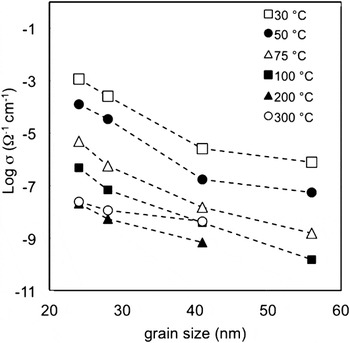
The proton conductivity observed under humidified atmosphere is strongly dependent on the grain size (Fig. 2). The conductivity dependence on grain size is shown in Fig. 4 at various temperatures ranging between 300 °C and room temperature. It can be observed that for temperatures ≤200 °C the conductivity increases more than three orders of magnitude as an effect of a moderate decrease in grain size, from 56 to 24 nm. This gap decreases for higher temperatures and vanishes when approaching the crossover between the dry and humid behavior (∼400 °C). This clearly indicates as the grain size plays a relevant role on the low-temperature proton conduction, while at high temperature, where the ionic Ti conduction is dominant, negligible differences can be observed, at least for this relatively narrow grain-size range.
Grain size dependence of the total conductivity, measured in humidified oxygen atmosphere, of four anatase samples sintered at 500, 550, 600, and 690 °C. The measurements were performed at six different temperatures: 30 °C (open squares), 50 °C (black circles), 75 °C (open triangles), 100 °C (black squares), 200 °C (black triangles), and 300 °C (open circles); r.d. of the samples: 92 vol% (500 °C), 94 vol% (550 °C), 94 vol% (600 °C), 95 vol% (690 °C).

If compared with the conductivity results previously reported on other nano oxides (zirconia- and ceria-based electrolytesReference Kim, Anselmi-Tamburini, Park, Martin and Munir5–Reference Shirpour, Gregori, Merkle and Maier12), nano anatase shows some relevant peculiarities. The crossover temperature falls at considerably higher temperatures (around 350 °C) than those reported, for instance, in the case of doped zirconia, where a crossover temperature between 100 and 150 °C was generally observed. Moreover, the conductivity at temperatures below 100 °C is considerably higher. If compared with the conductivity previously measured by our group on nanometric fully stabilized zirconia with an even smaller grain size (20 nm),Reference Anselmi-Tamburini, Maglia, Chiodelli, Riello, Bucella and Munir7 the anatase samples show conductivities two to three orders of magnitude higher (Fig. 2).
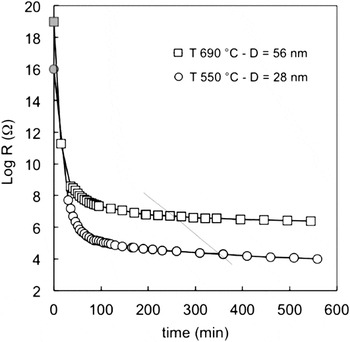
The relatively fast kinetic of the interaction with the moist environment, even at low temperatures, can be appreciated in Fig. 5 where the resistance, measured at 32 °C, is reported as a function of time for two different samples (sintering temperature equal to 550 and 690 °C, respectively) when exposed to a flux of moist oxygen. The points at time = 0 have been extrapolated from the dry oxygen behavior and correspond to the room temperature resistance prior to humidification. Despite the difference in the final values, consistent with the different grain size, the kinetic of the resistance variation is similar in all cases, with a drop of several orders of magnitude in the first hour followed by a slower decrease that stabilizes within few hours, suggesting that the proton incorporation mechanism, responsible for the resistance drop, occurs with an identical mechanism in all the samples.
Time dependence of total resistance, measured at 32 °C following exposure to a flux of moist oxygen, for anatase samples sintered at 550 °C (circles) and 690 °C (squares). The points at time = 0 (colored symbols) have been extrapolated from the dry oxygen behavior and correspond to the room temperature resistance prior to humidification.

As mentioned previously, the mechanism of proton incorporation and transport in nanometric dense oxides is still debated. There is an obvious and very strong dependence on the grain size, but the dependence from the nature of the oxide is still unclear. The result we are presenting here demonstrate how this unusual protonic conductivity can be observed not only in fluoritic oxidesReference Kim, Anselmi-Tamburini, Park, Martin and Munir5–Reference Shirpour, Gregori, Merkle and Maier12 but also in oxides, such as TiO2, characterized by a crystal structure and by a bulk-defect equilibria that does not include the presence of oxygen vacancies, a structural feature that is always present in traditional high-temperature protonic conductors. These observations suggest the possibility that the material bulk properties might play a limited role in this phenomenon. On the other hand, we verified the absence of any significant variation in the sample conductivity when the lateral surfaces of the sample are protected by epoxy resin, excluding the possibility that a superficial chemi- or physi-sorbed layer of water might produce the observed increase in the electrical conductivity. Any other possible interpretation for the observed behaviors must be based on the sample nanostructure, considering the strong dependence of the conductivity from the grain size. The ability to absorb anomalously high amounts of water might be relevant in this respect, as it represents the only anomaly, together with electrical conductivity, in the physical properties of these materials. A simple explanation for this anomalous water absorption is surely represented by the presence of open nanoporosity. Conduction through a network of water containing nanopores has been indeed observed in highly porous anatase and silica membranes.Reference Colomer14, Reference Garcia-Belmonte, Kytin, Dittrich and Bisquert15 In these materials, the nanopores contain a layer of water molecules chemically bonded with the pores lateral surface and a fraction of free water molecules in the center of the pore. Only the last fraction is believed to contribute to the conductivity, as the chemically bonded water is characterized by a very low mobility. Due to capillary condensation, liquid water can accumulate in nanopores even in presence of a relatively low water partial pressure. The possibility of such a conduction mechanism seems to be somehow supported by the kinetics we observed for change in electrical conductivity in samples exposed to a moist environment. The data of Fig. 5, in fact, show an exponential kinetics, that seems to be more compatible with an adsorption/condensation process than with any solid-state diffusion process.
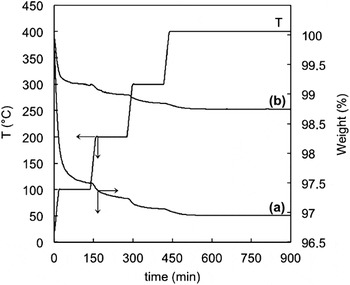
However, a conduction model based only on the accumulation of water in the residual porosity faces some serious problems in our case. First of all, the proton conductivity in HP-FAST densified materials has been observed also in samples characterized by a r.d. well above 90%. Even in the case of the anatase samples we presented in this work the relative porosity is never above 5–8 vol%. It is very unusual that such a level of r.d. might result in porosity that is completely open and interconnected throughout the sample, considering that the total sample thickness is over 1 mm. The reported data on anatase and silica films refer, on the opposite, to materials characterized by a relative porosity well above 50%. In such conditions, open interconnected porosity is surely present. In the attempt to shed further light on the role of nanoporosity, we compared conductivity measurements on samples sintered using two very different pressures (650 and 800 MPa) but the same temperature (500 °C) and time (5 min), to obtain materials characterized by similar grain size but very different relative porosity. The results are shown in Fig. 6. Both samples are characterized by a mean grain size of 24 nm while the relative porosity was 8 and 25 vol%, respectively. Surprisingly, the conductivities of the two samples resulted to be almost identical on the entire range of temperatures where the protonic conductivity is observed. On the other hand, the total water uptake of these two samples has been investigated by thermogravimetric analysis after hydration at room temperature for 72 h (Fig. 7). The weight is recorded while the sample is heated for 2 h at different temperatures ranging from room temperature to 400 °C in dry oxygen. As expected, the weight loss is considerably larger in the sample characterized by higher porosity. These results suggest that the role played by residual porosity in defining the electrical properties of our samples is complex and no straightforward relationship between the porosity fraction and conductivity can be observed.
Temperature dependence of the total conductivity, measured in dry and humidified oxygen atmosphere, of two anatase samples sintered at 500 °C with r.d. of 92 and 75 vol%, respectively.

Weight loss of two anatase samples sintered at 500 °C, with r.d. of 75 vol% (curve a) and 92 vol% (curve b), conditioned in humidified oxygen atmosphere for 72 h, during heating in dry oxygen at different temperatures (curve T).

An alternative explanation for the water uptake and the increased conductivity could be based on the possibility of incorporation of highly mobile water molecules at the grain boundaries. This would explain the strong dependence of the observed conductivity from the grain size, as its reduction produces a large increase in the grain boundary density in the material. The possibility of water incorporation and movement along the grain boundaries in nanometric oxides has been considered before,Reference Kim, Avila-Paredes, Wang, Chen, De Souza, Martin and Munir8, Reference Avila-Paredes, Chen, Wang, De Souza, Martin, Munir and Kim11 but no direct evidences supporting this mechanism have ever been presented. The literature on the traditional high temperature protonic conductors does not present evidences of protonic transport along the grain boundaries, but it must be noted that all these investigations have been performed on materials characterized by micrometric grain size, where the grain boundary density is several orders of magnitude lower than in the materials considered in our work. It must further be considered that the impedance spectroscopy, that represents the traditional tool for the understanding of the transport mechanism in ionic conductors, loses much of its effectiveness when the grain size is reduced to the lower nanometric range. In presence of grain sizes below 50 nm, much of the signal structure is lost and no clear distinction between competing conduction mechanisms can be obtained anymore.
In conclusion, the obtained experimental evidences do not allow to clarify the mechanism responsible for the observed, enhanced low temperature protonic conductivity observed in bulk nanocrystalline TiO2. A decision between the grain boundary and the nanopore mechanism is probably premature, also as a consequence of the poor knowledge of the grain boundary properties at such extreme grain size. A possible contribution of both transport paths, depending on the grain size and the nanoporosity diameter and volume content, cannot be a priori excluded.
Based on the above considerations, also the higher conduction exhibited by anatase with respect to other nano ceramics cannot be at the moment satisfactorily interpreted. As previously mentioned, similar improved characteristics were also reported in the case of fully covering TiO2 films, in comparison with zirconia and Ti2O5 films with identical microstructure. Also in this case, the authors could not decide between the possibility that TiO2 exclusively exhibits solid state proton conductivity, as suggested by other studiesReference Chan, Borghols and Mulder17, Reference Lunell, Stashans, Ojamae, Lindström and Hagfeldt27 or that it possesses a better proton conduction within hydrated nanopores.Reference Ekström, Wickman, Gustavsson, Hanarp, Eurenius, Olsson and Lindbergh16 Particularly in the case of proton migration through the solid state (grain boundary), a beneficial effect played by the excellent catalytic properties of anatase toward the breaking of water chemical bonds can have a role and cannot be a priori excluded as a factor contributing to the enhanced proton conductivity of anatase nanomaterials.
ACKNOWLEDGMENTS
This work has been funded by Fondazione Cariplo (Grant No. 2010-0435).