As the curtain rose on Dario Fo's 1978 adaptation of L'Histoire du soldat (1918) for La Scala, the audience was presented with a bold re-imagining of the original work.Footnote 1 Instead of Stravinsky's original music for L'Histoire du soldat, the composer's Octet for woodwind, completed five years later, started up; the musicians were placed on an elevated, movable platform at the back of the stage, rather than in the orchestra pit.Footnote 2 The titular soldier of Ramuz's play was nowhere to be seen; instead, the stage quickly filled with a crowd of figures silently enacting a pastoral scene. In a retrospective for the show, Fo described how
ten male mimes and ten female mimes come forward and allude, with their gestures, to working in the fields. It is dawn. A flock of sheep (made up of Bruegel-mimes on their hands and knees) crosses the scene. To the back of the stage is a group of blind and crippled men, in the style of the seven Flemish beggars by Bruegel.Footnote 3
To the critics in the audience this departure both from Ramuz's and Stravinsky's L'Histoire – and from Fo's theatrical style up until then – must have been startling. Here was a group of twenty mimes in a work written – as critics would have been aware, following both Giorgio Strehler's and Sandro Sequi's stagings of the same work for La Scala in 1957 and 1970, respectively – for just two actors and a dancer. The original work involved no introductory stage picture of any kind: Ramuz and Stravinsky had merely asked for a narrator speaking over a simple woodwind and percussion march, played while the soldier marches away on stage. Even more surprisingly, the man responsible for this strange collective of silent mimes was a left-wing dissident artist whose work consisted primarily of high-octane satirical monologues, and who had had no previous engagement with opera or any other aspect of the Western art music tradition.
The twenty mimes and the Octet that opened Fo's staging of L'Histoire made for a lengthy first scene, one almost entirely made up of gestures and with hardly any dialogue. The extended use of music and restricted use of dialogue was another substantial intervention in an hour-long work that used dialogue and narration – as well as short musical inserts – as the chief means of delivering a story of fable-like simplicity. (The clueless soldier is tricked by the devil into selling his violin, which is his soul; through a series of vicissitudes, he gains his soul back and marries the king's daughter, only to lose his soul again to the devil at the very end.) No such clear narrative could be discerned in the lengthy prologue to Fo's adaptation. Over the course of the Octet's entire duration – some fourteen minutes – the mimes worked themselves into a bucolic frenzy and then morphed into a bustling crowd inhabiting a Fritz Lang-type metropolis. The perpetual commotion of the big city was mimicked with the aid of a few props: cardboard boxes were cars; white sheets mounted on makeshift wooden frames were skyscrapers; large clothes-racks were trams and buses. The soldier eventually emerged at the end of this scene, yet his character hardly stood out against the swarm of peasants, commuters, factory workers and other soldiers who had previously haunted the stage. Remarkably for a man who had built a career on his own spectacular stage presence, Fo did not take a lead role in his own adaptation, or indeed any role at all. The mimes Fo hired were the real stars: a total of 32 young men and women featured in no less than fourteen extended scenes. The added scenes were interpolated with Ramuz's original narrative, and doubled the duration of the work from one to two hours. The mimes had a thoroughly divisive effect on the press: some waxed lyrical about how the group scenes were like ‘a fresco that has come off the wall, in which the colours change constantly … and the figures come alive, dancing’;Footnote 4 others read the collective as a disquieting allegory, remarking that ‘anxiety, a sense of catastrophe, tragedy and solitude all pile up on one another on stage at a frenetic pace’.Footnote 5 Still others saw the onstage mime collective as ‘an ugly degradation, without taste or communicative power, a mere accessory structure’;Footnote 6 or, worse, as Fo's ‘refusal to invest personally in the show by being the mere co-ordinator of a team’.Footnote 7
This wide spectrum of interpretation was probably to be expected. When, in early 1978, Fo announced that he would work at La Scala as director of a modern adaptation of L'Histoire du soldat, the press greeted the news with puzzlement at best, and often with sarcasm. Renato Palazzi, who opened his commentary on the matter in a tone of amused bewilderment, attempted nonetheless to find a coherent political rationale in Fo's surprising decision:
He always said that – for the purposes of popular and political theatre – it is more important to perform at La Scala that in a Quarto Oggiaro cinema. Now this statement – which used to sound like a joke – is about to become a concrete reality. Dario Fo, the great subversive of Italian theatre, the ‘court jester of the revolution’ as he has been called, is about to step into the quintessential ‘temple’ of opera.Footnote 8
Indeed, according to Italian cultural critics and commentators of all political hues, the association of Fo with La Scala seemed, at least at first, unthinkable. Fo had quit his television career in 1968 and had since been writing play after play for performance in the Case del popolo and occupied factories with his theatre collective, Nuova Scena.Footnote 9 Only his brief return to RAI for a broadcast of his play Mistero Buffo in 1977 – a return that was promptly condemned by the Vatican – could have provided anything akin to a precedent for Fo's collaboration with an institution of nationwide prestige. La Scala, on the other hand, had long catered for Milanese high society with a steady diet of nineteenth-century mainstream repertoire, only occasionally peppered with contemporary additions. The clash between Fo and La Scala was between the young, politically committed generation of activists shaped by the struggles of 1968 and a bastion of the high bourgeoisie, where traditional cultural forms and rituals were constantly reaffirmed in spite of the rapidly changing times. The most obvious manifestation of this clash was the S. Ambrogio premiere Mozart's Le nozze di Figaro on 7 December 1968: a group of demonstrators led by activist Mario Capanna waited outside the theatre and showered those entering with eggs and rotten vegetables.Footnote 10
Barely a year after this event, however, a far more violent sign of protest shook Milan: a bomb exploded in Piazza Fontana on 12 December 1969, killing no fewer than 17 people. The search for a culprit was fruitless. The police interrogations resulted in the death of one suspect – Giuseppe Pinelli, an anarchist railway worker afterwards found to be innocent – by ‘falling’ from a fourth-floor window, a death that inspired Fo's most famous play: Morte accidentale di un anarchico (1970). The massacre in Piazza Fontana turned out to be the first in a series of attacks perpetrated by terrorist organizations during the so-called Years of Lead, which marked the 1970s as a decade of armed political struggle in Italy. The single most disquieting aspect of this decade was, arguably, the pervasive uncertainty that had plagued the aftermath of the Piazza Fontana massacre: the authorities' inability to identify the perpetrators with any degree of confidence. Without doubt the so-called ‘historical compromise’ reached between Enrico Berlinguer's PCI (the Italian communist party) and the ruling Democrazia Cristiana in the early 70s – while bringing the PCI into government for the first time in Italian history – caused increased tensions among the extra-parliamentary Left and Right. By the end of the 1970s, members of parliament had become direct targets; the tension came to a climax when a terrorist organization, the Red Brigades, kidnapped Christian Democrat minister Aldo Moro in March 1978, murdering him two months later.
It is in this climate of deep disquiet and tension that Fo's collaboration with La Scala took shape. While the Moro kidnapping was taking place on 16 March, Fo was probably beginning to prepare his staging for La Scala. At the moment of utmost crisis, then, one of Italy's most politically outspoken playwrights was working for Italy's most prestigious opera company; he was dedicating his time not to a new play of his own, but to a piece of music theatre by a composer – Stravinsky – firmly rooted in the Western art music tradition.Footnote 11 At a time when he would have been most expected to respond to the contemporary political situation, Fo instead appeared to be working at a noticeable remove from it.Footnote 12 However, there is no doubt that Fo's adaptation of Ramuz and Stravinsky's original was intended to be politically charged. Anyone even superficially acquainted with Fo would have been able to guess his probable take on the story of the soldier whose soul is bought by the devil. Fo himself openly declared that he wanted to bring out ‘the story of a man who is caught in the trap of easy money, easy success, goaded by a devil who acts in accordance with the laws of capital’.Footnote 13 And yet the final result – at least so far as we can gather from the surviving materials – offers no such easy reading. If Fo wanted to use L'Histoire for mere didactic purposes, then why did he turn the work into a two-hour spectacle, acted out by no less than 32 mimes with no fixed stage identity? Why did he radically increase the amount of music by adding Stravinsky's Octet and repeating sections of the original score? And why did he choose to stage a work that involves not a note of singing for an institution famous for its world-class performances of nineteenth-century opera?
Charting the constellation that links Fo, La Scala and Stravinsky means delving into something far larger than the context of an unconventional staging. What we offer here is not, and does not aim to be, an exhaustive reception history of L'Histoire du soldat in Italy. Nor is it an attempt to read the show merely in the context of Fo's intentions and artistic career. Instead, we want to reveal Fo's adaptation as reflecting a particular moment in Italian political history, namely the crisis of the Left in the lead-up to and immediate aftermath of the Moro murder in 1978. We take Fo's L'Histoire as offering not only a vantage point but a material incarnation of the tight entwining of arts and left-wing politics in these years. The production can speak of many circumstances: of the ways in which politically engaged artists portrayed the ‘movement’ of 1968 in its aftermath; and of political address among the intellectuals and militant collective of the Left in this same aftermath. Finally, as we will show, the production folds the doubts plaguing artists and militants of the time into memories of the Risorgimento, memories saturated with the sonic imagery of the operatic voice.Footnote 14
I
Fo's decision to expand the duration of the work in order to include fourteen stage pictures was intended to take the spectators on a journey through the problematic settings of class struggle in contemporary Italy. The imagery in these pictures ranged from factories to polluted cities bursting with cars, to a neglected countryside – a human wasteland deprived of youthful energy and hope after the mass exodus to an anonymous, industrial North – to the corrupt seat of Parliament, populated by larger-than-life dying princesses and the ghosts of murdered politicians (an obvious reference to Moro). Fo wished to imbue the staging with the same tension that characterized the sites where political conflict reached its apex at the time. Instead of trying to draw public and media attention to marginal social settings and controversial topics, he recreated those settings on the stage with basic props. Thus, he aimed at forcing even the politically-uncommitted members of the audience to confront the reality of the struggle.
Previously, he had attacked high society from underground, independent venues such as the Palazzina Liberty, an abandoned building situated in the working-class neighbourhood of Porta Vittoria in Milan.Footnote 15 Fo's agreement to work for La Scala reflected a desire to expand the means of communication available to the post-1968 movement. In Fo's vision, this expansion corresponded to an idea of ‘decentralisation’ – a reconfiguration of the political landscape that would bring the centre and periphery of power to a cathartic confrontation. In an interview with Palazzi in the Corriere della sera, Fo spoke of his work with La Scala as just such an instance of ‘decentralisation’. Fo himself claimed that his collaboration did not constitute a symbolic ‘storming of the Winter Palace’, a conquest of upper-class settings on the part of the proletariat and the militant intelligentsia. Instead, he planned for La Scala to meet his purposes half way: the show's run took place in a host of sports palaces and local theatres both within Milan and across Lombardy (with a one-off detour to Rome). Most importantly, the run did not involve so much as one performance at the Teatro alla Scala: the Milanese performances took place at the sports palace and at the Teatro Lirico. By unsettling the theatre's geographical grounding in the wealthy quarters of Italy's financial hub, Fo saw himself as reviving La Scala's ‘historical role’. Fo was, in other words, haunted by the myth of Risorgimento opera as a political and artistic movement that rose above class division:
In other times this theatre obtained the participation of the working-class audience and of the most progressive bourgeoisie, which allowed an extremely advanced choice of topics at the European level. I believe that certain operas must be recuperated precisely in this sense. Besides, I was never interested in ‘ghettoising’ myself. I believe that showing an opera to 20,000 people in three days, for just 1000 liras per ticket, is a correct decision both on the cultural and on the political level. That is also why I brought my shows to television: because there is no greater decentralisation than the one allowed by television as a medium.Footnote 16
Fo's assertions emphasised a commitment to the future of his project in a rapidly changing, fast-paced world dominated by mass media. He advocated the need to deploy new means of communication as avenues for activism and for increased awareness, among widespread audiences, of social and political criticism. His intention was to put to full use the inherent communicative potential of mainstream companies such as La Scala. Fo's position was in this sense symptomatic of the shifting sensibilities of many left-wing thinkers and activists, people who were starting to criticise the old-fashioned, binary conception of class struggle heavily influenced by conventional Marxist categories. Their criticism was specifically addressed to figures such as Pier Paolo Pasolini, whom they thought to be indulging in a nostalgic cult of the nation's peasant and working-class roots. It is worth examining this context in some detail, since it had a significant impact both on the genesis of Fo's show and on its reception.
In 1973, Pasolini wrote a tentative script for a film adaptation of L'Histoire, which he was planning to produce with the help of his star actor Ninetto Davoli. In the script, mass culture is allegorised by the Devil as a media tycoon who lures the soldier into becoming a complacent spectator and consumer. Pasolini was explicit about this allegory:
Before consumer society … the Devil, for example, was the Church. Yes, the Church, Papacy, the Vatican. We could identify Evil with power and its ideology.… Today Power is symbolized by mass communication, which proposes, with a kind of equally sombre consolation, happiness in this world.Footnote 17
Pasolini was, in other words, mourning the loss of a world in which oppressor and oppressed were easily discernible categories, in which the source of evil could be located and attacked. There were the Church and the people, each loaded with an unmistakeable ethical charge. Now, however, power was mediated, ‘symbolised’; its presence was signalled by consumer society's blind, apolitical pursuit of superficial pleasure.
Pasolini's position was exemplary of one of the two divergent reactions of the progressive Left to the burgeoning of mass media in post-war Italy. Umberto Eco devoted a famous essay of 1964 to this split, nicknaming the opponents ‘apocalittici’ (those with an apocalyptic vision of the advent of mass media) and ‘integrati’ (those who sought to adapt to the new situation). For Eco, the fact that the mass media had arisen out of a post-industrial culture did not necessarily mean that they were instruments of hegemonic power, either for cultural indoctrination or for the organization of popular consent.Footnote 18 Instead, he interpreted mass culture as an evolution within popular culture, and thus as the expression of an irrepressible, pervasive form of popular democracy. He saw an increased circulation and wider distribution of knowledge across different social strata as a means of rewriting the notion of a hierarchical model in which the many dominated the few.Footnote 19 The question, for Eco, was not whether mass media were a good development in Italian society, but rather ‘what type of cultural action might allow for mass media to channel cultural values?’Footnote 20
Eco aimed at reconsidering the role of intellectuals as the mediators of mass access to cultural capital. This was a long-standing historical problem for Italy: Antonio Gramsci had criticised the Risorgimento precisely because it had been a movement initiated and carried forward by a rarefied and privileged bourgeoisie, rather than by that elusive, perennially invoked motor of political change, the people. At stake in the ruminations of left-wing thinkers in the Italy of the 1960s and 1970s, then, was an ideal of political community that had haunted the country's history for at least a century. Pasolini showed full awareness of this when he wrote, in relation to the rise of mass media, that
this experience has already taken place in other countries. But in Italy it has a very peculiar nature, because it constitutes the first real ‘unification’ our country has undergone.Footnote 21
Pasolini's concern with media was that its crucial function in establishing linguistic as well as cultural unity in Italy went hand in hand with a dampening of political self-awareness. Here Pasolini resonated powerfully with the famous – albeit isolated – reference Gramsci made to opera in his Prison Diaries, a reference we will consider in more detail later. Gramsci wrote that ‘the libretti and plots of the plays set to music by Verdi … are responsible for a whole series of “artificial” attitudes, for ways of thinking, and for a “style” in the life of the people’.Footnote 22 We need only think of the image of young Ninetto Davoli as the helpless, TV-watching young soldier in Pasolini's L'Histoire to get a glimpse of the poignancy of this kind of imagery in the Italian 1970s. We might also pay close attention to Pasolini's use of ‘unification’ here – especially since he himself puts the word in scare quotes. The historical reference to Italian unification in 1861 is easy enough to discern, but the word itself carries a particular strand of political anxiety: a desire to make a multitude into a ‘one’.
Among the left-wing activists of 1968 – and even more so in the crisis of its aftermath – the longing for oneness was perhaps the most pervasive political and aesthetic ideal. Writing of the kind of communal belonging fostered by the uprisings of that year, Guido Viale, of the extra-parliamentary left-wing group Lotta Continua, wrote: ‘the domain of one's experience expands and becomes manifold. One is “everywhere”’.Footnote 23 Later on, in Viale's memoirs of 1968, political rhetoric is always inextricably linked to a poetic conception of action as a single, unified vocal utterance on the part of the movement. This gesture was then reciprocated by a collective hearkening: ‘there was a will to speak … this is because of the presence of a mass interlocutor, an attentive listener’.Footnote 24 Political effectiveness apparently happens when the plurality coalesces into a single element listening to the voices addressing it. Writing some 12 years later, political activist and thinker Antonio Negri would brood on that same sonic imagery, albeit in a more anxious tone: ‘Good people. The problem is how to give weight to their voice … the question of unity is fundamental’.Footnote 25 Negri wrote this while in prison, accused of being the mastermind behind the Aldo Moro kidnapping and murder. References to political ‘voicing’ riddle his prison journal, and small wonder: as we shall see, his own voice played a crucial role in his trial. The problem of voice was thus a very concrete one to him; to raise one's voice with or on behalf of others in the political climate of post-1968 Italy was an epecially fraught affair. It seems hardly a coincidence, then, that the silent mimes morphing from peasants to city-dwellers in the opening of Fo's L'Histoire had been hired by a theatrical company that, in Italian history, was known to have channeled politics through the spectacular staging of the singing voice. Nor could the timing have been more eerily apt: 1978, the year that proved so crucial in the development of Italian politics, was also the year of La Scala's bicentenary.
II
La Scala was, by the late 1970s, hardly immune from political disquiet. The post-1968 cultural climate contributed to an important shift in the theatre's cultural policies, engineered by its new musical director, Claudio Abbado. Abbado, who was only 35 when he took the job at La Scala, already had a history of being outspoken about contemporary politics. The charged, faction-ridden atmosphere in which Abbado worked can be seen from his own recollections. ‘They called me a “communist”’, he remembered,
for ease of labelling, and anyway in Italy, back then, it was impossible not to be classified as either right-wing or left-wing. And yet, even though people often ascribed to me positions or political sympathies that had little or nothing to do with my actual choices, I never belonged to any party.Footnote 26
The very fact that Abbado was so adamant about staking neutral ground among political factions reveals the frustration of someone dragged onto the battlefield against his will. However, the cultural policies he implemented in the years of his directorship remind one of the deep rifts and contradictions among the Left in 1970s Italy – especially Enrico Berlinguer's PCI and its relation to extra-parliamentary groups.
Broadly speaking, the Italian Left and La Scala were torn between appeals to an international, progressive middle class and an attempt to address the national working class. There were two distinct perspectives on such matters. First, Abbado aimed for international prestige and an alliance with the educated middle class of Central Europe. In order to attain these goals, he addressed Mitteleuropan opera lovers by raising the house orchestra to an international level and organising collaborations with prestigious foreign institutions such as the Bolshoi (1973–4), the Royal Opera House (1976) and the Paris Opéra (1979). Another crucial move for Abbado was the alignment of La Scala with the Central European avant-garde, with premieres of works by Nono, Berio, Donatoni and Stockhausen, to mention only a few.Footnote 27 This move was intrinsically political: the composers – most of them Italian – had come of age under the Darmstadt Ferienkürse's project of radical cultural renewal in a Europe ravaged by a totalitarian past.Footnote 28 Although neither Nono, Berio nor Donatoni (nor for that matter, Stockhausen) stuck with the narrow political agenda of Darmstadt, each saw musical innovation as intrinsically linked to left-wing politics. Needless to say, Abbado's chosen composers yielded works that made intense demands on their audiences. One need only think of the broken Verdian dramaturgy that haunts Berio's La vera storia;Footnote 29 or the self-consciously plotless and disjointed Atem by Donatoni; or the creational myths and Wagnerian scope of Stockhausen's Licht cycle; or Abbado's role in the germination, in the late 1970s, of what would become, in 1986, Luigi Nono's Prometeo, a gargantuan, polychoral work for voices and instruments whose full title (‘tragedia dell'ascolto’, a tragedy of listening) speaks of an anxious search for a reconfiguration of the relationship between composer, performers and audience.
Secondly, Abbado was militant in attempting to reach a wider demographic than La Scala's traditionally highbrow audience. This desire chimed with that of the Left during these years: to attain direct contact with a ‘people’, a collective whose identity was, as we have seen, becoming impossibly elusive. We have already seen how, in 1978, Fo made a point of exporting his staging for La Scala to far less prestigious cultural venues. Yet Abbado had anticipated his move by several years: he had made sure that La Scala's ticket prices were drastically reduced and had created a new concert series in 1972 dedicated to students and workers.Footnote 30 The title of a further series of concerts, lectures and public debates created by Abbado that same year, Musica/Realtà, says much about the significance of the project. The desire was to pierce through art music's allure of cultural self-sufficiency and make it ‘real’, turn it into a site of engagement and even debate, force it into dialogue with the realm of the everyday:
Our ideal was to open music to all cultural and social classes. We deeply bonded over these ideas, we thought they were the right way to demolish listening limitations and habits.… We … succeeded in persuading politicians to work with us … we asked workers from the city to tell us about what music meant to them. It's important to consider that these people had never listened to Nono's music, they had never even heard Beethoven's Eroica!Footnote 31
The contradictions embedded in Abbado's project – between a belief in the political efficacy of a hyper-refined avant-garde opera and a well-meaning proselytising aimed at the lower classes – are easy to see. Indeed, they are just the kind of contradictions that had furnished, in these same years, material for Pierre Bourdieu's denunciation of the class divisions implied in a belief in the universality of Western high art. Bourdieu condemned cultural activities that claimed to be bringing high culture to the masses, arguing that belief in a ‘pure’ aesthetic appreciation demanded by works of high art is, and had always been, the prerogative of the bourgeoisie. ‘The detachment of the pure gaze’, he wrote in La Distinction: critique sociale du jugement (1979), ‘cannot be dissociated from a general disposition towards the world which is the paradoxical product of conditioning by negative economic necessities – a life of ease – that tends to induce an active distance from necessity’.Footnote 32 To attempt to make workers conversant with Beethoven's Eroica, then, meant to have them partake in a mode of aesthetic appreciation that utterly disregarded their socio-economic condition.
It would be rash, however, to conjure up the refined utopianism of Abbado only to reveal it as a form of cultural hypocrisy. It may be more productive to enquire about the historical and political conditions that made it possible for Abbado to devote so much time and effort to a project so riddled with contradictions. To stop at Bourdieu's denunciation would be to miss the feature that lent La Scala its symbolic potency in 1978: its nineteenth-century legacy as the mouthpiece for an Italian vox populi during the country's struggle towards political unification. The power of this legacy lay in the tangle of meanings that ‘voice’ had assumed within an institution whose artistic product was the spectacular staging of song. La Scala's legacy was the dream of a political address (the ‘voice’ of the Italian people) enabled by the physical act of singing. Mazzini had this vision as early as 1836 when, in his Filosofia della musica, he diagnosed the excessive individualism plaguing Italians as a people. By way of antidote, Mazzini prescribed the operatic chorus, which, according to his vision, could bind individuality and collectivity together in harmony:
Now, why shouldn't the chorus – which is collective individuality – take on a spontaneous life of its own, like the people it represents and interprets?… Why should genius lack ways of ascending musically from that inherent variety to the equally inherent unity that flows out, certain and full of wisdom, from the conflict of tendencies and opinions?Footnote 33
At stake in this ideal was the very basis of political governance, the relation of the one to the many. The voice of the people welds a plurality into a single moment of presence: there is only one ‘voice’ in vox populi. It is in the murky process by which the many voices are turned into one that politics comes most forcibly into play. Who has the power to mould a single voice from many? And how can this voice, being just one, represent the heterogeneity from which it springs?
Richard Middleton has devoted much effort to tracing the history of the overlap of voice and the collective. Tellingly, he points to the mid-nineteenth century (and, in particular, to the years of the Italian Risorgimento) as the watershed moment in which the people's self-representations and the way they were represented by the upper classes were no longer thinkable as distinct categories:
the century or so leading up to 1848, was … both the result and motivating force of a new sense of social space…. In the cultural sphere, the key genre was musical theatre: opera, of course.Footnote 34
The crucial feature of this space, then, was the extent to which it was the ground of negotiation of ‘the people's voice’. Most important of all was the fact that such a negotiation was hardly a self-enclosed historical moment, but the beginning of a productive contradiction that – if we consider that Middleton discusses a repertoire spanning the Enlightenment to contemporary hip-hop – we still seem unable to overcome, let alone dismiss. At La Scala in 1978, this contradiction, embedded in the opera house's two centuries of history, had emerged as the gathering force field for the militant Left and the elusive collectives that it was desperately trying to address and, thus, grant a ‘voice’.
As we have seen, Fo thought of La Scala – and its history – as a means by which to broach the topic of political struggle. In his programme note for L'Histoire, he crafted a fictional dialogue between Diaghilev and Stravinsky that is saturated with the imagery of the originary, irrepressible vox populi:
[Diaghilev said]: ‘You are a vulgar genius’. Stravinsky's facial expression feigned great dismay. ‘It's true’, he said ‘after all, I am the son of a baritono cronista of opera buffa. A man who sang in order to eat; and as he sang onstage, the gentlemen dined and felt up their ladies’ bums. Hunger has remained the treble and bass clef to everything I write.… Music is born out of the breathing of mankind. The new-born's wail, the mother's lullaby to make the baby fall asleep, these are the first songs. The first melody is the first love, the first grief, the cry of anger or of joy. That is why I am vulgar.’Footnote 35
Fo's tirade is comically riddled with distortions, starting from the misrepresentation of Stravinsky's background. Stravinsky's father Fyodor, far from being a provincial singer, was a man of noble descent and the leading bass of St Petersburg's Mariinsky theatre between 1876 and 1902. It is telling, though, that for all his inaccuracies Fo insisted on Fyodor Stravinsky's operatic background, and used it as a marker of his belonging to the working class (‘he sang in order to eat’).
Forced as Fo's constellation of Stravinsky, the working class and opera may be, it resonates powerfully with a much more famous advocacy of musical vulgarity: Alberto Moravia's 1963 essay entitled ‘The “Vulgarity” of Giuseppe Verdi’. What binds together Fo's and Moravia's thoughts on their chosen composers is their equation of music with a folkloristic, timeless human collective, safe from the divisiveness of the written word. Thus Moravia:
Verdi's conception of history was immobile, static, humanistic, Plutarchian. And so his characters still interest us today, because they are first and foremost men, and only secondarily medieval men or Renaissance men.… In other words we have the humanist view of our Renaissance which was abandoned and betrayed by the Italian ruling class after the Counter-Reformation, but preserved by the common people in a decayed form of folklore. This explains the difference between Verdi and nineteenth-century Italians such as Manzoni, Leopardi, Cavour and Mazzini.Footnote 36
Ultimately, the word ‘vulgar’ signifies a sort of humanism of the lower classes preserved in the face of a hyper-refined literature. Implicit in his division between Verdi and the other men of letters is a notion of orality versus literacy, and thus once again a notion of voice – the original human utterance. For Moravia as well as for Fo, voice becomes the potent incarnation of an ahistorical, originary ‘people’.
Human collective, the lower classes, opera: the constellation emerging from both Fo's and Moravia's imagery is the stuff of post-unification images of the Risorgimento and Verdi. The ideological weight of this imagery lies in the extent to which it superimposes the sight – and sound – of a monolithic group on what, historically, was certainly not a unified group.Footnote 37 Moravia and Fo, both left-wing men of letters, could not have evoked this sonic symbol of civic unity without also conjuring up Gramsci's critique of the notion that the Risorgimento had involved anything like popular participation. And yet the ideal of a cohesive ‘people’ persists in Gramsci's thought. The overlap of a human collective with the lower classes is a strong component of his concept of the ‘national-popular’, a collective that transcends any limiting definition of class not through a negotiation of common political interests, but through an authentic collective will.
The analysis of the obstacles to a national-popular collective takes up a large section of Gramsci's Prison Diaries. One of his most important arguments is that the lack of a national spoken or read language in nineteenth-century Italy was one of the causes of the Risorgimento's failure to bring about real national unity. No national literature such as the French feuilletons or English penny-dreadfuls emerged in Italy, and Gramsci ascribed Italy's lack of political unity in part to its failure to produce such a home-grown popular literature. Yet in a fleeting, and rare, passage on opera – part of which is quoted above but is worth reiterating here – Gramsci described Verdian opera as fostering a kind of popular culture:
Verdi's music – or rather, the libretti and plots of the plays set to music by Verdi – is responsible for a whole series of ‘artificial’ attitudes, for ways of thinking, and for a ‘style’ in the life of the people.… The serial novel and maidservant literature (all saccharine, mellifluous, mournful literature) provide heroines and heroes, but opera is the most contagious because words set to music are easier to memorise – they become like matrices in which the fluidity of thought is moulded into shape.Footnote 38
Gramsci's assumption of the wide popularity of Risorgimento opera is, of course, a myth of Italian cultural history that has recently come under intense scrutiny.Footnote 39 It was, however, a myth that had still great traction in 1970s Italy, as is apparent from the way Fo spoke of La Scala. Far more interesting, however, is Gramsci's tone in this quote. As Mary Ann Smart has rightly remarked, Gramsci's attitude to opera is diffident, even grim.Footnote 40 There is something that song does to words, it seems, that favours a lyrical subjectivity, that is ‘artificial’, even warped, and thus devoid of political awareness. And yet Gramsci's analysis might be read as more than just a high-handed dismissal. Read against the grain of the question of language that was so close to his heart, opera takes on significance precisely because it addressed a linguistically fragmented nation in a more immediate, non-semantic fashion. Opera comes close to being the ‘voice of the people’, then, but it fails precisely because of vocal excess. If only, Gramsci seems to be saying, one could eliminate that insidious residue – that invitation to sensuous selfhood – without also taking away its communicative potency; then one would have a sound basis for a national-popular consciousness.
III
Gramsci's suspicion of operatic sensuousness chimed, of course, with the modernist sensibilities of Abbado and of the composers he commissioned: with the search for a self-consciously disjointed yet communicative utterance. It also chimed with La Scala more specifically, as it approached a milestone anniversary in an intellectual climate still resounding with Gramsci's critique of the Risorgimento – if not with his specific observations about opera. David Osmond-Smith's work on Berio's La vera storia, an opera written during the same years as Fo's adaptation of L'Histoire, points out the resonance of Berio's use of onstage crowds with the Risorgimento chorus in a passage that could almost describe Fo's adaptation:
The chorus is thus required to take on once more the role so often assigned to it in nineteenth-century opera – that of ‘the people’. But one should note that this is no longer the essentially rural collective culture that was evoked by the texts and music of Coro. Instead, we are confronted by an urban community, one that displays a number of the violent traits theorised by Lewis Mumford as inseparable from city life.Footnote 41
Indeed, more broadly speaking, Berio's La vera storia – with its close ties to Verdi's Il trovatore – seems an experiment in how to compose a Risorgimento opera without resorting to bel canto or the melodramatic plots of which Gramsci was so wary.
In this context, it easily follows that the work chosen by Fo and La Scala involved no singing whatsoever. Ramuz and Stravinsky's L'Histoire du soldat has as its subject a soldier's precarious ownership of his soul. The soldier's disability is signalled by the fact that he never sings, or even speaks, of his own emotions. His soul is carried only by his old, out-of-tune violin – an instrument that Stravinsky strongly associated with the human voice and that, like any physical object, can be taken away from its owner. The soldier's lack of song is certainly allegorical: he has no strong sense of selfhood, indeed he has no name. Yet this lack makes him the allegorical incarnation of the collective to which he clearly belongs: the crowd of the disenfranchised. This is a perversely elegant dialectical turn on the part of Ramuz and Stravinsky, because the soldier's lack of a voice becomes the premise for a metaphorical voicing of the collective. The perversity lies in the extent to which the collective identity of the soldier, signalled by his lack of song, also marks his inability to escape the devil's clutches. Indeed, because the soldier is unable to sing of his joys and sorrows, most of his actions have to be commented on or described on his behalf by an external narrator. In order for the soldier to become the voice of the people, he has to have a voice that – at least by nineteenth-century operatic standards – fails: a voice devoid of resonance, unable to transmit a sense of presence or to address anything or anyone in an effective manner.
This much is coherent with the context of Stravinsky's output both before and especially after L'Histoire. By the time he wrote the piece, he had already repeatedly shown a suspicion towards operatic vocality. His first stage work that involved singing, the ‘lyric tale’ The Nightingale (1908–13), bears witness to this: when the work finally went on stage, the characters’ voices were produced by singers in the pit, while actors mimed the action onstage. Two years after L'Histoire, Stravinsky produced his first opera, Mavra (1920–1), and although in this opéra bouffe there is no separation of voices and bodies, any trace of lyrical subjectivity is erased, since virtually all sung numbers are parodies of either folk songs or of nineteenth-century Russian opera composers (Dargomizhsky, Glinka and Tchaikovsky).Footnote 42 Five years after L'Histoire, Stravinsky produced one of the early milestones of his neo-classical period, the Octet (1923), a piece structured as a three-movement symphony and scored for woodwind and brass alone. Stravinsky's aesthetic attitudes in the Octet were so self-conscious that he accompanied the work with an essay – his first expressly written for publication – in which he argued that a musical composition should be wiped clean of all lyricism so as to leave nothing but the structural thought of its maker, the composer.Footnote 43 The elimination of voice found in L'Histoire was, then, hardly an isolated quirk, but a – if not the – fundamental poetic decision that bridged Stravinsky's move from Russian folklore to neo-classicism.
One could hardly say the same for Fo. In 1977, his fame as a playwright and performer had been boosted by the RAI's television broadcast of his most celebrated theatre show, Mistero buffo (1969). A one-man show performed by Fo himself and largely based on a re-interpretation of texts from the fourteenth- and fifteenth-century jester and commedia dell'arte traditions, Mistero buffo is known to this day for its deployment of Fo's most famous theatrical invention, grammelot. This was, as Fo put it, a ‘sproloquio onomatopeico’, in other words ‘onomatopoeic gobbledygook which reproduces the phonetics of foreign languages and dialects’.Footnote 44 Fo thought of grammelot as a technique derived from a commedia dell'arte practice proper to jesters, who sought a non-semantic language that would channel their most biting satire while protecting them from the wrath of their patrons.Footnote 45 The emphasis that grammelot puts on gestuality and vocal delivery, rather than on the intelligibility of words, is key here: grammelot was invented as a tool for a single performer to ‘voice’ the dissatisfaction of a disenfranchised crowd through the material presence of vocality. It was, in other words, another incarnation of the idea of the vox populi, one that concentrated in a single utterance several physical and metaphorical voices: Fo's authorial intention, his vocal delivery as a performer and the voice of an imaginary popular collective.
It is difficult to imagine that an artist with such a large investment in ‘voicing’ would warm to the alienated, feeble voice of Stravinsky's soldier, still less the political impotence it allegorises. Indeed, previews of the show already hinted at the U-turn Fo intended to make on Ramuz's text: ‘Dario Fo gives an ideological re-interpretation of the tale of the soldier’, wrote one journalist, ‘the soldier for Fo is the proletariat, the peasant who goes to the city … and who after several misadventures gains a understanding of his position in society’.Footnote 46 And yet Fo's dramaturgical modus operandi seems hardly consistent with his intention. He does not, for example, stress the soldier's ability to voice his own feelings or ideas, despite the fact that, by and large, he eliminates the role of the narrator. Astonishingly, he also makes no use of grammelot, with the exception of one highly charged scene to which we will return in a moment. Instead, he further weakens the soldier's stage identity by distributing the role among the 32 mimes, who take turns to impersonate the soldier even within the span of a single scene.Footnote 47
Most importantly, the collective is not posited as a mere multiplication of the protagonist, but as a heterogeneous mass that is as likely to align itself with him as it is to mock him, compete with him or even turn on him. Fo drives this heterogeneity home in the first scene of L'Histoire, which follows the lengthy, strange prologue. As the soldier takes the violin from his bag and begins to play (‘Petits airs au bord du ruisseau’, from Stravinsky's original score), several young mimes, some pretending to play violins, clarinets and double basses – all instruments from the ensemble playing in ‘Petits airs’ – some dancing, appear. They begin to speak when the Devil approaches the soldier about his violin:
Diavolo: Allora, mi vendi questo violino?
Soldato: Quanto mi dai?
Fagotto: Non glielo vendere. Il violino è la tua anima e l'anima non ha prezzo!
Clarino: Ha ragione, non venderglielo. Ci sarebbe questa mia anima, prima scelta!
Contrabbasso: Non venderglielo. Un uomo senza anima è come un sacco vuoto. Vendigli il sacco e tieniti quello che c'è dentro.
(Passa un gruppo di ragazze che saltano dentro sacchi)
Coro: Vendigli il sacco e tieniti l'anima (ripetuto tre volte)
Soldato: Ma chi sono?
Contrabbasso: Sono le voci della coscienza.
Clarino, Fagotto: Nel sacco!
Diavolo: Basta con questi rigurgiti di coscienza. Allora lo vogliamo fare questo affare, sì o no?
I tre: Quanto? Sentiamo la prima offerta.
Diavolo: Non commercio con voi, ma con lui. Ti dò questo libro.Footnote 48
[Devil: So, will you sell me the violin? Soldier: How much will you give me for it? Bassoon: Don't sell it to him. The violin is your soul and the soul is priceless! Clarinet: He's right, don't sell it to him. I have this soul here, first quality! Double Bass: Don't sell it to him. A man without a soul is like an empty bag. Sell him your bag and keep the contents. (A group of sack-racing girls rushes past them) Chorus: Sell him the bag and keep the soul! (repeated three times) Soldier: Who's this? Double Bass: We are the voices of your conscience. Clarinet and Bassoon: In the bag! Devil: Enough with the crisis of conscience. Are we going to do business, yes or no? I will pay you well for this violin. All three: How much? Let's hear your first offer. Devil: I am not doing business with you lot, but with him. I will give you this book].
In Fo's adaptation, the soldier's soul is not an old violin but a chorus of bickering instruments that don't align into a single voice: the clarinet is ready to do business, the double bass speaks loftily of the pricelessness of the soul. To do this is to provide an even more sinister version of Ramuz and Stravinsky's premise: it is not that the soldier has a voice that can never carry song, but rather that his voice is always already fragmented into indistinct chatter. His is not the single, powerful vox populi of grammelot, but a group of voices whose provenance, identity and intent is, as the devil's response shows, frustratingly difficult to discern.
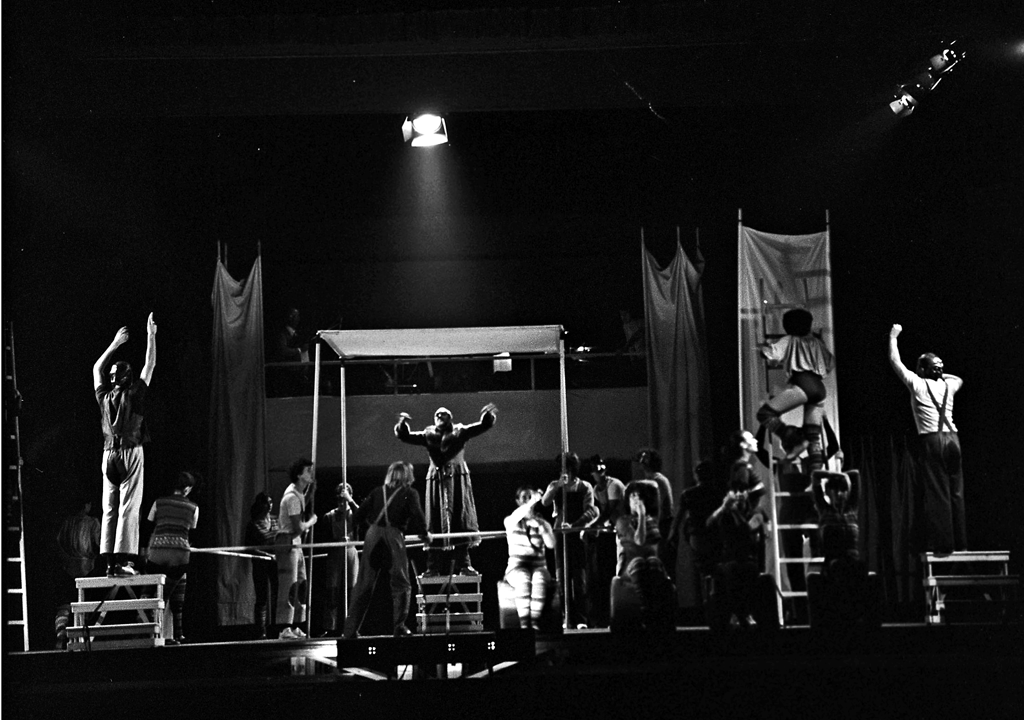
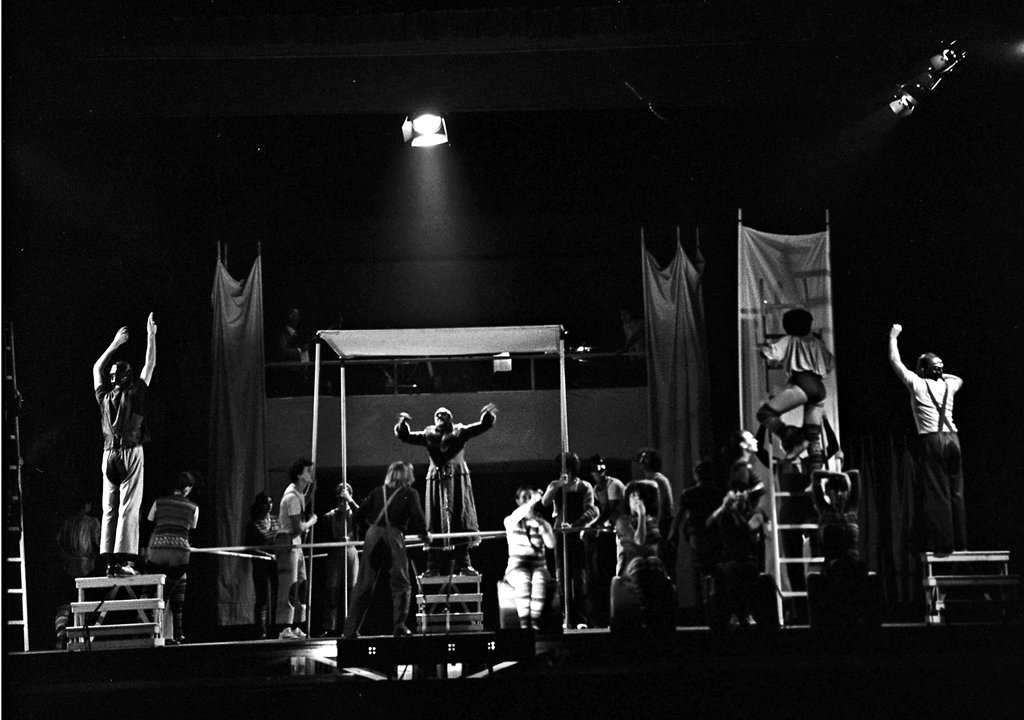
Soon after this scene, we are presented with a still darker version of this sort of vocality. The devil illustrates the contents of the book he is offering the soldier. In the original tale, the book contains accurate predictions of future business transactions, and thus enables its owner to amass enormous wealth. In Fo's updating, the book predicts the movements of the stock market, with the devil conjuring up for the soldier's benefit a re-enactment of the index's rapid fluctuations. Fo illustrated this by having a swarm of mimes gather around the devil as he guides the movement of the stocks with a sorcerer's skill. Music accompanies the movement, and not just any music but the Octet, a piece utterly devoid of the violin's – and thus the soldier's – lyrical interference.Footnote 49 For this scene, the typescript indicates an insert of rehearsal numbers 31 to 50 of the Octet, which correspond to variations A, B, C and D, plus the final repeat of variation A, from the second movement. The choice of music is especially apt because variation A, which opens and closes Fo's musical insert, is made up of rapid ascending and descending scales played by trumpets, bassoons, clarinet and flute. Meanwhile, the mimes divide into two groups: one, gathering around the devil on elevated platforms, mirrors the market movements by climbing up ladders and elevated platforms or jumping off of them, shouting ‘Sale, sale, sale, la borsa sale!’ (Rise, rise, rise, the stocks rise!) or ‘Scende, scende, scende, la borsa scende!’ (Fall, fall, fall, the stocks fall).Footnote 50 The other group, made up of women only, sits by the proscenium and mimics, in movement and voice, the work of female phone operators communicating the rises and falls by mumbling ‘high pitched, incomprehensible words’ (see Fig. 1).Footnote 51
Dario Fo, La storia di un soldato. The devil conjures up the stock market; the mimes mimic its rises and falls by climbing and falling off ladders.
It is striking how closely this plural vocalising resembles the basic characteristics of grammelot: its combination of different speech patterns, its partly non-semantic nature (the women's words) and the use of exaggerated gestures (the climbing and the falling of the other mimes). Yet these similarities only serve to articulate a radically opposite purpose. The mimes watching the stock market's rise and fall are not a cohesive collectivity – the sort that would speak through the single voice of grammelot – arguing against sovereign power; they are a heterogeneous crowd, either observing the stock market with rapt awe or excitedly registering, like brokers, its movements for the benefit of invisible phone interlocutors. It is, in short, difficult to draw the line between Fo's intention and his result. We have no reason to believe that he meant to put on stage such an ethically ambiguous crowd; yet it is impossible not to notice that the same crowd, which in the prologue had morphed from peasantry to the population of a crowded metropolis, is also at the root of the fundamental heterogeneity that causes the soldier's speech to break into a quartet of bickering voices in the following scene. As a snapshot of the position of the Left in the late 1970s, it is, in other words, sinister in its accuracy: the vox populi of La Scala's imagined Risorgimento past, the vox populi sought by Fo in his grammelot, is no longer one, and no longer discernible. In its place, for better or for worse, reigns the chaos of the multitude.
IV
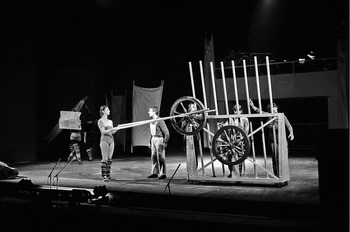
The only scene that makes use of grammelot finds the soldier, after bargaining his violin away, returning to his home village only to find that, although he has been away only for three days, three years have passed and none of his loved ones seems to recognise him (see Fig. 2). The use of grammelot is applied exclusively to the soldier's role. The devil, who is also the narrator in this scene, provides sardonic commentary. In the script, the soldier's role is written in conventional Italian, but preceded by the following annotation: ‘when the role is labelled “Soldier G.” this means that the line is to be delivered in grammelot – thus, the gist of the line written out in Italian has to be rendered in grammelot’.Footnote 52
Soldato G.: Oh, eccomi arrivato. Il mio paese, però, come sembra più piccolo adesso che sono stato in città!
Diavolo: Ecco il soldato che ritorna finalmente a casa, al suo paese. Certo, il paese adesso gli sembra molto più piccolo, adesso che è stato in città. Noterete, parla una strana lingua. Una lingua da forestiero. Sarà difficile che lo capiscano quelli del suo paese. Le ragazze!
Soldato G.: Ah, le ragazze! Le conosco. Però quella mi sembra più grande. Ehi, voi, scusate, ma voi non siete… non siete… no! Non sono!
Diavolo: Non lo riconoscono, né lo capiscono.Footnote 53
[Soldier G.: Ah, here I am. How small my village feels now that I have been to the city! Devil: Here is the soldier who has finally come home, to his village. His village certainly feels smaller now that he's been to the city. You'll notice that he speaks a strange language. A foreigner's language. It will be hard for the people in his village to understand him. The girls! Soldier G.: Ah, the girls! I know them! That one over there seems older, though. Hey you! Excuse me, but aren't you… aren't you… no! They're not. Devil: They don't recognise him, and they don't understand him.]
Dario Fo, La storia di un soldato. The soldier visits a factory back in his home village, and finds that no-one recognises him or understands what he is saying.

Grammelot, the theatrical voice that, unshackled from the semantics of official Italian, was once offered by Fo as a national vox populi, is seemingly put on stage for all to see it fail disastrously. This failure is confirmed when the villagers talk back to the soldier – only to shoo him away – and do so in well-spoken, dialect-free Italian.
The simplest explanation of this scene is as a commentary on the increased literacy and knowledge of official Italian that resulted from the post-war spread of radio and television. Indeed, part of the grammelot scene takes place in the factory where many of the soldier's loved ones are now working, a nod to the rise of industrialisation in Italy during the 1960s. The soldier's grammelot is, in this sense, nothing but the last remnant of a local dialect, wiped away by the impact of mass media. Yet there is much that is troubling about his failure to communicate. First, grammelot is not just a dialect but a mix of phonemes from several dialects and languages. Secondly, it seems odd that the soldier is trapped in grammelot, given that we have heard him speak flawless Italian thus far. In fact by the end of the scene the soldier, pushed over the edge by the sight of his girlfriend married to another and pregnant, switches back into Italian. At the height of his emotional distress, he reveals grammelot to be, far from the originary vox populi and a powerful means of expression, merely a residue of past linguistic habits. Grammelot as vox populi fails, it seems, not only because the villagers don't understand it, but because those alienated from it are precisely the disenfranchised people it is meant to ‘envoice’. Its use in the scene, then, stages a moment of rupture, of imminent extinction: the vox populi is offered to us as the withered sign to a lost signifier.
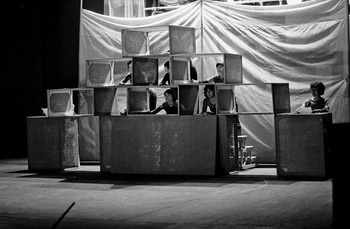
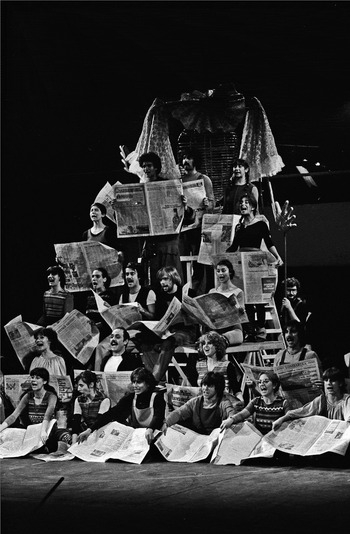
What follows onstage is a further descent into political and symbolic uncertainty, with incessant references to a plurality of voices that speak without being heard, striving fruitlessly to express themselves, vainly longing for unity but ultimately misunderstanding each other. The soldier goes to market in search of a new instrument, finds many precious violins, ‘but does not manage to play any of them. They all remain silent, voiceless’.Footnote 54 He is forced onto a medieval ‘ship of fools’ along with other misfits, their departure announced by a group of television presenters. Each presenter uses a different language to praise the restoration of medieval measures against those who do not conform to social norms; the effect is of a dystopian, mediatised tower of Babel (see Fig. 3). The closing scenes enact a chaotic fantasy in which the rapturous movements of the actors’ bodies on stage are set against the image of the disjointed ‘body politic’ itself, personified by a puppet of State, a seven-metre-long dummy manoeuvred by a group of mimes and technicians (see Fig. 4). As the soldier approaches, he is welcomed by the chorus to ‘an imaginary, longed for, non-existent’ democracy, where temporary alliances are formed and groups of actors stand in a semi-circle surrounding the puppet, representing the Left, Right and Centre coalitions. As the groups form, dissolve and merge into one another amidst a sonic carpeting of constant chattering and bickering, stage action grows increasingly chaotic. Four terrorists kidnap and kill one of the politicians, a straightforward reference to Aldo Moro's murder and the climate of instability and perilous alliances. As the puppet of State collapses under a terrorist attack and then stands up again with renewed zeal, the stage is occupied by the mimes playing a variety of characters – from policemen to members of parliament – all holding up newspapers or paper signs to form a wall-like surface.
Dario Fo, La storia di un soldato. Female actors speak from behind frames of cloth and wood, pretending to be TV news presenters.

Dario Fo, La storia di un soldato. Members of parliament bicker; the huge lifeless dummy representing the State towers behind them.

As this happens, the puppet of State's daughter, ‘Credibility’, makes her entrance. Credibility ‘does not laugh, does not speak, can no longer walk and looks like a lifeless puppet’; the soldier is required to rescue her and bring back her smile and her ‘movement’; but the movement that fuels the State is now solely ‘monetary’, and thus depicted by the constant flow of material goods and wealth.Footnote 55 As the script nears its end, it takes on a gratingly didactic character. The chorus literally illustrates the symbolic and allegorical tone of the Devil's speech:
Soldato: Ma a te che te ne viene in tasca che sia salvata la figlia del re?
Diavolo: […] Ebbene, ti dirò la verità. Io sono per la salvaguardia e la continuità delle istituzioni.
Coro: Attenti all'allegoria!
Diavolo: Sono per l'ordine contro il disordine. Sono per il bilancio dei pagamenti in attivo.
Coro: Capita l'allegoria?
Diavolo: Tu con il violino le ridarai l'anima, forse. […] Diventerai genero del re che è lo Stato. Da tutti invidiato, amato e reverito!
Grazia: Oh la bella favola del proletariato che va a nozze con la figlia del magnate.
Coro: E vissero felici e contenti.
Paolo: E nacque la socialdemocrazia.Footnote 56
[Soldier: What will you gain if the king's daughter is saved? Devil:… Well, I'll tell you the truth. I care about the safeguarding and continuity of institutions. Chorus: Pay attention to the allegory! Devil: I am in favour of order against disorder. I am for an active balance of payments. Chorus: Did you understand the allegory? Devil: With your violin, maybe you'll bring back her soul.… And you will become the son-in-law of the King, who is the State. You will be envied, loved and admired by all! Grazia: Ah, the beautiful fairy-tale of the proletariat that marries the rich man's daughter. Chorus: And they lived happily ever after. Paolo: And social democracy was born.]
With the marriage of the soldier and the State's daughter, Fo seems to point to his adaptation's uncertain status both as work of art and political statement. A product of the compromise between loyalty to old ideals and desire for renewal, of ‘apocalyptic’ and ‘integrated’ conceptions of militant engagement, the whole production is riddled with references to ambivalent forms of survival and expression in times of crisis. Such a condition represents the ultimate and most negative consequence of the death of grammelot as vox populi. It not only presents an aestheticised version of political events; it also resonates with the aesthetic aspect of the political crisis – the crisis of the voice of politics.
Indeed, the metaphor of failed vocal communication as a failure of political ‘voicing’ becomes so pervasive in Fo's staging because it crystalised – as the ideal of vox populi did at La Scala – aesthetics and politics in a single gesture. What is more, the crisis of the political voice, staged in the final scenes of Fo's L'Histoire, also resonates at a deeper level with an aesthetic crisis that accompanied the breakdown of left-wing politics in 1978. In the trials for the Moro murder on 7 April 1978, the issue of voice found its way into the sinews of forensic evidence against Antonio Negri, then a professor at Padua University, the leader of Potere Operaio and among the chief suspects in the Moro case. One of the most important exhibits in the case against Negri was a recording of his voice, which bore a striking resemblance to that of the kidnapper who called the Moro family on the eve of the murder. At stake in the comparison between these two recorded voices was not just Negri's putative involvement, but the identity of the political group that had perpetrated the murder.
The outcome was a spectacular failure: despite much scientific analysis, Negri's voice yielded no conclusive evidence; it failed, in other words, to speak of – and for – the political motives that had generated it. Unease about this particular failure found its material manifestation on 20 January 1980. While Negri was still under trial, the Italian weekly L'espresso released the two recorded voices as a 33rpm labelled ‘Fate voi la perizia fonica’ (You do the voice test).Footnote 57 The nation could thus bear witness to the voice's spectacular failure to name the body that produced it, a failure that in turn crystallised into a metaphor about the attribution of legal and political responsibility to those guilty of the crime. It is small wonder, then, that its putative owner, Antonio Negri, should produce from the depths of his prison cell in 1981 a first book in which he developed a concept of disunity, heterogeneity and elusiveness as the motor for political change: a concept of the multitude.Footnote 58
According to Negri, the fundamental aspect of multitude is its ambiguity, its internal fragmentation: multitude is certainly nothing like a cohesive collective – its vocal equivalent could never be the Risorgimento chorus – but rather an irrepressible, material force that, while constantly animated by tension, never achieves synthesis. As a political concept, it could only have been created at the moment of deepest crisis for the Left: the moment in which unitary political action, the ‘voicing’ of the people, vanished from the field of possibility. From a historical perspective, the concept of multitude was an attempt to retrieve a sense of potentiality out of an ideal of political action that had collapsed. As such, its strength derived precisely from its mercurial nature, its lack of identity or apparent purpose; descriptions of it, such this one from Negri, read like an inscrutable tangle of contradictions:
The logical network of utopia constructs itself on the basis of the correspondence between totality and multiplicity.… The terms of the correspondence comprehend … totalitarian tendencies, implying the potentiality of an absolute opposition, raised by the radicalization of the horizon of the totality and the extremism of the multiplicity.Footnote 59
Through the dense thicket of Negri's prose, we can distinguish the broad direction of his political thought: multitude is a plurality that unfolds without any inherently democratic tendency; it swings between the crushing sovereignty of a totalitarian state and the chaos of uncoordinated details. In other words, it does no specific party's bidding, not even that of the Left; but in this very respect, it is political energy at its purest and most invulnerable.
In discussing Negri's work on the multitude, Slavoj Žižek observes that ‘one can sense, behind the written lines, the smells and sounds of Seattle, Genoa and Zapatistas. So their theoretical limitation is simultaneously the limitation of the actual movement’.Footnote 60 His observation also holds for the particular concoction of stubborn hope and profound despair that accompanies a vision such as that of the multitude, rescued from the backlash of the 1980s and 1990s well into the twenty-first century. Settanta, a play co-authored by Negri and Raffaella Battaglini in 2007, features a dialogue between a nameless man and woman that renders this mood with piercing honesty:
L'uomo: La nostra generazione è stata repressa / questo è chiaro / ma […] l'orizzonte collettivo / non è sparito come dici tu / di certo si è eclissato / […] ma è già riapparso / in altre forme. […]
La donna: Non è andata così.
L'uomo: Non proprio / ma è bello pensarlo.Footnote 61
[The Man: Our generation has been repressed / that much is clear / but … the collective horizon / has not disappeared like you said / it has certainly been obscured / … but has already appeared again / in different forms…. The Woman: That is not how things went. The Man: Not exactly; but it is nice to think so.]
The elegiac tone is remarkable not so much in its obvious nostalgia, but to the extent to which the multitude – the ‘collective horizon’ – is rendered as an external aesthetic phenomenon, something to be watched from afar like the rising and falling of a star. As we have seen, the voice had been a century old, tried and tested linchpin between the political and the aesthetic, and one that featured prominently in the thought of Negri in the immediate aftermath of the 1978 crisis. The multitude is described in objective terms: ‘“it” constructs itself’; ‘“it” has not disappeared’. Fully external, a reality independent of any political actor's – or any intellectual's – control, a star rising on ever new horizons, it has lost its voice and gained the grim but untouchable potential of a multiplicity that never coalesces into a unified, resonant utterance.
When Fo accepted La Scala's commission for L'Histoire du soldat, he did much more than simply realign himself with institutional power: he positioned himself right in the middle of a fraught debate concerning the very possibility of political address in post-1968 Italy. As such, his L'Histoire addresses something far more disquieting than the feebly didactic message its creator seemed to have intended. While Fo may have wanted to twist Ramuz's original into a choral denunciation of the evils of capital, the collective stage pictures and the strange vocalizations that haunt them, read – and sound – like the theatrical incarnation of deep doubt. The 32 mimes are welded together into a protean collective that can jump, dance, speak but never raise its voice as one; they switch from peasants to urban dwellers, from soulfulness to sarcasm, from silence to amorphous babbling. As such, they are the allegorical personification of the inscrutable ‘mass’ of ‘mass media’, whose ethical charge – or lack of charge – Eco and Pasolini were passionately debating in just those years. As left-wing activists and intellectuals such as Viale and Negri agonized over the idea of the ‘voicing’ of a people through political action, La Scala grew increasingly laden with its historical legacy as the vox populi of the Risorgimento – the place in which art and politics could supposedly unite into a single utterance. Fo looked towards La Scala as a mirror onto the splendours and miseries of what he considered the political accomplishments of the ‘progressive bourgeoisie’ during the previous century. Abbado, in turn, saw in Fo the potential for the broad engagement he sought among the lower classes.
Yet the meeting between the two produced something far murkier, and thus perhaps more truthful, than either Fo's or La Scala's ideological agendas could imagine: a complex, often frustrating meditation on the relation between voice and politics, between the one and the many. As a theatrical creation, Fo's La storia di un soldato was not terribly successful; despite the fact that he had mentioned plans for subsequent collaboration with La Scala, he undertook no further work there.Footnote 62 And yet one small but telling feature bears witness to the intense, if temporary, collaboration of that year: La Scala's archives host La storia di un soldato – a work that involves no singing whatsoever – under the unlikely rubric of opera. This is a striking detail if we consider that Strehler's version of 1957, which was performed alongside a more traditionally operatic work (Luciano Chailly's Una domanda di matrimonio), is filed as ‘prosa’, prose theatre. Indeed, almost none of the subsequent productions of L'Histoire hosted by La Scala are filed as operas.Footnote 63 Of course, Fo's two-hour staging and his frequent use of stage music might have pushed the original across a generic boundary. Yet it is unlikely that such details could ever have warranted the label of ‘opera’ on their own. Surely, then, the appellation functions as a signifier for something altogether more complex. It points back to a time when, under the pressure of La Scala's tortured two-hundredth birthday, the murder of Moro and the resurgence of Risorgimento ghosts, opera came to stand for a bold, if wretched, experiment in the partaking of an utterance.