


Introduction
Autism spectrum disorder (ASD) is a complex neurodevelopmental condition that shapes the way individuals perceive and interact with the world. It is marked by differences in social interaction and communication, repetitive and restrictive behaviors or interests, and altered sensory processing (American Psychiatric Association [APA], 2022). A recent review on ASD prevalence estimates that 1/100 children receive an autismFootnote 1 diagnosis around the world (Zeidan et al., Reference Zeidan, Fombonne, Scorah, Ibrahim, Durkin, Saxena, Yusuf, Shih and Elsabbagh2022). Autism manifests early in life and can profoundly influence daily functioning across multiple domains (Tillmann et al., Reference Tillmann, San José Cáceres, Chatham, Crawley, Holt, Oakley, Banaschewski, Baron-Cohen, Bölte, Buitelaar, Durston, Ham, Loth, Simonoff, Spooren, Murphy and Charman2019).
Research consistently reports that life expectancy in autistic population is notably shorter than that of neurotypical individuals (Hirvikoski et al., Reference Hirvikoski, Mittendorfer-Rutz, Boman, Larsson, Lichtenstein and Bölte2016). Autistic people who require higher levels of support face even greater reductions in lifespan (Sala et al., Reference Sala, Amet, Blagojevic-Stokic, Shattock and Whiteley2020). A range of medical comorbidities, such as epilepsy, cardiovascular problems, and other chronic conditions, are commonly experienced by autistic people (Al-Beltagi, Reference Al-Beltagi2021; Ward et al., Reference Ward, Weir, Allison and Baron-Cohen2023), often linked to genetic mutations associated with autism (Khachadourian et al., Reference Khachadourian, Mahjani, Sandin, Kolevzon, Buxbaum, Reichenberg and Janecka2023; Matson & Goldin, Reference Matson and Goldin2013; Polyak et al., Reference Polyak, Kubina and Girirajan2015). However, beyond these biological influences, other factors, including mental health conditions, play a significant role in shaping life expectancy (Barlattani et al., Reference Barlattani, D’Amelio, Cavatassi, De Luca, Di Stefano, Di Berardo, Mantenuto, Minutillo, Leonardi, Renzi, Russo, Rossi, Pacitti and Pacitti2023; DiBlasi et al., Reference DiBlasi, Kirby, Gaj, Docherty, Keeshin, Bakian and Coon2020; Shaltout et al., Reference Shaltout, Al-Dewik, Samara, Morsi and Khattab2020). Indeed, psychiatric comorbidities are prevalent among autistic people (Rim et al., Reference Rim, Kwak and Park2023), affecting approximately 80% of this population, with anxiety and depression being the most frequently observed (Linden et al., Reference Linden, Best, Elise, Roberts, Branagan, Tay, Crane, Cusack, Davidson, Davidson, Hearst, Mandy, Rai, Smith and Gurusamy2023).
Beyond mental health concerns, autistic people, particularly adults, exhibit alarmingly high rates of suicide-related behaviors. These include suicidal ideation, which is defined as thoughts about ending one’s own life; suicide planning, which refers to the presence of a concrete plan to end one’s own life; suicide attempts, which are defined as any behavior undertaken with the intention of ending one’s own life; and completed suicide (Cassidy et al., Reference Cassidy, Bradley, Bowen, Wigham and Rodgers2018; Costa et al., Reference Costa, Loor and Steffgen2020). Estimations suggest that suicidal ideation occurs in 11–66% of autistic people, while suicide attempts range from 1 to 35% (Hedley & Uljarevic, Reference Hedley and Uljarević2018). Moreover, between 7.3% and 15% of adults who die by suicide present a concurrent autism diagnosis (Segers & Rawana, Reference Segers and Rawana2014). In a clinical cohort study involving late-diagnosed adults, 31% reported feelings of depression, 35% reported planning or attempting suicide, and 66% experienced suicidal ideation, compared to the general population (Cassidy et al., Reference Cassidy, Bradley, Robinson, Allison, McHugh and Baron-Cohen2014). Furthermore, both death by suicide (Hwang et al., Reference Hwang, Srasuebkul, Foley, Arnold and Trollor2019; Mouridsen et al., Reference Mouridsen, Brønnum-Hansen, Rich and Isager2008) and suicide attempts (Hirvikoski et al., Reference Hirvikoski, Boman, Chen, D’Onofrio, Mittendorfer-Rutz, Lichtenstein, Bölte and Larsson2020; Hwang et al., Reference Hwang, Srasuebkul, Foley, Arnold and Trollor2019) are more common in autistic people compared to the general population. Recent studies report suicidal ideation prevalence at 34.2%, suicide planning at 21.9%, and suicide attempts at 24.3% among autistic people (Newell et al., Reference Newell, Phillips, Jones, Townsend, Richards and Cassidy2023). Particularly concerning is the heightened risk among autistic females (Kirby et al., Reference Kirby, Bakian, Zhang, Bilder, Keeshin and Coon2019) and those without intellectual disability (ID) (Hirvikoski et al., Reference Hirvikoski, Mittendorfer-Rutz, Boman, Larsson, Lichtenstein and Bölte2016).
In light of these findings, it is important to systematically examine the factors contributing to suicide-related behaviors in autism. A comprehensive understanding of both risk and protective factors is essential for identifying those at heightened risk of engaging in suicidal behaviors. This is especially important considering the significant communication and self-expression challenges faced by many autistic people (APA, 2022; Sami et al., 2014). Moreover, gaining insights into potential risk and protective factors is critical for designing intervention programs and strategies aimed at preventing or mitigating these behaviors in this population.
According to the Interpersonal Theory of Suicide (Van Orden et al., Reference Van Orden, Witte, Cukrowicz, Braithwaite, Selby and Joiner2010), three main constructs have been identified as contributing to the increased risk of suicide in autistic people. These are: perceived burdensomeness or awareness of burden (i.e., physical and mental health conditions), thwarted belongingness (e.g., social isolation, lack of supportive relationships), and capability for suicide (e.g., access to lethal means) (Su & Procyshyn, Reference Su and Procyshyn2023). These constructs may be intensified by autism-specific characteristics. For instance, autistic people often exhibit altered sensory processing patterns and challenges in verbal and nonverbal communication, which can exacerbate feelings of isolation and the impact of systemic societal barriers, as well as increasing the likelihood of experiencing intimidation and abuse from harassers (Aral et al., Reference Aral, Usta and Aral2023; Dow et al., Reference Dow, Morgan, Hooker, Michaels, Joiner, Woods and Wetherby2021; Moseley et al., Reference Moseley, Atkinson, Surman, Greville-Harris, May and Vuillier2023). In addition to this, recent research in the field of camouflaging of autistic traits has uncovered a link between this phenomenon and suicide, particularly among autistic women, who often experience stigma, social prejudice, and mental health problems (Arqueros et al., Reference Arqueros, Jamett-Cuevas, Pulgar-Vera, Santander-Gonzalez, Pemau and Álvarez-Cabrera2025; Cassidy, Gould, et al., Reference Cassidy, Gould, Townsend, Pelton, Robertson and Rodgers2020; Tubío-Fungueiriño et al., Reference Tubío-Fungueiriño, Cruz, Sampaio, Carracedo and Fernández-Prieto2021).
Furthermore, previous systematic reviews have identified psychiatric comorbidities, particularly depression and anxiety, alongside adverse life experiences such as physical or sexual abuse and bullying, as key contributors to suicide risk in autistic people (Richa et al., Reference Richa, Fahed, Khoury and Mishara2014). Additionally, cognitive factors play a role, with individuals without IDs being at higher risk, while those with severe intellectual impairments may face greater difficulties in conceptualizing, planning, or carrying out suicide-related behaviors (Hannon & Taylor, Reference Hannon and Taylor2013). Moreover, a lack of social support has been consistently associated with increased suicide risk (Hedley et al., Reference Hedley, Uljarević, Wilmot, Richdale and Dissanayake2017).
However, compared to previous research on risk factors, considerably less is known about protective factors against suicide in autism. Emerging evidence suggests that social connections and interpersonal relationships may serve as critical protective factors (Mournet et al., Reference Mournet, Wilkinson, Bal and Kleiman2023).
Despite the growing body of research on suicidality in autism, the voices of autistic people remain largely absent from the scientific literature about suicide. Some studies have focused on investigating the relationship between the perspectives of autistic people regarding social support and either mental health (Scott & Sedgewick, Reference Scott and Sedgewick2021) or quality of life (Petty et al., Reference Petty, Allen, Pickup and Woodier2023), or the experiences of camouflaging and their impact on mental health (Bradley et al., Reference Bradley, Shaw, Baron-Cohen and Cassidy2021; Khudiakova et al., Reference Khudiakova, Levy, Sowden-Carvalho and Surtees2025). While these studies are important, they lack a deeper understanding of the relationship between these phenomena and suicide-related behaviors in this population. This may limit current knowledge and exclude specific risk and protective factors that may be underlying suicide.
Given the pressing need to better understand both risk and protective factors, this study systematically reviews the existing literature on suicide-related behaviors (ideation, attempts, plans, and death) in autistic people to identify such factors. This would facilitate the development of specific instruments to assess risk of suicide in this population and inform intervention plans based on scientific literature.
Method
This systematic review follows the Preferred Reporting Items for Systematic Reviews and Meta-Analyses (PRISMA) checklist guidelines (Page et al., Reference Page, McKenzie, Bossuyt, Boutron, Hoffmann, Mulrow, Shamseer, Tetzlaff, Akl, Brennan, Chou, Glanville, Grimshaw, Hróbjartsson, Lalu, Li, Loder, Mayo-Wilson, McDonald, McGuinness and Moher2021). The review protocol was registered in the PROSPERO database with the registration number (blinded for anonymous review).
Search Strategy
We systematically searched PubMed, Web of Science, PsychInfo, and Scopus databases using the filter “English as language of publication.” We searched for empirical studies published until March 3, 2025. The following combination of search terms was used in the four databases: ((suicid*) OR (suicide attempts) OR (suicidal ideation) OR (suicidal thoughts)) AND ((asd) OR (autism spectrum disorder) OR (autism) OR (autistic) OR (asperger)).
Duplicated records were removed before screening. During the screening phase, titles and abstracts were first screened for eligibility. The full-texts of the selected studies were then examined according to the inclusion/exclusion criteria described below. Any discrepancies were resolved in a meeting with another researcher. Studies were screened and excluded based on the following exclusion criteria: (a) different format than empirical paper (i.e., book chapters, reviews, meta-analysis, congress abstracts or communications, letters to the editor, and case reports); (b) studies not focused on ASD, autism, or Asperger’s syndrome; (c) animal studies and therefore not involving human samples; and (d) studies using a methodology that did not aim to assess suicide risk or protective factors that the participant can inform (that is, biological processes, genetics, secondary effects to certain medication).
Eligibility Criteria
Studies were selected to be included in the review based on the following eligibility/inclusion criteria: (a) studies whose sample was diagnosed with ASD, autism, or Asperger’s disorder according to the Diagnostic and Statistical Manual of Mental Disorders, fourth-revised edition (DSM-IV-TR, APA, 2001) or fifth and fifth-revised editions (DSM-5 [APA, 2013] and DSM-5-TR [APA, 2022]), (b) studies whose sample comprise male and female representation, (c) studies whose sample was larger than 50 autistic people, and (d) research that focused on identifying suicide risk factors and/or suicide protective factors but not focused on adapting or validating instruments to measure them.
We should note that a minimum sample size of 50 autistic participants was defined to ensure the representativeness and generalizability of the results. This ensures the inclusion of methodologically robust studies with improved comparability. At the same time, this also helps to minimize the bias associated with small samples and favors more robust conclusions.
Data Synthesis and Analysis
Although a meta-analysis was initially planned, it could not be conducted due to the heterogeneity of quantitative data across the included studies. Given this diversity, a narrative approach was adopted to synthesize the results. The findings were organized thematically into eight categories: psychiatric comorbidities; bullying, cyberbullying and other forms of victimization; sex/gender; age; cognition and executive functioning; social risk factors; family risk factors; and other risk factors. For each category, we present the number of studies supporting each association (i.e., the association between risk or protective factor with suicide-related behaviors). This approach enabled a structured, consistent, and transparent presentation of the findings despite the absence of quantitative analysis.
Risk of Bias Assessment
The methodological quality of the included results was assessed using the Joanna Briggs Institute Critical Appraisal Checklist for Systematic Reviews (Moola et al., Reference Moola, Munn, Tufanaru, Aromataris, Sears, Sfetcu, Currie, Qureshi, Mattis, Lisy, Mu, Aromataris and Munn2017). Each study was evaluated across eight criteria, including the comprehensiveness of the objective and selection criteria, providing a detailed sample description and appropriateness of data analysis. The selected studies then were categorized according to the percentage of criteria that met: high-quality (>70%), moderate-quality (50–70%), and low-quality studies (<50%) (Brouwers et al., Reference Brouwers, Kho, Browman, Burgers, Cluzeau, Feder, Fervers, Graham, Grimshaw, Hanna, Littlejohns, Makarski and Zitzelsberger2010). Of the 19 included studies, 16 were classified as high-quality: 12 met 8/8 criteria (100%) (Bal et al., Reference Bal, Leventhal, Carter, Kim, Koh, Ha, Kwon, Hong and Kim2022; Hedley et al., Reference Hedley, Uljarević, Foley, Richdale and Trollor2018; Horowitz et al., Reference Horowitz, Thurm, Farmer, Mazefsky, Lanzillo, Bridge, Greenbaum, Pao and Siegel2018; Hu et al., Reference Hu, Liu, Hsiao, Ni, Liang, Lin, Chan, Hsieh, Wang, Lee, Chou and Yen2019; Hunsche et al., Reference Hunsche, Saqui, Mirenda, Zaidman-Zait, Bennett, Duku, Elsabbagh, Georgiades, Smith, Szatmari, Ungar, Vaillancourt, Waddell, Zwaigenbaum and Kerns2020; Karakoç Demirkaya et al., Reference Karakoç Demirkaya, Tutkunkardaş and Mukaddes2016; Lin et al., Reference Lin, Peng, Hsiao, Chou and Yen2020; Liu et al., Reference Liu, Wang, Hsiao, Ni, Liang, Lin, Chan, Hsieh, Wang, Lee, Chou and Yen2022; McDonnell et al., Reference McDonnell, DeLucia, Hayden, Anagnostou, Nicolson, Kelley, Georgiades, Liu and Stevenson2020; Nyrenius et al., Reference Nyrenius, Waern, Eberhard, Ghaziuddin, Gillberg and Billstedt2023; Schwartzman et al., Reference Schwartzman, Williams, Richards, Mattheiss and Gotham2022; Strang et al., Reference Strang, Anthony, Song, Lai, Knauss, Sadikova, Graham, Zaks, Wimms, Willing, Call, Mancilla, Shakin, Vilain, Kim, Maisashvili, Khawaja and Kenworthy2023). One study met 7/8 criteria (87.5%) (Conner et al., Reference Conner, Golt, Righi, Shaffer, Siegel and Mazefsky2020) and three met 6/8 criteria (75%) (Hirvikoski et al., Reference Hirvikoski, Boman, Chen, D’Onofrio, Mittendorfer-Rutz, Lichtenstein, Bölte and Larsson2020; Jokiranta-Olkoniemi et al., Reference Jokiranta-Olkoniemi, Gyllenberg, Sucksdorff, Suominen, Kronström, Chudal and Sourander2021; La Buissonnière Ariza et al., Reference La Buissonnière Ariza, Schneider, Cepeda, Wood, Kendall, Small, Wood, Kerns, Saxena and Storch2022). Three studies were classified as moderate-quality (Hand et al., Reference Hand, Benevides and Carretta2020; Holden et al., Reference Holden, Mueller, McGowan, Sanyal, Kikoler, Simonoff, Velupillai and Downs2020; Kõlves et al., Reference Kõlves, Fitzgerald, Nordentoft, Wood and Erlangsen2021) as they met 5/8 criteria (62%). No studies were classified as low quality. Discrepancies were resolved through discussion with another reviewer. A comprehensive overview of the quality of the studies is provided in Supplementary Table S1.
Results
Data Extraction
The initial search of the databases yielded 4233 studies. After the elimination of duplicate results (1694), 2539 studies were selected for title and abstract inspection. After this first step of the screening phase, 136 studies were sought for retrieval. Whilst 8 studies could not be retrieved, 128 studies were finally assessed by full-text reading for its inclusion in the review.
In all, 109 articles were excluded as they did not meet the eligibility criteria. Of these, eight articles were excluded because they did not ensure a minimum of 50 autistic people. Eighty-nine studies were not included in the full-text analysis because the inclusion criteria of the individuals being diagnosed according to the DSM-IV-TR, DSM-5, or DSM-5-TR criteria could not be confirmed. Two of the studies did not use a gender-diverse sample (both were only focused on females). Finally, 10 studies were discarded based on their methodology, as they were adaptations and/or validations of scales to assess suicidality. The flowchart diagram (Figure 1) depicts the reasons for excluding articles.
PRISMA flowchart diagram.
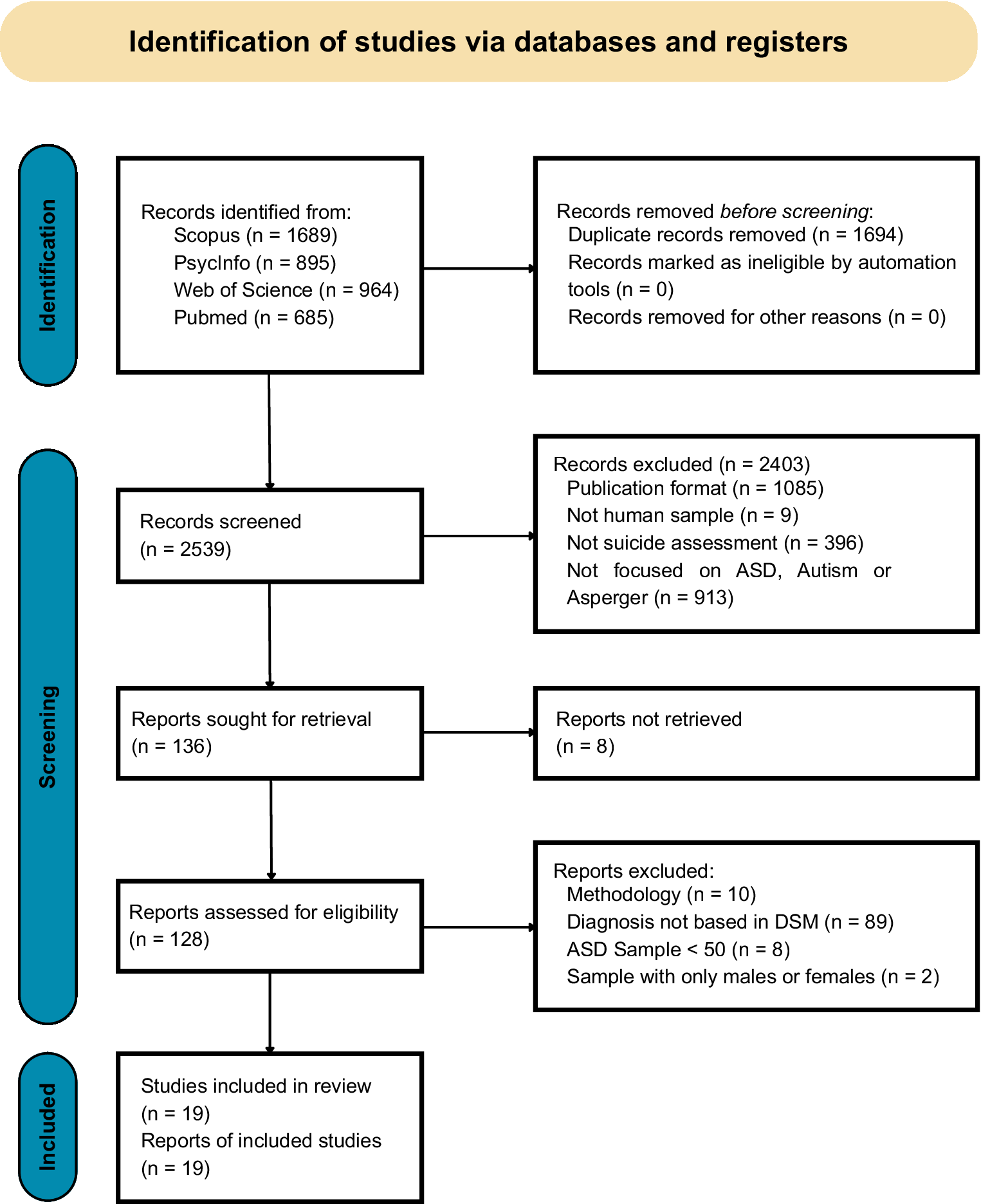
Figure 1. Long description
Starting at the top, the flowchart is anchored on the left with three vertical stages: Identification, Screening, and Included. Under Identification, records were identified from Scopus (1689), PsycInfo (895), Web of Science (964), and Pubmed (685), totaling 4233. To the right, records removed before screening include 1694 duplicates, zero ineligible by automation, and zero removed for other reasons. The remaining 2539 records were screened. In Screening, 2403 records were excluded for publication format (1085), not human sample (9), not suicide assessment (396), and not focused on ASD, Autism, or Asperger (913). The left branch continues with 136 reports sought for retrieval; 8 were not retrieved. Of 128 reports assessed for eligibility, 10 were excluded for methodology, 89 for diagnosis not based in D S M, 8 for ASD sample less than 50, and 2 for samples with only males or females. At the bottom, 19 studies and 19 reports were included in the review.
Nineteen studies were included in this review. All studies used a sample size of at least 50 autistic people diagnosed according to DSM-IV-TR, DSM-5, or DSM-5-TR.
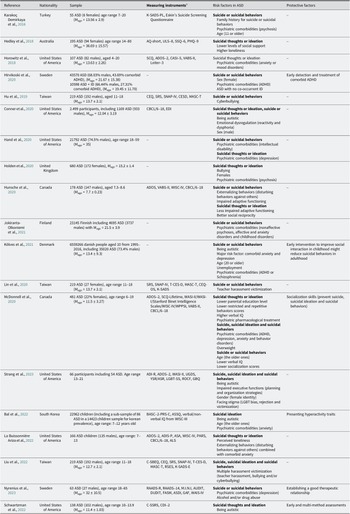
Among the included articles, two studies (Karakoç Demirkaya et al., Reference Karakoç Demirkaya, Tutkunkardaş and Mukaddes2016; Schwartzman et al., Reference Schwartzman, Williams, Richards, Mattheiss and Gotham2022) used a specific screening questionnaire for detecting suicidal behaviors. In five studies (Hand et al., Reference Hand, Benevides and Carretta2020; Hirvikoski et al., Reference Hirvikoski, Boman, Chen, D’Onofrio, Mittendorfer-Rutz, Lichtenstein, Bölte and Larsson2020; Holden et al., Reference Holden, Mueller, McGowan, Sanyal, Kikoler, Simonoff, Velupillai and Downs2020; Jokiranta-Olkoniemi et al., Reference Jokiranta-Olkoniemi, Gyllenberg, Sucksdorff, Suominen, Kronström, Chudal and Sourander2021; Kõlves et al., Reference Kõlves, Fitzgerald, Nordentoft, Wood and Erlangsen2021), the assessment of suicide-related behaviors relied solely on information collected during clinical appointments to gather sociodemographic and medical information. Four studies (Conner et al., Reference Conner, Golt, Righi, Shaffer, Siegel and Mazefsky2020; Hunsche et al., Reference Hunsche, Saqui, Mirenda, Zaidman-Zait, Bennett, Duku, Elsabbagh, Georgiades, Smith, Szatmari, Ungar, Vaillancourt, Waddell, Zwaigenbaum and Kerns2020; La Buissonnière Ariza et al., Reference La Buissonnière Ariza, Schneider, Cepeda, Wood, Kendall, Small, Wood, Kerns, Saxena and Storch2022; McDonnell et al., Reference McDonnell, DeLucia, Hayden, Anagnostou, Nicolson, Kelley, Georgiades, Liu and Stevenson2020) estimated the presence of suicidal ideation and/or attempts based on items 91 and/or 18 from the Child Behavior Checklist (CBCL, Achenbach & Rescorla, Reference Achenbach and Rescorla2001). One study (Bal et al., Reference Bal, Leventhal, Carter, Kim, Koh, Ha, Kwon, Hong and Kim2022) based their assessment of suicide ideation on items 92 and 138 from the Behavior Assessment System for Children, Second Edition, Parent Rating Scales-Child (Reynolds & Kamphaus, Reference Reynolds and Kamphaus2004). Hedley et al. (Reference Hedley, Uljarević, Wilmot, Richdale and Dissanayake2017) assessed suicidal behaviors or ideation based on the PHQ-9 questionnaire, while Horowitz et al. (Reference Horowitz, Thurm, Farmer, Mazefsky, Lanzillo, Bridge, Greenbaum, Pao and Siegel2018) based their information of suicidal behaviors on the CASI-5. Five studies (Holden et al., Reference Holden, Mueller, McGowan, Sanyal, Kikoler, Simonoff, Velupillai and Downs2020; Hu et al., Reference Hu, Liu, Hsiao, Ni, Liang, Lin, Chan, Hsieh, Wang, Lee, Chou and Yen2019; Lin et al., Reference Lin, Peng, Hsiao, Chou and Yen2020; Liu et al., Reference Liu, Wang, Hsiao, Ni, Liang, Lin, Chan, Hsieh, Wang, Lee, Chou and Yen2022; Strang et al., Reference Strang, Anthony, Song, Lai, Knauss, Sadikova, Graham, Zaks, Wimms, Willing, Call, Mancilla, Shakin, Vilain, Kim, Maisashvili, Khawaja and Kenworthy2023) used targeted scales to assess potential suicide risk and protective factors according to the existing literature: assessment of bullying, cyberbullying and/or teacher harassment victimization; loneliness and social adjustment or stigma related to belonging to the LGBTI+ community, among others.
Table 1 summarizes the studies included in this review reporting on suicide risk and protective factors.
Summary of the results of the included studies
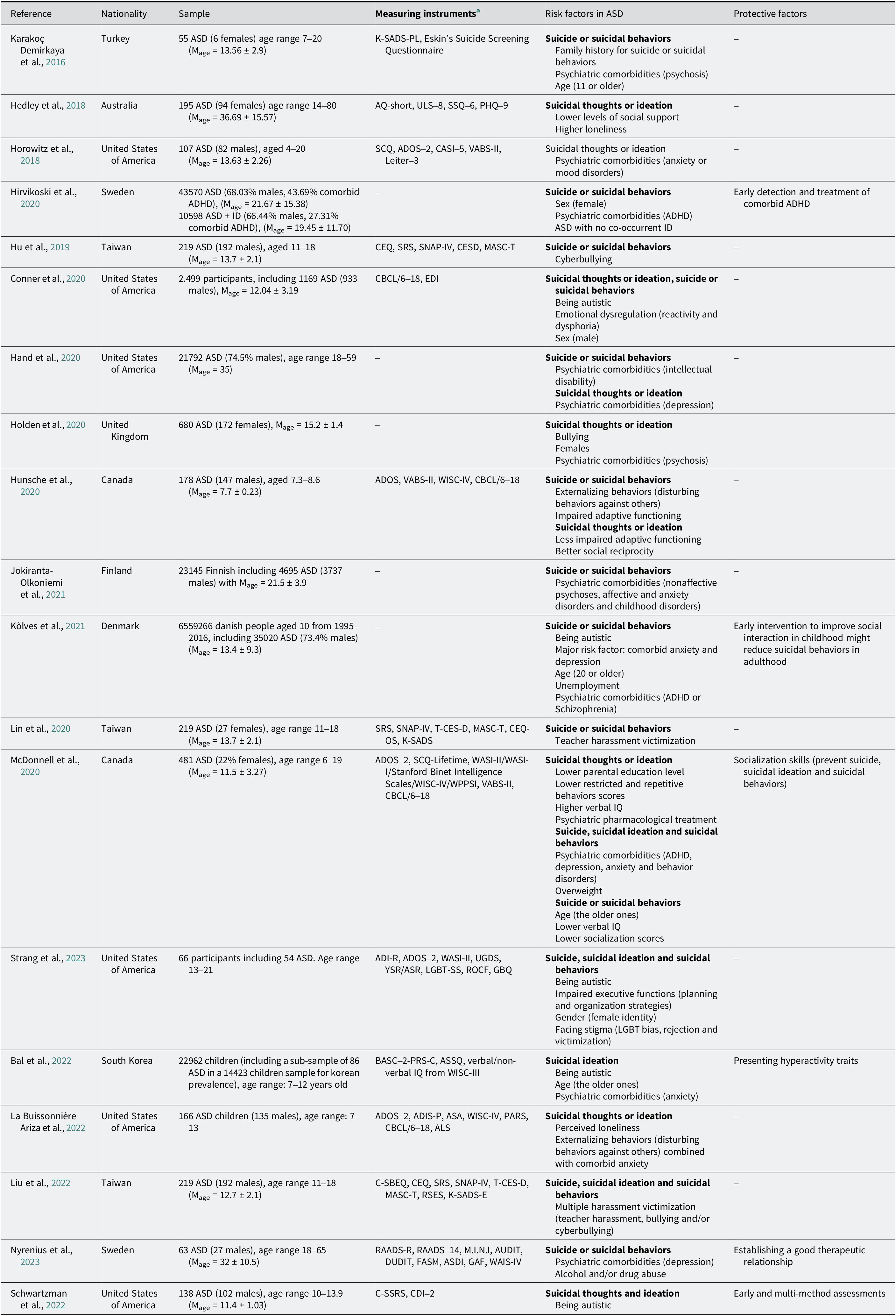
Table 1. Long description
The table consists of six columns: Reference, Nationality, Sample, Measuring instruments, Risk factors in A S D, and Protective factors. Each row details a study, beginning with Karakoç Demirkaya et al., 2016 from Turkey, sample of 55 A S D, instruments K-SADS-PL and Eskin’s Suicide Screening Questionnaire, risk factors include suicide or suicidal behaviors, family history, psychiatric comorbidities (psychosis), age 11 or older, no protective factors listed. Hedley et al., 2018 from Australia, 195 A S D, instruments A Q-short, U L S-8, S S Q-6, P H Q-9, risk factors are suicidal thoughts or ideation, lower social support, higher loneliness, no protective factors. Horowitz et al., 2018 from United States, 107 A S D, instruments S C Q, A D O S-2, C A S I-5, V A B S-I I, Leiter-3, risk factors are suicidal thoughts or ideation, psychiatric comorbidities (anxiety or mood disorders), no protective factors. Hirvikoski et al., 2020 from Sweden, 43570 A S D and 10598 A S D plus I D, no instruments listed, risk factors are suicide or suicidal behaviors, sex (female), psychiatric comorbidities (A D H D), A S D without co-occurrent I D, protective factor is early detection and treatment of comorbid A D H D. Hu et al., 2019 from Taiwan, 219 A S D, instruments C E Q, S R S, S N A P-I V, C E S D, M A S C-T, risk factors are suicide or suicidal behaviors, cyberbullying, no protective factors. Conner et al., 2020 from United States, 2499 participants including 1169 A S D, instruments C B C L/6-18, E D I, risk factors are suicidal thoughts or ideation, suicide or suicidal behaviors, being autistic, emotional dysregulation, sex (male), no protective factors. Hand et al., 2020 from United States, 21792 A S D, no instruments listed, risk factors are suicide or suicidal behaviors with psychiatric comorbidities (intellectual disability), suicidal thoughts or ideation with psychiatric comorbidities (depression), no protective factors. Holden et al., 2020 from United Kingdom, 680 A S D, no instruments listed, risk factors are suicidal thoughts or ideation, bullying, females, psychiatric comorbidities (psychosis), no protective factors. Hunsche et al., 2020 from Canada, 178 A S D, instruments A D O S, V A B S-I I, W I S C-I V, C B C L/6-18, risk factors are suicide or suicidal behaviors, externalizing behaviors, impaired adaptive functioning, suicidal thoughts or ideation, less impaired adaptive functioning, better social reciprocity, no protective factors. Jokiranta-Olkoniemi et al., 2021 from Finland, 23145 Finnish including 4695 A S D, no instruments listed, risk factors are suicide or suicidal behaviors, psychiatric comorbidities (nonaffective psychoses, affective and anxiety disorders, childhood disorders), no protective factors. Kõlves et al., 2021 from Denmark, 6559266 Danish people including 35020 A S D, no instruments listed, risk factors are suicide or suicidal behaviors, being autistic, comorbid anxiety and depression, age 20 or older, unemployment, psychiatric comorbidities (A D H D or schizophrenia), protective factor is early intervention to improve social interaction in childhood. Lin et al., 2020 from Taiwan, 219 A S D, instruments S R S, S N A P-I V, T-C E S-D, M A S C-T, C E Q-O S, K-SADS, risk factors are suicide or suicidal behaviors, teacher harassment victimization, no protective factors. McDonnell et al., 2020 from Canada, 481 A S D, instruments A D O S-2, S C Q-Lifetime, W A S I-I I/W A S I-I/W P P S I, V A B S-I I, C B C L/6-18, risk factors are suicidal thoughts or ideation, lower parental education, lower restricted and repetitive behaviors scores, higher verbal I Q, psychiatric pharmacological treatment, suicide, suicidal ideation and suicidal behaviors, psychiatric comorbidities (A D H D, depression, anxiety, behavior disorders), overweight, suicide or suicidal behaviors, age (older), lower verbal I Q, lower socialization scores, protective factor is socialization skills. Strang et al., 2023 from United States, 66 participants including 54 A S D, instruments A D I-R, A D O S-2, W A S I-I I, U G D S, Y S R/A S R, L G B T-S S, R O C F, G B Q, risk factors are suicide, suicidal ideation and suicidal behaviors, being autistic, impaired executive functions, gender (female identity), facing stigma (L G B T bias, rejection, victimization), no protective factors. Bal et al., 2022 from South Korea, 22962 children including 86 A S D, instruments B A S C-2-P R S-C, A S S Q, verbal/non-verbal I Q from W I S C-I I I, risk factors are suicidal ideation, being autistic, age (older), psychiatric comorbidities (anxiety), protective factor is hyperactivity traits. La Buissonnière Ariza et al., 2022 from United States, 166 A S D children, instruments A D O S-2, A D I S-P, A S A, W I S C-I V, P A R S, C B C L/6-18, A L S, risk factors are suicidal thoughts or ideation, perceived loneliness, externalizing behaviors combined with comorbid anxiety, no protective factors. Liu et al., 2022 from Taiwan, 219 A S D, instruments C-S B E Q, C E Q, S R S, S N A P-I V, T-C E S-D, M A S C-T, R S E S, K-SADS-E, risk factors are suicide, suicidal ideation and suicidal behaviors, multiple harassment victimization (teacher harassment, bullying, cyberbullying), no protective factors. Nyrenius et al., 2023 from Sweden, 63 A S D, instruments R A A D S-R, R A A D S-14, M I N I, A U D I T, D U D I T, F A S M, A S D I, G A F, W A I S-I V, risk factors are suicide or suicidal behaviors, psychiatric comorbidities (depression), alcohol or drug abuse, protective factor is establishing a good therapeutic relationship. Schwartzman et al., 2023 from United States, 138 A S D, instruments C-S S R S, C D I-2, risk factors are suicidal thoughts and ideation, being autistic, protective factor is early and multi-method assessments. All abbreviations for instruments and diagnoses are defined in the table footnote.
Note: ABC-I = Aberrant Behavior Checklist-Irritability Subscale; ADI-R = Autism Diagnostic Interview-Revised; ADIS-P = Anxiety Disorders Interview Schedule—Parent version; ADOS-2 = Autism Diagnostic Observation Schedule, Second Edition; ADOS-G = Autism Diagnostic Observation Schedule-Generic; ALS = Asher Loneliness Rating Scale; AQ-short = Autism-spectrum quotient-short version; ASA = Autism Spectrum Addendum; ASDI = Asperger Syndrome (and high functioning autism) Diagnostic Interview; ASSQ: Autism Spectrum Screening Questionnaire; AUDIT = Alcohol Use Disorders Identification Test; BASC-2-PRS-C:Behavior Assessment System for Children, Second Edition, Parent Rating Scales-Child; CASI-5 = Child and Adolescent Symptom Inventory-5; CBCL/6–18 = Child Behavior Checklist for Ages 6–18; CDI-2 = Children’s Depression Inventory; CEQ = Cyberbullying Experiences Questionnaire; CEQ-OS = Close-Ended Questionnaire of the Occupational Survey; CESD = Taiwanese Version of the Center for Epidemiological Studies Depression Scale; C-SBEQ = Chinese version of the School Bullying Experience Questionnaire; C-SSRS = Columbia Suicide Severity Rating Scale; DUDIT = Drug Use Disorders Identification Test; EDI = Emotion Dysregulation Inventory; FASM = Functional Assessment of Self-Mutilation; GAF = Global Assessment of Functioning; GBQ = Gender-diversity-related Barriers Questionnaire; ID = Intellectual Disability; K-SADS-E = Kiddie Schedule for Affective Disorders and Schizophrenia; Leiter-3 = Leiter International Performance Scale, Third Edition; LGBT-SS = LGBT Stigma Scale; MASC-T = Multidimensional Anxiety Scale for Children; M.I.N.I = Mini-International Neuropsychiatric Interview; PARS = Pediatric Anxiety Rating Scale; PHQ-9 = Patient Health Questionnaire-9; RAADS-14 = Ritvo Autism Asperger Diagnostic Scale-Screen; RAADS-R = Ritvo Autism Asperger Diagnostic Scale-Revised; ROCF = Rey-Osterrieth Complex Figure; RSES = Rosenberg Self-Esteem Scale; SCQ-Lifetime = Social Communication Questionnaire-Liftetime version; SNAP-IV = Swanson, Noland, and Pelham Version IV; SRS = Social Responsiveness Scale; SSQ-6 = Social Support Questionnaire -Shortened Version; T-CES-D = Center for Epidemiological Studies Depression; UGDS = Utrecht Gender Dysphoria Scale; ULS-8 = University of California Los Angeles Loneliness Scale-Short Form; VABS-II = Vineland Adaptive Behavior Scales-Second Edition; WAIS-IV = Wechsler Adult Intelligence Test, Fourth Edition; WASI-I: Wechsler Abbreviated Scale of Intelligence, 1st Edition; WASI-II = Wechsler Abbreviated Scale of Intelligence, 2nd Edition; WISC-IV = Wechsler Intelligence Scale for Children, 4th Edition, WPPSI = Wechsler Preschool and Primary Scale of Intelligence; YSR/ASR = Achenbach System of Empirically Based Assessment Self Report.
a In all studies demographic and clinical information was also collected with demographic and medical questionnaires, but not using specific scales.
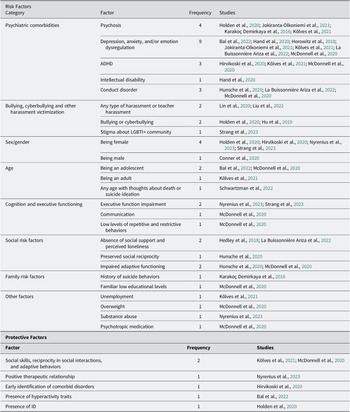
The synthesis identified a wide range of risk and protective factors. To facilitate interpretation, the findings in each thematic category are presented alongside the number of studies reporting on each suicide-related factor. Table 2 shows how often each risk factor appears in each thematic category and presents the frequency of each protective factor.
Frequency of each risk and protective factor in each category
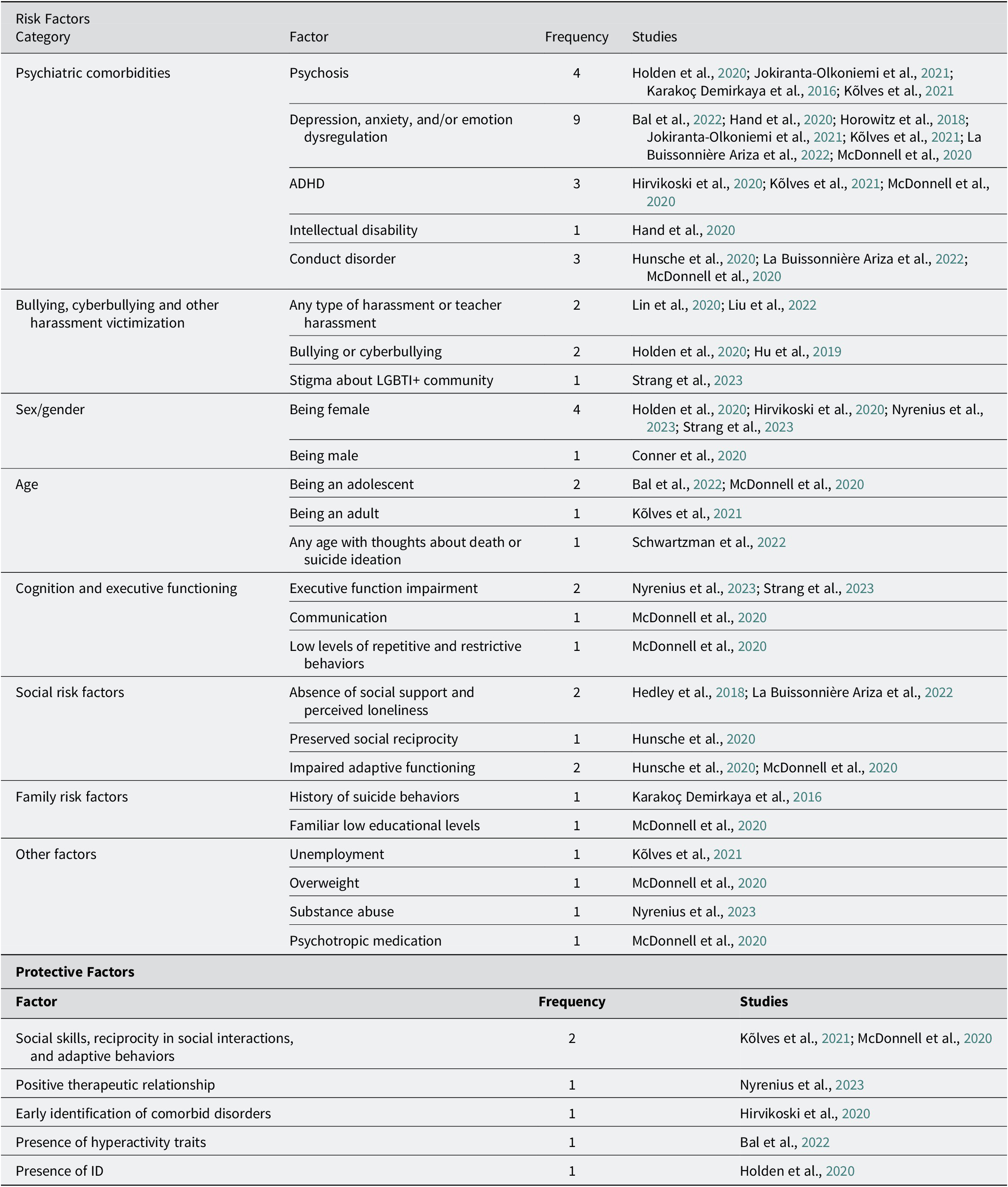
Table 2. Long description
The table is divided into two main sections. The first section lists risk factors, grouped by category in the leftmost column. Under psychiatric comorbidities, the factors are psychosis (frequency 4, studies: Holden et al. 2020, Jokiranta-Olkoniemi et al. 2021, Karakoç Demirkaya et al. 2016, Kõlves et al. 2021), depression, anxiety, and/or emotion dysregulation (9, Bal et al. 2022, Hand et al. 2020, Horowitz et al. 2018, Jokiranta-Olkoniemi et al. 2021, Kõlves et al. 2021, La Buissonnière Ariza et al. 2022, McDonnell et al. 2020), A D H D (3, Hirvikoski et al. 2020, Kõlves et al. 2021, McDonnell et al. 2020), intellectual disability (1, Hand et al. 2020), and conduct disorder (3, Hunsche et al. 2020, La Buissonnière Ariza et al. 2022, McDonnell et al. 2020). The next category is bullying, cyberbullying, and other harassment victimization, with factors: any type of harassment or teacher harassment (2, Lin et al. 2020, Liu et al. 2022), bullying or cyberbullying (2, Holden et al. 2020, Hu et al. 2019), and stigma about L G B T I plus community (1, Strang et al. 2023). The sex/gender category lists being female (4, Holden et al. 2020, Hirvikoski et al. 2020, Nyrenius et al. 2023, Strang et al. 2023) and being male (1, Conner et al. 2020). The age category includes being an adolescent (2, Bal et al. 2022, McDonnell et al. 2020), being an adult (1, Kõlves et al. 2021), and any age with thoughts about death or suicide ideation (1, Schwartzman et al. 2023). Cognition and executive functioning includes executive function impairment (2, Nyrenius et al. 2023, Strang et al. 2023), communication (1, McDonnell et al. 2020), and low levels of repetitive and restrictive behaviors (1, McDonnell et al. 2020). Social risk factors are absence of social support and perceived loneliness (2, Hedley et al. 2018, La Buissonnière Ariza et al. 2022), preserved social reciprocity (1, Hunsche et al. 2020), and impaired adaptive functioning (2, Hunsche et al. 2020, McDonnell et al. 2020). Family risk factors are history of suicide behaviors (1, Karakoç Demirkaya et al. 2016) and familiar low educational levels (1, McDonnell et al. 2020). Other factors include unemployment (1, Kõlves et al. 2021), overweight (1, McDonnell et al. 2020), substance abuse (1, Nyrenius et al. 2023), and psychotropic medication (1, McDonnell et al. 2020). The second section lists protective factors, with the leftmost two columns merged for each factor. These are social skills, reciprocity in social interactions, and adaptive behaviors (2, Kõlves et al. 2021, McDonnell et al. 2020), positive therapeutic relationship (1, Nyrenius et al. 2023), early identification of comorbid disorders (1, Hirvikoski et al. 2020), presence of hyperactivity traits (1, Bal et al. 2022), and presence of I D (1, Holden et al. 2020).
Risk Factors
Psychiatric Comorbidities
Comorbid psychosis was found in four studies to be associated with suicide. Specifically, it was reported as a risk factor for suicide or exhibiting suicidal behaviors (Jokiranta-Olkoniemi et al., Reference Jokiranta-Olkoniemi, Gyllenberg, Sucksdorff, Suominen, Kronström, Chudal and Sourander2021; Karakoç Demirkaya et al., Reference Karakoç Demirkaya, Tutkunkardaş and Mukaddes2016) and for having thoughts or ideas about suicide (Holden et al., Reference Holden, Mueller, McGowan, Sanyal, Kikoler, Simonoff, Velupillai and Downs2020). Similarly, one study found that autistic people with comorbid psychosis or schizophrenia had more suicidal behaviors or suicide attempts (Kõlves et al., Reference Kõlves, Fitzgerald, Nordentoft, Wood and Erlangsen2021).
Emotional problems were also reported as a risk factor for suicide-related behaviors in nine of the works. Depression and/or anxiety disorders were reported in seven different studies as other comorbidities that increased the risk of suicide or suicidal behaviors in autistic people (Jokiranta-Olkoniemi et al., Reference Jokiranta-Olkoniemi, Gyllenberg, Sucksdorff, Suominen, Kronström, Chudal and Sourander2021; Kõlves et al., Reference Kõlves, Fitzgerald, Nordentoft, Wood and Erlangsen2021; McDonnell et al., Reference McDonnell, DeLucia, Hayden, Anagnostou, Nicolson, Kelley, Georgiades, Liu and Stevenson2020) and suicidal thoughts and ideas (Bal et al., Reference Bal, Leventhal, Carter, Kim, Koh, Ha, Kwon, Hong and Kim2022; Hand et al., Reference Hand, Benevides and Carretta2020; Horowitz et al., Reference Horowitz, Thurm, Farmer, Mazefsky, Lanzillo, Bridge, Greenbaum, Pao and Siegel2018; La Buissonnière Ariza et al., Reference La Buissonnière Ariza, Schneider, Cepeda, Wood, Kendall, Small, Wood, Kerns, Saxena and Storch2022; McDonnell et al., Reference McDonnell, DeLucia, Hayden, Anagnostou, Nicolson, Kelley, Georgiades, Liu and Stevenson2020). Emotion dysregulation was reported in one study as another risk factor for autistic people who died by suicide or develop any type of suicidal behavior, thoughts, or ideas (Conner et al., Reference Conner, Golt, Righi, Shaffer, Siegel and Mazefsky2020).
The presence of other disorders diagnosed in childhood (Jokiranta-Olkoniemi et al., Reference Jokiranta-Olkoniemi, Gyllenberg, Sucksdorff, Suominen, Kronström, Chudal and Sourander2021) or another comorbid neurodevelopmental disorder was a risk factor for suicide. Particularly, Attention Deficit/Hyperactivity Disorder (ADHD) was reported in three studies as a risk factor for suicide or suicidal behavior (Hirvikoski et al., Reference Hirvikoski, Boman, Chen, D’Onofrio, Mittendorfer-Rutz, Lichtenstein, Bölte and Larsson2020; Kõlves et al., Reference Kõlves, Fitzgerald, Nordentoft, Wood and Erlangsen2021) and for suicide, suicidal ideation, and suicidal behavior (McDonnell et al., Reference McDonnell, DeLucia, Hayden, Anagnostou, Nicolson, Kelley, Georgiades, Liu and Stevenson2020).
Regarding the presence of ID, there is still a lack of consensus regarding the role of this diagnosis as a risk factor. Hand et al. (Reference Hand, Benevides and Carretta2020) reported that autistic people with ID tend to engage in more suicidal behaviors or die by suicide more frequently. Against this evidence, Holden et al. (Reference Holden, Mueller, McGowan, Sanyal, Kikoler, Simonoff, Velupillai and Downs2020) reported that the presence of ID was a protective factor against suicidal behaviors, whilst another study evidenced that the absence of an ID diagnosis was a risk factor for suicide or suicidal behaviors (Hirvikoski et al., Reference Hirvikoski, Boman, Chen, D’Onofrio, Mittendorfer-Rutz, Lichtenstein, Bölte and Larsson2020).
Conduct disorder or the presence of disruptive behaviors was also described in three studies as a risk factor for suicide or suicidal behaviors (Hunsche et al., Reference Hunsche, Saqui, Mirenda, Zaidman-Zait, Bennett, Duku, Elsabbagh, Georgiades, Smith, Szatmari, Ungar, Vaillancourt, Waddell, Zwaigenbaum and Kerns2020), suicidal ideation or suicidal behaviors (La Buissonnière Ariza et al., Reference La Buissonnière Ariza, Schneider, Cepeda, Wood, Kendall, Small, Wood, Kerns, Saxena and Storch2022), or any type of suicide-related behavior (McDonnell et al., Reference McDonnell, DeLucia, Hayden, Anagnostou, Nicolson, Kelley, Georgiades, Liu and Stevenson2020).
Bullying, Cyberbullying, and Other Harassment Victimization
Experiencing any type of harassment (Liu et al., Reference Liu, Wang, Hsiao, Ni, Liang, Lin, Chan, Hsieh, Wang, Lee, Chou and Yen2022) or being rejected and dealing with the stigma of being autistic and a member of the LGBTI+ community (Strang et al., Reference Strang, Anthony, Song, Lai, Knauss, Sadikova, Graham, Zaks, Wimms, Willing, Call, Mancilla, Shakin, Vilain, Kim, Maisashvili, Khawaja and Kenworthy2023) were reported in two studies as risk factors for suicide, engaging in suicidal behaviors, and/or developing suicidal thoughts. The experience of cyberbullying was reported in one study as a risk factor for suicide or exhibiting suicidal behaviors (Hu et al., Reference Hu, Liu, Hsiao, Ni, Liang, Lin, Chan, Hsieh, Wang, Lee, Chou and Yen2019), and bullying was found in one study as a risk factor for thinking about suicide or developing suicidal ideation (Holden et al., Reference Holden, Mueller, McGowan, Sanyal, Kikoler, Simonoff, Velupillai and Downs2020). Being a victim of teacher harassment was also described in one study as a risk factor for suicide or developing suicidal behaviors (Lin et al., Reference Lin, Peng, Hsiao, Chou and Yen2020).
Sex/Gender
One study reported that identifying with the female gender was associated with any type of suicide, suicidal behaviors, or thoughts (Strang et al., Reference Strang, Anthony, Song, Lai, Knauss, Sadikova, Graham, Zaks, Wimms, Willing, Call, Mancilla, Shakin, Vilain, Kim, Maisashvili, Khawaja and Kenworthy2023). Three studies reported that women were more likely to die by suicide or develop suicidal behaviors (Hirvikoski et al., Reference Hirvikoski, Boman, Chen, D’Onofrio, Mittendorfer-Rutz, Lichtenstein, Bölte and Larsson2020; Nyrenius et al., Reference Nyrenius, Waern, Eberhard, Ghaziuddin, Gillberg and Billstedt2023) or experience thoughts or ideas about suicide (Holden et al., Reference Holden, Mueller, McGowan, Sanyal, Kikoler, Simonoff, Velupillai and Downs2020). One study, conducted by Conner et al. (Reference Conner, Golt, Righi, Shaffer, Siegel and Mazefsky2020) reported, however, that being male was a risk factor for suicide, developing suicidal behaviors, and/or experiencing thoughts or ideas about suicide.
Age
Evidence from two studies shows that adolescents (Bal et al., Reference Bal, Leventhal, Carter, Kim, Koh, Ha, Kwon, Hong and Kim2022; McDonnell et al., Reference McDonnell, DeLucia, Hayden, Anagnostou, Nicolson, Kelley, Georgiades, Liu and Stevenson2020) evidence increased risk of suicide attempts or exhibiting suicidal behaviors, while one study (Kõlves et al., Reference Kõlves, Fitzgerald, Nordentoft, Wood and Erlangsen2021) found that people aged 20 and over were at the highest risk of suicide attempt or engaging in suicidal behavior. However, one study carried out by Schwartzman et al. (Reference Schwartzman, Williams, Richards, Mattheiss and Gotham2022) reported that age was not a risk factor for suicide but identified that lifetime presence of thoughts about death or suicide ideation was more prevalent in autistic people than typical peers.
Cognition and Executive Functioning
The study by Strang et al. (Reference Strang, Anthony, Song, Lai, Knauss, Sadikova, Graham, Zaks, Wimms, Willing, Call, Mancilla, Shakin, Vilain, Kim, Maisashvili, Khawaja and Kenworthy2023) reported that the presence of executive functioning impairments, particularly planning and organizational difficulties, was associated with every type of suicide-related behavior, from suicidal ideation to die by suicide. In addition, one study found that altered inhibitory control, reported as an increased impulsivity, led to a higher risk of self-injurious behaviors (Nyrenius et al., Reference Nyrenius, Waern, Eberhard, Ghaziuddin, Gillberg and Billstedt2023).
Regarding communication abilities (assessed by the verbal intelligence quotient [IQ]), McDonnell et al. (Reference McDonnell, DeLucia, Hayden, Anagnostou, Nicolson, Kelley, Georgiades, Liu and Stevenson2020) reported that autistic people with higher verbal IQ were at higher risk to develop suicidal thoughts and ideation. On the other hand, autistic people with lower verbal IQ were prone to develop suicidal behaviors. The study from McDonnell et al. (Reference McDonnell, DeLucia, Hayden, Anagnostou, Nicolson, Kelley, Georgiades, Liu and Stevenson2020) also reported that autistic people who present low repetitive and restrictive behaviors were at high risk for developing suicidal thoughts and ideation.
Social Risk Factors
One study in our review indicates that the absence of social support and experiencing loneliness (Hedley et al., Reference Hedley, Uljarević, Foley, Richdale and Trollor2018) were associated with the development of suicidal thoughts or ideas. The research of Hunsche et al. (Reference Hunsche, Saqui, Mirenda, Zaidman-Zait, Bennett, Duku, Elsabbagh, Georgiades, Smith, Szatmari, Ungar, Vaillancourt, Waddell, Zwaigenbaum and Kerns2020) also reported that those autistic people with preserved social reciprocity and good adaptive functioning are prone to develop suicidal thoughts or ideation. Nevertheless, impaired adaptive functioning (Hunsche et al., Reference Hunsche, Saqui, Mirenda, Zaidman-Zait, Bennett, Duku, Elsabbagh, Georgiades, Smith, Szatmari, Ungar, Vaillancourt, Waddell, Zwaigenbaum and Kerns2020), and impaired socialization skills (McDonnell et al., Reference McDonnell, DeLucia, Hayden, Anagnostou, Nicolson, Kelley, Georgiades, Liu and Stevenson2020), were associated with suicide or developing suicidal behaviors. La Buissonnière Ariza et al. (Reference La Buissonnière Ariza, Schneider, Cepeda, Wood, Kendall, Small, Wood, Kerns, Saxena and Storch2022) found that the experience of perceived loneliness was strongly related to the development of suicidal thoughts and ideation.
Family Risk Factors
One risk factor for suicide or suicidal behavior was the presence of a family history of suicide or relatives with presence of suicidal behavior, as reported in one study (Karakoç Demirkaya et al., Reference Karakoç Demirkaya, Tutkunkardaş and Mukaddes2016). The study by McDonnell et al. (Reference McDonnell, DeLucia, Hayden, Anagnostou, Nicolson, Kelley, Georgiades, Liu and Stevenson2020) reported that autistic young people whose parents had low levels of education were at greater risk of developing suicidal ideation and thoughts.
Other Risk Factors
Self-harming behavior was found in one study to be higher in autistic adults who had a history of suicidal ideation (Nyrenius et al., Reference Nyrenius, Waern, Eberhard, Ghaziuddin, Gillberg and Billstedt2023). Unemployment (Kõlves et al., Reference Kõlves, Fitzgerald, Nordentoft, Wood and Erlangsen2021) was found in one study as a risk factor for suicide and suicidal behavior; overweight (McDonnell et al., Reference McDonnell, DeLucia, Hayden, Anagnostou, Nicolson, Kelley, Georgiades, Liu and Stevenson2020) was found in one study as a risk factor for the development of any suicidal behavior (from thinking about death to suicide attempts); alcohol or drug abuse (Nyrenius et al., Reference Nyrenius, Waern, Eberhard, Ghaziuddin, Gillberg and Billstedt2023) was reported in one study as a risk factor for suicide and suicidal behavior; and the use of psychotropic medication (McDonnell et al., Reference McDonnell, DeLucia, Hayden, Anagnostou, Nicolson, Kelley, Georgiades, Liu and Stevenson2020) was reported in one study to be more strongly associated with the development of suicidal thoughts and/or ideation.
Protective Factors
Few studies have reported on the protective factors for suicidal ideation or attempts. However, the limited literature on this topic suggests that most protective dimensions of suicide-related behavior are social factors, such as the development of skills in socialization, reciprocity in social interactions, and adaptive behaviors reported in two studies (Kõlves et al., Reference Kõlves, Fitzgerald, Nordentoft, Wood and Erlangsen2021; McDonnell et al., Reference McDonnell, DeLucia, Hayden, Anagnostou, Nicolson, Kelley, Georgiades, Liu and Stevenson2020) or the establishment of a positive therapeutic relationship reported in one study (Nyrenius et al., Reference Nyrenius, Waern, Eberhard, Ghaziuddin, Gillberg and Billstedt2023). In addition, early identification of comorbid disorders such as ADHD was highlighted as a protective factor in one study (Hirvikoski et al., Reference Hirvikoski, Boman, Chen, D’Onofrio, Mittendorfer-Rutz, Lichtenstein, Bölte and Larsson2020). In relation to ADHD, the study carried out by Bal et al. (Reference Bal, Leventhal, Carter, Kim, Koh, Ha, Kwon, Hong and Kim2022) found that hyperactivity traits were a protective factor for the development of suicide ideation in autistic people. As previously mentioned, the presence of ID has also been reported as a protective factor for the development of suicidal ideation or thoughts, as reported in one study (Holden et al., Reference Holden, Mueller, McGowan, Sanyal, Kikoler, Simonoff, Velupillai and Downs2020).
Discussion
This study formally investigated the risk and protective factors associated with suicide and suicide-related behaviors in autism across all ages. Autistic people seem to be at increased risk of suicide compared to typically developing populations. Therefore, these findings have important clinical implications for clinicians working with autistic people who may present suicide-related behaviors. Early and tailored interventions targeting the factors contributing to suicide in this population may yield significant results in reducing suicidal behavior in autism, with long-term beneficial implications.
Risk Factors
While many of the variables identified in the studies and collected in this review encompass risk factors for a wide range of suicidal behaviors, from thoughts about death to die by suicide, specific risk factors have been associated with each type of behavior related to any type of suicide behavior.
The existence of a psychiatric disorder emerged as a significant risk factor for the presence of suicidal behaviors. In line with the existing literature, psychiatric diagnoses, such as anxiety and depression, were strongly associated with all types of suicidal behaviors in autism (Bal et al., Reference Bal, Leventhal, Carter, Kim, Koh, Ha, Kwon, Hong and Kim2022; Hand et al., Reference Hand, Benevides and Carretta2020; Horowitz et al., Reference Horowitz, Thurm, Farmer, Mazefsky, Lanzillo, Bridge, Greenbaum, Pao and Siegel2018; Jokiranta-Olkoniemi et al., Reference Jokiranta-Olkoniemi, Gyllenberg, Sucksdorff, Suominen, Kronström, Chudal and Sourander2021; Kõlves et al., Reference Kõlves, Fitzgerald, Nordentoft, Wood and Erlangsen2021; La Buissonnière Ariza et al., Reference La Buissonnière Ariza, Schneider, Cepeda, Wood, Kendall, Small, Wood, Kerns, Saxena and Storch2022; McDonnell et al., Reference McDonnell, DeLucia, Hayden, Anagnostou, Nicolson, Kelley, Georgiades, Liu and Stevenson2020; Pelton et al., Reference Pelton, Crawford, Bul, Robertson, Adams, de Beurs, Rodgers, Baron-Cohen and Cassidy2023). Schizophrenia and psychosis were also identified as risk factors for the presence of suicidal behaviors or suicide (Holden et al., Reference Holden, Mueller, McGowan, Sanyal, Kikoler, Simonoff, Velupillai and Downs2020; Jokiranta-Olkoniemi et al., Reference Jokiranta-Olkoniemi, Gyllenberg, Sucksdorff, Suominen, Kronström, Chudal and Sourander2021; Karakoç Demirkaya et al., Reference Karakoç Demirkaya, Tutkunkardaş and Mukaddes2016; Kõlves et al., Reference Kõlves, Fitzgerald, Nordentoft, Wood and Erlangsen2021). Also, among the common comorbid disorders in autistic people, ADHD was associated with an increased risk of suicidal ideation and behavior (Hirvikoski et al., Reference Hirvikoski, Boman, Chen, D’Onofrio, Mittendorfer-Rutz, Lichtenstein, Bölte and Larsson2020; Kõlves et al., Reference Kõlves, Fitzgerald, Nordentoft, Wood and Erlangsen2021; McDonnell et al., Reference McDonnell, DeLucia, Hayden, Anagnostou, Nicolson, Kelley, Georgiades, Liu and Stevenson2020). In addition, other studies emphasized the role of more emotional symptoms that affect the development of suicidal behavior, highlighting the presence of alexithymia and ruminations as symptoms related to suicide (Schwartzman et al., Reference Schwartzman, Williams, Richards, Mattheiss and Gotham2022).
According to our findings, it is unclear whether ID is a risk or protective factor. Studies in the review support its presentation as a risk (Hand et al., Reference Hand, Benevides and Carretta2020) or protective factor (Holden et al., Reference Holden, Mueller, McGowan, Sanyal, Kikoler, Simonoff, Velupillai and Downs2020), while another study indicates its absence as a risk factor for suicidal behaviors (Hirvikoski et al., Reference Hirvikoski, Boman, Chen, D’Onofrio, Mittendorfer-Rutz, Lichtenstein, Bölte and Larsson2020). Some evidence seems to indicate that suicidality is highly prevalent in autistic people without co-occurring ID, perhaps because some studies exclude the co-occurrence of ID from their analysis (e.g., Su & Procyshyn, Reference Su and Procyshyn2023).
It is important to note that early detection and proper identification of comorbidities can play a crucial role in preventing suicidal behaviors. The study conducted by Jokiranta-Olkoniemi et al. (Reference Jokiranta-Olkoniemi, Gyllenberg, Sucksdorff, Suominen, Kronström, Chudal and Sourander2021) reported that in most autistic people who died by suicide, the cause was more closely related to comorbidities than to the autism diagnosis itself.
Our review also found that having a family history of suicidal behaviors has been identified as a risk factor for suicide (Karakoç Demirkaya et al., Reference Karakoç Demirkaya, Tutkunkardaş and Mukaddes2016), consistent with previous literature emphasizing both personal (Cassidy et al., Reference Cassidy, Au-Yeung, Robertson, Cogger-Ward, Richards, Allison, Bradley, Kenny, O’Connor, Mosse, Rodgers and Baron-Cohen2022) and family history (Hawton et al., Reference Hawton, Comabella, Haw and Saunders2013) as relevant factors in suicide risk assessment.
Some studies suggest that specific age groups may be at greater risk for suicide, specially starting from early adolescence (Kõlves et al., Reference Kõlves, Fitzgerald, Nordentoft, Wood and Erlangsen2021; McDonnell et al., Reference McDonnell, DeLucia, Hayden, Anagnostou, Nicolson, Kelley, Georgiades, Liu and Stevenson2020). Although Karakoç Demirkaya et al. (Reference Karakoç Demirkaya, Tutkunkardaş and Mukaddes2016) did not find age as a risk factor for suicide, the authors reported that all suicidal autistic people in their study were adolescents older than 11 years. Similarly, Bal et al. (Reference Bal, Leventhal, Carter, Kim, Koh, Ha, Kwon, Hong and Kim2022) reported that autistic adolescents tend to exhibit more suicide ideation than children. Nevertheless, given the predominance of child and adolescent samples in most studies included in this review, it is possible that this association may change over time.
Inconsistencies regarding sex/gender as a risk factor for suicide in autistic people have also been observed. While three studies linked being a female or identifying with the female gender to suicidal behaviors or thoughts (Hirvikoski et al., Reference Hirvikoski, Boman, Chen, D’Onofrio, Mittendorfer-Rutz, Lichtenstein, Bölte and Larsson2020; Holden et al., Reference Holden, Mueller, McGowan, Sanyal, Kikoler, Simonoff, Velupillai and Downs2020; Nyrenius et al., Reference Nyrenius, Waern, Eberhard, Ghaziuddin, Gillberg and Billstedt2023), one study identified being male as a risk factor (Conner et al., Reference Conner, Golt, Righi, Shaffer, Siegel and Mazefsky2020). Previous research indicates that women may have more suicidal thoughts, although suicide mortality rates appear to be similar in both genders (Hirvikoski et al., Reference Hirvikoski, Mittendorfer-Rutz, Boman, Larsson, Lichtenstein and Bölte2016; Kirby et al., Reference Kirby, Bakian, Zhang, Bilder, Keeshin and Coon2019; Pelton et al., Reference Pelton, Crawford, Bul, Robertson, Adams, de Beurs, Rodgers, Baron-Cohen and Cassidy2023). However, it may be that some authors have identified male gender as a risk factor for suicide, as autism is more commonly diagnosed in males compared to females (e.g., Cruz et al., Reference Cruz, Zubizarreta, Costa, Araújo, Martinho, Tubío-Fungueiriño, Sampaio, Cruz, Carracedo and Fernández-Prieto2025). More research is needed to better understand the role of gender in relation to suicide and/or suicide-related behaviors in autism.
Cognitive functioning seems to also play an important role in suicidal behaviors in autism. Executive impairments were identified as a risk factor (Nyrenius et al., Reference Nyrenius, Waern, Eberhard, Ghaziuddin, Gillberg and Billstedt2023; Strang et al., Reference Strang, Anthony, Song, Lai, Knauss, Sadikova, Graham, Zaks, Wimms, Willing, Call, Mancilla, Shakin, Vilain, Kim, Maisashvili, Khawaja and Kenworthy2023), as well as altered impulse control, which was associated with increased self-injurious behavior (Cassidy, Robertson, et al., Reference Cassidy, Robertson, Townsend, O’Connor and Rodgers2020; Licence et al., Reference Licence, Oliver, Moss and Richards2020; Nyrenius et al., Reference Nyrenius, Waern, Eberhard, Ghaziuddin, Gillberg and Billstedt2023). It may be that altered executive function (e.g., difficulties with decision-making), a key area of difficulty in autistic people, contributes for suicide risk in this population.
The level of verbal IQ in autistic people was also relevant. Preserved verbal ability was associated with thoughts of death, while low verbal intellect was linked to suicide attempts and presence of suicidal behavior (McDonnell et al., Reference McDonnell, DeLucia, Hayden, Anagnostou, Nicolson, Kelley, Georgiades, Liu and Stevenson2020). It is possible that impaired verbal abilities contribute to difficulties with self-expression and communication, which, in turn, may be related to more suicide attempts (Richa et al., Reference Richa, Fahed, Khoury and Mishara2014).
Lack of social support, experiences of loneliness, and difficulties with socialization were consistently reported as risk factors for suicide in autism (Hedley et al., Reference Hedley, Uljarević, Foley, Richdale and Trollor2018; Hunsche et al., Reference Hunsche, Saqui, Mirenda, Zaidman-Zait, Bennett, Duku, Elsabbagh, Georgiades, Smith, Szatmari, Ungar, Vaillancourt, Waddell, Zwaigenbaum and Kerns2020; McDonnell et al., Reference McDonnell, DeLucia, Hayden, Anagnostou, Nicolson, Kelley, Georgiades, Liu and Stevenson2020). Evidence suggests that these social dimensions play a significant role in the presence of suicidal thoughts or behaviors given the social difficulties present in this population, which often lead to social isolation and loneliness (Hedley et al., Reference Hedley, Uljarević, Foley, Richdale and Trollor2018).
Our review also identified some studies that highlighted other contextual factors related to suicide in autism—unemployment, overweight, and the use of alcohol and drugs. For example, there are studies on the side effects of pharmacological treatment associated with self-harm, activation, or increased suicidality in ASD, highlighting the side effects of Selective Serotonin Reuptake Inhibitors (SSRIs) (Arranz et al., Reference Arranz, Salazar, Bote, Artigas-Baleri, Serra-LLovich, Triviño, Roige, Lombardia, Cancino, Hernandez, Cendros, Duran-Tauleria, Maraver and Hervas2022).
Protective Factors
Compared to the focus on risk factors, there is less research on protective factors against suicide. However, some research has shown that protective factors primarily include social support and social inclusion (Kõlves et al., Reference Kõlves, Fitzgerald, Nordentoft, Wood and Erlangsen2021; McDonnell et al., Reference McDonnell, DeLucia, Hayden, Anagnostou, Nicolson, Kelley, Georgiades, Liu and Stevenson2020), which involves the establishment of family, social, and clinical support networks (Kõlves et al., Reference Kõlves, Fitzgerald, Nordentoft, Wood and Erlangsen2021). Indeed, social support seems to act as a strong protective dimension, as the lack of it was also found to be a risk factor, possibly confirming the marked influence of this construct on suicide in this population (Mournet et al., Reference Mournet, Wilkinson, Bal and Kleiman2023).
Interestingly, early diagnosis of comorbidities, such as ADHD, has also been highlighted as a protective dimension against the emergence of suicidal thoughts and behaviors (Hirvikoski et al., Reference Hirvikoski, Boman, Chen, D’Onofrio, Mittendorfer-Rutz, Lichtenstein, Bölte and Larsson2020). The presence of hyperactivity traits was reported as a protective factor for developing suicide ideation, as evidence suggests that autistic people with hyperactivity tend to dedicate less time to think about suicide (Bal et al., Reference Bal, Leventhal, Carter, Kim, Koh, Ha, Kwon, Hong and Kim2022). The establishment of a positive relationship in psychiatric care was also reported as a protective factor (Nyrenius et al., Reference Nyrenius, Waern, Eberhard, Ghaziuddin, Gillberg and Billstedt2023).
Risk and Protective Factors and the Interpersonal Theory of Suicide: An Integrating Perspective
Our findings appear to align with the Interpersonal Theory of Suicide (Van Orden et al., Reference Van Orden, Witte, Cukrowicz, Braithwaite, Selby and Joiner2010), which suggests that certain constructs are associated with suicidal behavior. In this review, we observed that perceived burdensomeness or awareness of burden, and thwarted belongingness seem to be particularly related to an increase in suicide-related behaviors among autistic people.
Several risk factors emerged with noteworthy consistency and therefore warrant prioritization when interpreting of findings. The most reported risk factor for suicidal behavior relates to perceived burdensomeness or awareness of burden, that is the presence of psychiatric comorbidities, particularly emotional problems. Anxiety and depressive symptoms were consistently reported across high-quality studies (Bal et al., Reference Bal, Leventhal, Carter, Kim, Koh, Ha, Kwon, Hong and Kim2022; Horowitz et al., Reference Horowitz, Thurm, Farmer, Mazefsky, Lanzillo, Bridge, Greenbaum, Pao and Siegel2018; Jokiranta-Olkoniemi et al., Reference Jokiranta-Olkoniemi, Gyllenberg, Sucksdorff, Suominen, Kronström, Chudal and Sourander2021; La Buissonnière Ariza et al., Reference La Buissonnière Ariza, Schneider, Cepeda, Wood, Kendall, Small, Wood, Kerns, Saxena and Storch2022; McDonnell et al., Reference McDonnell, DeLucia, Hayden, Anagnostou, Nicolson, Kelley, Georgiades, Liu and Stevenson2020), as well as in moderate-quality studies (Hand et al., Reference Hand, Benevides and Carretta2020; Kõlves et al., Reference Kõlves, Fitzgerald, Nordentoft, Wood and Erlangsen2021). Comorbid psychosis was also identified as a strong and consistent risk factor in both high- and moderate-quality studies (Holden et al., Reference Holden, Mueller, McGowan, Sanyal, Kikoler, Simonoff, Velupillai and Downs2020; Jokiranta-Olkoniemi et al., Reference Jokiranta-Olkoniemi, Gyllenberg, Sucksdorff, Suominen, Kronström, Chudal and Sourander2021; Karakoç Demirkaya et al., Reference Karakoç Demirkaya, Tutkunkardaş and Mukaddes2016; Kõlves et al., Reference Kõlves, Fitzgerald, Nordentoft, Wood and Erlangsen2021). These findings emphasize the significant impact of mental health issues on suicidality among autistic individuals and reinforce the notion of perceived burdensomeness, whereby psychiatric distress can exacerbate feelings of being overwhelmed or a burden on others. These findings highlight the importance of considering the role of mental health comorbidities, as these may increase the likelihood of suicide-related behaviors. This may be particularly true for autistic people, given that comorbidities are often present.
Social factors also demonstrated consistent and significant associations with suicide-related outcomes in high- and moderate-quality studies. These included experiences of social isolation, loneliness and low social support (Hedley et al., Reference Hedley, Uljarević, Foley, Richdale and Trollor2018; La Buissonnière Ariza et al., Reference La Buissonnière Ariza, Schneider, Cepeda, Wood, Kendall, Small, Wood, Kerns, Saxena and Storch2022), as well as bullying and other forms of victimization (Holden et al., Reference Holden, Mueller, McGowan, Sanyal, Kikoler, Simonoff, Velupillai and Downs2020; Hu et al., Reference Hu, Liu, Hsiao, Ni, Liang, Lin, Chan, Hsieh, Wang, Lee, Chou and Yen2019; Lin et al., Reference Lin, Peng, Hsiao, Chou and Yen2020; Liu et al., Reference Liu, Wang, Hsiao, Ni, Liang, Lin, Chan, Hsieh, Wang, Lee, Chou and Yen2022). These findings clearly align with thwarted belongingness, emphasizing how difficulties in forming social connections may be exacerbated by hostile environments, stigma, and exclusion.
By contrast, social support networks and positive interpersonal relationships emerged as the most prevalent protective factors in both high-quality (McDonnell et al., Reference McDonnell, DeLucia, Hayden, Anagnostou, Nicolson, Kelley, Georgiades, Liu and Stevenson2020) and moderate-quality (Kõlves et al., Reference Kõlves, Fitzgerald, Nordentoft, Wood and Erlangsen2021) studies. This illustrates that a sense of belonging not only mitigates risk but can also actively protect autistic people against suicide. This finding aligns with other evidence indicating that supportive social relationships can mitigate stress and enhance quality of life for autistic people (Bishop-Fitzpatrick et al., Reference Bishop-Fitzpatrick, Mazefsky and Eack2018). Conversely, social difficulties can lead to isolation and loneliness, which can facilitate the emergence of suicide-related behaviors (Hedley et al., Reference Hedley, Uljarević, Foley, Richdale and Trollor2018). This is also in accordance with evidence on the perspectives of autistic people on social relationships. Autistic people have highlighted that social connections encompass both positive and negative elements (Scott & Sedgewick, Reference Scott and Sedgewick2021). Supportive relationships can improve wellbeing (Petty et al., Reference Petty, Allen, Pickup and Woodier2023), whereas negative relationships can lead to stigmatizing attitudes and greater mental health difficulties (Scott & Sedgewick, Reference Scott and Sedgewick2021).
Although influential, other factors, such as cognitive functioning and demographic variables, were reported less consistently across high-quality studies and should therefore be interpreted with caution. The prominence of mental health comorbidities and social adversity in the most methodologically rigorous studies suggests that these are the most reliable areas for clinical assessment and intervention.
It is important to highlight that autism-specific characteristics may exacerbate these social difficulties. For instance, camouflaging, which refers to the use of strategies to hide autistic traits in order to be accepted by social groups (Hull et al., Reference Hull, Petrides, Allison, Smith, Baron-Cohen, Lai and Mandy2017), has been identified as a risk factor for suicide-related behaviors, which has been reported in recent studies that did not meet the inclusion criteria for this systematic review (Cook et al., Reference Cook, Ogden and Winstone2018; Tierney & Burns, Reference Tierney, Burns and Legato2017; Tubío-Fungueiriño et al., Reference Tubío-Fungueiriño, Cernadas, Gonçalves, Segalas, Bertolín, Mar-Barrutia, Real, Fernández-Delgado, Menchón, Carvalho, Alonso, Carracedo and Fernández-Prieto2022). Camouflaging is associated with anxiety, depressive symptoms, and low self-esteem, especially in autistic females with preserved intellectual functioning (Cage & Troxell-Whitman, Reference Cage and Troxell-Whitman2019). Similarly, autistic people have reported that camouflaging can lead to exhaustion, isolation, and poor mental health (Bradley et al., Reference Bradley, Shaw, Baron-Cohen and Cassidy2021). They also tend to camouflage less when they feel accepted by their peers (Khudiakova et al., Reference Khudiakova, Levy, Sowden-Carvalho and Surtees2025).
Thus, the presence of mental health comorbidities alongside social challenges faced by autistic people may exemplify an intersection of risk factors related to suicidal behavior, thereby increasing vulnerability in this population. Therefore, there is a need to develop personalized interventions that can detect all the risk factors a person may present, and not just those traditionally associated with suicide.
As for the capability to commit suicide (the third construct of the Interpersonal Theory of Suicide), our review did not yield robust evidence. While autistic people may have access to lethal methods, the included studies did not appear to assess this aspect. Future studies should further clarify the role of this dimension as a risk factor for suicide-related behaviors in autism.
Limitations and Future Directions
While this study provides valuable insights, it is important to acknowledge certain limitations. One key limitation arises from the stringent inclusion criteria, which led to the exclusion of studies where DSM criteria for autism could not be confirmed. Although necessary for methodological rigor, this exclusion may have omitted studies that could offer additional perspectives on risk and protective factors for suicide in autism. Future systematic reviews should consider incorporating these studies to provide a more comprehensive understanding of the topic.
Importantly, the studies included in this review used different reporting methods: clinical interviews, specific questions from the CBCL questionnaire and the BASC-2 PRS-C (both parent reports), or specific scales to assess suicidal behavior. Although we did not control for the reporting methods used, it is important to note that this approach may have some limitations. For example, suicide thoughts may not be expressed to family members who complete the questionnaires and are therefore unaware of any suicidal thoughts or behaviors exhibited by their children. Thus, it is important that future studies consider the perspective of the respondent (self-report or other) when investigating the risk/protective factors underlying suicide in autism. This is even more important as suicide behaviors may go unnoticed by clinicians if the applied questionnaire is not sensitive to their identification. Furthermore, future qualitative studies involving autistic people who self-report risk factors would reinforce the findings of this study. Their qualitative contributions could provide valuable insights into aspects of suicidality that complement the quantitative findings or are not captured by conventional clinical measures. Autistic individuals often describe processes such as camouflaging, chronic invalidation, social exhaustion, or the cumulative impact of stigma. These are rarely captured by standardized instruments. For example, qualitative accounts from the autistic community emphasize that camouflaging is a tiring and frequently distressing strategy employed to fulfil social expectations (Higgins et al., Reference Higgins, Arnold, Weise, Pellicano and Trollor2021). This can result in burnout, identity confusion, and an elevated susceptibility to suicidal thoughts (Arqueros et al., Reference Arqueros, Jamett-Cuevas, Pulgar-Vera, Santander-Gonzalez, Pemau and Álvarez-Cabrera2025). Similarly, autistic individuals describe how social rejection, stigma, and invalidation (that is experiences that extend beyond typical indicators of social isolation) exacerbate feelings of being a burden and a sense of belonging that has been thwarted (Fardella et al., Reference Fardella, Burnham Riosa and Weiss2018). Taking these lived experiences into account helps to contextualize our quantitative findings, suggesting that commonly identified risk factors such as anxiety, depression, or loneliness may themselves be consequences of long-term social strain and masking. Incorporating autistic experiences may provide an explanation for quantitative associations and highlight the need for person-centered assessments and autism-informed suicide prevention.
Also, although we included all age groups in this study, providing a more comprehensive view of the issue, it is important to note that these factors may vary according to age and developmental stage.
As reported in this review, the role of ID as a protective or risk factor on developing suicidal behaviors is still unclear. Our findings suggest that it is important for future studies to consider ID when investigating risk factors for suicide in this population to help clarify its role.
Strategies to address and prevent suicidal behavior in autistic youth and adults are important. Scientific literature is beginning to showcase the integration of new technologies, such as supervised machine learning algorithms. These algorithms can identify risk factors for suicide in various psychiatric disorders using just a few variables (Bernert et al., Reference Bernert, Hilberg, Melia, Kim, Shah and Abnousi2020; Edavally et al., Reference Edavally, Miller and Youssef2021; Ehtemam et al., Reference Ehtemam, Sadeghi Esfahlani, Sanaei, Ghaemi, Hajesmaeel-Gohari, Rahimisadegh, Bahaadinbeigy, Ghasemian and Shirvani2024). This approach holds promise for providing early warning signals by combining information to formulate an algorithm based on key risk factors. Future studies should explore the implementation of these methods for autistic people (see Al‐Srehan et al., Reference Al‐Srehan, Ayasrah, Al‐Rousan, Khasawneh and Gharaibeh2025) considering the importance of including phenotypic variability and using large sample groups to train the algorithm as reliably as possible. Given the sensitivity of the suicide problematic, collaborative efforts involving patients, social and mental health professionals, and researchers are essential. Future studies in our group will consider creating and developing an instrument to assesses suicidal behavior in ASD, based on the risk factors reported in this systematic review. Our aim is to provide clinicians with a reliable instrument for identifying suicide risk that does not require long questionnaires.
Conclusion
Suicide is recognized as a multifactorial phenomenon (Franklin et al., Reference Franklin, Ribeiro, Fox, Bentley, Kleiman, Huang, Musacchio, Jaroszewski, Chang and Nock2017), requiring the interaction of different factors to identify a predisposition. This review identified individual risk factors for suicidal behavior in autism that appear to be consistent with the Interpersonal Theory of Suicide. In particular, these factors relate to the constructs of perceived burdensomeness or awareness of burden, and thwarted belongingness. The wide range of diverse factors identified as risk factors for suicidal-related behaviors in autistic people highlights the importance of early detection. The identification of risk factors, particularly mental health comorbidities and social difficulties, across the autism spectrum is thus crucial for developing early detection strategies for suicide-related behaviors. In addition, our review shows that promoting adaptive and supportive social relationships is an important protective factor against suicide-related behaviors, and therefore it is necessary for preventive and intervention approaches focus on this aspect. However, it is important to note that research into protective factors remains understudied compared to research into risk factors. Thus, future studies should investigate other potential dimensions that could act as a buffer against suicide in people with autism.
Supplementary material
The supplementary material for this article can be found at http://doi.org/10.1017/SJP.2026.10034.
Data availability statement
No new datasets were generated or analyzed during the current study. All data supporting the findings of this study are derived from previously published articles cited in the manuscript. The review protocol was registered in PROSPERO https://www.crd.york.ac.uk/PROSPERO/view/CRD420250654035.
Acknowledgements
M.T.F., A.C., and M.F.P. want to acknowledge the Fundación María José Jove for the support of this work. We also would like to thank all the authors who shared their work when we could not access it. A.C. is supported by Universidade de Santiago de Compostela.
Author contribution
Conceptualization: M.T.F., S.C., A.H., M.F.P. Methodology: M.T.F., S.C., M.F.P. Investigation: M.T.F., S.C., M.F.P. Data curation: M.T.F., S.C. Formal analysis: M.T.F., S.C. Writing—original draft: M.T.F., S.C., M.F.P. Writing—review & editing: S.C.P.Z., M.P.R., A.H., and A.C. Supervision: M.F.P. Project administration: M.T.F., M.F.P. Funding acquisition: A.C.
Funding statement
A.C., M.F.P., and M.T.F. were funded by Instituto de Salud Carlos III through the grant PI22/00208. S.C.P.Z. and M.P.R. are supported by predoctoral fellowships by Xunta de Galicia. S.C. is supported by national funds through FCT—Fundação para a Ciência e Tecnologia, I.P., under the R&D Unit: UID/04810/2025—William James Centre for Research.
Competing interests
The authors declare none.


 Open access

