Great changes in ecosystem sustainability and agricultural mechanization during recent years have led to the reorganization of production systems in dairy livestock. The intensive livestock model, based on the use of external inputs, can potentially have negative effects not only on biodiversity, ecosystems and climate change but also on product quality, human health and natural resources (Duru and Therond, Reference Duru and Therond2015). Turkey ranks second among the Mediterranean countries after France in terms of goat milk production with 577.209 tonnes (FAOSTAT, 2019). Of the total milking goat population estimated at 6.4 million, approximately 6.3 million are indigenous Hair goats and their crosses (TURKSTAT, 2020) that are hand-milked in small goat farms. As the main reason of the low production performance of Hair goats is the low nutritive quality of woody vegetation, and short plant vegetation periods, they need to be fed additional forage. Furthermore, in order to successfully transition goats from manual milking to machine milking technology, it is necessary to investigate the relationships between morphological udder characteristics and milk production and the parameters of adaptation to this technology. Therefore, the present study was conducted to compare the effect of management (additional feeding over and above grazing) and environmental factors on milk yield, milk composition and udder characteristics in Hair goat, Alpine × Hair F 1 goat (AHF1) and Saanen × Hair F 1 goat (SHF1) under a semi- intensive management system. It was hypothesized that both of these factors can have an influence.
Material and methods
All procedures were approved by the Bahri Dağdaş International Agricultural Research Institute Animal Ethics Committee, Konya, Turkey prior to the commencement of the experiment.
Animal management and feeding regime
During 2014 and 2015, we collected a total of 4126 lactation records. Of these, 1401 were from local Hair goats, 1573 from first-generation crossbred Alpine × Hair goats (AHF1) and 1152 from first-generation crossbred Saanen × Hair goats (SHF1), generated from 26 sires and 377 dams of parity one to four in 3 farms in Konya, Central Anatolian region of Turkey. During the lactation period, the 8-months average (March–October) precipitation was 249 mm and 237 mm in the years 2014 and 2015, respectively. The goats were fed approximately 400 g d−1 concentrate (16.1% CP 2500 kcal ME kg−1 dry matter) during the lactation periods and winter periods (Supplementary Table S1). They were kept in semi-intensive systems in semi-open barns and had year-round access to rangelands (Supplementary Material S1). They grazed approximately one hectare per goat characterized by rocky, steep grassland, shrubland, woodlands and herbaceous plants including annual and perennial pasture species (Supplementary Table S2).
Milking, milk samples and udder measurements
Goats were recorded using in-line milk meters (Tru-Test, Auckland, New Zealand). Milk yield controls recorded by the ICAR (2009) A4 method as well as samples for milk components analysis were collected from each goat once per 28-day (morning and evening). The milk samples were immediately analyzed for protein, fat, lactose, solids-non-fat, total solids, density, electrical conductivity, and freezing point by an ultrasonic milk analyzer (MILKANA EP 45 s Milk Analyser, Mayasan Ltd, Turkey). The milk pH was measured by a pH meter (WTW, InoLab, pH 720, Weilheim, Germany). First lactation records were obtained commencing within the first month after kidding and continuing for seven months. Udder measurements and udder conformation were taken from each animal only once after the morning milking during the period when milk controls started using the methods reported by Mavrogenis et al. (Reference Mavrogenis, Papachristoforou, Lysandrides and Roushias1988). Determination of udder volume (UV) was made at the same time as reported by Emediato et al. (Reference Emediato, Siquera, Stradiotto, Maesta and Fernandes2008).
Statistical analysis
The obtained data were analyzed using a General Linear Model (GLM) procedure. The significant differences among the factor levels were ascertained by using the Tukey multiple comparison tests (Kesici and Kocabas, Reference Kesici and Kocabas2007).
Results
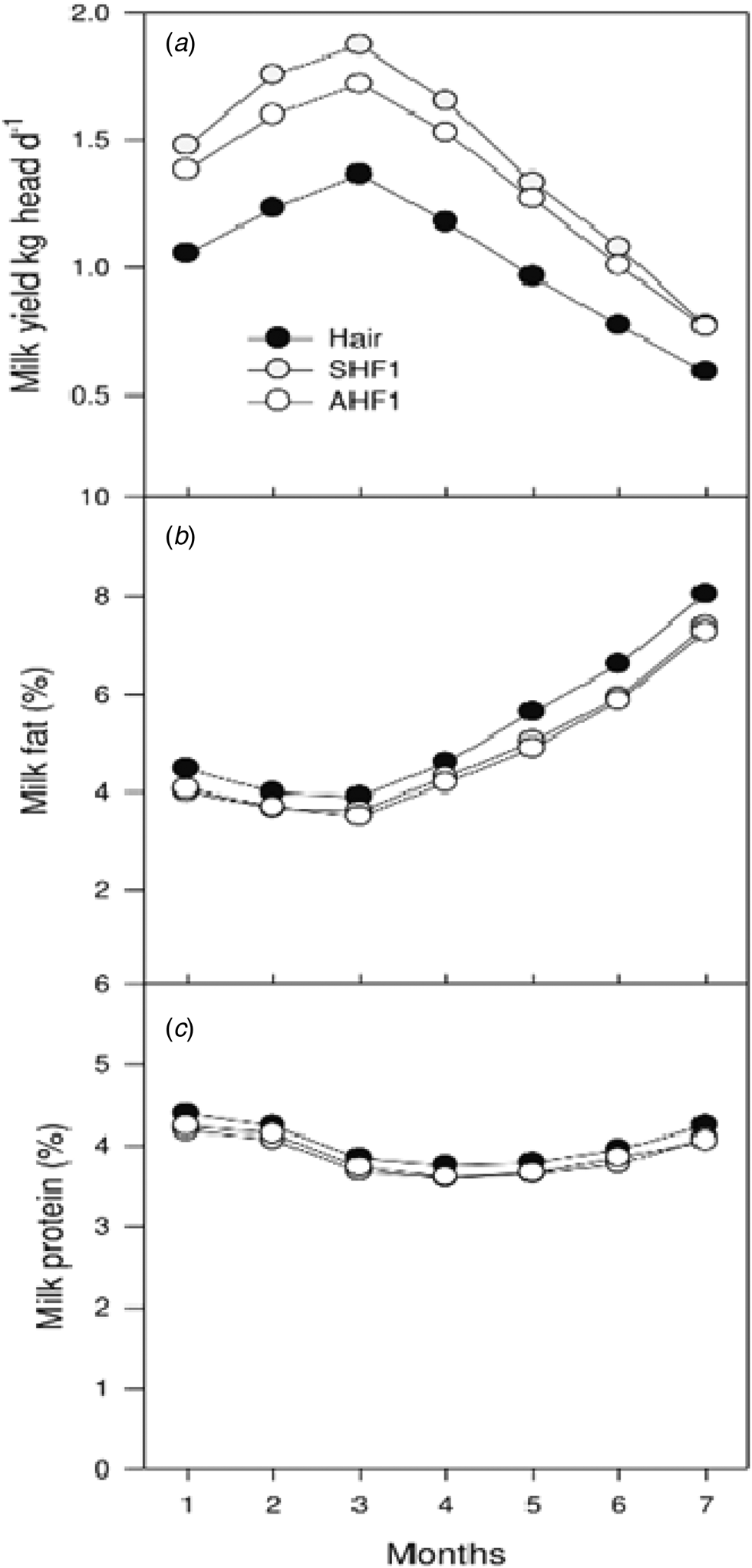
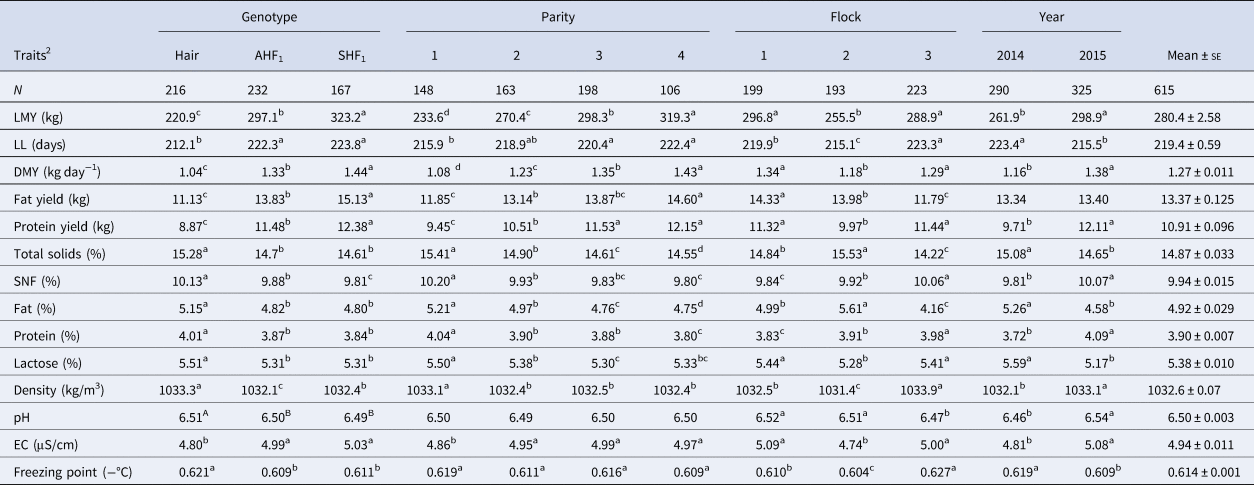
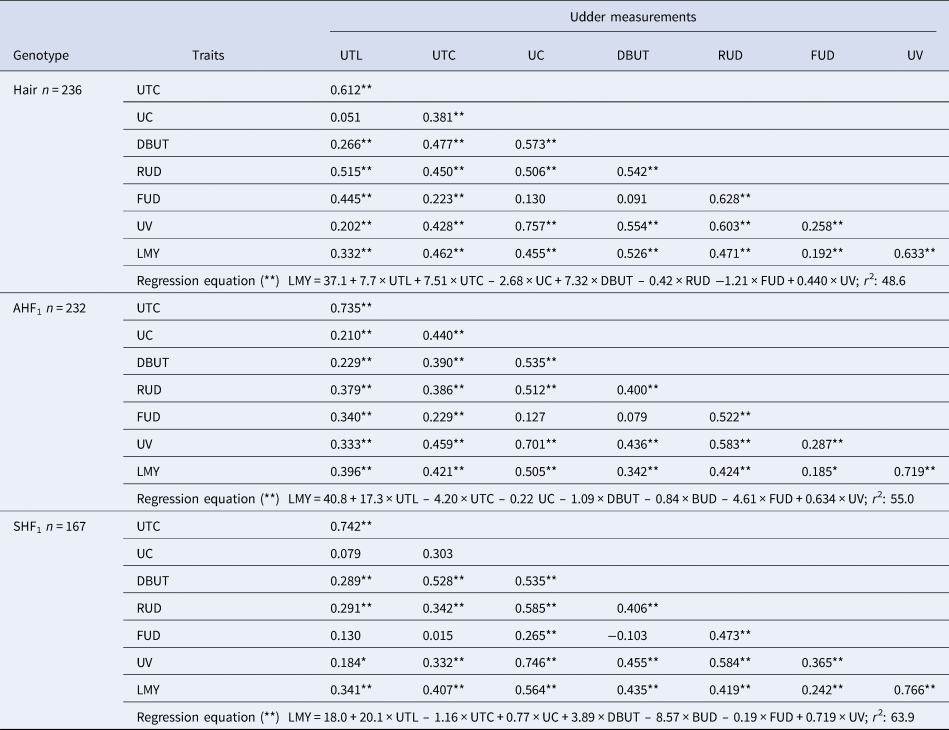
The ANOVA results indicated that the effects of genotype, parity, flock, and year on milk yield and composition traits exhibited were mostly significant (P < 0.05; Table 1). Milk yield varied between genotypes in the expected way (crossbred goats higher than local Hair goats) throughout lactation (Fig. 1) whilst differences in fat and protein contents were small. Udder traits were found to vary between genotypes (P < 0.01), whilst no relationship was noted between udder traits and udder shape (P > 0.05; Supplementary Table S3). The udder measurement of the SHF1 goats was significantly higher than the Hair goats. The defined halving (clearly two-piece) udder shape was the most predominant (36.6%) while the other udder shapes had similar frequencies, between 19.2% and 23.4%. The phenotypic correlation coefficients and regression equations between udder traits and lactation milk yield for genotypes are presented in Table 2. Excluding correlation between lactation milk yield and front udder depth and udder teat length in the Hair goats, a positive correlation was observed between lactation milk yield and all udder traits in the goat genotypes (P < 0.05). For the prediction of milk yield, the obtained regression equations were significant (P < 0.01) for all three genotypes.
Changes in daily milk yield (a), fat content (b), and protein content (c) milk samples obtained from Hair, Alpine × Hair F 1 (AHF1), and Saanen × Hair F 1 (SHF1) cross-bred goats during lactation.

Fixed effects of least squares means and standard error (se) for milk yield and composition traits of Hair, Alpine × Hair F 1 (AHF1) and Saanen × Hair F 1 (SHF1) goats1

1Value of factors within a row with different superscripts differ significantly at small letters (a,b,c; P < 0.01) capital letters (A,B,C; P < 0.05).
2Abbreviations are: se, standard error; LMY, lactation milk yield; LL, lactation length; DMY, daily milk yield; SNF, solids-non-fat; EC, electrical conductivity.
Phenotypic correlation coefficients and regression equations for predicting lactation milk yield (LMY, kg/d) according to udder measurements in Hair, Alpine × Hair F 1 (AHF1) and Saanen × Hair F 1 (SHF1) goatsa

Abbreviations are: UTL, udder teat length; UTC, udder teat circumference; UC, udder circumference; DBUT, distance between udder teats; RUD, rear udder depth; FUD, front udder depth; UV, udder volume, LMY, lactation milk yield; r 2: coefficient of determination.
a Levels of significance relation between LMY and udder measurements indicated by: P < 0.05; *, P < 0.01; **.
Discussion
The lactation milk yield of the AHF1 and SHF1 genotypes are shown to be approximately 46% and 35% higher than that of the Hair goats. The SHF1 genotype had the highest milk yield traits that can be attributable to its genetic superiority. This study shows that crossing Hair goats with Alpine and Saanen bucks is an appropriate strategy for improving milk production. The milk yield and lactation length for Hair, AHF1 and SHF1 genotypes ranged between the values reported by Serradilla (Reference Serradilla2001) and Scholtens et al. (Reference Scholtens, Lopez-Villalobos, Garrick, Blair, Lehnert and Snell2020) for pure, improved or cross-bred dairy goats, from 142 to 964 kg for lactation yield and from 1.01 to 3.34 kg d−1 for daily milk yield. Fat yield varied between 10.9 to 33.5 kg and protein yield from 7.2 to 22.5 kg (both total for lactation). Lactation length ranged from 129 d to 288 d for LL. Regarding their high genetic capacity of milk production, it is likely that the Hair, AHF1, and SHF1 cross-breed goats may provide higher yields at higher rates of concentrate supplementation than offered in the current study. It was also the case that these differences in mean milk performance from our study compared well with those obtained in other studies attributable to changing ecosystem conditions (Duru and Therond, Reference Duru and Therond2015), genotype, production systems, breeding programs (Serradilla, Reference Serradilla2001) and vegetation periods of the rangelands.
In the present study, milk production increased with increasing parity while the content of total solids, solids-non-fat, fat, protein and lactose decreased. The highest compositional values and lowest yield values were obtained during the first lactation. These results are in agreement with those reported by Scholtens et al. (Reference Scholtens, Lopez-Villalobos, Garrick, Blair, Lehnert and Snell2020), who showed that the lowest yield was observed in the first parity, probably due to continuing development of body weight and udder. The higher fat and protein content of first lactation goats could potentially lead to higher cheese yield.
Although the Hair goats produced the lowest milk, fat and protein yields, their milk composition had the highest fat, protein and lactose contents (Table 1). However, many previous studies have reported a range between 11.6 and 16.2% for total solids, 3.0 to 6.1% for fat, 2.7 to 4.8% for protein, and 3.6 to 5.5% for lactose in pure, improved, crossbreds and local goat breeds reared in different production systems both in Turkey (Erduran, Reference Erduran2014), and other countries (Serradilla, Reference Serradilla2001; Scholtens et al., Reference Scholtens, Lopez-Villalobos, Garrick, Blair, Lehnert and Snell2020). Our values of total solids, fat, protein and lactose contents of the Hair, AHF1, and SHF1 genotypes were, in the main, higher than those reported in the studies mentioned above. Regarding that the goats of necessity selected a greater quantity and dietary proportion of browse (trees, shrubs) than grassland, these results suggest that extra concentrate feed in addition to natural mountain flora that is rich in essential oils and aromatic compounds increased milk component contents (Morand-Fehr et al., Reference Morand-Fehr, Fedele, Decandia and Le Frileux2007). This may be explained by genetic variation as well as by a higher variation and nutritional composition in the grasslands (Flores-Najera et al., Reference Flores-Najera, Velez-Monroy, Sanchez-Duarte, Cuevas-Reyes, Mellado and Rosales-Nieto2020), and in this way potentially provides a higher quality milk product for consumers (Inglingstad et al., Reference Inglingstad, Eknaes, Brunborg, Mestawet, Devold, Vegarud and Skeie2016). However, the milk yield and milk content of the genotypes obtained in this semi intensive-system was higher than that reported by Erduran (Reference Erduran2014) under an extensive system of the same genotypes. In the genotypes in the semi-intensive system, there was a 68% and 5% higher lactation milk yield and total solids, respectively, compared with that obtained in the extensive system. This suggests that the semi-intensive system for goats is much better than extensive system for milk production, the superior milk production of local breeds can affect good management practices and grazing goats in the natural pasture supplementary feeding conditions (Morand-Fehr et al., Reference Morand-Fehr, Fedele, Decandia and Le Frileux2007). It may also be the case that feed supplementation can reduce methane emissions in the goats, which can help to reduce degradation of ecosystem resources (Miller and Lu, Reference Miller and Lu2019).
The average daily milk yield of the Hair, AHF1 and SHF1 genotypes increased until its peak in the third month of lactation; it then displayed a steady decrease until the end of the lactation period (Fig. 1a). However, the fat (Fig. 1b) and protein contents showed a decreasing trend until months three and four, respectively, followed by an increase thereafter. This observation of lowest values at around peak lactation stage is similar to the findings of Inglingstad et al. (Reference Inglingstad, Eknaes, Brunborg, Mestawet, Devold, Vegarud and Skeie2016) in Norwegian goats.
For all genotypes the highest positive correlations were estimated between udder volume and circumference (r = 0.757, 0.701 and 0.746, respectively) and between teat circumference and length (r = 0.612, 0.735 and 0.742, respectively). The highest positive correlations with lactation yield was found with udder volume (r = 0.633, 0.719 and 0.766, respectively). In other words, as the udder grows larger the circumference, distance between teats and rear udder depth increase, as of course does milk yield. In general, it was seen that the positive relationship between udder characteristics and lactation yield were significant. These results agree with several other studies in both goat and sheep breeds (Mavrogenis et al., Reference Mavrogenis, Papachristoforou, Lysandrides and Roushias1988; Emediato et al., Reference Emediato, Siquera, Stradiotto, Maesta and Fernandes2008; Margatho et al., Reference Margatho, Quintas, Rodriguez-Estevez and Simoes2020). Margatho et al. (Reference Margatho, Quintas, Rodriguez-Estevez and Simoes2020) also reported that udder characteristics significantly affect the number of SCC and microorganisms, and bifurcated pendular udders, where teats are vertically loose and very close to each other, are more prone to intramammary infections. Therefore, it can be predicted that a flat udder shape and then the defined halving shape will be more suitable for pasture, milking and milk quality. Moreover, according to the results about udder traits in this study, it can be also said that udder shape, volume and circumference as well as teat length and circumference should be taken into account in the selection based on udder traits. The highest coefficient of determination (r 2) value for lactation milk yield was estimated 64% for SHF1 goats, followed by AHF1 goats with 55%. It can be seen that crossbreeding between exotic breeds and native breeds not only increases milk production but also improves udder traits. Therefore, when evaluating phenotypic parameters in sustainable goat breeding, it is necessary to consider not only the breed standards and specified factors (Margatho et al., Reference Margatho, Quintas, Rodriguez-Estevez and Simoes2020), but also the production systems.
In conclusion, if strict genetic selection and management are practiced for the Hair goat and its cross-breeds, production traits such as milk yield could be improved to build up elite flocks with superior genetic potential, which could improve the dairy goat industry. Moreover, the milk yield traits of Hair goats could be increased by pure breeding method using the tools developed for better selection criteria. Where milk measurements cannot be made directly, the measurement of udder volume may be a suitable technique for estimating milk yield production as an indirect process. In many European countries, including semi-arid areas, this semi-intensive system of dairy goat production may be adopted as an alternative directed towards the sustainability of the ecosystem.
Supplementary material
The supplementary material for this article can be found at https://doi.org/10.1017/S0022029921000637
Acknowledgments
The authors express gratitude to late Bayram Yaman; technician at the Department of Animal Production of Bahri Dağdaş International Agricultural Research Institute, for his contributions on the present research. This work is a part of the PhD thesis of responsible author and was supported by the Scientific and Technological Research Council of Turkey (grant number 213O292); and General Directorate of Agricultural Research and Policy of Turkey (grant number 2015/A07/P-01//02).