Introduction
The beginning of animal husbandry and cereal cultivation in Finland has been one of the most actively researched topics of recent Finnish archaeology. Evidence of early agriculture has been sought, e.g. from animal bone, pollen, starch, and organic residue analyses of pottery (Alenius et al., Reference Alenius, Mökkönen and Lahelma2013; Bläuer & Kantanen, Reference Bläuer and Kantanen2013; Lahtinen & Rowley-Conwy, Reference Lahtinen and Rowley-Conwy2013; Cramp et al., Reference Cramp, Evershed, Lavento, Halinen, Mannermaa and Oinonen2014; Juhola et al., Reference Juhola, Etu-Sihvola, Näreoja and Ruohonen2014: 89; Lahtinen et al., Reference Lahtinen, Oinonen, Tallavaara, Walker James and Rowley-Conwy2017). Recent studies have dated the beginning of cereal cultivation in Finland to the Early Neolithic (c. 5300–4000 bc; Alenius et al., Reference Alenius, Mökkönen and Lahelma2013) or the Early Iron Age (c. 500 bc; Lahtinen & Rowley-Conwy, Reference Lahtinen and Rowley-Conwy2013). Starch, interpreted as derived from cultivated cereals, has recently been reported from pottery dating back to the Bronze Age (Juhola et al., Reference Juhola, Etu-Sihvola, Näreoja and Ruohonen2014: 89, 97) and cereal grains are known from Bronze Age sites (Pihlman & Seppä-Heikka, Reference Pihlman and Seppä-Heikka1985; Vuorela & Lempiäinen, Reference Vuorela and Lempiäinen1988; Asplund et al., Reference Asplund, Formisto and Illmer1989; Asplund, Reference Asplund2008: 292).
Even though the arrival of cereal cultivation is still debated, the earliest evidence of dairy farming thus far has been reported from two Corded Ware (3200–2250 cal bc) settlement sites in southern Finland (a general overview of the dates of pottery types is given in Table 1), where pottery fragments containing milk fats have been found (Cramp et al., Reference Cramp, Evershed, Lavento, Halinen, Mannermaa and Oinonen2014). Additionally, remains of goat hair have been recovered in a Corded Ware burial (Ahola et al., Reference Ahola, Kirkinen, Vajanto and Ruokolainen2018). Domestic animal bones dating to the Corded Ware period, however, have so far not been found in Finland. The oldest radiocarbon-dated domesticated animal bone of sheep/goat (Ovis aries/Capra hircus) comes from the Kiukainen culture (2400–1900/1500 bc; Bläuer & Kantanen, Reference Bläuer and Kantanen2013), while the oldest cattle (Bos taurus) and horse (Equus caballus) bones date to the Bronze Age (1700–500 bc; Bläuer & Kantanen, Reference Bläuer and Kantanen2013). However, when dealing with single occurrences of animal bones, hair, or dairy residues, it should be noted it is possible that these materials were brought to Finland from surrounding areas, and thus might not be evidence of animal husbandry in the study area.
Pottery types mentioned in the text and their general dating according to Haggrén et al. (Reference Haggrén, Halinen, Lavento, Raninen and & Wessman2015) and (for Swedish Pitted Ware in the Åland Islands) Halinen (Reference Halinen, Haggrén, Halinen, Lavento, Raninen and Wessman2015: 58; see Stenbäck, Reference Stenbäck2003: 85; Brorsson et al., Reference Brorsson, Lucenius and Stenbäck2019: 98). The table also shows the number of studied sherds and number of sherds with lipid yield over 5 μg/g.

Soils in Finland are acidic, which creates difficult conditions for the survival of prehistoric bone (Kibblewhite et al., Reference Kibblewhite, Tóth and Hermann2015). Unburnt bone typically decays over millennia, whereas burnt bone fragments are better preserved, even though they are highly fragmented (e.g. Siiriäinen, Reference Siiriäinen1981: 11; Ukkonen, Reference Ukkonen1996: 66; Ukkonen, Reference Ukkonen2001: 13). This environment makes the study of food culture and food procurement practises a challenging task. Furthermore, settlement sites have been found to have been used by different cultural groups over the millennia, a circumstance that affects the interpretation of zooarchaeological materials. On the other hand, acidic soils create favourable conditions for the survival of absorbed organic residues in archaeological pottery.
In recent years, the study of absorbed organic residues in pottery has become increasingly common in the Baltic Sea area, allowing prehistoric food procurement practises to be traced (e.g. Cramp et al., Reference Cramp, Evershed, Lavento, Halinen, Mannermaa and Oinonen2014; Papakosta et al., Reference Papakosta, Smittenberg, Gibbs, Jordan and Isaksson2015; Pääkkönen et al., Reference Pääkkönen, Bläuer, Evershed and Asplund2016; Oras et al., Reference Oras, Lucquin, Lõugas, Tõrv, Kriiska and Craig2017). The compound-specific stable carbon isotope (Δ13C=δ13C18:0-δ13C16:0) information on palmitic (C16:0) and stearic (C18:0) acid homologues can be used to distinguish the source of fats, in particular, non-ruminant and ruminant adipose, and dairy fats (Copley et al., Reference Copley, Berstan, Dudd, Docherty, Mukherjee and Straker2003: 1526). In addition, specific biomarkers originating from aquatic organisms can be used to distinguish lipid residues of marine and freshwater organisms from those of terrestrial origin. The biomarkers of aquatic origin found in archaeological pottery are notably: ω-(o-alkylphenyl)alkanoic acids (APAAs) with 20 and 22 carbon atoms, isoprenoid fatty acids (IFAs, phytanic acid, pristanic acid, 4,8,12-trimethyltetradecanoic acid (4,8,12-TMTD)), and dihydroxy fatty acids (DHYAs) with 20 and 22 carbon atoms (Avigan, Reference Avigan1966; Ackman & Hooper, Reference Ackman and Hooper1968; Hansel et al., Reference Hansel, Copley, Madureira and Evershed2004; Evershed et al., Reference Evershed, Copley, Dickson and Hansel2008; Hansel & Evershed, Reference Hansel and Evershed2009; Hansel et al., Reference Hansel, Bull and Evershed2011; Cramp & Evershed, Reference Cramp, Evershed, Holland and Turekian2014). In addition, dicarboxylic fatty acids are oxidation products of unsaturated fatty acids, and thus derive from processing of animal fats/oils (Regert et al., Reference Regert, Bland Helen, Dudd, van Bergen and Evershed1998). If branched chain fatty acids, especially C15 and C17, are found from pottery, they can be considered as possible indicators of ruminant fat (Mottram et al., Reference Mottram, Dudd, Lawrence, Stott and Evershed1999).
Here, we address questions of food procurement practices and animal husbandry in Finland, presenting new results on absorbed organic residues obtained from pottery sherds recovered from Finnish archaeological contexts. Previously published research on absorbed organic residues from Finnish material has been scarce. However, the Middle Neolithic groups with Comb Ware have been shown to have had a hunter-gatherer lifestyle (Cramp et al., Reference Cramp, Evershed, Lavento, Halinen, Mannermaa and Oinonen2014; Pääkkönen et al., Reference Pääkkönen, Bläuer, Evershed and Asplund2016). In this article, we present a substantially larger-scale study of organic residues absorbed into the walls of ceramic vessels from archaeological sites in southern and south-western Finland and the Åland Islands, dating back to the Late Neolithic and Early Metal period (Figure 1). In the world-wide context, the Neolithic is considered to begin with agriculture. However, in Finnish archaeology, it is a chronological term used to describe cultures that used ceramic containers. Hence, we have chosen to use the word ‘Neolithic’ for both hunter-gatherer groups with a pottery tradition as well as for culture groups that were more dependent on agriculture. The pottery types were selected as representative of periods of potential change in subsistence patterns towards animal husbandry in southern and south-western Finland. The chronological span of the vessels ranges from Corded Ware and Kiukainen Ware to Morby Ware. Two sherds of pottery related to Swedish Pitted Ware, as well as two sherds of Bronze Age pottery, were also studied. The organic residue findings are compared with zooarchaeological records from the same sites.
Location of the archaeological sites studied in southern and south-western Finland and the Åland Islands. 1: Jomala Överby (M); 2: Jomala Dalkarby (M); 3: Finström Godby (M); 4: Saltvik Härdalen 21.11 (S); 5: Ulvila Suolisto Peltomäki (M); 6: Kiukainen Uotinmäki (K); 7: Eura Luistarintien alue (B); 8: Turku Jäkärlä (C); 9: Turku Räntämäki Orhinkarsina (M); 10: Turku Kotirinne (K); 11: Piikkiö Moisio Moision Alitalo (M); 12: Kemiönsaari Kåddböle (M); 13: Västanfjärd Galtarby II (C); 14: Inkoo Ragnvalds Tähtelä (C); 15: Siuntio Dalamalm (C); 16: Kirkkonummi Tengo Nyåker (C); 17: Espoo Näkinkylä (C); 18: Espoo Bolarskog I (M); 19: Helsinki Malminkartano (C); 20: Vantaa Jönsas (C); 21: Hämeenlinna Hauho Perkiö (C); 22: Porvoo Böle Munkby (C); 23: Lapinjärvi Malmbacken Norrby (C). B: Bronze Age Ware; C: Corded Ware; K: Kiukainen Ware; M: Morby Ware; S: Swedish Pitted Ware. No organic residues were found at the Corded Ware sites of Inkoo Ragnvalds Tähtelä and Siuntio Dalamalm.

Material and Methods
A total of 121 sherds from 23 sites in southern Finland and the Åland Islands from different periods were screened for their absorbed lipid content. Of the studied sherds, 85 were chosen for further biomarker and compound-specific stable isotope analysis using gas chromatography-mass spectroscopy (GC-MS) and gas chromatography combustion isotope ratio mass spectrometry (GC-C-IRMS) respectively. Two different methods were used to extract sub-samples (1–2 g) of surface-cleaned sherds: (1) direct methanolic acid extraction (Correa-Ascencio & Evershed, Reference Correa-Ascencio and Evershed2014) and (2) solvent extraction (Evershed et al., Reference Evershed, Arnot, Collister, Eglinton and Charters1994) using CHCl3/MeOH (2:1 v/v). Extraction and instrumental methods are described in more detail in the Supplementary Data.
Results
Corded Ware
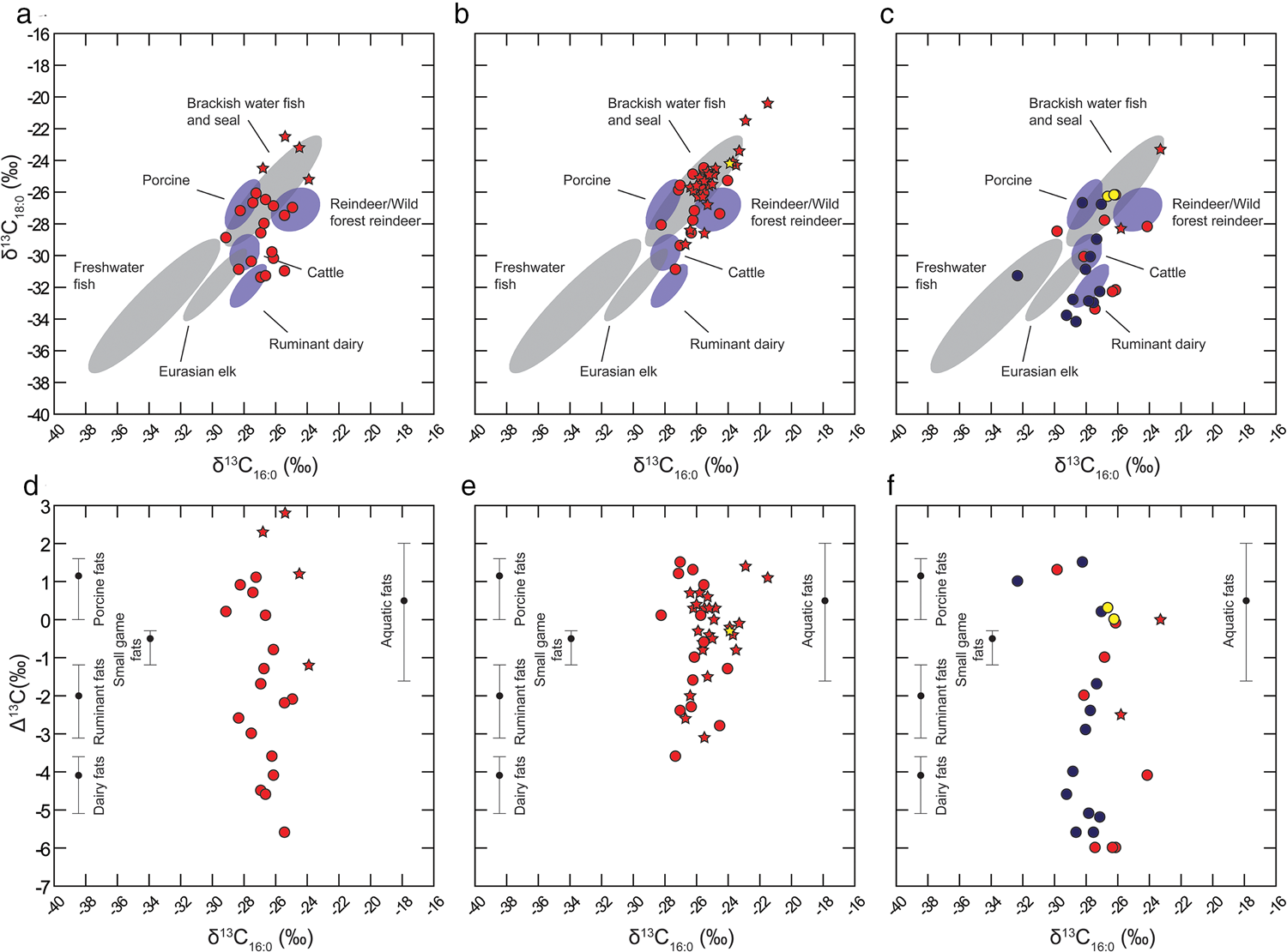
Out of the 30 sherds studied, 21 yielded appreciable lipid residues (Table 2 – Supplementary Data). The biomarker and stable carbon isotope analyses showed that a variety of different products were processed or stored in the vessels. Residues of dairy fats were observed in five sherds, a mixture of ruminant and possible aquatic fats in one sherd. In addition, ruminant carcass fat residues were found in six sherds, and six sherds contained ancient fat residues that are likely to be derived from the processing of non-ruminant terrestrial animal products, with three sherds containing mixtures of non-ruminant and aquatic or possibly aquatic fats (see Figure 2, Table 2). Since no aquatic biomarkers were detected in the Corded Ware sherds that were studied, aquatic fats identifications were based on the δ13C values of the C16:0 and C18:0 fatty acids and on the Δ13C proxy.
Graphs showing the scatter plots of δ13C16:0 values against δ13C18:0 values from (a) Corded Ware; (b) Kiukainen Ware (red) and Swedish Pitted Ware (yellow); (c) Bronze Age Ware (yellow), Morby Ware from Mainland Finland (red), and Morby Ware from the Åland Islands (blue). Ellipses represent confidence of 68.27% derived from modern reference datasets. Graphs of the Δ13C proxy plotted for the different pottery types: (d) Corded Ware; (e) Kiukainen Ware (red) and Swedish Pitted Ware (yellow); (f) Bronze Age Ware (yellow), Morby Ware from Mainland Finland (red), and Morby Ware from the Åland Islands (blue). The organic residues from sherds plotting to the right contained a greater marine component compared to those plotting more to the left. The stars represent lipid residues that contained biomarkers of marine/aquatic origin, and the circles represent the fats that originated from terrestrial resources. Modern reference data from Pääkkönen et al., Reference Pääkkönen, Evershed and Asplundin press. Modern terrestrial and freshwater fats have been corrected for contribution of post-industrial carbon by adding 1.3 ‰ (Friedli et al., Reference Friedli, Lötscher, Oeschger, Siegenthaler and Stauffer1986).

Kiukainen Ware and Swedish Pitted Ware
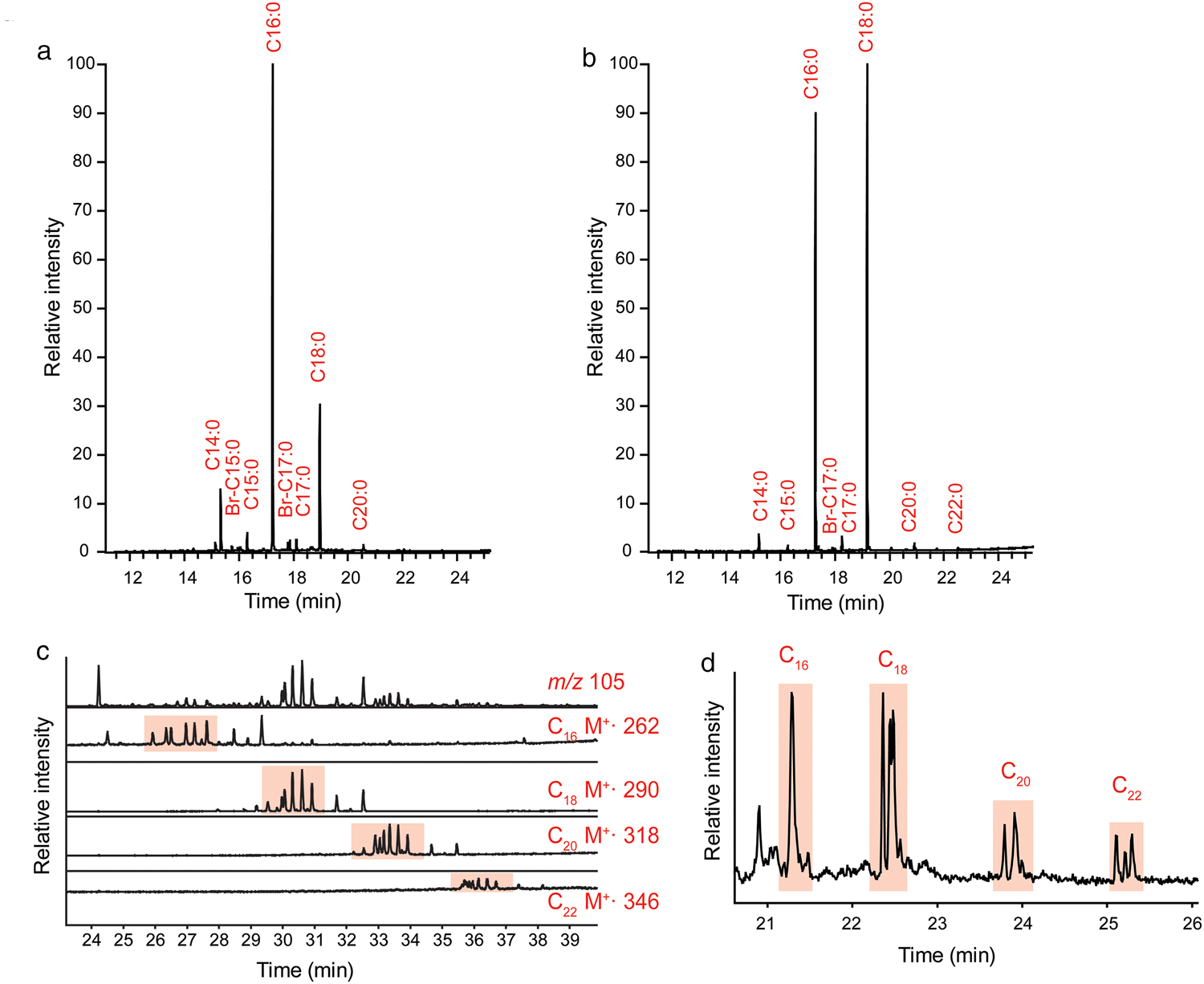
Only one sherd out of 56 Kiukainen Ware sherds contained a possible dairy fat residue. Based on the δ13C values of the C16:0 and C18:0 fatty acids and the Δ13C proxy, lipid residues of ruminant fats were found in nine sherds. Four of these contained, in addition to ruminant fats, possible traces of aquatic fats, detected by the presence of diagnostic C20 and C22 APAAs or DHYAs (Figure 3), or the δ13C values of the C16:0 and C18:0 fatty acids and the Δ13C proxy. Of the studied sherds, 15 contained fat residues derived from or likely to derive from non-ruminant terrestrial animals, five of these sherds contained a possible mixture of aquatic fats (Figure 2). One Swedish Pitted Ware sherd contained aquatic fats, and one sherd from the same site with characteristic Kiukainen Ware features contained a ruminant fat residue.
Partial gas chromatograms of lipid extracts of two sherds : (a) Kiukainen Ware vessel TYA 489:104, 120; (b) Morby Ware vessel ÅM 652:284. In (c) APAAs and (d) DHYAs indicate that aquatic organisms were processed in TYA 489:104, 120.

Early Metal Period Vessels: Bronze Age Ware and Morby Ware
Only two Bronze Age sherds were included in this study. During the Bronze Age, the quantity of pottery per site seems to have been low (Asplund, Reference Asplund2008: 88), which makes sampling difficult. The number of samples is insufficient for a generalized interpretation, but serves as an example, comparable to the results from two vessels analysed earlier by Cramp et al. (Reference Cramp, Evershed, Lavento, Halinen, Mannermaa and Oinonen2014). The sherds analysed in the present study contained fat residues from non-ruminant terrestrial animals, i.e. the vessels they came from were likely to have been used to process commodities from either small game animals or pigs. The 32 Morby Ware sherds sampled for this study came from settlement sites or burial cairns. The 18 sherds from mainland Finland were collected from settlement sites, one of which was related to a burial cairn. However, most of the 14 sherds from the Åland Islands were collected from burial cairns, and only one came from a settlement site. Four sherds from mainland Finland contained residues of dairy fats. One contained ruminant fats, and one, based on δ13C values of the C16:0 and C18:0 fatty acids and on Δ13C proxy, a mixture of ruminant and non-ruminant terrestrial fats. Three sherds contained residues of non-ruminant terrestrial fats, of which one also contained mixture of aquatic fats. One contained a possible mixture of ruminant and aquatic fats. Six of the Morby sherds from the Åland Islands contained dairy fat residues, three contained ruminant carcass fats, and three contained terrestrial non-ruminant fats (Table 2).
Discussion
Corded Ware
The results presented here demonstrate that the Corded Ware vessels were used for processing various commodities, including those from ruminant (adipose and dairy) and non-ruminant animals. These results are similar to those obtained by Cramp et al. (Reference Cramp, Evershed, Lavento, Halinen, Mannermaa and Oinonen2014), where dairy, ruminant, and possible aquatic fats were detected. In the present study, only four sherds showed evidence of fats deriving from the processing of commodities of aquatic origin. The low number of sherds with signs of processing aquatic organisms may suggest that groups using Corded Ware preferred terrestrial over aquatic resources. Even though four sherds showed evidence of processing of aquatic fats based on δ13C values, the lack of aquatic biomarkers could, on the other hand, also be explained by different cooking habits. The absence of food crusts and soot in Corded Ware vessels implies that they were not held over an open fire in the same way as the vessels from some of the other periods. Only one of the Corded Ware vessels sampled for this study contained traces of a food crust. Unfortunately, it contained modern contamination introduced during storage and was therefore not analysed further for aquatic biomarkers. As the APAAs are formed by heating at 260–270° C (Matikainen et al., Reference Matikainen, Kaltia, Ala-Peijari, Petit-Gras, Harju and Heikkilä2003; Hansel et al., Reference Hansel, Copley, Madureira and Evershed2004; Evershed et al., Reference Evershed, Copley, Dickson and Hansel2008), differing cooking habits could, in principle, explain the absence of such aquatic biomarkers in these vessels.
Animal bones (and one possible human bone) were recovered from most of the Corded Ware sites included in this study (see Table 3 – Supplementary Data). The majority of the sites were, however, multi-period settlement sites with several phases of occupation. Because of thin and mixed cultural layers, it is difficult to connect any individual bone with a given occupation phase without undertaking radiocarbon dating. The recovered bones are mostly burnt with a few unburnt fragments, which are most likely to date to later periods of use (see Bläuer & Kantanen, Reference Bläuer and Kantanen2013). No burnt domestic animal bones were recovered from these sites. The sites of Tengo Nyåker, Hämeenlinna Perkiö, Salo Märy Halikko, and Inkoo Ragnvalds included predominantly Corded Ware finds. Burnt bone from these sites was scarce, with only a few identifiable fragments of animals and one possible human bone.
A comparative geochemical analysis (scanning electron microscope-energy dispersive spectroscopy, SEM-EDS, and particle-induced X-ray emission, PIXE) of Corded Ware pottery recovered in Finland, Sweden, and Estonia indicated that c. 8 per cent of Corded Ware vessels recovered in archaeological contexts potentially derive from inter-regional material transport, i.e. assemblages include pots that were made and probably used in a geographic context that was separate from their archaeological find location (Holmqvist et al., Reference Holmqvist, Larsson, Kriiska, Palonen, Pesonen and Mizohata2018). Hence, the issue of material transfer should be acknowledged when using ceramic-related data to interpret regional subsistence strategies. Accordingly, lipid interpretations should also be carried out hand-in-hand with pottery source determination. The geochemical and mineralogical fingerprint of 12 Corded Ware pots included in this study was investigated, and 11 were confirmed as being products of the region they were found in, based on the SEM-EDS and PIXE data (see Figure 1). One pot from Jönsas in Vantaa (KM 19914:594) appears to be a geochemical outlier, and its source is yet to be determined (Holmqvist et al., Reference Holmqvist, Larsson, Kriiska, Palonen, Pesonen and Mizohata2018).
Corded Ware Culture potters also used pots produced in previous generations, sometimes imported, for temper (Holmqvist et al., Reference Holmqvist, Larsson, Kriiska, Palonen, Pesonen and Mizohata2018). Two of the pots geochemically associated with the Finnish region origin (KM 16288:59 and KM 21501:107, both with non-ruminant terrestrial fat residues) were tempered with grog originating from pottery probably made in Sweden, and another pot (KM 17281:149, with ruminant fat residues) displayed grog linked to Estonian pottery manufacture. A recent study shows that the firing of a pot, even at relatively low temperatures, removes lipids present in unfired clay matrices (Reber et al., Reference Reber, Kerr, Whelton and Evershed2018). Grog-tempered fabrics were not analysed by Reber et al. (Reference Reber, Kerr, Whelton and Evershed2018) but the results indicate that grog-introduced lipid contamination (i.e. lipids unrelated to the use of the analysed pot itself, being remnants from the previous generation of pot used as temper) will not occur.
Kiukainen Ware and Swedish Pitted Ware
In previous research by Cramp et al. (Reference Cramp, Evershed, Lavento, Halinen, Mannermaa and Oinonen2014), Kiukainen Ware vessels were found to contain both marine and ruminant carcass fats. We have been able to show that possibly dairy and non-ruminant terrestrial animals, likely to be game, were also part of the food procurement cycle. Evidence of processing aquatic fats were detected in 24 of the lipid residues extracted from Kiukainen Ware vessels. This finding agrees with the zooarchaeological data, as the animal bone from the Kiukainen culture sites consists predominantly of seal and fish bones (Bläuer & Kantanen, Reference Bläuer and Kantanen2013). Although only a few fragments of identifiable bone were recovered from the sites on which this study is focused, they consisted predominantly of seal and fish bones. This is entirely consistent with the organic residues and animal bone finds from contemporary sites (Table 4 – Supplementary Data).
In addition to seal and fish bones, there are possible indications of animal husbandry and cereal cultivation during the Kiukainen period. A sheep or goat bone from a Kiukainen settlement site at Pietarsaari has been radiocarbon-dated to this period (2200–1950 cal bc; Bläuer & Kantanen, Reference Bläuer and Kantanen2013). Two cattle (Bos taurus) bones, a sheep bone, and a pig (Sus scrofa) bone recovered from the Åland Islands have been radiocarbon-dated to the Late Neolithic, which was contemporaneous with the Kiukainen culture (Storå, Reference Storå2000). Furthermore, some pollen evidence indicates that cereals were cultivated in this period (Vuorela, Reference Vuorela and Fogelberg1999: 146–47; Asplund, Reference Asplund2008: 190). Cereal grains have been found at the Turku Niuskala site. One grain, radiocarbon-dated during earlier research, dates to the very end of the Neolithic or the Early Bronze Age (1900–1000 cal bc; see Figure 4; Pihlman & Seppä-Heikka, Reference Pihlman and Seppä-Heikka1985; Vuorela & Lempiäinen, Reference Vuorela and Lempiäinen1988; Asplund et al., Reference Asplund, Formisto and Illmer1989; Asplund, Reference Asplund2008: 292). The fact that organic residues of dairy fats were also found at the Turku Niuskala site provides further evidence that agriculture was carried out in south-western Finland to some degree during the Late Stone Age. It is, however, likely that cultivation of crops and possible dairy farming were only of local or minor importance for the dietary subsistence practices of the groups who were using Kiukainen pottery. This finding, i.e. that cultivation and farming seemingly played a minor role, agrees with previous views that Baltic Sea resources complemented early agrarian practices (e.g. Asplund et al., Reference Asplund, Formisto and Illmer1989: 126).
Radiocarbon dates from the studied sites. Saltvik Härdalen (ÅM 642:1) is regarded as a Stone Age/Bronze Age site (Nunez, Reference Nunez1990). These dates are later than an earlier interpretation of the Stone Age settlement in the area (Stenbäck, Reference Stenbäck2003: 93) but consistent with the interpretation of ÅM 642:1 as being reminiscent of Kiukainen Ware. The Jomala Överby (ÅM 652:80) and Espoo Bolarskog I (KM 19165:185 and 238) results from Morby Ware are earlier than expected when compared with the general views of the chronology of this ceramic type (e.g. Edgren, Reference Edgren and Fogelberg1999; Asplund, Reference Asplund and Uino2004). The Early Bronze Age dates are especially surprising. The characteristics of these sherds, as well as other dates from the same sites, indicate a Late Bronze Age or Early Iron Age date although the radiocarbon results have turned out differently. In principle, such divergences might relate to marine reservoir effects (for a definition and recent discussion, see Alves et al., Reference Alves, Macario, Ascough and Bronk Ramsey2018) or even to some freshwater reservoir effect (for a discussion on the dating of food crust, see Phillippsen, Reference Philippsen2015). In this case, no clear explanation can be given. The lipid contents of these sherds do not imply a marine origin of the dated crusts; the results were ruminant fat, dairy, and no lipid content, respectively (Table 2). Key: black: charcoal; light grey: food crust from vessel surface; white: cereal grain; dark grey: burnt bone. * from Vuorela & Lempiäinen, Reference Vuorela and Lempiäinen1988; # from Jungner & Sonninen, Reference Jungner and Sonninen1996; ¤ from Havia & Luoto, Reference Havia and Luoto1989 and Asplund, Reference Asplund2008. The calibration used the OxCal v3.10 program (Bronk Ramsey, Reference Bronk Ramsey1995; Reference Bronk Ramsey2001) and the IntCal13 calibration data (Reimer et al., Reference Reimer, Bard, Bayliss, Beck, Blackwell and Ramsey2013).

In the Ålandic Swedish Pitted Ware culture too, seals dominate the animal bone assemblages (Storå, Reference Storå2000: 69). Bones of mountain hare (Lepus timidus) and European beaver (Castor fiber), Eurasian elk (Alces alces), and red deer (Cervus elephus) have also been identified; however, it is likely that both Eurasian elk and red deer were transported to the islands as raw material for bone tool production, and were not part of the local diet (Storå, Reference Storå2000: 73–74). Radiocarbon dates of the first domestic animals (cattle and sheep) fall between 2400 and 760 cal bc (Storå, Reference Storå2000: 70). Thus, the residues of ruminant carcass fats recovered from a sherd from Saltvik Härdalen (ÅM 642:1), which is somewhat reminiscent of Kiukainen Ware, might just as easily derive from domesticated stock as from game animals.
In a previous study of organic residues from Neolithic pottery from the Åland Islands, traces of aquatic organism processing have been found (Papmehl-Dufay, Reference Papmehl-Dufay2005). In general, Swedish Pitted Ware groups along the Baltic Sea coastline did not include terrestrial animals in their diet to any significant extent (Eriksson et al., Reference Eriksson, Linderholm, Fornander, Kanstrup, Schoultz, Olofsson and Lidén2008; Fornander et al., Reference Fornander, Eriksson and Lidén2008: 293). The faunal remains from the Åland Islands also indicate a dependence on marine resources (Storå, Reference Storå2000: 73).
Bronze Age Ware and Morby Ware
During the Bronze Age, evidence of agriculture is more abundant in the Finnish archaeological record than during the preceding Late Neolithic Kiukainen culture. Cereal grains dating to the Bronze Age have been found at several settlement sites (e.g. from Turku Niuskala, Laihia Alatalo, and Palomäki, as well as from Eura Luistari and Luistarintie; Pihlman & Seppä-Heikka, Reference Pihlman and Seppä-Heikka1985; Vuorela & Lempiäinen, Reference Vuorela and Lempiäinen1988; Asplund et al., Reference Asplund, Formisto and Illmer1989; Asplund, Reference Asplund2008: 292; Holmblad, Reference Holmblad2010: 135; Uotila, Reference Uotila2014; Vanhanen & Koivisto, Reference Vanhanen and Koivisto2015). Domestic animal bones (cattle, sheep, and horse) have been radiocarbon-dated to the Bronze Age (Bläuer & Kantanen, Reference Bläuer and Kantanen2013). The results from organic residue analysis of pottery do not, however, indicate dairying during the Bronze Age; the sample size is however still too small to reach any firm conclusions.
Regarding the Morby sites included in this study, identifiable animal bones have been found at five sites. Only fish, ruminant, and seal (Phocidae) bones were identified at four sites (Table 5 – Supplementary Data), whereas at the Piikkiö Moisio settlement site domestic species, i.e. sheep or goat, dog (Canis familiaris), and possibly cattle, as well as wild mammals (European beaver and possibly elk) have been identified.
Even if agriculture seems to have spread geographically and its economic importance is likely to have increased during the Early Metal period and especially during the Early Iron Age, hunting, fishing, and gathering continued. This aspect is evident in both the zooarchaeological material and organic residues in pottery. Some sites of the Early Metal period have bone assemblages dominated by domestic animals with few and sometimes no seal bones. There are, however, also sites where seal bones are dominant and domestic animal bones are absent (Bläuer & Kantanen, Reference Bläuer and Kantanen2013). This could be interpreted as either one population using separate sites for sealing and animal husbandry, or as the presence of separate groups of people with different subsistence strategies—some continuing the Kiukainen culture tradition of sealing and others relying increasingly on agriculture. Such a dual configuration could have involved new influences, possibly also immigration, from neighbouring areas. Finnish inland bone assemblages consist, however, only of fish bones, wild mammals, and birds; significantly, no domestic animal bones have been identified (Deckwirth, Reference Deckwirth2008; Bläuer & Kantanen, Reference Bläuer and Kantanen2013).
The results of organic residue analyses presented here suggest that the pattern of use of cooking vessels by groups using Morby Ware was similar on mainland Finland and the archipelago. Sherds found at the Espoo Bolarskog I site and sherds from the Åland Islands contained residues of dairy fats, indicating the exploitation of domestic stock. Surprisingly, only two sherds contained aquatic or possibly aquatic residues. It seems that terrestrial resources were favoured over marine. Based on the organic residues, these groups did not use the Baltic Sea as a major food source, even though fish bones, albeit in only small quantities, have been found in zooarchaeological assemblages. However, it should be noted that there are ways of preparing food other than cooking it in pots. Foodstuffs can be, for example, smoked or dried, which would not leave organic residues on archaeological vessels, unless such commodities were subsequently processed in them, e.g. rehydration of dried fish.
The Changing Patterns of Resource Exploitation
Based on the modelling of summed probability distributions of radiocarbon dates, the population in Finland started to slowly grow after the end of the Stone Age, at around 1700 cal bc. That growth probably accelerated during the Late Bronze Age and Early Iron Age. In southern Finland, the lowest population levels are indicated for the period around 2900–2400 cal bc, the Corded Ware period (Tallavaara et al., Reference Tallavaara, Pesonen and Oinonen2010: 255; see Oinonen et al., Reference Oinonen, Pesonen and Tallavaara2010). The idea of using radiocarbon distributions as a proxy has been critically discussed as cultural factors could have had a big impact on the dating material available and collected by archaeologists (Mökkönen, Reference Mökkönen2011: 65; 2014; see Tallavaara et al., Reference Tallavaara, Pesonen, Oinonen and Seppä2014). This problem is, in principle, comparable to the one addressed above concerning the possibility of differing cooking habits affecting the detection of biomarkers in the pottery of the Corded Ware culture. Recently, however, an idea has emerged, which might fit the scenario of a low population rate: it envisages a possible reduction in the Late Neolithic culture groups in Estonia and Finland, followed by new waves of development, and probably also people, during the Early Metal period (Lang, Reference Lang, Mantila, Leinonen, Brunni, Palviainen and Sivonen2015; Reference Lang2018). Thus, it may be that animal husbandry and dairying practised during the Corded Ware period did not have any significant effect on population size. Based on this finding, in Finland, the transition to agriculture was not a coercive force created by increasing population, nor did the first adaptation to keeping domestic animals result in significant population growth.
In Finland, settlement sites used by the Corded Ware groups were not usually reoccupied in the Late Neolithic or Bronze Age (Larsson, Reference Larsson2009: 63). Thus, it has been suggested that settlement patterns would have changed in north-eastern Europe after the Corded Ware period (Nordqvist & Häkälä, Reference Nordqvist and Häkälä2014: 19). With these changing settlement patterns, food procurement patterns also changed. While the organic residues from the Corded Ware period revealed an origin from dairy and terrestrial animals, the organic residues from the Kiukainen period have been shown to derive from aquatic sources in addition to ruminant and non-ruminant terrestrial fats, and possibly also dairy fat, although the latter is only indicated by a single vessel.
A previous investigation of pottery from the region revealed three lipid residues from Late Bronze Age and Morby Ware pottery, all of which corresponded to dairy fat (Cramp et al., Reference Cramp, Evershed, Lavento, Halinen, Mannermaa and Oinonen2014). Here we have analysed a larger number of sherds and begun to demonstrate a more diverse procurement pattern consisting of both ruminant and non-ruminant terrestrial carcasses and dairy products, and possibly aquatic products and some variability within and between sites. However, the zooarchaeological evidence from some of the sites of the Early Metal period is dominated by seal bones (Bläuer & Kantanen, Reference Bläuer and Kantanen2013). These findings could indicate differing subsistence patterns among the Morby settlement sites. At some sites, the main focus was on animal husbandry and terrestrial resources, whereas at others sealing was important. It has been suggested that during this period in Sweden a more intensive form of agriculture using indoor winter feeding of animals and manuring of fields made it possible to keep animals and cultivate crops more efficiently in Norrland, an area that corresponds to the latitudes of the Finnish sites studied here (Viklund et al., Reference Viklund, Linderholm and Engelmark1998: 17; Welinder et al., Reference Welinder, Pedersen and Widgren1998: 255–56). Similar changes may have taken place in Finland too (see Bläuer & Kantanen, Reference Bläuer and Kantanen2013; Vanhanen & Koivisto, Reference Vanhanen and Koivisto2015). However, any direct evidence of stalling animals during this period is still missing.
Conclusions
This study has revealed a considerable variability in subsistence in southern Finland and the Åland Islands in the Late Neolithic and Early Metal period. We have shown that combining organic residue analysis with zooarchaeological data is an efficient method for studying past economies, as the two methods together can lead to more comprehensive interpretations of animal exploitation.
The first evidence of dairy fats, and thus possibly evidence of animal husbandry, comes from the Corded Ware period. Thereafter, the intensity of animal husbandry seems to have decreased and groups transitioned towards hunting and gathering. Traditionally, it has been assumed that the groups using Kiukainen Ware were mainly hunter-gatherers but our results indicate that animal domestication, at least to some extent, was also practised during the Kiukainen Ware period in southern Finland. It is however also possible that residues of dairy fats are indications of contacts with agrarian groups in neighbouring regions. Dairy or other domesticated animal products could have been transported to Finland, and therefore we cannot definitively conclude that animal husbandry was practised in the region during the Late Neolithic. Be that as it may, dairy product use was not as intensive during the Kiukainen Ware period as it was during the preceding Corded Ware period, even though the agrarian way of life appears not to have been fully discarded: at least some sites, such as Turku Niuskala, show that it was of local importance. It is possible that improvements in winter feeding and field manuring practices enabled the rise of animal husbandry during the Early Metal period. Based on the results presented here, it also seems, as expected, that animal husbandry or at least dairying became important again in the Early Metal period for groups using Morby Ware.
It is often assumed that environmental factors, for example climatic deterioration, are solely responsible for the slow start of farming in northern latitudes. However, it cannot be excluded that cultural reasons, such as contacts with non-agrarian communities in neighbouring areas, could also have caused such a delay. Even if the organic residues from Corded Ware do provide the first evidence of animal husbandry, this period in Finland is dualistic in terms of the subsistence economy. Contemporary groups, especially inland, continued with a hunter-gatherer lifestyle. In the process of assimilation, the fisher/hunter system, perhaps surprisingly, became stronger, and that aspect can be seen in the Kiukainen culture. Assimilation, in this case, meant the integration of a new culture, probably from immigrating people and a new subsistence strategy into a pre-existing lifestyle rather than the other way around.
Supplementary Material
To view supplementary material for this article, please visit https://doi.org/10.1017/eaa.2019.39.
Acknowledgements
This work was supported by the Academy of Finland under grant numbers SA258294, SA257395, and SA286499. We thank the Cultural History Museum of Åland, the Finnish Heritage Agency, and the Satakunta Museum for providing the sherds for this study. The dating result Ua-33386 was kindly provided by Kristiina Korkeakoski-Väisänen. Kari Uotila is thanked for providing the Bronze Age sherds used in this study. The UK Natural Environment Research Council is thanked for mass spectrometry facilities (GR3/2951, GR3/3758, and FG6/36101). Richard Evershed undertook this work while supported by an ERC Advanced Grant (‘NeoMilk’; FP7-IDEAS-ERC/324202).