Introduction
Antarctica is a remote continent where ice-free desert regions are subject to a unique combination of extreme environmental stresses. Small streams and lakes fed by glacial or snow meltwater are present in Antarctic ice-free areas during summer. Most lakes have a limited outflow and are supplied by surface stream inflow or groundwater (Malandrino et al. Reference Malandrino, Abollino, Buoso, Casalino, Gasparon, Giacomino, La Gioia and Mentasti2009).
The lakes are the main sinks for water. Solutes and particulate material from the catchment areas are buried in the sediments, and can be considered as short- and long-term integrations of biogeochemical processes taking place in the watershed. The Antarctic Peninsula has experienced some of the most rapid air temperature increases on Earth: 2°C over the past 40–50 years (Quayle et al. Reference Quayle, Peck, Peat, Ellis-Evans and Harrigan2002). However, lake distribution and the physical, biological and chemical characteristics are generally poorly understood around the Antarctic Peninsula (Nedbalová et al. Reference Nedbalová, Nývlt, Kopáček, Šobr and Elster2013).
Previous studies have shown that maritime Antarctic lakes responded faster than other Antarctic regions to changes in climate during the last 60 years, and significant increases in water temperature and primary productivity have been recorded (Quayle et al. Reference Quayle, Peck, Peat, Ellis-Evans and Harrigan2002). The maritime Antarctic region has a warmer and more humid climate than other parts of Antarctica; as a result, there is a higher potential for chemical weathering in this region (e.g. Campbell & Claridge Reference Campbell and Claridge1987). The chemical alteration and sedimentation processes of lacustrine sediments on the offshore islands have not been well studied.
King George Island is situated in the north of the Antarctic Peninsula and experiences a relatively mild climate with a strong marine influence. Evidence of palaeoclimatic changes and glacier advance and retreat recorded in lacustrine sediments from Fildes Peninsula, the largest ice-free area of King George Island, have been studied extensively (Liu et al. Reference Liu, Sun, Xie, Yin and Wang2005, Lee et al. Reference Lee, Yoon and Yoon2009, Monien et al. Reference Monien, Schnetger, Brumsack, Hass and Kuhn2011). To date, comprehensive geochemical investigations in this area are non-existent or restricted to rocks (Smellie et al. Reference Smellie, Pankhurst, Thomson and Davies1984, Machado et al. Reference Machado, Lima, Chemale, Morata, Oteiza, Almeida, Figueiredo, Alexandre and Urrutia2005), soils (Mendoça et al. Reference Mendoça, Melo, Schaefer, Simas and Michel2013, Michel et al. Reference Michel, Schaefer, Lopez-Martinez, Simas, Haus, Serrano and Bockheim2014) and marine sediments (Monien et al. Reference Monien, Schnetger, Brumsack, Hass and Kuhn2011).
The mineralogical and chemical characterization of sediments present in Fildes Peninsula lakes is an important step towards understanding the geochemical and environmental processes taking place in these ecosystems, and possible variations due to local anthropogenic activities, global contamination and/or climate change. Due to the high number of scientific stations and the increasing anthropogenic activity in the Fildes Peninsula, understanding and mapping the lacustrine ecosystems is crucial for appropriate conservation and use strategies. The objective of the present work is to study the geochemical background of recent lacustrine sediments from Fildes Peninsula, King George Island, maritime Antarctica.
Materials and methods
Study region and sampling
King George Island is the largest of the South Shetland Islands, at approximately 1400 km2. Similar to the rest of the archipelago, it is almost completely glaciated with only 5% of its area being ice-free (Rakusa-Suszczewski Reference Rakusa-Suszczewski2002). King George Island is characterized by a maritime cold climate, with a mean annual air temperature of -2.2°C (data from 2000–12, Teniente Rodolfo Marsh Martin Aerodrome Meteorological Station) and mean summer air temperatures above 0°C over 4 months. Precipitation ranges from 350–500 mm per year, with rainfall occurring in the summer (Michel et al. Reference Michel, Schaefer, Lopez-Martinez, Simas, Haus, Serrano and Bockheim2014). The Fildes Peninsula (longitude 58°40'59" to 59°01'50"W, latitude 58°40'59" to 62°14'02"S) is situated in the extreme south-western region of King George Island and is the largest ice-free area of the South Shetland Islands (Liu et al. Reference Liu, Sun, Xie, Yin and Wang2005). It is hilly with a total surface area of 29 km2 (Michel et al. Reference Michel, Schaefer, Lopez-Martinez, Simas, Haus, Serrano and Bockheim2014) and an elevation less than 150 m above sea level. Geological investigations showed that the Fildes Peninsula is mainly dominated by basalts and basaltic andesites (Smellie et al. Reference Smellie, Pankhurst, Thomson and Davies1984, Machado et al. Reference Machado, Lima, Chemale, Morata, Oteiza, Almeida, Figueiredo, Alexandre and Urrutia2005).
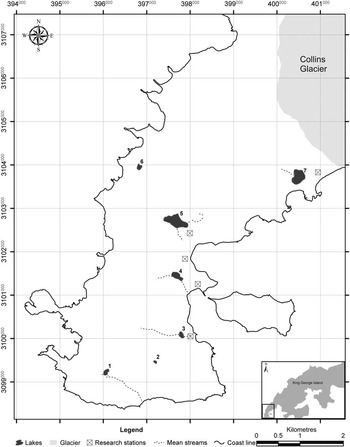
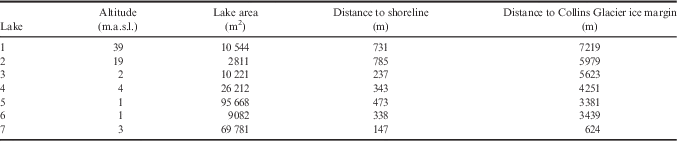
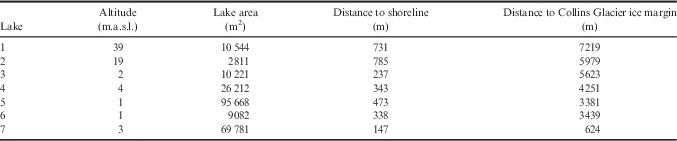
The seven lakes selected for this study are distributed along the Fildes Peninsula: 1) Jurasico lake (also known as Jurasee), 2) lake non-reported (58°58'38"W, 62°13'21"S), 3) Gran Muralla lake (also known as Xihou), 4) Langer lake (also known as Long, Langersee, Dlinnoye), 5) Kitiesh lake (also known as Kitieshsee, Kitiezh, Kitesch), 6) lake non-reported (58°58'32"W, 62°10'49"S), and 7) Uruguay lake (also known as Profound, Tiefersee, Glubokoye, Glubokoe). The lake names are not official, and follow the local toponymy. The locations of the lakes are shown in Fig. 1. Topographical and hydrographic data, including surface area, are summarized in Table I. Previously reported relevant information for these lakes is mostly limited to the biota of lake 3 (e.g. Li et al. Reference Li, Ochyra, Wu, Seppelt, Cai, Wang and Li2009) and the origin and age of lake 4 (e.g. Lee et al. Reference Lee, Yoon and Yoon2009).
A map of Fildes Peninsula showing the lakes included in the study.

Topographical and hydrographic characteristics of the lakes.
Four or five sediment samples (upper 3 cm) for each investigated lake were collected between January and February 2013 during the VI Scientific Venezuelan Expedition. The lakes were sampled along the shoreline at equidistant sites at the water depth of 0.2–0.3 m. All samples were collected with plastic tools, and stored in polycarbonate vessels that had been washed with sub-boiling HCl and rinsed several times with ultrapure water. The samples were maintained at -4°C during all stages of storage and transportation to the laboratory.
Analytical and statistical methods
In the laboratory the samples were dried at 40°C, disaggregated using a pestle and mortar, and sieved to less than 2 mm using a nylon sieve cloth. The samples were pulverized into a fine powder using a pestle and mortar, and carefully mixed to prepare homogeneous samples.
All analyses were performed on total sediment. For chemical analysis, the samples were pelletized into 4 cm diameter disks; mass was 4 g. To avoid contamination of the sediments during the preparation stage, both faces of the compression die were covered with thin disks of Teflon. Three replicates were processed for each sample. The samples were then analysed by wavelength-dispersive x-ray fluorescence spectrometry (XRF), using a Siemens SRS 3000 spectrometer fitted with a rhodium anode x-ray tube and controlled by SpectraPlus software. Certified sediments and soils standard reference materials were used for calibration and to check the accuracy and precision of the XRF analysis. The accuracy and precision of the analyses were within ±13% for all elements. The methodology used in this work has been reported by Alfonso et al. (Reference Alfonso, Martínez, Flores and Benzo2006).
The bulk mineralogy of lacustrine sediments was determined using a Siemens D-5005 x-ray diffractometer (XRD) equipped with parallel beam geometry and Cu Kα radiation, operated by DifraccPlus software at a voltage of 40 kV and at a current of 30 mA. The XRD patterns were recorded from 5–90° in 0.020 steps. Minerals were identified from their characteristic peaks and semi-quantified using integrated intensities of the major peaks. Granulometric analysis was carried out by laser granulometry (Mastersizer 2000 particle size analyzer, Malvern Instruments) to measure particles 4–2000 µm (Brunskill et al. Reference Brunskill, Orpin, Zagorskis, Woolfe and Ellison2001). Total organic matter (OM) content was determined by ignition at 550°C (Heiri et al. Reference Heiri, Lotter and Lemcke2001).
Cluster analysis and factor analysis by means of the principal components (PCA) method were used to assess the regional distribution pattern of the element assemblages in the study area. All data were log-transformed and standardized prior to application of multivariate statistical analyses. This approach approximates normality and gives the same weight to all variables (Reimann et al. Reference Reimann, Filzmoser and Garrett2002). The method chosen for the standardization was to subtract the mean from each variable and divide the resulting scores by the standard deviation. For factor rotation, Reimann et al. (Reference Reimann, Filzmoser and Garrett2002) suggest that an orthogonal method should be chosen; therefore, the varimax method was used. Different cluster analysis methods were evaluated for classification of the lakes: Ward, complete linkage, weighted pair-group average and unweighted pair-group average. The cluster analysis between sites was applied using the log-transformed and standardized element concentrations as variables. All multivariate statistical analyses were performed using the computer software STATISTICA version 7 (Statsoft 2004).
Chemical weathering
To estimate the degree of chemical weathering of the source material, both the chemical index of alteration (CIA) and the plagioclase index of alteration (PIA) were calculated. The CIA (Nesbitt & Young Reference Nesbitt and Young1982) and PIA (Fedo et al. Reference Fedo, Nesbitt and Young1995) of the recent lacustrine sediments were calculated according to the following formula:
 $${\rm CIA}=[{\rm Al}_{{\rm 2}} {\rm O}_{{\rm 3}} /({\rm Al}_{{\rm 2}} {\rm O}_{{\rm 3}} {\plus}{\rm CaO}{^\asterisk}{\plus}{\rm Na}_{{\rm 2}} {\rm O}{\plus}{\rm K}_{{\rm 2}} {\rm O})]\,{\rm x}\,{\rm 1}00$$
 $$\eqalignno{{\rm PIA}=\,&[({\rm Al}_{{\rm 2}} {\rm O}_{{\rm 3}} {\hbox-}{\rm K}_{{\rm 2}} {\rm O)/(Al}_{{\rm 2}} {\rm O}_{{\rm 3}} {\plus}{\rm CaO}{^\asterisk}{\plus}{\rm Na}_{{\rm 2}} {\rm O}{\hbox-}{\rm K}_{{\rm 2}} {\rm O})]\,\cr &{\rm x}\,100,$$
where the oxides are expressed as molar proportions and CaO* represents Ca in the silicate fraction only.
Results
Chemical composition
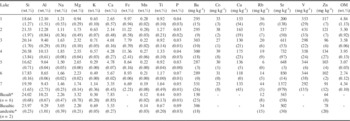
Table II reports the mean and standard deviation of the concentrations of major and trace elements and total OM measured in the sediment samples. In all sediment samples, Si was the element with the highest concentration. In general, it was followed by Al, Fe, Ca, Mg, Na, Ti, K, Mn and P. The OM content in the sediments was almost constant in all lakes, and there were only small variations in samples from lake 6 which had lower values.
Mean (standard deviation) of the elements and organic matter concentrations in the lake sediments (n=12).

* Smellie et al. Reference Smellie, Pankhurst, Thomson and Davies1984.
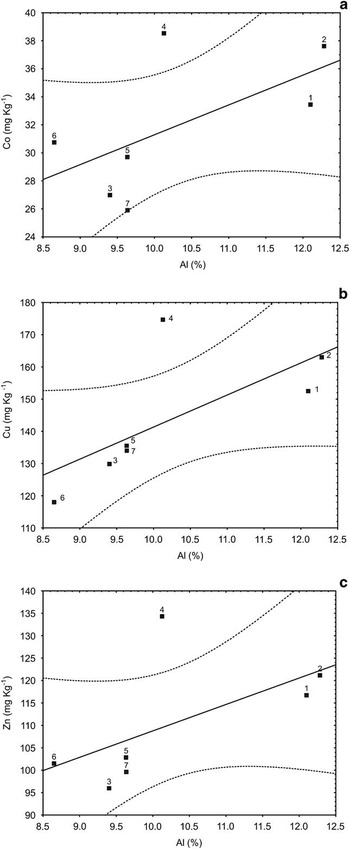
Figure 2 shows the correlation between the Al concentration (normalized) and Co, Cu and Zn concentrations. The results indicate enrichment of Co, Cu and Zn in lake 4.
Regression lines for correlation of Al with a. Co, b. Cu and c. Zn. The broken lines represent the 95% confidence interval for all data.

Statistical analysis
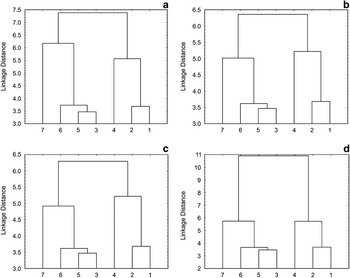
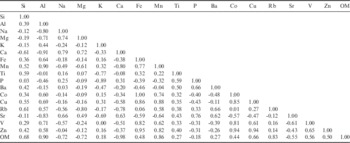
The correlation matrix for all chemical concentrations is shown in Table III. Cluster analysis and PCA were performed on the analytical data to obtain a visual representation of the element distribution, and to detect similarities and differences among lakes and correlations between variables. All dendograms suggest the same four groups (Fig. 3): i) lakes 1 and 2, ii) lake 4, iii) lake 7, and iv) lakes 3, 5 and 6.
Dendograms showing that the same four groups were obtained when cluster analysis of elemental concentrations was applied, using a. complete linkage method, b. unweighted pair-group average method, c. weighted pair-group average method, d. Ward’s method.

Correlation matrix for chemical data of the lake sediments (Pearson coefficients).

OM=organic matter.
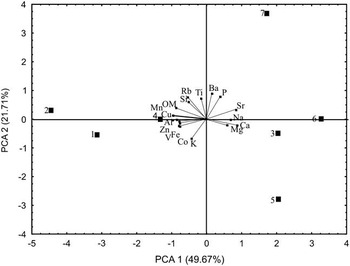
The results of the PCA are shown in a combined plot of scores and loading (Fig. 4). Two principal components explained 70.84% of the total variance. Component 1, with an eigenvalue of 8.9, is characterized by high negative loads of Al (-0.96), Fe (-0.79), Mn (-0.96), Co (-0.76), Cu (-0.85), V (-0.76), Zn (-0.78) and OM (-0.87), and high positive loads of Na (0.69), Mg (0.59), Ca (0.88) and Sr (0.84). Component 2, with an eigenvalue of 3.8, had high positive loads of Si (0.60), Ti (0.71), P (0.78), Ba (0.89) and Rb (0.76), and had a high negative load of K (-0.66). The same four main groups obtained in the cluster analysis can be distinguished in the PCA biplot.
Principal components analysis biplot of the lakes and chemical variables.

Mineralogy, particle analysis and index of chemical weathering
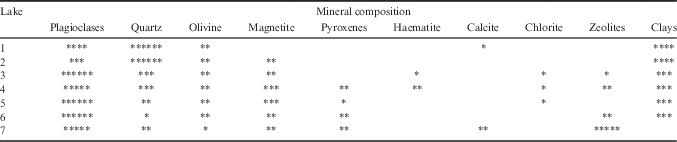
Mineralogical composition distribution is shown in Table IV. In general, the mineralogical species evidenced in lacustrine sediment samples collected at Fildes Peninsula were: plagioclase, quartz, magnetite, pyroxenes (augite-diopside), smectite group (nontronite, montmorillonite), kaolinite, chlorite and zeolites (heulandite-clinoptilolite, analcime, laumontite).
Bulk mineralogy of the studied lacustrine sediments.
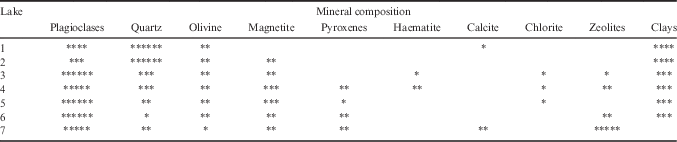
*<5%, **(5–10)%, ***(11–20)%, ****(21–30)%, *****(31–40)%, ******>40%.
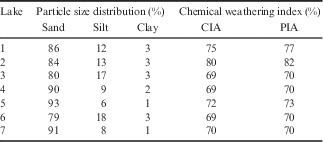
Particle size distribution and the indices of chemical weathering are shown in Table V. The particle size distribution of sediment samples was almost constant in all lakes. The CIA and PIA values range among 69–80 (average=72) and 70–82 (average=73), respectively. The samples with CIA values <60 display low chemical weathering, 60–80 indicate moderate chemical weathering and >80 exhibit extreme chemical weathering. Thus, the values reported here indicate moderate chemical weathering.
Particle size distribution and indices of chemical weathering of the sediments.
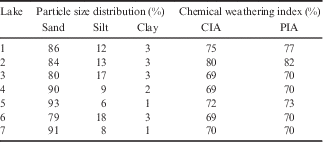
CIA=chemical index of alteration, PIA=plagioclase index of alteration.
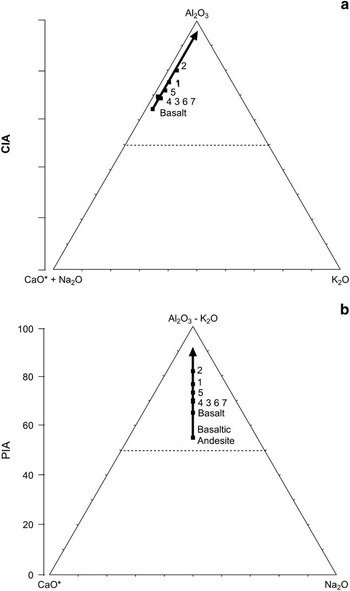
The chemical composition of the lacustrine sediments and the average composition of the dominant bedrock types of Fildes Peninsula (Machado et al. Reference Machado, Lima, Chemale, Morata, Oteiza, Almeida, Figueiredo, Alexandre and Urrutia2005) are plotted in Fig. 5a & b as molar proportions within Al2O3 - (CaO*+Na2O) - K2O and (Al2O3 - K2O) - CaO* - Na2O compositional spaces, respectively.
Ternary plots showing a. molar proportions of Al2O3 - (CaO*+Na2O) - K2O and b. molar proportion of (Al2O3 - K2O) - CaO* - Na2O. The arrow indicates the weathering trend of predominant rocks. CIA=chemical index of alteration, PIA=plagioclase index of alteration.

Discussion
Provenance and weathering
In Fig. 5a, the samples of parent basalt and all lake sediments plot on a trend subparallel to the Al2O3-(CaO*+Na2O) join, characteristic of the weathering of fresh basaltic rock (Nesbitt & Wilson Reference Nesbitt and Wilson1992). Therefore, this trend line can be considered as the weathering trend of basaltic bedrocks near the lakes. Similarly, the plagioclase weathering trends of the sediments fall on a single line and indicate that the sediments are derived from plagioclase enriched source rocks (Fig. 5b).
Previous work on the South Shetland Islands have generated contradictory conclusions. Lee et al. (Reference Lee, Lim and Yoon2004), analysing soils on King George Island, argued that there has been very little aluminosilicate weathering and concluded that chemical weathering is insignificant. On Livingston Island, it was first argued that chemical weathering is important and it is greatly enhanced by freeze–thaw cycles (Hall Reference Hall1993). Navas et al. (Reference Navas, Lopez-Martinez, Casas, Machin, Duran, Serrano, Cuchi and Mink2008) have argued that Livingston Island soils are weathering ‘limited’ but that chemical weathering does affect the evolution of the soils. Lyons et al. (Reference Lyons, Welch, Welch, Camacho, Rochera, Michaud, Dewit and Carey2013), analysing streams from Byers Peninsula, Livingston Island, concluded that active chemical weathering is occurring in that region.
Our results indicate moderate chemical weathering in the lacustrine sediments from Fildes Peninsula. With increasing CIA and PIA values, the sediments plot close to the Al2O3 apex of the triangles (Fig. 5). This suggests that with increasing chemical weathering the sediments are gradually enriched in secondary aluminous clay minerals. The CIA and PIA values are higher at lakes 1 and 2, intermediate in lake 5 and almost constant in the rest of the lakes. This is in good agreement with the mineralogical analysis (Table IV); clay mineral content was higher in lakes 1 and 2, and plagioclase is the dominant mineral in all the other lake sediments. Lakes 1 and 2 are located in the extreme southern part of Fildes Peninsula, the region furthest from Collins Glacier; therefore, there is higher potential for chemical weathering in this region.
The relatively limited variations in particle size distribution demonstrate the complex geochemical and environmental processes taking place in these systems. Our results suggest that the lacustrine sediments from Fildes Peninsula mainly originate from weathering of basaltic volcanic rocks and the depositional alteration is very low. Unfortunately, previous studies on lacustrine sediments or soils from Fildes Peninsula have not included information on the degree of chemical weathering impeding comparative studies.
Metal enrichments
For metals, one common technique for estimating background levels is to normalize the metal concentrations against some element of detrital origin (e.g. Al, Li, Ti). This procedure corrects for the natural variability in the metal concentrations due to parent material or grain size (Veinott et al. Reference Veinott, Perron-Cashman and Anderson2001). It has been suggested that Li is a more appropriate element for normalization purposes in coarse-grained sediments containing little aluminosilicate material (<1% Al; Loring & Rantala Reference Loring and Rantala1992). However, none of the sediments in this study fell into this category. TiO2 is also considered a fairly immobile constituent, but it is susceptible to loss in extremely alkaline or acidic conditions and is present in volcanic glass rather than a weather resistant mineral such as rutile or ilmenite. Hamdan & Burnham (Reference Hamdan and Burnham1996) ranked Ti as being more mobile than Al during pedogenesis of granitic rock. With low solubility in common soil and sediment solutions with normal pH values, Al is a candidate for the immobile element (Birkeland Reference Birkeland1999). The normalization of the total concentration data for Al permits identification of anomalies and variation in the trends (Lee et al. Reference Lee, Lim and Yoon2004, Casalino et al. Reference Casalino, Malandrino, Giacomino and Abollino2013). An advantage of the normalization of trace metal concentrations in total sediment is the rapid analysis and greater cost efficiency of conducting regional geochemical mapping.
Figure 2 shows enrichment of Co, Cu and Zn in lake 4. Lake 4 is located near to a number of research stations. The development of Antarctic research and tourism have resulted in a sharp increase in human pressure, leading to pollution problems near scientific stations (Santos et al. Reference Santos, Silva, Schaefer, Albuquerque-Filho and Campos2005, Lu et al. Reference Lu, Cai, Wang, Yang and He.2011, Majer et al. Reference Majer, Petti, Corbisier, Ribeiro, Theophilo, Ferreira and Figueira2014). Enrichment of Co, Cu and Zn is typically associated with alloys, paints and pigments (Siegel Reference Siegel2002). Previous studies on King George Island have indicated that the main sources of anthropogenic trace elements are fuel spills, waste disposal sites, sewage, paint residues and exhaust gases (Santos et al. Reference Santos, Silva, Schaefer, Albuquerque-Filho and Campos2005, Lu et al. Reference Lu, Cai, Wang, Yang and He.2011). Our results suggest that the enrichment of Co, Cu and Zn in lake 4 sediment is of anthropogenic origin. Trace metals in lacustrine sediments from Fildes Peninsula have been reported previously; however, such studies only considered a limited number of elements, did not deal with spatial variations and focused on palaeoclimatic changes. There is no precise information on trace metal distribution in recent sediments of the Fildes Peninsula lakes. Thus, the results attained in this study should be of considerable value in measuring future impacts on the area.
Geochemical similarities among lakes
Subjectivity is a limitation of cluster analysis (Griffiths Reference Griffiths1987). Furthermore, cluster analysis results may be influenced by the methodology. In this study, different analytical methods provided essentially the same picture, indicating that the groups are consistent and well separated.
Multivariate treatment of the results (Figs 3 & 4), did not show a sharp separation among lakes according to geographic distribution. Cluster analysis and PCA revealed that four main groups can be distinguished: i) lakes 1 and 2, ii) lake 4, iii) lake 7, and iv) lakes 3, 5 and 6. Sediment from lakes 1 and 2 represent a higher degree of chemical weathering and have the highest content of secondary aluminous clay minerals (Fig. 5 and Table IV). On the other hand, the results obtained in lake 4 sediments showed anthropogenic enrichment of Co, Cu and Zn (Fig. 2).
The combined plot of scores and loadings obtained by PCA shows which elements characterize the lakes and give rise to the differences among them. For instance, Ba and P determine the position of the lake 7 in the plot with respect to others. The values are most probably related to the highest amount of these elements found in this lake (Table II). Lake 7, in contrast to the other lakes, is located in the north-east region of Fildes Peninsula. Machado et al. (Reference Machado, Lima, Chemale, Morata, Oteiza, Almeida, Figueiredo, Alexandre and Urrutia2005) found that on Fildes Peninsula all rock samples were enriched in Ba relative to N-MORB, and that Ba concentration was higher in the rock samples collected in the north-east (508 ppm) compared to elsewhere on Fildes Peninsula (200 ppm). Therefore, local bedrock is probably the main source of sediment in lake 7.
Lake 7 sediments show the highest relative content of P and zeolites. There is a negative correlation of P with OM (Table III), thus the high content of P suggests the presence of apatite. Zeolites have been reported in rocks of the South Shetland Islands (Smellie et al. Reference Smellie, Pankhurst, Thomson and Davies1984), and in the soils and lacustrine sediments of Livingston Island (Jeong et al. Reference Jeong, Yoon and Lee2004, Navas et al. Reference Navas, Lopez-Martinez, Casas, Machin, Duran, Serrano, Cuchi and Mink2008, Cortizas et al. Reference Cortizas, Muniz, Taboada, Toro, Granados, Giralt and Pla-Rabes2014). The zeolites probably originate from the in situ weathering of volcanic bedrock as they have been reported in veins (Smellie et al. Reference Smellie, Pankhurst, Thomson and Davies1984) or infilling cavities (Navas et al. Reference Navas, Lopez-Martinez, Casas, Machin, Duran, Serrano, Cuchi and Mink2008) in rock fragments of the South Shetland Islands.
Conclusions
This is the first comprehensive geochemical characterization of lacustrine sediments along the Fildes Peninsula, King George Island. Our results suggest that depositional processes have little influence on the geochemistry of the investigated elements and that local bedrock is the main source of sediment in the lakes on Fildes Peninsula. In general, the element composition and concentration in lake sediments are dependent on the properties of parent rocks and climatic conditions in the watershed.
Our results indicate moderate chemical weathering in the lacustrine sediments from Fildes Peninsula. The degree of chemical weathering to which plagioclase enriched source rocks have been subjected is relatively higher at lakes 1 and 2, which are located in the extreme southern part of Fildes Peninsula, the region furthest from the Collins Glacier. This suggests that the distance to the glacial ice margin is one of the most important factors influencing chemical weathering in the area.
Four different lacustrine sedimentary environments can be distinguished: i) lakes 1 and 2 with relatively high values of secondary aluminous clay minerals, ii) lake 4 with anthropogenic enrichment of Co, Cu and Zn, iii) lake 7 with relatively high values of Ba and P and a high zeolite content, and iv) all the other lakes studied. The results attained in this study should be of considerable value in measuring future impacts on the area.
Acknowledgements
This project was supported by the FONACIT-Venezuela. We thank Carlos Bastidas, Jackson Ojeda and Juan Manuel Carrera for their assistance. The authors extend their gratitude to Instituto Antártico Chileno (INACH) and Programa Antártico Brasileiro (PROANTAR) for their assistance during sampling. The authors also thank the reviewers for their valuable comments.
Author contributions
J.A. Alfonso developed the concepts or methods of approach, co-ordinated the sampling, performed results discussion and prepared the manuscript. Y. Vasquez was head of the sampling and performed chemical, mineralogical and statistical analysis. A.C. Hernandez performed mineralogical and particle analysis. A. Mora and E. Sira helped in results discussion and preparation of the manuscript.