

INTRODUCTION
False starts are a special class of speech disfluencies, which include fillers, repeated words and repaired utterances. Generally speaking, there are a number of approaches to analyse this kind of event such as sociolinguistics, taking into account the speaker-hearer interaction and the framing, psycholinguistics, in relation to behavioural and developmental studies (such segments will be seen as indicative of incomplete language acquisition or poor communication skills, see Ochs Reference Ochs, Ochs and Schieffelin1979, with a particular interest in transcription), cognitive linguistics – especially in discourse planning – discourse analysis, phonetics (signal processing). . .
This article suggests a different perspective. Using data from the ESLO corpus (see infra 2), I describe how the speakers’ competence (internal grammar) plans to unravel the false starts. The observation is made from transcriptions. The spelling chosen by the transcribers reveals their underlying lexical interpretation. For example, writing ‘phot-’ for the phonetic string /fot/ is a reliable clue that the transcriber anticipated the word ‘photography’. The competence of transcribers is appreciated in its relationship to the vernacular morphophonology of French as a subset of universal principles.
The point is neither how the production of speech may reflect the context or the relations between the interlocutors nor the kind of mental representations they have when they are talking to each other. The false starts are not intended to be regarded as a specific case in the range of disfluencies.
1. HIERARCHY OF FEATURES AND MORPHOLOGY
We focus on the interface between phonology (in this case, the vocalic system, not the concrete realizations of the sounds) and morphology, or morpho-syntax, with special attention paid to some functional words. First, false starts are empirically used to test the theory of the hierarchy of features. After Clements'criticisms:
The apparently vast number of speech sounds found in the languages of the world turn out to be surface-level realisations of a limited number of combinations of a very small set of such features – some twenty or so, in current analyses. (. . .) What is less clear is the manner in which these ultimate constituents of speech are organised. Bloomfield's well-known characterisation of phonemes as ‘bundles of features’ suggests inherent disorganisation and lack of structure. One might make this view more explicit by proposing that feature bundles have no internal organisation at all, but that any two features characterising a phoneme are as closely (or as distantly) related as any two others. It is exactly this conception that is incorporated into the familiar view of phonemes as ‘feature columns’, that is, single-column feature matrices. (Clements, Reference Clements1985: 225)
Dresher has come back to this point:
Apart from explicit discussions of phonological theory, feature hierarchies are often implicit in at least a partial way in the common practice of phonologists from a variety of theoretical backgrounds when they are presenting segmental inventories. (Avery, Dresher & Rice, Reference Dresher, Avery, Dresher and Rice2008: 24)
It is believed that no research on false starts has been published that uses this approach. In addition, no link has yet been established between the characteristics of a morpho-phonological system and the procedure used for restoring an incomplete statement.
I analyse all the false starts in the corpus that begin with a vowel in order to draw some conclusions about their form, not about their use. The rationale for focusing exclusively on vocalic false starts is threefold: first, this reduces the tokens to a manageable number; second, the null onset in French, especially at the beginning of a word, is a very important site for all sorts of phonotactic events (liaison, elision, assimilation); third, the main possibilities can be exemplified without taking consonants into account. In this regard, it seems that the false starts are not correlated with the level of complexity of the word, linked with its low frequency or its phonotactics. In so far as the vocalic system is involved, the realignment requested by an empty onset is prevalent. The reconstruction of the conjectural whole word and the procedures whereby hearers bestow an interpretation are outlined at the end of the article.
2. THE POINT AT ISSUE
A false start is neither a noise (or an arbitrary sequence of phonemes), nor a complete word. Instead, by definition, it is considered to be an unfinished word or sentence that is cut off mid-utterance. It should be distinguished from stuttering, in which the flow of speech is disrupted by involuntary repetitions (Fitzgerald, Hall & Jelinek, Reference Fitzgerald, Hall and Jelinek2009). Although no exclusive cause of developmental stuttering is known, stuttering and false starts differ in both their origin and their phenomenology. One affects mainly the speaker, while the other affects speech. In both cases, false starts usually seem to occur before the first content word in a sentence. Most of the time, despite appearances to the contrary, the cause is not a block over the pronunciation of the phoneme or the syllable. Rather, the conflict occurs between the start of the sentence and the global design of the utterance, beyond observable phenomena. This feature suggests that a large part of the process of speech production takes place there.
In French, a false start is called ‘amorce’ (initiation, primer). The difference in the words chosen to describe this phenomenon in French and English reflects two directly opposed points of view. English prefers a sports metaphor meaning a failed attempt, whereas French chooses a psychological term (in the technical sense, ‘amorce’ is the beginning of a word provided by the examiner during a test to help someone to find the correct answer) signifying inception. So, ‘false starts’ are pragmatically conceived of as dysfluencies, while ‘amorces’ are indications about the speaker's state of mind and the interaction.
Here is an example including two false starts. The translation given in brackets reproduces the original form of the false start (for the data source and the transcription conventions used, see section 2 below):
(1) j- après j’étais à Trai- (‘j- then I lived in Trai-’)
To classify one phoneme (as j-) or more (three for Trai- [tʁɛ]) in this category, it is essential to identify the target word (term). A proper identification requires three operations:
(i) recognizing some phonemes in the signal and seeing how these sounds can be transcribed;
(ii) deriving a realistic assumption about the expected word, in this case: ‘je’ (I) and ‘Trainou’ (the name of a village); for this reason, as we can see, the orthographic spelling ‘Trai-’ instead of ‘trè-’ by the transcriber, and in particular the capital letter, which is restricted to proper nouns in the transcription conventions, anticipated this assumption;
(iii) the explicit forecasting of the subsequent word is so plausible that it is a logical decision to transcribe as ‘j-’ what will in fact be the whole word (‘j’’) as a result of elision.
So, at this stage, how can one establish a basis for deciding that a particular word is compatible with the context, especially when one or more words may separate the false start from its target – for example après in (1) between ‘j-’ and ‘j’’? How can a relevant word be assigned to the phonemes actually produced?
There are four ways to make this decision that can be clustered into pairs a–b and c–d:
(a) Recognition of phonemes (they all fit under one or more words that share the same beginning but an accurate pronunciation may favour one word in particular); and
(b) Statistics (in this approach, the expected word is assumed to be the most frequent one, possibly taking the type of text into account to weight the results);
(c) Syntax (with a specification of the criteria as set out in the structure of the sentence); and
(d) Potential paradigmatic substitution (what kind of words may co-occur in a given context).
When a decision is taken, whether it stems from the signal or from the clause structure, it is based on the interaction of these four criteria to address uncertainties.
Overall, this article leads to the conclusion that the amount of false starts results in an arrangement between the phonological organization (Clements & Hume, Reference Clements, Hume and Goldsmith1995), as a linguistic universal – for example, in any language, it is expected that there should be more unrounded vowels than rounded ones, more oral vowels than nasal ones –, and the morphological pressure of function words, in particular, when it comes to dialogue, the prominence of personal pronouns. The importance of these markers will be emphasized in the conclusion as a special feature of the recent evolution of present-day French.
The study is structured into five sections. Section 2 describes the sources of the data, Section 3 is an analysis of the corpus query results, from vowels (and any sort of letters featuring them) at the beginning of the word to almost the whole word, Section 4 consists of a review of i-false starts, Section 5 of a review of a-false starts, Section 6 of review of the other false starts.
3. DATA: FROM THE CORPUS TO THE SCREENING OF RELEVANT DATA
The data used in this article were retrieved from the ‘Enquête Sociolinguistique à Orléans 2’ (ESLO – Socio-Linguistic Survey in Orleans 2 – http://eslo.huma-num.fr/), a research programme undertaken by the LLL (Loire Linguistics Lab) from 2008 to build a reference corpus of present-day spoken French (Bergounioux et al., Reference Bergounioux, Baraduc and Dumont1992; Bergounioux, Reference Bergounioux2016). The objective was to record 400 hours or so of sound documents, i.e. about 6,000,000 words, a number of tokens that is today often considered as a reference value for the type of processing and investigations planned. The data were used in the state in which they were on the date when the study was finalized (January 2015). ESLO contains several modules. The largest one is the collection of approximately 100 face-to-face interviews based on an open-ended questionnaire.
The transcription is carried out through a processing line. Undergraduate students in linguistics cut into chunks and make a first version of what has been said (version A). A proofreading (version B) is carried out by another transcriber who has to refine the previous version. In version C, the operator rectifies the remaining errors and checks spelling and compliance with the instructions before posting. The transcriber must comply with the French spelling rules, regardless of the actual pronunciation or grammatical knowledge of the speaker. The plural ‘s’ is noted in the sentence ‘on les a éduqués’ even if the speaker does not use this rule of agreement where it is noticeable, when he says ‘la voiture qu'on a pris’ instead of ‘la voiture qu'on a prise’ for example. The three versions are stored to enable comparisons and to draw some conclusions. Only version C was studied here.
The tool Transcriber (http://trans.sourceforge.net/en/presentation.php) was selected to assist the manual annotation of speech as it is specifically designed for the transcription and annotation of speech signals for linguistic research. Transcriber supports multiple hierarchical layers of segmentation. While the transcription is proceeding, the words are grouped into clusters ranging from zero (pauses) to ten (or more) words. It is recommended, however, that the clusters be as short as possible in order to show how the clauses and sentences go together.
First of all, we need to specify how to sort the data – or set conditions – that enable relevant units to be identified from the transcriptions. For the present study, the query used, in line with the transcription conventions, was: ‘extract all the segments (chunked by the transcriber) corresponding to the following description <alphabetic character followed by a hyphen and a space>’.
The search queries led to two opposite results, either increasing or contrariwise decreasing the number of tokens. The three main reasons for removing some tokens from the data were:
– Noise (information theory), for example an unwanted space between units in the case of compound typographical units, e.g. ‘peut-être’ (perhaps) and all sorts of transcription errors;
– Abbreviations that are not lexicalized even if there is wide agreement on the truncated form – e.g. ‘placo-’ (placoplâtre, plasterboard), ‘Libé-’ (Liberation, a newspaper title) – or not: ‘réno-’ (standing for rénovation = refurbishment).
– Inability to retrieve certain false starts, documented in the transcriptions, in spite of repeated listening to the recordings: the false start in question was not obvious to me, though it forms part of the transcription.
The number of available occurrences may also increase, however, for two main reasons. The queries on the database provide results in line with the segmentation into chunks. So, although there is more than one false start in some chunks, especially when the same false start is repeated, the query will produce only one result including two to four tokens:
(2) j- j- j- j'aime pas trop l- (‘j- j- j- I don't like so much l-’)
Above all, unsurprisingly, a large number of tokens has been inadvertently omitted by the transcriber (Blanche-Benveniste, Reference Blanche-Benveniste2010: 4). Listeners’ expectations and auditory framework contribute to artefacts and failures. A cursory examination indicates that this affects at least 5 to 10 per cent of cases. Unfortunately, on this point there can be no perfect solution. Each listener has her/his own perception grid, which varies from one person to another. And this remark also applies to one and the same person, between one's previous listening and a later one. After scrutinizing the data, as far as I can ascertain these omissions do not seem to follow any particular pattern and they are no doubt more interesting for psycholinguists than for phoneticians.
The database comprises 87 individual interviews (work in progress) from ESLO2, men and women, from 18 to 80, from all social classes. It amounts to about 100 hours of recording. Approximately 10,000 tokens match the query mentioned above and many of them were produced by the interviewers. In order to observe precisely and exhaustively the occurrences, I selected only the first thousand false starts. They circumscribe a panel of nine interviewees, ranging in age from 25 to 82. Four bystanders (the interviewee's husband or daughter) and four professors are included in the survey. There are very significant fluctuations from one speaker to another, even for the same person at different times. The aim of the present review is not individual or social behaviour, however, but the phonetic characteristics of all the false starts as they were produced, regardless of the speaker. It is the graphic reproduction by the transcriber that matters and not the reasons of disfluencies in the speaker's oral production.
Before presenting an overview of the query outputs, there is one more case to consider. It concerns slips of the tongue and self-corrections. In such cases, the false start and the target are not exactly the same.
– Self-correction:
(3) Vous êtes pas sup- fan d'un club (‘You're not a sup- fan of a local sports club’)
‘fan’ instead of ‘supporter’.
– Mispronunciation:
(4) Surtr- surtout sur Orléans (‘surtr- especially in Orleans’)
in perseveration of ‘sur’: ‘surtr-’ instead of ‘surtout’
– Slip of the tongue
(5) On me dit que j'ai l'as- l'accent du Sud (‘I am told that I speak with l'as- a southern accent’)
‘assent’ is a common ironic designation that attempts to mimic the southern French pronunciation, with a reduced cluster from /ks/ to /s/, so perhaps this example is a kind of Freudian slip.
Henceforth, only one phoneme, or a string of phonemes, was taken into account; stuttering and slips of the tongue were excluded. There is however an additional requirement for the target to be retrieved. If not, matching is entirely conjectural when the only indicator available to settle the matter is morphology. As required by classical phonological theory, a sound becomes a phoneme if and only if this sound is able to characterize a chunk as a morpheme, and vice versa. This condition narrows down the scope to 80 per cent of the tokens, but the decrease is partly compensated by reiterations, bringing the level back up to over 90 per cent of the initial total.
As it is a time-consuming task to scrutinize each token, the manual examination was restricted to the first thousand outputs in the raw data, i.e. 916 appropriate responses to the query after data sorting. The selection criterion was the phonetic value of the orthographic transcription (regardless of the spelling used by the transcriber, even though this is an important matter), subject to the recognition of the target. In this process, all listeners – including transcribers and linguists – make the same inference, drawing on the signal to determine the meaning of the string.
4. AN OVERVIEW OF THE VOWEL SET
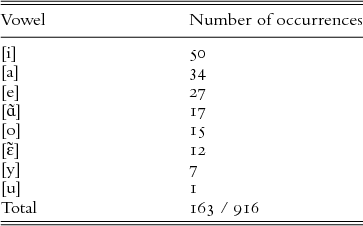
I first examined all the false starts beginning with a vowel from a strictly phonetic perspective, regardless the spelling. They account for less than 20 per cent of all false starts, or 167 tokens recorded, which is a little more than expected if we consider the average proportion of null onsets in French, even if we assign weights to create a probability sample.
[ɛ̃] potentially includes [œ̃]. In false starts, except if a diacritic exhibits a clear contrast between mid-open and mid-closed vowels – [o] / [ↄ] – [e] / [ɛ] –, the imputation to one of the phonemes, instead of an archiphoneme as done here, would probably provide arbitrary information. Indeed, in a wide range of cases, the application depends on the syllabic structure, which is unrealized at this stage
Table 1 corroborates, roughly speaking, hierarchical ratio of vowels, both in French and as a language universal (Trubetzkoy, Reference Trubetzkoy1969, Clements & Hume, Reference Clements, Hume and Goldsmith1995, Avery, Dresher & Rice, Reference Dresher, Avery, Dresher and Rice2008). The hierarchy was established exclusively on the basis of phonetic principles. It is based on the number of articulatory gestures and the theory of least effort to reach the articulation point (consonant) or optimal acoustic resonance (vowels). Interaction with morphology was not accommodated. That is the point that will be considered.
Frequency of vocalic false starts

For example, [ə] never occurs at the beginning of a word. [œ] (or [ø]), which is one of the less frequent vowels, is usually acknowledged as a filler, spelt as ‘euh’ (uh). Besides, there is only one grammatical word spelt in this way: ‘eux’ (them) and it seldom appears at the beginning of a chunk, except as an emphatic masculine plural third person pronoun (them).
So, unless one can clearly foresee the target, orthographic rules demand the most usual letter used to produce this sound. For instance, the transcriber generally selected ‘o-’ instead of ‘au-’ (or ‘hau-’, ‘eau-’ and so on).
As expected, for it is a linguistic universal within the structure of languages, with its counterpart in speech, there are more unrounded vowels than rounded ones:
 $$\begin{equation*}
140\,{\rm{vs}}.\,23 = ({15[{\rm{o}}] + 7[ {\rm{y}}] + 1[{\rm{u}}]})
\end{equation*}$$
and more oral vowels than nasal ones:
 $$\begin{equation*}
134\, {\rm{vs.}}\,29\,(=17[{\tilde{a}}]+12\,[{\tilde{\varepsilon}}])
\end{equation*}$$
Though, in this respect, the presence of /i/ at the top of the list is noteworthy. It is the only significant exception.
5. THE CASE FOR [i]
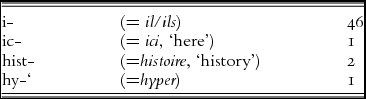
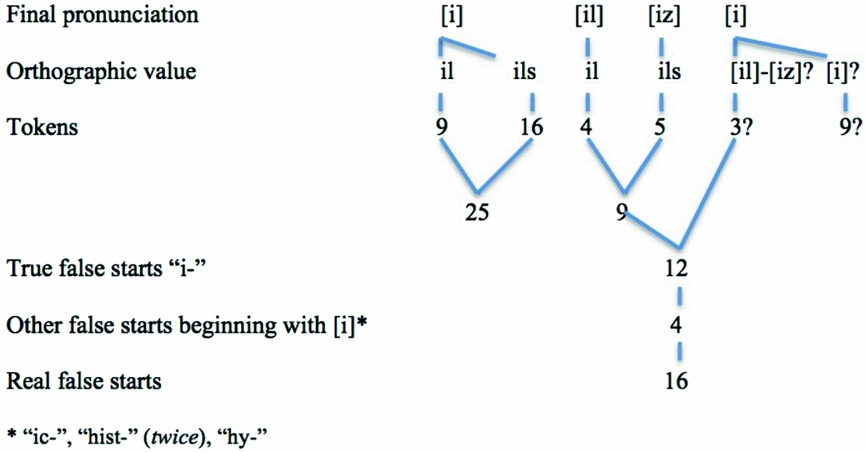
A closed vowel is not expected to be the most frequent one. There is however a morphological reason for this overrepresentation. A large proportion of ‘i-’ stand for ‘il/ils’ (he, it, they), the subject personal pronoun (third person masculine), including its occurrence in many set phrases.
Different spellings of [i]

It is of key importance to assess the relevance of the transcription. For example, ‘ic-’ would normally be pronounced [ik], whereas the elucidation of the corresponding word prescribes [is]. Regarding ‘il’, as a matter of fact, there is a marked discrepancy between spelling and actual pronunciation. In colloquial French, ‘il’ or ‘ils’ are more commonly pronounced as [i], without any consonant coda, if the next phoneme is a consonant. To a certain extent, [l] should be seen as the pronunciation of a latent word-final consonant immediately before a following vowel sound, i.e. a kind of mandatory liaison (Encrevé, Reference Encrevé1998) before a vowel but it differs from this process. There is always an optional realization of the consonant in any case, especially in acrolectal pronunciation. But what about the tokens in this corpus?
i- = il = [i] = 9
(6) justement i- il travaille (‘that's the point i- he's working’)
As already mentioned, in spite of the ‘il’ spelling, the actual pronunciation is [i].
i- = ils = [i] = 16
(7) c'est vrai que i- ils fonctionnent (‘it's true that i- they operate’)
The same can be said for this group. The written word-final [z], spelt ‘s’ is also latent except for liaisons (see below).
i- = il = [il] = 4
(8) i- il a pas de souci (‘i- he has no worries’)
Of course, in spoken French the first particle of a negation n(e) is very often omitted. When the next word begins with a vowel (‘null onset’), [il] is mandatorily fully realized, since by preserving the consonant, the hiatus is avoided. This form is very common due to the impact of (i) the auxiliary verbs être and avoir, (ii) the proclitics y and en, (iii) a set of Latin prefixes (ad-, ab-, ex-, in-, ob-...).
i- = ils = [iz] = 5
(9) en fait i- ils ont refait (‘in fact i- they have redecorated’)
‘Ils’ in the plural case is generally pronounced [iz] (= ‘ils’) when the next word starts with a vowel and [l] is most of the time deleted; so the only actualization is the liaison consonant, which is a silent letter in the other contexts.
i- = il/ils = [i] ? [il] ? [iz] ? = 12
(10) les petits à la maternelle i- i- (‘the toddlers at nursery school i- i’)
The sentence is cut off. It is impossible to predict the next word and hence the actual pronunciation.
One of the consistent principles of the ESLO guidelines (Guide du transcripteur) is that when a word is uttered, regardless its actual pronunciation is, the spelling should be respected when writing it down. For example, ‘parce que’ (because) is most often pronounced [pask], but is always transcribed according to orthographic rules in the ESLO corpus. When the whole utterance is taken into account, in other words when ‘il’/‘ils’ follows ‘i-’ in due course and then the sentence is finished, all the pronouns sound in fact like [i] or [iz], never [il] or [ilz] if the next word begins with a consonant. Moreover, the false start probably affects the actual spelling of the whole word, but after all, in light of the above, what is really the whole word?
Now, what can be said about the relevance of this transcription? If we consider the results:
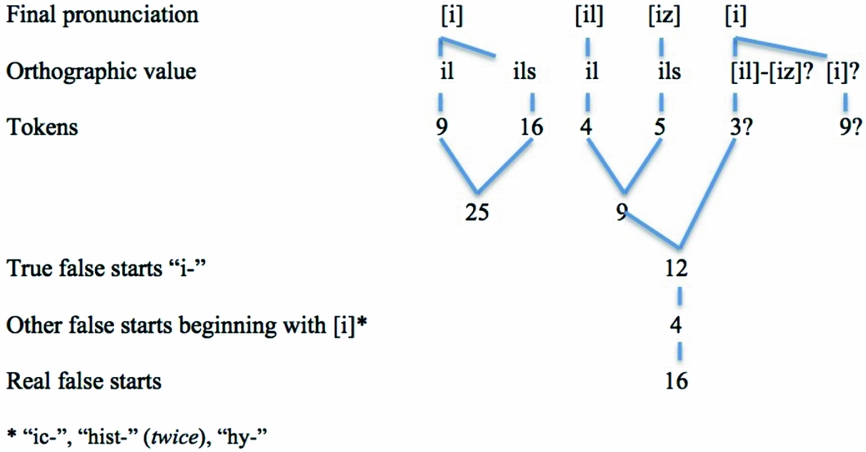
– 25 false starts (9 ‘il’ + 16 ‘ils’) are spelt ‘i-’ (plus a hyphen) although, as already noted, they are really expected to be spelt [i]. Is it relevant to consider ‘i-’ as a false start when the unfinished word and the whole word are exactly the same? Probably not, unless there is a reiteration. To consider the ‘i-’ of ‘il’ + word beginning with a consonant as a false start is not sustainable. That is why we do not keep these forms as ‘real’ false starts.
– 4 are pronounced [il] and 5 [iz], due to the vowel that follows.
– 12 are debatable, as they are not followed by any reiteration of the pronoun preceding the verb – the sentence starts afresh. Generally speaking, the rules of phonotactics stipulate that nothing (sometimes marked by a hashtag in formal linguistic representations) has the same value as a consonant. So, the solution is purely conjectural.
I take into account the number of acknowledged [i] (25) and the number of [il]–[iz] (9) (see Figure 1). If I extrapolate what would happen to the remaining 12, commensurate with the sample (three to one), nine would be assigned to the first category and three to the second one. So, the remainder of true false starts is 12 plus four others, totalling 16.
Corresponding forms for ‘i-’
This distribution fits perfectly under the vowel chart proposed by Trubetzkoy (the corresponding number is written under the phoneme):

Trubetzkoy argued that the aperture of the jaw is the first feature to be considered; the backness and the roundedness (they merge when [o] or [u] are pronounced) come second (see also Zipf, Reference Zipf1935). This is precisely the case here, which confirms his prediction. First, articulatory constraints would explain the relative frequency of vowels. Then, some grammatical morphems (words or affixes) would modify the expected weighting. Such an analysis, undertaken for the first time on false starts, provides support for Trubetzkoy's assumption.
6. THE CASE FOR [a]
Now, what can be said about the 35 [a]? There is a wide range of instances, each of which I will consider in turn.
One token is unidentifiable.
Three tokens seem to be unreliable transcriptions that are phonetically uncertain:
(11) n'est pas a- a- un Orléanais (‘is not a- a- an inhabitant of Orleans’)
When listening to the utterance, the possibility of ‘o- o-’ (standing for ‘Orléanais’) instead of ‘a- a-’ cannot be excluded.
There are two slips of the tongue:
(12) euh im- implantée dans ce mouvement-là pour pouvoir y ac- y adhérer (‘uh im- operating in this movement to be able to ac- to join it’)
There seems to be interference here between ‘accueillir’ (to welcome) and ‘adhérer’ (to join).
(13) mes parents alla- allaient un peu à l'aveuglette (‘my parents alla- acted a bit blindly’)
[ala] is probably an anticipation of ‘à l'a(veuglette)’ (blindly). ‘Alla’ ((he) went) does exist as well.
Half of the other words (15 cases) are content words, including eight nouns:
* Two tokens. One foreign word, used twice, is phonetically complex:
(14) là Ant- Antlaya (‘there Ant- Antlaya [name of a restaurant]’)
It is interesting to note that the problem with this word is purely the result of a misspelling: the real name of this restaurant is the name of the Turkish city Antalya, a word that is very easy to pronounce for a French speaker, but probably not foreign-sounding enough to be preserved in this form. From a phonological point of view, the sequence /nasal vowel + stop + liquid/ does not exist in French even though it can be commonly heard: ‘En t(e) la donnant. . .’ (giving it to you).
* One word, ‘association’, tends to a syllabic reduction: its three successive [s] lead to conflation of the second and the third syllables, erasing [o]. So, [asjasjↄ̃] is a very common realization of this noun in colloquial French. The speaker seems to be aware of this mispronunciation, as she apologizes:
(15) ça a aidé à des associa- associations pardon (‘it has been a support for as(so)cia- associations sorry’)
* One is the result of an adjustment, from the singular to the plural form of the article:
(16) on s'achète un a- des abonnements (‘we purchase an a- some subscriptions’)
* One is the output of a lexical shift, when ‘musiciens’ is used instead of ‘artistes’:
(17) tous ces a- tous ces g- c- tous ces musiciens (‘all these a- all these g- c- all these musicians’)
* Three are true false starts. A phonetic recurrence (‘année’/’annuler’) may have caused one of them, as in (13):
(18) qui fait que cette an- ça a été annulé cette année (‘so this an- it was cancelled this year’)
* There are also six verbs (accueille (‘welcome’), acheté (‘purchased’), amenez (‘(you) bring’), assisté (‘attend’), habite (‘live’, used twice):
(19) la ville avait a- achetés pour eux (‘the city council had a- purchased for them’)
* and 1 adverb: ‘actuellement’ (currently).
The remainder (14 tokens) comprises grammatical words such as:

Five of them represent different sorts of adjustment as in the following example:
(20) alors nous av- [on] a beaucoup de chance (‘so we av- we have been lucky’)
Five are unfinished words:
(21) qui est a- pratique pour travailler (‘which is a- convenient for working’)
Four resemble stuttering:
(22) a- ap- après quoi (‘a- ap- after which’)
7. WHAT ABOUT THE OTHER VOWELS?
There is only one unexpected result. It concerns [y], which is more common than [u] in the data. This is partly due to the indefinite feminine singular article ‘une’ (a), which accounts for four out of the seven tokens.
(23) c’était u- une vieille école (‘it was u- an old school’)
It would be difficult to make a direct comparison with the masculine article ‘un’ as this is a single phoneme word, so it is not relevant. Also, some transcribers may have perceived ‘un’ as a nasalized ‘euh’.
As seen above, the same hierarchy is replicated in the nasal vowels:

With regard to rounded vowels, [œ̃] has merged with [ɛ̃] and there is no [ɔ̃]. However, ‘on’ is very common in colloquial French at the beginning of a sentence as a substitute for ‘nous’ (‘ont’, third person plural of ‘avoir’, to have, is also very common, but is seldom found at the beginning of an utterance). At first glance, this may be due to the continuity of nasal vowels. As for ‘un’, it is the case when there is no ensuing consonant. The word is perceived as completed as soon as it is pronounced. It is worth noting that no [ɑ̃] stands for ‘en’ (the same as ‘dans’, in), but this vowel is always the beginning of a longer word. Nevertheless, it appears that the same argument holds for [a]. Even if ‘à’ (and ‘a’, has) are commonly used, there is only one token (out of 18) where the spelling a- stands for ‘à’ – the sentence starting afresh.
In addition, the same outcome is expected for the masculine as for the feminine pronouns elle/elles (she/they). The latter are spelt [ɛ] (open-mid front unrounded vowel), and the plural [ɛz], accruing from the same consonant erasure ([l] > Ø) in colloquial French. To the best of our knowledge, the percentage of masculine nouns in French is 55 per cent, and that of feminine nouns is 45 per cent. When anaphora occurs, one would expect a corresponding ratio, depending upon the grammatical gender of the antecedent. Anaphora in which the masculine form subsumes the two genders has only a slight effect on the final result. However, instead of 46 ‘il/ils’, there are only four ‘elle’:
(24) e- m- elle m'a pas mis dehors (‘e- m- she didn't kick me out’)
(25) é- elle est (‘é- she is’)
(26) ouais s- ben è- elle est chère (‘yes s- well è- it is expensive’)
(27) el- elle avait un côté (‘el- she had a side’)
Of particular interest are the transcriber's four spellings:
(24) chooses the usual spelling and uses the first letter of ‘elle’,
(25) is akin to a slip of the tongue, a correction from the closed-mid to the open-mid vowel.
(26) is an attempt to replicate the pronunciation, by means of a diacritic, the grave accent,
(27) emphasizes the difference between [ɛl(ə)] and [ɛlʔ] to indicate the continued contact between the side of the tongue and the roof of the mouth.
However, the strong asymmetry between the number of occurrences of ‘il/ils’ and that of ‘elle/elles’ demands an explanation, which is beyond the scope of this study. It should be noted that there is only a small proportion (10%) of set phrases including the dummy pronoun ‘il’ as in il y a (there is), il faut (we must), il est temps (it's time). Anaphora is the leading cause for the use of the masculine form. A quick glance at the data suggests that the ratio {il/il} ÷ {elle/elles} is 5 to 1. So, even without regard to false starts, why is anaphora so common with the masculine pronouns? Or why is it so infrequent with the feminine ones? This is a puzzling point.
DISCUSSION
When scrutinizing the data in any oral corpus, one has to reckon first with a great amount of bias due to the transcription. Some of the transcriptions are idiosyncratic, depending on the alphabet and conventions used. In environments where the phonemes do not contrast, it may become less clear which phoneme a given phone represents. As it is not straightforward to ascertain the accurate identity of a mid-vowel in spoken French, the decision usually taken by transcribers is to mix the two (open-mid and close-mid), using the simplest orthographic representation of the sound. French phonology (especially phonotactics) generally prescribes a closed vowel in an open syllable and an open vowel in a closed syllable. So, to deal with the issue, it is necessary to know what would have been the target and how the syllable is built. This may account for the many different transcriptions of a certain number of false starts. Moreover, the transcriber tends to omit the sound [œ/ø] because it is exactly the same as the filler ‘euh’ (uh), and almost the same as its nasalized allomorphism that sounds like ‘un’ (a). This problem concerns mainly [e]/[ɛ] and [o]/[ↄ].
It should be noted that the target of false starts is not primarily the word, as it seems at first glance. The clue is generally infralexical or supralexical:
– Infralexical when the problem lies at the syllabic level, especially in the relinking of words. The false start is not the result of particular difficulties with certain words or phonetic combinations; rather, null onset triggers a recalculation for liaison and elision or linking (Ségéral & Scheer, Reference Ségéral and Scheer2001), and the syllabification determines the vocalic aperture. Additionally, null onset is related to the erasure of the schwa but not in this case since it involves personal pronouns in particular such as je > j(e), tu > t(u), il > i(l), elle > e(lle).
– Supralexical, when related to sentence planning more than to the choice of words, following such locutions as ‘(il) y a’.
When listening to the recordings, the lexical segmentation involves, above all other considerations, the listener's skills, especially when the false start comprises two words such as d'a- (d'aller, d'accord), d'ar- (d'arriver), d'av- (d'avant) etc.
A third explanation, which focuses on the speech production, refers to a special relation to the ‘receiver’ (using Jakobson's terminology of language functions). This point implies the speaker's self-representation and again it focuses on the crucial role of pronouns as part of the global pattern of the ‘énonciation’ (Benveniste, Reference Benveniste1970).
From a phonological point of view, false starts illustrate some general characteristics of linguistic universals, though using a type of evidence not often adduced (see Bergounioux, Reference Bergounioux2008). They corroborate the hierarchy of features proposed by Trubetzkoy and by Jakobson (Reference Jakobson1962). So there are:
– more open and middle vowels than closed vowels,
– more unrounded than rounded ones,
– more oral than nasal ones. . .
Discrepancies between what is expected from this hierarchy and the observed occurrences in a given language highlight the special function of morphological words.
As a single consonant may be a false start or an abridged form in spoken French (elision), is it possible to consider some vocalic units such as [i] or [e] standing for ‘il’ or ‘elle’ as false starts when the actual realization of these pronouns is exactly the same? I discussed this point when it was found that ‘i-’ was so common that it came first in the list of vocalic false starts. Likewise, the morphological effect also explains the high frequency of [y] in comparison with [u].
A PROPOSAL OF GUIDELINES FOR THE RESTORATION OF WHOLE WORDS
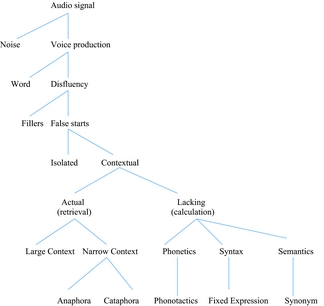
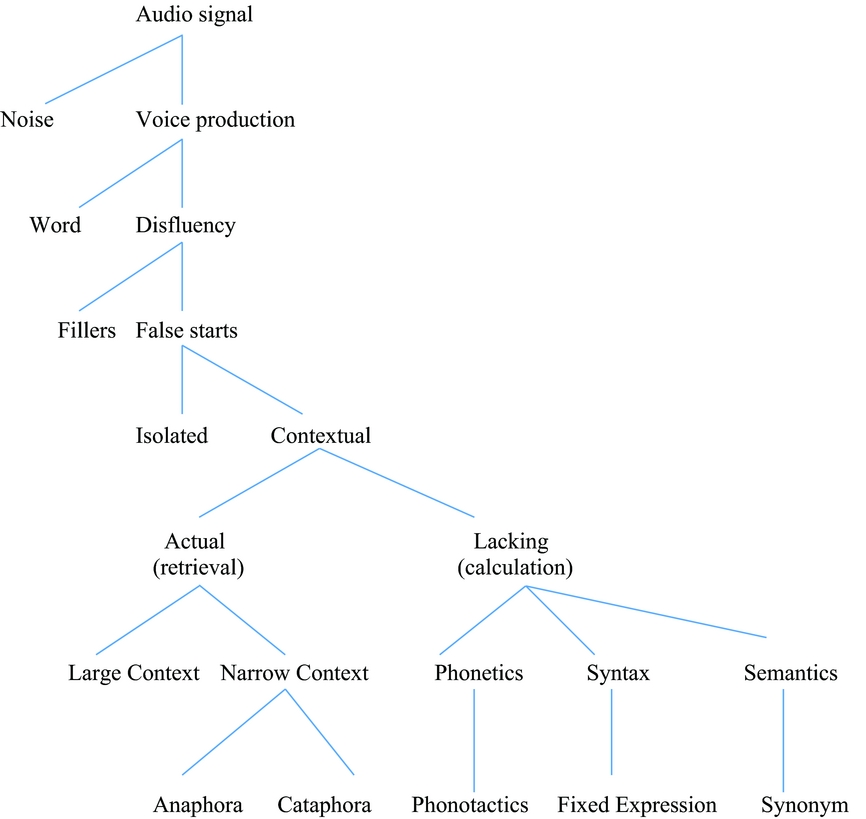
Once the transcriber has identified a segment as a false start and s/he has been able to write out a sequence of alphabetic characters roughly corresponding to what has been heard, the diagram of the identification of the word looks like that:
CONCLUSION
The decisive role of the lexicon in the preponderance of certain phonemes is revealed in the transcription of false starts. The way the listener manages to interpret an incomplete segment by spelling the expected word reveals a calculation procedure based on repetition, context or use of the most common word. In the latter case, the transcriptor cross checks phonological and morphological data to determine the best solution (see Figure 2).
How to restore the whole words starting from a false start?
False starts are illustrative of a general increase in personal markers (Bergounioux, Reference Bergounioux2015). The speaker's point of view surfaces more and more, as can be ascertained by comparing ESLO1 (1968–1971) and ESLO2 (2008–). Assuming that the frequency of tokens corresponds to their structural classification, the distribution of vowels among function words, especially for pronouns, has a significant effect on their relative importance. This interaction between morphology and phonology has not been integrated in either the feature geometry approach (Clements) or the Modified Contrastive Specification theory (Dresher). A step forward.