Since the beginning of Westernisation in the mid-1800s, Japanese musicians have avidly adopted a variety of foreign genres, including Western concert music, jazz, rock, salsa and hip-hop. However, apart from some notable exceptions, many of them have had difficulty in gaining recognition in the West, particularly in North America. Although the Japanese have been playing these genres for decades, one encounters with regularity Western writers who assume that Japanese musicians are mere imitators who are uncreative and inauthentic, able to capture the technique but not the soul of these genres. Take, for example, English writer Garry Sharpe-Young's description of Japanese heavy metal in Metal: The Definitive Guide (emphases mine):
Critics pointed towards a lack of feeling in the music, perhaps betraying a lack of blues foundation. While Japanese guitar gurus could match and outstrip their Western counterparts, it often seemed that their technicality masked a dearth of true passion. Somehow, it seemed that the Japanese had been able to emulate and expand the heavy metal formula, but somehow failed to get the gut instinct and individuality that was the very heart and soul of it … the East remains an enigma. (Sharpe-Young Reference Sharpe-Young2007, p. 408)
However, the same author views this ‘lack of blues foundation’ and ‘coldness’ as positives for German metal:
… what set German metal apart was a strict non-reliance on the blues … [The Germans'] natural aptitude and fondness for heavy industry meant that Teutonic metal was as cold and unforgiving as it could get. (Sharpe-Young Reference Sharpe-Young2007, p. 332)
Similarly, Atkins (Reference Atkins2001) and Condry (Reference Condry2006) provide many examples of dismissive commentary regarding the authenticity of Japanese jazz and hip-hop artists.
Why are Japanese artists prone to accusations of inauthenticity and inferiority, evidently more so than European artists performing foreign styles? One answer lies in the West's persistent perception of Japan as a perpetual Other. Marilyn Ivy cites a Time article describing Japan as ‘exclusive, homogeneous, … tribal’ as evidence that Americans perceive Japan as ‘culturally not modern’ (Ivy Reference Ivy1995, p. 2). Moreover, Japan is complicit in this exoticised view, as it cherishes its own image of uniqueness, thereby living up to its difference; it also revels in its image as the master assimilator, taking in foreign cultures yet retaining its cultural core (Iwabuchi Reference Iwabuchi1994, Reference Iwabuchi2002; Ivy Reference Ivy1995, pp. 1, 9). Hence, when the Japanese adopt Western cultural forms, the West sees a mimicking people who are almost, but not quite, Western, to paraphrase Homi Bhabha (Reference Bhabha, Michelson, Krauss, Crimp and Copjec1987). They are continually playing catch-up: as Atkins explains, Japanese jazz artists, by virtue of their different ethnicity, are placed on a lower rung of aesthetic hierarchy, because jazz is considered to be American (Atkins Reference Atkins2001, p. 11). Even Japanese critics – including the artists themselves – critique Japanese jazz and hip-hop as being inauthentic and inferior to American performances (Atkins Reference Atkins2001; Condry Reference Condry2006).
Coupled with these issues is the idea that the Western marketplace prefers to see non-Western artists providing exotic cultural products rather than their uncoloured rendition of a globalised genre (Stokes Reference Stokes2004). Often, the musicians who have incorporated the textures, timbres, scales and aesthetic principles of ‘traditional Japanese music’ – which many non-Japanese identify with pre-20th century genres involving the shakuhachi [Japanese end-blown flute] or shamisen [Japanese three-stringed instrument], or festival-related taiko drumsFootnote 1 – have garnered the most attention internationally; Japanese composers Yamada Kōsaku and Takemitsu Tōru, or jazz musician Akiyoshi Toshiko (Atkins Reference Atkins2001), come to mind.Footnote 2 Indeed, autoexoticism has historically been a successful strategy for composers outside Western Europe, such as Chopin, Albéniz, Piazzolla and Tan Dun (Locke Reference Locke2009; Born and Hesmondhalgh Reference Born and Hesmondhalgh2000).
In addition, Japanese artists have achieved success by projecting an image along expected stereotypes, often ironically. In the late 1970s the members of Yellow Magic Orchestra orientalised themselves under the hyper-technocratic stereotype of Japanese; the video for ‘Firecracker’, their electronic cover of Martin Denny's exotica (1959), features visions of giant cranes and laser-lit pagodas, while that for ‘Technopolis’ shows spaceships landing in a futuristic, neon-lit Ginza.Footnote 3 Similarly, the hip-hop unit Geisha Girls – two men dressed as geisha – played on stereotypes of Japanese held abroad (Yasuda Reference Yasuda2000, p. 54). Other performers have played on Japanese cuteness (e.g. Puffy AmiYumi) – or been received by fans as such (e.g. Shōnen Knife) – while Matsuzaki Satomi of the San Francisco band Deerhoof has incorporated Japanese words and taisō [Japanese group exercise] moves into her performance.
In vocal genres like rock or rap, Japanese artists must choose between performing in Japanese – making their music difficult to understand for non-Japanese audiences – or in English, in which they may not be fluent. This language barrier may contribute to the stereotypes attributed to some performers. But with no such barrier to overcome for their music to be appreciated, Japanese hip-hop DJs and producers would seem relatively better positioned for international stardom. Indeed, DJ-producers such as DJ Krush and DJ Kentarō have established large cadres of overseas fans, while others have bases abroad, such as DJ Tatsuki in London or DJ Honda in New York. These DJs have collaborated, as producers and performers, with African-American artists such as the Roots and the Pharcyde; there is mutual admiration between DJs in Japan and those in the West, such as the friendship between DJ Muro and Pete Rock (Rock, pers. commun.). Furthermore, Japanese turntablists such as DJ Kentarō, DJ Co-ma, DJ Akakabe and the duo Kireek have been placed at the top in DMC World competitions – perhaps the most recognised international tournament of hip-hop and electronic dance turntablists.
In building their overseas reputations, these DJ-producers have engaged in different strategies. DJ Krush has incorporated Japanese instruments and aesthetics in some of his works, in a path reminiscent of the aural nationalism of Takemitsu or Akiyoshi. On the other hand, DJ Kentarō – having catapulted to fame through the DMC World Competition – has built on über-performance, based on virtuosity, eclecticism and originality. As with Japanese musicians in other genres, both strategies reflect – to borrow Du Bois's term – a multiple consciousness of facing foreigners' expectations of Japanese balanced against the preferences of the Japanese audience, awareness of global trends in hip-hop, and the performer's own national pride and musical strengths.
Based on ethnographic interviews with the artists, coupled with musical analysis, this paper explores the aesthetics of Japanese DJs, considering how Japanese DJs have positioned themselves overseas and defined a ‘national’ style. Firstly, I consider the incorporation of the Japanese soundscape in hip-hop tracks, exploring the motivations of the artists and identifying the existence of Japanese aesthetics through musical analysis. I contrast this strategy against that of Japanese DJs at the DMC World Championships, which requires virtuosity rather than obviously nationalistic sounds.
‘Japaneseness’ in DJ-ing
DJ Krush (né Ishi Hideaki, b. 1962) is considered one of the pioneers of hip-hop in Japan. Born into a working-class family in Tokyo, he had been working in the underworld (Bojko Reference Bojko2007) when he saw the movie Wild Style in 1983, which inspired him to become a hip-hop DJ. Beginning by performing in Tokyo's Yoyōgi Park on Sundays, he formed the Krush Posse with DJ Muro and other artists in 1987. As a solo artist from 1992 onwards, Krush gained attention for using the turntable as a live instrument, trading licks onstage with musicians. Known for his atmospheric tracks, he has garnered an international fan base and is perhaps Japan's best-known DJ. Since the release of his first album Krush in 1994, he has released eight albums and several remix albums.
During his first tours overseas in the early 1990s, journalists kept asking Krush why he was not incorporating ‘traditional Japanese music’ into his sets. He responded that it was simply not the music of his environment.
It wasn't the music I'd been listening to since I was a kid. We never listened to shakuhachi, shamisen, or other traditional Japanese music at home. We listened to Westernised music, like kayōkyoku [‘Japanese popular song in Western style’] and anime songs. If I had featured traditional Japanese music in my tracks – just because I'm Japanese – I would have felt that I was lying to myself. People overseas think that all Japanese listen to such music constantly. But since I hadn't been listening to it, to bring out Japanese music in capital letters, just because I'm Japanese, would have been very obnoxious – right? So I didn't want to use Japanese music. I was embarrassed to do it. Very embarrassed. (DJ Krush, pers. commun.)Footnote 4
The turning point was his collaboration with African-American rapper C.L. Smooth,Footnote 5 ‘Only the Strong Survive’, included on Krush's album Meiso (‘Meditation’, 1995). Sensing that the track needed another sound to complete it, Krush claims he added a shakuhachi because its timbre matched Smooth's voice.Footnote 6 He also felt a need to differentiate himself:
I didn't want to imitate American hip-hoppers. If I came up with a sound that was no different from the American one, the American audience would definitely not appreciate it. On the other hand, if I could return a track with a sound from traditional Japanese music, it would be in keeping with the philosophy of representing in hip-hop.
Of all the Japanese sounds, I thought that the shakuhachi was most fitting, with its sense of ma [the Japanese aesthetic of space]. I thought it would command more attention from American hip-hoppers. It was the first time I had worked with an American rapper, and I wanted to produce something that left a ripple in the water. (DJ Krush, pers. commun.)
This experience encouraged Krush to continue experimenting with Japanese sounds and aesthetics. He explains his change in stance as follows:
In going to various countries, and in learning about different genres of music, I ended up taking another look at Japan. When you're in Japan, you can't see your own fields so well. But when you leave your country, you start to see the good and the bad of the place more objectively. So I came to believe that if I thought the music of my own country was good, I should study it, listen to its many types, and absorb it.
I listened to the shakuhachi as if my life depended on it, trying to figure out why it had that atmosphere, that sense of space. I listened to the shamisen a lot, too. I also started to listen to older Japanese jazz, when the artists tried to combine traditional Japanese music with jazz. I realised that many people before me had tried to do what I am trying to do. Jazz players were also experimenting with Japanese instruments. (DJ Krush, pers. commun.)
Krush's discovery of his Japanese roots following time spent abroad echoes the experiences of other autoexoticising composers such as Takemitsu, whose interest in incorporating Japanese music was stimulated, among other influences, by John Cage; as he recounted, ‘… for a long period I struggled to avoid being “Japanese”, to avoid “Japanese” qualities. It was largely through my contact with John Cage that I came to recognise the value of my own tradition’ (Narazaki and Kanazawa Reference Narazaki and Kanazawa2002).
Simulating heterophony
Krush subsequently released three albums that made extensive use of Japanese aesthetics and instruments. The first, Kakusei (‘Awakening’, 1998), not only sampled Japanese instruments such as the shakuhachi, shamisen and koto [Japanese zither], but also employed aesthetics reminiscent of Japanese music. As with many Asian musics, traditional Japanese music is played heterophonically, where each voice or instrument plays a variation of a basic melody; performers need not be in synchronisation with each other – instead anticipating or lagging behind other voices – nor be in perfect tune with one another.
DJ Krush often achieves a similar aesthetic by juxtaposing sampled musical loops of different timelines. In Kakusei, Krush experiments with small differences in timing. As he claims:
I displace timing on purpose. I totally aim for it. I'm sure if someone who doesn't know listens to it, they'll think there's something wrong [laughs]. I really like this sort of slight slippage in timing – when it's slipping, but it works. The music sometimes goes this way [he leans to one side] and then back [he returns upright]. These slight differences give off a sensation that changes the landscape of the music, if you listen closely. … Much of regular hip-hop is precisely looped. But sometimes, it's more interesting to have that bit of slippage, as if you were being pulled in another direction. … I wanted to conduct these types of experiments with sound – to see, using hip-hop as a base, the variety of scenes I could paint with music. (DJ Krush, pers. commun.)
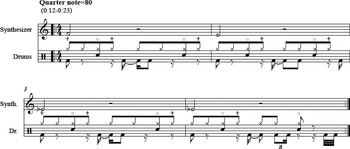
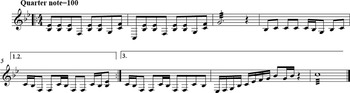
In ‘Parallel Distortion’ Krush displaces the loops of several instruments from one another – the steady drum beat, the opening string-like riff, and an echoing high-pitched sound. In ‘Deltaforest’ he places a synthesised sound reminiscent of geese on a different timeline from the rest of the rhythm track. Perhaps the most extreme example is ‘Interlude’, where he overlays a drum beat and heavily reverberated guitar line, at 80 bpm (beats per minute; Figure 1), on a shamisen melody at 100 bpm (Figure 2). As the former loop is four measures long while the latter is five, their beginnings coincide; however, because of the conflicts in tempo, the shamisen sounds as if it is floating freely.
DJ Krush, ‘Interlude’ (1998), drum loop.

DJ Krush, ‘Interlude’ (1998), shamisen loop.

Krush has also experimented with changing the timing within a particular loop, particularly on Kakusei. For example, he would take a 4/4 drum beat and make the third beat come in slightly early: ‘For every song on that album, I looked at the crack between drumbeats with a microscope and made music. … I'm really interested in seeing to what extent I can crush existing rules. The frame of hip-hop alone isn't enough’ (DJ Krush, pers. commun.).
Krush also plays with juxtaposing pitches that do not match, as he has applied on the lower notes of ‘Kemuri’ (Strictly Turntabilised, 1994). Rather than using the dials of the sampler to correct differences in the pitches of loops, he actually enjoys putting them in: ‘If you match all the pitches so perfectly, then it's just too sparkling clean. It's more hip-hop to leave in those little differences. It's the feel of it. But of course, if you make it too different, it feels bad. There's a range where it's OK and feels good’ (DJ Krush, pers. commun.). Examples of such detuned loops include ‘Escapee’, ‘Inorganizm’ and ‘1200’, on Kakusei.
While non-matching loop lengths and pitches are all imperfections that occur naturally in the course of working with samples, I find it interesting that instead of correcting them through technology, Krush has actively sought them out – and is proud of the results. Although Krush has not studied traditional Japanese music formally, he has nonetheless sensed and incorporated its aesthetics – the sense of ma, differences in timing and tuning, the preference for imperfections – into a hip-hop format. From his point of view, it is his attention to these details – these differences – that makes him ‘Japanese’; it also compensates for what he perceives as a physical disadvantage relative to Americans:
The Japanese pay attention to details. Americans are more into coming in with power – BOOM! They tend not to pay so much attention to details. But if we [Japanese] depended only on power like that, we'd lose. The other side will hit more and more [baseball] hits, and we wouldn't be able to compete. The way we can distinguish ourselves and compete effectively is not through power alone, but in attention to details. And I like dealing with those details. (DJ Krush, pers. commun.)
Using Japanese instruments
Following Kakusei, Krush released the Japan-inflected albums Zen (‘Gradual’, 2001) and Jaku (‘Nirvana’, 2004), the latter of which features Japanese instruments most prominently. The concept of this album is wa – not so much in the sense of wa (和) = ‘Japan’ but rather wa (輪) = ‘ring’, meaning ‘we are all connected’. To illustrate this concept of connectedness, he included both Japanese and Western instruments.
Krush invited top instrumentalists – Morita Shūzan for shakuhachi; Naitō Tetsurō of Kodō, Japan's most famous taiko troupe; and Kinoshita Shin'ichi, master of tsugaru shamisen [folk shamisen of Northern Japan] – to improvise continuously, rather than to play a single line to sample and loop. As Krush explained,
Sometimes I'll adjust what the soloists have played to make a hook. But if you loop it and tamper with it too much, there's no point in having brought in a live instrumentalist. When I call in a soloist, I'm trying to capture something that doesn't exist in my world; I want to get that person's special essence [aji, ‘flavor’] in my track. I want to capture that groove, so I don't cut it. (DJ Krush, pers. commun.)
Out of these improvisations, Krush constructed a series of tracks connected melodically through recurring motives – another manifestation of wa. In the opening track ‘Still Island’, the strings play a recurring theme (Figure 3).
‘Still Island’ theme.

Morita Shūzo improvises a melody based on this theme on the shakuhachi, emphasizing the D-E♭-D motive heard at the beginning. This motive recurs throughout the album, appearing in ‘Road to Nowhere’, ‘The Beginning’ and ‘Univearth’; in addition, the tritone at the end of the theme is heard obsessively in ‘Nosferatu’. Furthermore, the entire ‘Still Island’ theme is improvised upon by jazz pianist Ken Shima in ‘Stormy Cloud’. As a result of these recurring motives, the album gains a sense of unity in a manner often seen in Western musical works.
Recurring Japanese timbres provide a second unifying factor for the album. In addition to ‘Still Island’, Morita's haunting melodies on shakuhachi are heard in ‘The Beginning’, ‘Univearth’ and ‘Song 2’, and sampled for ‘Kill Switch’. Another often-occurring timbre is taiko, on which Naitō improvises extensively on ‘Univearth’. Taiko also provides a matsuri [festival] rhythm in ‘Distant Voices’, and taiko-like powerful drumming can be heard on ‘The Beginning’, ‘Kill Switch’ and ‘Beyond Raging Waves’; the latter song also features an improvisation by tsugaru shamisen master Shin'ichi Kinoshita against a pre-recorded synthesiser and drum. In ‘Slit of Cloud’, a lament is sung in minyō [folk song] style to ancient poetry:
Minyō reappears in sampled and looped form in ‘Passage’. Finally, sounds of nature, an important aspect of Japanese aesthetics, occur frequently in the album, with taiko, piano and synthesisers evoking rain (‘Still Island’, ‘Road to Nowhere’, ‘Stormy Cloud’) and insects (‘Still Island’). All of these sounds are integrated with hip-hop beats.
Krush's use of Japanese instruments has opened the way for other Japanese DJs to explore these sounds. DJ Kentarō has performed live with tsugaru shamisen and taiko players and scratched out the ‘Sakura’ melody on two turntables. Similarly, DJ Ono of Tha Blue Herb uses a shakuhachi loop in ‘Jidai wa kawaru’ (‘The Times They Are Changing’, 2000).
Parodic reinterpretations
Having grown up in the ancient capital of Nara, Evis Beats has a strong affinity to temple sounds; in the track ‘Han'nyashinkyō Rap’ (Amida, 2008), a loop of shōmyō [Buddhist chant] develops into a rap of spiritual thoughts. Much of his use of Japanese music is parody, particularly those tracks he made for the Osaka hip-hop group Infumiai Kumiai. The central rhythm of their ‘Oatsui no ga osuki’ (‘[The Lady] Likes It Hot’, Jangaru, 2003) is the 6/8 rhythm of matsuri music, with a distorted shamisen looped throughout the song. The matsuri motive is picked up by Infumiai's rappers, who rap humorously about picking up girls during summer festivals and interject typical matsuri-associated calls (‘Ho, ho!’). For ‘Evis Sound’ (Jangaru, 2003), Evis sampled a minyō, deriving the beat from the shamisen accompaniment and looping the call ‘yoi yoi’ at a distortedly high pitch.
Evis's concept of ‘Japanese’ also includes Western-based or syncretic Japanese music from another generation. ‘Happyakuman’ (‘Eight Million’, 2008) features a matsuri-like rhythm and loop, which he obtained not from matsuri music, but from the theme song of the television anime, Obake no Kyūtarō (‘Q-Tarō the Ghost’), which aired from 1966 to 1985. His track for Shingo Nishinari's ‘Shosenpai no kata kara no okotoba’ (‘Words from My Mentors’) is a parody of a dōyō [Western-style children's song], with a marimba playing a simple tune; picking up this reference, Shingo rapped the opening words to the well-known dōyō ‘Yūyake koyake’ (‘Glow of Sunset’).
Adopting historical genres
The rapper-producer Shing02 (né Annen Shingo, b. 1975) has taken DJ Krush's work with Japanese instruments a step further in incorporating them into a concept piece. The son of a Mitsubishi Corporation executive, Shingo was raised in Tanzania, England, suburban Tokyo and northern California, where he finished high school and earned a degree in electrical engineering and computer science from the University of California at Berkeley. He currently splits his time between Los Angeles and Japan, and he raps in both Japanese and English.
As a long-term resident of California, Shing02 is conscious of his Japanese identity and the Asian-American experience, which is manifested in his work. In his 1998 song ‘Pearl Harbor’ he narrates the battle from the vantage point of a young Japanese pilot participating in the attack, describing the strict obedience he has been taught, the precision of executing orders and the acceptance of probable death, with an anti-war message appended.
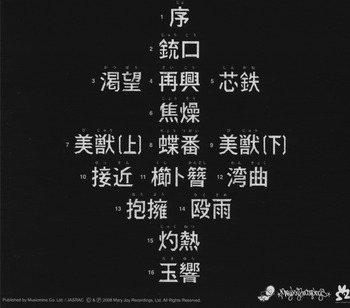
In his album Waikyoku (2008), Shing02 asserts his Japanese identity in a different way. This concept album, whose title means ‘warped song’, contains vignettes of a distorted society or mind. As shown on the back cover of the CD (Figure 4), the title to each song has been carefully chosen to be one to three kanji [Chinese characters], so that when put in sequence, they form a symmetrical design. The layout of the music, too, is symmetrical. The first half of the album is composed of songs generally about frustration and aggression, musically illustrated through looping tritones in ‘Jūkō’ (‘Muzzle of a Gun’), the busy bass line of ‘Katsubō’ (‘Earnest Desire’), and fast tempos. The second half is about human warmth and relationships, e.g. ‘Kushi to kanzashi’ (‘Comb and Hairpiece’) and ‘Nagusame’ (‘Comfort’).
Shing02, Waikyoku (2008), back cover. Used with permission from Mary Jay Recordings.

At the centre of the album are Parts I and II of ‘Bijou’, a metaphorical chronicle. The track is performed on the satsuma biwa [lute], whose narrative repertory draws from The Tale of the Heike, an epic of feudal wars in the 12th century. Typical themes of this repertory are impermanence, the fall of the mighty, destruction and pillage, and death in war.
‘Bijou I and II’ are about a mysterious princess who crosses a forbidden border zone and visits a hunter, bringing war and destruction in her wake. The title is a pun on the French bijou [jewel], for the pendant she wears, and 美獣 (bijū, ‘beautiful beast’), into which she transforms to disguise herself. Both Parts I and II open and end in the manner of a satsuma biwa narrative, as performed by Nishihara Kakushin, who is a former student of biwa master Tsuruta Kinshi – and a punk rocker. Shing02 then recites the story in the manner of a dramatic poetry reading, taking on the character of different characters, on top of hip-hop beats coloured at key points by a shakuhachi. The story itself, with its theme of needless death in war, is in keeping with the essence of biwa narrative. Shing02 acknowledged that the piece was inspired by another featuring biwa and shakuhachi – ‘November Steps’ (1967) by Takemitsu, whom he humorously calls ‘the DJ Krush of his time’. Thus, in Shing02's work, Japaneseness goes beyond a sample of a traditional instrument or a beat, to a modern-day version of a traditional genre.
Hence, Japanese DJ-producers have incorporated Japanese soundscapes in various ways. Some of them – including traditional instruments, incorporating Japanese aesthetics like ma, or performing a take on a genre – have also been attempted in concert music and jazz. Others, like distorted sampling or prolonged juxtapositions of different tempos, are products of hip-hop-related technologies and are innovations in the rendering of musical nationalism. But how does national identity come into play in the virtuosity-based setting of an international competition?
Japanese DJs in global competition: Japanese DJs and the DMC Championship
When Japanese DJs compete in international contests, they eschew obvious references to Japanese music, yet they believe they exhibit a Japanese style. A case in point is DJ Kentarō, who in 2002 became the first person from Asia to win the DMC DJ World Championship – the most widely recognised international competition for electronic dance turntablists. Founded in 1985 by Tony Prince, it is held annually in London. To qualify, contestants must place at the top of competitions held by DMC branches in their home countries. In the 2008 competition, 33 countries from six continents were represented; 10 DJs made the cut to the final round, where they each performed a six-minute solo routine.Footnote 7
It is difficult to watch Kentarō's performances without being awestruck. The speed and split-second precision with which he juggles sounds on multiple turntables is nothing short of breathtaking – a virtuoso performance that has resulted from several hours' daily practice (DJ Kentarō, pers. commun.). In the opening part of his winning performance in the 2002 DMC DJ World Championship, he skilfully times the words on one vinyl record against the bass line on the other, repeating the words, ‘The subject we are going to be talking about today is’, in smaller and smaller segments, before finishing with the punch line, ‘style’ (0:30).Footnote 8 He then scratches two records to form four-measure phrases of varying bass rhythms and arpeggios (1:02). Changing disks, he takes a simple horn line, repeating progressively shorter sections of it into rhythmic four-measure patterns, punctuating the end of these sequences with scratches (2:00–2:39). Next, he scratches two records simultaneously, scratching a kick-drum sound with one hand and a horn sound with the other – a rarely seen, risky feat, as the metre must be maintained solely by the DJ's scratches (2:40–3:12). He then generates several different tempi out of two percussion disks (c. 4:00–4:58). Next, he takes two reggae disks (complete with the quintessential Jamaican vulgarity ‘bumbaclot’) and generates a skank, gradually transitioning to a fast-paced electronic dance sequence (c. 176 bpm). The performance finishes with the pre-recorded tagline, ‘No wall between the music’, which is Kentarō's motto. For that performance, Kentarō earned the highest score ever recorded in the history of the DMC DJ World Championship.
An unusual feature of Kentarō's performance is the variety of music he used. By ‘No wall between the music’, he means that a variety of musical genres, including those from Japan, could be mixed to make good music. In that performance, he played house, reggae, hip-hop, drum ‘n’ bass and rock, illustrating their common features through the juxtapositions in his six-minute set. Kentarō's motto argues against narrow definitions of popular genres, in favour of a more inclusive ideal, harkening back to the origins of hip-hop as a sample-based sound:
Hip-hop originated as a free kind of music, where you could freely sample all sorts of music – rock guitar, soul, electronica. I want to make music with that kind of attitude, combining drum ‘n’ bass, reggae, hip-hop, R&B, soul, etc., through my own filter to make something original. (DJ Kentarō, pers. commun.)
As the Director of the DMC branch in Japan since 1996, who has attended every DMC World Championship and worked with many Japanese DJs, Ozaki Tomohiko is an authority on the styles and reception of Japanese DJs. He describes Kentarō's eclecticism itself as Japanese, in a way that recalls Japan's self-image as the master assimilator of foreign cultures. As Ozaki puts it:
Japan can bring in many musics, absorb the best parts of them, mix them well, and put them out as new products. [Kentarō's performance] showed that you can take the basic elements of a drum kick and a hi-hat to make any sort of rhythm – hip-hop, reggae, drum ‘n’ bass, or house. Kentarō showed the relationships among the musics. I was really glad that he was able to claim the championship with this very Japanese approach [‘nihonjin rashii kanji’]. (Ozaki Tomohiko, pers. commun.)
Indeed, North American fans of Japanese rock have told me that they like these artists' ‘eclecticism’ and ‘bravery in venturing out of the box in a genre’. Similarly, Ozaki's impression at the DMC championships is that the non-Japanese audience expects Japanese DJs to be ‘unusual’: these fans have told Ozaki that they buy the DVDs of the Japanese DMC Championships rather than those of the UK or World Championships, because they find Japanese contestants to be more creative, musical and distinctive in character than those in other contests.
Since Kentarō's victory in the 2002 DMC World DJ Championship, several other Japanese have also won top honours in DMC competitions. In the DMC World Battle Championships, where two DJs spar by trading 90-second performances, DJ Akakabe won the title in 2004, as did DJ Co-ma in 2006. In addition, the duo Kireek (DJ Yasa and DJ Hi-C) have won the DMC World Team Competition, where a group of two to four DJs perform together, for five consecutive years from 2007 to 2011. Nonetheless, since Kentarō's victory in 2002, the Japanese have been unable to recapture the coveted top prize of the single DJ championship, often occupying runner-up positions: DJ Izoh ranked third in 2005 and second in 2011; DJ Yasa (of Kireek) ranked second in 2006 and 2007; and DJ Co-ma ranked third in 2008 and 2011, and second in 2009 and 2010.Footnote 9
There are two issues that may put the Japanese at a disadvantage. One is the judging process at DMC. Unlike, say, a gymnastics competition, where difficulty, execution and artistry are accorded a certain number of points, there are no specific criteria for judging the DMC competition. Typically, judges assess technical skills on beat juggling and scratching, originality, musicality and stage presence, but each judge has his or her own preferences (DJ Shiftee, pers. commun.). Judges write down the name of the DJ they rank first, second and third. Each first rank is accorded three points; a second rank, two points; and a third rank, one point. The sum of the scores from all the judges determines the winner.
Furthermore, the judges are drawn from finalists in other DMC competitions (i.e. the finalists in the battle and team competitions are judges for the singles competition, and vice versa). Additional judges are included in the panel but, as the competition is based in London, many of them are from the UK or Western Europe. As a result, Europeans make up the majority of the 17 judges.
As the contestants and judges are peer DJs, they tend to know each other and socialise at the championships; afterwards, they stay in contact, exchanging emails and samples. According to DJ Shiftee, the American DJ who won the DMC World Battle Championship in 2007 and the DMC World DJ Championship in 2009, ‘There is a lot of socialising. Particularly after the battles, the bar is very rowdy. It doesn't hurt to be friends with people who can end up judging you’ (DJ Shiftee, pers. commun.). But while Kentarō and his manager (and brother), who have relatives in Michigan, are competent English speakers, those Japanese DJs who are not confident about their English do not socialise so much with the other DJs, putting them at a disadvantage in forming global networks. For example, DJ Co-ma – who continues to work as a rice farmer in the northern prefecture of Niigata – can be relatively reserved. Ozaki claimed that at DMC some Japanese would pick up fast food dinners and eat alone in their rooms while the Europeans partied. Given the unstructured nature of judging and the human tendency to favour one's friends, it seems likely that a lack of personal connections or being outside the dominant European sphere would put Japanese DJs at a disadvantage. The opinion of DJ Shiftee, who served as a judge for the DMC World finals in 2010, was that DJ Co-ma should have won in 2010 rather than placing second again. As Ozaki explained:
DJ Izoh can't speak English and is very shy about speaking with the foreign DJs – even though he's a nice, outgoing guy in Japanese. I think he would do well to spend a year in New York. Then he'd be able to talk to the other contestants, and they'd realise he's a friendly guy. At the 2005 World DJ Championship, he performed a great routine in the single championship but came in third. I told the judges I didn't understand the scoring, since the audience was so enthusiastic about his performance. That was one disappointment where I really felt sorry for the guy.
But language isn't always an impediment to communication. Take Kireek. One of the DJs can't speak English one bit, but given his Kansai-guy abandon, it doesn't keep him from partying with the French DJs until seven in the morning, making them laugh until the tears roll down their faces. Kireek has won the team competition four years in a row because they're both great DJs, they give off a great vibe, and they form a warm rapport with the audience. They're also good friends who perform together all the time; they even breathe synchronously. But I think the rapport they've built with the international DJ community doesn't hurt. (Ozaki, pers. commun.)
Secondly, the regions differ in what performance styles are judged to be good. According to Ozaki, ‘The Europeans focus more on skills, like the number of times a DJ scratches. On the other hand, Japanese turntablism is about making it easy to listen to the performance and understand it. Japanese audiences like to hear quotes they recognise, mixed in a new way’ (Ozaki, pers. commun.). DJ Izoh agrees, ‘The Japanese tend to be more individualistic’ (DJ Izoh, pers. commun.). According to DJ Shiftee, the European style is a hard electronic sound centred on scratching and drumming and a de-emphasis on beat juggling; the British style features cutting-edge, bass-oriented music, with emphasis on scratching; the American style is more rooted in traditional hip-hop, with classic beat juggling; and the Japanese style is highly individualistic, centred on beat juggling with an eclectic mix of music (DJ Shiftee, pers. commun.).
If these observations that the Europeans focus more on scratching technique while the Japanese concentrate on individual style based on beat juggling are true, then they would represent a fundamental difference in what is considered noteworthy in DJ contests between these two regions. In judging domestic competitions, the Japanese tend to favour originality over sheer technique – as do Americans (Katz Reference Katz2010, p. 136). At the Shibuya No. 1 DJ Championship in December 2008, I was surprised when one of the contestants with an excellent scratching technique failed to place in the top three. On the other hand, a DJ who had used a Disney track, which I personally found corny in the hip-hop context, was awarded second place. According to DJ Co-ma, ‘That DJ was the most original guy in the competition. What counts is originality.’ DJ Izoh chimed in, ‘If a contestant does something that is very similar to what I, DJ Co-ma, or other champions have done before, it's not original. You must have your own original style’ (DJ Izoh and Co-ma, pers. commun.). The skilful contestant's routine was not seen as sufficiently original.
This premium placed on originality seems at odds with recent trends at DMC. In 2006 DJ Netic won the DMC World Championships with a routine based on beats from the French producer Le Jad. Several competitions since then have been dominated by the French electronic music boom. In 2007 the German DJ Rafik also won using Le Jad's breaks, even though he is said to have made mistakes during his performance. In 2008 every one of the finalists – except for the Japanese DJ Co-ma – used samples by Le Jad (DJ Co-ma, pers. commun.); in 2009, six out of nine finalists used this same sound (DJ Shiftee, pers. commun.). ‘It's gotten to the point where if you use another sound, it really sticks out. … It wasn't just the Europeans; the Brazilian and Singaporeans also used it’ (Ozaki, pers. commun.). By not conforming to the majority's sound, one wonders to what extent Japanese contestants may be penalised for their eclectic musical choices – which defy the imitator stereotype.
In addition, the Japanese sensibility of austerity and simplicity seems to be the opposite of the current vogue in European dance music. Echoing Krush, DJ Co-ma cultivates the Japanese sense of ma, thinking in rests rather than filling every space with sound. On the other hand:
The European sound is to fill every bit of that six-minute routine – gasha, gasha! – so there's no ma, there's no pulling back. It tires me out, listening to it. The ma helps you pace yourself. Because you make space, the mountain that comes next is entertaining. The Japanese prefer that style – to save it, save it, and bang! (DJ Co-ma, pers. commun.)
Ozaki and the Japanese DJs have said that they sense no ethnic discrimination at DMC World, whose past champions include Caucasian Europeans and North Americans of Jewish, African-American, Latino and Filipino backgrounds. Nonetheless, I find Ozaki's statement that a stunning performance conquers all to be revealing:
Before Kentarō, it wasn't a situation where a Japanese could become number one. The feeling was that the Japanese were interesting players who could rank in third to fifth place. But Kentarō's performance was so overwhelming, so phenomenal, that it got the entire audience very excited. There's no way that the judges could have ignored that level of response. People would have questioned them as to why Kentarō wasn't given first prize. It would have reflected badly on the judges. Kentarō won with a panel of European and American judges. So if you give a performance that knocks people over, your nationality doesn't matter. (Ozaki, pers. commun.)
In my opinion, Ozaki's comment actually confirms the fact that Japanese DJs are operating on an unequal footing: they feel their achievements will be ignored unless they perform at a significantly higher level than others. As previously mentioned, Kentarō's performance was so exceptional that he received the highest score ever in the history of the competition. Very few contestants from any continent could reasonably be expected to match that level of performance; in fact, several champions have made mistakes during their performances. Furthermore, Ozaki's comments reveal an acceptance of this need to over-perform.
Conclusion
Japanese DJs and producers, with their wordless beats, should be able to compete in the global marketplace without being hampered by language, yet the strategies that some have followed imply that the international markets are not a level playing field. Like Japanese classical, jazz and rock musicians before them, some hip-hop artists sense that some non-Japanese (and Japanese) see them as inauthentic, due to their nationality, and imitators, given the national stereotype. Some producers have responded by incorporating the traditional Japanese soundscape, underlining the image of Japan's uniqueness and perhaps giving the Western marketplace what it expects from non-Western artists; it also replicates a successful strategy followed by Takemitsu, Akiyoshi and artists of other genres before them. Some turntablists have aimed for eclecticism, underlining Japan's image of the master assimilator, while contradicting the stereotype of being imitative and unimaginative.
Ivy has surmised that to many Japanese, ‘traditional Japan’ represents a past that is lost in modernity (Ivy Reference Ivy1995, p. 10). To some extent, I sense this desire to recapture a lost ideal in DJ Krush's evocation of Japanese aesthetics and Shing02's versioning of biwa narrative. I find it interesting that Tokyo-based Krush, who often tours abroad, and California-based Shing02, who has lived abroad for much of his life, take this interest in Japanese aesthetics, while Nara-native Evis Beats, who grew up in an environment where traditional music is heard more commonly, prefers a humorous approach to sampling Japanese music. Indeed, not all manifestations of autoexoticism are the same, and it is enlightening to consider, through musical analysis, the ways in which Japanese aesthetics such as ma and imperfection are conceived and moulded into an international genre.
The case of Japanese DJs at the DMC World Championships raises additional issues regarding international markets and national style. In pursuing ‘originality’ – which both counters stereotypical expectations and plays on the hip-hop ideal of ‘representing’ oneself – as a foremost goal, I wonder to what extent some contestants have deviated too far from expected norms by refusing to conform to current trends. This difference may be symptomatic of a more basic problem of communication, where some Japanese players may be left out of global loops simply because of differences in language. Perhaps success in wordless genres is not completely independent of words, after all.
Postscript
In September 2012, DJ Izoh won the 2012 DMC World DJ Championship with an overwhelming margin over the second-place winner, DJ Precision of the United States (http://www.dmcdjchamps.com/news-view.php?n=NDg0). However, the YouTube video of his winning performance (http://youtu.be/qdkq8ZFot74) attracted a number of negative comments. Many of these comments were aimed at DJ Izoh's use of a computer and pre-recorded discs, which are now the norm at DMC World; in contrast, the video of DJ Vajra, the American winner in 2011 who used the same setup, attracted little such criticism (http://youtu.be/HHJJxvPHVqs). One commentator even mentioned DJ Izoh's Asianness as a sign of DMC's deterioration. Such comments demonstrate that even if global contests have become more open to all nationalities, the global marketplace remains an uneven playing field for Japanese or Asian DJs.
Acknowledgements
The author thanks the SSRC/JSPS Fellowship for funding this research; Hosokawa Shūhei for acting as host at Nichibunken; Ishida Miho for transcribing interviews; Peter Manuel, William Rothstein, Mark Spicer, and Jane Sugarman for their comments on a prior version of this paper; the guest editors and reviewers for their suggestions; and the DJs/producers for their time in interviews.