


1 Introduction
Although its effects are not always recognised for what they are, the preference to avoid light syllables is one of the most common ways in which stress is sensitive to syllable weight.Footnote 1 The avoidance of stressed light syllables is behind such seemingly unrelated phenomena as weight-sensitivity in unbounded stress systems, weight-sensitivity in generalised trochee systems, iambic lengthening, trochaic lengthening and certain types of minimal word restrictions. In previous accounts, the members of this group have been subject to a number of different analyses, some involving constraints like PeakProminence (PkProm; Prince & Smolensky Reference Prince and Smolensky1993, Walker Reference Walker1997) or Stress-to-Weight (Hammond & Dupoux Reference Hammond, Emmanuel, Durand and Laks1996, Lorentz Reference Lorentz1996, Crosswhite Reference Crosswhite1998) and others involving Iambic Lengthening (Hung Reference Hung1994, Kenstowicz Reference Kenstowicz1995) or FootBinarity (FtBin; Prince & Smolensky Reference Prince and Smolensky1993, McCarthy & Prince Reference McCarthy and Alan1993a, Hewitt Reference Hewitt1994).Footnote 2 Despite the abundance of established proposals, I argue in this article that non-finality constraints (Prince & Smolensky Reference Prince and Smolensky1993) best account for the preference of stress to avoid light syllables.
In adopting a non-finality approach, the proposal accomplishes three objectives. First, it improves the typological predictions for each of the weight-sensitive phenomena mentioned above. Second, it provides these seemingly unrelated phenomena with a general and uniform account, incorporating them into a larger pattern with more traditional non-finality effects. This allows us to go beyond the superficial differences between the individual phenomena and gain a better understanding of the deeper relationships between them. Finally, the proposal provides additional support for non-finality's central position in the theory. As we see non-finality at work over and over again in the analysis of seemingly disparate phenomena, we can be increasingly confident that it is a significant principle of grammar, rather than just a superficial generalisation.
The article proceeds as follows. The remainder of this section introduces the general formulation for non-finality constraints and outlines some basic assumptions concerning the metrical grid (Liberman Reference Liberman1975, Liberman & Prince Reference Liberman and Alan1977, Prince Reference Prince1983). §2 considers unbounded stress systems, §3 addresses generalised trochee systems and §4 examines rhythmic lengthening and minimal word restrictions. §5 contains a summary and concluding remarks.
1.1 Non-finality constraints
At first glance, its connection to weight-sensitivity may be less than obvious, but non-finality very naturally captures the appropriate relationship between syllable weight and stress. The basic traditional weight distinction is simply the distinction between one and more-than-one. Light syllables contain one mora, and heavy syllables contain more than one. Though non-finality constraints do not detect this distinction directly, they can detect it indirectly through the final/non-final contrast on which they are based. If stress cannot occupy the final instance of a particular element within a particular domain, then the domain must contain at least two such elements to carry a stress. If stress cannot occupy the final mora of a syllable, for example, then a stressed syllable must contain at least two moras.
In the formulation adopted here, non-finality constraints have three arguments. Entries on a particular level of the metrical grid must avoid a final element of a particular type within a domain of a particular size. The grid level is the first argument, the final element is the second argument and the domain is the third argument:
(1) Non-fin(GCat, Cat, PCat)
No GCat occurs over the final Cat of PCat, where GCat is an entry on a particular level of the metrical grid, PCat is a prosodic category, and Cat is a grid entry or prosodic category.
As (1) indicates, the domain of a non-finality constraint is always a prosodic category, but the final element can be a prosodic category or a grid entry.
Although I will briefly discuss stress's avoidance of final gridmarks in §2, I focus primarily on its avoidance of final prosodic categories, particularly final moras. The moraic non-finality constraints in (2) form the core of the proposed analysis.
- (2)
a. Non-fin(xF, μ, σ) No foot-level gridmark occurs over the final mora of a syllable.
b. Non-fin(xF, μ, F) (adapted from Kager Reference Kager1995) No foot-level gridmark occurs over the final mora of a foot.
c. Non-fin(xF, μ, ω) No foot-level gridmark occurs over the final mora of a prosodic word.
Depending on the particular domain specified in a moraic non-finality constraint, the result can be general weight-sensitivity or weight-sensitivity restricted to a certain position. For example, by banning stress from syllable-final moras, Non-fin(xF, μ, σ) makes stress sensitive to the weight of syllables generally:
(3)

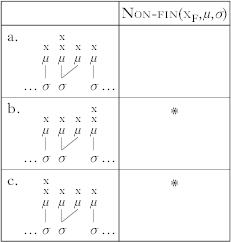
As (3) illustrates, Non-fin(xF, μ, σ) prefers that stress occupy a heavy syllable, as in candidate (a), where it can avoid the syllable-final mora, rather than a light syllable, as in candidates (b, c), where it cannot. As we shall see in §2, this is the type of general weight-sensitivity typically found in unbounded stress systems.
In contrast, Non-fin(xF, μ, F) and Non-fin(xF, μ, ω) produce a more limited type of weight-sensitivity, making stress sensitive to the weight of domain-final syllables only. To illustrate, since Non-fin(xF, μ, ω) bans stress from prosodic word-final moras, it makes stress sensitive to the weight of prosodic word-final syllables:
(4)
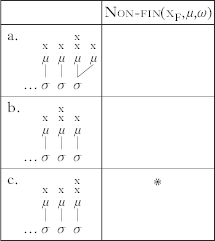
In (4), stressing a light prosodic word-final syllable, as in candidate (c), means that the prosodic word-final mora is also stressed. To avoid the prosodic word-final mora, stress must occupy a heavy final syllable, as in candidate (a), or avoid the final syllable altogether, as in candidate (b). §3 examines this type of weight-sensitivity in the context of generalised trochee systems.
Although its domain is smaller, the results for Non-fin(xF, μ, F) are similar. Since it bans stress from foot-final moras, it makes stress sensitive to the weight of foot-final syllables:
(5)
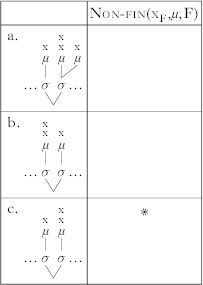
In (5), stressing a light foot-final syllable, as in candidate (c), means that the foot-final mora is also stressed. To avoid this situation, Non-fin(xF, μ, F) prefers that stress occupy a heavy foot-final syllable, as in candidate (a), or that it avoid the foot-final syllable altogether, as in candidate (b). As we shall see in §4, iambic lengthening languages exhibit this type of weight-sensitivity.
Before exploring the proposal in fuller detail, it should be mentioned at this point that the non-finality formulation in (1) differs in two ways from Prince & Smolensky's (Reference Prince and Smolensky1993) original formulation. First, the stress peaks that must avoid final position are grid entries rather than prosodic heads. In this, I follow previous proposals by Hung (Reference Hung1994), Hyde (Reference Hyde2001, Reference Hyde2002, Reference Hyde2003) and Gordon (Reference Gordon2002). Second, non-finality has been extended to domains smaller than the prosodic word, following Kager (Reference Kager1995) and Hyde (Reference Hyde2001, Reference Hyde2003). Despite these differences, the adopted formulation is a genuine non-finality formulation, as opposed to an extrametricality formulation (Liberman & Prince Reference Liberman and Alan1977, Hayes Reference Hayes1981, Reference Hayes1985). As discussed in Prince & Smolensky (Reference Prince and Smolensky1993), the difference between non-finality and extrametricality is that non-finality directly affects the position of a stress peak and extrametricality directly affects the ability of a final element to be parsed into higher prosodic structure. The formulation in (1) is a non-finality formulation because it directly affects the position of stress peaks, but does not directly prevent parsing.
1.2 The metrical grid
Since the adopted formulation for non-finality refers to grid entries rather than prosodic heads, the metrical grid plays a central role in the proposed analysis, and it will be helpful to outline some basic assumptions about how it is constructed. First, since a non-finality approach to weight-sensitivity involves prohibiting stress over domain-final moras, there must be a relationship between grid entries and individual moras. The proposal follows Kager (Reference Kager1993, Reference Kager1995) in mapping moras – rather than syllables – to the grid to form its base level. Second, the grid is constructed primarily by constraints that require prosodic categories to coincide with grid entries of an appropriate level. Since the constraints are violable, it is possible that they will not be satisfied and that some prosodic categories may be stressless.
To implement these assumptions, I adopt the non-violable condition in (6a) and the violable constraints in (6b–d).
- (6)
a. Head Mora Condition The head mora of every syllable coincides with a mora-level gridmark.
b. MapGM(μ) A mora-level gridmark occurs within the domain of every mora.
c. MapGM(F) A foot-level gridmark occurs within the domain of every foot.
d. MapGM(ω) A prosodic word-level gridmark occurs within the domain of every prosodic word.
The Head Mora Condition and MapGM(μ) establish the grid's base level. The Head Mora Condition requires that head moras correspond to mora-level gridmarks, and MapGM(μ) requires that moras generally correspond to mora-level gridmarks. Since the Head Mora Condition is non-violable, head moras always map to the grid, ensuring that the base level is always present in some form. In contrast, since MapGM(μ) is violable, non-head moras may not map to the grid in every situation.
The potential mismatch between moras and mora-level gridmarks allows the proposal to capture Prince's (Reference Prince1983) distinction between monopositional and multipositional mapping for heavy syllables. A heavy syllable maps monopositionally when only its head mora corresponds to a mora-level gridmark, but it maps multipositionally when any additional moras correspond to mora-level gridmarks.Footnote 3 One constraint that can interact with MapGM(μ) to produce the different mappings is Non-fin(xμ, μ, σ), given in (7), which bans mora-level gridmarks from syllable-final moras.
(7) Non-fin(xμ, μ, σ) No mora-level gridmark occurs over the final mora of a syllable.
When Non-fin(xμ, μ, σ) dominates MapGM(μ), as in (8a), heavy syllables map monopositionally, because it is more important to avoid mora-level gridmarks on syllable-final moras than it is to map non-head moras to the grid.
- (8)
a.
b.
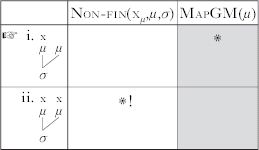
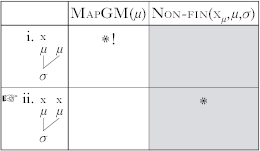
When the ranking is reversed, as in (8b), heavy syllables map multipositionally, because it is more important to map non-head moras than it is to avoid an entry on the syllable-final mora. Prince's primary motivation for the mapping contrast was to account for the different properties of heavy syllables in different languages with respect to clash avoidance.Footnote 4 In the proposed analysis, as we shall see in §2, the contrast is also used as a means to distinguish between different types of heavy syllables within the same language.
The constraints that construct the higher levels of the grid are (6c), MapGM(F), and (6d), MapGM(ω). MapGM(F) requires that every foot be associated with a foot-level gridmark, and MapGM(ω) requires that every prosodic word be associated with a prosodic word-level gridmark. Though these additional constraints will not figure prominently in the present discussion, it is possible to have mismatches between higher prosodic categories and higher grid levels, just as it is possible to have a mismatch between moras and the grid's base level (see Hyde Reference Hyde2001, Reference Hyde2002 for discussion).
To summarise, thus far I have introduced a grid-oriented approach to non-finality constraints, and I have outlined some basic assumptions about the construction of the metrical grid. With this as background, we turn now to a non-finality analysis of weight-sensitivity, beginning with unbounded stress systems. Since weight-sensitive, unbounded stress patterns contain some of the clearest examples of stress avoiding light syllables, this is an appropriate starting point.
2 Unbounded stress systems
Unbounded stress systems place no restriction on the maximum distance that can occur between stressed positions. Often, they have only a single stress per form, which orients itself towards one edge or the other of the prosodic word. In some languages, the stress occupies the initial syllable; in others, it occupies the ultima or the penult.
(9) Weight-insensitive unbounded systems

When unbounded systems exhibit weight-sensitivity, the edge orientation becomes a default location for stress, but stress may not always occur in the default position:
(10) Weight-sensitive unbounded systems
As (10) indicates, in forms where heavy syllables are absent, stress occurs over the light syllable at the default edge. In forms where heavy syllables are present, however, stress shifts away from the default edge and onto a heavy syllable.
Our concern in this part of the discussion is to account for the type of weight-sensitive stress shift illustrated in (10). §2.1 briefly shows how non-finality produces unbounded systems with two-way (light–heavy) contrasts in syllable weight, and §2.2 demonstrates how it produces systems with three-way (light–heavy–superheavy) contrasts. §2.3 discusses the peak prominence and stress-to-weight approaches, comparing these to the non-finality approach. Although their predictions are similar in many respects, non-finality has an important advantage. There is an upper limit on the number of significant weight distinctions that a language may exhibit. Languages can exhibit two- and three-way contrasts, for example, but not four- or five-way contrasts. Only non-finality offers a principled account for this upper limit.
2.1 Non-finality and two-way contrasts
In discussing two-way contrasts in syllable weight, I focus on default-to-same-side systems – unbounded systems where stress has the same directional orientation whether or not a form contains heavy syllables.Footnote 5 When heavy syllables are absent in a form, stress falls on the light syllable at a given edge. When heavy syllables are present, stress falls on the heavy syllable nearest the same edge. As examples, consider Murik (Abbott Reference Abbott1985) and Aguacatec (McArthur & McArthur Reference McArthur and McArthur1956). Both exhibit two-way contrasts, where heavy syllables are syllables with long vowels:
- (11)
a. Murik
b. Aguacatec
As (11a) illustrates, Murik stresses the leftmost heavy syllable, when one is available. Otherwise, it stresses the leftmost light syllable. Aguacatec, as illustrated in (11b), has the opposite directional specification. It stresses the rightmost heavy syllable, when one is available. Otherwise, it stresses the rightmost light syllable.Footnote 6
Two components are necessary in the analysis of default-to-same-side systems: one to establish directional orientation and one to introduce weight-sensitivity. The task of establishing directionality falls to the gridmark alignment constraints in (12). xF-L aligns foot-level gridmarks with the prosodic word's left edge, and xF-R aligns foot-level gridmarks with the prosodic word's right edge. By influencing the position of a gridmark column's foot-level gridmark, foot-gridmark alignment influences the position of the column as a whole and determines the default location for stress.
- (12)
a. xF-L The left edge of every foot-level gridmark is aligned with the left edge of some prosodic word.
b. xF-R The right edge of every foot-level gridmark is aligned with the right edge of some prosodic word.
Non-fin(xF, μ, σ) produces the appropriate weight-sensitivity. Because it bans stress from syllable-final moras, it requires that stressed syllables be bimoraic, regardless of their position.
To produce a default-to-same-side pattern, Non-fin(xF, μ, σ) must dominate gridmark alignment, so that it is more important for stress to avoid a light syllable than it is for stress to occur at the default edge.Footnote 7 For a left-oriented system like Murik, the crucial ranking would be Non-fin(xF, μ, σ)≫xF-L. In forms with heavy syllables, Non-fin(xF, μ, σ) would shift stress away from the left edge and onto a heavy syllable, with xF-L ensuring that it occurred over the leftmost. In forms without heavy syllables, xF-L would return stress to the light syllable at the left edge. Similarly, for a right-oriented system like Aguacatec, the crucial ranking would be Non-fin(xF, μ, σ)≫xF-R. In forms with heavy syllables, Non-fin(xF, μ, σ) would shift stress from the right edge and onto a heavy syllable, with xF-R ensuring that it occupied the rightmost. In forms without heavy syllables, xF-R would return stress to the light syllable at the right edge. Since these interactions are fairly straightforward, and similar to those involved in analyses based on peak prominence or stress-to-weight, I omit the example tableaux. For a more detailed presentation, see Hyde (Reference Hyde, Baković, Ito and McCarthy2006).
Though Murik and Aguacatec represent the simplest types of default-to-same-side systems, their rankings can easily be modified to produce the slightly more complicated patterns that avoid stress on prosodic word-final syllables:
(13) Non-fin(xF, σ, ω) (adapted from Prince & Smolensky Reference Prince and Smolensky1993) No foot-level gridmark occurs over the final syllable of a prosodic word.
When we add Non-fin(xF, σ, ω) to the simple default-to-same-side rankings discussed above, the result is the typology summarised in (14).
- (14)
a. Left-oriented
i. Non-fin(xF, σ, ω)
Non-fin(xF, μ, σ) xF-L Description: Leftmost heavy, else leftmost light; no stress on final syllable Example: Kashmiri (Bhatt Reference Bhatt1989, Kenstowicz Reference Kenstowicz1993)ii. Non-fin(xF, μ, σ)
Non-fin(xF, σ, ω) xF-L Description: Leftmost heavy, else leftmost light Example: Murikiii. Non-fin(xF, μ, σ)
xF-L Non-fin(xF, σ, ω) Same as (ii)
b. Right-oriented
i. Non-fin(xF, σ, ω)
Non-fin(xF, μ, σ) xF-R Description: Rightmost heavy, else rightmost light; no stress on final syllable Example: Western Cheremis (sonority-based) (Itkonen Reference Itkonen1955)ii. Non-fin(xF, μ, σ)
Non-fin(xF, σ, ω) xF-R Description: Rightmost heavy, else rightmost light; no stress on final syllable, unless it is the only heavy syllable Example: Sindhiiii. Non-fin(xF, μ, σ)
xF-R Non-fin(xF, σ, ω) Description: Rightmost heavy, else rightmost light Example: Aguacatec

For systems with two-way contrasts in syllable weight, non-finality's performance equals that of recent alternatives. The predictions in (14) match those produced by peak prominence in the Walker (Reference Walker1997) approach, for example, or those that might be produced by stress-to-weight in a similar framework.Footnote 8 Next, we turn to systems with three-way contrasts in syllable weight and consider the possibility of an even greater number of contrasts. This is an area where non-finality can be shown to have an important advantage, because it offers a principled account for the upper limit on significant weight distinctions.
2.2 Non-finality and three-way contrasts
An adequate analysis of weight-sensitivity must account for languages where stress is sensitive to a three-way contrast in syllable weight. For example, in Hindi (Kelkar Reference Kelkar1968, Hayes Reference Hayes1995) and Classical Arabic (Abul-Fadl Reference Abul-Fadl1961, Wright Reference Wright1971, McCarthy Reference McCarthy1979), stress prefers trimoraic superheavy syllables above bimoraic heavy syllables and bimoraic heavy syllables above monomoraic light syllables. Examples from Hindi are provided below.
(15)
As (15) illustrates, Hindi is a default-to-penult language, where stress prefers trimoraic CVVC and CVCC syllables to bimoraic CVV and CVC syllables and bimoraic CVV and CVC syllables to monomoraic CV syllables. When there is a tie for heaviest syllable, as in (15b), stress occupies the rightmost non-final of the tied syllables. When a form has a single heaviest syllable, as in (15a), stress occupies the single heaviest syllable, even if it means occupying the final syllable.
At first glance, it might seem impossible for non-finality to account for three-way contrasts in syllable weight. Since non-finality only distinguishes between final and non-final, it can only distinguish between one and more-than-one. It cannot distinguish between two and more-than-two. We saw in §2.1, for example, that Non-fin(xF, μ, σ) prefers that stress fall on a multimoraic syllable, where it can avoid the syllable-final mora, rather than a monomoraic syllable, where it cannot:
(16)
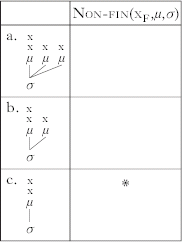
As (16) demonstrates, however, the constraint does not recognise additional contrasts. Since all stressed multimoraic syllables perform equally well on Non-fin(xF, μ, σ), it cannot require that stress occupy the trimoraic syllable in (a) rather than the bimoraic syllable in (b).
Fortunately, the problem has a simple solution. Non-finality cannot distinguish directly between two and more-than-two, but it can make the distinction indirectly when the two/more-than-two contrast is translated into a one/more-than-one contrast. The proposal accomplishes this translation through differences in the ways that multimoraic syllables map to the metrical grid. In §1.2, we saw that a high-ranked Non-fin(xμ, μ, σ), ‘no mora-level gridmarks over syllable-final moras’, produces a monopositional mapping for bimoraic syllables. As (17) demonstrates, when it dominates MapGM(μ), ‘every mora has a mora-level gridmark within its domain’, it strips the final gridmark from bimoraic syllables, leaving them with only a single mora-level entry:
(17)
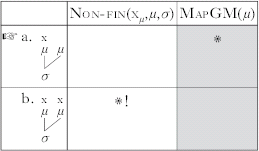
Applying the same ranking to trimoraic syllables, however, produces a bipositional mapping. As (18) indicates, Non-fin(xμ, μ, σ) still strips the mora-level gridmark from the final mora, but MapGM(μ) ensures that the two remaining moras both map to the grid:
(18)
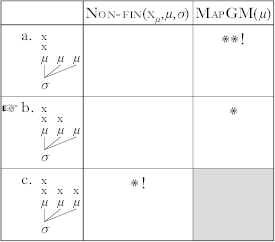
The result is a difference in gridmark mapping that distinguishes heavy syllables from superheavy syllables. Heavy syllables must map monopositionally, just like light syllables, but superheavy syllables can still map multipositionally.Footnote 9 Since the mapping distinction is a one/more-than-one distinction – heavy syllables have one mora-level gridmark where superheavy syllables have more than one – it is a distinction that non-finality constraints can detect.
To capture a three-way contrast like that found in Hindi, we can take advantage of the optimal mappings in (17) and (18) by distinguishing final from non-final twice, once with respect to moras and once with respect to mora-level gridmarks. Non-fin(xF, μ, σ) still distinguishes heavy syllables from light syllables by prohibiting stress over syllable-final moras, but an additional constraint, Non-fin(xF, xμ, σ), given in (19), distinguishes superheavy syllables from heavy syllables, by prohibiting stress over syllable-final mora-level gridmarks.
(19) Non-fin(xF, xμ, σ) No foot-level gridmark occurs over the final mora-level gridmark of a syllable.
When the effects of the two constraints combine, the desired three-way contrast emerges:
(20)
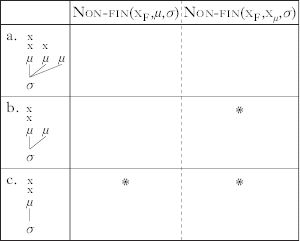
In (20), the best option is for stress to occupy a superheavy syllable, as in candidate (a). Because they are multimoraic and multipositionally mapped, superheavy syllables allow stress to avoid both a syllable-final mora and a syllable-final mora-level gridmark. The next best option is for stress to occupy a heavy syllable, as in candidate (b). Since heavy syllables are monopositionally mapped but multimoraic, stress fails to avoid the syllable-final mora-level gridmark, but it can still avoid the syllable-final mora. The worst option is for stress to occupy a light syllable, as in candidate (c). Because light syllables are neither multimoraic nor multipositionally mapped, stress can avoid neither the syllable-final mora nor the syllable-final mora-level gridmark.
To flesh out the analysis for the weight-sensitive, default-to-penult system in Hindi, consider the ranking in (21).
(21)
First, a penultimate default is established by ranking Non-fin(xF, σ, ω), ‘no stress on prosodic word-final syllables’, above xF-R. Such a ranking draws stress as far to the right as possible while still avoiding the final syllable. Next, we establish the appropriate weight-sensitivity by ranking Non-fin(xF, μ, σ), ‘no stress on syllable-final moras’, and Non-fin(xF, xμ, σ), ‘no stress on syllable-final mora-level gridmarks’, above the constraints that establish the penultimate default. This ensures that weight-sensitivity has priority over directional orientation. If the penult is not the heaviest syllable, stress can shift from the penult in an effort to seek out the heaviest syllable. Since the interactions are fairly straightforward, I omit the example tableaux.
Although non-finality can establish both two-way and three-way contrasts in syllable weight, it is important to understand that it does not have the ability to count moras. Instead, it uses a final/non-final distinction to indirectly detect a one/more-than-one distinction. It distinguishes monomoraic syllables from multimoraic syllables by distinguishing syllable-final moras from non-final moras, and it distinguishes bimoraic syllables from trimoraic and larger syllables by distinguishing syllable-final mora-level gridmarks from non-final mora-level gridmarks. For non-finality to detect additional weight distinctions, there would have to be additional one/more-than-one contrasts with a sufficiently intimate connection to mora count that they could be used as measures of syllable weight.Footnote 10 Since moras and mora-level gridmarks exhaust the elements that might qualify to create the appropriate contrasts, however, there can be no non-finality constraints capable of detecting additional weight distinctions, and the contrasts already discussed must constitute the full range of the approach.
To more clearly demonstrate the range of distinctions that non-finality can detect, consider the tableau in (22).Footnote 11
(22)
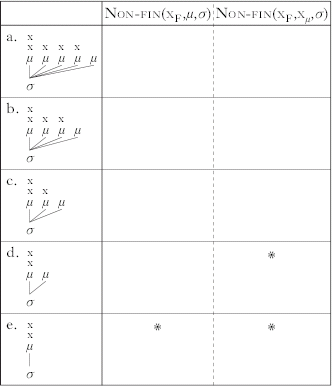
Combined, Non-fin(xF, μ, σ), ‘no stress on syllable-final moras’, and Non-fin(xF, xμ, σ), ‘no stress on syllable-final mora-level gridmarks’, allow the approach to distinguish between syllables with one mora, as in (e), syllables with two moras, as in (d), and syllables with three or more moras, as in (a–c). Because syllables with three or more moras always satisfy both constraints, however, the constraints cannot distinguish between them. They cannot distinguish syllables with three moras from syllables with four, for example, or syllables with four moras from syllables with five, and there are no other constraints in the proposal that could make these distinctions.
Non-finality's limited ability to detect weight contrasts is exactly the desired situation. Among the world's languages, the upper limit on significant weight contrasts seems to be the distinction between syllables with two moras and syllables with more than two. There appear to be no languages requiring the grammar to distinguish syllables with three moras from syllables with four, for example, or to distinguish syllables with four moras from syllables with five. In this context, then, non-finality's limitations constitute an important advantage: they offer a principled account for the upper limit on significant weight contrasts.
2.3 Peak prominence and stress-to-weight
In previous OT accounts, Stress-to-Weight and PkProm are the primary options for producing the kind of weight-sensitivity where stress avoids light syllables. The stress-to-weight approach is fairly straightforward. Hammond & Dupoux's (Reference Hammond, Emmanuel, Durand and Laks1996) formulation, for example, given in (23), prohibits stress over light syllables simply by requiring that stressed syllables be heavy:
(23) Stress-to-Weight (from Hammond & Dupoux Reference Hammond, Emmanuel, Durand and Laks1996) Stressed syllables are bimoraic.
Although its effects are similar, Prince & Smolensky's (Reference Prince and Smolensky1993) peak prominence approach is more complex. The general formulation in (24a) essentially states that a stress peak over an element with greater prominence is better than a stress peak over an element with lesser prominence. In conjunction with the scale in (24b), its effect is to position stress on heavier syllables at the expense of lighter syllables.
(24)
One way to implement the peak prominence approach is to say that the general formulation, in combination with the mora scale, generates the set of constraints in (25a) with the universal ranking in (25b).Footnote 12
- (25)
a. *Peak/σμ Stress does not occur on a monomoraic syllable. *Peak/σμμ Stress does not occur on a bimoraic syllable. *Peak/σμμμ Stress does not occur on a trimoraic syllable.
b. Universal ranking *Peak/σμ
*Peak/σμμ *Peak/σμμμ
Under the ranking in (25b), stress prefers syllables with two moras above syllables with one (due to *Peak/σμ), syllables with three moras above syllables with two (due to *Peak/σμμ) and syllables with four or more moras above syllables with three (due to *Peak/σμμμ).
Although the peak prominence and stress-to-weight formulations differ considerably from the non-finality formulation, they all have the same ability to capture two-way contrasts in syllable weight. This is why Non-fin, PkProm and Stress-to-Weight all predict the same typology for unbounded systems with two-way weight distinctions (see §2.1). When we consider the possibility of additional distinctions, however, differences begin to emerge.
PkProm's ability to produce three-way contrasts is clear and has been previously demonstrated by Prince & Smolensky (Reference Prince and Smolensky1993) for cases like Hindi. *Peak/σμ requires stress to avoid light syllables in favour of heavy syllables, and *Peak/σμμ requires stress to avoid heavy syllables in favour of superheavy syllables. The existence of *Peak/σμμμ is problematic, however, because it requires stress to avoid syllables with three moras in favour of syllables with four. Such a contrast is unattested among the world's languages, and this situation points to peak prominence's most serious shortcoming. Unlike non-finality, peak prominence cannot offer a principled account for the upper limit on significant weight distinctions. When combined with the mora scale, peak prominence is essentially a mora-counting device, and there is nothing in its formulation to limit how high it can count. While it is true that the scale cuts off after three moras, the cut-off point appears to be completely arbitrary. To avoid the unattested distinction made by *Peak/σμμμ, for example, the scale should cut off at two moras, but there seems to be no principle to prevent it from being extended instead, so that it includes four moras, five moras, six moras and so on. This, of course, would allow the approach to make an infinite number of distinctions that no language actually requires.
The situation with Stress-to-Weight is a bit different. Since Stress-to-Weight only has the ability to distinguish between heavy syllables and light syllables, being essentially equivalent to *Peak/σμ, it is clear that it cannot capture a three-way contrast in its current form. It is possible, however, that Stress-to-Weight might be reformulated as two separate constraints, as in (26).
- (26)
a. Stress-to-Heavy Stressed syllables are bimoraic.
b. Stress-to-Superheavy Stressed syllables are trimoraic.
Stress-to-Heavy would have essentially the same effect as *Peak/σμ, and Stress-to-Superheavy would have essentially the same effect as *Peak/σμμ. Stress-to-weight is also similar to peak prominence, however, in that it is essentially a mora-counting approach, especially if we are free to formulate additional constraints referring to different numbers of moras. If we can add a constraint like (26b) that requires stressed syllables to have three moras, there seems to be no reason why we could not add constraints that require stressed syllables to have four moras, five moras and so on. Like peak prominence, then, stress-to-weight cannot offer a principled account for the upper limit on significant weight distinctions.
2.4 Summary
We have seen that non-finality matches the successes of stress-to-weight and peak prominence when it comes to producing weight-sensitivity in unbounded systems. For languages with two-way contrasts, non-finality predicts the same typology as stress-to-weight and peak prominence. This is expected, since Non-fin(xF, μ, σ), ‘no stress on syllable-final moras’, has the same effect in prohibiting stressed light syllables as *Peak/σμ and Stress-to-Weight. For languages with three-way contrasts, the non-finality approach uses differences in gridmark mapping and an additional constraint, Non-fin(xF, xμ, σ), ‘no stress on syllable-final mora-level gridmarks’, to distinguish superheavy syllables from heavy syllables. While stress-to-weight and peak prominence can distinguish superheavy from heavy as well, only non-finality offers a principled account for the observation that the heavy–superheavy contrast marks the upper limit on attested weight distinctions. This indicates that it is both possible and desirable to eliminate stress-to-weight and peak prominence from the theory, transferring their workload to non-finality.Footnote 13
Before we move on, there is one other prediction that should be noted in this context. An anonymous reviewer points out that the possibility of ranking Non-fin(xF, μ, σ), ‘no stress over syllable-final moras’, above a constraint like Dep(μ), given in (27), is problematic in unbounded systems, because it would result in lengthening of the stressed syllable for inputs containing only light syllables.
(27) Dep(μ) Every mora present in the output is also present in the input.
While this is true, the prediction is not unique to non-finality. Ranking either Stress-to-Weight or *Peak/σμ above Dep(μ) would produce exactly the same result.Footnote 14 Any framework with a constraint prohibiting stressed light syllables will contain the prediction that stressed syllables can be lengthened. As we shall see in §4, however, the prediction does have advantages in other contexts.
3 Generalised trochee systems
§2 examined the type of general weight-sensitivity found in unbounded stress systems. This section examines the more limited weight-sensitivity found in generalised trochee – or syllabic trochee – systems. In generalised trochee systems such as Weṛgaia (Hercus Reference Hercus1986) and Estonian (Hint Reference Hint1973, Prince Reference Prince1980), stress is sensitive to the weight of prosodic word-final syllables only. It is never sensitive to the weight of initial or medial syllables.Footnote 15 The examples in (28) are taken from Weṛgaia, where heavy syllables are syllables with long vowels (typically limited to initial position), syllables with diphthongs (limited to initial or final position), and closed syllables.
(28)
As (28) illustrates, Weṛgaia stress is largely weight-insensitive. It falls automatically on every odd-numbered syllable counting from the left, except the final syllable. Stress falls on final syllables only if they are odd-numbered and heavy, as in (28c). If they are light, as in (28b), they are unstressed.
Our concern in addressing generalised trochee systems, then, is to restrict the avoidance of stressed light syllables to light syllables in prosodic word-final position, and to do so using the same general non-finality formulation that we used in the analysis of unbounded systems. The discussion proceeds as follows. §3.1 demonstrates how a non-finality analysis produces a Weṛgaia-type pattern. Non-finality's asymmetry allows stress to be sensitive to the weight of final syllables without also making it sensitive to the weight of initial or medial syllables. In §3.2, we examine foot-minimality approaches. Foot-minimality can also produce a Weṛgaia-type pattern, but it produces numerous unattested variations as well.
3.1 Non-finality and final syllables
One of non-finality's fundamental characteristics is its asymmetry. Non-finality constraints prevent stress from occupying the final element of a domain, but they do not prevent it from occupying initial or medial elements. In the context of weight-sensitivity, this asymmetry can sometimes go unnoticed. For example, as we saw in §2, when the domain of Non-fin is the syllable itself, stress is sensitive to the weight of all syllables, regardless of their position. The effects of the asymmetry become apparent, however, when the domain of Non-fin is larger. When applied to a larger domain, Non-fin makes stress sensitive to the weight of the domain's final syllable but not to the weight of its initial or medial syllables. The constraint relevant in the context of generalised trochee systems in Non-fin(xF, μ, ω), repeated in (29), which bans foot-level gridmarks from prosodic word-final moras and, therefore, from light prosodic word-final syllables.
(29) Non-fin(xF, μ, ω) No foot-level gridmark occurs over the final mora of a prosodic word.
Because it refers to prosodic word-final moras, and not to initial or medial moras, it limits its effects to the final syllable of the prosodic word.
Adopting the framework of Hyde (Reference Hyde2001, Reference Hyde2002), we can derive a Weṛgaia-type pattern from a more basic weight-insensitive pattern that positions stress on every odd-numbered syllable counting from the left. The adopted framework produces this more basic pattern, using the constraints in (30a) and the ranking in (30b).
- (30)
a. PrWd-L The left edge of every prosodic word is aligned with the left edge of some foot-head. Hds-R The right edge of every foot-head is aligned with the right edge of some prosodic word. MapGM(F) A foot-level gridmark occurs within the domain of every foot.
b. Weight-insensitive ranking PrWd-L
Hds-R MapGM(F)
Omitting the example tableaux, the ranking in (30b) produces the type of configuration in (31a) for even-parity forms and that in (31b) for odd-parity forms.
- (31)
a. Even-parity
b. Odd-parity
PrWd-L anchors a single foot-head at the prosodic word's left edge, and Hds-R draws the remaining foot-heads towards the prosodic word's right edge (foot-heads are indicated using vertical association lines). Since Hds-R is weight-insensitive, preferring disyllabic footing to monosyllabic footing, the weight of the individual syllables does not affect the resulting stress pattern. MapGM(F) ensures that each foot-head coincides with a foot-level gridmark.
To establish the weight-sensitivity appropriate for Weṛgaia-type patterns, we would add Non-fin(xF, μ, ω) to the ranking in (30b), as in (32), so that it dominates MapGM(F). This ensures that it is more important to avoid stress on a light final syllable than it is to stress the final foot.
(32) Weṛgaia ranking PrWd-L
Hds-R, Non-fin(xF, μ, ω) MapGM(F)
Consider the ranking's results for an odd-parity form whose final syllable is light. The light final syllable must remain stressless, but the ability of light initial syllables and light medial syllables to carry a stress is unaffected:
(33)
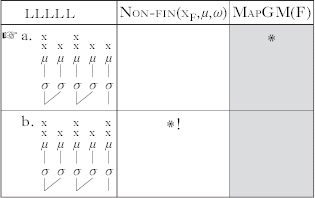
In (33), Non-fin(xF, μ, ω) excludes candidate (b). Since (b) stresses its light final syllable, it positions a foot-level gridmark over the prosodic word-final mora. Although the optimal candidate (a) has a stressless final foot in violation of MapGM(F), leaving the final foot stressless leaves the light final syllable stressless. Notice that no violations of Non-fin(xF, μ, ω) are incurred by either candidate in connection with stresses that occupy light initial or medial syllables.
Consider now the results for an odd-parity form whose final syllable is heavy. Stress is free to occupy the heavy final syllable, since an additional mora is available to support the gridmark column, and the column need not occur over the prosodic word-final mora:
(34)
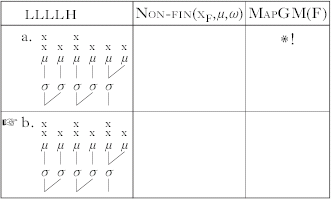
In (34), the optimal candidate (b) stresses its heavy final syllable. Since every foot in (b) is stressed, it satisfies MapGM(F). Since stressing the heavy final syllable does not mean stressing the final mora, it also satisfies the higher-ranked Non-fin(xF, μ, ω). Notice once again that Non-fin(xF, μ, ω) ignores the weight of initial and medial syllables.
We have seen, then, that non-finality easily produces a Weṛgaia-type pattern. It makes stress sensitive to the weight of final syllables in generalised trochee systems, and it does so without also making it sensitive to the weight of initial or medial syllables. The basic typology predicted by the interaction of Non-fin(xF, μ, ω) and MapGM(F) is summarised in (35).Footnote 16
(35) Typology for generalised trochee systems
a. Non-fin(xF, μ, ω)
MapGM(F) No stress on light final syllablesb. MapGM(F)
Non-fin(xF, μ, ω) Weight-insensitive system
The success of the non-finality approach in this context, coupled with its success in the context of unbounded stress systems, justifies a unified account of the two phenomena and supports non-finality's central role in the theory. The case is further strengthened in §3.2, where we compare non-finality's predictions to those of foot-minimality approaches.
3.2 Foot-minimality
In requiring that a foot contain at least two moras, foot-minimality (Prince Reference Prince1980, McCarthy & Prince Reference McCarthy and Prince1986, Hayes Reference Hayes1995) often has the effect of making stress sensitive to syllable weight. Since a heavy syllable has two moras, it can always be footed, even if it has to form a foot on its own. This means that heavy syllables are always potentially stressable. In contrast, a light syllable has only one mora, so it cannot form a foot on its own. In cases where additional syllables are unavailable to help support a minimal foot, a light syllable must remain unfooted and unstressed. Below, we examine the potential for foot-minimality to account for weight-sensitivity in generalised trochee languages. We will examine foot-minimality in both rule-based frameworks and constraint-based frameworks, and find that it causes substantial problems of overgeneration in both, but especially in the letter.
3.2.1 Overgeneration in a derivational framework
In Hayes' (Reference Hayes1995) approach to generalised trochee languages, foot-minimality is formulated as a prohibition against degenerate feet, and this prohibition is responsible for weight-sensitivity in final syllables. As (36) demonstrates, for a case like Weṛgaia, disyllabic trochees are constructed from left to right to produce the basic weight-insensitive pattern. When disyllabic footing is no longer possible, the prohibition against degenerate feet determines the status of a leftover syllable.
(36)
Since degenerate feet are defined as consisting of a single light syllable, even in syllabic trochee systems, a monosyllabic foot can be constructed when there is a leftover heavy syllable, as in (36b), but not when there is a leftover light syllable, as in (36c).
While the simplicity of Hayes' approach is appealing, the prohibition against degenerate feet is general and not restricted to final position. As a consequence, it predicts that weight-sensitivity will occur in a wider range of contexts than actually attested.
(37)
As (37) indicates, for example, we would expect to find Weṛgaia-type cases with right-to-left footing, cases where stress is absent from light initial syllables in odd-parity forms but not from heavy initial syllables. To the best of my knowledge, such patterns are unattested.
3.2.2 Overgeneration in an optimality-theoretic framework
The overgeneration problem is even more significant in a traditional OT framework. In restricting weight-sensitivity to final syllables, it is necessary, of course, to ensure that stress not be sensitive to the weight of initial or medial syllables. Under an OT approach, however, the effects of foot-minimality are so pervasive in binary patterns that such a restriction is impossible for generalised trochee systems as a class. Although a foot-minimality approach can produce a Weṛgaia-type pattern under certain conditions, it also produces numerous unattested variations. We examine the source of the problematic variations below and the conditions necessary for a Weṛgaia-type pattern in §3.2.3.
In the Alignment framework of McCarthy & Prince (Reference McCarthy and Alan1993a), the constraints primarily responsible for establishing stress patterns are those listed in (38).
- (38)
a. FtBin Feet must be binary under syllabic or moraic analysis.
b. Parse-σ All syllables must be parsed by feet.
c. AllFt-L The left edge of every foot is aligned with the left edge of some prosodic word.
d. AllFt-R The right edge of every foot is aligned with the right edge of some prosodic word.
FtBin implements the bimoraic foot-minimality restriction (as well as a disyllabic maximality restriction), Parse-σ requires syllables to be parsed into feet, and the alignment constraints determine parsing directionality.
For a binary pattern to emerge, as McCarthy & Prince demonstrate, the constraints must be ranked so that FtBin and Parse-σ both dominate Align:Footnote 17
(39) Ranking for binary patterns FtBin, Parse-σ
Align
It is typically assumed that the results of such rankings are binary patterns that are completely weight-insensitive. The reality, however, is that rankings conforming to (39) are not weight-insensitive at all. They actually produce the very peculiar type of weight-sensitivity described in (40).
(40) Weight-sensitivity under FtBin, Parse-σ
Align Stress will be sensitive to the weight of a heavy syllable H, iffa. H occurs in an odd-parity form;
b. H is odd-numbered, and;
c. of the heavy syllables satisfying (b), H is closest to the designated edge of alignment.
While alignment constraints do promote weight-insensitive footing, they are dominated by Parse-σ and the weight-sensitive FtBin in binary rankings, so that the effects of these constraints are free to interfere with those of Align. In odd-parity forms, parsing an odd-numbered heavy syllable as a monosyllabic foot is often the only way to achieve exhaustive binary footing, as required by the higher-ranked Parse-σ and FtBin. All Align can do in this situation is ensure that the monosyllabic foot is constructed using the odd-numbered heavy syllable closest to the designated edge of alignment.Footnote 18
To illustrate the inability of the FtBin/Parse-σ approach to appropriately restrict weight-sensitivity, consider the ranking FtBin≫Parse-σ≫AllFt-L, the ranking of the constraints from (39) most likely to produce a Weṛgaia-type pattern. In forms that contain only light syllables, the ranking produces the appropriate left-to-right footing and avoids degenerate feet:
(41) FtBin
Parse-σ AllFt-La. Even-parity (Ĺ L)(Ĺ L)
b. Odd-parity (Ĺ L)(Ĺ L)L
Omitting the tableaux, stress would occupy the first and third syllables of a four-syllable form, as in (41a), and the first and third syllables of a five-syllable form, as in (41b). FtBin is always respected, but the final syllable of the odd-parity form remains unparsed, in violation of Parse-σ. This is the desired result, because it leaves the light final syllable stressless.
Now consider the results when one of the odd-numbered syllables in the odd-parity form is heavy. FtBin and Parse-σ can be satisfied simultaneously by footing the heavy syllable as a monosyllabic foot at the expense of Align. The result is that heavy syllables – whether initial, medial or final – can easily perturb parsing directionality:
(42)

As (42a) indicates, if the only heavy syllable is final, we happen to get the appropriate result for a Weṛgaia-type pattern. Stress occupies the first, third and fifth syllables of an LLLLH form. In contrast, as (42b) and (42c) indicate, if the heavy syllable happens to be medial or initial, the ranking produces the wrong results. For a Weṛgaia-type pattern, we would expect stress on the first and third syllables, just as if every syllable were light. Stress actually occurs, however, on the first, third and fourth syllables in the LLHLL form in (42b) and on the first, second and fourth syllables in the HLLLL form in (42c).
Finally, consider a case where the form contains more than one odd-numbered heavy syllable. The heavy syllable that is closest to the designated edge of alignment will be the one that is parsed as a monosyllabic foot. Since alignment is to the left in the example ranking, this means that the leftmost heavy syllable will be parsed as a monosyllable:
(43)
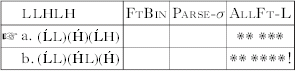
In (43), the final syllable is heavy, but the ranking fails to produce the final stress that would be expected for a Weṛgaia-type pattern. Since there is a heavy medial syllable – and a medial monosyllabic foot yields better leftward alignment than a final monosyllabic foot – stress occurs on the first, third and fourth syllables of an LLHLH form, rather than the first, third and fifth syllables as expected.Footnote 19
The tableaux in (42) and (43) demonstrate two points. First, the weight-sensitivity produced by FtBin is general. It can affect initial and medial syllables as well as final syllables. This should have been expected, since there is nothing in FtBin's formulation that might lead us to believe that its weight-sensitivity is restricted in any way. Second, the FtBin/Parse-σ approach overgenerates weight-sensitive patterns on a large scale. The type of weight-sensitivity described in (40) and illustrated in (42) and (43) is unattested, but it is present in any ranking of FtBin, Parse-σ and Align that conforms to (39). Given the number of variations in foot-type and footing directionality possible with such rankings, the number of problematic patterns is clearly substantial. In fact, the defective weight-sensitivity is so pervasive that it would be impossible to produce a truly weight-insensitive binary pattern without the introduction of additional appropriate constraints to counter the effects of FtBin and Parse-σ.Footnote 20
3.2.3 The desired pattern
Despite the overgeneration problems discussed above, a more traditional OT approach can produce a Weṛgaia-type pattern. As an anonymous associate editor points out, however, it is necessary to consider an additional constraint, *Clash, given in (44), and to assume that heavy syllables are monopositionally mapped.
(44) *Clash (adapted from Prince Reference Prince1983) For any two entries on level n+1 of the grid, there must be an intervening entry on level n.
With monopositional mapping, *Clash is violated whenever a monosyllabic foot – whether heavy or light – is followed by a trochee (see Footnote note 5). This being the case, high-ranking *Clash restricts monosyllables in trochaic systems to a form's right edge, the only position where they would not be followed by a trochaic foot.
As demonstrated in (45), when *Clash is added to the ranking so that it dominates Parse-σ, it takes back some of the control over parsing directionality that was previously lost to Parse-σ and FtBin, by restricting monosyllabic feet to final position. Since it restricts monosyllabic feet to final position, it restricts weight-sensitivity to final syllables.
(45)

Neither the heavy initial syllable in (45c) nor the heavy medial syllable in (45b) can be parsed as a monosyllabic foot, because both would be followed by trochees, resulting in a clash configuration. Only the heavy final syllable in (45a) can be parsed as a monosyllable without producing clash. This is the desired result.
We saw in §3.2.1 that the core constraints of the traditional OT approach – FtBin, Parse-σ and Align – produce a defective weight-sensitivity that is pervasive in binary patterns. We have seen in this section, however, that weight-sensitivity can be restricted to final syllables by adding a high-ranking *Clash and assuming that heavy syllables are monopositionally mapped. There are two reasons why this accomplishment is not particularly impressive. First, as (46c) indicates, the addition of *Clash does nothing to eliminate FtBin's defective weight-sensitivity in general and address the basic problem of overgeneration. The approach would still produce the unattested patterns discussed in §3.2.1, though it would no longer be limited to these patterns.
(46) Typology for generalised trochees under the FtBin/Parse-σ approach Footnote 21
a. *Clash, FtBin
Parse-σ Align Weight-sensitive: no stress on light final syllablesb. *Clash, Parse-σ
FtBinAlign Weight-insensitive (stress on every odd-numbered syllable)c. FtBin, Parse-σ
*Clash, Align Defective weight-sensitivity (described in (40))Footnote 22
Second, as (46b) indicates, an additional constraint or constraints would still have to be added just so the traditional approach could produce an appropriate range of weight-insensitive, trochaic patterns. The constraints in (46) produce only one: the pattern where stress occurs on every odd-numbered syllable, counting from the left.
It must be emphasised that the significance of these shortcomings goes beyond the particular context of weight-sensitivity in generalised trochee languages. They actually indicate a much more general deficiency in the traditional OT approach to metrical stress. The interactions between FtBin and Parse-σ are central to the traditional approach, but these constraints are directly responsible for the defective weight-sensitivity, and their central status is what makes it so pervasive.
3.3 Summary
Non-fin(xF, μ, ω), ‘no stress on prosodic word-final moras’, accounts for the weight-sensitivity found in generalised trochee languages. Since the constraint is asymmetric, like other non-finality constraints, it can affect the final syllable in a prosodic word without affecting initial or medial syllables. In contrast, foot-minimality approaches suffer from significant overgeneration problems. In a rule-based approach, foot-minimality makes stress sensitive both to final syllables and to initial syllables. In a constraint-based approach, foot-minimality makes stress sensitive to final, initial and medial syllables. This being the case, the non-finality approach clearly makes more accurate predictions, and the foot-minimality analysis should be abandoned. In fact, the pervasiveness of defective weight-sensitivity in the traditional OT approach strongly suggests that FtBin should be abandoned completely, not just in this particular context.Footnote 23 (See Hyde Reference Hyde2002 for additional typological arguments against the FtBin/Parse-σ approach.)
Thus far, then, we have seen that non-finality makes more accurate typological predictions than the alternatives, both in the context of unbounded stress systems and in the context of generalised trochee systems. This presents a strong case that the two should receive a uniform analysis under a non-finality formulation. It also strengthens the case that non-finality is more than a superficial descriptive generalisation, having produced the desired results in two seemingly unrelated contexts.
4 Rhythmic lengthening
We have focused thus far on non-finality's role as a simple detector of syllable weight, examining how it distinguishes light syllables from heavy syllables, so that it can ensure that the light syllables remain stressless. In this section, we examine non-finality's ability to actually influence syllable weight in the context of rhythmic lengthening. When stress would fall on an underlying light syllable, non-finality can force the syllable to become heavy on the surface. Since rhythmic lengthening is essentially a phenomenon where stressed light syllables become heavy, it is no surprise that non-finality is especially useful in this context.
Most discussions of rhythmic lengthening divide the phenomenon into two types: iambic lengthening and trochaic lengthening. The former adds a mora to the stressed syllable of an iamb, and the latter adds a mora to the stressed syllable of a trochee. Though the iambic type appears to occur more frequently than the trochaic type, both are well attested. As an example of iambic lengthening, consider the case of Carib (Hoff Reference Hoff1968, Inkelas Reference Inkelas1989, Kenstowicz Reference Kenstowicz1995), where the distribution of lengthened vowels provides the evidence for the distribution of stress:
(47)
As (47) illustrates, Carib lengthens even-numbered syllables counting from the left, but not the final syllable, producing a fairly typical iambic pattern.Footnote 24 Other languages which exhibit iambic lengthening include Choctaw (Nicklas Reference Nicklas1972, Reference Nicklas and Crawford1975, Lombardi & McCarthy Reference Lombardi and McCarthy1991), Hixkaryana (Derbyshire Reference Derbyshire1985), and several varieties of Yupik (Woodbury Reference Woodbury1981, Reference Woodbury1987, Jacobson Reference Jacobson1984, Reference Jacobson1985, Krauss Reference Krauss1985a, Leer Reference Leer1985, among others).
As an example of trochaic lengthening, consider the case of Chimalapa Zoque (Knudson Reference Knudson1975), a dual stress language based on trochaic footing. Stress occurs on the initial syllable and the penult, with the stress on the penult being primary:Footnote 25
(48)
As (48) illustrates, every stressed syllable in Chimalapa Zoque must be heavy on the surface. When an underlying light syllable is stressed, as in (48b), the syllable is made heavy by lengthening its vowel. Other languages that exhibit trochaic lengthening include Chamorro (Topping & Dungca 1973, Chung Reference Chung1983, Crosswhite Reference Crosswhite1998), Icelandic (Árnason Reference Árnason1980, Reference Árnason1985), Mohawk (Michelson Reference Michelson1988), Selayarese (Mithun & Basri 1986, Broselow Reference Broselow1999, Mellander Reference Mellander2003) and Swedish (Bruce Reference Bruce, Elert, Johansson and Stangert1984).
Although the primary burden for an account of rhythmic lengthening is that it produce both iambic lengthening and trochaic lengthening, there are two additional issues that an adequate analysis must address. The first is the observation mentioned above that lengthening occurs with greater frequency among iambic systems than it does among trochaic systems. The second is the correlation between ‘regular’ lengthening and certain types of minimal words. By ‘regular’ lengthening, I mean the exceptionless lengthening in non-minimal forms characteristic of many lengthening languages. In non-minimal forms, vowels automatically lengthen in underlyingly light syllables, whenever they receive the appropriate degree of stress. As (49) indicates, languages with regular lengthening exhibit only three types of minimal word: H, LL and HL.
(49) Minimal words that accompany regular lengthening
H minimal words are required in Chimalapa Zoque, Icelandic and Yupik, for example, and in Choctaw nouns. LL minimal words are required in Choctaw verbs, and HL minimal words are required in Carib, Hixkaryana and Selayarese. Notice that H and HL minimal words can accompany either iambic lengthening or trochaic lengthening, but LL minimal words only accompany iambic lengthening. There appear to be no regular lengthening languages that exhibit L minimal words and none that exhibit LH minimal words.Footnote 26
The discussion proceeds as follows. §4.1 examines the non-finality approach to rhythmic lengthening and demonstrates how it addresses each of the three issues mentioned above. §4.2 briefly discusses the peak prominence and stress-to-weight approaches and concludes that neither addresses the difference in frequency between iambic lengthening and trochaic lengthening or the typology of minimal words that can accompany regular lengthening. Finally, §§4.3 and 4.4 examine the Iambic-Trochaic Law approach and the Harmonic Bounding approach respectively. Both approaches fail to produce trochaic lengthening, and both fail to predict the correct typology for minimal words.
4.1 Non-finality in the syllable and non-finality in the foot
Under a non-finality approach, rhythmic lengthening is just a special case of the weight-sensitivity that we have examined throughout the article. To avoid stressing a light syllable – which would mean stressing a domain-final mora – the syllable's vowel is lengthened to make it heavy. The proposal follows Kager (Reference Kager1995) in applying non-finality to the foot domain to promote iambic lengthening, but it goes a bit further in applying it to the syllable domain as well. Applying non-finality to the syllable domain gives the proposal a second mechanism to promote iambic lengthening, as well as a mechanism to promote trochaic lengthening. The relevant constraints are Non-fin(xF, μ, σ) and Non-Fin(xF, μ, F).
As we saw in §2, Non-fin(xF, μ, σ) bans stress from syllable-final moras, making it sensitive to the weight of syllables generally. In contrast, Non-fin(xF, μ, F) bans stress from foot-final moras, making it sensitive to the weight of foot-final syllables only. Where Non-fin(xF, μ, σ) prohibits stress over light syllables in general, Non-fin(xF, μ, F) prohibits stress over foot-final light syllables in particular.
To produce lengthening, one of these non-finality constraints must dominate the faithfulness constraint Dep(μ) (27). Under such rankings, when stress would occupy a light syllable, in violation of Non-Fin, Non-Fin can require that a mora be added, in violation of Dep(μ), to make the syllable heavy. Given their different formulations, however, the non-finality constraints do not have an equal ability to promote lengthening in every type of foot. Since Non-fin(xF, μ, σ) prohibits stress over light syllables generally, it can produce lengthening when the stressed syllable occurs in an iamb or a trochee. Since Non-fin(xF, μ, F) prohibits stress over foot-final light syllables in particular, it can produce lengthening when the stressed syllable occurs in an iamb but not when it occurs in a trochee.
To illustrate, first consider the situation where the stressed syllables occur in iambic feet. If the syllables are light, stress will occupy both a syllable-final mora and a foot-final mora. This being the case, ranking either non-finality constraint above Dep(μ) produces lengthening.
(50)

In (50a), where Non-fin(xF, μ, σ) dominates Dep(μ), a second mora is added to the underlyingly light syllables to avoid stress on syllable-final moras. In (50b), where Non-fin(xF, μ, F) dominates Dep(μ), a second mora is added to the underlyingly light syllables to avoid stress on foot-final moras.
Next, consider the situation where the stressed syllables occur in trochaic feet. If the syllables are light, stress will occupy a syllable-final mora but not a foot-final mora. This being the case, ranking Non-fin(xF, μ, σ) above Dep(μ) produces lengthening, but ranking Non-fin(xF, μ, F) above Dep(μ) does not:
(51)

In (51a), Non-fin(xF, μ, σ) dominates Dep(μ), and the stressed syllables become heavy to allow stress to avoid syllable-final moras. In (51b), Non-fin(xF, μ, F) dominates Dep(μ). Since stress does not occupy the foot-final syllables in either candidate, and there is no danger that it will occupy the foot-final moras, Non-fin(xF, μ, F) fails to distinguish between the lengthening option and the faithful option, and Dep(μ) settles on the latter.
Given these results, the non-finality approach clearly meets its obligation to produce both types of lengthening. Two constraints, Non-fin(xF, μ, σ) and Non-fin(xF, μ, F), produce lengthening in iambs, and one, Non-fin(xF, μ, σ), produces lengthening in trochees. As we shall see next, the difference in the number of constraints that can produce the two types accounts for the difference in frequency with which they occur.
4.1.1 Asymmetries
Lengthening appears to occur less frequently among trochaic systems than iambic systems, and an analysis of rhythmic lengthening must account for this asymmetry. Fortunately, since it has more ways to produce iambic lengthening than it does to produce trochaic lengthening, the non-finality approach has an account built in.
There are two ways to produce rhythmic lengthening using non-finality: non-finality in the syllable and non-finality in the foot. Both produce iambic lengthening, but only non-finality in the syllable produces trochaic lengthening. This means that every ranking that produces lengthening in trochees also produces lengthening in iambs, but some rankings that produce lengthening in iambs do not produce lengthening in trochees. Since the percentage of possible rankings that produce iambic lengthening is greater than the percentage of possible rankings that produce trochaic lengthening, we would expect lengthening to occur with greater frequency in iambic systems than it does in trochaic systems, if the attested languages were truly a random sample of the possible grammars. This is the desired result.
Next, we examine non-finality's predictions concerning regular lengthening and minimal words.
4.1.2 Minimal words
Though not one of its more traditional uses, non-finality's ability to establish minimal words should be fairly clear. If stress cannot occupy the final syllable of a prosodic word, then a form must have at least two syllables to carry a stress. Similarly, if stress cannot occupy the final mora of a syllable or foot, then a form must have at least two moras to carry a stress. In general, non-finality constraints can establish minimal words requiring a strong–weak contour – either a trochaic foot or a heavy syllable – though they could not be used to establish minimal words requiring a weak–strong contour.Footnote 27
Non-finality's ability to establish certain types of minimal words is especially significant in the context of rhythmic lengthening, because it helps to account for the typology of minimal words associated with regular lengthening. As mentioned above, languages that automatically lengthen stressed vowels appear to allow only three types of minimal word: H, LL and HL. They appear never to allow L or LH minimal words. Using the same non-finality constraints to produce both the lengthening effects and the minimal word restrictions helps to predict this typology.Footnote 28
Consider first the absence of monomoraic minimal words. Under a non-finality approach, L minimal words are absent among regular lengthening languages, because the lengthening constraints themselves always establish H minimal words. The reason is simply that ranking Non-fin above Dep(μ) has the same effect in monosyllabic feet that it has in disyllabic feet.
As (52a) demonstrates, Non-fin(xF, μ, σ), ‘no stress on syllable-final moras’, has the same effect in monosyllables that it has in iambs and trochees: an underlyingly light syllable becomes heavy, so that stress can avoid the syllable-final mora.
(52)
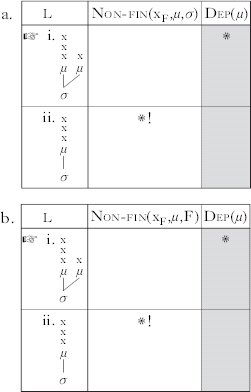
Similarly, as (52b) demonstrates, Non-fin(xF, μ, F), ‘no stress on foot-final moras’, has the same effect in monosyllables that it has in iambs. If a stressed syllable is underlying light, it becomes heavy on the surface, so that stress can avoid the foot-final mora.
As summarised in (53), if either non-finality constraint ranks highly enough to produce lengthening in the iambic or trochaic feet of longer forms, it also ranks highly enough to produce lengthening in the single monosyllabic foot of monosyllabic forms.
- (53)
a. Non-fin(xF, μ, σ)
Dep(μ) Iambic or trochaic lengthening + H minimal wordb. Non-fin(xF, μ, F)
Dep(μ) Iambic lengthening + H minimal word
This results in two desirable, and closely related, predictions. First, regular lengthening is always accompanied by a minimal word that is at least bimoraic. Second, of the possible minimal words that are at least bimoraic, iambic lengthening languages and trochaic lengthening languages can both have the H type.
Next, consider the attested disyllabic minimal words: LL and HL. While the two lengthening constraints cannot produce disyllables on their own, they do help to determine which type of disyllable emerges. If we assume that both LL and HL are trochaically stressed, then we can explain the two-syllable requirement with a high-ranking Non-fin(xF, σ, ω). Since Non-fin(xF, σ, ω) bans stress on prosodic word-final syllables, it establishes a disyllabic minimal word with a trochaic contour.Footnote 29 Once the trochaic contour is established, the different effects of the lengthening constraints can determine the weight of the initial syllable.
As (54a) demonstrates, Non-fin(xF, μ, σ), ‘no stress on syllable-final moras’, produces the HL version of the disyllabic minimal word. Since it requires that stressed syllables in general be heavy, it requires that the stressed syllable of a trochee be heavy.
(54)
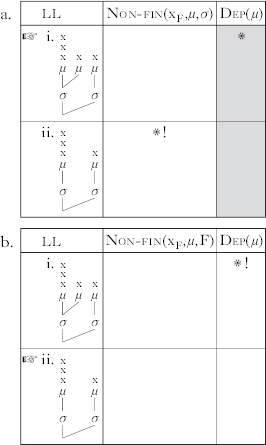
In contrast, as (54b) demonstrates, Non-fin(xF, μ, F), ‘no stress on foot-final moras’, produces the LL version of the disyllabic minimal word. Since stress occupies the initial syllable, and there is no danger that it will occupy the foot-final mora, Non-fin(xF, μ, F) cannot require that the initial syllable be heavy.
The consequences for minimal words of combining final stresslessness with rhythmic lengthening are summarised in (55):
- (55)
a. Non-fin(xF, σ, ω), Non-fin(xF, μ, σ)
Dep(μ)
Iambic or trochaic lengthening + HL minimal wordb. Non-fin(xF, σ, ω), Non-fin(xF, μ, F)
Dep(μ)
Iambic lengthening + LL minimal word
Prohibiting stress on prosodic word-final syllables ensures that the minimal word is disyllabic and that it has a strong–weak contour. The different effects of the lengthening constraints can then determine the weight of the initial syllable. Non-fin(xF, μ, σ), which can promote either iambic lengthening or trochaic lengthening, requires that the initial syllable be heavy, but Non-fin(xF, μ, F), which only promotes iambic lengthening, allows the initial syllable to remain light. The analysis correctly predicts, then, that either iambic lengthening or trochaic lengthening can be accompanied by an HL minimal word, but only iambic lengthening can be accompanied by an LL minimal word.
Finally, the absence of LH minimal words may be a bit surprising – especially since LH is the shape of the canonical iamb – but the non-finality approach provides a two-part explanation. First, non-finality simply cannot establish an iambic minimal word. Although Non-fin(xF, σ, ω) can establish a disyllabic minimal word, it can only do so in the form of a trochee (see Footnote note 28). Second, the lengthening constraints, Non-fin(xF, μ, F) and Non-fin(xF, μ, σ), can insist that the stressed syllables of right-headed feet be heavy, but they cannot distinguish LH iambs from H monosyllables. Since both types are right-headed, if a language allows LH words, then it must also allow H words.
We have seen, then, that a non-finality approach to rhythmic lengthening meets each of the obligations discussed above. First, applying non-finality to the foot and syllable domains allows the approach to produce both iambic lengthening and trochaic lengthening. Second, the approach offers more ways to produce lengthening in iambs than it does to produce lengthening in trochees, correctly predicting that lengthening should occur with greater frequency among iambic systems than trochaic systems. Finally, because the same non-finality constraints that promote lengthening also enforce the appropriate minimal word restrictions, the proposal correctly predicts the typology of minimal words that accompany regular lengthening.
4.2 Peak prominence and stress-to-weight
As discussed in §2.3, PkProm and Stress-to-Weight prohibit stress on light syllables generally. This being the case, they would produce lengthening in both iambs and trochees when ranked above Dep(μ), apparently presenting viable alternatives to non-finality for producing rhythmic lengthening. Since PkProm and Stress-to-Weight cannot limit weight-sensitivity to foot-final syllables, however, they fail to make the correct predictions in two areas.
First, consider the predictions of peak prominence and stress-to-weight with respect to the relative frequency of iambic and trochaic lengthening. Neither approach offers a principled means to restrict the effects of its constraints to foot-final syllables, so constraints that prohibit stress on light syllables generally would have to be used to promote lengthening in both trochees and iambs. Every ranking that produces lengthening in iambs would also produce lengthening in trochees, and every ranking that produces lengthening in trochees would also produce lengthening in iambs. Since the percentage of possible rankings that produce trochaic lengthening would be the same as the percentage of possible rankings that produce iambic lengthening, we would expect them to occur with equal frequency.
Second, consider the predictions of peak prominence and stress-to-weight concerning the typology of minimal words that accompany regular lengthening. Since lengthening must always result from constraints that prohibit stress on light syllables generally, the minimal words established by these constraints must always contain a heavy syllable. This means that peak prominence and stress-to-weight correctly predict the existence of H and HL minimal words, but it also means that they incorrectly predict the absence of LL minimal words.
Despite their ability to produce both iambic and trochaic lengthening, then, peak prominence and stress-to-weight fail to present viable alternatives to non-finality. Since they cannot restrict their effects to foot-final syllables, they cannot predict the relative frequency of iambic lengthening and trochaic lengthening, and they cannot predict the typology of minimal words associated with regular lengthening.
4.3 The Iambic-Trochaic Law
Since it has played such a significant role in the development of metrical stress theory, particularly in the context of rhythmic lengthening, it is important to examine the predictions of the Iambic-Trochaic Law (Hayes Reference Hayes1985, Reference Hayes1995) with respect to the issues outlined above:
(56) Iambic-Trochaic Law
a. Elements contrasting in intensity naturally form groupings with initial prominence.
b. Elements contrasting in duration naturally form groupings with final prominence.
First, consider the predictions of the Law with respect to the existence of both iambic lengthening and trochaic lengthening. Since one of the Law's fundamental requirements is that the constituents of iambic feet have a durational contrast and that the constituents of trochaic feet do not, any approach that might reasonably be said to be based on the Law will predict the existence of iambic lengthening and the non-existence of trochaic lengthening. The reason is simply that both types of lengthening create durational contrasts. An LL iamb becomes an LH iamb, and an LL trochee becomes an HL trochee. While the result for iambs is sanctioned by the Law, the result for trochees is not.
Approaches based on the Iambic-Trochaic Law, then, fail to meet the first of the obligations discussed above – that an account of rhythmic lengthening be able to produce both iambic lengthening and trochaic lengthening. Since they fail to produce trochaic lengthening at all, it can hardly be argued that they meet the second obligation either – the obligation to capture the relative frequency between the two types. Lengthening in trochaic feet occurs less frequently than lengthening in iambic feet, but it does not occur with a frequency of zero.
Next consider the predictions of the Law with respect to the typology of minimal words associated with regular lengthening. One of the most significant features of the Iambic-Trochaic Law is that it does nothing to enforce word- or foot-minimality requirements. It does nothing to ensure that a word or foot is disyllabic, or even bimoraic, because it only applies to feet that are already disyllabic. The Law can force an iamb's stressed syllable to be bimoraic, because it requires a durational contrast between the two syllables of an iambic foot. Since monosyllabic feet have only one syllable, however, they cannot contain a durational contrast, and the Law cannot force monosyllables to be heavy. Given this situation, approaches based on the Law must also include a separate stipulation concerning word- or foot-minimality. Since the two are not necessarily connected, there is no reason that their effects should coincide, and the approach incorrectly predicts that regular lengthening can be accompanied by an L minimal word. The Law also fails, then, in the third of the obligations mentioned above – the obligation to predict the correct typology of minimal words accompanying regular lengthening.
4.4 Harmonic Parsing
The Harmonic Parsing approach of Prince (Reference Prince1990), the last approach examined here, incorrectly predicts that regular lengthening languages allow LH minimal words. The approach might be implemented in an OT framework with the two universal rankings in (57).
(57)
As (57) indicates, there is a set of constraints that prohibit various configurations for each foot-type, and these constraints receive a universal ranking according to the relative unacceptability of the prohibited configurations. For an iambic foot-type, in particular, (57a) indicates that L feet are less acceptable than LL and H feet, and LL and H feet are less acceptable than LH feet.
To produce iambic lengthening, we would rank Dep(μ) below *L and *LL, allowing moras to be inserted to avoid these unacceptable iambic configurations. The result would be canonical LH feet in longer forms and H feet in monosyllabic forms. This is the desired result. However, if we were also to consider faithfulness constraints that prevent the insertion of segments – ranking them below *L, *LL and *H – underlying L forms would become LH forms on the surface. The high-ranking *L, *LL and *H constraints would ensure that enough segmental material could be added to an underlyingly monomoraic form to make it a canonical iamb: /CV/→[CV.CVː]. The result is the incorrect prediction mentioned above, that regular lengthening languages can have LH minimal words.
On the positive side for Harmonic Parsing, an anonymous reviewer rightly points out that the universal ranking in (57a) does not predict that iambic lengthening can be accompanied by L minimal words. Since Dep(μ) must rank below *LL to produce iambic lengthening in longer forms, it must also rank below *L, allowing for lengthening in monosyllabic forms as well. There are some additional negative points, however, beyond the prediction of LH minimal words already mentioned. First, the Harmonic Parsing approach, like the Iambic-Trochaic Law approach, fails to produce trochaic lengthening. Second, as an anonymous associate editor points out, the approach is unappealing, because the prohibition against L feet must be included in the grammar three times: in the iambic ranking, in the trochaic ranking and in FtBin. Prohibitions against LL and H feet are also included in both the iambic and trochaic rankings.
4.5 Summary
In this part of the discussion, I have outlined three issues that an adequate analysis of rhythmic lengthening must address. The first is the existence of two types of lengthening – iambic and trochaic – and the second is the difference in frequency with which they occur. The third is the typology of minimal words that can accompany regular lengthening.
First, we saw that non-finality meets the obligation to produce both types of lengthening. Non-finality in the foot can produce iambic lengthening, and non-finality in the syllable can produce both iambic lengthening and trochaic lengthening. Second, because there are more ways to produce iambic lengthening than trochaic lengthening, the approach correctly predicts that lengthening should occur less frequently among trochaic systems than iambic systems. The peak prominence and stress-to weight approaches, which would use a single constraint to produce both types of lengthening, fail to predict this asymmetry. The Iambic-Trochaic Law and Harmonic Parsing approaches fail to produce trochaic lengthening at all.
Third, we saw that non-finality correctly predicts the typology of minimal words that can accompany regular lengthening. It can limit regular lengthening languages to H, LL and HL minimal words, because the same constraints that promote lengthening also establish the appropriate minimal word restrictions. In contrast, the Iambic-Trochaic Law approach fails to predict the correct typology, because it produces regular lengthening with L minimal words. The Harmonic Parsing approach fails to predict the typology because it produces regular lengthening with LH minimal words.
Non-finality, then, makes more accurate typological predictions than the alternatives in the context of rhythmic lengthening, just as it does in the contexts of unbounded stress systems and generalised trochee systems. Its success in each of these areas allows the proposal to approach them with a unified analysis, and it indicates that non-finality's role in the grammar is much more significant then previously supposed.
5 Conclusion
Despite the existence of numerous established proposals, I have argued that non-finality provides the best account for the preference in some languages that stress avoid light syllables. The discussion has focused on non-finality constraints that prohibit stress over final moras in various domains. Depending on the particular domain that an individual constraint specifies, the resulting weight-sensitivity can be general or restricted to a certain position. By prohibiting stress over syllable-final moras, for example, Non-fin(xF, μ, σ) makes stress sensitive to the weight of syllables generally. By prohibiting stress over foot-final moras, Non-fin(xF, μ, F) makes stress sensitive to the weight of foot-final syllables in particular. By prohibiting stress over prosodic word-final moras, Non-fin(xF, μ, ω) makes stress sensitive to the weight of prosodic word-final syllables in particular.
In §2, we saw that non-finality matches the success of stress-to-weight and peak prominence when it comes to producing weight-sensitivity in unbounded stress systems, whether the systems are based on two-way contrasts in syllable weight or three-way contrasts. The primary difference is that non-finality offers a principled explanation for the upper limit on significant weight distinctions where the alternatives do not.
In §3, we examined the more limited weight-sensitivity found in generalised trochee languages and found that non-finality accounts for the restriction of weight-sensitivity to prosodic word-final syllables. Since non-finality is asymmetric, it can affect the final syllable in a prosodic word without affecting initial or medial syllables. Due to their substantial overgeneration problems, foot-minimality restrictions fail to offer a viable alternative. In a rule-based approach, foot-minimality makes stress sensitive both to final syllables and to initial syllables. In a constraint-based approach, foot-minimality makes stress sensitive to final, initial and medial syllables.
Finally in §4, we examined non-finality's role in producing rhythmic lengthening. We saw that non-finality in the foot produces iambic lengthening and that non-finality in the syllable produces both iambic lengthening and trochaic lengthening. Because there are more ways to produce lengthening in iambs under a non-finality approach than there are to produce lengthening in trochees, it correctly predicts that lengthening should occur less frequently in trochaic systems than iambic systems. Peak prominence and stress-to-weight fail to predict this asymmetry, and the Iambic-Trochaic Law and Harmonic Parsing approaches fail to produce trochaic lengthening at all. The non-finality approach also correctly predicts the types of minimal words that can occur with regular lengthening, limiting regular lengthening languages to H, LL and HL minimal words. The alternative approaches fail to predict this typology.
In examining the adequacy of the proposal in these different contexts, we have seen that a non-finality approach to weight-sensitivity accomplishes three objectives. First, non-finality significantly improves the typological predictions for a number of phenomena, including weight-sensitive unbounded stress, weight-sensitive generalised trochees, iambic lengthening, trochaic lengthening and certain types of minimal word restrictions. Second, non-finality provides these seemingly unrelated phenomena with a general and uniform analysis and incorporates them into a larger pattern with more traditional non-finality effects. Finally, the approach provides substantial support for non-finality's central role in the grammar. Although it was originally intended simply as a replacement for extrametricality (see Prince & Smolensky Reference Prince and Smolensky1993), we have seen non-finality at work over and over again in analyses of phenomena that go far beyond – and were seemingly unrelated to – this original purpose. Given this evidence, we can be reasonably certain that non-finality is a significant grammatical principle, rather than just a superficial generalisation.


