Introduction
Tonsillectomies have always been linked with subsequent haemorrhage, and can be a serious cause of morbidity and mortality for the patient, which in turn can have a significant financial burden on secondary care. Fatal haemorrhage has been described as far back as 1000 BC in Hindu medicine,Reference McLelland and Jones1 and it still remains a significant, albeit rare, risk of surgery.
Haemorrhage can be divided into primary (occurring within the first 24 hours of surgery) or secondary (after 24 hours). Secondary haemorrhage following tonsillectomy is generally attributed to tonsil bed infection, trauma from food ingestion and/or sloughing of eschar, although the aetiology is not completely understood.Reference Liu, Anderson, Willging, Myer, Shotts and Bratcher2 Other risk factors are thought to include male gender and increasing age.Reference Windfuhr, Chen and Remmert3
Secondary haemorrhage following tonsillectomy is well documented. The National Prospective Tonsillectomy Audit, which included data from over 30 000 tonsillectomies, showed that 3 per cent of patients suffered a secondary post-tonsillectomy haemorrhage and 0.9 per cent required a return to the operating theatre.4 At the time of that study, in 2003, the lowest haemorrhage rates were observed with ‘cold steel’ surgery and ties or packs (1.7 per cent haemorrhage risk), and the highest rates were associated with ‘hot’ techniques (6.6 per cent with monopolar diathermy).
Since then, the Getting It Right First Time programme has been introduced. This is a national programme designed to improve medical care within the National Health Service (NHS) by reducing unwarranted variations.5 This model has been applied across both surgical and medical specialties. Within otolaryngology, data suggest that tonsil surgery accounts for a significant portion of the work (17 per cent of the total elective workload) and costs roughly £68 million, which is 8 per cent of the total ear, nose and throat (ENT) budget.
There are limited data in the literature regarding diurnal variation in secondary post-tonsillectomy haemorrhage. We felt this warranted a review in order to counsel patients appropriately, and to see whether, as anecdotal evidence suggests, secondary post-tonsillectomy haemorrhage does occur more frequently out-of-hours than during the daytime.
Furthermore, a number of studies over the years have reviewed individual weather variables as potential causes for higher secondary post-tonsillectomy haemorrhage rates, although findings for a number of these are conflicting. In addition, fuelled by some recent post-tonsillectomy haemorrhage cases of our own in the summer months, we set out to establish whether there is any link between average temperature and post-tonsillectomy monthly haemorrhage rates. We postulate dehydration as a potential cause for secondary post-tonsillectomy haemorrhage; thus we sought to establish whether there is any link between risk of haemorrhage and the month in which tonsillectomy is performed, hypothesising that haemorrhage rates would be higher in the summer months.
In our unit, all patients with a post-tonsillectomy haemorrhage are admitted for observation, generally for at least 12–24 hours, with consideration given to returns to the operating theatre or blood transfusions if these are clinically warranted.
This study aimed to answer three questions: (1) are secondary post-tonsillectomy haemorrhages more likely to occur out-of-hours?; (2) is there any link between secondary post-tonsillectomy haemorrhage and month?; and (3) is there any link between secondary post-tonsillectomy haemorrhage and average monthly temperature?
Materials and methods
Patient selection
All patient episodes that included a procedure with an Office of Population Census and Surveys code relating to tonsillectomy (F34.1–F34.9), performed between January 2002 and December 2020, and all events coded as F36.5 (‘surgical arrest of postoperative bleeding from tonsillar bed’), were obtained via the coding department at the Dudley Group Foundation Trust.6
Duplicates were excluded where applicable. For ‘surgical arrest of postoperative bleeding from tonsillar bed’, exclusion criteria included missing data, the inability to retrieve patient notes and primary haemorrhage. With regard to diurnal variation, exclusion criteria included cases where the timing of the haemorrhage was not explicitly stated within the notes.
Data collection
Both paper and electronic case notes were used to collect data, which included: demographics, indication for surgery, co-morbidities, known bleeding disorder, age at operation, date of surgery, method of dissection, grade of surgeon performing the surgery, length of hospital stay, discharge medication, time of secondary haemorrhage, time of presentation to hospital, date of return to the operating theatre and method of haemorrhage arrest, haemoglobin level on arrival as well as subsequent levels, need for blood transfusion, and length of stay following secondary haemorrhage. Timing of haemorrhage onset was categorised into three groups: daytime (07:00–18:00), evening (18:00–22:00) and overnight (22:00–07:00).
Relevant data were obtained from the Meteorological Office historical records.7 The average temperatures for each calendar month between January 2002 and December 2020 were combined to give an average monthly temperature over this time period. We followed the Meteorological Office definitions of English seasons:8 summer (June, July, August), autumn (September, October, November), winter (December, January, February) and spring (March, April, May).
Statistical analysis
A chi-square goodness of fit test was used to assess both diurnal variation of post-tonsillectomy haemorrhage, which was divided into daytime, evening and overnight, and monthly variation in haemorrhage rates (p < 0.05 significance level). Pearson's correlation test was used to determine correlation between average monthly haemorrhage rates and average monthly temperature.
Results
A total of 5357 tonsillectomies were performed between January 2002 and December 2020. There were 76 patients coded as having ‘surgical arrest of postoperative bleeding from tonsillar bed’ after the removal of 15 cases because of incorrect coding or primary haemorrhage over the 18-year period. This equated to a secondary post-tonsillectomy haemorrhage return to theatre rate of 1.4 per cent.
The patients’ median age at the time of the primary procedure was 15.5 years (range, 2–55 years). Fifty per cent (n = 38) of patients were aged 2–15 years, 11.8 per cent (n = 9) were aged 16–18 years, 19.7 per cent (n = 15) were aged 19–24 years and 18.4 per cent (n = 14) were aged 25–55 years. Of the patients, 46.1 per cent were male (n = 35) and 53.9 per cent were female (n = 41).
Indications for surgery included recurrent tonsillitis (81.6 per cent, n = 62), asymmetry (4.0 per cent, n = 3), obstructive sleep apnoea (2.6 per cent, n = 2) and quinsy (1.7 per cent, n = 1). In eight cases, the reason for surgery was either not clearly documented or not available in the notes. No patients were known to have any bleeding tendencies. Co-morbidities included hypertension (n = 3), asthma (n = 8), psoriasis (n = 1), iron deficiency anaemia (n = 1), epilepsy (n = 1), diabetes (n = 1) and cerebral palsy (n = 2).
There was clear documentation that 11.8 per cent of patients (n = 9) were given antibiotics to go home with, and 71.5 per cent (n = 54) were given one or more different analgesics to go home with. The median length of hospital stay was 1 day (range, 0–2 days). Regarding grade of surgeon, 6.6 per cent of surgical procedures (n = 5) were undertaken by a ‘senior house officer’, 34.2 per cent (n = 26) by a staff grade, 31.6 per cent (n = 24) by a registrar and 11.8 per cent (n = 9) by a consultant. In 12 cases, there was no clear documentation. Dissection techniques varied and included cold steel (7.9 per cent, n = 6), a combination of cold steel and bipolar (56.6 per cent, n = 43), and bipolar alone (14.5 per cent, n = 11); in 21.1 per cent of cases (n = 16), the method was not clearly documented.
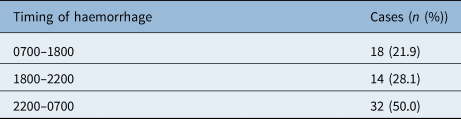
Secondary post-tonsillectomy haemorrhage occurred, on average, at day 5 (median) (range, 2–17 days). In the notes of 64 patients, the timing of the secondary haemorrhage was clearly documented: 21.9 per cent of patients bled between 07:00 and 18:00, 28.1 per cent bled between 18:00 and 22:00, and 50.0 per cent bled between 22:00 and 07:00. These results were statistically significant (p = 0.018, chi-square value = 8.0) (Table 1). Seven patients (9.2 per cent) required a blood transfusion. The median length of hospital stay after arrest of secondary haemorrhage was 2 days (range, 0–5 days).

Seventeen patients had two post-tonsillectomy haemorrhages. Three of these patients had already returned to the operating theatre for arrest of haemorrhage (one patient returned to the operating theatre for a second time, whilst two patients were managed conservatively), and one patient had three post-tonsillectomy haemorrhages (they returned twice to the operating theatre for arrest of haemorrhage, and on one occasion the haemorrhage was managed conservatively).
Monthly analysis
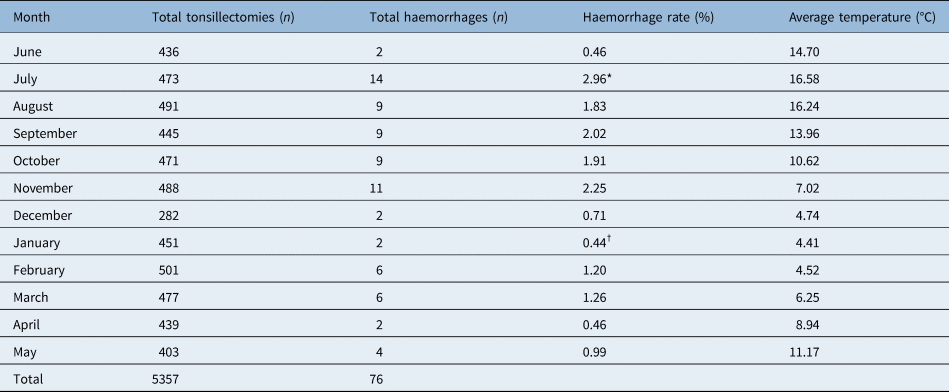
The total numbers of tonsillectomies by month, the secondary post-tonsillectomy haemorrhage rate and the average temperature by month are seen in Table 2.
Tonsillectomy and haemorrhage numbers, haemorrhage rate and average temperature, by month

*Highest and †lowest haemorrhage rates
There was a statistically significant result (p = 0.0024, chi-square value = 28.8) for variation in monthly secondary haemorrhage rates. The highest haemorrhage rate occurred in July (2.96 per cent); the lowest haemorrhage rate occurred in January (0.44 per cent).
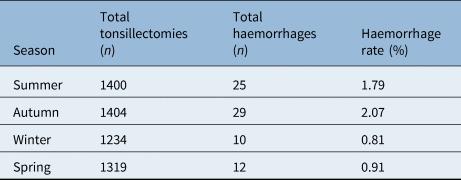
There was a statistically significant result (p = 0.0029, chi-square value = 14.0) for the three-monthly seasonal periods, with more haemorrhages occurring in the autumn (38.2 per cent of all secondary haemorrhages), followed by summer, then spring and then winter. The highest post-tonsillectomy haemorrhage rate was during autumn (2.07 per cent) and the lowest was in winter (0.81 per cent) (Table 3).
Tonsillectomy and haemorrhage numbers, and haemorrhage rate, by season

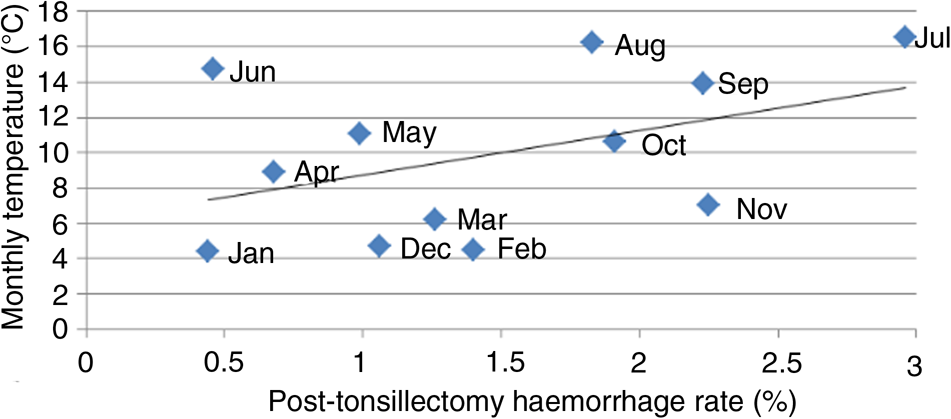
There was a positive correlation between the average monthly temperature and average secondary post-tonsillectomy haemorrhage rate (Pearson's correlation = 0.478, p = 0.116004), although this was not significant (Figure 1).
Average rate of secondary post-tonsillectomy haemorrhages requiring a return to the operating theatre, by month, against average monthly temperature.

Discussion
Secondary haemorrhage rates
Our hospital's return to theatre rates following tonsillectomy (1.4 per cent) are in keeping with other recent published data.5,Reference Chadha9 This allows us to give appropriate figures in terms of risk to the patient during the consent process. Within the recently published Getting It Right First Time document,5 Hospital Episodes Statistics data from April 2015 to September 2016 were analysed, and this revealed higher haemorrhage rates than those of the previously published National Prospective Tonsillectomy Audit, which had been carried out 12 years prior. The overall national haemorrhage rate for 2015–2016 was 8.0 per cent, and the return to theatre rate was 1.3 per cent.
Diurnal variation
The majority of secondary post-tonsillectomy haemorrhages do occur out-of-hours (78.1 per cent).
Joo Kim et al.Reference Kim S, Walsh, Tunkel, Boss, Ryan and Lee10 are the only other authors to have investigated this diurnal variation in detail, and they also found that secondary post-tonsillectomy haemorrhage occurred more frequently both at night and in the evening (p = 0.0007).
They described research from Soulban and Labrecque,Reference Soulban and Labrecque11 who recognised, in animal studies, that there are 24-hour variations in clotting times, with minimal activity of factors II, VII and X occurring overnight and significantly longer clotting times exhibited during the dark period. This behaviour may be replicated in humans, giving rise to diurnal variation in haemorrhage rates.
Physiologically, overnight, there is relaxation of the pharyngeal muscles as well as dehydration, providing an environment for bacteria to thrive, which also may create a favourable situation for haemorrhage.
Monthly variation
We have demonstrated a significantly higher haemorrhage rate in the autumn and summer months, which is in keeping with our initial hypothesis.
Lee et al. reviewed certain weather variables and their correlation with secondary post-tonsillectomy haemorrhage rates.Reference Lee, Montague and Hussain12 Their prospective study of 346 patients revealed a 9.2 per cent secondary haemorrhage rate. However, these authors found a significant negative correlation between haemorrhage rate and the average monthly temperature (p < 0.002), suggesting that tonsillectomy performed in warmer weather is associated with lower post-tonsillectomy haemorrhage rates.
Roberts et al. assessed a cohort of 1090 patients undergoing tonsillectomy or adenotonsillectomy over a 12-month period in 1991.Reference Roberts, Jayaramachandran and Raine13 The post-tonsillectomy haemorrhage rate was 4.7 per cent; of the affected patients, 1.3 per cent returned to the operating theatre. The authors found a higher rate of haemorrhage when surgery was performed between May and July (p < 0.01). Of note, this study was performed in the same region as ours, making comparisons potentially more viable. The surgical team listed their surgical method as ‘dissection’, which we are led to believe implies cold steel, and they used either ligatures or diathermy for haemostasis.
More recently, Cadd et al. reviewed 941 patients who underwent tonsillectomy in Australia over a five-year period.Reference Cadd, Rogers, Patel and Crossland14 The post-tonsillectomy haemorrhage rate was 7.7 per cent. They found no correlations between temperature or season (wet or dry), or water vapour pressure and humidity, and haemorrhage rates. They do recognise, however, the presence of air conditioning units in many homes, which could make the outdoor climate factors less relevant.
Chadha reviewed seasonal variation in post-tonsillectomy haemorrhage for over 250 000 tonsillectomies performed in all NHS trusts over a five-year period (2000–2005).Reference Chadha9 This analysis yielded a statistically significant association between calendar month and post-tonsillectomy haemorrhage, with winter rates higher than spring rates (p = 0.0104). The author also established a national overall secondary post-tonsillectomy haemorrhage return to theatre rate of 1.4 per cent, which is exactly in keeping with our hospital's figures.
• Anecdotally, secondary post-tonsillectomy haemorrhage seems to occur out-of-hours, although research is limited in this area
• It is unclear whether winter or summer months have higher rates of secondary post-tonsillectomy haemorrhage, or whether there is an association with monthly weather conditions
• Our research confirmed that post-tonsillectomy haemorrhage rates tend to occur out-of-hours (78.1 per cent), showing significant diurnal variation
• There was significant variance in monthly haemorrhage rates, with the highest number occurring in July (2.96 per cent).
• Autumn had the highest number of haemorrhages (38.2 per cent of all secondary haemorrhages, 2.07 per cent haemorrhage rate)
• There was a positive association between secondary post-tonsillectomy haemorrhage and average monthly temperatures, but this was not significant
Carmody and colleagues’ series of over 3000 tonsillectomies revealed a rate of severe secondary post-tonsillectomy haemorrhage (requiring blood transfusion or hospital stay longer than 48 hours) of 1 per cent, and they found a peak in the winter months. They explicitly state that these patients (n = 24) had no evidence of upper respiratory tract infection.Reference Carmody, Vamadevan and Cooper15
The hypothesis is that a higher rate of haemorrhage in the winter is the result of a greater prevalence of upper respiratory tract infections, therefore increasing the risk of tonsillar bed infection and, in turn, haemorrhage rate.
Limitations
As with all studies, there are a number of limitations. Incomplete data, incorrect or missed coding, and data from a hospital not providing weekend cover, means that a number of cases will have been missed. This would not affect the results with regard to haemorrhage timing; rather, the total number of cases may be smaller than expected. Furthermore, the data obtained from the Meteorological Office for the average monthly temperature were for a region coded as ‘Midlands’. This is a large geographical area and is not confined solely to our hospital's location; hence, there may be some variation in the average temperature throughout the region.
Conclusion
This study demonstrates that secondary post-tonsillectomy haemorrhage does tend to happen out-of-hours and there is monthly variation. The incidence of haemorrhage was lower in the winter and spring months, whilst the highest rate of haemorrhage occurred in July, which was statistically significant. Furthermore, there was a positive correlation between a higher average monthly temperature and the average haemorrhage rate, although this was not statistically significant.
Ultimately, we feel there are multifactorial reasons for these results. However, armed with this new knowledge, we feel it is important to impart these findings to the patient and/or caregiver during the consent process. Out-of-hours post-tonsillectomy haemorrhage can cause panic and anxiety amongst patients, especially in the paediatric population, but if patients are aware of this phenomenon, this stress can be alleviated beforehand.
It is also perhaps prudent to consider scheduling patients who are at higher risk (e.g. anticoagulant users) during the winter months, so as potentially to decrease their risk of post-tonsillectomy haemorrhage even further, although we appreciate this may be difficult to achieve within the NHS.
Competing interests
None declared