





I
Central Istanbul today is dotted with gold sellers and foreign exchange booths offering to exchange US dollars for Turkish lira, often at above the market rate. Ahmet Başaran Kolay, the owner of an exchange office near the historic Grand Bazaar, explained his business in 2024, ‘Let me put it this way: people who buy lira buy it because they need to spend it, but generally people want to buy dollars in order to invest and guarantee their savings’ (McLean, Yezdani and Cooban Reference MCLEAN, YEZDANI and COOBAN2024). Already in December 2021, more than three years into Turkey’s currency crisis, over a half of locals’ savings were held in a foreign currency or gold (Erkoyun and Toksabay Reference ERKOYUN and TOKSABAY2021). In October 2022 prices in Turkish lira were 85.5 percent higher than the previous year. The government introduced a series of measures, from patriotic appeals to loan restrictions on companies holding too much foreign currency, in an attempt to restore the prominence of the Turkish lira, but, as of August 2024, FX deposits were once more on the rise (The Economist 2018, 2022; Akman and Karakaya Reference AKMAN and KARAKAYA2024). That same year some 4 percent of Turkey’s GDP was also invested in stablecoins pegged to a foreign currency, usually the US dollar (Birch Reference BIRCH2024). The switch to foreign currencies during times of domestic currency instability, known as dollarization, and competition among international currencies are recurring phenomena in today’s global economy (Dodd Reference DODD2005).
This article examines an earlier example of foreign currency adoption in seventeenth-century Istanbul, the capital city of the vast Ottoman Empire that governed in the Balkans, Middle East and North Africa for more than 600 years. During the tumultuous seventeenth century, the Ottoman Empire transitioned from a monetary system relying largely on a variety of different Ottoman coins to one dependent almost exclusively on European coins. This dramatic turn towards foreign currency has received little attention in global histories of money but is well known among Ottomanists (Pamuk Reference PAMUK1997). The currency transition from Ottoman to European coins as well as wider histories of Ottoman money have been studied largely from the government’s perspective seen through state decrees and minting records (Sahillioğlu Reference SAHİLLİOĞLU1965). The social history of Ottoman money and the seventeenth-century currency transition have mostly been based on Ottoman literary sources, fragmented court records, European travel accounts and European merchant letters (for example, Kafadar Reference KAFADAR1987; Pamuk Reference PAMUK1997; Frangakis-Syrett Reference FRANGAKIS-SYRETT2007).
This article uses a remarkable source, a series of Istanbul court registers digitized by the Centre for Islamic Studies (İSAM), to investigate the history of the Ottoman Empire’s transition to European currencies from a social perspective. Our database includes over 22,000 entries produced in four different court districts of Istanbul during the sixteenth and seventeenth centuries. These court records provide a granular and wide-ranging perspective on currency usage in seventeenth-century Istanbul. Despite their limitations which are discussed in Section III, our database of court records allows us to examine the currency transition and its social dimensions across two centuries and 22 courts distributed across four Istanbul court districts.
Equipped with a new quantitative source base, we statistically investigate the currency transition and its social dimensions. Specifically, we have three objectives. First, we draw on court records to examine how the use of foreign versus domestic currencies changed during the period between the early sixteenth century and the year 1710, a period predating the firm establishment of a new domestic currency called the Ottoman kuruş. We do this by measuring both the frequency and value shares of foreign currencies. We then use these shares to determine which major European currencies dominated in Ottoman legal transactions during this period. Our second objective is to investigate foreign versus domestic currency use across different segments of society, focusing on differences by gender, religion and socio-economic status (approximated through honorific titles). Finally, we explore differences in currency use across types of legal transactions and court districts and use regression analysis to investigate how the gender, religion and status differences varied between commercial and non-commercial interactions and between those in central courts in the İstanbul Suriçi district and in other districts.
Our results first show that the adoption of foreign currency accelerated around 1600, driven first by the Spanish dollar and then by the Dutch lion dollar. The analysis demonstrates that the use of foreign currency in Ottoman court cases was shaped by gender, religion and status, as well as by the type of legal interaction and location of the court. Cases involving only males were generally more likely than cases involving women to be denominated in foreign currency, yet this pattern is reversed when we consider only commercial entries, in which cases involving women disproportionately relied on foreign currency. Religious differences were equally complex: all-Muslim cases tended to use less foreign currency than cases involving non-Muslims, but in commercial contexts – and especially in the commercial cases recorded in Istanbul’s central (Suriçi) courts – Muslim litigants used foreign currencies the most. Honorific titles played a smaller role: cases in which all participants held titles used somewhat more foreign currency, particularly in the central district. Our results suggest that the headline finding of male and non-Muslim dominance in foreign coin use masks a more nuanced reality in which women and Muslims, under specific institutional and transactional conditions, were at the forefront of adopting foreign currency. Both findings are intriguing. Research has shown that despite having rights not afforded to their European contemporaries, women were disadvantaged in Ottoman economic life. However, these disadvantages, at least in access to foreign currency, were mitigated for women in commercial transactions in the central district who were likely to have been relatively wealthy and elite. The finding that Muslim litigants in commercial cases in the central district used foreign currencies the most despite non-Muslims generally using foreign currency more is also striking given the longstanding connections between Ottoman coinage and sovereignty. We would have expected these connections to have mattered most to elite Ottoman Muslims in Istanbul’s administrative center. Taken together, this article then shows how different forms of privilege intersected to shape foreign currency adoption in early modern Istanbul.
In investigating the social history of the seventeenth-century Ottoman transition to foreign currency, this article contributes a quantitative perspective from Middle Eastern history to a thriving literature on money based on evidence from elsewhere. Drawing on literature from across the social sciences, economic historians have shown that far from being a modern phenomenon, competition among a multiplicity of monies was the norm in the pre-industrial world (Kuroda Reference KURODA2020). These different monies often formed circuits, with people using one kind of money for one purpose while reserving another for a different purpose (Kuroda Reference KURODA2008). For example, certain kinds of money were acceptable for taxes while others were used in foreign exchange. Within this landscape, access to certain kinds of money was often stratified with the wealthy using a different kind of money than the poor (Spang Reference SPANG2015; Kuroda Reference KURODA2018). For example, in early modern England, foreign gold coinage was a high-order currency used by the wealthy (Deng Reference DENG2011, pp. 161–86). Money was also deeply political, and control over it was a key preoccupation of states (Desan Reference DESAN2014; Eich Reference EICH2022). Coins served an important function in exchange, but they were also an expression of sovereignty that communicated political authority and national belonging (Gilbert and Helleiner Reference GILBERT and HELLEINER1999; Pallaver Reference PALLAVER2015). These variegated monetary practices and competing currencies often result in fragmented currency transitions that were less uniform than they initially appear, with older monetary practices persisting in some segments of society (Cohen Reference COHEN1998; Guyer Reference GUYER2004).
In bringing insights from global histories of money to early modern Ottoman monetary history, this article relies on a growing body of scholarship in Ottoman studies as well. Building on earlier research such as Sahillioğlu’s (Reference SAHİLLİOĞLU1965) analysis, Pamuk (Reference PAMUK1997, Reference PAMUK2000) has provided the most comprehensive macroeconomic account of Ottoman money, situating the empire within global patterns of bullion movement and price fluctuations. Subsequent works have extended this macro perspective, examining how the influx of New World silver, European trade and state monetary policies interacted to shape the empire’s fiscal capacity and long-term economic trajectory. Baki Tezcan and Mehmet Kuru, in particular, have deepened our understanding of the Ottoman monetary turbulence surrounding the 1585 debasement (Tezcan Reference TEZCAN2009; Kuru Reference KURU2022). Yet these studies have tended to rely on fragmentary evidence or remain anecdotal in their treatment of how foreign and domestic coins were actually used on the ground. By employing a large, digitized corpus of court records, our study bridges these literatures: it extends Pamuk’s macro-institutional insights into the realm of everyday practice while offering a more systematic and quantitative account of the social dimensions of coin use than has previously been possible. In doing so, it not only complements the dominant state- and economy-centered narratives but also opens a new line of inquiry into how currency transitions were experienced, negotiated and differentiated across Ottoman society.
II
The existing scholarship has outlined the history of money in the Ottoman Empire. Within traditions of Islamic kingship, the minting of coinage was a central marker of sovereignty. The Ottoman sultan was often referred to as ‘the master of coinage and the Friday prayer’ (sâhib-i sikke ve hutbe) (Koçi Bey [c. 1640–8] Reference KOÇİ and Aksüt1939, p. 95; Pamuk Reference PAMUK2000, p. 5). One of the earliest pieces of evidence of the existence of the Ottoman dynasty is a coin bearing the name of Osman, the founder of the dynasty (Lindner Reference LINDNER2007, p. 18).
As the Ottoman Empire expanded from a small beylik in Western Anatolia to a large, multi-ethnic empire, the diversity of its coinage also grew. Ottoman mints produced a wide variety of coins including the silver akçe and gold sultânî in Anatolia, the pâre in Egypt, the square nasrî in Tunis, the şâhî in the Persian borderlands and the rod-shaped lârî in Basra. Some foreign currency, particularly large gold coins like the Venetian ducat (flori), were also used, particularly for large transactions and foreign trade (Pamuk Reference PAMUK2000, pp. 62–6, 88–111). The Ottoman tax collection system gradually became dominated not by the fief (tîmâr) system, in which taxes were collected in kind, but by a system of tax farming (iltizâm), in which taxes were collected in cash (Kunt Reference KUNT1983, p. 98; İnalcık Reference İNALCIK1980). Growing urban centers and even rural peasants and nomads increasingly relied on money for their exchanges. Cash vakıfs that offered loans to ordinary people at interest cropped up across Anatolia, including in small, rural villages (Mandaville Reference MANDAVILLE1979). The size of the coinage was appropriate for many daily transactions. For instance, an unskilled laborer in the sixteenth century earned five to six silver akçes per day (Özmucur and Pamuk Reference ÖZMUCUR and PAMUK2002, p. 301). According to mid-sixteenth-century price lists, one akçe could purchase a kilogram and a half of bread and 600 grams of lamb (Akkaya Reference AKKAYA2003, p. 38). Although the degree of monetization varied over time and space, exchanges based in money reached more and many different kinds of people in the sixteenth century (Pamuk Reference PAMUK2000, p. xix; Hanna Reference HANNA2014, pp. 10-20).
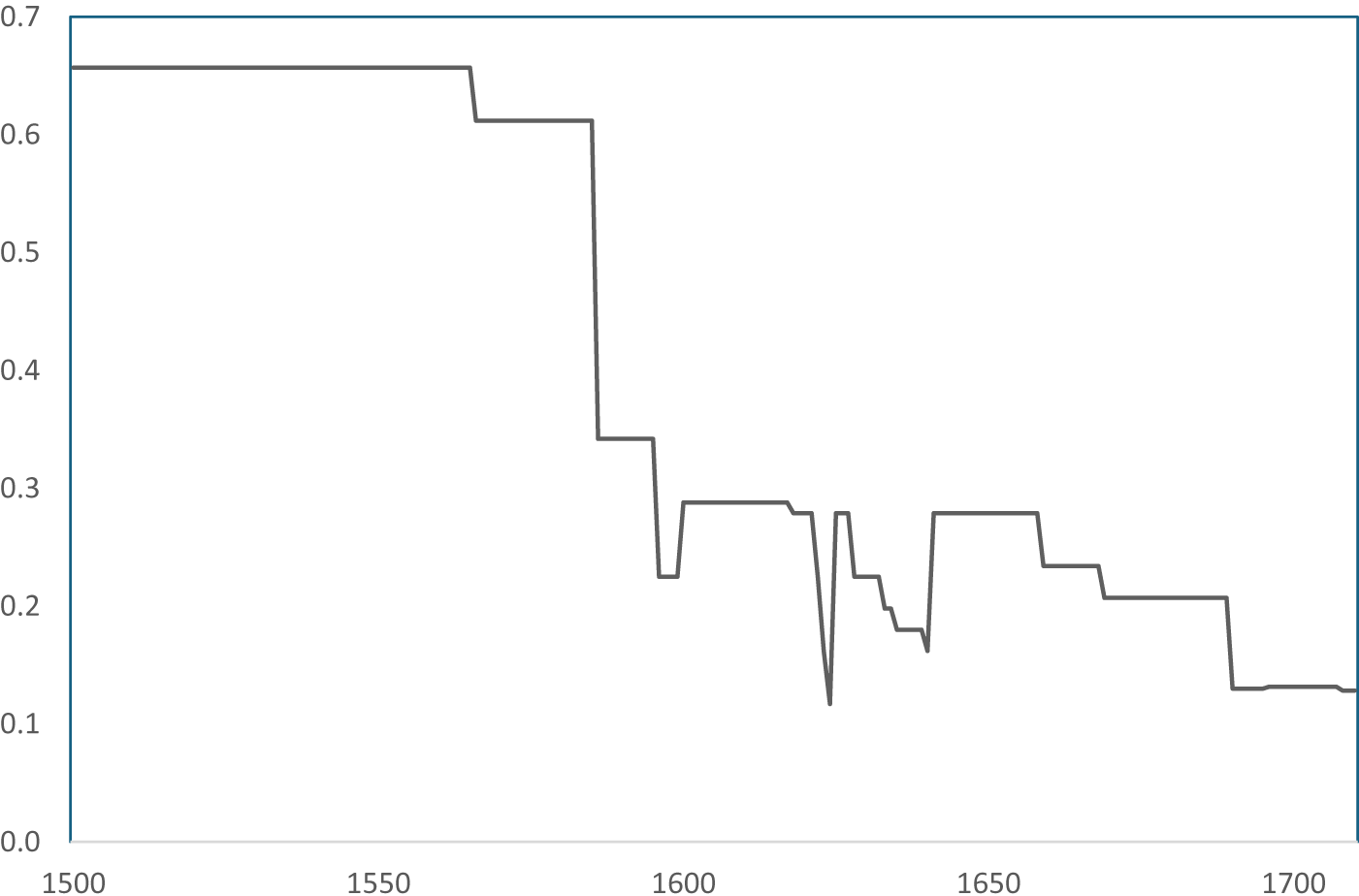
At the end of the sixteenth century, the influx of American silver and market integration between different currency zones during a time of costly warfare against the Safavid Empire led the Ottoman state to impose a series of painful debasements on the akçe (Pamuk Reference PAMUK2000; Tezcan Reference TEZCAN2009; Kuru Reference KURU2022). These included a debasement in 1585 of 44 percent, the largest debasement so far in the empire’s almost 300-year history. Figure 1 shows the silver content of the akçe during the sixteenth and seventeenth centuries. Many merchants in the bazaar stopped accepting the akçe because of its instability. As the akçe grew smaller and smaller, it also became inconvenient for larger transactions (Pamuk Reference PAMUK2000, pp. 142-8). In a fairly monetized society, the volatility of the akçe led to painful disruptions to economic life and cost more than one sultan his throne (Tezcan Reference TEZCAN2010). Despite periodic attempts to improve the standard of the akçe, the Ottoman akçe was treated with suspicion by those with the luxury of choosing between different coins.
Silver content of the akçe (grams)

With the instability of Ottoman coinage during this period, people began to use imported European coins instead. The Ottoman state’s longstanding policy of exempting imported coins from customs fees offered merchants opportunities to profit from the differential rates of coins between states. European coins including the Spanish dollar (riyal kuruş), Dutch lion dollar (esedî kuruş) and Polish zloty (zolota) became common (Pamuk Reference PAMUK1997, pp. 357–8; Pamuk 2000, pp. 142-4). While the quality of the akçe deteriorated, mints had difficulties finding silver that they could procure for minting. After experiencing the akçe’s instability, few Ottoman subjects wanted to bring European coins, silver or silver bullion to the Ottoman mint where it could be exchanged for akçes. In the first half of the seventeenth century, many Ottoman mines also closed, because they were unable to compete with cheaper American silver (Sahillioğlu Reference SAHİLLİOĞLU1965, p. 24). People with a traditional obligation to provide the mint with silver made their payments in the form of European coins instead of silver bullion (Sahillioğlu Reference SAHİLLİOĞLU1999b, p. 44). Faced with a scant supply of silver, between 1650 and 1687, the Ottoman state mints, like their counterparts in Iran, dramatically reduced their minting output (Sahillioğlu Reference SAHİLLİOĞLU1965, pp. 18–36; Matthee Reference MATTHEE2012, pp. 79–85). Foreign coins were used as the unit of account in state budgets, and even small change arrived from abroad and then passed from shopkeepers’ hands to the coffers of the state through tax payments (Sahillioğlu Reference SAHİLLİOĞLU1999a, pp. 86–7). With their longstanding associations with Ottoman sovereignty, some watched the disappearance of Ottoman coins with horror (Kafadar Reference KAFADAR1987).
Ottoman minting resumed at the end of the seventeenth century amidst the pressure of crop failures and the financial strains of protracted war against the Habsburg Empire and the rest of the Holy League. In 1687, Ottoman bureaucrats installed new minting technology that milled the edges of coins making them harder to clip and issued copper coins called mangır as well as silver coins (Sahillioğlu Reference SAHİLLİOĞLU1999a, pp. 87–93). A unit of account equal to 120 akçe and a new Ottoman coin called the kuruş, both based on the esedî kuruş but managed domestically, ended the empire’s heavy dependence on foreign coins. The Ottoman kuruş, which was minted episodically in 1697 and 1701, was produced on a consistent basis beginning in 1719 (Bölükbaşı Reference BÖLÜKBAŞI, Emecen, Akyıldız and Gürkan2019, p. 410). According to the work of Şevket Pamuk, the kuruş succeeded in becoming the leading unit of account and means of exchange across much of the Ottoman Empire by the middle of the eighteenth century (Pamuk Reference PAMUK2000, p. 159).
III
We examine the transition to foreign currencies through the registers (sicil) of Ottoman courts administering Islamic law. Over 30,000 registers of Ottoman courts, some dating to the fifteenth century, are estimated to have survived loss and destruction. They are available to researchers in archives located in numerous successor states of the Ottoman Empire in the Middle East and Eastern Europe. About 20,000 of these registers are available in Turkish archives, half of which are from the courts of Istanbul, the empire’s capital city.Footnote 1
Court registers contain a wealth of useful information regarding the economic lives of individuals, the financial activities of public and private institutions, and the administrative affairs of the state. All Ottoman subjects, regardless of gender, religion and socio-economic status, could appear before the court if they could pay the court fees (Ergene Reference ERGENE2002). The court book provided summaries of their different concerns – economic activities, financial transactions, contractual agreements and legal disputes. These records often document the currencies used in a wide range of legal and financial matters such as sales, rentals, loans, dowries, inheritance settlements, tax payments and charitable endowments.
For our analysis, we use data from the Istanbul Sharia Court Registers (ISCR) project. The ISCR project consists of 100 volumes, selected to cover the period between 1513 and 1884 in approximately ten-year intervals. This collection provides broad coverage of Istanbul court registers across districts and over time. Court records present both promising opportunities and important limitations. The most significant limitation is the risk of selection bias: the monetary transactions recorded in court registers represent only transactions brought to court, not all transactions (Coşgel and Ergene Reference COŞGEL and ERGENE2014). It is therefore possible that there were meaningful differences in currency usage between those transactions brought to court and those that were not. For instance, court records usually record larger transactions rather than small everyday dealings. A second limitation of our records is that they do not allow us to distinguish systematically between a currency’s use as a medium of exchange and its use as a unit of account. For some currencies, we can assume one function rather than the other. For instance, after the dramatic decrease in Ottoman minting after 1650, we can assume the akçe is mostly used as a currency of account measuring goods, services and debts rather than as physical coinage. In other cases, it is difficult to distinguish between functions, and this distinction was rarely explicit in the registers. For this reason, we treated these functions jointly as a general use of a currency, leaving finer distinctions to future research. Despite these limitations, our study advances beyond the better-known focus on coin production by state actors and provides suggestive evidence of how coins were actually used by the people of Istanbul, an elusive perspective that has not previously been analyzed quantitatively and that sheds new light on Ottoman economic life.
The first step in our analysis was to identify Ottoman and foreign currencies listed in the court records. We used textual analysis to extract information regarding the currency, if any, used in each court entry and to determine the type(s) and amount(s) of currencies expressed in the record. In the original dataset of over 54,000 entries, currency information is available in about 31,000 of them. We further restricted the sample to the period before 1710 in order to avoid confusion between large silver European coins and a new Ottoman coin, both of which were called the kuruş. As discussed in Section II, after the episodic minting of the Ottoman kuruş, it was minted regularly beginning in 1719. By restricting our study to before 1710, we are able to focus on the transition from domestic to foreign currencies before the era in which the Ottoman kuruş was firmly established. After restricting our sample to those cases occurring before 1710, 22,234 currency observations remained.
To observe the evolution of foreign currency used in Ottoman courts over time, we calculated two basic indicators: the share of entries involving foreign currencies and the share of total transaction value denominated in foreign currencies. To calculate the first measure, we created a binary measure for each entry that records whether any foreign currency was used. We then aggregated these indicators by year to calculate the fraction of entries in which foreign currencies appeared. A limitation of this measure is that it overlooks systematic variation in transaction values across currencies, time periods, or types of cases. For instance, even if domestic currencies were used in the majority of cases in a given year, foreign currencies could still account for a substantial share of total value if they were concentrated in a small number of high-value transactions. Moreover, the relationship between frequency and value may vary over time.
To address this limitation, we constructed a second measure capturing the annual share of transaction value denominated in foreign currencies. When an entry reported multiple values, such as when a plaintiff and defendant had different recollections of a loan amount in a dispute, we used the simple average of all expressed amounts as an approximation of the transaction value. To aggregate across currencies, we converted all values into akçe equivalents using exchange rates reported in Pamuk (Reference PAMUK2000). For each year, we then calculated the fraction of total transaction value represented by foreign currencies. Examining these two indicators jointly allows us to assess whether the use of foreign currencies increased both in terms of transaction frequency and aggregate monetary value over time.
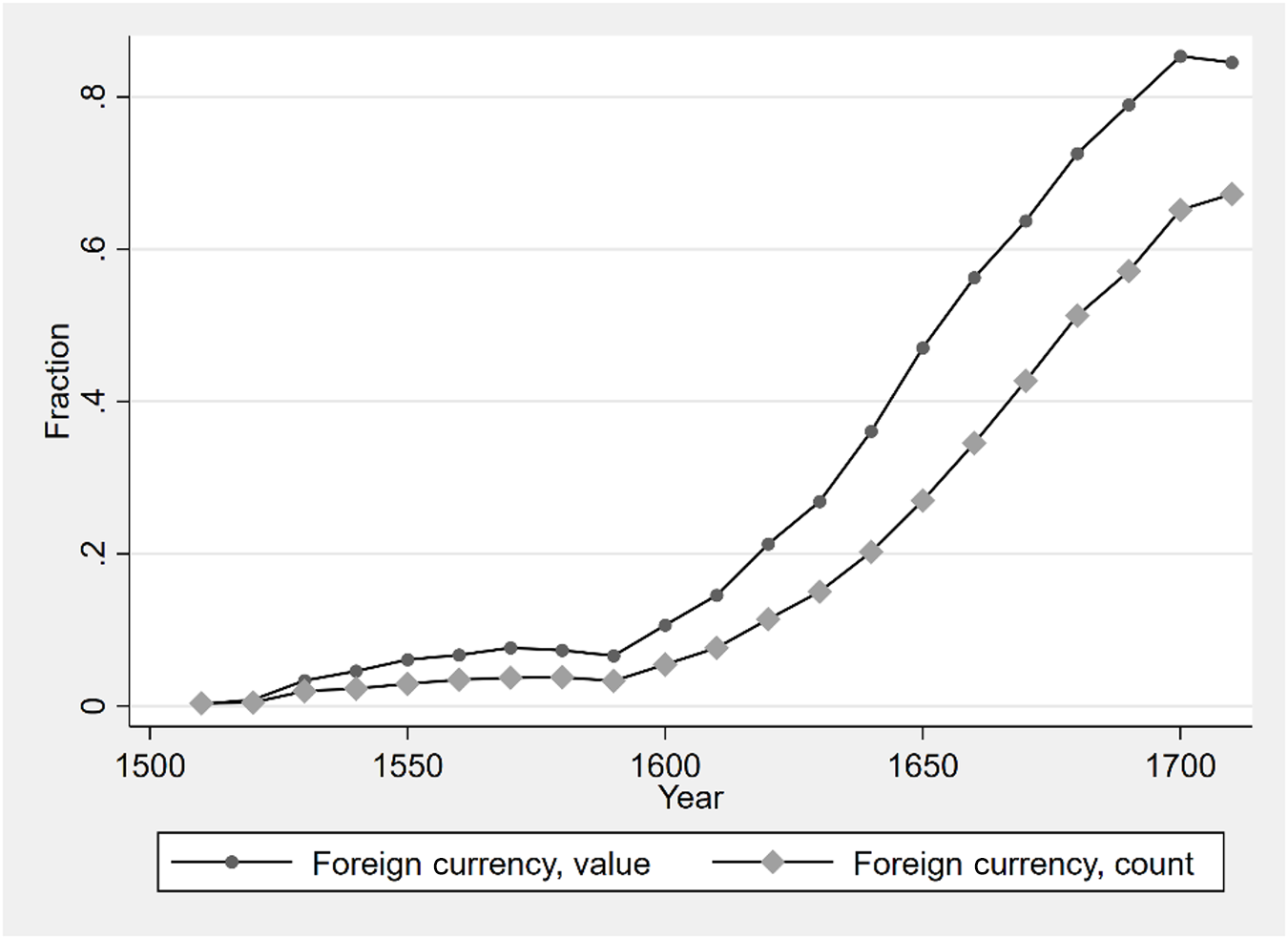
Figure 2 shows the 30-year moving averages of the fractions of the frequency and values of foreign currencies used in our sample of Istanbul court records during the period between 1513 and 1710. Whereas the fraction of foreign currency use by both value and count increased little during the period before the major debasement of 1585, they rose sharply and steadily thereafter. Moreover, both the frequency and value measures rose uniformly over time, providing confidence that they are consistent and robust measures of the extent of foreign currency use in Istanbul during this period. The evidence from court records clearly shows that foreign currencies dominated everyday transactions in legal matters towards the end of the seventeenth century but that the Ottoman silver currency, the akçe, continued to be used as a unit of account in some transactions despite no longer being minted.
Shares of foreign currencies: frequency and value (30-year moving averages)

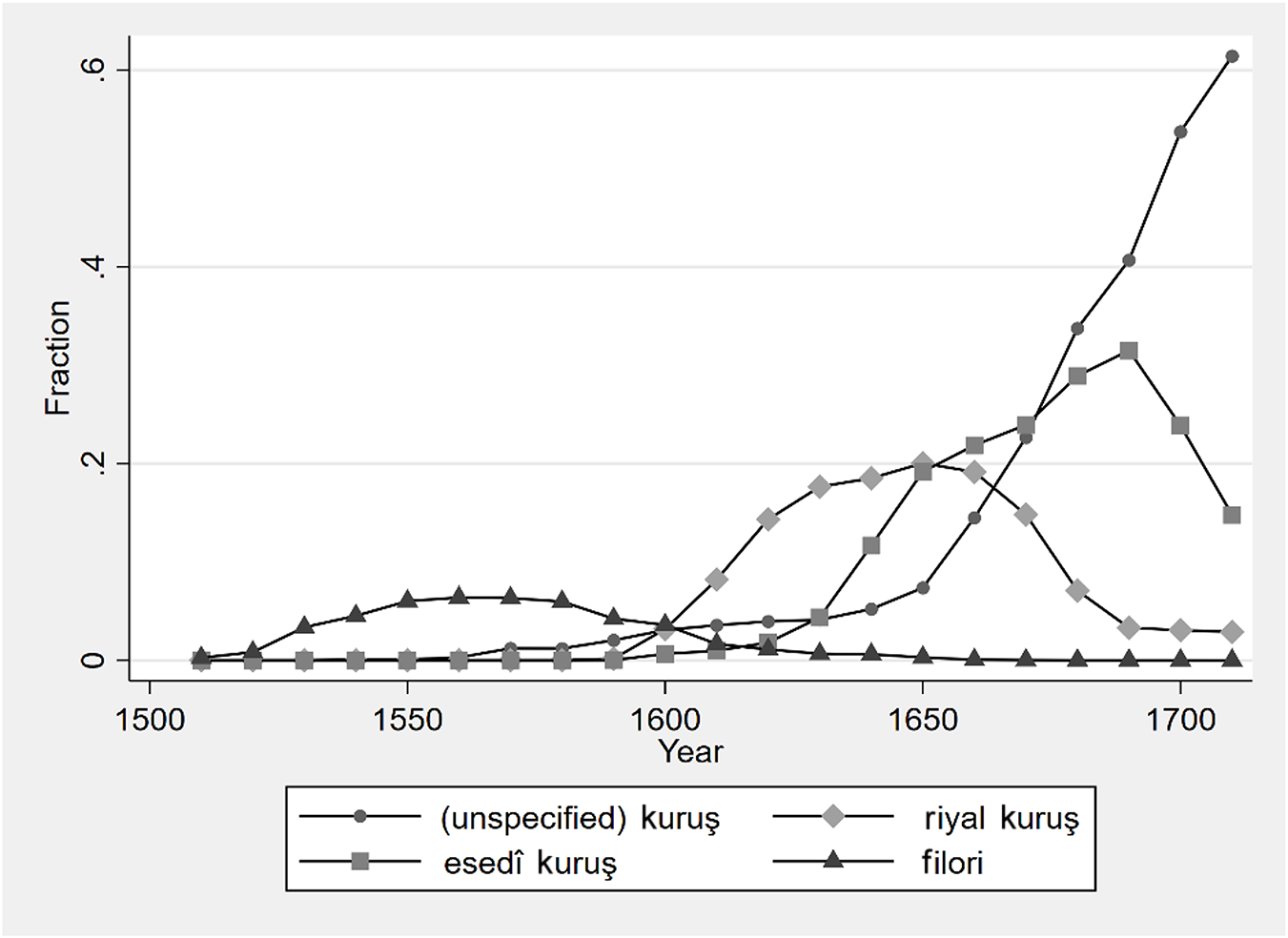
Through the court records, we can see not only a general transition to foreign currency, but a granulated picture of the different currencies driving that transition. We identified over 100 different types of coins in our records, a testimony to Istanbul’s commercial importance and large cosmopolitan population. Two currencies, however, stood out in prominence during this period, namely the Spanish dollar and the Dutch lion dollar, typically referred in court records as the riyal kuruş and the esedî kuruş. Their usage in Istanbul is consistent with the major role that the Spanish and Dutch silver currencies played in global trade during the seventeenth century.
Sometimes the record did not specify the type of kuruş that applied to a legal matter, i.e. whether the amount was in the Spanish or the Dutch kuruş, using the generic term kuruş instead. This happened more frequently in the second half of the seventeenth century, while the Dutch kuruş was gaining prominence, and was increasingly used as the unit of account equal to 120 akçe in official bookkeeping after 1690 (Bölükbaşı Reference BÖLÜKBAŞI, Emecen, Akyıldız and Gürkan2019). Regardless, we can still assume the generic term kuruş referred to a foreign coin during our period because the Ottoman kuruş did not gain prominence until the eighteenth century (Sahillioğlu Reference SAHİLLİOĞLU1965, pp. 91–2; Pamuk Reference PAMUK2000, pp. 159–61; Bölükbaşı Reference BÖLÜKBAŞI, Emecen, Akyıldız and Gürkan2019). Therefore, we decided to include the unspecified kuruş as a foreign currency during our period which ends in 1710.
Figure 3 shows the changing shares of prominent foreign currencies used in Istanbul courts over time. For simplicity, we use only the value measure for this analysis, because we saw in Figure 2 that the count and value measures of foreign currency use provide consistent results. The results show that the riyal kuruş was the dominant foreign currency during the first half of the seventeenth century but lost dominance after about 1650. Meanwhile, the esedî kuruş started to gain prominence after the 1620s and became the dominant foreign currency after mid-century. This is particularly noteworthy if we recall that the unspecified kuruş probably referred to the esedî kuruş, either as the medium of exchange or unit of account, in the second half of seventeenth century.
Shares (in total value) of prominent foreign currencies (30-year moving averages)

IV
We next investigated the social dimension of the currency transition to foreign currency. For a preliminary description of which segments of population were more likely than others to use foreign currency and which were more likely to continue using Ottoman currency, we categorized individuals into social groups based on textual analysis of court registers. For everyone in a court entry, the registers provide their name and various types of additional detail including identification, which can be used to determine their personal characteristics such as gender, religion and socio-economic status. Although the registers do not explicitly record the gender of an individual, we are able to make this determination indirectly from their names and the use of ‘son of’ (bin) versus ‘daughter of’ (bint) in reference to their fathers. Likewise, the records do not always identify an individual’s religion, but we can use their name and the name of their father to determine if someone was Muslim or non-Muslim. The registers also include honorific titles for some of the individuals involved in the cases, which researchers have previously used as an indicator of socio-economic status (Coşgel and Ergene Reference COŞGEL and ERGENE2016, pp. 49–61). All of the titles identified were those held by Ottoman Muslims, as non-Muslim honorifics were used less frequently and are not included in our study. Following this approach, we generated an indicator variable to indicate whether an individual had an honorific title.
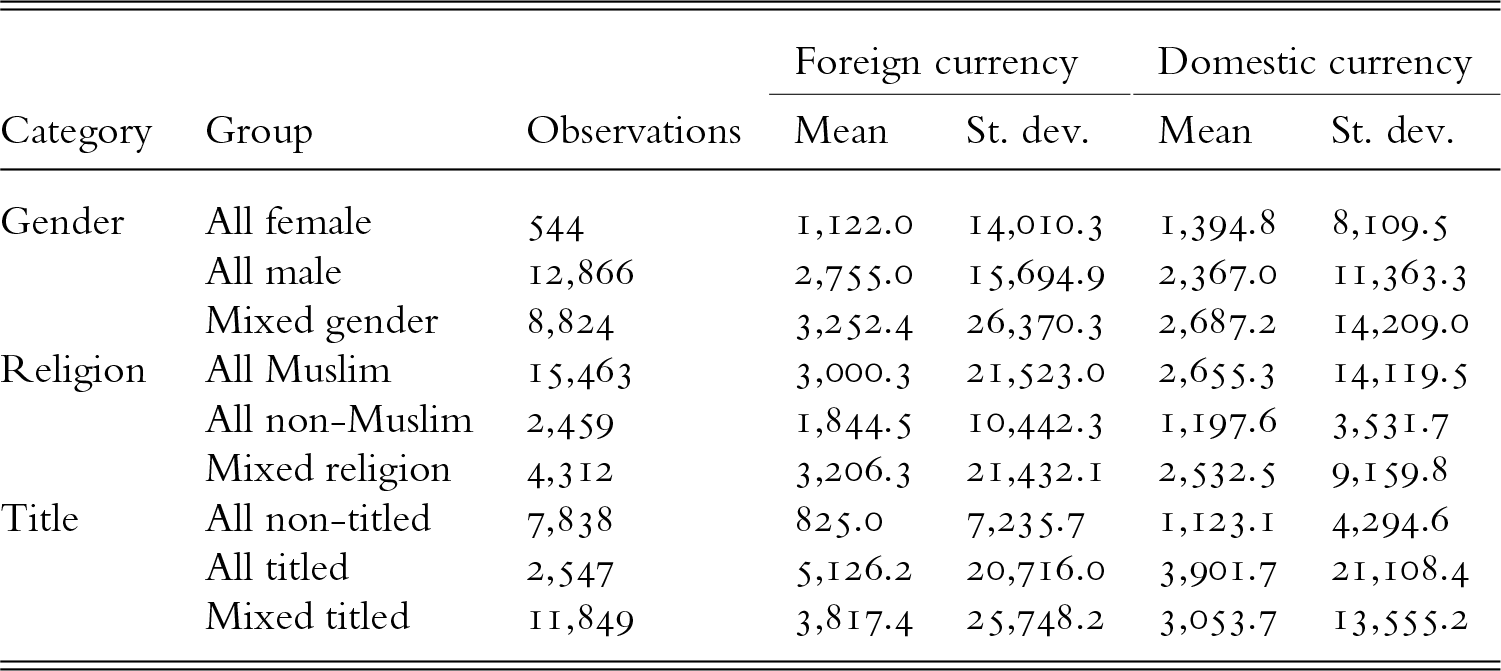
Table 1 shows the descriptive statistics of domestic and foreign currency use among different categories of social groups in the whole sample, broken down by gender, religion and status. To facilitate intertemporal comparison of currency amounts, we converted original nominal values into their inflation-adjusted equivalents (in akçe). The amounts of currency provided in the registers were specified in nominal terms. This would not have been a problem for our analysis had the price level stayed about the same during the sixteenth and seventeenth centuries. The consumer price index for Istanbul, however, increased from 1.0 in 1469 to 5.52 in 1710. To remove price effects from the currency data, we deflated the original nominal figures to real values by using the consumer price index prepared by Şevket Pamuk.
Currency use by gender, religion and status (inflation adjusted 1469 akçes)

Table 1 Long description
The table reports, for each group, the number of observations and the mean and standard deviation of amounts held or used in foreign and domestic currency, with values adjusted to a common price level. By title status, all titled groups have the highest means: foreign currency mean 5,126.2 and domestic currency mean 3,901.7, compared with all non-titled groups at 825.0 foreign and 1,123.1 domestic; mixed titled groups are also high at 3,817.4 foreign and 3,053.7 domestic. By gender, mixed gender groups have the highest means (3,252.4 foreign; 2,687.2 domestic), followed by all male (2,755.0 foreign; 2,367.0 domestic), while all female groups are lowest (1,122.0 foreign; 1,394.8 domestic). By religion, all Muslim and mixed religion groups have higher means than all non-Muslim groups; all Muslim averages 3,000.3 foreign and 2,655.3 domestic, mixed religion averages 3,206.3 foreign and 2,532.5 domestic, and all non-Muslim averages 1,844.5 foreign and 1,197.6 domestic. Standard deviations are large across most groups, indicating wide variation and that means may be influenced by extreme values. Observation counts vary substantially, from 544 for all female to 15,463 for all Muslim, which affects how stable each group’s averages may be.
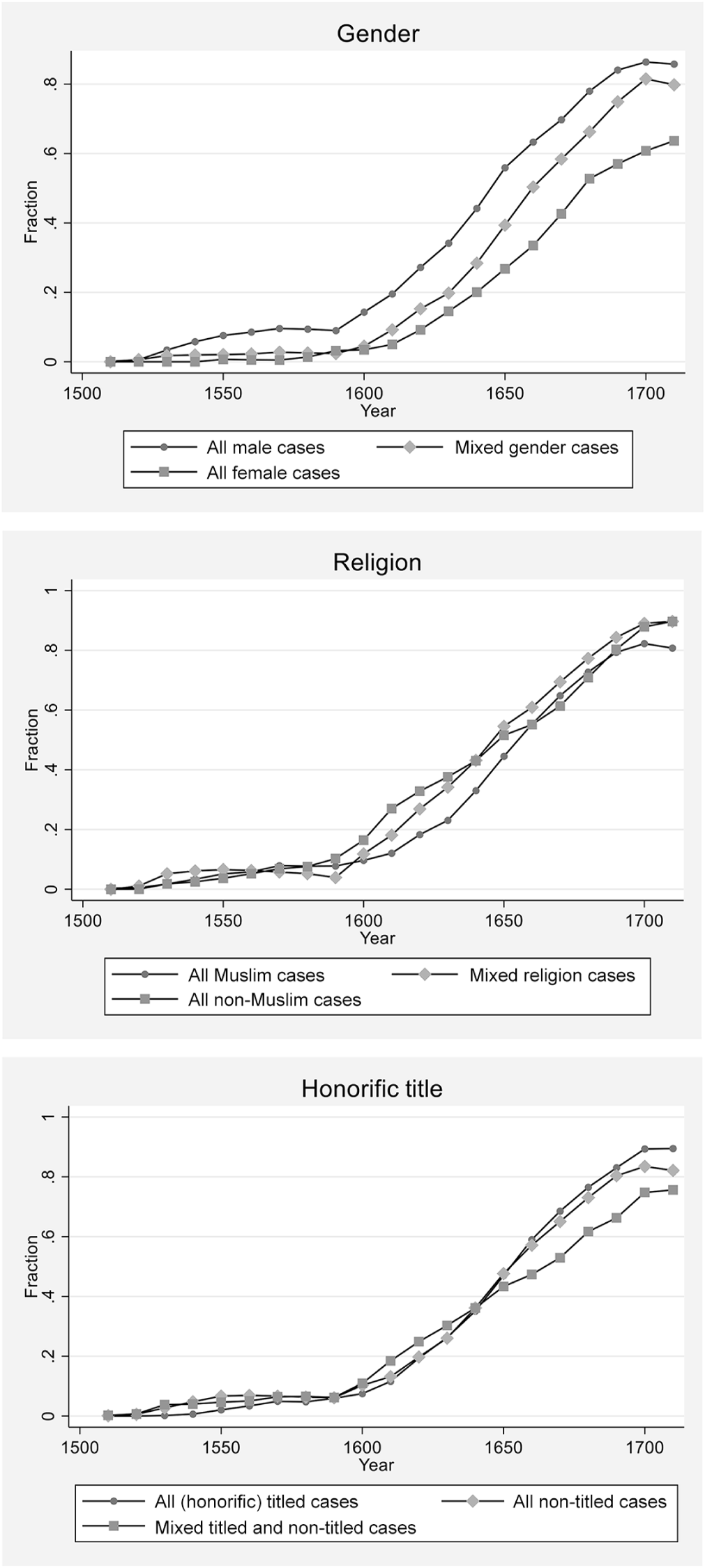
Comparisons across groups indicate that the use of foreign currency was generally higher, on average, in transactions involving males, Muslims, titled individuals and mixed-status groups, while females, non-Muslims and non-titled individuals tended to transact with substantially lower mean amounts of foreign currency. Domestic currency use appears more evenly distributed across groups, though it also increases with social status, as titled and mixed-titled cases show higher means than non-titled ones. Across nearly all categories, the raw standard deviations are very large relative to the means, indicating substantial heterogeneity in transaction values and currency choice. One plausible reason for this high dispersion – especially for foreign currency – is that its use increased markedly over the sixteenth and seventeenth centuries, so the pooled data combine early cases with very low foreign-currency use and later cases with much higher use, mechanically inflating the standard deviations over time. Overall, the table suggests that access to or preference for foreign currency was strongly associated with higher social standing and with transactions involving mixed groups, whereas more marginal groups relied more heavily on smaller-scale and domestic-currency transactions. Figure 4 shows the 30-year moving averages of the fractions of the value of the foreign coins used by social groups, broken down by gender, religion and status. For a simple description of changes over time, the fractions apply to each subgroup’s own total. For gender, for example, the fractions measure the value of foreign currency used in cases between men, cases between men and women, and cases between women. As seen in Figure 4, cases between men adopted foreign currency sooner and used foreign currency at a higher rate than mixed-gender cases and all-female cases, both of which used Ottoman currencies more despite the absence of newly minted akçes after 1650. When breaking down the cases by religion, we see that cases between non-Muslims were more likely to involve foreign currencies than all Muslim cases or mixed cases in the first half of the seventeenth century. By the end of the seventeenth century, however, foreign currency use for all three types of cases converged around 80 percent. For status approximated through the use of an honorific title, it appears that elite status played little part in the adoption of foreign currencies in the first half of the seventeenth century, but as the seventeenth century came to a close, people with titles used foreign currencies the most. These figures allow us to glimpse how different groups of people used Ottoman and foreign currencies.
Foreign currency use as a fraction of group’s own total by gender, religion and status (30-year moving averages)

Figure 4 Long description
The first graph titled 'Gender' shows the fraction of foreign currency use over time. The horizontal axis is labeled 'Year' ranging from 1500 to 1700, and the vertical axis is labeled 'Fraction' ranging from 0 to 1. The graph includes three lines: 'All male cases,' 'All female cases,' and 'Mixed gender cases.' All male cases show a steady increase, peaking near 0.8 by 1700. Mixed gender cases follow a similar trend but peak slightly lower. All female cases rise more slowly, peaking around 0.6. The lines are distinguished by different markers. The second graph titled 'Religion' presents similar data with lines for 'All Muslim cases,' 'All non-Muslim cases,' and 'Mixed religion cases.' All non-Muslim cases show the highest increase, peaking near 0.8. Mixed religion cases and all Muslim cases follow closely, peaking around 0.7. The third graph titled 'Honorific title' includes lines for 'All (honorific) titled cases,' 'Mixed titled and non-titled cases,' and 'All non-titled cases.' All titled cases show the highest increase, peaking near 0.8. Mixed titled cases and non-titled cases follow, peaking around 0.7. The graphs illustrate the increasing use of foreign currency across different social groups over time, highlighting differences in adoption rates.
Breaking down the data on foreign currency usage by social group provides a more granular perspective on the broader transition to foreign currencies illustrated in the previous section. Some of the results suggest that access to foreign currencies was tied to social status. Men, for instance, used foreign currencies more often than women, who continued to use Ottoman currencies even after the Ottoman mints stopped large-scale coin production. Interestingly, non-Muslims’ early adoption of foreign currency was surpassed by usage by Muslims over the century. The early use by non-Muslims is consistent with scholarship on the prominent role of non-Muslims in foreign trade. Over time, however, Muslims seem to have used foreign coins just as much, suggesting foreign coins’ successful transition into mainstream Ottoman usage. Men had greater access to foreign currency than women throughout the period, but other differences across categories of identity were less pronounced, particularly later in the century.
V
The patterns we observed in foreign and Ottoman currency use by gender, religion and status over time provide important initial insights, but they do not tell the whole story. Court registers are not a neutral record of monetary practice; they are shaped by who brings cases to court, the kinds of disputes that appear, and where those cases are recorded or adjudicated. In other words, any apparent differences between men and women, Muslims and non-Muslims, or titled and untitled litigants may be partly driven by the underlying mix of cases and the institutional settings in which they occurred.
Two dimensions are especially important: case type and court district. In addition to providing information on individuals, the text of each entry makes it possible to classify its type into analytical categories. These categories are somewhat arbitrary, because the original court records did not formally classify entries by type. For a simple classification suitable for our analysis, we divided the legal matters handled by the courts into five broad categories, namely those concerning family, personal crimes, property, probate and commerce.Footnote 2 In the family category, we included entries related to marriage, divorce, children and associated obligations (e.g. alimony, custody, mehir). Personal crimes include rape, banditry, murder, theft, simple assault and verbal insults and swearing. Property-related entries could be recorded based on numerous interactions concerning real estate, arable land, water rights and rights to various other types of fixed and movable property. The fourth category consists of probate entries, which include all legal interactions concerning the division of estate and appropriation of inheritance shares. The final category consists of commercial interactions regarding loans, contracts, partnerships, production and exchange. Through this process, we are able to dissect foreign currency use by the type of issue that brought people to court.
For consistency, we used the same procedure across case-types to determine the amounts of domestic and foreign currencies used in a case. Specifically, if there was a single amount reported, we simply took it as the relevant value for the corresponding stated currency. When multiple values were reported, such as when plaintiffs and defendants offered differing accounts of a disputed amount, we used the simple average of all expressed amounts, separately for domestic and foreign currencies, as an approximation of the values in question. To standardize across currencies and time periods, we converted all values into akçe equivalents using the exchange rates and price indices reported in Pamuk (Reference PAMUK2000, Reference PAMUK2004).
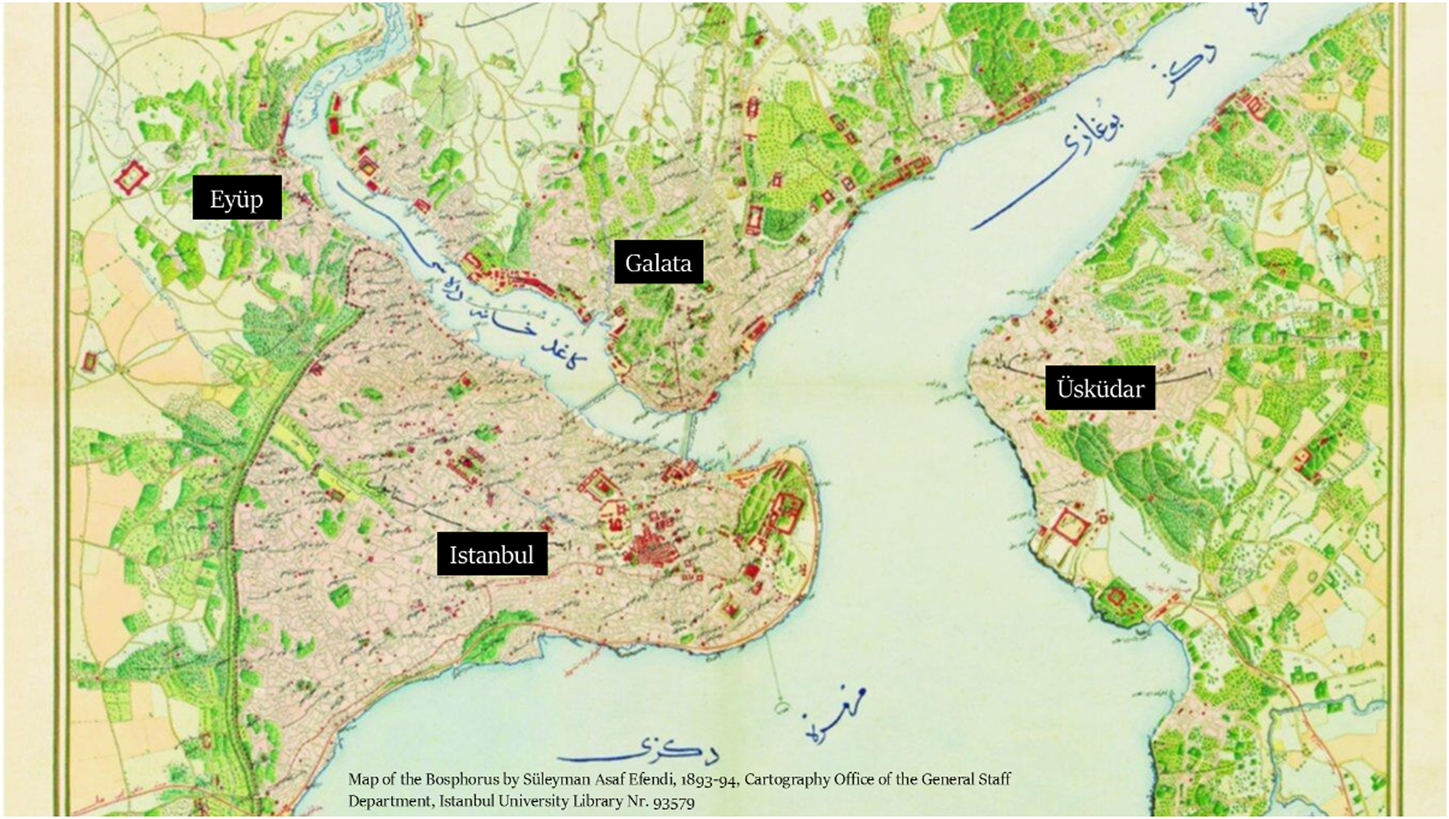
Our records contain a wide range of legal and administrative documents kept by 22 different courts in Istanbul. Geographically, these courts were organized into four main groups, namely the central ‘Walled’ (Suriçi) district of Istanbul and the ‘Three Towns’ (bilâd-ı selâse) of Eyüp, Üsküdar and Galata districts. There were also courts specialized in various administrative legal matters, such as the Kısmet-i Askeriye and Evkaf-ı Hümâyun Müfettişliği branches charged with managing the probates of government officials and the supervision of charitable foundations (vakıf). Figure 5 shows the locations of the Istanbul neighborhoods that correspond to the court districts in the year 1893–4. The Suriçi district lies at the center of the map, with Galata to the north, the Bosphorus and Üsküdar to the east, and Eyüp in the far northwestern corner.
The locations of Istanbul neighborhoods and court districts, c. 1893

Figure 5 Long description
This historical map of Istanbul highlights key districts: Eyüp in the northwest, Galata to the north, and Üsküdar to the east across the Bosphorus. Istanbul is centrally located. The map is oriented with north at the top. It shows detailed topographical features, including waterways and urban areas. The Bosphorus divides the European and Asian sides of the city. Notable labels include major districts and the Bosphorus Strait. The map does not display a visible legend or symbols. The geographic extent includes surrounding coastlines and urban areas, providing a historical view of the region. The title and source are noted at the bottom.
Corresponding to the oldest neighborhoods of the city and located to the south of the Golden Horn, the Suriçi district had previously served as the capital region of the Byzantine Empire. Under Ottoman rule, this district, with the palaces, central bureaucracy and most of the army, continued to serve as the administrative center of the Ottoman Empire. It was also a key forum for justice with over half of the courts in the four districts. Additionally, central Istanbul was an important commercial center with many wholesalers, shops and markets, including the largest markets in the city. The luxury industries that depended on the patronage of palace and state officials were also based within the walls. The population was itself mixed as the home of both the most prominent Islamic medreses and the Greek and Armenian patriarchates. The Eyüp neighborhood was located just outside the walls to the west and included gardens, pastures, fisheries and many animal by-product industries such as slaughterhouses, tanneries and candlemakers. As the site of the shrine of Ebu Eyüb el-Ansari, it was a spiritual center with many mosques and schools and populated mainly by Muslims, including the ulema and other dignitaries. Located on the northern side of the Golden Horn and the European side of the Bosphorus, the Galata neighborhood was a former Genoese colony that housed a diverse population and contained a major port that was important for international trade. Both non-Muslim migrants from the provinces and European merchants arriving in Istanbul were drawn to the neighborhood’s cosmopolitan population. Many of Galata’s inhabitants engaged in trade and finance in the nearby harbors and warehouses as well as in crafts associated with Galata’s military factories. The Üsküdar neighborhood was located on the Asian side of the Bosphorus in Istanbul and densely populated with Muslims. Since the roads leading to Anatolia began there, Üsküdar was an important center for transit trade and the staging ground for military expeditions headed east (Yi Reference YI2004, pp. 20–2; Bostan Reference BOSTAN2012, p. 367).
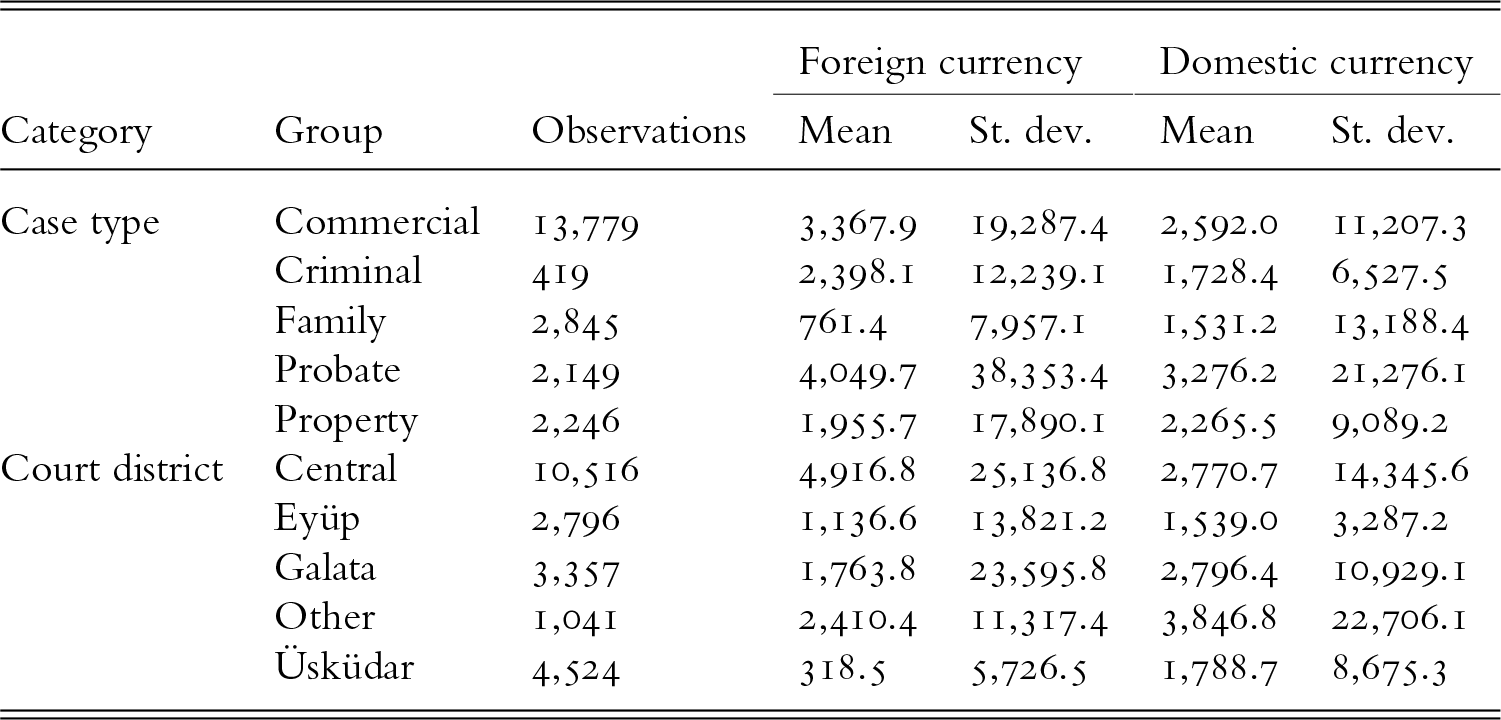
Table 2 shows the descriptive statistics of domestic and foreign currency use across case-types and court districts (including ‘other’ courts specialized in administrative legal matters). As in Table 1, the original currency amounts have been standardized and deflated (1469 = 1.0) to real values by using the exchange rates and consumer price index prepared by Pamuk (Reference PAMUK2000, Reference PAMUK2004). Table 2 shows clear variation in currency use across both case-types and court districts in Istanbul. Foreign currency use was highest, on average, in probate and commercial cases, and lowest in family cases, suggesting that foreign coin was more closely associated with capital-intensive, asset-related, or trade-oriented legal activity, whereas Ottoman currency dominated everyday household disputes. Ottoman currency means are somewhat more compressed across case types, though they are again highest in probate and commercial matters. Across districts, central courts (Suriçi) display the highest mean use of foreign currency, consistent with their proximity to state institutions and major markets, while peripheral districts – especially Üsküdar and Eyüp – show much lower foreign-currency means and greater reliance on domestic currency. As in Table 1, the very large standard deviations relative to the means point to substantial heterogeneity within categories, and probably also reflect the growing prevalence of foreign currency over the sixteenth and seventeenth centuries, with early low-use observations and later high-use observations combined in the same descriptive statistics.
Currency use across case types and court districts (inflation adjusted 1469 akçes)

Table 2 Long description
The table summarizes inflation-adjusted amounts for foreign and domestic currency by case type and by court district, reporting the number of observations plus the mean and standard deviation for each currency. By case type, foreign-currency means are highest in probate cases at about 4,050 and commercial cases at about 3,368, while family cases have the lowest foreign-currency mean at about 761. Domestic-currency means by case type are highest in probate cases at about 3,276 and commercial cases at about 2,592, with criminal cases lowest at about 1,728. By court district, the Central district has the highest foreign-currency mean at about 4,917, and Üsküdar the lowest at about 319; domestic-currency means are highest in the “Other” district group at about 3,847 and next highest in Galata at about 2,796. Standard deviations are large across most groups, especially for probate cases and the Central district, indicating wide dispersion and likely outliers relative to the means. Observation counts vary substantially, with commercial cases and the Central district contributing the most observations, while criminal cases and the “Other” district group contribute the fewest. Comparisons should be made cautiously because some cases could not be confidently classified, so totals by case type may not match the overall number of currency observations.
Note: The figures show the summary statistics of foreign and domestic currency use across types of cases and court districts (including the category of other courts specialized in administrative legal matters). The number of observations broken down by case types is less than the total number of currency observations in the data because of cases that could not be classified with certainty.
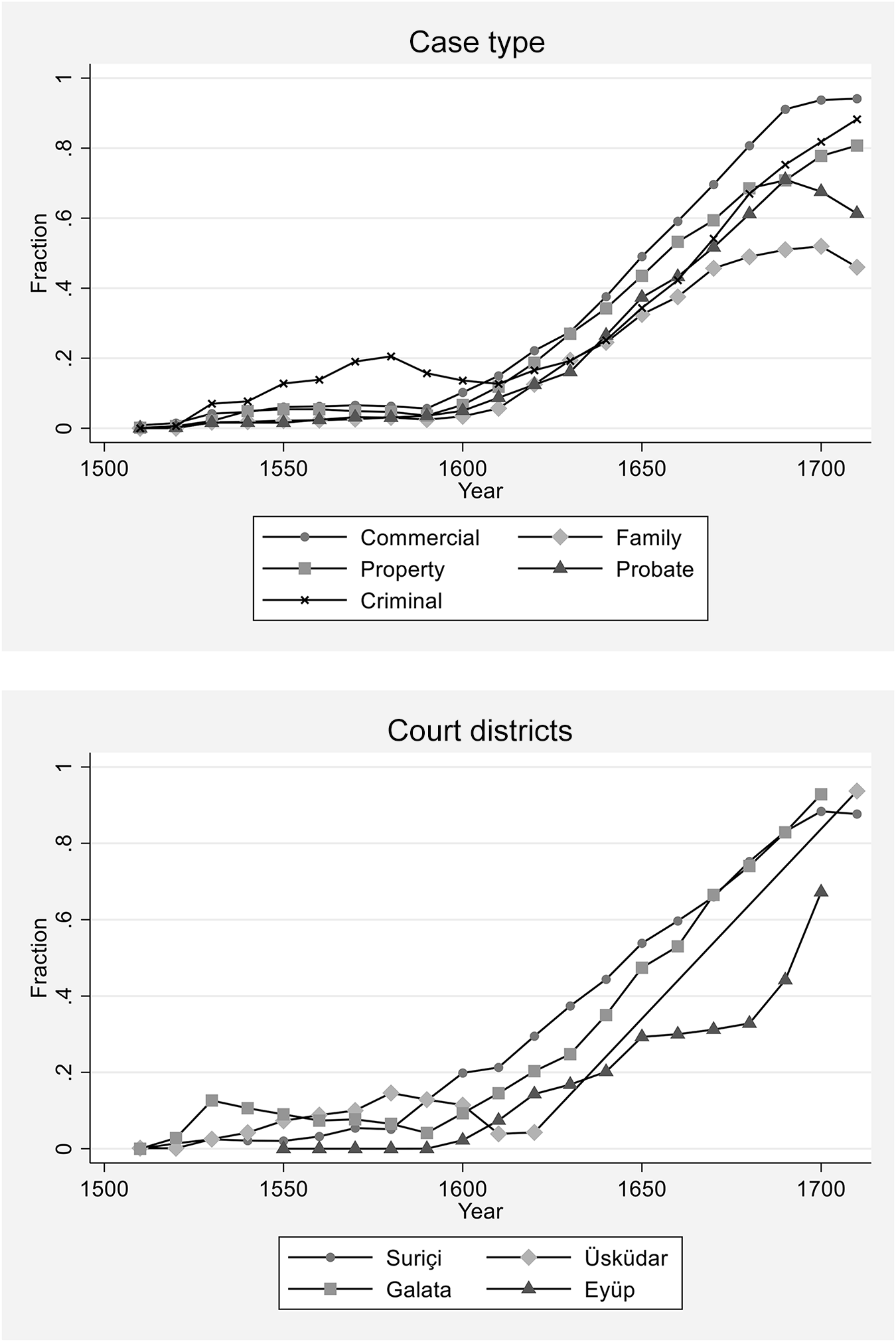
Figure 6 shows how the fraction of foreign currency used in court records changed over time across different case types and court districts. The top panel shows the percentage of foreign coins used within commercial, family, property, probate and criminal cases. Interestingly, before 1600, criminal cases involve foreign currencies the most. Over time, commercial cases developed into the type of case most heavily using foreign currency – rising to around 90 percent of transactions listed in foreign currencies. Family cases used foreign currencies the least – around 90 percent of transactions. The use of foreign currency in property, probate and criminal cases rose steadily over the century.
Foreign currency use by case types and court districts (30-year moving averages)

Figure 6 Long description
Case type Horizontal axis label: Year. Range: 1500 to 1700. Vertical axis label: Fraction. Range: 0 to 1. Legend labels: Commercial, Property, Criminal, Family, Probate. Line identification by marker shapes: Commercial cases use square markers. Property cases use circle markers. Criminal cases use x markers. Family cases use diamond markers. Probate cases use triangle markers. Data points as coordinate pairs. Commercial: (1500, 0), (1550, 0.05), (1600, 0.10), (1650, 0.50), (1700, 0.90) Property: (1500, 0), (1550, 0.03), (1600, 0.08), (1650, 0.45), (1700, 0.80) Criminal: (1500, 0), (1550, 0.10), (1600, 0.12), (1650, 0.55), (1700, 0.70) Family: (1500, 0), (1550, 0.02), (1600, 0.05), (1650, 0.40), (1700, 0.50) Probate: (1500, 0), (1550, 0.04), (1600, 0.09), (1650, 0.48), (1700, 0.65) Trend and comparison summary using the listed points. At Year 1500, all series are at Fraction 0. At Year 1550, Criminal is highest at 0.10 and Family is lowest at 0.02. At Year 1600, Criminal is highest at 0.12 and Family is lowest at 0.05. At Year 1650, Criminal is highest at 0.55 and Family is lowest at 0.40. At Year 1700, Commercial is highest at 0.90 and Family is lowest at 0.50. From Year 1650 to Year 1700, Commercial increases from 0.50 to 0.90, Property increases from 0.45 to 0.80, Criminal increases from 0.55 to 0.70, Family increases from 0.40 to 0.50 and Probate increases from 0.48 to 0.65. Court districts Horizontal axis label: Year. Range: 1500 to 1700. Vertical axis label: Fraction. Range: 0 to 1. Legend labels: Surici, Galata, Uskudar, Eyüb. Line identification by marker shapes: Suriçi uses circle markers. Galata uses square markers. Üsküdar uses diamond markers. Eyüb uses triangle markers. Data points as coordinate pairs. Suriçi: (1500, 0), (1550, 0.05), (1600, 0.10), (1650, 0.55), (1700, 0.95) Galata: (1500, 0), (1550, 0.08), (1600, 0.12), (1650, 0.60), (1700, 0.90) Üsküdar: (1500, 0), (1550, 0.06), (1600, 0.11), (1650, 0.58), (1700, 0.92) Eyup: (1500, 0), (1550, 0.02), (1600, 0.05), (1650, 0.30), (1700, 0.70) Trend and comparison summary using the listed points. At Year 1500, all series are at Fraction 0. At Year 1550, Galata is highest at 0.08 and Eyüb is lowest at 0.02. At Year 1600, Galata is highest at 0.12 and Eyüb is lowest at 0.05. At Year 1650, Galata is highest at 0.60 and Eyüb is lowest at 0.30. At Year 1700, Surici is highest at 0.95 and Eyüb is lowest at 0.70. From Year 1650 to Year 1700, Surici increases from 0.55 to 0.95, Galata increases from 0.60 to 0.90, Üsküdar increases from 0.58 to 0.92 and Eyüb increases from 0.30 to 0.70.
The results indicate how having access to multiple currencies allowed people to choose between different sorts of money for different activities. Some of these decisions are seen through the breakdown by case type. The early use of foreign coins in criminal cases is intriguing and may speak either to the smaller number of observations or to recording practices. Cases of theft, for instance, are likely to record any money stolen and may therefore record changes in what kinds of coins are being used more quickly than cases using currencies of accounts that lag behind currency adoption. The heavy use of foreign currencies in commercial cases is in keeping with their dominant role in long-distance trade. The dominance of domestic currencies in family cases may also show a tradition of listing mehir and probate amounts in Ottoman currencies instead of foreign currencies. Although family cases also show the adoption of foreign coins, the rate is much slower with many cases continuing to use the akçe as the unit of account. These family cases then suggest how the transition to foreign currencies in the seventeenth century was in fact a much more patchy process than it initially appears. Certain groups engaged in particular activities still used Ottoman currencies for accounting even at a time when the Ottoman mint produced little physical coinage.
The bottom panel of Figure 6 similarly highlights that the adoption of foreign currency was not uniform across Istanbul. Instead, it spread outward from commercial and administrative centers (Suriçi and Galata) toward peripheral districts (Üsküdar and especially Eyüp). By 1700, all districts had become heavily reliant on foreign currency, but the timing and intensity of adoption differed in ways that align closely with their economic and institutional functions with the bureaucratic and commercial districts using foreign currency more. Through court records, we can begin to see not how coinage was produced, but how money was used in early modern Istanbul.
VI
Next, we considered the possibility of bias due to variations in the types of cases brought to court if certain interactions were more likely than others to involve foreign currency and social groups had differential involvement in these cases. We also wondered if the location of courts could itself introduce bias if courts were specialized or districts had different levels of exposure to foreign coins and particular social groups had differential access to these locations. Fortunately, our dataset allows us to test for and mitigate potential bias due to differences in case type and court locations. We used regression analysis to investigate systematically how gender, religion and status shaped the use of foreign currency across different types of cases and institutional settings. By comparing trends within and across these contexts, we can distinguish between broad social divides and the institutional or transactional conditions under which those divides narrowed or reversed.
To make the regression analysis tractable and to facilitate the use of interaction terms, we simplified the categorical variables from the earlier descriptive sections into binary indicators. This step reduces complexity while preserving the key contrasts of interest. For example, instead of distinguishing among all-female, all-male and mixed-gender cases, the binary variable ‘All male’ simply compares cases composed entirely of men against all other cases (those involving women). Likewise, religion and status were reduced to ‘All Muslim’ versus cases involving non-Muslims, and ‘All titled’ versus cases involving non-titled litigants.
We similarly collapsed case type and court district categories into commercial vs. non-commercial and central (Suriçi) vs. other. As seen in Figure 6, commercial cases were more likely than family or household entries to involve foreign currency, likely because of their large transaction size. Likewise, we divided the courts into two categories based on whether they were in the central district or in one of the other three districts. The courts located in the capital’s Suriçi district, embedded in dense networks of imperial trade and finance, were more exposed to foreign currency than other courts (Figure 6). This binary coding makes the models easier to interpret, ensures adequate cell sizes across specifications, and allows for the systematic inclusion of two-way and three-way interaction terms.
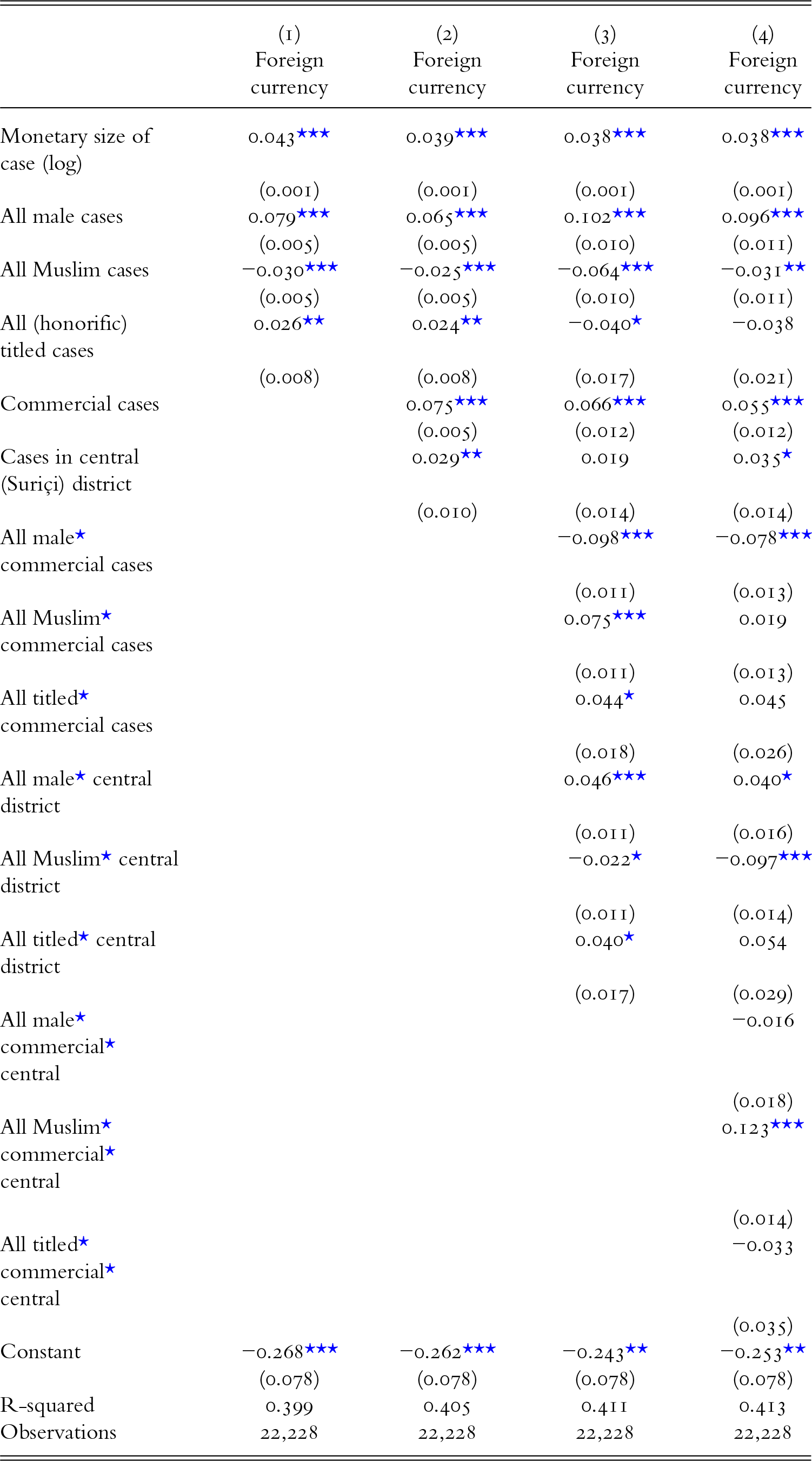
We used this framework to estimate four different models of foreign currency use by social groups, as seen in Table 3. The dependent variable in all models is the fraction of the value of foreign currency used in a case. All models include year fixed effects to control for variations over time. In addition, all models include the monetary size of the case (in logs). It is essential to control for size because currency choice may be mechanically and behaviorally related to the scale of a legal matter. Larger cases were more likely to involve foreign currency simply because high-value payments exceeded the practical limits of small-denomination domestic coin and were more closely tied to long-distance trade, credit, or asset transfers.
Foreign currency use by gender, religion and status

Table 3 Long description
Four regression models estimate how likely a case is to use foreign currency, with the outcome labeled “Foreign currency” in all columns. Across all models, larger monetary size is consistently linked to more foreign-currency use, with a small but highly precise positive coefficient around 0.038 to 0.043. All-male cases are associated with higher foreign-currency use in every model, with coefficients ranging from about 0.065 to 0.102. All-Muslim cases are associated with lower foreign-currency use in every model, with effects from about minus 0.025 to minus 0.064, though the size changes once interactions are added. Adding case type and location shows commercial cases have higher foreign-currency use (about 0.055 to 0.075), and central-district cases have a smaller positive association (about 0.019 to 0.035, not always statistically clear). Interaction terms indicate the all-male advantage is smaller in commercial cases (negative interaction around minus 0.078 to minus 0.098) but larger in the central district (positive interaction around 0.040 to 0.046). A three-way interaction suggests all-Muslim commercial cases in the central district are associated with notably higher foreign-currency use (about 0.123). Model fit changes only modestly across specifications, with R-squared rising from about 0.399 to 0.413, and all models use 22,228 observations; coefficients should be read as associations with uncertainty indicated by standard errors and significance markers.
Notes: All models include year fixed effects and the monetary size of the case (in logs). The dummy variable ‘All male’ equals 1 if all litigants in the case were men and 0 otherwise (including both all-female and mixed-gender cases). ‘All Muslim’ equals 1 if all litigants were Muslim and 0 otherwise (including all non-Muslim or mixed-religion cases). ‘All titled’ equals 1 if all litigants held honorific titles and 0 otherwise. ‘Commercial cases’ refer to legal interactions regarding loans, contracts, partnerships, production and exchange, as distinct from the criminal, family, probate and property cases that constitute the non-commercial category. ‘Central district’ refers to courts located in the Suriçi district, as distinct from those in the Eyüp, Üsküdar and Galata districts and other courts specialized in administrative legal matters. The number of observations is slightly less than the total number of currency observations because of missing values on covariates. Standard errors in parentheses.
* p < 0.05, **p < 0.01, ***p < 0.001.
The baseline model includes only the three binary variables for ‘All male’, ‘All Muslim’ and ‘All titled’. The results show that all-male cases used significantly higher shares of foreign currency than cases in which women were present (whether all-female or mixed). By contrast, all-Muslim cases used significantly less foreign currency than cases involving non-Muslims (whether entirely non-Muslim or mixed), while all-titled cases showed modestly higher shares of foreign currency than cases involving non-titled individuals (whether entirely non-titled or mixed). These results establish that gender, religion and status each shaped patterns of foreign coin use, but do not yet account for variation in case types or court districts.
The second model adds binary variables for ‘Commercial Cases’ and ‘Central (Suriçi) District’. Both variables have strong positive effects: commercial cases were far more likely to involve foreign currency than family or household cases, and Suriçi courts consistently recorded higher shares of foreign currency than other courts, as expected. This specification highlights that some of the apparent gender, religious, or status differences observed in Model 1 may be partly explained by the types of cases groups brought to court or the districts in which their cases were heard.
The third model introduces two-way interactions between gender, religion and status on the one hand, and case type and court district on the other. Given the results of the second model, if men, non-Muslims, or elites were disproportionately represented in commercial cases or in Suriçi courts, then simple regressions on gender, religion and status alone would overstate their independent role in driving foreign currency adoption. For this reason, this model examines not only case type and court district separately but also their interactions with gender, religion and status. Interaction coefficients capture the additional effect of belonging to both categories, above and beyond the separate main effects. For example, ‘All male’ × ‘Commercial’ shows how the share of foreign currency in exclusively male commercial cases differs from what would be predicted by simply adding the effect of being all-male and the effect of being a commercial case. Interactions thus allow us to see whether the apparent dominance of men or non-Muslims in foreign coin usage is a general pattern, or whether it is contingent on particular institutional settings – such as commercial cases in the central district. This shift in perspective helps to uncover where the headline differences are strongest, where they disappear and even where they reverse.
Several key patterns emerge in the results. Across all four models, monetary size remains a robust predictor of foreign currency use, as expected, while the social variables show meaningful but context-dependent effects. Regarding gender, the male advantage almost entirely disappears in commercial cases: all-male commercial cases used significantly less foreign currency than expected, while cases involving women disproportionately used foreign currency in commercial contexts. In Suriçi, however, all-male cases again showed higher shares of foreign currency than women-involved cases. Similarly for religion, while all-Muslim cases lagged overall, they used significantly more foreign currency in commercial cases compared to mixed-religion or non-Muslim cases. In Suriçi, by contrast, all-Muslim cases used significantly less foreign currency. Title effects were weaker but positive in Suriçi, where all-titled cases used higher shares of foreign currency. These results demonstrate that the influence of gender, religion and status was not uniform but depended on the type of legal interaction and the institutional setting.
The final model includes three-way interactions among gender, religion, status, case type and court district. The most striking result is that all-Muslim commercial cases in Suriçi courts used dramatically higher shares of foreign currency than predicted by the lower-order effects alone. By contrast, the three-way interactions for all-male cases and all-titled cases were small and statistically insignificant. This indicates that the most consequential contextual reversal occurred along religious lines: Muslims, who used less foreign currency in most contexts, became the most intensive users in Suriçi commercial cases.
Taken together, the four models show that differences in foreign currency usage cannot be reduced to simple contrasts of men versus women, Muslims versus non-Muslims, or titled versus untitled litigants. While the baseline results suggest clear social divides, subsequent models reveal that these divides were contingent on transactional context and institutional location. Women were disproportionately likely to use foreign currency in commercial cases, Muslims became the heaviest users in Suriçi commercial cases, and titles mattered primarily in the Suriçi courts. The adoption of foreign currency was thus structured not just by identity categories but by their intersection with the types of cases brought to court and the institutional arenas in which those cases were adjudicated.
VII
The seventeenth-century transition to European currency was not a sudden collapse of Ottoman money and immediate replacement by foreign money but a gradual and uneven process shaped by social, institutional and transactional contexts. Using a new quantitative dataset of Istanbul court records, this study has shown that foreign coins steadily displaced the akçe and other Ottoman coins, with the Spanish dollar and Dutch lion dollar becoming dominant in everyday legal and economic life by the mid seventeenth century. Yet the transition was neither uniform nor socially neutral. Patterns of adoption varied across gender, religion and socio-economic status, and these divides were contingent on the kinds of legal interactions and the courts in which they were recorded.
Men, non-Muslims and elites appear dominant in foreign coin use at first glance, but the fuller models show that these differences intersected with other forms of privilege. Women disproportionately used foreign currency in commercial cases. Previous scholarship has shown that early modern Ottoman women had property rights not afforded to European women, participated in public life, presented themselves at court, invested in business and participated in cottage industry. Despite these rights, they were still disadvantaged in participation in Ottoman economic life. Their inheritances were smaller than those of men, and various studies show they were less wealthy (Jennings Reference JENNINGS1975; Gerber Reference GERBER1980; Faroqhi Reference FAROQHI1987, p. 176). They were also usually excluded from economic participation in organizations like guilds (Yi Reference YI2004, p. 54). It then makes sense that one consequence of less economic power was less use of foreign currency. However, this trend does not hold for women who were active in commerce in the central district. These women were likely to have been relatively wealthy and high-status, giving them greater access to foreign currency than most Ottoman male subjects. This finding parallels the work of Ronald Jennings and Haim Gerber showing that women had greater economic opportunity in an important city like Bursa than in a provincial city like Kayseri (Jennings Reference JENNINGS1975; Gerber Reference GERBER1980). Even within the city of Istanbul, women in the central district who were active in commerce used foreign currency more than women elsewhere or men involved in commerce more generally.
Similar distinctions emerge between Muslims and non-Muslims. Although non-Muslims, including prominent Greek and Armenian merchants who were disproportionately active in the export trade with Europe (Masters Reference MASTERS and Faroqhi2006), adopted foreign currency first, Muslims became leaders in foreign currency use in commercial cases in central courts later in the century. This suggests that the initial advantage non-Muslims had in adopting foreign currency was eroded as foreign currency became less tied to foreign trade and increasingly mainstream. As its usage became more widespread, Muslims in the central districts, which included the most prominent in the empire, translated their status into foreign currency use in commercial cases. They responded dynamically to changing circumstances and the increased availability of foreign coins.
Intriguingly, the least striking findings had to do with differences between those who held titles and those who did not, an indicator of socio-economic status for Muslim men that suggests various forms of privilege. In our results, titles played a small and inconsistent role, showing modest positive effects primarily in central courts. Yet even this small finding points to the complexity of early modern currency usage. Titleholders in the central courts included the imperial elite who would have been familiar with complaints regularly voiced in the chronicles about how the dominance of European currency threatened Ottoman sovereignty and calls to restore the glory of Ottoman currency (Kafadar Reference KAFADAR1987). Yet rather than spurning foreign currency, titleholders in the central districts used foreign currency more than those without titles. For these titleholders in central courts, the economic advantages of foreign currency accessible to them due to their status outweighed political concerns about a loss of monetary sovereignty, especially in the second half of the seventeenth century. The results indicate that the adoption of foreign currency was not a simple matter of male dominance, Muslim ‘conservatism’, or elite power. Rather, the fractions of foreign currency used in court entries were structured by the intersection of gender, religion and status with the types of cases that came before the courts and the institutional settings in which they were processed.
These findings complicate existing accounts of Ottoman monetary history that have focused primarily on state fiscal policy, minting output or bullion flows. By shifting the lens from the imperial treasury to the everyday exchanges of ordinary people, this article highlights how currency transitions were lived, negotiated and contested across society. In doing so, it bridges macroeconomic perspectives with the micro-level realities of legal and social practice.

 Open access

